文档文本内容
话题 17 小说、戏剧、诗歌、传记、文学简史、经典演讲、
文学名著等
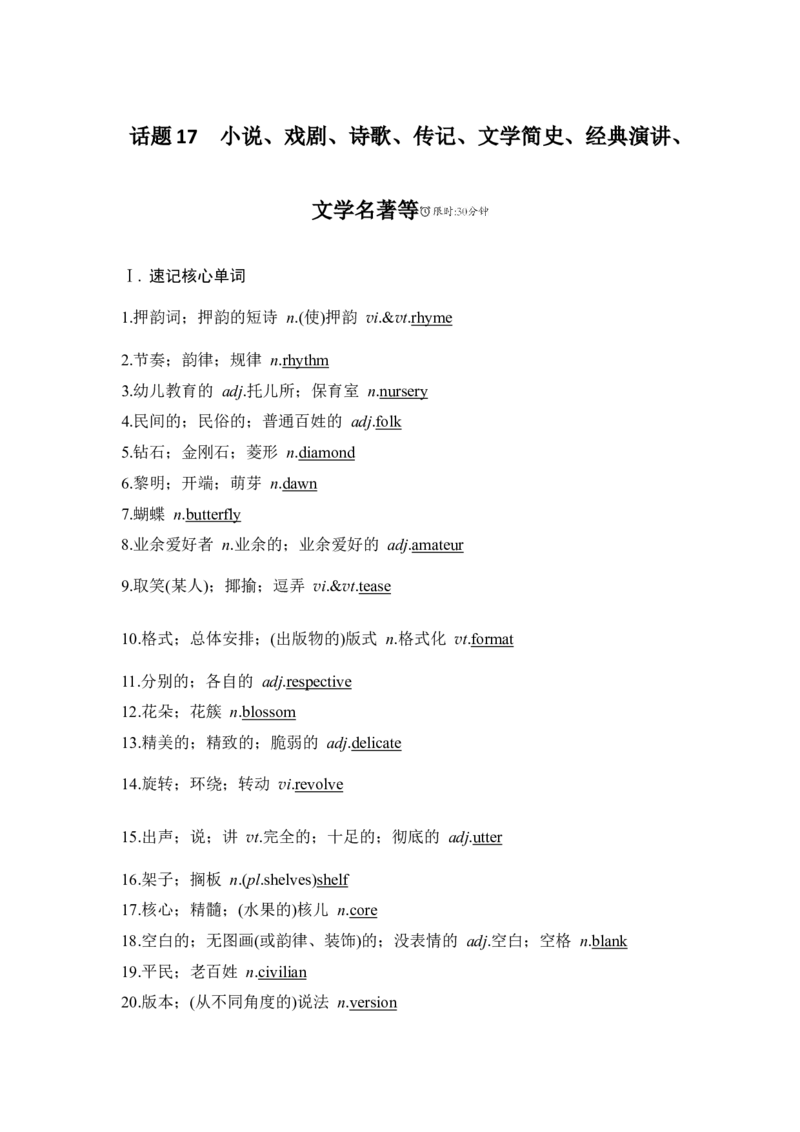
Ⅰ. 速记核心单词
1.押韵词;押韵的短诗 n.(使)押韵 vi.&vt.rhyme
2.节奏;韵律;规律 n.rhythm
3.幼儿教育的 adj.托儿所;保育室 n.nursery
4.民间的;民俗的;普通百姓的 adj.folk
5.钻石;金刚石;菱形 n.diamond
6.黎明;开端;萌芽 n.dawn
7.蝴蝶 n.butterfly
8.业余爱好者 n.业余的;业余爱好的 adj.amateur
9.取笑(某人);揶揄;逗弄 vi.&vt.tease
10.格式;总体安排;(出版物的)版式 n.格式化 vt.format
11.分别的;各自的 adj.respective
12.花朵;花簇 n.blossom
13.精美的;精致的;脆弱的 adj.delicate
14.旋转;环绕;转动 vi.revolve
15.出声;说;讲 vt.完全的;十足的;彻底的 adj.utter
16.架子;搁板 n.(pl.shelves)shelf
17.核心;精髓;(水果的)核儿 n.core
18.空白的;无图画(或韵律、装饰)的;没表情的 adj.空白;空格 n.blank
19.平民;老百姓 n.civilian
20.版本;(从不同角度的)说法 n.version21.时代;年代;纪元 n.era
22.播种;种 vt.&vi.sow (sowed, sown/sowed)
23.种子;起源;萌芽 n.seed
24.首要的;占支配地位的;显著的 adj.dominant
25.最后期限;截止日期 n.deadline
26.比赛;竞赛;竞争 n.争取赢得(比赛、选举等);争辩 vt.contest
27.修改;润色;抛光 vt.上光剂;抛光;擦亮 n.polish
28.细绳;线;一串 n.悬挂;系(strung, strung) vt.弦乐器的;线织的 adj.string
29.贫瘠的;不结果实的 adj.barren
30.悲伤;悲痛;伤心事 n.grief
31.复杂的;难懂的 adj.complicated
32.种族的;人种的 adj.racial
33.偏见;成见 n.使怀有(或形成)偏见 vt.prejudice
34.戏;剧;戏剧艺术 n.drama→戏剧性的 adj.dramatic→戏剧性地;显著地;急
剧地 adv.dramatically
35.悲伤;悲痛;伤心事 n.感到悲伤 vi.sorrow→悲伤的 adj.sorrowful
36.文学的;爱好文学的;有文学作品特征的 adj.literary→文学 n.literature→有
读写能力的 adj.literate→读写能力 n.literacy
37.背诵;吟诵;列举 vt.recite→朗诵;朗读 n.recitation
38.情绪;心情;语气 n.mood→喜怒无常的 adj.moody
39.理解力;领悟力;理解练习 n.comprehension→理解 v.comprehend→可理解
的 adj.comprehensible→全部的;详尽的 adj.comprehensive
40. 同 情 的 ; 有 同 情 心 的 ; 赞 同 的 adj.sympathetic→ 富 有 同 情 心 地adv.sympathetically→同情;赞同 n.sympathy
41.天真;单纯;无罪 n.innocence→天真无邪的;无辜的;无恶意的
adj.innocent
42.相一致;符合;相当于;通信 vi.correspond→来往信件;通信联系
n.correspondence
43.变化;变体;变奏曲 n.variation→变化,变种 v.vary→各种不同的;各种各
样的 adj.various
Ⅱ.速记重点短语
1.精炼的用词 economical use of words
2.生动形象的语言 descriptive and vivid language
3.文学手法 literary devices
4.童谣;儿歌 nursery rhyme
5.简洁中肯,恰到好处to the point
6.有意义,讲得通make sense
7.理解或明白……的意义make sense of
8.有灵活的行长have a flexible line length
9.由……组成(构成)be made up of
10.受……的欢迎be popular with...
11.尝试give it a try/shot
12.修辞手法figures of speech
13.处理微妙的情况handle a delicate situation
14.以樱花盛开的景象为特色feature the image of cherry blossoms
15.用独特的声音in distinctive voices
16.以一个孩子的视角from a child’s perspective
17.进行私人通信enter into personal correspondence
18.播下爱的种子sow the seeds of love
19.秘密地,悄悄地in secret
20.用先前的知识use the prior knowledge21.参加诗歌比赛enter a poem contest
22.尽力而为give it the best shot
23.紧紧抓住梦想hold fast to dreams
24.使诗歌读起来赏心悦目make the poem pleasing to read
25.反映人们日常生活的主题 reflect themes from the people ’ s daily lives
Ⅲ. 速记经典句式
1.There are various reasons why people compose poetry.(why引导定语从句)
人们写诗歌有各种各样的原因。
2.By playing with the words in nursery ryhmes,children learn about language.[by
doing(作状语)+主句]
通过玩童谣中的文字游戏,孩子们学习了语言。
3.Some rhyme (like B and C),while others do not. (while作连词,表对比)
有些押韵(像B和C),而有些不押韵。
4.Haiku is a Japanese form of poetry that consists of 17 syllables. It has a format of
three lines, containing 5, 7 and 5 syllables respectively.(现在分词短语作后置定语)
俳句是日本的一种诗歌形式,由17个音节组成。其格式为三行,每行的音节分
别是5个、7个和5个。
5.Where she awaits her husband, on and on the river flows.(where引导地点状语从
句)
望夫处,江悠悠。
6.Should the traveller return, this stone would utter speech. 行人归来石应语。
(should位于句首的虚拟语气的倒装)
7.Poems often have to be read aloud, and with feeling,to be really understood andenjoyed. (不定式短语作目的状语)
诗歌往往必须带着感情大声朗读,才能真正被理解和欣赏。
8.It seems incredible to me that the question of how best to arrange books on shelves
could cause a lively online discussion. (it作形式主语,that引导主语从句)
对我来说,如何最好地排列书架上的书的问题会在网上引起热烈的讨论,这似
乎是不可思议的。
9.I can see a field and I can imagine what it looks like with lots of snow. (what引导
宾语从句)
我可以看到田野,我可以想象它有很多雪时的样子。
10.He wants us to keep dreaming, because life is much better when we dream and
have something to look forward to. (have+宾语+宾语补足语)
他希望我们继续梦想,因为当我们有梦想,有所期待的事物的时候,生活会变
得更好。
Ⅳ.话题语篇填空
There are a variety of reasons for people to write poems. In the text, five kinds of
poems 1.are introduced (introduce). Some poems convey certain emotions 2.to the
readers, such as joy and sorrow. Some leave a deep 3.impression (impress) on the
readers. What’s more, we learn about some characteristics of poetry through the text.
Nursery rhymes may seem 4.contradictory (contradict) and sometimes senseless, but
they can help children learn about language. List poems have a flexible line length
and 5.repeated (repeat) phrases. The Cinquain, made up of five lines,6.conveys
(convey) a strong picture or a certain mood. Haiku is a Japanese form of poetry
7.consisting (consist) of 17 syllables with only three lines. It isn’t a traditional form of
English poetry, 8.but English writers are attracted to it. English speakers appreciate
Tang poetry as well. With so many different forms of poetry 9.to choose (choose)from, students may eventually feel like 10.composing (compose) poems of their own.