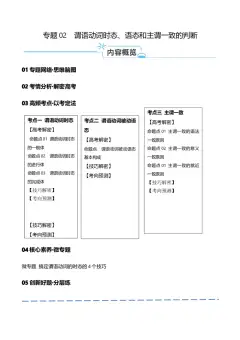
专题 07 动词的时态和语态及主谓一致
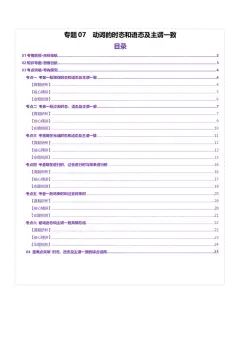
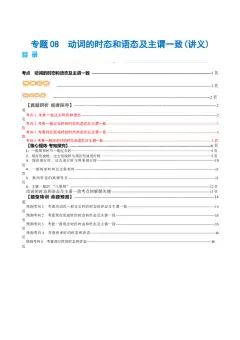
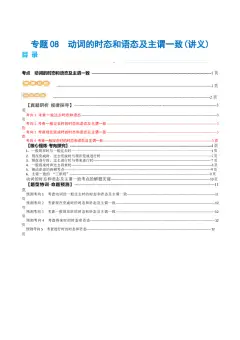
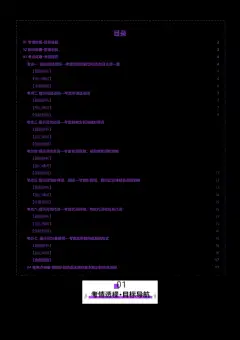
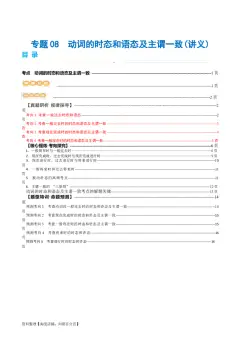
目录
01考情透视·目标导航..........................................................................................................................................................2
02知识导图·思维引航..........................................................................................................................................................3
03考点突破·考向探究..........................................................................................................................................................4
考点一 考查一般现在时态和语态及主谓一致....................................................................................................................4
【真题研析】.............................................................................................................................................................................................4
【核心精讲】.............................................................................................................................................................................................4
【命题预测】.............................................................................................................................................................................................5
考点二 考查一般过去时态、语态及主谓一致....................................................................................................................6
【真题研析】.............................................................................................................................................................................................6
【核心精讲】.............................................................................................................................................................................................7
【命题预测】.............................................................................................................................................................................................8
考点三 考查现在完成时态和语态及主谓一致..........................................................................................................................................8
【真题研析】.............................................................................................................................................................................................8
【核心精讲】.............................................................................................................................................................................................9
【命题预测】...........................................................................................................................................................................................12
考点四 考查现在进行时、过去进行时与将来进行时...........................................................................................................................12
【真题研析】...........................................................................................................................................................................................12
【核心精讲】...........................................................................................................................................................................................13
【命题预测】...........................................................................................................................................................................................14
考点五 考查一般将来时和过去将来时....................................................................................................................................................15
【真题研析】...........................................................................................................................................................................................15
【核心精讲】...........................................................................................................................................................................................15
【命题预测】...........................................................................................................................................................................................16
考点六 被动语态和主谓一致高频总结....................................................................................................................................................16
【真题研析】...........................................................................................................................................................................................16
【核心精讲】...........................................................................................................................................................................................16
【命题预测】...........................................................................................................................................................................................18
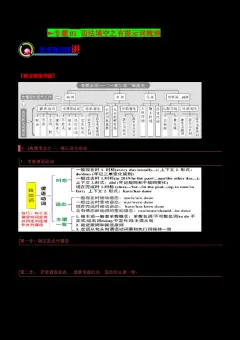
04 重难点突破 时态、语态及主谓一致的综合运用........................................................................................................18动词的时态和语态及主谓一致
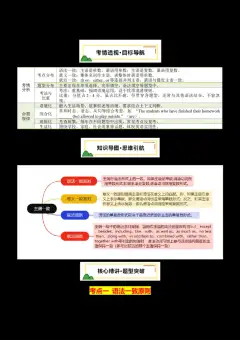
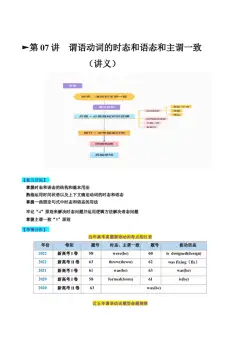
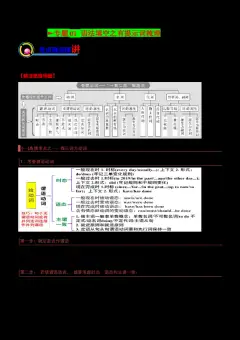
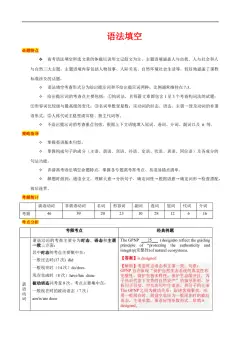
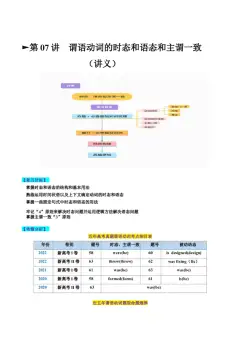
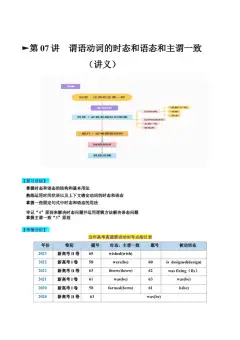
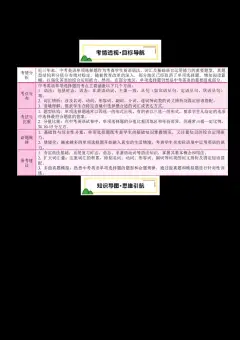
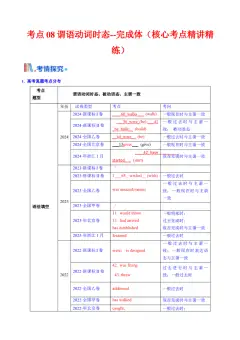
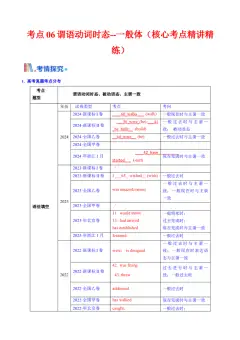
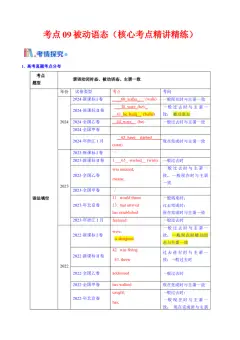
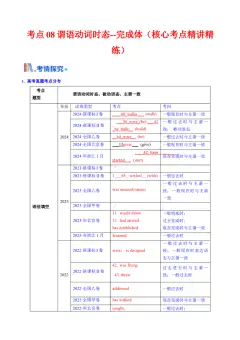
考点 目标要求 考题统计及展示 考情分析
熟练掌握 (2024·新高考I卷)60.walks一般现在时及主谓一致;
考查一
一般现在
般现在 (2023·全国乙卷)means一般现在时及主谓一致 从 近 三
时的用
时态和 年高考试题
法,及与 (2022•新高考I卷)is designed一般现在时的被动语态及主谓一致
语态及 来看,试题
之相关的
主谓一 (2021年浙江卷1月)is considered一般现在时的被动语态及主谓 以语法填空
语态及主
致 一致 的 形 式 命
谓一致
题,题目中
(2024•新高考Ⅱ卷)38.were一般过去时及主谓一致
等,以考查
学生对有关
(2024•新高考Ⅱ卷)41.was built一般过去时的被动语态及主谓一致
时态、语态
熟练掌握 (2024•全国甲卷) 44.were一般过去时及主谓一致 及主谓一致
考查一
一般过去 的 掌 握 情
般过去 (2023·1月新高考浙江卷)were permitted一般过去时的被动语态
时的用 况,强化语
时态、 及主谓一致
法,及与 言运用能力
语态及
之相关的 (2022•新高考I卷)were一般过去时及主谓一致 和 语 境 理
主谓一
语态及主 解。动词的
致
谓一致 (2023年新高考II卷)wished一般过去时及主谓一致 时态和语态
是高考必考
(2023·1月新高考浙江卷)featured一般过去时及主谓一致
点。
(2022•新高考Ⅱ卷)threw一般过去时及主谓一致
预 计 在
熟练掌握 2025 年高考
考查现
现在完成 中,以语法
在完成 (2024年1月浙江高考真题)62.have started现在完成时及主谓一致
时的用 填空的形式
时态和
法,及与 (2022•全国甲卷)has walked现在完成时及主谓一致 命题。
语态及
之相关的
主谓一 (2022年浙江卷1月)have promised现在完成时及主谓一致
语态及主
致
谓一致考点一 考查一般现在时态和语态及主谓一致
1.(2024·新高考Ⅰ卷)Further, the Silk Route Garden around the greenhouse 60 (walk) visitors through a
journey influenced by the ancient Silk Road, by which silk as well as many plant species came to Britain for the
first time.
2.(2024·北京高考卷)When we slow down, we create space to reflect on our thoughts and emotions, which
helps us identify important areas of our lives and 13 (give) us the opportunity to make right choices.
3.(2023·全国乙卷)The remarkable development of this city, which is consciously designed to protect the
past while stepping into the modern world, (mean) there is always something new to
discover here, and I could be photographing Beijing for the next 50 years.
4.(2022•新高考I卷)After a three-year pilot period, the GPNP will be officially set up next year. The GPNP
______ (design)to reflect the guiding principle of “protecting the authenticity and integrity(完整性)of natural
ecosystems, preserving biological diversity, protecting ecological buffer zones, and leaving behind precious natural
assets(资产)for future generations”.
5.(2021年浙江卷1月)It is calculated by dividing a person’s weight in kg by their height in meters squared, and
a BMI of between 19 and 25 _______ (consider) healthy.
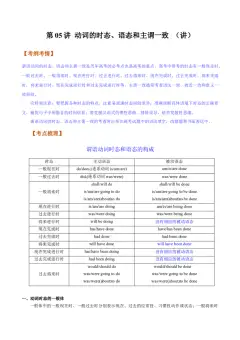
一般现在时
一般现在时和一般过去时是近几年语法填空必考的语法项目,而且考查的均是最基本的用法。
(一)一般现在时
一般现在时常用来表示习惯性、经常性发生的动作或存在的状态。
1.谓语动词的构成:do/does2.基本用法
(1)表示经常性的动作。【记住这些时间状语标志词是快速解题的关键】
常与usually,always,often,sometimes,never,every day等表示频度的时间状语连用。
On Monday morning it usually takes me an hour to drive to work.星期一早晨,我通常花费一小时开车去
上班。
(2)表示客观真理、格言或者警句等。
表示客观真理时,即使主句是一般过去时,宾语从句还要用一般现在时。
As we all know, the earth travels around the sun.众所周知,地球围绕太阳转。
(3)表示按规定、时间表、计划或安排要发生的动作。
谓语动词是come, go, arrive, leave, start, begin, return, live, fly等,可以用一般现在时表示将来发生的动作。
My dream school starts at 8:30 am and ends at 3:30 pm.
我理想的学校上午8:30上课,下午3:30放学。
(4)在时间、条件等状语从句中常用一般现在时代替一般将来时。
If you come this afternoon, we'll have a meeting.如果你今天下午过来,我们将开个会。
1.(2025·东北三省三校联考)Take Christmas as an example. At its heart (lie) the story of Jesus
Christ’s birth, a symbol of love, hope and rebirth. This festival is celebrated worldwide, showing the agreement of
faith and culture across borders.
2.(2025·东北三省三校联考)The festival’s emphasis on family ties and continuity (root) in Confucian
values and reflects the collectivist nature of Chinese society.
3.(2025·广东省佛山市H7联盟高三摸底联考)In the vast and wind-swept steppes of the Inner Mongolia
autonomous region, there exists a great connection between the people and their music. The connection
(present) by the appealing melodies(旋律) of the morin khuur, a two-stringed instrument often referred to as the
horse-headed fiddle (琴).
4.(2025·广东省佛山市H7联盟高三摸底联考)Despite modernization and urbanization, the morin khuur
(remain) a precious part of daily life for many families in Irmer Mongolian.考点二 考查一般过去时态、语态及主谓一致
1. (2024•新高考Ⅱ卷) “Some of the things that Tang was writing about ___38___ (be)also Shakespeare’s
concerns. I happen to know that Tang’s play The Peony Pavilion (《牡丹亭》) is similar in some ways to Romeo
and Juliet.”
2. (2024•新高考Ⅱ卷) A statue commemorating Shakespeare and Tang was put up at Shakespeare’s Birthplace
Garden in 2017. Two years later, a six-meter-tall pavilion, inspired by The Peony Pavilion, ___41___ (build)at the
Firs Garden, just ten minutes’ walk from Shakespeare’s birthplace.
3. (2024•全国卷卷) They 44 (be)part of a 15-member exploring party that had spent almost five
awesome weeks in witness of the natural beauties there.
4.(2023·1月新高考浙江卷)Citizens of higher social classes ________ (permit)to live closer to the center of
the circles.
5.(2022•新高考 I 卷)The plan will extend protection to a significant number of areas that ______
(be)previously unprotected, bringing many of the existing protected areas for giant pandas under one authority to
increase effectiveness and reduce inconsistencies in management.
1.本题中的解题关键是:previously (之前地),可是很多考生不知道这个词的意思,造成解题失误。如
果考生不能准确理解文章的意思,试题中will也对考生造成误导,由将来时转到一般过去时的跨度较大。
再者,本句还是一个长难句。
2.找准试题中的时间关键线索是解题的关键所在。
3.高考试题中的主谓一致一般难度都较小,只要我们能判断出真正的主语是谁或者说主语的核心词是
谁就可以了。本题中areas是主语,故用were。
6.(2023年新高考II卷) As a little girl, I (wish) to be a zookeeper when I grew up. Now, I’m
living out that dream indirectly by helping the panda keepers do their job in English.根据“标志性时间状语”快速解决时态问题
(1) 试题中有yesterday, last night,a few days ago,the other day等过去时间标志,要想到用一般过
去时。
(2)本题中的As a little girl就是标志性的过去时间状语,故很快就判断出用一般过去时
7.(2023·1月新高考浙江卷)The large siheyuan of these high-ranking officials and wealthy businessmen often
________ (feature)beautifully carved and painted roof beams and pillars(柱子).
8. (2022•新高考Ⅱ卷)He looked up and saw Eric hanging from the balcony. He quickly ______ (throw) his
tools aside, and started running, arms out.
根据 “并列谓语动词”解决时态问题
(1) 当句中有两个或两个以上的动词时,它们之间可能是同时发生,也可能有一定的先后关系,我们
可以根据这种谓语动词的关系来判定时态。同一个主语的两个或两个以上的并列谓语,谓语动词的时态要
一致。
(2)本题中的looked up and saw ,started就是断定空处时态的隐含时间线索。
一般过去时
1.谓语动词的构成:did
2.基本用法
(1)表示过去某一时间所发生的动作或存在的状态,常与表示具体的过去时间状语连用,如 yesterday,
last month, just now, the other day, three days ago, in 1989 等。【记住这些时间状语标志词是快速解题的关
键】
The other day I came across an old friend on the top of Mount Tai.
前几天,我在泰山顶上偶然遇到了一位老朋友。(2)在时间、条件等状语从句中,常用一般过去时代替过去将来时。
He said he would tell her about the news as soon as he met her.他说他一见到她就把这个消息告诉
她。
(3)表达“原以为/本来认为/原希望”等意义时,know,think,expect等动词常用一般过去时。Much
to my disappointment,the film is not as moving as I expected.
使我非常失望的是,这部电影不像我原来预料的一样感人。
(4)常见句型:【高频再现】
①It is time that sb. should do/did sth.
该到……的时候了
②It is/has been+一段时间+since...did sth.
自从做某事已经一段时间了
③would/had rather sb. did sth.
宁愿某人做某事
It is time that we took action to protect our environment.该到我们采取措施保护环境的时候了。
As far as I know,it is/has been three years since he joined the army.据我所知,他参军三年了。
(5)句中暗含有表示过去的时间状语。【难点提醒】
George said that he would come to school to see me the next day,but he didn't.乔治说他会在第二天来学
校看我,但是他没有来。
1.(2025·江苏省海门中学高三第一次调研)The opening ceremony of the Tang Xianzu Theater Festival and
International Theater Exchange Month — a series of programs to honor Tang Xianzu and to strengthen
international cultural exchanges — (hold) in the renowned (著名的) Chinese playwright’s birthplace of
Fuzhou, Jiangxi Province, on Sept. 28.
2.(2025·江苏省南京市六校联合体期中)Named after the ancient name for Xi’an in Shaanxi Province, which
(serve) as the capital of the Tang Dynasty for over 280 years, the movie brings to life some of the most
iconic figures in Chinese literary history.
3.(2025·内蒙古多校高三上学期第一次联考)The panda (hold)in captivity (圈养) until her death in
2000.
4.(2025·广东省清远市高三上学期一模)“Experience China: Dunhuang Culture Enters New Zealand”exhibition kicked off in New Zealand's largest city Auckland on Monday. The exhibition (bring) by the
Gansu Provincial Information Office and the Dunhuang Academy, with the aim of vividly showcasing the rich
cultural heritage of China.
考点三 考查现在完成时态和语态及主谓一致
1.(2024 年 1 月浙江高考真题)If your supermarket sells loose produce, then buying smaller quantities is
easier. Over the last two years, some supermarkets 62 (start) selling chicken or salad in packs designed
with two halves containing separate portions (份).
2.(2022·全国甲卷)In the last five years, Cao ______ (walk) through 34 countries in six continents, and in
2016, he reached the top of Kilimanjaro, Africa’s highest mountain.
3.(2022年浙江卷1月)On a website called No Fly Climate Sci, for example, roughly 200 academics —many
of them climate scientists __________ (promise) to fly as little as possible since the effort started two years
ago.
根据“标志性时间状语”快速解决时态问题
(1) 试题中有since,so far,up to now,in the last/past few years等与现在相关的时间标志,要想到
用现在完成时。
(2)上面试题中的over the past 20 years, since it opened to the public,since the effort started two
years ago,In the last five years就是标志性的与现在相关的时间状语,故很快就判断出用现在完成时。
现在完成时、过去完成时与现在完成进行时
(一)现在完成时
1.谓语动词的构成:+done
2.基本用法
(1)表示过去发生或已经完成的某一动作对现在造成的影响或结果,常用的时间状语:already,so far,never,just,before,recently,for a long time,in the past/last few years等。
Great changes have taken place in our city in the past ten years.
在过去的10年中我们的城市发生了很大变化。
(2)表示过去已经开始,一直持续到现在(也许还会继续进行下去)的动作或状态,常与“since+时间
点”或“for+时间段”等表示一段时间的状语连用。
He moved here in 2019 and he has lived here ever since.
他2019年搬到这里,自那之后他一直住在这里。
3.现在完成时还可以用在时间和条件状语从句中,表示将来某时完成的动作。
Please return the book to me when you have finished it.当你读完这本书请归还给我。
【高频再现】注意牢记以下固定句型:
①It is/has been+时间段+since...
表示“自从……以来已经……”。
It is/has been ten years since I graduated from the university.
我大学毕业已十年了。
②This/It/That is the first/second/third...time that...表示“这/那是(某人)第几次做某事”,that从句中要用
现在完成时。
It is the first time that I have visited the city.这是我第一次游览这座城市。
③This is+the+形容词最高级+名词+that...结构,that从句要用现在完成时。
This is the best film that I've (ever) seen.
这是我看过的最好的电影。
注意避免思维定式:一看到for+时间段,就用动词的现在完成时态。一定要看语境强调是“该动作曾经做
过多长时间”(一般过去时),还是“该动作已经做完多长时间”(现在完成时)。
Yang Zhenning lived in America for many years and now he lives in China.
杨振宁在美国定居多年,现在他生活在中国。
Dashan has lived in China for many years.大山在中国住了许多年。
(二)过去完成时
1.谓语动词的构成:had+done
2.基本用法
(1)表示到过去某一时间之前动作已经完成即“过去的过去”,常见的时间状语有 by...,until...,
when...,before...等。【解题关键】
When he was in Beijing, he visited places where he had played as a child.
他在北京的时候游览了他儿时曾玩过的地方。By the time Jack returned home from England, his son had already graduated from college.
杰克从英国回到家时,他的儿子已经大学毕业了。
(2)表示一个过去的动作先于另一过去的动作发生,这种情况多见于宾语从句。
He remembered that he had left the key at home.
他记得他把钥匙落家了。
(3)过去完成时的常用句型【高频再现】
①It was the first/second...time that...
这是第一/第二……次……
It was the third time that the boy had been late.
这是那个男孩第三次迟到了。
②had hardly...when刚……就……;had no sooner...than一……就……。如:
I had hardly opened the door when he hit me.
我刚打开门,他就打了我。
He had no sooner bought the car than he sold it.
他刚买了这辆车,转眼又卖了。
表示意向的动词,如hope,wish,expect,think,intend,mean,suppose 等,用过去完成时表示“原
本……(事实上未能……)”。
We had expected that you would be able to win the match.
我们原来预料你们能够赢比赛。
(三) 现在完成进行时
1.谓语动词的构成:been+doing
2.基本用法
(1)常用来表示开始于过去某个时间,一直持续到现在并且会继续进行下去的动作。
For days the kids have been looking for others we can help.
几天以来,孩子们一直在找我们能够帮助的其他人。
(2)表示到目前为止的一段时间里一直在反复进行的动作。
I have been calling him many times this morning,but there's no answer.
今天早晨我一直给他打了很多电话,但是没人接。
(1)有少数几个双音节形容词,既可以加er和est,又可以加more和most构成比较级和最高级。这些双音节
词有:common, handsome, quiet, pleasant, cruel, stupid, friendly等。(2)有些形容词没有程度可分或形容词本身就表示某种程度,因此没有比较级和最高级。这类形容词有:
right (正确的), wrong (错误的), excellent (优秀的), possible (可能的), empty (空的), first (第一的),
wooden (木制的), final (最后的), east (东方的), last (最后的), favourite (最喜欢的)等。
(3)不规则变化
1.(2025·浙江Z20名校联盟高三第一次联考)This practice (prove) to be beneficial in terms of
ensuring the growth of the industry so far, evidenced by the successful cooperation between DreamWorks and
Reliance Entertainment in India.
2.(2025·江苏省海安高级中学高三月考)Understanding the story behind Nian Gao not only enriches your
knowledge of Chinese culture but also provides a deeper appreciation for the traditions that (pass) down
through generations.
3.(2025·重庆巴蜀中学高考适应性月考卷(二))Since 1994, the San Diego Zoo (work) with the
Sichuan conservation center to carry out cooperative research on the species’ behavior and disease prevention.
考点四 考查现在进行时、过去进行时与将来进行时
1.(2023·天津·高考真题)Some restaurants are happy to provide a free cake if you let them know in advance
that you ________a group for a birthday party.
A.will be bringing B.have brought
C.have been bringing D.were bringing
2.(2021·天津·高考真题)Good evening, everybody. Professor King ________ his lecture in a moment, but let
me introduce him first.
A.delivered B.will be delivering
C.was delivering D.has been delivering
3.(2015·天津·高考真题)Jane can’t attend the meeting at 3 o'clock this afternoon because she ______ a class
at that time.A.will teach B.would teach
C.has taught D.will be teaching
4.(2012·辽宁·高考真题)I feel so excited! At this time tomorrow morning I ________ to Shanghai.
A.will be flying B.will fly
C.have been flying D.have flown
5.(2008·辽宁·高考真题)—Have you got any job offers?
—No. I ______.
A.waited B.had been waiting C.have waited D.am waiting
6.(2008·重庆·高考真题)Teenagers their health because they play computer games too much.
A.have damaged B.are damaging C.damaged D.will damage
7.(2018·北京·高考真题)Susan had quit her well-paid job and _________ as a volunteer in the neighborhood
when I visited her last year.
A.is working B.was working
C.has worked D.had worked
现在进行时、过去进行时与将来进行时
(一)现在进行时
1.谓语动词的构成:+doing
2.基本用法
(1)表示此刻正在进行的动作或存在的状态,常与时间状语now,at the moment,at present等连用。
He is watching a football match on TV at home now.
他现在正在家里看电视上的足球赛。
(2)一些特定的表示动作趋向性的短暂性动词come, go, leave, get, start, open, arrive, begin, return等常用
现在进行时表将来。
I am leaving for Shanghai to attend an important international meeting.我要出发去上海参加一个重要的国
际会议。
(3)现在进行时态与频率副词always,constantly连用表达某种感情色彩,如不满、厌恶、赞赏等。
You are always forgetting the important thing.
你总是把重要的事情忘掉。(表达出不满的情绪)
(二)过去进行时
1.谓语动词的构成:+doing2.基本用法
(1)过去某一时刻或某一段时间内正在进行的动作或者存在的状态。
He was playing basketball with his friends on the playground at 3:00 pm yesterday.昨天下午3点他正在
操场与他的朋友们一起打篮球。
(2)表示过去一个动作发生时另外一个动作正在进行。
She was watching TV when a burglar broke into her house.
她正在看电视,这时一个盗贼闯入她家。
(3)表示过去按计划、安排将要发生的动作,此用法常见动词有 go,begin,leave,arrive,come,
return等。
I was coming to visit you later that day,but I had to phone and cancel.
我本打算那天晚些时候去看你,但是我不得不打电话取消了。
(三)将来进行时
1.谓语动词的构成:will be doing
2.基本用法
表示将来某个时间正在进行的动作,或按预测将来会发生的事情。
This time next week I'll be lying on the beach,enjoying the sunshine.
下星期这个时候,我正躺在海滩上,享受着阳光。
1.(2024·江苏省高三名校联考检测试题) One day when she (cycle) to school, she bumps into a
handsome student named Souta, who turns out to be a “Closer” — a person charged with “closing doors to another
world”.
2.The coach, rather than the players (be) working out when I entered the gym.
3.Jane can't attend the meeting at 3 o'clock this afternoon because she (teach) a class at that time.
考点五 考查一般将来时和过去将来时
1.(2025·黑龙江省实验中学高三月考)The girl, as well as her parents, (be) going to visit China nextweek.
2.(2025·广东省佛山市南海区南执高级中学高三段考)As he proudly signed his name at the bottom of the
page, Beethoven tried to imagine how people (respond) when they heard it for the first time.
3.(2025·江苏省扬州中学月考)In those days, whenever I had trouble, I (turn) to Mr. Smith for
help.
一般将来时和过去将来时
(一)一般将来时
1.表示将来某一时刻的动作或状态常用以下四种结构
(1)will/shall+动词原形
(2)be going to+动词原形
(3)be to+动词原形
(4)be about to do sth.
2.基本用法
(1)一般将来时表示将来某一时刻的动作或状态,即单纯的将来事实。
He will graduate from Beijing University next year.
明年,他将毕业于北京大学。
(2)be going to do sth.表示计划、打算要做某事或者有预兆要发生某事。
Look at the cloud. It is going to rain.
瞧那乌云,天要下雨了。
(3)be to do sth.表示按计划或安排即将要做某事,或者按照职责、义务、规定等要做某事。
We are to obey these rules when we go into the library.
当我们进了图书馆,就要遵守这些规章制度。
(4)be about to do sth.表示即将要发生某事。该结构通常不与具体的时间状语连用。
The train is about to leave.
火车即将开出。
(二)过去将来时
1.谓语动词的构成:
2.基本用法
过去将来时表示在过去某个时间看将要发生的动作或存在的状态。即过去将来时是“立足过去,着眼
未来”的一种时态,常用于宾语从句中。The shop would soon close,and all the people would go home.
这个商店不久将关闭,所有的人将回家。
1.(2025·上海交通大学附属中学浦东实验高中期中)Larry’s parents made up their mind that they
(buy) a new house once their little daughter changed her job.
2.(2025·北京市朝阳区质量检测)Tom was my leader and he promised that he (help)me if necessary.
3.It is reported that the new famous astronomer (visit) our school in a few days.
考点六 被动语态和主谓一致高频总结
1.(2025·吉林省东北师范大学附属中学高三摸底)Ho Feng- Shan decided to give visas to whoever applied.
Consequently, he issued thousands of Shanghai visas until he ( transfer) back to China in 1940.
2.(2025·广东省佛山市南海区段考)Cotton (use) by humans for over three thousand years.
3.(2025·福建省厦门第一中学高三开学考试)So why did you open a letter that (address) to me?
4.As a matter of fact, not your deskmate but you (be) to blame for the matter.
被动语态的高频考点
(1)不能用被动语态的特殊动词
①系动词类(look,seem,feel,taste,sound,prove,appear等)。
②表示主语特征的词(read,wash,write,sell,wear,lock等),常与not,hardly,well,easily,
badly,nicely等副词连用。
This kind of cloth washes easily.
这种布料容易洗。
(2)get构成的表示被动的短语
此类短语主要有get paid/lost/hurt等。We get paid every week.我们按周获得薪酬。
(3)主动形式表示被动意义
①在need,want,require,deserve,bear等动词;worth等形容词的后面,动名词主动形式表示被动意
义,其含义相当于动词不定式的被动形式。
The house needs repairing/to be repaired.
这房子需要修理。
②在某些“主语(人/物)+be+形容词+不定式”中不定式的主动形式表示被动意义。这些形容词有
nice,easy,fit,hard,difficult,important,impossible,pleasant,interesting等。
The problem is difficult to work out.
这道题很难计算出。
主谓一致的 “三原则”
(1)“语法一致”原则
1.可数名词单数或不可数名词作主语时,谓语动词用单数;可数名词复数作主语时,谓语动词用复
数。
2.在定语从句中,关系代词that, who, which等作主语时,其谓语动词的数应与先行词的数保持一致。
3.单个的动词-ing形式、名词性从句作主语,谓语动词一般用单数。但what引导的主语从句表示复
数概念时,谓语动词用复数。
4.主语后跟有with, together with, as well as, but, except, along with, rather than等连接另一主语时,谓语
动词的数要与前面的主语保持一致。
(2)“意义一致”原则
1.集体名词作主语时,若被看作一个整体,谓语动词则用单数形式;若被看作是构成集体的一个个
成员,谓语动词则用复数形式。常见的集体名词有:family, class, team, group, public, committee,
government, audience等。
2.“分数/百分数/the majority+of+名词”作主语时,谓语动词的单复数取决于of后名词的数及其表
示的意义;all, some, half, most, the rest等作主语时,谓语动词的单复数取决于主语实际表达的意义。“a
number of+名词”作主语,其谓语动词常用复数形式;“the number of+名词”作主语,其谓语动词常用
第三人称单数形式。
(3)“就近一致”原则
1.由either ...or ..., neither ...nor ..., not only ...but also ...等连接的并列主语或者在there be句型
中,谓语动词常与最邻近的主语在人称和数上保持一致。
2.在There be句型中,若有几个并列成分作主语,谓语动词的单复数形式由最邻近的主语
决定。1.(2025·黑龙江省牡丹江市第一高级中学高三期中)Twenty years (have) passed since he left
his hometown.
2.(2025·福建省厦门第一中学高三开学考试)The children (drill) to leave the classroom quickly when
the fire bell rang.
3.(2025江苏省某校月考)Last Year, large amounts of money (spend) on building the bridge.
04 重难点突破 时态、语态及主谓一致的综合运用
1. 动词的时态和语态及主谓一致考点的解题关键:
(1)通过“标志性状语”解决时态问题
在题干中,yesterday, tomorrow, always, since, in the past few years, over the years, by+时间, so
far等都是动词时态常用的标志性状语,做题时可以通过寻找这些标志性状语来判定时态。
(2)通过“并列谓语动词”解决时态问题
当句中有两个或两个以上的动词时,它们之间可能是同时发生,也可能有一定的先后关系,我们可以
根据这种谓语动词的关系来判定时态。同一个主语的两个或两个以上的并列谓语,谓语动词的时态要一致。
(3)通过“语境暗示”解决时态问题
有些题目在时间状语和其他参照物都不明显的情况下,通过“语境暗示”,正确分析语境也是解决时
态问题的一条行之有效的方法。
(4)通过“时态定义”解决时态问题
准确理解常考时态的定义是做题的根本。
(5)通过“固定句式”解决时态问题
掌握常用句式也是解决时态问题的快速且行之有效的方法。
【高频再现】
①It's (high) time sb did sth表示“正是某人做某事的时候”,从句要用一般过去时。
②It is/has been ... since ... 表示“自从……以来……”,since 之前用一般现在时或现在完成时,
since后用一般过去时或接表示过去的时间状语。③sb was/were doing sth when sb did sth表示“正在做某事,这时突然……”。
④“It/This/That is/was+the+形容词最高级+n.+定语从句”句型中,定语从句的时态用现在/过去完
成时。
⑤“It is/was the first time+that从句”句型中,从句的时态一般用现在/过去完成时。
⑥hardly, scarcely, barely+过去完成时+when+一般过去时,表示“一(刚)……就……”。
⑦no sooner+过去完成时+than+一般过去时,表示“一(刚)……就……”。
⑧by (the end of)+过去时间,句子谓语动词用过去完成时,表示“到过去某时为止,已经做了某
事”。
⑨by (the end of)+将来时间,句子谓语动词用将来完成时,表示“到将来某时为止,已经做了某
事”。
⑩“祈使句+and/or/otherwise+陈述句”,陈述句用一般将来时。
①在时间、条件状语从句中,主句用一般/过去将来时,从句用一般现在/过去时。
②在宾语从句中,如果主句用一般过去时,从句应用过去的某种时态;从句表示客观事实或真理,用
一般现在时。
2.通过“逻辑关系”解决语态问题
有时候做题时,我们对于时态问题比较关注,但往往忽略了语态,因此我们可以采用“先语态、后时
态”的方式。解决语态问题主要是根据谓语动词与句子主语之间的逻辑关系,二者为主动关系用主动语态,
是被动关系则用被动语态。
3.主谓一致把握三原则即可。(语法填空中主谓一致的难度较小,一般就是根据真正主语的
单复数判断谓语动词的单复数)。
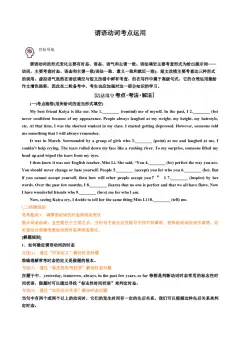
语法填空
(2025·福建省福州市第一次质量检测)阅读下面短文,在空白处填入1个适当的单词或括号内单词
的正确形式。(标黄题号为本专题考点)
The term Xuan paper first appeared in On Famous Paintings through the Ages, a book written by Tang
Dynasty scholar Zhang Yanyuan, 1 he described Xuan paper as an ideal carrier for calligraphy and
painting. Handmade Xuan paper from Jingxian county, East China’s Anhui province, 2 (list) as a gift tothe imperial court then for its supreme quality,
During the Tang and Song Dynasties Xuan paper reached its peak of 3 (popular) and quality. The
traditional craft (工艺) of making Xuan paper is extremely 4 (demand). Sandalwood bark, a plant native
to southern China, 5 (go) through108 procedures over the course of three years before it can transform
into fine Xuan paper.
The flow of ink determines the output of Chinese art, and Xuan paper outshines others with its excellent
ability 6 (give) full play to ink. Different proportions (比例) of bar k to straw during the paper- making
process can create different canvases (帆布) best suited 7 artistic expression u freehand ink paintings or
calligraphy. The unique quality of Xuan paper is 8 (high) valued in the world of Chinese calligraphy and
painting.
Xuan paper is very resistant to damage brought by time. It is this durability 9 has made the
preservation of many valuable works from ancient China possible. The long history, unique craftsmanship, and
high quality of Xuan paper have made it a 10 (treasure) cultural heritage of China.