必修 1 Unit 2 Travelling Around
Part 1 单元语法讲义--现在进行时表将来
Part 2 读后续写素材积累
Part 3 单元语法+读后续写即时检测
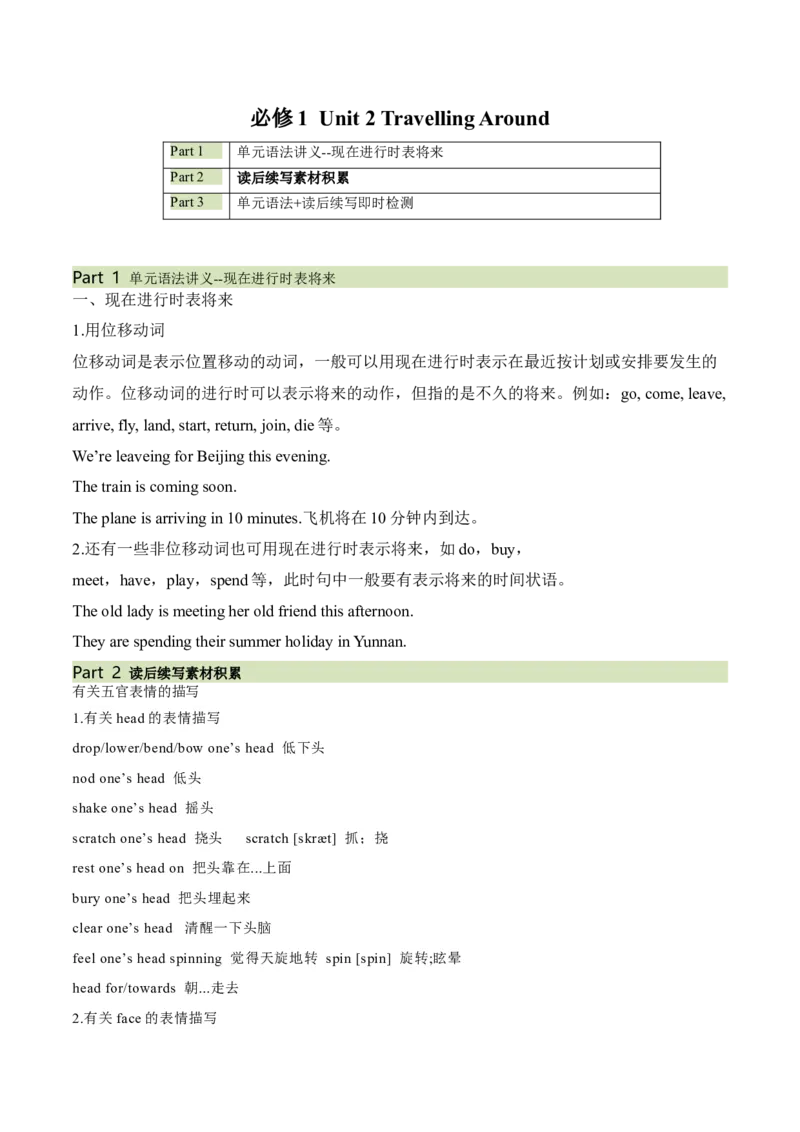
Part 1 单元语法讲义--现在进行时表将来
一、现在进行时表将来
1.用位移动词
位移动词是表示位置移动的动词,一般可以用现在进行时表示在最近按计划或安排要发生的
动作。位移动词的进行时可以表示将来的动作,但指的是不久的将来。例如:go, come, leave,
arrive, fly, land, start, return, join, die等。
We’re leaveing for Beijing this evening.
The train is coming soon.
The plane is arriving in 10 minutes.飞机将在10分钟内到达。
2.还有一些非位移动词也可用现在进行时表示将来,如do,buy,
meet,have,play,spend等,此时句中一般要有表示将来的时间状语。
The old lady is meeting her old friend this afternoon.
They are spending their summer holiday in Yunnan.
Part 2 读后续写素材积累
有关五官表情的描写
1.有关head的表情描写
drop/lower/bend/bow one’s head 低下头
nod one’s head 低头
shake one’s head 摇头
scratch one’s head 挠头 scratch [skræt] 抓;挠
rest one’s head on 把头靠在...上面
bury one’s head 把头埋起来
clear one’s head 清醒一下头脑
feel one’s head spinning 觉得天旋地转 spin [spin] 旋转;眩晕
head for/towards 朝...走去
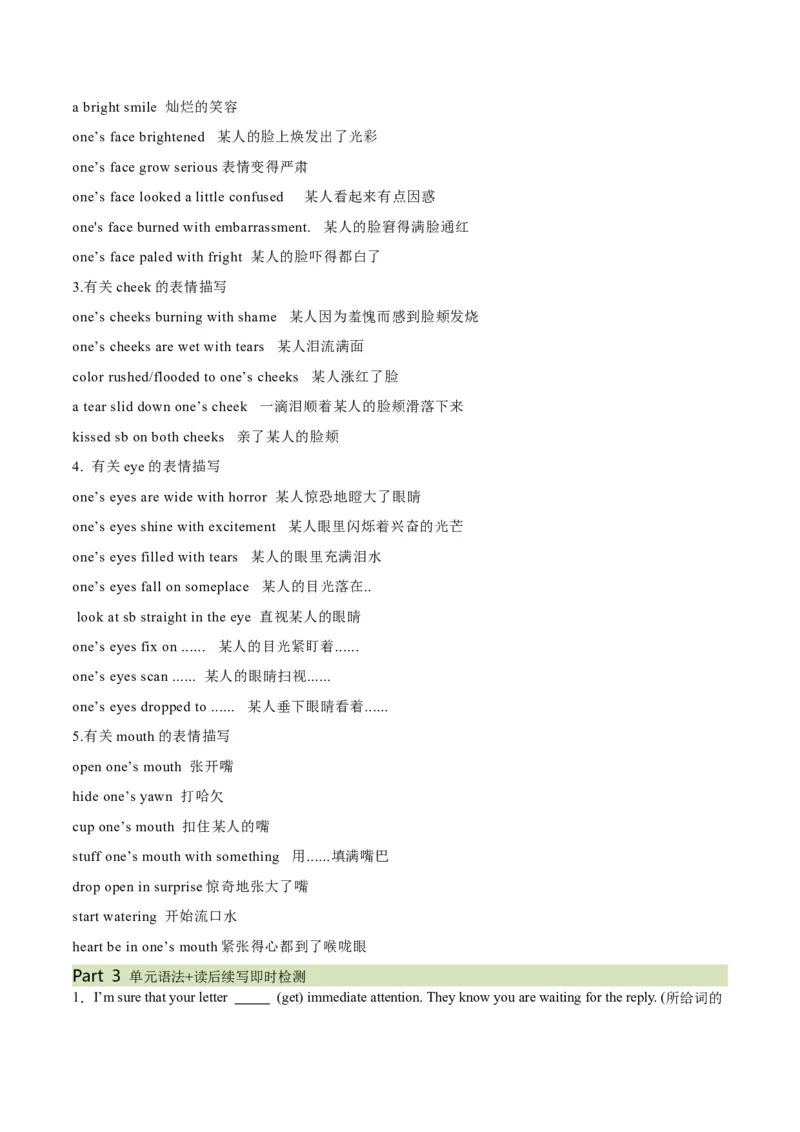
2.有关face的表情描写a bright smile 灿烂的笑容
one’s face brightened 某人的脸上焕发出了光彩
one’s face grow serious表情变得严肃
one’s face looked a little confused 某人看起来有点因惑
one's face burned with embarrassment. 某人的脸窘得满脸通红
one’s face paled with fright 某人的脸吓得都白了
3.有关cheek的表情描写
one’s cheeks burning with shame 某人因为羞愧而感到脸颊发烧
one’s cheeks are wet with tears 某人泪流满面
color rushed/flooded to one’s cheeks 某人涨红了脸
a tear slid down one’s cheek 一滴泪顺着某人的脸颊滑落下来
kissed sb on both cheeks 亲了某人的脸颊
4. 有关eye的表情描写
one’s eyes are wide with horror 某人惊恐地瞪大了眼睛
one’s eyes shine with excitement 某人眼里闪烁着兴奋的光芒
one’s eyes filled with tears 某人的眼里充满泪水
one’s eyes fall on someplace 某人的目光落在..
look at sb straight in the eye 直视某人的眼睛
one’s eyes fix on ...... 某人的目光紧盯着......
one’s eyes scan ...... 某人的眼睛扫视......
one’s eyes dropped to ...... 某人垂下眼睛看着......
5.有关mouth的表情描写
open one’s mouth 张开嘴
hide one’s yawn 打哈欠
cup one’s mouth 扣住某人的嘴
stuff one’s mouth with something 用......填满嘴巴
drop open in surprise惊奇地张大了嘴
start watering 开始流口水
heart be in one’s mouth紧张得心都到了喉咙眼
Part 3 单元语法+读后续写即时检测
1.I’m sure that your letter (get) immediate attention. They know you are waiting for the reply. (所给词的适当形式填空)
【答案】will get
【详解】考查时态。句意:我相信你的信会立即得到重视。他们知道你在等回信。根据“immediate
attention. They know you are waiting for the reply”可知,get“得到”这一动作发生在将来,that引导的宾语从
句时态用一般将来时。故填will get。
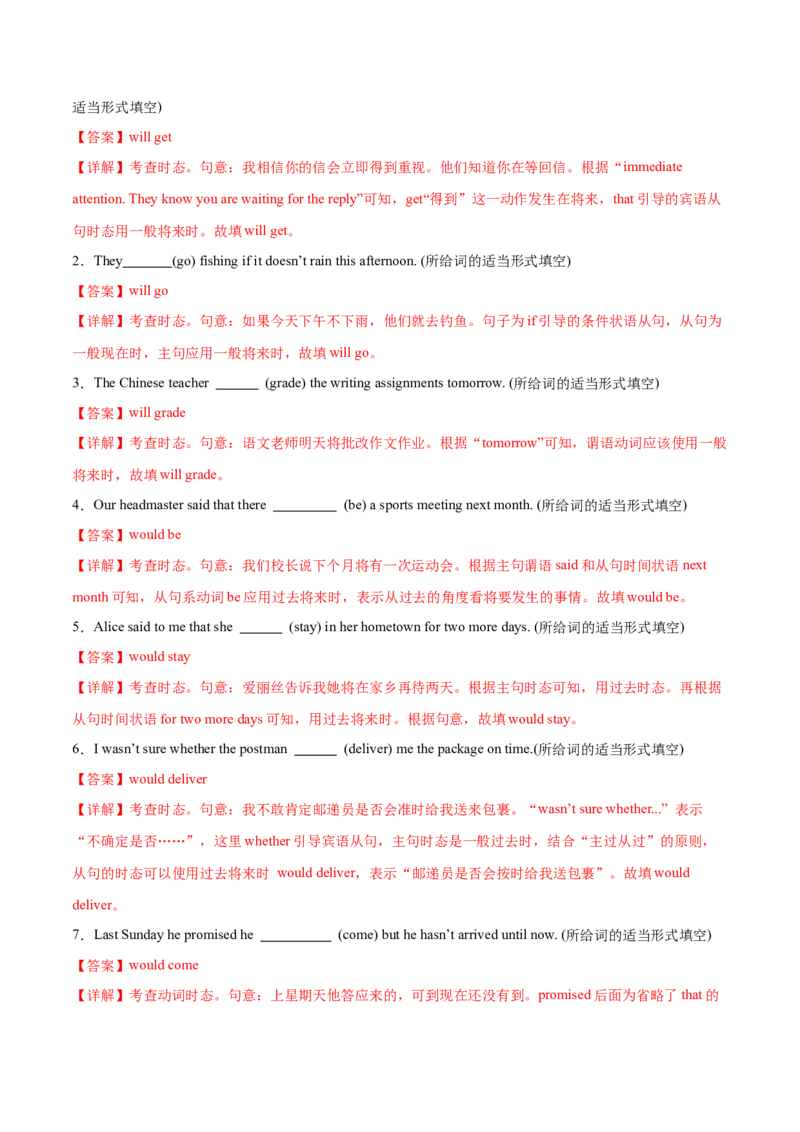
2.They (go) fishing if it doesn’t rain this afternoon. (所给词的适当形式填空)
【答案】will go
【详解】考查时态。句意:如果今天下午不下雨,他们就去钓鱼。句子为if引导的条件状语从句,从句为
一般现在时,主句应用一般将来时,故填will go。
3.The Chinese teacher (grade) the writing assignments tomorrow. (所给词的适当形式填空)
【答案】will grade
【详解】考查时态。句意:语文老师明天将批改作文作业。根据“tomorrow”可知,谓语动词应该使用一般
将来时,故填will grade。
4.Our headmaster said that there (be) a sports meeting next month. (所给词的适当形式填空)
【答案】would be
【详解】考查时态。句意:我们校长说下个月将有一次运动会。根据主句谓语said和从句时间状语next
month可知,从句系动词be应用过去将来时,表示从过去的角度看将要发生的事情。故填would be。
5.Alice said to me that she (stay) in her hometown for two more days. (所给词的适当形式填空)
【答案】would stay
【详解】考查时态。句意:爱丽丝告诉我她将在家乡再待两天。根据主句时态可知,用过去时态。再根据
从句时间状语for two more days可知,用过去将来时。根据句意,故填would stay。
6.I wasn’t sure whether the postman (deliver) me the package on time.(所给词的适当形式填空)
【答案】would deliver
【详解】考查时态。句意:我不敢肯定邮递员是否会准时给我送来包裹。“wasn’t sure whether...” 表示
“不确定是否……”,这里whether引导宾语从句,主句时态是一般过去时,结合“主过从过”的原则,
从句的时态可以使用过去将来时 would deliver,表示“邮递员是否会按时给我送包裹”。故填would
deliver。
7.Last Sunday he promised he (come) but he hasn’t arrived until now. (所给词的适当形式填空)
【答案】would come
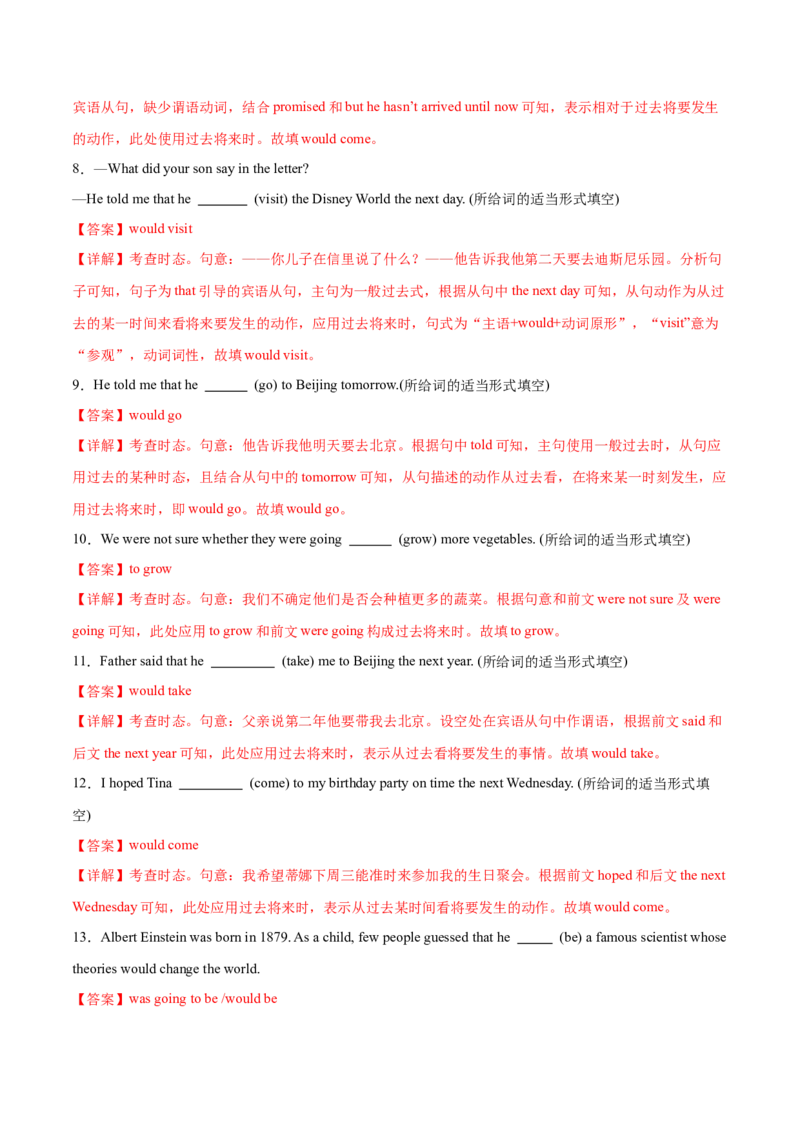
【详解】考查动词时态。句意:上星期天他答应来的,可到现在还没有到。promised后面为省略了that的宾语从句,缺少谓语动词,结合promised和but he hasn’t arrived until now可知,表示相对于过去将要发生
的动作,此处使用过去将来时。故填would come。
8.—What did your son say in the letter?
—He told me that he (visit) the Disney World the next day. (所给词的适当形式填空)
【答案】would visit
【详解】考查时态。句意:——你儿子在信里说了什么?——他告诉我他第二天要去迪斯尼乐园。分析句
子可知,句子为that引导的宾语从句,主句为一般过去式,根据从句中the next day可知,从句动作为从过
去的某一时间来看将来要发生的动作,应用过去将来时,句式为“主语+would+动词原形”,“visit”意为
“参观”,动词词性,故填would visit。
9.He told me that he (go) to Beijing tomorrow.(所给词的适当形式填空)
【答案】would go
【详解】考查时态。句意:他告诉我他明天要去北京。根据句中told可知,主句使用一般过去时,从句应
用过去的某种时态,且结合从句中的tomorrow可知,从句描述的动作从过去看,在将来某一时刻发生,应
用过去将来时,即would go。故填would go。
10.We were not sure whether they were going (grow) more vegetables. (所给词的适当形式填空)
【答案】to grow
【详解】考查时态。句意:我们不确定他们是否会种植更多的蔬菜。根据句意和前文were not sure及were
going可知,此处应用to grow和前文were going构成过去将来时。故填to grow。
11.Father said that he (take) me to Beijing the next year. (所给词的适当形式填空)
【答案】would take
【详解】考查时态。句意:父亲说第二年他要带我去北京。设空处在宾语从句中作谓语,根据前文said和
后文the next year可知,此处应用过去将来时,表示从过去看将要发生的事情。故填would take。
12.I hoped Tina (come) to my birthday party on time the next Wednesday. (所给词的适当形式填
空)
【答案】would come
【详解】考查时态。句意:我希望蒂娜下周三能准时来参加我的生日聚会。根据前文hoped和后文the next
Wednesday可知,此处应用过去将来时,表示从过去某时间看将要发生的动作。故填would come。
13.Albert Einstein was born in 1879. As a child, few people guessed that he (be) a famous scientist whose
theories would change the world.
【答案】was going to be /would be【详解】考查时态。句意:阿尔伯特·爱因斯坦出生于1879年。当他还是个孩子的时候,很少有人想到他
会成为一个著名的科学家,他的理论会改变世界。这里用过去将来时,表示从过去的某一时间来看将来要
发生的动作或呈现的状态。故填was going to be /would be。
14.From the time I met Alicia, I knew she the next big thing in the technology world. (be) (所给词
的适当形式填空)
【答案】would be
【详解】考查动词时态。句意:从我见到艾丽西娅的那一刻起,我就知道她将成为科技界的下一个大人物。
分析句子结构可知,本句是省略that的宾语从句,be作从句谓语,根据next big thing可知,应用将来时,
根据knew知,用过去将来时。故填would be。
15.When the Internet first appeared, few people believed that it (become) popular. (所给词的适当
形式填空)
【答案】would become
【详解】考查动词时态。句意:当互联网刚出现的时候,很少有人相信它会变得流行起来。过去将来时表
示在过去某个时间看来将要发生的动作或存在的状态,构成为:would+动词原形。动词become意为“变
得”。根据语境和believed可知,that引导的宾语从句时态用过去将来时。故填would become。
16.Tom was my leader and he promised that he (help)me if necessary. (所给词的适当形式填空)
【答案】would help
【详解】考查动词时态。句意:汤姆是我的领导,他答应必要时他会帮助我。分析句子可知,此处为谓语
动词的填入,由主句动词promised可知,此处也要用相应的过去时态,结合句意可知,从句表示过去将要
发生的事情,用过去将来时,为would do。故填would help。
17.I didn’t know when she (come), but when she came I would let you know. (所给词的适当形式填
空)
【答案】would come
【详解】考查动词时态。句意:我不知道她什么时候来,但她来了我会告诉你的。分析句子可知,此处为
谓语动词的填入,根据句意可知,此处动词come应发生在将来,结合主句动词didn’t know可知,此处应
为过去将来时。故填would come。
18.The professor told us that he (leave) for Canada for an important meeting the next Friday. (所
给词的适当形式填空)
【答案】would leave/was leaving
【详解】考查时态。句意:教授告诉我们他下星期五要去加拿大参加一个重要的会议。由told可知,整件事描述过去发生的事,且由the next Friday可知,此处表示过去某一时间将要发生的事,应用过去将来时
would do,动词leave,come,go等词的过去进行时也可表示过去将来时,主语是he,be动词应用was,
故填would leave/was leaving。
19.He didn’t know that the experience (change) his whole life in the future. (所给词的适当形式填空)
【答案】would change
【详解】考查时态。句意:他不知道的是,他的经历会改变未来的一生。根据句子分析可知,此处作谓语
动词,主语为the experience,且此处意为“将会改变”,故应用将来时,且根据前文didn't know可知,此
处应用过去将来时,故填would change。
20.She said that the bus (leave) at seven next morning.(所给词的适当形式填空)
【答案】was leaving/would leave
【详解】考查动词时态。句意:她说公共汽车第二天早上七点离开。根据时间状语“the next morning”和
“said”可知,that从句用过去将来时,leave“离开”为表示位移的动词,故可使用其进行时表示将来,主语
the bus为第三人称单数,be动词用was。过去将来时也可用“would+动词原形”表示。故填was leaving或
would leave。
二、读后续写
(2024·黑龙江吉林·模拟预测)
Crab Lessons
My son Geordi was a rather spirited boy. Very little held his attention for long. He spent most of his spare
time thinking up new ways to scare me half to death. Like the time he decided to “surf” on a tiny plastic table that
was meant to hold a few drinks rather than a six-year-old boy. Geordi had just begun learning about the ocean in
school and was surprisingly fascinated by it. We lived in Delaware, so any discussion about the ocean usually
included horseshoe crabs, which crowded our coasts to mate in the late spring.
As part of the lesson, Geordi’s teacher brought horseshoe crab shells (壳) to school for the children to touch
and examine. Hearing that horseshoe crabs had been around for over 300 million years, even before the dinosaurs,
Geordi thought that was officially the coolest thing he had ever heard. He could not stop talking about it for days,
and I decided it was time for us to take a drive to the Delaware Bay.
As we stepped out from the car, strong wind nearly blew my poor forty-five-pound child to the ground.
Being a six-year-old mischievous (调皮的) boy, Geordi saw this as an opportunity to showcase his amazing talents,
which included falling down, getting up, falling down and, yes, getting up again. This, of course, was always
complete with giggles (咯咯笑). The drama came to a sudden stop as Geordi spied the dozens of army-truck-looking creatures in the sand. The next sound effect was “Wow!” as his body froze and his eyes widened with
wonder.
Geordi ran around excitedly, not knowing which one to check out first. He settled on a horseshoe crab that
was on its back, legs waving wildly in the air, desperate for water. “Mom, look at this one!” he screamed. “He’s
cool!” I pointed out the different body parts of the crab for him, and he listened quietly and absorbed the
information. He said, “I really liked him. I think I will name him Spike because he had all those really cool, spiky
(尖的) things on his back.” Then I picked up the crab, turned it over to its proper position and placed it at the edge
of the water.
注意:
1.续写词数应为150 左右;
2.请按如下格式作答。
Geordi asked what I was doing.
____________________________________________________________________________________________
____________________________________________________________________________________________
____________________________________________________________________________________________
____________________________________________________________________________________________
_____________________________________________________________________________________
Geordi spotted many more horseshoe crabs on their backs.
____________________________________________________________________________________________
____________________________________________________________________________________________
____________________________________________________________________________________________
____________________________________________________________________________________________
_____________________________________________________________________________________
【答案】范文
Geordi asked what I was doing. I explained to him that if the crab got stuck on its back and could not get
back to the water soon, it would die. Horseshoe crabs, I told him, are very important in many ways. Their eggs are a
great food source for birds, and their shells and blood have special medical properties that can help many people.
Besides, it didn’t seem right to let a species that had survived so long just dry up in the sun. Geordi listened intently,
his eyes sparkling with concern. He then bent down and cautiously touched Spike’s shell with his finger,
murmuring, “Go home, Spike.” We watched the horseshoe crab slowly make his way back into the ocean.Geordi spotted many more horseshoe crabs on their backs. He decided that we should help them all. Without
fear or hesitation, he began picking up stuck horseshoe crabs and turning them over, and helped me carry them to
the water. He was extra careful and gentle, worried that he may hurt one. His sincere concern for the horseshoe
crabs touched my heart. When the job was done and it was time to leave, Geordi asked, “Do you think we will ever
see Spike again?” “Maybe,” I said, “but now that we have helped him, we know he will be okay even if we don’t
see him again.”
【导语】本文以人物为线索展开,讲述了作者和儿子乔迪去海边观察马蹄蟹,作者教导了儿子关于马蹄蟹
的知识以后,儿子决定帮助海滩上被困的马蹄蟹,作者也被儿子的行动感动。
【详解】1.段落续写:
①由第一段首句内容“乔迪问我在做什么”可知,第一段可描写作者教导了儿子关于马蹄蟹的知识。
②由第二段首句内容“乔迪在他们的背上发现了更多的马蹄蟹”可知,第二段可描写儿子采取行动帮助马
蹄蟹以及作者的感悟。
2.续写线索:好奇询问——作者解释——儿子认真倾听——帮助马蹄蟹——作者被触动——作者感悟
3.词汇激活
行为类
①完成:do/finish/accomplish
②看到:see/spot/notice
③伤害:hurt /injure
情绪类
①小心:cautiously/carefully
②真诚:sincere/heartfelt
【点睛】[高分句型1] He decided that we should help them all. (运用了that引导宾语从句)
[高分句型2] “Maybe,” I said, “but now that we have helped him, we know he will be okay even if we don’t see
him again.”(运用了even if引导宾语从句和now that引导原因状语从句)