押天津卷 56~60 题
阅读表达
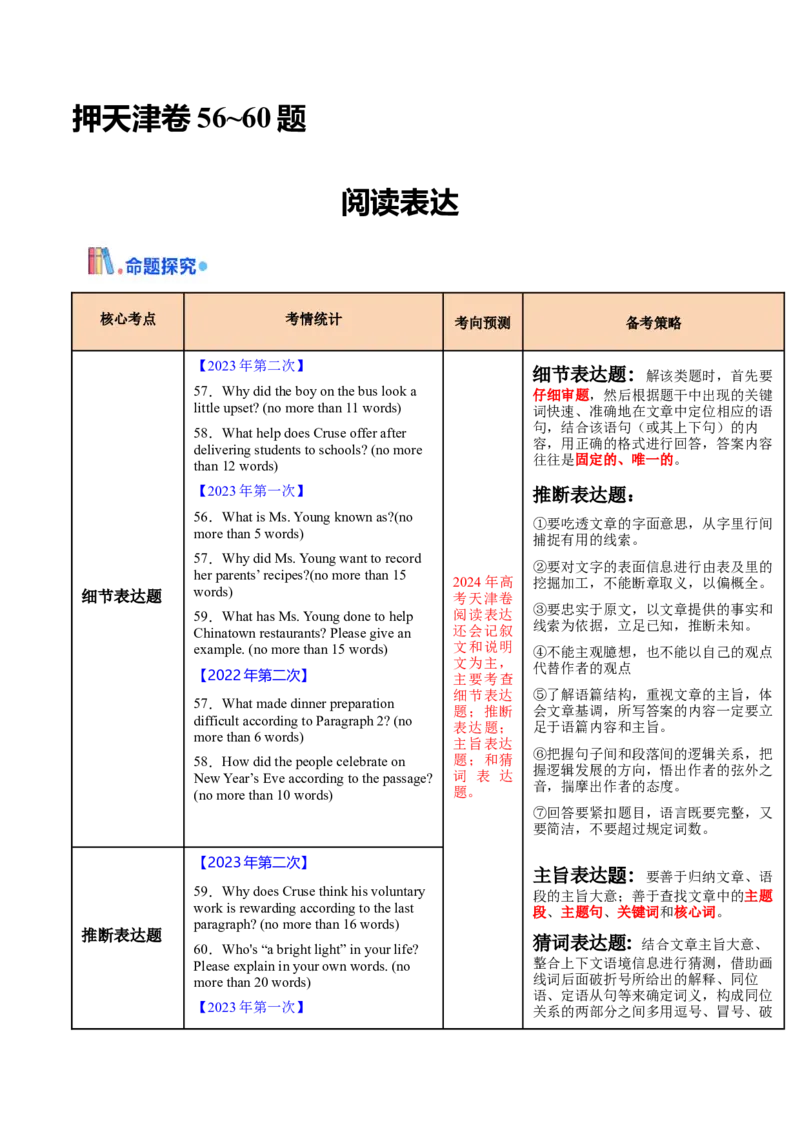
核心考点 考情统计 考向预测 备考策略
【2023年第二次】
细节表达题:解该类题时,首先要
57.Why did the boy on the bus look a 仔细审题,然后根据题干中出现的关键
little upset? (no more than 11 words) 词快速、准确地在文章中定位相应的语
句,结合该语句(或其上下句)的内
58.What help does Cruse offer after
容,用正确的格式进行回答,答案内容
delivering students to schools? (no more
往往是固定的、唯一的。
than 12 words)
【2023年第一次】 推断表达题:
56.What is Ms. Young known as?(no
①要吃透文章的字面意思,从字里行间
more than 5 words)
捕捉有用的线索。
57.Why did Ms. Young want to record
②要对文字的表面信息进行由表及里的
her parents’ recipes?(no more than 15
2024年高 挖掘加工,不能断章取义,以偏概全。
细节表达题 words) 考天津卷
③要忠实于原文,以文章提供的事实和
59.What has Ms. Young done to help 阅读表达
线索为依据,立足已知,推断未知。
Chinatown restaurants? Please give an 还会记叙
example. (no more than 15 words) 文和说明 ④不能主观臆想,也不能以自己的观点
文为主,
代替作者的观点
【2022年第二次】 主要考查
细节表达 ⑤了解语篇结构,重视文章的主旨,体
57.What made dinner preparation
题;推断 会文章基调,所写答案的内容一定要立
difficult according to Paragraph 2? (no
表达题; 足于语篇内容和主旨。
more than 6 words)
主旨表达
⑥把握句子间和段落间的逻辑关系,把
58.How did the people celebrate on 题;和猜
握逻辑发展的方向,悟出作者的弦外之
New Year’s Eve according to the passage? 词 表 达
音,揣摩出作者的态度。
(no more than 10 words) 题。
⑦回答要紧扣题目,语言既要完整,又
要简洁,不要超过规定词数。
【2023年第二次】
主旨表达题:要善于归纳文章、语
59.Why does Cruse think his voluntary 段的主旨大意;善于查找文章中的主题
work is rewarding according to the last 段、主题句、关键词和核心词。
paragraph? (no more than 16 words)
推断表达题
猜词表达题:
结合文章主旨大意、
60.Who's “a bright light” in your life?
Please explain in your own words. (no 整合上下文语境信息进行猜测,借助画
more than 20 words) 线词后面破折号所给出的解释、同位
语、定语从句等来确定词义,构成同位
【2023年第一次】
关系的两部分之间多用逗号、冒号、破60.How does Ms. Young inspire you in
her efforts to preserve Chinese Culinary
traditions? Please explain in your own
words. (no more than 20 words)
【2022年第二次】
59.How does the author feel about that
particular New Year’s Eve? (no more than
8 words)
60.What do you think is the most
necessary quality when dealing with an
unexpected difficult situation? Please
explain why. (no more than 25words)
【2023年天津第二次】
折号和小括号等连接;定语从句在文中
56.What does the underlined word mean
起着解释和说明的作用。还要利用同义
in Paragraph 1? (1 word)
或者反义关系、构词法及语篇文脉关系
【2023年第一次】 等理解猜测其含义有些题目需要对较大
猜 词 表 达 的上下文范围进行理解,甚至通过理解
58.What does the underlined word mean
整个语篇,来进行猜测判断。
题 in Paragraph 3?(no more than 2 words)
【2022年第二次】
56.What does the underlined word mean
in Paragraph 1? (1 word)
主旨表达题
Passage 1
【2023年天津第二次】Herman Cruse, a school bus driver from New Jersey, has been with Middle Township
Public Schools for the past nine years. He believes bus drivers are the eyes and ears of students when they're away
from home and they have a gift to discern what kids are feeling.
During one morning ride, Cruse noticed a kindergartner seemed a little sad. When Cruse asked him what was
wrong, the boy explained that he wasn't able to complete his reading assignment because his parents were busy
with his four siblings (兄弟姐妹). An idea suddenly crossed Cruse's mind. “Listen, if you don't mind, I'd like to
come to the school and read with you. ”he said.After receiving permission from the boy's teacher, Alex Bakley, Cruse showed up at her classroom the
following week. When he walked in, the boy shouted proudly, “Hey, that's my bus driver!”They went into a quiet
corner and began reading together. Later, a second student wanted to read with him, then a third. All the kids went
to the teacher asking, “Can I read with Mr. Herman?”
Cruse now volunteers to help kindergarten students with reading two days a week, and on a third day, he
instructs the school's first-and second-graders. After dropping the kids off at school, of course. Every child looks up
to Cruse, both on and off the school bus. “Herman is super positive and he's a bright light at our school who makes
every child feel loved and heard. ”said Bakley.
For Cruse, what started out as a way to kill time has now developed into a way to make a difference in the
heart of a child. He used to go to the gym or library after delivering students to schools. It wasn't until he offered to
help the boy on the bus that he realized there was something more rewarding he could be doing. It's a joy for him to
see the kids get excited when they learn to sound out words. He loves how reading opens up a new world for them.
56.What does the underlined word mean in Paragraph 1? (1 word)
57.Why did the boy on the bus look a little upset? (no more than 11 words)
58.What help does Cruse offer after delivering students to schools? (no more than 12 words)
59.Why does Cruse think his voluntary work is rewarding according to the last paragraph? (no more than 16
words)
60.Who's “a bright light” in your life? Please explain in your own words. (no more than 20 words)
Passage 2
【2023年天津第一次】Growing up in San Francisco, Grace Young used to watch her father shop daily in
Chinatown for whatever he needed to make traditional Chinese meals at home. As an award-winning cookbook
author, Ms. Young, now 66, has spent decades shopping the same way in New York’s Chinatown.
Ms. Young developed a passion for cooking at an early age. At 13, she started to sit in on cooking classes.
After college, Ms. Young moved to New York and worked in a book-packaging company. In her 30s, she realizedthat while she had helped create more than 40 cookbooks, she didn’t know how to make the dishes that tasted of
home. “I knew if I recorded all of my parents’ recipes, it would be a great gift that I could give my family and the
next generation.” she says.
Yet what began as a recipe book became a kind of memoir. Talking about food encouraged her parents to
finally open up about their past, like the fact that her father had owned a Chinatown restaurant in the 1940s. “It was
really an amazing way to learn not only my family’s recipes, but also my family’s story. “she says. The Wisdom of
the Chinese Kitchen (1999) launched Ms. Young’s work in preserving and sustaining Chinese culinary (烹饪
的)traditions.
Ms. Young has also devoted herself to supporting the restaurants in Chinatown. Since early 2020, Ms. Young
has raised money to buy meals from Chinatown restaurants and deliver them to those in need. This year, instead of
cooking at home for her husband and friends, she celebrated the Chinese New Year with various dishes from local
restaurants in Chinatown. “If these restaurants don’t survive, Chinese culinary traditions in our city won’t survive.”
she says.
56.What is Ms. Young known as?(no more than 5 words)
57.Why did Ms. Young want to record her parents’ recipes?(no more than 15 words)
58.What does the underlined word mean in Paragraph 3?(no more than 2 words)
59.What has Ms. Young done to help Chinatown restaurants? Please give an example. (no more than 15 words)
60.How does Ms. Young inspire you in her efforts to preserve Chinese Culinary traditions? Please explain in your
own words. (no more than 20 words)
Passage 3
【2022年天津第二次】It was a dark and stormy night. The ferocious wind shook the windows wildly, as
though someone outside were beating on the glass. It was also New Year’s Eve. We were having our annual party
and had a house full of people just starting to celebrate.
Suddenly, we heard loud explosions. Looking outside and up into the hills, we saw sparks(火花) flying fromelectrical transformers(变压器). One area after another went dark up in those hills. Then there was the loudest
explosion of them all and our house went dark too. I tried to find every candle we had and lit them. The candles
made everything look lovely. But we had problems. We had fifteen people standing around and we still had to cook
dinner. How would we do that without electricity?
The barbecue! Why not cook on the barbecue? We men went outside, some holding flashlights and others
cooking. We did a wonderful job. The women stayed inside and got the salads ready. Everything was delicious.
There were still a few hours to go before the beginning of the new year, so we all sat around the dining room table
and sang up until a few minutes before midnight. We couldn’t watch the ball drop in Times Square on television but
that wouldn’t stop us from celebrating. I stood on a chair and, with the help of someone’s watch to tell us the time,
we all counted down and I dropped a tennis ball! We all screamed Happy New Year. We didn’t need electricity for
that!
Nowadays, we still get together with the same group to celebrate the New Year and we still talk about that
special night. I don’t think we have ever laughed so much as we did on that New Year’s Eve.
56.What does the underlined word mean in Paragraph 1? (1 word)
57.What made dinner preparation difficult according to Paragraph 2? (no more than 6 words)
58.How did the people celebrate on New Year’s Eve according to the passage? (no more than 10 words)
59.How does the author feel about that particular New Year’s Eve? (no more than 8 words)
60.What do you think is the most necessary quality when dealing with an unexpected difficult situation? Please
explain why. (no more than 25words)
秘籍01细节表达题
1、题目要求:要求考生能扑捉并理解文章中出现的具体信息,并结合文中的具体要求进行回答。
2、设问形式:此类问题的设置通常基于文章自身内容,常用 what , why , how 等特殊疑问词进行
3、答题技巧:解该类题时,首先要仔细审题,然后根据题干中出现的关键词快速、准确地在文章中定位相应的语句,结合该语句(或其上下句)的内容,用正确的格式进行回答,答案内容往往是固定的、唯一
的。
①问题形式: Why ..?
回答形式: Because +句子(表示原因); Because of +名词性短语(表示原因); To +动词原形(表示
目的); In order to +动词原形(表示目的)。。
②问题形式: What ...? 回答形式:完整的句子;名词(短语);动名词(短语)
③问题形式:列举性问题。回答形式:名词(短语);动名词(短语)。
④问题形式: How ...?(询问方式)回答形式: By ( doing )..;完整的句子。
秘籍02主旨表达题
1.题目要求:
①概括全文或文中某一段的大意;
②给文章拟一个恰当的标题。
2.设问形式:
① What ' s the main idea of the passage / Paragraph ...?② What ' s the passage mainly about ?
③ What ' s the best title for the passage ?
3.答题技巧:考生在回答该类问题时,要善于归纳文章、语段的主旨大意;善于查找文章中的主题
段、主题句、关键词和核心词。
解该类题时,注意一要紧扣能够体现文章或段落主旨的关键词,二要计言简练。
4.常用的回答形式有:
①名词短语/动名词短语;②名词+后置定语;名词+定语从句;名词+同位语从句;
③名词性从句或"疑问词+不定式": What .../ Why ... How ./ How to...?
秘籍03 推断表达题
1.题目要求:
要求考生能够在理解原文字面意义的基础上,通过对语篇逻
辑关系的分析,做出合理的推理和判断。推断表达题包含两个方面的,容,一是对文中的具体内容做
出推理和判断;二是推测作者或文中相关人物的意图、观点和态度。
2.设问形式:
① What ' s the purpose of the text ?
② For what purpose does the author mention .. in Paragraph ...?
③ What does the author really mean by saying ...?
④ What kind of attitude does the author have towards ...?
⑤ What does ... imply ?⑥ What can we learn from the text ?
3.答题技巧:
①要吃透文章的字面意思,从字里行间捕捉有用的线索。②要对文字的表面信息进行由表及里的挖掘
加工,不能断章取义,以么全。
③要忠实于原文,以文章提供的事实和线索为依据,立足已知,推断未知。
④不能主观臆想,也不能以自己的观点代替作者的观点
⑤了解语篇结构,重视文章的主旨,体会文章基调,所写答案的内容一定要立足于语篇内容和主旨。
⑥把握句子间和段落间的逻辑关系,把握逻辑发展的方向,悟出作者 1L弦外之音,揣摩出作者的态
度。
⑦回答要紧扣题目,语言既要完整,又要简洁,不要超过规定词数。
秘籍04 猜词表达题
(一)题目要求:考生能够利用上下文判断某个单词、短语或句子在特定语言环境中的确切含义。
(二)设问形式:
① What ' s the meaning of the underlined word / phrase / part in the ... paragraph '?
② What does the underlined part in the .. paragraph mean ?
(三)答题技巧:结合文章主旨大意、整合上下文语境信息进行猜测,还要利用同义或者反义关系、构词
法及语篇文脉关系等理解猜测其含义有些题目需要对较大的上下文范围进行理解,甚至通过理解整个语篇.
能进行猜测判断。
(四)常用的回答形式有:①相近含义、相同词性的单词;②完整、直白、简短的句子。
1、根据上下文语境理解词义
2、根据释义猜测词义:
①借助画线词后面破折号所给出的解释、同位语、定语从句等来确定词义。构成同位关系的两部分之间多
用逗号、冒号、破折号和小括号等连接;定语从句在文中起着解释和说明的作用。
②如果生词在文中直接被句子或段落解释,理解句子或段落本身就能推断出词义。
Passage 1
【2024 届天津市和平区一模】Having established himself as one of the greatest magicians over the last
three decades, David Copperfield remains hailed by audiences and critics because his magic still leaves most
puzzles unsolved — not only for ordinary people but counterparts in the field of illusion (错觉). He believes he’sremained at the top because of an undiminished passion for magic. “I’m among the few who are lucky enough to
know what they want to do at early age,” he said.
Copperfield discovered an interest in magic at the age of 8 when he learnt some simple tricks from his parents
who were both magicians. “When I showed those tricks to other kids, I found they all liked them very much, and
they thought I was great. This made me very willing to learn new magic,” he recalled. “Such a feeling still supports
me now. I like to see the audiences become amazed and go crazy for my performance.”
He began performing professionally at the age of 12 and became the youngest person to be admitted to the
Society of American Magicians. By 16, he was teaching a course in magic at New York University. He was among
the first magicians to pioneer the TV spectacular, helping boost the appeal for the craft (职业) worldwide.
His love for magic also turned him from a shy, timid boy to a risk-taker prepared to challenge limits. “Magic
provides me a channel to express myself, just like singers through their songs and poets through poems,” he said,
“And I think everyone needs to dream. Magic offers me the chance to make true my dreams and those of other
people.”
Now 68, Copperfield has no thought of retiring from his beloved career. “I really enjoy what I’m doing. I
enjoy the process of creating and sharing my creation with others. I dream that my career will last forever. Dreams
aren’t a matter of chance, but a matter of choice.”
56.What makes David Copperfield one of the greatest magicians for decades? (no more than 10 words)
57.How did David Copperfield discover an interest in magic at an early age? (no more than 15 words)
58.What is mainly talked about in the third paragraph? (no more than 5 words)
59.What does the underlined word “hailed” mean in paragraph 1? (1 word)
60.How does Copperfield’s story inspire you? (no more than 15 words)
Passage 2
【2024 届天津市河北区一模】Scott McKenzie and Jeremy Uhrich, two dads from Huntingdon,
Pennsylvania, have transformed their passion for baking into a heartwarming community endeavor (努力). Thisjourney began when McKenzie, 58, found himself laid off and decided to learn a new skill every week. Baking was
one of these new skills, and he was pleasantly surprised by the quality of his first batch of cookies. Proudly, he
shared his creation on social media, catching the attention of Uhrich, a longtime friend, who playfully challenged
him to a bake-off (食品烘烤比赛).
Uhrich, 42, baked with his sons that same day and proposed a competition to McKenzie. The two agreed to let
community workers in the community judge the treats as a thank-you for their help during the challenging times.
The competition was a success, but McKenzie and Uhrich didn’t stop there. They decided to deliver the rest of the
cookies to community workers, sparking an idea that would eventually become Cookies for Caregivers.
The timing couldn’t have been more crucial—the community had recently experienced a terrible earthquake,
leaving many homes destroyed and families displaced. As part of the rebuilding efforts, Cookies for Caregivers was
born. The Facebook group created by McKenzie and Uhrich allowed their neighbors to volunteer to make treats for
first responders and business owners who were working tirelessly in the aftermath of the earthquake. Since the
disaster struck, more than 100 people have joined the group, baking and delivering more than 15,000 cookies to
workers at hospitals, grocery stores, fire departments, and more. Each week, bakers drop cookies off at Uhrich’s
house, and he and McKenzie organize and deliver them to businesses in large containers.
The impact of Cookies for Caregivers has been profound. Uhrich says “they’ve seen a lot of smiles and tears
during deliveries; people are so appreciative”. The project has brought together members of the community who
may have never interacted otherwise, all with a common goal of showing gratitude to those on the front lines of the
rebuilding efforts after the earthquake. McKenzie says “they plan on continuing the effort because they are
immensely grateful for the selfless contributions and want to express their appreciation to as many people as
possible”.
McKenzie and Uhrich’s message is clear: kindness doesn’t have an expiration date. In a time of uncertainty
and rebuilding, they’ve shown that small acts of kindness can make a big difference. Their bake-off may have been
just for fun, but the impact it’s had on their community is immeasurable.
56.What happened to Scott McKenzie before he started to bake? (no more than 5 words)
57.Who received the cookies after the bake-off? (no more than 5 words)
58.What is Paragraph 3 mainly about? (no more than 10 words)59.What does the underlined word “expiration” in the last paragraph mean? (1 word)
60.What have you learned from the story? Please explain in your own words. (no more than 20 words)
Passage 3
【2024届天津市河西区一模】After being evacuated (疏散) from her Florida home following Hurricane
Michael. Amber Gee was attempting to get an idea of the destruction left behind when she discovered a sign of
trouble. As reported by ABC News, Gee was using NOAA’s interactive aerial map (交互式航拍地图) to check the
damage done to her and her family’s homes when she spotted the word “H-E-L-P” spelled out in the yard.
The NOAA website allows those impacted in the hurricane to get a look at specific streets or homes by
zooming in on (用变焦距镜头拉近) aerial imagery of the affected area. According to ABC News, Gee was looking
at one of these photos when she noticed a cry for help spelled out in wood in the front yard of her grandmother’s
Bay County home.
Though her grandmother had evacuated, several other family members, including Gee’s uncle and his wife,
had stayed behind. After spotting the message, Gee alerted (向……报警) Bay County Emergency Services, who
went to the house and rescued those who were trapped in the residence.
“Apparently, they had to cut through a lot of downed trees to get there,” Gee told ABC News. Her uncle,
Ernest, had reportedly used wood from one of those trees to spell out the message.
After the rescue, Bay County Emergency Services posted the incident on their Facebook page, writing, “This
is an incredible story of how people are working together in this situation. Someone from another county was using
the mapping app to check property in rural Bay County and noticed the word ‘help’ spelled out in the grass in
wood. That person immediately contacted us and sent the picture and we dispatched emergency workers.”
Meanwhile, Gee says she is thankful that she was able to use the mapping tool to get her family to safety. “The
hurricane has turned everything upside down everywhere. Some were more fortunate than others. I’m just happy
that everybody is safe and sound and, hopefully, soon we will all get through this together and recover from this
storm,” she said.
56.What did Gee use the mapping app to do? (no more than 12 words)
57.Who can look at the NOAA website’s aerial photos of the affected area? (no more than 5 words)58.Who spelled out “Help” to cry for help? (no more than 5 words)
59.What does the underlined word “dispatched” in Para. 5 probably mean? (one word)
60.What lesson can you learn from this story? Please explain. (no more than 25 words)
Passage 4
【2024届天津市红桥区一模】A kind father lost about 57 kg in just six months after being shamed dieting
when he became too fat to play with his young daughter. Chris Willis, 47, tipped the scales at 172 kg following a
lifetime of fatty foods. But overweight Chris turned to dieting when he realized he was too fat to play with his ten-
year-old daughter, Sophie, who had a passion for running.
The determined dad cut out all the fatty foods he had enjoyed, and began exercising. He now weights 105 kg
after losing 10 kg every month since July. Chris, who lives in Shepreth. Cambridgeshire with his wife Jackie. 51, a
coach driver, said: “The hardest thing was seeing my little girl in the garden and not being able to join in because I
was so unhealthy. But now I am making up for lost time---we do so much together and it is just great.”
Chris used to consume an incredible 5,000 calories a day, before he switched to healthy lifestyle. On average
he would eat five slices of bread for breakfast as a mid morning meal before a full English breakfast. He would then
eat a sandwich, a large pack of crisps and a pasty for lunch before chewing a whole packet of biscuits in the
afternoon. For dinner Chris would demolish a curry(咖啡) and, ice cream, and also drink four pints of beer very
quickly, before feeding on fatty snacks all evening.
Amazingly Chris claims he still eats the same amount---but has simply cut out the unhealthy fatty foods. Chris
said: “'My family and friends have been so supportive and my wife and daughter are so pleased for me. In fact it’s
them I did it for more than anyone else. The whole journey has been amazing and I am still shocked myself that I
have managed to lose so much weight.” Chris is now aiming for a new target weight of 96 kg.
56.Why did Chris Willis lose weight?(no more than 10 words)
57.What does the underlined word “demolish” mean? (1 word)
58.What measures did Chris take to lose weight? (no more than 10 words)
59.What’s Chris’ next plan for keeping healthy? (no more than 10 words)60.How are you inspired by Chris Willis? (no more than 20 words)
Passage 5
【2024 届天津市宁河区一模】When people think of New York City, most of them probably picture the
attractive lifestyles of the rich and famous or think of Broadway, Times Square and other tourist attractions.
However, there is another side of New York City. The summer after tenth grade, I went with my group on a mission
to New York City for a week.
I had always known that poverty existed in major cities, but you had never seen it to a degree as high as we did
there. We worked at several different locations with our small groups. One day, we served at a soup kitchen and
what I saw astounded me. I couldn’t believe my eyes. We saw people from all walks of life. We met people who
came there because they had no jobs, no home and no money.
Another day, we volunteered at a homeless shelter. We helped people there do some cleaning and spent time
talking to them and listening to their stories. It was incredible to see how thankful they were to us for just spending
a couple of hours talking to them.
Every person we met on that trip had a unique story. Whatever their stories were, there was a common thread
we saw in them—hope and thanks. These were people who had nothing, yet they were so hopeful about their
futures and they were thanking us.
My experience during that summer changed my life. I used to picture my future as containing a big house and
a lot of money, but now I see my future as helping others. After college, I would really like to work for some sort of
global aid organization that deals with the social issues, such as poverty and homelessness.
56.What do most people have in mind when thinking of New York City? (No more than 10 words)
57.What does the underlined word “astounded” in the paragraph 2 mean? (One word)
58.What did the author discover in the people at the homeless shelter? (No more than 15 words)
59.What kind of organizations does the author want to work for after college? (No more than 10 words)
60.How does the author’s experience inspire you? (No more than 20 words)
Passage 6
【2024届天津市十二区县重点学校联考一模】Just like everyone, I have experienced ups and downs in my
life. I am an aerospace engineer from India. I was told by my relatives, close friends and others that it was hard for
a non-IT student to pursue a master’s degree in IT and graduate from a US university.I had never taken courses related to computers or programming. I was never interested in being a programmer,
but things changed. I became so captivated by the convenience IT has brought to our life that I made up my mind
to chase a master’s degree in IT.
At first, I came across too many difficulties and setbacks. Coming from a middle-class family, the huge cost
per credit was a big issue. My English accent was terrible. Most importantly, the course seemed impossible at first.
Although I felt so discouraged and frustrated, I never thought of giving up.
Then I decided to choose my university because it promised its students to help them learn practically. During
my first month, it was difficult to understand the Americans’ accent and finish my assignments. But I never gave in.
I walked two miles to the university every day so that I could use my travel money to buy a meal. I started looking
for jobs and I got an offer to work as a student assistant, which meant lifting benches and chairs every day.
I took all these challenges as my chances, and I believed that hard work was my strength. Right now I am
graduating with a GPA of 3.96/4 and a job offer from a multinational company that has asked me to start right after
graduation.
When you have a dream to realize, there is nothing that can stop you. All you need is the diligence and
persistence. Hard work always pays off. Having a determined will is also necessary.
56.Why did the author’s family and friends say that it was hard for him to pursue a master’s degree in IT? (no
more than 8 words)
57.What does the underlined part “captivated by” in paragraph 2 mean? (2 words)
58.What is the main idea of paragraph 3? (no more than 10 words)
59.What made the author graduate with a higher GPA and a good job offer? (no more than 15 words)
60.What do you learn from the author’s story? (no more than 25 words)