Period 2 Learning about Language
The General Idea of This Period
In this period the students are to do some exercises on the useful words,expressions and structures learned in
the reading part.It is to help them use the useful words and expressions from the context.They are also to learn
something about the usage of -ing form.To achieve the above aims,that is,the teacher will get the students to work
on the exercises individually first and then check the answers together with their partners.While dealing with the
usage of -ing form,the teacher will help the students do it as a task.That is,the teacher will first ask the students to
find and read some sentences from the text in which the -ing form is used,then ask them to discover the function
of each -ing form,summarize the rules and apply them to the exercises.This is to help the students to learn
autonomously and cooperatively.
Teaching Important and Difficult Points
How to grasp and apply the the usage of -ing form.
How to gain the ability to use the key words and expressions from the context.
Teaching Methods
Autonomous learning,cooperative learning,task-based learning
Teaching Aids
A multi-media computer and a blackboard.
Three Dimensional Teaching Aims
Knowledge and Skills
Help the students gain the ability to use the useful words and expressions from the context.
Help the students learn something about the usage of -ing form.
Process and Strategies
Necessary explanation to make the students apply the useful words and expressions correctly.
Individual work to finish each task.
Feelings and Value
Get the students to sum up the grammatical rules themselves.Meanwhile,train their ability of appreciating
simple jokes in English.
Teaching Procedures
Step 1 Time for fun
T:Nice to see you again.I’m sure each of you has prepared an English joke or funny story for us?Now first share
them with your partners,so that everyone has a chance to present your work,and then some volunteers will tell
their jokes or stories in class.
T:Who would like to tell your English jokes or funny stories?Volunteers!
S:I’d like to.My joke is very short.One day the teacher asked the class when Rome was built?Tom answered,“At
night”.The teacher felt puzzled and asked,“ Who told you that?”“You did.You said Rome wasn’t built in a
day.”answered Tom.
T:That’s funny.Another one!
S:Let me tell you a funny story.The title of the story is Key to one’s success.It goes like this.One day a father was
teaching his son and said,“The keys to your success are keeping your word and cleverness.Once you promise
somebody a promise,you must carry it out no matter what will happen.This is called ‘keeping one’s word.’”“What
is cleverness?” asked his son.“Cleverness is that you’ll never make such a promise,” the father answered.
T:Thank you for your wonderful jokes!
Step 2 Discovering useful words and expressions.
T:Just now we had great fun telling jokes and stories.Let’s move on to the Discovering useful words and
expressions part.I’d like you to do Exercises 1、2 and 3 first individually,as I think they are easy for you to finish
1them,and then we will check the answers together.
A few minutes later.
T:Let’s check the answers together.
Keys to Exercise 1 on Page 19:
Alternative expressions Words and expressions from the text
break down food using teeth chew
outer covering of a body or plant skin
the lower part or point of something bottom
be happy and satisfied with;not wanting more content
surprise greatlyastonish in every part of
throughout special,more than usual
particularly someone or something that is not successful
failure extremely good
outstanding when water is hot enough to turn into gas
boil
Keys to Exercise 2 on Page 19:
1.chew 2.astonishes 3.bottom 4.contented 5.particular 6.throughout 7.failure 8.skin
Keys to Exercise 3 on Page 20:
Noun Adjective Noun Adjective
enjoyment enjoyable difficulty difficult
entertainment entertaining cruelty cruel
mouth mouthful honesty honest
help helpful fortune fortunate
T:Finished?You see it is very important to learn to use the useful words and expressions in the given sit
uation.Only in this way can you gain the ability to use them correctly.It is the same with the learning of
grammar.So in the next part,while learning the usages of -ing form,you should also learn them by discovering the
usages,summarizing the rules and then you can apply them to speaking and writing.Now let’s move on to the next
part.
Step 3 Discovering useful structures
T:First you are to read the text once again quickly to find out the sentences in which the -ing form is used,and try
to tell the function of each -ing form.
A few minutes later.
T:Have you finished your job?OK,let’s read them out.
1.Do you find it funny to see someone sliding on a banana skin,bumping into someone else round
a corner,or falling down a hole in the road?
2.His entertaining silent movies are still popular today.
3.His charming character The little Tramp is well known throughout the world.
4.That was the problem facing Charlie Chaplin in one of his most famous films The Gold
Rush.
5.Their job is “panning for gold”.
6.Chaplin sits down at the table with his plate and drinking cup.
T:From these sentences what can you learn about the -ing form?
S:Let me try.From these sentences,we can learn that the -ing form can be used as the attribute,the predicative and
the object complement.
T:Good!Anything more?
S:When an -ing form word is used as the attribute,it is put before the noun,while when an -ing form phrase is used
as the attribute,it is put after the noun.
T:What a good observation!Another point for you to bear in mind is that when the -ing form is used as the
attribute,it may tell the use of the noun or tell the action,character or quality of the noun,and the -ing form
attribute can be replaced by an attributive clause.Now let’s consolidate this point by doing Exercise 4 on page
20.
2T:Well,what does a sleeping boy mean?
S:A sleeping boy is a boy who is sleeping.
T:What does a drinking cup mean?
S:A drinking cup is a cup used for drinking.
T:It seems that you have master the usage of the -ing form as attribute.Now,do the same with your partners and
finish the rest phrases.
T:Now let’s have a competition.Look at Exercise 3 on Page 21.I’d like you to do it in groups.
T:This is a very interesting exercise,isn’t it?Let’s learn the usage of -ing form as the object complement.Can you
tell the structure of -ing form as the object complement?
Ss:The structure is Subject+Predicate+Object+Object complement.
T:Yes.The object complement is used to explain what object has done,or doing,or to do.Or we can think that the
speaker wants to express his/her meaning more completely.Of course,in this unit we only study the -ing form as
the object complement.To grasp it,do Exercise 2 on Page 21.
T:OK,now let’s check the answers for this Exercise.Who would like to say your answers out?
The teacher can ask 9 students to read the 9 complete sentences to check the answers.If there are some
questions,the teacher should give the students some explanations,and make some changes if there are some
incorrect answers.
T:Well,can you analyze the part of speech of the -ing form in the 9 sentences?
S:In the first three sentences the -ing form is used as object complement.
T:Right.Have you found the same structure in other sentences?
S:Yes.In the fifth,the sixth,the seventh,the eighth and the ninth sentence,the -ing form is also used as the object
complement.
T:How about the rest?
S:In the fourth sentence,the -ing form is used as the attribute.
T:Quite right.It is very important to analyze the sentences correctly while learning the usages of the -ing form.And
here,I’d like to remind you to pay attention to the verbs that can be followed by the -ing form as the object
complement,such as see,watch,notice,find,observe,and so on.
T:Well,now let’s look at Ex 4.Who would like to do this exercise?
S:Seeing is believing.
S:His job is teaching us physics.
S:What he likes is playing chess after supper.
S:The news is exciting.
S:The film is more interesting than any that I’ve ever seen.
T:Very good.All of them are right.In order to make sure that you master the usage of the structure,I’ll give you
some more sentences.Now please look at the screen,and try to analyze the usage of the -ing form in these
sentences.
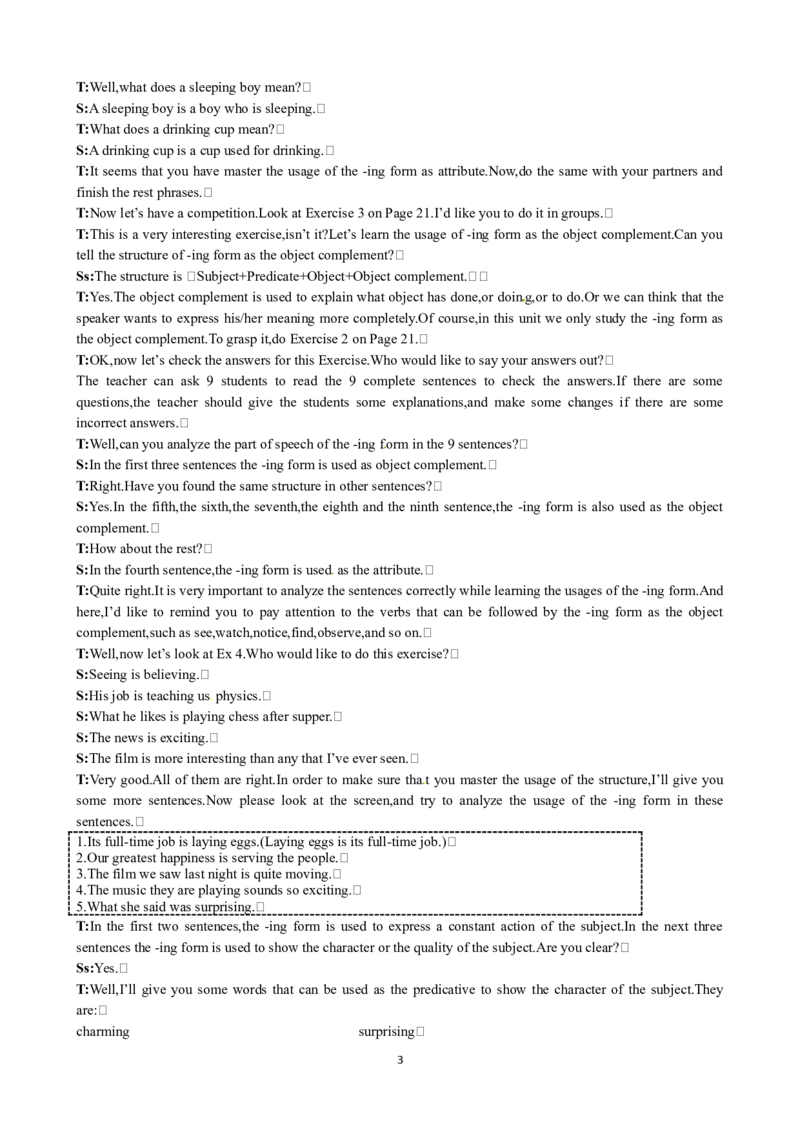
1.Its full-time job is laying eggs.(Laying eggs is its full-time job.)
2.Our greatest happiness is serving the people.
3.The film we saw last night is quite moving.
4.The music they are playing sounds so exciting.
5.What she said was surprising.
T:In the first two sentences,the -ing form is used to express a constant action of the subject.In the next three
sentences the -ing form is used to show the character or the quality of the subject.Are you clear?
Ss:Yes.
T:Well,I’ll give you some words that can be used as the predicative to show the character of the subject.They
are:
charming surprising
3interesting
moving inspiring
disappointing boring
encouraging confusing
astonishing tiring
exciting frightening
Step 4 Summary and homework
T:Well,it’s almost time for a break.We have to bring an end to the class.To consolidate what we have learned in
this period,I’d like you to do the exercises in the Using words and expressions part and the exercises in the Using
structures part as your homework.Yes,if you want to master a grammar item,you must do much practice,and
practice makes perfect.See you tomorrow!
Ss:See you!
The Design of the Writing on the Blackboard
Unit 3 A taste of English humour
Period 2 Learning about language
The usage of the -ing form
1)as the attribute
2)as the object complement
3)as the predicative
Record after Teaching
Activities and Research
In this period the teacher may offer the students a situation and ask the students make up a story according to
the situation given using the -ing form.It seems to be a two-birds-with-one-stone task,which can not only enable
the students to apply the -ing form correctly,but can...
Reference for teaching
Grammar
动词-ing 形式
1.动名词可以在句子中充当定语,表示所修饰名词的用途或使用目的,并且位于所修饰词的前面。可以转
换成“for...”的结构。例如:a walking stick=a stick for walking
swimming pool reading room
waiting room walking stick
dining room painting shop
washing machine sleeping car
teaching building working method
sleeping bag drinking cup
dancing hall operating table
2.现在分词在句子中也可以充当作定语,表示正在进行的动作、状态、性质、特征。可以转换成定语从句
结构或表语结构。例如:a developing country=a country which is developing;the tiring journey=the journey is
tiring
注意:单个现在分词作定语放在所修饰名词的前面;分词短语作定语放在所修饰名词的后
a waiting man a developing country
a missing boy a sleeping child
a walking man a dancing girl
a drinking horse the rising sun
4the girl wearing a red skirt the boy playing football
the man standing at the school gate the old man sitting on the sofa
the farmers getting in crops the scientist doing experiment
the man chewing his own shoes a charming character
the surprising news an interesting story
moving deeds a inspiring leader
a disappointing answer the boring class
encouraging words confusing choices
astonishing loud sound the tiring journey
an exciting football match
3.动名词可以在句子中充当表语,表示一般性、经常性的动作。这是主语和表语的位置可以互换。例如:
Its full-time job is laying eggs.(Laying eggs is its full-time job.)
Our greatest happiness is serving the people.
Our task is building socialism.
4.现在分词在句子中也可以充当表语,表示主语的性质、特征。这是主语和表语的位置不可以互换。例如:
The film we saw last night is quite moving.
The music they are playing sounds so exciting.
What she said was surprising.
常可以作表语的现在分词有:
charming surprising
interesting moving
inspiring disappointing
boring encouraging
confusing astonishing
tiring exciting
frightening
5.现在分词可以在句子中充当宾语补足语,表示正在发生的动作。例如:
We watched her crossing the street.
He looked around and caught a man putting his hand into the pocket of a passenger.
常跟现在分词作宾语补足语的多是一些使役动词(have,get,send,leave,keep)、感官动词
(see,hear,watch,observe,notice,catch,find,listen to,look at,etc.)。
5