Period 3 Listening and Speaking
The General Idea of This Period
This is the third period of this unit. At the beginning of this period, the teacher should (can)
design some exercises to review what the students learned in the last period, that is to say, go
over what the students learned about that John Snow defeats“King Cholera”. The teacher can
begin with asking some questions or having a competition to make some sentences with“John
Snow”according to the passage.
During this period, listening and speaking will be mainly dealt with. At the beginning,
teachers focus on training the Ss’ listening. This listening content is about the importance of Qian
Xuesen for space travel in China, the contributions made by a botanist named Carl Linnaeus and
the research into the life and work of a mathematician called Leonhard Euler.
When training the Ss’ listening ability, teachers should start with pre-listening, that is, lead-
in. If it is necessary, teachers had better introduce some background knowledge about the
listening material. Later, let the Ss listen to it. At the same time, teachers should design some
simple questions. After that, the Ss have known about the listening material, and then teachers
can ask them to listen to it again to be ready for more difficult questions. If necessary, the Ss can
be given another time to listen. While practicing, teachers had better offer students some advice
on how to do it well. Especially, train the students to predict what to be talked about according to
the hints and limited information and let them form the good listening habit of listening with the
purpose of finding useful information and to summarize. Certainly, suppose there are many new
words and expressions, teachers should help them to deal with them at the first place. All the
listening practice should focus on developing the students’ listening skill.
After practicing listening, the Ss are expected to learn some expressions about talking about
scientific job as well as scientists’ achievements and recount stories. Besides those, the students
are expected to learn the skill of describing a person.
During the course, teachers should rank class activities from the easy to the difficult. First,
ask them to learn the expressions. Then, ask them to imitate it to have a dialogue. Finally, the
students are expected to create a dialogue or discuss the given topic. In order to draw students’
attention, the teacher had better prepare for some interesting situations.
This period centers on emphasis on speaking and listening. The teacher should try his or her
best to encourage the students to say something. Don’t always correct the mistakes that the
students would make while speaking. Otherwise, the students would feel reluctant to speak out
their opinions.
Teaching Important Points
Train the students’ speaking ability by describing, talking and discussing.
Help the students improve their listening ability.
Teaching Difficulties
Train the students’ listening ability. Especially listen and understand what the speakers
mean beyond words.
Teaching Aids
a tape recorder, a projector and the blackboard
Three Dimensional Teaching Aims
Knowledge aims:
Let the Ss know about some scientists and their life and contributions.
1Get the Ss to learn how to talk about scientific work and how to describe a person.
Ability Aims:
Train the students’ speaking ability by describing, talking and discussing.
Train the students’ listening ability.
Emotional Aims:
Train the students’ability to cooperate with others.
Encourage the students to learn from scientists to show interest in scientific exploration and
research.
Teaching Procedure
Step 1 Greeting
T: Hello, boys and girls.
Ss: Hello, Miss Wang.
Step 2 Revision
T: Today we will begin our lesson with a competition between groups. In the last period, we
learnt about John Snow who defeats“King Cholera”. Now, please say something that you know
about it. If you offer a complete sentence, you will be given ten marks. Your group will be given
twenty marks when your expression is especially beautiful.
S: John Snow was a well-known doctor in London, who attended Queen Victoria to ease the
birth of her babies.
S: He became inspired when he thought about helping ordinary people exposed to cholera,
which was the deadly disease of his day.
S: John Snow got interested in two theories explaining how cholera killed people.
S: He believed in the second theory that is people absorbed this disease into their bodies
with their meals. From the stomach the disease attacked the body quickly and soon the affected
person was dead.
Ss: . . .
(The teacher should encourage more students to join in the competition. At the end of the
competition, the teacher should announce the result of this competition. Praise the winner and
encourage the losers. )
T: What can we learn from John Show?
S: We should base our theories on practice.
S: We are inspired to have a spirit of scientific exploration.
S: We do some research with the purpose of serving the people and society.
Ss: . . .
T: Yes, we can learn a lot from the scientist. In fact, there are a great number of people
working on science worthy of being learned both at home and abroad. Can you name some
scientists and introduce their main contributions?
S: Archimedes, who discovered that objects in water are lifted up by a force that helps them
float.
S: Darwin wrote a book explaining how animals and plants developed as the environment
changed.
S: Madam Curie discovered radium.
S: Stephen Hawking put forward a theory about black holes.
S: Zhang heng invented the earliest instrument to tell people where earthquakes happened.
2Ss: . . .
T: You did a good job and listed many scientists as well as their contributions. Today, we are
going to learn about more scientists.
Step 3 Listening (on Pages 5-6)
Task 1 Pre-listening
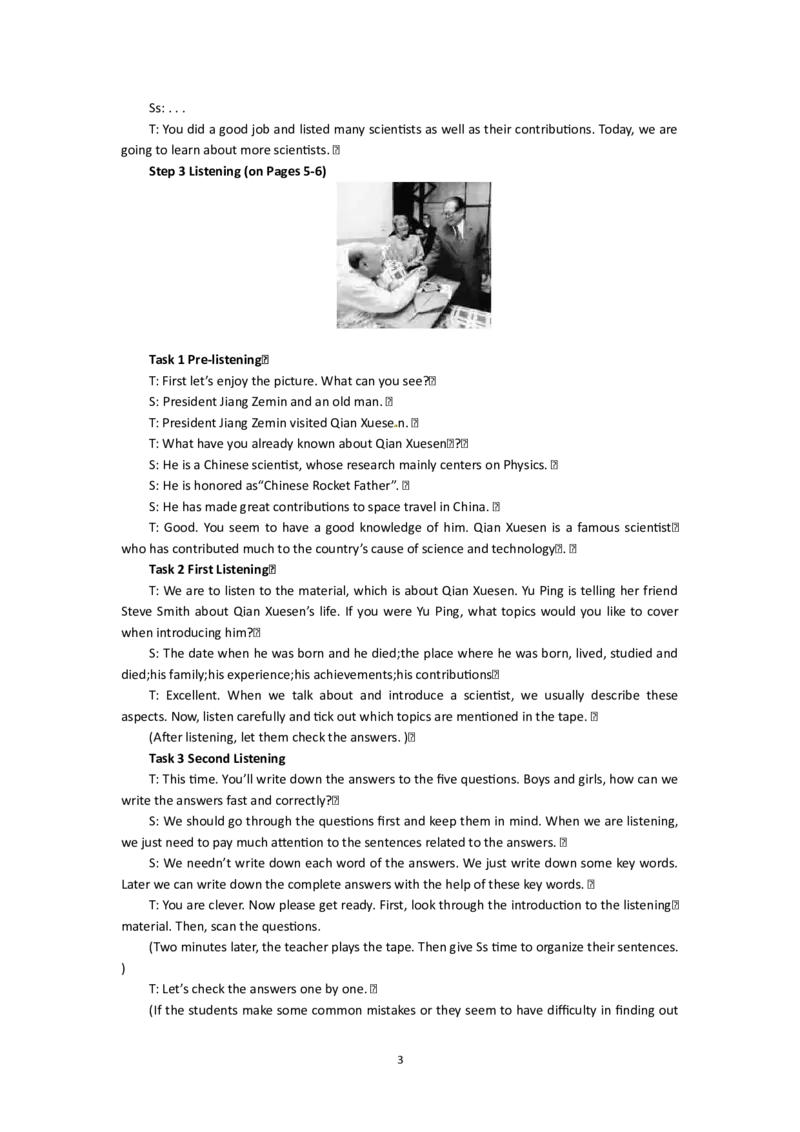
T: First let’s enjoy the picture. What can you see?
S: President Jiang Zemin and an old man.
T: President Jiang Zemin visited Qian Xuesen.
T: What have you already known about Qian Xuesen?
S: He is a Chinese scientist, whose research mainly centers on Physics.
S: He is honored as“Chinese Rocket Father”.
S: He has made great contributions to space travel in China.
T: Good. You seem to have a good knowledge of him. Qian Xuesen is a famous scientist
who has contributed much to the country’s cause of science and technology.
Task 2 First Listening
T: We are to listen to the material, which is about Qian Xuesen. Yu Ping is telling her friend
Steve Smith about Qian Xuesen’s life. If you were Yu Ping, what topics would you like to cover
when introducing him?
S: The date when he was born and he died;the place where he was born, lived, studied and
died;his family;his experience;his achievements;his contributions
T: Excellent. When we talk about and introduce a scientist, we usually describe these
aspects. Now, listen carefully and tick out which topics are mentioned in the tape.
(After listening, let them check the answers. )
Task 3 Second Listening
T: This time. You’ll write down the answers to the five questions. Boys and girls, how can we
write the answers fast and correctly?
S: We should go through the questions first and keep them in mind. When we are listening,
we just need to pay much attention to the sentences related to the answers.
S: We needn’t write down each word of the answers. We just write down some key words.
Later we can write down the complete answers with the help of these key words.
T: You are clever. Now please get ready. First, look through the introduction to the listening
material. Then, scan the questions.
(Two minutes later, the teacher plays the tape. Then give Ss time to organize their sentences.
)
T: Let’s check the answers one by one.
(If the students make some common mistakes or they seem to have difficulty in finding out
3answers, teachers can give them some hints and let them listen to it again. After that, check the
answers. If the students feel it difficult to make sense about the key words and understand the
speakers’ intention and attitude, the teacher should give them some help. )
Task 4 Post-listening
T: After listening, would you please answer some questions?
1 What did you hear on the tape?
2 What can you learn from Qian Xuesen?
(At this part the teacher may have the students present what they have heard on the tape
and show their own opinion about what they have learned from him. If possible, the teacher may
have some of the students do the presentation work in class. By doing this, the students can get
full understanding of what the tape is talking about. )
Step 4 Listening (Page 41)
Task 1 Pre-listening
T: Just now we learned about a Chinese scientist, Qian Xuesen, who has made great
contributions on space travel in China. We will get to know another scientist, whose contribution
is on botany. Can you guess who he is?
S: Carl Linnaeus, maybe Darwin.
T: You are right. Both scientists did study botany and devoted their time to the research. As
we know, Carl Linnaeus developed his system about how to classify species. While Darwin wrote
a book on the Original of Species, in which he explained how animals and plants developed as
the environment changed. The following is about Carl Linnaeus.
T: Now, read the instructions about the listening and choose which of the following
statements mist closely describes what this listening passage is about. Explain why the others are
wrong.
S: I think the third one is right. This is about a man who finds a flower and wants to know if it
is a new species of flower. Because he is interested in biology and especially in the study of
plants. What he wants to do is to study whether it is a new species. The other two statements
can not convey the study.
Task 2 Listening
T: What you said is reasonable. Let’s listen together to find whether your answer is right.
(After listening, let them check the answers. )
T: Listen to the tape again and try to complete the following passage.
To find the name of an unknown flower, first you have to go to see a flower
__________he/she will look in a special__________written by Carl Linnaeus. He lived
in__________ from__________ to __________. He was very important because he solved a
serious problem for __________. He saw all plants and animals produce __________. Some
animals produce __________but others lay__________while plants__________. He used these
different ways of producing young to put plants and animals into__________. For example, the
group called birds lay__________to produce young and they all have __________. Linnaeus put
the plants and animals into smaller groups or species. He gave each one two names. One is for
the large group, for example__________and one is for the species, for example __________. So a
parrot would be __________. He was the first person to successfully classify all plants and
animals.
Task 3 Post-listening
4Let the students fill in the blankets and then check. If the students feel it difficult to do it, let
them listen it a third time. After checking the answers, ask the students to read it together.
Step 5 Listening (Page 44)
T: Look at the screen and let’s read the following new words firstly.
(These words are presented on the screen: analyse, pure, foundation, symbol, sin, cosin,
geometry, calculus, mechanics, practical, topology)
T: Can you guess which field the next scientist is in according to the new words?
S: The next must be a mathematician.
T: Right. This mathematician is Leonhard Euler. John Smith is discussing with Zhao Yang his
research into the life and work of a mathematician called Leonhard Euler. Listen to the tape and
fill in the chart on the importance of Euler’s work.
Euler’s achievements Examples
New symbols and terms
Old areas of mathematics
New area of mathematics
Importance
(After listening, ask some students to fill in it. If many students feel it difficult, let them listen
to it again. While doing it, the teacher can also ask two students to come to write the answers on
the blackboard. The teacher had better give them praise if they do it well. )
Step 6 Speaking
Task 1 Lead-in
T: Boys and girls, from the listening material, we know about some scientists. Do you have a
dream to be a scientist in the future?
Ss: Yes. /No.
T: Suppose you would like to work as a scientist, and you are discussing with your partner
about your future job. What questions would you like to concern?
S : What job do you want to do?
1
S : How will you get the job?
2
S : What preparations will you make for the future job?
3
T: Right. Apart from those, we can also talk about the following questions:
1 What education will you need?
2 What personality will be needed?
3 What work experience would be useful?
4 How long will the training take?
5 How will you prepare for this career?
T: These expressions may help you:
I always wanted to. . . because. . . The experience I will need is. . .
I might find it difficult to. . . I need to practise. . .
My greatest problem will be to. . .
I will need to be/become. . .
patient, creative, hard-working, co-operative, confident, brave, positive, pleasant, polite,
determined, energetic, strict with. . .
Task 2 Dialogue (pair work)
T: Now it is time to discuss what scientific job each of you would like to choose in the future
with the help of the mentioned questions and expressions in pairs. I will give you five minutes to
5prepare for it. After that I will let some of pairs to come to act it out.
Sample:
A: What job do you want to do in the future?
B: I always want to be a botanist.
A: If you want to be a scientist, what education will you need?
B: I will try my best to go to a key university to learn and study botany.
A: What work experience would be useful?
B: The experience I will need is to study wild plants in the wild when I am at school. Now, I
join the social natural club organized by our school. Every time I make every effort to overcome
difficulty to study plants in the wild.
A: Do you know what personality will be needed if you want to be a scientist in the future?
B: I will need to be patient, creative, hard-working, brave, energetic and co-operative.
A: Yes, I agree with you. Besides those personalities, we also should be determined,
confident and positive.
B: I will make efforts to own such good quality.
A: How will you prepare for this career?
B: I intend to go to college next year and then I will have a chance to be a scientist. But my
greatest problem will be whether I will be able to go to university in the future.
A: Don’t worry about it and just get down to preparing for it. Good chances always belong
to the persons who have already prepared for them. I am sure you will succeed if you keep
working hard. I am waiting for your good news.
B: Thank you for your encouragement. I will make full use of time to struggle for success.
Task 3 Free-talk
T: Let us talk freely. You are allowed to move about to find a student you’d like to talk with.
Imagine you are going to meet a specialist about a newly-found flower. Your partner will be the
assistant for the flower specialist. You both need a description of the other so you can recognize
each other when you meet. Now ring the assistant to sort out the necessary information.
(Of course, following the above, the students may gather around or move around to find
their own favorite partners to talk with. This is a half-controlled activity. Teachers let them
express whatever they want to on condition that there are some expressions on the theme. Give
them about five minutes to prepare for it. Later, ask some pairs to act it out. As usual, the teacher
won’t forget to give comments on what the students do, including the teacher’s words praising
what they are doing in the first few stages. Only in this way are the students encouraged to talk
freely about what they want to say and why they think so. )
Step 7 Summary and Homework
T: In this period, we mainly focus on the speaking and listening abilities. If you feel listening
or speaking poor, you had better practice more after class. Practice makes perfect. Today’s
homework is to describe a scientist to your partner and let your partner guess who she/he is.
Then exchange.
The Design of the Writing on the Blackboard
Unit 1 Great scientists
Period 3 Listening and Speaking
The questions may be useful to discuss the scientific The expressions may help you to discuss your future
job, scientific job.
What job do you want to do? I always wanted to...because...
6What education will you need? The experience I will need is...
What personality will be needed? I might find it difficult to...
What work experience would be useful? I need to practise...
How long will the training take? My greatest problem will be to...
How will you prepare for this career? I will need to be/become patient, creative, hard-
working, co-operative, confident, brave...
Research and Activities
After class, use the library or the Internet to find out facts about important women scientists
in medicine, physics, chemistry, biology, astronomy or mathematics.There are very useful
websites (including the“Biographies of women mathematicians website”).Prepare a talk on your
chosen scientists.Remember to include some information about their life, their achievements and
why they are considered important in science history.Then give your talk to the class.
Research for Teaching
Euler, Leonhard
(born April 15, 1707, Basel, Switz.died Sept.18, 1783, St.Petersburg, Russia)
Swiss mathematician and physicist, one of the founders of pure mathematics.He not only
made decisive and formative contributions to the subjects of geometry, calculus, mechanics, and
number theory but also developed methods for solving problems in observational astronomy and
demonstrated useful applications of mathematics in technology and public affairs.
Euler’s mathematical ability earned him the esteem of Johann Bernoulli, one of the first
mathematicians in Europe at that time, and of his sons Daniel and Nicolas.In 1727 he moved to
St.Petersburg, where he became an associate of the St.Petersburg Academy of Sciences and in
1733 succeeded Daniel Bernoulli to the chair of mathematics.
Euler devoted considerable attention to developing a more perfect theory of lunar motion,
which was particularly troublesome, since it involved the so-called three-body problem—the
interactions of the Sun, Moon, and Earth.(The problem is still unsolved.) His partial solution,
published in 1753, assisted the British Admiralty in calculating lunar tables, of importance then in
attempting to determine longitude at sea.One of the feats of his blind years was to perform all the
elaborate calculations in his head for his second theory of lunar motion in 1772.Throughout his
life Euler was much absorbed by problems dealing with the theory of numbers, which treats of the
properties and relationships of integers, or whole numbers (0, ±1, ±2, etc.); in this, his greatest
discovery, in 1783, was the law of quadratic reciprocity, which has become an essential part of
modern number theory.
In his effort to replace synthetic methods by analytic ones, Euler was succeeded by J.-
L.Lagrange.But, where Euler had delighted in special concrete cases, Lagrange sought for
abstract generality; and, while Euler incautiously manipulated divergent series, Lagrange
attempted to establish infinite processes upon a sound basis.Thus it is that Euler and Lagrange
together are regarded as the greatest mathematicians of the 18th century; but Euler has never been
excelled either in productivity or in the skillful and imaginative use of algorithmic devices (i.e.,
computational procedures) for solving problems.
Carl Linnaeus
(born May 23, 1707, R . shult, Sm ^ land, Swed. died Jan.10, 1778, Uppsala )
a a
Carl Linnaeus is a Swedish botanist and explorer who was the first to frame principles for
defining genera and species of organisms and to create a uniform system for naming them.
Linnaeus was the son of a curate.His love of flowers developed at an early age; when only
7eight years old he was nicknamed“the little botanist.”He studied at the universities of Lund and
Uppsala and received his degree in medicine from the latter.
The Systema Naturae, which Linnaeus had shown to the botanist Jan Fredrik Gronovius in
manuscript, so impressed Gronovius that he published it at his own expense.Linnaeus’ system was
based mainly on flower parts, which tend to remain unchanged during the course of evolution.
Although artificial, as Linnaeus himself recognized, such a system had the supreme merit of
enabling students rapidly to place a plant in a named category.It came into use at a period when
the richness of the world’s vegetation was being discovered at a rate that outstripped more
leisurely methods of investigation.So successful was his method in practice that its very ease of
application proved to be the greatest obstacle to its replacement by the more natural systems that
superseded it.
His later years were taken up by teaching and the preparation of other works: Flora Suecica
(1745) and Fauna Suecica (1746); two volumes of observations made during the journeys in
weden, V .. stg.. ta resa (1747) and Sk . nska resa (1751); Hortus Upsaliensis (1748); his
a o a
Philosophia Botanica (1751); and the important Species Plantarum (1753), in which the specific
names are fully set forth.In 1755 he declined an invitation from the King of Spain to settle in that
country with a liberal salary and full liberty of conscience.In 1761 he was granted a Swedish
patent of nobility, antedated to 1757, from which time he was styled Carl von Linné.An apoplectic
attack in 1774 left him greatly weakened, and he died four years later.
The Linnaean manuscripts, and his herbarium and collections of insects and shells, purchased
by Sir J.E.Smith in 1783, are carefully preserved by the Linnean Society at Burlington House,
London.
Marie Curie
(born Nov.7, 1867, Warsaw, Pol., Russian Empire.died July 4, 1934, near Sallanches,
France )
Maria Sklodowska Polish—born French physicist famous for her work on radioactivity and
twice a winner of the Nobel Prize.With Henri Becquerel and her husband, Pierre Curie, she was
8awarded the 1903 Nobel Prize for Physics.She was then the sole winner of the 1911 Nobel Prize
for Chemistry.
From childhood she was remarkable for her prodigious memory, and at the age of 16 she won
a gold medal on completion of her secondary education at the Russian lycée.Because her father, a
teacher of mathematics and physics, lost his savings through bad investment, she had to take work
as a teacher and, at the same time, took part clandestinely in the nationalist“free university,
”reading in Polish to women workers.At the age of 18 she took a post as governess, where she
suffered an unhappy love affair.From her earnings she was able to finance her sister Bronia’s
medical studies in Paris, on the understanding that Bronia would in turn later help her to get an
education.
She came first in the licence of physical sciences in 1893.She began to work in Lippmann’s
research laboratory and in 1894 was placed second in the licence of mathematical sciences. It was
in the spring of this year that she met Pierre Curie.
Their marriage (July 25, 1895) marked the start of a partnership that was soon to achieve
results of world significance, in particular the discovery of polonium (so called by Marie in
honour of her native land) in the summer of 1898, and that of radium a few months
later.Following Henri Becquerel’s discovery (1896) of a new phenomenon (which she later
called“radioactivity”), Marie Curie, looking for a subject for a thesis, decided to find out if the
property discovered in uranium was to be found in other matter.She discovered that this was true
for thorium at the same time as G.C.Schmidt did.
In December 1904 she was appointed chief assistant in the laboratory directed by Pierre
Curie.The sudden death of Pierre Curie (April 19, 1906) was a bitter blow to Marie Curie, but it
was also a decisive turning point in her career: henceforth she was to devote all her energy to
completing alone the scientific work that they had undertaken.On May 13, 1906, she was
appointed to the professorship that had been left vacant on her husband’s death; she was the first
woman to teach in the Sorbonne.In 1908 she became titular professor, and in 1910 her
fundamental treatise on radioactivity was published.In 1911 she was awarded the Nobel Prize for
Chemistry, for the isolation of pure radium.In 1914 she saw the completion of the building of the
laboratories of the Radium Institute (Institut du Radium) at the University of Paris.
One of Marie Curie’s outstanding achievements was to have understood the need to
accumulate intense radioactive sources, not only for the treatment of illness but also to maintain an
abundant supply for research in nuclear physics; the resultant stockpile was an unrivaled
instrument until the appearance after 1930 of particle accelerators.The existence in Paris at the
Radium Institute of a stock of 1.5 grams of radium in which, over a period of several years,
radium D and polonium had accumulated, made a decisive contribution to the success of the
experiments undertaken in the years around 1930 and in particular of those performed by Irène
Curie in conjunction with Frédéric Joliot, whom she had married in 1926 (see Joliot-Curie,
Frédéric and Irène).This work prepared the way for the discovery of the neutron by Sir James
Chadwick and above all the discovery in 1934 by Irène and Frédéric Joliot-Curie of artificial
radioactivity.A few months after this discovery Marie Curie died as a result of leukemia caused by
the action of radiation.Her contribution to physics had been immense, not only in her own work,
the importance of which had been demonstrated by the award to her of two Nobel Prizes, but
because of her influence on subsequent generations of nuclear physicists and chemists.
In 1995 Marie Curie’s ashes were enshrined in the Panth on in Paris; she was the first woman
9to receive this honour for her own achievements.
10