第 10 讲 情态动词
目录
01 考情透视·目标导航····························································································································2
02 知识导图·思维引航····························································································································3
03 考点突破·考法探究····························································································································3
考点一 情态动词的基本用法
知识点1 情态动词的基本含义和用法······················································································4
知识点2 情态动词+have done的用法·················································································8
考点二 虚拟语气
知识点1 if条件句的虚拟语气用法·······················································································9
知识点2 (should)+动词原形的虚拟语气···········································································9
知识点3 虚拟语气特殊句式································································································11
04真题练习·命题洞现
1.真题实战 ·································································································································11
2.命题演练 ·································································································································12
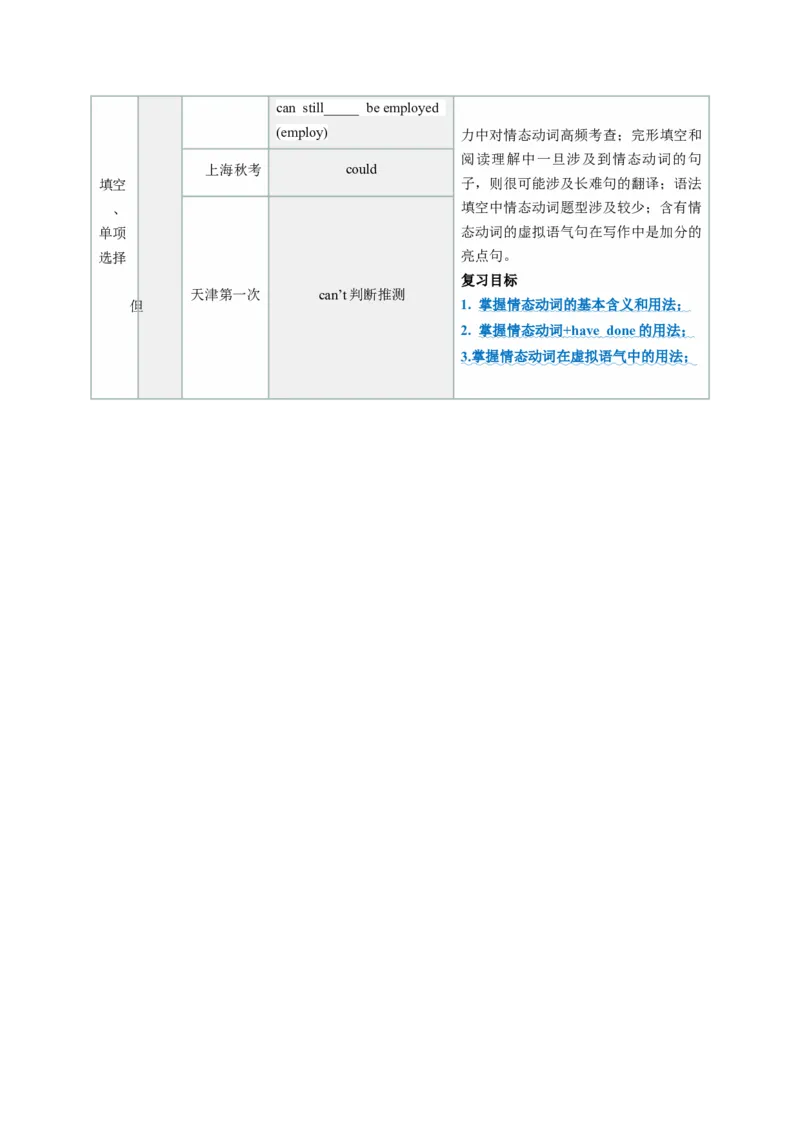
题型 年份 卷别 考点统计 考情分析
分析近年高考真题可知,高考对情态动
语法 2023 全国甲卷
词的考查在地方卷比较常见。全国卷听can still_____ be employed
(employ) 力中对情态动词高频考查;完形填空和
阅读理解中一旦涉及到情态动词的句
上海秋考 could
填空 子,则很可能涉及长难句的翻译;语法
、 填空中情态动词题型涉及较少;含有情
单项 态动词的虚拟语气句在写作中是加分的
选择 亮点句。
复习目标
天津第一次 can’t判断推测
但 1. 掌握情态动词的基本含义和用法;
2. 掌握情态动词 +hav e don e 的用法;
3 . 掌握情态动词在虚拟语气中的用法;考点一 情态动词的基本用法知识点1 情态动词的基本含义和用法
情态动词:本身具有一定的意义,用于表达说话人的情感态度、语气或主观设想。情态动词不能独立作谓
语,必须与动词原形一起构成谓语。情态动词在特殊语境具有特殊含义(如:must“非得;偏要”,should“竟
然”,shall用于第二、三人称表示警告、命令、威胁、允诺、规定等)是高考的热点和难点。常见情态动词
的基本用法是高考考查的重点。必须根据具体语境判断使用相应的情态动词。
类别:1. 只作情态动词,如may, might, must, can等。
2. 既作情态动词又作实义动词,如need, dare。
3. 具有情态动词特征的动词词组,如have(had, has) to, used to, ought to。
4. 可做情态动词又可作助动词,如shall(should), will(would)。
一 can/could的用法
1. 表示能力,could表示过去的能力。
That’s when APL can make a difference.(2021年上海卷听力)
这就是APL能够发挥作用的时候。
How long can you balance on one leg?
你单腿能站多久?
2.表示可能(理论上或是逻辑上)。
He can't/couldn't have enough money for a new car.他不可能有足够的钱买一辆新车。
典例(2024年新高考I卷听力Text 3)His aunt is in town, so he can't go with us today.
【解析】考查情态动词的基本用法。根据上句语境可判断,can表示判断推测,用于否定句,意为“不可
能”。
【译文】他的阿姨在镇子里,所以他今天不可能和我们一起去。
3. 表示允许。
Can I have a look at your new pen?我能看看你的新钢笔吗?
4. 表示惊讶、怀疑、不相信等态度。主要用于否定句、疑问句或感叹句中。
He can't/couldn't be over sixty. 他不可能超过六十岁了。
How can you be so careless?
你怎么能这么粗心呢?
5. 比较委婉客气地提出问题或陈述看法。
Can/Could you lend me a hand?
你能帮我一下吗?
典例1.(2023年全国甲卷)Carson proves that a simple literary form that has been passed down through
the ages can still ______ (employ) today to draw attention to important truths.
【解析】考查情态动词和动词语态。句意:Carson证明了一种被传承了多年的简单的文学形式依然能在今天
被利用以引起人们对重要真理的注意。此处从句的主语是a simple literary form,这里指这种文学形式被利
用。又因为空处在情态动词can后面。故填be employed。
【答案】be employed思维建模:解答涉及动词的题时,要瞻前顾后,发现情态动词后,首先根据复杂语境判断情态动词的基本
含义,再根据其具体用法解题。切忌不看语境和句意一律使用情态动词后+动词原形。
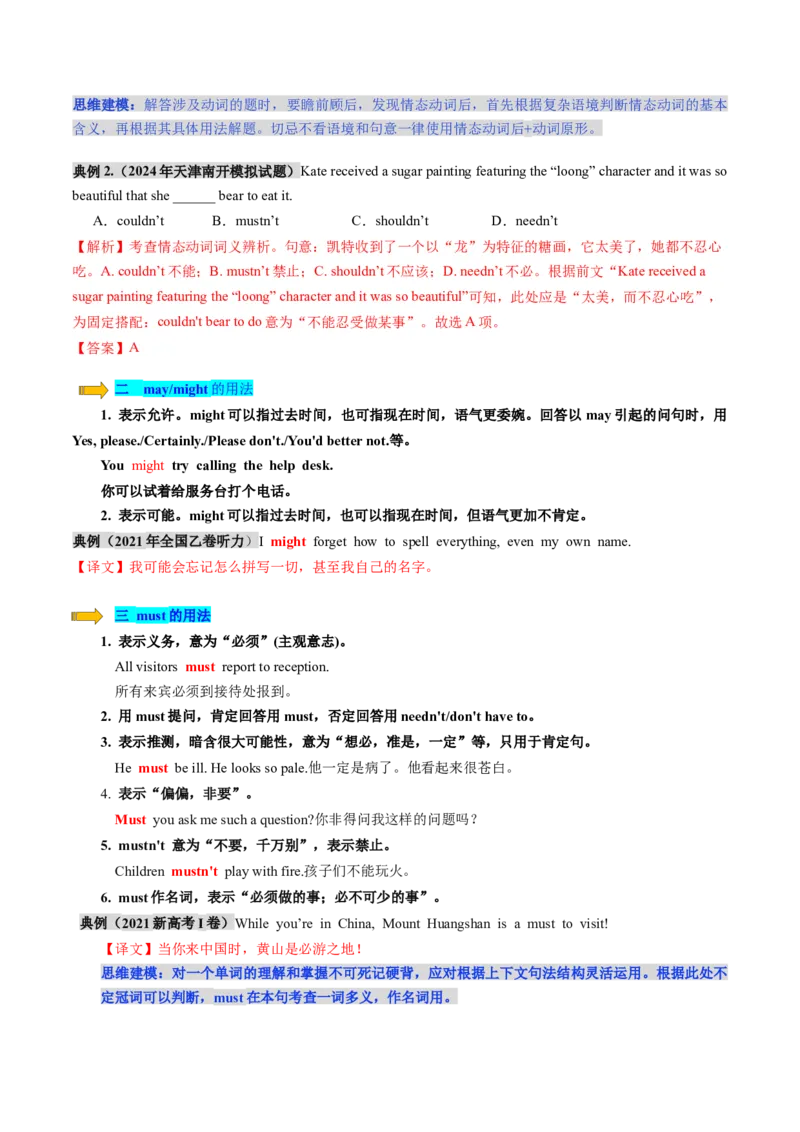
典例2.(2024年天津南开模拟试题)Kate received a sugar painting featuring the “loong” character and it was so
beautiful that she ______ bear to eat it.
A.couldn’t B.mustn’t C.shouldn’t D.needn’t
【解析】考查情态动词词义辨析。句意:凯特收到了一个以“龙”为特征的糖画,它太美了,她都不忍心
吃。A. couldn’t不能;B. mustn’t禁止;C. shouldn’t不应该;D. needn’t不必。根据前文“Kate received a
sugar painting featuring the “loong” character and it was so beautiful”可知,此处应是“太美,而不忍心吃”,
为固定搭配:couldn't bear to do意为“不能忍受做某事”。故选A项。
【答案】A
二 may/might的用法
1. 表示允许。might可以指过去时间,也可指现在时间,语气更委婉。回答以may引起的问句时,用
Yes, please./Certainly./Please don't./You'd better not.等。
You might try calling the help desk.
你可以试着给服务台打个电话。
2. 表示可能。might可以指过去时间,也可以指现在时间,但语气更加不肯定。
典例(2021年全国乙卷听力)I might forget how to spell everything, even my own name.
【译文】我可能会忘记怎么拼写一切,甚至我自己的名字。
三 must的用法
1. 表示义务,意为“必须”(主观意志)。
All visitors must report to reception.
所有来宾必须到接待处报到。
2. 用must提问,肯定回答用must,否定回答用needn't/don't have to。
3. 表示推测,暗含很大可能性,意为“想必,准是,一定”等,只用于肯定句。
He must be ill. He looks so pale.他一定是病了。他看起来很苍白。
4. 表示“偏偏,非要”。
Must you ask me such a question?你非得问我这样的问题吗?
5. mustn't 意为“不要,千万别”,表示禁止。
Children mustn't play with fire.孩子们不能玩火。
6. must作名词,表示“必须做的事;必不可少的事”。
典例(2021新高考I卷)While you’re in China, Mount Huangshan is a must to visit!
【译文】当你来中国时,黄山是必游之地!
思维建模:对一个单词的理解和掌握不可死记硬背,应对根据上下文句法结构灵活运用。根据此处不
定冠词可以判断,must在本句考查一词多义,作名词用。四 shall的用法
1. 表示征询意见,用于第一、第三人称疑问句。
When shall I be at your place?(2021年新高考I卷听力)
我什么时候去你那儿?
2. 表示说话人的意愿,有“命令,允诺,警告,决心”等意思,用于第二、第三人称陈述句。
You shall do as I say. (命令) 你要照我说的去做。
Everyone shall not pass without permission! (警告)没有允许,任何人休想通过!
五 will的用法
1. 表示意愿,用于各种人称陈述句。
If you will read the book, I'll lend it to you.如果你愿意读这本书,我就借给你。
2. 表示某种倾向或习惯性动作。
These things will happen. 这些事情早晚要发生。
3. 表示临时作出的决定。
—Someone is knocking at the door. 有人在敲门。
—I will answer it. 我来开门。
六 would的用法
1. 表示意愿。
She just wouldn't do what I asked her.
她就是不愿照我说的去做。
2. 表示委婉地提出请求、建议或看法。
3. 表示过去反复发生的动作或过去的一种倾向。
When he was young, he would sit in front of the door, waiting for his father to come back home.
小时候,他常常坐在门口等着爸爸回家。
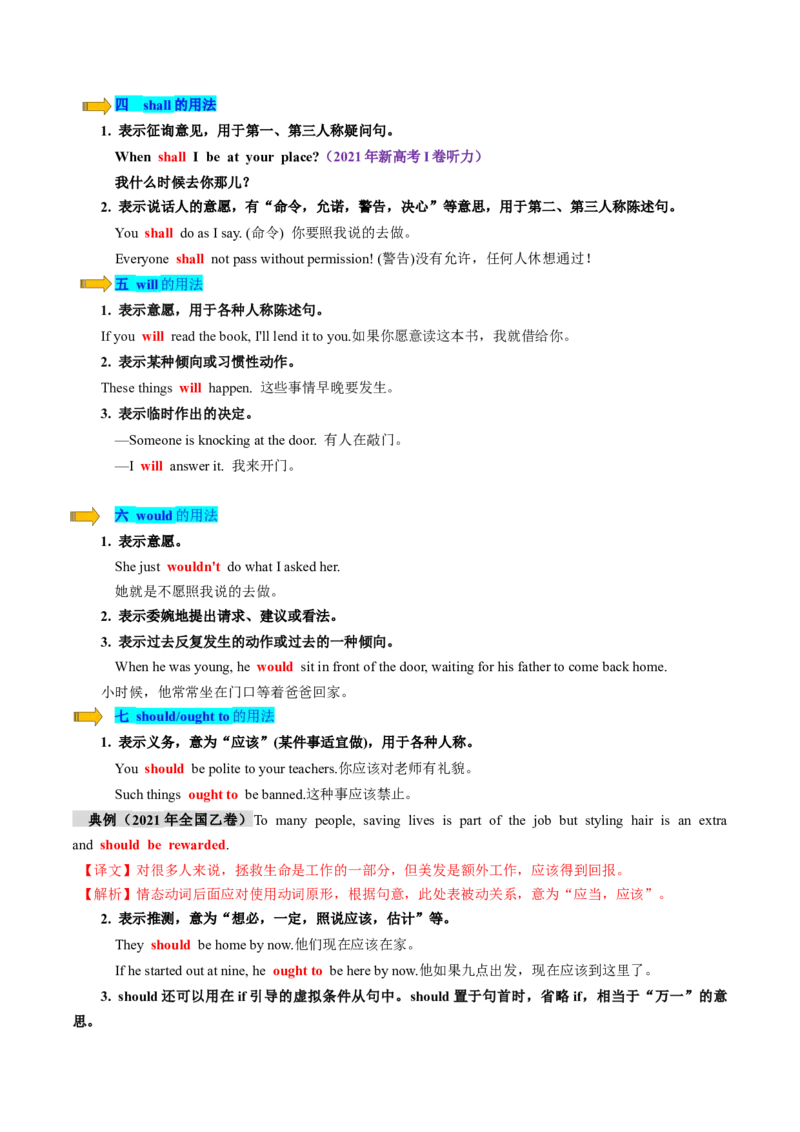
七 should/ought to的用法
1. 表示义务,意为“应该”(某件事适宜做),用于各种人称。
You should be polite to your teachers.你应该对老师有礼貌。
Such things ought to be banned.这种事应该禁止。
典例(2021年全国乙卷)To many people, saving lives is part of the job but styling hair is an extra
and should be rewarded.
【译文】对很多人来说,拯救生命是工作的一部分,但美发是额外工作,应该得到回报。
【解析】情态动词后面应对使用动词原形,根据句意,此处表被动关系,意为“应当,应该”。
2. 表示推测,意为“想必,一定,照说应该,估计”等。
They should be home by now.他们现在应该在家。
If he started out at nine, he ought to be here by now.他如果九点出发,现在应该到这里了。
3. should还可以用在if引导的虚拟条件从句中。should置于句首时,省略if,相当于“万一”的意
思。If it were not raining, we should go for a picnic.
如果现在不下雨的话,我们就出去野餐了。
Should you change your mind, please let us know.
万一你改变主意,请让我们知道。
4. should还可用在以 why, who, how等开头的疑问句或某些感叹句中,带有感情色彩。意为“竟然,
竟会”。
Why should you be so late today?
你今天竟然来得这么晚?
5. 在It is+adj.+that从句中,从句的谓语动词常用should+动词原形,should可以省略。
It is vital that every student (should) respect their teachers.
每个学生都应该尊重他们的老师,这很重要。
八 need的用法
need表示必要性,常用于疑问句和否定句中,needn't表示“不必”。need作实义动词时,可用于肯
定句、否定句和疑问句中,有人称、数和时态的变化;其后可接名词、代词、带to的不定式或动名词作宾
语。
The classroom needs cleaning.
=The classroom needs to be cleaned.
教室需要打扫。
九 dare的用法
dare“敢,敢于”,没有人称、数和时态的变化,主要用于疑问句、否定句和条件句中,后接动词原
形。作实义动词时,在肯定句中通常接带to的不定式,在疑问句和否定句中,dare之后的不定式可省略
to。
We should not be producing compliant students who do not dare (to) criticize.
我们不应当把学生培养成不敢批评的唯唯诺诺的人。
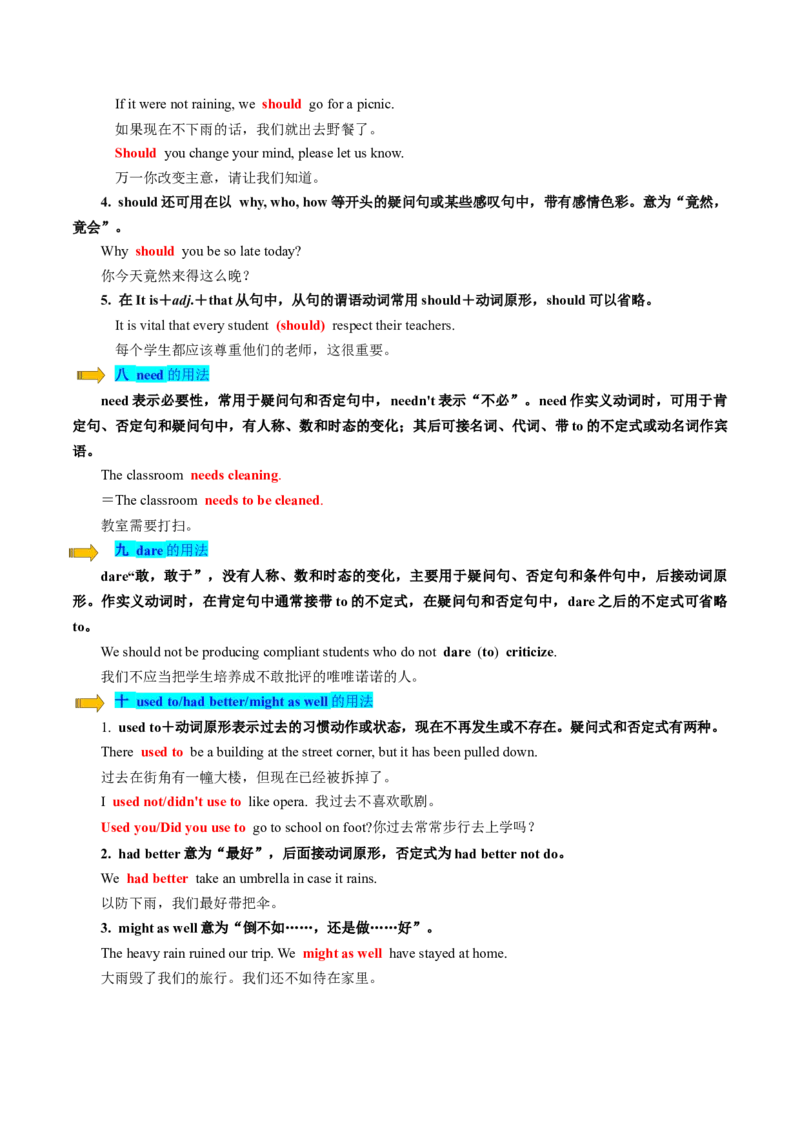
十 used to/had better/might as well的用法
1. used to+动词原形表示过去的习惯动作或状态,现在不再发生或不存在。疑问式和否定式有两种。
There used to be a building at the street corner, but it has been pulled down.
过去在街角有一幢大楼,但现在已经被拆掉了。
I used not/didn't use to like opera. 我过去不喜欢歌剧。
Used you/Did you use to go to school on foot?你过去常常步行去上学吗?
2. had better意为“最好”,后面接动词原形,否定式为had better not do。
We had better take an umbrella in case it rains.
以防下雨,我们最好带把伞。
3. might as well意为“倒不如……,还是做……好”。
The heavy rain ruined our trip. We might as well have stayed at home.
大雨毁了我们的旅行。我们还不如待在家里。知识点2 情态动词+have done的用法
分类 形式 用法
must have done 对过去的动作的肯定推测,表示肯定做过某事
表示对过去情况的否定推测,用于否定句和疑问句,表示不可
can't/couldn't have done
能做过某事
对过去的推测
表示对过去情况的不太肯定的推测;用于肯定句、否定句,但
may/might
不用于疑问句。表示“可能”。might have done 也用于虚拟语
have done
气句,表示未实现的动作
needn't have done 过去没有必要做……但实际上做了
should/ought to have
对过去情况的
过去本应该做……而实际上并未做
done
后悔、遗憾或
责备等 would have done 本来会做……而未做
could have done 本来可以做……但是实际没有做
典例1.(23-24高三·陕西西安·模拟试题)But for his timely help, we ______ our task in such a short time.
A.wouldn’t finish B.haven’t finished
C.couldn’t have finished D.can’t have finished
【解析】考查情态动词+have done的用法。句意:要不是他及时的帮助,我们不可能在这么短的时间内完
成任务。根据句意及所给句子可知,此处是对过去事情的否定推测,应用couldn’t have done,表示过去不
可能做某事。故选C。
【答案】C
典例2.(23-24高三·天津·期中)Mary’s bedroom is so tidy. She________have cleaned it yesterday.
A.must B.should C.need D.would
【解析】考查情态动词辨析。句意:玛丽的卧室很整洁。她昨晚一定打扫过了。A. must 一定;B. should
应该,很有可能;C. need 需要;D. would将,会。由“情态动词+have+done”结构可知,此处表示对过去
发生事件的肯定性推测,因为第一句交代了玛丽的卧室很整洁的背景,因此推测房间一定是打扫过了,
must符合文意。故选A项。
【答案】A
变式训练1. I’m not feeling well in the stomach. I shouldn’t (eat) so much fried chicken just now.
【解析】考查虚拟语气。句意:我的胃不舒服。我刚才不应该吃那么多炸鸡。根据“so much fried chicken
just now”可知,此处是指刚才不应该吃那么多炸鸡,shouldn’t have done意为“本不应该做某事”,是与过
去事实相反的虚拟语气。故填have eaten。【答案】have eaten
变式训练2. Johnson suggested the problem worth paying attention ________ at the meeting.
A.to be discussed B.to been discussed
C.being discussed D.should be discussed
【解析】考查虚拟语气。句意:约翰逊建议这个值得注意的问题在会上讨论。worth后应是及物动词的动
名词形式,pay attention to“注意”,to为介词不能省去;主句中的谓语动词为suggest,从句中应用虚拟语
气(should) do结构,主语problem与discuss是被动关系,故用be discussed,故选A项。
【答案】A
考点二 虚拟语气
知识点1 if条件句的虚拟语气用法
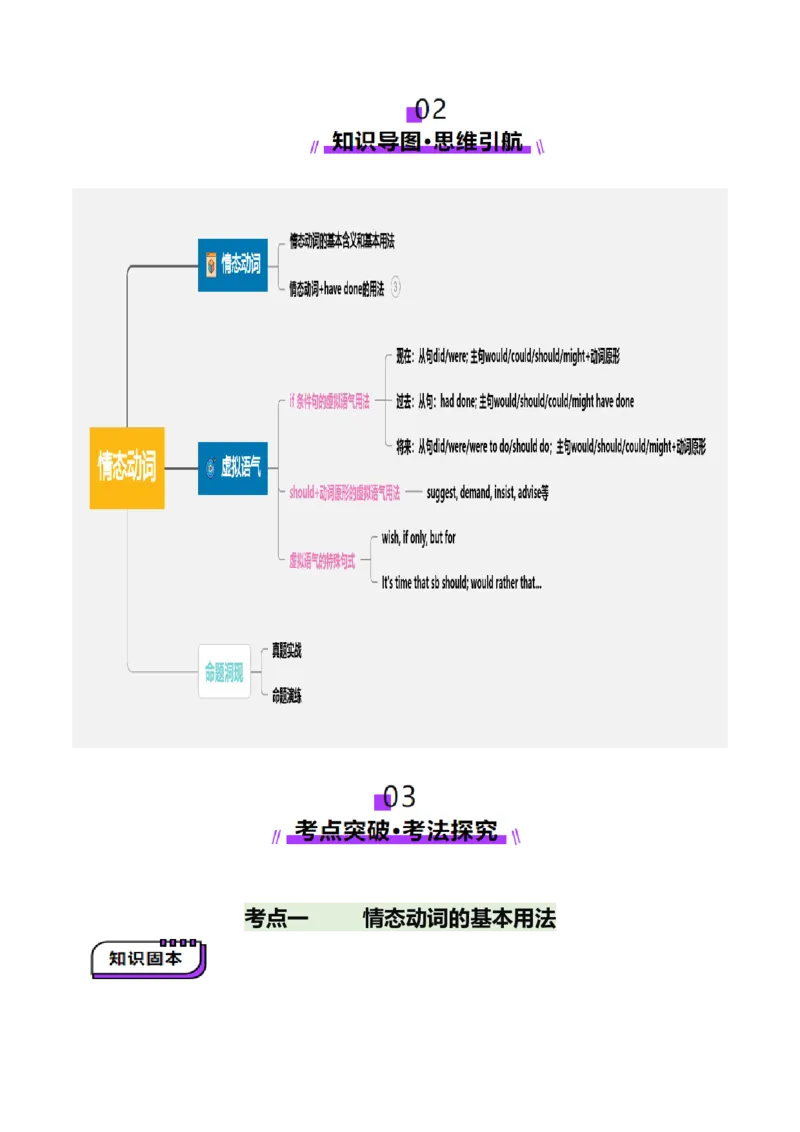
场合 从句谓语动词形式 主句谓语形式
与现在事实相反 动词过去式(be用were) would / could / should / might+ 动词原形
与过去事实相反 had +动词过去分词 would/ could / should / might have done
1.动词过去式(be用were)
与将来事实相反 2.were to + 动词原形 would / could / should / might + 动词原形
3.should + 动词原形
知识点2 (should)+ 动词原形的虚拟语气
1. (坚持 insist 命令 order, command 建议 advise, suggest, recommend 要求 demand, desire, require,
request)接从句谓语用should+动词原形,且should可以省略。但应注意insist表示“坚持说”,suggest表
示“暗示,表明”时,后接宾语从句应用陈述语气。
It is suggested that the meeting should be put off till next week.
2.名词(order, command, advice, suggestion, requirement等)后接从句,该从句谓语动词用should+动词原
形,且should可以省略。
We agreed to the order that the task (should) be completed at 5 o'clock.
3. It is necessary/strange/ impossible..that..从句谓语用should+动词原形,且should可以省略。若从句涉及
已经发生的动作,则应用should have done。
It is strange that he should have acted toward his parents like that.
典例1.(2024高三·全国·专题练习)My suggestion is that you much meat.A.wouldn’t take B.shall not take
C.not have D.won’t have
【解析】考查虚拟语气。句意:我的建议是你不要吃太多肉。名词suggestion“建议”后的表语从句用虚拟
语气,谓语动词用should+动词原形,should可以省略;“吃肉”可以用动词have,不用take。故选C。
【答案】C
典例2.(2023高三·全国·专题练习)He was determined that his children _____ to the best school available.
A.should go B.went C.ought to go D.would go
【解析】考查虚拟语气。句意:他决心让孩子们去最好的学校。分析句子结构和意思可知,that引导的是
determine后的宾语从句,从句谓语常用should do,should可省的虚拟语气结构。故选A。
【答案】A
变式训练1.(23-24高三·天津南开·阶段练习)I can’t find my wallet now. I________ it in the bus just now, but
I’m not sure.
A.should leave B.could have left
C.must have left D.might leave
【解析】考查情态动词表示推测的用法。句意:我现在找不到我的钱包了。我可能刚才在公交车上把它落
下了,但我不确定。should leave表示应该做某事,不符合句意。 could have left表示过去可能做了某事,
符合句意,表示说话者对可能发生的事情的推测。must have left表示对过去发生的事情的肯定推测,但句
中提到“但我不确定”,所以这个选项太绝对了。might leave表示将来可能做某事,不符合句意,因为句
子讨论的是过去发生的事情。故选B项。
【答案】B
变式训练2.(2024·天津南开·二模)They queued (排队) for two hours for nothing. They _________ have been
told the tickets were sold out.
A.would B.may C.must D.should
【解析】考查情态动词辨析。句意:他们白白排队两个小时。他们本应该被告知票已经卖完了。A. would
将会;B. may可能;C. must必须;D. should应该。根据空后have been told the tickets were sold out以及常
识可知,他们本应该被告知票已经卖完了,这样他们就不需要白白排队两个小时,空处应用should,
should have done结构表示“本应该做某事却没做”,符合题意。故选D项。
【答案】D
知识点3 虚拟语气特殊句式
1. I wish that…从句与过去、现在、将来事实相反,分别用had done, did, would/could do。
I wish 从句结构 示例
与现在事实相反 一般过去式 I wish it were autumn now.
与过去事实相反 过去完成式 He wished he had not lost the chance.与将来事实相反 would+动词原形 I wish you would come soon.
2. if only表示“如果……该多好”,as if/though表示“好像”,从句虚拟用法同上。
3. I would rather that…从句与过去事实相反用过去完成时,与现在、将来相反用一般过去时。
4. It is high/about time that..后面常用did或should do, should不能省,意为“早该……”。
例1. If only I had gone by taxi. 我要是乘出租车去就好了。
例2.It’s high time that you concentrated on your work at hand!
是该你集中精力做你手头上工作的时候了!
一、 真题实战
1.(2019·江苏·高考真题)What a pity! You missed the sightseeing, or we ________ a good time together.
A.had B.will have C.would have had D.had had
【答案】C
【解析】考查虚拟语气。句意:真遗憾!你错过了这次观光,否则,我们本应该在一起度过一段愉快时光
的。根据上文可知,是对过去事情的虚拟,是与过去事实相反的假设。其句子结构为:从句:If+主语+过
去完成时+其他,主句:主语+should(would, could, might)+现在完成时+其他,故选C。
2.(2019·天津·高考真题)Mary’s description of the party was so vivid that I felt as if I there.
A.would be B.might have been
C.would have been D.had been
【答案】D
【解析】考查虚拟语气。句意:玛丽对这次聚会的描述是如此生动,以至于我觉得我好像去过那里一样。
根据句意及句中felt可知,此处描述的是与过去事实相反的情况,应使用过去完成时。故D选项正确。
3.(2020·江苏·高考真题)If I hadn’t been faced with so many barriers, I _____where I am.
A.won’t be B.wouldn’t have been C.wouldn’t be D.shouldn’t have been
【答案】C
【解析详解】考查虚拟语气。句意:如果我没有面对那么多的障碍,我现在就不会在这里。分析句子成分
可知,此处是错综时间虚拟语气,根据空后where I am可知,此处是与现在事实相反的假设,主句谓语动
词应使用would/could/might/should+do。故选C。
二、 命题演练
1.(23-24高三·天津·期末)—I’m leaving for Shanghai tomorrow for the Spring Festival holiday.—Good for you. Remember to bring more clothes because the winter in Shanghai _______ be very cold
sometimes.
A.would B.shall C.can D.may
【答案】C
【解析】考查情态动词。句意:———我明天要去上海过春节。———真不错。记得多带些衣服,因为上
海的冬天有时会很冷。A. would会,要;B. shall可以,将(常与第一人称连用);C. can可以,可能;D.
may也许,可能。根据下文“be very cold sometimes”可知,此处表示按常理推断的抽象的可能性,应用
can;may通常表示实际的、马上能应验的可能性。故选C项。
2.(23-24高三·天津·阶段练习)—Sorry, I missed your party yesterday because of an unexpected visitor.
— Actually, you________ the party. It was canceled at the last moment.
A.didn’t need to attend B.needn’t have attended
C.shouldn’t have attended D.couldn’t have attended
【答案】A
【解析】考查情态动词用法。句意:——对不起,因为一位不速之客,我昨天错过了你的聚会。——事实
上,你不需要参加聚会。在最后一刻取消了。A. didn’t need to attend不需要参加;B. needn’t have attended
本不必出席,表示已经出席了;C. shouldn’t have attended本不应该参加:表示对过去某个行为的后悔,认
为自己不应该做那件事;D. couldn’t have attended本来不可能出席,表示过去某个时间或事件不可能发生
或不可能做到某事。根据后文“It was canceled at the last moment.”此处指不需要参加,故选A。
3.(23-24高三·天津·期中)You________be right but I’m going back to check anyway.
A.must B.should C.need D.might
【答案】D
【解析】考查情态动词。句意:你也许是对的,但我还是要回去检查一下。A. must一定,必须;B. should
应该;C. need需要;D. might或许。本题主要考查情态动词表示推测的用法,由I’m going back to check
anyway可知,说话人对此很不确定。must表示非常有把握的推测,should表示推测时,肯定性远大于
might,need意思不合适。由此可知,D项符合题意。故选D项。
4.(23-24高三·天津和平·阶段练习)—When can I come for the computer? I need it next Tuesday.
—It________ be repaired by next Monday afternoon.
A.can B.need C.should D.might
【答案】C
【解析】考查情态动词的用法。句意:——我什么时候可以来取电脑?我下周二需要。——它应该在下周
一下午之前修好。根据“When can I come for the computer? I need it next Tuesday.”可知,此处是指承诺、保
证,所以应用should。故选C。
5.(23-24高三·天津·阶段练习)I advise you to stay away from Mary. Although she is usually easy-going, she
______be quite annoying sometimes.
A.can B.need C.must D.should
【答案】A
【解析】考查情态动词用法。句意:我劝你离玛丽远点。虽然她通常很随和,但有时也很烦人。A. can有时会;B. need需要;C. must必须;D. should应该。根据“Although she is usually easy-going”可知,此处应
用情态动词can表示“有时会”。故选A。
6.(2024·天津和平·一模)People liked O. Henry’s stories, because simple as the tales were, they ______ finish
with a sudden change at the end, to the readers’ surprise.
A.could B.would C.might D.must
【答案】B
【解析】考查情态动词词义辨析。句意:人们喜欢欧·亨利的故事,因为这些故事虽然简单,但往往会在结
尾突然发生变化,让读者感到惊讶。A. could可能;B. would常常;C. might也许;D. must必须。此处表
示过去的习惯,“would + 动词原形”表示过去常常做某事。故选B。
7.(23-24高三·重庆·开学考试)Look at the school rules. It says we___________ be late for school.
A.can B.must C.needn’t D.mustn’t
【答案】D
【解析】考查情态动词的辨析。句意:看看校规。上面说我们上学不能迟到。A. can能,可以;B. must必
须,一定;C. needn’t不必;D. mustn’t不应该,不可以,不能。根据上下文可知,校规说我们不能迟到。
故选D。
8.(23-24高三·天津河东·期末)I ______ pay Tracy a visit, but I am not sure whether I will have time this
Sunday.
A.should B.might C.would D.could
【答案】A
【解析】考查情态动词。句意:我应该去拜访特蕾西,但我不确定这个星期天是否有时间。根据 but 后的
句意,可以推测出前一句,我应该拜访。should 表示“应该”。might 表示“可能”和“允许”,would
表示“将要”,could 表示“可能性”和“能力”。故选A项。
9.(23-24高三·天津·阶段练习)My nephew William is still a puzzle to me—sometimes he is as quiet as a
mouse, while he________be fairly active at other times.
A.should B.need C.must D.can
【答案】D
【解析】考查情态动词。句意:我的侄子威廉对我来说仍然是个谜——有时他像老鼠一样安静,而其他时
候他又很活跃。A. should应该,竟然;B. need需要;C. must肯定,必须;D. can能,可能。结合语境与at
other times可知,此处表示对现在情况的推测,情态动词can表示一时的情况,意为“有时侯会……”符
合语境。故选D项。
10.(2024·天津·二模)I love spring because I______ endure the cold of winter or avoid the burning sun of
summer in spring.
A.mustn’t B.needn’t C.can’t D.shouldn’t
【答案】B
【解析】考查情态动词的用法。句意:我喜欢春天,因为在春天我不必忍受冬天的寒冷或避开夏天的烈
日。A. mustn’t禁止;B. needn’t不必;C. can’t不能;D. shouldn’t不应该。根据句意,春天是一个温和的季
节,不需要避免极端的冷或热,needn’t符合题意,故选B项。