第 24 讲 特殊句式
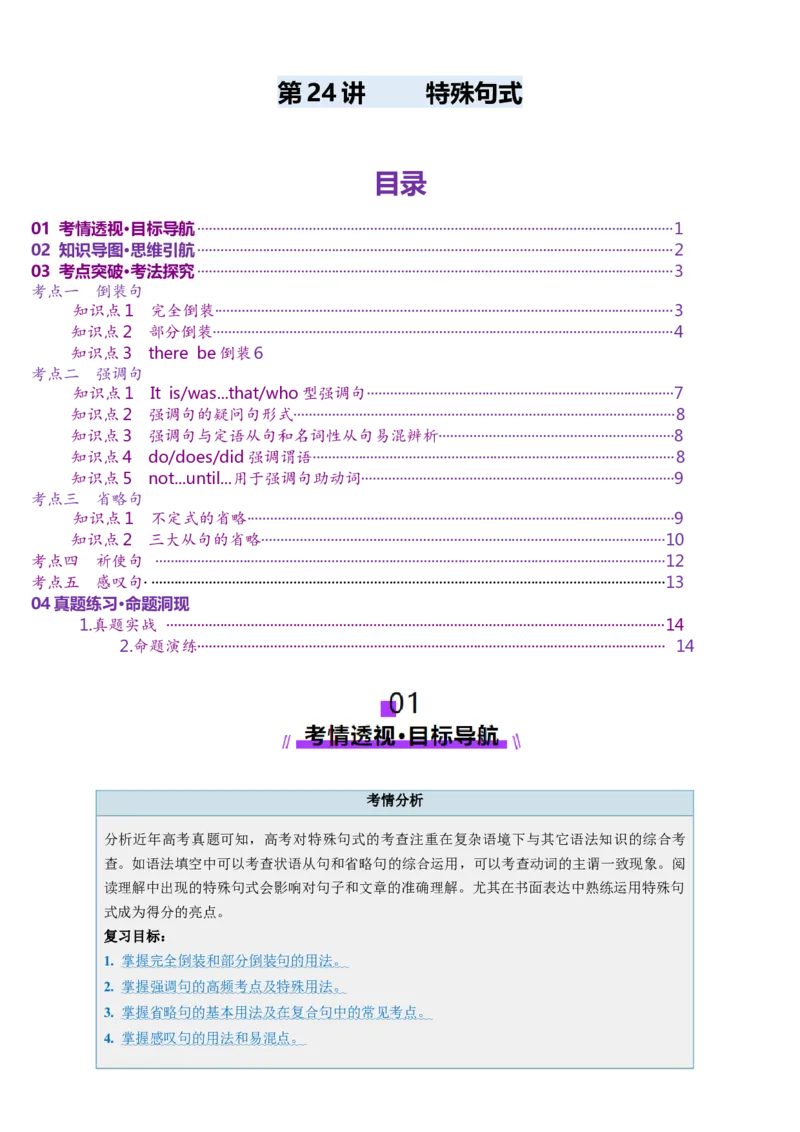
目录
01 考情透视·目标导航····························································································································1
02 知识导图·思维引航····························································································································2
03 考点突破·考法探究····························································································································3
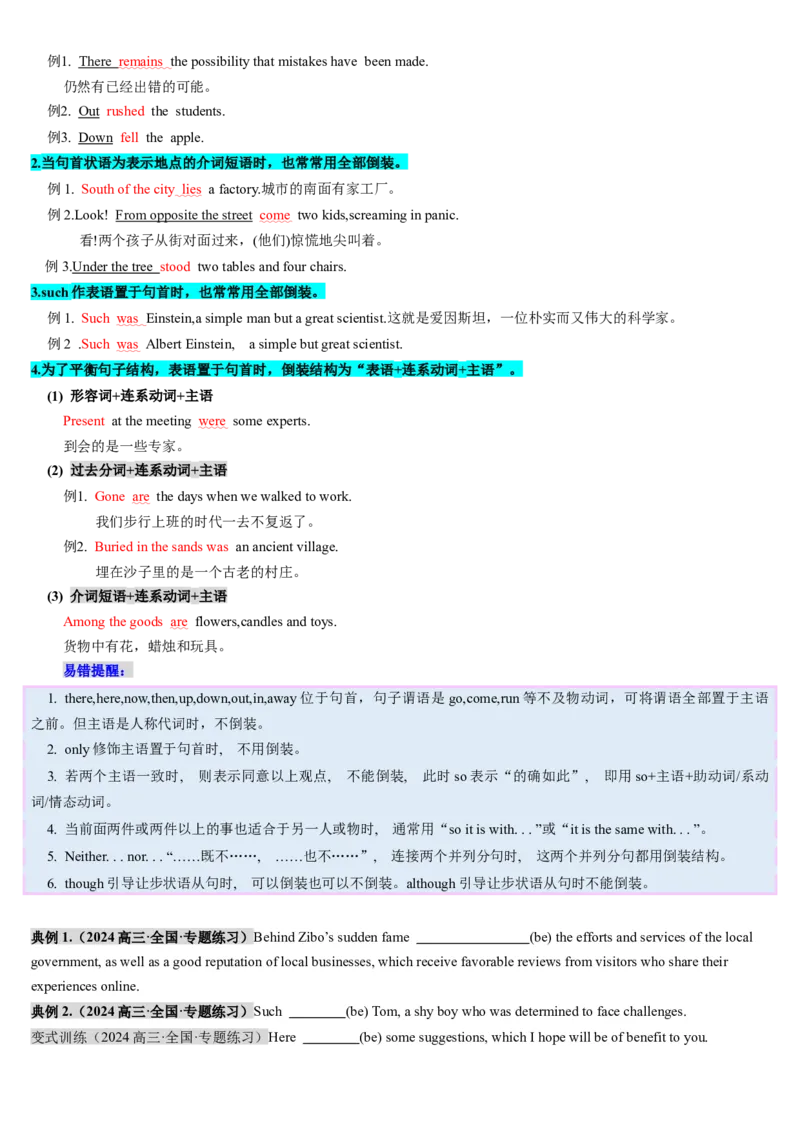
考点一 倒装句
知识点1 完全倒装·······················································································································3
知识点2 部分倒装························································································································4
知识点3 there be倒装6
考点二 强调句
知识点1 It is/was...that/who型强调句················································································7
知识点2 强调句的疑问句形式···································································································8
知识点3 强调句与定语从句和名词性从句易混辨析·····························································8
知识点4 do/does/did强调谓语······························································································8
知识点5 not...until...用于强调句助动词·················································································9
考点三 省略句
知识点1 不定式的省略···············································································································9
知识点2 三大从句的省略·········································································································10
考点四 祈使句 ·····································································································································12
考点五 感叹句·······································································································································13
04真题练习·命题洞现
1.真题实战 ··································································································································14
2.命题演练·························································································································· 14
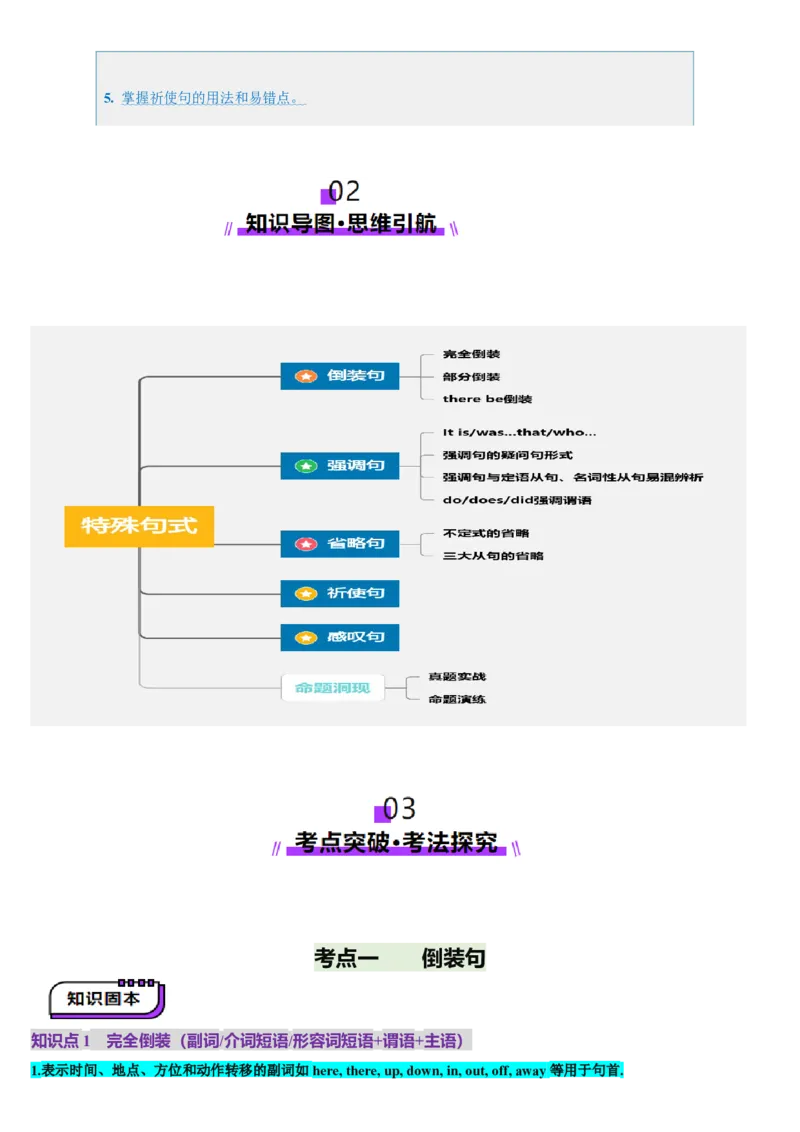
考情分析
分析近年高考真题可知,高考对特殊句式的考查注重在复杂语境下与其它语法知识的综合考
查。如语法填空中可以考查状语从句和省略句的综合运用,可以考查动词的主谓一致现象。阅
读理解中出现的特殊句式会影响对句子和文章的准确理解。尤其在书面表达中熟练运用特殊句
式成为得分的亮点。
复习目标:
1. 掌握 完全倒装和部分倒装句 的用法 。
2. 掌握强调句的高频考点及特殊用法。
3. 掌握省略句的基本用法及在复合句中的常见考点。
4. 掌握感叹句的用法和易混点。5. 掌握祈使句的用法和易错点。
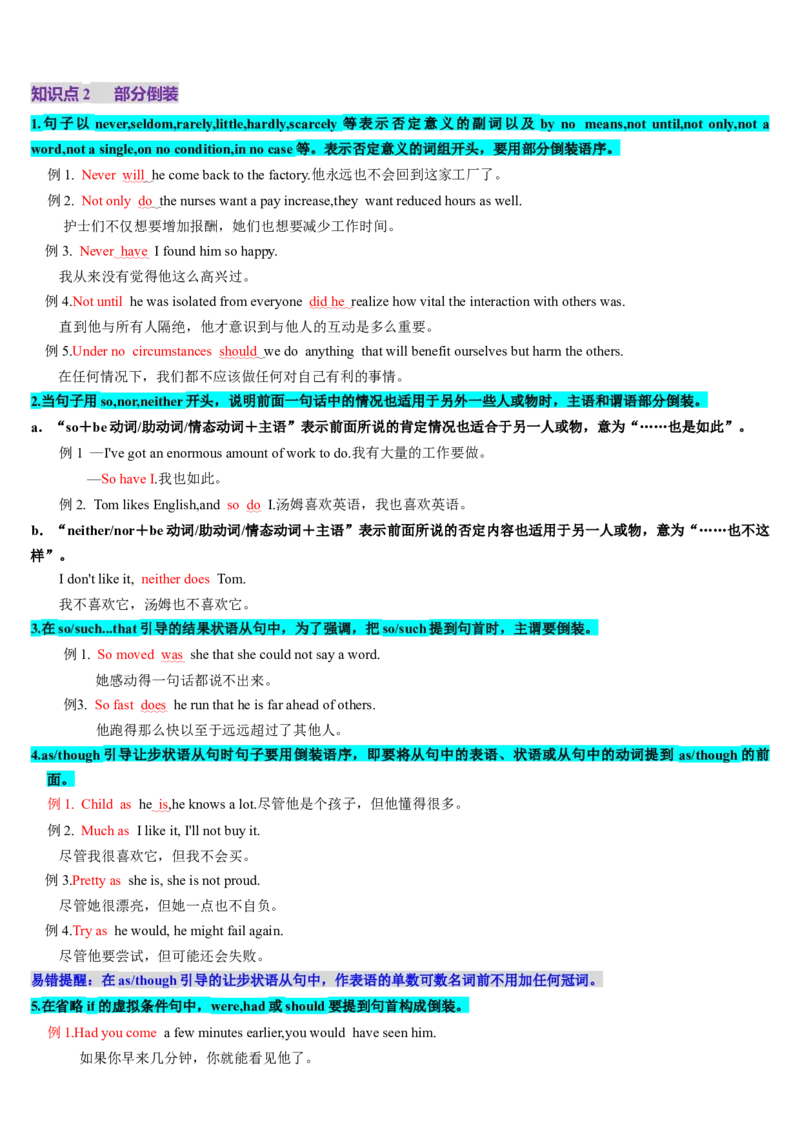
考点一 倒装句
知识点1 完全倒装(副词/介词短语/形容词短语+谓语+主语)
1.表示时间、地点、方位和动作转移的副词如here, there, up, down, in, out, off, away等用于句首.例1. There remains the possibility that mistakes have been made.
仍然有已经出错的可能。
例2. O ut rushed the students.
例3. Down fell the apple.
2.当句首状语为表示地点的介词短语时,也常常用全部倒装。
例1. South of the city lies a factory.城市的南面有家工厂。
例2.Look! From opposite the street come two kids,screaming in panic.
看!两个孩子从街对面过来,(他们)惊慌地尖叫着。
例3. Under th e tree stood two tables and four chairs.
3.such作表语置于句首时,也常常用全部倒装。
例1. Such was Einstein,a simple man but a great scientist.这就是爱因斯坦,一位朴实而又伟大的科学家。
例2 .Such was Albert Einstein, a simple but great scientist.
4.为了平衡句子结构,表语置于句首时,倒装结构为“表语+连系动词+主语”。
(1) 形容词+连系动词+主语
Present at the meeting were some experts.
到会的是一些专家。
(2) 过去分词+连系动词+主语
例1. Gone are the days when we walked to work.
我们步行上班的时代一去不复返了。
例2. Buried in the sands was an ancient village.
埋在沙子里的是一个古老的村庄。
(3) 介词短语+连系动词+主语
Among the goods are flowers,candles and toys.
货物中有花,蜡烛和玩具。
易错提醒:
1. there,here,now,then,up,down,out,in,away位于句首,句子谓语是go,come,run等不及物动词,可将谓语全部置于主语
之前。但主语是人称代词时,不倒装。
2. only修饰主语置于句首时, 不用倒装。
3. 若两个主语一致时, 则表示同意以上观点, 不能倒装, 此时so表示“的确如此”, 即用so+主语+助动词/系动
词/情态动词。
4. 当前面两件或两件以上的事也适合于另一人或物时, 通常用“so it is with. . . ”或“it is the same with. . . ”。
5. Neither. . . nor. . . “……既不……, ……也不……”, 连接两个并列分句时, 这两个并列分句都用倒装结构。
6. though引导让步状语从句时, 可以倒装也可以不倒装。although引导让步状语从句时不能倒装。
典例1.(2024高三·全国·专题练习)Behind Zibo’s sudden fame (be) the efforts and services of the local
government, as well as a good reputation of local businesses, which receive favorable reviews from visitors who share their
experiences online.
典例2.(2024高三·全国·专题练习)Such (be) Tom, a shy boy who was determined to face challenges.
变式训练(2024高三·全国·专题练习)Here (be) some suggestions, which I hope will be of benefit to you.知识点2 部分倒装
1.句子以 never,seldom,rarely,little,hardly,scarcely 等表示否定意义的副词以及 by no means,not until,not only,not a
word,not a single,on no condition,in no case等。表示否定意义的词组开头,要用部分倒装语序。
例1. Never will he come back to the factory.他永远也不会回到这家工厂了。
例2. Not only do the nurses want a pay increase,they want reduced hours as well.
护士们不仅想要增加报酬,她们也想要减少工作时间。
例3. Never have I found him so happy.
我从来没有觉得他这么高兴过。
例4.Not until he was isolated from everyone did he realize how vital the interaction with others was.
直到他与所有人隔绝,他才意识到与他人的互动是多么重要。
例5.Under no circumstances should we do anything that will benefit ourselves but harm the others.
在任何情况下,我们都不应该做任何对自己有利的事情。
2.当句子用so,nor,neither开头,说明前面一句话中的情况也适用于另外一些人或物时,主语和谓语部分倒装。
a.“so+be动词/助动词/情态动词+主语”表示前面所说的肯定情况也适合于另一人或物,意为“……也是如此”。
例1 —I've got an enormous amount of work to do.我有大量的工作要做。
—So have I.我也如此。
例2. Tom likes English,and so do I.汤姆喜欢英语,我也喜欢英语。
b.“neither/nor+be动词/助动词/情态动词+主语”表示前面所说的否定内容也适用于另一人或物,意为“……也不这
样”。
I don't like it, neither does Tom.
我不喜欢它,汤姆也不喜欢它。
3.在so/such...that引导的结果状语从句中,为了强调,把so/such提到句首时,主谓要倒装。
例1. So moved was she that she could not say a word.
她感动得一句话都说不出来。
例3. So fast does he run that he is far ahead of others.
他跑得那么快以至于远远超过了其他人。
4.as/though引导让步状语从句时句子要用倒装语序,即要将从句中的表语、状语或从句中的动词提到 as/though的前
面。
例1. Child as he is,he knows a lot.尽管他是个孩子,但他懂得很多。
例2. Much as I like it, I'll not buy it.
尽管我很喜欢它,但我不会买。
例3.Pretty as she is, she is not proud.
尽管她很漂亮,但她一点也不自负。
例4.Try as he would, he might fail again.
尽管他要尝试,但可能还会失败。
易错提醒:在as/though引导的让步状语从句中,作表语的单数可数名词前不用加任何冠词。
5.在省略if的虚拟条件句中,were,had或should要提到句首构成倒装。
例1.Had you come a few minutes earlier,you would have seen him.
如果你早来几分钟,你就能看见他了。例2. Had you reviewed your lessons, you might have passed the examination.
要是早复习了功课,你有可能就通过考试了。
例3. Should it not rain tomorrow, we would go for a picnic.
要是明天不下雨,我们就可以去野餐。
6.当only所修饰的副词、介词短语或状语从句位于句首时,采用部分倒装形式。要注意“only+主语”用在句首时不倒
装。
例1. Only when Lily walked into the office did she realize that she had left the contract at home.
直到莉莉走进办公室,她才意识到自己把合同落在家里了。
例2. Only by this means is it possible to explain it. (介词短语)
只有用这种方法才能可能解释它。
例3. Only when the war was over in 1918 was he able to get happily back to work. (从句)
直到1918年战争结束后,他才得以满怀高兴地重返工作岗位。
例4. Only you can help me.只有你能帮助我。
7.用于某些表示祝愿的句子。
例1. May you succeed!祝你成功!
例2. Long live the People’s Republic of China! = May the People’s Republic of China (should) live long.
中华人民共和国万岁!
8.neither...nor...连接两个并列分句时,这两个分句都要用倒装形式。
Neither do I know it,nor do I care about it.我既不知道这件事,也不关心这件事。
典例1.(2024高三·全国·专题练习)Rarely I need to prepare family dinner every day.
典例2.(2024高三·全国·专题练习)Only when I reached the top of the mountain I feel a great sense of achievement.
变式训练1.(2024高三·全国·专题练习)Hardly I rested on my couch after a tough day when the phone rang.
变式训练2.As the demand for products rises, so their prices.
知识点3 there be 句型
1.There be 句型表示“某地有某物或某时有某事”。there 是引导词,be 后面的名词是主语,基本结构为 “there
be+人或物+地点或时间”。
例1. There have been many great changes in our country since then.
自从那时起我国发生了很多大的变化。
例2. I think there is a problem with the engine.【2021年新高考I卷听力】
我想是引擎出了问题。
例3. There, at the entrance, was a cash machine.【2024年新高考I卷读后续写】
在入口处,有一台提款机。
2. There be 句型中的主谓一致的原则
主语是单数或不可数名词时,be用单数形式。主语是复数名词时,be用复数形式。如果主语是并列结构,be动词应遵
循“就近原则”,即be动词与离其最近的主语保持一致。
例1. There are two people waiting outside. 有两个人正在外面等候。例2. There was a nice kitchen and a comfortable bed. 有一个漂亮的厨房和一张舒适
3.There be 句型中常用动词和形式
There be 结构中的谓语动词 be 有时可以用 seem to be, happen to be, is likely to be 或半系动词 remain , stand , lie ,
go , exist , follow , live , come , occur 等替换。结构有的时态形式,而且可以和各种助动词、情态动词连用。
例1. Despite the defence, there is likely to be some flooding. 尽管有保护措施,但洪水还是很可能涌进城市。
例2. Once upon a time, there lived an old king in the castle. 从前,那座城堡里住着一位国王。
例3. There is going to be hardship, but we have to grit our teeth and get on with it.
磨难会有的,但我们必须下定决心继续做下去。.
例4. There have been many such accidents.已发生了好几起那样的事故。
例5. There can be thousands of rice plants in one paddy.
一块稻田可能有成千上万株水稻。
4.There be 句型的常考句式:
There is no point/sense(in)doing sth.做某事没有意义
There is no doubt that...毫无疑问……
There is no need(for sb.)to do sth.(某人)没有必要做某事
There is(no)difficulty/trouble in doing/with sth.做某事(没)有困难
There is(no)possibility of(doing)sth./that...(做)某事(没)有可能性
5. There be 句型中的非谓语形式
There be 结构的非谓语动词形式是there to be 和there being 两种形式。在句中作主语、宾语和状语。
I expect there to be no argument about this.
我希望在这方面不会有任何争论。
I never dreamed of there being any good chance for me.
我从没想过会有什么好机会。
There being nothing else to do,we went home. (there be句型的独立主格结构)
由于我们无事可做,我们就回家了。
考点二 强调句
句子 句型
陈述句式 It is/was...that/who...
一般疑问句 Is/Was +it+...that/who...?
特殊疑问句 特殊疑问词+ is / was it+ that +句子的其余部分?
not...until... It is/was not until...that.知识点1 It is/was...that/who...强调句
1.It is/was. . . that/who可以对除谓语以外的成分进行强调。当强调部分为“人”时, 可用that或who, 其他情况下用
that。强调的是现在时或将来时,用It is...that/who...;强调部分是过去时,用It was...that/who...。
例1. It was him who won the game held last week.
是他赢得了上周举行的比赛。.
例2. It was in the park that he met Lily for the first time.
正是在那个公园他第一次遇到了lily。
2.在强调句中, 当强调主语时, 其后的谓语动词应和主语在人称和数上保持一致。
例1. It is White and Betty who often do good deeds for the old lady.
知识点2 强调句的疑问句形式
1. 强调句型的一般疑问句形式: Is/Was it+被强调部分+that/who+其他成分?
例1. Was it in 1939 that World War Ⅱ broke out?
是在1939年Ⅱ世界大战爆发了吗?
例2. Was it in the park that he met our new teacher?
他是在公园里遇到我们的新老师的吗?
2. 强调句的特殊疑问句句型为: 疑问词+is/was+it +that/who. . . ?
例1. Where was it that you met Jack yesterday?
你昨天是在哪里见到杰克的?
例2. When was it that he made up his mind to take this course?
他是什么时候决定选修这门课程的?
例3. Who was it that broke the window?打破窗户的是谁?
知识点3 强调句与定语从句和名词性从句易混辨析
强调句与主语从句的区别
强调句型去掉It is/was和that之后, 句子结构仍然完整, 而主语从句却不能。
1. It is there that accidents often happen. (强调句)
2. It is a fact that English is being accepted as an international language. (主语从句)
强调句与定语从句的区别
强调句中that没有意义, 且不作任何成分, 而定语从句中that为关系代词, 在从句中充当主语、宾语或表语。
1. It is novels that Miss William enjoys reading. (强调句)
2. It is a question that needs careful consideration. (定语从句)
强调句与状语从句的区别
强调句型去掉It is/was和that后, 结构完整, 而It is. . . when. . . 中, it指代时间。
1. It was at six o’clock that I got up today. (强调句)
2. It was six o’clock when I got up today. (状语从句)知识点4 do/does/did强调谓语
用助动词do,does或did来强调谓语动词,用于一般现在时和一般过去时的肯定的陈述句中,do还可以用于祈使句。
1. do/does/did+动词原形。
例1. She does like music. 她真的喜欢音乐。
例2. She did tell me her address,but I forgot all about it.
她确实告诉过我她的地址,但我全忘了。
2. “never+助动词do”也常用来表示强调, 一般意为“从来没有, 绝不”。
名师提醒:在强调谓语时,do/does/did译为“的确、真的”等,其后动词用原形。
知识点5 not...until用于强调句
“not. . . until. . . ”句型的强调结构为“It is/was not until. . . that. . . ”。
例1. It was not until 11 o’clock last night that he went to bed.
直到昨晚11点,他才上床睡觉。
例2. It was not until he got home 30 minutes later that he found he had left his bag in the taxi.
直到他到家三十分钟后他才发现他把包落在了出租车上。
名师提醒:Not until...用于句首时,也可表示强调,句子使用部分倒装。如,Not until 11 o’clock did he go to bed.
典例1.(24-25高三·全国·专题练习)Although it was ten years ago I read the book, it shows me a universal truth
that books are friends, always pushing us to move on.
典例2.(24-25·江苏扬州·阶段练习)It was not until his third match in 1790 he finally beat Humphries and became
champion of England.
变式训练1.(24-25高三·全国·专题练习)Why is it some people are so much more intelligent or creative than the
rest of us?
变式训练1.(2025高三·全国·专题练习)Was it on October 1, 1949 the People’s Republic of China was
founded?
考点三 省略句
知识点1 不定式的省略
1. 当不定式用于let, make, have等使役动词后作宾语补足语时,不定式必须省略to。
2. 在feel, observe, hear, notice, see, watch等感官动词后作宾补的不定式也要省略to。
3. 在had better, would rather, rather than等结构后的动词不定式要省略to。
4. 在由and, or, than连接的两个不定式中,第二个不定式to可以省去。易错提醒:在被动语态中,使役动词和感官动词后用作宾语补足语的不定式前的 to不能省略;需要强调对比或特定意
义,保留to。
知识点2 三大从句的省略
一、状语从句中的省略
在as if,if,though,when,where,while,no matter what,until等引导的状语从句中,若谓语部分含be动词,而主语又与主句
的主语一致或从句主语是it时,从句的主语和谓语中的be动词可以一起省略。
例1. All the photographs in this book,unless (the photographs are) stated otherwise,date from the 1950s.
这本书里所有的照片,除非有说明,否则,都要追溯到20世纪50年代。
例2. When (it is) faced with so many options, the lion chooses to freeze and wait instead of attacking the man holding the
chair.
当(它是)面对如此多的选择时,狮子会选择冻结和等待,而不是攻击拿着椅子的人。
例3. When (people are)reading texts of several hundred words or more, learning is generally more successful when it’s on
paper than onscreen.【2024年新高考I卷】(主句逻辑主语for people省略)
当阅读几百个单词或更多的文本时,在纸上学习通常比在屏幕上学习更成功。
特殊省略 意义 特殊省略 意义
as soon as possible 尽快 as before/usual 像以前/寻常一样
if so 如果这样的话 if not 若非如此
if ever 如果曾经有的话 if any 如果有的话
if possible 如果可能的话 if necessary 如果有必要的话
If possible,let me know beforehand. 如有可能,事先通知我。
Whenever (it is) possible, he will come to my help.
他会在任何可能的时候来帮助我。
二、定语从句的省略
① 在限制性定语从句中, 关系代词that, which, whom充当宾语, 而且前面无介词时可省略。
例1. He lost the watch (that/which) he bought yesterday.
② the way后的定语从句常省略关系词that或in which, the time后的定语从句常省略关系词that或when。
例1. I don’t like the way (that/in which) he speaks to others.
三、名词性从句的省略
1.引导宾语从句的从属连词that可省略。但及物动词后跟两个或两个以上that引导的宾语从句时, 只有第一个连词that
可省略。
例1. He told me (that) she was a beautiful girl and that she was kind.
他告诉我(那个)她是一个漂亮的女孩,而且她很善良
例2. ......educators shouldn’t assume all media are the same....【2024年新高考I卷】
教育工作者不应该认为所有的媒体都是一样的。
2.wh-+to do如果从句中不影响句意理解,可以省略主谓的部分,保留wh+to do, 在句子中作主语、宾语、表语或同位
语。
例1. I don’t know what to do.【2021年全国乙卷听力】=I don’t know what I can do.我不知道该怎么办。
例2.You have to know where to stand for a good viewpoint. (作宾语)
你得知道站在哪儿才会有好的视角。
例3. I have no idea how to deal with it. (作同位语)
我不知道怎么应对。
3.I’m afraid, I think, I believe, I hope, I guess等作答语后面跟so与not分别相当于肯定或否定,宾语从句可省去。
例1. —Do you think it will rain?
—I hope not (that it will not rain).
例2—Do you think it will rain?你认为会下雨吗?
—I hope not/that it will not rain.我希望不要下。
例3—Do you believe our team will win?你相信我们队会赢吗?
—I guess so.我猜会赢。
四、不定式符号to的省略
1. 动词mean, prefer, refuse, seem, try, want, wish, 后面可用保留不定式符号to而省略其余短语。如果不定式
中含有be, have, have been, 通常保留be, have和have been。
例1. —Are you a sailor?
—No, but I used to be.
例2.—Will you join in the game?
—I’d be glad to.
2.当主语部分含有动词do的某种形式时,作表语的不定式可省略to。
The only thing you have to do is press the button.
你唯一要做的事情就是按按钮。
3.不定式作介词but, except的宾语,前面有实义动词do的某种形式时,不定式常省略to。
I had nothing to do but wait here.
今天下午我除了在这等待无事可做。
4.当两个或两个以上的不定式并列时,后面的不定式符号to可省略,但表示对比关系时则不能省略。
I'm really puzzled what to think of and express.
我真的不知道想什么和表达什么。
It is easier to make a plan than to carry it out.
制订计划比执行计划容易。
5.在see, watch, hear, feel, observe, notice, look at, listen to等感官动词及使役动词let, make, have后作宾语补足语的
不定式不加to,但当宾语补足语变为主语补足语时,不定式要加上to。
She saw him walk into the house.
她看到他走进了那座房子。
He was seen to walk into the house.
有人看到他走进了那座房子。
He had two boys wash his car.
他让两个男孩给他洗车。
6.you'd better/why not后跟不带to的不定式。
Why not try it again?
为什么不再试试?You'd better get up early when you want to keep up with others.
当你想追赶他人时,你最好起得早些。
典例1.(24-25高三·全国·专题练习)Though (surprise) to see us, the professor gave us a warm welcome.
典例2.(24-25高三·全国·专题练习)If (leave) alone, the younger members of the species are more physically active.
变式训练1. To guarantee security, children, when ( accompany) by their parents, are allowed to enter the
stadium.
变式训练2. These mountains are a splendid sight when (view) from the valley floor.
考点四 祈使句
祈使句的基本用法如下:祈使句用来表达说话人的请求、命令、建议、劝告等。祈使句的主语一般为第二人称,通常省
略,有时也可以加称呼语。
肯定式:动词原形开头。(I)Wish you were here. 如果你在这就好了
否定式:在动词前面加don’t。(It)Don’t give up.不要放弃。
强调式:肯定句在其前加do, 否定句在其前加never。
“祈使句+and+陈述句(一般将来时)”。
(1) 名词词组+and+陈述句
名词词组中通常含有more,another,further,earlier等词。
One step further and you'll fall down.再多走一步,你就会摔倒。
Just a little more patience and we'll look into its00n.
再耐心点儿,我们很快就会调查此事。
(2) 祈使句+破折号+陈述句
Try some of this juice—perhaps you'll like it.尝尝这种果汁,也许你会喜欢它的。
考点五 感叹句
感叹句用来表示“喜、怒、哀、乐”等强烈情感,亦可用于表扬、批评等情感表达。英语感叹句常用“what”和
“how”引导,并与所修饰的词置于句首,其它部分用陈述句语序。句末用感叹号“!”,读时用降调。
How引导的感叹句
How +形容词/副词+主语+谓语! How high the mountain is!这山真高呀!
How+形容词+a/an+可数名词单数+主语+谓语! How clever a boy he is!多聪明的男孩呀!
How+主语+谓语! How time flies! 时间过得真快呀!What引导的感叹句
What+a/an+形容词+可数名词单数+主语+谓语! What a clever boy he is!多聪明的男孩呀!
What+形容词+复数名词+主语+谓语! What beautiful flowers they are!多美的花啊!
What+形容词+不可数名词+主语+谓语! What fine weather it is!多好的天气啊!
典例1.(24-25高三·天津·阶段练习)________ beautiful the scenery in Xinjiang is!
A.What a B.How a C.What D.How
典例2.(2024年·山东·一模)__________advice the teacher gave us!
A.What B.What a C.What an D.How
变式训练.What comes next is the endless series of steps. You can’t help wondering how hard it (be) for the people
then to put all those rocks into place.
一、 真题实战
1.(2024年北京卷)And when ______ (ask) about his new title, he shared the secret: moderation (适度).
2.(2022年新高考II卷)He saved my son's life," said Mrs. Brown. "I don't know ______ to thank him. ”
3.(2019年全国卷Ⅱ卷改错)They were two reasons for the decision.
4.(2018年天津卷)It was only when the car pulled up in front of our house ___________we saw Lily in the passenger seat.
A. which B. that C. when D. where
5.(2017年天津卷)It was when I got back to my apartment ___________ I first came across my new neighbors.
A. who B. where C. which D. that
6.(2021全国乙卷 改错)That's our view on housework. And hopes this can inspire more thinking on the topic!
二、 命题演练
1.(2024高三·全国·专题练习)At the foot of the mountain (lie) a small village.
2.(2024高三·全国·专题练习)Only when you can find peace in your heart you keep good relationships with others.
3.(2024高三上·全国·专题练习)So much homework we have to do every day that we have little time to have a
rest.
4.(2024高三·全国·专题练习)It wasn’t invented in the United States, nor (do) it originate in Germany. It really
comes from China.
5.(2024高三·全国·专题练习)After the wars, the Indians were driven to the west of the country. Not until 1924
they gain the right to vote.
6.(24-25高三·内蒙古赤峰·阶段练习)Could it have been the other day Tom saw Mary seated and dressing
herself on the bed?
7.(24-25高三·全国·专题练习)It is only when we get ill we begin to realize how important it is to keep healthy.8.(24-25高三·全国·专题练习)When (permit), you can have access to the Internet in our school.
9.(24-25高三·全国·专题练习)Get up early tomorrow. If , you will miss the early bus.
10.(24-25高三·全国·专题练习)Unluckily, my pet was killed in an accident. You can imagine how
(sorrow) I am now!