练习 19 阅读理解+读后续写
Ⅰ.阅读理解
A
2022·湖南名校联考 说明文 295词 ★★☆☆☆
Make the Best of a Bad Situation
Since COVID-19 spreads all over the world, many people have to stay indoors and work
from home. For most of us, it greatly challenges our lives and brings boredom. But for a few
people, working at home brings more creativity. Here are three famous historical figures who let
their creativity flow during past pandemics.
Giovanni Boccaccio (1313—1375)
When a plague(瘟疫) hit Florence in 1348, Italian writer Giovanni Boccaccio lost his father
and stepmother. In order to survive, he left the city and hid in the countryside. Inspired by the
experience, Boccaccio wrote The Decameron (《十日谈》), a collection of short novels framed
as stories told by a group of friends, while he was quarantined (隔离) inside a house during the
plague.
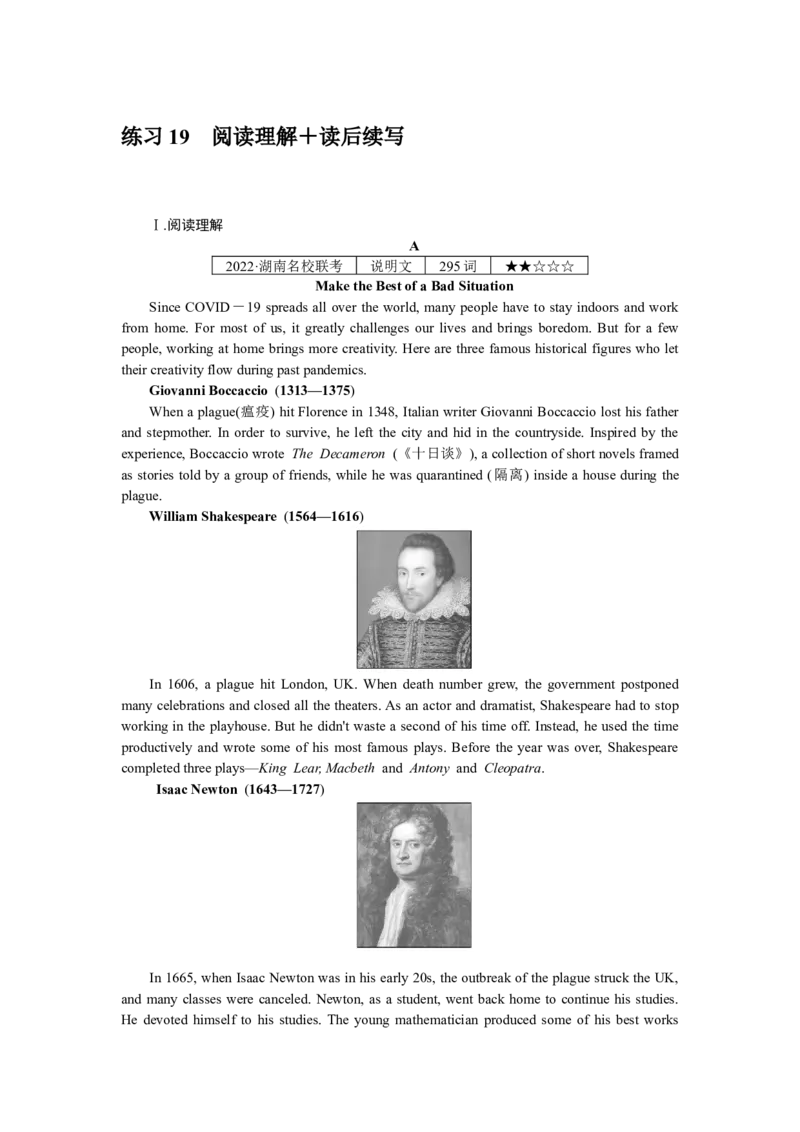
William Shakespeare (1564—1616)
In 1606, a plague hit London, UK. When death number grew, the government postponed
many celebrations and closed all the theaters. As an actor and dramatist, Shakespeare had to stop
working in the playhouse. But he didn't waste a second of his time off. Instead, he used the time
productively and wrote some of his most famous plays. Before the year was over, Shakespeare
completed three plays—King Lear, Macbeth and Antony and Cleopatra.
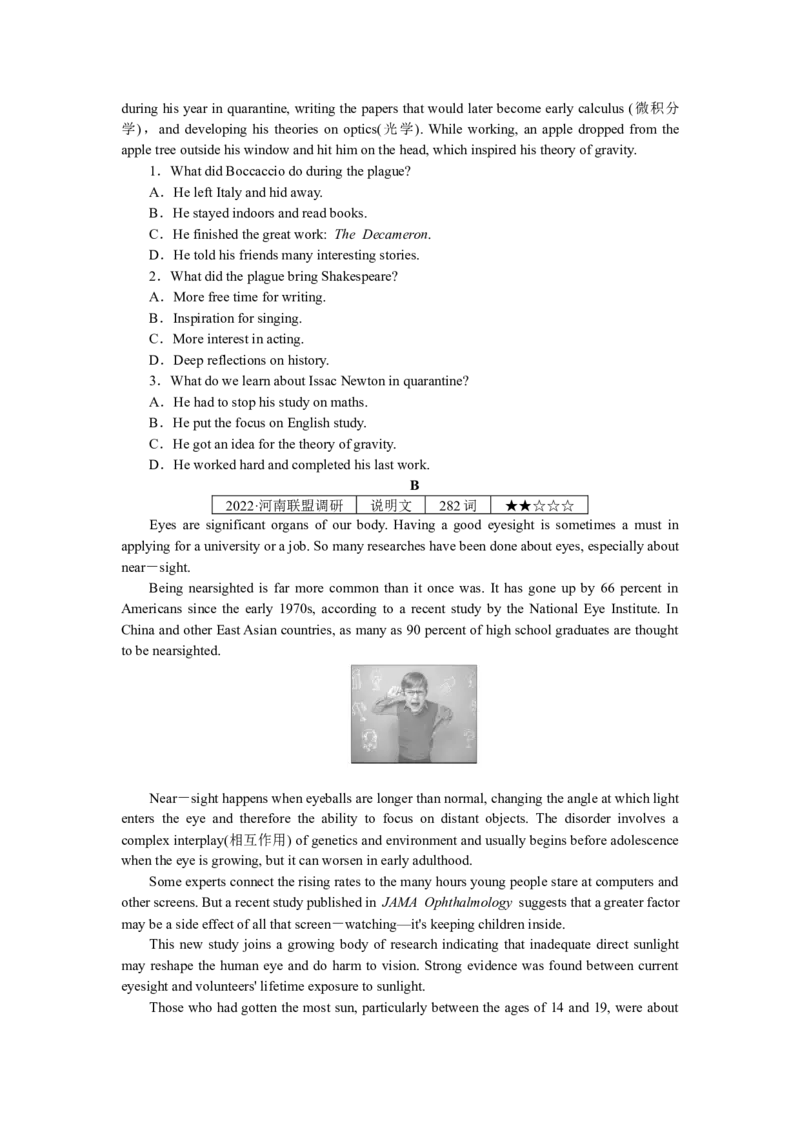
Isaac Newton (1643—1727)
In 1665, when Isaac Newton was in his early 20s, the outbreak of the plague struck the UK,
and many classes were canceled. Newton, as a student, went back home to continue his studies.
He devoted himself to his studies. The young mathematician produced some of his best worksduring his year in quarantine, writing the papers that would later become early calculus (微积分
学),and developing his theories on optics(光学). While working, an apple dropped from the
apple tree outside his window and hit him on the head, which inspired his theory of gravity.
1.What did Boccaccio do during the plague?
A.He left Italy and hid away.
B.He stayed indoors and read books.
C.He finished the great work: The Decameron.
D.He told his friends many interesting stories.
2.What did the plague bring Shakespeare?
A.More free time for writing.
B.Inspiration for singing.
C.More interest in acting.
D.Deep reflections on history.
3.What do we learn about Issac Newton in quarantine?
A.He had to stop his study on maths.
B.He put the focus on English study.
C.He got an idea for the theory of gravity.
D.He worked hard and completed his last work.
B
2022·河南联盟调研 说明文 282词 ★★☆☆☆
Eyes are significant organs of our body. Having a good eyesight is sometimes a must in
applying for a university or a job. So many researches have been done about eyes, especially about
near-sight.
Being nearsighted is far more common than it once was. It has gone up by 66 percent in
Americans since the early 1970s, according to a recent study by the National Eye Institute. In
China and other East Asian countries, as many as 90 percent of high school graduates are thought
to be nearsighted.
Near-sight happens when eyeballs are longer than normal, changing the angle at which light
enters the eye and therefore the ability to focus on distant objects. The disorder involves a
complex interplay(相互作用) of genetics and environment and usually begins before adolescence
when the eye is growing, but it can worsen in early adulthood.
Some experts connect the rising rates to the many hours young people stare at computers and
other screens. But a recent study published in JAMA Ophthalmology suggests that a greater factor
may be a side effect of all that screen-watching—it's keeping children inside.
This new study joins a growing body of research indicating that inadequate direct sunlight
may reshape the human eye and do harm to vision. Strong evidence was found between current
eyesight and volunteers' lifetime exposure to sunlight.
Those who had gotten the most sun, particularly between the ages of 14 and 19, were about25 percent less likely to have developed myopia (近视眼) by middle age. Exposure to sunlight up
to the age of 30 can also confer a protective benefit.
4.What do we learn from paragraphs 2—3?
A.The rate of near-sight has been on the decline.
B.Near-sight happens when eyeballs are abnormal.
C.Near-sight is only caused by environment.
D.Near-sight usually begins in early adulthood.
5.What is the main cause of near-sight according to the recent study?
A.Lack of sleep.
B.Using smartphones too much.
C.Reading too much.
D.Lack of direct sunlight exposure.
6.What does the underlined word “confer” in the last paragraph mean?
A.Provide. B.Damage.
C.Avoid. D.Reduce.
7.Where is the text most likely from?
A.A diary. B.A magazine.
C.A novel. D.A notebook.
Ⅱ.读后续写
[2022·浙江衢州二中段考]阅读下面材料,根据其内容和所给段落开头语续写两段,使
之构成一篇完整的短文。
As children, my brothers and I constantly annoyed our mother. When we combined forces,
we had the power to make that sweet, loving woman go mad.
One day, I arrived home from school feeling overheated, exhausted, and angry with my
brothers for being kicked out of the car and walking home alone. Taking a few steps inside, I
dropped my books and realized the house was a little too quiet. Looking around, my anger turned
to weariness, and suddenly I felt a fierce stream of water glide across my shirt. Before I realized
what happened, another was blasted directly on my face. I dove behind the couch as I heard my
brothers yell, “Water fight!”
Running to the other side of the room where my own water gun was hidden beneath a loose
floorboard, loaded and ready to go, I grabbed it and congratulated myself on being prepared in
advance.
Instantly, my anger with my brothers disappeared, and I eagerly joined in the water spraying.
We didn't stop until we were nearly wet all over and out of water. Calling a truce, we decided to
team up and take on a larger, more dangerous enemy. While taking turns to reload our weaponry,
we hatched our plan.
Our mother was outside watering the garden, totally unaware of the danger approaching her
from behind. We silently counted to three and began showering her with water. She turned around
and stood still as we finished the last of our supply. Only when she thought our guns were empty
did she dare to speak a word. However, when she began to lecture us, a water ‘bullet’ shot from
my gun, smacking (啪的一声打) her right eye, and she lost her temper.
We ran to the living room with our mother close behind and barely reached the door in time
to shut her out. She began pounding at it and shouting at us to let her in, but we had no idea that
this was all an act. She actually had her own plan.注意:
1.续写词数应为150左右;
2.请按如下格式作答。
She decided to hatch her own plan.
________________________________________________________________________
________________________________________________________________________
________________________________________________________________________
________________________________________________________________________
________________________________________________________________________
________________________________________________________________________
________________________________________________________________________
________________________________________________________________________
When we left the door open for too long, she took action.
________________________________________________________________________
________________________________________________________________________
________________________________________________________________________
________________________________________________________________________
________________________________________________________________________
________________________________________________________________________
________________________________________________________________________
________________________________________________________________________