练习 46 语法填空+阅读理解
Ⅰ.语法填空
2022·岳阳一中月考 201词 ★★★★☆
Nearly forty percent of China's young people born after 1990 have turned off notifications
(通知) from social media apps due 1.________ sensing the negative effects of social media,
according to the 2.________ (recent) released Kantar China Social Media Impact Report, Beijing
Evening News reported.
The report shows that social media, especially WeChat, 3.________ (become) more and
more popular in the past years among people over the age of 40, 4.________ the WeChat use of
the “post90s” generation has slightly decreased, from 94.1 percent to 86.6 percent.
Most of those people 5.________ (interview) for the report mentioned that positive effects of
social media include socializing with 6.________ (acquaintance) and taking in more information.
However, respondents also noted that social media has caused them to read fewer books, suffer
from 7.________ (bad) eyesight, sleep less and have less privacy, among other concerns.
As 8.________ consequence, 39 percent of the “post90s” generation attempts
9.________ (avoid) the negative effects of mobile phone use. In the first place, they turn off app
notifications when necessary. Moreover, they intentionally limit the 10.________ (frequent) of
social media interactions(交流) and stay away from social media entirely in certain situations.
Ⅱ.阅读理解
A
2022·重庆南开月考 记叙文 276词 ★★★☆☆
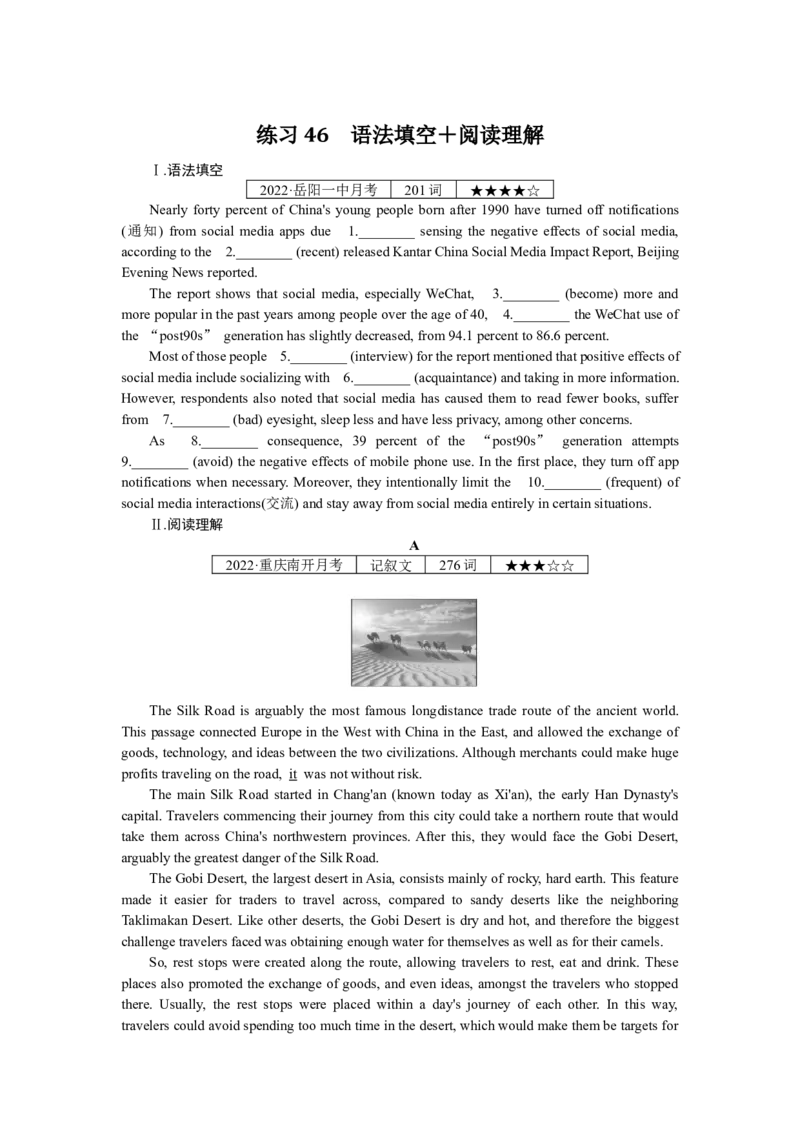
The Silk Road is arguably the most famous longdistance trade route of the ancient world.
This passage connected Europe in the West with China in the East, and allowed the exchange of
goods, technology, and ideas between the two civilizations. Although merchants could make huge
profits traveling on the road, it was not without risk.
The main Silk Road started in Chang'an (known today as Xi'an), the early Han Dynasty's
capital. Travelers commencing their journey from this city could take a northern route that would
take them across China's northwestern provinces. After this, they would face the Gobi Desert,
arguably the greatest danger of the Silk Road.
The Gobi Desert, the largest desert in Asia, consists mainly of rocky, hard earth. This feature
made it easier for traders to travel across, compared to sandy deserts like the neighboring
Taklimakan Desert. Like other deserts, the Gobi Desert is dry and hot, and therefore the biggest
challenge travelers faced was obtaining enough water for themselves as well as for their camels.
So, rest stops were created along the route, allowing travelers to rest, eat and drink. These
places also promoted the exchange of goods, and even ideas, amongst the travelers who stopped
there. Usually, the rest stops were placed within a day's journey of each other. In this way,
travelers could avoid spending too much time in the desert, which would make them be targets forrobbers, another danger of the Silk Road.
Once through the Gobi Desert, travelers would continue their journey into Iran, Turkey, and
finally Europe. While this part of the journey may have been less dangerous, it is not entirely
without peril (危险).
1.The underlined word “it” in the first paragraph refers to ________ .
A.making huge profits
B.traveling on the Silk Road
C.exchanging goods and ideas
D.connecting different civilizations
2.Why was the Gobi Desert easier to cross than other deserts?
A.The desert's surface was easier to walk on.
B.Camels for transportation were easier to find.
C.It was smaller and could be crossed in less time.
D.There were more natural water sources available.
3.What do we learn about the rest stops in the Gobi Desert?
A.They offered travelers free accommodation.
B.They were located around the edges of the desert.
C.Travelers staying there were often attacked by criminals.
D.They were shared by travelers from different countries.
4.What is the passage mainly about?
A.The origins of the Silk Road.
B.The benefits of the Silk Road.
C.The difficulties faced by Silk Road travelers.
D.The cultural exchanges among Silk Road travelers.
B
2022·唐山一中月考 说明文 349词 ★★★☆☆
Reintroducing beavers (海狸) to Britain could help clean up rivers, prevent flooding and
minimise soil loss, an expert has claimed.
Professor Richard Brazier, a researcher at the University of Exeter, said unpublished results
from a trial area in Devon showed muddy water entering an area where beavers were living was
three times cleaner when it left. “Our trial has shown that the beavers are able to dam our
streams in a way that keeps soil in the headwaters of our catchment (流域) so it doesn't block up
rivers downstream and pollute our drinking and bathing waters. If we bring beavers back it's just
one tool we need to solve Britain's crisis of soil loss and agricultural pollution of waterways, but
it's a useful tool,” he said.
Prof Brazier's claims were disputed by the National Farmers' Union (NFU), which warned
that the reintroduction of beavers to Scotland had led to fields and forests becoming damaged.
Spokesman Mark Pope said: “The knowledge of the impacts beavers have had on farmland,
riverbanks and flood defences in Scotland is concerning. We await the results of the Devon trial
and will analyse the outcomes then.”
Prof Brazier, an expert in Earth Surface Processes, insisted the animals could even play a
useful role in preventing flooding. He told BBC News: “The public is currently paying people to
build leaky dams to keep storm waters in the uplands. The beavers can do it free of charge and
even build their own homes.”However, Professor Jane Rickson, a soil specialist from Cranfield University, Bedfordshire,
joined the NFU in sounding a note of caution. She agreed that in some places in the UK there was
evidence of worrying soil loss, and said new policies were urgently needed. Beavers may in fact
reduce the river channel and remove vegetation, exposing banks to greater erosion (侵蚀) and
increasing, rather than decreasing, the risk of flooding, she warned. And she said beaver dams
should be “leaky” to avoid buildups of large volumes of water.
5.How do beavers help clean up rivers, prevent flooding and minimise soil loss?
A.By building dams in their own way.
B.By protecting the forests or fields.
C.By building their own homes in the riverbank.
D.By damaging their dams to avoid buildups of large volumes of water.
6.What can we learn from the passage?
A.Beavers can't clean up rivers.
B.Mark Pope supports Professor Richard Brazier.
C. The scientists haven't decided to introduce beavers.
D.Beavers have positive effects on agriculture.
7.Professor Jane Rickson didn't agree with Professor Richard Brazier because she thought
that ________.
A.beaver dams are not leaky
B.beavers couldn't decrease the risk of flooding
C.it would take a lot of time to introduce beavers
D.the environment problems were extremely serious
8.In which section of a website can you most probably find this passage?
A.Technology. B.Environment.
C.Education. D.Culture.