第 1 讲 八下 Unit 1 Time to Relax.
Talk about how you spend your free time
目标导航
Unit 1 Time to Relax.
目标 1.学习 U1 Section A 课文表达重点句型。 2.动词不定式 to do 用法。
Section A, 3a
Peter: Hey Yaming!What are you up to?
Yaming:Hi Peter.I'm doing calligraphy.
Peter: It's beautiful! What are you writing?
Yaming:It's a poem by Li Bai. My grandmother taught me how to write it.
Peter: What's this character?
Yaming: It's yue. It means "moon".
Peter:It's nice! I like watching you write like that. But it looks difficult.
Yaming:Well,the first step is always the hardest. When I started to do calligraphy,I spent hours practising single
strokes.
Peter:I know how that feels! My dad's teaching me to play the guitar. It's difficult,but he always encourages me
not to give up.
Yaming: Exactly. Now I do calligraphy to relax. I even like how the ink smells!Why did you choose to play the
guitar?
Peter: I think playing the guitar is cool. Will you teach me to write a poem? I can teach you to play a song in
return.
Yaming: It's a deal!
词汇梳理
(一)词汇变形小结:
1write 写(v.) → (n.) 书法;写作
teach 教(v.) → (过去式) → (现在分词) → (n.) 老师
practise 练习(v.) → (n.) 练习
encourage 鼓励(v.) → (n.) 鼓励
choose 选择(v.) → (过去式)
difficult 困难的(adj.) → (n.) 困难
beautiful 美丽的(adj.) → (n.) 美
relax 放松(v.) → (adj.) 令人放松的 → (adj.) 感到放松的
【练一练】用所给词的适当形式填空
1.My father is me to drive. (teach)
2.I spent an hour the guitar. (practise)
3.Her words gave me great to try again. (encourage)
4.The game is for beginners. (difficulty)
5.After the holiday, I feel and happy. (relax)
1.What are you up to? 你在做什么?
【用法详解】"What are you up to?" 是口语中常用的句子,意为“你在忙什么?/ 你在做什么?”,相当于
"What are you doing?"。
【即学即用】
— Hey! What are you up to?
— Not much. I'm just (read) a book.
2. I’m doing calligraphy. 我在写书法
【用法详解】calligraphy 为不可数名词,意为“书法”。
do calligraphy 表示“练习书法;写书法”。
【拓展延伸】表达个人爱好或正在进行的活动
I'm doing... 我正在做......
I do... to relax. 我做......来放松。
23. My grandmother taught me how to write it. 我的祖母教我如何写它。
【用法详解】 重点:teach sb. (how) to do sth. 表示“教某人(如何)做某事”。
teach 的过去式为 taught。
【即学即用】
Mr. Smith teaches us (speak) English.
She (teach) me how to swim last summer.
4. I spent hours practising single strokes. 我花了数小时练习基本笔画
【用法详解】 重点:spend + 时间 + (in) doing sth. 表示“花费时间做某事”。
practise 为动词,后接动词-ing 形式,即 practise doing sth.(练习做某事)。
【易混辨析】spend, pay 与 take
sb. spend + 时间/金钱 on sth./(in) doing sth. (人作主语)
sb. pay + 金钱 for sth. (人作主语)
It takes sb. + 时间 to do sth. (It 作形式主语)
【即学即用】
I spent two hours (finish) my homework.
She needs to practise (play) the piano every day.
5. My dad’s teaching me to play the guitar. 我爸爸正在教我弹吉他。
【用法详解】play the guitar 表示“弹吉他”。演奏乐器时,乐器前需加定冠词 the。
6. He always encourages me not to give up. 他总是鼓励我不要放弃。
【用法详解】 重点:
encourage sb. to do sth. 鼓励某人做某事
encourage sb. not to do sth. 鼓励某人不要做某事
give up 表示“放弃”,后可接名词或动词-ing 形式。若宾语为代词,需放在 give 和 up 之间。
【即学即用】
Our teacher always encourages us (work) hard.
Don't (放弃) your dream.
This problem is too difficult. I want to give up. (it / them)
37. Now I do calligraphy to relax. 现在我写书法是为了放松。
【用法详解】to relax 是动词不定式,在此作目的状语,表示做某事的目的。
relax 为动词,其形容词形式为 relaxing(令人放松的)和 relaxed(感到放松的)。
【即学即用】
I listen to music (relax).
The story has a (relax) ending. We all feel (relax).
8. I can teach you to play a song in return. 我可以教你弹一首歌作为回报。
【用法详解】in return 是一个固定短语,意为“作为回报;作为交换”,通常放在句末。
【即学即用】
— Happy birthday! This is for you.
— Thank you! I'll sing a song for you (作为回报).
9.It’s a deal! 一言为定!
【用法详解】It's a deal! 是口语中常用的句子,用于表示同意对方提出的建议或交易,意为“成交!/ 一言
为定!”。
SectionA 基础提升练
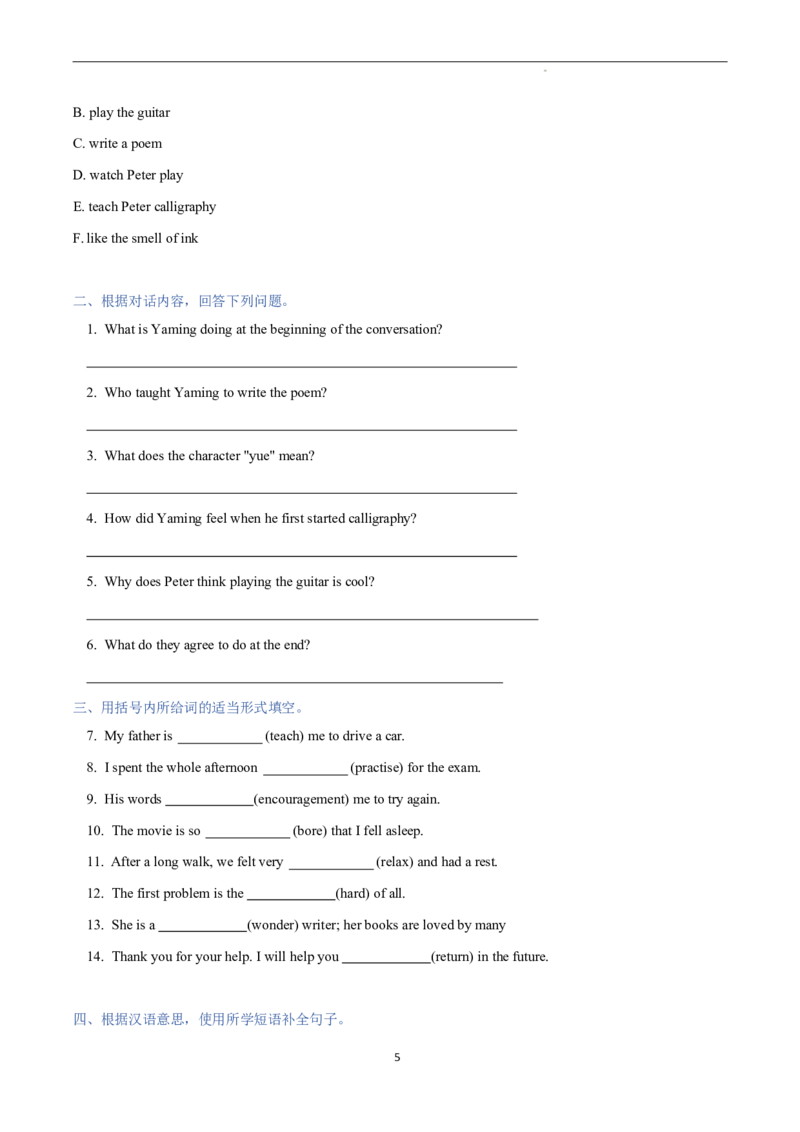
一、根据对话内容,选择彼得和亚明的空闲时间活动。
Peter's activities:A. do calligraphy
B.play the guitar
C.write a poem
D.watch Yaming write
E.teach Yaming a song
F.practise single strokes
Yaming's activities:
A.do calligraphy
4B.play the guitar
C.write a poem
D.watch Peter play
E.teach Peter calligraphy
F.like the smell of ink
二、根据对话内容,回答下列问题。
1. What is Yaming doing at the beginning of the conversation?
2. Who taught Yaming to write the poem?
3. What does the character "yue" mean?
4. How did Yaming feel when he first started calligraphy?
5. Why does Peter think playing the guitar is cool?
6. What do they agree to do at the end?
三、用括号内所给词的适当形式填空。
7. My father is (teach) me to drive a car.
8. I spent the whole afternoon (practise) for the exam.
9. His words (encouragement) me to try again.
10. The movie is so (bore) that I fell asleep.
11. After a long walk, we felt very (relax) and had a rest.
12. The first problem is the (hard) of all.
13. She is a (wonder) writer; her books are loved by many
14. Thank you for your help. I will help you (return) in the future.
四、根据汉语意思,使用所学短语补全句子。
515. 请不要放弃学习英语。
Please don't learning English.
16. 我每天花一小时练习弹钢琴。
I an hour the piano every day.
17. 作为回报,她请我吃了一顿丰盛的晚餐。
She bought me a big dinner .
18. 这本书看起来很有趣。
This book .
19. 他总是鼓励我要勇敢。
He always me be brave.
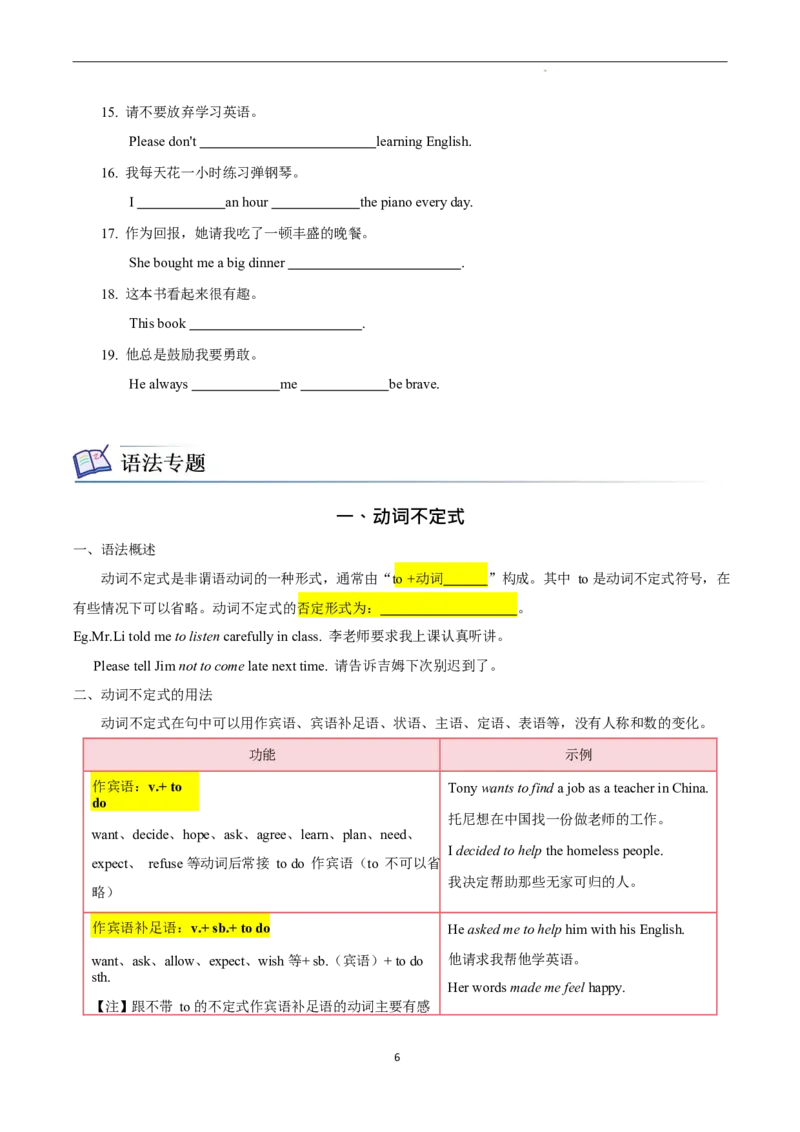
一、动词不定式
一、语法概述
动词不定式是非谓语动词的一种形式,通常由“to +动词 ”构成。其中 to 是动词不定式符号,在
有些情况下可以省略。动词不定式的否定形式为: 。
Eg.Mr.Li told me to listen carefully in class. 李老师要求我上课认真听讲。
Please tell Jim not to come late next time. 请告诉吉姆下次别迟到了。
二、动词不定式的用法
动词不定式在句中可以用作宾语、宾语补足语、状语、主语、定语、表语等,没有人称和数的变化。
功能 示例
作宾语:v.+ to Tony wants to find a job as a teacher in China.
do
托尼想在中国找一份做老师的工作。
want、decide、hope、ask、agree、learn、plan、need、
I decided to help the homeless people.
expect、 refuse 等动词后常接 to do 作宾语(to 不可以省
我决定帮助那些无家可归的人。
略)
作宾语补足语:v.+ sb.+ to do He asked me to help him with his English.
want、ask、allow、expect、wish 等+ sb.(宾语)+ to do 他请求我帮他学英语。
sth.
Her words made me feel happy.
【注】跟不带 to 的不定式作宾语补足语的动词主要有感
6官动词(see、feel、watch、hear)和使役动词(let、 她的话让我感到开心。
make、
have)等。
如: 让某人做某事
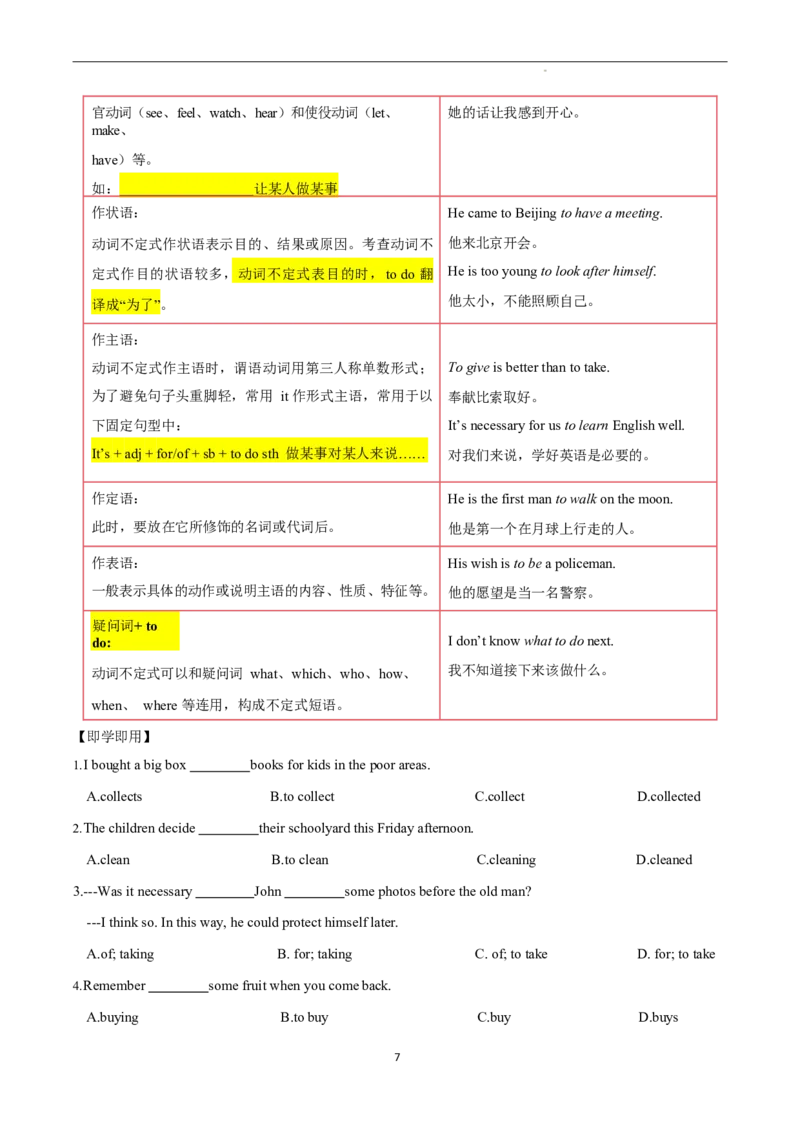
作状语: He came to Beijing to have a meeting.
动词不定式作状语表示目的、结果或原因。考查动词不 他来北京开会。
定式作目的状语较多,动词不定式表目的时,to do 翻 He is too young to look after himself.
他太小,不能照顾自己。
译成“为了”。
作主语:
动词不定式作主语时,谓语动词用第三人称单数形式; To give is better than to take.
为了避免句子头重脚轻,常用 it 作形式主语,常用于以 奉献比索取好。
下固定句型中: It’s necessary for us to learn English well.
It’s + adj + for/of + sb + to do sth 做某事对某人来说…… 对我们来说,学好英语是必要的。
作定语: He is the first man to walk on the moon.
此时,要放在它所修饰的名词或代词后。 他是第一个在月球上行走的人。
作表语: His wish is to be a policeman.
一般表示具体的动作或说明主语的内容、性质、特征等。 他的愿望是当一名警察。
疑问词+ to
do: I don’t know what to do next.
动词不定式可以和疑问词 what、which、who、how、 我不知道接下来该做什么。
when、 where 等连用,构成不定式短语。
【即学即用】
1.I bought a big box books for kids in the poor areas.
A.collects B.to collect C.collect D.collected
2.The children decide their schoolyard this Friday afternoon.
A.clean B.to clean C.cleaning D.cleaned
3.---Was it necessary John some photos before the old man?
---I think so. In this way, he could protect himself later.
A.of; taking B. for; taking C. of; to take D. for; to take
4.Remember some fruit when you come back.
A.buying B.to buy C.buy D.buys
75.Our teacher often asks us time.
A.not waste B.don’t waste C.not to waste D.doesn’t waste
6.He wants to know how (speak ) English well.
7.Joan hopes (study) law(法律) at Harvard University.
8.It is very easy for me (play) ping-pong well because my father has been teaching me for three years.
9.My dream is (become) a reporter in the future.
10.Tom's mother told him (not spend) too much time playing computer games.
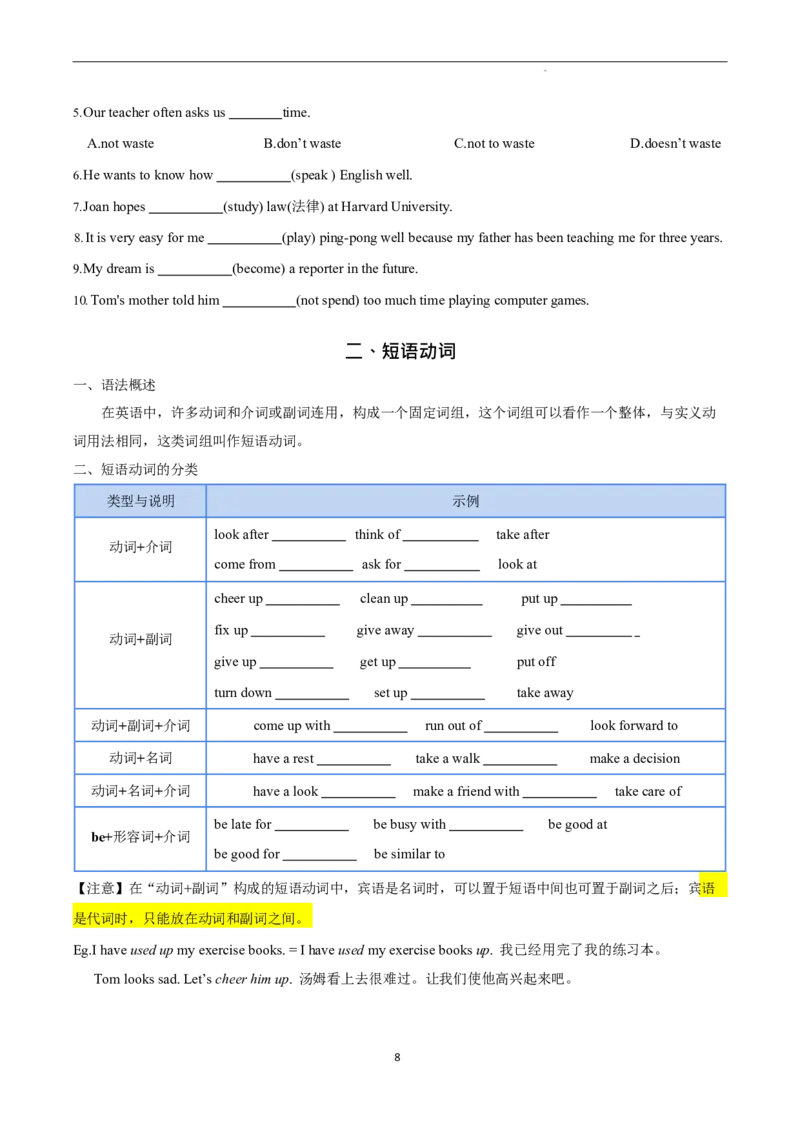
二、短语动词
一、语法概述
在英语中,许多动词和介词或副词连用,构成一个固定词组,这个词组可以看作一个整体,与实义动
词用法相同,这类词组叫作短语动词。
二、短语动词的分类
类型与说明 示例
look after think of take after
动词+介词
come from ask for look at
cheer up clean up put up
fix up give away give out
动词+副词
give up get up put off
turn down set up take away
动词+副词+介词 come up with run out of look forward to
动词+名词 have a rest take a walk make a decision
动词+名词+介词 have a look make a friend with take care of
be late for be busy with be good at
be+形容词+介词
be good for be similar to
【注意】在“动词+副词”构成的短语动词中,宾语是名词时,可以置于短语中间也可置于副词之后;宾语
是代词时,只能放在动词和副词之间。
Eg.I have used up my exercise books. = I have used my exercise books up. 我已经用完了我的练习本。
Tom looks sad. Let’s cheer him up. 汤姆看上去很难过。让我们使他高兴起来吧。
8【即学即用】
1.Can you look after the children? Do you know how to ?
A. cheer them up B.cheer up them C.give them up D.give up them
2.Because of the bad weather, we have to the sports meeting till next week.
A.take off B.get off C.put off D.set off
3.We have raised some books. We’ll to the poor children.
A. put them up B. give them away C. put up them D.give away them
语法小测
一、单项选择
1.I some clothes to charities(慈善机构)because they are too small for me.
A.take after B.hang out C.give away D.put off
2.(宜昌中考) ---The Organization Wild Aid(野生救援组织)is to protect wild animals.
---It has done a lot so far.
A.cheered up B.picked up C.given up D.set up 3.
(常州中考) Our teacher a bookshelf at the back of our classroom to make a small reading corner.
A.picked up B.put up C.cleaned up D.got up
4. (莱芜中考)Don't forget the rubbish out when you leave.
A.taking B.bring C.to take D.to bring
5.(辽宁铁岭中考)My cousin volunteers in the Children's Home. His job is to food and clothes.
A. sell out B. work out C. hand out D. find out
6. Don’t worry . We will meet next Monday the project again .
A. discuss B. discussed C. discussing D. to discuss
7.—Can you help me my camera now ?
—What about tomorrow? I am too busy today.
A. put up B. fix up C. set up D. look up
8.(山东东营中考)---Could we the arriving time for school to 8:00 am, Mr. Li?
---You mean 7:30 is a little earlier? Let's discuss it with the headmaster.
A. find out B. give up C. put off D cut out
9.(泰州中考)---Mr. Ling, I have some difficulty the article.
9---Remember it three or four times at least.A.to understand; reading
B.understanding; reading
C.understanding;to read D.to understand; to read
10.You had better ask your brother playing computer games. It’s bad for him.
A. to give up B. not to give up C. to give it up D. giving up
11. If you love animals, you can volunteer animals
A. protect B. protecting C. to protect D. protected
12.We must everyone that keeping our city clean is our duty.
A.let; to know B.make; understand C.make; to understand D.have; to know
13.Hello, everyone, attention, please. Now let me tell you to the Changsha park.
A.how to get B.what to get C.whom to get D.where to get
14.The boy that man.Maybe that man is the boy’s father.
A. looks after B. takes after C. takes break D. looks for
15.He fails the math test and looks sad. Let’s .
A.put him up B.set him up C.cheer him up D.clean him up
二、用所给词的适当形式填空
1.In people’s free time, they think about what (do) for fun.
2.Would you like (go) and have a picnic with us tomorrow?
3.The joke made all of us want ( laugh).
4.Ben Smith is very lucky (have) a special trained dog because of Miss Li’s kindness.
5.Mike taught his grandpa how (use) the computer.
10第 2 讲 八下 Unit 1 Time to Relax.
Talk about hobbies and their benefits
目标导航
Unit 1 Time to Relax.
1. 掌握与爱好和健康生活相关的核心词汇与表达。
2. 熟练运用动词不定式作目的状语。
目标
3. 能够区分事实(Fact)与观点(Opinion)。
4. 能够描述个人爱好并阐述其益处
Hobbies That Are Good for You
When work or school is over, what do you do to pass the time? Do you spend time on hobbies you love?
Reading or listening to music can help us to calm down after a busy day. Physical hobbies, such as playing tennis
or doing yoga, can help us to keep fit. And some hobbies are creative. For example,people sometimes paint pictures
to remember a beautiful landscape or object, or reduce stress.
Luca Bruno likes to be creative in his free time. But he doesn't make art or write stories. Instead, this Italian
teenager finds it fun to make mobile phone apps. He thinks that apps can be a great way to help people. He
started programming when he was ten, after he read about famous businessmen who started out as programmers.
His latest app allows people around the world to find study partners for learning Italian. They can learn Italian and
make friends at the same time!
“It gives me such a sense of achievement to see people using the app,”says Luca. “I believe I'm helping
people around the world to learn Italian!”
Some people prefer not to make things.They prefer to collect them! In India,Maya Badal doesn't collect coins
or stamps. Instead,this teenage girl collects postcards!
11“I know some people think postcards are rather old-fashioned, but I think they're a good way to learn about
different places,” Maya says. “I think it's interesting to see the beautiful buildings and landscapes in foreign
countries."
Maya's first postcard shows the Mogao Caves in Dunhuang. Her dad sent it to her when she was five, and she
liked it so much that she put it up on her bedroom wall! Now there are over one hundred postcards from thirty-two
countries on Maya's walls. She dreams of travelling to these places in the future!
词汇梳理
(一) 词汇变形小结:
visit the memories each postcard brings—of
relax 放松 (v.) → (adj.) 令人放松的 → (adj.) 感到放松的
create 创造 (v.) → (adj.) 有创造力的 → (n.) 创造力
achieve 达到,实现 (v.) → (n.) 成就
believe 相信 (v.) → (n.) 信念
encourage 鼓励 (v.) → (n.) 鼓励
collect 收集 (v.) → (n.) 收藏品
choose 选择 (v.) → (过去式) → (n.) 选择
difficult 困难的 (adj.) → (n.) 困难
【练一练】用所给词的适当形式填空
1.After a hot bath, I felt completely (relax).
2.Painting is a (create) activity that allows me to express myself.
3.Winning the competition was a great (achieve) for her.
4.My parents give me a lot of (encourage) to try new things.
5.His (collect) of stamps from around the world is amazing.
6.She (choose) to learn French instead of Spanish last year
7.The (difficult) of the task made us work harder.
1. 动词不定式作目的状语:to relax / to learn / to try
12【用法详解】动词不定式(to do)可以放在句首或句末,表示做某事的目的,意为“为了……”。
【例句】
To learn a new skill, he started programming.
Some people listen to music to relax after a busy day.
She collects postcards to learn about different places.
【即学即用】根据中文意思完成句子。
我跑步是为了保持健康。
I run keep fit.
为了通过考试,他每天都努力学习。
pass the exam, he studies hard every day.
2. He thinks that apps can be a great way to help people 他认为应用程序是帮助人们的好方法。
【用法详解】表达观点的句型:I think / I believe / In my opinion..这些句型用于表达个人的看法、感受或信
念,其后接宾语从句。
【例句】
I think that apps can be a great way to help people.
I believe I'm helping people around the world.
In my opinion, postcards are a good way to learn about different places.
【即学即用】将下列句子翻译成英文
我认为每个人都应该有一个爱好。
我相信努力终会带来成功。
3. Reading or listening to music can help us to calm down after a busy day 阅读或聆听音乐有助于在忙碌的一
天后放松心情.
【用法详解】help 后面可接宾语和带 to 或不带 to 的动词不定式,help sb. (to) do sth 意为“帮助某人做某
事”。
【例句】
His app helps people (to) find study partners.
Reading can help us (to) calm down.
13【即学即用】用括号内词的适当形式填空。
Could you help me (carry) this heavy box?
A good hobby can help you (feel) happier.
4. Instead, this Italian teenager finds it fun to make mobile phone apps 相反,这位意大利少年发现开发手机
应
用很有趣。.
知识点 1: 【易混辨析】instead 与 instead of
单词 词性 用法
instead 副词 意为“代替;反而;却”,用来修饰整个句子,位于句末,也可位于句首
instead of 副词短语 意为“代替;而不是”,后面可以接名词、代词或者动词-ing
Eg.He didn’t play basketball. He went swimming instead. 他去游泳了,而没有去打篮球。
= He went swimming instead of playing basketball.
【即学即用】
1.He didn’t go to the children’s home. His friend Jack went there .
A.instead B. too C. also D. instead of
2.Let’s go skating instead of (stay) at home.
3. He didn’t write to Jenny. He talked with her on the phone, instead.(合成一
句) He talked with her on the phone writing to her.
4.我会待在家而不是出去闲逛。(完成句子)
I will stay at home out with friends.
知识点 2::It’s + adj + (for/of) sb. to do sth.“做某事对某人来说……”。
【用法详解】本句中 it 为形式主语,真正的主语为后面的动词不定式短语。当不定式短语较长时,通常用
it 作形式主语放在句首,将真正的主语放在句子后面,构成句型:It’s + adj + (for/of) sb. to do sth.“做某事对
某人来说……”。
Eg. It’s very important for us to learn English well. 对我们来说,学好英语很重要。
It’s very kind of you to help me. 你来帮助我真是太好了。
【即学即用】
1. is difficult for us to draw a beautiful picture as well as you.
A. That B. This C. It D. We
2.It’s very dangerous for us the mobile phone while crossing the street.
14A.answering B.to answer C.answer D.answered
3.It is important for children (learn) how to do chores at home.
5. His latest app allows people around the world to find study partners for learning Italian 他最新推出的这款
应用,能让全球用户轻松找到学习意大利语的伙伴。
【用法详解】allow 意为“允许”,常用结构为 allow sb. to do sth.(允许某人做某事)。
【例句】
His latest app allows people to find study partners around the world.
【即学即用】根据中文完成句子。
我父母不允许我晚上外出。
My parents don't out at night.
6. It gives me a sense of achievement. 这让我感到成就感。
【用法详解】“It gives me a sense of + 抽象名词” 表示“这给我一种……的感觉”。
【例句】
It gives me a sense of achievement to see people using my app.
Helping others gives me a sense of satisfaction.
【即学即用】翻译句子。
完成这个项目给了我巨大的成就感。
7. Some people prefer not to make things.They prefer to collect them!有些人不喜欢动手做东西,他们更喜欢
收集东西!
【用法详解】prefer 意为“更喜欢”,后可接不定式或动词-ing 形式。prefer to do / prefer doing
【例句】
Some people prefer not to make things. They prefer to collect them.
She prefers watching movies at home.
【即学即用】用所给词的正确形式填空。
I prefer (stay) at home during the weekend.
15Section B 基础提升练
一、基础提升练习
(一)根据对话内容,补全句子(每空一词)
1.Yaming is calligraphy when Peter meets him.
2.Yaming's grandmother him how to write the poem by Li Bai.
3.The character "yue" in the poem "moon".
4.Peter's father is teaching him to the guitar.
5.Yaming and Peter agree to teach each other: Yaming teaches Peter to write a poem, and Peter teaches Yaming
to play a .
(二)用所给词的适当形式填空
1.This is one of the (difficult) tasks I have ever done.
2.The (relax) music made everyone feel calm after the busy work.
3.He has a large (collect) of stamps from all over the world.
4.The singer's (perform) was so wonderful that the audience cheered for a long time.
5.It's important for us (develop) good learning habits.
(三)句型转换
6.He spent 3 hours finishing his homework yesterday.(改为同义
句) It him 3 hours finish his homework yesterday.
7.My mother taught me how to cook.(对划线部分提问)
taught you how to cook?
8.He chose to study English because he liked it.(对划线部分提问)
he choose to study English?
9.Don't give up learning English.(改为同义句)
Don't learning English
10.I do calligraphy to relax.(对划线部分提问)
do you do calligraphy?
二、语法填空
Hobbies are an important part of our life. They help us relax and make our free time more
161. (meaning). Different people have different hobbies. Some like creative hobbies, while others prefer
active ones.
Luca, an Italian teenager, loves 2. (create) mobile phone apps. He started programming at the age of ten
after reading about successful businessmen who began as programmers. At first, he faced man3. (difficult).
He often spent hours solving a single problem and wanted to give up. But his parents encouraged him
4. (keep) trying. Now, his latest app helps people around the world find study partners for learning Italian.
"It gives me a strong sense of 5. (achieve) to see others using my app," Luca said.
Maya, a teenage girl from India, has a different hobby—collecting postcards. She 6. (start) collecting
when she was five. Her dad sent her a postcard from Dunhuang, and she fell in love with it at once. Now, she has
over 100 postcards from 32 countries. She thinks postcards are a great way 7. (learn) about different
places and cultures. "Some people think postcards are old-fashioned, but I find 8. (they) interesting. Each
postcard tells a story," Maya explained.
No matter what hobby we have, it's important to stick to it. Hobbies not only help us relax but also teach us
valuable skills. They make our life more colorful and 9. (enjoy). So if you don't have a hobby yet, why not
10. (take) up one today?
三、阅读理解
Passage 1
Calligraphy is a traditional art form in many cultures. It is not just about writing; it is about expressing beauty
and emotion through strokes (笔画). For Yaming, a middle school student, calligraphy is more than a hobby—it's
a way to connect with his family and relax.
Yaming started learning calligraphy from his grandmother when he was seven. His grandmother was a skilled
calligrapher who taught him to write Chinese poems. At first, Yaming found it very hard. He had to practise single
strokes for hours every day, and his fingers often hurt. There were times when he wanted to quit, but his
grandmother told him, "Calligraphy is like a journey. The harder the beginning, the more beautiful the end."
With time, Yaming improved. He began to enjoy the process of writing— the smell of ink, the feel of the
brush, and the way characters came to life on paper. Now, he does calligraphy for 30 minutes every evening after
finishing homework. It helps him relax after a busy day at school. Last year, he joined a city-level calligraphy
competition and won second prize. His grandmother was very proud of him.
Yaming hopes to keep this hobby for life. He wants to learn more about traditional Chinese poems and write
17them in beautiful calligraphy. He also plans to teach his little sister calligraphy one day, so she can also experience
the joy of this traditional art.
阅读题目:
( )1.What does calligraphy mean to Yaming?
A. A way to make money B. A way to connect with family and relax
C. A way to become famous D. A way to improve his Chinese
grades ( )2.Who taught Yaming calligraphy?
A. His father B. His mother C. His grandmother D. His teacher
( )3.What did Yaming's grandmother compare calligraphy to?
A. A poem B. A journey C. A competition D. A
story ()4.How long does Yaming do calligraphy every evening?
A. 20 minutes B. 30 minutes C. 40 minutes D. 50 minutes
( )5.What prize did Yaming win in the city-level calligraphy competition?
A. First prize B. Second prize C. Third prize D. Fourth prize
Passage 2
In today's fast-paced world, hobbies are more important than ever. They help us reduce stress, improve our
skills, and even make new friends. Two teenagers, Luca and Maya, share how their hobbies changed their lives.
Luca is a 15-year-old from Italy. He loves making mobile phone apps. He first became interested in
programming when he read a book about young programmers who started their own companies. At first, Luca
found programming very difficult. He couldn't understand complex codes (代码) and often made mistakes. He felt
frustrated and wanted to give up. But his math teacher encouraged him to keep trying. "Mistakes are part of
learning," the teacher said. Luca took the advice and spent more time practising. He even joined an online
programming club to learn from others.
Now, Luca has created three apps. His latest app, "Italian Study Pals", helps people find study partners to learn
Italian. Users can chat with each other, share learning materials, and practice speaking Italian. The app has over
1,000 users from 20 countries. "Seeing people use my app and make progress in Italian makes me very happy,"
Luca said. "It gives me a sense of achievement that I can't get from schoolwork."
Maya, a 14-year-old from India, has a hobby of collecting postcards. She started when her dad sent her a
postcard from Dunhuang, China. The postcard had a picture of the Mogao Caves, and Maya was fascinated by its
beauty. She began asking friends and family to send her postcards from different places. Now, she has 120
18postcards from 35 countries. Each postcard has a story—some are from famous landmarks, while others show local
people's daily lives.
Maya often shares her postcards with her classmates. She even gave a talk about her collection at school.
"Postcards are like windows to the world," Maya said. "They help me learn about different cultures without leaving
my home. I also made new friends who share the same hobby."
阅读题目:
( )1.Why did Luca become interested in programming?
A. Because his father was a programmer B. Because he read a book about young programmers
C. Because his math teacher asked him to learn it D. Because he wanted to make money
( )2.What did Luca do to improve his programming skills?
A. He quit school to study programming
B. He asked his parents to hire a tutor
C. He spent more time practising and joined an online club
D. He gave up other hobbies to focus on programming
( )3.How many users does "Italian Study Pals" have?
A. Over 500 B. Over 1,000 C. Over 1,500 D. Over 2,000
( )4.What fascinated Maya about the first postcard from Dunhuang?
A. The picture of the Mogao Caves
B. The writing on the postcard
C. The stamp on the postcard
D. The sender of the postcard
( )5.What does Maya think of postcards?
A. They are old-fashioned and boring
B. They are expensive but valuable
C. They are windows to the world
D. They are difficult to collect
19Unit 1 写作训练
【写作任务】
以 “My Favorite Hobby” 为题,写一篇短文,介绍你最喜欢的爱好。要求:1. 说明爱好是什么及开始
的原因;2. 描述在培养爱好过程中遇到的困难及如何克服;3. 阐述爱好给你带来的好处;4. 词数 100-120。
【谋篇布局】
开头段(引入爱好):明确点明自己最喜欢的爱好,说明开始这个爱好的时间和原因(如受家人 / 朋
友影响、偶然机会接触等)。
中间段(困难与克服):具体描述培养爱好时遇到的困难(如技术难度、时间冲突、想放弃的时刻),
以及如何克服(如他人鼓励、调整方法、坚持练习)。
结尾段(好处与总结):说明爱好带来的好处(如放松心情、提升技能、结交朋友、获得成就感),
表达对爱好的热爱及未来的计划。
【写作模板】
开头段
My favorite hobby is . I started it when I was years old. The reason I chose this hobby is
that (如:my father taught me how to do it / I was fascinated by it when I saw others doing it). At first, I
just did it for fun, but now it has become an important part of my life.
中间段
However, learning this hobby was not easy. I faced many difficulties. For example, (如:I couldn't
master the basic skills / I didn't have enough time to practice). There were times when I wanted to give up. But
(如:my mother encouraged me to keep trying / I adjusted my practice time). I (如:
practised for 30 minutes every day /asked a teacher for help), and slowly I improved.
结尾段
This hobby has brought me many benefits. It helps me (如:relax after a busy school day /improve
my patience). I also (如:made new friends who share the same hobby /won a small competition last
year). I will keep this hobby for a long time, and I hope to (如:become better at it /share it with more
people) in the future.
20【好句积累】
描述爱好的表达:
My favorite hobby is... / I am passionate about...
I have been doing... as a hobby for... years.
This hobby has always been close to my heart because...
描述困难的表达:
At first, I found it quite challenging to...
I struggled with... and often felt frustrated.
There were moments when I thought about giving up because...
描述克服困难的表达:
With the encouragement of..., I decided to keep going.
I changed my approach and started to...
I persisted in practising, and gradually I made progress.
描述好处的表达:
This hobby not only helps me relax but also improves my...
It gives me a strong sense of achievement when I...
Thanks to this hobby, I have made many like-minded friends.
【必背范文】
My Favorite HobbyMy favorite hobby is playing the violin. I started it when I was eight years old. My music
teacher played the violin for our class, and I was deeply impressed by its beautiful sound. That's why I decided to
learn it.
However, learning the violin was much harder than I expected. At first, I couldn't hold the bow correctly, and
the sound I made was terrible. I practised for hours but still didn't improve. I felt discouraged and wanted to quit.
My teacher noticed my frustration and told me, "Progress takes time. Keep practising, and you'll get better." I
followed her advice, practising 40 minutes every day and watching online tutorials. Slowly, the sound became
better.
Now, playing the violin is my favorite way to relax. After a busy day at school, playing a piece of music makes
all my stress disappear. Last year, I joined a school music competition and won third prize. This hobby has also
taught me the importance of persistence. I will keep playing the violin and hope to perform on a bigger stage one
day.
21【实战演练】
以 “My Hobby and Relaxation” 为题,写一篇短文。
要求:1. 介绍你最喜欢的放松类爱好(如书法、弹吉他、听音乐等);
2. 用 1-2 句话说明你如何通过这个爱好放松(参考课文 “do sth. to relax” 结构);
3. 简单分享一次用这个爱好缓解压力的经历;
4. 词数 80-100,需用到 “spend...doing sth.”“encourage sb. to do sth.” 等课文重点句型。
22第 3 讲 八下 Unit 2 Stay Healthy.
Talk about health problems and give advice
目标导航
Unit 2 .Stay healthy
1. 学习描述健康问题的表达方式
目标 2. 掌握情态动词 should 提建议的用法
3. 掌握重点短语和句型
5a Read the conversation. What’s the matter with Helen?
Doctor: Take a seat, Helen. How are you feeling?
Helen: Not good ... I have a runny nose and a fever.
Doctor: Let me take your temperature ... Oh, it's quite high.
Helen: Yes, it started yesterday. I felt so cold, and I didn't have much energy. When I tried to get out of bed, I
almost fell and hurt myself. My throat hurts too.
Doctor: Let's see. Yes, the back of your throat looks very red. We'll need to do a test, but I believe you have the
flu. It's flu season.
Helen: What should I do, Doctor?
Doctor: You should take some medicine and drink enough water.
Helen: OK, thank you. Can I go to school tomorrow?
Doctor: No, you should rest at home. When you're outside, please wear a mask. It stops us from passing the
flu virus to others easily.
Helen: I will!
Doctor: And remember, your health is in your hands. If you take good care of yourself, you'll get better soon.
23词汇梳理
(一)词汇变形小结:
feel 感觉(v.) → (n.) 感觉;感受
run 跑(v.) → (adj.) 流鼻涕的
energy 精力(n.) → (adj.) 精力充沛的
hurt 受伤(v.) → (过去式)
medicine 药(n.) → (adj.) 医学的
health 健康(n.) → (adj.) 健康的
care 照顾(v.) → (adj.) 小心的
【练一练】用所给词的适当形式填空
1.I don't have much (energy) today.
2.She (hurt) her leg when she fell down yesterday.
3.You should take the (medicine) three times a day.
4.It's important to keep (health).
5.Please take (care) of your little sister.
重点词考点拓展
1. How are you feeling? 你感觉怎么样?
【用法详解】用于询问对方(尤其是身体状况),比 "How are you?" 更具体、更关切。
【即学即用】
—How are you (feel)?
—Not good. I have a headache.
2. I have a runny nose and a fever. 我流鼻涕还发烧。
【用法详解】描述症状的常用句型:have a + 症状名词。
常见症状:a cough(咳嗽),a sore throat(喉咙痛),a headache(头痛),a fever(发烧)。
24【用法详解】
感冒 发烧
have a/an +疾病名称 咳嗽
头痛 胃痛
have a/an +身体部位-ache 牙痛
患病的表达方式
have a sore +身体部位 背疼 喉咙疼
主语+hurt (s) / cut (s) + 身体部位 / 反身代词 He hurts himself.
【即学即用】
I have a (咳嗽) and a (喉咙痛).
3. I didn't have much energy. 我没有太多精力。
【用法详解】energy 为不可数名词,表示“精力;能量”。
【即学即用】
After the long race, he had no (energy) left.
4.I almost fell and hurt myself 伤到自己
【用法详解】hurt + 反身代词 表示“伤到自己”。反身代词有:myself, yourself, himself, herself, itself,
ourselves, yourselves, themselves。
【即学即用】
Be careful! Don't (hurt) yourself with that knife.
5. You should take some medicine and drink enough water。 你应该吃点药并且喝足够的水。
【用法详解】 重点:should 为情态动词,表示“应该”,用于提建议。后接动词原形。
否定形式:should not (shouldn't) + do
【拓展延伸】enough 意为“足够的;足够地”,既可作形容词也可作副词。作形容词修饰名词时,放在名
词的前面,作副词修饰形容词或副词时,放在所修饰词的后面。(名前形副后)
25Eg.Don’t worry! You have enough time to finish it. 别担心!你有充足的时间来完成它。
You should be careful enough when you cross the road. 过马路时你应该足够小心。
The player runs quickly enough. 这个运动员跑得足够快。
【即学即用】
1.You should (drink) more water when you have a cold.
2.You shouldn't (go) to school if you have a fever.
3.Cathy checked her paper so that she could get good grades this time.
A.careful enough B.enough careful C.enough carefully D.carefully enough
4.It was for us to solve the math problem. Few of us could even understand it.
A.easy enough B.enough easy C.difficult enough D.enough difficult
6. It stops us from passing the flu virus to others. 它阻止我们把流感病毒传染给别人。
【用法详解】 重点:stop sb. from doing sth. 意为“阻止某人做某事”。
【即学即用】
The heavy rain stopped us from (play) football outside.
7. Your health is in your hands. 你的健康掌握在你手中。
【用法详解】固定短语 be in one's hands 意为“由某人自己掌控”。
【即学即用】
Your future is your hands. (在)
8. take good care of yourself 好好照顾自己
【用法详解】 重点:take care of = look after,意为“照顾”。后接代词需用宾格。
【即学即用】
26You are ill. You should take good care of (you).
Section A 基础提升练
一、根据对话内容,选择 Helen 的症状和医生的建议
Helen's symptoms:
A.runny nose
B.fever
C.sore throat
D.no energy
E.hurt herself
Doctor's advice:
A.take medicine
B.drink enough water
C.rest at home
D.wear a mask outside
E.do a test
二、根据对话内容,回答下列问题
6. What's the matter with Helen?
7. What did the doctor say about her throat?
8. What should Helen do to get better? (列出两点)
9. Why should she wear a mask?
10. What does "Your health is in your hands" mean?
三、用括号内所给词的适当形式填空
11.You should (take) the medicine after meals.
12. She (hurt) her arm when she fell off the bike.
13. My brother doesn't have much (energy) in the morning.
14. Please take care of (you) when you're alone.
15. The mask can stop us from (get) sick.
四、根据汉语意思,使用所学短语补全句子
2716. 你应该好好休息。
You should .
17. 她昨天发烧了。
She a yesterday.
18. 请照顾好你的妹妹。
Please your sister.
19. 这药能阻止你咳嗽。
This medicine can you .
20. 你的未来掌握在你手中。
Your future is .
五、完形填空
All over the world people enjoy sports. Sports help people to keep 1 , happy and to live 2 . People
play different games in winter and summer. 3 is good for swimming. And in winter people often go skating.
Some sports are very 4 and people everywhere like them. For example, football is very popular. In China ,
most people, men, 5 boys and girls, like to watch football games. They often talk about them. 6 and
jumping began long, long ago. But basketball and volleyball are rather 7 . People began to play them not long
ago. And people are 8 new sports. Water skiing(滑水) is one of 9 . People 10 different countries may
not be able to understand each other, but after a game they often become friends.
( )1.A. health B. busy C. healthy D. lazy
( )2.A. long B. longer C. happy D. short
( )3.A. Winter B. Summer C. Autumn D. Spring
( )4.A. boring B. difficult C. expensive D. interesting
( )5.A. woman B. women C. old D. people
( )6.A. Run B. Runs C. Running D. To run
( )7.A. new B. interesting C. popular D. old
( )8.A. start B. play C. playing D. starting
( )9.A. oldest B. newest C. the oldest D. the newest
( )10.A. in B. of C. from D. at
28语法专题
一、情态动词 should 的用法
情态动词 should 意为“应当;应该”,后接动词 ,没有人称和数的变化。
一、should 的句式结构
句式 结构 例句
肯定句 主语+ should +动词原形+其他 We should help the people in trouble.
否定句 主语+ shouldn’t +动词原形+其他 They shouldn’t eat too much.
特殊疑问句 特殊疑问词+ should +主语+动词原形+其他? Where should we meet?
Should +主语+动词原形+其他? —It’s too cold. Should I close the window?
一般疑问句 肯定回答 Yes, 主语+ should. —Yes, you should.
否定回答 No, 主语+shouldn’t. —No, you shouldn’t.
二、should 的基本用法及示例
用法 示例
表示劝告、建议 You should answer the question in English.你应该用英语回答这个问题。
表示义务、责任 Children should do their homework by themselves.孩子们应该独自做作业。
表示推断、判断 They should be at home now, I think.我认为,他们现在应该在家。
表示惊讶、赞叹、不满等 How should I know?我怎么会知道?
【即学即用】
1.Dogs run through soccer games at the park. It's dangerous!
A. should B. shouldn't C.need D. needn't
2.To keep children safe, we put the things like knives and medicine away in our house.
A. may B.should C. can D. might
3.You should more fruit.
A.eats B.eat C.eating D.to eat
4.If you have a headache, I think you see a doctor.
A.will B.shall C.should D.can
29二、反身代词
一、语法概述
反身代词常表示“某人自己”,在人称代词宾格或形容词性物主代词后加-self(单数)/ -selves(复数)
构成反身代词。
三、反身代词的分类
第一人称 第二人称 第三人称
单数
我自己 你自己 他自己 她自己 它自己
复数
我们自己 你们自己 他们自己
三、反身代词的用法
1.反身代词多用于动词或介词后作宾语,表示“某人自己”
Eg. He learned to ride a bicycle by himself.他自己学会了骑自行车。
2.反身代词应与它所指代的名词或代词在人称和数上保持一致。
Eg. In 1955, Walt Disney himself opened the first Disney Park.在 1955 年,沃尔特·迪士尼自己开了第一个迪士
尼公园。
3.反身代词常考短语:
►by oneself 独自
►enjoy oneself 玩得开心
►look after oneself 照顾自己
►help oneself to 随便吃,随便用
►teach oneself 自学
►hurt oneself 伤到自己
►cut oneself 切到自己
►dress oneself 自己穿衣服
【即学即用】
1. Could you help me clean the floor? I can't do it (I).
2. You must look after (you) well while I'm away, Tom.
303. Your sister is too young, so she can’t go to school by (she).
4. Don’t worry. We can solve our problems by (we).
5.---Dad, could you please teach English?
---Sure! But it's more important to learn it by .
A. my ; English B. my; you C. me; you D. me; yourself
语法小测
一、单项选择
1.You are the future of this country. Don't keep asking what this country can do for you. Ask what you
can do for this country.
A.us B. ourselves C.you D. yourselves
2. —Do you know who taught French?
—Nobody. He learned it by .
A. his; himself B. him; him C. him; himself D. his; him
3. -Your uncle is very good at cooking! How did he learn it?
-He learned it by .
A.him B.himself C.her D.herself
4.You drive your car so fast. It's very dangerous.
A.wouldn't B.shouldn't C.couldn't D.mightn't
5.Boys, don’t lose in playing Angry Birds. It is bad for your eyes to play computer games for a long time.
A. himself B. yourself C. themselves D. yourselves
6. —I’ll have a tennis game tomorrow. I’m a little bit nervous.
—Believe in . You’re the best in our club.
A. herself B. myself C. yourself D. himself
7.Be careful with the knife. You may hurt .
A.himself B.ourselves C.myself D.yourself
8. —Will my car be ready by the end of the day?
—It be, sir. I’ll call if there’s any problem.
A.must B.could C.shall D.should
9.We eat or drink in the museum. It is against the rule.
31A.shouldn’t B.needn’t C.would D.could
10.My son is older than , and he can look after now.
A.your; himself B.yours; him C.yourself; him D.yours; himself
二、用所给词的适当形式填空
1.As a student, I should try to finish my homework by (I).
2.Without my parents' help, you should look after . (you)
3.You shouldn’t always think about (you).
4.The little girl usually finishes her homework by (her) and doesn’t need others’ help.
5.We are old enough to control (we) well.
32第 4 讲 八下 Unit 2 Stay Healthy.
Talk about what to do in an emergency
目标导航
Unit 2 .Stay healthy
1. 掌握与火灾安全相关的词汇和表达。
目标
2. 学习并运用“so...that...”, “thanks to”, “be about to do...when...”等重点句型。
A Cooking Accident
James lived in the city with his friend Allen. It was their first time living away from their families, and
they enjoyed learning how to do many things themselves.
One Saturday, James decided to make fried chicken. First, he poured oil into a pan. Then he turned
on the stove and left the oil to heat while he prepared the chicken. Just then, he heard the front door
open, followed by the sound of Allen singing.
"Guess what," Allen called out happily. "We won!"
"No way!" James followed him into the living room. He wanted to hear all about the football game!
Suddenly, Allen stopped talking and looked up.
"Hey, do you smell something burning?"
"Oh no!"
They both rushed back into the kitchen. The pan was on fire! Large flames were jumping into the air.
In a panic, James turned off the stove at once. But he was so close to the pan that a flame jumped onto
his shirt. James cried out and threw himself to the floor. He put out the fire by rolling on the ground, but
the pan was still burning!
"Get water, quick!" he shouted.
Allen was about to do so when he stopped short. Thanks to the first aid and safety classes he took at
33school, he knew that water could make oil fires much worse! Instead, he ran to the living room to get the
fire extinguisher. In seconds, the fire in the burning pan was put out.
"Are you OK?" Allen asked his friend.
"I think so," James said. It was lucky that his shirt wasn't too thin! His arm was red, but it didn't hurt
very much.
"Maybe we should eat out tonight," James said as he ran cool water over his arm.
"Sure, we could do that. What do you want?"
"Anything but fried chicken," he said sadly.
词汇梳理
(一)词汇变形小结:
-fire 火 (n.) → on fire (短语) 着火
-burn 燃烧 (v.) → burning (adj.) 燃烧的
-panic 惊慌 (n./v.) → in a panic (短语) 惊慌地
-extinguish 熄灭 (v.) → fire extinguisher (n.) 灭火器
-safe 安全的 (adj.) → safety (n.) 安全
-decide 决定 (v.) → decision (n.) 决定
-prepare 准备 (v.) → preparation (n.) 准备
【练一练】用所给词的适当形式填空
1.The building was (fire) when the firefighters arrived.
2.He shouted (panic) when he saw the flame.
3.Every kitchen should have a fire (extinguish).
4.We must put (safe) first when cooking.
5.She made a (decide) to learn first aid.
341. He was so close to the pan that a flame jumped onto his shirt. 他离平底锅太近了,以至于火苗窜到
了他的衬衫上。
【用法详解】 重点:so...that... 引导结果状语从句,意为“如此……以至于……”。结构为:so +
adj./adv. + that + 从句。
【易混辨析】so...that... 与 such...that...
-so + 形容词/副词 + that...
-such + (a/an) + 形容词 + 名词 + that...
【即学即用】
1.The box is heavy nobody can move it.
2.It was a boring movie I fell asleep. (用 so 或 such 填空)
2. Thanks to the first aid and safety classes he took at school, he knew that water could make oil fires
much worse! 多亏了他在学校上的急救和安全课,他知道水会让油火更糟!
【用法详解】 重点:Thanks to... 是一个介词短语,意为“多亏了,由于”,后接名词或代词,表
示原因,通常引出积极的原因或因素。
【易混辨析】thanks to 与 thanks for
thanks to 多亏;由于 介词 to 后跟表示感谢的对象,可以是名词、代词或动词-ing 形式
thanks for 因……而感谢 介词 for 后跟感谢的原因,可以是名词、代词或动词-ing 形式
Eg. Thanks to you, I am not lost. 幸亏你我才没迷路。
Eg. Thanks for sending me such a nice present. 谢谢你寄给我这么好的一个礼物。
【即学即用】
3. our teacher's help, we finished the work on time.
4. the heavy rain, the football match was cancelled. (此句用 Thanks to 是否合适?为什么?)
3. Allen was about to do so when he stopped short. 艾伦正要这么做,这时他突然停了下来。
【用法详解】 重点:was/were about to do...when... 表示“正要做……这时……突然……”。when
在此处相当于“at that moment”。
35【即学即用】
5.I was about to go to bed the doorbell rang.
6.They were about to start the game it began to rain.
4. He put out the fire by rolling on the ground. 他通过在地上打滚扑灭了火。
【用法详解】 重点:by doing sth. 表示“通过做某事的方式”,用作方式状语。
【即学即用】
7.We saved the little bird (climb) up the tree.
8.She improves her English (read) aloud every morning.
5. In seconds, the fire in the burning pan was put out. 几秒钟之内,燃烧的平底锅里的火就被扑灭了。
【用法详解】in seconds 意为“在几秒内;瞬间”。put out 为动词短语,意为“扑灭(火)”。
【即学即用】
9.The firemen arrived and the big fire quickly.
10.The new computer can finish the calculation .
Section B 基础提升练
一、根据课文内容,选择正确答案。
1.What caused the fire?
A.James poured too much oil.
B.James left the heating oil unattended.
C.Allen turned the stove too high.
D.The chicken was not prepared well.
2.Why did Allen run to get the fire extinguisher instead of water?
A.Because there was no water in the kitchen.
B.Because he learned in safety classes that water is bad for oil fires.
C.Because James told him to do so.
D.Because the fire extinguisher was closer.
36二、根据课文《A Cooking Accident》内容,判断下列句子正(T)误(F)。
( ) 1. James and Allen were living with their families in the city at that time.
( ) 2. James was preparing the chicken when the oil started to heat.
( ) 3. Allen came home happily because his football team won the game.
( ) 4. When James turned off the stove, the fire was completely put out.
( ) 5. Allen used water to put out the oil fire at first.
三、根据课文内容,回答下列问题。
6.Why did James leave the kitchen while the oil was heating?
7.What was the first thing James did when they saw the pan was on fire?
8.How did James put out the fire on his shirt?
9.What stopped Allen from getting water?
10.What is the main lesson we can learn from this story?
四、用括号内所给词的适当形式填空。
1. James (decide) to make fried chicken that Saturday.
2. He (pour) oil into a pan and then (turn) on the stove.
3. His shirt (catch) fire because he was too close to the pan.
4. Allen (put) out the pan fire with the fire extinguisher.
五、根据汉语意思,使用所学短语或句型补全句子。
1. 这个游戏太有趣了,我们都想再玩一次。
The game was interesting we all wanted to play again.
2. 多亏了现代医学,许多疾病得以治愈。
modern medicine, many illnesses can be cured.
373. 我正要出门,这时电话响了。
I leave the phone rang.
4. 如果油着火了,千万不要用水去扑灭。
If oil , never use water to .
六、完形填空
All over the world people enjoy sports. Sports help people to keep 1 , happy and to live 2 .
People play different games in winter and summer. 3 is good for swimming. And in winter people often
go skating. Some sports are very 4 and people everywhere like them. For example, football is very
popular. In China , most people, men, 5 boys and girls, like to watch football games. They often talk
about them. 6 and jumping began long, long ago. But basketball and volleyball are rather 7 .
People began to play them not long ago. And people are 8 new sports. Water skiing(滑水) is one of
9 . People 10 different countries may not be able to understand each other, but after a game they
often become friends.
( )1.A. health B. busy C. healthy D. lazy
( )2.A. long B. longer C. happy D. short
( )3.A. Winter B. Summer C. Autumn D. Spring
( )4.A. boring B. difficult C. expensive D. interesting
( )5.A. woman B. women C. old D. people
( )6.A. Run B. Runs C. Running D. To run
( )7.A. new B. interesting C. popular D. old
( )8.A. start B. play C. playing D. starting
( )9.A. oldest B. newest C. the oldest D. the newest
( )10.A. in B. of C. from D. at
38第 5 讲 八下 Unit 3 Growing Up.
Talk about family communication and feelings
Unit3 Growing Up.
1. 学习表达情绪与沟通的句型
目标
2. 掌握重点动词短语与句型结构
Read the conversation. Do you think Judy and her parents communicate well?
Lily: What's wrong, Judy?
Judy: Well, my parents aren't happy with my grades.
Lily: Really? Weren't they pretty good this term?
Judy: Yeah, but my parents have very high standards. They often compare me with my cousin, Kate. She gets
better grades, plays the piano well, often wins awards ...
Lily: I'm sorry to hear that. But I'm sure your parents just want you to do well, although they may not show it. Why
don't you talk to them? Until you talk to them, they might not know how you feel.
Judy: I guess ... I know my parents love me, but sometimes I think they love Kate more. I'm afraid I'll cry if we
talk.
Lily: How about writing them a letter so that you can get your message across clearly?
Judy: Oh, that's a good idea.
Lily: Writing things down can also make you feel better.
Judy: Thanks! Just talking to you makes me feel better already!
词汇梳理
(一)词汇变形小结:
compare 比较 (v.) → (n.) 比较
write 写 (v.) → (n.) 写作
39communicate 沟通 (v.) → (n.) 沟通
feel 感觉 (v.) → (n.) 感觉
encourage 鼓励 (v.) → (n.) 鼓励
choose 选择 (v.) → (过去式)
relax 放松 (v.) → (adj.) 令人放松的 → (adj.) 感到放松的
【练一练】用所给词的适当形式填空
1. My parents often make a between me and my brother. (compare)
2. Good is the key to a good relationship. (communicate)
3. She told me her about the exam. (feel)
4. Thank you for your . It helped me a lot. (encourage)
5. After a hot bath, I felt and sleepy. (relax)
6. He to stay at home last night. (choose)
1. Judy’s parents have very high standards.朱迪的父母有着非常高的标准。
【用法详解】
have high standards 表示“有很高的标准”。
standard 为可数名词,常用复数形式表示“标准、要求”。
【即学即用】
My teachers for our homework.
A. have high standard B. has high standards
C. have high standards D. has high standard
2. They often compare her with her cousin, Kate.他们经常把她和她的表妹凯特作比较。
【用法详解】compare 此处用作及物动词,意为“比较”,常与介词 with/to 搭配使用。
Eg.If you compare the two books, you’ll find which one is better. 如果你比较一下这两本书,你就会发现哪一本
更好。
【易混辨析】compare ... with ...与 compare ... to ...
40固定搭配 用法 图解助记
表示“把……与……比较”,常用于同
compare ... with ...
类事物之间的比较,侧重区分
表示“把……比作……”,常用于异类
事物之间的比较或比喻,侧重相同点或
相似点
compare ... to ...
也可表示“把……与……比较”,此时
可与 compare ... with ...互换
【即学即用】
1.你的新房子和旧房子比起来怎么样?
How does your new house your old house?
2.中国古代的皇帝把他们自己比作龙。
The emperors of ancient China dragons.
3.—If you always compare yourself others, you may have tons of pressure.
—I agree. We should believe in ourselves.
A.of B.with C.for D.in
4.When we study foreign languages , it’s necessary them Chinese in English study.
A. compare; to B. to compare; with C. comparing; to D. to compare; into
3.Until you talk to them, they might not know how you feel。直到你告诉他们,否则他们可能永远不会知道
你的感受。
【用法详解】
until 表示“直到……为止”,主句为延续性动词时用肯定形式;主句为短暂性动词时用否定形式(not...until)。结
构:
肯定句:主句(延续性动词)+ until + 时间点/从句
否定句:主句(非延续性动词)+ not + until + 时间点/从句
【例句】
I will wait until you come back.(肯定)
41He didn't go to bed until he finished his homework.(否定)
【即学即用】
1.She leave the rain stops.
A. will; until B. won't; until
C. doesn't; until D. didn't; until
2. We played games it was dark.
A. when B. after C. until D. while
4. Why don’t you talk to them?为什么不和他们谈谈呢?
【用法详解】
Why don’t you…? 用于提建议,相当于 Why not…?后接动词原形。
【即学即用】
you write a letter to her?
A. Why don’t B. Why not C. How about D. Let’s
5. How about writing them a letter?写信给他们怎么样?
【用法详解】
How about…? 用于提建议,后接名词或动词-ing 形式。类似表达:What about…?
【即学即用】
How about a walk after dinner?
A. take B. to take C. taking D. takes
6. I’m afraid I’ll cry if we talk.我害怕如果我开口,泪水就会不自觉地流下。
【用法详解】
用法 含义 图解助记
be afraid of (doing) sth. 害怕(做)某事/某物
be afraid to do sth. 害怕/不敢做某事
be afraid + that 从句 恐怕……,that 可省略
42Eg.The boy is afraid of falling into the river. 这个男孩害怕掉进河里。
The girl is afraid to walk alone on the street at night. 这个女孩害怕晚上独自在街上走。
I’m afraid (that) I can’t come tomorrow. 恐怕明天我不能来了。
【即学即用】
1.---Are you afraid of at home, Linda?
---No, I've grown up.
A. alone B. being alone C. being lonely D. lonely
2.The little girl is afraid snakes.
A. of B. at C. in D. to
7. Although they may not show it, I’m sure your parents just want you to do well.虽然他们没有表现出来,
但我确定你的父母只是希望你去做好。
【用法详解】
although 意为“虽然”,引导让步状语从句,不能与 but 连用。
【例句】
Although it was raining, we went out.
虽然下雨,我们还是出去了。
【即学即用】
he is tired, he still keeps working.
she is young, she knows a lot.
8.Don’t be too hard on yourself!不要对自己太苛刻了!
【用法详解】
be hard on sb. 表示“对某人严厉”。反义:be easy on sb.(对某人宽容)
【即学即用】
My math teacher is us.
A. hard on B. hard to C. hard for D. hard with
9.so that you can get your message across clearly.这样你就能清楚地传达你的信息。
【用法详解】get sth. across 是一个有用的短语动词,意思是“把……传达清楚;使被理解”。
43【即学即用】
1.He is good at his ideas .
2.The teacher tried to get the meaning across to the students. (同义句转换)
The teacher tried to the meaning to the students.
10.Try to look on the bright side.要看到事情积极的一面。
【用法详解】
look on the bright side 表示“看光明的一面;乐观对待”。常用于鼓励他人。
1.【即学即用】
Even if you fail, you should .
A.look the bright side B. look on the bright side
C. look at bright side D. look on bright side
Section A 基础提升练
一、根据对话内容,完成思维导图填空。
1..Judy's problem
Judy's parents have very high .
Judy's parents often her with her cousin, Kate.
2.Lily's opinion
Judy's parents just want her to .
3.Lily's advice
Judy can .
Judy can also .
二、用括号内所给词的适当形式填空。
1.My father is me to drive. (teach)
2.I spent an hour for the English test. (practise)
443.Her words gave me great to try again. (encourage)
4.After the holiday, I feel and happy. (relax)
5.He to study abroad last year. (choose)
6.This is a (relax) movie. It makes me feel calm.
三、根据汉语意思,使用所学短语或句型补全句子。
1.请不要放弃学习英语。
Please don't learning English.
2.直到我和他谈过,我才知道真相。
I know the truth I talked to him.
3.虽然下雨了,但我们玩得很开心。
it was raining, we had a great time.
4.去散散步怎么样?
going for a walk?
5.他发现很难把他的想法说清楚。
He found it hard to his ideas .
四、单项选择。
1. he is very rich, he doesn't spend much on clothes.
A. Although B. But C. So D. Because
2.We didn't leave the park it got dark.
A. when B. while C. until D. after
3.How about them a letter?
A. write B. to write C. writing D. wrote
4.My parents often compare me my classmates.
A. to B. with C. for D. on
5.The teacher encouraged us hard.
A. work B. to work C. working D. worked
45五、完形填空
Whenever the exam season comes, stress may come along. Here are some 1 that have helped me and my
friends through this season.
When the stress of exams is really hitting me, I stop and take a walk. I usually borrow my neighbor’s dog and
2 for about fifteen minutes. Many boys would simply choose to run for a while, or play ball games. Having
some 3 drives away your stress easily most of the time.
And 4 you find music helpful, just have a try. Listening to your favorite songs will surely make you 5 .
The best thing about this is that you don’t have to go 6 .
But if you are a book lover just like me, 7 a book you like for half an hour. Reading can take you to places
you 8 get to. Putting yourself into a new world helps you forget your stress in this world for a little bit.
For sure, there’s nothing better than laughing. Laughing is the best medicine. It can really keep 9 off your
mind! I often call my best friend and we 10 our good time or something funny, and I’m feeling better before I
know it.
Remember many others also face the problem of stress just like you, and it is not something that cannot be
dealt with.
( )1. A. ways B. reasons C. habits D. results
( )2. A. walk B. jump C.stand D. sit
( )3. A. jokes B. sports C. tasks D. lessons
( )4. A. before B. until C. since D. if
( )5. A. lovely B. friendly C. happy D. sleepy
( )6. A. somewhere B. everywhere C. anywhere D. nowhere
( )7. A. copy B. write C. print(打印) D. read
( )8. A. ever B. never C. sometimes D. always
( )9. A. worry B. action C. surprise D. peace
( )10. A. think about B. talk about C. care about D. hear about
六、阅读还原七选五
It is necessary to learn how to communicate with people from other cultures to build good relationships with
them. 1
Learn about the culture first. 2 Before meeting with someone from another culture, try to take time to
learn the basic “dos and don’ts”of that culture.
463 Each culture has its own values, beliefs and prejudices(偏见).You shouldn't judge people based
on these differences. Instead,respect them for what they are. You may even learn something new.
Speak clearly and slowly. Don't shout at others. Raising your voice doesn’t make you easier to
understand. 4 . Communication difficulties lie in cultural differences, not because of intelligence.
Understand rules about touching.Some cultures may expect more physical contact(接触)between people. For
example, some cultures may shake or touch hands more readily than others. 5
A.Here are some rules.
B.So don't take it as impolite.
C. Show respect for the culture.
D.A little knowledge can be helpful
E.Do not treat other people as if they are silly.
F. Do you think you can communicate with no words?
G. People can communicate in many ways without words.
一、提建议的句型
一、常用提建议的句型
句型结构 含义 示例
Why don’t you + ? 你(们)为什么 Why don’t we write to pen friend?
不……
= Why not sth.? Why not join an English club?
呢?
How/What about + ? ……怎么样? What/How about watching English movies?
Let’s + . 让我们……吧. Let’s go swimming this afternoon.
我们/你(们)应该/可
We/You should/could + . We should get up earlier.
以……
Would you mind + ? 你介意……吗? Would you mind speaking in a low voice?
Would/Could you please 请你……好吗? Would you please turn down the radio?
+ ?
had better(not)do sth. 最好(不要)做某事 We’d better speak English as much as possible.
Would you like + to do sth.? 你(们)想要……吗? Would you like to go out for a walk?
47二、提建议句型的常用答语
肯定回答 否定回答
Good idea./That’s a good idea.好主 I’d love/like to, but...我愿意,但是……
意。 OK./All right./Great.好/行/太好 Sorry, I can’t./Sorry, but...
了。 No problem.没问题。 对不起,我不能/对不起,可是……
I agree with you.我同意你的看法。 I don’t think so.我不这样认为。
Sure./Of course./Certainly./I’d love to./I’d like I’m afraid not.恐怕不行。
you.当然可以/我愿意。
【即学即用】
1.—You write him a letter to say you are sorry for it.
—I’m not good at writing letters. I want to talk about it the phone.
A. could; on B. should; in C. can; over D. must; by
2.—My English is poor.Could you help me with it?
— .
A.Thank you B.Me,too C.No problem D.See you
3.—Why don’t you stop to have a rest?
— .
A.That’s a good idea B.That’s all right C.Yes,I do D.That’s for sure
4.It’s getting dark. You’d better out by yourself. It’s dangerous.
A.not go B.not to go C.to go D.go
5.Why don’t you earlier to catch the early bus?
A.getting up B.get up C.gets up D.got up
二、until、although 与 so that 引导的状语从句
一、语法概述
在复合句中,用作状语的从句叫作状语从句。状语从句由从属连词引导,从属连词不充当句子成分,
只起连接作用。根据状语从句表达的意思可分为时间、原因、条件、目的、结果和让步等类型。本单元主
要学习 until、although 与 so that 引导的状语从句。
二、until 引导的时间状语从句
48肯定句中 表示“ ” 主句谓语动词用延续性动词
否定句中 表示“ ” 主句谓语动词用非延续性动词
Eg.I have to stay here until the rain stops. 我不得不待在这儿,直到雨停。
Cathy didn’t go home until the rain stopped. 直到雨停了,凯茜才回家。
三、although 引导的让步状语从句
although 引导的让步状语从句一般翻译为“ ”,一般情况下,although 与 though 可以互换,但两
者都不能与 同时出现在一个句子中,但可以和 yet/still 同时出现。
Eg.Although she’s very weak, she works very hard. 她尽管身体很弱,但是工作很努力。
四、so that 引导的目的状语从句
so that 表示“ ”,从句中的谓语动词常与情态动词 can/could/may/might 等连用。
Eg.He should talk to his friend so that he can say he’s sorry. 他应该跟他的朋友谈谈,以便能向其道歉。
【拓展延伸】so that +从句 = in order that +从句= in order to + do
语法小测
一、单项选择
1.They went to the playground and practiced running they could win the race.
A. until B. so that C. as soon as D. unless
2.—Would you like something to eat?
— . I'm hungry.
A. Yes, I can B. Yes, please C. No, thanks D. No, I don't like it
3.—Jim, you shouldn't argue with your friend. You are really best friends.
— Thanks for your advice.
A. Really? B. You're right. C. Why? D. Sounds great.
4.Some people won’t realize the importance of their friendship they lose it.
A.after B.when C.until D.as
5.You should study hard you can make progress in study.
A.in order to B.as soon as C.so that D.such as
496. He didn’t walk slowly he was sure nobody was following him.
A.and B.since C.until D.but
7.This little boy can speak English he is only eight years old.
A.if B.so C.because D.although
8.—I feel stressed from time to time. Could you give me some advice?
— sharing your worries with your parents?
A. Why don't you B. How about C. Why not D. Would you like
9.—It's nearly lunchtime. How about having some noodles and dumplings?
— .
A.You're welcome B.That's all right C. That's nice of you D.That sounds good
10.You could climb the mountains you can keep healthy.
A. until B. so that C. as soon as D. in order to
11.—Jim, let's go out to play basketball.
—Oh, I won't do that I finish my homework.
A. if B. until C. because D. although
12.—Why not hold a Chinese Poetry Competition to welcome our school's 70th birthday?
— Let's make a plan together in our group.
A. That's all right. B. Yes, please. C. Good idea. D. Never mind.
13.—Mom,shall we have supper now?
—Oh,we won’t have supper your dad comes back.
A.until B.when C.after D.although
14.—Why not John a toy car for his birthday?
—Good idea! He is crazy about cars.
A.buy B. buying C.to buy D. buys
15.(山东滨州中考)—I think I am the shyest in my class.What should I do?
—Be more active in class you can improve your ability to express yourself.
A.so that B.unless C.or D.although
50二、语法填空
Working on a team is important. However,if people on your team are not good at 1.
(communicate), you may often feel terrible. To create a successful team, good communication is the
most necessary part for both the leader(领导) and team members. The following are some 2. (help)
suggestions.
Listen to other people actively.
When someone is speaking to you, you should listen to him/her actively. 3. you're not sure about
something, you should ask him/her about it. In this way, you can get your answer 4. any question
before moving on.
Think about other people's ideas carefully.
When someone tells you about his/her ideas, you should think about them carefully. This shows you
are 5. (interest) in his/her ideas and makes him/her feel good.
Share your ideas with other people.
When you have a new idea, talk about 6. with your team members. This helps to get better ideas.
Besides this, it also helps to improve the relations 7. you and your team members.
8. (not) criticize(批评) other people.
When someone on your team does something wrong, don't criticize him/her. You can help him/her to find out
9. (reason) and then help him/her to deal with the problem. Criticizing your team members too often
makes them 10. (keep) away from you. As a result, you may feel lonely.
51第 6 讲 八下 Unit 3 Growing Up.
How can we stay positive?
Unit3 Growing Up.
1. 掌握情绪相关习语
目标 2. 理解并运用重点句型:be hard on oneself / look on the bright side / pull together / let sb. down
3. 巩固一般过去时的运用
You Can’t Win Them All
When the bell rang, Matt entered the classroom with a heavy heart. "Hey, Matt," his best friend Tom
greeted him. He and Tom were in the school's basketball team. "Why the long face? Are you still feeling blue
about Saturday night's game?" Tom asked.
"Of course I am," Matt said quietly. He didn't dare to look at Tom as he spoke. "I'm really sorry about
letting everybody down. The other team got those points because of me."
"Don't be too hard on yourself!" Tom said. "Although you pushed their player, it was just an accident.
Everyone knows that!"
Tom was a good friend. But Matt knew the referee didn't share Tom's opinion. When the referee saw Matt
push another player, he gave the other team two free throws. Matt was as shocked as anyone when the
accident happened, but it was too late. He couldn't take it back.
"I guess we have to respect his decision," Matt said after a while. "But we had a good chance to win until I
made that mistake. Why wasn't I more careful? I could just kick myself! I really could."
"Listen, Matt," said Tom, "try to look on the bright side. The other team is the best in our area, but our
scores were really close. I'm proud of us, and I know our coach and everyone else in our school are as well."
Matt felt a bit better. "Thanks, Tom. I guess it's just hard to lose."
52"Hey, you can't win them all," said Tom. "It's more important to learn from your mistakes so that you
don't repeat them in future. We'll keep working together as a team. One for all, and all for one, right?"
"You're right. If we pull together, we should win next time," Matt smiled. He was lucky to have a friend like
Tom!
词汇梳理
(一)情绪习语小结
习语 含义 情绪
a heavy heart 心情沉重 负面
feel blue 感到悲伤 负面
have a long face 拉长脸,不高兴 负面
in low spirits 情绪低落 负面
on top of the world 高兴极了 正面
be all smiles 满面笑容 正面
in high spirits 情绪高涨 正面
(二)重点词汇变形
enter (v.) → entered (过去式)
greet (v.) → greeting (n.) 问候
push (v.) → pushed (过去式)
accident (n.) → accidental (adj.)
意外的
53decision (n.) → decide (v.) 决定
proud (adj.) → pride (n.) 自豪
repeat (v.) → repeated (过去式)
1.Matt entered the classroom with a heavy heart. 马特心情沉重地走进教室。
【用法详解】with a heavy heart 表示“心情沉重”,常用于描述情绪低落的状态。
【即学即用】
He left his hometown a heavy heart.
2. Why the long face? / feel blue 为什么拉长脸?/ 感到悲伤
【用法详解】“Why the long face?” 是口语中常用的句子,相当于“Why are you unhappy?”;"feel blue"意为
感到悲伤。
【即学即用】
—You look so sad. ?
—Yes, I'm because my pet is ill.
3.“I’m really sorry about letting everybody down.”我真的很抱歉让大家失望了
【用法详解】let sb. down 是固定短语,意为“让某人失望”。
【即学即用】
I promised to help, and I won't you .
4.“Don’t be too hard on yourself!”“不要对自己太苛刻!”
【用法详解】be hard on sb. 表示“对某人严厉/苛刻”。
【即学即用】
You've tried your best. Don't too hard yourself.
5.try to look on the bright side.”试着从好的方面看问题。”
54【用法详解】look on the bright side 看开一点,乐观面对,是鼓励他人保持乐观的常用表达。
【即学即用】
Even if you fail, you should on the bright and learn from it.
6"It's more important to learn from your mistakes so that you don't repeat them in future.从错误中吸取教
训更为重要,以免将来重蹈覆辙
【用法详解】
重点:so that 意为“ ”,引导目的状语从句,相当于 in order that。so that 引导
目的状语从句时,从句常出现情态动词 may/ might/can/ could 等。
【拓展延伸】重点:so......that 与 such.....that 的用法
so+ / + that
如此……
such + a/an + + + that
以至于……
【即学即用】 such + + / + that
1.The teacher speaks very loudly all the students can hear her.
A. so that B. because C. since D. when
2.They spoke quietly I could hardly hear them.
A.such ; that B.so ; that C.neither ; nor D.both ; and
3.—Did you watch the soccer game last night? Our school team won the game in the last minute!
—Yes. I was excited I could not fall asleep.
A.as ; as B.so ; as C.too ; to D.so ; that
4.Some word puzzles in this book are difficult that students can solve them.
A. such; few B. such; little C. so; few D. so; little
7.“If we pull together, we should win next time.”只要我们齐心协力,下次我们一定赢
【用法详解】pull together 齐心协力,表示“团结一致,共同努力”。
【即学即用】
It's a difficult task, but if we all together, we can succeed.
55Section B 基础提升练
一、用所给词的适当形式填空
1. Matt (enter) the classroom with a heavy heart after the game.
2. Tom (greet) him kindly and (ask) about the game.
3. Don’t (be) too hard on yourself. It was an accident.
4. We should (pull) together as a team to win the next game.
5. I'm sorry for (let) the team down.
6. She spent the whole night (practise) writing the poem.
7. My coach always encourages me (not give) up easily.
8. It's important (learn) from your mistakes.
二、选择正确的短语完成句子
A.look on the bright side
B.let him down
C.with a heavy heart
D.pull together
E.be hard on yourself
F.feeling blue
G.a long face
H.on top of the world
1.She walked out of the room after hearing the sad news.
2.Why do you have such ? Cheer up!
3.Don't ; it wasn't your fault.
4.We must to overcome the difficulty.
5.Please ; tomorrow is another day.
6.I hope I didn't by missing the goal.
7.After winning the competition, he felt .
568.She has been since her best friend moved away.
三、根据课文内容回答问题
1.How did Matt feel at the beginning of the story and why?
————————————————————————————————————
2.What mistake did Matt make in the basketball game?
————————————————————————————————————
3.What did Tom say to encourage Matt? (找出文中两句鼓励的话)
————————————————————————————————
4.What does "pull together" mean in the story?
题型专练
一、完形填空
Matt was a member of the school basketball team. Last Saturday, they had an important game. During the game,
Matt accidentally pushed a player from the other team. The referee saw it and gave the other team two free throws.
They 1 the game by just one point. Matt felt he had 2 everyone down.
The next Monday, Matt entered the classroom 3 . His best friend, Tom, noticed his long face. "Why the long
face? Are you still 4 about the game?" Tom asked. Matt said sorry for 5 the team down. But Tom told him
not to 6 too hard on himself because it was just an accident.
Tom also asked Matt to 7 on the bright side. He said that the other team was the best in their area, and their
own scores were very close. He was 8 of the team. Finally, Tom said, "If we 9 together, we should win next
time." Matt smiled and felt better. He was 10 to have such a good friend.
( )1.won B. lost C. missed
( )2.Let B. made C. put
( )3.with a heavy heart B. in high spirits C. all smiles
( )4.feeling blue B. on top of the world C. in high spirits
57( )5.let B. letting C. to let
( )6.Is B. be C. are
( )7.Look B. see C. watch
( )8.pride B. proud C. proudly
( )9.Push B. pull C. work
( )10.lucky B. unlucky C. luck
二、阅读理解
Everyone fails sometimes. The most important thing is how we deal with failure. Tom, in the story, showed us
a good example. He didn't blame Matt for the loss. Instead, he helped his friend look on the bright side. He
reminded Matt that the other team was the best, and their team did very well to have such a close score. He also
encouraged the whole team to pull together for the next game. This positive attitude is very important in our daily
life, too. When we face difficulties, we should support each other and never give up. Remember, failure is not the
end. It's a chance to learn and become better.
1.What is the most important thing according to the passage when we fail?
————————————————————————————————————————
2.How did Tom help Matt after the game?
————————————————————————————————————————
3.What should we do when we face difficulties?
————————————————————————————————————————
4.What can failure be according to the writer?
————————————————————————————————————————
58Unit 3 写作训练
【写作任务】
假设你是李华,你的笔友 Mike 在邮件中说他因为在一次重要的英语演讲比赛中忘词而没有取得好名次
他感到非常沮丧(upset),觉得让老师和父母失望了。请你给他回复一封邮件,安慰并鼓励他。
写作要点:
1.对他的感受表示理解。
2.用本课所学短语(如:don't be too hard on yourself, look on the bright side, learn from mistakes 等)安慰和
鼓励他。
3.分享一个你或你朋友类似的经验以及如何克服的。
4.表达你对他的信心和美好祝愿。
参考开头:
Dear Mike,
I'm sorry to hear that you are upset about the English speech contest...
Yours,
LiHua
【写作思路】
(四步搭建框架)
第一步:开头 —— 共情引入,缓解情绪
先回应 Mike 的邮件内容,明确表达 “我理解你的感受”,避免一上来就讲道理,让 Mike 感受到被接纳。
比如:“I’m sorry to hear about your experience in the English speech contest. Forgetting lines and feeling like you
let others down must make you really upset, and I totally get that.”
第二步:中间 1—— 用本课短语提建议,传递积极视角
结合单元核心短语,帮 Mike 换个角度看问题:先劝他 “别对自己太严格”,再引导他 “看到积极的一面”,
最后告诉他 “从错误中学习” 的意义,既扣题又让建议有依据。比如:“But please don’t be too hard on
yourself—everyone makes mistakes, even great speakers. Look on the bright side: you had the courage to stand on
stage, which is already amazing. And you can learn from this mistake too.”
第三步:中间 2—— 分享类似经历,增强说服力
讲一个自己或朋友 “遇到挫折、最终克服” 的小故事,让 Mike 觉得 “我不是一个人这样”,同时隐含 “挫
折能解决” 的信心。故事不用太复杂,重点突出 “问题 + 解决方法”,比如:“I once forgot my lines in a
class presentation. I felt terrible at first, but I practiced more with note cards later. Next time, I did much better.”
第四步:结尾 —— 表达信心,给予祝愿
明确告诉 Mike 你相信他,用积极的话语收尾,让他感受到支持。比如:“I believe you’ll do better next time.
Cheer up, and let me know how you’re doing soon!”
59【好句积累】
1. 共情类(开头用,拉近距离)
I’m really sorry to hear about your tough experience in the English speech contest.
It must have been so disappointing to forget your lines and not get a good rank—I’d feel upset too if I were
you.
2. 安慰鼓励类(中间用,扣单元短语)
Don’t be too hard on yourself—mistakes are just part of learning, especially when you’re trying something
challenging.
Look on the bright side: you practiced hard for the contest and dared to speak in front of many people—that’s
more than many people can do!
Learning from mistakes is the best way to get better. This experience will help you be more prepared next
time.
3. 分享经历类(中间用,更显真实)
Last term, I messed up my English debate because I forgot my points. I felt like I let my team down, but my
teacher told me to keep trying. I practiced with my teammates every weekend, and we won the next debate.
My friend once forgot her speech in a school contest. She cried at first, but then she made a practice plan and
asked her mom to listen to her every night. Next time, she got second prize!
4. 结尾祝愿类(结尾用,传递信心)
I have full confidence in you—you’re always hard-working, and this small problem won’t stop you from doing
well next time.
Cheer up! Every setback is a step closer to success. I’m looking forward to hearing good news from you soon.
【必背范文】
Dear Mike,
I’m sorry to hear that you felt upset after the English speech contest. Forgetting your lines and thinking you let
your teachers and parents down must be really tough, and I totally understand that.
But please don’t be too hard on yourself! Even great speakers make mistakes sometimes. Look on the bright side
—you had the courage to join such an important contest, which is already amazing. And you can learn from
mistakes too: next time, you could practice with small note cards to help you remember the speech.
I once had a similar experience. I forgot my lines in a class English presentation last year. I froze on stage and
felt terrible. But my teacher encouraged me to keep trying. I practiced every night with my deskmate, and when I
did the presentation again, I did it perfectly.
I believe you’ll do much better next time. You’re always hard-working, and this setback will just make you
stronger. Cheer up, and let me know how you’re doing soon!
Yours,
Li Hua
60【实战演练】
假设你是李华,你的笔友 Emma 在邮件中向你倾诉烦恼:她最近刚开始学习中文,不仅汉字记不住、发
音总出错,课堂上也不敢开口回答问题,觉得自己学不好中文,甚至想放弃。请你给她回复一封邮件,安慰
并鼓励她勇敢面对学习中文的困难。
写作要点:1. 对她学习中文的困境和感受表示理解;
2. 用积极观点帮她看待学习中的困难(如 “初学难是正常的”“错误是进步的阶梯”);
3. 分享你或他人初学某门语言 / 技能时遇到困难并克服的经历;
4. 给出具体的中文学习小建议(如记汉字的方法、练习发音的技巧),并表达你对她的
信心。词数要求:100-120 词。
61第 7 讲 Unit 4 The Wonders of Nature
目标导航
1. 学习与自然奇观相关的核心词汇与表达(wonder, below, research 等)。
Section A 目标 2. 掌握 wonder 作名词和动词的用法,区分 below 与 under 的用法差异。
3. 能谈论自然奇观的特点与感受。
Section A, 3a
Yaming: Welcome back, Ella! How was your trip?
Ella: It was great! We saw the Hukou Waterfall on the Yellow River. Is that the longest river in China?
Yaming: No, the Yangtze River is the longest river in China. It travels the farthest and is about 6,300
kilometres long. The Yellow River is 5,464 kilometres long and is the second longest. By the way, do you know
why it’s called the Yellow River?
Ella: Because it’s yellow?
Yaming: Right. Some parts of the river carry brown and yellow earth.
Ella: That’s interesting! I like learning about rivers. My favourite is the Nile. Did you know it’s the
longest river in Africa?
Yaming: Yes, it’s 6,671 kilometres long. It’s very important in Egypt’s history.
Ella: That’s right. Both the Nile and the Yellow River helped ancient civilizations to develop. And
they’re still very important today.
Yaming: Yes. In China, we even call the Yellow River our “mother river”!
Ella: We should protect them by all means.
62词汇梳理
一、词汇变形小结
long(adj. 长的)→ (n. 长度)
develop(v. 使发展;培育)→ (n. 发展);→ (adj. 发达的)
protect(v. 保护)→ (n. 保护)
important(adj. 重要的)→ (n. 重要性)
【练一练】用所给词的适当形式填空
(所给词:long /develop/protect /important)
The Yangtze River has a of about 6,300 kilometres.
Ancient civilizations with the support of big rivers.
We should pay attention to the of our “mother river”.
The Nile is of great to Egypt’s ancient history.
1. Both the Nile and the Yellow River helped ancient civilizations to develop. 尼罗河和黄河都为古代文明的
发展提供了助力。
【用法详解】
动词词义:表示 “发展;使成长;培育”
常用搭配:
① develop ... from ...(从…… 发展而来)
② develop into(发展成为)
③ help (sb./sth.) to develop(帮助…… 发展)
【例句】
Both the Nile and the Yellow River helped ancient civilizations to develop.
A small village near the Yellow River developed into a big city.
【即学即用】
用 develop 的适当形式完成句子:
Rivers provided water and soil to early farming.
Over thousands of years, the area has into a cultural center.
632. wonder n. 奇观;v. 琢磨;想知道
【用法详解】
作可数名词,意为 “奇观”,常用搭配:a wonder of nature(自然奇观)。
作动词,意为 “琢磨;想知道”,后接宾语从句或 about sth.。
固定短语:no wonder(难怪)、in wonder(惊讶地)。
【即学即用】
It’s a (wonder) that he finished the task in such a short time.
I (wonder) how they built Dujiangyan 2,000 years ago.
(wonder) you’re tired—you’ve been walking for hours.
3. below prep./adv. 在…… 下面;少于
【用法详解】
表示位置 “在…… 下面”,不一定垂直,两者间有空隙,反义词 above。
表示数量 “少于;低于”,后接数字。
易混辨析:under 强调垂直正下方,反义词 over。
【即学即用】
The temperature remained (below/under) zero all
day. We live on the floor (below/under) theirs.
The quality of the product is (below/under) average.
Section A 基础提升练
(一)根据对话内容,补全句子(每空一词)
Ella saw the Hukou Waterfall on the River during her trip.
The Yangtze River is than the Yellow River in China.
The Yellow River carries brown and yellow in some parts.
The Nile is the longest river in .
In China, people call the Yellow River “ river”.
(二)用所给词的适当形式填空
(所给词:long /develop/importance /see/help)
64Is the Yellow River the river in China? No, it’s the second.
The of the Yellow River culture influences Chinese people
deeply. We the beautiful Hukou Waterfall last summer vacation.
Big rivers ancient people build their homes and farms.
It’s important to support the of areas along the Yangtze River.
(三)句型转换
The Yangtze River is about 6,300 kilometres long.(对划线部分提问)
→ is the Yangtze River?
We should protect rivers by all means.(改为同义句)
→ We should protect rivers in .
Ella likes learning about rivers.(对划线部分提问)
→ does Ella like learning about?
The Nile is the longest river in Africa.(改为同义句)
→ The Nile is than other river in Africa.
Yaming said, “The Yellow River is our ‘mother river’.”(改为间接引语)
→ Yaming said that the Yellow River “mother river”.
65第 8 讲 The Wonders of Nature
目标导航
1. 掌握 survive, risk, curious, include 等重点词汇及相关短语。
Section B 目标 2. 熟练运用形容词和副词的比较级与最高级描述事物特征。
3. 理解探索自然的意义,能阐述相关观点。
词汇梳理
(一)词汇变形小结:
wonder(n. 奇迹)→ (adj. 精彩的;绝妙的)
survive(v. 生存;存活)→ (n. 生存;存活)
determine(v. 决定;使下决心)→ (adj. 坚决的;有决心的)
condition(n. 状态;状况)→ (adj. 有条件的)
【练一练】用所给词的适当形式填空
The scenery of Mount Qomolangma is (wonder) in autumn.
The (survive) of the climbers depended on their careful preparation.
The Chinese team was (determine) to finish the climb from the northern side.
The activity will be held (condition) on the weather.
三、重点词考点拓展
1. survive v. 生存;存活;艰难度过
【用法详解】
作及物 / 不及物动词,常见搭配:
① survive sth.(艰难度过某事)
② survive on sth.(靠某物生存)
名词形式:survival(生存;存活,不可数名词)
例句
66Only the best climbers reach the top, and that is only if they survive the terrible conditions first.
Food and water are necessary for survival in the wild.
【即学即用】
用 survive 的适当形式完成句子:
He was lucky to the car accident last month.
The plant’s in the dry environment surprised the scientists.
2. condition n. 状态;状况;条件
【用法详解】
表示 “状态 / 状况” 时,常用搭配:in...condition(处于…… 状态)
表示 “条件” 时,常用搭配:under...conditions(在…… 条件下)
复数形式 conditions 常表示 “环境;情况”
例句
Climbers must deal with thin air, high cliffs, and changeable conditions.
Her shoes were in poor condition.
The rescue was carried out under extremely difficult conditions.
即学即用
用 condition 的适当形式完成句子:
The old house is in bad and needs to be repaired.
We can go camping the weather is fine.
3. risk v. 使…… 冒风险 n. 危险;风险
【用法详解】
作及物动词:risk sth./doing sth.(冒…… 的风险;冒险做某事)
作名词:常用搭配 at risk(有危险)、take the risk of doing sth.(冒着做某事的风险)
形容词形式:risky(有危险的)
例句
Why do people still risk their lives to climb the highest mountain in the world?
Doctors say it’s too risky to try and operate.
即学即用
67用 risk 的适当形式完成句子:
Don’t swimming in the deep river alone.
The patient’s life is if we don’t act
quickly.
Section B 基础提升
(一)根据文章内容,补全句子(每空一词)
Mount Qomolangma is one of the greatest of the world.
On Mount Qomolangma, temperatures can fall to degrees.
Before 1960, the northern side of Qomolangma was called the “ Road”.
The Second Step of Qomolangma is metres above sea level.
On 25 May 1960, the national flag flew on Qomolangma for the first time.
(二)用所给词的适当形式填空
(所给词:wonder /survive/condition /risk/determine)
It’s (wonder) that the team finished the climb in such bad weather.
The (survive) of the climbers in the snowstorm was a real miracle.
Climbers have to face terrible (condition) on high mountains.
You shouldn’t (risk) your safety to take beautiful photos.
The students were (determine) to finish their project before the holiday.
(三)句型转换
A Chinese climbing team was determined to make the climb.(改为同义句)
→ A Chinese climbing team to make the climb.
Climbers must deal with thin air, high cliffs, and changeable weather.(对划线部分提问)
→ climbers must deal with?
People said it was so high that even birds could not reach it.(改为同义句)
→ People said it was high birds to reach.
At 4:20 a.m. on 25 May, the Chinese national flag flew above Qomolangma.(对划线部分提问)
→ did the Chinese national flag fly above Qomolangma?
Only the best climbers reach the top of Qomolangma.(改为被动句)
→ The top of Qomolangma only by the best climbers
68形容词和副词的比较级和最高级
一、语法概述
形容词和副词的比较级用于两者比较,最高级用于三者及以上比较,分为规则变化和不规则变化。
二、变化规则
分类 规则 示例
单音节词 / 部分双
一般加 -er/-est fast → faster → fastest
音节词
以 e 结尾加 -r/-st large → larger → largest
重读闭音节(辅元辅),双写尾字
fat → fatter → fattest
母加 -er/-est
多音节词 / 部分双 popular → more popular → most
加 more/most
音节词 popular
good/well → better → best;
bad → worse → worst;
不规则变化 特殊记忆 many/much → more → most;
little → less → least;
三、用法
far → farther/further → farthest/furthest
(一)比较级用法
A + 动词 + 比较级 + than + B(A 比 B 更……)
比较级 + and + 比较级(越来越……)
Which/Who + 比较级,A or B?(A 和 B 哪一个更……?)
(二)最高级用法
A + 动词 + the + 最高级 + in/of...(A 是…… 中最…… 的)
one of + the + 最高级 + 可数名词复数(最…… 的之一)
Which/Who + 最高级,A, B or C?(A、B、C 哪一个最……?)
69【即学即用】
This river is (long) than that one.
Our life is becoming (more and more convenient) with
technology. Mount Qomolangma is (highest) mountain in the
world.
Which is (fiercer), the tiger or the lion?
语法小测
一、单项选择
Tom runs than his brother.A. fast B. faster C. fastest D. the fastest
This is book I’ve ever read.A. interesting B. more interesting C. most interesting D. the most
interesting
Which is , coffee or tea?A. better B. best C. good D. the best
She sings than any other student in the class.A. beautiful B. more beautiful C. beautifully D.
more beautifully
二、用所给词的适当形式填空
He works (hard) than his classmates.
This is the (good) movie I’ve seen this year.
The weather is getting (warm) and (warm).
She is one of the (clever) students in our school.
Unit 4 写作训练
【写作任务】
以 “My Favorite Natural Wonder” 为题,写一篇短文,介绍你最喜欢的自然奇观。要求:1. 说明奇
观的名称及位置;2. 描述其特点(用比较级或最高级);3. 阐述你喜欢它的原因;4. 词数 100-120。
【谋篇布局】
开头段(引入奇观):明确点明自己最喜欢的自然奇观名称,说明其所在的位置(国家 / 地区)。
中间段(描述特点):用 “最高级” 说明该奇观的全球 / 区域地位,用 “比较级” 对比它与其他自
然奇观的不同之处,补充 1-2 个具体特点(如景观、气候等)。
结尾段(阐述原因 + 总结):说明喜欢该奇观的 2 个核心原因,表达观赏它时的感受,提及未来
70想要探访的愿望。
【写作模板】
开头段 My Favorite Natural WonderMy favorite natural wonder is . It is located in
(国家 / 地区).
中间段 It is one of the (最高级 + 名词,如:greatest mountains) in the world. Compared
with other wonders, it is (比较级 + 形容词,如:more challenging to reach). For example, (描
述具体特点,如:its temperature can fall to -30℃ in winter).
结尾段 I love it because (原因 1,如:it shows the power of nature). Besides, (原
因 2,如:it reminds me of the courage of climbers). It makes me feel (感受,如:small but inspired)
and appreciate the beauty of nature. I hope to (未来的愿望,如:visit its base camp) one day.
【好句积累】
描述自然奇观位置的表达
-...is located in... /...lies in...
This amazing wonder can be found in...
It sits in the southern/northern part of...
描述自然奇观特点的表达
It is one of the + 最高级 + 可数名词复数 + in the world/China.
Compared with..., it is + 比较级 + (to do/adj.).
What makes it special is that...
阐述喜欢原因的表达
I love this wonder mainly because...
What impresses me most about it is...
It not only... but also... (如:shows nature’s beauty but also teaches me about persistence)
【必背范文】
My Favorite Natural WonderMy favorite natural wonder is Mount Qomolangma. It is located in the
border area between China and Nepal.
It is one of the greatest mountains in the world. Compared with other famous peaks, it is more dangerous to
climb. For example, its temperature can fall to -30℃, and climbers have to face thin air and changeable weather.
I love it because it stands for the “top of the world” and shows nature’s great power. Besides, the story of
71Chinese climbers reaching its top in 1960 inspires me deeply. It makes me feel humble in front of nature and
cherish the spirit of courage. I hope to visit its base camp and see its beauty with my own eyes one day.
【实战演练】
以 “My Favorite Natural Wonder in China” 为题,写一篇短文。要求:1. 说明该奇观的名称及所在省
份;2. 用 “one of the + 最高级” 描述其地位;3. 用 “compared with” 对比它与另一自然奇观的特点;4. 词
数 90-110,需用到 “be able to”“make sb. feel...” 等课文重点句型。
72专项训练
一、语法选择(共 10 小题)
阅读下面短文,按照句子结构的语法性和上下文连贯的要求,从 A、B、C、D 中选出最佳选项。
Zhangjiajie is one of the 1 amazing natural wonders in China. It’s a place 2 you can see
thousands of strange rock pillars (石柱) reaching into the sky. Many visitors come here every year, and 3 of
them gaze at the views below 4 wonder.
Last year, I visited Zhangjiajie with my family. We walked along a path 5 the mountains. The
temperature there was a little 6 than that in the city. We saw some birds flying 7 the pillars, and even
met a researcher who was 8 the local plants.
“It’s no wonder people love this place,” my dad said. “It’s a wonder that nature 9 such beautiful
sights.”
Yes, Zhangjiajie is not just a natural wonder—it’s also a place 10 reminds us of the power of nature.
1. more B. most C. much D. many
2. where B. when C. which D. what
3. much B. little C. many D. few
4. on B. in C. at D. with
5. between B. among C. above D. under
6. low B. lower C. lowest D. the lowest
7. below B. under C. over D. above
8. research B. researches C. researched D. researching
9. create B. creates C. created D. creating
10. who B. which C. when D. where
二、完型填空(共 10 小题)
阅读下面短文,从 A、B、C、D 中选出能填入空白处的最佳选项。
Last summer, my class took a trip to Dujiangyan—one of the greatest irrigation wonders in the world.
We were all 1 about this ancient project before the trip, so we did some 2 online to learn its history.
When we arrived, our guide told us Dujiangyan was built over 2,000 years ago. Unlike modern dams, it
doesn’t stop the river but controls the water flow. “It’s still working today,” the guide said. “That’s why it’s
called
73a 3 of nature and human wisdom.”
We walked along the river and saw farmers using the water to water their crops. Some of us
were 4 to know how it was built. The guide explained that the project 5 three parts, and each part
has its own job.
On our way back, we talked about the trip. “I 6 how people made this without modern tools,” my
deskmate said. “Me too,” I replied. “It makes me realize we should 7 the wonders left by our ancestors.”
This trip wasn’t just fun—it also taught us to 8 nature and human creativity. I even wrote a
diary about it, 9 some photos I took. I hope I can visit more natural wonders in the future, even if I have
to 10 a little tiredness!
1. A. curious B. bored C. angry D. tired
2. A. Housework B. research C. exercise D. shopping
3. A. wonder B. condition C. risk D. death
4. A. happy B. easy C. curious D. lucky
5. A. includes B. including C. included D. include
6. A. wonder B. wonders C. wondered D. wondering
7. A. Protect B. destroy C. risk D. die
8. A. Look B. appreciate C. fight D. struggle
9. A. includes B. including C. included D. include
10. A. survive B. risk C. struggle D. fight
三、阅读理解(选择,共 5 小题)
阅读下面短文,从每题所给的 A、B、C、D 中选出最佳选项。
Mount Qomolangma is the highest mountain in the world. For years, it has attracted climbers from all over
the world. But climbing it is not easy—climbers have to face terrible conditions: thin air, cold temperatures (as low
as -40℃), and changeable weather.
Before 1960, no one could reach the top from the northern side (the Chinese side). It was even called the
“Death Road”. But in 1960, a Chinese climbing team made history. They struggled with the bad conditions and
finally reached the top on May 25. Later, in 1975, another Chinese team brought a ladder to the “Second Step” (a
dangerous part of the mountain). This ladder, called the “Chinese Ladder”, helped many climbers after that.
In 2020, a Chinese team measured Mount Qomolangma’s height: 8,848.86 metres. This number is now the
74official height of the mountain.
Why do people risk their lives to climb it? Some say it’s because of human curiosity; others say it’s just
“because it’s there”.
1What is the main problem for climbers of Mount Qomolangma?
A.The high cost. B. The terrible conditions.
C. The long distance. D. The crowded paths.
2What did the 1975 Chinese team bring to Mount Qomolangma?
A. A flag. B. A ladder. C. A map. D. A camera.
3What is the official height of Mount Qomolangma now?
A.8,848.43 metres. B. 8,848.86 metres.
C. 8,600 metres. D. 8,844.43 metres.
4Why is the northern side called the “Death Road”?
A.Because no one could climb it before 1960.
B.Because it’s too long.
C.Because there are many animals.
D.Because the weather is always sunny.
5What does the underlined word “curiosity” mean?
A. 愤怒 B. 好奇 C. 悲伤 D. 害怕
四、回答问题(共 5 小题)
阅读下面短文,根据短文内容回答问题。
Dujiangyan is a famous irrigation project in Sichuan, China. It was built by Li Bing and his son over 2,000
years ago. Unlike other dams, Dujiangyan doesn’t block (阻挡) the whole river. Instead, it divides the river into
three parts to control the water flow. This helps stop floods (洪水) in rainy seasons and provides water for farming
in dry seasons.
Even today, Dujiangyan is still working well. It helps millions of farmers in Sichuan grow crops. In 2000, it
was listed as a World Heritage Site (世界遗产) because of its great value.
Many visitors come to Dujiangyan every year. They learn about its history and watch how it works. Some
visitors even do research on it to learn more about ancient Chinese engineering.
751Who built Dujiangyan?
2How long ago was Dujiangyan built?
3What does Dujiangyan do in rainy seasons?
4Why was Dujiangyan listed as a World Heritage Site in 2000?
5What do some visitors do to learn more about Dujiangyan?
76第 9 讲 形容词副词的比较等级
形容词和副词的比较等级
英语中的形容词和副词常用三种形式来表达事物的等级差别,分别是原级、比较级和最高级。
一、形容词和副词的比较级、最高级的构成
1.规则变化
类别 构成 图解助记
一般在词尾加 或
以字母 e 结尾加 或
以重读闭音节结尾,如末尾只有
单音节词和
一个辅音字母( 辅元辅) ,
部分双音节
则
词
末尾辅音字母再加
或
以“ 辅音字母+y” 结尾的词, 变
为 再加 或
多音节词和
所有多音节和部分双音节词,在
部分双音节
词前加 或
词
772.不规则变化(补全表格)
原级 比较级 最高级 原级 比较级 最高级
good/well farther farthest
far
bad/badly/ill further furthest
many/much older oldest
old
little elder eldest
二、形容词和副词比较等级的用法
1.原级的用法和句式
两者的同级比较用“as+形容词和副词的原级+as”(否定用“not + as/so +形容词或副词的原级+ as”)
Eg.This ruler is as long as that one. 这把尺子和那把尺子一样长。
Jim is not as/so tall as Tom. 吉姆不如汤姆高。
2.比较级的句式和用法
句式和用法 示例
“A+谓语动词+比较级+ than +B”用于两者 You are taller than your brother. 你比你弟弟高。
之间的比较,表示其中一个比另一个更…… He jumped higher than you. 他比你跳得高。
He is running faster and faster. 他跑得越来越快。
“比较级+ and +比较级”表示事物本身程度
The city is becoming more and more beautiful.
的逐渐变化,意为“ ”
这个城市变得越来越漂亮了。
“the +比较级...,the +比较级...”表示一方
The more you eat, the fatter you will be.
程度的变化随着另一方的变化而平行变化,
你吃得越多,就会越胖。
意
为“ ”
“Which/Who +系动词+比较级,A or B?”表 Which sweater is cheaper, the red one or the blue one?
示两个人或事物中哪一个/谁更…… 哪件毛衣更便宜,红色的还是蓝色的?
“A+系动词+ the +比较级+ of the two(+复数 Mary is the taller of the two girls.
名词)”表示两者中比较……的 玛丽是两个女孩中较高的。
【拓展延伸】
78(1)修饰形容词或副词的比较级可以用 much, a lot, a little, a bit, even, far 等,但不能用 very, so, too 等修饰。
【记忆口诀】两多(much, a lot)两少(a little, a bit)一甚至(even),还有一个远(far)去了。
Eg.This story is much more interesting than that one. 这个故事比那个有趣得多。
(2)在比较结构中,被比较的事物应是同等成分,常用 that 或 those 代替前面的名词。
Eg.The workers in that factory are fewer than those in our factory.那个工厂的工人比我们工厂的工人少。
【即学即用】
1.Li Wei is a student, but his brother is even than him.
A.best; better B.better; better C.good; best D.good; better
2.These flowers are much more beautiful than ones.
A. that B. it C. those D. one
3.Shenzhen is a modern city and it’s as as Hong Kong.
A. busy B. busier C. the busiest D. the busier
4.—If there are people driving, there will be air pollution.
—Yes, and the air will be fresher.
A.less; less B.less; fewer C.fewer; fewer D.fewer; less
5. our country gets, the people will be, which is well known.
A.The stronger; the happier B.The more strong; the more happy
C.The stronger; the happy D.The strong; the happier
3.最高级的句式和用法
句式和用法 示例
She is the youngest in our class.
“the +最高级+ in/of...”,其中 in 后常跟表
她是我们班里年龄最小的。
示组织、团体之类的集体名词;of 后跟名词
She is the youngest of the students.
或代词与句子的主语属于同一个概念范畴
她是学生中年龄最小的。
“ Which/Who +系动词+ the +最高级,A,B Which is the biggest, the sun, the moon or the earth?
or
太阳、月球和地球,哪一个最大?
C?”表示三个人或事物中哪一个/谁最……
79“ one of the + 最高级+ 复数名词” 表示 Shanghai is one of the most beautiful cities in China.
“最……的……之一” 上海是中国最美丽的城市之一。
【即学即用】
1.—Do you know Hong Kong-Zhuhai Macao bridge(港珠澳大桥)?
—Yes, it is cross-sea bridge in the world.
A. the longer B. longest C. the longest D. longer
2.Fishing is one of activities among the middle—aged men like my uncles.
A.popular B.more popular C.most popular D.the most popular
3.Amy has read many history books, so she learns history of all the subjects.
A.well B.bad C.best D.worst
4.Which is way to travel, by plane, by train or by bus?
A.less expensive B.more cheaper C.the least expensive D.cheaper
一、单项选择
1.—Of the two shirts, which one did Mom buy?
—She bought the one because she could save some money for a cap.
A. cheapest B. cheaper C. more expensive D. most expensive
2.The earlier we take action to protect our environment, the it will be for our future.
A.better B.best C.worse D.worst
3.A mobile phone with 5G can send videos much than the one with 4G.
A.fast B.faster C.fastest D.the fastest
4.If there is pollution, the air in our city will be dirtier.
A. less; more B. more; much C. less; less D. more; more
5.Although Jane is only ten years old,she can swim as as her elder brother.
A. well B. better C. badly D. worse
6.My sister is different from me. She is more outgoing than me.
A. much B. quite C. very D. pretty
7.Funtawild Adventure is very popular and tourists visit it year by year.
80A. more and more B. fewer and fewer C. less and less D. more or less
8.—Which country has population, Japan, India or China?
—Japan, of course.
A. small B. smaller C. smallest D. the smallest
9.The kids learn to be independent, the it is for their future.
A.early; beautiful B. early; more beautiful
C. earlier; beautiful D. earlier; more beautiful
10.---No animals in the world are as as pandas.
---I agree. I also think they are of all the animals.
A. lovely; the most interesting B. more lovely; interesting
C. the most lovely; the most interesting D.lovely; most interesting
11.The air in our city is than it used to be. We must do something to make it clean.
A. pretty good B. much bad C. even worse D. very bad
12.In China, noodles are than dumplings, dumplings are the most popular food.
A.popular B.more popular C. less popular D.most popular
13.The weather of Beijing is cooler than of Guangzhou.
A. it B. this C. that D. those
14.Nanjing isn't so large Shanghai, however, it's the second city in East China.
A. like; largest B. as; largest C. like; large D. as; large
15.—It’s cold today. I can’t stand it.I hope tomorrow won't be so .
—I can't, either. But the radio says it will be even tomorrow.
A.cold; cold B. cold; colder C. colder; colder D. colder; coldest
二、用所给词的适当形式填空
1.The weather in Fujian is (warm) than that in Jilin in winter.
2.This mountain is as (high) as that one.
3.Of the three parks, this one is the (far) from my home.
4.We’re happy to see our city is developing (quickly) than before.
5.My cousin is the (thin) in his family. He needs to eat more and exercise more.
6.Cindy is growing fast. She is even (tall) than her mother.
817.Most of the students think Huang Bo is one of the (popular) movie stars in China now.
8.The more you try to improve yourself, the (happy) you will feel.
9.Do you think you are (outgoing) than your father?
10.This bag is very heavy but that one is even (heavy).
三、按要求完成句子,每空一词
1.Qomolangma is the highest mountain in the world.(改为同义句)
Qomolangma is than mountain in the world.
2.He became strong day by day as he took exercise.(改为同义句)
The exercise he took, the he became.
3.Cindy gets up early. Linda gets up earlier than Cindy.(合并成一
句) Cindy doesn't get up Linda.
4.Shanghai is bigger than any other city in China.(改为同义句)
Shanghai is city in China.
三、完形填空
阅读下面短文,从各题所给的选项中,选出最佳答案,补全短文。
Tom and his sister Lily are twins, but they have very different habits. Tom is much 1. than Lily. He
likes playing sports and always runs 2. in his class. Lily is quieter. She enjoys reading and thinks books are
3. than any other activity.
Last weekend, their family went hiking. The mountain was 4. than they expected. Tom walked 5.
at first, but soon he felt tired. Lily walked 6. but steadily. In the end, Lily reached the top 7.
than Tom. Their mom said Lily’s way was 8. because "slow and steady wins the race".
At school, Tom’s math grade is good, but Lily’s is 9. She studies 10. than Tom and never
makes silly mistakes.
( )1.active B. more active C. most active
( )2.faster B. fastest C. the fastest
( )3.Interesting B. more interesting C. the most interesting
( )4.steeper B. steepest C. the steepest
( )5.Quickly B. more quickly C. the most quickly
( )6.Slowly B. more slowly C. the most slowly
82( )7.earlier B. earliest C. the earliest
( )8.wise B. wiser C. the wisest
( )9.better B. best C. the best
( )10.carefully B. more carefully C. the most carefully
四、阅读理解
The Fastest Runners in the School
Our school held a sports meeting last month, and the 100-meter race was the most exciting event. Three
students stood out: Mike, Lucy, and Sam.
Mike is in Grade 8. He is taller and stronger than most of his classmates. He runs very fast, but Lucy is faster.
Lucy is only in Grade 7, but she has been training for running for two years. She runs more steadily than Mike, so
she rarely trips. Sam is from Grade 9. He is the oldest among the three, and he is the fastest runner in the whole
school. Many teachers said Sam runs the most quickly they have ever seen in the school’s history.
In the final race, Sam started a little slowly, but soon he caught up. He ran faster and faster as the race went on.
Lucy tried her best, but she couldn’t run as fast as Sam. Mike finished third, but he was happy because he ran faster
than he did in the practice.
After the race, Sam said, "Training is important. I practice running every morning, and I think consistency is
more important than talent." Lucy agreed and said she would train harder to become faster next year.
阅读理解题目
( )1.Who is the fastest runner in the school?
A. Mike B. Lucy C. Sam D. The teacher
( )2.Why does Lucy run more steadily than Mike?
A. She is taller. B. She has trained for two years。
C. She is older . D. She is
stronger. ( )3.Which sentence is TRUE
according to the passage?
A. Mike is faster than Lucy. B. Sam runs the most quickly in the school’s history.
C. Lucy finished third in the race. D. Sam doesn’t practice
running. ( )4.What does Sam think is more
important than talent?
A. Height B. Strength C. Consistency D.
83Age ( )5.How did Mike feel after the race?
A. Sad B. Angry C. Happy D. Bored
84第 10 讲 过去进行时
过去进行时
一、语法概述
过去进行时表示过去某一时刻或某一阶段正在进行的动作,其基本结构为“was/were+动词-ing 形式”。
二、过去进行时的基本句式
句式 构成 例句
肯定句 主语+ +其他 The girl was shopping when I saw her.
否定句 主语+ +其他 The girl wasn’t shopping when I saw her.
+主语+ +其他? —Was the girl shopping when I saw her?
一般疑问句 肯定回答 Yes, 主语+ / . —Yes, she was.
否定回答 No, 主语+ / . No, she wasn’t.
特殊疑问词+ was/were +主语+动词-ing 形式+其 What was the girl doing when I saw her?
特殊疑问句
三、过去进行时他的?基本用法
用法 时间标志
表示过去某一段时间内 常用时间状语:this morning, the whole morning/night, all day yesterday, all night,
正在进行的动作 from 10:00 to 12:00 yesterday, in those days 等
表示过去某一时刻正在 常用时间状语:at that time, at this time yesterday, at 3 o’clock yesterday afternoon
发生的动作 等
表示过去某个动作发生 与 when 引导的时间状语从句 连用(主句用 从句用 )
时,另一个动作正在进行 时, 时
与 while 引导的时间状语从句 连用(主句用 从句用 )
时, 时
表示过去某两个延续性
多与 while 引导的时间状语从句连用
动作同时进行
85Eg.I was watching TV the whole night. 整个晚上我都在看电视。
Miss Li was shopping at this time yesterday. 昨天这个时候李小姐正在购物。
The students were reading when the teacher came in. 老师进来时学生们正在读书。
While he was reading, the telephone rang. 他正在看书时电话铃响了。
I was cleaning my bedroom while my mother was cooking. 我打扫卧室的时候妈妈在做饭。
四、过去进行时的特殊用法
用法 示例
与 go, come, leave, start 等瞬间动词
She was leaving for Shanghai then. 那时候她就要动身去上海了。
连用时,过去进行时表示过去即将发
He said the early bus was coming. 他说早班车就要来了。
生
的动作
与 always, often 等频度副词连用时, The baby was always crying. 那个婴儿总是哭。(表示抱怨)
表示对过去某件事的埋怨、讨厌、赞 Why were you always getting up late last week? 你上周怎么老是
【即学即用】
扬或喜爱,并不强调动作正在进行 起床很晚?(表示埋怨)
一、句型转换,每空一词。
1.The girl was talking with her classmates. Her mother called her. (合并为一句)
The girl with her classmates her mother her.
2.David was writing a report at ten yesterday morning.(改为否定句)
David a report at ten yesterday morning.
3.The children were laughing loudly at that time.(改为一般疑问句,并作肯定回答)
the children loudly at that time?
Yes, . .
4.We were waiting for the bus at the time of the rainstorm.(对画线部分提问)
you at the time of the rainstorm?
5.They took a walk in the park yesterday.(用 at 7:00 yesterday evening 改写句
子) They a walk in the park at 7:00 yesterday evening.
二、根据汉语意思及英文提示翻译句子
1.昨天下午三点半,我们正在上音乐课。(lesson)
.
862.当我看到他的时候,他正在给他的妈妈打电话。(saw, calling)
.
3.昨天晚上七点,他们正在家里看电视。(watching)
.
一、单项选择
1.I on the computer when Frank called me last night.
A.work B.will work C.was working D.am working
2.—I called you yesterday afternoon, but you didn't pick up.
—Sorry. I an online class at that time.
A.take B.took C.is taking D.was taking
3.While the lights to red, a car suddenly appeared around the corner.
A.change B.have changed C.were changing D.will change
4.The Greens TV together from 5:00 to 7:00 yesterday evening.
A.is watching B.are watching C.was watching D.were watching
5.The woman with her daughter in that mall when she saw the boy fall down.
A.shopped B.was shopping C.were shopping D.is shopping
6. Linda’s mother was reading newspaper, her father was doing dishes.
A.When B.While C.Before D.Until
7.(湖北裹阳中考)—Lucy, what were you doing at nine last night?
—I the piano. I usually practice the piano at that time.
A.play B. played C. was playing D. am playing
8. we came back to school, Dale was playing the violin.
A. When B. While C. Until D. After
9.—Were you eating dinner at the time of the rainstorm?
— . I was reading a book about plants.
A. Yes, I did B. No, I wasn’t C. Yes, I was D. No, I didn’t
10.My father was reading a newspaper while my mother dinner.
A. is cooking B. cooks C. was cooking D. will cook
8711.–What was your brother doing at this time yesterday?
- He was reading a magazine I was writing an e-mail at home.
A. as soon as B. after C. until D.
while 12.Listen, our teachers Red Songs in the next room.
A. sings B. are singing C. is singing D. sang
13.— I was doing my homework, what were you doing?
—I was a hot shower.
A.While; taking B.Before; taking C.When; take D.When; took
14.—What was your dad doing at nine yesterday?
—He was reading a book I was playing the piano.
A.until B.while C.because D.if
15.(黑龙江齐齐哈尔中考) -What were you doing at this time yesterday?
-I a movie named Lost in Russia directed by Xu Zheng.
A. was seeing B. saw C. am seeing
二、用所给词的适当形式填空
1.My father (read) a book at nine o'clock yesterday evening.
2.While I (shop) in the supermarket, my sister called me.
3.The old man was walking across the street slowly when I (see) him.
4.The girl (have) lunch with her friend at 11:45 a.m. yesterday.
5.Our teacher (give) us a lesson when Mario came into the classroom.
6.Look! Barry and Jim (wait) for the bus there.
7.I ran to the bus stop quickly but I still (miss) the bus.
8.What were you doing when the rainstorm (come)?
9.We didn't hear your phone because we (sing) then.
10.The rain was (beat) heavily against the window.
三、完形填空
I looked at my watch. It was ten to six. There was just ten minutes left before we 1 leave for home.
Suddenly the earth began to shake. In no time the shake became very 2 . “Earthquake ( 地震)!” someone
shouted. I 3 the others to the door but we couldn’t get out. I stayed under a desk, covering my head and neck
88with my arms. “Will someone save me 4 the building falls down? Is this the end for me?” I kept thinking
about that.
Several minutes 5 the shake stopped. Two of my workmates tried to open the door again, and they made
it! We ran quickly to the street. It was such a(n) 6 that we couldn’t believe our eyes — the street was full of
debris (碎片) and broken wood. More and more people came out and many were injured (受伤的). Lots of them
did 7 but look up into the sky in shock.
We walked a long way home not saying much. Some were praying (祈祷) and some were crying. 8 in
such a situation was difficult. Our phones didn’t work because of the earthquake. So it was 9 to find out if
our friends were okay. I had no way of letting my family in China 10 that I was still alive (活着) . I just
hoped that they wouldn’t hear about the earthquake until tomorrow.
( )1. A. could B. couldn’t C. need D. needn’t
( )2. A. tall B. far C. strong D. easy
( )3. A. helped B. allowed C. followed D. waited
( )4. A. since B. while C. until D. if
( )5. A. ago B. before C. later D. after
( )6. A. mess B. accident C. problem D. mistake
( )7. A. everything B. anything C. something D. nothing
( )8. A. Communication B. Notice C. Discussion D. Report
( )9. A. normal B. impossible C. necessary D. important
( )10. A. feel B. remember C. imagine D. know
四、阅读理解
When I was young, I liked to play jokes on people I knew, especially on my parents and friends. One day my
mother was cooking and I was playing with my younger brother Tony. Suddenly I ran to my mother and said:
“Tony fell from the open window!”She was very worried and ran out of the kitchen. Then I said:“Don’t worry,
I’m just joking.”My mother shouted at me,“If you do it again, I’ll hit you.”
Another day I went swimming with my friends in the sea. I wanted to play a joke on them. In the beginning I
swam fast and I called ou“t Help!”All my friends came to help me. However, they found that I was joking. But half
an hour later I wasn’t joking. I was so fast, soon I got tired and couldn’t swim on in water. I tried my best to call
my friends for help, but this time nobody came to help me.
89In the end they found I was telling the truth. They came and saved my life. They took me to the hospital. This
is the best lesson in my life. From then on I haven’t joked on anyone.
( )1. When he was young, the writer liked to .
A. play with his brother B. help his mother cook
C. play jokes on people D. go swimming with his friends
( )2. What happened when the writer was playing with his brother?
A. He got tired. B. He played a joke on his mother.
C. Tony fell from the open window. D. His mother hit him.
( )3. In the beginning, all his friends came to help him because he .
A. swam fast B. called for help
C. would sink in water D. couldn’t swim on in the water
( )4. When the writer called his friends for help for the second time, they .
A. took him to the hospital at once B. came and saved him immediately
C. thought at first he was joking again D. did nothing because the writer had lied to them
( )5. The story tells us that .
A. swimming is dangerous
B. the writer is a naughty boy
C. one can play jokes only on people he knows
D. if someone always tells lies, others won’t trust (信任) him
90第 11 讲 状语从句
unless、as soon as、so...that 引导的状语从句
一、语法概述
在主从复合句中,用作状语的句子叫状语从句。unless、as soon as、so...that 分别引导条件状语从句、
时间状语从句和结果状语从句。
二、unless、as soon as、so...that 引导的状语从句的用法
引导词 用法及示例
意为“ ”,相当于 if...not。引导条件状语从句,句中的谓语动词常用一般现在时
代替一般将来时,即遵循“ ”原则。
unless
Eg.如果明天不下雨,我们将去游泳。
If it doesn’t rain tomorrow, we will go swimming.
= .
意为“ ”,引导时间状语从句,若主句是一般将来时,从句用一般现在时表示将
来,即遵循“ ”原则;若主句是一般过去时或过去将来时,从句用一般过去时。
as soon as
Eg.我一吃完饭就会做作业。
.
意为“ ”,引导结果状语从句,其结构如下
►so +形容词/副词+ that 从句
►so +形容词+ a/an +可数名词单数+ that 从句
so...that ►so + many/few +可数名词复数+ that 从句
►so + much/little +不可数名词+ that 从句
【口诀】“多多少少(many/much/few/little)要用 so”
Eg.他如此强壮以至于能搬动这个箱子。
91.
她是如此漂亮的一个女孩,以至于我们都喜欢她。
.
【拓展延伸】
1.在so...that 中,当 that 引导的结果状语从句是肯定句且从句主语与主句主语相同时,so...that 可以
与...enough to do 进行转换;当 that 引导的结果状语从句是否定句时,可与 too...to...或 not...enough to do 进
行转换。 Eg.He is so strong that he can carry the box.他如此强壮,能搬动这个箱子。
= He is strong enough to carry the box.
Jimmy is so young that he can’t go to school. 吉米(年龄)太小了,不能去上学。
= Jimmy is too young to go to school.
= Jimmy is not old enough to go to school.
2.such...that 也可以引导结果状语从句,其结构为:
►such + a/an +形容词+可数名词单数+ that 从句
►such +形容词+可数名词单数+ that 从句
►such +形容词+不可数名词+ that 从句
Eg.They are such good students that the teacher likes them. 他们是很好的学生,所以老师喜欢他们。
【即学即用】
一、用括号中所给的连词将两个简单句合并成一句话
1.You have to speak very slowly. He won't be able to understand you. (unless)
2. It was very cold. We stayed at home all day. (so ... that)
3. I will tell Eric the good news. I will see Eric. (as soon as)
二、词汇运用。(用 unless, until, as soon as, so...that, such...that, if 填空)
1.He didn’t go to bed his mother came back.
2. he saw her, he fell in love with her.
3.She is beautiful everyone likes her.
924.I’ll feel sad you don’t go together with me.
5.My daughter won’t eat dumplings she is very hungry.
6.This is an interesting book many students in my class want to read it.
7.You will fall behind your classmates you study harder than others.
8.He was crazy about rock music he almost spent all his free time listening to it.
一、单项选择
1.The movie Nezha is educational I want to see it again.
A. so; that B. such; that C. too; to D.enough;to
2.My family always go somewhere interesting the holiday begins.
A. as soon as B. unless C. since D. because
3.In summer, food will go bad quickly we put it into a fridge.
A. if B. unless C. as soon as D. when
4.The problems were easy all of us finished them in just half an hour.
A. too; to B. such; that C. so; that D. very; that
5.When you are in your school dining hall during lunchtime, you may feel lonely you can find someone
to have lunch with.
A.if B.unless C.after D.because
6.As soon as the rain , they will go out to pick apples.
A. stops B. stopped C. will stop D. is stopping
7.Jack’s mother was so tired. She felt asleep she lay down on the bed.
A.until B.as soon as C.unless D.although
8.I’ll go to the store with you as soon as my mother back.
A.come B.comes C.is coming D.will come
9.I believe his new book , it will many young people.
A.if; comes out; excited B. as soon as; will come out; exciting
C.if; came out; excite D. as soon as; comes out; excite
10.Tom won’t go to the zoo unless he his homework.
A.finish B.finishes C.will finish D.finishing
9311.Table tennis is an interesting game people all over the world play it.
A.so; that B. too; to C. such; that D. as; as
12.Mary will make a plan as soon as she her homework.
A. finish B. finishes C. finished D. will finish
13.It was difficult a question people couldn't answer it.
A. too; to B. such; that C. enough; to D. so; that
14.Mom won’t let Dick go out he promises to be back by 10:00 tonight.
A.if B.when C.since D.unless
15.—He has much courage that he wants to challenge himself.
—He is a brave boy!
A. such; so B. so; so C. so; such D.such; such
16.Jim, remember to tell me the news as soon as your cousin .
A. arrive B. arrives C. arrived D.will arrive
17.You won’t feel happy at school you get on well with your classmates.
A. if B. until C. unless D. because
18.The elephant has a strong body it can do heavy work for people.
A. so; that B. such; that C. too; to D. so; and
19.Wu Yi will help with the housework he gets home after school.
A.since B.while C.as soon as D.unless
20.---Why didn’t you write down what the teacher said?
---He spoke fast I didn’t follow him.
A. so; that B. too; to C. very; that D. such; that
二、用所给词的适当形式填空
1.Be sure to let tom know the news as soon as he (arrive).
2.I will go swimming unless it (rain).
3.Her dream will come true unless she never (give) it up halfway.
4.The young man was brave enough (fight) bad people.
5.As soon as Lucy (feel) better, she will go to school.
94三、完形填空
Long long ago, there lived a 1 monkey. It had two heads and they faced 2 directions (方向).
One day, one head of the monkey saw a nice red 3 . The head ate it and kept 4 how delicious it was.
The other head asked, "Can I taste it?" The first head said, "Though I ate it in my mouth, it will go into our
5 ." The other head still wanted to taste the fruit. The first head 6 , "I saw the fruit and I have the
right(权利) to eat it 7 sharing."
Later, the second head saw a beautiful pink fruit on a tree. It tried to pick the fruit and eat it. The birds living
in the tree said, "Don't eat it. It will 8 you. "
The first head also shouted, "Don't eat it!" But the second head didn't 9 them, "I saw it, and I have the
right to eat it. It will go into our stomach later. "And it ate the fruit. In a few minutes, the strange monkey with two
heads died!
A family should 10 each other instead of working for one's own good (好处).
( )1. A. common B. short C. big D. strange
( )2. A. same B. different C. right D. wrong
( )3. A. fruit B. vegetable C. meat D. bread
( )4. A. thinking B. saying C. writing D. missing
( )5. A. heart B. mind C. stomach D. head
( )6. A. agreed B. promised C. shared D. refused
( )7. A. without B. with C. by D. through
( )8. A. kill B. help C. improve D. save
( )9. A. hear from B. look for C. fight with D. listen to
( )10. A. take after B. compare with C. care for D. learn from
四、阅读理解
A
In Chinese, there is an idiom (成语) Jiang Lang’s talent ends. It describes writers who have lost their talent.
Jiang Lang was a Chinese poet who lived long ago. His real name was Jiang Yan. He was born in a poor family
during the Southern Dynasty (420—589). When he was young, he studied hard and became good at writing. Many
people praised (赞赏) his talent. The prince heard about him and gave him a job in the royal court (朝廷). Later,
Jiang got an even better job and became rich. He wrote less and less, and his writings were no longer good. People
95felt sorry for him and used “Jiang Lang’s talent ends” to describe him.
A story says that he had a dream one day. A man said to him, “I have left my pen in your hand for too
long. Now it’s time to take it back.” So Jiang took out a colorful pen and returned it to the man. Jiang never wrote a
good poem again after having this dream.
( )1.When Jiang Lang was young, he was good at .
A.writing B.teaching students C.speaking D.telling stories
( )2.According to the passage, which of the followings about Jiang Lang is NOT TRUE?
A.He was born in a poor family. B.Many people praised his talent.
C.His writings were always good. D.The dream was about losing his talent.
( )3.Which of the following sentenced can be put in ?
A.What does the idiom really mean? B.Who is Jiang Lang in the idiom? C.
How did Jiang Lang become rich? D.Why did Jiang Lang lose his talent?
( )4.The best title of the passage may be .
A.Writers and Their Talents B.Jiang Liang’s Fall from Glory (荣
耀) C.Interesting Chinese Idioms D.The Pen in the Dream
B
Celebrating (庆祝) Chinese New Year with Chinese friends can be great, but, because of the cultural gap
(文化差异), it can be really easy to give the wrong gift for Chinese New Year. Here are four things you should not
give as a Chinese New Year gift.
Wallet—Loss of your finances (财源)
In Chinese Spring Festival culture, giving a wallet as a gift means giving away all your money and you
might lose all your finances and luck. However, it is no problem to give a wallet to your family member who
already shares your money.
Handkerchiefs (手帕)—Saying goodbye forever
People generally give handkerchiefs at the end of a funeral ( 葬礼). Handkerchiefs are a symbol of saying
goodbye forever. Giving someone a gift like this insinuates you are saying goodbye forever.
Umbrellas—Break up
Umbrellas are a bad idea to give as gifts, because the Chinese word for “umbrella” sounds like the word
“San” for “breaking up”. Giving somebody an umbrella may mean that you feel your relationship has fallen apart.
96Shoes—Evil (邪恶)
Shoes are a bad idea as a present for Chinese New Year because the Chinese word for “shoes” sounds
exactly like a word for bad luck or “evil”. And shoes are something that you step on, they are considered as (被认
为) bad gifts.
( )5.Why can’t you give a wallet as a gift during the Spring Festival in China?
A. Because it is too expensive to buy a wallet.
B. Because it is a symbol of saying goodbye forever.
C. Because your family members won’t let you do that.
D. Because it means that you may give away all your money and luck.
( )6.The meaning of the underlined word “insinuates” .
A.暗示 B.找到 C.决定 D.证明
( )7.Giving an umbrella as a Chinese New Year gift is impolite because it means .
A.you will break up with him/her B.you are saying goodbye forever to him/her
C.you will develop a relationship with him/her D.you don’t want to share something with him/her
( )8.Why can’t shoes be given as a Chinese New Year gift?
a.Because shoes are bad for a person’s feet.
b.Because shoes are often seen as bad gifts in Chinese culture.
c.Because “giving shoes” stands for giving bad luck in Chinese culture.
d.Because the sound of “shoes” in Chinese is similar to the sound of “evil”.
A.a,b,c B.b,c,d C.a,c,d D.a,b,c,d
97第 12 讲 现在完成时
(一)
现在完成时(一)
一、现在完成时的含义
1. 过去对现在 :表示过去某一时间发生的动作或存在的状态对现
在仍有影响(动作发生在过去,结果影响到现在)。
2. 过去到现在 :从过去某一时间开始一直持续到现在并有可能还
会持续的动作或状态(一直延续到现在,for 与 since 把时间
带)。
二、现在完成时的句式结构
现在完成时是由“助动词 have/has +过去分词(done)”构成的,其中助动词 have/has 无实义,帮助构
成时态结构,不可省略。规则动词的过去分词与其过去式相同,不规则动词的过去分词须加强记忆。
句式 结构 示例
肯定句 主语+ + +其他. He has read this book before.他以前读过这本书。
否定句 主语+ + +其他. He hasn’t read this book before.他以前没读过这本书。
一般疑 +主语+ +其他? —Has he read this book before?他以前读过这本书吗?
问句及 肯定回答: , 主语+ . —Yes, he has./No, he hasn’t.
其答语 否定回答: , 主语+ . 是的,他读过。/不,他没读过。
三、现在完成时与一般过去时的区别
现在完成时 一般过去时
表示过去发生的动作对现在造成的影响, 表示过去某个时候发生的动作或存在的状
用法
侧重于现在的情况 态,与现在无关
常和 already(已经)、yet(已经;还)、 常和 yesterday、last week、just now、in2012、
时间状语
just(刚刚)、ever(曾经)、never(从 two days ago 等具体的表示过去的时间状语
不)、
98before(以前)、since(自从)+时间点/从 连用
句(一般过去时)、for+时间段、so far
(到
目前为止)等连用
与一段时间连用时,谓语动词要用延续性
谓语动词 谓语动词没有延续性或非延续性动词的限制
动词而不用非延续性动词
【拓展延伸】
already“已经”,用在现在完成时的肯定句中(have/has 和 done 之间)
yet“已经”,用在现在完成时的
疑问句末;“还”,用在现在完成时的否定句末。
ever“曾经”,never“从来没有”,just“刚刚”,用在现在完成时句中(have/has 和 done 之间)
recently “最近;近来”,用于现在完成时的句首或句末。
【即学即用】
一、用 for、since 填空
1.Jim has been in our city last Friday.
2.He has been in France three days.
3.My aunt has lived in Australia two weeks
4.My mother is in her office. She has been there 7 o’clock.
5.I have had my bike three months ago.
6. I have lived here I was born.
二、按要求完成句子,每空一词
1.Tom has already finished all his homework.(改为否定
句) Tom all his homework .
2.Ben has already painted the room.(改为一般疑问句)
Ben painted the room ?
3.一 Have you decided which car to buy? (补全肯定答语)
—Yes, .
4.My sister has received many birthday gifts . (对划线部分提问)
has your sister ?
5.My sister is taking some photos in the park.(用 already 改写句子)
99My sister some photos in the park.
三、用所给词的适当形式填空
1.Has she (see) the movie So Young yet?
2.They have already (decide) to go to Beidaihe on vacation.
3.Jerry (start) to write the letter yesterday, but he hasn't (finish) it yet.
4.How many words Mike (remember) so far?
5.Hansel (read) the book, he doesn’t want to read it again.
一、单项选择
1.一 Have you heard of the story?
— It's really interesting.
A.Yes, I have. B.Yes, I do. C.No, he hasn't. D.No, I haven't.
2.Jack has learned more about teamwork(团队合作) he joined the soccer team.
A.until B.since C.while D.for
3.—Would you like to watch Harry Potter with me tonight?
—Sorry. I it many times.
A.watch B.have watched C.will watch D.was watching
4.一 This is the second time I have come to Taiyuan. It a lot.
— Yeah, it is becoming more and more beautiful.
A. changes B. will change C. was changing D. has changed
5.(2019·贵州铜仁)—Kangkang, I saw your English teacher in the office just now.
—It be him.He to Shanghai on business.
A.must; has gone B.must; has been C.can’t; has been D.can’t; has gone
6.一 Tom, you ever that new film?
—Yes, I ever it a week ago.
A. have; seen; saw B. have; seen; see C. do; see; see D. had; seen; saw
7.In the past few years.many schools the ways of doing morning exercises.
A.change B.changes C.will change D.have changed
8.一 Joe doesn't mind lending you his iPad.
100—He needn't. I have borrowed one.
A. already B. ever C. yet D. never
9.Miss Brown, we cleaning our classroom. Can we go home now?
A. finish B. finishing C. are finished D. have finished
10.— you your homework yet?
—Yes. I it a moment ago.
A.Did; do; finished B.Have; done; finished C.Have; done; have finished D.Will; do; finish
11.I the book club last week and I two books already.
A. join; read B. joined; read C. joined; have read D. join; has read
12.I hit about it two days ago, but he what to do yet.
A. told; hasn't decided B. have told; doesn’t decide
C. told; doesn't decide D. have told; hasn't decided
13.—Hi, Lily! Why don't you go swimming with them?
—Because I my homework yet.
A. didn't finish B. won't finish C. haven't finished D. don't finish
14.I my dictionary to my classmate David a week ago, but he it to me yet.
A. lent; return B. have lent; returned
C. lent; hasn't returned D. have lent; didn't return
15.So far the young man anything useful, but he will keep trying.
A. won’t invent B. didn’t invent C. doesn’t invent D.
hasn’t invented
二、用所给词的适当形式填空
1.This American boy (try) Beijing duck twice.
2.Linda's brother (use) the tool to move the stone in a minute.
3.They have already (arrive) at that village.
4.She (speak) Japanese well, so she can teach us Japanese.
5.My sister (buy) a CD yesterday and has listened to it.
6.Ever since then, many of us (realize) the importance of the family.
7.I lent my bike to her yesterday. But she (not give) it back yet.
8.Tom isn't thirsty because he (drink) two cups of tea.
1019.Mr. Wang (work) at the factory ever since he was young.
10.I told him about it two days ago.But he (not decide) what to do yet.
三、按要求完成句子,每空一词
1.Has Tony written an article for the magazine?(作否定回
答) No, .
2.He has already done his homework.(改为一般疑问句)
done his homework ?
3.The students have cleaned their classroom.(改为否定句)
The students their classroom.
4.The students have read the book Tom Sawyer .(对画线部分提问)
the students ?
5.Have you decided when to start? (根据句意回答问题)
, . We're still discussing.
四、阅读理解
There are many different kinds of music in the world. Now let’s study some of them.
Classical music is a form of music which needs high musical skills. If you want to learn this kind of music,
you have to go through proper training.
Heavy metal music came out after World War Ⅱ. The melody of the song is heavily influenced by the
structure( 结构) of it. It is also known as “information music”. In heavy metal music, songwriting is based on a
form.
Hip-hop music always includes the use of instruments such as the guitar, violin, piano, bass(低音电吉他) and
drums. In this kind of music, the bass is the main instrument. It was first played by a group of traveling singers and
poets of West Africa.
Opera music first appeared in Italy in the 1600s. It has a great mixture of theatrical(戏剧的) art and musical
invention and is used in theaters.
Jazz has strong and complex(复杂的) melodies. The main musical instruments are the cornet(短号), trumpet
and violin, which help carry the melody.
Besides these, there are many other kinds of music such as the blues, new-age music, Celtic music, religious
music and chamber music.
( )1. music needs high musical skills.
102A.Classical B.Heavy metal C.Hip-hop D.Opera
( )2.What does the underlined word “melody” probably mean in Chinese?
A.影响 B.款式 C.系统 D.韵律
( )3.The is used in both hip-hop music and jazz.
A.piano B.violin C.trumpet D.cornet
( )4.Which of the following is NOT true according to the passage?
A.Heavy metal music appeared after World WarⅡ.
B.Only after proper training can you learn classical music.
C.Opera music first appeared in Italy.
D.People call jazz “information music”.
( )5.What’s the best title of the passage?
A.Different kinds of music B.Our favorite musicians
C.We love music best D.Welcome to the music club
五、完形填空
Angela was interested in writing when she was young. She got her first lesson about storytelling from her
grandfather. He started her 1 and taught her a lot.
Angela 2 remembered the call that changed her life. It was a sunny morning on Tuesday. The
3 rang in the kitchen of her home. Marty Banderas, the worker of a book publisher (出版商) made the phone
call. Angela sent her novel to Banderas three weeks earlier. Banderas asked Angela some 4 information,
like age and address. Angela felt 5 and asked what that was about. Banderas 6 , “I sold your
novel for one and a half million dollars!”
Angela sat down in shock. She wrote over fourteen novels, but publishers always 7 them. Her
husband advised her to find something else to do, but she never 8 writing. The news from this book
publisher was an exciting thing for her.
Now Angela is writing another novel. And she 9 to get another success. Her belief (信念) has
brought her success, and it has also changed her 10 . Angela thinks she will enjoy a meaningful life if
she keeps on with her dream.
1.A.treasure B.imagination C.challenge D.research
2.A.hardly B.probably C.clearly D.slowly
1033.A.phone B.doorbell C.clock D.alarm
4.A.amazing B.difficult C.personal D.natural
5.A.asleep B.angry C.sad D.strange
6.A.asked B.replied C.wrote D.returned
7.A.accepted B.protected C.refused D.trained
8.A.gave out B.gave up C.gave away D.gave back
9.A.hopes B.hates C.agrees D.compares
10.A.mark B.life C.band D.Article
104第 13 讲 现在完成时
(二)
一、现在完成时表示经历的用法
表示经历的词汇 用法说明 示例
have/has been to 表示去过某地,可以与 never、ever、 Mr.Smith has ever been to China three times.
(去过) just、once 等连用 史密斯先生曾去过中国三次。
常用于现在完成时的一般疑问句 Have you ever visited the Palace Museum?
ever(曾经)
中,放在主语之后、过去分词之前 你曾参观过故宫博物院吗?
表示否定,用在助动词 have/has 之
—I have never been to Hong Kong.
never(从没) 后,过去分词之前。表示否定的简
—Me neither. 我也没去过。
短回答可以用 neither
二、have/has been to、have/has gone to 与 have/has been in 的用法区别
比较项目 用法说明 图解助记
意为“ ”,表示去过某地,现
have/has
在已经回来了,通常与表示次数等的状语连
been to
用,如 twice、several times、ever 或 never 等
意为“ ”,表示到某地去了,
have/has
强调说话时去某地的人不在场(可能在途
gone to
中,
也可能已到达)
have/has 意为“ ”,in 后面接表示地点
been in 的名词,通常与一段时间连用
Eg.She has been to Europe twice. 她去过欧洲两次。(已经回来了)
—Where is Jim? 吉姆在哪里?
—He has gone to England. 他去英国了。(现在不在这里)
105I have been in China for two years. 我已经在中国待了两年了。
【拓展延伸】若 have/has been to 或 have/has gone to 后接 here、there、home 等副词时,则省略介词
to。 Eg.He has gone home. 他回家去了。
三 、现在完成时的“未完成用法”
现在完成时表示动作或状态从过去某时开始,一直延续至今,还可能继续下去。这种用法称为“未完
成用法”。此时常与 for 或 since 引导的时间状语(从句)连用。
表示“未完成”的句式 示例
现在完成时+ for +一段时间 We have known each other for twenty years. 我们认识有二十年了。
现在完成时+ since +表示过去的时间点 Mr. Smith has worked here since 1984. 自从 1984 年史密斯先生就
在这里工作。
现在完成时+ since +从句 I have lived here since I was born. 我从出生就住在这儿。
【拓展延伸】
1.在现在完成时中,for 与 since 引导的时间状语可以进行相互转换,即“for +时间段= since +时间段+ ago”。
Eg.I have kept the book for a month. = I have kept the book since a month ago. 我已经借这本书一个月了。
2.在现在完成时中,当谓语动词是延续性动词时,可以用 how long 提问。
Eg.He has been a soldier for three years.他参军三年了。→ How long has he been a soldier?他参军多长时间了?
四、延续性动词与非延续性动词
1.延续性动词表示经验、经历;非延续性动词表示行为的结果,不能与表示一段时间的状语连用。有些非延
续性动词可以用延续性动词替换并用在现在完成时中。
2.在现在完成时的句子中,若含有 for 或 since 引导的时间 状语,则句中谓语动词一定要用延续性动词。非
延续性动词转换为延续性动词的方法有:
(1)将非延续性动词转化为“be+形容词或副词”,这样才能和时间段连用:
begin/start → be on(开始) marry → (结婚)
coma back → be back(回来) come here → be here(来这里)
open → be open(开业) close → be closed(关门)
die → (死) get/arrive/reach → be in/at(到达)
finish → be over(结束) fall ill → be ill(生病)
106leave → (离开) join/become → be in/be a member of(参加;加入)
(2)有的非延续性动词可以转化为意思相同的延续性动词
borrow/lend → (借) put on → wear/be on(穿)
become → (成为) get to know → know(认识)
buy → (买) catch a cold → have a cold(感冒)
receive → have(收到) go to sleep → sleep(睡觉)
Eg.【译】这家商店已经开业 6 小时了。
【误】The shop has opened for 6 hours.
【正】The shop has been open for 6 hours.
【注意】在完成时的否定句中,非延续性动词可以与表示一段时间的状语连用。
Eg.I haven’t caught a cold for two hours. 我已经 2 个月没感冒了。
一、单项选择
1.—Have you been to our town before?
—No, it's the first time I here.
A.ever; have come B.never; come C.ever; came D.never; came
2.—May I speak to Mr.Green?
—Sorry, he Hong Kong. He back in a week.
A.has been to;will come B. has gone to;will come
C. has been to; has come D. has gone to; has come
3.—Anna, have you seen China’s Got Talent(中国达人秀)?
—Of course. I it last weekend.
A.never; saw B.ever; have seen C.never; have seen D.ever; saw
4.—How many times Carl to the Great Walls.
—Only once.
A. does; go B. did; go C. has; gone D. has;been
5.—Have you visited the Terracotta Army, Nina?
107—No, I've visited it.
A. ever; never B. never; ever C. ever; ever D. never; never
6.—Can you speak Chinese, Steve?
—Yes only a little. I China for only two months.
A.come B.have gone to C.have been in D.came
7.-When will your sister go to England?
-She London since four months ago.
A.went to B.has gone to C. has been to D.has been in
8.As an exchange student, Alan Qiqihar for one and a half years.
A. has been to B. has been in C. has gone to D. has gone
9.—Have you ever been to Guilin?
—Yes. I there four months ago.
A. have been B. have gone C. had been D. went
10.Bruce how to use a computer. He a computer of his own. He it two years ago.
A. learns; will get; bought B. is learning; has got; bought
C. learned; has got; bought D.is learning; got; has bought
11.—Do you know where Miss Li is?
—Oh, she Beijing and she to Shanghai tomorrow.
A.has been to; will go B.has gone to; will go
C.has been to; came D.has gone to; came
12.—Would you like to go to the water park with me?
—Sorry, I there many times.
A. have gone B. have gone to
C. have been to D. have been
13.—Have you ever been to Disneyland?
—No, . I hope I can go there next year.
A.always B.ever C.never D.often
14.—I you in Harry's Restaurant last night.
—No, it wasn't me. I have never there.
A.saw; gone B.have seen; gone C.saw; been D.have seen; been
10815.Mr.Green isn’t at home. He London on business. He will be back in two days.
A.has been to B.has gone to C.has been in D.is going to
16.— have you been in Beijing?
—For two days.
A.How many B.How often C.How soon D.How long
17.— have you been interested in paper cutting, Tom?
—Since I first came to China 10 years ago.
A.How long B.When C.How soon D.How much
18.Cathy her mother since she to America. Her mother is worried about her a lot.
A.has called; went B.has called; has gone C. hasn’t called; went D.hasn’t called; has gone
19.—Where is Mr. Wang?
—He to Beijing. He has for two hours.
A.has gone; been away B.has gone; left C.has been; left D.has been; been away
20.—Many people have been back to their work March 5th.
—Cities are brought back to life.
A. for B. in C. since D. during
二、按要求完成句子,每空一词
1.They have ever been to an English-speaking country. (改为一般疑问句)
they ever to an English-speaking country?
2.His father has been to America twice. (对划线部分提问)
has his father to America?
3.Mr. Li has been a teacher for ten years . (对画线部分提问)
Mr. Li a teacher?
4.She's never been to the water park before. (改为反意疑问句)
She's never been to the water park before, ?
5.They have been to Australia. (改为否定
句) They to Australia.
三、用所给词的适当形式填空
1.Bruce (learn) Chinese for two years. He can speak it well.
1092.Stephen Hawking (die) for over 3 months, but his spirit still lives on.
3.I have (have) this bread maker since I was 15 years old.
4.In many places, the government has also built new schools and (send) teachers from the cities to
help.
5.He has worked on the farm since he (leave) the army.
四、语法填空
A
Have you ever been to Singapore? For thousands of Chinese tourists, this is 1. island that is
wonderful and small in Southeast. It is a safe place to take a holiday. On the one hand, more than three quarters of
the population 2. (be) Chinese, so you can 3. (simple) speak Putonghua. On the other
hand, Singapore is an English-speaking country, so it’s a good place 4. (practice) your English!
Maybe you fear that you'll find nothing good to eat when you travel. However, in Singapore, you won't have
any problem 5. (get) a lot of food from China. It's also an excellent place to try new food.
6. you like Indian food, Western food or Japanese food, you’ll find it all in Singapore!
Have you ever 7. (hear) of the Night Safari? There is a Night Safari in Singapore. It might seem
strange to go to a zoo when it s dark. That s because a lot of animals only wake up at night, during the daytime they
probably are asleep. You can watch animals in a 8. (natural) environment than in a normal zoo. One
great thing about Singapore is that the temperature is almost the same all year round. This is because the island is
so close 9. the equator. So you can choose 10. (go) whenever you like-spring, summer,
autumn or winter. Of course, it’s not far from China!
B
These days my children 1. (grow) up fast. My daughter is 16 years old and my boy is already in
junior high school. It seems that our house is becoming smaller and 2. (small). We decided to have
3. yard sale so that we can give the money to a 4. (children) house.Each of us will send
five old things after 5. (clear) out the things from our bedrooms. Of course, my son felt a little sad first
6. he still wanted to keep the 7. (toy). He ever played with them so much. As you see, he
8. (have) his train and railway set since he was four years old. And he played with 9. almost
every day until about seven years old. He also wanted to keep his toy monkey. Every night he slept next to the toy
monkey as a child. We could remember that forever. My daughter was sad to part 10. some of her toys,
too.
110第 14 讲 开学考综合复习
(英语)
第Ⅰ卷
第一部分 阅读理解。
阅读下面短文, 从每题所给的四个选项(A、B、C 和 D)中, 选出最佳选项。
A
What will our homes be like in the future? Here are some predictions:
◆Want to take a shower when you get home? You’ll be able to let your smart water heater (热水器) to
start heating up when you’re on your way home.
◆Did I turn off the oven? Did I close the window? Everyone may have a moment like that. But in the future,
your home will check these for you.
◆In your home of the future all of your devices can work together to make your life more comfortable.
When you turn on the lights in the morning, your windows will open at the same time. The lights will slowly turn
off by themselves after the sun appears.
◆Your home may have dangers. The hackers (黑客) could open your door and cause a mess at your home
through your phone or other devices. Your home will tell you about it but you can’t arrive in time. So people will
have to be careful of their personal information.
1.In the future, what can we do on our way home?
A.Take a shower. B. Let the water heater work.
C. Keep working. D. Have a look at our smart home devices.
2.What will our life be like in the future in smart homes?
A.More comfortable. B. Very busy.
C. Very safe. D. More boring.
3.Who will let you know if someone breaks into your home in the future?
A.Your friend. B. Your home.
C. The police. D. Your neighbor.
1114.What can we NOT learn from the passage?
A.There might be dangers about smart homes in the future.
B.The hackers might only come into your home through the phone.
C.The lights will turn off by themselves when the sun comes out.
D.You don’t need to worry if you forget to close windows in the future.
5.What’s the best title of the passage?
A.Some Beautiful Houses B. Some Famous Predictions
C. A Better World D. Homes of the Future
B
A few good friends are talking about their last vacations.
Helen
I went to Xi’an with my cousin. We visited the Terracotta Army and had a great time. We ate delicious food too.
Xi’an is a big and nice city. I like it a lot.
Jason
My parents took me to Hong Kong by plane. We went to Disneyland. It’s just like a fairy tale kingdom(童话
王国). And we bought many special things. Most of them weren’t expensive at all.
Diana
Last summer, my family went to Hainan. The weather was sunny and hot. We went swimming and boating. They
were exciting. Later, we ate some seafood. It was very delicious!
112Bruce
My uncle works in Xizang(西藏). Last summer, I took a train to visit him. There I saw lots of tall and clean
mountains. Many people there are good at singing and dancing.
6.What did Jason do on vacation?
A. Ate delicious food. B. Went shopping. C. Went boating. D. Saw some mountains.
7.Who had a great time at the sea?
A. Helen. B. Jason. C. Diana. D. Bruce.
8.Which people are good at dancing and singing?
A. People in Xi’an. B. People in Hong Kong. C. People in Hainan. D. People in Xizang.
9.How did all the friends feel about their vacations?
A. Sad. B. Bored. C. Terrible. D. Happy.
10.Which of the following is TRUE?
A.Helen went to Xi’an by plane. B. Jason liked boating on the sea.
C Diana visited Disneyland. D. Bruce visited his uncle in Xizang.
C
Robots are playing an important role in our life. They help us a lot.
In factories, robots can help people do lots of work. They work faster and do not need a rest. People will feel
bored if they do the same job again and again, but the robots will not. And they can work in some dangerous places.
Usually people cannot.
In our homes, robots are useful, too. They can help us do some cooking. They can help blind people read
newspapers and help the old people move some heavy things. They are our best friends. They are clean and do not
need feeding.
However, robots are not as clever as people. They cannot think like us. If we do not “teach” them how to do
things first, they can do nothing.
11311.From the passage we know that are playing an important role in our life.
A. newspapers B. robots C. computers D. telephones
12.Robots will not feel if they do the same job again and again.
A. bored B. happy C. relaxed D. dangerous
13.In our homes, robots can help people .
A. do some cooking B. do dangerous jobs C. do homework D. have a rest
14.Robots are than people. They can’t think like us.
A. less clever B. cleverer C. more important D. more useful
15.If we don’t “teach” robots how to do things, they can do .
A. something B. anything C. nothing D. everything
D
Wednesday is my favorite day, because I have music that day. Music is my favorite. I want to be
a musician.
I don’t like math, because it is difficult and the math teacher is too strict (严格的). Who’s my
favorite teacher? Mr. Brown. He is very fun. He teaches history and we are relaxed and happy
in his class.
I love P.E. very much, because I think I’m a good basketball player. My favorite day is Friday.
We can play basketball. But we have only one PE class a week.
16.Allan has music on .
A. Monday B. Tuesday C. Wednesday D. Thursday
11417.Gina thinks math is .
A. difficult B. interesting C. relaxing D. exciting
18.Mr. Brown is Gina’s teacher.
A. music B. art C. history D. Chinese
19. loves PE very much.
A. Gina B. Jim C. Mr. Brown D. Allan
20.According to the table, which is NOT true?
A.Allan’s favorite subject is music. B. Gina likes her math teacher.
C. Jim likes to play basketball. D. Mr. Brown is a history teacher.
第二部分 语言知识运用
第一节:完形填空。
阅读下面短文, 从短文后各题所给的四个选项(A、B、C 和 D)中, 选出可以填入空白处的
最佳选项。
The New Year is coming. Our class is going to have a 21 . When is a good time to have it? I did a
survey (调查). Some classmates 22 to have it on Thursday night. But some classmates said they had to
study for the test. Wang Mei said we could have the party on Friday. That’s a 23 idea. So we decided to
have it on Friday afternoon. There are only four days left. We 24 prepare for it right now. We plan to invite
some of our teachers. Our monitor is going to bring them 25 the party without telling them about it. We’re
sure that they will be 26 . I think of some games to play at the party. If one wins the game, he/she 27
some small gifts. Wang Mei is going to organize some shows 28 singing and dancing. Should we ask our
classmates to bring food? I’m afraid that 29 we ask them to bring food, they’ll just bring some junk food.
So we will bring some fruit and vegetables, and we can make salad by ourselves. 30 we will have a good
time. We can’t wait.
21. A. concert B. festival C. trip D. party
22. A. refused B. forgot C. wanted D. happened
23. A. dangerous B. good C. sad D. serious
24. A. must B. might C. could D. would
25. A. for B. with C. to D. at
26. A. angry B. surprised C. bored D. worried
27. A. gets B. got C. is getting D. will get
11528. A. like B. for C. in D. of
29. A. though B. before C. if D. unless
30. A. Luckily B. Only C. Hardly D. Certainly
阅读下面一篇短文,按照句子结构的语法性和上下文连贯的要求,从各小题的四个选项中选出一个最佳答
案,使短文连贯完整。
Showing your feelings is important. It is a mistake not to talk to anyone 31 you’re feeling sad,
worried or nervous (紧张的). If you keep bad feelings inside, it can even make you 32 .
But if you 33 with someone like your mom or dad, you’ll usually begin to feel 34 than
before. Now you’re not all alone with your problems or worries. 35 , it doesn’t mean your problems and
worries will 36 magically (神奇地). But, at least, someone else understands what’s 37 with
you and can help 38 find ways to solve your problems.
Your mom and dad want to know if you have 39 . They love you and they want to know what’s
happening in your life. But if you don’t want to talk with them, what should you do? Find a trustworthy (可信任的)
teacher at school or a relative. Maybe that person can help you deal with your problems. Then you’ll feel as
40 as before.
31. A. what B. when C. how D. where
32. A. ill B. creative C. afraid D. sad
33. A. tell B. speak C. talk D. say
34. A. worse B. better C. well D. terrible
35. A. And B. Then C. However D. Or
36. A. disappear B. run C. happen D. appear
37. A. wrong B. bad C. problem D. question
38. A. them B. you C. us D. me
39. A. problems B. question C. things D. something
40. A. happily B. bad C. happy D. surprised
第Ⅱ卷
第二节:语法填空。
阅读下面短文,在空白处填入 1 个恰当的词或括号内单词的正确形式 (不超过 3 个单词)。
The reality show is a kind of television program. 41 (usual) a reality show has many series. And it
116can be shown on TV for many years.
The reality show is quite different 42 other kinds of TV shows. Because it shows the life of common
people, and there are no actors or actresses playing in it. It often shows true stories that 43 (happen) in
people’s daily life. So many people enjoy watching reality shows.
The first reality show 44 (appear) in the 1990s in America. At that time, the 45 (famous)
reality show was Survivor. It was popular around the world.
Reality shows also show different kinds of 46 (competition). For example, there is a Chinese reality
show called The Voice of China. In this show, there are four Chinese 47 (sing). Their job is to find their
favorite students and help them be the 48 (win). The show is very 49 (success). Lots of people
like to watch it.
50 , some people don’t like to watch reality shows. They think the stories in the shows are made up.
第三部分 写作
第一节:信息摘录。
阅读短文,根据要求完成下面各小题
。
Yesterday afternoon, my friends played football by the roadside in front of my house. I couldn’t join them
because I was ill, but I enjoyed watching the game from the window.
When the game was at its best, Paul kicked (踢) the ball hard and it went across the road. Then he crossed the
road carelessly to take it. Unluckily, as he crossed the road, a fast car came. The driver tried not to hit (撞击)
him, but it was too late.
Paul was hit by the car, and he was scared. Some of his friends shouted for help. Soon many people went
around Paul. The driver got out of the car to see if Paul was OK. Someone called for an ambulance (救护车). One
of Paul’s friends went to tell his mother and she came quickly. When she saw her helpless son, she started crying.
Soon the ambulance came and took Paul to hospital. Luckily he wasn’t seriously hurt (受伤). All’s well that
ends well. Paul and his friends learned that they shouldn’t play football by the roadside. And the driver learned he
should drive more slowly.
51.Why didn’t the writer play football with his friends?
52.What did Paul want to do to cross the road?
11753.Who told Paul’s mother he was hit by a car?
54.Was Paul hit seriously by the car?
55.What did Paul and his friends learn?
第二节:书面表达
56. 作文
请根据下面的表格, 谈谈你家家庭成员喜欢与不喜欢的电视节目,并说明理由。要求:1. 词数:80 左右;2.
开头已给出,不计入总词数。
family like reason dislike reason
I sports shows, game shows interesting soap operas boring
mother sitcoms, soap operas relaxing, funny the news boring
father the news useful soap operas boring
There are three people in my family.
118