UNIT 1
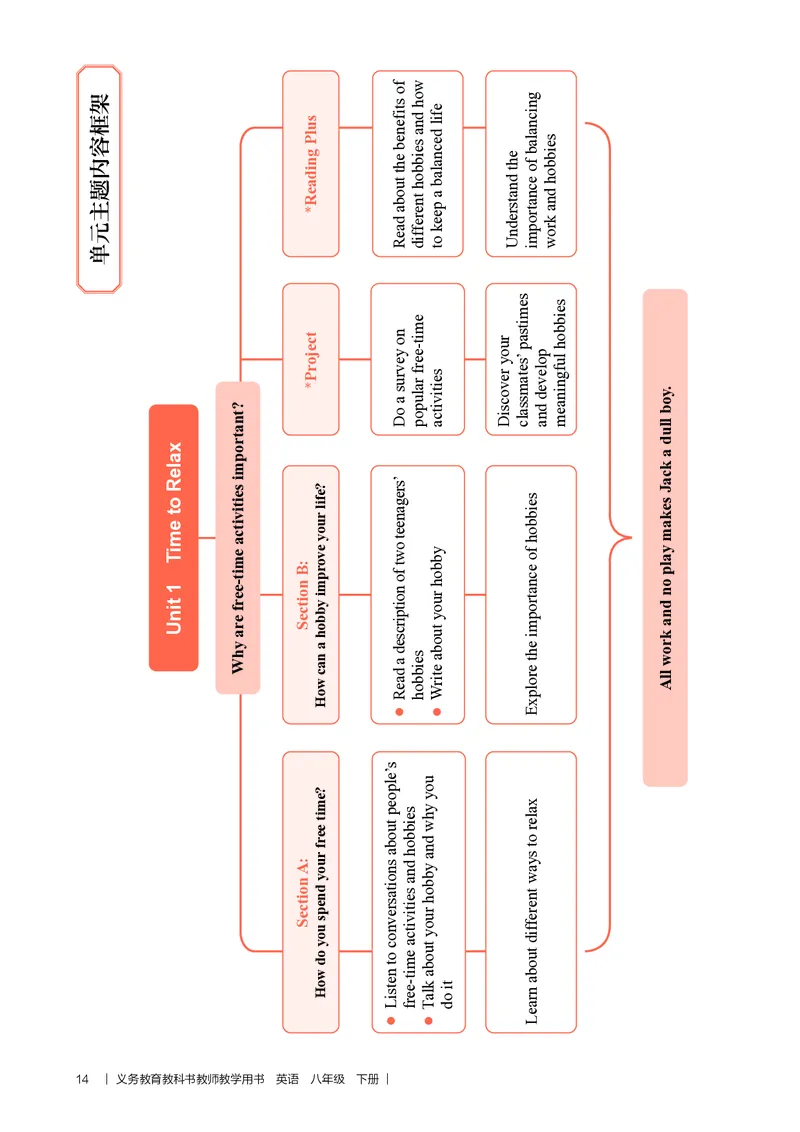
TIME TO RELAX架框容内题主元单
xaleR
ot
emiT
1
tinU
?tnatropmi
seitivitca
emit-eerf
era
yhW
:B
noitceS
:A
noitceS
sulP
gnidaeR*
tcejorP*
?efil
ruoy
evorpmi
ybboh
a
nac
woH
?emit
eerf
ruoy
dneps
uoy
od
woH
s’elpoep
tuoba
snoitasrevnoc
ot
netsiL
fo
stifeneb
eht
tuoba
daeR
no
yevrus
a
oD
’sreganeet
owt
fo
noitpircsed
a
daeR
seibboh
dna
seitivitca
emit-eerf
woh
dna
seibboh
tnereffid
emit-eerf
ralupop
seibboh
uoy
yhw
dna
ybboh
ruoy
tuoba
klaT
efil
decnalab
a
peek
ot
seitivitca
ybboh
ruoy
tuoba
etirW
ti
od
ruoy
revocsiD
eht
dnatsrednU
semitsap
’setamssalc
gnicnalab
fo
ecnatropmi
seibboh
fo
ecnatropmi
eht
erolpxE
xaler
ot
syaw
tnereffid
tuoba
nraeL
poleved
dna
seibboh
dna
krow
seibboh
lufgninaem
.yob
llud
a
kcaJ
sekam
yalp
on
dna
krow
llA
14 │ 义务教育教科书教师教学用书 英语 八年级 下册 │一、单元概览与目标设计
单元内容概述
本单元以“课余爱好”为主题,该主题与课标中“人与自我”主题范畴里“丰富、充实、积极向
上的生活”“ 身心健康,抗挫能力”“自我认识,自我管理,自我提升”子主题以及“人与社会”主题
范畴里“良好的人际关系与人际交往”子主题密切相关。本单元旨在让学生通过交流、讨论课余活动
和爱好,意识到它们对减轻压力、丰富生活、激发创造性和提升生活品质的重要意义。
本单元的大问题“Why are free-time activities important?”为师生探讨本单元的主题意义指引了方
向。为引导学生更深入、全面地探讨单元主题意义,本单元设置了两个引导性问题,即Section A的
“How do you spend your free time?”和Section B的“How can a hobby improve your life?”。Section A通
过几组主线人物间的对话展现他们的课余活动和爱好,进而引导学生谈论自己如何度过闲暇时间,回
应该部分的引导性问题。Section B引导学生探究更深层次的问题,探讨如何度过休闲时间才能提升生
活质量,从而体会到爱好对改善生活品质的意义。本部分的阅读语篇介绍了两个外国青少年的爱好。
他们其中一个是科技达人,通过制作语言学习手机小程序帮助世界各地的人们学习意大利语。另一个
是明信片爱好者,通过收集小小明信片“看”广阔世界。语篇借此向学生说明,好的爱好不但有利于
个人身心发展,还能造福他人和社会。以读促写板块设置了青少年发帖征询意见的真实情境。学生先
阅读两篇发帖和跟帖,然后写回帖,分享自己的爱好和喜爱此项活动的原因。在与他人分享并阐述自
己的爱好和原因的过程中,学生可以更深入地思考引导性问题“How can a hobby improve your life?”。
爱好不仅可以利己,有时还可以利他,这样的爱好更有意义和价值。本单元的项目活动是让学生在班
上对同学的课余爱好和喜爱的原因展开调查,在培养学生综合语言运用能力和图表制作技能的同时,
增进同学间的相互了解和情感联结。本单元的拓展阅读是一篇说明文,阐述了运动型和创造型爱好对
人们身心健康的重要作用。文章旨在建议人们平衡好工作和爱好,既不能玩物丧志,也不能只工作不
放松。
总之,本单元旨在让学生懂得课余活动和爱好的意义和作用,它们不仅能给忙碌的生活减少压
力,还能怡情养性,让生活更加丰富多彩。对青少年而言,兴趣爱好是一个用于“自我建设”的工
具箱。通过发展兴趣爱好,他们能构建更坚韧的内心、更丰满的人格、更强大的能力和更健康的社
交关系,为充实、快乐和有意义的人生奠定基础。青少年时期正是培养健康、有益爱好的关键期,
希望本单元能够帮助他们意识到课余活动和爱好的重要性,正确处理它们和学习之间的关系,通过
有意义的课余活动促进身心健康,并在发展自己爱好的同时惠及他人和社会。
│ UNIT 1 TIME TO RELAX│ 15单元学习目标
通过本单元的学习,学生能够:
听懂人们在日常生活中有关课余活动话题的交流,并能谈论自己的课余活动或爱好;
理解阅读语篇的写作目的,了解说明性语篇的结构特征和语言特点;掌握语篇中客
观事实和主观观点的表达特征,学会区分语篇中哪些是作者观点,哪些是客观事实
信息;
读懂论坛上关于青少年课余时间最喜欢的活动的帖子,并准确把握论坛帖子的语篇
特征;能够在论坛上发帖,分享自己最喜欢的课余活动和原因;
理解动词不定式作目的状语和宾语补足语的功能和意义,能够在语境中正确使用这
两种动词不定式形式;
学习和积累与本单元主题相关的表示课余活动的词汇;培养词语搭配的意识,逐步
养成按语块记忆词汇的习惯;
懂得课余活动和爱好对身心健康、自身发展、社会生活的重要性,培养和发展适合
自己的爱好;学会平衡课余活动和爱好与学习之间的关系。
二、单元内容分析与教学建议
Opening Page
Why are free-time activities important?
内容分析
本单元的标题Time to Relax(是时候放松了)简洁明快,营造了轻松的氛围,并精准传达了单元
主题内涵。本单元旨在引导学生理解休闲放松对于身心健康的重要性,让他们在紧张学习之余学会
释放压力、放松身心、平衡学习与生活,成为可持续发展的高效学习者。
本单元的主题图展示了明媚的春日里,学生在学校操场上放风筝的生动情境。放风筝的活动古
已有之,老少皆宜,不仅能够帮助学生预防近视、增强体质,还能愉悦身心,是一种很好的放松方
式。在画面中心,女孩手里的风筝即将飞翔,女孩的笑容和晴朗的天气一样明媚。画面中蓝天白云、
葱郁的树木、碧绿的草坪相互映衬,红色跑道为画面增添了一抹亮色。远处背景中还有其他人在放
风筝、散步,整个画面洋溢着轻松、愉悦的气息。
16 │ 义务教育教科书教师教学用书 英语 八年级 下册 │单元学习内容导引部分列出了本单元的学习要点,包括交流和分享各自的课余活动和爱好,正
确使用动词不定式丰富句子信息,以及探讨人们为什么需要放松等。Look and share部分的问题首先
让学生看图并描述图中人物从事的活动,然后结合个人喜好和感受,分享对图中活动的看法。
学习目标
能够根据单元标题、主题图和单元大问题预测本单元主要内容,了解单元主题意义
探究的方向。
能够描述主题图,理解主题图和单元主题之间的关系,并能联系自身实际讨论相关
问题。
能够根据单元学习内容导引了解本单元的学习目标和主要学习内容,对单元有一个
整体性的了解。
教学建议
1. 教师通过以下问题链引导学生仔细观察主题图,充分讨论主题图传达的信息,初步感知本单元
的主题内容。
What is the girl in the photo doing?
Where is the girl?
Does the girl like this activity? How do you know?
教学提示:“看”是英语综合技能的重要组成部分,也是理解多模态语篇(如图片内容)的关键技能。
在理解多模态语篇时,学生不仅要认真观察图片中的各类信息(时间、地点、人物、行为、情绪等),
还要敏锐地捕捉细节,深入分析信息之间的内在联系。例如,当学生看到图片中有人在放风筝,脸上
洋溢着快乐笑容时,应能建立起“放风筝”这一活动、“面带笑容”这一表情与“心情放松”的情绪
状态之间的关联。教师应鼓励学生仔细观察图片,运用语言描述图片、表达个人理解。
2. 教师激活学生已知的有关课余活动的话题词汇,可通过以下问题引发讨论,将主题图自然关联
到学生的生活。
Do you like flying kites?
What other activities do you like to do in your free time?
学生小组讨论后,教师梳理学生的回答,完成关于Free-time activities词汇语义网的构建。以下语
块可供教师参考:
Free-time activities
play ping-pong, play Chinese chess, play the guitar, play the drums, play the violin, play tennis, swim,
run, draw, make delicious cakes, cook, take photos, watch birds, visit nature parks, go hiking, ...
│ UNIT 1 TIME TO RELAX│ 17教学提示:词汇学习是一个逐步积累的过程。在教学过程中,教师应引导学生紧扣主题,构建词汇语
义网络。教师要有意识地打破年级与单元的界限,帮助学生根据主题归纳词汇。例如,在本单元的教
学中,教师可提前布置任务,要求学生复习七年级上册第五单元Fun Clubs中关于个人爱好的词汇,
为本单元学习作铺垫。
3. 教师引导学生思考单元标题Time to Relax的含义。接下来,教师引导学生回答问题“Why do
you do free-time activities?”,鼓励学生以头脑风暴的形式从不同角度回答。以下回答可供参考:
I swim to relax.
I go hiking to stay healthy.
I play the drums to have fun.
4. 教师自然过渡,鼓励学生尝试初步回答单元大问题“Why are free-time activities important?”。
教学提示:在正式开启单元学习之前,教师有必要引导学生思考并尝试回答单元大问题,这有助于学
生迅速明确单元学习主线,并激活学生已有经验和知识。学生在尝试回答的过程中可能会感受到语言
和认知的匮乏,这有助于激发他们探究主题意义的内在动力。单元学习结束后,教师可再次让学生回
顾并回答单元大问题,学生通过对比前后的理解,可以感受到自己对单元主题的认知从模糊到清晰、
从浅显到深入的提升过程。
5. 教师让学生浏览开篇页左下角的单元学习内容导引,引导他们关注其中的行为动词,如talk
about、describe、use ... to show、explore等,感受学习内容的不同维度和进阶性。教师可针对学生
可能理解困难的词汇(如infinitive、purpose、provide等)进行解释,确保他们理解本单元主要学习
内容。
Section A
How do you spend your free time?
活动1a—1d
内容分析
文本分析:从八年级下册开始,每个单元有两轮听力活动。这是本单元的第一轮听力活动。该听
力对话的语境是朋友之间的采访活动。采访体对话是一种结构清晰、目的明确的交流形式,其最显著
的特征是问答模式。该采访包括三个简短的对话,分别是Adam采访朋友Teng Fei、Helen和Chen Jie,
采访的目的是完成一项关于青少年课余活动情况的调查。每个被采访的人不仅回答了他们在课余时间
做什么,还解释了做这项课余活动的原因或目的。
朋友之间的采访对话通常比较直接,所以Adam所用语言是非正式的口语,如打招呼用语“Hey,
18 │ 义务教育教科书教师教学用书 英语 八年级 下册 │Teng Fei!”,请求帮助用语“Could you help?”,以及Teng Fei回应请求的用语“Sure!”。这样的语言风
格使对话显得自然而亲切。
这三个对话还展现了Adam作为采访者的一些优秀特质,包括良好的语言表达能力和临场反应
能力。在三个采访中,Adam分别使用了三个不同的问句开启采访,即“What do you usually do when
you’re free?”“How do you spend your free time, Helen?”“What do you do in your free time, Chen Jie?”。
虽然这三种问法表达的意思基本一样,但在句式和用词上各有不同,充分展示出Adam语言表达的丰
富性。能够运用多种句式丰富表达是优秀语言学习者应具备的基本能力之一。Adam还能根据被采访
者的回答继续追问或积极回应。例如,当Teng Fei表示喜欢编程时,Adam追问“Oh, are you creating
an app?”;当Helen说喜欢画画时,Adam追问“How did you get into it?”;当Chen Jie说喜欢吹笛子
时,Adam表达惊叹并追问“Wow! Isn’t that difficult?”,得到回复后还继续追问“And is it easier now?”。
这些问题都有助于进一步了解被采访者的课余活动,从而增加访谈的深度。此外,被采访者的回答也
体现了乐于配合的积极态度。例如,Teng Fei在回答Adam的一般疑问句提问时,不只是简单地应答,
还进行了补充,如“I also like hiking at the weekend. It’s a great form of exercise.”。Chen Jie在回答追问
时也提供了更多信息,如“It’s never easy, but it’s more fun now. I do it to relax these days.”。
这三段对话呈现了本单元的目标语法结构,包括不定式作宾语补足语(I saw my mother paint
when I was young.)和作目的状语(I do it to relax these days.)的用法。此外,该对话还复现了不定式
作宾语的用法,如“I decided to give it a go too!”和“I needed to practise a lot!”。
这三个简短对话呈现了学生丰富多彩的课余生活,以及开展不同活动的情况,融入了丰富的语言
表达和语用知识,为学生后面的口语输出活动提供了示范。
活动设计:该板块重视听力学习的过程,采用听前、听中、听后任务链的设计。活动1a是听前
活动,呈现了六个活动的词汇和图片,让学生进行图文匹配,其中就包含了对话中会出现的几个活动
(如programming、hiking、painting、playing the flute),为学生的听力理解进行了词汇铺垫。活动1b
和1c是听中活动。活动1b聚焦采访对话的核心内容,即被采访者在课余时间喜欢做的事情。教材的
题目设计突出了动词不定式作宾语的功能。活动1c关注被采访者从事某项课余活动的目的,集中呈现
了动词不定式作目的状语的用法。活动1d让学生使用“I like to ...”和“I do it to ...”这两个句型,与
同伴简单谈论自己的课余活动。
学习目标
能够学习和积累与本单元主题相关的话题词汇。
能够听辨出不同被采访者开展的课余活动,以及他们选择该项活动的目的。
能够初步感知动词不定式作宾语补足语和目的状语的意义和用法。
能够模仿听力对话,与同伴简单地谈论自己的课余活动以及从事这些课余活动的
目的。
...
│ UNIT 1 TIME TO RELAX│ 19教学建议
1. 听前准备
(1)教师展示学生课余活动的视频或图片(最好是本班学生真实的活动记录),并呈现由Section
A的引导性问题转化而来的问题“How do they spend their free time? / What do they do in their free
time?”,学生在表格里记录同学参加的课余活动。教师用这种方式引出主题,引导学生进入学习情
境,激活背景知识,同时感受学习主题与现实生活间的关联。
Name Free-time activity
(2)教师用课件呈现活动1a中的六幅图片,让学生在图片情境中理解新词汇。然后,教师指导学
生通过自主拼读、示范朗读、跟读模仿等方式学习方框中的词汇,特别关注-ing在词中的拼读,确保
学生正确掌握目标词汇的音、形、义,为听力理解活动减少词汇障碍。
Word Syllable
flute 单音节:flute
calligraphy 拆分为四个音节:cal-lig-ra-phy
painting 拆分为两个音节:paint-ing
skiing 拆分为两个音节:ski-ing
hiking 拆分为两个音节:hik-ing
programming 拆分为三个音节:pro-gram-ming
教学提示:在教学生词时,教师应帮助学生建立音节意识(syllable awareness)。每个单词都由一
个或多个音节组成,每个音节通常包含一个元音音素。例如,cat只有一个音节,window有两个音节
(win-dow),而international有五个音节(in-ter-na-tion-al)。音节意识可以帮助学生显著提高他们的
单词拼读和记忆能力。
(3)学生先大声朗读活动1a中的六个短语,强化记忆,然后独立完成图文配对,之后与同桌核对
答案。教师鼓励学生用完整的句子描述图片内容。
2. 听力理解
(1)学生阅读活动1b的指示语和题目内容,推测听力对话大意。然后,教师播放录音,学生验证
猜测并概括听力对话的主要内容,写在下面的横线上。
They are talking about .
20 │ 义务教育教科书教师教学用书 英语 八年级 下册 │(2)学生再次阅读活动1b中的四个句子,明确要听取的目标信息是不同对话人物喜欢做的事情,
同时推测需要填写的词语形式为动词不定式、动词-ing形式或名词。
(3)教师播放录音,学生运用速记策略(如长单词取前四个字母代替、用符号代替具体活动、复
合词只记核心词、短语保留一个关键词等),独立完成活动1b。然后,师生核对答案。教师利用与
Section A的引导性问题相同的句式询问学生记录的内容,引导学生用完整句子回答。
T: How does Teng Fei / Helen / Chen Jie spend his / her free time?
S: He / She likes / loves to ...
教学提示:在听力理解阶段,正确记录核心信息是一项挑战,也是学生必备的一项学习技能。教师
应有意识地向学生系统介绍多种实用且高效的速记方法,引导学生通过实践,逐步探索并选择适合
自身的速记方式,进而在各类听力理解活动中不断应用并持续优化这些速记方法。
(4)教师问“Why do they do these free-time activities?”,自然过渡到活动1c。学生快速阅读活动1c
的指示语。教师引导学生回答问题“What are the four purposes?”,将四个动词不定式短语与目的进行
关联,帮助学生在对话情境中理解四个选项(动词不定式短语)表目的的语义。然后,教师鼓励学生
将表示目的的四个动词不定式短语与活动1b中的四个句子匹配,通过这种方式进行听前预测。
(5)教师播放录音,学生独立完成活动1c,并验证听前预测。然后师生通过对话核对答案。以下
对话可供参考。
T: Why does Teng Fei do programming?
S: He does it to create an app.
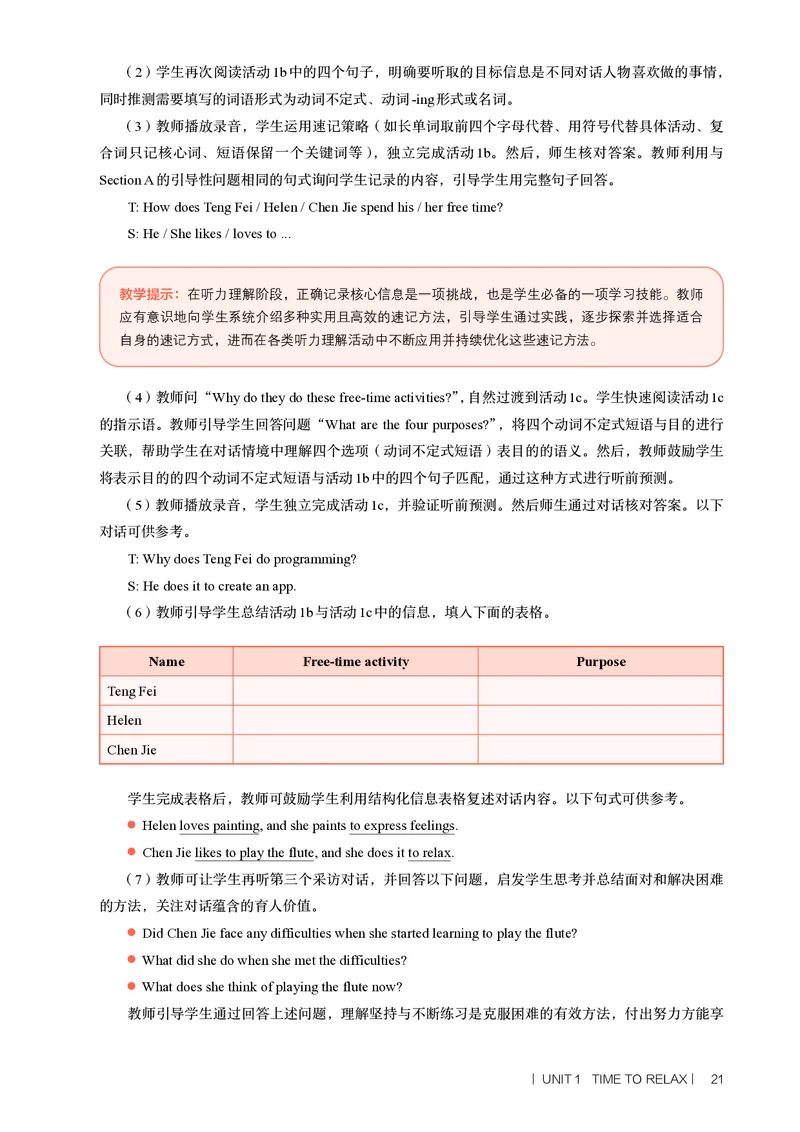
(6)教师引导学生总结活动1b与活动1c中的信息,填入下面的表格。
Name Free-time activity Purpose
Teng Fei
Helen
Chen Jie
学生完成表格后,教师可鼓励学生利用结构化信息表格复述对话内容。以下句式可供参考。
Helen loves painting, and she paints to express feelings.
Chen Jie likes to play the flute, and she does it to relax.
(7)教师可让学生再听第三个采访对话,并回答以下问题,启发学生思考并总结面对和解决困难
的方法,关注对话蕴含的育人价值。
Did Chen Jie face any difficulties when she started learning to play the flute?
What did she do when she met the difficulties?
What does she think of playing the flute now?
教师引导学生通过回答上述问题,理解坚持与不断练习是克服困难的有效方法,付出努力方能享
│ UNIT 1 TIME TO RELAX│ 21受成功的喜悦。
3. 听后活动
(1)学生对照教材附录中对应的听力对话文本,边听录音,边跟读模仿对话中人物的语音、语调
和节奏,在语境中进一步理解不同表达的语用功能,以及动词不定式表示的意义。
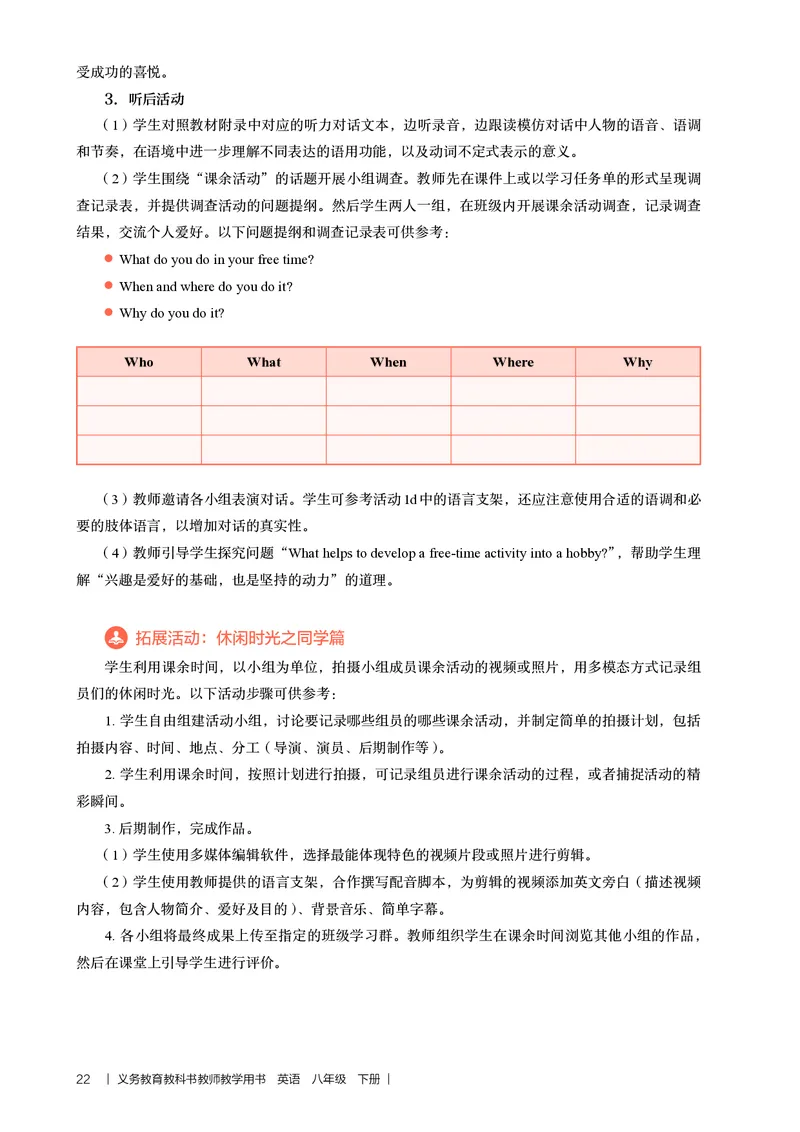
(2)学生围绕“课余活动”的话题开展小组调查。教师先在课件上或以学习任务单的形式呈现调
查记录表,并提供调查活动的问题提纲。然后学生两人一组,在班级内开展课余活动调查,记录调查
结果,交流个人爱好。以下问题提纲和调查记录表可供参考:
What do you do in your free time?
When and where do you do it?
Why do you do it?
Who What When Where Why
(3)教师邀请各小组表演对话。学生可参考活动1d中的语言支架,还应注意使用合适的语调和必
要的肢体语言,以增加对话的真实性。
(4)教师引导学生探究问题“What helps to develop a free-time activity into a hobby?”,帮助学生理
解“兴趣是爱好的基础,也是坚持的动力”的道理。
拓展活动:休闲时光之同学篇
学生利用课余时间,以小组为单位,拍摄小组成员课余活动的视频或照片,用多模态方式记录组
员们的休闲时光。以下活动步骤可供参考:
1. 学生自由组建活动小组,讨论要记录哪些组员的哪些课余活动,并制定简单的拍摄计划,包括
拍摄内容、时间、地点、分工(导演、演员、后期制作等)。
2. 学生利用课余时间,按照计划进行拍摄,可记录组员进行课余活动的过程,或者捕捉活动的精
彩瞬间。
3. 后期制作,完成作品。
(1)学生使用多媒体编辑软件,选择最能体现特色的视频片段或照片进行剪辑。
(2)学生使用教师提供的语言支架,合作撰写配音脚本,为剪辑的视频添加英文旁白(描述视频
内容,包含人物简介、爱好及目的)、背景音乐、简单字幕。
4. 各小组将最终成果上传至指定的班级学习群。教师组织学生在课余时间浏览其他小组的作品,
然后在课堂上引导学生进行评价。
22 │ 义务教育教科书教师教学用书 英语 八年级 下册 │活动2a—2d
内容分析
文本分析:这是本单元第二轮听力活动。对话在两位好友Fu Xing和Emma之间展开,Emma分享
了她上周末体验的课余活动——滑冰。滑冰这项运动需要技巧,更需要勇气和毅力。对话包括多个轮
次,基本随着Emma情绪的变化过程推进,即“沮丧—鼓励—犹豫—再次激励—重燃信心”。对话情
境真实,逻辑流畅。
这段对话体现了Fu Xing真诚和积极的交流态度。例如,她在听到Emma抱怨浑身疼痛时立即
表示关心(How come?),在听到Emma多次摔倒时及时表达共情(Oh dear!)。此外,她还通过分
享自己的真实经历,对Emma的感受表示共情,并激励她不要轻易放弃。在朋友的鼓励和建议之下,
Emma从最初想放弃滑冰转变成愿意再次挑战,重拾信心。
这段对话集中且自然地呈现了本单元的目标语法结构,即动词不定式作目的状语(I went to the
sports centre to try ice skating.)和宾语补足语(She also encouraged me to get back up whenever I fell. / She
told me not to give up so easily.),也复习了动词不定式作宾语的用法(I don’t want to go ice skating again.)。
这段对话还蕴含着更深刻的内涵。培养爱好如同掌握一项技能,不能一蹴而就,需要循序渐进、
坚持不懈,才能真正享受爱好带来的快乐,收获成长。
活动设计:该板块的活动按照听前、听中、听后的任务链设计。活动2a是听前活动,让学生看图
讨论滑冰和游泳时会遇到哪些挑战。该活动可以帮助学生预测听力对话的内容,为接下来的听力理解
做好铺垫。活动2b和2c是听中活动。活动2b让学生选择对话谈论的信息要点,训练学生听取对话大
意的能力。活动2c让学生听后填空,训练学生听取细节的能力。从题干可以看出,这些句子都含有动
词不定式,帮助学生再次在语境中巩固对目标语法结构的理解。活动2d是结合听力内容的口语输出活
动,让学生谈论第一次尝试某项课余活动的情况,比如如何克服恐惧。
学习目标
能够进一步积累和课余活动相关的表达。
能够分层次理解听力对话,先关注对话中人物谈论的信息要点,再关注细节信息;
在听力语境中加深对动词不定式作状语和作宾语补足语用法的理解。
能够简单谈论第一次从事某项课余活动时的感受和经历。
能够认识到培养爱好的过程中可能会遇到困难,但唯有坚持才能最终体会到该项活
动带来的快乐。
...
│ UNIT 1 TIME TO RELAX│ 23教学建议
1. 听前准备
(1)学生观察活动2a中的图片,教师通过提问引出听力对话中的相关表达,为听力理解做好准
备。例如:
What is he / she doing in the photo?
Do you like this activity?
What do you think are the challenges of doing it?
(2)学生可以展示自己参加课余活动的照片,与同学互相提问,在语境中练习更多词汇和表达。
2. 听力理解
(1)学生阅读活动2b的指示语和内容,明确听力任务,然后圈出题干中的关键词,根据题干预测
对话大意。例如:
what they are going to do the next day
what Emma did at the weekend
what Fu Xing did at the weekend
challenges of their free-time activities
教学提示:对于题干较长的听力题型,教师可提醒学生在听前迅速浏览题干,圈出其中的关键词。学
生通过读取关键词,可以在听力过程中更有针对性地获取信息,提升听力理解的效果。
(2)教师播放录音,学生完成活动2b,并验证听前预测,然后师生核对答案。
(3)教师呈现表格,再次播放录音,引导学生围绕下面两个问题,获取相关细节信息。
What are they talking about? How do you know?
Emma’s activity at the weekend I went to the sports centre to try ice skating.
… but now I hurt all over.
challenges of free-time activities But I didn’t expect to fall so many times!
... but I used to be scared of water.
(4)学生阅读活动2c的指示语和五个不完整的句子。教师启发学生根据动词不定式的标志词to推
断所填内容为动词原形,然后让他们圈出句中的关键词,以便在听时更快定位目标信息。
(5)教师再次播放录音,学生使用有效的速记策略记录信息,完成活动2c。接下来,学生两人一
组核对答案,核对时要使用完整句子。教师引导学生观察所填内容的语言形式和特点,关注本单元目
标语法结构。
(6)教师呈现表格,再次播放录音,引导学生将对话信息进行结构化梳理。
24 │ 义务教育教科书教师教学用书 英语 八年级 下册 │Name Free-time activity Challenge Solution
Emma
Fu Xing
(7)教师将对话中关于建议的句子进行挖空处理,然后播放录音,让学生边听录音边将句子补充完整。
Nobody expects you from .
The instructor also encouraged Emma to whenever she fell.
The instructor told Emma so easily.
Everything’s before it ’s .
3. 听后活动
(1)教师用课件呈现听力文本,再次播放录音。学生跟读、模仿对话中的语音、语调和节奏,感
知、体会对话中的表达及目标语言的表意功能,如Emma说“... but now I hurt all over!”时表现出不舒
服,Fu Xing说“How come?”时表现出好奇。
(2)教师引导学生结合自身回答问题“What can you learn from the conversation?”,学生可以借鉴
听力对话中的表达来回答。例如:
Nobody expects you to be perfect from the start.
Get back up whenever you fall!
Don’t give up easily.
Everything’s difficult before it’s easy.
教师还可以进一步追问“What do you want to say to Emma?”,让学生学会运用恰当的语言鼓励他
人。以下句子可供学生参考使用:
Where there is a will, there is a way.
No pain, no gain.
Rome wasn’t built in a day.
A journey of a thousand miles begins with a single step.
(3)学生阅读活动2d的提示语,明确“分享第一次进行某项课余活动的经历”的要求。学生阅读
示范对话,获取信息,完成表格,厘清对话的目的和逻辑。
Challenge Solution
I love singing and performing now. But I was afraid I practised by performing in front of my friends.
to sing in front of others at first.
(4)教师可组织学生以头脑风暴的形式提取活动1b、活动1c、活动2b、活动2c中的相关表达,
为他们搭建丰富的语言支架。
│ UNIT 1 TIME TO RELAX│ 25Function Expression
I love ... now, but I ... at first.
Talk about challenges
I love ..., but I used to be scared of ...
I practised by ...
... helped me to get better quickly!
Talk about ways to get over challenges
I practised a lot to ...
I started to ... to get over my fear.
Nobody expects you to be perfect from the start.
Get back up whenever you fall.
Encourage somebody
Don’t give up so easily.
Everything’s difficult before it’s easy.
(5)学生两人一组,根据个人实际情况,灵活使用以上表达分享个人经历。
活动3a—3d
内容分析
文本分析:本单元的示范对话是Peter和好友Yaming围绕练习书法展开的一段对话。书法是中国
文化的代表之一,也是外国人对中国文化比较感兴趣的一个方面。Peter和Yaming之间关于中国书法
的交流正是跨文化沟通的体现。作为一名外国留学生,Peter看到Yaming在练习书法后产生兴趣,询
问Yaming该项活动的相关信息和练习书法的感受,从而产生共鸣,与他分享自己学吉他的经历和感
受,并提议互相学习对方的技艺,未来共同培养兴趣爱好。
该对话反映出两位学生良好的交际策略运用能力。Peter善于给予积极评价。例如,他看到
Yaming的书法时赞叹道:“It’s beautiful!”;看到Yaming写“月”字时夸赞道:“It’s nice! I like watching
you write like that.”。对话还展现了Peter的同理心。当Yaming谈及开始学习书法的不易时,Peter表示
理解,并分享自己学吉他的经历,以此引起对方的共鸣。Yaming同样是积极的对话者,也是中国文化
的热心传播者。他乐于分享自己学习书法的感受,以及这门艺术的魅力。此外,中外两名学生之间产
生的情感共鸣也体现出学习过程中互帮互助、积极交流的重要性。
该对话包含了三种时态。对话始于谈论Yaming正在进行的书法练习,故对话的前几个话轮以一
般现在时和现在进行时为主。两人分享过往经历时用到了一般过去时。最后两人讨论将来互相学习
时采用了一般将来时。这些时态的转换在真实对话中经常发生。此对话还自然融入了目标语法结构,
如动词不定式作目的状语的用法(Now I do calligraphy to relax.)、动词不定式作宾语补足语的用法
(... he always encourages me not to give up.),也复习了动词不定式作宾语的用法(When I started to do
calligraphy, ...)。
该段对话还融入了鲜明的中国文化元素。从图中可以看出,Yaming书写的正是古诗《静夜思》中
26 │ 义务教育教科书教师教学用书 英语 八年级 下册 │的一句,其中的“月”字尤为关键,它承载了思念和眷恋,不仅寓意丰富,还体现了深远的文化意
境。此外,对话还借Yaming之口传递了中国的一句古话:“万事开头难”(The first step is always the
hardest.),以此鼓励学生坚持不懈,享受爱好带来的乐趣。
活动设计:此板块的任务链融入了读、听、说三项技能训练。活动3a和3b是阅读理解活动。活
动3a让学生读对话,圈出Peter和Yaming的课余活动,这也是对话谈论的焦点内容。活动3b的问题
引导学生关注对话的细节,其中包括两个开放性问题,一个让学生谈论如何理解“万事开头难”这句
话,另一个让学生结合自身经验谈谈克服困难做成某事的感受。活动3c是角色扮演活动,让学生听对
话,在对话语流中感受Yaming和Peter如何用合适的语音、语调、节奏及其他朗读技巧表达自己的情
感。活动3d是开放性的口语输出活动,让学生分享自己的爱好,包括培养该爱好的心得与原因。教材
通过前面听力板块的充分铺垫和此处的语言支架,确保学生有话想说、有话能说。
学习目标
能够获取对话中主要人物谈论爱好、分享相关经历的细节信息,丰富自己的语言
储备。
能够分析并运用对话中的交际策略,如给予积极评价、展现同理心、表达共鸣等。
能够运用动词不定式作宾语补足语、作目的状语、作宾语的相关句式丰富自己的语
言表达。
能够与同伴流利地朗读对话并进行角色扮演,在表达中充分关注重读、弱读和节
奏,并自然运用其他朗读技巧,如连读、停顿等。
能够更深入地谈论自己的爱好,分享学习过程中的感受和喜欢该项活动的原因。
...
教学建议
1. 对话理解
(1)教师通过以下问题引导学生细致观察、讨论活动3a中的图片,并通过其中的最后一问引入活
动3a的阅读任务。
Where are the two students?
When do you think this conversation takes place?
What is in Yaming’s hand? What is he doing?
What poem is Yaming writing?
What do you think they’re talking about?
What do you think is Yaming’s favourite free-time activity? What about Peter’s?
(2)学生快速阅读对话,圈出Peter和Yaming的课余活动,验证读前猜测。
(3)教师提供以下表格,让学生从对话文本中提取有关两人课余活动的信息。
│ UNIT 1 TIME TO RELAX│ 27Question Yaming Peter
What’s his free-time activity?
Whom did he learn it from?
How did he feel at the beginning?
What does he like about the
hobby now?
Why does he like it?
根据所填信息,教师引导学生归纳两人兴趣爱好的共同点,回答活动3b中的第三个问题“What
are the similarities between Yaming’s and Peter’s hobbies?”。
(4)教师针对对话中的其他细节信息问学生下列问题,以加深学生的理解。
What words does Peter use to describe Yaming’s work?
What does Peter think of Yaming’s hobby?
What do you think“ The first step is always the hardest” means?
What will Yaming teach Peter to do? What will Peter do in return?
(5)教师进一步引导学生梳理示范对话的结构和语言表达,从开启对话、深入交流、回应对方、
结束对话四个方面归纳对话中的表述,填入下表,学习会话的语用知识。
Function Expression
Hey!
Start the conversation Hi!
What are you up to?
What are you writing?
Develop the conversation What’s this character?
Why did you choose to play the guitar?
It’s beautiful! It’s nice!
Make responses I like watching you write like that. I know how that feels!
Exactly. I think playing the guitar is cool.
End the conversation It’s a deal!
2. 角色扮演
(1)教师播放对话录音,引导学生模仿对话中人物的语音、语调,标出重读的单词,同时对句子
中连读、停顿、语调变化处进行标记。
28 │ 义务教育教科书教师教学用书 英语 八年级 下册 │When I ʹstarte(d) to do caʹlligraphy, I ʹspent ʹhours | ʹpractising ʹsingle strokes.
ʹWhy did you ʹchoose to ʹplay the guitar?
Will you ʹteach me | to ʹwrite a poem?
I can ʹteach you to ʹplay a ʹsong in return.
教学提示:英语句子中承载重要信息的内容词通常要重读,而表示语法功能的词则会弱读。即使同
为内容词,其重音程度也会因语义的重要性而有所不同。例如,在句子“I can teach you to play a
song in return.”中,return和song的重音可能比play和teach更明显。教师可以引导学生关注这
一特点,学会根据语境和表达灵活运用重音,以提升英语表达的自然度和准确性。
(2)学生分角色表演对话,完成活动3c。教师先让学生两人一组进行练习,然后再请几组学生到
教室前面进行表演。教师应鼓励学生记忆并背诵对话内容或对话中一些经典的句子,还可鼓励学生在
对话时使用道具或设计一些动作,以体现人物情感和个性。
3. 口语输出
(1)教师让学生根据示范对话的内容陈述Yaming的课余活动。教师可以根据学情,提供以下语
言支架,以降低学生表达的难度。
Yaming loves . His grandmother taught him how , but the first step is
always . Yaming spent hours . Now, it’s a great way , and Yaming
even likes !
(2)学生阅读活动3d的指示语,明确任务要求。教师通过以下问题链引导学生关联自身,谈论自
己的爱好。
What is your hobby?
Whom did you learn it from?
How did you get into it?
Did you like it at the beginning? Why?
What do you like about it now?
Why do you like it?
(3)教师组织全班学生开展头脑风暴活动,梳理有关爱好对自己的影响的表达。例如:
It makes me feel happy to ... It’s a great form of ...
It helps me to ... I think ... is cool.
It’s a great way ... I even like ...
When I started to ..., I ...
(4)学生两人一组,利用前面环节的问题链、目标语法结构,以及关于开启对话、深入交流、回
应对方、结束对话的语用知识,围绕课余爱好及喜爱的原因开展对话交流。
(5)教师可以鼓励学生增加细节,体现个性化表达。学生可使用以下评价量表进行互评。
│ UNIT 1 TIME TO RELAX│ 29Aspect Criteria Score (1–5)
The conversation is related to the topic.
Content
The conversation is complete and clear.
The grammar in the conversation is correct.
Language
The conversation uses different sentence patterns.
Pronunciation is clear and understandable.
Pronunciation
The speaking speed is appropriate.
Eye contact and facial expressions are used.
Body language
Body language helps communication.
(6)教师邀请几组学生展示对话,其他学生使用下表记录信息。然后,教师邀请几名学生进行评
价。评价前,学生需根据表格记录的内容复述展示的同学所述有关课余爱好的信息。
Name Hobby Reason Challenge Solution Feeling
教学提示:当部分小组上台展示时,其余同学大多只能被动地充当观众。此时,若让他们使用信息表
格记录展示小组的对话内容,便能有效促使这些学生积极主动地融入学习活动。此外,将对话形式转
化为陈述形式,是一种极为有效的文本转换方式。通过不同文本形式的转换,学生能够不断使用所学
知识、所获信息进行表达,在用中学,在表达中内化。
Grammar Focus
内容分析
本单元的目标语法结构是动词不定式(infinitive)作目的状语和宾语补足语,同时复习动词不定
式作宾语的用法。在开篇页的单元学习内容导引部分,教材已经提示了本单元所学动词不定式的两
种功能,即表示目的(to show purpose),以及对宾语进行补充(to provide more information about a
sentence’s object)。活动4a表格中的语法例句采用问答形式,目的是尽量通过语境呈现动词不定式的
不同用法,其中包含动词不定式作宾语补足语时的不同形式,即动词不定式可以带to,也可以不带
to,以及动词不定式的否定式。活动4b提供了四个简短对话,让学生结合语境,用所给动词的正确形
式填空。这些动词不定式分别充当不同的句子成分,如宾语、宾语补足语、主语等。活动4c是综合性
和挑战性更强的学习任务。首先,语篇层面的活动对学生提出了更高要求,因为他们需要在整体理解
语篇大意的基础上,根据上下文语境选择合适的动词,并用其适当的形式填空。该语篇还运用了多种
30 │ 义务教育教科书教师教学用书 英语 八年级 下册 │显性的衔接词,如but、and、after、instead、also、so等,对学生写作起到示范作用。虽然该语篇提供
的是单元目标语法结构的使用语境,但同样蕴含深层意义。语篇中双胞胎的人物设定和他们迥异的爱
好向学生传递了一个道理:每个人都是独一无二的个体,我们需要尊重差异,求同存异。
学习目标
能够辨别动词不定式作目的状语、宾语补足语、宾语的用法,并理解动词不定式作
不同成分的功能。
能够在语境中正确运用动词不定式结构表达与爱好相关的内容。
能够通过阅读语篇,懂得尊重他人的爱好,求同存异,才能共同发展的道理。
...
教学建议
1. 语法探究
(1)学生阅读活动4a的指示语,明确任务要求,了解动词不定式的呈现形式,判断粗体词在句中
的不同功能。
(2)教师给学生提供含动词不定式的语篇,让学生阅读并观察其中加粗的词语,找出它们的共同点。
Peter watched Yaming practise calligraphy and found it enjoyable. Yaming explained that it takes
patience to practise calligraphy. When he first started, he spent hours practising single strokes to build
basic skills. Peter understands this feeling well. His father is teaching him to play the guitar, and it is also
challenging. However, his father always encourages him not to give up.
Now, Yaming likes doing calligraphy very much. He often enjoys the smell of the ink while he is doing
calligraphy to relax. Peter chose to play the guitar because he thinks it is cool. He offered to teach Yaming a
song if Yaming could teach him to write a Chinese poem. It’s fun to learn new skills together.
(3)教师提出以下问题引导学生思考语篇中粗体词的意义和作用。
What do the expressions in bold mean?
Are their functions the same?
(4)学生按照动词不定式的表意功能,将语篇中的粗体词分类填入表中。
Function Form Expression
作目的状语 to do
作宾语 to do
to do
作宾语补足语
do
作主语 to do
│ UNIT 1 TIME TO RELAX│ 31Section B
2. 语法运用 How can a hobby improve your life?
(1)学生快速浏览活动4b的要求及对话,独立完成活动。然后,两人一组,以问答的形式核对答
案。教师引导学生关注句子中动词不定式充当的成分及其功能。
(2)教师呈现下列句子填空题,鼓励学生用动词不定式完成下半句。 活动1a—1e
I often meet my friends to .
内容分析
My mum told me (not) to .
My teacher often encourages me to . 文本分析:阅读语篇是Section B的核心内容。该板块的阅读语篇为一篇观点类说明文,以青少年
My brother decided (not) to . 的爱好为主题,聚焦两位来自不同国家的青少年:一位是意大利男孩Luca,他在业余时间开发用于帮
I heard someone over there. 助他人学习意大利语的小程序;另一位是印度女孩Maya,她热衷于收集世界各地的明信片。选择青
It’s important (not) to . 少年的不同兴趣爱好作为主题,一可以让学生产生共鸣,二可以引导青少年培养多元化的兴趣爱好。
(3)学生快速浏览活动4c的语篇,回答下列问题,获取语篇大意。 文中谈到Luca需要运用计算机编程技术制作小程序,这不仅锻炼了他的技术能力,还培养了他的创新
What is the passage about? 精神和解决问题的能力。而Maya的爱好是收集明信片,语篇配图正是她的几张收藏,内容涵盖历史
Do the twin brothers have the same hobby? 文化古迹(如敦煌莫高窟、秦始皇兵马俑、雅典卫城等),也包括自然风光(如沙漠和海滩)。这个爱
(4)学生独立完成活动4c,然后教师邀请学生朗读整篇语篇,以核对答案。教师还可以让学生指 好不仅能够开阔视野、增长见识,还能通过欣赏明信片上的图片和设计提升审美情趣。此外,明信片
出语篇中的动词不定式在句子中的作用。 可能承载有关旅行、友谊或特殊事件的美好回忆,因此明信片也是记录美好生活和情感的载体。
(5)教师提出以下问题,引导学生再次阅读活动4c的语篇,加深对语篇内容的理解。 这篇文章采用“总—分”结构,首段总述不同爱好的益处,接着通过分述意大利男孩Luca和印度
Why were the parents worried about one of the twins? 女孩Maya的两个案例,具体说明不同类型的爱好及其益处。作者运用了多种手段提升文章的可读性。
What did the parents want the twins to do? 例如,文章开头的设问可以引起读者的兴趣,增加读者的参与感,拉近读者与语篇的距离。在描述
Do you agree with the parents’ plan? Why? Luca和Maya的爱好时,直接引语的使用让文章更有说服力,更容易使读者产生共鸣。这篇文章段落
间和句子间的自然衔接也增强了文章的可读性,其中既有显性的文字衔接,也有隐性的意义衔接。例
如,第二段和第三段介绍Luca的爱好时,段落间通过核心词app、Italian相连;第四至六段介绍Maya
拓展活动:休闲时光之家人篇
的爱好时,又通过核心词postcards相连;第二段和第四段的首句都承担了过渡作用,将上下文有机衔
1. 学生课后询问家人爱好的户外活动,然后连同自己的喜好一起记录在表格中。
接在一起。而段落内部的衔接主要依靠衔接词,如and、but、instead、after等。还有一类衔接通过代
词实现,因此教学中需要特别注意那些容易被忽略但影响理解的重要代词。例如,第二段最后一句中
Family member Hobby When Where How often
的they指代上一句中的study partners。
这篇说明文有意培养学生分辨事实和观点的阅读策略。英语中观点类说明文以“观点为纲、事
实为证”,先明确提出作者对主题的看法(观点),再用具体事例、数据或细节描述(事实)支撑观
点,二者紧密结合。在这篇文章里,作者先亮明观点——多样爱好有益身心,再用Luca 通过 app 帮
助他人学意大利语、Maya 收集明信片了解世界等具体事实支撑观点。在叙述事实时,语篇穿插了主
2. 学生围绕自己和家人的户外活动情况汇报调查结果。以下问题可作为汇报提纲供学生参考
人公的想法,既让支撑性的事实更丰满,又能帮助读者理解观点的合理性。阅读此类文章,学生要学
使用:
会区分事实和观点,这有助于提升信息分辨的准确性,是培养批判性思维的基础。例如,“Luca Bruno
What do you usually do outdoors? When, where, and how often do you do it?
likes to be creative in his free time.”是一个事实性陈述,而“He thinks that apps can be a great way to
What about your family members?
help people.”则属于观点性表达,带有很强的主观色彩。文章在体现Luca和Maya的观点时常常使用
Do you often spend time together?
标记词believe、think、find等,以及短语give ... such a sense of。这些表达可以成为学生区分事实和观
What should you do if your family members have different hobbies?
点的抓手。
理解作者的写作目的也是一个重要的阅读技能。Luca开发小程序的爱好既能帮助人们学习意大利
32 │ 义务教育教科书教师教学用书 英语 八年级 下册 │Section B
How can a hobby improve your life?
活动1a—1e
内容分析
文本分析:阅读语篇是Section B的核心内容。该板块的阅读语篇为一篇观点类说明文,以青少年
的爱好为主题,聚焦两位来自不同国家的青少年:一位是意大利男孩Luca,他在业余时间开发用于帮
助他人学习意大利语的小程序;另一位是印度女孩Maya,她热衷于收集世界各地的明信片。选择青
少年的不同兴趣爱好作为主题,一可以让学生产生共鸣,二可以引导青少年培养多元化的兴趣爱好。
文中谈到Luca需要运用计算机编程技术制作小程序,这不仅锻炼了他的技术能力,还培养了他的创新
精神和解决问题的能力。而Maya的爱好是收集明信片,语篇配图正是她的几张收藏,内容涵盖历史
文化古迹(如敦煌莫高窟、秦始皇兵马俑、雅典卫城等),也包括自然风光(如沙漠和海滩)。这个爱
好不仅能够开阔视野、增长见识,还能通过欣赏明信片上的图片和设计提升审美情趣。此外,明信片
可能承载有关旅行、友谊或特殊事件的美好回忆,因此明信片也是记录美好生活和情感的载体。
这篇文章采用“总—分”结构,首段总述不同爱好的益处,接着通过分述意大利男孩Luca和印度
女孩Maya的两个案例,具体说明不同类型的爱好及其益处。作者运用了多种手段提升文章的可读性。
例如,文章开头的设问可以引起读者的兴趣,增加读者的参与感,拉近读者与语篇的距离。在描述
Luca和Maya的爱好时,直接引语的使用让文章更有说服力,更容易使读者产生共鸣。这篇文章段落
间和句子间的自然衔接也增强了文章的可读性,其中既有显性的文字衔接,也有隐性的意义衔接。例
如,第二段和第三段介绍Luca的爱好时,段落间通过核心词app、Italian相连;第四至六段介绍Maya
的爱好时,又通过核心词postcards相连;第二段和第四段的首句都承担了过渡作用,将上下文有机衔
接在一起。而段落内部的衔接主要依靠衔接词,如and、but、instead、after等。还有一类衔接通过代
词实现,因此教学中需要特别注意那些容易被忽略但影响理解的重要代词。例如,第二段最后一句中
的they指代上一句中的study partners。
这篇说明文有意培养学生分辨事实和观点的阅读策略。英语中观点类说明文以“观点为纲、事
实为证”,先明确提出作者对主题的看法(观点),再用具体事例、数据或细节描述(事实)支撑观
点,二者紧密结合。在这篇文章里,作者先亮明观点——多样爱好有益身心,再用Luca 通过 app 帮
助他人学意大利语、Maya 收集明信片了解世界等具体事实支撑观点。在叙述事实时,语篇穿插了主
人公的想法,既让支撑性的事实更丰满,又能帮助读者理解观点的合理性。阅读此类文章,学生要学
会区分事实和观点,这有助于提升信息分辨的准确性,是培养批判性思维的基础。例如,“Luca Bruno
likes to be creative in his free time.”是一个事实性陈述,而“He thinks that apps can be a great way to
help people.”则属于观点性表达,带有很强的主观色彩。文章在体现Luca和Maya的观点时常常使用
标记词believe、think、find等,以及短语give ... such a sense of。这些表达可以成为学生区分事实和观
点的抓手。
理解作者的写作目的也是一个重要的阅读技能。Luca开发小程序的爱好既能帮助人们学习意大利
│ UNIT 1 TIME TO RELAX│ 33语、让学习者结交朋友,又能为自己带来成就感;Maya收集明信片的爱好让她了解世界,还激发她
探索美好世界的愿望。通过这些例子,文章回答了Section B的引导性问题“How can a hobby improve
your life?”,也体现了单元的育人价值,即爱好既可以丰富个人生活,又可以惠及他人。
活动设计:活动1a作为读前预热环节,旨在让学生讨论爱好如何让生活更美好。教材已经提供若干
选项,学生可以结合自身生活经验,补充爱好的更多潜在益处。该活动不仅有助于启发学生思考,也为
他们后面的阅读进行语言上的铺垫。活动1b呈现了阅读语篇,要求学生在阅读过程中特别关注文中两名
学生所表达的观点,并在相应内容下画线,该活动旨在培养学生区分事实和观点的阅读技能。活动1c要
求学生进一步聚焦关于两位青少年爱好的信息,通过完成思维导图构建信息关联,从而加深对语篇结构
和细节信息的理解。活动1d引导学生根据语篇内容总结人们从事不同爱好的目的,让他们在有意义的表
达中巩固动词不定式作目的状语的用法。最后,学生还需要结合自身实际造句,说明自己的爱好和目的,
以加强个性化学习体验,并迁移运用目标语法结构。活动1e是一个开放式的口语讨论,鼓励学生探讨自
己感兴趣的新爱好及原因,旨在让学生通过口语活动拓展对阅读语篇的话题的讨论,同时促进学生之间
的交流和思想碰撞。
学习目标
能够理解语篇中两个主人公的爱好及其原因,同时了解不同类型的爱好,以及不同
爱好带给人们的益处。
能够区分文章中的事实和观点,特别是通过一些关键词或短语(如believe、think、
find、give ... such a sense of等)辨别观点类信息和事实类信息。
能够利用思维导图结构化梳理语篇信息。
能够正确运用所学语篇知识和语言表达讨论想要培养哪项新爱好和选择该爱好的
原因。
能够认识到有益的爱好对提高个人生活质量、促进个人发展的作用。
...
教学建议
1. 读前活动
(1)教师可用课件展示有关自己的业余爱好的照片,同时呈现下表。教师边口头介绍自己的业余
爱好,边填写表格。例如:
Name Hobby Purpose
Ms Zhang running to keep fit
doing calligraphy to reduce stress
to make my life better
34 │ 义务教育教科书教师教学用书 英语 八年级 下册 │Ms Zhang: Running is my hobby. In my free time, I like to run in the park. It helps me to keep fit. I also
like to do calligraphy. Doing calligraphy helps me to reduce stress. My hobbies help to make my life better.
(2)学生根据自己的实际情况填写上表。学生完成后,教师问以下问题,学生根据所填内容回答。
T: What is your hobby?
S: My hobby is ... / I like ...
T: In what ways does your hobby make your life better?
S: My hobby helps me to ...
2. 读中活动
(1)学生快速阅读语篇,回答下列问题:
What is Luca’s hobby?
Why does he like the hobby?
What is Maya’s hobby?
Why does she like the hobby?
(2)教师引导学生阅读活动1c的指示语,并观察思维导图,明确阅读任务,然后使用寻读策略搜
索信息。学生获取信息后填入思维导图,建立信息之间的关联,构建结构化信息图。
(3)学生完成活动1c后,以小组为单位交流所填内容。教师应引导学生关注需要概括和整合的信
息条目,如When he / she started it和Why he / she likes it这两项,提醒他们在组内充分交流。
(4)学生再次阅读语篇,找出与Luca和Maya从事某项爱好的目的的相关句子,填入下面表格。
Luca Maya
Instead, this Italian teenager finds it fun to make I think they’re a good way to learn about different
mobile phone apps. places.
He thinks that apps can be a great way to help people. I think it’s interesting to see the beautiful buildings
It gives me such a sense of achievement to see and landscapes in foreign countries.
people using the app.
I believe I’m helping people around the world to
learn Italian!
学生观察并判断这些表达属于事实类(fact)还是观点类(opinion),然后说明理由。教师可以引
导学生观察画线的部分,并结合教材第六页中的“小贴士”进行判断。
(5)学生根据归纳的规律,判断活动1c所填的信息哪些属于事实类、哪些属于观点类。然后,教
师让学生以头脑风暴的形式收集更多表示观点的表达,如in my opinion、I suppose、for me等。
│ UNIT 1 TIME TO RELAX│ 35教学提示:区分事实与观点是一项重要的阅读策略。事实指客观存在的真实陈述,其内容能够通过
实证、数据或可靠资料进行验证,不掺杂个人情感与主观认知;而观点则属于主观表达,反映个人
的情感倾向、价值判断或信念,具有较强的主观性与个体差异性,且未必以客观事实为依据。在阅
读中,学生可通过关键特征辅助区分事实与观点:描述事实通常使用陈述性语句,以数据、时间、
地点等具体信息为支撑;表达观点则常使用think、believe、feel、suppose、in one’s opinion / view
等主观性词汇和短语。学生借助这些语言特征可以高效地识别事实和观点,提升阅读分析能力。
(6)学生阅读活动1d的指示语,明确阅读任务是找出“不同爱好的不同目的”。接下来,学生再
次阅读语篇,提炼关键信息,补全第一至第五句。最后师生以问答形式核对答案。
3.读后活动
(1)学生将在阅读语篇和前面板块出现的课余活动按下面的类型分类,也可以按其他分类自由补充。
Physical hobby Creative hobby
do yoga, run, fly a kite, … make apps, do calligraphy, …
(2)教师通过提问引导学生再读第一自然段,并结合自身实际回答。然后,学生根据回答完成阅
读活动1d第六句的填写。以下问题可供参考:
Why do people have different hobbies?
What is your favourite hobby?
How does the hobby improve your life?
(3)学生两人一组,互相交流自己想要尝试的某项新爱好及原因。学生可以从以下几个方面谈论:
What new hobby do you want to try?
Why do you want to try it?
How will that hobby improve your life?
教学提示:在引导性问题“How can a hobby improve your life?”的统领下,教师通过问题链、阅
读任务链引导学生了解不同爱好的益处,并谈论自己的爱好及打算尝试的新爱好,帮助学生感知爱
好与生活质量的深层关系,理解爱好不仅是娱乐,更是自我提升的途径和身心健康的调节器,最终
深入理解语篇的主题意义:“Hobbies help us relax, stay healthy, be creative, connect with others,
and learn new things.”。
拓展活动:校园采访
学生在校园范围内开展一个调查活动,调查大家的兴趣爱好,找到具有相同爱好的人,将这些人
组织起来成立社团。以下采访提纲可供参考:
What is your hobby?
Why do you like the hobby?
36 │ 义务教育教科书教师教学用书 英语 八年级 下册 │How often do you do it?
Where do you do it?
Who do you often do it with?
What special things do you need?
In what ways does your hobby make your life better?
Vocabulary in Use
内容分析
本单元的词汇运用板块共有三个活动,这三个活动都跟爱好这个主题相关。活动2a和2b都是语
块练习。活动2a让学生用动词和名词搭配,构建表达不同活动的短语。该活动不仅能强化学生的语块
意识,还有利于学生构建主题词汇网络。活动2b是句子层面的填空练习,让学生在语境中练习和运用
本单元出现的短语或句式。活动2c是语篇填空。该语篇以第一人称视角讲述了自己在指导老师的帮助
下,克服登台跳舞的紧张情绪,最终面对众多观众仍能保持镇定、享受表演的经历。学生需要根据语
篇语境,用所给词的适当形式填空。
学习目标
能够掌握表达常见课余活动的短语,以语块为单位构建主题词汇网。
能够掌握所学词汇的不同变化形式,并根据语境选择正确的形式进行表达。
能够在语境中正确使用本单元所学语块介绍自己喜爱的课余活动,以及对自己的爱
好培养帮助最大的人。
...
教学建议
活动2a
1. 学生阅读活动2a的指示语,明确活动要求。教师将活动2a中的词汇整理成词云图,以课件形
式呈现,学生以抢答的形式说出图中隐藏的动词短语,进行语块构建。
collect go
stories tennis postcards skiing
calligraphy poems football ice skating hiking guitar
write do play
coins stories stamps
│ UNIT 1 TIME TO RELAX│ 372. 教师鼓励学生将刚刚在词云图中找到的动宾搭配填入活动2a的表格中。接下来,教师引导学生
以头脑风暴的形式,在表格中补充更多动宾搭配,积累与本单元主题相关的语块,构建单元词汇语义
网。以下语块可供参考使用:
collect do go play write
cards, records, yoga, gardening, hiking, swimming, piano, flute, blogs, songs,
photos, story books, crafts, photography, fishing, camping, violin, drums, novels, ...
colour pencils, gymnastics, karate, shopping, climbing, chess, basketball,
leaves, shells, puzzles, magic bird-watching, badminton,
bottle caps, posters, tricks, ... fruit picking, ping-pong,
stickers, buttons, sightseeing, ... volleyball, ...
pebbles, model
cars, key chains,
movie tickets, dried
flowers, ...
活动2b
1. 学生阅读活动2b的指示语,理解活动要求。然后,学生阅读方框中的词汇选项,了解它们的意
义和词性等。接着,通读对话,根据上下文推测空白处所填词的意义。教师再引导学生根据对话空白
处前面的词汇,推测所填短语中动词的正确形式。
2. 学生独立完成填空,然后师生核对答案。接着,学生两人一组,分角色朗读对话,进一步体会
这些短语在对话语境中的含义。
3. 教师鼓励学生整理本单元所有语篇中的动词短语,积累语块,扩展自己的词汇语义网。以下语
块可供学生参考:
My word bank
give it a go, get into sth, how come, try sth / doing, expect sb to do, used to, get back up, start doing, pass the
time, calm down, make friends, learn about, put up, dream of, get some ideas, stay / keep fit, spend time, ...
活动2c
1. 学生快速阅读活动2c的语篇,回答下列问题,了解语篇大意。
What hobby does the writer have?
Who is the writer talking about?
2. 学生浏览活动2c的指示语,明确活动要求。然后,学生阅读方框中的词汇,尽可能多地写出它
们的变化词形。例如:
achievement→achieve
instructor→instruct, instruction
chat→chatting, chatted
38 │ 义务教育教科书教师教学用书 英语 八年级 下册 │similarity→similar
perform→performer, performance
然后,学生根据上下文,以及上面所列的变化词形,推测语篇中所填词汇的词性。接着,学生在
理解语篇大意的基础上,独立完成活动2c。最后全班核对答案。
3. 教师问以下问题,引导学生进一步理解语篇的主题意义。
How did the writer’s feelings change?
Can you think of a title for this passage?
4. 学生以“Meet our hobby inspiration”为主题,以讲故事的形式在班级分享对自己的爱好培养帮
助最大的人。教师可根据学情,提供不同层次的语言支架。以下表达支架可供学生参考使用:
My biggest inspiration is . When I first started , I . My
was . She / He encouraged me . Finally, I . Now
I .
活动3a—3c
内容分析
文本分析:本单元以读促写板块的阅读语篇类型是网络发帖。该阅读语篇包括两部分,第一部分
是来自英国的Jason为发展自己的兴趣爱好找寻灵感,在网络上发起讨论话题,询问大家最喜欢的课
余活动及喜欢的原因。第二部分是来自中国的Shuyin的回帖,她分享了自己最喜欢的课余活动——
骑马,以及她喜欢骑马的原因。高质量的语篇通常需要满足几个条件:一是中心或重点突出,目标明
确;二是整体布局合理,段落与段落之间,以及段落内部各句子之间衔接自然流畅;三是言之有物,
表达真情实感。Shuyin的跟帖基本符合这三个条件。首先她回应了Jason的提问,体现了回帖的写作
目的。其次,她的帖子结构清晰,每个段落都有明确的中心或主题。第一段总体介绍自己的休闲活
动,并表达自己最喜欢的活动是骑马。第二段分享了自己是如何爱上骑马的,以及现在在周末骑马的
情况。第三段则详细阐述自己喜欢骑马的具体原因:不仅锻炼了身体,还通过户外运动增加了与大自
然的接触,同时在与动物的互动中获得情感满足,可谓一举多得。作者的描述生动细致,情真意切。
作者分享了与自己的爱马Nini相处的美好瞬间,例如每次去都给Nini带她喜欢的零食。作者在描写这
项爱好时使用了多个表示积极情感的形容词,如amazing、favourite、best、happy、lucky等。
活动设计: 该板块活动3a—3c构成读写任务链。活动3a让学生阅读两个帖子,通过Jason的发帖
了解交流的主题和目的,并通过思维导图梳理Shuyin的回帖的内容要点和语篇结构。在活动3b中,学
生按照活动3a中思维导图的提示,结构化梳理自己的信息,为后面的写作活动做好准备。活动3c则明
确写作目的、语篇类型,并提供语言支架。这些语言支架具有不同的功能,如“My favourite free-time
activity is ...”可以用作首段的核心句,“I started this activity when I was ...”则可用来引出自己是何时开始
这项活动的。而为什么喜欢这项活动是回帖的核心内容,教材也提供了不同的语言支架,如“I like to
do it because ...”“It makes me really happy when ...”等,帮助学生丰富表达,增强语篇的表现力和可读性。
│ UNIT 1 TIME TO RELAX│ 39学习目标
能够通过阅读发帖了解交流的主题和目的,通过阅读回帖获得发帖人喜爱的某项课
余活动的详细信息,获得更多的语言储备,为细节描写进行铺垫。
能够利用结构化工具整理和分析回帖的语篇结构和内容要点。
能够借助思维导图梳理自己最喜爱的课余活动的信息,然后写一篇回帖,介绍这项
课余活动。
...
教学建议
1. 阅读理解
(1)教师先让学生快速浏览活动3a中Jason的发帖,并回答下列问题,获取发帖人的信息和帖子
的主要内容。
What is the topic of the post?
What is the poster’s name and nationality?
Why did Jason post his post?
(2)学生阅读Shuyin的回帖,找出活动3a的思维导图中各个问题的答案分布在哪个段落,然后
回答所有问题,梳理回帖的语篇结构。
Paragraph Question Answer
1 What is her hobby?
How did it start?
2 When does she do it now?
Where does she do it now?
3 Why does she like it?
(3)教师让学生再次阅读回帖的第三段,通过以下问题引导学生分析Shuyin喜欢骑马的原因和语
篇的叙述手法。
How many reasons does Shuyin give?
What linking words does she use in Paragraph 3?
What details does she write about the third reason?
回帖的第三段是Shuyin叙述的重点,她给出了喜欢骑马的三个原因,这三个原因分别由because、
also、but most importantly引出。在她描述第三个原因,也是最重要的原因时,呈现了不同的细节描
写,如举具体的例子(She’s happy to see me whenever I visit, especially when I bring her some carrots for
a snack!),以及描写她的感受(I’m lucky to have her in my life.)。正是这些细节描写让Shuyin的叙述
更加生动。
40 │ 义务教育教科书教师教学用书 英语 八年级 下册 │教学提示:细节描写是写作的一项重要能力。在写作教学中,教师首先应引导学生关注教材语篇中的
细节是如何呈现的,如通过感官描写、具体事例等。教师要提醒学生在自己的写作中运用这些方法,
并使用恰当的连接词将细节有机串联。这样写出来的文章才会更鲜活、更有感染力,真正打动读者。
(4)学生再次阅读回帖,收集回帖中表达“喜爱”的语言,为写作积累语言素材。例如:
My favourite free-time activity is ...
It was such an amazing experience!
I love ... because I enjoy ...
... also helps me stay fit.
Most importantly, it lets me spend time with ...
I’m lucky to have ... in my life.
通过让学生提取上述表达“喜爱”的语言,教师也在引导学生思考引导性问题“How can a hobby
improve your life?”。
2. 写作实践
(1)学生阅读活动3c的指示语,明确写作任务。
(2)教师用下面的表格引导学生梳理自己的写作内容。
Paragraph Question Answer
1 What is your hobby?
How did it start?
2 When do you do it now?
Where do you do it now?
3 Why do you like it?
教师可鼓励学生根据自己的实际情况修改或增加其他内容,如“What challenges did I meet?”“Who
helped me?”等,从而丰富写作内容。
(3)学生填写上面的表格后,教师引导学生总结回答上述问题的语言支架,并可根据学情补充表
目的的动词不定式等表达。接下来,教师引导学生关注活动3c中的语言支架,还可以补充教材其他部
分出现的表示“喜爱”的句式。例如:
I like how the ink smells!
It’s a great way to ...
It helps me to ...
It gives me such a sense of achievement to ...
I think it’s interesting to ...
(4)学生独立完成初稿写作。同时,教师提示学生,写作过程中要注意内容完整、结构清晰、语
言规范、感情真挚、细节生动。
│ UNIT 1 TIME TO RELAX│ 413. 写作评价
(1)教师可提供以下评价量表供学生评价使用,或者师生共同制定评价标准。
Aspect Criteria Score (1–5)
Theme Does your writing clearly express a central theme?
Have you included all key elements?
Content Have you added specific details (feelings, memorable
moments, etc.) to make your writing impressive?
Structure Have you used linking words to connect ideas?
Language Have you checked the verb tenses and spelling?
Handwriting Is your handwriting neat and easy to read?
(2)完成初稿后,学生对照上面的评价量表进行自评。
(3)学生两人一组交换初稿进行互评,并写出修改意见。学生根据同伴的意见进一步修改文章。
(4)教师可选取两至三篇回帖,以投影的方式引导学生依据评价量表进行集体评价,达成共识。
(5)学生根据评价意见不断优化稿件。最后,教师可鼓励学生将习作分享至班级群。
教学提示:在写作实践中,教师可鼓励学生使用多样化的语言,通过细节描写展现爱好的价值。在分享
阶段,教师应结合学生具体作品进行多轮评价,既要充分肯定其在语言表达、结构安排等方面的写作亮
点,又要通过引导性提问,帮助学生逐步构建“爱好是自我探索与终身学习的重要载体”的认知,从而
呼应单元大问题“Why are free-time activities important?”,实现语言能力与思维品质的协同发展。
*
Project
内容分析
本单元的项目活动是调查流行的课余活动(Do a survey on popular free-time activities),要求学生
以小组为单位调查组内成员喜爱的课余活动。该活动有助于增进学生之间的了解,帮助他们找到有相
同爱好的人,扩大自己的朋友圈。学生也可以借此获得灵感,发展新的爱好。
该综合实践活动包含若干步骤。活动4a让学生组成小组,小组成员互相采访,了解对方喜欢的课
余活动及原因,并详细记录采访结果。活动4b要求各小组根据收集到的数据绘制统计图,直观呈现
调查结果。活动4b还展示了一个柱状图,可以作为学生制表的范例。柱状图作为数据可视化的常用
工具,非常适合呈现分类数据的对比关系。该柱状图直观地显示了丰富的信息,如小组成员参与的课
余活动种类、参与各类活动的人数等。这个项目活动不仅训练学生用语言做事的能力,还提升了他们
的读图能力和绘制图表的能力。活动4c要求各小组结合数据统计图,在班级内汇报调查结果。此调查
42 │ 义务教育教科书教师教学用书 英语 八年级 下册 │活动涉及采访、记录、绘图和口头汇报等多个步骤,学生会自然运用本单元所学语言,包括讨论课余
活动所需的词汇、语法结构和关键句型等,进而提升综合语言运用能力,并体会到用语言做事的成就
感。此外,该项目活动有助于加深学生之间的了解和友谊,培养他们的团队合作精神。
学习目标
能够积极参与团队项目活动,并根据自己的特长和喜好主动承担任务。
能够综合运用本单元所学语言,包括关于爱好的主题词汇和动词不定式的目标语法
结构,汇报调查结果。
能够读懂教材提供的统计图,并根据调查结果绘制和介绍自己的数据统计图,学会
使用文字以外的多种表达手段交流信息。
能够通过项目活动提高团队合作能力,促进同学之间的交流、加深彼此的了解;能
够借助共同爱好拓展朋友圈,拓宽自己的视野。
...
教学建议
1. 学生阅读活动4a的指示语,明确活动要求。教师可以引导学生梳理活动过程,即“确定任务分
工—调查组员爱好—绘制小组调查结果统计图—汇报小组调查结果—形成全班调查结果总图”。
2. 学生分为若干小组,组内做好任务分工。教师鼓励学生根据自己的特长和喜好承担不同任务,
如撰写采访提纲、现场采访、记笔记、画统计图、整理调查结果、汇报调查情况等。
3. 调查小组成员的课余活动。调查之前,学生可以结合本单元所学内容进一步丰富采访问题,并
灵活运用本单元积累的句式进行个性化表达。例如:
Question Expression
I enjoy ...
What free-time activities do you like? I like / love to ...
My favourite free-time activity is ...
I ... at the age of ...
When did you start doing it?
I ... when I was ...
Because it lets me ...
Because I find it fun to ...
Why do you like it? Because it helps me to ...
Because it’s a great way to ...
Because it makes me feel happy to ...
│ UNIT 1 TIME TO RELAX│ 434. 各组按照分工汇总、整理调查结果,绘制统计图。教师可先引导学生分析活动4b中的图表。例
如:纵轴呈现学生参与的不同课余活动,横轴上的数字代表人数,柱状图则表示各类活动参与的人
数;柱状图通过柱子高度直观展示数据差异。然后,教师引导学生仿照该图绘制自己的统计图,呈现
调查结果。
5. 教师可提供以下短语和句式,帮助学生丰富报告内容。
Function Expression
Tell results Three of us enjoy ... / Five people love ... / ...
They find it fun to ... / They think it helps them to ... / They believe that it makes
Tell reasons
them happy to ... / They think that it is a great way to ... / ...
Sequence: first / first of all / next / then / finally / in the end / ...
Reason: because / since / as / ...
Result: so / as a result / ...
Link different ideas Comparison: but / however / although / even though / ...
Addition: and / also / too / besides / ...
Example: for example / such as / ...
Conclusion: in a word / to sum up / ...
同时,教师应鼓励学生在汇报时添加总结性的结尾,以概括要点、呼应单元主题。例如:
Hobbies are not just for fun. They make our lives better!
All work and no play makes Jack a dull boy.
6. 各小组的汇报人汇报调查结果,可使用多媒体展示报告中的图表。其他学生听取信息,学习汇
报小组做得好的方面,并完善自己的报告。
7. 教师和学生一起点评各小组的汇报,找出全班最受欢迎的课余活动并分析原因。
Reflecting
内容分析
单元反思评价板块的问题与开篇页的单元学习内容导引相呼应,引导学生分别从语言表达、语法
功能和主题探究三个维度进行反思和评价。具体来看,在语言表达方面,学生需要思考自己是否掌握
了有关课余活动的表达,并评价自己是否能够流畅地谈论自己及他人的课余活动。在语法功能方面,
学生反思的焦点是能否娴熟地运用动词不定式作目的状语和宾语补足语这两种功能。在主题意义探究
方面,学生需反思自己是否理解开展课余活动、培养爱好的重要性,以及平衡学习与课余活动的意义。
44 │ 义务教育教科书教师教学用书 英语 八年级 下册 │本单元的价值引领句“ All work and no play makes Jack a dull boy.”(只工作不玩耍,聪明的孩子
会变傻。)强调了课余活动的重要性。然而,人们对课余活动或爱好常有误解,认为花时间在这些活
动上是不务正业的表现。事实上,懂得如何放松并且在投入喜欢的活动时寻得乐趣,对保持身心健康
和提升工作和学习效率具有重大意义。无论是运动、音乐、创作还是收藏,这些活动都能有效缓解焦
虑,使人感到快乐和幸福。这也是本单元需要学生探究的主题意义所在。
教学建议
1. 教师可基于学情适当细化单元反思评价板块的问题,以便学生更精准地评判自己的学习效果。
学生按照自己的实际情况填写表格,评估本单元的学习效果。
Question I can ... Example
name the free-time activities in this unit.
talk about some challenges that I met
What free-time activities have at the beginning of doing my free-time
you learnt about? activities.
encourage people to overcome
difficulties.
name more free-time activities.
talk about how often people do these
What free-time activities do you,
activities.
your friends, and your family do?
talk about where people do these
activities.
use infinitives to show purpose.
Which two functions of infinitives
use infinitives to provide more
have you learnt?
information about a sentence’s object.
Why do you do free-time talk about the reasons for doing free-
activities? time activities.
How do free-time activities help talk about how free-time activities can
you? improve my life.
Why do you think we need time understand the importance of balancing
to relax? between study and relaxation.
2. 教师呈现本单元的价值引领句,并让学生翻译成中文,然后用自己的话谈谈对这句话的理解。
3. 学生基于本单元所学内容创作一句价值引领句,或寻找一句能够表达单元主题意义的名言警
句,然后全班交流分享。
│ UNIT 1 TIME TO RELAX│ 45三、课文注释
1. What helped you to get over your fear? 什么帮助你克服了恐惧?
句中动词短语get over意为“克服(某种困难、问题或情感障碍等)”。又如:
It’s important to get over your mistakes and learn from them. 重要的是要克服自己的错误并从中吸取
教训。
She can’t get over her shyness. 她无法克服她的羞怯心理。
2. What are you up to? 你在做什么?
这是一种询问对方正在做什么或近来在忙什么的口语表达。类似的表达还有:
What are you doing? 你在做什么?
How’s it going? 最近怎么样?
在口语中,be up to sth表示“正在做/忙于某事”,根据语境可引申为“正在做不该做的事;密
谋”。例如:
What have you been up to lately? 你近来在忙些什么?
What in the world are you up to? Stop it at once! 你到底在搞什么名堂?马上停止!
I know they’re up to something, but I don’t know what. 我知道他们在策划什么事,但不知道具体内容。
3. It’s a deal! 成交!
这个句子通常用于表示双方达成协议或一致同意,相当于“I agree / accept.”。名词deal表示“协
议”,通常与动词make或reach连用,表示“达成协议”。又如:
They made a deal to sell the house to a foreign family. 他们达成了协议,要把这座房子卖给一个外国
家庭。
The two universities reached a deal to increase the number of exchange students. 两所大学就增加交换
生数量达成一致。
4. Instead, this Italian teenager finds it fun to make mobile phone apps. 相反,这位意大利少年以制作
手机应用程序为乐。
(1)单词instead单独使用时作副词,通常放在句首或句末,表示“代替;相反”等含义。又如:
I don’t have any coffee. Would you like some tea instead? 我没有咖啡了。你来点茶代替好吗?
She didn’t go to the party. Instead, she stayed at home and watched a movie. 她没有去参加派对。相
反,她待在家里看了一部电影。
(2)此句中的代词it是形式宾语,真正的宾语是to make mobile phone apps。又如:
I find it fascinating to learn about different cultures. 我觉得了解不同文化很有趣。
He considers it important to get enough sleep every night. 他认为每晚获得足够的睡眠很重要。
46 │ 义务教育教科书教师教学用书 英语 八年级 下册 │5. It gives me such a sense of achievement to see people using the app. 看到人们使用这款应用程序,我
非常有成就感。
(1)此句中的代词it是形式主语,真正的主语是to see people using the app。又如:
It is common for people to experience stress at work. 人们在工作中感受到压力是很常见的事情。
It is exciting to travel to new places and explore the world. 到新的地方旅行、探索世界是件令人兴奋的事。
(2)短语a sense of achievement表示“成就感”。类似的表达还有:
a sense of humour 幽默感
a sense of responsibility 责任感
6. I think they’re a good way to learn about different places. 我认为这是一种了解不同地方的好方法。
此句中动词不定式to learn about different places作后置定语,修饰名词way,说明way的用途。名
词way、time、right(权利)、plan、chance等后常接动词不定式作定语。又如:
It is already time to start spring sowing. 是开始春播的时候了。
You have the right to defend yourself. 你有权为自己辩护。
We need a plan to solve this problem. 我们需要一个解决这个问题的计划。
Thank you for giving me the chance to make the speech. 谢谢你给我发言的机会。
7. It was such an amazing experience! 这是一次如此令人惊叹的经历!
(1)此句中such为形容词,用于强调名词短语an amazing experience中的形容词amazing,意为
“如此程度的;这样的”。“It was such an amazing experience!”比“It was an amazing experience.”语气
更强。such的这一用法有以下几种形式:
“such + a / an + 形容词 + 可数名词单数”。例如:
It was such a lovely day! 多么美好的一天!
She seems such a happy woman. 她似乎是一个非常幸福的女人。
“such + 形容词 + 可数名词复数”。例如:
I’ve never seen such big apples. 我从没见过这么大的苹果。
He had such long arms that he could touch the basket. 他的胳膊很长,手能触到球篮。
“such + 形容词 + 不可数名词”。例如:
It is such fine weather. 这是如此好的天气。
It was such hard work. 这是非常艰苦的工作。
(2)此句中experience表示“经历”,为可数名词。又如:
Learning a new language can be a challenging experience. 学习一门新语言可能是一种颇具挑战性的
经历。
名词experience还可表示“经验”,为不可数名词。例如:
He has many years of experience as a professional chef. 他拥有多年专业厨师的从业经验。
此外,experience可用作动词,表示“经历;体验”。例如:
She experienced a lot of hardship during her childhood. 她在童年时经历了许多困难。
Travelling allows you to experience different cultures. 旅行让你体验不同的文化。
│ UNIT 1 TIME TO RELAX│ 47Unit 1 Time to Relax
The theme of this unit is free-time activities and their importance in our lives. Students will talk about
how they and others spend their spare time, describing many different free-time activities and hobbies.
They will learn to use infinitives to show purpose or provide more information about a sentence’s object.
A class survey will help them discover and share each other’s interests. This will lead to discussion about
which hobbies are good for us and how they can improve our lives. It is hoped that this unit will help
students learn to balance their study and leisure time.
Opening Page
Suggested 1. The girl in the photo is flying a kite.
Answers 2. Yes, I really like flying kites, and I think it’s great fun.
(Look and share) 3. I think it helps us to relax because we can enjoy the sunshine and the fresh air.
Section A
1a
B playing the flute E doing calligraphy F painting
Answers
A skiing C hiking D programming
1b
Different expressions that express similar meanings
There is often more than one way to ask the same thing in English. For example,
these questions from the conversations in 1b and 1c mean the same thing:
How do you spend your free time?
What do you usually do when you’re free?
What do you do in your free time?
There are many other ways to ask this. Some are more casual, formal, or specific.
Language Tip
For example:
What do you do to relax?
What do you like to do for fun?
Got any hobbies?
What do you usually do when you’re not working / studying?
How do you typically spend your leisure time?
How do you unwind after a busy day?
What are your interests outside of work / school?
1. programming
Suggested 2. hiking
Answers 3. painting pictures
4. play the flute
48 │ 义务教育教科书教师教学用书 英语 八年级 下册 │1c
Answers A. 3 B. 4 C. 2 D. 1
1d
A: What do you do in your free time?
B: I like to go for a run.
Sample A: Why do you do it?
Conversation B: I do it to keep fit, but I also like to be outside and listen to music as I run. How
about you?
A: I like to play the guitar. It’s interesting and relaxing.
2a
Words related to “skating”
skates, blades, laces, blade guards, ice rink, gloves
Language Tip
Words related to “swimming”
pool, stroke, water, dive, splash, kick, paddle, float, underwater, surface, freestyle,
breaststroke, backstroke, lap, swimsuit
2b
Suggested √ what Emma did at the weekend
Answers √ challenges of their free-time activities
2c
1. try ice skating
2. go ice skating
Suggested
3. be perfect
Answers
4. get back up
5. get over
2d
“be scared of” vs “be afraid of”
Both expressions mean essentially the same thing, though there are some differences
Language Tip between them.
be scared of: more informal, emotional, dramatic, used by children
be afraid of: more formal, reserved, subtle, more general use
A: The first time I tried tai chi, I found it difficult and a bit boring. But now I love it.
B: Oh, that’s interesting. What made you keep doing it?
Sample A: I watched other people doing it and wanted to be as peaceful and graceful as they
Conversation were. I kept practising, and it got easier.
B: Yes, practice is always important! It’s funny how we often end up liking things we
don’t like at first.
│ UNIT 1 TIME TO RELAX│ 493a
“What are you up to?”
This is a casual way of asking what someone is doing, usually because you want to
arrange to meet and do something. There are different ways of asking the same or
a similar question, to just catch up with what’s been happening with someone, or to
arrange to do something together. For example:
Language Tip What’s up?
What’s going on?
What’re you doing?
Up to much?
What’s happening?
Keeping busy?
Yaming: doing calligraphy
Answers
Peter: play the guitar
3b
1. Peter uses the words “beautiful”, “nice”, and “difficult” to describe Yaming’s work.
2. Yaming likes it because it’s relaxing. He even likes how the ink smells.
3. Yaming’s and Peter’s hobbies were both difficult at the beginning and required lots
Suggested
of practice.
Answers
4. I think this means that starting something new is more difficult than continuing it
once you have begun.
5. Answers will vary.
3d
A: What’s your favourite hobby?
B: Running!
A: Why do you like it so much?
B: It makes me feel happy to be outside. It’s a great way to stay fit, and it also helps
Sample me clear my head and gives me time to think.
Conversation A: But I feel tired and a bit bored when I run.
B: When I started to run, I didn’t like it either. But I worked through that and found
friends to run together with. Now I feel great during and after a run.
A: Sounds great! I want to join you next time.
B: Welcome!
Optional Activity: Memory Match Up
Purpose To help students practise using infinitives as adverbials.
Materials
Sheets of paper with a list of sentence halves.
Required
50 │ 义务教育教科书教师教学用书 英语 八年级 下册 │Procedure
1. Explain to the class that infinitives can show purpose, for example, “He exercises to stay healthy.”
2. In pairs, give students a sheet with the sentence halves about the hobbies below. Have them work
together to complete the sentences with infinitives that make sense.
I play the guitar .
She paints .
They go hiking .
We read novels .
He takes photos .
We cook new recipes .
They learn languages online .
I practise yoga .
She plays chess .
He writes poems .
3. Ask the pairs to read their sentences to the class. Who has the most interesting or special purposes?
Grammar Focus
4a
Saw my mother paint
There is a difference between “saw my mother paint” and “saw my mother painting”.
Language Tip The former phrase suggests they saw their mother painting over a long period, not
just one specific time. To say “they saw their mother painting” could have a similar
meaning but could also just be referring to one specific time when they saw this.
to relax: adverbial
to ice-skate: adverbial
Answers
paint: object complement
to give up: object complement
4b
1. decide, to forget
Suggested 2. to fly, fly
Answers 3. to relax, to relax
4. not to push, not to forget
4c
Suggested
to play, not to come, to stay, watch, listen, to spend, do
Answers
│ UNIT 1 TIME TO RELAX│ 51Section B
1a
Hobbies
Hobbies are activities people do in their spare time, for enjoyment, relaxation, or
personal development. They can be creative (such as painting or writing), physical
(such as sports), object-based (such as collecting), or intellectual (such as puzzles,
Cultural Note
games, or reading). Hobbies in different countries vary depending on many factors,
such as age, gender, culture, tradition, climate, and technology. However, despite
the great variety of possible hobbies, they are all similar in giving people a very
important source of enjoyment, stress relief, and social connection.
Suggested All the options could be valid.
Answers Other benefits: to keep healthy, to increase confidence, etc.
1b
“pass (the) time” vs “kill (the) time” vs “spend (the) time”
There are many expressions for how time is used in English.
To “pass (the) time” means to do something to make time feel shorter, particularly
when waiting.
Language Tip
To “spend (the) time” means to use time to do something, for something meaningful,
so it is usually positive.
To “kill (the) time” means to do something, usually unimportant, just to make the
time pass quickly.
Luca Bruno’s opinions:
He thinks that apps can be a great way to help people.
It gives me such a sense of achievement to see people using the app,
I believe I’m helping people around the world to learn Italian!
Suggested
Answers
Maya Badal’s opinions:
I think they’re a good way to learn about different places,
I think it’s interesting to see the beautiful buildings and landscapes in foreign
countries.
1c
Luca
What his hobby is make mobile phone apps
Suggested When he started it when he was ten
Answers
help people around the world to learn Italian and
Why he likes it make friends at the same time; give him a sense of
achievement
52 │ 义务教育教科书教师教学用书 英语 八年级 下册 │续表
Maya
What her hobby is collect postcards
Suggested When she started it when she was five
Answers
a good way to learn about different places;
Why she likes it interesting to see the beautiful buildings and
landscapes in foreign countries
1d
1. calm down after a busy day
2. keep fit
Suggested 3. remember a beautiful landscape or object, or reduce stress
Answers 4. allow people around the world to find study partners for learning Italian
5. learn about different places
6. go jogging to keep fit
1e
There are two new hobbies I would like to take up. I would like to collect fridge
Suggested magnets when I travel because they are interesting, and it’s fun to look for them in
Answer different places. I would also like to know how to make some craft items. It will give
me a sense of achievement.
Vocabulary in Use
2a
More nouns that collocate with the verbs in the box below.
collect do go play write
cards archery fishing piano letters
Language Tip
toys gymnastics running basketball songs
records swimming chess
shells
collect do go play write
Suggested coins calligraphy ice skating football stories
Answers stamps sport skiing tennis poems
postcards guitar
2b
Suggested
taking up, find it fun to, to reduce stress, give up, get over
Answers
│ UNIT 1 TIME TO RELAX│ 532c
Suggested
instructor, perform, chatted, similar, achievement
Answers
Optional Activity: Show and Tell Me More
Purpose To help students practise talking about their favourite hobbies.
Materials
Photos or items related to students’ favourite hobbies.
Required
Procedure
1. Ask students to bring a photo or an item that relates to their favourite hobbies to class.
2. Give the class a short presentation about your hobby. After that, elicit the phrases you used and write
them on the board. For example:
My favourite hobby is ...
I’m really into ...
I’ve been doing it for ...
I usually do it ...
It makes me feel ...
3. Have students give a short presentation to the class about their photos or items, using the same or
similar expressions.
4. Put students into pairs. Have them tell each other more about their hobbies by asking further questions,
focusing on more details about them. Give them some questions to help:
Can you tell me more about your hobby?
How did you get into that hobby?
How often do you do it?
Where do you usually do it?
What do you enjoy most about it?
Do you do it alone or with others?
What do you need to get started?
Is it easy or hard to learn?
5. Afterwards, ask some pairs to give feedback on their partners’ hobbies in class. Did they find it
interesting to learn more about it? Would they like to try it?
3a
When she was six, she visited her
How did it start? grandfather’s farm, and he took her to
ride a horse.
Shuyin
When does she do it now? Every weekend.
Suggested
Where does she do it now? At her grandfather’s farm.
Answers horse
riding Because she enjoys being in nature.
Because it helps her stay fit.
Why does she like it?
Because it lets her spend time with her
favourite horse, Nini.
54 │ 义务教育教科书教师教学用书 英语 八年级 下册 │3b
When I was 10, my father took me on
How did it start?
my first hike in Fragrant Hills Park.
When do you do it now? At weekends.
Me
Sample Where do you do it now? In the parks or the mountains nearby.
Mind Map
hiking Because I can enjoy the fresh air.
Because it makes me feel relaxed.
Why do you like it?
Because it’s a great way to spend my
free time and stay close to nature.
3c
My favourite free-time activity is hiking. It all started when I was 10 years old. My
father took me on my first hike in Fragrant Hills Park. I felt a little tired at first, but
when we reached the top, I saw the beautiful view and felt really happy. From then
Sample
on, I loved hiking. Now, I usually go hiking at weekends. I often go with my friends
Writing
or my family. We usually choose a nearby park or a mountain to enjoy the fresh air.
Hiking makes me feel relaxed. I think it’s a great way to spend my free time and stay
close to nature.
*Project
4a
Name Free-time activity Reason
playing the piano It helps him relax.
Suggested
Answers Colin going to art galleries It is interesting and inspiring.
collecting keyrings It’s fun and interesting.
4c
In our group, eight people like listening to music. It is the most popular free-
time activity. We like it because it makes us happy to hear our favourite songs and
sing along with the melody. Playing a sport is the second most popular activity in
Sample our group. Seven people like it. It helps us keep fit, and it’s fun to play in a team.
Report Reading and watching TV are equally popular because they are interesting and
entertaining pastimes. Five people play instruments, including the piano and the
violin. This hobby helps us learn skills and relax. Four people like going to the
cinema, which is a good way to relax, and three people paint in their free time.
│ UNIT 1 TIME TO RELAX│ 55Value Statement: All work and no play makes Jack a dull boy.
Ask students what they think the statement means and how they think it is true. Help
the discussion by asking the following questions:
What do you think this saying means?
Do you agree or disagree? Why?
What happens when someone works too much without rest?
Do you think people today work too much? Why or why not?
Why is it important to have fun or relax sometimes?
How can we find a good balance between work and play?
The saying means that if someone spends all their time working and never takes time
Teaching Tip to relax or have fun, they can become bored, tired, or less interesting.
In pairs, have students research other sayings or quotes about hobbies and the
importance of doing activities in one’s free time (in English or Chinese translated
into English). Have students read them to the class with a brief explanation of what
they mean. For example:
Find three hobbies you love: one to make you money, one to keep you in shape,
and one to be creative.
The end of labour is to gain leisure.
Balance work and rest.
Teach through fun.
*
Reading Plus
1
Answers 1. A 2. B 3. B 4. A
2
1. Hobbies can help people stay healthy and support emotional well-being.
2. Maybe because they think there are always more important things to do.
3. Because some hobbies may take a lot of time and cause some health problems.
4. I agree. I think it means that if you just work all the time and never play or do
Suggested
other things, it makes you and your life boring and unhappy.
Answers
5. My favourite hobby is collecting magnets. Whenever I go to a new or special
place, I buy a magnet to remember it and put it on my fridge at home. When I look
at them, they help me remember the great places and experiences I’ve had. They
always make me feel better, and I always look forward to adding to my collection!
56 │ 义务教育教科书教师教学用书 英语 八年级 下册 │UNIT 2
STAY HEALTHY架框容内题主元单
yhtlaeH
yatS
2
tinU
?sevlesruo
fo
erac
ekat
ew
od
woH
:B
noitceS
:A
noitceS
sulP
gnidaeR*
tcejorP*
?efas
yats
ew
dluohs
woH
?llew
leef
t’nod
ew
nehw
od
ew
dluohs
tahW
gnikooc
a
tuoba
yrots
a
daeR
htlaeh
tuoba
snoitasrevnoc
ot
netsiL
tnedicca
ecivda
evig
elpoep
woh
dna
smelborp
gnizeens
tuoba
daeR
eruhcorb
htlaeh
a
ekaM
noitasrevnoc
tneitap–rotcod
a
etirW
a
neewteb
noitasrevnoc
a
tuo
tcA
ygrella
doof
tuoba
tneitap
a
dna
rotcod
eht
dnatsrednU
htlaeh
esiaR
gnizeens
fo
stifeneb
gnirahs
yb
ssenerawa
mrah
morf
efas
flesruoy
peek
ot
nraeL
htlaeh
ruoy
fo
erac
ekat
ot
syaw
revocsiD
tcetorp
ot
nrael
dna
tuoba
egdelwonk
srehto
dna
sevlesruo
smelborp
htlaeh
.ti
tuohtiw
gnihton
evah
uoy
tub
,gnihtyreve
ton
si
htlaeH
58 │ 义务教育教科书教师教学用书 英语 八年级 下册 │一、单元概览与目标设计
单元内容概述
本单元围绕“健康与安全”这一主题展开。该主题与课标要求的“人与自我”主题范畴中的“身
心健康,珍爱生命的意识”“自我认识,自我管理,自我提升”子主题以及“人与社会”主题范畴中
的“良好的人际关系与人际交往”子主题密切相关。本单元重点谈论生活中常见的健康问题,包括常
见疾病和意外伤害,还特别谈到厨房火情的处理和预防。健康的体魄是学生学习和生活的基础,因此
健康教育在学生的成长中起着重要作用。本单元的目的不仅是介绍健康与安全知识、常见疾病和意外
伤害的防范和应对措施,更重要的是培养学生的健康与安全意识、自我管理能力以及积极提供和听取
建议的人际交往能力。
为体现本单元的育人价值,教材设置了“How do we take care of ourselves?”的主题意义探究方
向,Section A围绕引导性问题“What should we do when we don’t feel well?”展开。此部分呈现了朋
友之间、学生与学校护士之间以及学生就医时与医生之间的对话,引导学生谈论生活中常见的健康问
题,学会描述身体状况,并针对不同健康问题提出建议。Section B围绕引导性问题“How should we
stay safe?”展开,在Section A的基础上进一步培养学生应对意外伤害的意识和方法。本部分的阅读语
篇描述了两个年轻人在厨房中应对突发火情的经历,体现了消防培训的重要性。本单元的写作任务是
基于一段学生食物过敏的经历,要求学生创编对话,再现医院里医生与病人的对话,让学生切身体会
树立健康与安全意识的重要性。本单元的项目活动是让学生就某个健康问题制作一份健康宣传手册,
在学校组织的健康宣传活动中宣传疾病和意外伤害的防范和应对知识,提升大家的健康和安全意识。
本单元的拓展阅读语篇介绍了“打喷嚏”的相关知识。该语篇话题新颖、趣味性强,目的是引导学生
思考打喷嚏时应注意的问题,以及对周围人的保护。
正如本单元价值引领句“Health is not everything, but you have nothing without it.”所说,健康对每
个人至关重要,它是我们享受生活、追求梦想的基础。本单元旨在帮助学生学会预防和应对生活中常
见的疾病和意外事故,培养健康和安全意识。
单元学习目标
通过本单元的学习,学生能够:
│ UNIT 2 STAY HEALTHY │ 59听懂朋友之间、学生与学校护士之间以及医生与病人之间有关常见疾病和健康问题
的对话;陈述不同的健康问题,描述身体状态,说明产生健康问题的原因,并对不
同健康问题提供合理的建议;
通过阅读厨房失火的故事,学会厘清故事的叙述逻辑,掌握故事叙述的语言特点;
通过分析起火原因和灭火措施,学习一些相关的安全措施,树立安全防患意识;
归纳用于提建议的情态动词should和could的用法,理解两者的区别;归纳反身代词
的功能和特点;在语境中正确使用上述目标语法结构;
通过阅读学生食物过敏的故事,以及创编医生和患者之间的对话,进一步体会培养
健康与安全意识的重要性,提出有关保持健康的建议;
积累包含-self / -selves、-less词缀的单词,以及身体部位名称与ache组成的合成词,
掌握更多利用构词法记忆词汇的方法;树立词汇辨析意识,在语境中辨析并恰当使
用近义词;
了解生活中常见的健康和安全问题,分析常见疾病和意外伤害产生的原因及其与生
活习惯的关系;了解常见的疾病和意外伤害的防范和应对措施;树立健康与安全意
识,养成良好的生活习惯,为自己的健康和安全负责。
二、单元内容分析与教学建议
Opening Page
How do we take care of ourselves?
内容分析
本单元的标题是Stay Healthy(保持健康),这是一个常见搭配,其核心词是healthy,本单元谈论
的话题就与健康相关。人的健康状态既包括身体健康,又包括心理健康。就“健康”主题,本套教材
做了系统安排。七年级下册的第三单元Keep Fit和第四单元Eat Well探讨了塑造健康体魄和保持健康
饮食的重要性。本单元是对前面两个单元主题的呼应和拓展,主要探讨常见疾病和意外伤害的防范和
应对措施。本册第三单元Growing Up将探讨青少年的心理健康主题。这四个单元分别从身心健康和安
全等不同角度对学生进行生命与安全教育,引导他们树立健康生活的理念,养成良好的生活习惯,保
持健康的生活状态。
本单元的主题图呈现了一个常见的生活场景:生病的男孩卧床在家。从他微闭的双眼、略显憔悴
的神情可以看出其身体状况不佳。从男孩将冰袋放在前额的动作中可以推测出他发烧了。床上的托盘
60 │ 义务教育教科书教师教学用书 英语 八年级 下册 │里放着水、温度计和药品。画面里男孩对感冒发烧的应对措施既包括遵医嘱服药,也包括人们日常采
用的有效方法,比如使用冰袋降温、多喝白开水或柠檬水。教师可以充分利用图片中的信息引出本单
元的主题,并适当铺垫话题词汇。Look and share部分引导学生观察图中男孩的身体状况,推测他得了
什么病、为什么会得病,并简单讨论他该怎么做。这三个问题密切联系本单元谈论身体状况、常见疾
病、应对措施的核心语言。
单元学习内容导引为学生勾勒了本单元的学习内容蓝图,其中包括掌握谈论日常健康问题和描述
身体状况的语言、学会给身体不舒服的人提供有针对性的建议、归纳反身代词的功能、探究本单元的
主题意义(即如何保持健康和安全)。本单元大问题“How do we take care of ourselves?”引导学生探
究这一主题意义,以突显语言学习之外的教育价值。
学习目标
能够通过单元标题了解本单元主题;能够围绕单元主题,结合自身经历,就如何保
持健康和安全简单发表看法,并通过大问题理解单元主题意义探究的方向。
能够描述主题图的场景,激活背景知识,理解主题图与单元主题之间的关系。
能够通过单元学习内容导引了解本单元的主要学习内容,为后续学习做好准备。
...
教学建议
1. 观察与讨论主题图
(1)教师问以下问题,引导学生观察单元主题图。
What can you see in the photo?
What is the boy doing?
How do you think the boy in the photo is feeling?
(2)教师问以下问题,进一步引导学生说出猜测的依据以及对男孩康复的建议,逐步深入思考单
元主题。
Why do you think he feels this way?
What should he do to feel better?
(3)教师问以下问题,鼓励学生联系实际,分享个人经历,激活背景知识和语言,并就单元大问
题初步发表看法。
Have you had a similar or other health problem?
How did you take care of yourself when you were not well?
2. 了解单元学习内容和目标
(1)教师引导学生结合单元标题和主题图了解本单元主题和学习内容。教师可提问:
What does “stay healthy” mean?
What’s the opposite of “healthy”? Can you give an example?
│ UNIT 2 STAY HEALTHY │ 61What do you think you will learn in this unit?
(2)教师带领学生阅读单元学习内容导引,让学生圈出关键词,验证前面的推测,并通过这种
方式引导学生聚焦本单元重点学习内容。针对其中有难度的词汇和搭配,如physical condition、feel
well、reflexive pronoun、stay safe等,教师可进行简要说明。
Section A
What should we do when we don’t feel well?
活动1a—1d
内容分析
文本分析:这是本单元第一轮听力输入,包括四个听力对话,均发生在朋友之间。对话的内容是
了解朋友哪里不舒服,以及不舒服的原因。这四个对话涉及的健康问题包括胃痛、背痛、牙痛、喉咙
痛,造成的原因分别是在生日聚会中吃得太多、踢足球时不小心受伤、吃了太多甜食、练习演讲时忘
记喝水。这几种情况都与缺乏健康意识、生活习惯不佳有关系,教学中教师可由此引导学生探究单元
主题意义。对话还体现了对朋友健康的关心,传达出朋友之间的友爱之情。这表现在说话人及时发现
朋友不舒服并主动询问,更表现在听到朋友生病后的反馈,如“Oh no!”“Oh dear.”“I’m sorry to hear
that.”,并进一步追问原因。
此轮听力输入呈现了询问他人健康问题、描述自身身体状况以及谈论造成身体不适的原因的语言
表达。对话呈现了丰富多变的句式,比如询问对方哪里不舒服时可以问“What’s wrong?”“ What’s the
matter?”“Are you OK?”,还可以说“You don’t look well.”。询问发生了什么事情或不适的原因时,
可以问“What happened?”“Why did you ...?”“Did you ...?”。描述自身身体不适时,前三人使用了“I
have a stomachache / backache / toothache.”句型,最后一人使用了“I’m suffering from ...”句型。有的
人还进一步描述了具体症状,如“I can’t eat anything.”“Oh, my tooth really hurts!”“... it’s difficult for
me to talk.”等。此外,这四个对话还自然使用了反身代词,并且呈现了包含这些反身代词的常见搭
配,如couldn’t help oneself、cook sth oneself、hurt oneself、help oneself、by oneself,让学生在语境中
体会反身代词的意义和用法,并以语块的形式形成整体认知,为后续语法学习作铺垫。
活动设计:该板块包括四个活动,构成以听为核心的任务链。其中,活动1a为听前准备阶段,呈
现了六个表达健康问题的话题词,其中四个词以ache结尾。此处采用匹配的方式,借助图片引导学生
观察不同健康问题的典型症状,深化对这几个话题词的认知。活动1b和1c为该板块的核心环节,共
用一个表格,引导学生分步进行听力理解,降低听力的难度。活动1b让学生初步确认对话中涉及的健
康问题,在活动中检测学生对前面学过的话题词的掌握情况。活动1c让学生再次听录音,关注与不同
健康问题相关的更为细节的信息,即产生这些问题的原因。为降低难度,表格中给出了语言支架,只
让学生填写部分核心信息词。活动1d为听后环节,要求学生两人结伴,操练录音中的一组对话。教材
提炼出四组对话中的核心问答句式,作为学生模仿输出的语言支架。
62 │ 义务教育教科书教师教学用书 英语 八年级 下册 │学习目标
能够识别并列举生活中一些常见疾病和意外伤害的名称,并掌握描述健康问题的句
式,如“I have a stomachache / headache / toothache / backache / sore throat / ...”。
能够听懂听力对话中说话人对自身身体状况的描述及健康问题产生的原因。
能够与同伴模拟听力对话,学会询问和描述身体状况,并说明健康问题产生的原因。
能够留心周围人的身体状况,学会主动关心他人;能够分析造成健康问题的不同原因。
...
教学建议
1. 听前准备
(1)教师创设情境,与学生展开对话,以此导入话题。例如:
T: I don’t feel well today.
S: What’s wrong? / What’s the matter?
T: I have a headache. / I have a sore throat. / I cut myself.
...
(2)教师可展示关于不同身体部位疼痛的图片,先让学生说出对应的健康问题,然后呈现答案,
让学生跟读,理解话题词汇并加深对它们的印象。以下词汇可供参考使用:
head + ache = headache
tooth + ache = toothache
stomach + ache = stomachache
back + ache = backache
ear + ache = earache
教学提示:在教学与健康问题相关的主题词汇时,教师可从引导学生观察ache入手,鼓励他们运
用构词法,生成更多表达疼痛的词汇,以此激发学生对词汇构成规律的探索兴趣。除此之外,教师
可以采用诸如情境教学、词汇游戏、小组讨论等多样化的教学方法,引导学生整理并掌握更多与健
康问题相关的词汇,扩大词汇语义网。
(3)学生阅读活动1a的指示语,明确任务要求。接着,学生独立完成图文匹配活动。然后,教师
核对答案,并通过对图片再次提问巩固学生对词汇的理解。例如:
Which picture shows a toothache?
Why do you think so?
(4)学生两人一组,进行“症状猜猜猜”小游戏。一人用肢体语言描述一种健康问题,另一人猜
测(You have a ... / You cut yourself.)。然后两人交换角色重复练习,强化词汇记忆。
│ UNIT 2 STAY HEALTHY │ 632. 听力理解
(1)教师引导学生观察活动1b的表格,预测听力内容。教师可提问:
Who are the speakers?
What are they talking about?
(2)学生听第一遍录音,填写活动1b表格中的Health problem一栏。
(3)教师提醒学生可以结合Health problem一栏中填写的结果和Cause一栏中的题设,快速预测产
生这些健康问题的原因,如David的健康问题可能由什么引起以及和朋友的生日聚会有什么关系,为
后面的听力理解做好准备。教师再引导学生观察Cause一栏中空白处的上下文,推测需要填入词汇的
词性和词义,并说明理由。例如:
at a friend ’s birthday party(填入的可能是动词,与生日派对有关)
fell during a ( 填入名词,因为前面有冠词a,可能和地点或事件有关)
ate too many ( 填入和食物有关的名词,与ate搭配)
talked too much and didn’t ( 填入动词原形,因为前面有didn’t)
(4)学生听第二遍录音,完成活动1c,然后师生核对答案。在核对答案时,教师可逐个播放对
话,并采用以下问答形式核对。
T: Why is David suffering from a stomachache?
S: Because he ate too much at a friend’s birthday party.
(5)学生听第三遍录音,回答下列问题。教师通过问题链引导学生关注对话中的更多细节,并联
系自身,思考如何从致病原因中吸取教训,防患于未然。
Why did David eat so much at his friend’s birthday party?
Did Nancy bite something hard?
What should Judy do when she has a sore throat?
What can you learn from their health problems?
教学提示:提问内容针对的是表格以外的信息。表格的优点在于结构化信息,但教师仍要对听力语
篇中未被表格包含的信息进行处理,引导学生深入挖掘语篇、探究对话的主题意义,引导学生关注
各类健康问题产生的原因,帮助他们形成良好的健康意识与生活习惯。
(6)学生听第四遍录音,写出不同说话人询问和描述健康问题的表达。教师可根据学情,增加语
言支架。
Conversation Ask about the health problem Describe the health problem
1 What’s wrong, David? I have a stomachache.
2 Are you OK, Ben? Did you hurt yourself? I have a backache.
3 Did you bite something hard? I have a terrible toothache.
4 What’s the matter, Judy? What happened? I’m suffering from a sore throat.
64 │ 义务教育教科书教师教学用书 英语 八年级 下册 │3. 听后活动
(1)学生两人一组完成活动1d。学生可以根据活动1b和前面询问和描述健康问题的表格内容,
先合作把对话写出来,再进行角色扮演活动,降低表达的难度。
(2)学生四人一组,以第三人称轮流讲述对话中David、Ben、Nancy、Judy的健康问题和原因,
同时可以补充更多细节。例如:“David went to his friend’s birthday party yesterday. He ate too much at
the party, so he has a stomachache now.”。如有遗漏,小组其他成员可以补充。
拓展活动:校园健康调查
1.学生利用健康普查表在校园里任意采访五名同学,在表格中记录被采访者的信息,包括姓名、
健康问题和原因。以下表达和记录表可供参考使用。
Interviewer: Do you have any health problems? Why?
S1: I have ... because ...
Name Health problem Cause
1.
2.
3.
4.
5.
2.学生根据调查情况记录结果,在班级进行汇报。汇报的内容包括以下几点:
What is the health problem the interviewees mostly have?
How do they feel?
What are the causes?
活动2a—2d
内容分析
文本分析: 这是本单元的第二轮听力输入,包含三个对话,是第一轮听力输入语境的延续和拓
展。此处为身体不适的学生与学校护士之间的对话,对话内容从询问及描述身体状况、谈论原因,过
渡到针对不同健康问题提出建议以及陈述发现健康问题后采取的措施,关联Section A的引导性问题
“What should we do when we don’t feel well?”。这三个对话分别涉及三种健康问题:胃痛、牙痛和流
鼻血。其中前两个对话中的学生为第一轮听力对话中的人物,他们与朋友交谈后便来到医务室,向学
校护士寻求帮助。第三个对话谈论的是新的健康问题。在三个对话中,学校护士分别给出了专业的建
议:对于胃痛,她在了解了原因之后提供了简单的药品,还建议下次不要吃太多、暂时不要喝软饮
料,并说明了不要喝软饮料的原因;对于牙痛,她建议去看牙医,做X射线检查,并且暂时吃点软的
│ UNIT 2 STAY HEALTHY │ 65食物,不要再吃甜食,还要认真刷牙;对于流鼻血,她亲自指导学生如何止血,并建议下次要更小
心。这些常见健康问题的防范措施和应对办法对学生树立健康意识、提升应对疾病和意外伤害的能
力、丰富生活经验很有帮助。
在语言方面,这三个对话复现并巩固了前面学习的询问对方身体状况的句式,如“What’s the
matter?”“What’s wrong?”,以及描述身体状况和说明原因的表达法,但在第一轮听力输入的基础上,
进一步丰富了句式。比如,学生描述身体状况时,除了使用“I have a really bad toothache.”,还使用了
“Now my stomach aches.”“Oh, your nose is bleeding!”。在提出建议时,学校护士使用了should和could
两种情态动词,两者表达建议的方式有细微的差别:前者强调某种行为或做法是正确或必要的,后者
相对委婉,更多的是表达一种可能性或选择。除了使用情态动词,学校护士还使用了包括祈使句在
内的句式提出建议,如“And please avoid soft drinks for now ...”“But no more sweet things. Remember
to brush your teeth carefully too!”。此外,学生可以从这三个对话中体会到精练、地道的口语表达,如
“Got it, thanks!”“I see.”“But no more sweet things.”“Oh dear! Come in.”“Good. Now wait for a few
minutes.”。学生学习并模仿这些表达有助于提高口语表达的地道性和流畅性。
活动设计: 该板块包含四个活动,构成第二个以听力为核心的任务链。活动2a让学生将不同的健康
问题与应对方法匹配,从而激活学生的背景知识和生活经验,为听力理解做好知识和内容上的准备。左
列健康问题在前面的基础上增加了流鼻血(nosebleed)和发烧(fever),右列有关应对措施的动词短语
是该板块的学习重点。活动2b的指示语说明了说话人的身份,即学生和学校护士,要求学生在活动2a
中圈出听到的健康问题,获取对话的核心信息。该活动还让学生在三个对话中筛选出一个信息,即学
校护士给哪个学生提供了药品。活动2c让学生进一步关注对话中与学校护士的建议相关的细节信息。
教材采用表格归类的形式帮助学生结构化梳理听力信息,帮助学生理解和记忆对话结构和内容。学生
补全这些建议后,可以通过表格梳理提建议的不同方式。活动2d为听后的口语输出环节,与上一页的
口语输出活动相比,此活动的开放度进一步加大,鼓励学生模拟听力对话,就健康问题进行问答,并
提供建议。该活动一方面有利于提升学生使用目标语言表达意义的能力,另一方面有助于学生积累应
对疾病和意外伤害的生活经验,提升自我保护能力。
学习目标
能够积累更多有关健康问题的英文表达,简单描述生活中常见健康问题的有效应对
措施。
能够把握听力对话中的人物关系,识别不同说话人的健康问题,并梳理学校护士提
供的相应建议。
能够理解should和could表达建议的用法,并与同伴就不同的健康问题开展对话,
提供合理的建议。
能够初步树立健康和安全意识,认识到良好的生活习惯的重要性。
...
66 │ 义务教育教科书教师教学用书 英语 八年级 下册 │教学建议
1. 听前准备
(1)教师展示关于健康问题的图片,学生快速说出健康问题的英文名称。其中既要包括学生之前
学到的表示健康问题的词汇,还要加入活动2a中拓展的健康问题的词汇,如nosebleed和fever。
(2)教师可以采用全身反应法(total physical response)带领学生学习活动2a右列中有关建议的
表达。例如,教师喊出“Press down!”,学生边做动作边重复该口令。以下口令可供参考:
Clean your face. Have a rest.
Cover your nose. Drink water.
Put your hand on your stomach.
(3)师生进行快速抢答游戏(fast quiz)。学生根据自己的生活经验思考如何处理常见的健康问
题。教师可提供以下情况让学生选择正确的答案。
What should you do for a sore throat?
A. Wear a mask.
B. Drink some water with honey.
What should you do for a stomachache?
A. Put an ice bag on your stomach.
B. Put something warm on your stomach.
What should you do for a toothache?
A. Brush the teeth. B. See a dentist.
What should you do for a cut?
A. Clean the area and cover it. B. Wash the area with water.
What should you do for a nosebleed?
A. Raise your head. B. Press down on your nose.
What should you do for a fever?
A. Take an X-ray. B. Rest and drink enough water.
(4)教师让学生观察活动2b的指示语和活动2c中表格的表头(Name和Advice),通过以下问题
引导学生预测听力内容。
Who will be the speakers in the conversations?
What will the speakers talk about?
2. 听力理解
(1)学生快速浏览活动2b的指示语,明确两个听力任务。听第一遍录音后,学生完成活动2b。
(2)学生听第二遍录音,填写下表,记录David、Nancy和Jeff的健康问题和原因。然后师生核对
答案。
│ UNIT 2 STAY HEALTHY │ 67Name Health problem Cause
David
Nancy
Jeff
(3)学生阅读活动2c的指示语和表格内容,然后尝试填写表格。之后,教师播放录音,学生边
听录音边核对自己所填的信息是否准确。接着,师生核对答案。教师可问“What are the two different
ways to express advice?”,引导学生关注表格中提建议的两种表达方式,并将表格中的句子进行归类。
例如:
Ways to give advice
Way 1: Use modal verbs Way 2: Use imperative sentences
You shouldn’t eat so much next time. Avoid soft drinks for now as the gas could make the
… ache worse.
…
(4)学生再听录音,回答下列问题,获取对话中的更多细节信息。
How can we deal with a stomachache?
How can we protect our teeth?
What should we do to avoid falling off a bike?
3. 听后活动
(1)教师准备两套卡片,其中一套为“问题卡”,另一套为“建议卡”,让学生通过头脑风暴活动
列举不同的健康问题(如cough、bruised knee、sore throat、cut、headache、stomachache、toothache、
backache、fever、nosebleed、flu、runny nose等),并将它们逐一抄写在“问题卡”上。
(2)学生两人一组,任选一张“问题卡”,针对上面的健康问题讨论出至少两条建议,然后与选
择同一症状的小组进行汇总,将建议写在一张“建议卡”上。以下表达可供参考。
runny nose: You should wash your hands after blowing your nose. You should keep warm.
cough: You could drink water with honey.
bruised knee: You shouldn’t run. You could put an ice bag on the bruise within 48 hours.
(3)全班分成“问题组”(problem group)和“建议组”(advice group)。“建议组”的成员每人领
取一张“建议卡”。“问题组”的成员轮流抽取“问题卡”,然后按照卡片上的健康问题,模拟病人进
行提问。领到针对该问题的“建议卡”的学生起立,根据卡片提示给出建议。活动2d中的语言支架可
供参考。
68 │ 义务教育教科书教师教学用书 英语 八年级 下册 │活动3a—3d
内容分析
文本分析: 本单元示范对话的场景设置在医院里,是病人Helen和医生之间的对话。这里需要特
别指出的是,整个Section A的语境相互关联,逐步拓展。第一轮听力对话的语境是朋友之间关于日常
生活中常见健康问题及其原因的谈话。第二轮听力对话呈现的是学生在学校医务室看病的情境,聚焦
学生的健康问题与学校护士给出的初步治疗建议。在示范对话板块,对话的语境是医院里病人与医生
之间的对话,就医问诊流程完整,内容更加丰富,同时具有教育意义。该对话反映了真实生活中的看
病问诊情境和语言,主要包括“问询—诊断—建议”三个阶段。Helen生病去看医生,医生询问她的
病情,Helen描述她的症状,医生根据病情描述做了检查,然后初步诊断为流感,并给Helen提出了一
系列建议。其中,医生提出的三条建议不仅涉及现阶段如何应对(take some medicine and drink enough
water、rest at home),还涉及对他人的保护(When you’re outside, please wear a mask.),以及今后如
何做(take good care of yourself)。这些不仅能够帮助学生更好地理解Section A的引导性问题“What
should we do when we don’t feel well?”,还体现了对学生良好的生活习惯和疾病防控意识的培养。对话
中“And remember, your health is in your hands.”一句是点睛之笔,帮助学生树立自己才是健康的第一
责任人的意识。另外,医生建议Helen出门戴口罩,还解释了这样做的原因(It stops us from passing the
flu virus to others easily.),体现了对他人健康负责的态度,潜移默化地帮助学生养成良好的卫生习惯。
活动设计: 该板块包括四个活动,融合了读、听、说等多项技能训练。活动3a和活动3b是阅读理
解活动。活动3a是对语篇内容的整体理解,要求学生通读对话,确认Helen的病症。活动3b涉及细节
信息的梳理,要求学生利用表格梳理Helen对自己症状的描述和医生的建议,以培养学生的信息分类
提取能力。学生只需从对话中摘选相应的短语填入表格,这是记录信息的一种快捷方式。活动3c是对
话操练步骤,要求学生听对话录音,关注对话中的语音、语调、节奏并分角色演练,体会对话中人物
自然流畅的交流,加深对对话的理解。活动3d是迁移运用的口语输出活动,要求学生模拟示范对话的
场景,创编病人到医院看病时与医生的对话。教材按照对话中人物的身份,分别给出医生询问病情、
提出建议以及病人描述病情、询问建议的典型句式,作为口语输出的语言支架。
学习目标
能够理解对话的语境、说话人的身份以及对话的主要内容。
能够梳理对话中病人描述症状、询问建议和医生询问病症、提供建议的表达,掌握
医生与病人之间对话的特点。
能够分角色表演医生与病人之间的对话,运用所给语言,就某种病症及相关治疗措
施和建议开展交流,做到内容丰富,逻辑合理,语音、语调自然,表达得体。
能够掌握关于流感防护和应对措施的表达,认识到健康的重要性,树立为自己的健
康负责的意识。
...
│ UNIT 2 STAY HEALTHY │ 69教学建议
1. 对话理解
(1)教师让学生合上书,播放听力对话,要求学生根据听力内容回答以下问题。
Where does this conversation take place?
What’s the relationship between the two speakers?
(2)学生打开书,阅读活动3a的指示语,明确阅读任务,然后快速浏览对话,验证前面的听力问
题的答案,然后回答问题“What’s the matter with Helen?”。
(3)学生再次阅读对话,然后根据对话开展的情况将下面的内容要点进行排序。某些要点可能会
重复出现。
A. Doctor asks about Helen’s illness.
B. Doctor examines Helen.
C. Doctor gives advice.
D. Doctor finds out the cause.
E. Helen describes her illness.
F. Helen asks for advice.
(4)学生再次阅读对话,填写活动3b中的表格。因为信息分散,教师可以引导学生通过关键词检
索的方式快速找到信息,如通过“I have ... / I felt ...”等关键表达快速锁定Helen对自己健康问题的描
述(Helen’s descriptions of her problems),通过“What should I do? / You should ...”等关键表达快速找
出医生的建议(The doctor’s advice)。
(5)教师问以下问题,引导学生获取对话的其他细节信息,培养学生根据上下文进行推理的
能力。
Why does the doctor think Helen has the flu?
Why does the doctor ask Helen to wear a mask when she’s outside?
What does “your health is in your hands” mean?
教学提示:教师可让学生从对话中找出最能反映对话主旨的表达,并基于对“When you’re outside,
please wear a mask.”“... your health is in your hands.”这些话的理解,引导学生讨论Section A
的引导性问题“What should we do when we don’t feel well?”。教师应鼓励学生分享自己的答案
和理由,在提供具体建议的基础上概括该部分的主旨:“We should be careful and learn different
ways to take care of ourselves.”。
2. 角色扮演
(1)教师播放对话录音,学生跟读模仿,注意语音、语调和节奏。
70 │ 义务教育教科书教师教学用书 英语 八年级 下册 │教学提示:在此过程中,学生感受不同情态动词的表意功能:如果医生用could或might提出建议,
是给患者提供一种选择,语气比较温和,没有强烈的指令性;如果医生使用的是should,就是明确
指出这是患者应该遵循的建议,带有一定的督促意味。当情况紧急或医生需要强调必须采取某种行
动以确保患者健康和安全时,通常会使用祈使句。
(2)学生两人一组,一人扮演Doctor,另一人扮演Helen。角色扮演时,学生应结合肢体语
言,尽量展示真实就医时的情境和不同角色说话的特点。
3. 口语输出
(1)学生进行头脑风暴活动,拓展描述健康问题和提建议的表达。以下表达可供学生参考:
Health problem Description of the problem Advice
I have a headache. I’ve been suffering You should take a break and lie down for a
Headache
from it all day. while. Maybe take some painkillers.
I have a sharp pain in my stomach. You’d better avoid spicy food. Drink some
Stomachache
My belly feels tight. warm water.
My tooth hurts when I bite or chew. You should go to the dentist as soon as possible.
Toothache
It hurts like a thousand needles. Don’t eat too much sweet food.
I have a sore throat. It hurts when I You could drink more water with honey and
Sore throat
swallow. avoid talking too much.
My back is killing me. I cannot sleep You could try some stretching exercises. Don’t
Backache
at night. sit or stand for too long.
I think I have the flu. My body aches. Stay in bed and get some rest. Take some
Flu
I have a runny nose and a cough. medicine and drink plenty of water.
(2)学生阅读活动3d的指示语,明确任务要求。然后,学生分为三人小组,一人扮演病人,一人
扮演医生,一人是观察员。病人从之前制作的“问题卡”中抽取一张,以上面的健康问题作为自己的
病症与医生展开对话。对话语言可参考前面头脑风暴活动和教材活动3d中的表达。学生可参考以下顺
序开展对话:
Doctor asks about illness.→Patient describes illness.→Doctor asks patient to do some tests.→Doctor
finds out the problem(s) and the cause(s). → Patient asks for advice. → Doctor gives advice.
组内学生还可以轮换不同角色进行对话,体会不同角色的语言特点。
(3)观察员用评价量表评价对话情况,并在对话结束后给予反馈。以下评价量表可供学生参考,
还可根据具体对话内容进行有针对性的调整。
│ UNIT 2 STAY HEALTHY │ 71Aspect Criteria Score (1–5)
Use clear pronunciation, accurate grammar, and natural
Language
expressions.
Clearly describe the problem and give proper advice.
Content
Develop the conversation naturally.
Role-play Act the role naturally, with emotions and body language.
Teamwork Work well with partners. Listen and respond actively.
Grammar Focus
内容分析
本单元的目标语法项目有两个,一个是用来提建议的情态动词(modal verb for advice)should和
could,另一个是反身代词(reflexive pronoun)。情态动词是英语中非常实用的一类词,掌握情态动词
的用法能够帮助我们更好地传达想法和观点、理解他人的意图,使交流更加顺畅和有效。情态动词
should常用来表达建议,语气较强烈,意为“应该做某事”,可用来提出有关规则、健康、安全等方面
的较为明确、权威的建议,表达说话人认为对方“有必要”或“有责任”采取行动。情态动词could在
表达建议时语气较为委婉、温和,用来给出非强制性的选项或替代方案,表达礼貌的推荐,但尊重对
方的选择。
关于反身代词,学生首先需要掌握与不同人称代词对应的反身代词的形式,并借助常用搭配整体
记忆,如enjoy / hurt / help / protect oneself、by oneself、do sth oneself。反身代词可作动词或介词的宾语,
表示主语和宾语是同一个(些)人或物,如“She hurt herself.”“They cooked by themselves.”;反身代
词还可作主语或宾语的同位语,用来加强语气,此时反身代词通常放在被强调的词后面或句末,如“I
myself did the work. / I did the work myself.”。
该板块的活动设计体现了从语法探究到练习、巩固,最后到目标语法结构灵活运用的过程。活动
4a通过表格呈现包含本单元目标语法结构的典型例句,并引导学生通过圈画相关部分,分别聚焦句子
中情态动词表建议的用法以及反身动词的使用。活动4b是反身代词的单句练习,涵盖反身代词的几
种常见用法,并且呈现了包含反身代词的几个常用短语,如by / cut / enjoy / protect oneself。这几个句
子呈现了较完整的语境,且意义与本单元话题相关。活动4c中的语篇讨论如何正确使用手机以保护眼
睛、保证睡眠、避免危险、改善生活方式和人际关系,与本单元主题密切相关,引导学生树立健康和
安全意识,以及合理使用电子产品,具有较强的教育意义。语篇讨论如何正确使用手机,为情态动词
should和could的使用提供了真实的语境,便于学生根据上下文进行准确判断,并体会两个情态动词表
建议时的区别。活动4d是一个表演游戏,要求学生猜测对方展示的疾病或意外情况,并提出恰当的建
议,既有一定的趣味性,又能巩固本单元目标语法结构的使用。
72 │ 义务教育教科书教师教学用书 英语 八年级 下册 │学习目标
能够梳理和归纳询问和描述身体状况以及提建议的语言表达,掌握使用should和
could提建议时用法的差别;学会根据不同语境使用恰当的表达提出建议。
能够归纳不同人称代词对应的反身代词形式,理解反身代词的功能,掌握常见反身
代词的搭配,如by oneself、cut oneself、hurt oneself、enjoy oneself、protect oneself、
take care of oneself等。
能够结合语篇的主题,反思如何合理使用手机,保护眼睛,保证安全,不影响人际
交往。
...
教学建议
1. 语法探究
(1)教师组织学生课前录制几个短视频,内容是一人出现健康问题,另一人询问情况并给出建议。
例如:一人吃多了冰激凌肚子痛,另一人建议他(她)饮食要适度;一人玩滑板摔伤了,另一人建议
他(她)下次要注意佩戴护具、降低速度。学生看视频后回答问题“What’s the matter with them? What
should they do?”。
(2)教师呈现短视频中的对话文本。
Video 1
A: You look pale. What’s wrong with you?
B: I ate too much ice cream last night. Now my stomach aches terribly.
A: Oh no! You shouldn’t eat so much next time, especially before bed. You could drink some warm water.
B: Good idea. I’ll try that. Thanks!
A: And you should rest for a while. If it gets worse, you should go to see a doctor!
Video 2
C: You look terrible! What is that bandage for?
D: I broke my knee.
C: How did you hurt yourself?
D: I was skateboarding in the park yesterday. I rode too quickly and couldn’t stop. I crashed into another
skater when turning.
C: You should wear protective gear. And you really shouldn’t go so fast next time!
D: You’re right. I should protect myself and be more careful.
教师引导学生观察视频中的人物如何询问对方身体状况、描述疾病、表达建议,然后用对话中的
表达填写下表。
│ UNIT 2 STAY HEALTHY │ 73Ask about the health problem Describe the health problem Give advice
(3)学生将活动4a中表格里的句子与上面表格中的句子进行比较,分析它们的语用功能。在此基
础上,教师可以让学生集思广益,写出更多表达。
(4)教师引导学生观察表达建议的句子有什么特点,请学生总结情态动词should和could表示建
议的用法和规律,再根据情况给学生以下反馈作为总结。
should和could是情态动词,可以用来提出建议,其后直接加动词原形。
在本单元的语境中,should表示一种较为正式、强烈的建议,语气较为直接和肯定;could表示
较为委婉、礼貌的建议,多用于表达一种可能性,语气较为柔和、委婉。
(5)教师从本单元摘录包含反身代词的句子或补充更多例句让学生阅读、观察,找一找反身代词
的使用规律。以下几个对话可供学生观察。
Conversation 1
A: What’s wrong with your finger?
B: I cut myself when I was cutting carrots yesterday.
Conversation 2
A: Her French is good. How did she learn it?
B: She taught herself by watching lessons online.
Conversation 3
A: We’re going on a holiday next week.
B: Have fun and take good care of yourselves.
Conversation 4
A: He never thinks of other people. He only thinks of himself.
B: That’s why he has few friends.
Conversation 5
A: Did he cook the dishes?
B: No, I cooked them myself. / I myself cooked them.
Conversation 6
A: I know Rowling is your favourite writer. If you like her, just read more of her books.
B: But I would like to see Rowling herself with my own eyes.
教师让学生观察例句后思考下面的问题,并与同伴展开讨论:
在前四个对话中,这些反身代词是否与句子的主语人称一致?这些反身代词是否可以用对应的
人称代词宾格替换?
反身代词在前四个对话中作什么成分?在后两个对话中作什么成分?
74 │ 义务教育教科书教师教学用书 英语 八年级 下册 │在第五个和第六个对话中,省略反身代词myself和herself是否影响句子的完整性?这两个反身
代词有什么功能?
第五个对话的两种回答中,反身代词的位置有什么特点?
2. 语法运用
(1)学生完成活动4b,然后通过“同伴互查”和“错误归类”的方式核对答案、强化记忆。
(2)学生阅读活动4c中的语篇,回答以下问题,理解语篇细节。
How do we protect our eyes while using mobile phones?
When shouldn’t we look at mobile phones?
What could we do to avoid using our mobile phones too often?
(3)学生根据情态动词should、shouldn’t和could的不同用法,用恰当的情态动词填空,完成活
动4c。
(4)学生以“健康顾问”的身份,参考填空后的语篇,为全校录制一条“手机使用指南”的语音
建议。教师可以给学生提供以下语言支架。
Mobile phones are useful, but you should ...
To protect your eyes, you should ...
What’s more, you shouldn’t ...
In fact, you could ... instead of using your mobile phone.
(5)学生分小组完成活动4d。教师介绍活动规则:第一步,组内成员轮流抽取“问题卡”(提
前准备,上面写上各种健康问题,如 toothache、headache、fever、cut yourself、sprained ankle、burnt
finger等);第二步,抽取卡片的组员只能用动作和表情表现卡片上的健康问题,可加入简单道具(如
假装用绷带包扎脚踝) ;第三步,小组其他成员用英语提问(如“Are you feeling sleepy?”“Did you
hurt your leg?”),表演者只能用点头或摇头回应;第四步,率先猜对的组员得一分,猜对的组员还需
用“ You could / should / shouldn’t ...”提供至少一条合理建议(如“You should put ice on your ankle.”),
每条建议额外加一分。游戏还可在全班范围内进行,正确率最高的小组获得Healthcare Master称号,
最快猜中病症的小组获得Quick Thinker称号,建议最合理的小组获得Health Expert称号。
(6)教师通过以下问题引导学生思考该活动的意义,让他们认识到“准确提问+精准描述+合理
建议=有效帮助”,培养学生的语用能力,帮助学生了解常见疾病和意外伤害的预防和应对措施。
How do you ask about someone’s health problem?
How can we describe health problems?
How can you give advice on health problems?
│ UNIT 2 STAY HEALTHY │ 75Section B
How should we stay safe?
活动1a—1e
内容分析
文本分析: 该部分的阅读语篇是一篇记叙文,标题“A Cooking Accident”可概括语篇的主要内容。
语篇按照时间顺序讲述了James做饭时引发火情,最终在Allen的帮助下成功灭火的故事,呈现“起因—
发展—高潮—结局”的完整故事情节。故事开头说明两人第一次独立生活的状态,为后文埋下伏笔。故
事主体部分叙述了事件的经过,包括“开始烹饪—因分心离开锅灶—火情突发及灭火—处理烫伤后决定
出去吃饭”,最后以“Anything but fried chicken.”收尾,略带幽默,体现了主人公经历突发事件之后苦
中作乐的心情。
该故事情节流畅,叙述时使用了如first、then、just then、be about to、when、in seconds、as等表示时
间的表达,便于读者厘清情节顺序。在语言风格上,文中包含大量动词和动词短语,如pour、turn on / off、
call out、look up、rush、roll、shout、run,生动地描写了人物动作细节,增强了画面感。故事的对话中
还有不少鲜活的口语化短语和句子,或用来引发兴趣(如“Guess what.”),或表达惊讶和怀疑(如“No
way!”),或制造紧张感(如“Oh no!”“Get water, quick!”)。故事还使用了拟人的修辞手法,如“Large
flames were jumping into the air.”“... a flame jumped onto his shirt.”,形象、生动地描写了着火的场景。
学生要特别关注的是故事叙述中人物对话的作用。记叙文常使用直接引语增强故事的真实性和
生动性,让读者感觉身临其境。此外,直接引语还能展示人物性格、推动故事发展。例如,故事开
头Allen兴奋地说“Guess what.”“ We won!”,James回答“No way!”,还原了两人分享好消息的场景,
同时为后面两人因分心导致火情埋下伏笔。接下来,Allen问“Hey, do you smell something burning?”,
显示两人发现火情,让读者跟随角色互动进入情境,避免平铺直叙,并迅速将故事推向高潮。而后的
“Oh no!”加快了叙述的节奏,让读者感受到紧张的气氛,增加了故事的节奏感。对话还体现了人物
“紧张—恐慌—庆幸—放松”的情绪变化过程。学生关注上述特点,不仅能熟悉记叙文的特点,深入
理解故事内容,还能积累实用的语言表达和写作技巧。
该故事通过一次意外事故强调树立安全意识的重要性,情节贴近生活,容易引发读者的共鸣。故
事没有直接告知读者安全知识,而是将安全教育融入James和Allen的具体行为中,避免生硬说教。故
事还涉及如何处理身上着火的衣服、何时使用灭火器、如何处理轻微烧伤等知识,强调急救和消防知
识的重要性,以及在紧急情况下更要冷静行动,提升学生的安全意识,从而回应Section B的引导性问
题“How should we stay safe?”。
活动设计:该板块围绕阅读语篇设计了包含五个步骤的阅读任务链。活动1a为读前活动,通过
讨论的方式引入应对厨房火情的话题。这两个问题要求学生描述语篇插图,并分享各自了解的灭火
知识。活动1b、1c和1d是读中活动,活动1b要求学生读懂事件的因果关系,理解故事中火情发生的
原因,认识到“意外往往源于疏忽大意”,强调安全意识的重要性。活动1c列出故事中的几个主要情
节,让学生通过排序的方式梳理故事的脉络,关注记叙文写作的顺序,故事中表示顺序的副词和其他
语言结构有助于学生完成该活动。活动1d呈现了故事的概述,并且与前面的活动1c紧密相关。此处
76 │ 义务教育教科书教师教学用书 英语 八年级 下册 │对故事内容的概述包含了活动1c中列举的主要情节,并且句式结构与活动1c中句子的结构相似。学
生会发现,将前面排好序的句子稍作变化后填入适当的空白处,就能获得一篇完整的概述。然后,学
生回顾完整的概述,并借助语篇旁边“小贴士”的提示,便能理解写概述时应筛选哪些信息、应如何
组织语言,从而更好地理解此处的学习策略(summarizing a text)。活动1e为读后拓展环节,让学生
基于语篇内容进一步讨论。这些问题有助于学生反思该阅读语篇的意义和价值,理解Section B的引导
性问题,并提升处置意外和安全防护的能力。
学习目标
能够通过阅读James和Allen厨房灭火的故事,梳理故事的主要情节,把握故事叙述
的基本顺序。
能够体会故事生动的呈现方式,理解并积累故事中生动、地道的表达。
能够掌握概括故事大意的方法,即在梳理故事主要情节的基础上进行概述。
能够理解学校安全教育的重要性,掌握避免和应对家庭火情的措施,认识到在危急
时刻保持沉着冷静的重要性,同时避免疏忽大意,强化安全意识。
...
教学建议
1. 读前活动
(1)教师展示语篇配图,导入话题。教师提出以下问题,引导学生仔细观察图片并预测故事大意。
Where did the fire take place?
What might cause the fire?
What will the story tell us?
(2)教师继续抛出问题,让学生关联自身的生活经验,积极表达处理火情的方法。
What’s the most dangerous part of a fire accident?
Do you know what to do if oil catches fire?
教师收集学生的回答,如pour water、turn off the electricity、use a fire extinguisher、call 119等,
并板书在黑板上。
2. 读中活动
(1)学生阅读故事,验证对读前问题的预测,然后填写下表,初步梳理故事大意。
Setting Character Event
Time: Saturday James and Allen The pan was on fire, and they put
Place: In the kitchen, at James it out together.
and Allen’s home
│ UNIT 2 STAY HEALTHY │ 77(2)教师让学生将故事按照“起因—发展—高潮—结局”划分为四个部分,然后找出各个部分中
体现James和Allen行动的行为动词,填入下面的思维导图,并提示学生:行为动词常伴随主语出现,
如“James followed ...”。
Started to Got distracted and Caught fire and Treated the burn and
cook left the kitchen put out the fire decided to eat out
接着,让学生圈出表示情节先后顺序的标志词,如first、then、just then等。之后,学生两人一
组,互换课本,补充遗漏项并标记存疑处,最后师生共同核对答案。
(3)根据标注,学生完成活动1c,梳理情节顺序,然后师生核对答案。
(4)学生再次阅读故事,在所标注的动词的帮助下完成活动1d。
(5)教师引导学生将活动1d中补充完整的概述与原文对比,思考哪些信息或情节被选择写入概
述,哪些没有,以及筛选的原因(只叙述主要情节),并借助“小贴士”中的提示,帮助学生理解和
掌握概述的方法。同时,教师引导学生关注概述中的衔接词,如one day、when、suddenly、until等,
它们使句子间的衔接更加紧密、自然。
3. 读后活动
(1)教师让学生完成以下表格,关注James和Allen在这次火情中的表现,然后组织学生讨论活
动1e中的三个问题。
Person Correct action Wrong action Result
turned off the stove; was too close to the fire; his shirt caught fire;
James
rolled on the ground suggested pouring water his arm was hurt
Allen used the fire extinguisher put out the fire
(2)学生按照故事情节顺序,提取主要环节绘制成连环画。然后,学生两人一组进行展示,一人
根据情节顺序使用恰当的行为动词和衔接词复述故事发生的经过,另一人根据描述按顺序展示图画。
教学提示:教师可以介绍用英语复述故事的技巧,例如:复述故事时既可以用现在时,也可以用
过去时,并根据故事中不同的情节使用恰当的时态;使用表示时间和逻辑顺序的标志词,如one
Saturday、just then、suddenly、in seconds、first、then、next、finally等,增加叙述的条理性和
节奏感;复述时关注关键情节的发展,不用描述过多细节。
78 │ 义务教育教科书教师教学用书 英语 八年级 下册 │拓展活动1:新闻采访报道
学生两人一组开展新闻采访报道。一人扮演校报新闻记者,另一人扮演James或Allen。记者采访
当事人关于这次厨房失火的事件。记者采访完毕,需要写一篇报道这次厨房失火事件的新闻稿。新闻
稿写出之后,要由被采访人修改并把关。然后全班进行分享与交流。
拓展活动2:创编情景剧
教师提供一些生活中常见的紧急情况,让学生选择一个情境创编情景剧。学生可仿照使用教材语
篇中“No way!”“Oh no!”“Get water, quick!”“ Are you OK?”“I think so.”等生活化的语言调节对话
的节奏,使表演更加自然、生动。
Situation 1: The alcohol lamp is knocked over and sets fire to the desk.
Situation 2: During an outdoor activity, a classmate experiences dizziness and vomits due to high
temperature.
Situation 3: There is a gas leak during a shower.
Vocabulary in Use
内容分析
本单元的词汇运用板块包括三个活动,侧重点各不相同。活动2a渗透了利用构词法学习和记忆
单词的策略。结合本单元话题词的特点,此处编排了三种构词方式:使用-self / -selves(表示“某人自
己”)构成反身代词;使用-less(表示“没有;无”)构成形容词;通过在名词后加上ache 构成表示各
种疼痛的复合词(如 headache、backache 等)。其中-self / -selves和 -less属于后缀,能够改变或限定
单词的词性;而ache并非词缀,它作为独立的词加入名词后形成复合词,改变的是词义而非词性。学
习构词法可以帮助学生通过词根、词缀等构词方式理解和记忆词汇,还可以将相关词汇归类,形成规
律性的认识,扩大词汇量。
活动2b关注近义词的辨析,此处呈现的每组单词词性相同、词义相近,学生需要根据句子提供的
语境,选择合适的单词填空。掌握近义词辨析的技巧有助于深度理解语义,更准确、更细致地描绘事
物,提升表达的准确性和地道性。
活动2c要求学生在语篇语境中巩固本单元几个重点词语的使用。该语篇以故事的形式对学生起
到警示作用。故事说Kelly因为在匆忙中看手机不看路而导致撞车,手臂骨折。故事结尾借人物之口,
告诉大家过马路时不要低头看手机,要注意自身安全。用实例替代说教,更容易引起学生的共鸣。可
见,词汇运用板块的语篇对于单元主题意义的探究也起到重要作用,同时呼应了Section B的引导性问
题“How should we stay safe?”。
│ UNIT 2 STAY HEALTHY │ 79学习目标
能够归纳-self / -selves、-less、ache的意义,积累通过这三种变化形式生成的单词,
理解构词法对于提升词汇学习效率的作用。
能够树立词汇辨析意识,准确理解近义词的区别,并在语境中结合词性、搭配等选
择使用恰当的词汇。
能够总结和积累与疾病、意外伤害以及应对与防范措施相关的话题词汇。
能够通过阅读语篇认识到走路看手机的危害,增强安全意识。
...
教学建议
活动2a
1. 教师提供词根(root word),让学生添加后缀 -less 并推测词义。例如:
hope: hopeless (without hope)
home: homeless (without a home)
use: useless (without value)
care: careless (without care / attention)
fear: fearless (without fear)
2. 学生观察这些词根和加-less后的词性,尝试归纳后缀 -less 通常表示的意思。例如:
hope (n.) + less = hopeless (adj.)
use (n./v.) + less = useless (adj.)
然后教师进行总结:-less加在名词或动词后构成形容词,表示“没有;无”。
3. 教师提供若干含有后缀-less的词,学生将后缀改为-ful,形成反义词,扩大词汇语义网。例如:
-less -ful
hopeless, useless, careless, fearless, ... hopeful, useful, careful, fearful, ...
教师提醒学生注意,不是所有带-less后缀的词都能直接将后缀改为-ful形成反义词。
4. 教师提供以下句子,让学生用括号中词的正确形式填空。
After losing the final chance, he felt completely . (hope)
They raised money to buy thick clothes for the people. (home)
Her attitude saved the work from failure. (care)
The instructions were clear and full of details, so they were really . (use)
The firefighter showed courage rushing into the burning building. (fear)
80 │ 义务教育教科书教师教学用书 英语 八年级 下册 │5. 学生完成活动2a的构词活动,掌握不同的构词法。
6. 学生选用恰当的反身代词填写下列句子,巩固所学。
She looked at in the mirror before going out.
We enjoyed at the party last night.
Please help , and don’t be afraid to ask questions.
Tom made the cake by .
The cat hurt while jumping from the tree.
活动2b
1. 学生根据词汇辨析知识,完成活动2b,并说明选择的理由。然后,教师根据学生填写的情况,
提供更多例句,让学生先观察,再归纳有关“疼痛”的词语在表意上的区别,填写“含义”一栏。以
下内容可供教师参考:
词汇 词性 用法 含义
After the long hike, he felt dull aches in
(身体部位)持续的(地)、隐
ache n., v. his legs.
隐的(地)疼痛
My head aches.
My leg hurts.
hurt v., adj. He hurt his arm. (使)疼痛/受伤,感到疼
I got hurt.
I have sore muscles / eyes / feet. (身体部位)酸痛的、发炎的、
sore adj.
I feel sore after running. 一碰就疼的
I feel pain in my back.
泛指疼痛感(既可指身体上
pain mostly n. I called out in pain.
的,也可指精神上的)
A true friend can see pain in your eyes.
injury n. He suffered from a serious knee injury. 身体受到的物理损伤
2. 教师提供以下句子,让学生用方框中所给词的正确形式填空,再完成一组与“疼痛”有关的词
汇辨析练习。
ache hurt sore pain injury
Lily accidentally touched the hot pan. Her finger really .
I can’t sing today because I have a very throat.
Losing his pet dog caused him great emotional .
The football player suffered from a serious after he fell, so he needed some rest these days.
Her head terribly, so she lay in bed.
│ UNIT 2 STAY HEALTHY │ 81活动2c
1. 教师提供以下问题引导学生阅读活动2c中的语篇,了解语篇大意。
Why did Kelly get hurt?
How did the driver feel after the accident?
What symptoms did Kelly have after the accident?
What did the doctor find after checking Kelly’s arm at the hospital?
What did Kelly learn from the accident?
2. 学生浏览所有空白处,推测填入单词的词性和词义,然后根据上下文完成填空。学生完成后,
师生核对答案。
3. 学生概述Kelly发生意外的过程,注意时间标志词的使用。
4. 教师让学生回答问题“What lesson can you learn from the accident?”,引起学生对安全使用手机
的重视,对学生进行生命安全教育。
活动3a—3c
内容分析
文本分析: 该板块以一个故事引出写作任务,提供故事的作用是为写作创设语境。故事讲述的是
Mark因为在朋友家误食花生导致过敏,被朋友们紧急送医,Dr Cooper及时给予药物治疗并提供建议
的经历。故事的叙事结构清晰,情节发展环环相扣。与本单元阅读板块的记叙文一样,故事按时间顺
序叙述,主要采用一般过去时回顾故事的发展过程,中间穿插人物对话,增强情境的真实性和角色的
互动。故事反映了食物过敏的危险性,提醒读者如果有过敏史,就餐时应事先了解食物成分,提升自
我管理和安全意识。本文还通过Mark朋友们的出色表现,体现具备应急能力和知晓正确处置方法的
必要性,突显本文的教育意义。
活动设计: 该板块设计了三个环环相扣的活动,助力学生最后的写作产出:创编Dr Cooper与
Mark的对话。活动3a要求学生阅读故事并梳理脉络后复述故事,主要目的是帮助学生在深入理解故
事原委的基础上开展后续的对话创作,确保创作的对话符合故事的逻辑。本单元的写作任务具有“续
写”性质,需要找到续写内容与原文的契合点。考虑到部分学生对食物过敏现象可能不了解,活动
3b列举了Dr Cooper可能问到的问题以及提出的建议,以启发学生的思维,并降低写作难度。该步骤
还要求学生根据Dr Cooper的问题和建议写出Mark的应答。学生通过表格整理Dr Cooper与Mark双方
的问答后,只需要把它们串成完整的对话,补充开头和结尾就能完成写作任务。活动3c为学生提供
了Dr Cooper与Mark对话的开头,让学生运用在活动3b中整理的问答句续写对话。当然,学生在此基
础上还可以增加其他相关问答句。教材为学生提供了循序渐进的写作支架,帮助他们顺利完成对话创
作,并提供了适当开放的创作空间。
82 │ 义务教育教科书教师教学用书 英语 八年级 下册 │学习目标
能够读懂有关食物过敏的小故事,并简单复述故事(包含where、when、who、
what、how等关键内容)。
能够对故事中Dr Cooper和Mark的对话展开想象,梳理有关询问病情和原因、叙述
事情经过、提供建议的语言表达。
能够合理创编医院里Dr Cooper和Mark的对话,迁移运用本单元所学语言,创造性
地进行表达。
能够了解食物过敏可能产生的症状、危害,以及可能引起过敏的食物,积累相关知
识,为应对自己或他人可能遇到的类似情况积累经验。
...
教学建议
1. 阅读理解
(1)学生阅读故事,然后回答以下问题。
What happened to Mark?
What food caused Mark’s health problem?
What actions did his friends take?
What did Dr Cooper do?
(2)学生再次阅读故事,找到故事的关键信息并填写表格,掌握故事的发展脉络。
Who: Mark, Lucy, and Julie.
Background When: One Saturday.
Where: At Julie’s house.
Rising action They ordered pizza, salad, and juice for lunch.
In the middle of the meal, Mark started to feel strange. There were peanuts in the salad.
Climax
Mark’s friends took him to the hospital at once.
Dr Cooper gave him some medicine right away, after Mark’s friends told her what
Falling action
happened.
Resolution Dr Cooper asked him some questions and gave him some advice. Mark made a promise.
(3)学生分别圈出故事中描述症状的表达(如“His face felt warm, and his throat felt tight.”)和描述
行为的动词短语(如jumped into action、took him to the hospital),然后利用上面的表格,完成活动3a,
向同伴复述故事。
│ UNIT 2 STAY HEALTHY │ 832. 写作实践
(1)学生阅读活动3c的指示语和语言支架,明确写作任务:想象Mark去医院就诊的场景,编写
Dr Cooper为Mark诊断和治疗后两人的对话。
(2)学生根据故事内容并结合生活实际发挥合理想象,完成活动3b,在表格中填写Mark对Dr
Cooper的询问和建议的应答。有些问题没有直接答案,如“How much salad did you eat?”,学生可以
适当发挥。
(3)学生围绕就医的主题进行头脑风暴活动,按下面表格中的分类为创编对话收集更多表达,教
师适当补充。
How are you feeling now?
询问症状
Do you feel better?
Do you have any other known allergies?
医生 询问病史
Did you have similar reactions before?
You should avoid peanuts completely.
给出建议与医嘱
Take this medicine twice a day after meals.
My throat feels tight.
描述症状
I’m having trouble breathing.
提供病史 I’m allergic to peanuts.
病人 Is this serious?
询问病况
What should I do in future?
I’ll follow your instructions.
回应医嘱
I promise to be more careful next time.
(4)学生两人一组完成对话初稿。
教学提示:创编对话需要遵循一些基本原则。首先,要明确主题和场景。例如,此处创编的对话必
须围绕医院就医来谈,同时聚焦食物过敏的话题。其次,要确定对话人物的身份。该对话是医生和
病人之间的对话,所以要使用符合各自身份的语言以及与就医有关的句型。再次,对话结构要完
整,对话内容要有逻辑。对话要有头有尾,话轮转换要自然,角色之间有互动,如提问、回答、追
问等。最后,语言要准确,比如根据不同表达目的选用过去时或现在时。
3. 写作评价
(1)教师可根据学生实际的语言水平设置不同的任务目标。对于语言能力一般的学生,可鼓励他
们尽量使用活动3b中的句子编写对话;对于语言能力较强的学生,可鼓励他们增加细节并根据想象增
加话轮。教师可提供以下写作评价量表供学生创编对话时参考使用。
84 │ 义务教育教科书教师教学用书 英语 八年级 下册 │Aspect Criteria Score (1–5)
Ask about and describe the symptoms clearly.
Content Find out the cause(s) of the health problem.
Give suitable advice.
Structure Make the conversation go smoothly.
Use correct imperative sentences or modal verbs to
give advice.
Language
Use correct medical terms.
Use accurate pronunciation and tones.
(2)组与组之间交换初稿,进行互评,提出修改意见和建议。然后,各组修改、定稿。
(3)学生按组进行角色扮演展示。教师根据学生语言水平,可提出如下差异化展示要求。
基础组:允许持稿朗读,重点评估其对话结构和内容。
提高组:要求脱稿表演,要使用恰当的语言和准确的语音、语调。
(4)由学生评选最佳搭档,还可以推选个人单项奖,比如最佳角色奖、最佳编创奖等。
*
Project
内容分析
为了将本单元所学内容运用到实际生活,教材设计了一个制作健康手册(Make a health brochure)
的综合表现性任务。教材为该任务设置的语境是学校要组织一次健康宣传活动,目的是在校园内宣传
健康知识,提升学生的健康意识。学生可以通过制作简明易懂的健康手册传递专业知识,提供可操作
性建议,引起周围人对个人健康和公共卫生的重视,从而培养良好的卫生习惯。
该项目活动分三步开展。活动4a创设任务情境,并让学生先以小组为单位选定一个想要聚焦的健
康问题,也可以另选新的问题。活动4b提供了一系列健康问题,引导学生围绕选定的问题,从不同维
度搜索信息,为制作健康手册筛选和收集素材。活动4c让学生根据前面的准备情况,制作自己的健康
手册。教材提供了一个健康手册的参考页面,聚焦因使用电子产品而造成的健康问题,图文并茂,具
有非连续文本的典型特征。它比叙事性文本更直观地呈现基本信息,具有概括性强、醒目、简洁等特
点。比如,标题“Protect your eyes from DIGITAL EYE STRAIN”简短突出,明确告诉读者该手册的主
题。手册每部分的小标题体例一致,并且突出了核心词How、What、Why,便于读者快速了解各部分
内容,具体细节则以列举的方式呈现在小标题下面。标题旁边的插图辅助解释其含义,而右页下方的
三个图标与下面的文字互相配合,向读者直观地讲解“20—20—20”这一保护眼睛的科学方法。学生
可以通过分析这个示例,学习如何有效制作自己的健康手册。另外,教材提供的保护眼睛的健康手册
对学生来说有很强的现实意义。该手册介绍了造成问题的原因、问题症状、为什么要重视这个问题以
│ UNIT 2 STAY HEALTHY │ 85Reflecting
及应该怎么保护眼睛。随着电子产品在现代生活中的广泛应用,学生有必要了解过度使用电子产品对
健康产生的负面影响,养成健康用眼的习惯,保护好自己的视力。
学习目标 内容分析
本单元的反思性问题呼应开篇页的单元学习内容导引,引导学生从以下四个方面回顾和评价自己
的学习情况:分辨并描述不同的健康问题、就本单元出现的健康问题提出建议、正确使用反身代词、
能够积极参与讨论,了解生活中常见的健康问题,并通过深入研究某个健康问题,
对如何保持健康和安全发表个人看法。这四个方面的提问引导学生进一步梳理与本单元主题相关的表
深化对该问题的认识,掌握防范与应对该问题的措施,同时培养搜索信息的能力。
达,以及目标语法结构的用法,能帮助学生较全面地反思单元主题意义的探究过程,了解自己学习的
能够根据获得的信息制作一份图文并茂的健康宣传手册,向同学讲解这个健康问题
效果。
的成因、症状、为什么需要引起重视,以及该怎么做,促使更多同学关注此问题。
能够通过与同伴分享对不同健康问题的研究结果,积累更多健康常识,进一步强化 单元末尾的价值引领句“Health is not everything, but you have nothing without it.”重申健康的重要
性。这句话简单易懂,但意义深远。健康是学习、工作和生活的基础。青少年正处在身心发展、习惯
健康意识。
...
养成的重要阶段。因此,教师有必要引导他们树立健康意识、增强自我保护能力,为他们一生的发展
奠定良好的健康基础。
教学建议
教学建议
1. 教师如果想把项目活动作为整个单元的任务开展,那么需要在单元学习的开始就告知学生这个任
1. 教师提供以下自我评价量表,学生根据评价量表逐项评价自己的学习成果。
务的要求,比如:学校即将举办一次健康宣传活动,学生以小组为单位制作一本健康手册,向大家宣传
健康知识。学生可分成五人小组,选择活动4a中的一个健康问题,按照以下分工,利用课余时间深入
Aspect Criteria Score (1–5)
调查活动4b中提示的几个方面的问题,为宣传活动作准备。
Description of the
I can accurately describe at least five health problems.
health problem
Group member Task
Giving advice I can give health advice using the correct sentence patterns.
Group leader 协调小组工作,监督进度,担任主要发言人。
Listening and I can understand and make conversations about health
Researcher 收集、整理并筛选健康问题的相关信息。
speaking ability problems.
Writer 撰写健康手册的文字内容,确保表达清晰、准确。
Use of reflexive
Designer 设计健康手册,选择颜色、字体和插图。
I can use reflexive pronouns correctly in sentences.
pronouns
Proofreader 校对和审核健康手册的内容,确保内容和语法准确无误。
I have learnt how to stay healthy and keep safe, and I can take
Health awareness
2. 小组根据调查结果,可参考以下表格整理调查内容,然后制作纸质版或电子版健康手册。 care of myself after learning this unit.
Health problem: ____________________________ 2. 学生完成自评后,教师引导他们思考下列问题:
What problems you Why it is important to What aspects did I do very well? Why?
How you may get it What you can do
may have act now
What do I need to improve on? How?
学生可以分享自己的评价结果,教师给予反馈和鼓励。
3. 教师让学生朗读本单元价值引领句,然后讨论这句话的含义,并思考下列问题:
Why is health so important?
3. 学生利用班级宣传栏或班级在线群展示本组的健康手册,并在班上进行汇报,然后评选“最佳
How do we take care of ourselves?
手册”“最佳组织”“最佳汇报”等奖项。
86 │ 义务教育教科书教师教学用书 英语 八年级 下册 │Reflecting
内容分析
本单元的反思性问题呼应开篇页的单元学习内容导引,引导学生从以下四个方面回顾和评价自己
的学习情况:分辨并描述不同的健康问题、就本单元出现的健康问题提出建议、正确使用反身代词、
对如何保持健康和安全发表个人看法。这四个方面的提问引导学生进一步梳理与本单元主题相关的表
达,以及目标语法结构的用法,能帮助学生较全面地反思单元主题意义的探究过程,了解自己学习的
效果。
单元末尾的价值引领句“Health is not everything, but you have nothing without it.”重申健康的重要
性。这句话简单易懂,但意义深远。健康是学习、工作和生活的基础。青少年正处在身心发展、习惯
养成的重要阶段。因此,教师有必要引导他们树立健康意识、增强自我保护能力,为他们一生的发展
奠定良好的健康基础。
教学建议
1. 教师提供以下自我评价量表,学生根据评价量表逐项评价自己的学习成果。
Aspect Criteria Score (1–5)
Description of the
I can accurately describe at least five health problems.
health problem
Giving advice I can give health advice using the correct sentence patterns.
Listening and I can understand and make conversations about health
speaking ability problems.
Use of reflexive
I can use reflexive pronouns correctly in sentences.
pronouns
I have learnt how to stay healthy and keep safe, and I can take
Health awareness
care of myself after learning this unit.
2. 学生完成自评后,教师引导他们思考下列问题:
What aspects did I do very well? Why?
What do I need to improve on? How?
学生可以分享自己的评价结果,教师给予反馈和鼓励。
3. 教师让学生朗读本单元价值引领句,然后讨论这句话的含义,并思考下列问题:
Why is health so important?
How do we take care of ourselves?
│ UNIT 2 STAY HEALTHY │ 874. 学生根据本单元的学习内容,结合自我评价量表和对价值引领句的思考,制订一个“个人健康
计划”,并写下或引用一句话鼓励自己。以下例句可供参考:
Stay healthy, stay happy!
Your health is your wealth!
Early to bed and early to rise makes a man healthy, wealthy, and wise.
5. 学生可以分享自己的健康计划,教师总结本单元所学知识的同时,鼓励他们落实计划。
三、课文注释
1. What should we do when we don’t feel well? 当我们感到不适,我们应该做什么?
(1)此句中well表示身体状况时是形容词,意为“健康的;身体好的”。又如:
Get well soon! 早日康复!
He didn’t look well. 他看起来身体不太好。
(2)该词还常作副词,表示“好;令人满意地”。例如:
The whole team played well. 整个团队表现很好。
Everything worked well in the end. 最终,一切进展得很顺利。
2. I’m suffering from a sore throat. 我喉咙疼。
(1)此句中suffer表示“遭受;受苦”,作不及物动词时常和介词from连用,后面可加某种疾病。
又如:
He suffers from frequent headaches. 他经常头疼。
People suffered greatly during the war. 人民在战争中饱受苦难。
(2)该词也作及物动词,表示“遭受;忍受”。例如:
The company suffered a huge loss last year. 公司去年遭受了巨大的损失。
I won’t suffer it a moment more. 我一刻也不再忍受了。
3. When I tried to get out of bed, I almost fell and hurt myself. My throat hurts too. 当我尝试着起床时,
我差点儿摔倒伤到自己。我的喉咙也疼得厉害。
(1)此句中的两个hurt含义有所不同,第一个hurt是及物动词,表示“使受伤;使疼痛”。又如:
She hurt herself. 她弄伤了自己。
Ow! You are hurting me. 啊!你弄疼我了。
及物动词hurt也可以表示精神方面受到伤害。例如:
What he did hurt my feelings. 他的所作所为伤害了我的感情。
(2)句子中的第二个hurt是不及物动词,表示“感到疼痛;带来痛苦”。又如:
It hurts when I turn my head. 我一转头就疼。
88 │ 义务教育教科书教师教学用书 英语 八年级 下册 │4. No way! 不可能吧!
“No way!”是英语中非常地道且常用的口语表达,主要传递强烈的惊讶、难以置信、断然拒绝或
兴奋等情绪。不同语境下,可以表示“不可能!”“没门!”“太棒了!”等意思。例如:
No way! You got the ticket! 不是吧!你居然抢到票了!
A: Can you wash the socks for me? 你能给我洗下袜子吗?
B: No way! Do it yourself! 没门!你自己洗!
A: We won free concert tickets! 我们赢得了几张免费的音乐会门票。
B: No way! That’s amazing! 太棒了!简直不可思议!
5. James cried out and threw himself to the floor. 詹姆斯惊叫着,扑倒在地。
(1)句中cry out表示“呼喊;喊叫”,通常指因害怕、不快或疼痛而大叫。又如:
She cried out for help during the fire. 她在火灾中呼救。
(2)句中throw oneself to the floor表示“扑倒在地”,很形象地表现了一头倒下、猛冲的动作。
例如:
Jenny threw herself onto the bed. 珍妮一头倒在床上。
6. Allen was about to do so when he stopped short. 艾伦正打算这么做时猛地停住。
(1)此句中be about to是将来意义的一种表达形式,意为“正打算做某事”。又如:
I was about to leave when the telephone rang. 我正打算离开时,电话铃突然响了。
(2)句子中的stop short表示“突然停止;中途停下”。又如:
The man stopped short and walked back.这位男士突然停住,然后走了回来。
7.“ Anything but fried chicken,” he said sadly“. 除了炸鸡,什么都行。”他难过地说。
(1)本句中的but作介词,表示“除……之外”,常和不定代词连用。又如:
Everybody but Paul will be there. 除了保罗,大家都会到场。
There was nobody but me. 这里除了我没有别人。
(2)该词通常作连词,表示“但是”,起转折作用,常用于连接句子。例如:
I like these, but she likes those. 我喜欢这些,但是她喜欢那些。
8. Her parents weren’t home, so they had it all to themselves. 她的父母不在家,因此他们独享了这个空间。
句中have ... to oneself表示“独自拥有……”。又如:
I have the whole day to myself. 今天整天都是属于我自己的。
9. His friends jumped into action and took him to the hospital at once. 他的朋友们迅速行动,立刻把他
送去了医院。
动词短语jump into action表示“立即行动;迅速行动”。又如:
Time to jump into action! 该是立即行动的时候了!
The volunteers jumped into action to help the flood victims. 志愿者迅速行动起来帮助洪灾受害者。
│ UNIT 2 STAY HEALTHY │ 89Unit 2 Stay Healthy
The theme of this unit is staying healthy and what we can do to take care of ourselves. Students will talk about
different health problems and physical conditions. They will also talk about some accidents and dangerous
situations. They will learn how to give advice to people who are not feeling well, using modal verbs
“should” or “could”. They will also learn to use reflexive pronouns to refer to the subject in sentences.
For the project, they will create informative health brochures for their peers. Finally, they will learn about
sneezing in Reading Plus, which will expand their knowledge of how to take care of themselves and others.
Opening Page
Ask students to look closely at the photo on the opening page, and ask what they can
see. (In the photo, the boy is holding an ice pack on his head to help reduce his high
temperature. The tray next to the boy has several things to help him with his illness.
There is a cup of lemon water, which can help with cold and flu symptoms. There
Teaching Tip
is also a glass of water, because it is very important to drink enough water when
sick. There is a thermometer to measure the boy’s temperature. There is also some
medicine: some pills, a bottle of liquid to help with a sore throat, and a nasal spray to
help clear his nose.)
Suggested 1. I think the boy in the photo is not feeling very well.
Answers 2. He feels that way probably because he has a cold or the flu.
(Look and share) 3. I think he should rest, drink lots of water, and take some medicine.
Section A
1a
Many common health problems end with “ache”. It is used to describe the pain in that
specific part of the body, for example, headache, stomachache, toothache, earache,
Language Tip backache.
To express a health problem using words ending with “ache”, we can say “I have a
headache.”
D sore throat A stomachache E headache
Answers
B toothache C backache F cut
1b-1c
Name Health problem Cause
David stomachache ate too much at a friend’s birthday party
Suggested
Ben backache fell during a football game
Answers
Nancy toothache ate too many sweet things
Judy sore throat talked too much and didn’t drink enough water
90 │ 义务教育教科书教师教学用书 英语 八年级 下册 │1d
“What’s the matter?”
We often ask “What’s the matter?” to make a general inquiry about a problem or
a worry somebody may have. We might also ask “Is everything all right?” or “Are
you OK?”
Asking “What’s the matter with you?” has a different meaning and could be
Language Tip interpreted in different ways depending on the context and the way the question
is asked. It can just be a direct question about a person’s well-being, for example,
if they clearly have a health issue. However, it can also be used if the person
is behaving strangely or unexpectedly, unrelated to any clear health issue.
Similarly, asking “What’s wrong with you?” can just be a specific question about
somebody’s well-being, but it can also sound critical depending on the context.
Cathy: Are you OK, Bill? You look tired.
Bill: Not very well, and I have a sore throat.
Sample Cathy: Oh no! What happened?
Conversation Bill: I caught a cold, and I didn’t drink any water today.
Cathy: It’s really important to drink enough water every day!
Bill: You’re right. I will go and get a glass of water now. Thanks!
Groups of three
Pair work activities that are designed to be done by two students working together
can actually be done by “groups of three”. Two students take turns playing the roles
while the third student observes. For example:
Student A works with Student B. Student C observes.
Teaching Tip
Student B works with Student C. Student A observes.
Student C works with Student A. Student B observes.
This gives each student a chance to observe the activity, as well as to participate
twice. Ensure that students know it is acceptable to help or offer polite advice to their
peers.
2a
Answers 1. D 2. F 3. E 4. A 5. B 6. C
2b
Soft drinks
“Soft drinks” are cold drinks that do not contain alcohol. They are often sweet.
Language Tip
Drinks containing alcohol may be considered “hard” drinks, although that expression
is not common.
Suggested The health problems: stomachache, toothache, nosebleed
Answers David got some medicine from the school nurse.
│ UNIT 2 STAY HEALTHY │ 912c
“should” vs “could”
We use “should” to give advice or make suggestions, for example, “I think you
should wear blue. It suits you.”
Although commonly used, “should” can sound impolite, particularly if the advice
is not asked for. It sounds like we are telling someone what to do. Parents can tell
their children to do something with “should”, but students cannot use “should”
with their teacher, because it will be considered impolite. We should carefully
consider with whom we are speaking and choose the appropriate manner of
Language Tip
speaking. We can avoid sounding impolite by reducing the intensity of a phrase.
For example, you can say “You should probably go to bed a little earlier.” instead
of “You should go to bed earlier.”
We also use “could” to give advice or make suggestions, but it is more commonly
used to suggest possibilities or options, for example, “You could try going to bed
a little earlier.” This is meant as advice but doesn’t have the tone of directly telling
the other person to follow this advice. Instead, the tone is “softer” and thus more
polite.
David: eat so much, soft drinks
Suggested
Nancy: soft food, sweet things, brush your teeth
Answers
Jeff: Press down, Wait, more careful
2d
Conversation 1
A: I have a terrible cough. What should I do?
B: You could get some rest and drink some lemon water.
A: Yes, you’re right. Thanks for your advice.
B: You’re welcome. I hope you get better soon!
Conversation 2
Sample
A: I can’t focus properly today. I keep reading the same line in my book over and
Conversation
over. I’m suffering from a very bad headache.
B: Did you get enough sleep last night?
A: No, not really. My brother needed my help to prepare for a school project next
week. We stayed up until 11:00 p.m.
B: Well, in that case, you should go to bed earlier tonight.
A: That’s good advice. Thanks!
3a
Suggested
Helen has the flu.
Answer
92 │ 义务教育教科书教师教学用书 英语 八年级 下册 │3b
Helen’s descriptions of her problems The doctor’s advice
has a runny nose and a fever take some medicine
Suggested
felt so cold drink enough water
Answers
didn’t have much energy should rest at home
throat hurts wear a mask when you’re outside
3d
Joe: I feel terrible. I’m quite hot and dizzy.
Philip: You should go to the doctor. I think the doctor will help you.
Joe: Good idea. Thanks.
[At the clinic.]
Doctor: Good morning, what’s wrong with you?
Joe: I feel terrible. I have a headache, Doctor. And I also feel quite hot and dizzy.
Sample
Doctor: L et me take your temperature. Yes, it is high. Your face looks quite red. What
Conversation
have you done today?
Joe: I played basketball in the park for three hours.
Doctor: I see. You had too much sun. You should drink plenty of water, but no ice
water. Don’t stay outside in the sun too long without any protection.
Joe: OK, thank you, Doctor. Can I go to school tomorrow?
Doctor: No, you should stay at home and get some rest until you recover.
Optional Activity 1: Telephone Role-play
To give students practice in listening carefully and speaking clearly in a realistic
Purpose
conversational situation.
Materials
None.
Required
Procedure
1. Organize students in pairs.
2. Assign one student the role of a doctor at a medical clinic.
3. Assign the other student the role of a student with a health problem.
4. Instruct these students to sit facing away from each other.
5. The student is to role-play telephoning the clinic for advice about the problem. The doctor is to role-
play answering the phone and giving advice.
6. After they finish, students should switch roles and repeat the activity so each student has had a chance
to perform each role.
Optional Activity 2: Doctor Match
To give students practice in recognizing symptoms and offering good advice while
Purpose
playing a fun memory game.
Materials
Paper cards.
Required
│ UNIT 2 STAY HEALTHY │ 93Procedure
1. Make two decks of cards, one with symptoms and the other with matching advice using “should” or
“could”. For example:
(Symptom card) I can’t sleep.
(Advice card) You shouldn’t use your phone before going to sleep.
2. Make multiple sets for the class, each set with five or more pairs of symptoms and matching advice.
3. In pairs, students play a matching game using a set of cards. They turn all the cards face down and mix
them up. Then they take turns to turn over two cards, looking for a matching pair.
4. If a student finds a matching pair, they say, for example,“ Doctor Match! If you can’t sleep, you
shouldn’t use your phone before going to sleep.” And they also keep the pair of cards.
5. The player with the most pairs wins. Alternatively, give students blank cards and have them make their
own symptom / advice pairs. Then have them swap their sets with another pair of students before they
play the game again.
Grammar Focus
4a
Suggested Modal verbs for advice: shouldn’t, should, could
Answers Reflexive pronouns: yourself, myself, ourselves
4b
Suggested 1. herself 2. yourself 3. ourselves
Answers 4. himself 5. themselves 6. itself
4c
Suggested
should, should, could, shouldn’t, shouldn’t, should, could, could
Answers
4d
A: [Act.]
B: Do you have a broken leg?
A: No, I don’t.
B: Do you have a sore foot?
Sample
A: Yes, I do.
Presentation
B: Did you hit your toe?
A: Yes, I did.
B: It might be broken. You should go and see a doctor, and maybe get an X-ray.
A: Thanks. I will do that now!
Optional Activity: Making a Body Map
Purpose To encourage students to create their own dictionaries, which can help them to recall.
Materials
Notebooks (normally used by students at school).
Required
94 │ 义务教育教科书教师教学用书 英语 八年级 下册 │Procedure
1. Draw or show a large picture of a human body on the board.
2. Instruct students to draw their own pictures of a human body in their notebooks.
3. Ask students to label the body with all of the related vocabulary items (e.g. head, back) that they know.
4. Tell students to add health problems and link them to the body parts (e.g. head–headache, back–
backache).
5. Finally, ask students to add health advice for each of the health problems (e.g. head–headache–aspirin,
back–backache–lie down).
Tip
Encourage students to be creative in their drawings. Explain that this is just one way to note down
vocabulary, and encourage students to create their own records of vocabulary items, including words,
collocations, and phrases.
Section B
1a
1. Two boys are cooking in a kitchen. The pan on the stove is on fire. The boys look
Suggested frightened.
Answers 2. If oil catches fire, you should turn off the heat and cover the fire with a lid to cut off
the supply of oxygen to the flames. You absolutely shouldn’t put water on the fire.
1b
Suggested The fire started because James left the pan with oil on the stove while he went to the
Answer other room.
1c
Tips for putting events in order
1. Underline the key words in each sentence that describe an event.
Teaching Tip 2. Read the whole text to get a general understanding of the story.
3. Read again and highlight those key words in the text.
4. With the help of those highlighted words, put the events in order.
Answers 2, 1, 5, 4, 6, 3
1d
Tips for summarizing a text
1. Read the whole text first. Make sure you understand the main idea and purpose.
2. Pick out key points, highlighting the most important facts or arguments and
Teaching Tip
avoiding opinions or repeated details.
3. Be short and clear, avoiding complicated language.
4. Use connectors to reduce word count (e.g. first, next, because, in conclusion).
Suggested heated some oil on the stove, followed him into the living room, the pan was on fire,
Answers caught fire, rolled on the ground, got the fire extinguisher
│ UNIT 2 STAY HEALTHY │ 951e
1. I think James was careless to leave the pan with oil on the stove, but he was right
to turn it off. Allen was smart to remember not to put water on the fire. He did the
right thing to get a fire extinguisher instead.
2. Don’t leave a stove unattended. Don’t put water on an oil pan fire. You should turn
Suggested
off the stove when it is on fire, but be careful. You could use a fire extinguisher to
Answers
put out the fire.
3. Fires could start at home from cooking, smoking, candles, or because of electrical
faults. We could learn first aid and safety rules and practise fire drills. We should
stay calm and make sure to take the right actions.
Vocabulary in Use
2a
-less -ache -self / -selves
(without) (pain) (a person or thing on their own)
colourless backache myself ourselves
Suggested
careless headache yourself yourselves
Answers
harmless stomachache itself themselves
painless toothache himself
herself
2b
Suggested
1. pain 2. catch 3. injury 4. hurt 5. sore
Answers
2c
“Are you all right?”
There are many ways to ask about someone’s physical condition or state of mind.
There are some different meanings depending on the context. If we can see or sense
something that is not right, we can ask these questions:
Are you OK?
Language Tip
How are you feeling?
Is everything all right?
What’s wrong?
What’s the matter?
If we know they were feeling ill before, we can ask “How do you feel today?”
Suggested
threw, colourless, aid, X-ray, injury, avoid
Answers
96 │ 义务教育教科书教师教学用书 英语 八年级 下册 │3a
“They had it all to themselves” means there were no other people in that place but
Language Tip them. In other words, they were by themselves, for example, “We went to the cinema
yesterday and had the place all to ourselves! It was great.”
Julie invited her friends, Mark and Lucy, to her house for lunch when her parents
weren’t home. They ordered pizza, salad, and juice, but they didn’t realize the salad
Suggested had peanuts in it. Mark was allergic to peanuts and had a reaction. Julie and Lucy
Answer took him to the hospital at once, and a doctor found out what happened and gave him
some medicine right away. After that, the doctor gave Mark some advice, and Mark
promised to be more careful in future.
3b
Dr Cooper Mark
ate something at my friend’s place; felt
What happened just now?
strange
Do you know what you are allergic to? peanuts
Suggested When did you start to feel sick? in the middle of the meal
Answers
How much salad did you eat? about half of it
felt strange; face felt warm; throat felt
What happened after you ate the salad?
tight
You should always check the ingredients be more careful; take better care of
of anything you eat or drink. myself from now on
3c
Mark: Thank you, Dr Cooper. I feel much better now.
Dr Cooper: That’s good. What happened just now?
Mark: Well, I ate something at my friend’s place, and then I started to feel strange.
Dr Cooper: Do you know what you are allergic to?
Mark: Yes, I’m allergic to peanuts. There are peanuts in the salad.
Dr Cooper: When did you start to feel sick?
Mark: Not right away, but in the middle of the meal.
Sample
Dr Cooper: How much salad did you eat?
Conversation
Mark: About half of it.
Dr Cooper: What happened after you ate the salad?
Mark: After a while, I felt strange. My face felt very warm, and my throat
started to feel tighter and tighter.
Dr Cooper: I see. You should always check the ingredients of anything you eat or
drink. You could ask the person making the food.
Mark: Thank you, Dr Cooper. I’ll take better care of myself from now on.
│ UNIT 2 STAY HEALTHY │ 97*Project
4a
More health problems
flu, sore throat, skin problems (spots or acne), muscle injuries, tiredness, low energy,
Language Tip
migraine, indigestion, poor appetite, bad posture, dehydration, earache, hearing
problems, weight issues (overweight or underweight), mental health (stress, anxiety)
4b
Problem: toothache
What causes this health problem?
Bad diet, with too much sweet and sugary food and drinks.
How might you feel when you have it?
You might feel a lot of pain in your tooth and unable to concentrate, eat, or sleep
very well.
Why is it important to deal with it?
Suggested
Because it could influence your normal life and cause further related health
Answers
problems, such as poor nutrition and heart concerns.
What should we do to treat it and avoid it?
We can avoid it by reducing sugar in our diet and by having good dental hygiene,
flossing and brushing our teeth at least twice a day. If the situation is serious, we
should see a dentist to check the bad tooth.
What other facts do you know about it?
The longer you leave it, the worse it gets!
4c
Vision Care 101
The term “101” is used to refer to a course or information that provides an
introduction to a subject, giving basic information about it, in particular for people
who have little or no existing knowledge of it. In this case, it is the basic knowledge
about how to care for our eyes. The term comes from standard notation in US
colleges for beginner introduction courses. They are numbered this way to indicate
the first semester and first lecture on this topic.
Digital eye strain
Language Tip It is a common problem, particularly in the modern world where screens are a part
of everyday life. We should limit our screen time. However, it can also be caused by
other factors, such as bad lighting and stress. As well as the “20-20-20” rule, students
should take regular breaks, use proper lighting, get their eyes checked regularly, as
well as stay hydrated and sleep well.
Double vision
It is also called “seeing double”. Double vision means we can see two or more of
something when we should only see one. This can happen for different reasons,
usually when we have a health issue or injury.
98 │ 义务教育教科书教师教学用书 英语 八年级 下册 │Optional Activity: Sentence Scramble Race
To help students practise sentence structures with modal verbs (“should” and
Purpose
“could”) and reflexive pronouns.
Materials
Slips of paper with cut-up sentences (one set for each team).
Required
Procedure
1. Print or write the following sentences onto slips of paper. Cut them up along the lines “ | ”.
You should | protect yourself from the sun | with sunscreen.
She should | remind herself to drink more water | during the day.
I could | do more exercise | if I want to keep fit.
We should | take better care of ourselves | by eating more vegetables.
You should | take a rest | when you feel too tired to continue.
He could | eat more fruit and vegetables | if he wants to stay healthy.
I could | make myself a fruit smoothie | instead of drinking a soft drink | to be more healthy.
We could | go for a walk outside | to get some fresh air.
He should | check himself for injuries | after falling off his bicycle.
2. Split the class into several equal teams of three to five students. Prepare one set of paper slips for each
team. Hand them out to each team, placing them face down on their desks.
3. When you say start, each team must race to correctly arrange the slips to make sentences. All sentence
parts must be used, and sentences may differ slightly, so long as they all make sense. The first team to
do so correctly wins.
Value Statement: Health is not everything, but you have nothing without it.
Ask students what they think the statement means and how they think it is true. Help
the discussion by asking the following questions:
Do you agree or disagree? Why?
What does it mean that “health is not everything”?
Why would you have “nothing” without your health?
Can you be happy without good health?
Teaching Tip Can you say this statement in your own words?
In pairs, have students discuss the question: What are three simple things people can
do to protect their health?
Then ask each pair to write a short passage titled “Why Health Is Important to Me”.
Encourage them to write about things they do to take care of their health, and ways
they can improve their health. Have them read it to the class together.
*
Reading Plus
1
Answers 1. F 2. T 3. T 4. F 5. T
│ UNIT 2 STAY HEALTHY │ 992
1. sneezing
2. our brain
Suggested
3. the seasons when the plants don’t bloom
Answers
4. If you sneeze, always cover your nose and mouth.
5. your body
3
1. I have learnt that sneezing is a way the body protects itself. I have also learnt that
sneezing can send germs up to about 8 metres at a speed of 160 kilometres per
Suggested
hour.
Answers
2. We should cover our nose and mouth to stop other people getting sick from our
germs.
100 │ 义务教育教科书教师教学用书 英语 八年级 下册 │