Unit 1 What’s the matter?
第2课时 Section A (3a-4c)
1.重点单词的含义及用法:passenger;off;onto;trouble;hit;herself
重点词汇 2.重难短语:see sb. doing sth.;without thinking twice;get off;have a heart
problem;to one’s surprise;thanks to;right away;do the right thing;get into
trouble;see a doctor;hurt oneself
1.The driver saw an old man lying on the side of the road.司机看到一位老人正躺
在路边。
重点句型 2.He got off and asked the women what happened.他下了车,问那个妇女发生了什
么事。
3.But to his surprise, they all agreed to go with him.
但令他惊讶的是,他们都同意和他一起去。
技能目标
能读懂有关描述健康问题与意外事故的短文。
重难单词默写与词性变换
1. 乘客;旅客 n. passenge r
2. 离开(某处);不工作;从……去掉 adv.&prep. of f
3. 向;朝 prep. ont o
4. 问题;苦恼 n. troubl e
5. (用手或器具)击;打 v. hi t →过去式: hi t
6. 她自己 pron. hersel f
经典短语默写:
1. 看见某人正在做某事 se e sb . doin g sth .
2. 没多想 withou t thinkin g twic e
3. 下车 ge t of f4. 有心脏病 hav e a hear t problem
5. 带某人去医院 tak e sb . t o th e hospita l
6. 期待/期望某人做某事 expec t sb . t o d o sth .
7. 等待某人 wai t fo r sb .
8. 使……惊讶的;出乎……意料 t o on e ’ s surpris e
9. 同意做某事 agre e t o d o sth .
10. 帮助某人做某事 hel p sb . ( t o ) d o sth .
11. 多亏 thank s t o
12. 及时 i n tim e
13. 考虑 thin k abou t
14. 立即;马上 righ t awa y
15. 到达 ge t t o
16. 做正确的事 d o th e righ t thin g
17. 陷入麻烦 ge t int o troubl e
18. 看医生 se e a docto r
19. 伤到某人自己 hurt oneself
20. 摔倒 fall down
经典句型过关:
1. ……这时司机看到一位老人正躺在路边。
... when the driver saw an old man lyin g on the side of the road.
2.他下了车,问那个妇女发生了什么事。
He go t of f and asked the women wha t happene d .
3.但令他惊讶的是,他们都同意和他一起去。
But t o hi s surpris e , they all agree d t o go with him.
4.多亏了王先生和乘客们,医生及时挽救了老人的生命。
Thank s t o Mr. Wang and the passenger s ,the man was saved by the doctors i n
time .
5.因为不想惹麻烦,许多人不愿意帮助别人,这是令人寒心的。
It’s sad that many people don’t want to hel p other s because they don’t want any troubl e
.
6.26路公交车在中华路上撞了一位老人。
Bus No. 26 hi t an old man on Zhonghua Road.
7.你踢足球时伤到自己了吗?
Did you hur t yoursel f playing soccer?1.... when the driver saw an old man lying on the side of the road....... 这时司机看到一位老人正躺在
路边。
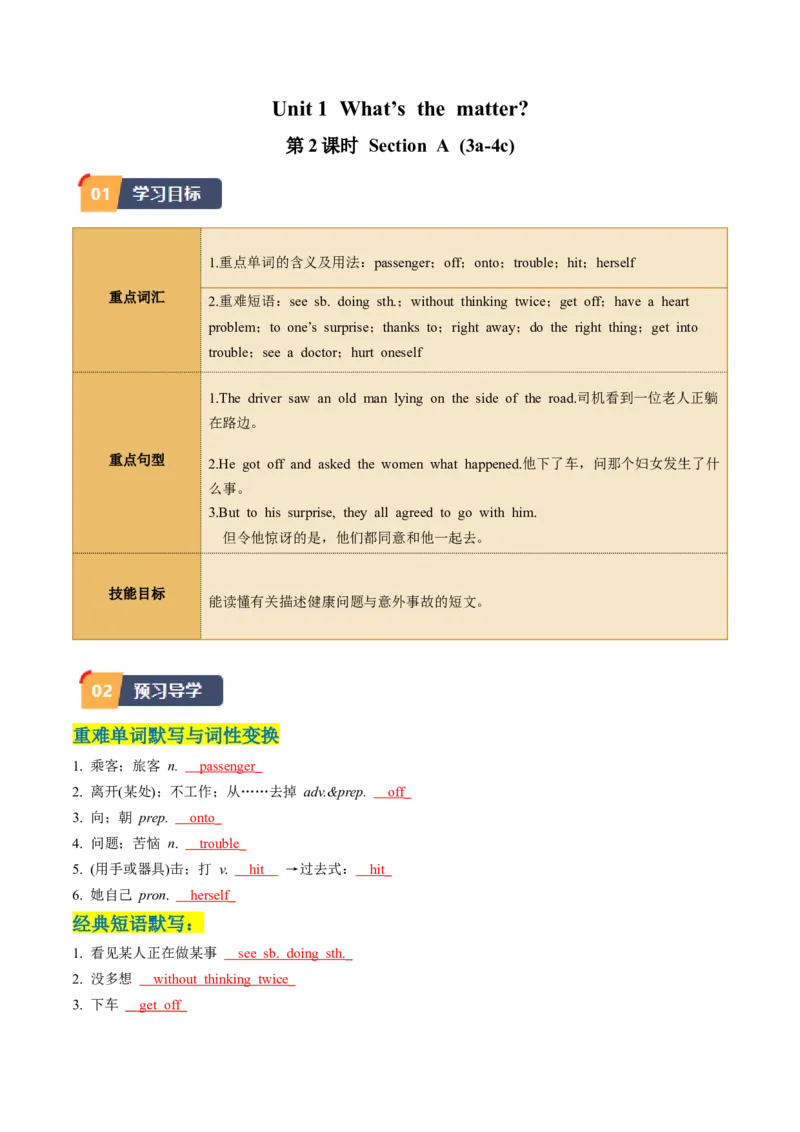
▲see搭配用法
例:I saw him playing soccer a moment ago. 刚刚我看见他正在踢足球。
I see him walk across the bridge. 我看着他过了桥。
【注意】
类似用法的词:watch、hear、feel、notice、find
牛刀小试
1.Every morning, Tim often sees some groups of middle aged women ________ in the square.
A.dance B.to dance C.dances D.danced
【答案】A【详解】句意:每天早上,蒂姆经常看到几群中年妇女在广场上跳舞。
考查非谓语动词。根据“Every morning”可知,是经常性动作,see sb do sth“看见某人经常做某事”。故选
A。
2.—I often hear Linda ________ next door.
—Yeah. I also saw her ________ the piano when I passed the door just now.
A.sing; play B.singing; playing C.sing; playing D.singing; play
【答案】C
【详解】句意:——我经常听到琳达在隔壁唱歌。——是的。刚才经过门口的时候,我还看见她在弹钢琴。
考查非谓语动词。sing唱歌;play演奏;singing“唱歌”,现在分词或动名词;playing“演奏”,现在分词
或动名词。第一空,根据频度副词often可知,考查hear sb. do sth.“听见某人做某事”,表示经常发生的动
作,用动词原形,排除B和D;第二空,根据“when I passed the door”可知,考查see sb. doing sth.“看见某
人正在某事”,当说话人路过的时候,看到她正在弹钢琴,需用现在分词形式,排除A。故选C。
2.He got off and asked the women what happened.他下了车,问那个妇女发生了什么事。
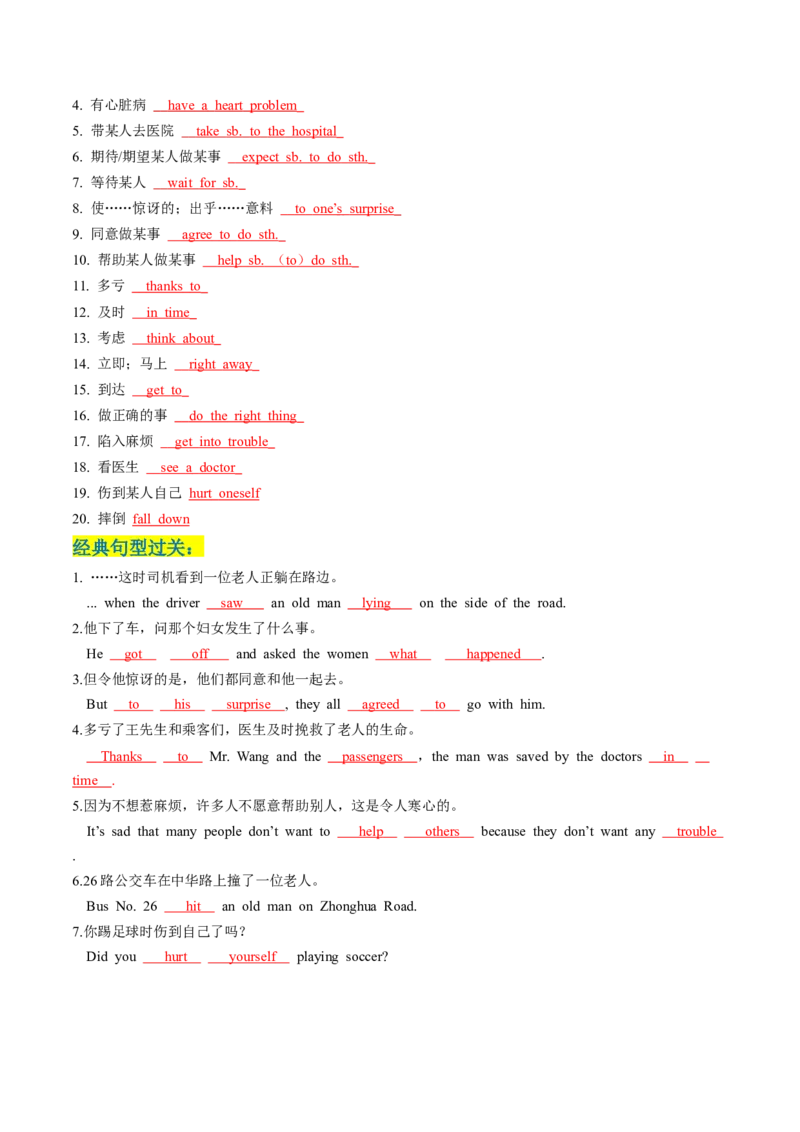
▲上车、下车表达方式
【注意】
get on与代词连用时,代词放后面,如:get on it
get off与代词连用时,代词放中间,如:get it off
牛刀小试
1.在你下公共汽车前,你应当先等它停下来。
Before you the bus, you should wait until it has stopped.
【答案】 get off
2.Dear passengers, our bus is arriving at the bus station. Please take all the things with you before you________.
A.get it off B.get it on C.get off it D.get on it
【答案】C
【详解】句意:亲爱的乘客们,我们的巴士即将到达车站。请下车前带好随身物品。
考查动词短语。get off下车;get on上车;当人称代词作为短语动词+副词的宾语时,位于动词和副词之间,
get off和get on是动词+介词,因此人称代词作宾语,位于动词短语后面,排除AB两项。根据“our bus is
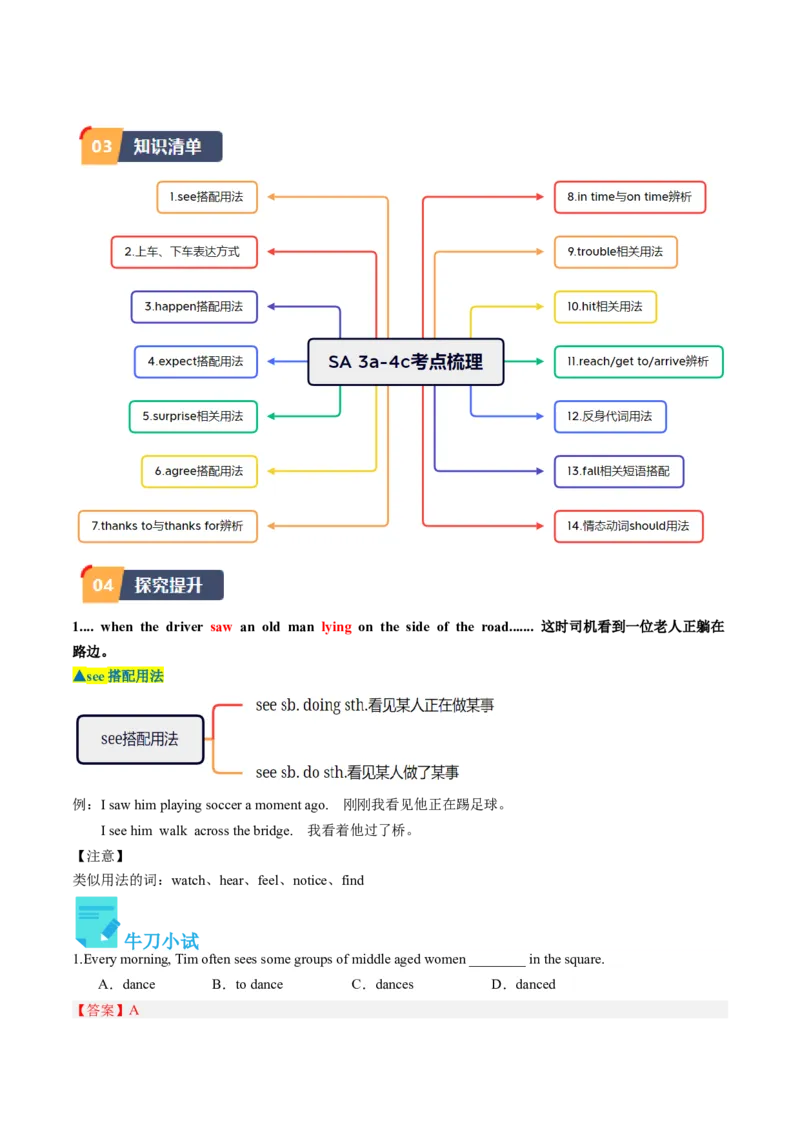
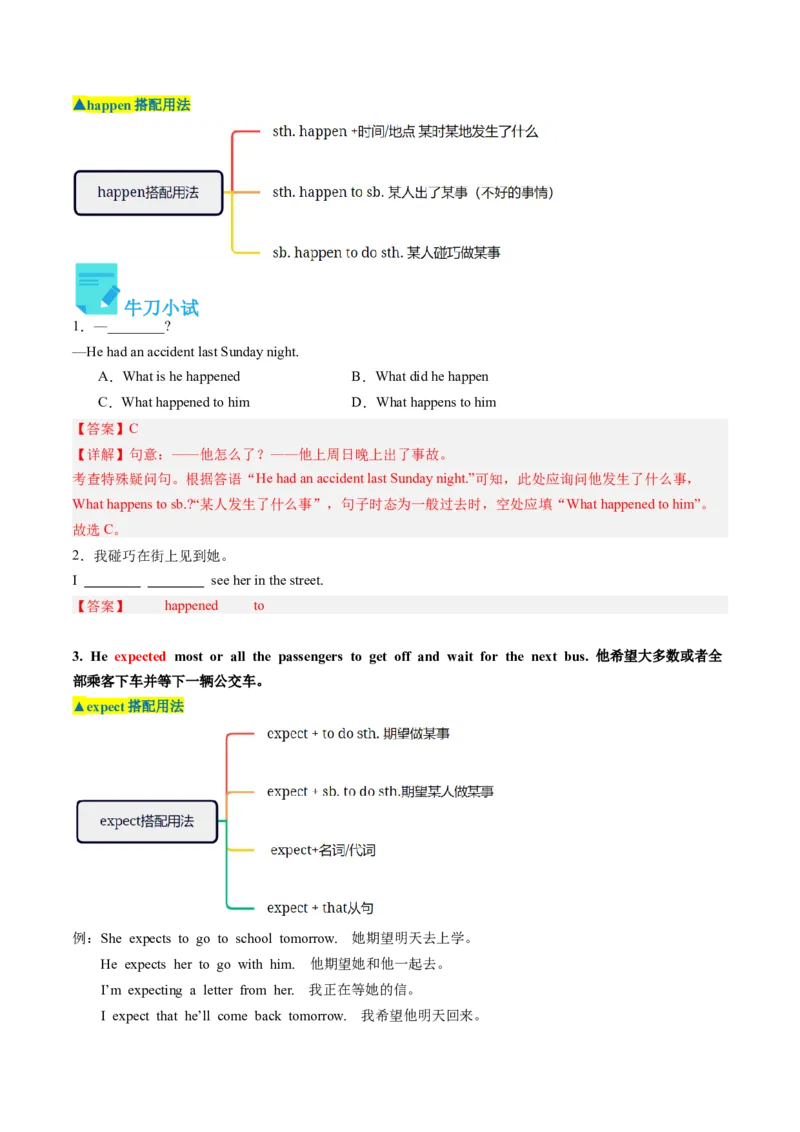
arriving at the bus station.”可知,我们的巴士即将到达车站,因此要下车,故选C。▲happen搭配用法
牛刀小试
1.—________?
—He had an accident last Sunday night.
A.What is he happened B.What did he happen
C.What happened to him D.What happens to him
【答案】C
【详解】句意:——他怎么了?——他上周日晚上出了事故。
考查特殊疑问句。根据答语“He had an accident last Sunday night.”可知,此处应询问他发生了什么事,
What happens to sb.?“某人发生了什么事”,句子时态为一般过去时,空处应填“What happened to him”。
故选C。
2.我碰巧在街上见到她。
I see her in the street.
【答案】 happened to
3. He expected most or all the passengers to get off and wait for the next bus. 他希望大多数或者全
部乘客下车并等下一辆公交车。
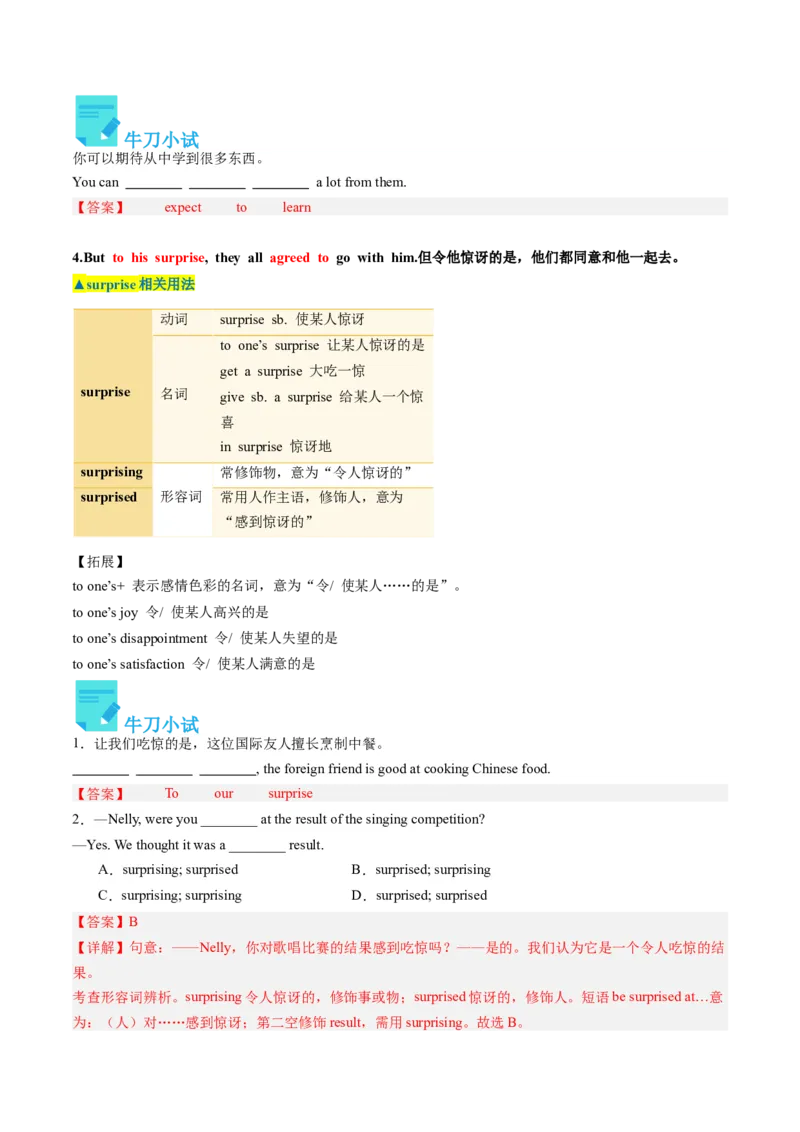
▲expect搭配用法
例:She expects to go to school tomorrow. 她期望明天去上学。
He expects her to go with him. 他期望她和他一起去。
I’m expecting a letter from her. 我正在等她的信。
I expect that he’ll come back tomorrow. 我希望他明天回来。牛刀小试
你可以期待从中学到很多东西。
You can a lot from them.
【答案】 expect to learn
4.But to his surprise, they all agreed to go with him.但令他惊讶的是,他们都同意和他一起去。
▲surprise相关用法
动词 surprise sb. 使某人惊讶
to one’s surprise 让某人惊讶的是
get a surprise 大吃一惊
surprise 名词 give sb. a surprise 给某人一个惊
喜
in surprise 惊讶地
surprising 常修饰物,意为“令人惊讶的”
surprised 形容词 常用人作主语,修饰人,意为
“感到惊讶的”
【拓展】
to one’s+ 表示感情色彩的名词,意为“令/ 使某人……的是”。
to one’s joy 令/ 使某人高兴的是
to one’s disappointment 令/ 使某人失望的是
to one’s satisfaction 令/ 使某人满意的是
牛刀小试
1.让我们吃惊的是,这位国际友人擅长烹制中餐。
, the foreign friend is good at cooking Chinese food.
【答案】 To our surprise
2.—Nelly, were you ________ at the result of the singing competition?
—Yes. We thought it was a ________ result.
A.surprising; surprised B.surprised; surprising
C.surprising; surprising D.surprised; surprised
【答案】B
【详解】句意:——Nelly,你对歌唱比赛的结果感到吃惊吗?——是的。我们认为它是一个令人吃惊的结
果。
考查形容词辨析。surprising令人惊讶的,修饰事或物;surprised惊讶的,修饰人。短语be surprised at…意
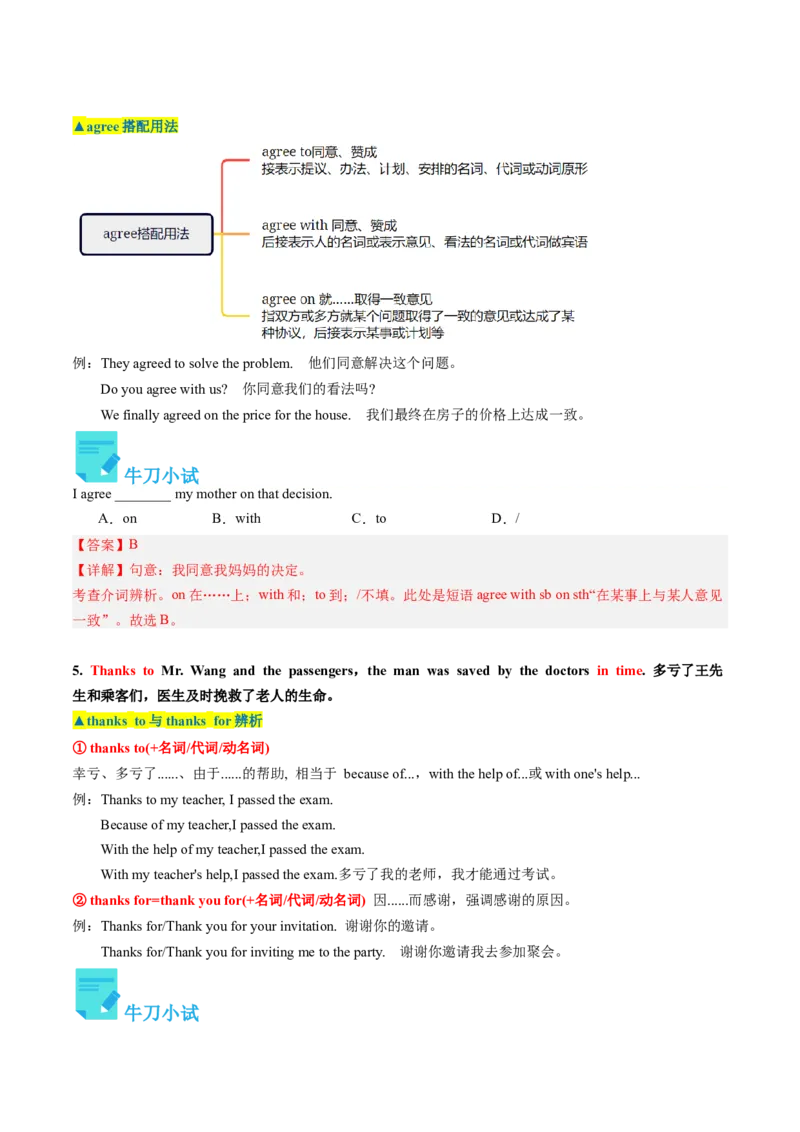
为:(人)对……感到惊讶;第二空修饰result,需用surprising。故选B。▲agree搭配用法
例:They agreed to solve the problem. 他们同意解决这个问题。
Do you agree with us? 你同意我们的看法吗?
We finally agreed on the price for the house. 我们最终在房子的价格上达成一致。
牛刀小试
I agree ________ my mother on that decision.
A.on B.with C.to D./
【答案】B
【详解】句意:我同意我妈妈的决定。
考查介词辨析。on在……上;with和;to到;/不填。此处是短语agree with sb on sth“在某事上与某人意见
一致”。故选B。
5. Thanks to Mr. Wang and the passengers,the man was saved by the doctors in time. 多亏了王先
生和乘客们,医生及时挽救了老人的生命。
▲thanks to与thanks for辨析
①thanks to(+名词/代词/动名词)
幸亏、多亏了......、由于......的帮助, 相当于 because of...,with the help of...或with one's help...
例:Thanks to my teacher, I passed the exam.
Because of my teacher,I passed the exam.
With the help of my teacher,I passed the exam.
With my teacher's help,I passed the exam.多亏了我的老师,我才能通过考试。
②thanks for=thank you for(+名词/代词/动名词) 因......而感谢,强调感谢的原因。
例:Thanks for/Thank you for your invitation. 谢谢你的邀请。
Thanks for/Thank you for inviting me to the party. 谢谢你邀请我去参加聚会。
牛刀小试1.多亏了你的帮助,我的房间看起来整洁多了。
your help, my room looks much tidier.
【答案】 Thanks to
2.感谢你帮我的孩子找到回家的路。
Thank you my son find his way home.
【答案】for helping
▲in time与on time辨析
in time 及时,指按照规定的时间行事,不迟,尚有充裕的时间可做些别的事情。
on time 按时、准时,指正好在规定的时间内。
牛刀小试
1.As a student, you must arrive at school ________.
A.on time B.in time C.for the first time D.from time to time
【答案】A
【详解】句意:作为一名学生,你应该按时到学校。
考查介词短语。on time按时;in time及时;for the first time第一次;from time to time不时地。根据
“arrive at school”可知是按时到校。故选A。
2.Luckily, the doctor came ________ and the sick man was saved.
A.on time B.in time C.at times D.at a time
【答案】B
【详解】句意:幸运的是,医生及时赶到,病人得救了。
考查介词短语辨析。on time准时;in time及时;at times有时;at a time每次,依次。根据“the doctor
came...and the sick man was saved”可知,病人得救应该是医生来得及时,故选B。
6.It’s sad that many people don’t want to help others because they don’t want any trouble.
因为不想惹麻烦,许多人不愿意帮助别人,这是令人寒心的。
▲trouble相关用法
(1) trouble 作名词,常用作不可数,相当于difficulty。
常用搭配:
①get (sb.) into trouble(使某人)陷入困境
②have trouble /difficulty/problems with sth.
=have trouble /difficulty/problems (in) doing sth. 做某事有困难
③ask for trouble 自寻烦恼
④in trouble 陷入困难
(2) trouble 作动词,表示“使烦恼,使忧虑;麻烦”。例:Could I trouble you to open the door? 可以麻烦你开下门吗?
牛刀小试
1.Alice had trouble ________ the way back home yesterday.
A.found B.find C.finding D.to find
【答案】C
【详解】句意:爱丽丝昨天很难找到回家的路。
考查动名词。have trouble doing sth“做某事有困难”,可知填动名词。故选C。
2.If someone gets ________ trouble, we will help them in time.
A.to B.in C.up D.into
【答案】D
【详解】句意: 如果有人遇到麻烦,我们会及时帮助他们。
考查介词辨析。to去、到,表动词的方向; in(表示状态、情况)处于……中,强调处在该种状态下;up
向上; into进入……状态,强调动作的发生。根据“we will help them in time”可知此处指“遇到麻烦”,
用get into trouble。故选D。
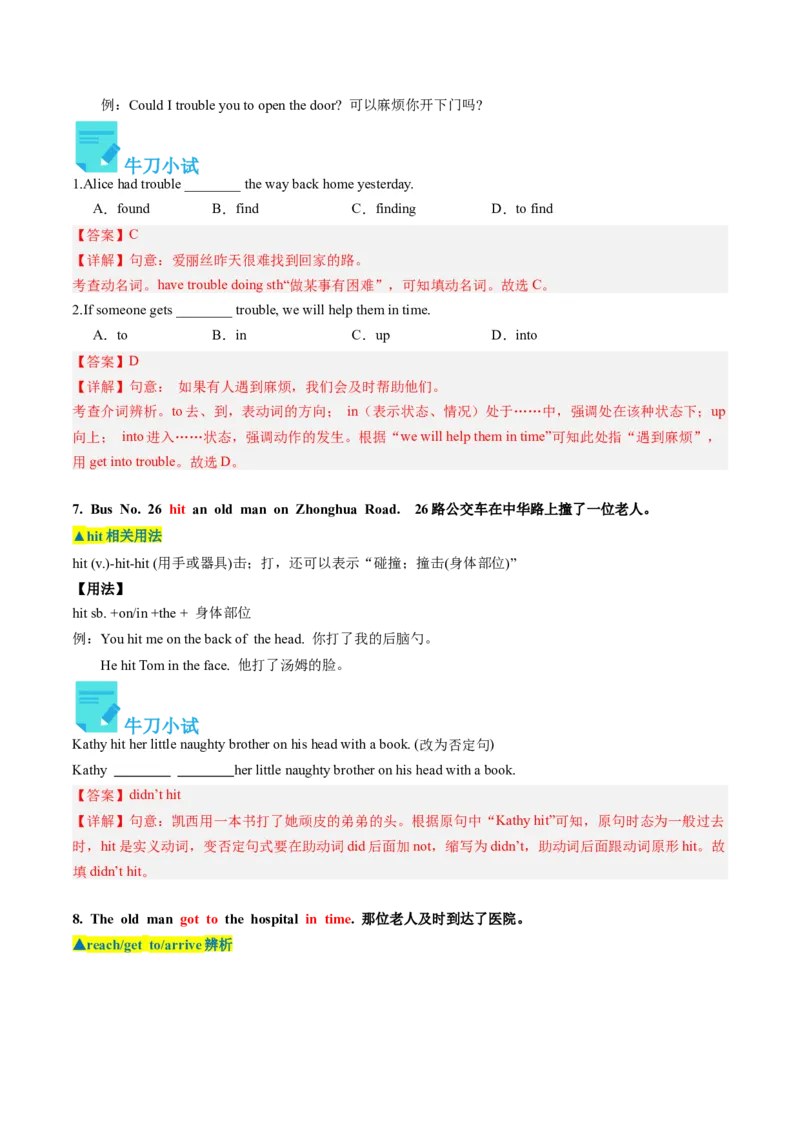
7. Bus No. 26 hit an old man on Zhonghua Road. 26路公交车在中华路上撞了一位老人。
▲hit相关用法
hit (v.)-hit-hit (用手或器具)击;打,还可以表示“碰撞;撞击(身体部位)”
【用法】
hit sb. +on/in +the + 身体部位
例:You hit me on the back of the head. 你打了我的后脑勺。
He hit Tom in the face. 他打了汤姆的脸。
牛刀小试
Kathy hit her little naughty brother on his head with a book. (改为否定句)
Kathy her little naughty brother on his head with a book.
【答案】didn’t hit
【详解】句意:凯西用一本书打了她顽皮的弟弟的头。根据原句中“Kathy hit”可知,原句时态为一般过去
时,hit是实义动词,变否定句式要在助动词did后面加not,缩写为didn’t,助动词后面跟动词原形hit。故
填didn’t hit。
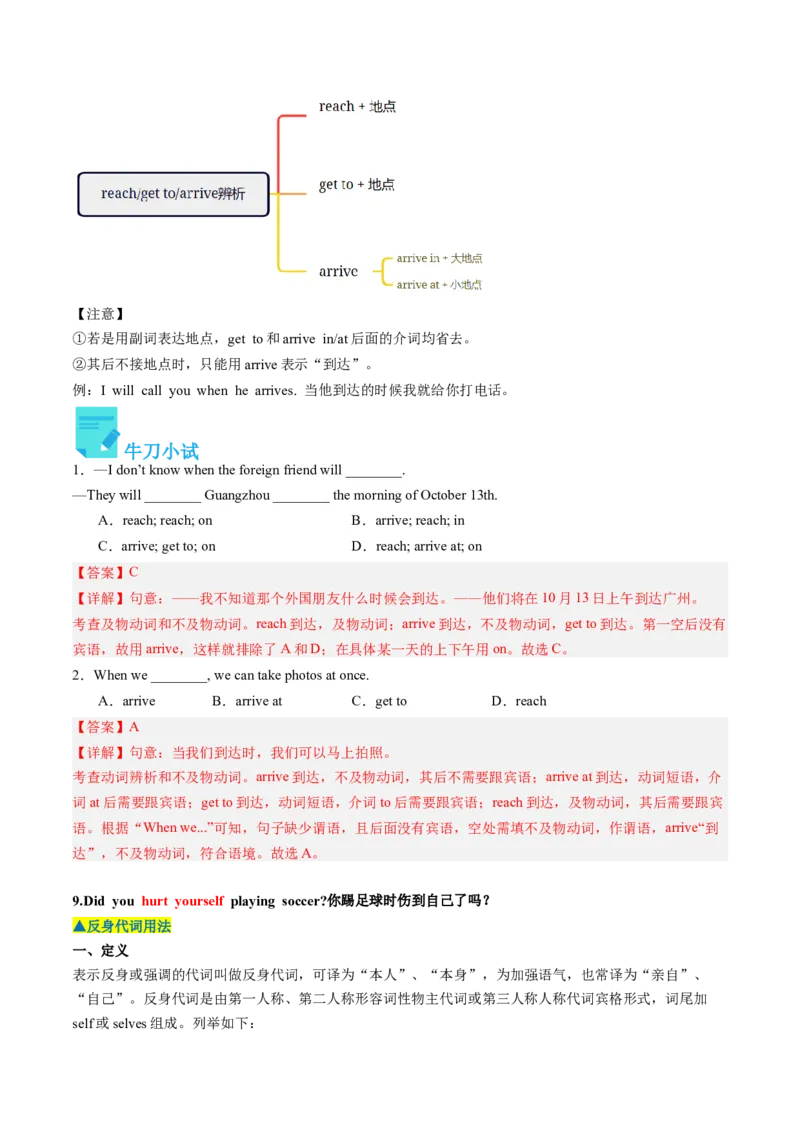
8. The old man got to the hospital in time. 那位老人及时到达了医院。
▲reach/get to/arrive辨析【注意】
①若是用副词表达地点,get to和arrive in/at后面的介词均省去。
②其后不接地点时,只能用arrive表示“到达”。
例:I will call you when he arrives. 当他到达的时候我就给你打电话。
牛刀小试
1.—I don’t know when the foreign friend will ________.
—They will ________ Guangzhou ________ the morning of October 13th.
A.reach; reach; on B.arrive; reach; in
C.arrive; get to; on D.reach; arrive at; on
【答案】C
【详解】句意:——我不知道那个外国朋友什么时候会到达。——他们将在10月13日上午到达广州。
考查及物动词和不及物动词。reach到达,及物动词;arrive到达,不及物动词,get to到达。第一空后没有
宾语,故用arrive,这样就排除了A和D;在具体某一天的上下午用on。故选C。
2.When we ________, we can take photos at once.
A.arrive B.arrive at C.get to D.reach
【答案】A
【详解】句意:当我们到达时,我们可以马上拍照。
考查动词辨析和不及物动词。arrive到达,不及物动词,其后不需要跟宾语;arrive at到达,动词短语,介
词at后需要跟宾语;get to到达,动词短语,介词to后需要跟宾语;reach到达,及物动词,其后需要跟宾
语。根据“When we...”可知,句子缺少谓语,且后面没有宾语,空处需填不及物动词,作谓语,arrive“到
达”,不及物动词,符合语境。故选A。
9.Did you hurt yourself playing soccer?你踢足球时伤到自己了吗?
▲反身代词用法
一、定义
表示反身或强调的代词叫做反身代词,可译为“本人”、“本身”,为加强语气,也常译为“亲自”、
“自己”。反身代词是由第一人称、第二人称形容词性物主代词或第三人称人称代词宾格形式,词尾加
self或selves组成。列举如下:人称 单数 复数
第一人称 myself我自己 ourselves我们自己
第二人称 yourself你自己 yourselves 你们自己
herself /himself
第三人称 themselves他们自己
/itself
二、常见用法
(1)反身代词作宾语,表示主语和宾语为同一个人或事物。
例:He bought himself a book. 他给自己买了一本书。
(2)反身代词作同位语,起强调作用。
例:I myself repaired the bike. 我自己修的自行车。
三、含反身代词的常用词组:
teach oneself 自学 learn...by oneself 自学…… by oneself 独自
enjoy oneself 玩得高兴,过得愉快 help oneself to... 为(自己)取用……
hurt oneself 伤到自己
牛刀小试
1.Did she hurt (she)when she played tennis?
【答案】herself
【详解】句意:她打网球时受伤了吗?hurt oneself“伤到某人自己”,空处需用反身代词herself“她自己”,
与主语she保持一致。故填herself。
2.I really like to see all the children enjoy (他们) at the party.
【答案】themselves
【详解】句意:我真的很喜欢看到所有的孩子在聚会上玩得很开心。enjoy oneself意为“玩得开心”,根
据提示“他们”可知,此处应用反身代词themselves,故填themselves。
10.Did you fall down?你摔倒了吗?
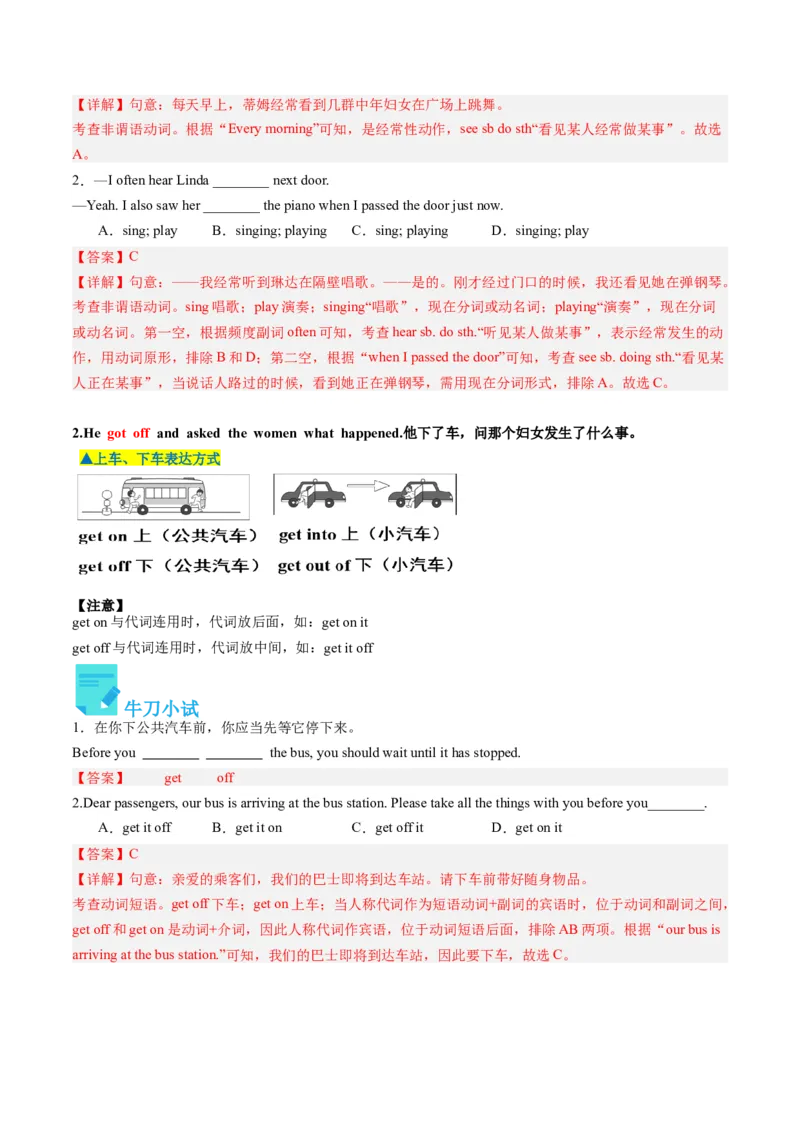
▲fall相关短语搭配牛刀小试
1.When we first learn how to ride a bike, we may ________ again and again.
A.fall down B.fall off from C.fall from D.fall over
【答案】A
【详解】句意:当我们第一次学习如何骑车时,我们可能一次又一次地摔倒。
考查动词短语。fall down跌倒;fall off from表述错误;fall from摔倒,滑倒,后接宾语时必须加介词
from;fall over绊了一跤。BC两项中均有from,后应加sth,排除BC选项;再根据“we may...again and
again.”可知,此处是指摔倒。故选A。
2.Yesterday I___________ the bike and hurt my leg.
A.fell down B.fell over C.fell into D.fell off
【答案】D
【详解】句意:昨天我从自行车上摔下来,伤了我的腿。
考查短语辨析。fell down跌倒,倒塌;fell over摔倒,绊了一跤;fell into掉进……里面;fell off从……上
摔下来。根据空后“…the bike”可知,这里表示“从自行车上摔下来”,应用短语fall off,故选D。
11.You should go home and get some rest.你应该回家休息。
▲情态动词should用法
should“应当;应该”,没有人称和数的变化,不能单独作谓语,后面接动词原形,其否定式是 shouldn’t,
疑问式应把 should提前。具体用法如下:
1. should表示提出建议,意为“应该;应当”
You should listen to music when you are tired. 当你累的时候你应该听音乐。We should help the people in trouble. 你应该帮助有困难的人。
2 should表示可能性或判断、推测、推论。
I don’t know who should speak first. 我不知道谁应该第一个讲。
He should be around sixty years.他应该60岁上下。
3. shouldn’t用来表示責备或批评,意思是“不应该”
You shouldn’ t spend too much time on TV. 你不应该花太多时间看电视
4. should用来征求意见、提供帮助或请求指示。
Should I buy the book for him? 我应该给他买这本书吗?
5. should表示委婉客气地表达某种想法,意为“倒想;想
I should advise you to say less and do more..我想劝你少说多做。
6. should表示说话人的感情,如:惊奇、愤怒、失望等。
It’s surprising that Mary should love such a person as Jack. 玛丽竟然会爱杰克这样的人,真是奇怪
7. should是 shall的过去式,用于第一、三人称,多用在间接引语中,用于征求对方的意见。
Mr. Wang asked if he should get his visa the next day.王先生问明天他是否可以拿到签证。
8. should用于疑问向中,表示意外、惊奇、不能理解等,有“竟会;竟然会;怎么会”的意思。
How should I know?我怎么会知道呢?
Why should I do it?为什么要我做那件事呢?
Should she do such a thing?她会做这种事吗?
9. should用于虚拟语气中
If she asked me tomorrow, I should do it.假如她明天问我,我会做的。
牛刀小试
1.Teachers should (be) strict with their students in order to help them make great progress.
【答案】be
【详解】句意:老师应该严格要求学生,以帮助他们取得进步。情态动词should后加动词原形。故填be。
2.She should eat more fresh fruit. (改为否定句)
She more fresh fruit.
【答案】 shouldn’t eat
【详解】句意:她应该多吃点新鲜水果。原句改为否定句,直接在情态动词should后面加not即可,缩写
为shouldn’t。情态动词后面加动词原形。故填shouldn’t;eat。一、单项选择
1.Little Jane is crying because her brother ________ her head with a ball. Luckily, there is nothing serious.
A.hit B.used C.put D.broke
【答案】A
【详解】句意为:小简在哭,因为她弟弟用一个球砸了她的头。幸运的是,情况并不严重。
考查动词辨析。hit意为“(用手或器具)击;打”;use意为“使用”;put意为“放置”;break意为
“打破”。根据“her head with a ball.”可知是用球砸到了头,故选A。
2.Uncle Joe ________ the habit of reading news after getting up. He knows a lot about what’s going on around
the world.
A.got into B.got on C.got off D.got over
【答案】A
【详解】句意:乔叔叔起床后养成了看新闻的习惯。他非常了解世界各地发生的事情。
考查动词短语。got into养成(某种习惯);got on上车;got off下车;got over克服。根据“ the habit of
reading news”可知是指养成了看新闻的习惯。故选A。
3.When our parents become too old to take care of themselves one day, we ________ look after them well.
A.should B.shouldn’t C.may D.may not
【答案】A
【详解】句意:当我们的父母有一天变得太老而不能照顾自己时,我们应该好好照顾他们。
考查情态动词。should应该;shouldn’t不应该;may可能;may not可能不。根据“When our parents
become too old to take care of themselves one day”可知,当父母老去那一天,我们应该照顾他们,这是我们
的责任和义务,故应用“应该”should。故选A。
4.—I want to keep a pet. I think it’s interesting to keep a pet.
—But it may bring you much ________.
A.problem B.fun C.money D.trouble
【答案】D
【详解】句意:——我想养一只宠物。我觉得养宠物很有趣。——但是它可能会给你带来很多麻烦。
考查名词辨析。problem问题,麻烦,为可数名词;fun 乐趣,为不可数名词;money金钱,为不可数名词;
trouble麻烦,为不可数名词。结合句意可知养宠物会带来麻烦,根据“much”可知横线处为不可数名词。
故选D。
5.—I have trouble _________ new word. Can you help me?
—Sure. You can look it up in the dictionary.
A.understanding B.to understand C.understand D.understood
【答案】A
【详解】句意:——理解新词对我来说有困难。你能帮助我吗?——当然。你可以查阅词典。
考查非谓语动词。have trouble doing sth表示“做某事有困难”。因此此处用动名词形式。故选A。
6.My grandmother expects ________ the soap opera again.
A.watched B.watching C.watches D.to watch【答案】D
【详解】句意:我奶奶想再看一遍肥皂剧。
考查动词不定式。根据“My grandmother expects...the soap opera again.”可知,此处是expect to do sth.“期望
做某事”,故选D。
7.Are you ________ when someone looks at you in ________?
A.surprised; surprised B.surprised; surprise
C.surprised; surprising D.surprising; surprise
【答案】B
【详解】句意:当有人惊讶地看着你时,你会感到惊讶吗?
考查词汇辨析。surprised惊讶的,形容词;surprising令人惊讶的,形容词;surprise惊讶,名词。根据
“Are you ...”可知,第一空应用形容词作表语,修饰人应用-ed结尾的形容词surprised;再根据“when
someone looks at you in ...”可知,in surprise“惊讶地”,介词短语。故选B。
8.—________ the computer, we can chat with our friends on the Internet at any time.
—I agree with you.
A.Thanks to B.Thanks for C.Instead of D.According to
【答案】A
【详解】句意:——多亏了电脑,我们可以随时在网上和朋友聊天。——我同意你的观点。
考查介词短语。Thanks to多亏了;Thanks for感谢;Instead of反而;According to根据。根据“the
computer, we can chat with our friends on the Internet at any time.”可知,多亏了电脑,我们才可以随时在网上
和朋友聊天,故选A。
9.________ Mr. Brown’s anger, it was his own son who didn’t agree ________ him.
A.To; with B.Because of; to
C.With; of D.For; on
【答案】A
【详解】句意:令布朗先生生气的是,是他自己的儿子不同意他的意见。
考查动词与介词短语。to到;with和;Because of因为;of的;on在……上面。第一个空为短语to one’s
anger“令某人感到生气的是”;第二空考查短语agree with sb.“同意某人的意见”。故选A。
10.When the bus ________, the children couldn’t wait ________.
A.reached, to get on it B.arrived, to get it on
C.arrived, to get on it D.reached, to get it on
【答案】C
【详解】句意:公交车到达时;孩子们迫不及待地要上车。
考查动词辨析及动词辨析。reached到达,及物动词,后需跟宾语;arrived到达,不及物动词,后不跟宾语。
根据“When the bus ...”可知,空后无宾语,用arrived,排除A、D选项;couldn’t wait to do sth“迫不及待要
做某事”,get on“上车”,为“动词+介词”构成的短语,代词放在介词后面。故选C。
二、根据所给提示填空,每空一词1.Frank was so angry that he (hit)the tree beside him.
【答案】hit
【详解】句意:弗兰克是如此的生气,以致于他狠打了身旁的树。主句中be动词是一般过去时,因此that
从句中也应采取一般过去时,hit“打;击”的一般过去式为hit,故填hit。
2.He expected most of the (passenger) to get off and wait for the next bus.
【答案】passengers
【详解】句意:他期望大多数的乘客能下车等下一辆公共汽车。passenger“乘客”,可数名词,前面有
most of修饰,因此此处用复数名词passengers。故填passengers。
3.—What's the matter with her?
—She cut (she) when cooking dinner.
【答案】herself
【详解】句意:——她怎么了?——她做饭时割伤了自己。根据“She cut...when cooking dinner.”可知,此
处说的切到了她自己,应用反身代词,故填herself。
4.I'm sorry to make so much (trouble) for you.
【答案】trouble
【详解】句意:很抱歉给你添这么多麻烦。trouble为不可数名词,意为“麻烦”。故填trouble。
5.I saw a bag (lie) on the street on my way to school.
【答案】lying
【详解】句意:我在上学的路上看到一个书包躺在街上。根据see是感官动词,之后加原型或现在分词。
加原型只表示出现过的动作,即“看到过一件发生了的事”;加分词体现一个过程性,即“看到了一件正
在发生的事”,结合句中是去学校的路上,所以是用分词,故填lying。
6.You shouldn’t (stay) up too late at night.
【答案】stay
【详解】句意:你不应该晚上睡得太晚。“熬夜”stay up late,句子中有情态动词should’t,后跟动词原形。
故填stay。
7.We were very excited because our teacher agreed (take)us to the museum.
【答案】to take
【详解】句意:我们非常兴奋,因为我们的老师同意带我们去博物馆。agree to do sth“同意做某事”,为固
定短语。故填to take。
8.Nobody wants to get i trouble.
【答案】into
【详解】句意:没人想惹麻烦。根据“Nobody wants to get … trouble”可知,此处表示“惹麻烦”,英文表
达为get into trouble,故填into。
9.Please think t before you call him back.
【答案】twice
【详解】句意:在你给他回电话之前请三思。根据首字母t及“think”可知,此处为短语think twice,意为“慎重考虑,思忖再三”。故填twice。
10.Do you have any [ˈtrʌbl] working out the problem?
【答案】trouble
【详解】句意:你解这道题有困难吗?根据音标提示可知,应填trouble“麻烦,问题”。故填trouble。
三、选词填空
根据语境,从方框中选择恰当的单词填空,有的需要变换形式。
A
passenger, onto, trouble, hit
1.You’re just asking for if you don’t give them the money.
2.The number of flying on planes in the country has increased (增长) by 35 percent in the past six
years.
3.Mary Mike on the head with a book by accident.
4.—I’ll see you the train.
—Thank you.
【答案】1.trouble 2.passengers 3.hit 4.onto
【解析】
1.句意:你简直就是在自找麻烦如果你不给他们钱的话。
根据“if you don’t give them the money.”如果你不给他们钱,可知情况不好,再根据短语ask for trouble自寻
烦恼,trouble是不可数名词,不要变形。故答案填trouble。
2.句意:在过去的6年,这个国家的飞机乘客数量已经增长了35%。
根据“flying on planes”可知是乘客passenger。The number of……的数量,跟上可数名词复数形式。乘客
passenger是可数名词。故答案填乘客passengers。
3.句意:Mary不小心用书砸到了Mike的头。
根据“on the head with a book by accident”可知是不小心书砸到头了,hit是撞击。根据意思,说明事情已经
发生了,所以用一般过去时,hit是不规则动词,过去式是原形。故答案填hit。
4.句意:——我会送你上火车。——谢谢。
句子成分分析:I主语,will see谓语,you宾语,the train.地点状语。状语前缺少介词。onto the train上火
车。故答案填onto。
B
next to, wait for, put…on, get off, right away
1.It's time to go to school. I must go .
2.There will be a beautiful lake our neighborhood in two years.
3.Bill cut his knee by accident, and the doctor some medicine the cut.
4.The visitors the train at the wrong station yesterday.5.We are all you, Linda. Please try your best to arrive here in half an hour.
【答案】1.right away 2.next to 3. put on 4.got off 5.waiting for
【解析】
1.句意:到上学的时间了。我必须马上走了。分析句子结构及前一句“It's time to go to school”可知,空格
处缺少状语,备选词汇right away“马上”符合语境。故填right away。
2.句意:两年之内我们社区附近将有一个漂亮的湖。分析句子结构和语境,可知空格部分作表语;备选
词汇next to“在近旁”符合语境。故填next to。
3.句意:Bill意外地割伤了他的膝盖。医生在伤口上放了一些药。根据“some medicine”和“the cut”可推
测是在伤口处放药,根据语境可知时态为过去时态;备选词汇put…on“把……放到……上”符合语境,put
过去式为put。故填put;on。
4.句意:昨天,游客在错误的车站下了火车。根据句子结构和语境可知,此空缺少动词,且为过去时态;
由“at the wrong station”可知,下错站了。备选词汇get off“下车”,符合语境。故填got off。
5.句意:Linda,我们都正在等你。请尽你最大的努力在半个小时之内到达。根据语境及系动词are可知,
此空填动词的现在进行时;根据“Please try your best to arrive here in half an hour”可知,我们在等她;备选
词汇wait for“等待”,符合语境。故填waiting for。
四、短文选词填空
rest hit afraid with I until slow lie hurt advice
Barry was shopping with his friends when he saw a woman on the ground outside one of the shops.
“I saw the woman 1 on the ground. She 2 her head on the ground,” Barry said. He
thought the woman was having a seizure(病的突然发作). Thinking of the 3 from his first-aid course, he
knew that he needed to stop the woman from 4 herself. So he put his coat under her head. “I asked the
shopper to call 120, because I wasn’t sure if the woman has the history of seizures and nobody was 5 her,”
Barry said. When the seizure stopped, he made sure the woman was breathing(呼吸) and he helped her 6 .
About five minutes later, the woman started to come round very 7 , but she was too weak to know where
she was. So Barry stayed with her 8 the doctor came.
“After they left, I felt too tired to get my thoughts together. I didn’t know how I stayed calm(镇定的). I always
thought I would feel 9 in a real first-aid situation. Remembering what I had learned helped 10 a lot,
he said. Barry believed that it was useful for us to learn first aid.
【答案】
1.lying/was lying 2.hit 3.advice 4.hurting 5.with 6.rest/to rest 7.slowly
8.until 9.afraid 10.me
【解析】本文讲述了巴里拯救了一位发病女士的经历。
1.句意:我看到一位女士正躺在地上。根据“saw the woman…on the ground”,并结合所给词,可知应用
lie“躺着”,表达的是看见躺在地上。see sb. doing sth.“见到某人正在做某事”,lie的动名词形式为lying;此处也可用过去进行时,从句主语为the woman,故可以用was lying。故填lying/was lying。
2.句意:她头撞在了地上。根据“I saw the woman…on the ground.”,结合备选词,可知此处应填hit“撞”,
摔倒了,头长在了地上,且要用一般过去时,hit要用过去式hit。故填hit。
3.句意:想到从他的急救课学到的建议。根据“Thinking of the…from his first-aid course”,结合备选词,
可知是从急救课上学到的建议,advice“建议”,不可数名词。故填advice。
4.句意:他知道他需要阻止这个女人伤到自己。根据“he knew that he needed to stop the woman from…
herself”可知,此处为stop sb. from doing sth.“阻止某人做某事”,结合语境和备选词,可知应用hurt“伤
害”,故填hurting。
5.句意:因为我不确定这个女人是否有癫痫病史,也没有人陪着她。根据“nobody wasnobody was…her”
可知是没人和她在一起,结合备选词,可知应填with“和……在一起”。故填with。
6.句意:当癫痫停止时,他确定这个女人正在呼吸,并且他帮助她休息。根据语境及备选词可知,此处
应填rest“休息”。根据“helped her…”可知是help sb. (to) do“帮助某人做某事”。故填rest/to rest。
7.句意:大约五分钟后,这个女人开始慢慢苏醒过来,但是她太虚弱了,以至于她不知道她在哪里。根
据“started to come round very…”可知此处修饰动词短语come round,需要用副词;结合语境及所给词,故
填slowly。
8.句意:所以巴里和她待在一起直到医生来。根据“So Barry stayed with her…the doctor came”可知此处需
要用连词,until意为“直到……为止”,符合语境,故填until。
9.句意:我一直以为在真正的急救情况下我会感到害怕。根据“I didn’t know how I stayed calm.”可知应用
afraid;feel为感官动词,后需要用形容词作表语,故填afraid。
10.句意:记得我学过的东西帮了我很多。根据“what I had learned helped”可知要选I,动词helped后需
要用人称代词宾格,故填me。