Unit 1 What’s the matter?
第4课时 Section B (2a-2e)
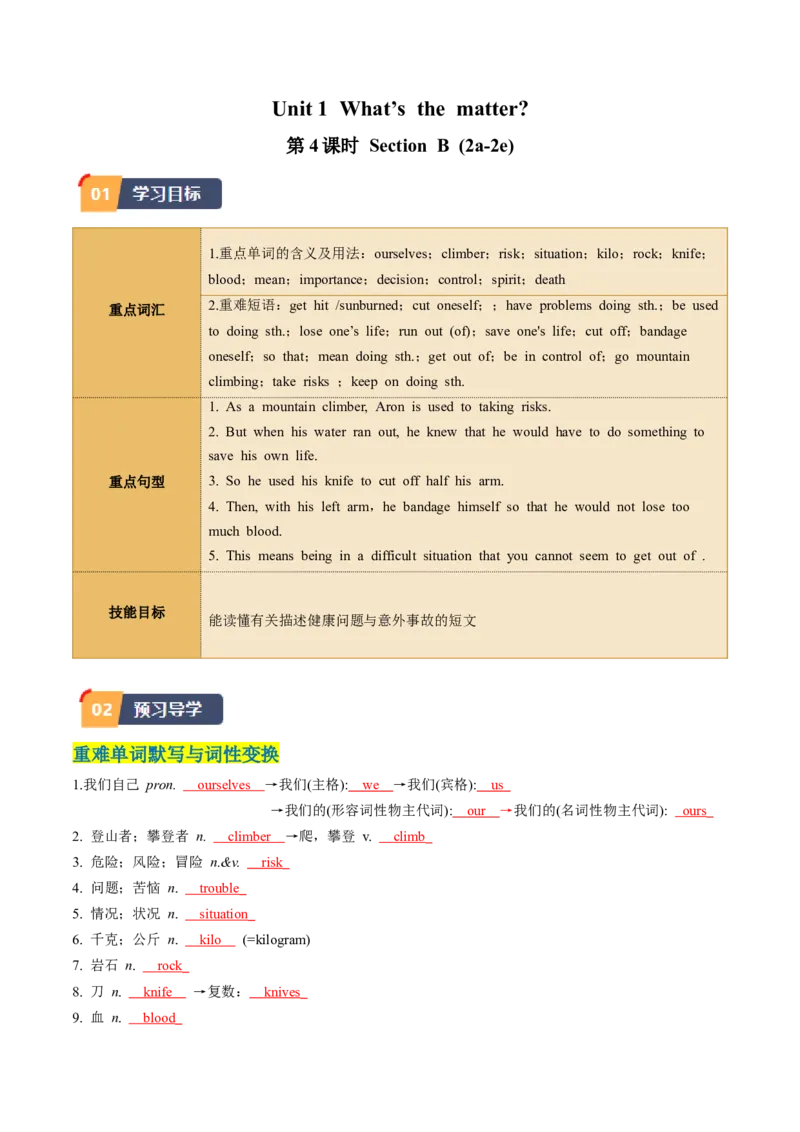
1.重点单词的含义及用法:ourselves;climber;risk;situation;kilo;rock;knife;
blood;mean;importance;decision;control;spirit;death
重点词汇 2.重难短语:get hit /sunburned;cut oneself;;have problems doing sth.;be used
to doing sth.;lose one’s life;run out (of);save one's life;cut off;bandage
oneself;so that;mean doing sth.;get out of;be in control of;go mountain
climbing;take risks ;keep on doing sth.
1. As a mountain climber, Aron is used to taking risks.
2. But when his water ran out, he knew that he would have to do something to
save his own life.
重点句型 3. So he used his knife to cut off half his arm.
4. Then, with his left arm,he bandage himself so that he would not lose too
much blood.
5. This means being in a difficult situation that you cannot seem to get out of .
技能目标
能读懂有关描述健康问题与意外事故的短文
重难单词默写与词性变换
1.我们自己 pron. o urselve s →我们(主格): we →我们(宾格): us
→我们的(形容词性物主代词): our →我们的(名词性物主代词): our s
2. 登山者;攀登者 n. climbe r →爬,攀登 v. clim b
3. 危险;风险;冒险 n.&v. ris k
4. 问题;苦恼 n. troubl e
5. 情况;状况 n. situatio n
6. 千克;公斤 n. kil o (=kilogram)
7. 岩石 n. roc k
8. 刀 n. knif e →复数: knive s
9. 血 n. bloo d10. 意思是;打算;意欲 n. mea n →过去式: mean t
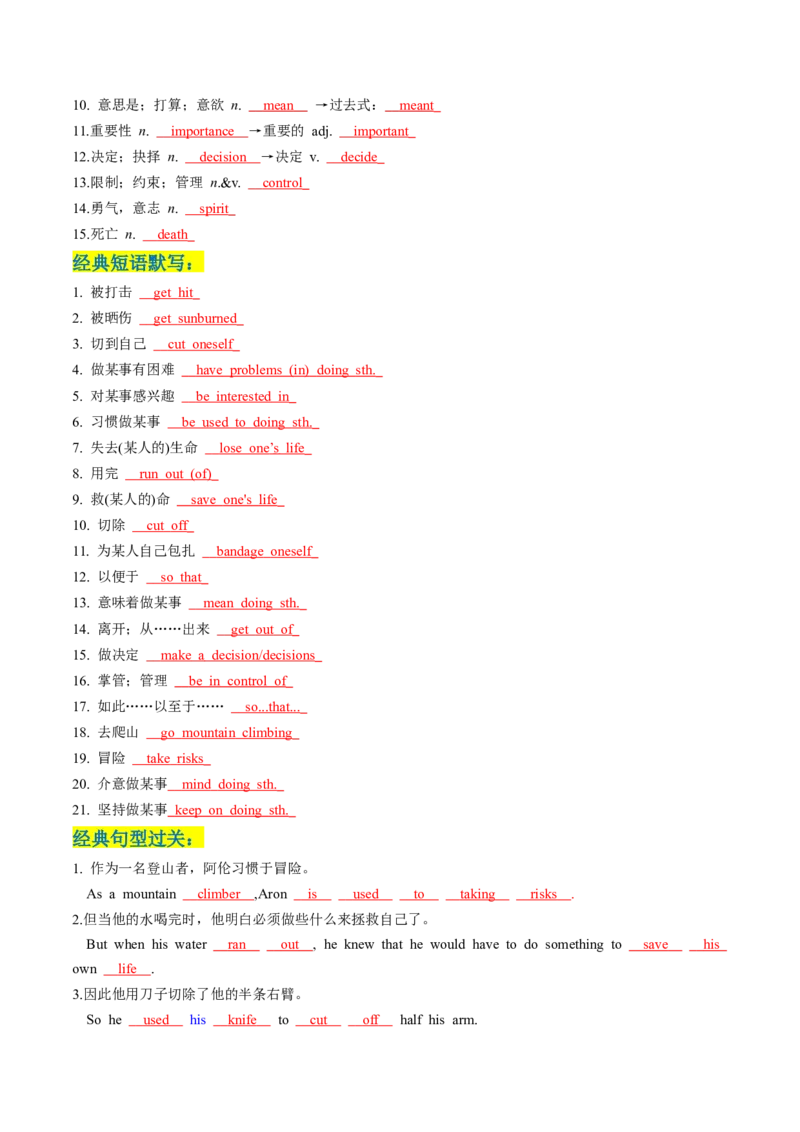
11.重要性 n. importanc e →重要的 adj. importan t
12.决定;抉择 n. decisio n →决定 v. decid e
13.限制;约束;管理 n.&v. contro l
14.勇气,意志 n. spiri t
15.死亡 n. deat h
经典短语默写:
1. 被打击 ge t hi t
2. 被晒伤 ge t sunburne d
3. 切到自己 cu t onesel f
4. 做某事有困难 hav e problem s (in ) doin g sth .
5. 对某事感兴趣 b e intereste d i n
6. 习惯做某事 b e use d t o doin g sth .
7. 失去(某人的)生命 los e on e ’ s lif e
8. 用完 ru n ou t (of )
9. 救(某人的)命 sav e one' s lif e
10. 切除 cu t of f
11. 为某人自己包扎 bandag e onesel f
12. 以便于 s o tha t
13. 意味着做某事 mea n doin g sth .
14. 离开;从……出来 ge t ou t o f
15. 做决定 mak e a decision/decision s
16. 掌管;管理 b e i n contro l o f
17. 如此……以至于…… so...that. ..
18. 去爬山 g o mountai n climbin g
19. 冒险 tak e risk s
20. 介意做某事 min d doin g sth .
21. 坚持做某事 kee p o n doin g sth .
经典句型过关:
1. 作为一名登山者,阿伦习惯于冒险。
As a mountain climbe r ,Aron i s use d t o takin g risk s .
2.但当他的水喝完时,他明白必须做些什么来拯救自己了。
But when his water ra n ou t , he knew that he would have to do something to sav e hi s
own lif e .
3.因此他用刀子切除了他的半条右臂。
So he use d his knif e to cu t of f half his arm.4.然后,他用左臂给自己打上绷带,这样不至于失血过多。
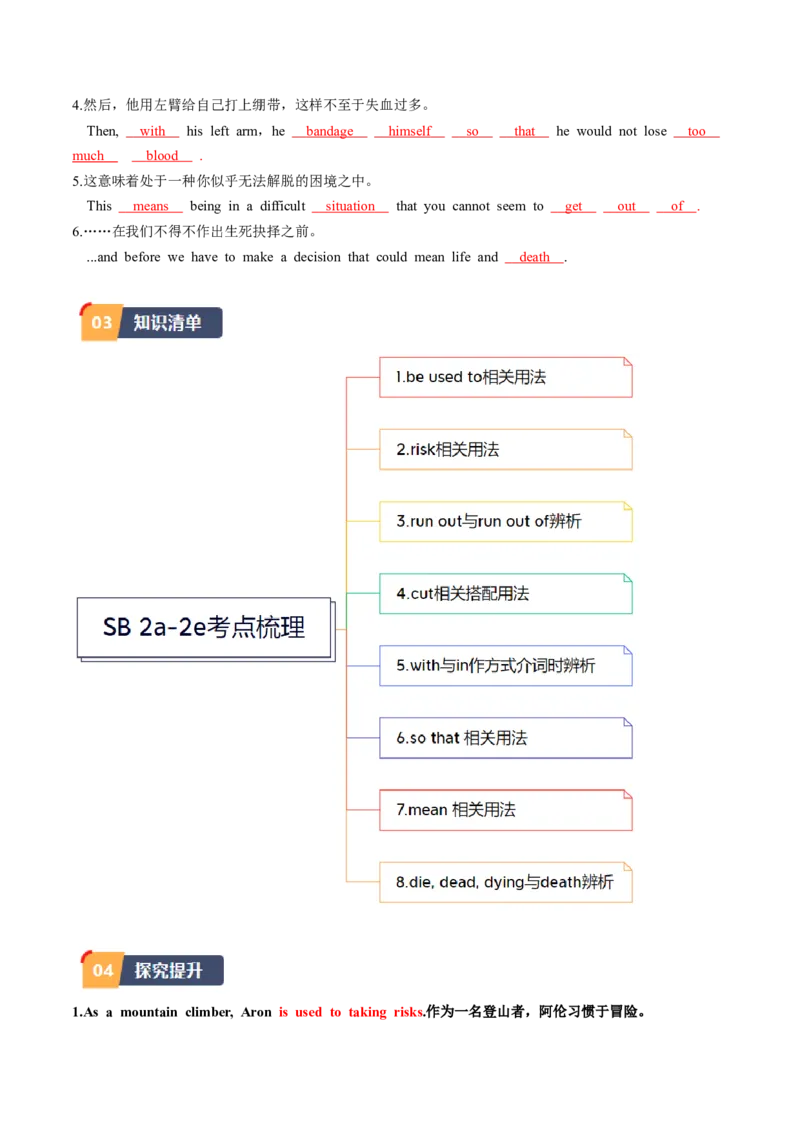
Then, wit h his left arm,he bandag e himsel f s o tha t he would not lose to o
much bloo d .
5.这意味着处于一种你似乎无法解脱的困境之中。
This mean s being in a difficult situatio n that you cannot seem to ge t ou t o f .
6.……在我们不得不作出生死抉择之前。
...and before we have to make a decision that could mean life and deat h .
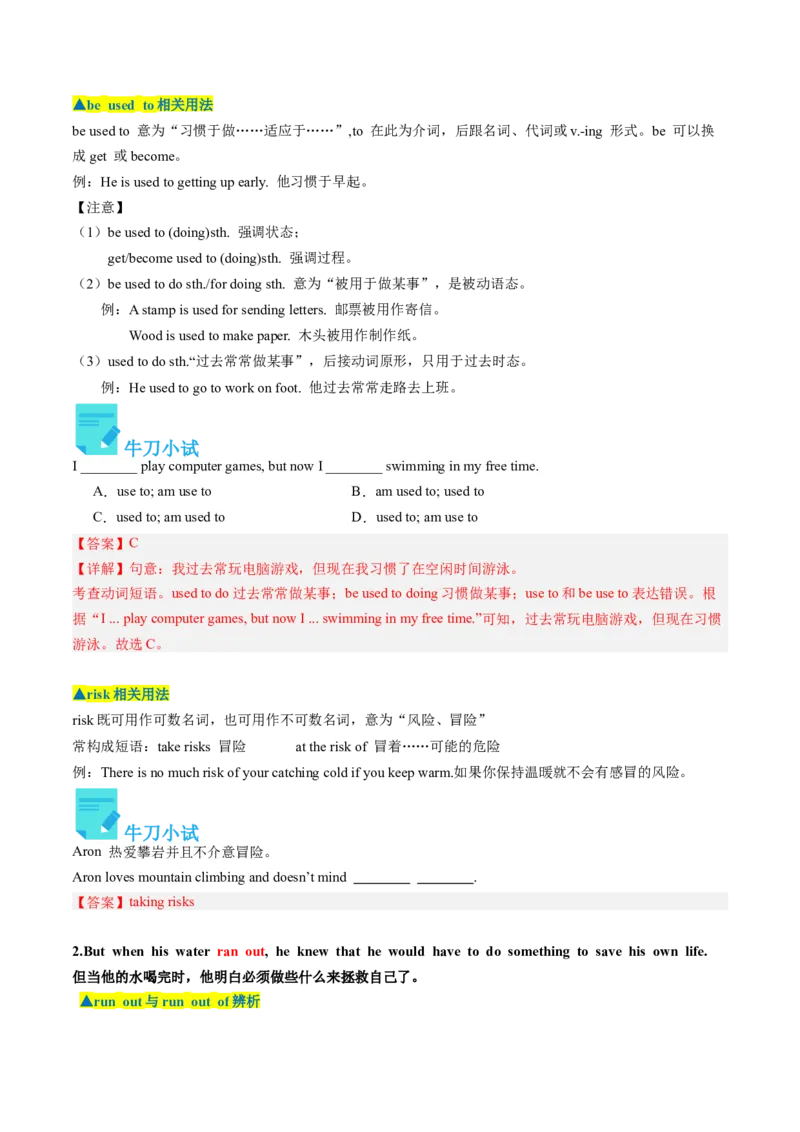
1.As a mountain climber, Aron is used to taking risks.作为一名登山者,阿伦习惯于冒险。▲be used to相关用法
be used to 意为“习惯于做……适应于……”,to 在此为介词,后跟名词、代词或v.-ing 形式。be 可以换
成get 或become。
例:He is used to getting up early. 他习惯于早起。
【注意】
(1)be used to (doing)sth. 强调状态;
get/become used to (doing)sth. 强调过程。
(2)be used to do sth./for doing sth. 意为“被用于做某事”,是被动语态。
例:A stamp is used for sending letters. 邮票被用作寄信。
Wood is used to make paper. 木头被用作制作纸。
(3)used to do sth.“过去常常做某事”,后接动词原形,只用于过去时态。
例:He used to go to work on foot. 他过去常常走路去上班。
牛刀小试
I ________ play computer games, but now I ________ swimming in my free time.
A.use to; am use to B.am used to; used to
C.used to; am used to D.used to; am use to
【答案】C
【详解】句意:我过去常玩电脑游戏,但现在我习惯了在空闲时间游泳。
考查动词短语。used to do过去常常做某事;be used to doing习惯做某事;use to和be use to表达错误。根
据“I ... play computer games, but now I ... swimming in my free time.”可知,过去常玩电脑游戏,但现在习惯
游泳。故选C。
▲risk相关用法
risk既可用作可数名词,也可用作不可数名词,意为“风险、冒险”
常构成短语:take risks 冒险 at the risk of 冒着……可能的危险
例:There is no much risk of your catching cold if you keep warm.如果你保持温暖就不会有感冒的风险。
牛刀小试
Aron 热爱攀岩并且不介意冒险。
Aron loves mountain climbing and doesn’t mind .
【答案】taking risks
2.But when his water ran out, he knew that he would have to do something to save his own life.
但当他的水喝完时,他明白必须做些什么来拯救自己了。
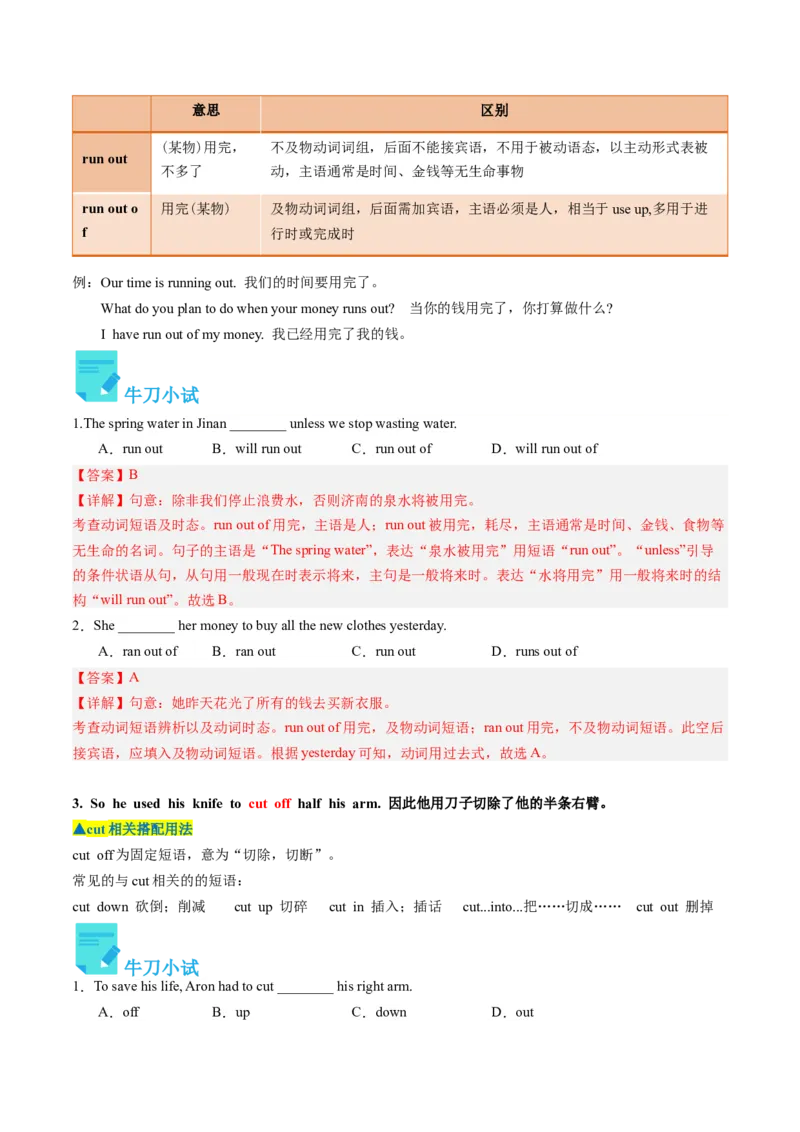
▲run out与run out of辨析意思 区别
(某物)用完, 不及物动词词组,后面不能接宾语,不用于被动语态,以主动形式表被
run out
不多了 动,主语通常是时间、金钱等无生命事物
run out o 用完(某物) 及物动词词组,后面需加宾语,主语必须是人,相当于use up,多用于进
f 行时或完成时
例:Our time is running out. 我们的时间要用完了。
What do you plan to do when your money runs out? 当你的钱用完了,你打算做什么?
I have run out of my money. 我已经用完了我的钱。
牛刀小试
1.The spring water in Jinan ________ unless we stop wasting water.
A.run out B.will run out C.run out of D.will run out of
【答案】B
【详解】句意:除非我们停止浪费水,否则济南的泉水将被用完。
考查动词短语及时态。run out of用完,主语是人;run out被用完,耗尽,主语通常是时间、金钱、食物等
无生命的名词。句子的主语是“The spring water”,表达“泉水被用完”用短语“run out”。“unless”引导
的条件状语从句,从句用一般现在时表示将来,主句是一般将来时。表达“水将用完”用一般将来时的结
构“will run out”。故选B。
2.She ________ her money to buy all the new clothes yesterday.
A.ran out of B.ran out C.run out D.runs out of
【答案】A
【详解】句意:她昨天花光了所有的钱去买新衣服。
考查动词短语辨析以及动词时态。run out of用完,及物动词短语;ran out用完,不及物动词短语。此空后
接宾语,应填入及物动词短语。根据yesterday可知,动词用过去式,故选A。
3. So he used his knife to cut off half his arm. 因此他用刀子切除了他的半条右臂。
▲cut相关搭配用法
cut off为固定短语,意为“切除,切断”。
常见的与cut相关的的短语:
cut down 砍倒;削减 cut up 切碎 cut in 插入;插话 cut...into...把……切成…… cut out 删掉
牛刀小试
1.To save his life, Aron had to cut ________ his right arm.
A.off B.up C.down D.out【答案】A
【详解】句意:为了救他的命,Aron不得不砍下他的右臂。
考查动词短语。cut off切断,割掉;cut up切碎;cut down削减;cut out切断(电源)。根据“To save his
life, Aron had to cut...his right arm.”可知砍掉右臂是为了救命,故选A。
2.There are some apples here. Let me help you ________.
A.cut up them B.cut them up C.cut it up D.cut up it
【答案】B
【详解】句意:这里有一些苹果。让我帮你把它们切开。
考查动词短语及代词辨析。them它们;it它。上文中apples是复数,应用them指代。cut up“切开”,是
“动词+副词”型短语,当所接宾语是代词时,代词应置于短语中间。故选B。
4.Then, with his left arm,he bandage himself so that he would not lose too much blood. 然后,他
用左臂给自己打上绷带,这样不至于失血过多。
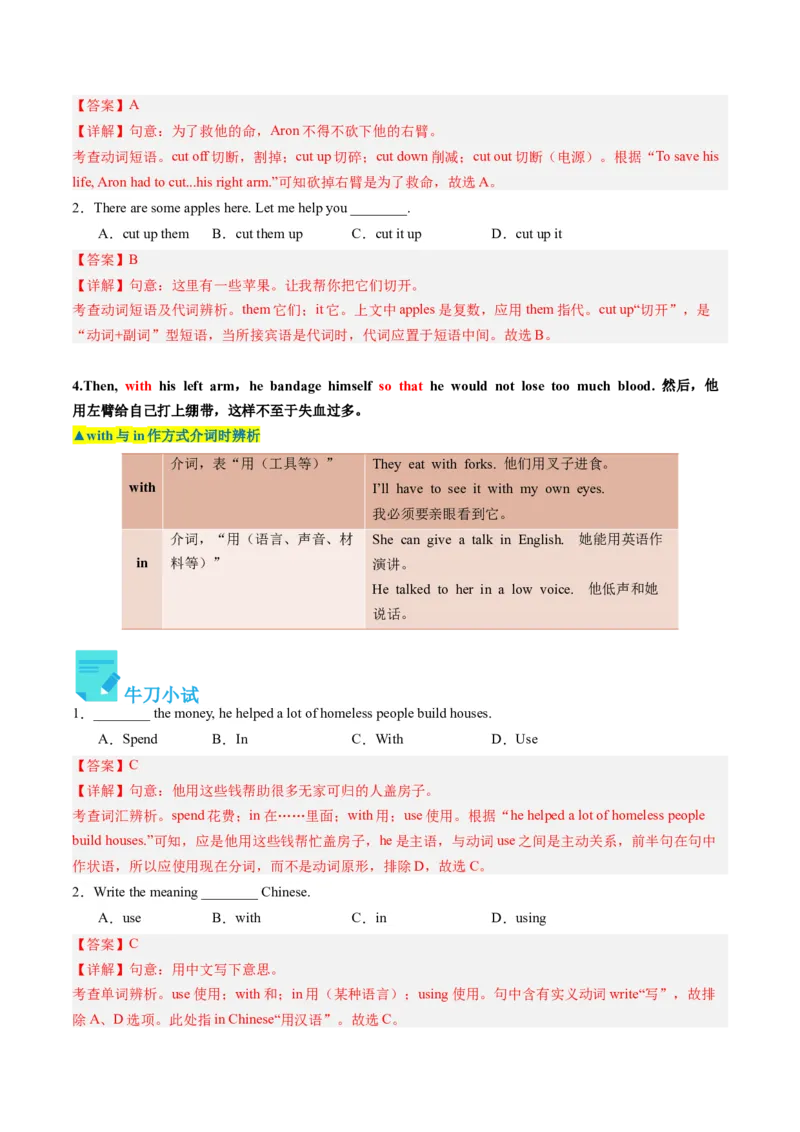
▲with与in作方式介词时辨析
介词,表“用(工具等)” They eat with forks. 他们用叉子进食。
with I’ll have to see it with my own eyes.
我必须要亲眼看到它。
介词,“用(语言、声音、材 She can give a talk in English. 她能用英语作
in 料等)” 演讲。
He talked to her in a low voice. 他低声和她
说话。
牛刀小试
1.________ the money, he helped a lot of homeless people build houses.
A.Spend B.In C.With D.Use
【答案】C
【详解】句意:他用这些钱帮助很多无家可归的人盖房子。
考查词汇辨析。spend花费;in在……里面;with用;use使用。根据“he helped a lot of homeless people
build houses.”可知,应是他用这些钱帮忙盖房子,he是主语,与动词use之间是主动关系,前半句在句中
作状语,所以应使用现在分词,而不是动词原形,排除D,故选C。
2.Write the meaning ________ Chinese.
A.use B.with C.in D.using
【答案】C
【详解】句意:用中文写下意思。
考查单词辨析。use使用;with和;in用(某种语言);using使用。句中含有实义动词write“写”,故排
除A、D选项。此处指in Chinese“用汉语”。故选C。▲so that 相关用法
so that 以便,为了
(1)so that引导目的状语从句,从句谓语动词常用情态动词may/might/can/could等。
例:We went early so that we could get good seats. 我们很早到以便有好的座位。
(2)so that引导目的状语从句,当主句主语与从句主语一致时,可用“so as to(in order to)+动词原形”转化
为简单句。
例:He got up early so that he could catch the early bus.
=He got up early in order to/so as to catch the early bus.他起床如此早以便于可以赶上早班车。
(3)so that还可以与in order that互换。
例:He worked day and night so that/in order that he could succeed.
牛刀小试
1.We should study hard ________ get much knowledge.
A.when B.so that C.unless D.in order to
【答案】D
【详解】句意:为了获得更多的知识,我们应该努力学习。
考查连词辨析。when当……时;so that以便于,后接从句;unless除非;in order to为了,后接动词原形。
根据“We shouldstudy hard ... get much knowledge.”可知,努力学习是为了获得更多知识,get是动词原形,
故选D。
2.He left the office in a hurry _________ he could catch the last train to his hometown.
A.so that B.in order to C.even if D.because of
【答案】A
【详解】句意:他匆匆离开了办公室,以便赶上去家乡的最后一班火车。
考查目的状语从句。so that为了,后接句子;in order to为了,后接短语;even if即使,尽管;because of
因为,后接短语。根据“He left the office in a hurry...he could catch the last train to his hometown.”可知,匆匆
离开的目的是为了赶上最后一班车,空处后面是句子,故选A。
5. This means being in a difficult situation that you cannot seem to get out of . 这意味着处于一种
你似乎无法解脱的困境之中。
▲mean 相关用法
mean (v.)意思是(vt.),打算,意欲(vi.)
常用搭配:
mean doing 意味着 mean to do 打算;意图;企图
例:Success means working very hard. 成功意味着非常努力。
I don't know what do you mean.我不知道你是什么意思。
I mean to see you off tomorrow.我打算明天去为你送别。【拓展】
①meaning (n.)意思(可数/不可数)
例:The word has many meanings. 这个单词有很多意思。
②means (n.)方式/方法/手段(单复同形)
例:There are no means of getting there. 有很多到达那里的方式。
牛刀小试
错过这辆火车意味着你得再等一小时。
Missing this train another hour.
【答案】 means waiting for
6. ...and before we have to make a decision that could mean life and death.在我们不得不作出生死抉
择之前。
▲die, dead, dying与death辨析
die 动词,“死,死亡”,非延续性东动词,不能与表示一段时间的状语连用
dead 形容词,“死的,无生命的”,表示状态,可以与表示一段时间的状语连用,表达“死了多长时
间”用have/has been dead for+时间段,或“died+时间段+ago”
dyin die的现在分词,作定语或表语,表“垂死的,要死的”
g
deat 名词,“死,死亡”,在句中作主语或宾语
h
牛刀小试
My dog ________ yesterday. Its ________ made me sad.
A.die; dead B.died; dying C.died; death D.dead; died
【答案】C
【详解】句意:我的狗昨天死了。它的死让我很伤心。
考查动词时态和词汇辨析。die“死”,动词,过去式是died;dead死亡的;dying垂死的;death死亡,名
词。由yesterday可知,时态是一般过去时,所以第一空用die的过去式died,排除A、D;Its是形容词性
物主代词修饰名词,空处在句中作主语,所以用death。故选C。一、单项选择
1.I used to ________ my dream. But now I get used to ________ doing everything. I’m successful at last.
A.give up; keeping B.giving up; keeping
C.giving up; keep D.give up; keep
【答案】A
【详解】句意:我曾经放弃了我的梦想。但现在我习惯坚持做每件事。最后我成功了。
考查动词短语辨析。used to do sth.过去常常做某事;get used to doing sth.习惯做某事。根据“I used to...mydream. But now I get used to...doing everything.”可知,第一空指之前放弃过梦想,应使用动词原形;第二空
叙述现在的情况,指习惯了坚持,应是用动名词形式。故选A。
2.Some people waste much water. They don’t believe it can ________ some day.
A.run out B.be run out C.run out of D.keep out
【答案】A
【详解】句意:有些人浪费了太多的水。 他们不相信有一天水会被用完。
考查动词短语。run out是动副型短语动词,作不及物动词,表示“被用完了”,无被动语态,所以B可以
排除;run out of后接宾语,表示“用尽……”;keep out阻止……进入;主语it指代“水”,这里表示
“水被用完”。故选A。
3.—Angela, I want to make Russian soup. Would you please tell me how to make it?
—I’m glad to. First, you need to ________ the vegetables and beef.
A.cut up B.cut down C.cut off D.cut out
【答案】A
【详解】句意:——Angela,我想要做罗宋汤。你能告诉我如何做吗?——我很愿意。首先,你需要切碎
蔬菜和牛肉。
考查动词短语辨析。cut up切碎;cut down砍倒;cut off切除;cut out切断。根据“make Russian soup”和
“the vegetables and beef”可知,此处是指切碎,需用cut up。故选A。
4.People can _______ their phones to communicate with their family, and _______ their phones they can even
have video talks.
A.use;use B.with;with C.use;with D.with;use
【答案】C
【详解】句意:人们可以用手机与家人沟通,甚至可以用手机进行视频交谈。
考查动词短语。use sth to do sth“用某物做某事”,排除BD;根据“and...their phones they can even have
video talks”可知,本句已有谓语动词,此处用介词with表示“用”。故选C。
5.The ________ woman is afraid of ________.
A.death; dying B.dead; die C.dying; death D.died; dying
【答案】C
【详解】句意:那个垂死的女人怕死。
考查形容词辨析。death名词,死亡;dying形容词,垂死的、临终的;die动词,死亡,过去式是died;
dead形容词,死的。第一空后面名词是woman,因此填形容词dying,意为“垂死的女人”;第二空表示
“害怕死亡”,of后跟名词。故选C。
6.We should learn the ________ of the Chinese women's volleyball team in our life and study.
A.decision B.situation C.importance D.spirit
【答案】D
【详解】句意:我们应该在生活和学习中学习中国女排的精神。
考查名词辨析。decision决定;situation情况;importance重要性;spirit精神。根据“learn the…of the
Chinese women's volleyball team”可知,要学习中国女排努力拼搏的精神,故选D。7.My uncle was ______ control of a small company.
A.for B.in C.to D.on
【答案】B
【详解】句意:我叔叔管理着一家小公司。
考查介词短语。短语be in control of是固定搭配,意为“掌管;管理;控制”,故选B。
8.He was badly ill, but he kept on ________ until 2:00 a.m.
A.work B.working C.worked D.to work
【答案】B
【详解】句意:他病得很重,但是他持续工作到凌晨2点。
考查非谓语动词。keep on doing sth.是固定搭配,意为“继续做某事”。故选B。
9.If you go out on such a cold day, there is a ________ of catching a cold.
A.risk B.choice C.symbol
【答案】A
【详解】句意:如果你在这么冷的天出去,就有患感冒的风险。
考查名词辨析。risk 风险;choice 选择;symbol 象征。根据“If you go out on such a cold day, there is a...of
catching a cold”可知天冷的时候出去会有感冒的风险,a risk of “有……的风险”,符合句意。故选A。
10.We can’t see any trees here because some people ________ them ________.
A.cut; down B.cut; up C.cut; off D.cut; into
【答案】A
【详解】句意:我们在这里看不到任何树木,因为一些人把它们砍倒了。
考查动词短语。cut down砍倒;cut up切碎;cut off切断;cut into切入。根据“can’t see any trees here”可知
看不到任何树木,因此是把树砍倒了。故选A。
二、根据所给提示填空,每空一词
1.Nothing is impossible. It (意思是) everything can happen if you make efforts(努力).
【答案】means
2.We can take care of (our) and do everything well.
【答案】ourselves
3.He feels sad every time he thinks of his cat’s (dead)
【答案】death
4.Once his is made, there will be no going back. (decide)
【答案】decision
5.It is necessary for everyone to know the (important) of wetlands.
【答案】importance
6.Many (climb) died on the half way to the mountain.
【答案】climbers
7.Although he died, his (精神) will live on.【答案】spirit
8.We use (knife) to cut fruit.
【答案】knives
9.In such a dangerous (形势、情况), what should we do to keep us safe?
【答案】situation
10.Buying clothes online has some (风险). But I like it.
【答案】risks
三、选词填空
blood,rock,kilo,important,die
1.The monkey hid behind the , so we couldn't find it.
2.—I need about two of meat for dinner. Can you buy it for me, Bob?
—Sure. I'll buy it right now.
3.Remember to tell the children the of saving water.
4.Betty loved her grandpa and she learned a lot from him. Her grandpa's made her really sad.
5.The old man lost a lot of in the accident. I am afraid he might die.
【答案】1.rock(s) 2.kilos 3.importance 4.death 5.blood
【解析】
1.句意:猴子藏在石头后面,所以我们找不到它。定冠词the后接名词,根据“The monkey hid behind”及
“so we couldn't find it”可知,藏在了石头后面所以找不到它,rock“石头”符合,此空填单数名词或复数名
词表泛指,故填rock(s)。
2.句意:——我晚餐需要大约两公斤肉。你能帮我买吗,鲍勃?——当然。我现在就买。根据“of meat”
可知,此处是用量词修饰meat,备选词kilo“公斤”符合,two后接复数名词,故填kilos。
3.句意:记得告诉孩子们节约用水的重要性。定冠词the后接名词,根据“tell the children the … of saving
water”可知,是要告诉孩子们节约用水的重要性,importance“重要性”,故填importance。
4.句意:贝蒂爱她的爷爷,她从他身上学到了很多。她爷爷的死使她很伤心。名词所有格后接名词,根
据“made her really sad”及备选词,可知,爷爷的死让她很伤心,名词death“死”,故填death。
5.句意:那位老人在事故中流了很多血。我担心他会死。a lof of后接名词,根据“I am afraid he might
die”可知,留了很多血以为他会死,blood“血”,不可数名词,故填blood。
四、完成句子
1.不要去冒险,那样做是很危险的。
Don’t . It is dangerous.
【答案】 take risks
2.这位老人上周用完了所有的大米和水。
The old man all of his rice and water last week.【答案】 ran out of
3.他不想当老师,所以他正考虑放弃教学。
He doesn't want to be a teacher. So he is thinking of teaching.
【答案】 giving up
4.我不习惯这里的一切。
I was not anything here.
【答案】 used to
5.医生切除了她的左臂。
The doctor her left arm.
【答案】 cut off
五、阅读理解
Cait, 11, was trying to fall asleep when her 8-year-old brother, Doug, came into her room. He looked around,
but seemed really out of it. Then Doug went back into the hallway and stood there looking straight up at the light.
This was really strange. Cait didn’t know what to do. Just then, Cait’s father appeared and explained Doug was
sleepwalking.
Not all sleep is the same every night. We experience some deep, quiet sleep and some active sleep, which is
when dreams happen. You might think sleepwalking would happen during active sleep but a person isn’t physically
active during active sleep. It usually happens in the first few hours of sleep in the period called deep sleep.
The truth is that not all sleepwalkers walk. Some simply sit up or stand in bed or act like they’re awake when,
in fact, they’re asleep! Most, however, do get up and walk around for a few seconds or for as long as half an hour.
Sleepwalkers’ eyes are open, but they don’t see the same way they do when they’re awake. They tend to go back
to bed on their own and won’t remember it in the morning.
You also might have heard that sleepwalkers can get frightened if you wake them up. That’s true, so what do
you do if you see someone sleepwalking? You should call for a grown-up who can lead the person back to bed. And
once the sleepwalker is tucked back in bed, it’s time for you to get some sleep, too!
Word Bank
tend 倾向于
frightened 受惊的
tuck 掖好被子
1.What does “out of it” most probably mean in Chinese?
A.茫然不觉 B.心满意足 C.垂头丧气 D.悠然自得
2.When does sleepwalking usually happen?
A.During active sleep. B.In the first few hours of sleep.
C.When dreams begin. D.When we're trying to fall asleep.
3.Which paragraphs tell what sleepwalkers do?
A.①② B.②③ C.③④ D.④⑤4.What should we do if we see people sleepwalking?
A.Wake them up. B.Walk around with them.
C.Do nothing and get your own sleep. D.Ask grown-ups to lead them to bed.
5.Who is the text written for?
A.Teachers. B.Doctors. C.Parents. D.Children.
【答案】1.A 2.B 3.C 4.D 5.D
【解析】文章讲述了晚上梦游的事情,同时指出了梦游发生的时间和表现,如果遇到梦游的人,要找一个
成年人带梦游的人回去睡觉。
1.词意猜测题。根据下文中“Cait’s father appeared and explained Doug was sleepwalking. Sleepwalkers’ eyes
are open, but they don’t see the same way they do when they’re awake.”可知,道格正在梦游,梦游者的眼睛是
睁开的,但与他们醒着的时候看东西的方式不同,所以虽然道格环顾四周,但是他毕竟是在梦游,此处划
线部分out of it的意思是“茫然不觉”,表示“他看东西的方式和醒着的时候不一样”。故选A。
2.细节理解题。根据第二段中“It usually happens in the first few hours of sleep in the period called deep
sleep.”可知,梦游通常发生在睡眠的最初几个小时。故选B。
3.主旨大意题。根据第三段中“Some simply sit up or stand in bed or act like they’re awake when, in fact,
they’re asleep! Most, however, do get up and walk around for a few seconds or for as long as half an hour.”和第四
段中“Sleepwalkers’ eyes are open, but they don’t see the same way they do when they’re awake.”可知,这两段
介绍了梦游者会做什么,有些人只是坐起来,或者站在床上,或者表现得好像他们是醒着的,大多数人都
会站起来走动几秒钟,或者长达半个小时。故选C。
4.细节理解题。根据最后一段中“You should call for a grown-up who can lead the person back to bed.”可知,
如果你看到有人在梦游,你应该找个成年人带他回去睡觉。故选D。
5.推理判断题。根据最后一段中,作者提到的如何应对梦游“You should call for a grown-up who can lead the
person back to bed.”你应该找一个成年人把梦游的人领回到床上,因此可知这里的“you”指的是孩子,因为
需要找一个成年人,所以这篇文章是给孩子们写的。故选D。