Unit 2 I’ll help to clean up the city park.
单元小结
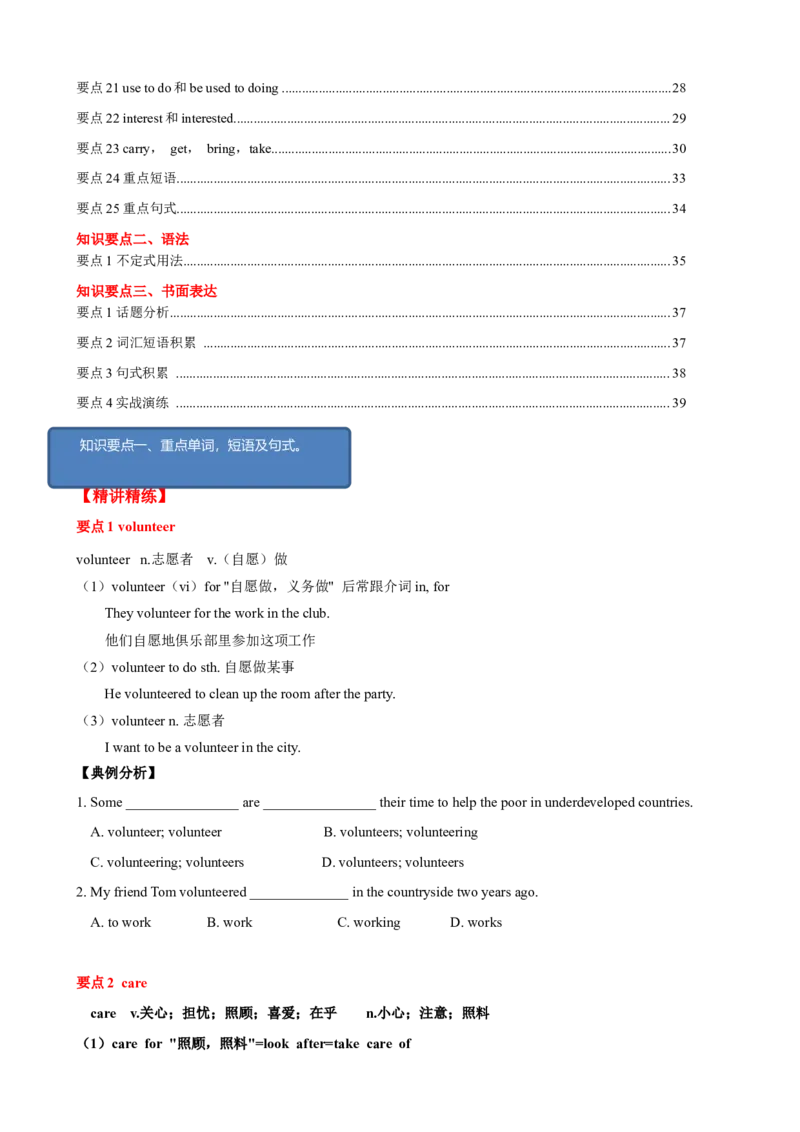
知识目录
学习目标:提供帮助。能学会提供帮助的一些用语和参加志愿者活动的一些用语,能够读懂
有关志愿者参加志愿服务的语篇。
语法目标:学习不定式的用法。
听说目标:能听懂并谈论提供帮助及志愿者活动的一些用语。
写作目标:能够写出关于提供帮助和志愿者活动的短文。
目录
知识要点一、重点单词,短语及句式
要点1 volunteer的用法...........................................................................................................................................2
要点2 care的用法....................................................................................................................................................3
要点3 own的用法...................................................................................................................................................5
要点4 try,try out....................................................................................................................................................6
要点5 alone和lonely的区别..................................................................................................................................7
要点6 run out和run out of......................................................................................................................................8
要点7 give out和give away....................................................................................................................................9
要点8 notice的用法...............................................................................................................................................11
要点9 similar,take after, look like..........................................................................................................................12
要点10 put off/put up.............................................................................................................................................14
要点11 such 和so..................................................................................................................................................16
要点12 cheer..........................................................................................................................................................17
要点13 satisfaction和satisfy.................................................................................................................................18
要点14 come true ..................................................................................................................................................19
要点15 stop doing和stop to do.............................................................................................................................20
要点16 raise的用法...............................................................................................................................................22
要点17 homeless构词法.......................................................................................................................................24
要点18 feeling........................................................................................................................................................25
要点19 difficulty....................................................................................................................................................26
要点20 broken的用法 .........................................................................................................................................27要点21 use to do和be used to doing ....................................................................................................................28
要点22 interest和interested..................................................................................................................................29
要点23 carry, get, bring,take.......................................................................................................................30
要点24 重点短语...................................................................................................................................................33
要点25 重点句式...................................................................................................................................................34
知识要点二、语法
要点1 不定式用法.................................................................................................................................................35
知识要点三、书面表达
要点1 话题分析.....................................................................................................................................................37
要点2 词汇短语积累 ...........................................................................................................................................37
要点3句式积累 ...................................................................................................................................................38
要点4实战演练 ...................................................................................................................................................39
知识要点一、重点单词,短语及句式。
【精讲精练】
要点1 volunteer
volunteer n.志愿者 v.(自愿)做
(1)volunteer(vi)for "自愿做,义务做" 后常跟介词in, for
They volunteer for the work in the club.
他们自愿地俱乐部里参加这项工作
(2)volunteer to do sth. 自愿做某事
He volunteered to clean up the room after the party.
(3)volunteer n. 志愿者
I want to be a volunteer in the city.
【典例分析】
1. Some ________________ are ________________ their time to help the poor in underdeveloped countries.
A. volunteer; volunteer B. volunteers; volunteering
C. volunteering; volunteers D. volunteers; volunteers
2. My friend Tom volunteered ______________ in the countryside two years ago.
A. to work B. work C. working D. works
要点2 care
care v.关心;担忧;照顾;喜爱;在乎 n.小心;注意;照料
(1)care for "照顾,照料"=look after=take care of(2) care for 还可意为“非常喜欢”,通常用于否定句或疑问句中
I don't care for basketball.
(3)care about “关心;在意”
Your father truly cares about you.
Careful 和careless
careful是形容词,可用在系动词后作表语,也可用在名词前作定语。口语中提醒别人要小心时常用be
careful,意为"当心;小心"。
Be careful--the floor's slippery.小心地板很滑。
careless adj.“粗心的;不小心的”,反义词为careful
固定搭配
① be careful about/of...对.....小心
②be careful to do sth,小心做某事
【典例分析】
1. When Bob had the flu, his mother ________ him day and night.
A. found out B. took up
C. cared for D. took away
2. Some students are so _______________ that they often make mistakes in their homework.
A. surprised B. careless C. upset D. excited
3. He often makes _______________ mistakes, because he doesn’t read _______________.
A. careful; carefully B. careless; careful C. careless; carefully D. careful; carelessly
4.注意你的健康 / 请多保重。
_________________your health.
5.她过分讲究衣着。
She ______________her dress.
6.小心! 那个男人带着一把刀。
___________! The man has a knife.
7.吉姆,小心那条狗。它有时候咬人。
Jim, ________ ________ ________ that dog. It sometimes bites people.
要点3 own
own的用法
(1)作为形容词,意为“自己的”。He had his own company by 25.他25岁时就有了自己的公司。
(2)作为动词,意为“拥有”。
I want to own a big house with three bedroom.
我想拥有一套三居室的大房子。
(3)其名词为owner,意为“所有权人;主人”。
The wallet must be returned to its owner.
钱包必须归还给它的主人。
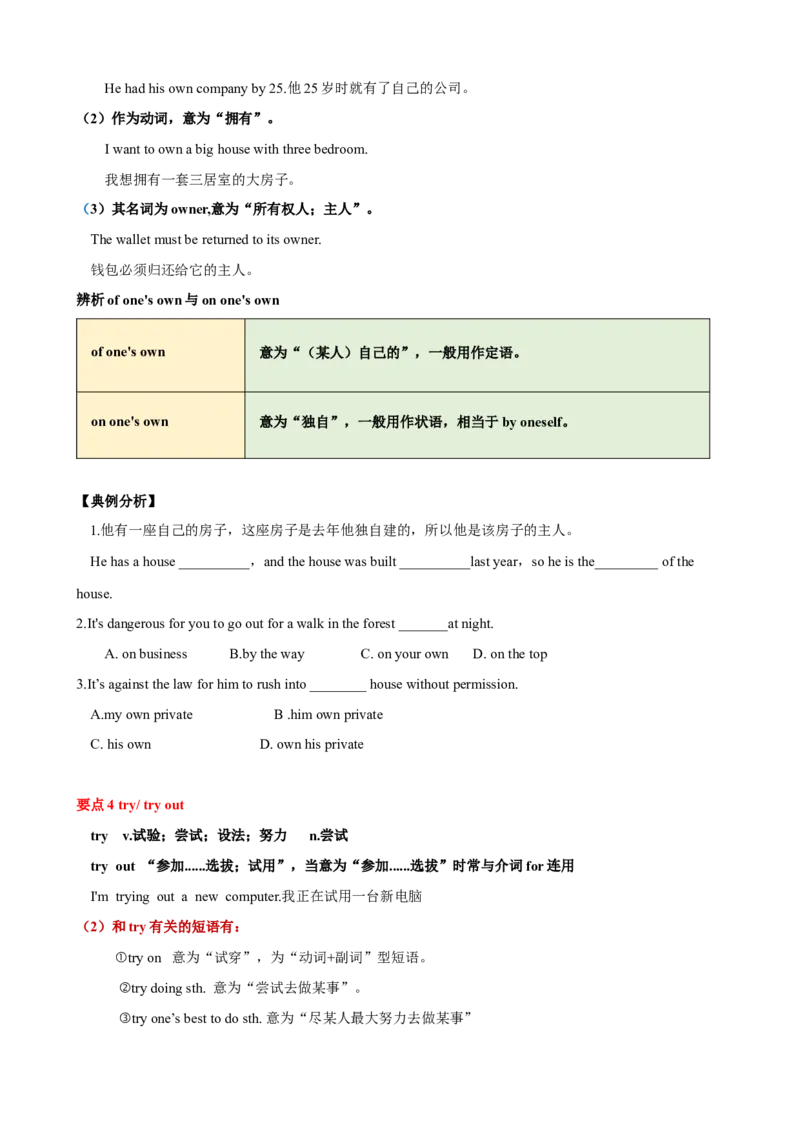
辨析of one's own与on one's own
of one's own 意为“(某人)自己的”,一般用作定语。
on one's own 意为“独自”,一般用作状语,相当于by oneself。
【典例分析】
1.他有一座自己的房子,这座房子是去年他独自建的,所以他是该房子的主人。
He has a house __________,and the house was built __________last year,so he is the_________ of the
house.
2.It's dangerous for you to go out for a walk in the forest _______at night.
A. on business B.by the way C. on your own D. on the top
3.It’s against the law for him to rush into ________ house without permission.
A.my own private B .him own private
C. his own D. own his private
要点4 try/ try out
try v.试验;尝试;设法;努力 n.尝试
try out “参加......选拔;试用”,当意为“参加......选拔”时常与介词for连用
I'm trying out a new computer.我正在试用一台新电脑
(2)和try有关的短语有:
①try on 意为“试穿”,为“动词+副词”型短语。
②try doing sth. 意为“尝试去做某事”。
③try one’s best to do sth. 意为“尽某人最大努力去做某事”④have a try 意为“试一试”,其中,try为名词。
【典例分析】
1. ---- Oh, it’s bad. The radio doesn’t work. ---- Didn’t you the radio before you bought it?
A. count down B. try out C. tidy up D. point out
2.If you want to buy this dress, you’d better ______ first to make sure it fits you.
A. try it out B. take it off C. tidy it up D. try it on
3.— Do you prepare to _____ for the volunteer job in the hospital?
— Yes, I'm ready.
A. hand out B. try out C. put up D. give up
4.我可以试穿一下这件裙子吗?
May I _________ _________ _________ _________?
5.让我们尝试着换一种方式解决问题吧。
Let’s_________ ________ the problem in another way.
6.本学期我会尽力学好物理。
I’ll ________ __________ _________ ________ learn physics well this term.
= I’ll ___________ ___________learn physics well this term.
7.去尝试一下,不要害羞。
Just ________ ________ __________ Don’t be shy.
8.我刚才买了一部新手机,我正在试用它。
I bought a new mobile phone just now. I am_________ ________ __________.
要点5 alone与lonely的区别:
(1) alone既可作形容词,又可作副词,意为“单独的/地,独自的/地”,没有感情色彩。
(2) lonely只作为形容词,意为“孤独的,寂寞的”,具有感情色彩。
He lived alone after his wife left,so he was very lonely .
他妻子离开后,他一个人生活,所以他很孤独。
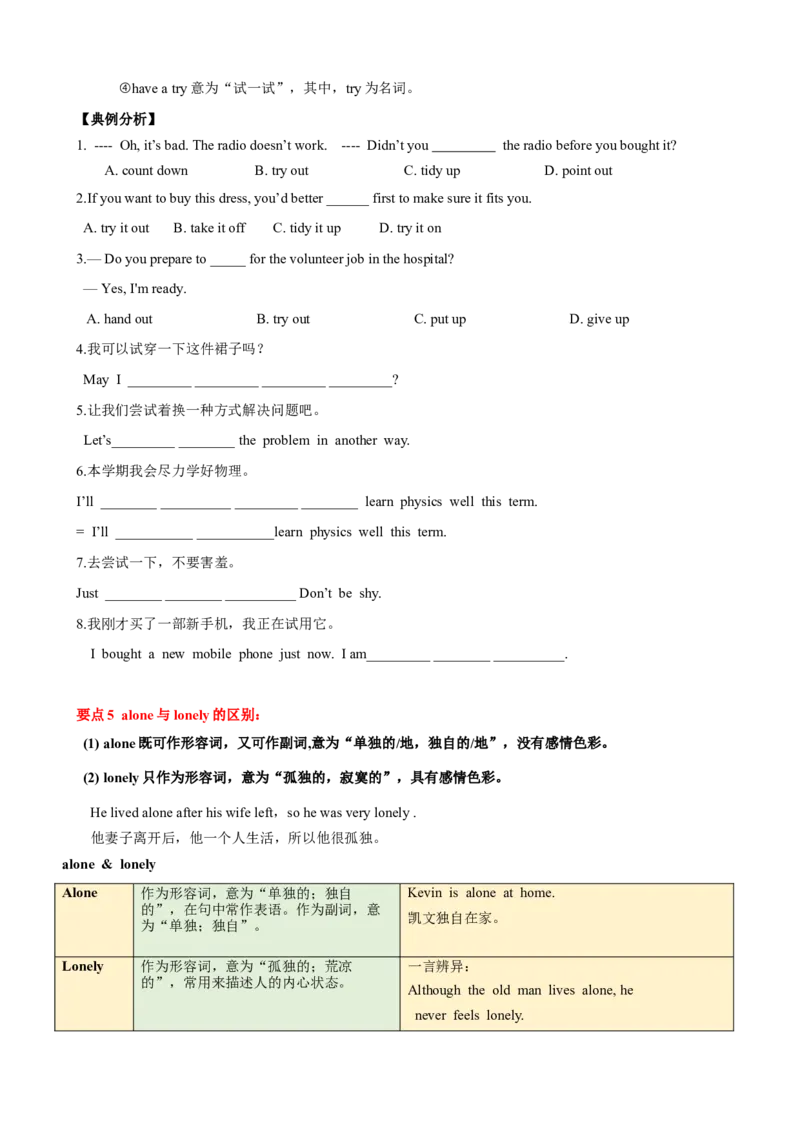
alone & lonely
Alone 作为形容词,意为“单独的;独自 Kevin is alone at home.
的”,在句中常作表语。作为副词,意
凯文独自在家。
为“单独;独自”。
Lonely 作为形容词,意为“孤独的;荒凉 一言辨异:
的”,常用来描述人的内心状态。
Although the old man lives alone, he
never feels lonely.虽然老人独自一人生活,但是从来不感到孤独。
【典例分析】
1.The old man lives ______,but he doesn't feel ______.
A.lonely;lonely B.alone;alone C.lonely;alone D.alone;lonely
2. Her grandparents live in a big house, but they don’t feel .
A. lonely; alone B. alone; lonely C. lonely; lonely D. alone; alone
3.Though the old man lived______, he didn’t feel______.
A. alone; alone B. lonely; lonely
C. alone; lonely D. lonely; alone
4.The old man lives in a ____________place ____________. He feels ___________ because he doesn’t have any
sons or daughters.(用alone,lonely填空)
5. His grandparents live ________ in a small house, but they don't feel ________.
A. lonely; alone B. alone; lonely C. lonely; lonely D. alone; alone
要点6 run
run out of 主语通常是“人”的名词,也可用于某种能消耗物品的机器,意为“用完....”相当use up
(1)run out of 也可表示“从......跑出来"
The dog ran out of the room.
(2)run out 意为“用尽,耗尽”,其主语通常是被使用的事物,其后不接宾语。
His water soon ran out.
【典例分析】
1. —Jack, I think we need to buy a new car.
—Oh, no! We are ________________ out of money, you know?
A. trying B. going C. getting D. running
2. 他的钱用完了。
His money ________ _________.
3. 他用完了他的钱。
He __________ ________ ________ his money.
要点7 give out/ give away/hand out
give out =hand out分发(v. +adv) give out sth to sb. 分….给某人
give out 发出(光,热,声音等)/用完,耗尽The sun gives out light and heat.
Our supplies are giving out.
give away意为“赠送;捐赠”,动副短语
The old man gives away some books to the poor children every year.
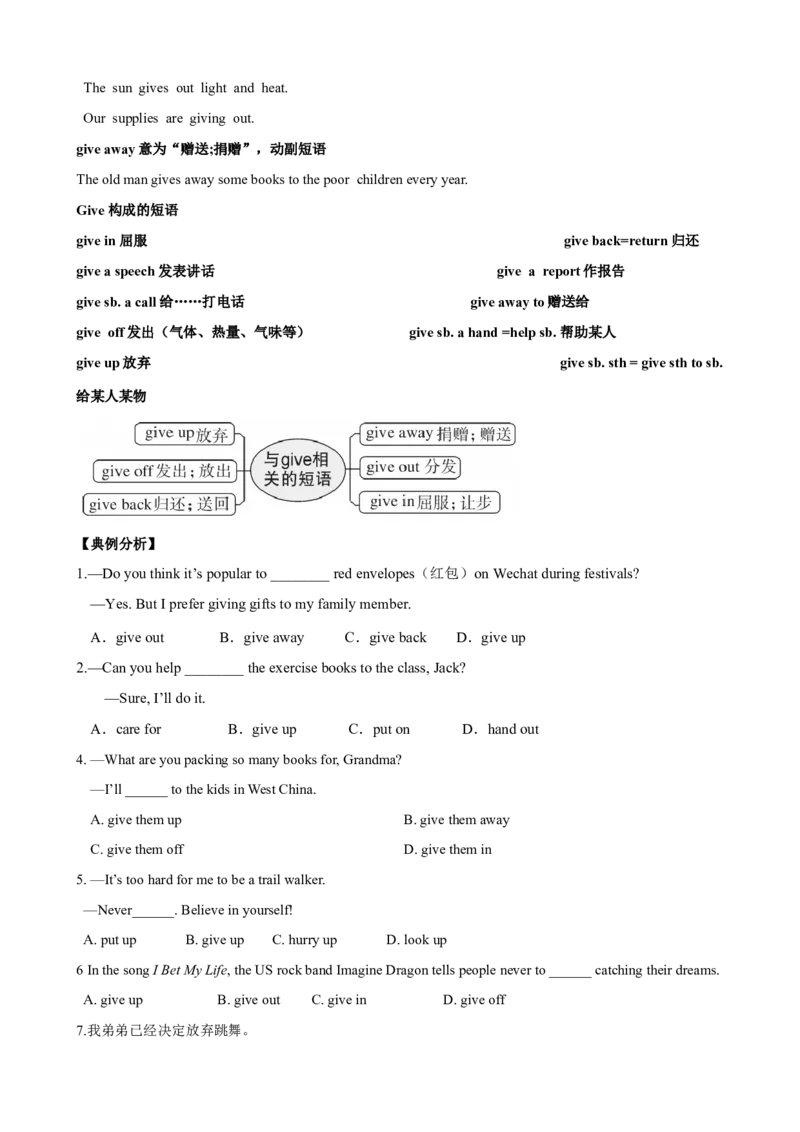
Give 构成的短语
give in 屈服 give back=return 归还
give a speech 发表讲话 give a report作报告
give sb. a call 给……打电话 give away to赠送给
give off发出(气体、热量、气味等) give sb. a hand =help sb. 帮助某人
give up放弃 give sb. sth = give sth to sb.
给某人某物
【典例分析】
1.—Do you think it’s popular to ________ red envelopes(红包)on Wechat during festivals?
—Yes. But I prefer giving gifts to my family member.
A.give out B.give away C.give back D.give up
2.—Can you help ________ the exercise books to the class, Jack?
—Sure, I’ll do it.
A.care for B.give up C.put on D.hand out
4. —What are you packing so many books for, Grandma?
—I’ll ______ to the kids in West China.
A. give them up B. give them away
C. give them off D. give them in
5. —It’s too hard for me to be a trail walker.
—Never______. Believe in yourself!
A. put up B. give up C. hurry up D. look up
6 In the song I Bet My Life, the US rock band Imagine Dragon tells people never to ______ catching their dreams.
A. give up B. give out C. give in D. give off
7.我弟弟已经决定放弃跳舞。My brother has decided to __________ ___________ _____________.
要点8 notice
Notice n.注意;布告 v.注意
【重点】notice的用法
注意到某人/某物
notice sb./sth.
eg:I noticed a big hole on the floor. 我发现地板上有个大洞。
注意……
notice+that从句
eg:I notice that you like reading. 我注意到你喜欢读书。
注意到某人做了某事
notice sb. do sth.
I noticed him enter the teacher's office.
注意到某人正在做某事
notice sb. doing sth.
I noticed that boy copying others' homework.
【拓展】notice作名词时,意为“布告,通告”。
例:There is a notice about our school in front of the classroom building.
在教学楼前有一则关于我们学校的通知。
【典例分析】
1.—Did you notice someone ________ the meeting room just now?
—Sorry, I was making a phone call.
A.to leave B.leaves C.left D.leave
2.—Last night at 7 the little boy noticed a thief ________ in the supermarket.
A.steal B.to steal C.steal D.stealing
3.He saw his mother___________(do)housework when he got up earlier.
4. I often see her ____________(dance) in the park.
5. Did you see them _________ TV just now?
A. to watch B. watching C. watched D. watches
要点9 similar /take after/ look like
similar作形容词,意为“相似的”。be similar to…意为“与……相似,接近”,一般用在相近似
的物
品和情境的对比上。例如:
His problem is similar to yours. 他的问题和你的相似。
I guess it may be similar to the Hindu culture. 我猜想,这可能接近于印度文化。【拓展】
(1)look like意为“看起来像……” 。应用范围最广,除了描述人、物之外,也能抽象表达事件或现
象。例如:
He looks like a famous movie star. 他看起来像一个电影明星。
It looks like it’s going to rain soon. 天看起来要下雨。
(2)take after 最常见的是用在有血缘关系的亲子之间,外貌用的最多,也能够用在性格脾气这些内
在特质上。例如:
She took after her mother almost in everything. 她几乎与她母亲一模一样。
Adam was my grandfather and I took after him. 亚当是我的祖父,我和他很相像。
【典例分析】
1.—Can you tell the difference between these two pictures?
—The difference? Oh, no. They look quite .
A. similar B. different C. strange D. interesting
2. Dona is ________ to her mother in many ways. For example, they are both tall and thin.
A. different B. kind C. friendly D. similar
3. Alice has the same taste of clothes as I and her clothes are __________________ mine.
A. interested in B. similar to
C. popular with D. different from
4.他长得像他父亲
He__________ _______ his father
5. 他看起来像他父亲
He__________ _______ his father
要点10
put off doing sth. 推迟做某事
Don’t put off till tomorrow what should be done today.
(1)put up 是由“动词+副词”构成的动词短语,意为“张贴;公布”。例如:
The principal put up the exam result. 校长公布了这次考试的结果。
(2)put up 意为“提高;增加;抬高(租金、价格等)”。例如 :
My landlord was threatening to put the rent up by 10 dollars a week.
我房东要挟说要把每周房租提高10美元。
Put构成的短语put up挂;张贴;公布;举起;搭起;
put off 推迟 put away 收起来
put on 穿上;戴上;体重上升 put down 放下
put up with 忍受 put out 扑灭;熄灭
【典例分析】
1.—Jason, would you please this notice?
—With pleasure.
A. put on B. put off C. put up D. put out
2. Tony bought a photo of his favourite sports star and________ on his bedroom wall.
A. gave it up B. found it out
C. looked it through D. put it up
3. — How heavily it is raining!
— What a pity! We have to ________ our sports meeting.
A. put off B. put out C. put on D. put up
4.The exam is over and results will be on Friday afternoon.
A. put down B. put off C. put up D. put away
5. You needn’t go to the guitar lesson tomorrow. The teacher ________.
A. put off it B. put it off
C. fixed up it D. fixed it up
要点11 Such与so
二者都表示程度,意为“如此;这样”,其区别为
词条 词性 用法 常用结构
such 形容词 修饰名词 such a/an +形容词+可数名词单数
no/any/ some/ all/ many 等+such+名词
such+形容词+可数名词复数
such +形容词+ 不可数名词
so 程度 修饰形容词 so+ 形容词+a/an + 可数名词复数
或副词
副词 so+ many/few +可数名词复数
so+ much/little+不可数名词
【典例分析】
3.Santaishan Forest Park is __________ beautiful that it has become a hot tourist attraction.A. so B. very C. such D. quite
4. I’ve had _______ many falls that I am black and blue all over.
A. so B. such C. too D. very
4. I don’t think I can finish the work in ________ a short time.
A. so B. such C. very D. too
5. The camera is _______ expensive _______ I can’t afford it.
A. so; that B. such; that C. too; to D. enough; to
6. It was ______ yesterday that they went out for a picnic.
A. a such fine day B. such a fine day C. so a fine day D. a so fine day
要点12 cheer
(1)cheer 作不及物动词,意为“欢呼;喝彩”。例如:
We couldn’t help cheering when we won the final.
当我们赢得决赛时我们不禁欢呼起来。
(2)cheer...up 意为“使……高兴起来;使……振奋起来”。例如:
The whole audience stood up and cheered them up.
所有的观众全部起立并大声欢呼。
Let’s cheer him up.让我们使他振奋起来。
(3)cheer on意为“为……加油;为……打气”。
We all cheered them on loudly. 我们大声地为他们加油。
【典例分析】
1. ! It's not the end of the world. Let's try again.
A. Put up B. Set up C. Cheer up D. Pick up
2.—My best friend went abroad. I miss her and feel down today.
—Don’t be sad. Here is good news for you .
A. cheer up B. cheering up C. cheered up D.to cheer up
3. Dave failed in the singing competition. He’s very sad now. Let’s go to ________.
A.wake him up B.cheer him up C.pick him up D.take him up
4. —I find that I am unlucky today.
—______________________. Everything will be OK.
A. What’s wrong? B. It’s bad. C. Cheer up! D. What would you do?要点13 satisfaction 和satisfy
satisfaction用作不可数名词,意为“满意;满足”。
She smiled in satisfaction.
Satisfy v.使满意;满足
Your plan will not satisfy everyone. 你的计划不会让每个人都满意。
satisfy为动词,后接名词或代词作宾语。satisfy sb.意为“使某人满意”。
His homework satisfies the teacher. 他的作业让老师很满意。
形容词:satisfied和satisfying
be satisfied with... 意为“对……感到满意”与be happy with, be pleased with 同义。
I am satisfied with your explanation.我对你的解释感到满意。
satisfied 形容词 满足的 常用来修饰或描述人
satisfying 形容词 令人满足的 常用来修饰或描述事物
【典例分析】
1.得知彼得找到了一份令人满意的工作,他的父母感到很满意。
Peter's parents are ___________ to know that he has found a ____________job.
2.Mr. Green is very happy because he is satisfied with his students' work today. (同义改写)
= Mr. Green is very happy because he his students' work today
= Mr. Green is very happy because he his students' work today
3.They are very ________ with the results of the survey.
A. satisfy B. satisfies C. satisfied D. to satisfy
4.If something you, it gives you what you want or need to make you happy.
A. leaves B. counts C. forgets D. satisfies
5. Linda gets great ________ from helping others, so she’s always ready to give others a helping hand.
A. discussion B. satisfaction
C. preparation D. prediction
要点14
come true意为“实现;成为现实”,其主语常为梦想、愿望或目标等。
I've always wanted to visit Beijing, so going there on vacation next week will be a dream come true for me.
His dream of becoming a teacher came true.是否接宾语 用法
achieve 是 主语一般为“人”
come true 否 主语一般是“梦想;理想”
【典例分析】
1. If we Chinese work hard together, China Dream will ________.
A. come out B. come true C. achieve D. come on
2. He wants to be a pilot. I think his dream will _____ in the future.
A. come in B. come out C. come over D. come true
2.恐怕他的愿望很难实现。
I’m afraid his wish won’t __________ __________easily.
I’m afraid he won’t ___________ __________ _________easily.
3. Even a small success can give you a sense of ______________ (achieve) .
要点15
stop的后面可以用动词不定式也可以用动名词作宾语。stop doing表示“停止正在做的事情”;stop to do
表示“停下来开始做”的意思。例如:
Now let’s stop reading. 现在咱们停止读书。
Our teacher stopped to look at the boy. 老师停下来看了看那个男孩。
(2)stop还可以构成短语stop somebody/something from doing something表示“阻止某人做某事或者阻
止某事发生”。例如:
The trees and grasses can stop the wind from blowing the earth away.
树和草可以阻止风把土吹走。
【典例分析】
1.那场大雪使他未能来我们的聚会。
The heavy snow _____________ __________ __________ __________ to our party.
2.The heavy rain stopped them _______ home on time.
A. return B. returning C. returned D. to return
3. You look tired, you must________.
A. stops to work B. stopped working C. stop to work D. stop working
4. In the end, we felt tired, so we stopped ______ a rest.
A. having B. to have C. had D. have
5.请停止说话,咱们开始上课。Please _________ _____________. Let’s start the lesson.
6大雨使我们踢不了球。
The heavy rain ___________ us ___________ ___________ football.
7.我们必须阻止人们砍伐树林。
We must ___________people _____________ ____________ down trees.
要点16 raise
1)raise是及物动词,意为“举起,抬起”。例如:
He raised his glass and said,“Your health, Carl.”
他举起了杯子说道:“祝你健康,卡尔” 。
If you want to ask a question, first raise your hand.
如果你要问问题,请先举手。
(2)raise还表示“招募,筹集”。例如:
They are going to raise funds for the school buildings.
他们将为盖校舍筹集资金。
The foolish prince raised an army against his father.
那个愚蠢的王子招募军队反对他的父亲。
(3)raise还表示“提高(音量、某种水平)” 提出,养育。例如:
The ticket price was raised to 30 yuan. 票价上升到了30元。
The speaker raised his voice so that we could hear him.
演讲者提高了声音,以便我们都能听到。
搭配
raise crops 种庄稼
raise a building 造起一座房子
raise a cloud of dust 扬起一片尘土
raise one's voice 提高嗓音
raise funds 筹集资金
raise a question 提出问题
raise the flag 升旗
【重难点】辨析raise与rise
不及物动词,主要指自然物的升高,比 In summer,the temperature sometimes rises as
rise 如:太阳的升起、涨水、月亮的升起、 high as 39°C.在夏天,气温有时高达39°C。
价格的上涨等She raised her hand before answering the question.
raise 及物动词,主要指举起,抬高
回答问题前,她举起了手。
【典例分析】
1. 用raise, rise的正确形式完成下列句子。
(1)He __________ and walked to the window.
(2)He ______ his hat to me as a sign of respect.
(3)The people’s living standard has greatly been ______.
(4)Her temperature is still ______.
2根据汉语意思完成句子
(1)月亮已经从山上升起。
The moon ________ ________ above the hills.
(2)老板答应要给她加薪水。
The boss promised ________ _________her salary.
3.As the curtain________, the famous singer came out. The fans________ and screamed with excitement.
A.was raised; rose B.had been raised; were raised
C.rose; were raised D.had risen; raised
4.Many people complain that some of KFCs in China ________ the price of a hamburger by one yuan.
A.rose B.raised C.dropped D.controlled
5. They the glasses between two peoples last year.
A. rise B. raise C. rose D. raised
6.-How did your class raise money for the poor old man in hospital ?
-We organized a book fair on the playground and sold some books and CDs .(同义句替换)
A. collect B. put up C. spend
7. 太阳从东边升起,从西边落下。
要点17 homeless
homeless用作形容词,意为“无家可归的”,是由“名词 home+-less构成的。英语中,后缀-less
表示否定意义,意为“没有;无”,“某些名词+less构成形容词,是英语中的一种构词法。
hope希望→ hopeless无望的
use用处→ useless无用的
meaning意义→ meaningless毫无意义的care谨慎→ careless粗心的
【知识链接】
-less是最常见的含否定意义的英语后缀之一,它附在名词或动词之后主要构成形容词,有时也构成副词。
homeless 无家可归的 helpless 无助的 useless 没用的
nameless 莫名的 voiceless 无声的 endless 无尽的
colorless 暗淡的
【典例分析】
1. Jack failed the maths exam again. He felt ________ and wanted to give up.
A. helpful B. successful C. careless D. hopeless
2. He failed his job interview again, and he felt really ________ ( with no hope) about the future.
3.We tried to stop the fire from spreading,but we knew it was .(help)
要点18 feeling
1.feeling n. 意为“感觉; 直觉; 看法”。
拓展: feelings作名词, 还意为“情感; 感情”, 常用复数形式。
常用短语:hurt one’s feelings 伤害某人感情;
consider the feelings of… 考虑……的感情。
2.feel用作连系动词,意为“感到,感觉”,后跟sorry,tired,afraid,happy,excited等形容词。
I feel very tired today. 今天我感到非常累。
【典例分析】
1.I've lost all ________ in my legs.
A.head B.thought C.words D.feeling
2.—How do you feel when you see these pictures?
—Well, I have a strange ________.
A. skill B. feeling C. dream D. relationship
3. —I got a ______ that the other classmates don't like me.
—It's not what you think. They are just too busy to talk with you.
A. feeling B. decision C. difficulty D. satisfaction
要点19
difficulty n. 意为“困难; 困境; 难事”。difficulty 作抽象的“困难”讲时,是不可数名词;表示具体意义的“困难(如难事、难题)” 时,是可数
名词。
difficult,形容词。困难的
常用短语: have difficulty/trouble (in) doing sth. 在做某事方面有困难。
have difficulty with sth 在某方面有困难
【典例分析】
1. Mr. Li says we can ask him for help if we have any ________.
A. excuses B. difficulty C. information D. programmes
2.I had great difficulty the suitable food on the menu in that restaurant.
A. find B. found C. to find D. finding
3. — I have some __________________ in learning English. Could you help me with it?
—Sure, I’d love to.
A. differences B. interest C. kindness D. difficulties
4.我们费了好大劲才找到你的房子。
We had a lot of _______________ in __________ your house
要点20 broken
(1) broken是形容词,意为“打破的;碎了的;坏了的”。例如:
The room whose window is broken is our classroom.
那个窗户坏了的房间是我们的教室。
(2) broken还可作为动词break的过去分词,break的过去式为broke。例如:
Be careful, or you’ll break the cup.小心,否则你会打碎杯子。
A thief had broken the window of my uncle’s house before we got there.
在我们到达之前一个小偷已经打破了我叔叔家的窗户。
【拓展】break的相关固定搭配:
(1)break down 意为“(机器)坏了;(计划、谈判)失败;(谈话、通讯)中断等”。
We are sorry to arrive late, because the car broke down.
很抱歉我们来晚了,由于车坏了。
Negotiations between the two sides have broken down. 双方的谈判已经破裂。
(2)break into 表示“破门而入;打断(谈话)”。
I caught two men trying to break into the office. 我瞧见两个人想闯入我的办公室。
(3)break out 表示“(战争、瘟疫、火灾等)爆发 ”。World War II broke out in September 1939. 第二次世界大战爆发于1939年9月。
【典例分析】
1. —Does Jimmy often volunteer in his free time?
—Yes. He often fixes up __________________computers for others.
A. sick B. fallen C. broken D. weak
2. His race car ________ halfway. He had to give up the race.
A.broke out B.broke into C.broke up D.broke down
3.There are lots of ________ bottles on the road.
A.break B.broke C.broken D.breaking
要点21
过去常常做某事,意思是现在不做了,主语常是人,当然也可以是能实施动作的动物等。
used to
I used to get up early and took an hour's walk before breakfast. 我过去常常起床很早并且在早
do sth.
餐前散步一小时。
习惯于做某事,主语也通常是人,但是也可以是能实施动作的动物等。“get used to doing
be used to
sth.”相当于“be used to doing sth.”。
doing sth.
He is/gets used to living like this. 他习惯了这样生活。
be used for doing sth. 被用于做某
be used to do sth. 被用于做某事
【典例分析】
1. My grandparents used to__________ in a small village, and now they aren’t used to_________ in the big city.
A. live; living B. live; live C. living; live D. living; living
2.John _________with a knife but now he _________with chopsticks after living in Beijing for several months.
A. used to eat; is used to eat B. used to eating; gets used to eat
C. used to eat; is used to eating D. was used to eating; is used to eat
2.用 used to 和 be used to 的适当形式填空。
1. My uncle _____________ live in a big city, but he _________________ living in a village now.
2. I _________________ get up late when I was in the middle school.
3. The child _________________ watch too much TV at night. So he has poor eyesight now.
4. We students ___________________ doing morning exercises every day.
5. There _______________ be a beautiful park.要点22 interested/interest
interest的用法
(1)作为名词,意为“兴趣;爱好”。其同义词为hobby。
Different people have different interests.
不同的人有着不同的兴趣爱好。
(2)作为及物动词,意为“使感兴趣”,主语通常是人。
The novel interests me a lot.这本小说让我很感兴趣。
(3)拓展:常用于以下固定搭配中
① have/show (great/much) interest in... 意为“对……有着/表现出(浓厚的)兴趣”
The boy showed much interest in science when he was five.
男孩儿五岁时就对科学产生了浓厚的兴趣。
②with interest 意为“感兴趣地”
The students were watching the little animals with interest.
学生们饶有兴致地看着那些小动物。
③ be interested in (doing) sth. 意为“对(做)某事感兴趣”
Almost everyone is interested in stories.
几乎所有人都对故事感兴趣。
interest 可以作名词,意为“兴趣;爱好”,也可以作动词,意为“使感兴趣”
interesting 作形容词,意为“有趣的;令人感兴趣的”,常用来修饰事或物
interested 作形容词,意为“感兴趣的”,常用来修饰人。be/become/get interested
in...意为“对……感兴趣”
【典例分析】
1.My friend Jack has an _______ hobby.He is _______ in old newspapers.
A.interesting;interesting B.interested;interested
C.interesting;interested D.interested;interesting
2 The________ show on Zhejiang TV, Running Man, makes lots of people ________.
A. interesting;relaxing B. interesting;relaxed
C. interested;relaxed D. interest;relax
3.David visited lots of_________ in the world.
A. places of interesting B. places of interest C. place of interests D.
place of interesting4.National Treasure quickly rose to the top rating ranks after it was aired on CCTV. It means a growing ________
in traditional culture among China’s youth.
A. interest B. direction C. habit D. dream
5.我对学英语不感兴趣。
I_________ ________ ________ _________ ________English.
= I_________ ________ ________ _________ ________English.
要点23 carry的用法
carry意为“提、扛、搬、携带”,意思较多,但没有方向性
辨析get, bring, take与carry
(1)get意为“去拿来”,强调“来回过程”
(2)take意为“带走”,指把某物或某人从说话的地方带到另一个地方去,也可以说是“由近及远”,
常和介词to构成搭配。例如:
You can take this book home. 你可以把这本书带回家。
Can you help me take the books to the classroom?
你能帮我把这些书带到教室去吗?
(3)bring意为“带来,拿来”,指把某物或某人从另一个地方带到说话的地方来,也可以说是“由远
及近”。 例如:
Bring me your dictionary tomorrow. 明天把你的词典给我拿来。
get 有一个过程,表示“去拿”
bring 靠近说话地点,意为“拿来;带来”
take 远离说话地点,意为“拿走;带走”
carry 表示携带的动作,不说明方向,意为“搬;扛;提”【典例分析】
1.用get take bring或carry的适当形式填空
(1)My teacher asked me to go to her office to ________ the notebooks for her.
(2) I asked Lily to _________me an English book, but she brought me a Chinese book, so I asked her to
________ it back to the teacher's office.
(3)Will you please ______ the child to his mother?
(4). Next time don’t forget to ______ me a copy of your work.
(5). Please ______ the letter to the post office.
(6). The box is too heavy for Joe to ______.
2.—I don't know where Xingfu Restaurant is.
—There's a map in my car over there. Let me________ it for you.
A.take B.bring C.get D.carry
3.Could you__________ me some water? I need it to water these flowers.
A. get B. carry C. take D. bring
4.Could you ______ these books to the classroom?
A. put B. take C. bring D. make
【重点词组】
1.clean up 打扫(或清除)干净
2.cheer up (使)变得更高兴;振奋起来
3.give out 分发;散发
4.used to 曾经....;过去......
5.give away 赠送;捐赠
6.set up 建起;设立7.make a difference 影响;有作用 make a difference to对......产生影响 to 为介词)
make no difference to “对......没有影响” (to 为介词)
8.come up with 想出;提出
9.put off 推迟
10.put up 张贴;搭建;举起
11.call up 打电话给(某人);征召
12.help out 帮助......摆脱困境
13.care for 照顾;非常喜欢
14.try out 参加......选拔;试用
15.come true 实现
16.take after(外貌或行为)像
17.fix up 修理;装饰
18.be similar to 与......相似
19.be strong in 擅长
20.work out fine 奏效
21.a dream come true 梦想成真
22.at the same time 同时(一定有the)
23.raise money for “为......筹钱”
24.be excited about 对.....感到兴奋、激动
25.make plans to do sth.制订计划做某事
26.help sb. out “帮助某人摆脱困境;帮助某人解决难题”
27.make it possible for sb. to do 使得做某事对某人来说成为可能
28.hope to do sth. 希望做某事
【重点句式】
1.The girl could visit the sick kids in the hospital to cheer them up.
这个女孩在医院看望了患病的孩子们
2.The girl could volunteer in an after school study program to teach kids.
这个女孩能自愿加入课后计划组织去教孩子们。
3.We need to come up with a plan to tell people about the city park clean-up.
我们需要制定一个计划去告诉人们有关市公园清洁日。need to do sth需要干什么
4.Clean-Up Day is only two weeks from now. We can’t put off making a plan.
清洁日距现在只有两周,我们不能推迟计划。5.We could put up signs.我们可以张贴标语。
6.Let’s make some notices, too. Then I’ll hand them out after school.
让咱们制作一些通知。然后放学后分发它们。
7.We could each call up 10 students and ask them to come.
我们每人可以给10个同学打电话并叫他们来。
8.I’m making some plans to work in an old people’s home this summer.
这个夏天我正制定计划去敬老院工作。
9.What did they ask you to help out with? 他们叫你帮助什么?
10.but I want to learn more about how to care for animals.
我想了解更多照料动物的知识。(特殊疑问词how + to do作about宾语)
11.I get such a strong feeling of satisfaction when I see the animals get better and the look of joy on their owners’
faces.当我看到动物更健康和主人脸上高兴的笑容时,我就有这样一种强烈的满足感。
12.She could read by herself at the age of four.=when she was four years old.
当她四岁时就独自会看书了。
13.she decided to try out for a volunteer after-school reading program.
她决定参加课后阅读计划自愿者竞赛。
14.The kids are sitting in the library, but you can see in their eyes that they’re going on a different journey with
each new book.
孩子们虽然坐在图书馆里,但是从他们的眼神中你能明白他们将在每本新书中不同的旅行。
15.Volunteering here is a dream come true for me.
这儿的自愿服务工作多我来说已是梦想成真。
16.I can do what I love to do and help others at the same time.
我干我热爱干的工作同时帮助别人。
17.You helped to make it possible for me to have Lucky.
你帮助拥有幸运儿对我来说成为可能。
18.Lucky makes a big difference to my life.
幸运儿对我的生活起重要作用
19.I love animals and I was excited about the idea of having a dog.
我喜欢动物并且因过去拥有狗的想法而感到激动。
20.The ideas that he came up with worked out fine.
他提出的办法效果不错。(that定语从句) (结果,效果;算出,制定出)知识要点二:语法
动词不定式 to do(动词原形),其否定形式是not to do(动词原形),在句中可以作主语,宾语,宾语补
足语,表语,定语及状语等成分。
(1) 作主语
To sweep the floor is my duty.打扫地板是我的职责。
如果动词不定式太长,常用it做形式主语,构成结构:It is + adj. for sb to do sth.
(2) 作宾语
能接不定式作宾语的动词有:ask, agree, decide, hope, plan, refuse 等词。
动词不定式与名词等词构成复合宾语时,通常要用it作形式宾语,而不定式放后面,如:
I found it easy to learn English.我发现学英语很简单。
(3) 作宾语补足语
某些动词在主动式中后接不定式作宾语补足语,这些动词有consider, expect, tell, ask, want, invite等词。
They told them to leave the room as soon as possible.
(4) 作状语
动词不定式作状语可表示目的,原因及结果等。例如:Come to see me again soon.尽快再来看我。
(5) 作表语
动词不定式往往放在系动词后面作表语,例如:
My dream is to be a singer.我的梦想是成为一名歌手。
(6) 作定语 动词不定式在名词或不定代词后面作后置定语。
Do you have anything to do tonight ? 你今晚有什么事情要做吗?
(7) 和特殊疑问词连用
不定式前可用what, when, how, where, why, which等疑问词构成不定式短语。
When to start is a problem.什么时候开始时一个问题。
(8) 省略to的动词 使役动词let, make, have sb.do sth.
感官动词feel, notice, hear, find, see sb do sth.
【典例分析】
一、用所给词的适当形式填空
1. The man wishes _________ (travel) around the world.
2. Would you like _________ (visit) the Science Museum?
3. Please let me _________ (finish) the report first.
4. Why not offer _______ (help) your mother with some housework?5. You can ask Mary ___________ (organize) the party.
6. Nobody wants __________ (suffer) from this disease.
7. They decided _________ (pay) nothing for the terrible meal.
8. We’ll learn __________ (sing) a beautiful English song tomorrow.
9. Who made Little Tom _____ (do) so much work?
10. Our Chinese teacher always encourages us ________ (read) more books.
知识要点三:书面表达
【话题分析】
本单元的话题是“提供帮助和做志愿者”,应用文体裁居多,该话题属于中考常考话题之一。主要
是叙述自己参与的志愿者活动,提供给别人的帮助,包括应聘到某处做志愿者,会做的志愿者活动,能
为别人或者机构提供的帮助等内容。重点考查学生以下能力:
1.掌握并熟练使用表达出活动的要点;
2.会写一些简单的应聘信;
3.清晰表达自己的能力。
【词汇积累】
1.帮助做..... _________________________ 2.打扫_________________________
3.使高兴起来 ________________________ 4.分发食物________________________
5.(外貌或行为)像________________________ 6.制定计划________________________
7.想出...... ________________________ 8.在敬老院上班________________________
9.想办法解决______________________ 10.照顾________________________
11.放弃 ________________________ 12.在.....岁时_____________________
13.参加.....选拔 ______________________ 14.实现________________________
15.对......感兴趣________________________ 16.同时________________________
17.自愿去做..... ________________________ 18.张贴________________________
19.捐赠 ________________________ 20....因......而感谢________________________
21.用光钱 __________________ 22.修理破自行车_________________
23.为无家可归的人筹钱__________________ 24.为帮助残疾人而建立 __________________
25.使得做某事成为可能 ________________ 26.对我的生活产生了影响
_____________________
27.一只经过特殊训练的狗 ________________ 28.对……感到激动 __________________
29.为拥有它而感到幸运__________________ 30.因为你的善良___________________【句型积累】翻译下面句子
1.我想去帮忙打扫市里的公园。
2.我会教孩子们学英语。
3.咱们做些通知吧。
4.我想在敬老院做志愿者。
5.我喜欢读报给他们听。
6.我们应该倾听他们并且照顾他们。
7.我喜欢小动物想成为一名兽医。
8.我得到强烈的满足感当我看见他们主人脸上的喜悦感。
9.能在这做志愿者,我的梦想实现了。
10.我可以做我喜欢做得去帮助别人。
11.帮助别人能给我们带来快乐。
12.我觉得我们最好....
13.在业余时间我喜欢做所以我觉得我擅长这项工作。
14.我强烈想加入....
15.我想在你们的团队里做一名志愿者。
【实战演练】
如今,越来越多的人加入了周末的志愿者队伍,学生是否应该做志愿者工作呢?为此,上周五我对我们
班的学生进行了调查,结果如下。请你代写一篇不少于100词的调查报告。
Pros ①一种很好的体验,帮助得到梦想的工作
60% ②消磨空余时间的好方法,以便于不会花时间做一些无聊的事,如:玩电脑游戏
①浪费时间,影响学习
Cons
②家长担心结交一些不良朋友
40%
③年龄小,容易累
我 ……