Unit 2 Stay Healthy
课时 5 Section B Vocabulary in use 2a-2c 分层作业
核心知识速记 01 基础达标 02 能力提升 03 拓展培优 0 4 思维进阶
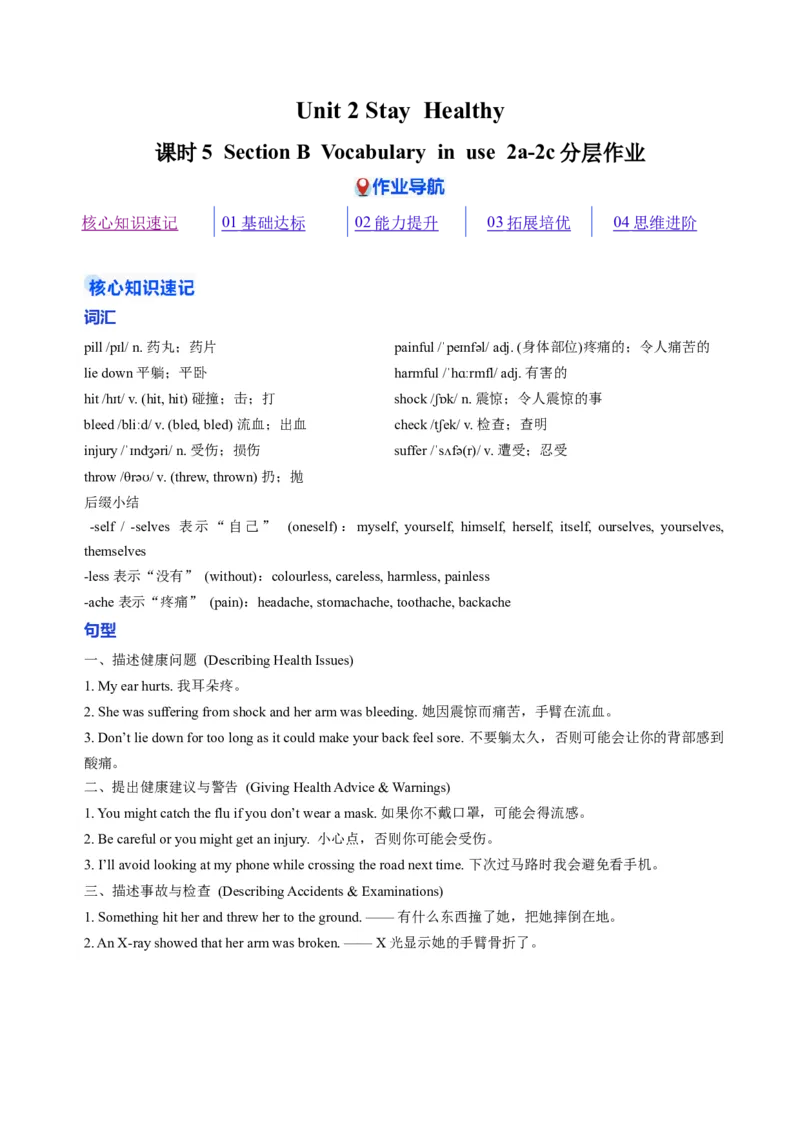
词汇
pill /pɪl/ n. 药丸;药片 painful /ˈpeɪnfəl/ adj. (身体部位)疼痛的;令人痛苦的
lie down 平躺;平卧 harmful /ˈhɑːrmfl/ adj. 有害的
hit /hɪt/ v. (hit, hit) 碰撞;击;打 shock /ʃɒk/ n. 震惊;令人震惊的事
bleed /bliːd/ v. (bled, bled) 流血;出血 check /tʃek/ v. 检查;查明
injury /ˈɪndʒəri/ n. 受伤;损伤 suffer /ˈsʌfə(r)/ v. 遭受;忍受
throw /θrəʊ/ v. (threw, thrown) 扔;抛
后缀小结
-self / -selves 表示“自己” (oneself):myself, yourself, himself, herself, itself, ourselves, yourselves,
themselves
-less 表示“没有” (without):colourless, careless, harmless, painless
-ache 表示“疼痛” (pain):headache, stomachache, toothache, backache
句型
一、描述健康问题 (Describing Health Issues)
1. My ear hurts. 我耳朵疼。
2. She was suffering from shock and her arm was bleeding. 她因震惊而痛苦,手臂在流血。
3. Don’t lie down for too long as it could make your back feel sore. 不要躺太久,否则可能会让你的背部感到
酸痛。
二、提出健康建议与警告 (Giving Health Advice & Warnings)
1. You might catch the flu if you don’t wear a mask. 如果你不戴口罩,可能会得流感。
2. Be careful or you might get an injury. 小心点,否则你可能会受伤。
3. I’ll avoid looking at my phone while crossing the road next time. 下次过马路时我会避免看手机。
三、描述事故与检查 (Describing Accidents & Examinations)
1. Something hit her and threw her to the ground. —— 有什么东西撞了她,把她摔倒在地。
2. An X-ray showed that her arm was broken. —— X光显示她的手臂骨折了。四、说明医疗处理 (Explaining Medical Treatment)
1. The doctor checked his leg and took an X-ray. —— 医生检查了他的腿并拍了一张X光片。
2. This pill is helpful for your headache. —— 这药片对你的头痛有帮助。
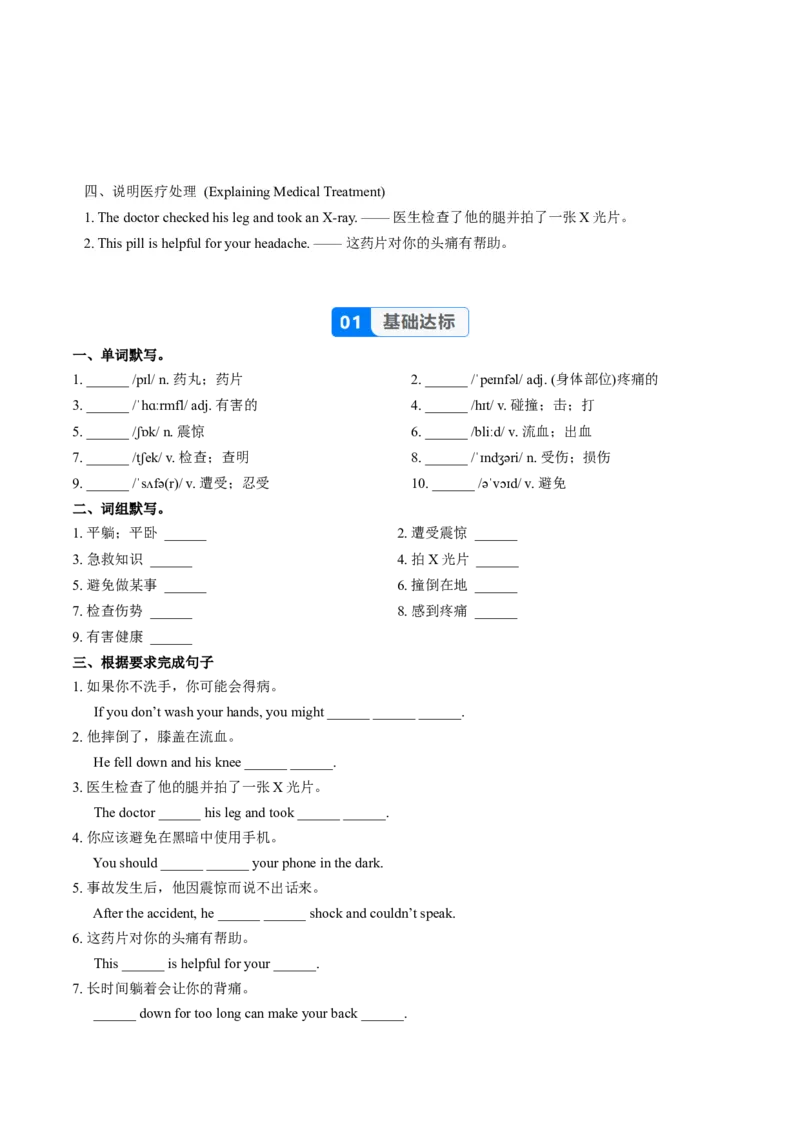
一、单词默写。
1. ______ /pɪl/ n. 药丸;药片 2. ______ /ˈpeɪnfəl/ adj. (身体部位)疼痛的
3. ______ /ˈhɑːrmfl/ adj. 有害的 4. ______ /hɪt/ v. 碰撞;击;打
5. ______ /ʃɒk/ n. 震惊 6. ______ /bliːd/ v. 流血;出血
7. ______ /tʃek/ v. 检查;查明 8. ______ /ˈɪndʒəri/ n. 受伤;损伤
9. ______ /ˈsʌfə(r)/ v. 遭受;忍受 10. ______ /əˈvɔɪd/ v. 避免
二、词组默写。
1. 平躺;平卧 ______ 2. 遭受震惊 ______
3. 急救知识 ______ 4. 拍X光片 ______
5. 避免做某事 ______ 6. 撞倒在地 ______
7. 检查伤势 ______ 8. 感到疼痛 ______
9. 有害健康 ______
三、根据要求完成句子
1. 如果你不洗手,你可能会得病。
If you don’t wash your hands, you might ______ ______ ______.
2. 他摔倒了,膝盖在流血。
He fell down and his knee ______ ______.
3. 医生检查了他的腿并拍了一张X光片。
The doctor ______ his leg and took ______ ______.
4. 你应该避免在黑暗中使用手机。
You should ______ ______ your phone in the dark.
5. 事故发生后,他因震惊而说不出话来。
After the accident, he ______ ______ shock and couldn’t speak.
6. 这药片对你的头痛有帮助。
This ______ is helpful for your ______.
7. 长时间躺着会让你的背痛。
______ down for too long can make your back ______.8. 她受伤了,但她很幸运伤得不重。
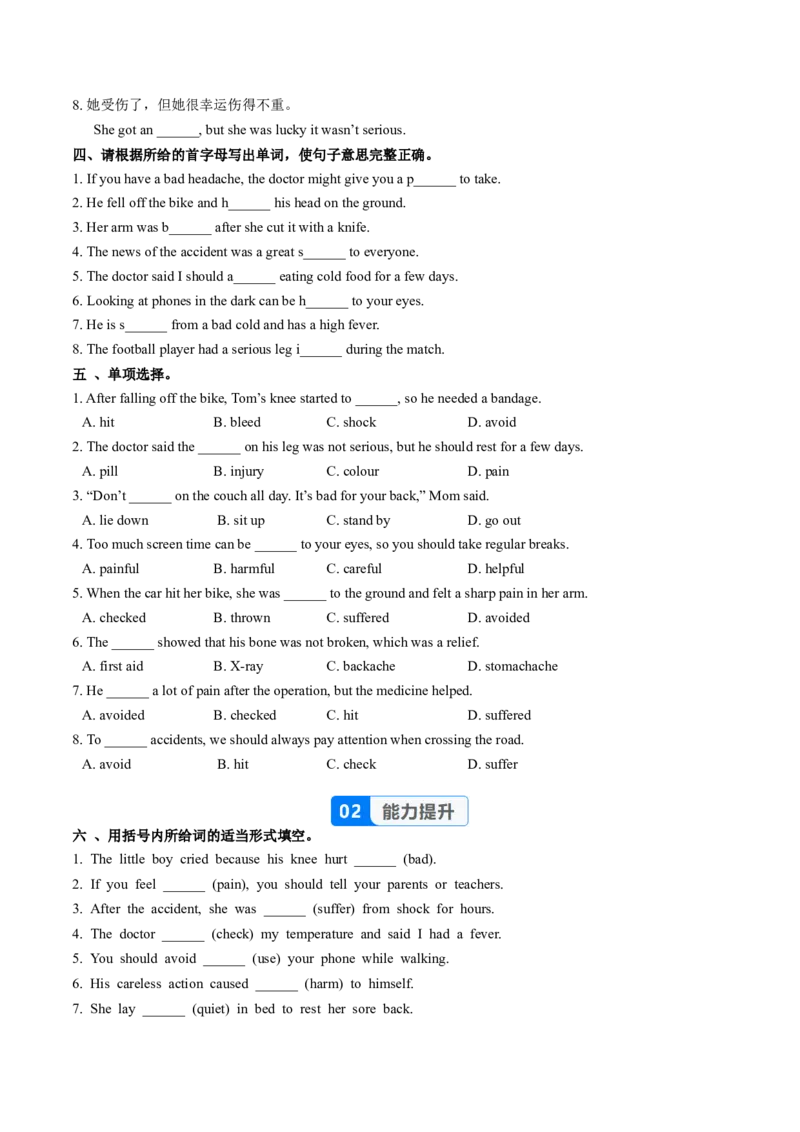
She got an ______, but she was lucky it wasn’t serious.
四、请根据所给的首字母写出单词,使句子意思完整正确。
1. If you have a bad headache, the doctor might give you a p______ to take.
2. He fell off the bike and h______ his head on the ground.
3. Her arm was b______ after she cut it with a knife.
4. The news of the accident was a great s______ to everyone.
5. The doctor said I should a______ eating cold food for a few days.
6. Looking at phones in the dark can be h______ to your eyes.
7. He is s______ from a bad cold and has a high fever.
8. The football player had a serious leg i______ during the match.
五 、单项选择。
1. After falling off the bike, Tom’s knee started to ______, so he needed a bandage.
A. hit B. bleed C. shock D. avoid
2. The doctor said the ______ on his leg was not serious, but he should rest for a few days.
A. pill B. injury C. colour D. pain
3. “Don’t ______ on the couch all day. It’s bad for your back,” Mom said.
A. lie down B. sit up C. stand by D. go out
4. Too much screen time can be ______ to your eyes, so you should take regular breaks.
A. painful B. harmful C. careful D. helpful
5. When the car hit her bike, she was ______ to the ground and felt a sharp pain in her arm.
A. checked B. thrown C. suffered D. avoided
6. The ______ showed that his bone was not broken, which was a relief.
A. first aid B. X-ray C. backache D. stomachache
7. He ______ a lot of pain after the operation, but the medicine helped.
A. avoided B. checked C. hit D. suffered
8. To ______ accidents, we should always pay attention when crossing the road.
A. avoid B. hit C. check D. suffer
六 、用括号内所给词的适当形式填空。
1. The little boy cried because his knee hurt ______ (bad).
2. If you feel ______ (pain), you should tell your parents or teachers.
3. After the accident, she was ______ (suffer) from shock for hours.
4. The doctor ______ (check) my temperature and said I had a fever.
5. You should avoid ______ (use) your phone while walking.
6. His careless action caused ______ (harm) to himself.
7. She lay ______ (quiet) in bed to rest her sore back.8. An X-ray ______ (show) that nothing was broken, which was good news.
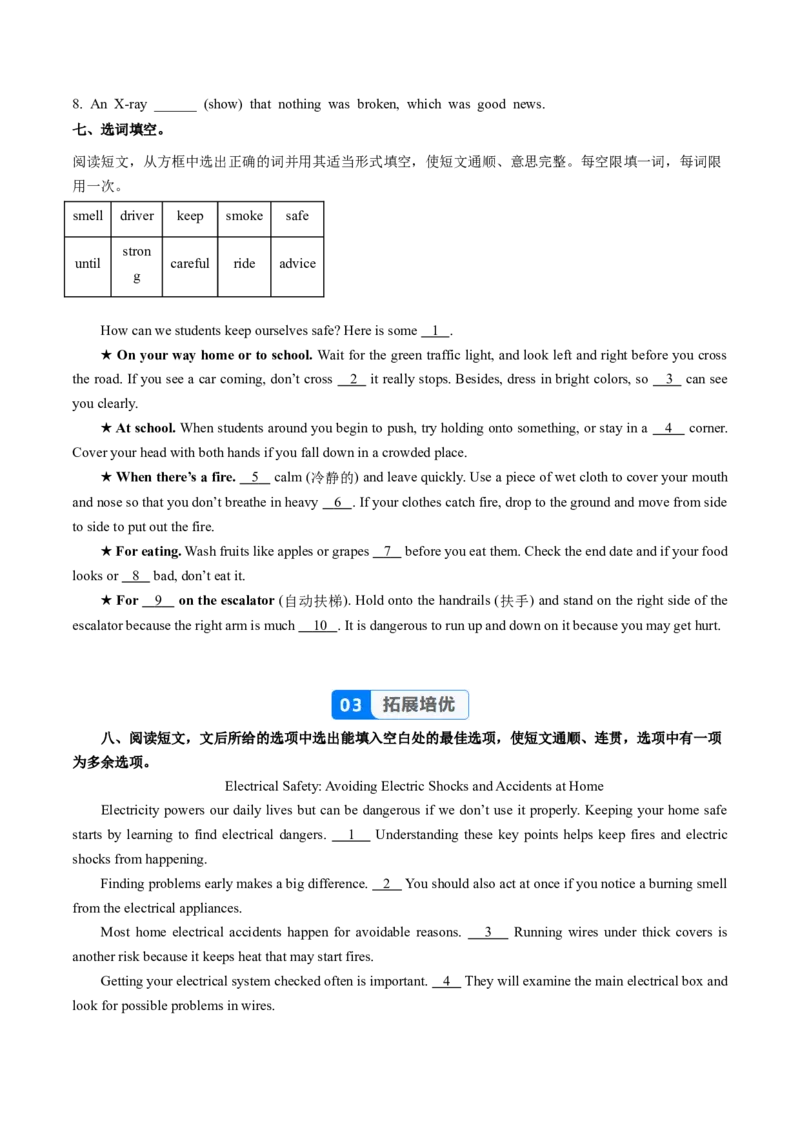
七、选词填空。
阅读短文,从方框中选出正确的词并用其适当形式填空,使短文通顺、意思完整。每空限填一词,每词限
用一次。
smell driver keep smoke safe
stron
until careful ride advice
g
How can we students keep ourselves safe? Here is some 1 .
★ On your way home or to school. Wait for the green traffic light, and look left and right before you cross
the road. If you see a car coming, don’t cross 2 it really stops. Besides, dress in bright colors, so 3 can see
you clearly.
★ At school. When students around you begin to push, try holding onto something, or stay in a 4 corner.
Cover your head with both hands if you fall down in a crowded place.
★ When there’s a fire. 5 calm (冷静的) and leave quickly. Use a piece of wet cloth to cover your mouth
and nose so that you don’t breathe in heavy 6 . If your clothes catch fire, drop to the ground and move from side
to side to put out the fire.
★ For eating. Wash fruits like apples or grapes 7 before you eat them. Check the end date and if your food
looks or 8 bad, don’t eat it.
★ For 9 on the escalator (自动扶梯). Hold onto the handrails (扶手) and stand on the right side of the
escalator because the right arm is much 10 . It is dangerous to run up and down on it because you may get hurt.
八、阅读短文,文后所给的选项中选出能填入空白处的最佳选项,使短文通顺、连贯,选项中有一项
为多余选项。
Electrical Safety: Avoiding Electric Shocks and Accidents at Home
Electricity powers our daily lives but can be dangerous if we don’t use it properly. Keeping your home safe
starts by learning to find electrical dangers. 1 Understanding these key points helps keep fires and electric
shocks from happening.
Finding problems early makes a big difference. 2 You should also act at once if you notice a burning smell
from the electrical appliances.
Most home electrical accidents happen for avoidable reasons. 3 Running wires under thick covers is
another risk because it keeps heat that may start fires.
Getting your electrical system checked often is important. 4 They will examine the main electrical box and
look for possible problems in wires.Old wiring in older houses is especially risky. Old wires may cause fires. 5 Modern wiring follows new
safety rules and greatly reduces fire risks. If lights often flash, call an electrical worker right away.
Cheap electrical products are unsafe. They might get too hot or give electric shocks because they don’t meet
safety rules. Always buy from trusted stores that sell products with safety marks.
A.Place covers on outlets (插座) to protect children.
B.Change old wiring for new safer systems.
C.Watch for broken wires (电线) or warm outlets.
D.Don’t use electric wires of poor quality even if they
seem cheaper.
E.Have electrical workers check your home’s
electrical system every year.
F.Using too many electrical appliances (电器) at the
same time or using old wires often causes accidents.
九、阅读理解。
Cooking is fun, but sometimes accidents may happen. If you burn yourself, cut your finger, or pour out hot oil
carelessly, don’t panic! Here are some things you should do when the accidents happen.
When you get burned by fire, hot oil, or steam (蒸汽), cool the burn at once under cold running water for 10-
15 minutes. Then cover it with a clean cloth or bandage. Don’t use ice or butter! If the burn is serious, you’d better
see a doctor at once. Don’t break the blisters (水泡) or touch them often; this can increase the pain.
If you are cut by knives or sharp (锋利的) tools, wash the cut with clean water and soap. Press a clean cloth on
it to stop bleeding. Then cover it with a bandage. If the cut is deep or won’t stop bleeding, go to the hospital. Don’t
use alcohol (酒精) directly on deep cuts or touch them with a dirty hand.
If something in the pan catches fire, turn off the stove at once. Cover the pan with a metal lid (锅盖). Without
oxygen, the fire will go out soon. If the fire becomes bigger or covers other things, leave the kitchen and call 119 as
soon as possible. Do remember, don’t pour water on an oil fire or try to carry a burning pan outside.
To stay away from cooking accidents, we must always be careful when using knives or fire. Most cooking
accidents are small if we treat them in the right way. Knowing these tips will help us stay safe in the kitchen!
1.What should you do first if you burn yourself from a fire?
A.Go to see a doctor at once.
B.Break the blisters at once.
C.Cool the burn under the cold water.
D.Cover it with a clean cloth or bandage.
2.新考向 代词指代 What does the underlined word “them” refer to?
A.Cuts. B.Knives. C.Hands. D.Sharp tools.
3.What can stop the burning pan?①Water. ②Oxygen. ③Firefighters. ④A metal lid. ⑤Turning off the stove.
A.①③⑤ B.③④⑤ C.①④⑤ D.②③④
4.新考向 篇章结构 What would be the best structure of the passage?
A. B. C. D.
5.What is the passage mainly about?
A.How to cook delicious food.
B.How to keep safe in the kitchen.
C.How to have a healthy lifestyle.
D.How to deal with the accidents in the kitchen.
十、完形填空。
Last weekend, Tom and his friends camped by the lake. They put up tents and were about to start a fire to cook
lunch 1 a strong wind blew a flame onto the dry leaves. In seconds, the leaves 2 and the fire spread fast.
“Help! The fire’s getting bigger!” Lucy called out 3 .
“We need to stop it before it reaches the tents!” John said. He 4 badly because he took in some smoke.
Peter remembered that their teacher told them to take a fire 5 with them. He 6 to get the fire
extinguisher and turned it on. Soon, some of the fire were 7 .
Maria said, “Let’s get water from the lake.” Others thought it was a 8 idea. They ran to the lake, getting
water to pour water on the flames. Just then, a small 9 landed on Mike’s hand. He cried out in pain. “Let me
help treat it!” Tom said. He took out of some 10 from his first-aid kit (急救箱) and put it on Mike’s injury.
Smoke 11 their eyes, but they kept going. After another 10 minutes, the fire died down. “ 12 for any
small fires!” John breathed heavily. They looked over the area to make sure no 13 was left.
Later, as they packed up. “We saved 14 by acting fast,” John said. “Luckily, we remembered 15
rules.”
“What’s more, first aid helped Mike a lot,” Lucy said.
1.A.if B.when C.though D.because
2.A.flew B.left C.dropped D.burnt
3.A.unfortunately B.importantly C.nervously D.surprisingly
4.A.pressed B.coughed C.cleared D.pushed
5.A.station B.alarm C.stove D.extinguisher
6.A.ran B.cross C.cleared D.threw
7.A.lay down B.put out C.turned on D.called back
8.A.painful B.good C.quick D.careless
9.A.news B.bread C.paper D.flame
10.A.time B.money C.medicine D.information11.A.hurt B.fried C.protected D.aided
12.A.Check B.Look C.Care D.Search
13.A.smoke B.harm C.pill D.knife
14.A.myself B.ourselves C.yourselves D.themselves
15.A.school B.home C.safety D.traffic
When Knowledge Meets Emergency
Part 1: Read and Explore
Leo was playing basketball with his friends after school when he suddenly slipped and fell hard. A sharp pain
shot through his right ankle immediately, and he couldn’t stand up. His friend Sam rushed over.
“Don’t try to move him!” called out Mia, who had just finished a first aid course. She remembered the key
rule: if a bone might be broken, moving could make the injury worse.
Mia carefully checked Leo’s ankle. It was already starting to swell and looked painful. She asked Leo to
wiggle his toes gently – he could, which was a good sign that the nerves might be okay. Meanwhile, Sam called
Leo’s parents and got a bag of ice from the school canteen.
“We need to avoid putting any weight on it,” Mia said. She used Sam’s jacket to make a soft support around
Leo’s ankle, not too tight. She also reminded him to keep his leg raised while waiting.
At the hospital, the doctor praised their quick thinking. An X-ray showed a minor sprain, not a break. “The
ice, the support, and not moving him were exactly right,” the doctor said. “You avoided causing more harm.”
Leo’s ankle would be sore for a week, but he learned something more valuable than any game score. He saw
how calm, correct knowledge could turn a scary situation into a manageable one. The next week, he and Mia started
a “First Aid Helpers” board in their classroom, sharing simple tips on how to deal with common injuries.
True help, they learned, isn’t just about caring; it’s about knowing how to care correctly.
Task 1:Skills Challenge
Critical Thinking (根据文章内容回答下列问题)
1. What was Leo’s injury and how did it happen?
_______________________________________________________
2. What were the TWO correct first aid steps that Mia and Sam took? (用文中信息回答)
a) _______________________________________________________
b) _______________________________________________________
3. Why did the doctor praise the kids’ actions?
_______________________________________________________
Task 2: 信息对比 (Information Comparison)
对比课文中James的厨房事故与本篇中Zhang Wei的骑车事故的应对方式,完成下表。情景 Scenario 正 确 处 理 方 式 (Correct 常见错误处理方式 (Common Wrong Response)
Response)
脚踝受伤后 After the 1. _________________________. 1.Try to help him walk.
ankle injury 2. 立即冰敷 (Used ice at once). 2. _________________________.
等 待 就 医 时 While 1. Used clothing for soft support. 1.Massage the swollen part.
waiting for medical help 2. Kept the leg raised. 2. Tie it up with a very tight bandage.
我的总结 My Conclusion Correct first aid is based Wrong handling often comes from panic or wrong
on3._____________ and information.
4.__________.
Task 3: 事件排序 (Sequence Ordering)
将下列事件按正确顺序排列(将字母填入横线)。
A. Mia used a jacket to support Leo’s ankle.
B. Leo fell and felt a sharp pain in his ankle.
C. The doctor took an X-ray and confirmed a sprain.
D. Sam called Leo’s parents and got some ice.
E. Mia asked Leo to wiggle his toes to check.
F. Leo and Mia started a first aid information board.
正确顺序:_______ → _______ →_______ → _______ → _______→ _______
Task 4: 创新与表达 (Innovation & Expression)
假设你是学校“健康小卫士”社团的负责人,请设计一个“校园急救知识宣传”活动。
My First Aid Awareness Campaign
· 活动名称 (Campaign Name): “Be a Helper, Not Just a Bystander!”
· 两个核心活动 (Two Core Activities):
1. Poster & Video Series: Create simple posters/short videos showing what to do for common school injuries (e.g.,
nosebleeds, sprains, cuts).
2. Practical Demonstration Session: Invite a school nurse or a Red Cross volunteer to demonstrate how
to handle minor injuries with hands-on practice.
· 一句宣传口号 (A Slogan): “____________________________”
· 我希望同学们学到什么 (What I hope students will learn):
I hope students will learn that basic first aid is ______ and feel confident to ______ when someone gets hurt.