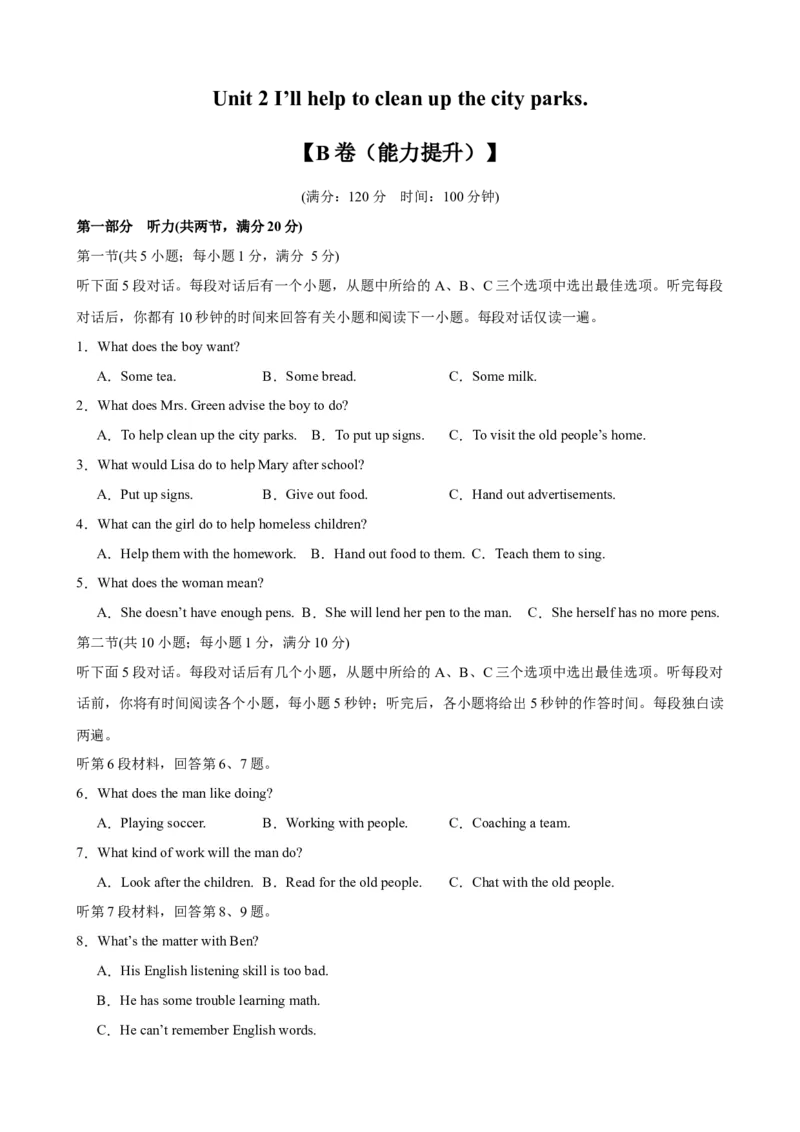
Unit 2 I’ll help to clean up the city parks.
【B 卷(能力提升)】
(满分:120分 时间:100分钟)
第一部分 听力(共两节,满分20分)
第一节(共5小题;每小题1分,满分 5分)
听下面5段对话。每段对话后有一个小题,从题中所给的A、B、C三个选项中选出最佳选项。听完每段
对话后,你都有10秒钟的时间来回答有关小题和阅读下一小题。每段对话仅读一遍。
1.What does the boy want?
A.Some tea. B.Some bread. C.Some milk.
2.What does Mrs. Green advise the boy to do?
A.To help clean up the city parks. B.To put up signs. C.To visit the old people’s home.
3.What would Lisa do to help Mary after school?
A.Put up signs. B.Give out food. C.Hand out advertisements.
4.What can the girl do to help homeless children?
A.Help them with the homework. B.Hand out food to them. C.Teach them to sing.
5.What does the woman mean?
A.She doesn’t have enough pens. B.She will lend her pen to the man. C.She herself has no more pens.
第二节(共10小题;每小题1分,满分10分)
听下面5段对话。每段对话后有几个小题,从题中所给的A、B、C三个选项中选出最佳选项。听每段对
话前,你将有时间阅读各个小题,每小题5秒钟;听完后,各小题将给出5秒钟的作答时间。每段独白读
两遍。
听第6段材料,回答第6、7题。
6.What does the man like doing?
A.Playing soccer. B.Working with people. C.Coaching a team.
7.What kind of work will the man do?
A.Look after the children. B.Read for the old people. C.Chat with the old people.
听第7段材料,回答第8、9题。
8.What’s the matter with Ben?
A.His English listening skill is too bad.
B.He has some trouble learning math.
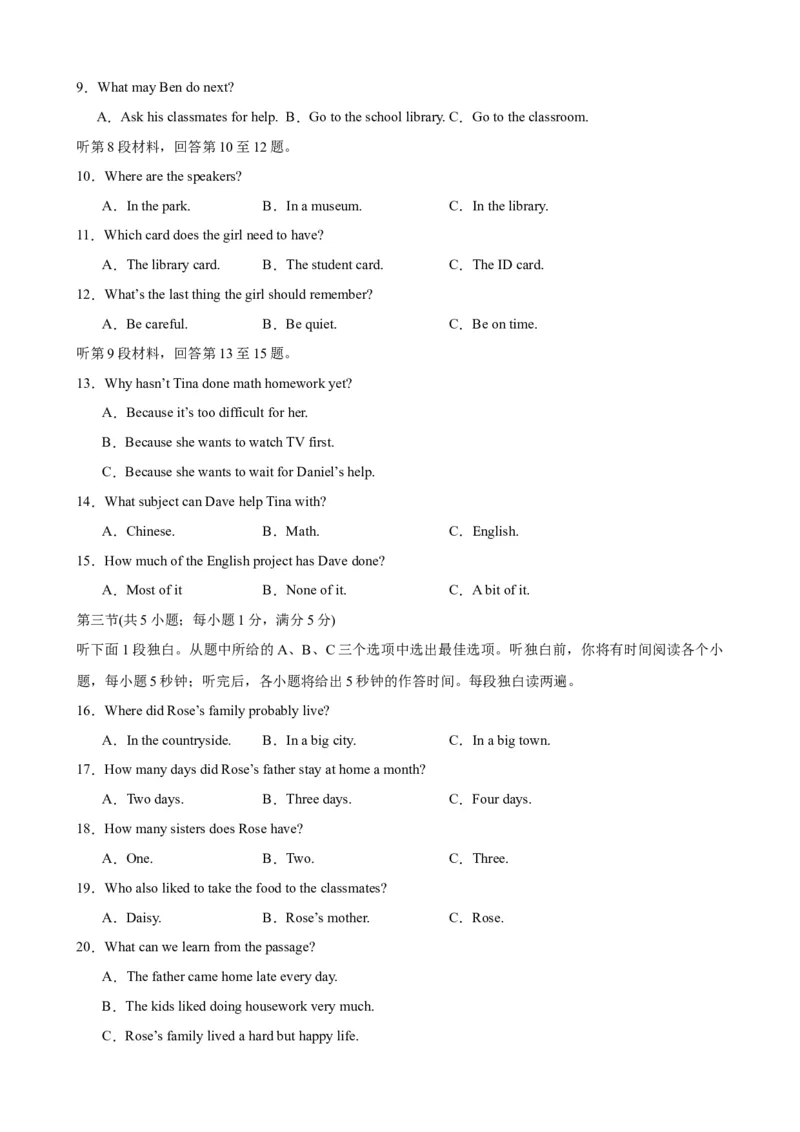
C.He can’t remember English words.9.What may Ben do next?
A.Ask his classmates for help. B.Go to the school library.C.Go to the classroom.
听第8段材料,回答第10至12题。
10.Where are the speakers?
A.In the park. B.In a museum. C.In the library.
11.Which card does the girl need to have?
A.The library card. B.The student card. C.The ID card.
12.What’s the last thing the girl should remember?
A.Be careful. B.Be quiet. C.Be on time.
听第9段材料,回答第13至15题。
13.Why hasn’t Tina done math homework yet?
A.Because it’s too difficult for her.
B.Because she wants to watch TV first.
C.Because she wants to wait for Daniel’s help.
14.What subject can Dave help Tina with?
A.Chinese. B.Math. C.English.
15.How much of the English project has Dave done?
A.Most of it B.None of it. C.A bit of it.
第三节(共5小题;每小题1分,满分5分)
听下面1段独白。从题中所给的A、B、C三个选项中选出最佳选项。听独白前,你将有时间阅读各个小
题,每小题5秒钟;听完后,各小题将给出5秒钟的作答时间。每段独白读两遍。
16.Where did Rose’s family probably live?
A.In the countryside. B.In a big city. C.In a big town.
17.How many days did Rose’s father stay at home a month?
A.Two days. B.Three days. C.Four days.
18.How many sisters does Rose have?
A.One. B.Two. C.Three.
19.Who also liked to take the food to the classmates?
A.Daisy. B.Rose’s mother. C.Rose.
20.What can we learn from the passage?
A.The father came home late every day.
B.The kids liked doing housework very much.
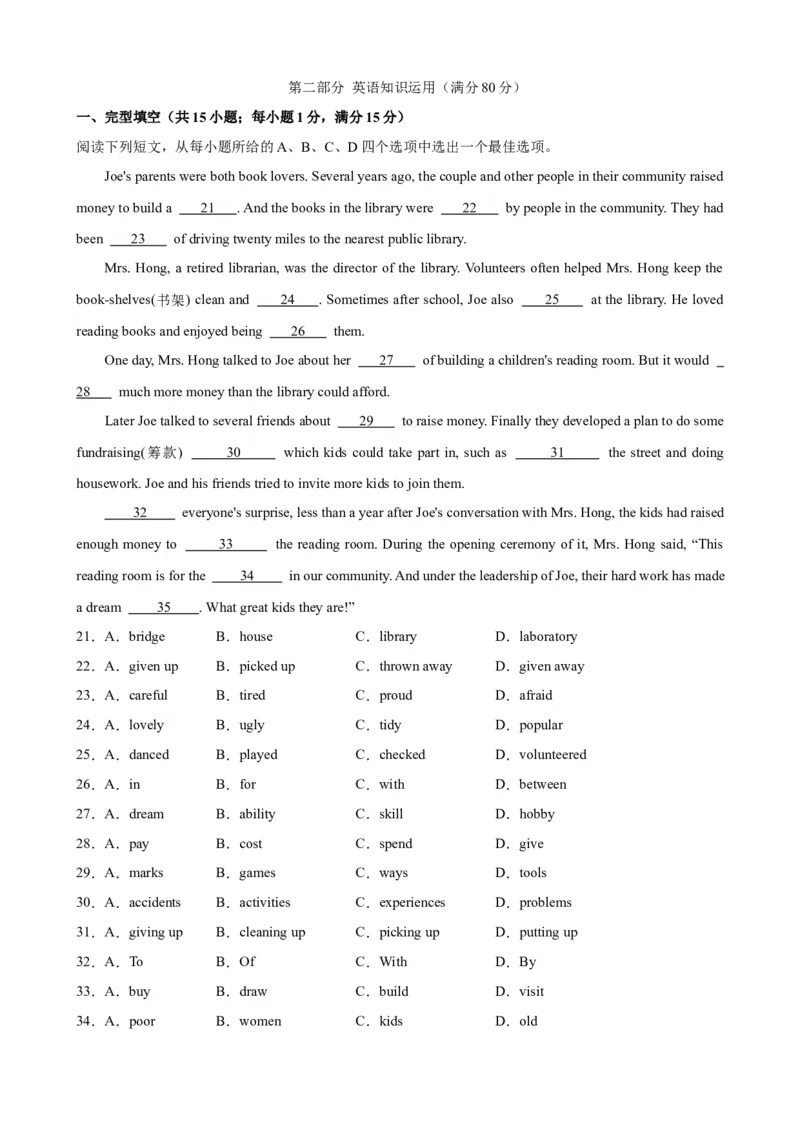
C.Rose’s family lived a hard but happy life.第二部分 英语知识运用(满分80分)
一、完型填空(共15小题;每小题1分,满分15分)
阅读下列短文,从每小题所给的A、B、C、D四个选项中选出一个最佳选项。
Joe's parents were both book lovers. Several years ago, the couple and other people in their community raised
money to build a 21 . And the books in the library were 22 by people in the community. They had
been 23 of driving twenty miles to the nearest public library.
Mrs. Hong, a retired librarian, was the director of the library. Volunteers often helped Mrs. Hong keep the
book-shelves(书架) clean and 24 . Sometimes after school, Joe also 25 at the library. He loved
reading books and enjoyed being 26 them.
One day, Mrs. Hong talked to Joe about her 27 of building a children's reading room. But it would
28 much more money than the library could afford.
Later Joe talked to several friends about 29 to raise money. Finally they developed a plan to do some
fundraising(筹款) 30 which kids could take part in, such as 31 the street and doing
housework. Joe and his friends tried to invite more kids to join them.
32 everyone's surprise, less than a year after Joe's conversation with Mrs. Hong, the kids had raised
enough money to 33 the reading room. During the opening ceremony of it, Mrs. Hong said, “This
reading room is for the 34 in our community. And under the leadership of Joe, their hard work has made
a dream 35 . What great kids they are!”
21.A.bridge B.house C.library D.laboratory
22.A.given up B.picked up C.thrown away D.given away
23.A.careful B.tired C.proud D.afraid
24.A.lovely B.ugly C.tidy D.popular
25.A.danced B.played C.checked D.volunteered
26.A.in B.for C.with D.between
27.A.dream B.ability C.skill D.hobby
28.A.pay B.cost C.spend D.give
29.A.marks B.games C.ways D.tools
30.A.accidents B.activities C.experiences D.problems
31.A.giving up B.cleaning up C.picking up D.putting up
32.A.To B.Of C.With D.By
33.A.buy B.draw C.build D.visit
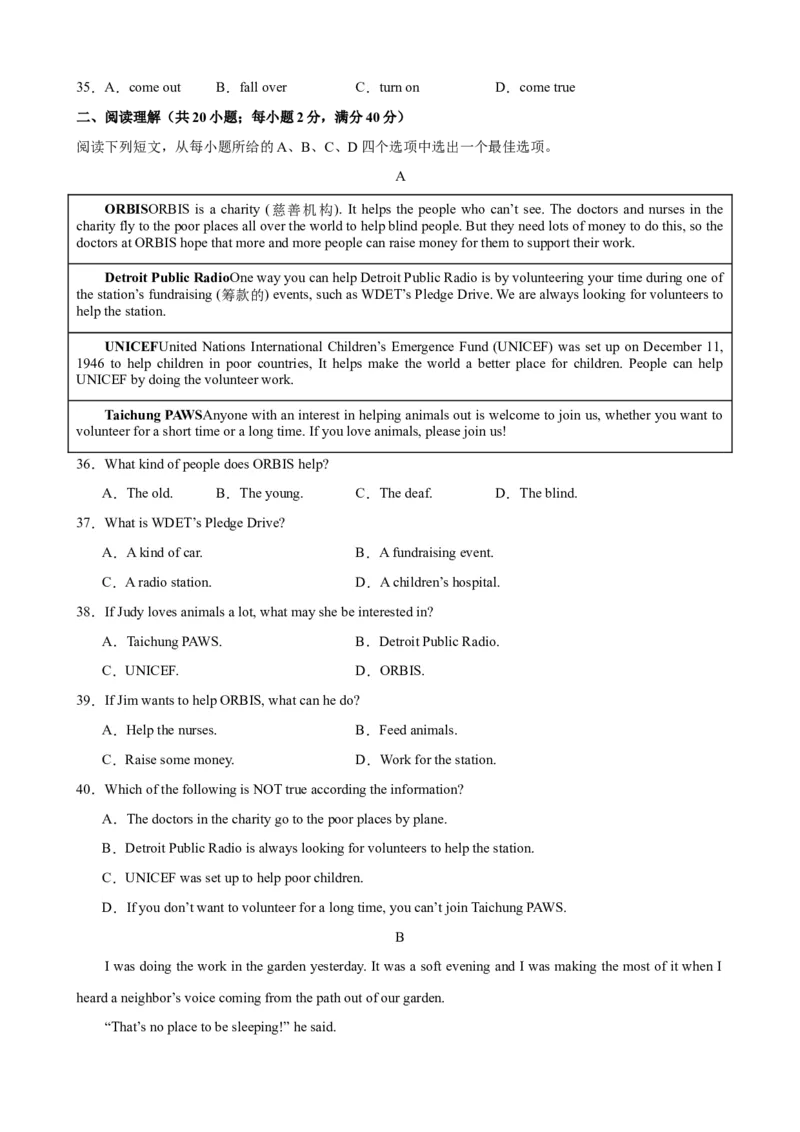
34.A.poor B.women C.kids D.old35.A.come out B.fall over C.turn on D.come true
二、阅读理解(共20小题;每小题2分,满分40分)
阅读下列短文,从每小题所给的A、B、C、D四个选项中选出一个最佳选项。
A
ORBISORBIS is a charity (慈善机构). It helps the people who can’t see. The doctors and nurses in the
charity fly to the poor places all over the world to help blind people. But they need lots of money to do this, so the
doctors at ORBIS hope that more and more people can raise money for them to support their work.
Detroit Public RadioOne way you can help Detroit Public Radio is by volunteering your time during one of
the station’s fundraising (筹款的) events, such as WDET’s Pledge Drive. We are always looking for volunteers to
help the station.
UNICEFUnited Nations International Children’s Emergence Fund (UNICEF) was set up on December 11,
1946 to help children in poor countries, It helps make the world a better place for children. People can help
UNICEF by doing the volunteer work.
Taichung PAWSAnyone with an interest in helping animals out is welcome to join us, whether you want to
volunteer for a short time or a long time. If you love animals, please join us!
36.What kind of people does ORBIS help?
A.The old. B.The young. C.The deaf. D.The blind.
37.What is WDET’s Pledge Drive?
A.A kind of car. B.A fundraising event.
C.A radio station. D.A children’s hospital.
38.If Judy loves animals a lot, what may she be interested in?
A.Taichung PAWS. B.Detroit Public Radio.
C.UNICEF. D.ORBIS.
39.If Jim wants to help ORBIS, what can he do?
A.Help the nurses. B.Feed animals.
C.Raise some money. D.Work for the station.
40.Which of the following is NOT true according the information?
A.The doctors in the charity go to the poor places by plane.
B.Detroit Public Radio is always looking for volunteers to help the station.
C.UNICEF was set up to help poor children.
D.If you don’t want to volunteer for a long time, you can’t join Taichung PAWS.
B
I was doing the work in the garden yesterday. It was a soft evening and I was making the most of it when I
heard a neighbor’s voice coming from the path out of our garden.
“That’s no place to be sleeping!” he said.I found there was a man lying on his back on the path with his eyes closed. I recognized him. I had seen him
doing the drunkard’s (酒鬼) walk along that path several times.
I stopped to walk out. “Do you need some help?” I asked.
He opened his eyes and said, “Probably.” Then he told me because of arthritis (关节炎) he couldn’t walk
well at the most of times. I thought I should do it when he asked to help him go home where he lived a few
hundred metres away.
I tried to let him walk under his own strength with me guiding him but that was getting us nowhere. It was
easier to carry him, but that would be a real insult (侮辱) to him. So, I held his left hand with my left hand and
grabbed his belt with my right hand. Then we started walking slowly.
On the way he told me his name, what he had worked as, what holidays he had been, how wonderful his
granddaughter was, what his wife’s name was — and what a hard time she would give him when he got home!
Thank goodness! His wife wasn’t in when we walked forty-five minutes back to his home.
If we wait until we feel good about helping before we help, then people will go unhelped and we will become
the ones who end up walking on by.
41.When did the story happen?
A.When the writer finished his work.
B.When the writer was walking on the path.
C.When the writer almost ended up his work.
D.When the writer wanted to begin his work.
42.Who was lying on the path?
A.A neighbor. B.The writer’s wife. C.A drunkard. D.A gardener.
43.Why didn’t the writer carry the man?
A.Because he could walk well by himself.
B.Because it would be an insult to him.
C.Because it was only a few hundred metres away.
D.Because his wife would give him a hard time.
44.According to the passage, which is RIGHT?
A.The man was a talented person.
B.The man enjoyed having holidays.
C.The man’s wife was always kind to him.
D.The man loved his granddaughter very much.
45.What does the story want to tell us?A.Work hard and you’ll have a better life.
B.Give somebody a helping hand in time.
C.Never give up when you meet difficulties.
D.Solve problems by yourself when something happens.
C
A job well done
Whirrr. The deafening sound of a power washer echoed in the neighborhood. Earlier, my dad had bought a
power washer—and we were finally going to get our deck clean. After years of using a brush, we now had a high-
power, high-pressure washer: a little square machine that sprayed out a strong stream of water.
My dad took the first shift, and washed our upper deck. I watched in amazement as the washer simply left
clean wood—exactly the color of the paint originally. “Wow, our deck sure got dirty this year,” I thought.
However, that was exactly why we were cleaning—so that we could have sparkling floors outside once again. The
machine hummed along, and I decided to change before I had to start cleaning. I put on some light clothing, since
the sun was high in the sky, and a sunhat to protect my face from a sunburn.
I took charge of the lower deck. I could feel the machine vibrating the whole deck, and I nervously started on
a corner. It felt as if the whole deck would fall! But after a few minutes and no large cracking sound, I relaxed and
let the loud monotonous buzzing send me into a comfortable pattern. Left, right, left, right. Surprisingly, the paint
on the lower deck ended up being completely stripped off! It wasn’t that big of a loss though, since we were going
to repaint the deck anyhow. Left, right, left, right. Soon, I had made a large sized “hole” of unpainted deck.
I looked to my left—sigh. There was still a lot left to go.
The sun shined, and I kept going. Buzz, buzz. Left, right, back, and forth. Slowly, I moved from the top to the
bottom, from one end of the deck to the other. With the last bit sprayed clean, I jumped for joy! Finally, it was
done. I put away the machine, went inside and sat down on the couch, and admired my work. A beautiful deck,
nice and sparkling from all my hard work!
46.The author used ________ to clean their deck.
A.a brush B.the power washer C.a mop D.rags
47._________ washed the upper deck.
A.The author B.The author’s motherC.The author’s father D.The author and his father
48.What does the underlined word “sunburn” mean?
A.紫外线 B.晒伤 C.阳光 D.日光浴
49.Did the author cause heavy losses when he washed the lower deck?
A.Yes, he did. B.No, he didn’t. C.It doesn’t say. D.We don’t know.50.What does the passage tell?
A.A story of cleaning house. B.A story of cleaning garden.
C.A story of washing deck. D.A story of buying a power washer.
D
Research has shown that when we volunteer—where we give ourselves and our time to help others—we
actually end up benefiting too. Our happiness grows. We feel more satisfied with life. We even have more energy
and creativity. Basically, we have more to give.
I’ve noticed a pattern with my friends. Sometimes, they get into the habit of gossiping about others. They
will constantly complain about their bosses or coworkers. It seems as if they get caught in this loop of
complaining, and their frustration distracts them in other parts of their life. When this happens, they become
uninterested in new events or become annoyed by their colleagues or things that happen at work.
At the same time, I’ve also seen other friends go out of their way to help someone on their team or to help
out on a project that had very little—or even nothing—to do with their main work. Although it seems like they
won’t receive anything in return, my friends benefit from these interactions. My friends have told me about the
stronger relationships they’ve built at work and the fun they’ve had working on new and interesting projects.
They’ve told me about how the people they helped before have returned the favor later on. Not only that, but they
have even talked about times where their boss recognized them for their work or when they were informed in
advance about upcoming projects.
We often think that when we help someone else, we aren’t doing anything for ourselves. But we actually
often end up getting back just as much as we give. When we step in to help someone, we often turn out to be
helping ourselves, as well.
51.Can we benefit from helping others?
A.Yes, we can. B.No, we can’t. C.Yes, we can only be happy. D.We don’t know.
52.Complaining about others may make people________.
A.be interested in new events B.be uninterested in new events
C.be happy with their colleagues D.gossip about others
53.The author’s friends have built strong relationships through________.
A.gossiping B.working C.helping others D.complaining
54.What we get back is _________what we give when we help others.
A.more than B.less than C.as much as D.no more than
55.What does the passage mainly tell us?
A.Helping others is not interesting. B.Helping others is helping yourself.C.Helping others has little benefits. D.Don’t help others.
三、补全对话(共5小题;每小题1分,满分5分)
根据对话内容,从文后的选项中选出能填入空白处的最佳选项,其中有两个为多余选项。
A: Good morning, Bill. 56
B: Yes. I finished my homework yesterday evening.
A: 57
B: I’d like to work outside.
A: Me, too. 58
B: I’d like to do something to help others. Would you like to go with me?
A: Sure! Let’s come up with a plan. 59 In the afternoon, we can visit the children’s hospital to cheer up
the sick children. What do you think?
B: 60 But we’d better join the school weekend volunteer program.
A: Good idea. We could do better then.
A.Do you have any ideas?
B.Are you free tomorrow?
C.I don’t agree with you.
D.That sounds good.
E.In the morning let’s do your homework first.
F.What would you like to do?
G.Tomorrow morning let’s hand out food at the food bank.
四、短文填空(共10小题;每小题1分,满分10分)
阅读下面短文,在空格处填入一个适当的词,或使用括号中词语的正确形式填空。
Mario and Helen are classmates. They believe volunteering their time 61 (help) others in need is a
good way 62 (spend) their free time.
Mario loves animals. He volunteers at Animals Helpers, a group set up to help 63 (able) people.
He helps to take care of the special trained dogs there. Volunteering there makes his dream come 64 . He
can do what he loves to do and help others at the same time.
Helen plans 65 (volunteer) in an old people’s home this summer. She says a lot of old people are
66 (alone), and people should care 67 them. In fact, she did it last summer. She told funny stories
to cheer them 68 and listened to the old people as they told stories about the past and how things 69
(use) to be. She got a strong feeling of 70 (satisfy) when she saw the look of joy on the old people’s
faces.五、阅读短文回答问题(共5小题;每小题2分,满分10分)
下面是一篇介绍一种新型的旅游方式,即公益旅行,在旅游期间担任志愿者的短文,根据所提供的信息,
回答问题。
This past summer, when most Chinese college students wondered where to travel, Wang Chaodi jumped into
one of the hottest ways of travel—voluntourism.
Wang is a 22-year-old law student at Yunnan University. He spent three weeks taking part in community
service(社区服务)in Nairobi, Kenya. At the same time, he enjoyed himself in African culture. “I want to go to
the farthest end of the Earth to help people who are most in need,” he said.
On weekdays, Wang taught elementary courses at a poor orphanage(孤儿院). It was only 300 square
meters large. And the students there had only an old textbook to study from. During weekends, he visited tourist
sites including Masai Mara National Reserve and Amboseli Park, where he could watch amazing animals.
Voluntourism, also known as volunteer tourism, connects volunteer work with travel. Now, it is getting more
and more popular among young Chinese, especially college students.
Last year, when Ciweishixi (a Shenzhen based company) carried out its South Asia voluntourism program,
more than 250,000 college students signed up. According to Li Yaping, the director of the program, 3,000 young
people took the trips.
“Young people today want a richer experience,” Li said. “Instead of taking regular ways such as practicing at
big companies, an increasing number of them want to try unusual ways to connect with the world.”
Voluntourism doesn’t have to be international. “We hope young people can devote(付出)more attention to
what’s around them before going abroad(出国),” Li added. “They can get to know more about the countryside,
gain a deeper understanding of China and find future voluntourism opportunities(机会)in our own country.”
71.Wang visited Kenya only for sightseeing, didn’t he?
72.What did Wang Chaodi do at a poor orphanage?
73.Why did Wang visit Masai Mara National Reserve and Amboseli Park?
74.How do you think voluntourism get its name?
75.What is the benefit(好处)of voluntourism for young people even if it isn’t international?
第三部分 写作(满分20分)六、书面表达(满分20分)
为了捐助贫困山区的孩子们,潮州民生志愿者会多次在人民广场举行慈善义卖活动,许多学校也纷
纷组织一些校园义卖的爱心活动,请你就此写一篇短文谈谈自己的看法。
内容包括:
1.叙述你曾经参加的一次义卖活动的经过;
2.你认为这种活动有什么好处(至少两点);
3.呼吁大家尽自己所能关心和帮助他人。
要求:
1.不能照抄原文,不得在作文中出现学校真的名称和学生的真实姓名;
2.语句连贯,词数80左右。作文的开头已出,不计入总词数。
Nowadays, charity sales are very popular in Chaozhou.
___________________________________________________________________________________________
___________________________________________________________________________________________
___________________________________________________________________________________________
___________________________________________________________________________________________
___________________________________________________________________________________________
____________________