Unit 3 Could you please clean your room?
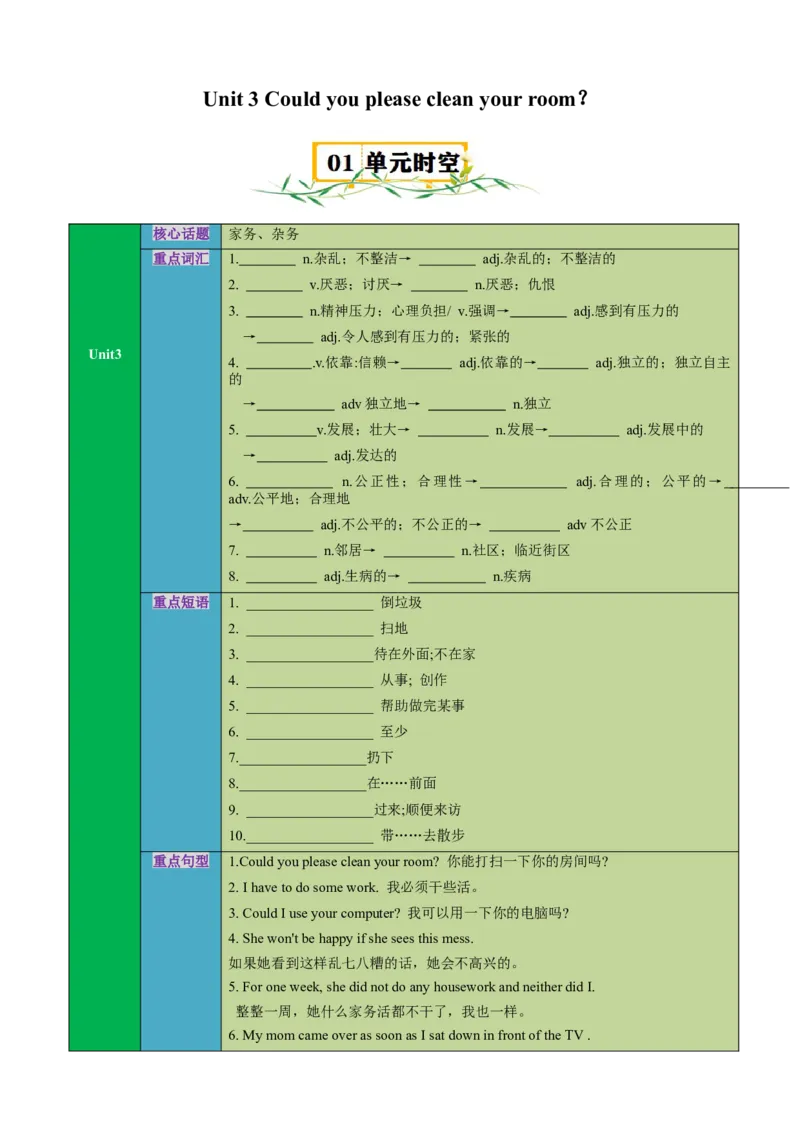
核心话题 家务、杂务
重点词汇 1. n.杂乱;不整洁→ adj.杂乱的;不整洁的
2. v.厌恶;讨厌→ n.厌恶;仇恨
3. n.精神压力;心理负担/ v.强调→ adj.感到有压力的
→ adj.令人感到有压力的;紧张的
Unit3
4. .v.依靠:信赖→ adj.依靠的→ adj.独立的;独立自主
的
→ adv独立地→ n.独立
5. v.发展;壮大→ n.发展→ adj.发展中的
→ adj.发达的
6. n.公正性;合理性→ adj.合理的;公平的→
adv.公平地;合理地
→ adj.不公平的;不公正的→ adv不公正
7. n.邻居→ n.社区;临近街区
8. adj.生病的→ n.疾病
重点短语 1. __________________ 倒垃圾
2. __________________ 扫地
3. __________________待在外面;不在家
4. __________________ 从事; 创作
5. __________________ 帮助做完某事
6. __________________ 至少
7.__________________扔下
8.__________________在……前面
9. __________________过来;顺便来访
10.__________________ 带……去散步
重点句型 1.Could you please clean your room? 你能打扫一下你的房间吗?
2. I have to do some work. 我必须干些活。
3. Could I use your computer? 我可以用一下你的电脑吗?
4. She won't be happy if she sees this mess.
如果她看到这样乱七八糟的话,她会不高兴的。
5. For one week, she did not do any housework and neither did I.
整整一周,她什么家务活都不干了,我也一样。
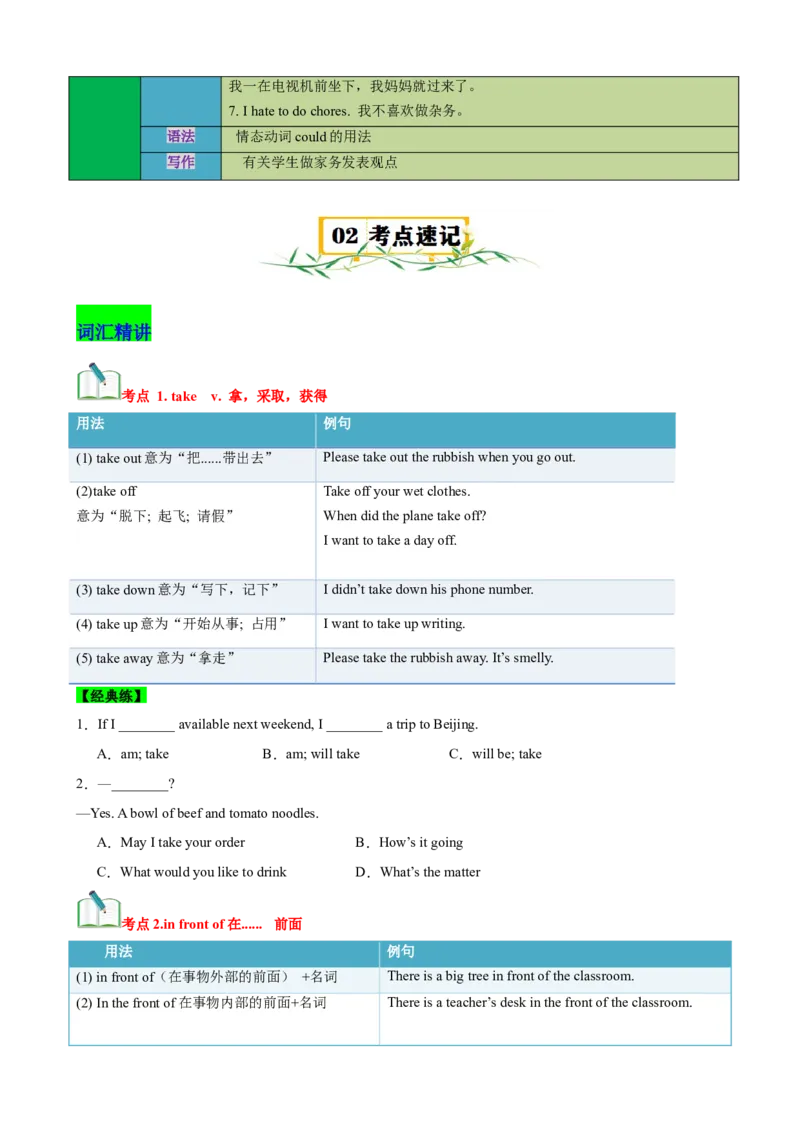
6. My mom came over as soon as I sat down in front of the TV .我一在电视机前坐下,我妈妈就过来了。
7. I hate to do chores. 我不喜欢做杂务。
语法 情态动词could的用法
写作 有关学生做家务发表观点
词汇精讲
考点 1. take v. 拿,采取,获得
用法 例句
(1) take out意为“把......带出去” Please take out the rubbish when you go out.
(2)take off Take off your wet clothes.
意为“脱下; 起飞; 请假” When did the plane take off?
I want to take a day off.
(3) take down意为“写下,记下” I didn’t take down his phone number.
(4) take up意为“开始从事; 占用” I want to take up writing.
(5) take away意为“拿走” Please take the rubbish away. It’s smelly.
【经典练】
1.If I ________ available next weekend, I ________ a trip to Beijing.
A.am; take B.am; will take C.will be; take
2.—________?
—Yes. A bowl of beef and tomato noodles.
A.May I take your order B.How’s it going
C.What would you like to drink D.What’s the matter
考点2.in front of在...... 前面
用法 例句
(1) in front of(在事物外部的前面) +名词 There is a big tree in front of the classroom.
(2) In the front of在事物内部的前面+名词 There is a teacher’s desk in the front of the classroom.【经典练】
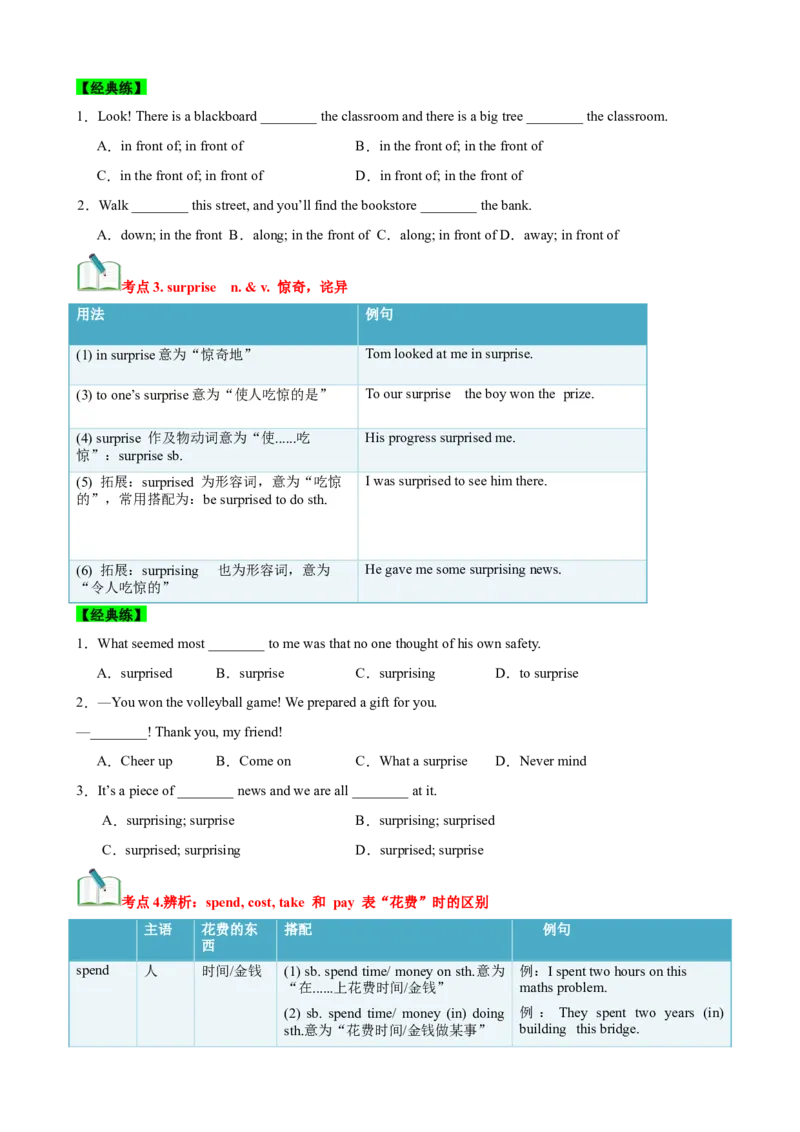
1.Look! There is a blackboard ________ the classroom and there is a big tree ________ the classroom.
A.in front of; in front of B.in the front of; in the front of
C.in the front of; in front of D.in front of; in the front of
2.Walk ________ this street, and you’ll find the bookstore ________ the bank.
A.down; in the front B.along; in the front of C.along; in front ofD.away; in front of
考点3. surprise n. & v. 惊奇,诧异
用法 例句
(1) in surprise意为“惊奇地” Tom looked at me in surprise.
(3) to one’s surprise意为“使人吃惊的是” To our surprise the boy won the prize.
(4) surprise 作及物动词意为“使......吃 His progress surprised me.
惊”:surprise sb.
(5) 拓展:surprised 为形容词,意为“吃惊 I was surprised to see him there.
的”,常用搭配为:be surprised to do sth.
(6) 拓展:surprising 也为形容词,意为 He gave me some surprising news.
“令人吃惊的”
【经典练】
1.What seemed most ________ to me was that no one thought of his own safety.
A.surprised B.surprise C.surprising D.to surprise
2.—You won the volleyball game! We prepared a gift for you.
—________! Thank you, my friend!
A.Cheer up B.Come on C.What a surprise D.Never mind
3.It’s a piece of ________ news and we are all ________ at it.
A.surprising; surprise B.surprising; surprised
C.surprised; surprising D.surprised; surprise
考点4.辨析:spend, cost, take 和 pay 表“花费”时的区别
主语 花费的东 搭配 例句
西
spend 人 时间/金钱 (1) sb. spend time/ money on sth.意为 例:I spent two hours on this
“在......上花费时间/金钱” maths problem.
(2) sb. spend time/ money (in) doing 例 : They spent two years (in)
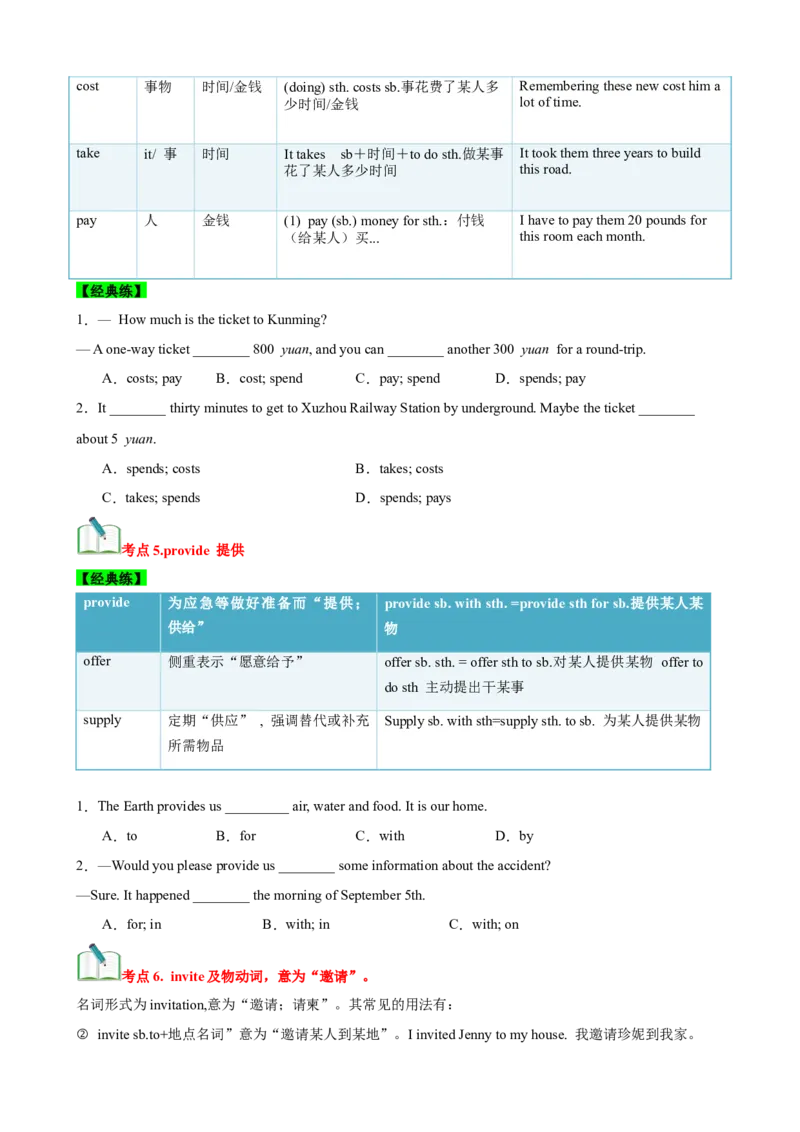
sth.意为“花费时间/金钱做某事” building this bridge.cost 事物 时间/金钱 (doing) sth. costs sb.事花费了某人多 Remembering these new cost him a
少时间/金钱 lot of time.
take it/ 事 时间 It takes sb+时间+to do sth.做某事 It took them three years to build
花了某人多少时间 this road.
pay 人 金钱 (1) pay (sb.) money for sth.:付钱 I have to pay them 20 pounds for
(给某人)买... this room each month.
【经典练】
1.— How much is the ticket to Kunming?
— A one-way ticket ________ 800 yuan, and you can ________ another 300 yuan for a round-trip.
A.costs; pay B.cost; spend C.pay; spend D.spends; pay
2.It ________ thirty minutes to get to Xuzhou Railway Station by underground. Maybe the ticket ________
about 5 yuan.
A.spends; costs B.takes; costs
C.takes; spends D.spends; pays
考点5.provide 提供
【经典练】
provide 为应急等做好准备而“提供; provide sb. with sth. =provide sth for sb.提供某人某
供给” 物
offer 侧重表示“愿意给予” offer sb. sth. = offer sth to sb.对某人提供某物 offer to
do sth 主动提出干某事
supply 定期“供应” , 强调替代或补充 Supply sb. with sth=supply sth. to sb. 为某人提供某物
所需物品
1.The Earth provides us _________ air, water and food. It is our home.
A.to B.for C.with D.by
2.—Would you please provide us ________ some information about the accident?
—Sure. It happened ________ the morning of September 5th.
A.for; in B.with; in C.with; on
考点6. invite及物动词,意为“邀请”。
名词形式为invitation,意为“邀请;请柬”。其常见的用法有:
② invite sb.to+地点名词”意为“邀请某人到某地”。I invited Jenny to my house. 我邀请珍妮到我家。②invite sb.to do sth. 意为“邀请某人做某事”。They invite me to play the game.他们邀请我来玩这个游
戏。
【经典练】
1.Would you please ________ them ________ us in the games?
A.inviting; join B.invite; to join C.to invite; to join D.to invite; join
2.I won’t go to Tina’s birthday party unless I ________.
A.am inviting B.will be invited C.was invited D.am invited
3.—Who would you like ________ join your birthday party?
—My friends.
A.to invite to B.to invite C.invite D.inviting to
考点7.depend 依靠,依赖
depend on意为“依靠;依赖”,主语通常是表示人的词,其中depend用作动词,意为“依靠;依赖”。
Independence 为名词独立,其形容词是independent独立的。
You can't depend on your parents forever.你不能永远依赖你的父母。
[拓展]depend on 其他的用法:
①depend on意为“信赖”。You can depend on this English dictionary.
②depend on意为“取决于;视······而定”。Everything depends on whether you pass the exam.
③It depends.看情况吧
【经典练】
1.—What is the best way to visit Nanjing?
—________. When I don’t need to rush, I’d like to see it by bike.
A.No problem B.Forget it C.With pleasure D.It depends
2.Children these days depend ________ their parents too much.
A.in B.at C.on D.of
考点8.throw v. 扔、掷 threw-thrown
throw sb. sth.= throw sth. to sb.
throw away 扔掉、抛弃、浪费 throw at 向…扔去 throw to 扔给
【经典练】
1.—What does the sign mean?
—It means “________”
A.You must be quiet here.B.Don’t walk on the grass here. C.You shouldn’t throw rubbish here.2.Since Huangshi is trying ________ a civilized city (文明城市), you had better ________ the rubbish
everywhere.
A.to create; not throw B.creating ; not throw
C.creating ; don’t throw D.to create ; don’t throw
考点9.the minute(that)·一…就······
the minute(that)意为“一·····就······”,引导时间状语从句,相当于the moment 或者 as soon as.
例:I'll tell her the minute that/the moment that she comes.她一来我就告诉她。
as soon as····“一·····就······”相当于前面学到的 the minute(that).在含有 as soon as引导的时间状语从句的复
合句中,如果主句用一般将来时(或主句含情态动词,或主句为祈使句),从句应用一般现在时。
例: You can go as soon as he comes. 他来了你就可以走。
【经典练】
1.________ I sat down in front of the computer, my mom came over.
A.The minute B.As well as C.If D.As long as
2.—________ is your home from the school?
—Only ________ walk.
A.How far; 5 minutes’ B.How far; 5 minute’s C.How long; 5 minutes’ D.How long; 5 minutes
考点10.pass 给,递
pass sb. sth. =pass sth. to sb. ,意为”把某物递给某人”。
He passed me the magazine. =He passed the magazine to me. 他把那本杂志递给了我。
pass 作动词的其他常见含义①走过;通过 例:The road was so narrow that cars were unable to pass.
②及格,合格 例:I was happy that I passed the exam.
【经典练】
1.More than five hundred students ________ this test in the ________ few years.
A.have pasted; passed B.have passed; pass C.passed; past D.have passed; past
2.—I’d like to read the book over there. Could you pass ________, please?
—Certainly. Here you are.
A.me on it B.it to me C.it for me
考点11.in order to 目的是,为了
in order to表示目的,后接动词原形,可位于句首,也可位于句中。
例:In order to finish the report, he stayed up very late.
拓展延伸in order that 也表示"为了”,其后要接从句。可与in order to或so that 进行转换。例:In order to catch the early bus, he has to get up early.=He has to get up early in order that he can catch the
early bus. =He has to get up early so that he can catch the early bus. 为了赶上早班车,他不得不早起。
【经典练】
1.________ get lost in the forest, we’d better take a compass (指南针) with us.
A.In order to B.Don’t in order to C.In order not to D.In order to not
2.The children start early in the morning ________ get to school on time because their school is far from their
homes.
A.in order B.in order to C.in order that D.so that
考点12.fairness n. 公正性;合理性
为不可数名词。例:The judge was a man of fairness. 这位法官是一个是非公正的人。
fair adj. 公正的 fairness n. 公平性;合理性
unfair adj. 不公正的 unfairness n. 不公平;不合理
【经典练】
1.—Did you watch the show Readers on CCTV 1 last night?
—Yes. It’s very educational. It tells of the ________ of reading classic.
A.importance B.habits C.fairness D.independence
2.In this competition,it's ____ to give each student fifteen minutes to talk.
A.sad B.fair C.dangerous D.delicious
考点13.since因为;既然 ; 从······以后;自······以来
since在此处作连词,意为“因为;既然”,引导原因状语从句,常位于句首。since表示的原因是众所周
知或显而易见的。Since you don't know the boy, I'll ask someone else.
拓展延伸:(1)作连词,意为“从······以后;自······以来”,其引导的时间状语从句常用一般过去时,主
句多用现在完成时。
例:Mary has lived here since she was five. 玛丽从五岁起就一直住在这里。
(2)作介词,意为“从······以后;自······以来",后接表示时间点的词或短语,句子的时态常用现在完成
时。She has been here since three o'clock this morning. 她从今天凌晨三点起就一直在这儿。
(3)作副词,意为“从······以后;自······以来"。常与现在完成时连用。Once she got sick from eating rice
noodles and she hasn't eaten them since. 一次,她吃米线得了病,从那以后,她就再也没有吃过。
【经典练】
1.—How do you like China?
—Great changes ________ since I ________ here 8 years ago.A.have taken place; came B.have taken place; have comeC.took place; came
2.She ________ this book ________ nearly three weeks ago.
A.has borrowed; since B.has borrowed; for C.has kept; for D.has kept; since
考点14. .take care of 照顾;处理
take care of 意为“照顾;处理”,相当于look after或者care for
例:Can you help me take care of/look after/care for my little brother?你能帮我照顾我弟弟吗?
拓展延伸.take care意为“小心;当心”,相当于be careful 和look out
Take care that you don't drink too much!当心别喝得太多!
【经典练】
1.—Can you come to my party on Saturday?
—I’m afraid I can’t. I have to take care of my baby sister this weekend.
A.look for B.look over C.look after
2.—Did you ________ a good idea to make them happy?
—Yes. I will take them to watch the movie Kungfu Panda 4 tonight.
A.take care of B.get out of C.come up with D.look forward to
考点15.stress意为“精神压力;心理负担”。
既可以做可数名词,又可以做不可数名词,意为精神压力,心理负担。作可数名词复数时形式为stresses
例:People find different ways to deal with stresses. 人们找到各种不同的方法来应对压力。
【经典练】
1.When I listen to music, I ____________and forget everything that I worry about.
A.feel relaxed B.am stressed C.feel sad D.am modest
2.—Few students like exams because they bring the students __________
—I agree. I think fewer exams will make students less ______________
A.stress; stressed B.stressed; stress
C.stress; stress D.stressed; stressed
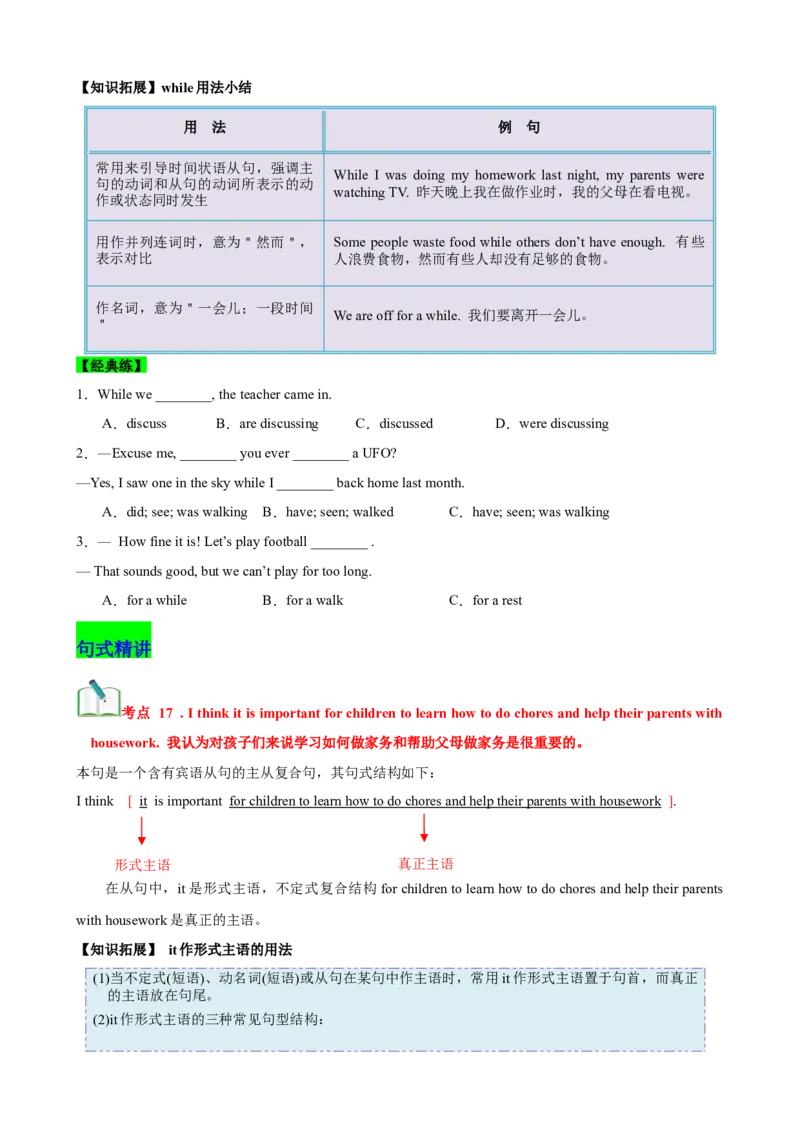
考点16. while
(1)while作连词时,可以意为“当……时候, 和……同时”。例如:
Our friends arrived while we were having dinner. 当我们吃饭的时候,朋友们来了。
(2)while还可作并列连词,意为“而,然而”,表示两者之间的对比。例如:
I like listening to music, while my brother likes doing sports.
我喜欢听音乐,而我的弟弟爱好运动。【知识拓展】while用法小结
用 法 例 句
常用来引导时间状语从句,强调主
While I was doing my homework last night, my parents were
句的动词和从句的动词所表示的动
watching TV. 昨天晚上我在做作业时,我的父母在看电视。
作或状态同时发生
用作并列连词时,意为"然而", Some people waste food while others don’t have enough. 有些
表示对比 人浪费食物,然而有些人却没有足够的食物。
作名词,意为"一会儿;一段时间
We are off for a while. 我们要离开一会儿。
"
【经典练】
1.While we ________, the teacher came in.
A.discuss B.are discussing C.discussed D.were discussing
2.—Excuse me, ________ you ever ________ a UFO?
—Yes, I saw one in the sky while I ________ back home last month.
A.did; see; was walking B.have; seen; walked C.have; seen; was walking
3.— How fine it is! Let’s play football ________ .
— That sounds good, but we can’t play for too long.
A.for a while B.for a walk C.for a rest
句式精讲
考点 17 . I think it is important for children to learn how to do chores and help their parents with
housework. 我认为对孩子们来说学习如何做家务和帮助父母做家务是很重要的。
本句是一个含有宾语从句的主从复合句,其句式结构如下:
I think [ it is important for children to learn how to do chores and help their parents with housework ].
形式主语 真正主语
在从句中,it是形式主语,不定式复合结构for children to learn how to do chores and help their parents
with housework是真正的主语。
【知识拓展】 it作形式主语的用法
(1)当不定式(短语)、动名词(短语)或从句在某句中作主语时,常用it作形式主语置于句首,而真正
的主语放在句尾。
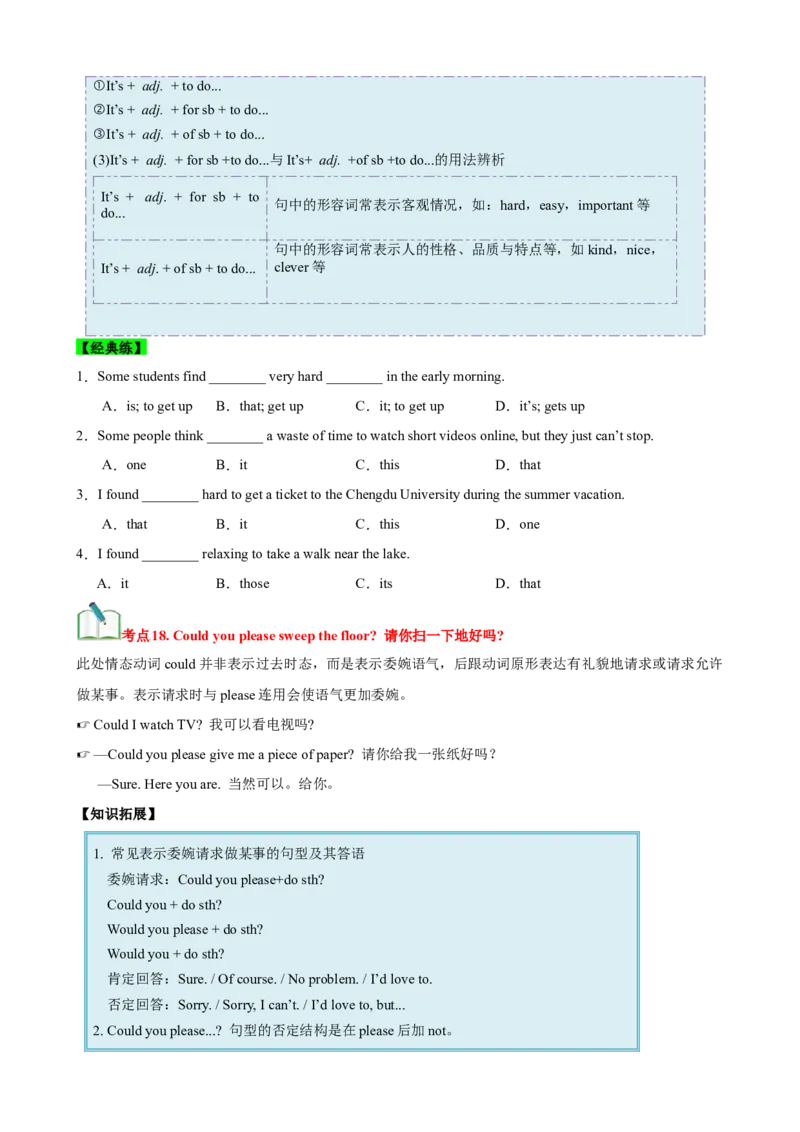
(2)it作形式主语的三种常见句型结构:①It’s + adj. + to do...
②It’s + adj. + for sb + to do...
③It’s + adj. + of sb + to do...
(3)It’s + adj. + for sb +to do...与It’s+ adj. +of sb +to do...的用法辨析
It’s + adj. + for sb + to
句中的形容词常表示客观情况,如:hard,easy,important等
do...
句中的形容词常表示人的性格、品质与特点等,如kind,nice,
It’s + adj. + of sb + to do... clever等
【经典练】
1.Some students find ________ very hard ________ in the early morning.
A.is; to get up B.that; get up C.it; to get up D.it’s; gets up
2.Some people think ________ a waste of time to watch short videos online, but they just can’t stop.
A.one B.it C.this D.that
3.I found ________ hard to get a ticket to the Chengdu University during the summer vacation.
A.that B.it C.this D.one
4.I found ________ relaxing to take a walk near the lake.
A.it B.those C.its D.that
考点18. Could you please sweep the floor? 请你扫一下地好吗?
此处情态动词could并非表示过去时态,而是表示委婉语气,后跟动词原形表达有礼貌地请求或请求允许
做某事。表示请求时与please连用会使语气更加委婉。
☞ Could I watch TV? 我可以看电视吗?
☞ —Could you please give me a piece of paper? 请你给我一张纸好吗?
—Sure. Here you are. 当然可以。给你。
【知识拓展】
1. 常见表示委婉请求做某事的句型及其答语
委婉请求:Could you please+do sth?
Could you + do sth?
Would you please + do sth?
Would you + do sth?
肯定回答:Sure. / Of course. / No problem. / I’d love to.
否定回答:Sorry. / Sorry, I can’t. / I’d love to, but...
2. Could you please...? 句型的否定结构是在please后加not。☞ Could you please not make noises? 请你不要制造噪音好吗?
【经典练】
1.—_________ you please tell me how to make a paper airplane?
—Sure. First, we need a piece of paper and then…
A.Shall B.Could C.Must
考点19.For one week , she did not do any housework and neither did I.
“neither+连系动词 be/助动词/情态动词+主语”表示“······也不”。这是一个倒装结构,表示前面否定
的情况也同样适合后者。neither此处用作副词,也可用nor来替换,意为“也不”。
He doesn't like swimming and neither does Tom.他不喜欢游泳,汤姆也不喜欢。
You can't speak Japanese and neither can I.你不会说日语,我也不会。
[拓展]①neither还可用作代词,意为“两者都不”,其反义词为both,意为“两者都”。
Neither of his parents knows/know English.他的父母都不懂英语。
Neither of the answers is/are right. 两个答案都不对。
②neither也可用作限定词,意为“两者都不(的)”,其后直接跟可数名词的单数形式。作主语时,谓
语动词用单数形式。Neither answer is right. 两个答案都不对。
【经典练】
1.—Shall we go to the science and technology museum this Saturday or Sunday?
—________ day is OK. We can visit there next week.
A.Both B.Either C.Neither
2.—Helen, have you ever been to the Fujian Provincial Museum with Jane?
—________ of us has. We plan to go there next week.
A.Either B.Neither C.None
3.—Shall we go to Wuyi Mountain or Qingyuan Mountain this weekend?
—________ is OK, as long as we can get close to the nature.
A.Both B.Either C.Neither
一.语法精讲
情态动词could的用法could
can 的过去式 礼貌地请求 提出建议 推测
一、提出礼貌的请求
could表示委婉地请求,其句型结构主要有:
1. Could you +动词原形+...?
2. Could you please+动词原形+...?
意为"请你做……好吗? "句型2比句型1语气更加委婉。肯定回答:Yes, sure. / Sure. / Of course. /
No problem. 否定回答:Sorry. / Sorry, I can’t.
☞ Li Lei, could you please help me? 李雷,请你帮我个忙好吗?
☞ —Could you come here soon? 你尽快过来,行吗?
—Sure. 当然可以。
☞ —Could you please close the window? 请你关上窗户好吗?
—I’m afraid not. 恐怕不行。
【注意】其否定结构为:Could you(please)not do...?
【知识拓展】
Would you mind doing sth? 也可表示请求,常用句型:
Would you please + do sth?
Would you + do sth?
肯定回答:Sure. / Of course. / No problem. / I’d love to.
否定回答:Sorry. / Sorry, I can’t. / I’d love to, but...
☞ —Would you mind cleaning your room? 你介意去打扫你的房间吗?
—No. I’d like to. 不,我很乐意。
二、表示请求许可
1. could表示请求允许,其句型结构为:
Could I/we +动词原形+...? 意为"请问我(们)能做……吗? "
肯定回答:Sure. / Of course. / No problem.
否定回答:I’m sorry / Sorry, you can’t. 若关系比较亲近,也可以直接说No, you can’t.
【温馨提示】在以上句子结构中情态动词could不是can的过去式,而是用来表示委婉语气的,后跟动词
原形。
☞ Could I come in? 我可以进来吗?
2. 另外,用Could I ...?时,表示请求对方准许,对方回答时不能用could,而要用can。☞ —Could I use your bicycle? 我可以用你的自行车吗?
—Yes, you can. 是的,可以。学!科网
3. 对于这种请求的肯定和否定回答的常用语
肯定回答常用语:Certainly. / Of course. / With pleasure. / No problem. / Sure. / Yes, you can.
否定回答常用语:I’m afraid not. / No, I’m afraid I can’t. / No, you can’t.
三、could与can的区别
could与can都是情态动词,could是can的过去式。二者都可用于表示请求,但是用法稍有不同:
1. can表示一般性的请求,语气随便,常用于熟人之间或长辈对晚辈、上级对下级的场合。
☞ Can you tell us your story, Tony? 你能给我们讲讲你的故事吗,托尼?
2. could表示有礼貌地请求,语气委婉,常用于非熟人之间或晚辈对长辈、下级对上级的场合。
☞ —Could you tell us if it snows in winter in Australia? 请告诉我们,澳大利亚冬天下雪吗?
—Sure. 当然可以。
二、家务劳动
Unit 3 Could you please clean your room?
单元写作小专题
【单元话题分析】
本单元以"家务、杂务"为话题,围绕这一话题,引导学生学习掌握情态动词could表示委婉地请求
以及请求许可的用法。以谈论家务以及对家务喜欢与不喜欢的原因和理由为话题的作文或是请求他人帮
忙的电子邮件之类的书面表达是单元测试或中考所常考查的。
【单元写作目标】
本单元的话题为“做家务”,该话题就“学生是否应该做家务”提出观点,然后进一步阐述其利
弊。在写作时,要学会运用“Could I…?/Could you…?”来表达“请求得到许可”和运用“I
think/believe that…”或“I agree/disagree that…”表达自己的观点。
【单元写作素材】
◆开头句
①It is everyone’s duty to do chores.
②I think it is necessary for us to do housework.
③Now many students are too lazy to do housework at home.
④I think we should help parents do some housework.
◆中间句
①I swept the floor at first and took out the rubbish.
②We should finish our homework independently and make a study plan carefully.
③What’s more,I also cooked some porridge.
④Third,doing housework can relax ourselves.⑤I often help my parents with much housework,such as cleaning the rooms,taking out the rubbish and doing the
dishes.
◆结尾句
①I believe if we can do these things,we will be more independent.
②I think it’s our duty to share housework to keep the house clean and tidy.
◆谚语积累
1.Practice makes perfect.熟能生巧。
2.Easier said than done.说起来容易做起来难。
1.假如你是李华,某英文报刊正在就“Should Teenagers Help Their Parents with Housework?”这一话
题展开征文活动,请你根据自己的体会,写一篇短文向该报社投稿。
要点提示:
1. 你认为青少年应该帮助父母做家务吗?
2. 你的理由是什么?
写作要求:
1. 词数80词左右(文章格式已经给出,不计入总词数);
2. 根据要点提示,可以适当发挥;
3. 文中不得出现真实的姓名及校名。
Dear Sir or Madam,
___________________________________________________________________________________________
___________________________________________________________________________________________
___________________________________________________________________________________________
___
Yours,
Li Hua
【答案】例文:
Dear Sir or Madam,
I think that teenagers like me should help their parents with housework.
First, doing housework makes us independent. We can’t depend on our parents all the time. So we should
learn how to take care of ourselves now. Second, doing housework is a kind of physical exercise. It helps us stay
healthy and strong. Third, since we live in a house with our parents, it’s fair for us to work together and make the
house clean and comfortable.
In my opinion, doing housework helps us learn life skills and understand the idea of fairness. So I thinkteenagers should learn to enjoy doing chores with their parents.
Yours,
Li Hua
【详解】[总体分析]
①题材:本文是一篇书信作文;
②时态:时态为 “一般现在时”;
③提示:写作要点已给出,注意不要遗漏信息提示,适当增加细节,并突出写作重点。
[写作步骤]
第一步,表明观点,青少年应该帮助父母做家务;
第二步,详细阐述自己觉得应该这样做的理由;
第三步,书写总结。
[亮点词汇]
①help sb. with sth.帮助某人某事
②depend on依靠
③take care of关心
④stay healthy 保持健康
⑤in one’s opinion在某人看来
[高分句型]
①I think that teenagers like me should help their parents with housework. (宾语从句)
②In my opinion, doing housework helps us learn life skills and understand the idea of fairness. (动名词作主语)
2.李梅的父母都是医生。由于疫情的暴发,他们去了武汉做志愿工作,所以李梅和爷爷奶奶在家。
懂事的李梅经常帮助爷爷奶奶做家务。
假如你是李梅,一天父母打电话说要从武汉回家,你决定把家打扫得干干净净。请你根据下面的提
示写一篇短文,可适当发挥,80词左右。短文的开头已给出,不计入总词数。
提示:
1. Why did you do the housework?
2. What housework did you do?
3. How did your parents feel?
My parents went to Wuhan as volunteers as medical staff. One day,
___________________________________________________________________________________________
___________________________________________________________________________________________
___________________________________________________________________________________________
______________________________________________________________________________________________________________________________________________________________________________________
___________________________________________________________________________________________
___________________________________________________________________________________________
___________________________________________________________________________________________
________
【答案】
例文
My parents went to Wuhan as volunteers as medical staff. One day, they called me they would come back, so
I decided to clean up the house to make them happy. After having breakfast, I did the dishes. After that, I began to
clean the living room. I swept the floor, cleaned the windows and took out the rubbish.
After having a break, I began to do some washing. At about half past eleven, I finished all the chores. I was
tired but happy.
When my parents got home, they were surprised to find I did so many chores and made the house so clean.
They said “Dear, you really did a good job! Thank you.” Hearing this, I was really proud of myself.
【详解】1.题干解读:本文是一篇材料作文。要求根据英文提示写一篇英语短文,可适当发挥。
2.写作指导:本文时态采用一般过去时,人称采用第一人称和第三人称相结合。描写做了什么家务时,场
景要连贯细致;重点描写父母回家后看到自己做了这些事情的感受,要生动形象。写作时要有逻辑性,
无语法和标点错误。
一、单词转换
1. sweep(v.) → swept (过去式/过去分词)扫;打扫
2. throw(v.) →threw (过去式)扔;掷 →thrown (过去分词)
3. lend(v.) →lent (过去式/过去分词) 借给;借出
4. depend(v.) 依靠;信赖 →independent (adj.)独立的;自主的 →independence (n.)独立
5. develop(v.) 发展;壮大 →development (n.) 发展;发育;成长
developing country 发展中国家 developed country 发达国家
6. fair(adj.) 合理的;公正的→unfair (反义词)不合理的;不公正的
→fairness (n.)公正性;合理性
7. drop(v.) →dropped (过去式/过去分词) →dropping (现在分词) 落下;掉下
二、短语1. take out the rubbish 倒垃圾
2.fold the clothes 叠衣服
3. sweep the floor 扫地
4.make the bed整理床铺
5. go out for dinner 出去吃饭
6.stay out late 在外面待到很晚
7.get a ride 搭车
8. work on从事
9. help out with housework =help out around the house 帮忙做家务
10. throw down扔下
11.come over 过来
12. take the dog for a walk 遛狗
13. all the time一直;总是
14.shout back 吼回去
15.ask in surprise 惊讶地问
16. share the housework 分担家务
17. neither of us 我们两人都不
18.as soon as一····就······
19. get something to drink 拿点喝的东西
20.hang out with friends 和朋友出去闲逛
21. pass sth.to sb.把某物传给某人
22.lend me some money 借我些钱
23. get wet 淋湿
24. do chores 做杂务;做家务
25. invite my friends to a party 邀请我的朋友们来参加聚会
26. have enough stress from school 有来自学校足够多的压力
27.have time to do sth.有时间做某事
28. a waste of time 浪费时间
29. in order to do sth.为了做某事
30. get older 长大
31. provide sth. for sb. 给某人提供某物
32.depend on 依靠;依赖
33. be always doing sth. 总是/一直做某事34. the idea of fairness公平意识
35. do one's part in (doing) sth. 尽自己的职责
36. take care of/look after 照顾
37. as a result 结果
38.fall ill生病
三、重点句型
1. Could you please clean your room?
你能整理一下你的房间吗?
2. Could I use your computer?
我可以用一下你的电脑吗?
3. She won’ t be happy if she sees this mess.
如果她看到这样乱七八糟的话,她会不高兴的。
4. For one week, she did not do any housework and neither did I.
整整一周,她什么家务活都不干了,我也一样。
5. My mom came over as soon as I sat down in front of the TV.
我一在电视机前坐下,我妈妈就过来了。
6. Peter, could you please take out the rubbish?
彼得,你能把垃圾倒了吗?
7. I think two hours of TV is enough for you!
我觉得你看两个小时的电视已经足够了。
8. The minute I sat down in front of the TV, my mom came over.
我刚坐在电视机前面,我妈妈就过来了。
9. For one week, she did not do any housework and neither did I.
一周的时间,她不做任何家务,我也不做。
10. The next day, my mom came home from work to find the house clean and tidy.
第二天,妈妈下班回到家后发现房间很干净、整洁。
11. “ I’m do sorry, Mom. I finish understand that we need to share the housework to have a clean and comfortable
home.” I replied.
“对不起,妈妈。我终于理解为了拥有一个干净、舒适的家我们需要共同来分担家务。” 我回答说。
12. Could you please pass me the salt?
你能把盐递给我吗?
13. Could I invite my friends to a party?
我能邀请我的朋友们来聚会吗?14. I don’t understand why some parents make their kids help with housework and chores at home.
我不理解为什么有些父母在家让孩子们帮忙做家务和杂务。
15. Housework is a waste of their time.
做家务是在浪费他们的时间。
16. They should spend their time on schoolwork in order to get good grades and get into a good university.
为了取得好成绩并考上一所好大学,他们应该把时间用在学习上。
17. Also, when they get older, they will have to do housework so there’s no need for them to do it now.
而且,当他们长大的时候,他们也将会做家务,因此,他们没必要现在在做。
18. It is the parents’ job to provide a clean and comfortable environment at home for their children.
在家为孩子们提供一个干净、舒适的环境是父母的义务。
19. And anyway, I think doing chores is not so difficult.
无论如何,我认为做家务并不那么难。
20. ... Everyone should do their part in keeping it clean and tidy.
每个人都有责任保持家里的干净和整洁。
21. Doing chores helps to develop children’s independence and teaches them how to look after themselves.
做家务不仅可以培养孩子们的独立性还可以教他们如何照顾自己。
四、语法
情态动词could的用法
原文再现:
Tony, could you please help me out with a few things? 托尼,你可以帮着做几件事情吗?
Peter, could you please take out the trash? 彼得,你能把垃圾倒了吗?
以上例句中,情态动词could用于有礼貌地提出要求或请求准许,在时间上与can没有区别,语气要比
can委婉、有礼貌。回答时要用can,不能用could.
肯定回答:Sure./ Of course./ Certainly./No problem.
否定回答: Sorry , I can’t
【复习】could 的其他用法:
(1) could为can 的过去式,表示能力。
eg. Could the girl read before she went to school? 这个女孩上学前能识字吗?
He said that he couldn’t come. 他说不能来了。
(2) could可以表建议,意为“可以”, 在时间上与can没有区别,语气比can更加委婉。没有人称和数
的变化,其后直接跟动词原形。
eg. We could help them clean the classroom. 我们可以帮助他们打扫教室。
You could try your best to help the old people. 你可以尽力去帮助老人。