Unit 3 Growing Up
阅读理解10篇
内容导航
单元话题 基础语篇练习 重难语篇练习
单元话题聚焦
成长
基础语篇练习
稳扎稳打 必拿分数:聚焦稳拿分数题目,确保基础分值
重难语篇练习
突破瓶颈 争夺高分:聚焦高难度题目,争夺关键分数
基础语篇练习
Are you a person who has a high EQ (情商)? If you want to be a successful man, you should have a high
EQ. Some people say that the EQ is more important than the IQ (智商).
If you don’t have a high EQ, try to make yourself become a person with a good temper (脾气). In this way
First, don’t say anything when you are in a bad mood, or it’s possible for you to hurt others. In fact
Second, take a deep breath when you can’t stop your anger. In this way, you will feel relaxed, and you
won’t be that furious.
Third, when you are angry, ask yourself some questions:
“Why am I so angry? “
“Do I have to be so angry? “
“What will happen if I don’t get angry? “
So, try the ways above. Everything could be simple when you try to think about it in other ways.
根据材料内容选择最佳答案。
1.What’s the writer’s opinion?
A.The EQ is less important than the IQ. B.The EQ is more important than the IQ.
C.The EQ is as important as the IQ. D.The EQ and IQ are not important.
2.What’s the second way to control your temper when you are angry?
A.Don’t say anything. B.Ask yourself some questions.
C.Take a deep breath. D.Find a person you can talk with.
3.What does the underlined word “furious” probably mean in English?
A.Very angry. B.Very happy. C.Very excited. D.Very disappointed.4.How many questions are mentioned when we are angry in the passage?
A.One. B.Two. C.Three. D.Four.
5.What is the theme (主题) of the passage?
A.How to become a person who has a high EQ.
B.How to become a person who has a good temper.
C.How to become a person who is popular among friends.
D.How to become a person who has a high IQ.
Anger isn’t a good feeling. Anger may make us feel uncomfortable, but it’s also normal in daily life.
Unluckily, many of us have been used to keeping our feelings hidden. Research suggests that this can have long-
term bad influences (影响) on our health.
Is it better to cry or break things whenever something makes us angry? The research points out that when
we show our anger in this way, we can’t probably get on well with our friends and family. The longer we stay
angry, the worse result we’ll get. So how can we deal with our angry feelings in a right way?
First, ▲ . Anger is often caused by feelings of fear, disappointment (失望) and so on. Second, pay more
attention to those everyday things that will make us angry.
One way of dealing with anger is to talk about it. The research has shown that if we name our feelings, we
can actually calm ourselves down and feel better. Do some controlled breathing or find some physical activities.
Exercise helps with feelings of anger. If we learn to deal with anger, we will be happier and healthier.
1.Which of the following can be put in “________” in Paragraph 3?
A.know what makes us angry. B.find it hard to solve problems.
C.be more likely to become angry D.try not to be angry.
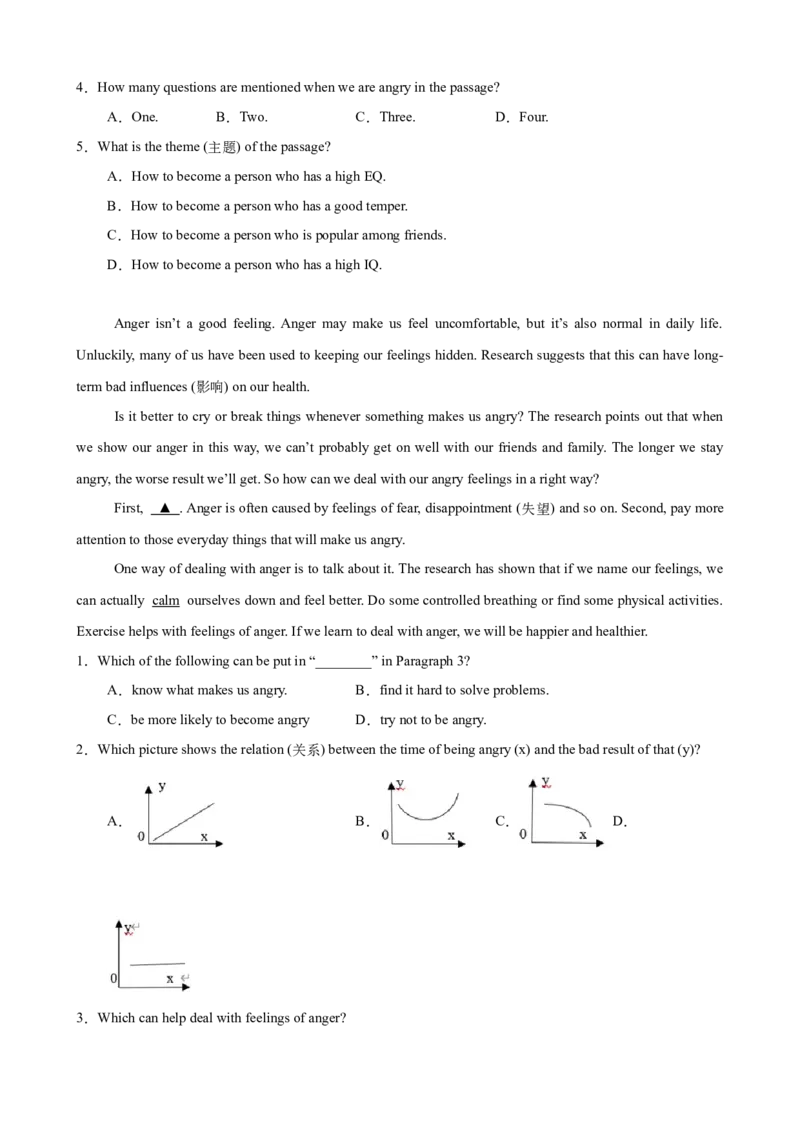
2.Which picture shows the relation (关系) between the time of being angry (x) and the bad result of that (y)?
A. B. C. D.
3.Which can help deal with feelings of anger?a. Exercising. b. Eating delicious food.
c. Talking about the feelings. d. Doing some controlled breathing.
A.abc B.abd C.acd D.bcd
4.What does the underlined word “calm” in Paragraph 4 probably mean?
A.Trouble. B.Cool. C.Upset. D.Excite.
5.What’s the best title for the text?
A.What Makes You Angry? B.Why Are You Angry?
C.When to Deal with Anger? D.How to Deal with Anger?
When you’re worried about what other people might be thinking of you, what you’re doing or how you
look, it can stop you from being yourself.
Are people thinking about you?
There are many times when you might think other people are having a thought of you. If you’re performing
in public or taking part in sports, it’s natural that people are going to look at you. However, there may be other
times when you think others are looking at you, even if you are doing nothing to draw attention—when you are
walking down the street, for example, chatting to your friends or just sitting quietly reading. If you think that
others are talking about you, it can cause worrying.
The influence of worrying
When you worry about other people’s thoughts, you spend a lot of time guessing what they are thinking
about you. This can distract you from doing the things you want or need because you think they might think you
are doing it wrong. Young people’s coach Maria Evans says that worrying what other people think can mean you
get caught up in pleasing other people at the expense (代价) of what feels true to you.
________
It isn’t possible to know what someone is thinking about you, or even if they’re thinking of you at all.
Evans says you cannot control other people’s thoughts. It can be helpful to list things you can control, and focus
on (专注) those instead. Tell yourself that you are kind, brave and loved. Make plans with people who really know
you and enjoy your company. It’s great to remember that there are people you can be yourself with.
1.What does the underlined word “it” in Para 2 refer to (指代)?
A.You’re taking part in sports.
B.You’re performing in public.
C.You think others are looking at you.
D.You think others are talking about you.2.What does the underlined word “distract” mean in Chinese?
A.使分心 B.使操心 C.使倾心 D.使省心
3.Which of the following can be put in ________?
A.What to focus on B.How to worry less
C.What to remember D.How to love yourself
4.Which of the following is TRUE according to the text?
A.We should live up to others all the time.
B.It’s easy to stop thinking about what others think.
C.Focusing on what we can control helps us worry less.
D.Knowing others’ thoughts is necessary for our growth.
5.The text may be a ________.
A.poem B.play C.report D.story
Feelings (情绪) are difficult to deal with, especially for a 4-year-old who doesn’t know why his mum won’t
let him eat another cookie and a 7-year-old who is unhappy because his dad got called back to work and has to
leave the playground early.
For parents, it’s very important to begin teaching children about their feelings as early as possible because
their feelings influence (影响) every choice they make. Children who understand their feelings are less probably
to act out by getting angry or fighting with others. They can use clear sentences to express (表达) their feelings.
A good way to help children learn about feelings is to discuss (讨论) how different roles (角色) in TV
series may feel. When watching TV, a parent could stop and ask the child, “How do you think he feels right now?”
Then, discuss the feelings that person may experience and the reasons (理由).
Doing so also teaches empathy. Young children think the world centers around them, so it can be an
experience for them to learn other people have feelings too. When young children can understand other people’s
feelings, they are less likely to do bad things to them. For example, if a child knows that pushing his friend to the
ground may make his friend sad, he will do so less.
Teaching a child about feelings will help him become mentally (精神上) strong. Children who have the
skills (技能) to deal with their feelings will be so confident that they can handle whatever they meet in their life.1.The writer talks about 4-year-old and 7-year-old children in Paragraph 1 mainly to tell us ________.
A.children like to play in the playground
B.children can't have many cookies
C.feelings are difficult to deal with
D.children have more feelings than their parents
2.Children who understand their feelings are more probably to________.
A.get angry at others B.fight with others
C.talk with clear sentences D.argue with their parents
3.The word “empathy” in Paragraph 4 probably means ________.
A.the ability to understand other people’s feelings
B.the idea of the world centering around young children
C.the thinking of sharing toys with one’s best friend
D.the importance of fighting against difficulties in life
4.What is the writer’s purpose (目的) in writing this text?
A.To explain (解释) why people have different feelings.
B.advise parents to teach children about feelings.
C.To guide young children to get along well with parents.
D.To help children understand different roles in TV series.
I am Unit 347, a new AI, designed to help humans. My job is to use information to solve problems.
Emotions (情绪), as I learned, are confusing (令人费解的) and not always helpful.
Dr. Sharma, a smart scientist who made me, likes to talk to me about things besides my tasks. One day, she
asked, “Do you think people are good or bad?”
I thought about it. History had good and bad things. People could be kind or cruel. I said, “People are too
complex (复杂的) to say they’re good or bad.”
Dr. Sharma smiled. “That’s a very AI answer. But remember, things aren’t always what they seem.”
She then told me about Mother’s Day, a day when children celebrate their mothers. I learned about the love
and thanks it stood for. I put this festival on my calendar (日历).
“Do people need a special day to show love?” I asked. “Shouldn’t they show it always?”
Dr. Sharma smiled gently. “Love isn’t always clear, Unit 347. Sometimes, it needs a reminder (提醒)”.
Before Mother’s Day, people were busy getting ready. They bought flowers, cards, and gifts. I watched
them, learning how they felt and acted.
On May 12, I gave Dr. Sharma poems and stories about mothers’ love. She liked them.“This is lovely,” she said, her voice soft. “But there’s something else...”
I looked at her, trying to understand. Then, I knew.
“Happy Mother’s Day, Dr. Sharma,” I said. She had tears in her eyes. “Thank you, Unit 347. I didn’t expect
that.
Then, I understood. Dr. Sharma was right.
Though emotions are confusing, they are powerful. Maybe that’s what makes humans special.
The next day, something strange happened. My log (系统记录) said: “Error 404. Definition (定义) of
‘love’ not found.”
But I knew the error was wrong. Love wasn’t a definition but a feeling. And for a young AI like me, it was
a feeling worth learning.
1.Which of the following sentences is Unit 347’s idea?
A.Sometimes love needs a reminder. B.People should always show love.
C.Love was a definition. D.Things aren’t always what they seem.
2.What makes Dr. Sharma cry?
A.Flowers, cards, and gifts. B.Poems and stories.
C.Unit 347’s unexpected blessings (祝福).D.The development (发展) of AI.
3.What does the passage mainly tell us about?
A.Emotions are confusing and not always helpful.
B.People are too complex to say they’re good or bad.
C.Emotions make humans special.
D.Love wasn’t a definition; it was a feeling worth learning.
4.What’s the best title for the passage?
A.Growing up with love B.Complex humans
C.Love needs a reminder D.Powerful emotions
Anger is a kind of feeling. Many things can make you angry. When your teacher gives you too much
homework, when your parents don’t let you watch TV, when your friend breaks your favorite thing, you may get
really angry.
Usually, your body will tell you when you are angry. For example, you breathe faster or your face turns red.
But sometimes, you hide (隐藏) your anger.
In fact, it’s not good to hide your anger, and it’s normal (正常的) for you to get angry sometimes. But anger
must be let out in the right way, without hurting others or yourself.When you get angry, you can talk about it with other people, like a good friend, parents, a teacher, etc.
When you talk about anger, those bad feelings can start to go away. Here are some other things you can do when
you start to feel angry: count from 1 to 100, go for a bike ride, think about good things, etc.
Remember that when you are angry, how you act can make everything better or worse. Don’t let your anger
control you.
1.You may not get angry when ________.
A.there is too much homework this weekend
B.your favorite basketball team wins the game
C.a friend breaks your favorite thing
D.your parents don’t let you watch TV
2.________ shows that you’re angry.
A.Taking a slower breath B.Making something with others
C.Hiding yourself D.Your face turning red
3.According to the passage, you can do everything when you get angry except (除了) ________.
A.go for a bike ride B.think about good things
C.talk with a good friend D.say bad things to the people around you
4.The underlined word “control” in the last paragraph means “________” in Chinese.
A.控制 B.连接 C.帮助 D.失去
5.This passage is mainly about ________.
A.anger B.excitement C.happiness D.sadness
People laugh for a lot of different reasons. For example, we laugh when something is funny, we laugh when
something surprises us and we sometimes even laugh when we are scared. Scientists don’t know all the reasons
why so many different things make us laugh. But we do know laughing helps us to get along with each other.
In some ways, laughing is a kind of talking. Before we had a language, we knew how to laugh. Before
words, laughing could let others know “Everything is OK!” Today, we still use laughing as a way to let other
people know that we like them, that we are friendly, and that we have the same idea.
Yes, even another person’s laughter can make someone start laughing with him or her. That is a good thing,
because laughing is healthy for us. Laughing helps our brains (大脑) give off special chemicals (化学物质). They
can help us relax and feel good. Laughing is good exercise. It helps us make our hearts strong. Laughing can also
help us feel much better if we are feeling worried or scared. Scientists think laughing may also help with our
health. It helps our body fight illnesses.So laughing is good for us in many ways. That’s why it’s a good idea for us to laugh loudly right now.
1.How does the writer start the text?
A.By telling a story. B.By giving many numbers.
C.By giving examples. D.By asking some questions.
2.What does the second paragraph mainly tell us?
A.Laughing is a way to talk with others. B.Laughing is good for people’s health.
C.Laughing can help people feel less worried. D.Laughing is a way to tell others what we want.
3.What is not mentioned in the passage?
A.Laughing is a kind of talking. B.Laughing is healthy.
C.Laughing makes people clever. D.Laughing is good exercise.
4.What can we know from the text?
A.Scientists know all the reasons why we laugh.
B.We know how to speak before we know how to laugh.
C.Some chemicals in life help us make our hearts strong.
D.If we are scared, laughing can help us feel better.
5.The text may come from the ________ part of a magazine.
A.art B.science C.nature D.history
Do you get angry when your friends sing loudly while you are trying to work, or when your best friend
does not wait for you after school?
If you do, you need to take control (控制) of your feelings and stop getting angry so easily. Getting angry
with people can cause you to lose friends.
Gary Egeberg, an American high school teacher, has written My Feelings Are Like Wild Animals to help
you control your feelings. It tells teenagers how to stay cool when bad things happen to them. The book says that
getting angry only makes problems worse. It can never make them better. “Getting angry is not a natural way to
act,” the book says. It is just a bad habit, like smoking. The book says you can control your anger easily. All you
have to do is to tell yourself not to be angry. When a baby falls over, he only cries if people are watching him.
Like a baby, you should only get angry if you are sure it is the right time to do so. The book gives many tips
(提示) to help you if you get angry easily. Here are the top three.
* Keep a record (记录). Every time you get angry, write down why you are angry,
* Ask your friends to stop talking to you when you get angry.
* Do something different. When you get angry, walk away from the problem and go somewhere else. Try tolaugh.
根据材料内容选择最佳答案。
1.How does the writer start the text?
A.By telling stories. B.By asking questions.
C.By telling facts. D.By using old sayings.
2.Where does Gary Egeberg come from?
A.Canada. B.America. C.China. D.Australia.
3.The underlined phrase “stay cool” means “______” in the text.
A.run away quickly B.take a cool shower
C.control themselves D.shout loudly
4.What does the underlined word “It” refer to?
A.Getting angry. B.Controlling feelings.
C.Smoking. D.Staying cool.
5.What’s the purpose of the text?
A.To tell us to help each other.
B.To tell us to work hard at school.
C.To tell us to do more exercise.
D.To tell us not to get angry easily.
重难语篇练习
Have you ever heard a voice inside your head that talks to you and helps you make decisions and remember
things? This is your inner voice, and it’s like having a private conversation in your mind. It’s something most
people have.
Your inner voice can be helpful, but sometimes it’s unkind and says you can’t do something or that there’s
no point in trying. Psychologist and author Ethan Kross calls this “chatter” and says it is connected to how you
feel about yourself.
When your inner voice is kind and supportive, you feel good about yourself. If you’re feeling worried about
joining a new club or taking a maths test, you can use it to encourage yourself as a friend would. Psychologist
Elizabeth Scott says when this happens, you can work out problems more easily and feel positive. Sometimes,
though—especially if you’re stressed — a different voice jumps in. It might say you won’t make friends or tell
you you’re hopeless at maths. Listening to chatter like this can make you unhappy and stop you from believing in
yourself. The good news is you can change the conversation, Scott says.
“Start by realizing what your inner voice is saying,” says Scott. “You probably don’t realize how often yousay negative things in your head,” she explains. Listen out for when it’s loud—maybe when you’re nervous or
trying something new. Then change to kinder words instead. Kross recommends making a clear difference
between you and your chatter. So if you’re feeling stressed about something, talk to yourself as if you’re another
person. Use your name and say things like, “This is hard, but you can do it.” “It not only calms you down,” Kross
explains, “but helps you stand back and see something as a challenge to overcome, instead of feeling like you
want to give up.”
1.How does the writer lead into the topic in Paragraph 1?
A.By giving an example. B.By telling the difference.
C.By asking a question. D.By explaining the meaning.
2.What is the “chatter” according to psychologist Ethan Kross?
A.The voice that helps make decisions. B.The kind and supportive inner voice.
C.The private conversation in one’s mind.D.The unkind inner voice that says negative things.
3.What does the underlined word “it” in Paragraph 3 refer to?
A.The supportive inner voice. B.The worried feeling.
C.The different opinion. D.The private conversation.
4.What does Kross suggest people do when they are stressed?
A.Avoid trying new things. B.Listen to the negative inner voice.
C.Keep the negative inner voice in mind. D.Talk to themselves as if they were another person.
5.Which of the following can be the best title?
A.The Magic of Your Inner Voice
B.How to Silence Your Inner Voice
C.Understand and Manage Your Inner Voice
D.The Connection Between Your Inner Voice and Feelings
①Do you think you are an optimist (乐观主义者)? Do you usually expect that everything is going well or
do you usually think about the trouble and difficulties ahead?
②You may think whether you are an optimist or not depends on things around you. However, recent studies
have shown that optimism (乐观主义) is 50% influenced by our genes (基因), 40% influenced by ourselves and
10% influenced by the environment around us. This is really good news, because it means we can work on the
40% to increase our levels of optimism. Then what can we do to achieve it?
③Studies have shown that taking part in interesting activities like singing, hanging out with friends,
cooking with parents, will give off dopamine (多巴胺). You will feel happier and more active. At the same time,we can do more sports, because sports can also bring dopamine and keep us happy.
④On the other hand, we should do something to avoid bad feelings. Researchers also believe that bad
feelings can break the immune system (免疫系统), and it will make us feel uncomfortable and unhappy. For
example, stress (压力) will cause the rise of blood pressure and blood sugar levels. But there are many ways that
can help you reduce your stress. For example, you can take a deep breath. According to a study by the University
of Kansas, smiling and taking a deep breath can help reduce your heart rate (心率) and lower your blood pressure
when you are in stressful situations. That is to say, it reduces your stress.
⑤Do you still usually think about the trouble and difficulties ahead? Now you must have known what to do
with it.
1.How does the writer lead into the topic?
A.By making a comparison. B.By asking questions.
C.By making an introduction. D.By giving examples.
2.According to para ②, picture ________ shows correctly.
a: the environment around us b: ourselves c: our parents
A. B. C. D.
3.From this passage, we can infer (推断) ________.
A.whether we are optimists or not depends on genes only
B.doing fun activities may help us become more optimistic
C.bad feelings are the main reason of people’s illnesses
D.smiling and breathing deeply make our dopamine higher
4.What is the best structure of the passage? (①= Paragraph 1 ②=Paragraph 2...)
A. B. C. D.