Unit 5 Nature's Temper(复习讲义)
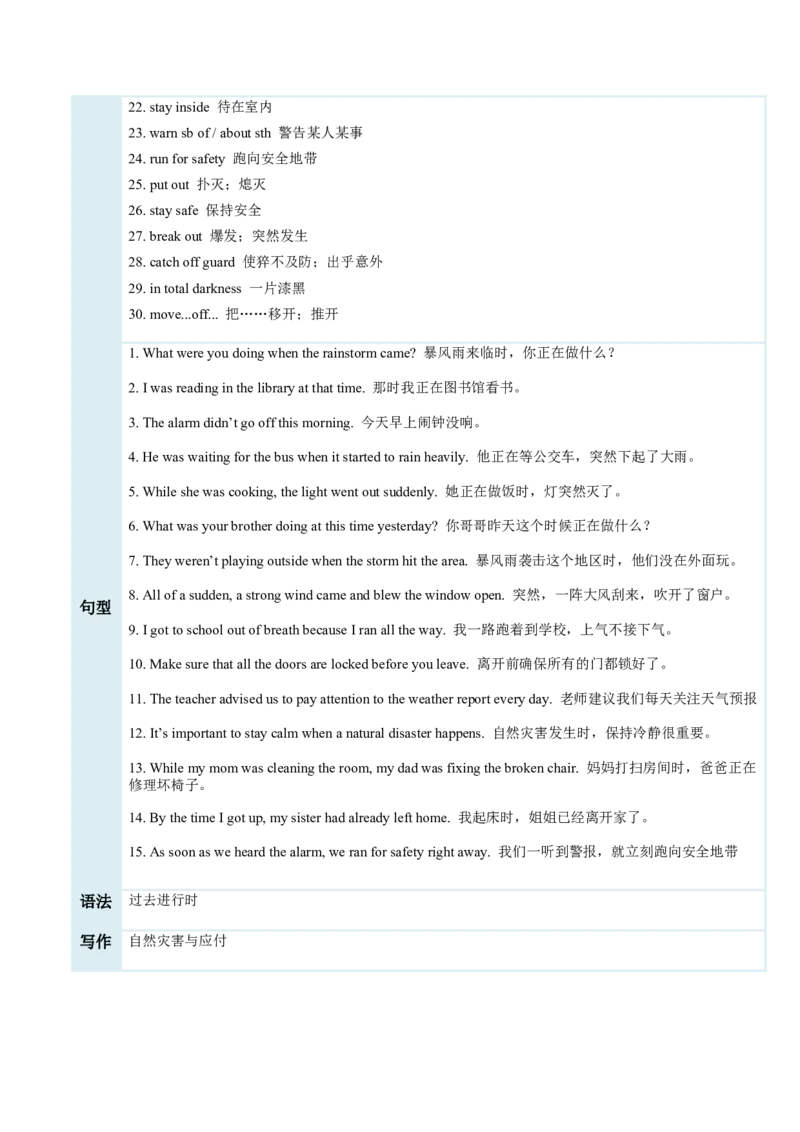
1.temper /ˈtempə(r)/ n. 脾气;怒气
2.earthquake /ˈɜːθkweɪk/ n. 地震
3.typhoon /taɪˈfuːn/ n. 台风
4.wildfire /ˈwaɪldfaɪə(r)/ n. 野火
5.snowstorm /ˈsnəʊstɔːm/ n. 暴风雪
6.flood /flʌd/ n. 洪水;v. 泛滥;淹没
7.tsunami /tsuːˈnɑːmi/ n. 海啸
8.rainstorm /ˈreɪnstɔːm/ n. 暴风雨
9.tornado /tɔːˈneɪdəʊ/ n. 龙卷风
10.heatwave /ˈhiːtweɪv/ n. 热浪
单词
11.landslide /ˈlændslaɪd/ n. 滑坡;塌方
12.floodwater /ˈflʌdwɔːtə(r)/ n. 洪水
13.preparation /ˌprepəˈreɪʃn/ n. 准备;预备
14.security /sɪˈkjʊərəti/ n. 安全;保障
15.hero /ˈhɪərəʊ/ (pl. heroes) n. 英雄
16.neighbourhood /ˈneɪbəhʊd/ n. 街区;社区
17.relative /ˈrelətɪv/ n. 亲戚;亲属
18.power /ˈpaʊə(r)/ n. 电力;能量;力量
19.warn /wɔːn/ v. 警告;提醒
20.wave /weɪv/ v. 挥手;挥舞;n. 波浪21.interview /ˈɪntəvjuː/ v.&n. 采访;面试
22.beat /biːt/ (beat, beaten) v. 敲打;击败
23.hide /haɪd/ (hid, hidden) v. 躲藏;隐藏
24.refuse /rɪˈfjuːz/ v. 拒绝
25.rescue /ˈreskjuː/ v.&n. 救援;营救
26.volunteer /ˌvɒlənˈtɪə(r)/ v. 自愿做;n. 志愿者
27.worst /wɜːst/ adj.&adv. 最坏的(地);最糟的(地)(bad/badly最高级)
28.nearby /ˌnɪəˈbaɪ/ adj.&adv. 附近的(地)
29.thankfully /ˈθæŋkfəli/ adv. 幸亏;感激地
30.terribly /ˈterəbli/ adv. 非常;很糟地
1. do chores 做家务
2. except for 除了……之外
3. wake up 醒来;叫醒
4. by the time 到……时候为止
5. go wrong 出故障;出差错
6. make preparations 做准备
7. as soon as 一……就……
8. go off (闹钟)响;离开
9. out of breath 上气不接下气
10. security guard 保安
短语 11. alarm clock 闹钟
12. all of a sudden 突然;猛地
13. as a result 结果
14. a natural disaster 自然灾害
15. at the time of 在……的时候
16. strong winds and heavy rain 狂风暴雨
17. get flooded 被淹没
18. take place 发生;举行
19. weather report 天气预报
20. clean up 打扫干净;清理
21. pay attention to 注意;关注22. stay inside 待在室内
23. warn sb of / about sth 警告某人某事
24. run for safety 跑向安全地带
25. put out 扑灭;熄灭
26. stay safe 保持安全
27. break out 爆发;突然发生
28. catch off guard 使猝不及防;出乎意外
29. in total darkness 一片漆黑
30. move...off... 把……移开;推开
1. What were you doing when the rainstorm came? 暴风雨来临时,你正在做什么?
2. I was reading in the library at that time. 那时我正在图书馆看书。
3. The alarm didn’t go off this morning. 今天早上闹钟没响。
4. He was waiting for the bus when it started to rain heavily. 他正在等公交车,突然下起了大雨。
5. While she was cooking, the light went out suddenly. 她正在做饭时,灯突然灭了。
6. What was your brother doing at this time yesterday? 你哥哥昨天这个时候正在做什么?
7. They weren’t playing outside when the storm hit the area. 暴风雨袭击这个地区时,他们没在外面玩。
8. All of a sudden, a strong wind came and blew the window open. 突然,一阵大风刮来,吹开了窗户。
句型
9. I got to school out of breath because I ran all the way. 我一路跑着到学校,上气不接下气。
10. Make sure that all the doors are locked before you leave. 离开前确保所有的门都锁好了。
11. The teacher advised us to pay attention to the weather report every day. 老师建议我们每天关注天气预报
12. It’s important to stay calm when a natural disaster happens. 自然灾害发生时,保持冷静很重要。
13. While my mom was cleaning the room, my dad was fixing the broken chair. 妈妈打扫房间时,爸爸正在
修理坏椅子。
14. By the time I got up, my sister had already left home. 我起床时,姐姐已经离开家了。
15. As soon as we heard the alarm, we ran for safety right away. 我们一听到警报,就立刻跑向安全地带
语法 过去进行时
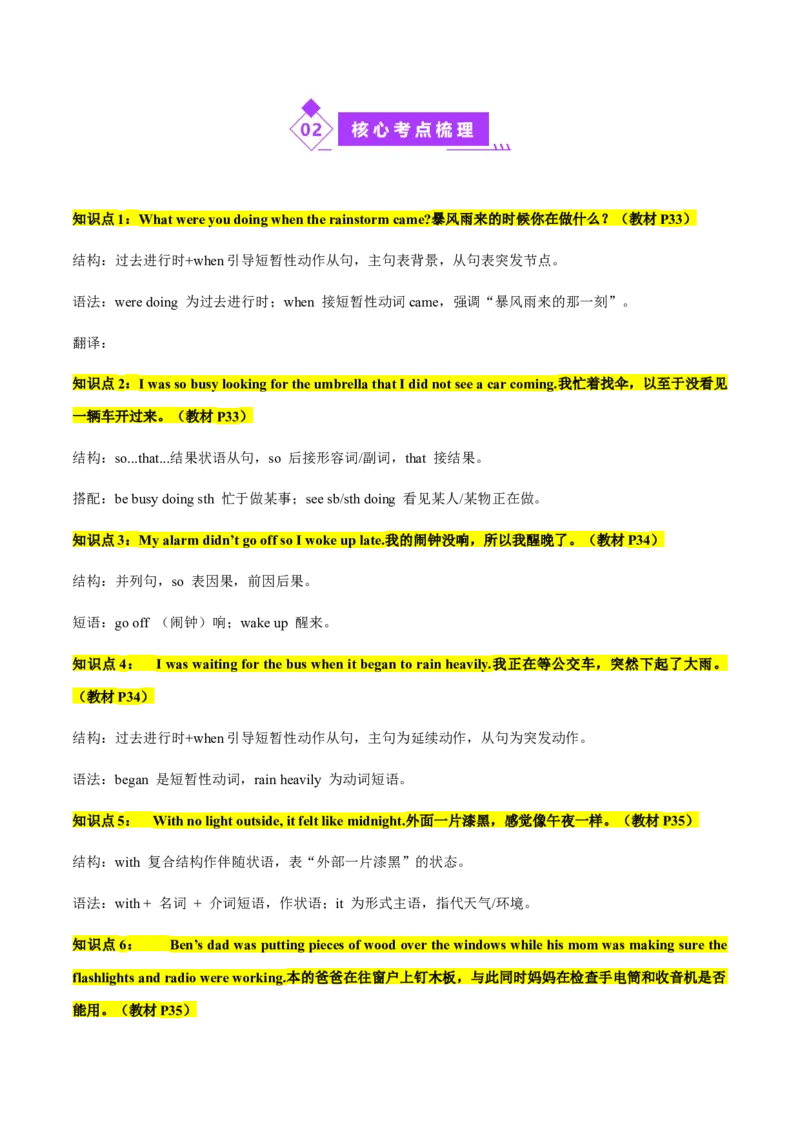
写作 自然灾害与应付知识点1:What were you doing when the rainstorm came?暴风雨来的时候你在做什么?(教材P33)
结构:过去进行时+when引导短暂性动作从句,主句表背景,从句表突发节点。
语法:were doing 为过去进行时;when 接短暂性动词came,强调“暴风雨来的那一刻”。
翻译:
知识点2:I was so busy looking for the umbrella that I did not see a car coming.我忙着找伞,以至于没看见
一辆车开过来。(教材P33)
结构:so...that...结果状语从句,so 后接形容词/副词,that 接结果。
搭配:be busy doing sth 忙于做某事;see sb/sth doing 看见某人/某物正在做。
知识点3:My alarm didn’t go off so I woke up late.我的闹钟没响,所以我醒晚了。(教材P34)
结构:并列句,so 表因果,前因后果。
短语:go off (闹钟)响;wake up 醒来。
知识点4: I was waiting for the bus when it began to rain heavily.我正在等公交车,突然下起了大雨。
(教材P34)
结构:过去进行时+when引导短暂性动作从句,主句为延续动作,从句为突发动作。
语法:began 是短暂性动词,rain heavily 为动词短语。
知识点5: With no light outside, it felt like midnight.外面一片漆黑,感觉像午夜一样。(教材P35)
结构:with 复合结构作伴随状语,表“外部一片漆黑”的状态。
语法:with + 名词 + 介词短语,作状语;it 为形式主语,指代天气/环境。
知识点6: Ben’s dad was putting pieces of wood over the windows while his mom was making sure the
flashlights and radio were working.本的爸爸在往窗户上钉木板,与此同时妈妈在检查手电筒和收音机是否
能用。(教材P35)结构:while 连接两个过去进行时,强调两个延续动作同时发生。
搭配:put...over... 把……盖在……上;make sure + 从句,确保……。
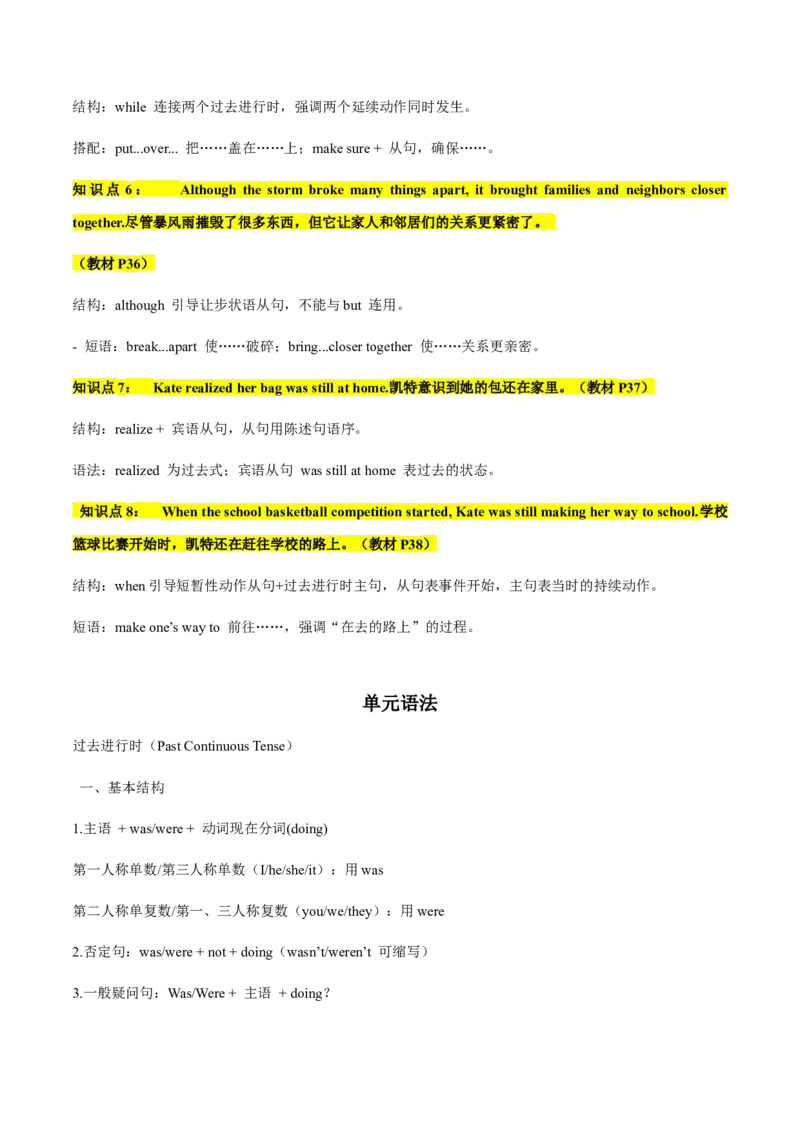
知识点 6: Although the storm broke many things apart, it brought families and neighbors closer
together.尽管暴风雨摧毁了很多东西,但它让家人和邻居们的关系更紧密了。
(教材P36)
结构:although 引导让步状语从句,不能与but 连用。
- 短语:break...apart 使……破碎;bring...closer together 使……关系更亲密。
知识点7: Kate realized her bag was still at home.凯特意识到她的包还在家里。(教材P37)
结构:realize + 宾语从句,从句用陈述句语序。
语法:realized 为过去式;宾语从句 was still at home 表过去的状态。
知识点8: When the school basketball competition started, Kate was still making her way to school.学校
篮球比赛开始时,凯特还在赶往学校的路上。(教材P38)
结构:when引导短暂性动作从句+过去进行时主句,从句表事件开始,主句表当时的持续动作。
短语:make one’s way to 前往……,强调“在去的路上”的过程。
单元语法
过去进行时(Past Continuous Tense)
一、基本结构
1.主语 + was/were + 动词现在分词(doing)
第一人称单数/第三人称单数(I/he/she/it):用was
第二人称单复数/第一、三人称复数(you/we/they):用were
2.否定句:was/were + not + doing(wasn’t/weren’t 可缩写)
3.一般疑问句:Was/Were + 主语 + doing?答语:Yes, 主语+was/were. / No, 主语+wasn’t/weren’t.
4.特殊疑问句:疑问词 + Was/Were + 主语 + doing?
二、现在分词(doing)变化规则
1. 一般情况直接加-ing:play→playing,read→reading
2. 不发音e结尾,去e加-ing:come→coming,make→making
3. 重读闭音节(辅+元+辅),双写尾字母加-ing:run→running,beat→beating
4. ie结尾,变ie为y加-ing:lie→lying,die→dying
三、核心用法(单元必考,3大场景)
1. 单独使用:表过去具体时刻/时间段正在进行的动作
常配时间状语:at 8 last night, this time yesterday, from 7 to 9 p.m. yesterday
例句:He was reading a book at 9 o’clock last night.
2. 与when连用:延续性动作(过去进行时)+ 短暂性动作(一般过去时)
when引导的从句表“动作发生的瞬间”,动词多为短暂性(come, start, ring, hit等)
例句:We were having dinner when the rainstorm came.
3. 与while连用:2种高频结构
① 短暂性动作(一般过去时)+ 延续性动作(过去进行时)
例句:The light went out while we were watching TV.
② while连接两个过去进行时:表两个动作同时进行(一边…一边…)
例句:My mom was cooking while my dad was washing dishes.
单元写作
核心主题:描述一次自然灾害的经历/见闻,用过去进行时写清过程+应对,总结安全启示,字数不少于80
词
经典结构:三段式(突发→应对→感悟),时态精准切换(过去进行时+一般过去时+一般现在时)第一段:灾害突发(25-30词)→ 铺垫背景+突现险情
核心公式:时间+地点+正在做的事(过去进行时)+灾害突然发生
万能句型:
1. Last summer, my family and I were having dinner at home when a terrible typhoon hit our city.
2. It was Sunday morning. I was hiking in the hills when dark clouds gathered and a rainstorm broke out all of a
sudden.
关键要求:点明灾害类型(typhoon/earthquake/rainstorm),用1句写初始反应(如It caught us totally off
guard.)
第二段:紧急应对(40-50词)→ 细节描写+动作应对(核心段)
核心逻辑:灾害升级→感官描写→应对动作(必用过去进行时),用when/while连接
写作步骤:
1. 写灾害细节:The wind howled loudly and the rain poured down./The ground was shaking and windows
crashed.
2. 写持续动作:While we were hiding under the strong table, my dad was calling the emergency number.
3. 写应对结果:We stayed calm and moved to a safer place until the danger passed.
加分技巧:加视觉/听觉描写(dark clouds/ thunder rumbled),让画面更生动
第三段:灾后感悟(25-30词)→ 灾后情况+安全启示+未来准备
核心公式:灾后现状+感悟道理+具体行动
万能句型:
1. After the disaster, we saw fallen trees everywhere. This experience taught me the importance of keeping an
emergency kit.
2. We were lucky to be safe. I realized nature’s power is unpredictable, so I will check the weather report before
going out.
高分核心要点1. 时态必对:过去进行时(was/were+doing)写持续动作,一般过去时写短暂/完成动作(如the typhoon
started/we called for help)
2. 词汇活用:用单元短语(run for safety/take cover/warn sb of sth/stay inside)
3. 避坑提醒:while后接过去进行时,when后接一般过去时,不要颠倒;不写真实姓名/地址,控制字数
80词左右
巩固练习
一、单项选择
1.—What are you going to do this evening, Jane?
—I’m going to ________ my lesson to get a good result in tomorrow’s test.
A.refuse B.review C.stop D.start
【答案】B
【详解】句意:——简,你今晚打算做什么?——我打算复习我的功课,以便在明天的考试中取得好成绩。
考查动词辨析。refuse拒绝;review复习;stop停止;start开始。根据“get a good result in tomorrow’s test”
可知,为了考试取得好成绩,应该复习功课。故选B。
2.The reporter advised people ________ inside during the typhoon.
A.stay B.to stay C.staying D.stayed
【答案】B
【详解】句意:记者建议人们在台风期间待在室内。
考查非谓语动词。根据“advised people...inside during the typhoon”可知,此处是“advise sb. to do sth.”结构,
意为“建议某人做某事”,使用动词不定式作宾语补足语。故选B。
3.Floodwater ________ many houses in the village, so people had to move to safe places.
A.wash away B.washed away C.washes away D.will wash away
【答案】B
【详解】句意:洪水冲走了村里的许多房子,所以人们不得不搬到安全的地方。考查动词时态。根据“so people had to move to safe places”可知,人们不得不搬到安全的地方,说明洪水冲
走房子这一动作发生在过去,句子应该用一般过去时,washed away为一般过去时,符合语境。故选B。
4.This app helps you ________ photos safely.
A.take B.bring C.store D.copy
【答案】C
【详解】句意:这个应用帮助你安全地存储照片。
考查动词辨析。take拍摄;bring带来;store储存;copy复制。根据“safely”和“app”的语境,应用的功能
通常是安全地“储存”照片,而不是拍摄、带来或复制。故选C。
5.All the people went home ________ John, for he had to finish his work.
A.with B.besides C.except D.beside
【答案】C
【详解】句意:除了约翰,所有人都回家了,因为他必须完成工作。
考查介词辨析。with和……一起;besides除了……(还);except除了……(不包括);beside在……旁边。根
据“for he had to finish his work”可知,约翰因工作未完成而未回家,因此他不包括在“回家的人”之中。
故选C。
6.—Did you ________ the first place of the football match?
—Of course we did. We ________ all the other teams.
A.beat; beat B.win; beat C.win; won D.beat; win
【答案】B
【详解】句意:——你们赢得了足球比赛的第一名吗?——当然。我们击败了所有其他队伍。
考查动词辨析。beat击败;win赢得。第一空后接the first place(第一名),表示赢得比赛名次,应用
win;第二空后接all the other teams(所有其他队伍),表示击败对手,应用beat。故选B。
7.Our class is sure to win the basketball game ________ Class Three.
A.of B.in C.against D.from【答案】C
【详解】句意:和三班的篮球赛我们班肯定能赢。
考查介词辨析。of……的;in在……里面;against对抗;from来自。根据“the basketball game”可知,篮球
比赛是班级与班级之间的对抗,此处表示“对阵三班”。故选C。
8.We should be firmly ________ killing wild animals.
A.up B.for C.against D.to
【答案】C
【详解】句意:我们应该坚决反对捕杀野生动物。
考查介词辨析。up向上;for支持;against反对;to向,对。根据“killing wild animals”可知,捕杀野生动
物是不对的,所以我们应该坚决反对。故选C。
9.The typhoon was one of the worst ________ in our city’s history.
A.conditions B.wonders C.programs D.disasters
【答案】D
【详解】句意:这场台风是我们城市历史上最严重的灾难之一。
考查名词辨析。conditions条件;wonders奇迹;programs项目;disasters灾难。根据“typhoon”和“worst”
可知,台风属于自然灾害,应选表示灾难的词。故选D。
10.I________ forgot the party! Luckily, Gina called to remind me about it.
A.hardly B.nearly C.clearly D.finally
【答案】B
【详解】句意:我差点忘了那个聚会!幸运的是,吉娜打电话提醒了我。
考查副词辨析。hardly几乎不;nearly几乎、差点;clearly清楚地;finally最终。根据“Luckily, Gina called
to remind me about it.”可知,前句表示差点忘记,强调忘记的可能性很大但最终没有忘记。故选B。
二、根据要求完成单词拼写
11.They looked at each other in fear when the e (地震) happened.【答案】earthquake/arthquake
【详解】句意:当地震发生时,他们惊恐地对视着。earthquake“地震”,此处是特指某次地震,用名词单
数形式。故填earthquake。
12.Frank h (躲藏) himself behind the door, so we can’t find him now.
【答案】hid/id
【详解】句意:Frank躲在门后,所以我们现在找不到他。hide“躲藏”,根据“can’t find him now”可知,
躲藏的动作应发生在过去,时态用一般过去时,动词用过去式hid。故填hid。
13.The scientist uses his k (知识) to help factories produce better cars.
【答案】knowledge/nowledge
【详解】句意:这位科学家运用他的知识帮助工厂生产出更优质的汽车。knowledge“知识”,不可数名词。
故填knowledge。
14.When I went by his room, I saw him r (复习) the textbook yesterday.
【答案】reviewing/eviewing
【详解】句意:当我经过他的房间时,看到他昨天正在复习课本。结合首字母及汉语提示可知,动词
review“复习”符合,再结合语境可知,该句在描述看见某人昨天那个时候正在做某事,应用“see sb. doing
sth.”表示“看见某人正在做某事”,应用其对应的现在分词作宾语补足语。故填reviewing。
15.Lin Zexu and Zheng Chenggong are national h (英雄) in Chinese history.
【答案】heroes/eroes
【详解】句意:林则徐和郑成功是中国历史上的民族英雄。hero“英雄”,可数名词;此处指林则徐和郑成
功两位英雄,所以空格处应填hero的复数形式heroes。故填heroes。
16.Before running, the boy r (拒绝) to tie his shoes. Unluckily, he fell over.
【答案】efused/refused
【详解】句意:在跑步之前,这个男孩拒绝系好鞋带。不幸的是,他摔倒了。结合首字母及汉语提示可知,
动词refuse“拒绝”符合,且后句谓语动词fell为动词过去式,则该句时态为一般过去时,应用其对应的动词过去式refused作谓语。故填refused。
17.We should be (care) when walking on the wet road after the rain.
【答案】careful
【详解】句意:雨后走在湿滑的路面上时一定要小心。根据语境及“We should be…”可知,此处应该是建
议对方雨后过马路时要“小心”,应用其对应的形容词形式careful作表语。故填careful。
18.The movie was (terrible) boring, so we left early.
【答案】terribly
【详解】句意:这部电影非常无聊,所以我们提前离开了。terrible“糟糕的”,是形容词,此处需用副词修
饰形容词“boring”,表示“非常、极其”,terrible的副词形式是terribly。故填terribly。
19.Many (volunteer) helped clean the park and plant trees last weekend.
【答案】volunteers
【详解】句意:上周末,许多志愿者帮忙打扫公园和种树。volunteer“志愿者”,是可数名词,其前有
“many”(许多)修饰,需用复数形式volunteers。故填volunteers。
20.We were (lucky) —we didn’t win the soccer game.
【答案】unlucky
【详解】句意:我们很不幸——我们没有赢得那场足球赛。lucky“幸运的”,是形容词,结合语境“we
didn’t win the soccer game”可知此处表示“不幸的”,需用否定前缀“un-”构成反义词unlucky。故填
unlucky。
三、完形填空
On the morning of May 22, two serious landslides happened in Dafang County, Bijie City, Guizhou
Province. The first one 21 Changshi Town at around 3 o’clock. It was 22 bad, and 2 families
with 2 people were trapped (被困).
Then at about 9 o’clock, another one struck Qingyang Village, Guowa Township. It was much larger. The
news on TV 23 that the landslide was 1,040 metres long, 300 metres wide and 10 metres thick on
average. Its total volume reached about 2.4 million cubic metres. 24 , 8 families with 19 people weretrapped here.
After the disasters, many 25 came to help quickly. They worked with local officials to carry out
the 26 work. The government also sent a lot of 27 like food, water and medicine to the
affected areas (受灾地区). People were 28 about the possible dangers before, but no one expected such
big landslides.
The rescuers tried their best to dig through the mud (泥土) and rocks, but some people were still trapped
under the debris. Unfortunately, the disasters caused many 29 and injuries. This event tells us that we
must 30 natural disaster warnings to stay safe.
21.A.checked B.burnt C.hid D.hit
22.A.enough B.so C.terribly D.quite
23.A.wrote B.recorded C.reported D.heard
24.A.Unluckily B.Finally C.Luckily D.Suddenly
25.A.volunteers B.dentists C.teachers D.farmers
26.A.research B.rescue C.study D.clean
27.A.clothes B.gifts C.books D.supplies
28.A.warned B.talked C.asked D.told
29.A.alarms B.deaths C.poems D.risks
30.A.look after B.pay attention to C.look at D.turn on
【答案】
21.D 22.C 23.C 24.A 25.A 26.B 27.D 28.A 29.B 30.B
【导语】本文是一篇记叙文。文章主要讲述贵州大方县发生的两次严重山体滑坡,以及灾后救援和应对措
施,强调要关注自然灾害预警以保障安全。
21.句意:第一次发生在大约3点钟的长石镇。checked检查;burnt燃烧;hid隐藏;hit袭击。根据“The first one”可知,此处描述山体滑坡发生的地点,
“hit”表示“袭击、发生在(某地)”符合语境,指山体滑坡袭击了长石镇。故选D。
22.句意:情况非常糟糕,两户人家的两人被困。
enough足够地;so如此;terribly非常;quite相当。根据“bad”可知,此处需要副词修饰形容词,表示
“非常糟糕”,terribly符合语境。故选C。
23.句意:电视上的新闻报道称,滑坡体长1040米,宽300米,平均厚度10米。
wrote写;recorded记录;reported报道;heard听见。根据“The news on TV”可知,电视上的新闻对滑坡体
的情况进行报道,“reported”符合语境。故选C。
24.句意:不幸的是,有8户共19人被困在这里
Unluckily不幸地;Finally最终;Luckily幸运地;Suddenly突然。根据“8 families with 19 people were
trapped here”可知,这么多人被困是不幸的情况,“Unluckily”符合语境。故选A。
25.句意:灾难发生后,许多志愿者迅速赶来帮忙。
volunteers志愿者;dentists牙医;teachers教师;farmers农民。根据“came to help quickly”以及后文描述他
们与当地官员一起开展救援工作可知,赶来帮忙的是“志愿者”,“volunteers”符合语境。故选A。
26.句意:他们与当地官员一起开展救援工作。
research研究;rescue救援;study学习;clean清洁。根据“came to help quickly. They worked with local
officials”可知,此处是开展“救援”工作,“rescue”符合语境。故选B。
27.句意:政府还向受灾地区运送了大量食品、水和药品等物资。
clothes衣服;gifts礼物;books书籍;supplies物资。根据“like food, water and medicine”可知,这些都是救
援所需的“物资”,“supplies”符合语境。故选D。
28.句意:人们之前曾被警告过可能存在的危险,但没人料到会发生如此大的山体滑坡。
warned警告;talked谈论;asked询问;told告诉。根据“about the possible dangers”可知,人们是被“警
告”过可能存在的危险,“warned”符合语境。故选A。
29.句意:不幸的是,这场灾难造成了许多人死亡和受伤。alarms警报;deaths死亡;poems诗歌;risks风险。根据“and injuries”以及语境可知,山体滑坡造成人员
“死亡”和受伤,“deaths”符合语境。故选B。
30.句意:这件事告诉我们,我们必须关注自然灾害预警以保障安全。
look after照顾;pay attention to关注;look at看;turn on打开。根据“natural disaster warnings to stay safe”
可知,为了保障安全要“关注”自然灾害预警,“pay attention to”符合语境。故选B。
四、阅读理解
A
How to Stay Safe During an Earthquake
Earthquakes can happen suddenly. Do you know how to protect yourself? Follow these tips to stay safe.
During an earthquake1. Drop,
Before an earthquake1. cover, and hold on:
Prepare an emergency kit:
Include water, food, ◆Drop to the ground.
and a flashlight.
◆Cover under a strong table.
2. Find safe spots:
◆Hold on until the shaking stops.
Under strong tables or away
from windows. 2. Stay away from glass, walls and
heavy objects that can fall over.
After an earthquake1. Check for injuries.
2. Move to a safe area outside.
3. Call for help if needed.
Stay calm, be prepared, and protect yourself!
根据以上内容,选择正确答案。
31.What isn’t supposed to be in an emergency kit?
A.Water. B.Food. C.A flashlight. D.A camera.
32.Where is the safest place during an earthquake?
A.Near windows. B.Under strong tables.C.Beside heavy bookshelves. D.Next to walls.
33.What is the right order of the three steps during an earthquake?
① ② ③
A.①②③ B.③①② C.②③① D.①③②
34.What should you do first when an earthquake starts?
A.Run outside immediately. B.Hide in a wardrobe.
C.Drop to the ground. D.Call for help.
35.Why is it important to prepare an emergency kit?
A.To have fun during the earthquake.
B.To get everything you want.
C.To have basic supplies when needed.
D.To show off your items.
【答案】31.D 32.B 33.B 34.C 35.C
【导语】本文是说明文,主要介绍了地震发生前、发生时和发生后的安全防护措施,以帮助人们在地震中
保护自己。
31.细节理解题。根据“Before an earthquake”部分的“Include water, food, and a flashlight.”可知,应急包中
应包含水、食物和手电筒,不包含相机。故选D。
32.细节理解题。根据“During an earthquake”部分的“Cover under a strong table.”可知,地震时最安全的地
方是坚固的桌子下方。故选B。
33.细节理解题。根据“During an earthquake”部分的“Drop, cover, and hold on: Drop to the ground. Cover
under a strong table. Hold on until the shaking stops.”可知,正确的顺序是:先蹲到地上(③)→躲到桌子下(①)→抓住桌子直到摇晃停止(②),对应图片是③①②。故选B。
34.细节理解题。根据“During an earthquake”部分的“Drop to the ground.”可知,地震开始时首先要做的是
蹲到地上。故选C。
35.推理判断题。根据“Before an earthquake”部分的应急包内容可知,准备应急包是为了在需要时获得基
本的物资供应。故选C。
B
How to Stay Safe During a Thunderstorm
Thunderstorms are common natural phenomena, but they can be dangerous if we don’t take proper
precautions. Here are some important safety tips to follow during a thunderstorm.
First, stay indoors. If you are outside when a thunderstorm starts, find a safe building or a closed car to take
shelter immediately. Avoid staying in open areas such as fields, parks, or on top of hills. Also, stay away from tall
objects like trees, poles, and towers, as they are more likely to be struck by lightning.
Second, avoid using electronic devices. Lightning can travel through power lines and damage electronic
equipment. Do not use telephones, computers, TVs, or other electrical appliances during a thunderstorm. It’s also a
good idea to unplug them to prevent damage from power surges.
Third, be careful with water. Do not take a bath, shower, or wash dishes during a thunderstorm. Lightning
can travel through plumbing systems and cause electric shocks. Also, avoid swimming in pools, lakes, or rivers
until the storm has passed completely.
Fourth, stay away from windows and doors. Close all windows and doors to prevent rainwater from entering
the house. Do not stand near windows or glass doors, as strong winds or flying debris may break the glass and
cause injuries.
Finally, wait for the storm to pass completely before going outside. Even if the rain stops, there may still be
lightning. It’s safe to go outside only after 30 minutes of the last thunderclap.
By following these safety tips, you can reduce the risk of injury or death during a thunderstorm. Remember,
safety should always be the top priority when facing natural disasters.36.What should you do if you are outside when a thunderstorm starts?
A.Stay in open areas. B.Find a safe building or a closed car to take shelter.
C.Stand near tall objects. D.Continue swimming in a lake.
37.Why should you avoid using electronic devices during a thunderstorm?
A.They will use too much electricity.
B.Lightning can travel through power lines and damage them.
C.They will make loud noises.
D.They are not necessary during a storm.
38.What should you not do with water during a thunderstorm?
A.Drink water. B.Water plants.
C.Take a bath or shower. D.Wash hands quickly.
39.How long should you wait before going outside after the last thunderclap?
A.10 minutes. B.20 minutes. C.30 minutes. D.40 minutes.
40.What is the main idea of the passage?
A.How to predict a thunderstorm. B.The damage caused by thunderstorms.
C.Safety tips during a thunderstorm. D.The causes of thunderstorms.
【答案】36.B 37.B 38.C 39.C 40.C
【导语】本文开篇指出雷雨是常见自然现象但存在危险,随后分5个核心要点介绍雷雨天气中的安全防范
措施,最后总结遵循这些贴士能降低受伤或死亡的风险,核心主旨为介绍雷雨天气中的安全注意事项。
36.细节理解题。根据“If you are outside when a thunderstorm starts, find a safe building or a closed car to take
shelter immediately.”可知,如果雷雨来临时你在户外,要立即找一个安全的建筑或封闭的汽车躲避。故选
B。37.细节理解题。根据“Lightning can travel through power lines and damage electronic equipment.”可知,闪
电会通过电线传导,并损坏电子设备,因此需要避免使用电子设备。故选B。
38.细节理解题。根据“Do not take a bath, shower, or wash dishes during a thunderstorm.”可知,雷雨天气不
要泡澡、淋浴,也不要洗碗。故选C。
39.细节理解题。根据“It’s safe to go outside only after 30 minutes of the last thunderclap.”可知,只有在最后
一声雷声过后的30分钟,出门才是安全的。故选C。
40.主旨大意题。根据文章可知,首段引出雷雨天气的安全贴士,中间分5点具体介绍,尾段总结遵循贴
士的重要性,因此文章的核心是介绍雷雨天气中的安全注意事项。故选C。
五、短文填空
阅读短文,用括号内所给词的适当形式填空,使短文通顺、意思完整。
Last night, a terrible thunderstorm attacked our city. I 41 (finish) my homework and was about to
go to bed when it started. First, the sky 42 (become) dark quickly. Then, the wind 43 (begin)
to blow hard. While I 44 (close) the windows, I saw a bright flash of lightning. Soon after that, loud
thunder 45 (follow).
My little sister was very scared. She 46 (cry) when my mom 47 (hold) her in her arms.
My dad 48 (check) the doors and windows to make sure they were closed tightly. We 49
(stay) in the living room together, listening to the rain and thunder. After about half an hour, the storm 50
(stop) gradually. We felt relaxed finally.
【答案】
41.had finished 42.became 43.began 44.was closing 45.followed 46.was crying
47.held 48.was checking 49.stayed 50.stopped
【导语】本文是一篇记叙文,主要讲述了昨晚一场可怕的雷暴袭击城市时,作者一家人的经历和反应。
41.句意:我做完作业,正准备上床睡觉,这时雷暴开始了。设空处需用过去完成时had done,表示“完
成作业”发生在“雷暴开始”之前,finish的过去分词是finished。故填had finished。42.句意:首先,天空迅速变暗。设空处需用一般过去时,描述过去发生的动作,故用过去式became。故
填became。
43.句意:然后,风开始猛烈地吹。设空处需用一般过去时,描述过去发生的动作,故用过去式began。
故填began。
44.句意:当我正在关窗户时,我看到一道明亮的闪电。设空处需用过去进行时was/were doing,表示
“关窗户”的动作正在进行时,另一个动作“看到闪电”发生。主语是I,be动词用was,close的现在分
词是closing。故填was closing。
45.句意:不久之后,响亮的雷声随之而来。设空处需用一般过去时,描述过去发生的动作,故用过去式
followed。故填followed。
46.句意:当妈妈把她抱在怀里时,她正在哭。设空处需用过去进行时was/were doing,表示“哭”的动
作在过去某个时间“妈妈抱她的时候”正在进行。主语是She,be动词用was,cry的现在分词是crying。
故填was crying。
47.句意:当妈妈把她抱在怀里时,她正在哭。设空处需用一般过去时,描述过去发生的动作,故用过去
式held。故填held。
48.句意:我爸爸正在检查门窗,确保它们关紧了。设空处需用过去进行时,表示“检查”的动作在过去
某个时间正在进行。主语是My dad,be动词用was,check的现在分词是checking。故填was checking。
49.句意:我们一起待在客厅里,听着雨声和雷声。设空处需用一般过去时,描述过去发生的动作,故用
过去式stayed。故填stayed。
50.句意:大约半小时后,暴风雨逐渐停止了。设空处需用一般过去时,描述过去发生的动作。故用过去
式stopped。故填stopped。
六、书面表达
51.假设你是李华,上周经历了一场暴雨引发的洪水,请给你的笔友 Tom写一封邮件,描述当时的
情况。
提示:
1. 洪水发生时你正在做什么;2. 洪水带来的影响(如道路被淹、停电等);
3. 你和家人的应对措施及感受。
要求:80 词左右,语句通顺,语法正确。
____________________________________________________________________________________________
____________________________________________________________________________________________
____________________________________________________________________________________________
____________________________________________________________________________________________
____________________________________________________________________________________________
____________________________________________________________________________________________
【答案】例文:
Dear Tom,
Last week, I experienced a terrible flood caused by heavy rain. At that time, I was doing my homework
quietly at home. Suddenly, water rushed in very quickly. The roads outside were soon completely under water and
the power went out suddenly. It was dark and really scary outside.
My family and I quickly moved important things upstairs. We stayed together, feeling worried but also trying
to help each other. Luckily, we were all safe. The flood made me realize the great power of nature.
Yours,
Li Hua
【详解】[总体分析]
①题材:本文是一篇应用文,为电子邮件;
②时态:时态为“一般过去时”;
③提示:写作要点已给出,考生应注意不要遗漏“信息提示”中洪水发生时的情况、洪水带来的影响、应
对措施及感受等要点,适当添加细节,并突出写作重点。
[写作步骤]
第一步,表明写作意图。借用“上周经历了一场暴雨引发的洪水”来引出重点介绍的内容;第二步,具体阐述写作内容。从“洪水发生时正在做什么、洪水带来的影响、应对措施及感受”几个方面
重点介绍当时的情况;
第三步,书写结语。表达对自然力量的感慨。
[亮点词汇]
①rushed in 冲进来
②completely under water 完全被水淹没
③went out 熄灭
④realize 意识到
[高分句型]
①At that time, I was doing my homework quietly at home.(过去进行时)
②The flood made me realize the great power of nature.(make sb do sth使某人做某事)