文档文本内容
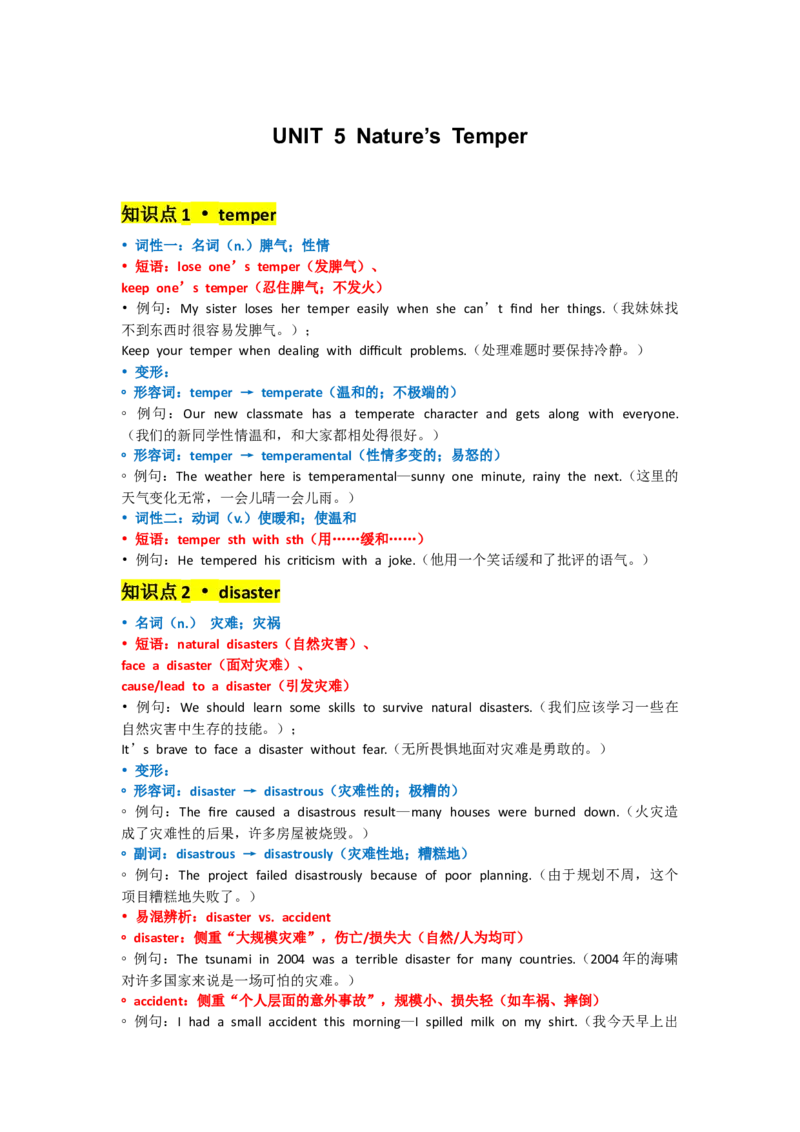
UNIT 5 Nature’s Temper
知识点1 • temper
• 词性一:名词(n.)脾气;性情
• 短语:lose one’s temper(发脾气)、
keep one’s temper(忍住脾气;不发火)
• 例句:My sister loses her temper easily when she can’t find her things.(我妹妹找
不到东西时很容易发脾气。);
Keep your temper when dealing with difficult problems.(处理难题时要保持冷静。)
• 变形:
◦ 形容词:temper → temperate(温和的;不极端的)
◦ 例句:Our new classmate has a temperate character and gets along with everyone.
(我们的新同学性情温和,和大家都相处得很好。)
◦ 形容词:temper → temperamental(性情多变的;易怒的)
◦ 例句:The weather here is temperamental—sunny one minute, rainy the next.(这里的
天气变化无常,一会儿晴一会儿雨。)
• 词性二:动词(v.)使暖和;使温和
• 短语:temper sth with sth(用……缓和……)
• 例句:He tempered his criticism with a joke.(他用一个笑话缓和了批评的语气。)
知识点2 • disaster
• 名词(n.) 灾难;灾祸
• 短语:natural disasters(自然灾害)、
face a disaster(面对灾难)、
cause/lead to a disaster(引发灾难)
• 例句:We should learn some skills to survive natural disasters.(我们应该学习一些在
自然灾害中生存的技能。);
It’s brave to face a disaster without fear.(无所畏惧地面对灾难是勇敢的。)
• 变形:
◦ 形容词:disaster → disastrous(灾难性的;极糟的)
◦ 例句:The fire caused a disastrous result—many houses were burned down.(火灾造
成了灾难性的后果,许多房屋被烧毁。)
◦ 副词:disastrous → disastrously(灾难性地;糟糕地)
◦ 例句:The project failed disastrously because of poor planning.(由于规划不周,这个
项目糟糕地失败了。)
• 易混辨析:disaster vs. accident
◦ disaster:侧重“大规模灾难”,伤亡/损失大(自然/人为均可)
◦ 例句:The tsunami in 2004 was a terrible disaster for many countries.(2004年的海啸
对许多国家来说是一场可怕的灾难。)
◦ accident:侧重“个人层面的意外事故”,规模小、损失轻(如车祸、摔倒)
◦ 例句:I had a small accident this morning—I spilled milk on my shirt.(我今天早上出了个小意外,把牛奶洒在衬衫上了。)
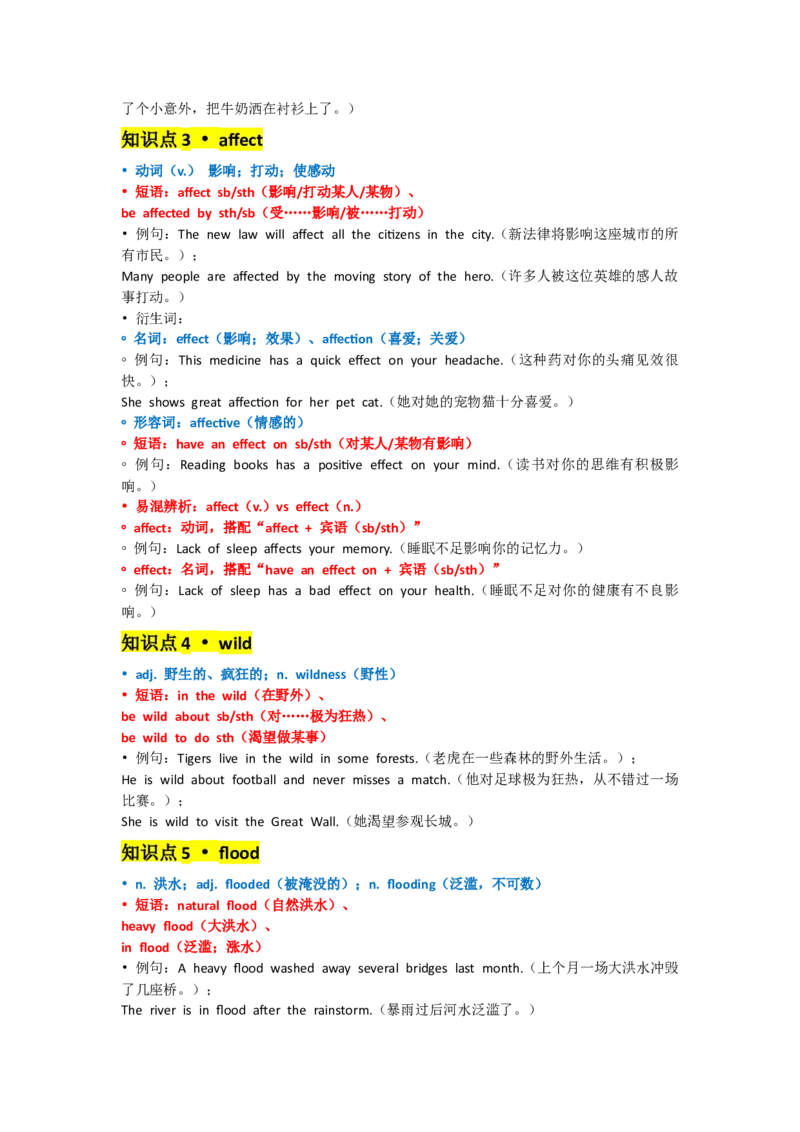
知识点3 • affect
• 动词(v.) 影响;打动;使感动
• 短语:affect sb/sth(影响/打动某人/某物)、
be affected by sth/sb(受……影响/被……打动)
• 例句:The new law will affect all the citizens in the city.(新法律将影响这座城市的所
有市民。);
Many people are affected by the moving story of the hero.(许多人被这位英雄的感人故
事打动。)
• 衍生词:
◦ 名词:effect(影响;效果)、affection(喜爱;关爱)
◦ 例句:This medicine has a quick effect on your headache.(这种药对你的头痛见效很
快。);
She shows great affection for her pet cat.(她对她的宠物猫十分喜爱。)
◦ 形容词:affective(情感的)
◦ 短语:have an effect on sb/sth(对某人/某物有影响)
◦ 例句:Reading books has a positive effect on your mind.(读书对你的思维有积极影
响。)
• 易混辨析:affect(v.)vs effect(n.)
◦ affect:动词,搭配“affect + 宾语(sb/sth)”
◦ 例句:Lack of sleep affects your memory.(睡眠不足影响你的记忆力。)
◦ effect:名词,搭配“have an effect on + 宾语(sb/sth)”
◦ 例句:Lack of sleep has a bad effect on your health.(睡眠不足对你的健康有不良影
响。)
知识点4 • wild
• adj. 野生的、疯狂的;n. wildness(野性)
• 短语:in the wild(在野外)、
be wild about sb/sth(对……极为狂热)、
be wild to do sth(渴望做某事)
• 例句:Tigers live in the wild in some forests.(老虎在一些森林的野外生活。);
He is wild about football and never misses a match.(他对足球极为狂热,从不错过一场
比赛。);
She is wild to visit the Great Wall.(她渴望参观长城。)
知识点5 • flood
• n. 洪水;adj. flooded(被淹没的);n. flooding(泛滥,不可数)
• 短语:natural flood(自然洪水)、
heavy flood(大洪水)、
in flood(泛滥;涨水)
• 例句:A heavy flood washed away several bridges last month.(上个月一场大洪水冲毁
了几座桥。);
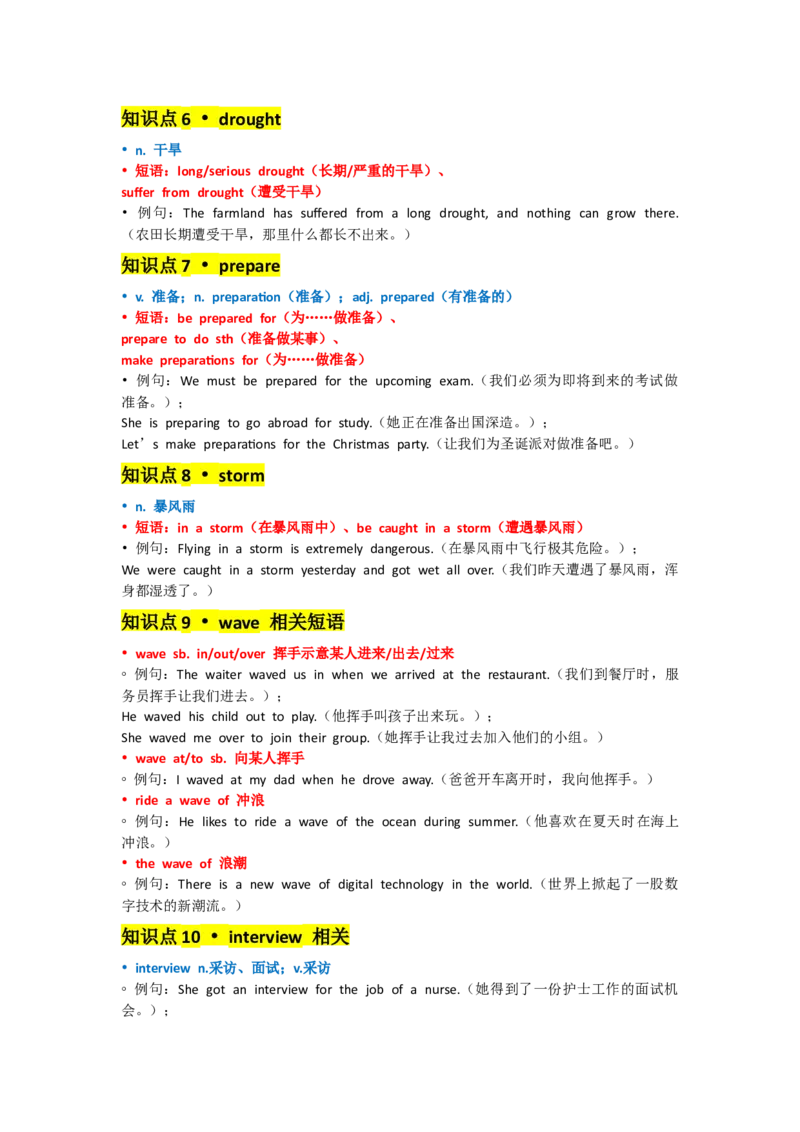
The river is in flood after the rainstorm.(暴雨过后河水泛滥了。)知识点6 • drought
• n. 干旱
• 短语:long/serious drought(长期/严重的干旱)、
suffer from drought(遭受干旱)
• 例句:The farmland has suffered from a long drought, and nothing can grow there.
(农田长期遭受干旱,那里什么都长不出来。)
知识点7 • prepare
• v. 准备;n. preparation(准备);adj. prepared(有准备的)
• 短语:be prepared for(为……做准备)、
prepare to do sth(准备做某事)、
make preparations for(为……做准备)
• 例句:We must be prepared for the upcoming exam.(我们必须为即将到来的考试做
准备。);
She is preparing to go abroad for study.(她正在准备出国深造。);
Let’s make preparations for the Christmas party.(让我们为圣诞派对做准备吧。)
知识点8 • storm
• n. 暴风雨
• 短语:in a storm(在暴风雨中)、be caught in a storm(遭遇暴风雨)
• 例句:Flying in a storm is extremely dangerous.(在暴风雨中飞行极其危险。);
We were caught in a storm yesterday and got wet all over.(我们昨天遭遇了暴风雨,浑
身都湿透了。)
知识点9 • wave 相关短语
• wave sb. in/out/over 挥手示意某人进来/出去/过来
◦ 例句:The waiter waved us in when we arrived at the restaurant.(我们到餐厅时,服
务员挥手让我们进去。);
He waved his child out to play.(他挥手叫孩子出来玩。);
She waved me over to join their group.(她挥手让我过去加入他们的小组。)
• wave at/to sb. 向某人挥手
◦ 例句:I waved at my dad when he drove away.(爸爸开车离开时,我向他挥手。)
• ride a wave of 冲浪
◦ 例句:He likes to ride a wave of the ocean during summer.(他喜欢在夏天时在海上
冲浪。)
• the wave of 浪潮
◦ 例句:There is a new wave of digital technology in the world.(世界上掀起了一股数
字技术的新潮流。)
知识点10 • interview 相关
• interview n.采访、面试;v.采访
◦ 例句:She got an interview for the job of a nurse.(她得到了一份护士工作的面试机
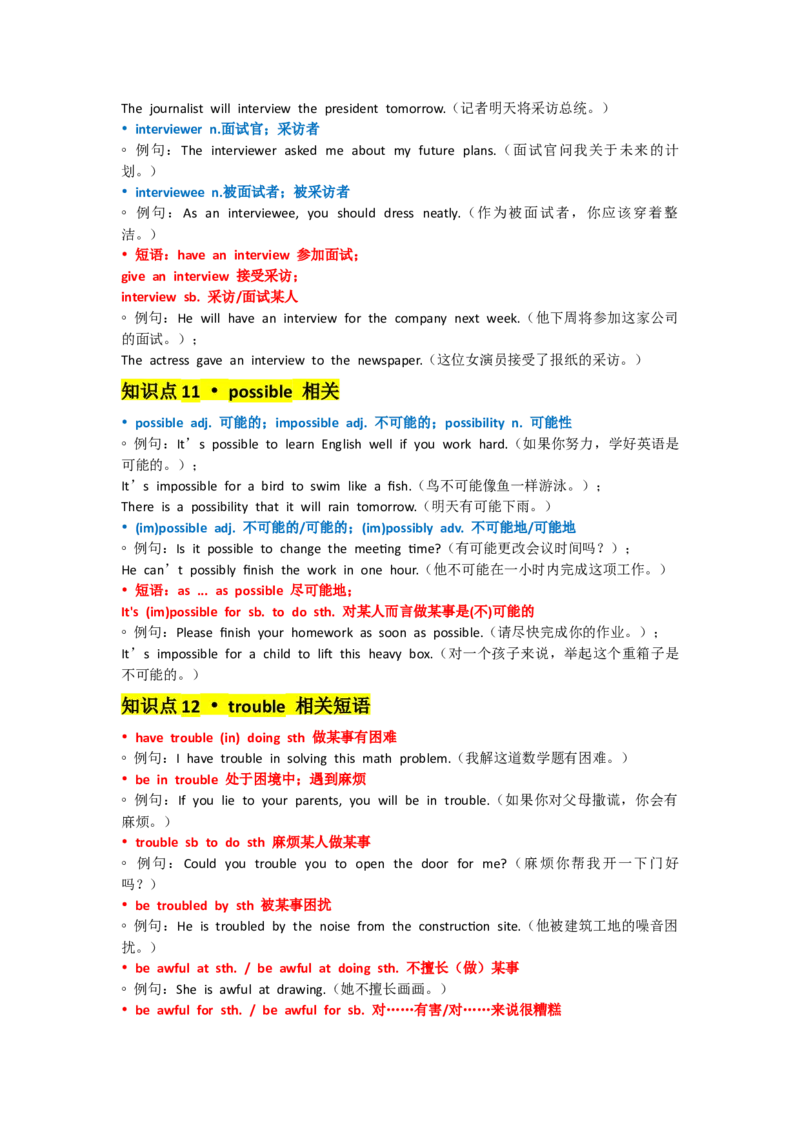
会。);The journalist will interview the president tomorrow.(记者明天将采访总统。)
• interviewer n.面试官;采访者
◦ 例句:The interviewer asked me about my future plans.(面试官问我关于未来的计
划。)
• interviewee n.被面试者;被采访者
◦ 例句:As an interviewee, you should dress neatly.(作为被面试者,你应该穿着整
洁。)
• 短语:have an interview 参加面试;
give an interview 接受采访;
interview sb. 采访/面试某人
◦ 例句:He will have an interview for the company next week.(他下周将参加这家公司
的面试。);
The actress gave an interview to the newspaper.(这位女演员接受了报纸的采访。)
知识点11 • possible 相关
• possible adj. 可能的;impossible adj. 不可能的;possibility n. 可能性
◦ 例句:It’s possible to learn English well if you work hard.(如果你努力,学好英语是
可能的。);
It’s impossible for a bird to swim like a fish.(鸟不可能像鱼一样游泳。);
There is a possibility that it will rain tomorrow.(明天有可能下雨。)
• (im)possible adj. 不可能的/可能的;(im)possibly adv. 不可能地/可能地
◦ 例句:Is it possible to change the meeting time?(有可能更改会议时间吗?);
He can’t possibly finish the work in one hour.(他不可能在一小时内完成这项工作。)
• 短语:as ... as possible 尽可能地;
It's (im)possible for sb. to do sth. 对某人而言做某事是(不)可能的
◦ 例句:Please finish your homework as soon as possible.(请尽快完成你的作业。);
It’s impossible for a child to lift this heavy box.(对一个孩子来说,举起这个重箱子是
不可能的。)
知识点12 • trouble 相关短语
• have trouble (in) doing sth 做某事有困难
◦ 例句:I have trouble in solving this math problem.(我解这道数学题有困难。)
• be in trouble 处于困境中;遇到麻烦
◦ 例句:If you lie to your parents, you will be in trouble.(如果你对父母撒谎,你会有
麻烦。)
• trouble sb to do sth 麻烦某人做某事
◦ 例句:Could you trouble you to open the door for me?(麻烦你帮我开一下门好
吗?)
• be troubled by sth 被某事困扰
◦ 例句:He is troubled by the noise from the construction site.(他被建筑工地的噪音困
扰。)
• be awful at sth. / be awful at doing sth. 不擅长(做)某事
◦ 例句:She is awful at drawing.(她不擅长画画。)
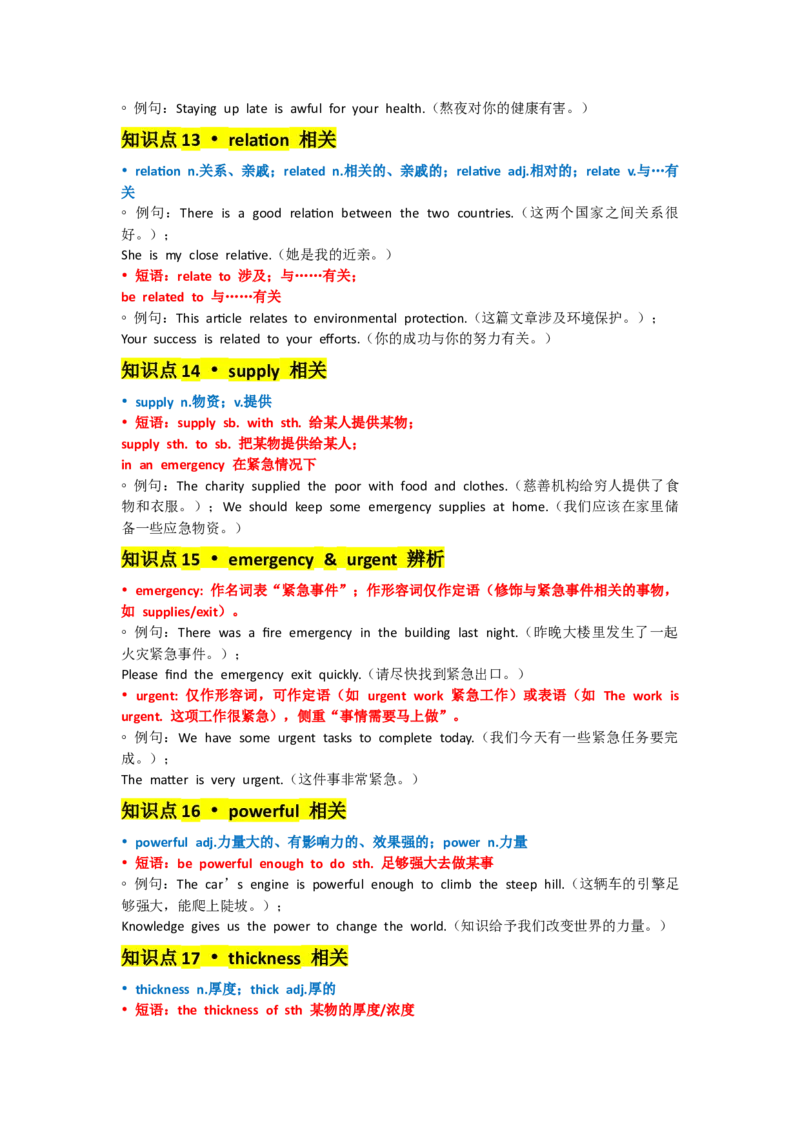
• be awful for sth. / be awful for sb. 对……有害/对……来说很糟糕◦ 例句:Staying up late is awful for your health.(熬夜对你的健康有害。)
知识点13 • relation 相关
• relation n.关系、亲戚;related n.相关的、亲戚的;relative adj.相对的;relate v.与…有
关
◦ 例句:There is a good relation between the two countries.(这两个国家之间关系很
好。);
She is my close relative.(她是我的近亲。)
• 短语:relate to 涉及;与……有关;
be related to 与……有关
◦ 例句:This article relates to environmental protection.(这篇文章涉及环境保护。);
Your success is related to your efforts.(你的成功与你的努力有关。)
知识点14 • supply 相关
• supply n.物资;v.提供
• 短语:supply sb. with sth. 给某人提供某物;
supply sth. to sb. 把某物提供给某人;
in an emergency 在紧急情况下
◦ 例句:The charity supplied the poor with food and clothes.(慈善机构给穷人提供了食
物和衣服。);We should keep some emergency supplies at home.(我们应该在家里储
备一些应急物资。)
知识点15 • emergency & urgent 辨析
• emergency: 作名词表“紧急事件”;作形容词仅作定语(修饰与紧急事件相关的事物,
如 supplies/exit)。
◦ 例句:There was a fire emergency in the building last night.(昨晚大楼里发生了一起
火灾紧急事件。);
Please find the emergency exit quickly.(请尽快找到紧急出口。)
• urgent: 仅作形容词,可作定语(如 urgent work 紧急工作)或表语(如 The work is
urgent. 这项工作很紧急),侧重“事情需要马上做”。
◦ 例句:We have some urgent tasks to complete today.(我们今天有一些紧急任务要完
成。);
The matter is very urgent.(这件事非常紧急。)
知识点16 • powerful 相关
• powerful adj.力量大的、有影响力的、效果强的;power n.力量
• 短语:be powerful enough to do sth. 足够强大去做某事
◦ 例句:The car’s engine is powerful enough to climb the steep hill.(这辆车的引擎足
够强大,能爬上陡坡。);
Knowledge gives us the power to change the world.(知识给予我们改变世界的力量。)
知识点17 • thickness 相关
• thickness n.厚度;thick adj.厚的
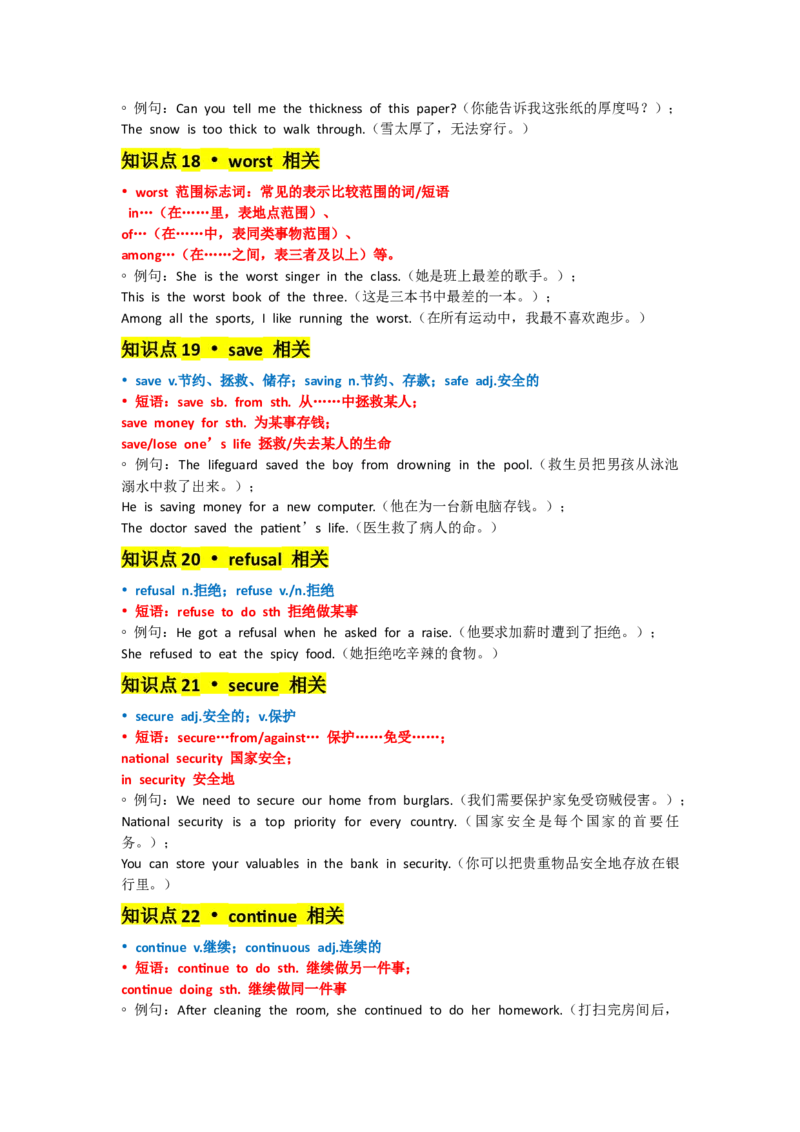
• 短语:the thickness of sth 某物的厚度/浓度◦ 例句:Can you tell me the thickness of this paper?(你能告诉我这张纸的厚度吗?);
The snow is too thick to walk through.(雪太厚了,无法穿行。)
知识点18 • worst 相关
• worst 范围标志词:常见的表示比较范围的词/短语
in…(在……里,表地点范围)、
of…(在……中,表同类事物范围)、
among…(在……之间,表三者及以上)等。
◦ 例句:She is the worst singer in the class.(她是班上最差的歌手。);
This is the worst book of the three.(这是三本书中最差的一本。);
Among all the sports, I like running the worst.(在所有运动中,我最不喜欢跑步。)
知识点19 • save 相关
• save v.节约、拯救、储存;saving n.节约、存款;safe adj.安全的
• 短语:save sb. from sth. 从……中拯救某人;
save money for sth. 为某事存钱;
save/lose one’s life 拯救/失去某人的生命
◦ 例句:The lifeguard saved the boy from drowning in the pool.(救生员把男孩从泳池
溺水中救了出来。);
He is saving money for a new computer.(他在为一台新电脑存钱。);
The doctor saved the patient’s life.(医生救了病人的命。)
知识点20 • refusal 相关
• refusal n.拒绝;refuse v./n.拒绝
• 短语:refuse to do sth 拒绝做某事
◦ 例句:He got a refusal when he asked for a raise.(他要求加薪时遭到了拒绝。);
She refused to eat the spicy food.(她拒绝吃辛辣的食物。)
知识点21 • secure 相关
• secure adj.安全的;v.保护
• 短语:secure…from/against… 保护……免受……;
national security 国家安全;
in security 安全地
◦ 例句:We need to secure our home from burglars.(我们需要保护家免受窃贼侵害。);
National security is a top priority for every country.(国家安全是每个国家的首要任
务。);
You can store your valuables in the bank in security.(你可以把贵重物品安全地存放在银
行里。)
知识点22 • continue 相关
• continue v.继续;continuous adj.连续的
• 短语:continue to do sth. 继续做另一件事;
continue doing sth. 继续做同一件事
◦ 例句:After cleaning the room, she continued to do her homework.(打扫完房间后,她继续做家庭作业。);
It has been snowing continuously for five days.(雪已经连续下了五天了。);
He continued reading the novel after lunch.(午饭后他继续读那本小说。)
知识点23 • strange 相关
• strangely adv.奇怪地、陌生地;strange adj.奇怪的;陌生的;stranger n.陌生人
◦ 例句:He looked at the strange object strangely.(他奇怪地看着那个陌生的物体。);
It’s strange that he hasn’t arrived yet.(他还没到,真奇怪。);
Don’t accept gifts from strangers.(不要接受陌生人的礼物。)
知识点24 • thankful 相关短语
• be thankful to sb 对某人心存感激
◦ 例句:I’m thankful to my parents for raising me up.(我很感激父母养育我长大。)
• be thankful for sth 因某事/某物感激
◦ 例句:We should be thankful for the clean air and water.(我们应该感激清洁的空气
和水。)
• be thankful to do sth 庆幸能做某事;感激能做某事
◦ 例句:I’m thankful to have such a supportive family.(我很庆幸有这样一个支持我的
家庭。)
• thanks (a lot) for (doing) sth. (非常)感谢(做)某事
◦ 例句:Thanks a lot for lending me your umbrella.(非常感谢你把伞借给我。)
• thanks for sb.’s help 感谢某人的帮助
◦ 例句:Thanks for your help—I can now solve the problem.(感谢你的帮助,我现在能
解决这个问题了。)
知识点25 • death 相关
death 作“死亡人数”讲时是可数名词,故用复数
deaths;若表“死亡状态”则为不可数。
• 例句:The war caused thousands of deaths.(这场战争造成了数千人死亡。);
Death is inevitable for everyone.(死亡对每个人来说都是不可避免的。)
知识点26 • thanks for 与 thanks to 辨析
• thanks for:核心表“因……而感谢”,侧重“感谢的具体原因”
◦ 例句:Thanks for helping me with my project.(感谢你帮助我做项目。)
• thanks to:核心表“多亏/幸亏……”,侧重“借助某人/某物,才达成某结果”
◦ 例句:Thanks to your help, we won the game.(多亏了你的帮助,我们赢得了比
赛。)
知识点27 • rescuer 相关
• rescuer n.营救者;rescue n./v.营救
• 短语:rescue sb from sth./sb 从某物/某人手中营救某人;
carry out a rescue 开展营救;实施救援
◦ 例句:The rescuers rescued many hikers from the mountain.(营救者从山上救出了许
多徒步旅行者。);The army carried out a rescue mission to save the hostages.(军队实施了一项营救任务
来解救人质。)
知识点28 • avoid 相关
• avoidance n.避免;avoidable adj.可避免的;avoid v.避免
• 短语:avoid doing sth 避免做某事;
avoid from 从……中避开;
the avoidance of sth 避免……
◦ 例句:You should avoid eating too much junk food.(你应该避免吃太多垃圾食品。);
We should aim for the avoidance of mistakes.(我们应该力求避免错误。)
知识点29 • alarm 相关
• alarm n.闹钟;使惊恐;
alarmed adj.惊恐的;
alarming adj.令人惊恐的
• 短语:in alarm 惊恐地;
be alarmed at/about 对……感到惊恐/担忧
◦ 例句:I set my alarm to wake up at 7 every day.(我每天把闹钟设到 7点叫醒自
己。);
She screamed in alarm when she saw the snake.(她看到蛇时惊恐地尖叫起来。);
We are alarmed at the increasing number of accidents.(我们对事故数量的增加感到担
忧。)
知识点30 • review 相关
• review sth for sth 为……而复习某物;
review doing sth 回顾/复习做过的事;
review sth with sb 和某人一起复习某物
◦ 例句:I need to review physics for the exam.(我需要为考试复习物理。);
Let’s review what we did in class today.(让我们回顾一下今天课堂上的内容。);
Can you review the English lesson with me?(你能和我一起复习英语课吗?)
知识点31 • terrible 相关
• terribly adv.非常;糟糕地;terrible adj.糟糕的;可怕的;terror n.恐惧;terrify v.使恐
惧
• 短语:terribly sorry 非常抱歉;
a terribly ill 病得很重;
a sense of terror 恐惧感;
fill sb. with terror 使某人充满恐惧;
terrify sb. into doing sth. 吓得某人做某事;
be terrified of sth./doing sth. 害怕某物/做某事;
be terrible at sth. 不擅长某事
◦ 例句:I’m terribly sorry for being rude to you.(我非常抱歉对你无礼。);
He is terribly ill and has to stay in hospital.(他病得很重,必须住院。);
The dark room filled him with terror.(黑暗的房间让他充满恐惧。);The loud thunder terrified the baby into crying.(巨大的雷声吓得婴儿哭了起来。);
She is terrified of heights.(她恐高。);
He is terrible at playing the piano.(他不擅长弹钢琴。)
单元短语总结
1. natural disasters 自然灾害 30. floodwater 洪水
2. earthquake 地震 31. manpower 人力
3. typhoon 台风 32. heartbeat 心跳
4. wildfire 野火 33. cause drought 引发干旱
5. snowstorm 暴风雪 34. hit the city 袭击城市
6. flood 洪水 35. put out wildfires 扑灭野火
7. drought 干旱 36. bring to safety 带到安全处
8. have trouble during… 在……期间遇到 37. warn others 警告他人
麻烦 38. refuse to give up 拒绝放弃
9. be better prepared for 为……做好更充 39. stay safe 保持安全
分准备 40. while doing sth 当做某事时
10. store emergency supplies 储存应急物 41. all of a sudden 突然
资 42. then 然后
11. pay attention to the weather reports 43. by the time 到……时候
关注天气预报 44. as a result 结果
12. stay inside 待在室内 45. because of 因为
13. warn a neighbour 提醒邻居 46. stormy weather 暴风雨天气
14. do homework 做作业 47. freezing cold 极冷
15. call one's mother 给妈妈打电话 48. heavy snow 大雪
16. do chores 做家务 49. rainy day 雨天
17. prepare lunch 准备午餐 50. cause heavy traffic 造成交通拥堵
18. stay in a hotel 待在酒店 51. have to walk slowly 不得不慢走
19. take a train 乘火车 52. too dark to see 太暗看不见
20. clean up the neighbourhood 清理社区 53. catch a cold 感冒
21. move things off the floor 把东西从地 54. chain story 连环故事
板移开 55. work in a group 小组合作
22. cover windows 遮盖窗户 56. take turns to add sentences 轮流加句
23. drive home 开车回家 子
24. get into an accident 发生事故 57. vote for the best 投票选最佳
25. earthquake hit/rocked/happened/took 58. save lives 拯救生命
place 地震袭击/震动/发生 59. mean the difference between life and
26. typhoon hit/landed/blew across 台风 death 关乎生死
袭击/登陆/横扫 60. thanks to 多亏
27. tsunami hit/came/swept through 海啸 61. quick thinking 快速思考
袭击/来临/席卷 62. wake up late 起床晚
28. landslide 山体滑坡 63. rush to the bus stop 冲向公交站
29. safeguard 保护措施 64. review notes 复习笔记65. roll across the sky 划过天空 67. be out of breath 气喘吁吁
66. start to pour 开始倾盆大雨 68. avoid driving 避免开车
过去进行时
1. 核心定义:表示“过去某个特定时间(或时间段内),正在进行或发生的动作”,强调
“动作的进行中‘状态’”(而非“动作完成与否”)。
2. 核心结构:主语 + was/were + 动词的现在分词(V-ing)
•人称搭配规则(单was复were):
◦ 主语为“第一人称单数(I)、第三人称单数(he/she/it/人名)”:用was;
◦ 主语为“第一人称复数(we)、第二人称(you)、第三人称复数(they/复数名词)”:
用were;
◦ 否定句:was/were + not(缩写为wasn’t weren’t);
◦ 一般疑问句:was/were提前至句首,主语紧随其后。
•高频标志词:
◦ 明确的“过去时间点”(某一时刻):at 8 o’clock last night、at this time
yesterday、just now、at that moment;
◦ 明确的“过去时间段”(某段时间内持续进行):from 6 to 8 last Sunday morning、
during the summer holiday last year;
◦ 从句引导词:when(引导“短暂动作”从句)、while(引导“持续动作”从句)。
• 初中核心用法:
◦ 用法1:描述“过去某一具体时间点”正在做的动作(最高频)
◦ 例句:My mom was cooking dinner at 6:30 yesterday evening.(昨晚6点半,我妈妈正
在做晚饭。)
◦ 用法2:描述“过去两个动作同时进行”(while为核心标志)
◦ 结构:while + 主语+was/were doing, 主语+was/were doing.
◦ 例句:While my father was reading newspapers, my brother was playing the piano.
(我爸爸在看报纸时,我弟弟正在弹钢琴。)
◦ 用法3:描述“过去一个动作发生时,另一个动作正在进行”(when为核心标志)
◦ 规则:“短暂动作”用一般过去时,“持续动作”用过去进行时;
◦ 结构1:When + 主语+过去式(短暂动作),主语+was/were doing(持续动作);
◦ 例句:When the rain started, we were walking to school.(下雨的时候,我们正在步行
去学校。)
◦ 结构2:主语+was/were doing(持续动作)+ when + 主语+过去式(短暂动作);
◦ 例句:We were walking to school when the rain started.(我们正在步行去学校,突然
下雨了。)
• 动词现在分词(V-ing)拼写规则:
◦ 一般动词直接加ing:work→working, play→playing;
◦ 以不发音的“e”结尾,去e加ing:write→writing, dance→dancing;
◦ 以“重读闭音节”结尾(辅元辅结构,且末尾只有一个辅音字母),双写末尾辅音加
ing:run→running, stop→stopping.
• 与“一般过去时”的核心差异:
◦ 过去进行时表“过去正在做(强调过程)”;◦ 一般过去时表“过去做了(强调结果/动作完成)”。
• 对比示例:
◦ 1. I watched TV last night.(我昨晚看了电视。)——一般过去时,不强调“何时正在
看”;
◦ 2. I was watching TV at 8 last night.(我昨晚8点正在看电视。)——过去进行时,强
调“8点那一刻正在看”的过程。