Unit 5 Nature’s Temper
核心语法精练(过去进行时)
目录
A 考点概览·知识回顾..............................................................................................................................................1
B 考点夯基·专项突破..............................................................................................................................................3
一、单项选择.........................................................................................................................................................3
二、完成句子.........................................................................................................................................................9
C 综合攻坚·能力跃升............................................................................................................................................12
题型一 语法填空...............................................................................................................................................12
题型二 阅读理解.................................................................................................................................................15
1.过去进行时的句子结构
(1)肯定句
I was reading at 7 yesterday morning . 昨天早上七点我
主语+be(was,were) +动词ing形式
在读书。
(2)否定句
I was not reading at 7 yesterday morning . 昨天早上七点
主语+be(was,were)+not +动词ing原形
我没有读书。
(3)一般疑问句
Were you reading at 7 yesterday morning? 昨天早上七点
Be(was,were) +主语+动词原形
你在读书吗?
重要时间状语
1. at 9 o’clock yesterday(昨天九点)
2. at this time last week(上周的这个时候)
3. from 7 to 9 last night(昨晚7点到9点)
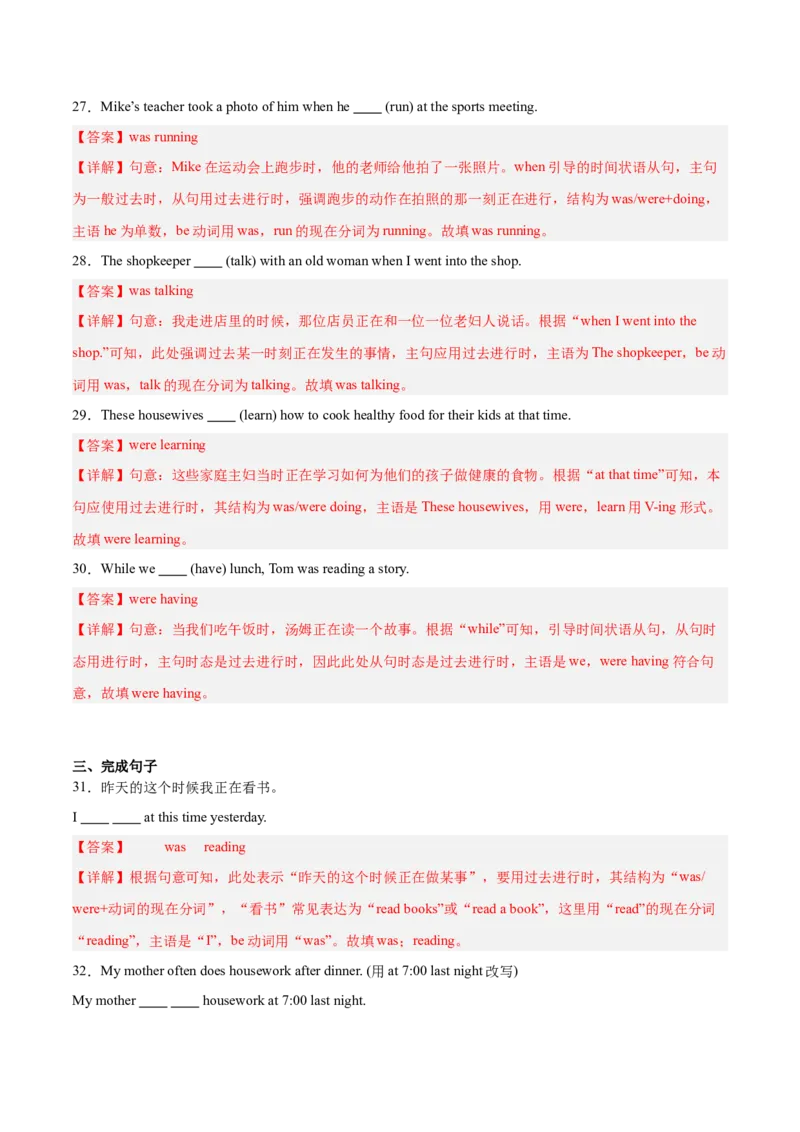
4. all day/morning yesterday(昨天一整天/整个早上)
5. when/while/as(当…时)
6. just as(正当…时)2.过去进行时的具体用法
1. 描述过去特定时刻正在进行的动作
表示在过去的某一具体时间点(通常由时间状语指明)动作正在进行。
At 8 o’clock last night, I was watching TV.(昨晚八点,我正在看电视。)
What were you doing when I called?(我打电话时,你正在做什么?)
2. 描述过去特定时间段内持续进行的动作
表示在过去的某一段持续时间内,动作一直在持续。
He was working on his project all day yesterday.(他昨天一整天都在做项目。)
They were traveling in Europe during the summer.(整个夏天他们都在欧洲旅行。)
3. 作为故事背景,为另一动作的发生提供场景
常用于叙述中,用过去进行时描述“背景”,用一般过去时描述“背景中发生的具体事件”。
It was raining heavily when we left the house.(我们离开家时,正下着大雨。)
While I was walking in the park, I saw an old friend.(我正在公园散步时,遇到了一位老朋友。)
4. 表示过去同时进行的两个动作
用 while 或 as 连接两个过去进行时的句子。
My father was reading the newspaper while my mother was cooking.(我爸爸在看报纸,而我妈妈在做
饭。)
5. 表示过去暂时的或未完成的动作
强调动作在当时是临时的、正在进行但未结束的状态。
I was living in London in 2015.(2015年那段时间我正住在伦敦。)(暗示是暂时的)
对比:I lived in London for 5 years.(我在伦敦住了5年。)(用一般过去时,表示一个完成的、持
续的事实)
6. 与“always”等词连用,表示过去反复发生的习惯性动作(常含感情色彩)
表达赞赏、批评或抱怨等情绪。
He was always helping others.(他过去总是帮助别人。)(赞赏)
She was constantly complaining about her job.(她过去老是抱怨她的工作。)(厌烦)
【易错提醒】
when与while在复合句中的使用区别
when:可接时间点或时间段,从句动词可以是延续性或终止性动词。
例:When I was cooking, the phone rang.我正在做饭时,电话响了。
while:只接时间段,从句动词必须是延续性动词。
例:While I was sleeping, he left.我睡觉时,他离开了。一、单项选择
1.They ________ math problems when the teacher came into the classroom.
A.discussed B.are discussing C.were discussing
【答案】C
【详解】句意:当老师走进教室时,他们正在讨论数学问题。
考查过去进行时。根据“when the teacher came into the classroom”可知,当老师进来时他们正在讨论,表示
过去某个时刻正在进行的动作,用过去进行时。故选C。
2.When the earthquake happened, people were ________ in their houses.
A.sleeping B.sing C.dance D.work
【答案】A
【详解】句意:当地震发生时,人们正在他们的房子里睡觉。
考查过去进行时。sleeping睡觉;sing唱歌;dance跳舞;work工作。根据“When the earthquake happened”
可知,此处是描述过去的某一时刻正发生的动作,用过去进行时,因此空处用现在分词与were构成过去进
行时结构,选项中只有sleeping是现在分词,符合语法结构。故选A。
3.My cousin ________ the traffic rules by crossing the road carelessly while he ________ to the bus stop
yesterday.
A.broke; was running
B.followed; was running
C.was breaking; ran
D.was following; ran
【答案】A
【详解】句意:昨天,我表兄跑向公交车站时不小心横穿马路,违反了交通规则。
考查动词辨析和时态。broke违反;followed遵守;was running正在跑;was breaking正在违反;ran跑;
was following正在遵守;ran跑。根据“yesterday”和“by crossing the road carelessly”可知,昨天不小心过马
路,表示“违反”交通规则,且为一般过去时,第一空用“broke”;第二空,“while”引导的时间状语从句,
强调动作同时发生,主句用一般过去时“broke”,从句用过去进行时“was running”表示背景动作“正在跑
去”。故选A。
4.—I knocked at your door last night, but you ________ at home.
—Oh, I ________ at the supermarket.A.didn’t; shopped B.weren’t; were shopping C.weren’t; was shopping
【答案】C
【详解】句意:——昨晚我敲了你家的门,但你不在家。——哦,我当时在超市购物。
考查时态辨析和主谓一致。didn’t用于实义动词否定,不适用于状态描述;shopped为一般过去时,不强调
进行动作;were shopping主语应为复数,“I”为单数,不匹配;weren’t表否定状态,“was shopping”表示
过去进行。第一空表示“不在家”的状态,主语为“you”,时态为一般过去时,be动词的过去否定形式为
weren’t;第二空表示过去某个时间点正在进行的动作,需用过去进行时。故选C。
5.While we ________ an English song, some visitors came to our class.
A.are singing B.sang C.were singing
【答案】C
【详解】句意:当我们正在唱一首英文歌时,一些访客来到了我们班。
考查过去进行时的用法。当主句使用一般过去时,“while”引导时间状语从句表示动作在某一时间点正在
进行时,从句需用过去进行时强调动作的持续性,其结构为was/were+现在分词;主语为“we”,be动词用
were,动词sing的现在分词为singing,即were singing。故选C。
6.When I passed by the hall yesterday, the students ________ for the concert.
A.will prepare B.are preparing C.were preparing
【答案】C
【详解】句意:昨天当我经过大厅时,学生们正在为音乐会做准备。
考查过去进行时。根据“When I passed by the hall yesterday”可知,此句为when引导的时间状语从句,主
句用过去进行时,表示过去某个时间点正在进行的动作,即经过大厅时,正在做准备,结构为was/were
doing。故选C。
7.My mother _________ when he knocked at the door.
A.has cooked B.was cooking C.is cooking
【答案】B
【详解】句意:当他敲门时,我的妈妈正在做饭。
考查时态。has cooked已经做饭,现在完成时;was cooking过去正在做饭,过去进行时;is cooking正在做
饭,现在进行时。由“knocked”可知,从句敲门是过去动作,对应主句应表示过去某个时间点正在进行的
动作,用过去进行时。故选B。
8.When I saw Daniel yesterday, he ________ an old man cross the road.
A.helps B.was helping C.will help D.is helping
【答案】B【详解】句意:昨天当我看到丹尼尔时,他正在帮助一位老人过马路。
考查动词时态。根据“When I saw Daniel yesterday”可知,此处是when引导的时间状语从句,表示从句动
作发生时,主句动作正在进行,且从句是一般过去时,所以主句用过去进行时。故选B。
9.While I _________ my dance moves, my cat watched me and it seemed to enjoy it.
A.practice B.am practicing C.was practicing D.will practice
【答案】C
【详解】句意:当我在练习我的舞蹈动作时,我的猫看着我,它似乎很享受。
考查动词时态。practice一般现在时;am practicing现在进行时;was practicing过去进行时;will practice一
般将来时。此处主句使用一般过去时,while引导的时间状语从句表示过去正在进行的动作,应用过去进行
时。故选C。
10.While we ________ an English song, some visitors came into our classroom.
A.were singing B.sang C.are singing D.sings
【答案】A
【详解】句意:当我们正在唱英语歌时,一些访客走进了我们的教室。
考查动词的时态。were singing是过去进行时;sang是一般过去时;are singing是现在进行时;sings是一般
现在时第三人称单数形式。分析句子可知,while引导的时间状语从句常用进行时态,根据主句中“came”
可知,主句是一般过去时,所以从句应用过去进行时(was/were+动词现在分词),表示过去某个时间正在
进行的动作。故选A。
11.—I met Jack when I passed by the garden.
—Yes, he ________ some flowers with the help of his mother.
A.planted B.is planting C.was planting
【答案】C
【详解】句意:——我路过花园的时候遇到了杰克。——是啊,他当时正在他妈妈的帮助下种花。
考查过去进行时。根据上文“met Jack when I passed by the garden”可知,“遇到杰克”是过去某个具体时
刻发生的动作,而“种花”是在这个时刻正在进行的动作,需用过去进行时,was planting表示过去某个时
刻正在种植,故选C。
12.When I saw Xiao Wang yesterday, he________ an old man cross the road.
A.helps B.was helping C.will help D.is helping
【答案】B
【详解】句意:昨天我看到小王的时候,他正在帮助一位老人过马路。
考查动词时态。根据“When I saw Xiao Wang yesterday, he…an old man cross the road”的语境和主从句结构,可知从句动作(帮助老人)发生在主句动作(看到)的同时,且强调动作的持续性。根据时间状语
“yesterday”可知,此处表示过去某个时刻正在进行的动作,用过去进行时,结构为“主语+was/were+动词
的现在分词(V-ing)。故选B。
13.The headteacher took a photo of Mario while he __________ in class.
A.was sleeping B.sleeps C.slept
【答案】A
【详解】句意:班主任在马里奥上课睡觉时给他拍了一张照片。
考查动词形式。根据“took a photo”可知拍照是过去动作,while引导的从句表示拍照时正在进行的动作,
用过去进行时。故选A。
14.Tom ________ his homework carefully when his mother came back home.
A.does B.did C.was doing
【答案】C
【详解】句意:当他妈妈回家时,汤姆正在认真做作业。
考查动词时态。根据“when his mother came back home”可知,当他妈妈回家时,汤姆做作业的动作正在进
行,所以用过去进行时态,其结构是“was/were + doing”结构,主语“Tom”是第三人称单数,所以用
was。故选C。
15.—John, I called you up this afternoon but nobody answered.
—Oh, I ________ with my father at that time.
A.is fishing B.are fishing C.was fishing D.were fishing
【答案】C
【详解】句意:——约翰,我今天下午给你打电话但没人接。——哦,那时我正和我父亲在钓鱼。
考查过去进行时。is fishing现在进行时,主语是第三人称单数;are fishing现在进行时,主语是复数或第二
人称;was fishing过去进行时,主语是第一、三人称单数;were fishing过去进行时,主语是复数或第二人
称。根据“called”以及“at that time”可知,这里说的是过去某个时间点正在进行的动作,要用过去进行时;
“I”是第一人称单数,其过去进行时结构是“was+现在分词”,即“was fishing”。故选C。
16.—I didn’t see you at the meeting yesterday. Why?
—I ________ for an important telephone call at that moment.
A.will B.have waited C.was waiting D.am waiting
【答案】C
【详解】句意:——昨天开会我没见到你。为什么?——我当时在等一个重要的电话。
考查过去进行时。根据“at that moment”可知,此句时态为过去进行时,强调过去某一时刻正在进行的动作,结构为was/were doing。故选C。
17.—I asked Jim a question, but he didn’t reply.
—Maybe he________ about something else.
A.thought B.thinks C.was thinking D.will think
【答案】C
【详解】句意:——我问了吉姆一个问题,但他没有回答。——可能他正在考虑其他事情。
考查时态辨析。根据“I asked Jim a question, but he didn’t reply.”可知,问的动作发生在过去,此处表示过去
某时发生的事,因此用过去进行时。故选C。
18.The girls ________ in the room happily when Miss Lee walked in.
A.dance B.were dancing C.are dancing D.have danced
【答案】B
【详解】句意:当李老师走进来时,女孩们正在房间里开心地跳舞。
考查动词的时态。根据“when Miss Lee walked in”可知,从句是一般过去时,是when引导的时间状语从句,
此处指的是李老师走进来时女孩们正在跳舞,主句应用过去进行时。故选B。
19.When the boy ________ in the morning yesterday, his mother ________ breakfast.
A.got up; was cooking B.get up; cooks
C.got up; cooked D.got up; is cooking
【答案】A
【详解】句意:昨天早上当男孩起床时,他的妈妈正在做早餐。
考查动词时态。get up起床;cook做饭。根据“When the boy… in the morning yesterday”中的时间状语
yesterday morning可知第一个空需用一般过去时got up;根据“his mother…breakfast”可知妈妈过去正在进
行的动作需用过去进行时was cooking。故选A。
20.Jim ________ to an English program in his bedroom at 8:00 yesterday evening.
A.listened B.is listening C.was listening D.has listened
【答案】C
【详解】句意:昨天晚上8点Jim正在他的卧室里听一个英语节目。
考查过去进行时。根据“at 8:00 yesterday evening”可知,此处描述的是过去某个具体时间点正在进行的动
作,因此应该使用过去进行时,其结构为“was/were+现在分词”。主语“Jim”是第三人称单数,所以be
动词用“was”,“listen”的现在分词为“listening”。故选C。二、单词拼写
21.Li Ming (listen) to the news at half past seven this morning.
【答案】was listening
【详解】句意:李明今天早上七点半正在听新闻。根据“at half past seven this morning”这一具体时间点,
可知此处表示过去某一时刻正在进行的动作,要用过去进行时,其结构为“was/were + 现在分词”。主语
Li Ming是第三人称单数,所以be动词用was,listen的现在分词是listening。故填was listening。
22.Millie (watch) TV when lightning hit a nearby building.
【答案】was watching
【详解】句意:当闪电击中附近的建筑物时,米莉正在看电视。根据“when lightning hit a nearby building”
可知,此处强调闪电发生时“看电视”的动作正在进行,用过去进行时“was/were+现在分词”,主语
Millie是第三人称单数,be动词用was,watch的现在分词为watching,符合语境。故填was watching。
23.While (walk) in the park, we saw many beautiful flowers.
【答案】walking
【详解】句意:在公园里散步时,我们看到了许多美丽的花。 walk“散步”,此处为while引导的时间状
语从句的省略形式,完整句子应为“While we were walking in the park”,当主从句主语一致且从句含be动
词时,可省略主语和be动词,故填walking。
24.They didn’t notice me come in because they (play) computer games.
【答案】were playing
【详解】句意:他们没有注意到我进来,因为他们正在玩电脑游戏。根据“They didn’t notice me come in
because they...computer games”可知,此处要表达“他们没注意到是因为他们正在玩电脑游戏”,因此时态
用过去进行时,主语是they,be动词用were,play现在分词是playing。故填were playing。
25.I (chat) with my friends on the Internet when my mum came in.
【答案】was chatting
【详解】句意:当我妈妈进来的时候,我正在网上和我的朋友们聊天。根据“I ... with my friends on the
Internet when my mum came in.”可知,这是一个由when引导的时间状语从句,强调主句动作(chat)在从
句动作(came in)发生时正在进行,从句时态为一般过去时,主句需用过去进行时,主句主语是I,be动
词要用was,chat的现在分词为chatting。故填was chatting。
26.I (check) the map at that moment and didn’t notice the red light.
【答案】was checking
【详解】句意:那时我正在查看地图,没注意到红灯。根据“at that moment”可知句子用过去进行时,其结
构为“was/were+现在分词”,主语“I”是第一人称单数,用“was checking”。故填was checking。27.Mike’s teacher took a photo of him when he (run) at the sports meeting.
【答案】was running
【详解】句意:Mike在运动会上跑步时,他的老师给他拍了一张照片。when引导的时间状语从句,主句
为一般过去时,从句用过去进行时,强调跑步的动作在拍照的那一刻正在进行,结构为was/were+doing,
主语he为单数,be动词用was,run的现在分词为running。故填was running。
28.The shopkeeper (talk) with an old woman when I went into the shop.
【答案】was talking
【详解】句意:我走进店里的时候,那位店员正在和一位一位老妇人说话。根据“when I went into the
shop.”可知,此处强调过去某一时刻正在发生的事情,主句应用过去进行时,主语为The shopkeeper,be动
词用was,talk的现在分词为talking。故填was talking。
29.These housewives (learn) how to cook healthy food for their kids at that time.
【答案】were learning
【详解】句意:这些家庭主妇当时正在学习如何为他们的孩子做健康的食物。根据“at that time”可知,本
句应使用过去进行时,其结构为was/were doing,主语是These housewives,用were,learn用V-ing形式。
故填were learning。
30.While we (have) lunch, Tom was reading a story.
【答案】were having
【详解】句意:当我们吃午饭时,汤姆正在读一个故事。根据“while”可知,引导时间状语从句,从句时
态用进行时,主句时态是过去进行时,因此此处从句时态是过去进行时,主语是we,were having符合句
意,故填were having。
三、完成句子
31.昨天的这个时候我正在看书。
I at this time yesterday.
【答案】 was reading
【详解】根据句意可知,此处表示“昨天的这个时候正在做某事”,要用过去进行时,其结构为“was/
were+动词的现在分词”,“看书”常见表达为“read books”或“read a book”,这里用“read”的现在分词
“reading”,主语是“I”,be动词用“was”。故填was;reading。
32.My mother often does housework after dinner. (用at 7:00 last night改写)
My mother housework at 7:00 last night.【答案】 was doing
【详解】句意:我妈妈经常在晚饭过后做家务。用“at 7:00 last night”表示过去某一时刻进行改写,句子变
为过去进行时。主语“My mother”是第三人称单数,be动词变为was,后接动词现在分词doing。故填
was;doing。
33.I was doing my homework when my father got home. (对画线部分提问)
you when your father got home?
【答案】 What were doing
【详解】句意:当我父亲到家的时候,我正在做作业。划线部分为“doing my homework”,是对做什么事
情的提问,应用特殊疑问词what,并置于句首;再根据“was doing”可知,本句时态为过去进行时;当主
语为第一人称I时,要变为第二人称you,was也需变为对应的were,疑问句时,需把were提到主语you
前。故填What;were;doing。
34.我正在等公交车的时候,天开始下起了大雨。(用when引导从句)
I the bus it began to rain heavily.
【答案】 was waiting for when
【详解】根据中英文对照可知,此处缺少“正在等……的时候”;be waiting for“正在等”,when“……的
时候”,根据“when”可知,when引导的时间状语从句,从句为一般过去时态,主句为过去进行时态,且
主语为I,be动词应用was。故填was;waiting;for;when。
35.下雨的时候我正在做作业。
I my homework when it rained.
【答案】 was doing
【详解】根据中英文对照,空格处缺“正在做”。“正在做”表示过去某个时刻正在进行的动作,要用过
去进行时,其结构为“was/were+现在分词”,主语是“I”,所以be动词用“was”,“do”的现在分词是
“doing”。故填was;doing。
36.I was watching TV at the time of the rainstorm. (对划线部分提问)
you watching TV?
【答案】 When were
【详解】句意:暴风雨来的时候我正在看电视。划线部分at the time of the rainstorm表示“暴风雨来的时
候”,是时间状语,应用when“什么时候”提问;原句为过去进行时,其疑问句需将be动词was提到主语
前,且主语由I变为you,be动词相应改为were。故填When;were。
37.我们正在外边玩,这时下起雨来了。We outside when it began to rain.
【答案】 were playing
【详解】此句包含“正在做某事,这时……”的结构,应用“be doing...when...”来表达。主句描述的是过
去正在进行的动作,所以应用过去进行时,其结构为“was/were+现在分词”。主语“We”是复数,所以be
动词用“were”,“玩”的英文表达是“play”,其现在分词形式是“playing”。故填were;playing。
38.莉莉放学走路回家时,听到了小狗微弱的呜咽声。
Lily home from school when she heard a puppy’s faint whimpers.
【答案】 was walking
【详解】根据语境可知,此句用过去进行时;由汉语提示可知,此处缺少“正在走路”;走路walk,由
when引导的时间状语从句可知,主句应用过去进行时表示动作正在进行。故填was;walking。
39.当暴风雨来临时,我弟弟正在睡觉。
When the rainstorm came, my younger brother .
【答案】 was sleeping
【详解】根据“When the rainstorm came”可知,此处描述过去某个时间点正在进行的动作,要用过去进行
时,其结构为“was/were+现在分词”;主语“my younger brother”是第三人称单数,be动词用was;
sleep“睡觉”,现在分词是sleeping。故填was;sleeping。
40.那时,爸爸在手机上看新闻,而妈妈在做饭。
At that time, Dad the news on his phone while Mom was cooking.
【答案】 was reading
【详解】原句描述“那时”(At that time)的动作,while 引导的时间状语从句中 Mom was cooking 是过去
进行时,主句动作与从句动作同时发生,所以主句也要用过去进行时,结构为“was/were + 现在分词”。
主语是Dad,be 动词用 was,“看(新闻等)” 用read,现在分词是reading。故填was;reading。
题型一 语法填空
阅读短文,在空白处填入适当的单词或用括号内所给词的正确形式填空,使短文通顺、连贯。
A very terrible fire happened in Hong Kong not long ago. It took many lives, including a brave firefighter who
was trying 1 (save) people.
The bamboo scaffolding (脚手架) 2 the buildings acted as fuel (燃料) helping the fire grow fast. The way
of the building arrangements (安排) 3 (create) a “chimney effect (烟囱效应)”. This effect made the fire moveupward 4 (quick) and become extremely hot, just like how air moved through a real chimney. Strong winds
made everything even 5 (bad).
Firefighters faced great challenges during the rescue (救援). The chimney effect made 6 fire too hot and
dangerous to get close to. Burning pieces kept falling from above, and thick black smoke made it hard to see and
breathe. Still, these brave 7 (work) did their best to save people caught inside.
Our hearts are with all the families who lost 8 (they) loved ones. We also remember the heroic fighter
because he gave his life trying to help others. We hope the injured (伤者) will recover (康复) soon.
The terrible event reminds us how important fire safety is. 9 we all learn from this and are more careful,
such tragedies (悲剧) 10 (not happen) again and everyone may live safely.
【答案】
1.to save 2.on 3.created 4.quickly 5.worse 6.the 7.workers 8.their 9.If 10.will
not happen/won’t happen
【导语】本文讲述了不久前香港发生的一场严重火灾,介绍了火势快速蔓延的原因、消防员面临的救援挑
战,表达了对遇难者及其家属的哀悼,同时强调了消防安全的重要性。
1.句意:这场火灾夺走了许多人的生命,其中包括一名奋力救人的勇敢消防员。 根据“trying”可知,try
to do sth.“努力做某事”,要求其后接动词不定式,故填to save。
2.句意:建筑物上的竹制脚手架充当了燃料,助力火势迅速蔓延。根据“the bamboo scaffolding (脚手架)”
和“the buildings”的位置关系可知,脚手架是附着在建筑物表面的,介词on可表示“在……之上(表面接
触)”,故填on。
3.句意:建筑物的布局方式形成了一种“烟囱效应”。根据“A very terrible fire happened in Hong Kong
not long ago” 可知,全文讲述的是过去发生的火灾事件,时态为一般过去时,谓语动词要用过去式,create
的过去式是created,故填created。
4.句意:这种效应让火势迅速向上蔓延,温度变得极高,就像空气在真正的烟囱里流动的原理一样。 根
据“made the fire move upward”可知,此处需要修饰动词move,修饰动词要用副词,quick的副词形式是
quickly,故填quickly。
5.句意:强风让一切情况变得更加糟糕。根据“even”可知,副词even常用于修饰形容词比较级,用来加
强程度,bad的比较级是worse,故填worse。
6.句意:烟囱效应使得这场大火温度过高、过于危险,人们无法靠近。根据前文提到的“A very terrible
fire”可知,此处特指这场已经提及的火灾,定冠词the用于特指前文出现过的事物,故填the。7.句意:尽管如此,这些勇敢的工作者仍竭尽全力营救困在火场里的人。根据“these brave”可知,形容
词后需接名词,且these后接可数名词复数,动词work对应的表 “工作者”的名词是worker,其复数形式
是workers,故填workers。
8.句意:我们与所有失去亲人的家庭感同身受。根据“loved ones”可知,此处需要形容词性物主代词来修
饰这个名词短语,人称代词they的形容词性物主代词是their,故填their。
9.句意:如果我们都能从这件事吸取教训,更加小心谨慎,这样的悲剧就不会再发生,每个人都能平安
生活。根据“we all learn from this and are more careful”和“such tragedies(悲剧) ... not happen again”的逻辑关
系可知,前者是后者的条件,连词if可引导条件状语从句,句首首字母大写,故填If。
10.句意:如果我们都能从这件事吸取教训,更加小心谨慎,这样的悲剧就不会再发生,每个人都能平安
生活。根据“If we all learn from this and are more careful”可知,if引导的条件状语从句遵循“主将从现”规
则,从句用一般现在时,主句要用一般将来时,其否定形式是will not happen或won’t happen,故填will
not happen/won’t happen。
Last summer, a terrible flood hit our small town. It was raining heavily for days. The river near our town 1
(rise) continuously (持续地). People were going about their daily lives as usual at first. Some 2 (work) in their
offices, some were shopping in the markets and children 3 (play) in the parks.
4 , as the rain kept pouring, the situation got worse. The water in 5 river was overflowing its banks
(岸). The flood was approaching (靠近) 6 (quick). Soon, the low-lying areas of the town were flooded. People
who were living 7 the town had to leave their homes in a hurry. They were carrying whatever they could take,
like important documents (文件), some clothes and other things. Some 8 (call) for help on their phones, their
voices full of worry.
The local government was taking immediate action. Rescue (救援) teams 9 (rush) to the flooded areas.
They 10 (use) boats to search for people trapped (困) in the flood.
【答案】
1.was rising 2.were working 3.were playing 4.However 5.the 6.quickly 7.in 8.were
calling 9.were rushing 10.were using
【导语】本文描述了去年夏天洪水袭击小镇的情景,包括洪水来袭前人们的日常活动、洪水逐渐加剧的过
程、人们被迫撤离以及政府救援团队的行动。
1.句意:我们镇附近的河水持续上涨。根据“It was raining heavily for days”可知,句子时态为过去进行时,
其结构为“was/were+doing”,主语“The river”为第三人称单数,所以助动词用was,rise的现在分词为rising。故填was rising。
2.句意:一些人正在办公室工作,一些人正在市场购物,孩子们在公园里玩耍。根据“Some…in their
offices”可知,此处指一些人在办公室工作,句子时态为过去进行时,其结构为“was/were+doing”,work
的现在分词为working。故填were working。
3.句意:一些人正在办公室工作,一些人正在市场购物,孩子们在公园里玩耍。根据“Some…in their
offices, some were shopping in the markets and children…in the parks”可知,此处为并列句,且时态均为过去
进行时,其结构为“was/were+doing”,主语“children”为复数,所以be动词用were,play的现在分词为
playing。故填were playing。
4.句意:然而,随着雨持续下,情况变得更糟了。根据“as the rain kept pouring, the situation got worse”可
知,此处表转折,however“然而”符合语境,空处位于句首,首字母要大写。故填However。
5.句意:河里的水漫过了河岸。根据“The water in…river was overflowing its banks”可知,此处特指上文
提到的“The river near our town”,所以应用定冠词the表示特指。故填the。
6.句意:洪水迅速逼近。根据“The flood was approaching…(quick)”可知,此处应用副词quickly修饰动词
approaching。故填quickly。
7.句意:住在镇里的人们不得不赶紧离开他们的家。根据“People who were living…the town had to leave
their homes in a hurry”可知,此处指住在镇里的人们,in the town“在镇里”。故填in。
8.句意:一些人正在用手机求助,声音中充满了担忧。根据“Some…for help on their phones”可知,此处
指一些人用手机呼救,句子时态为过去进行时,其结构为“was/were+doing”,主语“Some”为复数,所以
be动词用were,call的现在分词为calling。故填were calling。
9.句意:救援队正冲向被洪水淹没的地区。根据“Rescue (救援) teams…to the flooded areas”可知,此处指
救援队冲向被洪水淹没的地区,句子时态为过去进行时,其结构为“was/were+doing”,主语“Rescue
teams”为复数,所以be动词用were,rush的现在分词为rushing。故填were rushing。
10.句意:他们正用船去搜寻被困在洪水中的人。根据“They…boats to search for people trapped (困) in the
flood”可知,此处指他们用船去搜寻被困在洪水中的人,句子时态为过去进行时,其结构为“was/were+doi
ng”,主语“They”为复数,所以be动词用were,use的现在分词为using。故填were using。
题型二 阅读理解
No one can know for sure what the weather is going to be like in the future, but many people think there are
going to be some differences.
According to (根据) the scientists, one difference is that in many places it’s going to be much hotter and it’s
going to rain less. Some countries in Africa are going to become very dry all year round, and people will hardly findfood and water. In Southern Europe and the United States, it’s going to be less easy for plants to grow. People there
are also going to have problems finding food in the future.
No one knows how much warmer it is going to be, but scientists say that the change is going to be at least 2℃.
They say that the ice in the Arctic (北极) is going to melt in the next few years and a lot of the animals there are going
to die. There is also going to be more water in the sea, so cities near the sea are going to disappear (消失).
Another difference is that there are going to be more hurricanes and typhoons (飓风和台风). Scientists say
they are going to happen all over the world, and many people are going to lose their homes.
1.Scientists think it is ________ for people to find food and water in some countries in Africa.
A.unlucky B.difficult C.common D.easy
2.The underlined word “melt” in the third paragraph means ________.
A.become water B.become dirty C.turn white D.turn clean
3.We can know from the passage that ________.
A.the plants will be less difficult to grow in the USA
B.a lot of animals in the Arctic will still live happily there
C.few people will lose their homes because of more typhoons
D.people living in some cities near the sea will have to leave their homes
4.What’s the structure of this passage?
A. B. C. D.
【答案】1.B 2.A 3.D 4.C
【导语】本文主要预测了未来气候变化的几种趋势,包括气温升高导致的干旱、冰川融化引起的海平面上
升以及飓风台风的增多,并阐述了这些变化对人类和自然界的影响。
1.细节理解题。根据“Some countries in Africa are going to become very dry all year round, and people will
hardly find food and water.”可知,科学家认为未来非洲一些国家的人们将很难找到食物和水。故选B。
2.词句猜测题。根据“the ice in the Arctic (北极) is going to melt...There is also going to be more water in the
sea”可知,北极的冰将融化,导致海里有更多的水。结合语境,冰融化即变成水。melt意为“融化”,与
become water意思相近。故选A。
3.推理判断题。根据“There is also going to be more water in the sea, so cities near the sea are going to
disappear (消失).”可知,由于海平面上升,海边的城市将会消失。由此可推断出,居住在这些城市的人们将不得不离开他们的家园。故选D。
4.篇章结构题。通读全文可知,第一段引出主题,说明未来的天气会有一些不同;第二、三段主要介绍
的是天气变热和温度上升带来的影响;第四段介绍的是飓风和台风带来的影响。故选C。
Have you ever heard of an avalanche (雪崩)? The avalanche is a kind of sudden natural disaster like
earthquakes. During an avalanche, a lot of snow and ice rush down the mountain. As they rush, the snow and ice
move faster and faster. In fact, snow from an avalanche can move as fast as two hundred miles an hour. That is three
times faster than a car on a highway!
Most avalanches happen after big storms. In the mountains like the Alps and the Himalayas, there is snow and
ice all year round. After big storms, new snow puts more pressure (压力) on the snow that is already in the mountains.
It can make the old snow rush down.
Avalanches are very dangerous. Heavy snow moving down the mountains may pull trees and rocks along. That
can cause great damage, such as pushing down houses and killing people. Luckily, few people live in the parts of the
mountains where avalanches are most likely to happen. So not many people die from avalanches each year.
Most people who may lose their lives in avalanches are ski lovers. It’s important for them to stay safe while
having fun in the snowy mountains. Scientists can usually tell whether (是否) an avalanche might happen or not. If
you are a ski lover, remember to pay attention to scientists’ warnings before you go skiing.
1.Which word best describes the avalanche according to Paragraph 1?
A.Slow. B.Fast. C.Powerful. D.Dangerous.
2.What makes the old snow rush down the mountain?
A.The pressure. B.The mountain. C.The storm. D.The ice.
3.What should ski lovers do before skiing according to the passage?
A.Go and talk to scientists about avalanches.
B.Learn about how to keep themselves safe.
C.Check whether there is an avalanche warning.
D.Live far away from the mountain with avalanches.
【答案】1.B 2.A 3.C
【导语】本文是一篇说明文,主要介绍了雪崩的形成原因、危害以及滑雪爱好者应注意的安全事项。
1.细节理解题。根据“In fact, snow from an avalanche can move as fast as two hundred miles an hour.”可知,
雪崩产生的雪可以以每小时200英里的速度移动。说明雪崩的特点是“快速”。故选B。
2.细节理解题。根据“After big storms, new snow puts more pressure on the snow that is already in themountains. It can make the old snow rush down.”可知,暴风雪过后,新雪对山上已有的雪施加更大的压力,
可能导致旧雪冲下山。由此可知,导致旧雪冲下山的原因是压力。故选A。
3.细节理解题。根据“If you are a ski lover, remember to pay attention to scientists’ warnings before you go
skiing.”可知,如果你是滑雪爱好者,记得在滑雪前关注科学家的警告,即滑雪爱好者应在滑雪前查看是否
有雪崩预警。故选C。