Unit 5 What were you doing when the rainstorm came?
单元小结
知识目录
学习目标:学生通过听说读写训练,学会运用过去进行时态,谈论和描述发生在过去的事情或故事。
语法目标:过去进行时
听说目标:能听懂并谈论过去的事情或讲述过去的故事。
写作目标:能够用一般过去时和过去进行时记录自己难忘的事件。
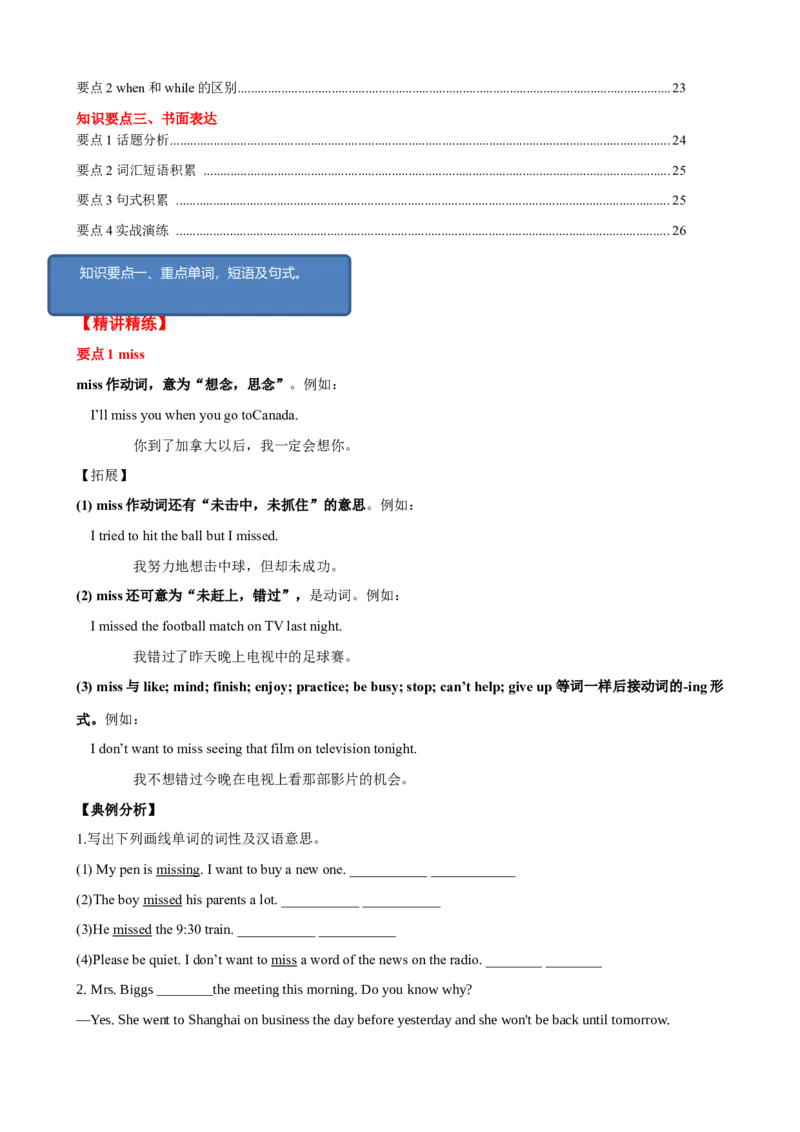
目录
知识要点一、重点单词,短语及句式
要点1 miss的用法...........................................................................................................................................练习
要点点2 remember to do和remember doing的用法.......................................................................................练习
要点3 beat/win的用法......................................................................................................................................练习
要点4 against的用法.........................................................................................................................................练习
要点5 go off用法...............................................................................................................................................练习
要点6 pick up用法............................................................................................................................................练习
要点7 when 和while的区别.............................................................................................................................练习
要点8 sleep /asleep/sleepy的用法.....................................................................................................................练习
要点9 raise的用法.............................................................................................................................................练习
要点10 make one’s way的用法........................................................................................................................练习
要点11 silence的用法......................................................................................................................................练习
要点12 hard 和hardly的用法...........................................................................................................................练习
要点13 true的用法............................................................................................................................................练习
要点14 die down及短语的用法........................................................................................................................练习
要点15 realize的用法........................................................................................................................................练习
要点16 take down的用法..................................................................................................................................练习
要点17 make sure的用法..................................................................................................................................练习
要点18 light的多种及用法 .............................................................................................................................练习
要点19 重点短语...............................................................................................................................................练习
要点20重点句式...............................................................................................................................................练习
知识要点二、语法
要点1 过去进行时 ...............................................................................................................................................23要点2 when 和while的区别.................................................................................................................................23
知识要点三、书面表达
要点1 话题分析.....................................................................................................................................................24
要点2 词汇短语积累 ...........................................................................................................................................25
要点3句式积累 ...................................................................................................................................................25
要点4实战演练 ...................................................................................................................................................26
知识要点一、重点单词,短语及句式。
【精讲精练】
要点1 miss
miss作动词,意为“想念,思念”。例如:
I’ll miss you when you go toCanada.
你到了加拿大以后,我一定会想你。
【拓展】
(1) miss作动词还有“未击中,未抓住”的意思。例如:
I tried to hit the ball but I missed.
我努力地想击中球,但却未成功。
(2) miss还可意为“未赶上,错过”,是动词。例如:
I missed the football match on TV last night.
我错过了昨天晚上电视中的足球赛。
(3) miss与like; mind; finish; enjoy; practice; be busy; stop; can’t help; give up等词一样后接动词的-ing形
式。例如:
I don’t want to miss seeing that film on television tonight.
我不想错过今晚在电视上看那部影片的机会。
【典例分析】
1.写出下列画线单词的词性及汉语意思。
(1) My pen is missing. I want to buy a new one. ___________ ____________
(2)The boy missed his parents a lot. ___________ ___________
(3)He missed the 9:30 train. ___________ ___________
(4)Please be quiet. I don’t want to miss a word of the news on the radio. ________ ________
2. Mrs. Biggs ________the meeting this morning. Do you know why?
—Yes. She went to Shanghai on business the day before yesterday and she won't be back until tomorrow.A. held B. attended C. missed D. joined
3. Don’t ________ the chance when you can catch it, or you will regret.
A. guess B. miss C. remember D. allow
要点2 remember
remember作动词,意为“记得”。与forget意思相反。例如:
Please remember his name. 请记得他的名字。
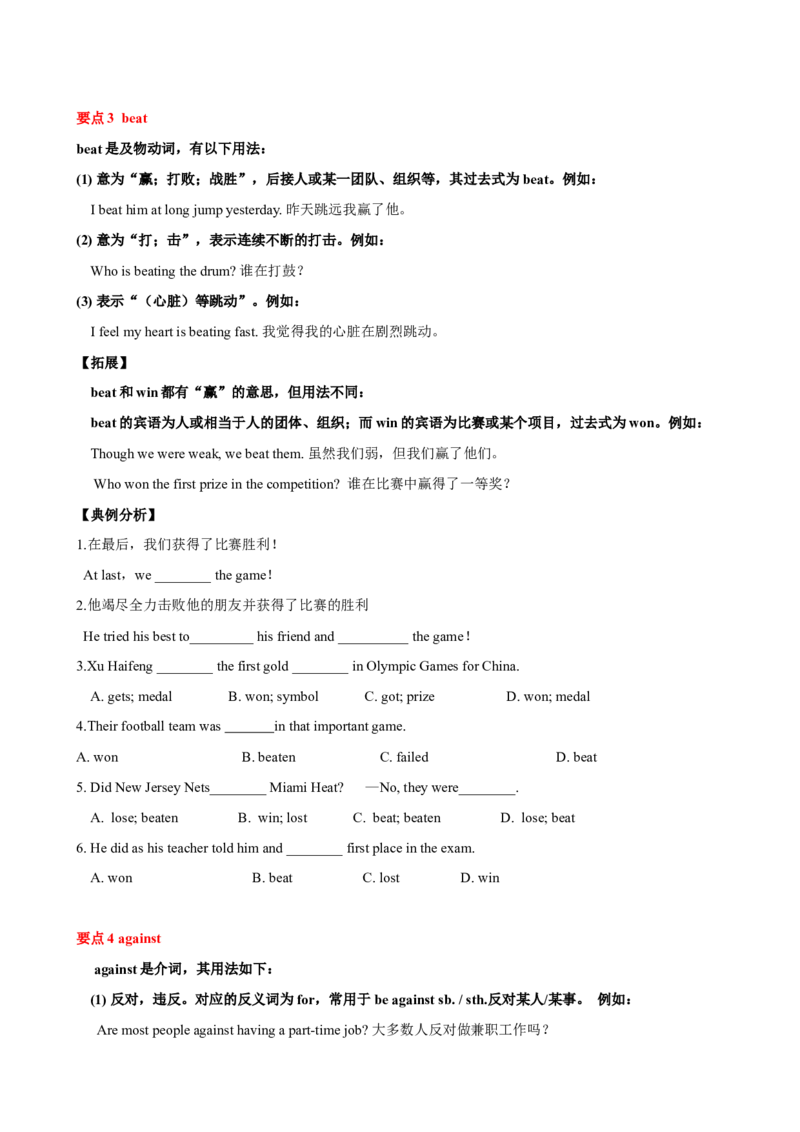
【拓展】
(1)remember to do sth.表示“记得要做某事”,事情还没有做。例如:
Remember to turn off the light when you leave. 离开时记得关灯。
(2)remember doing sth.表示“记得曾经做过某事”,事情已经做过了。例如:
He remembered going to Shanghai with his parents when he was five years old.
他记得五岁时曾经和父母去过上海。
【典例分析】
1.Tina is busy ____ at school, but she never forgets _____ her mother every day.
A. work; to call B. working; to call C. working; calling
2.I forgot _________(borrow) some money from you last week, I’m so sorry.
3.—Do you still remember ________ Yao Ming in Beijing?
—Yes, of course, three years ago.
A. to meet B. meeting C. meet D. met
4 —Will she forget ______ dinner for us? —No, she won’t.
A.cooks B.to cook C.cooking D.cooked
5 —Why do you mention this again?
—Oh, dear, I forgot ______ you about that before.
A.telling B.told C.to tell D.to telling要点3 beat
beat是及物动词,有以下用法:
(1) 意为“赢;打败;战胜”,后接人或某一团队、组织等,其过去式为beat。例如:
I beat him at long jump yesterday. 昨天跳远我赢了他。
(2) 意为“打;击”,表示连续不断的打击。例如:
Who is beating the drum? 谁在打鼓?
(3) 表示“(心脏)等跳动”。例如:
I feel my heart is beating fast. 我觉得我的心脏在剧烈跳动。
【拓展】
beat和win都有“赢”的意思,但用法不同:
beat的宾语为人或相当于人的团体、组织;而win的宾语为比赛或某个项目,过去式为won。例如:
Though we were weak, we beat them. 虽然我们弱,但我们赢了他们。
Who won the first prize in the competition? 谁在比赛中赢得了一等奖?
【典例分析】
1.在最后,我们获得了比赛胜利!
At last,we ________ the game!
2.他竭尽全力击败他的朋友并获得了比赛的胜利
He tried his best to_________ his friend and __________ the game!
3.Xu Haifeng ________ the first gold ________ in Olympic Games for China.
A. gets; medal B. won; symbol C. got; prize D. won; medal
4.Their football team was in that important game.
A. won B. beaten C. failed D. beat
5. Did New Jersey Nets________ Miami Heat? —No, they were________.
A. lose; beaten B. win; lost C. beat; beaten D. lose; beat
6. He did as his teacher told him and ________ first place in the exam.
A. won B. beat C. lost D. win
要点4 against
against是介词,其用法如下:
(1) 反对,违反。对应的反义词为for,常用于be against sb. / sth.反对某人/某事。 例如:
Are most people against having a part-time job? 大多数人反对做兼职工作吗?(2) 和……交战(指竞争、比赛等)。例如:
We’ll have a basketball match against the team from No. 2 Middle School next week.
下星期我们将与二中的球队举行一场篮球赛。
(3) 碰、装、擦。例如:
Rain beats against the window. 雨打在窗户上。
(4) 倚着、靠着。例如:
There was a ladder propped up(支撑) against the wall.一把梯子靠着墙。
(5) 防备,抗……。例如:
She saved money against old age. 她攒钱防老。
(6) 逆着……。例如:
We are sailing against the wind. 我们(的船)正逆风航行。
(7) 衬托,相映,对照。例如:
Red flags stand out brightly against the blue sky.
红旗在蓝天的衬托下显得分外鲜艳。
【典例分析】
1.我们将和来自二班的足球队比赛。
We will ________ ____________ the football team from Class Two.
2.全世界人民都反对战争。
The people around the world _________ _____________ the war.
3. We are all against _____________________ wild animals for food.
A. to kill B. killing C. of killing D. kill
4.—Which team will the French football team play ______?
—The South Korean team.
A. for B. on C. against D. at
5. We will ______________ the other strong team in the final match.
A. fight against B. against C. go against D. play against
6. I have a lot of homework to do every day. I can’t play football. Though it’s ________ my own wishes.
A. in B. on C. for D. against
要点5 go off
1. My alarm didn’t go off so I woke up late. 我的闹钟没有响,因此我醒晚了。
go off为不及物动词短语,在此意为"发出响声",可指闹钟或警报器等突然发出声响。☞ You’d better get up as soon as the alarm clock goes off.最好闹钟一叫你就起床。
☞Listen! The bell is going off. 听!铃响了。
【知识拓展】
(1) go off意为"(灯)熄灭;停止运转;离开"。
☞ The light went off as we entered the room. 我们进屋时灯灭了。
(2) go off还可以表示"变质,变坏"。
☞ Milk goes off quickly in hot weather. 牛奶在热天很容易变坏。
【典例分析】
1.我的闹钟没有响。
My alarm clock didn’t ____________.
2.他匆匆走掉了。
He ____________in a hurry.
3.你们一定不要独自离开。
You mustn't ________ ________ ______ _____ _____.
4. He in a great hurry after he answered the phone
A. gave off B. put off C. went off D. took off
5. — Why are you late again, Jeff?
— Sorry. My alarm didn’t ________, so I got up late.
A. take off B. put off C. run off D. go off
要点6 pick up
pick up意为"接电话",是动副结构。当宾语是代词时,放在pick up中间,当宾语是名词时,放在
pick up中间或后面。
☞ The phone is ringing. Could you please pick it up for me? 电话响了。请你帮我接一下好吗?
【知识拓展】
pick up的其他含义
(1)pick up还指“拾起来,捡起”,接名词作宾语时,放在副词前后都可以,当接代词it/them作宾语时,
只能放在动词和副词之间。
☞ Your pen is lying on the floor; please pick it up.你的钢笔在地板上,请把它拾起来。
(2)pick up还可意为“(开车)接(某人)”。
☞ I will pick you up at six tomorrow morning.明天早上六点钟我去接你。
(3)学会;(偶然)得到☞ Here’s a tip I picked up from my mother.告诉你一个窍门,是我从妈妈那里学来的。
【典例分析】
1.他从地板上捡起帽子,重新戴在头上。
He _________his cap ________ from the floor and stuck it back on his head.
2.我们第二天早晨开车去机场接苏姗。
We drove to the airport the next morning to _________ ________ Susan.
3.-Look ! What’s on the ground ?
-Oh , it’s my sweater . Please _________.
A. pick it up B. pick up it C. pick them up D. pick up them
4.My grandmother is coming from Nanjing and I'm going to the airport to .
A、pick her up B、see her off C、ring her up D、wake her up
5. —I called you last night, but you didn’t ________. What were you doing?
—I was taking a shower.
A. get up B. pick up C. give up D. look up
6. —Dave, please __________ the onion on the floor.
—No problem, mom.
A. pick up B. care for C. take off D. look out
要点 7. While与when区别
while conj. 在……期间;当……的时候
【例句】
He was doing homework while I was cooking. 当我在做饭的时候,他在做家庭作业。
【辨析】while与when
while 和 when都可以表示“当……的时候”。
(1)when后面可以接延续性动词和短暂性动词,若主从句表达将来发生的事情,要遵从“主将从现”原则;
如果从句动作为过去时而且是短暂性动词,则主句用过去进行时。
I came in when/while he was reading. 他在看书时我走了进来。
He was reading when I came in. 我走进来时他正在看书。
When he comes back tomorrow, I will ring you up. 他明天回来的时候,我会打电话给你。
(2)while后面只能接延续性动词,常用进行时态;如若主句的动作也是延续性的,则构成“...be doing
while...be doing...”。
Mum was washing clothes while Dad was reading a newspaper. 爸爸在看报纸的时候,妈妈在洗衣服。【拓展】
(1)while n. 一会儿
She likes to lie down for a while after lunch. 她喜欢午饭后躺一会儿。
2)while conj. 而;然而(表示对比)
Some people waste food while others haven’t enough. 有些人浪费粮食,然而有些人却吃不饱。
【典例分析】
1.当我在做饭的时候,他在做家庭作业。
He _________ ___________homework __________ I was cooking.
2.我走进来时他正在看书。
He __________ ___________ _________ I came in.
3. The girl was flying a kite________ her father came back.
A. when B. while C. until
D. after
4. The boy was listening to music ________ he was riding his bike.
A. when B. while C. after D. before
5. Mother’s Day is coming. Some students want to buy flowers as gifts, _________ I plan to cook a big dinner for
my mother.
A. when B. while C. before D. after
6. Sandy was hiding behind the tree ________ a snowball hit her badly.
A. since B. as C. while D. when
7. —_________ time goes on, her illness gets worse and worse.
—She is always a strong-minded lady. Hope a miracle will happen.
A. When B. While C. Once D. As
8. —John, you are ten minutes late.
—Sorry! I was leaving ________ my phone rang. And it was from my sister.
A. when B. while C. after D. before
要点8
asleep为形容词,"睡觉的,睡着的",在句中常作表语。fall asleep"入睡",fall用作系动词,asleep
作表语。
☞ He fell asleep when I saw him. 当我看见他时,他睡着了。☞ He was just falling asleep when he heard a cry for help. 他刚要睡着,这时听到呼救声。
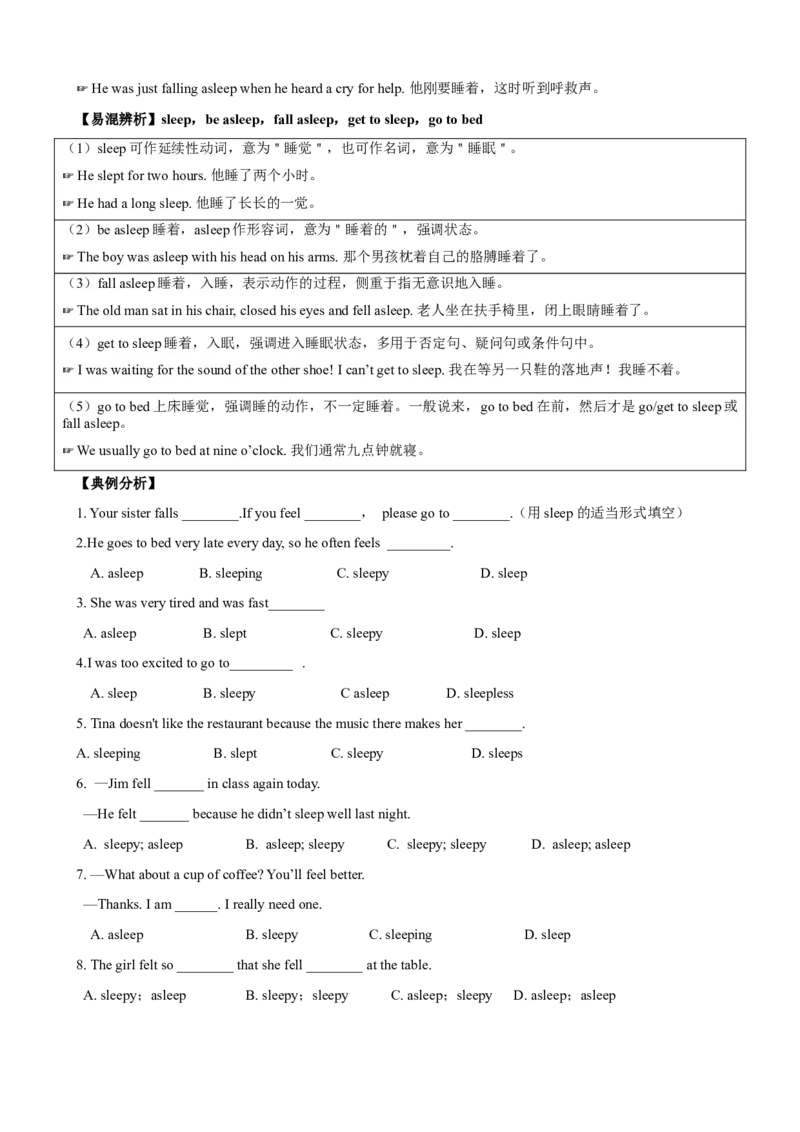
【易混辨析】sleep,be asleep,fall asleep,get to sleep,go to bed
(1)sleep可作延续性动词,意为"睡觉",也可作名词,意为"睡眠"。
☞ He slept for two hours. 他睡了两个小时。
☞ He had a long sleep. 他睡了长长的一觉。
(2)be asleep睡着,asleep作形容词,意为"睡着的",强调状态。
☞ The boy was asleep with his head on his arms. 那个男孩枕着自己的胳膊睡着了。
(3)fall asleep睡着,入睡,表示动作的过程,侧重于指无意识地入睡。
☞ The old man sat in his chair, closed his eyes and fell asleep. 老人坐在扶手椅里,闭上眼睛睡着了。
(4)get to sleep睡着,入眠,强调进入睡眠状态,多用于否定句、疑问句或条件句中。
☞ I was waiting for the sound of the other shoe! I can’t get to sleep. 我在等另一只鞋的落地声!我睡不着。
(5)go to bed上床睡觉,强调睡的动作,不一定睡着。一般说来,go to bed在前,然后才是go/get to sleep或
fall asleep。
☞ We usually go to bed at nine o’clock. 我们通常九点钟就寝。
【典例分析】
1. Your sister falls ________.If you feel ________, please go to ________.(用sleep 的适当形式填空)
2.He goes to bed very late every day, so he often feels _________.
A. asleep B. sleeping C. sleepy D. sleep
3. She was very tired and was fast________
A. asleep B. slept C. sleepy D. sleep
4.I was too excited to go to_________ .
A. sleep B. sleepy C asleep D. sleepless
5. Tina doesn't like the restaurant because the music there makes her ________.
A. sleeping B. slept C. sleepy D. sleeps
6. —Jim fell _______ in class again today.
—He felt _______ because he didn’t sleep well last night.
A. sleepy; asleep B. asleep; sleepy C. sleepy; sleepy D. asleep; asleep
7. —What about a cup of coffee? You’ll feel better.
—Thanks. I am ______. I really need one.
A. asleep B. sleepy C. sleeping D. sleep
8. The girl felt so ________ that she fell ________ at the table.
A. sleepy;asleep B. sleepy;sleepy C. asleep;sleepy D. asleep;asleep要点9 raise
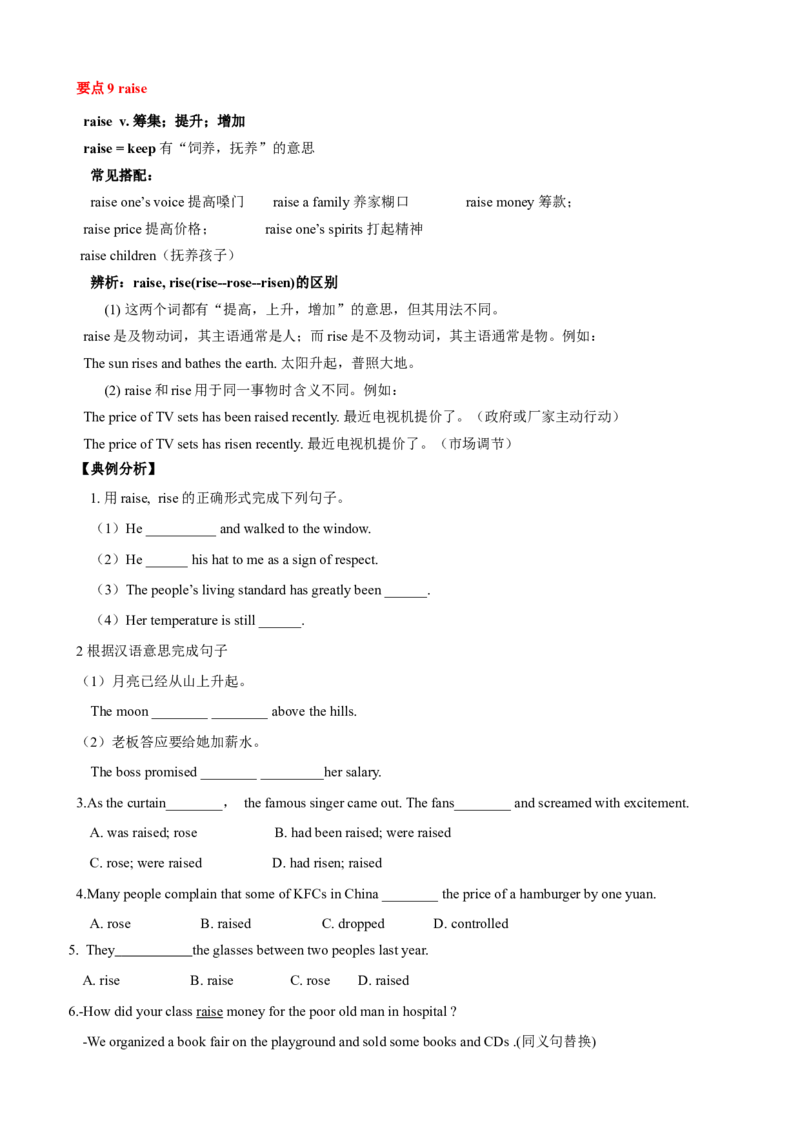
raise v. 筹集;提升;增加
raise = keep 有“饲养,抚养”的意思
常见搭配:
raise one’s voice 提高嗓门 raise a family 养家糊口 raise money 筹款;
raise price 提高价格; raise one’s spirits 打起精神
raise children(抚养孩子)
辨析:raise, rise(rise--rose--risen)的区别
(1) 这两个词都有“提高,上升,增加”的意思,但其用法不同。
raise是及物动词,其主语通常是人;而rise是不及物动词,其主语通常是物。例如:
The sun rises and bathes the earth. 太阳升起,普照大地。
(2) raise和rise用于同一事物时含义不同。例如:
The price of TV sets has been raised recently. 最近电视机提价了。(政府或厂家主动行动)
The price of TV sets has risen recently. 最近电视机提价了。(市场调节)
【典例分析】
1. 用raise, rise的正确形式完成下列句子。
(1)He __________ and walked to the window.
(2)He ______ his hat to me as a sign of respect.
(3)The people’s living standard has greatly been ______.
(4)Her temperature is still ______.
2根据汉语意思完成句子
(1)月亮已经从山上升起。
The moon ________ ________ above the hills.
(2)老板答应要给她加薪水。
The boss promised ________ _________her salary.
3.As the curtain________, the famous singer came out. The fans________ and screamed with excitement.
A. was raised; rose B. had been raised; were raised
C. rose; were raised D. had risen; raised
4.Many people complain that some of KFCs in China ________ the price of a hamburger by one yuan.
A. rose B. raised C. dropped D. controlled
5. They the glasses between two peoples last year.
A. rise B. raise C. rose D. raised
6.-How did your class raise money for the poor old man in hospital ?
-We organized a book fair on the playground and sold some books and CDs .(同义句替换)A. collect B. put up C. spend
7. 太阳从东边升起,从西边落下。
要点10 make one’s way
make one’s way中的one’s在句中常换成与主语一致的物主代词。make one’s way to/towards + 地点意为
"前往某地,到某地方去"。
☞ Will you be able to make your way to the bus stop? 你能自己去汽车站吗?
☞ He was still making his way though it was raining heavily. 尽管雨下得很大,他仍然在前进。
【知识拓展】
(1)by the way 为固定短语,意为"顺便提一下"。
☞ By the way, what’s the time? 顺便问一下,几点了?
☞ By the way, where did you buy this dress? 顺便问一下,你在哪里买的这件连衣裙?
(2)on the / one’s way to +地点意为"在去……的路上"。当表示地点的词是副词时,则要省略to。
☞ I met my sister on my way to the station. 在去车站的路上,我遇到了我的姐姐。
(3)lose one’s way为固定短语,意为"迷路"。
☞ I almost lost my way yesterday. 昨天我差点迷了路。学&科网
【典例分析】
1.—I'm sorry I have no notebooks.
—Oh, it doesn't matter. ________, don't forget to buy a notebook ________ to school next time.
A. By the way; on your way B. In the way; on your way
C. On the way; in the way D. In this way; in the way
2. 那时那位老人正费力地走向门口。
The old man________ ________ ________ ________ to the door at that time.
3.她的社交生活妨碍了学业。
Her social life _______________________ her studies.
4. 在去车站的路上我买了些巧克力。
_____________the station, I bought some chocolate。
5.巴巴拉一路上沉默着,但是她也说了这样的话。
Barbara had been silent_____________, but she said so too.
6.顺便说一句,你最近见过哈里吗?__________________, have you seen Harry recently?
要点11 silence
silence n. 沉默;缄默;无声
① silence是silent的名词形式,常用短语为in silence沉默,无声。
☞ Nobody knew what to say and they just sat there in silence.
没有人知道说什么,他们只是默默地坐在那儿。
☞ As night fell, everything was in silence. 当夜幕降临,一切都静悄悄的。
☞ He looked at the boy in silence for some minutes. 他默默地盯着那个男孩看了好一会儿。
② silent是silence的形容词形式,表示"不说话的;沉默的"。
☞ The street was silent. 大街上很安静。
【易混辨析】 silent与quiet
silent着重指沉默无语或没有声音,但不一定指没有动作或活动。
☞ That is a silent movie. 那是一部无声电影。
☞ He is silent about what happened. 他对发生的事情保持沉默。
quiet表示安静的、寂静的、平静的。指物时,表示没有喧闹或没有骚动,处于一种静止的状态或宁静的
环境;指人时,表示不发出声音或不发表意见,也可指人的性格温和、文静、不易激动等。
☞ He lives a quiet life in the country. 他在乡下过着悠闲的生活。
☞ Can’t you keep the children quiet? 你能不能让孩子们保持安静?
☞ Mary is a quiet girl. 玛丽是个文静的姑娘。
【典例分析】
1. 用silence的适当形式填空
①I don't think you should keep ________.
②She always sat in ________ and didn't say a word.
2. None of them talked. They finished their meal in ________.
A. silence B. order C. place D. public
3.—How strange! You sit in your room ________ for a long time, Li Ming.
—I just want to be quiet for a while. I'm sorry, Dad. I failed the test again.
A. in silence B. in person C. in public D. in fact
4. —Why do you stand there ________?
—I just want to be quiet and think about a question.
A. in person B. in silence C. in public D. in fact
5. Keep ________, and we should listen to the tape ________.A. silent;silently B. in silent;silently C. in silence;in silence D. silently;silently
要点12 hardly (高频考题)
hardly是副词,意为“几乎不;几乎没有”,是一个具有否定意义的词。
My legs were so weak that I could hardly stand. 我的腿太虚弱,以至于几乎无法站立。
hardly 几乎不= almost not
He can hardly believe the result, can he?(前否后肯)
辨析hard和 hardly的区别:
hard 作形容词,意为“困苦的;艰难的;坚硬的”; 作副词,意为“努力地;猛烈地
hardly 作副词, 意为“几乎不;几乎没有”,它并不是hard的副词形式
The task is so hard that I can't finish it on my own. 这个任务太难了,以至于我不能独立完成。
Study hard, and you can pass the exam. 努力学习,你会通过考试的。
Look! It' s raining hard outside.看!外面雨下得正大。
The children were so excited they could hardly speak. 孩子们兴奋得几乎连话都说不出来了。
【典例分析】
1.—I have some trouble in learning maths.
—Take it easy, because we can __________avoid meeting problems in study.
A. always B. usually C. often D. hardly
2. It rained ______. People could _______ go out.
A. hardly, hardly B. hard, hardly C. hardly, hard D. hard, hard
3.It is ______ for him to get to school on time, because it is raining ______.
A .hard ; hardly B. hardly; hard C. hard; hard D. hardly hardly
要点13
true 为形容词,表示"真的,真实的"。truth是形容词true的名词形式,其副词是truly。to tell ( you )
the truth意为"说实话;老实说",一般放在句首。
☞ The news is true. 这消息是真的。学&科网
☞ He told me the truth. And I truly believe it is true. 他把真相告诉了我。我确信那是真的。
☞ To tell the truth, I fell in love with Shanghai when I got there. 老实说,一到上海,我就爱上了那里。与to tell ( you ) the truth结构类似的插入语有:
to be honest 坦白地说;to be sure 诚然;
to start with=to begin with 起初,开始时
【典例分析】
1. To tell the ________, everyone is good at something, but some people are ________ talented.
A. true, truth B. truth, truly C. true, truly
2. Our dream will come ________ one day.
A. true B. truth C. truly D. be true
3. —Wang Gang, I know you didn’t tell me the _______. How could you lie to me?
—Sorry, Mom. I won’t do it again.
A. place B. plan C. truth D. story
要点14 die down
die down逐渐变弱,逐渐平息
When you saw him, his anger had died down a bit.
你看见他的时候,他的火气已经下去了。
die的用法
die(v) 死亡 death(n) 死亡
die为不及物动词,意为“死”,其过去式为died,现在分词为dying。
More than three hundred people died in the air crash. 在这次飞机失事中有300多人死亡。
dead形容词,意为“死的,失去生命的”,在句中可作定语或表语。
He was watching his dead cat when I came in.
当我进来时,他正在注视着他的死去的猫。
I’m afraid he is dead. 我恐怕他已经去世了。
拓展:die 构成的短语
① die of意为“因……而死”,一般指由于疾病、情感等内因引起的死亡。
Her grandfather died of cancer in 1992. 她的祖父于1992年死于癌症。
② die from意为“因……而死”,一般指由于外伤、事故等外因引起的死亡。
The old man died from a car accident last year. 那位老人去年死于一场车祸。
die out 灭绝。
【典例分析】1. —It’s reported that the storm will ________ at about 10:00 am.
—Good news!
A. give away B. put off C. die down D. cut down
2. —Do you know that Mr. Zhang passed by last week?
—Yes. He died ________ illness.
A. of B. from C. with D. as
3. —When did the old man ________?
—In 2006. He ________ for nearly ten years.
A. die; died B. die; has been dead C. dead; has died D. dead; died
4. —Don’t let the fire ________, or it will be very cold in this room.
—Yes, I will put more wood in the fire.
A. take down B. take after C. die down D. take up
5. I waited for the laughter to _______ before I spoke.
A. close down B. turn down C. die down D. break down
6.那个老人死于一起交通事故。
The old man ________ _________ a traffic accident.
7.那个婴儿死于发烧。
The baby _______ __________a fever.
8. 过了一会儿,风开始减弱了。
After a while, the wind began to __________ __________.
9. 这种动物50年前就灭绝了。
The animal _________ _________ 50 years ago.
要点15 realize
(1) realize作为及物动词,意为“认识到,了解”。
He didn’t realize his mistake until his mother told him.
直到妈妈告诉他,他才认识到自己的错误。
I didn’t realize how late it was. 我没有意识到天已经那么晚了。
(2) realize还可以表示“实现;完成”的意思。
The girl finally realized her dream of becoming an actress.
那个女孩当演员的梦想终于实现了。
【拓展】
realize与recognize这两个词都有“认识,识别”的意思,但在具体用法上又有所差别。(1)recognize也可以用作及物动词,表示“认出, 辨认”的意思。
I recognized his voice. 我辨认出了他的声音。
I recognized her as my friend’s daughter. 我认出了她是我朋友的女儿。
(2)recognize还可以表示“清楚知道;认定”的意思。
I recognized him to be cleverer than I am. 我认识到他比我聪明。
【典例分析】
1. It was too dark that night, so I could hardly ________ the traffic signs on the road.
A. require B. refuse C. realize D. recognize
2. Now, more and more people begin to _________ the importance of keeping healthy.
A. realize B. control C. encourage D. invent
3. —It took Ms. Zhang many years to help her students to ________ their college dreams.
—That’s true.
A. realize B. describe C. admire D. master
4. —Some Chinese government officers have turned into live streamers(网络主播).
—Yes. They’re trying their best to help local farmers to ________ sales(销售).
A. receive B. improve C. return D. realize
要点16 take down
take down表示将建筑物或高的物体“拆除;拆掉;拆卸”,此处根据上下文可翻译成“摧毁;毁掉”。
They’re talking about how to take that wall down. 他们在讨论如何拆除那堵墙。
【拓展】take down还有如下含义:
All the pupils took down the speech.
记下; 写下
所有的学生都把那篇演讲记下来了 。
Did he take down the blue flag?
拿下; 取下
他把蓝旗子取下来了吗?
常见的含有take的词组:
take turns轮流
take away拿走
take out拿出,取出
take over接手,接管
take notes 做笔记
take care当心,注意take care of 照顾
take photos 照相
take it easy别紧张
take in 吸入 领悟,理解
take up 占据(一定的时间、空间、精力......);开始从事......
【典例分析】
一、用take构成的短语完成句子
1.他长得像他父亲
He__________ _______ his father
2.母亲把我们的盘子拿走,回来拿一些水果给我们吃
Mother _________our plates __________and came back with some fruit for us to eat.
3.那首曲子把我带回到童年时代
That music ________ me________ to my childhood.
4.我们需要把窗帘拿下来清洗下
We need to _________ __________ the curtains to be cleaned.
5. 如果你有钢笔,可以把我的电话号码记下来
If you have a pen, you can ________ _________ my phone number.
6. 当我路过时,工人们正在拆除那座旧房子。
The workers __________ __________ __________the old house when I walked by.
7.飞往曼谷的航班准时起飞。
The flight for Bangkok ________ ________ on time.
8.天气太热了,所以我把夹克衫脱掉了
It was hot, so I________ my jacket __________.
9.她请两天假来照顾她奶奶。
She __________two days _________school to _________ _________ _________his grandma.
10.请在整个房子有臭味前把垃圾清除出去
Please _________ ________the trash before the whole house starts to smell.
11.自从他挂了之后,他的儿子就接管了他的公司。
His son has ________ ________ his company since he died。
12. 有关金融的书籍占用了三个书架
The books on finance_______ ________ three shelves.
13.这种布料吸水性很好。This kind of cloth _______ _______water very well.
14. —Could you please________ the picture on the wall and make it clean?
—Sure. I’d love to.
A. take down B. die down C. cut down D. put down
15. —Hi, Tina, what are you going to do for the coming winter holiday?
—I am going to ________ cooking because I like eating delicious food.
A. take down B. take up C. look down D. clean up
16. People are ________ more and more land. So animals will have fewer and fewer places to live.
A. taking away B. taking out C. taking off D. taking down
17. —The earthquake broke so many things apart.
—It’s really a disaster. Hundreds of houses were ________.
A. taken up B. taken down C. taken out D. taken off
要点17 make sure
make sure 确信,有把握
Make sure he writes it down. 让他一定记下来。
【考点聚焦】1)make sure后常接从句;
2)常见搭配:
be sure to do sth. 一定要做……;
be sure of sth.对……有把握;
be sure that从句,相信……
【典例分析】
1.选词填空make sure/be sure (to)
1)I Mr. Liu is right.
2) that you have got the tickets.
3) come to my party next week.
2. ________ to close the windows before you go out.
A. Making sure B. Is sure C. Make sure D. Sure
3. There are not many tickets left for the movie. You have to________ that you get one today.
A. make use of B. make up C. make a face D. make sure
要点18 light(1)light作不可数名词,意为“光;光亮;光线”。例如:
The sun gives out light and heat. 太阳发出光和热。
He read the letter by the light of the candle. 他在烛光下读那封信。
(2)light作可数名词,意为“电灯;光源”。
Don’t cross the road when the traffic lights are red.
当交通灯是红色时,不要横穿马路。
(3)light作形容词,意为“轻的;浅色的”。例如:
Is the box heavy or light? 那箱子是重还是轻?
I like the light green dress. 我喜欢哪件浅绿色的裙子。
(4)light作动词,意为“点燃;照亮”。例如:
He sat down and lit a cigarette. 他坐下来,点了一支烟。
【典例分析】
1.Since the accident she can only do work. 她出事以后只能做轻活儿了。
2.It’s beginning to get . 天渐渐亮了。
3.We the candle and the candle the room. 我们点燃了蜡烛,蜡烛照亮了房间。
4. Don’t read books in the sun. The strong _________ will hurt your eyes.
A. wind B. cloud C. light D. match
5. —Our school will __________ some new lights in the library.
—Great. It’s good for our eyes.
A. put down B. put away C. put on D. put in
6. Things are _______ on the moon _______ on the earth.
A. much lighter;than B. more lighter;than C. as heavy;as D. not so light;as
7. We all can mix white with another colour to make it a ________ colour.
A. good B. big C. light D. dark
8. Jenny was so scared of the dark that she always leaves a ________ on even when she was asleep.
A. phone B. light C. radio D. computer
9. —The box is too ________. I can’t carry it. What’s in it?
—Sorry, I don’t know.
A. light B. small C. big D. heavy
【重点词组】1.make sure 确信;确认
2.beat against... 拍打……
3. fall asleep 进人梦乡;睡着
4. die down 逐渐变弱;逐渐消失
5. wake up 醒来
6. in a mess 一团糟
7. break...apart 使……分离
8. at the time of 当.......时候
9. go off (闹钟)发出响声
10. take a hot shower 洗热水澡
11. pick up 接电话
12. by the side of the road 在路边
13. walk by 走路经过
14. make one’s way to.... 在某人去……的路上
15.important events in history 历史上的重大事件
16.in silence 沉默;无声
17.take down 拆除;摧毁
18.have meaning to 对……有意义
19.remember doing sth. 记得做过某事
20.at first 首先;最初
【重点句式】
1.昨晚8点你在干什么?我在洗淋浴。
— What were you doing at eight last night?
— I was taking a shower.
2.人们常常记得当他们听到重大历史事件的消息时,他们正在做什么。
People often remember what they were doing when they heard the news of important events in history.
3.当我们从广播中听到这个消息时,我们正在厨房里吃晚饭。
We were eating dinner in the kitchen when we heard the news on the radio.
4.我的姐姐正在做家庭作业的时候,那条宠物狗跑出去了。(while/when)
While my sister was doing her homework, that pet dog ran out. / My sister was doing her homework when that
pet dog ran out.
5. 当开始下雨的时候,本正在帮他妈妈做晚饭。When it began to rain, Ben was helping his mom make dinner.
3. 琳达在睡觉的时候,珍妮正在干什么?
琳达在睡觉的时候,珍妮正在帮玛丽做作业。
— What was Jenny doing while Linda was sleeping?
— While Linda was sleeping, Jenny was helping Mary with her homework.
知识要点二:语法
过去进行时
(一)定义:过去进行时主要用于表示过去某个时间点正在进行的动作,有时也可表示过去某个阶段一
直在进行的动作。其形式为”was/were+ doing”。例句:
(二)常见的时间状语有:then, at that time, this time yesterday, at (eight) yesterday (morning), the
whole morning, all day yesterday, from nine to ten last evening等;或者与when, while,引导的过去时间状语连
用。
【注意】when和while引导的时间状语从句的区别
1、when引导的从句中的动词可以跟延续性动词和短暂性动词, 时态上可以是进行时,也可以是一般时;
while引导的状语从句中,谓语动词必须是延续性动词, 时态上必须是进行时。
例句:When/While we were having supper, the light went out.
例句:I was walking in the street when someone called me.
2、若主、从两个动作都是延续性的或同时发生, 那么主、从句的动词都可用过去进行时, 此时的时间
状语从句一般由while 引导。
例句:My father was cleaning for his car while I was playing basketball yesterday afternoon.
【典例分析】
用所给单词的适当形式填空
1. While we ________________(wait)for the bus, a girl ________ (run)up to us.
2. I ________________(telephone)a friend when Bob____________ (come)in.
3. Jim ___________(jump)on the bus as it __________ (move)away.
4. While mother _______________(put)Cathy to bed, the door bell ___________(ring).
5. As I _____________ (walk)in the park, it _________(begin)to rain.
6. We _______________(test)the new machine when the electricity __________(go)off.7. He said he _____________ (help) his sister with homework at that time.
8. While we _____________ (wait) for the bus, an old man fell down.
When 和while 区别训练参看上面要点7
知识要点三:书面表达
【话题分析】
本单元以"谈论过去正在发生的事情"为话题,讲述了大事件发生时人们正在进行的各种活动。具体到
书面表达中,要求同学们会对过去正在发生的事情进行描述,在写这类短文时,要运用相应的过去时态
如一般过去时或过去进行时等。在写作时要注意以下几点:
①明确中心思想,无论是看图写作,还是情景描写,都要围绕文章中心展开;
②要注意记叙文的几个要素,即把时间、地点、人物、事件、起因、经过、结果等交代清楚;
③要合理安排好写作的顺序;
④叙述事件时语言简洁,把文章写得生动、详实。
【单元写作素材】
【词汇积累】
(一)动作类短语
1. 步行回家 walk home 2. 去上班 go to work
3. 入睡 fall asleep 4. 下大雨 rain heavily
5. 洗热水澡 take a hot shower 6. 发出响声 go off
7. 接电话 pick up 8. 逐渐变弱 die down
9. 确认;确信 make sure 10. 等公共汽车 wait for the bus
11. 把人们更紧密地团结在一起 bring people closer together
12. 前往学校make the way to school 13. 撕裂 break things apart
14. 参加一项活动go to an even 15. 删除cut out
16.做某事有困难 have trouble (in) doing sth. 17.拆除 take down
18.对.….….有意义 have meaning to
(二)时间类短语
1. 当暴风雨来的时候 at the time of the rainstorm
2. 在那个时候 at that time
3. 在地震时 at the time of the earthquake(三)其他短语
1. 沉默地 in silence 2. 说实话 to tell the truth
3. 一团糟 in a mess 4. 首先;起初 at first
5. 在历史上 in history 6. 在路边by the side of the road
【句子积累】
1.当校篮球赛开始时,凯特还在去学校的路上。
2.人们常常记得当他们听到重大历史事件的消息时,他们正在做什么。
3.当我们从广播中听到这个消息时,我们正在厨房里吃晚饭。
4.我们默默地吃完了晚饭。
5.她记得当时(自己)正在距两座塔楼不远的办公室工作。
6.我是如此害怕以至于在那之后我很难清晰地思考。
7.尽管这场风暴撕裂许多东西,但它拉近了家庭和邻居的距离。
8.这个日期对大多数美国人来说具有一定意义。
9.我的姐姐正在做家庭作业的时候,那条宠物狗跑出去了。(while/when)
10 “在下雪的时候这个男孩正在做什么?”(at the time of) “他正在家里读书。”(read)
【实战演练】
你经历过什么令你印象深刻的事情吗? 假设在本周的英语口语课上,老师要求每个小组讲述一件记
忆深刻的事情。请你以“An Unforgettable Event”为题,写一篇英语短文, 代表小组发言。
写作提示:
1. 事件发生的时间和地点;
2. 事件发生的时候你在做什么;
3. 事件的重要意义或令你印象深刻的原因。写作要求:
1. 语句通顺,条理清晰,详略得当,书写工整;
2. 100词左右,开头和结尾已给出,不计入总词数。
An Unforgettable Event
I have a good friend. He is on a basketball team.
___________________________________________________________________________________________
___________________________________________________________________________________________
___________________________________________________________________________________________
___________________________________________________________________________________________
___________________________________________________________________________________________
___________________________________________________________________________________________
___________________________________________________________________________________________
___________________________________________________________________________________________.