文档文本内容
Unit 5 What were you doing when the rainstorm
came?
单元知识清单
Section A
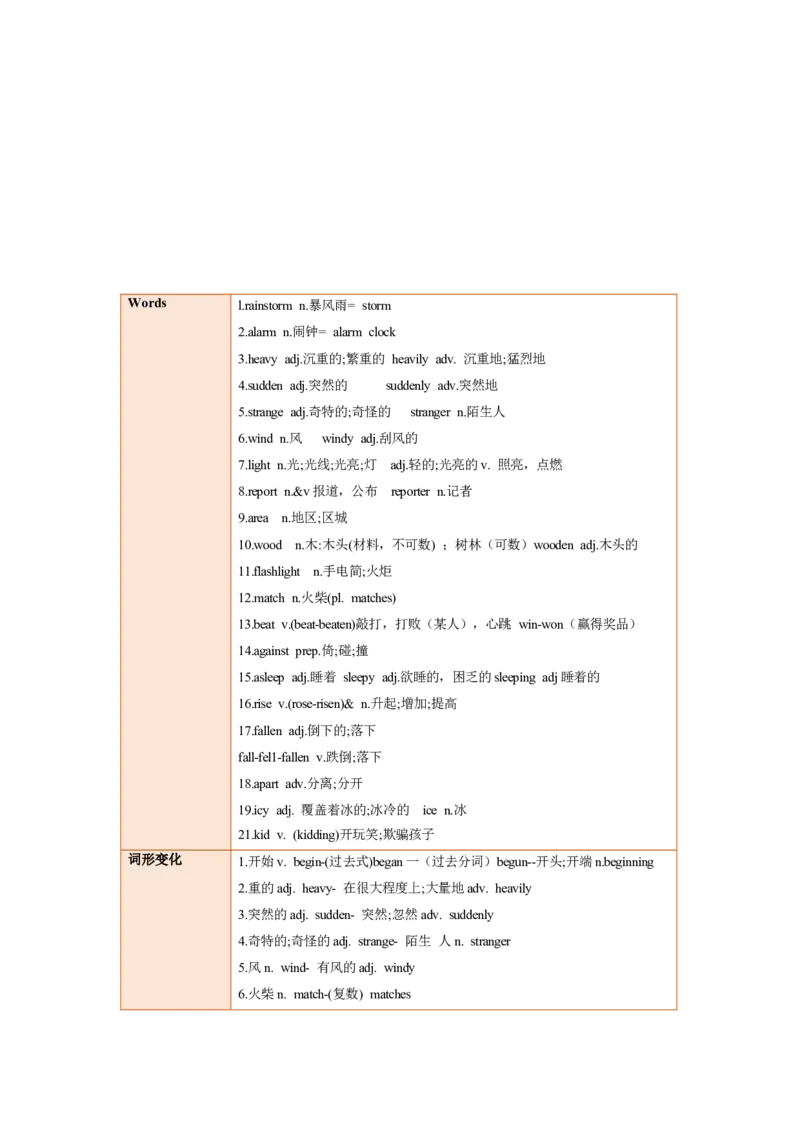
一、 基础知识清单Words l.rainstorm n.暴风雨= storm
2.alarm n.闹钟= alarm clock
3.heavy adj.沉重的;繁重的 heavily adv. 沉重地;猛烈地
4.sudden adj.突然的 suddenly adv.突然地
5.strange adj.奇特的;奇怪的 stranger n.陌生人
6.wind n.风 windy adj.刮风的
7.light n.光;光线;光亮;灯 adj.轻的;光亮的v. 照亮,点燃
8.report n.&v报道,公布 reporter n.记者
9.area n.地区;区城
10.wood n.木:木头(材料,不可数) ;树林(可数)wooden adj.木头的
11.flashlight n.手电简;火炬
12.match n.火柴(pl. matches)
13.beat v.(beat-beaten)敲打,打败(某人),心跳 win-won(赢得奖品)
14.against prep.倚;碰;撞
15.asleep adj.睡着 sleepy adj.欲睡的,困乏的sleeping adj睡着的
16.rise v.(rose-risen)& n.升起;增加;提高
17.fallen adj.倒下的;落下
fall-fel1-fallen v.跌倒;落下
18.apart adv.分离;分开
19.icy adj. 覆盖着冰的;冰冷的 ice n.冰
21.kid v. (kidding)开玩笑;欺骗孩子
词形变化 1.开始v. begin-(过去式)began一(过去分词)begun--开头;开端n.beginning
2.重的adj. heavy- 在很大程度上;大量地adv. heavily
3.突然的adj. sudden- 突然;忽然adv. suddenly
4.奇特的;奇怪的adj. strange- 陌生 人n. stranger
5.风n. wind- 有风的adj. windy
6.火柴n. match-(复数) matches7.睡觉v. sleep-(过去式)slept -(过去分词)slept 睡着adj. asleep一困倦的
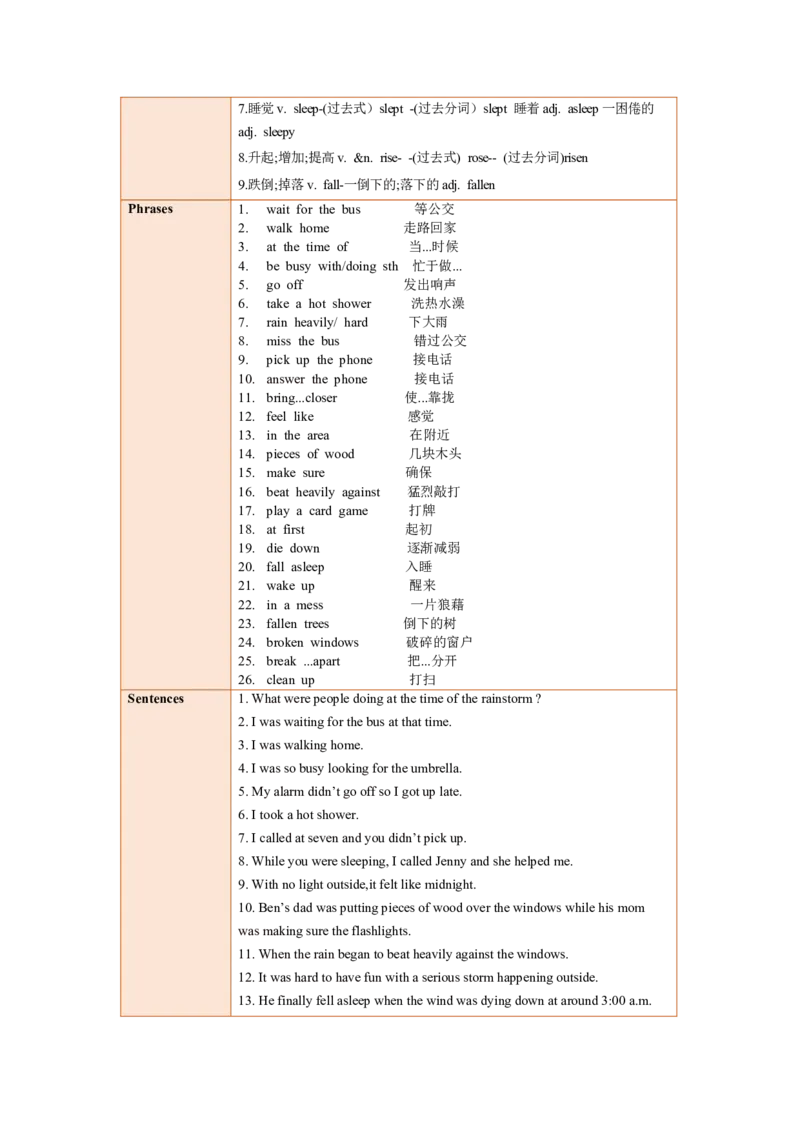
adj. sleepy
8.升起;增加;提高v. &n. rise- -(过去式) rose-- (过去分词)risen
9.跌倒;掉落v. fall-一倒下的;落下的adj. fallen
Phrases 1. wait for the bus 等公交
2. walk home 走路回家
3. at the time of 当...时候
4. be busy with/doing sth 忙于做...
5. go off 发出响声
6. take a hot shower 洗热水澡
7. rain heavily/ hard 下大雨
8. miss the bus 错过公交
9. pick up the phone 接电话
10. answer the phone 接电话
11. bring...closer 使...靠拢
12. feel like 感觉
13. in the area 在附近
14. pieces of wood 几块木头
15. make sure 确保
16. beat heavily against 猛烈敲打
17. play a card game 打牌
18. at first 起初
19. die down 逐渐减弱
20. fall asleep 入睡
21. wake up 醒来
22. in a mess 一片狼藉
23. fallen trees 倒下的树
24. broken windows 破碎的窗户
25. break ...apart 把...分开
26. clean up 打扫
Sentences 1. What were people doing at the time of the rainstorm ?
2. I was waiting for the bus at that time.
3. I was walking home.
4. I was so busy looking for the umbrella.
5. My alarm didn’t go off so I got up late.
6. I took a hot shower.
7. I called at seven and you didn’t pick up.
8. While you were sleeping, I called Jenny and she helped me.
9. With no light outside,it felt like midnight.
10. Ben’s dad was putting pieces of wood over the windows while his mom
was making sure the flashlights.
11. When the rain began to beat heavily against the windows.
12. It was hard to have fun with a serious storm happening outside.
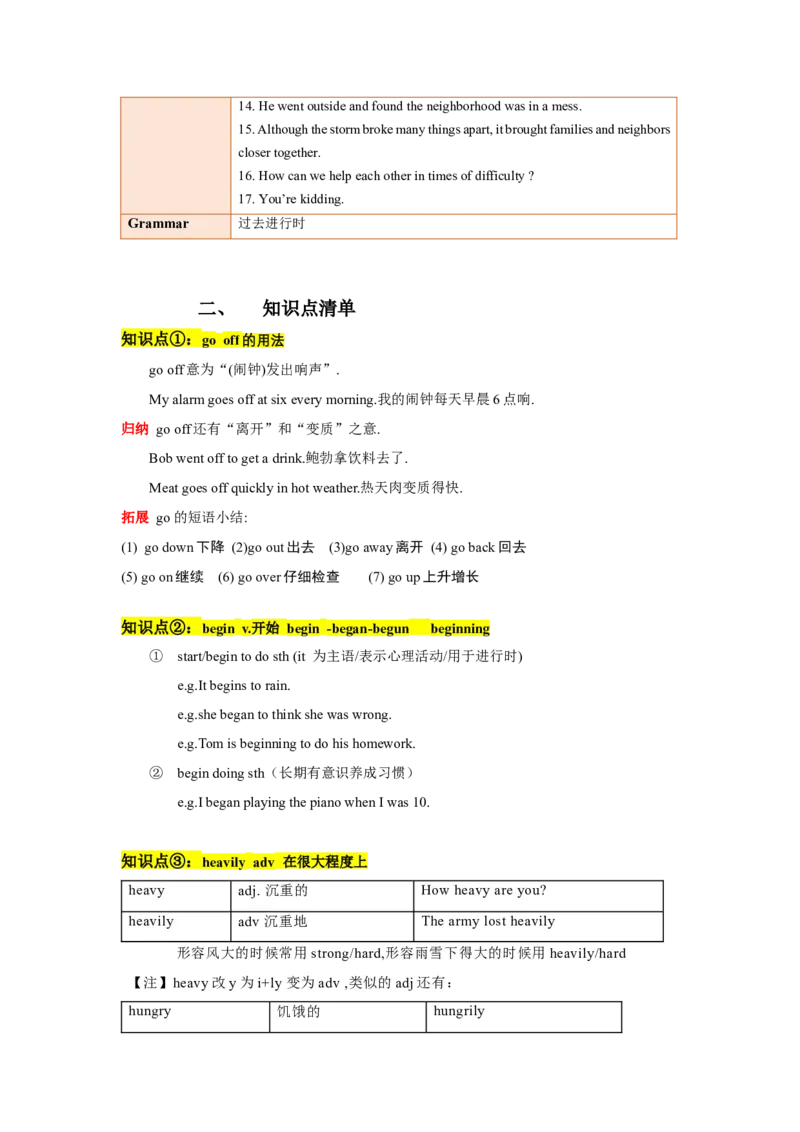
13. He finally fell asleep when the wind was dying down at around 3:00 a.m.14. He went outside and found the neighborhood was in a mess.
15. Although the storm broke many things apart, it brought families and neighbors
closer together.
16. How can we help each other in times of difficulty ?
17. You’re kidding.
Grammar 过去进行时
二、 知识点清单
知识点①:go off的用法
go off意为“(闹钟)发出响声”.
My alarm goes off at six every morning.我的闹钟每天早晨6点响.
归纳 go off还有“离开”和“变质”之意.
Bob went off to get a drink.鲍勃拿饮料去了.
Meat goes off quickly in hot weather.热天肉变质得快.
拓展 go的短语小结:
(1) go down下降 (2)go out出去 (3)go away离开 (4) go back回去
(5) go on继续 (6) go over仔细检查 (7) go up上升增长
知识点②:begin v.开始 begin -began-begun beginning
① start/begin to do sth (it 为主语/表示心理活动/用于进行时)
e.g.It begins to rain.
e.g.she began to think she was wrong.
e.g.Tom is beginning to do his homework.
② begin doing sth(长期有意识养成习惯)
e.g.I began playing the piano when I was 10.
知识点③:heavily adv 在很大程度上
heavy adj. 沉重的 How heavy are you?
heavily adv 沉重地 The army lost heavily
形容风大的时候常用strong/hard,形容雨雪下得大的时候用heavily/hard
【注】heavy改y为i+ly 变为adv ,类似的adj还有:
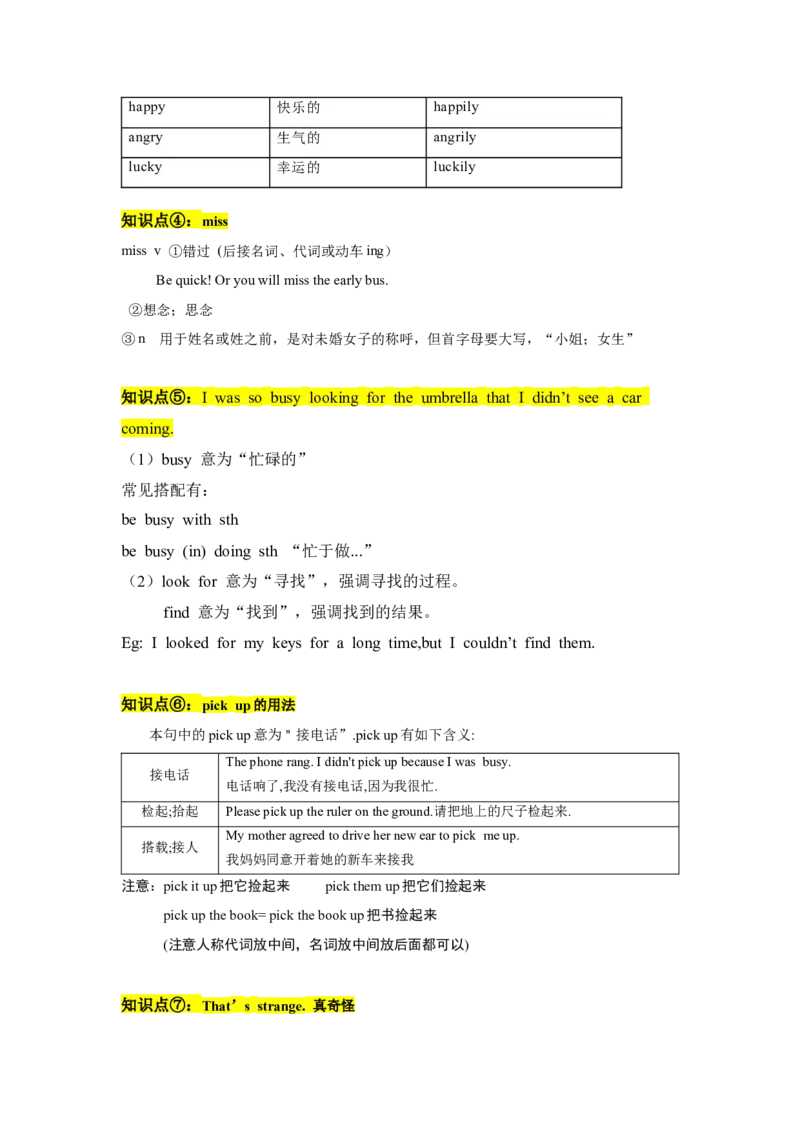
hungry 饥饿的 hungrilyhappy 快乐的 happily
angry 生气的 angrily
lucky 幸运的 luckily
知识点④:miss
miss v ①错过 (后接名词、代词或动车ing)
Be quick! Or you will miss the early bus.
②想念;思念
③n 用于姓名或姓之前,是对未婚女子的称呼,但首字母要大写,“小姐;女生”
知识点⑤:I was so busy looking for the umbrella that I didn’t see a car
coming.
(1)busy 意为“忙碌的”
常见搭配有:
be busy with sth
be busy (in) doing sth “忙于做...”
(2)look for 意为“寻找”,强调寻找的过程。
find 意为“找到”,强调找到的结果。
Eg: I looked for my keys for a long time,but I couldn’t find them.
知识点⑥:pick up的用法
本句中的pick up意为"接电话”.pick up有如下含义:
The phone rang. I didn't pick up because I was busy.
接电话
电话响了,我没有接电话,因为我很忙.
检起;拾起 Please pick up the ruler on the ground.请把地上的尺子检起来.
My mother agreed to drive her new ear to pick me up.
搭载;接人
我妈妈同意开着她的新车来接我
注意:pick it up把它捡起来 pick them up把它们捡起来
pick up the book= pick the book up把书捡起来
(注意人称代词放中间,名词放中间放后面都可以)
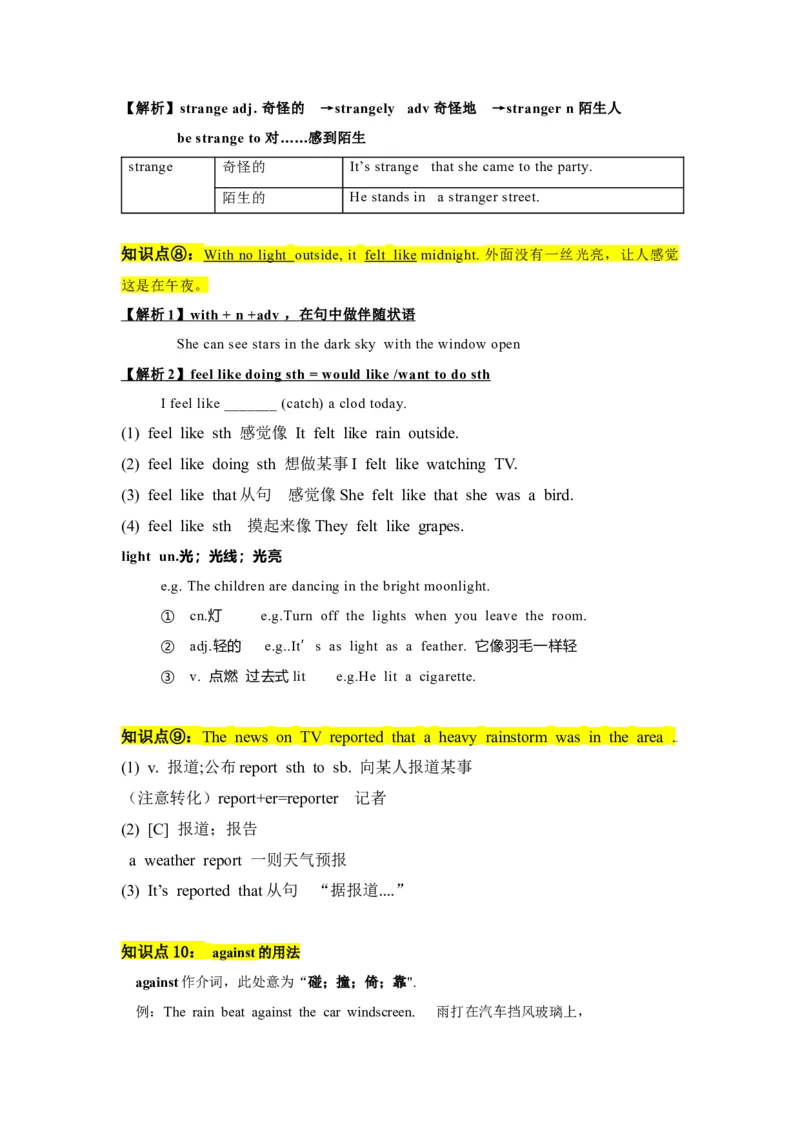
知识点⑦:That’s strange. 真奇怪【解析】strange adj. 奇怪的 →strangely adv奇怪地 →stranger n 陌生人
be strange to 对……感到陌生
strange 奇怪的 It’s strange that she came to the party.
陌生的 He stands in a stranger street.
知识点⑧: With no light outside, it felt like midnight. 外面没有一丝光亮,让人感觉
这是在午夜。
【解析 1 】 with + n +adv ,在句中做伴随状语
She can see stars in the dark sky with the window open
【解析 2 】 feel like doing sth = would like /want to do sth
I feel like _______ (catch) a clod today.
(1) feel like sth 感觉像 It felt like rain outside.
(2) feel like doing sth 想做某事I felt like watching TV.
(3) feel like that从句 感觉像She felt like that she was a bird.
(4) feel like sth 摸起来像They felt like grapes.
light un.光;光线;光亮
e.g. The children are dancing in the bright moonlight.
① cn.灯 e.g.Turn off the lights when you leave the room.
② adj.轻的 e.g..It’s as light as a feather. 它像羽毛一样轻
③ v. 点燃 过去式lit e.g.He lit a cigarette.
知识点⑨:The news on TV reported that a heavy rainstorm was in the area .
(1) v. 报道;公布report sth to sb. 向某人报道某事
(注意转化)report+er=reporter 记者
(2) [C] 报道;报告
a weather report 一则天气预报
(3) It’s reported that从句 “据报道....”
知识点10: against的用法
against作介词,此处意为“碰;撞;倚;靠".
例:The rain beat against the car windscreen. 雨打在汽车挡风玻璃上,Put the piano there,with its back against the wall 把钢琴放在那里,背靠着
墙,
He leaned against the tree. 他靠着树,
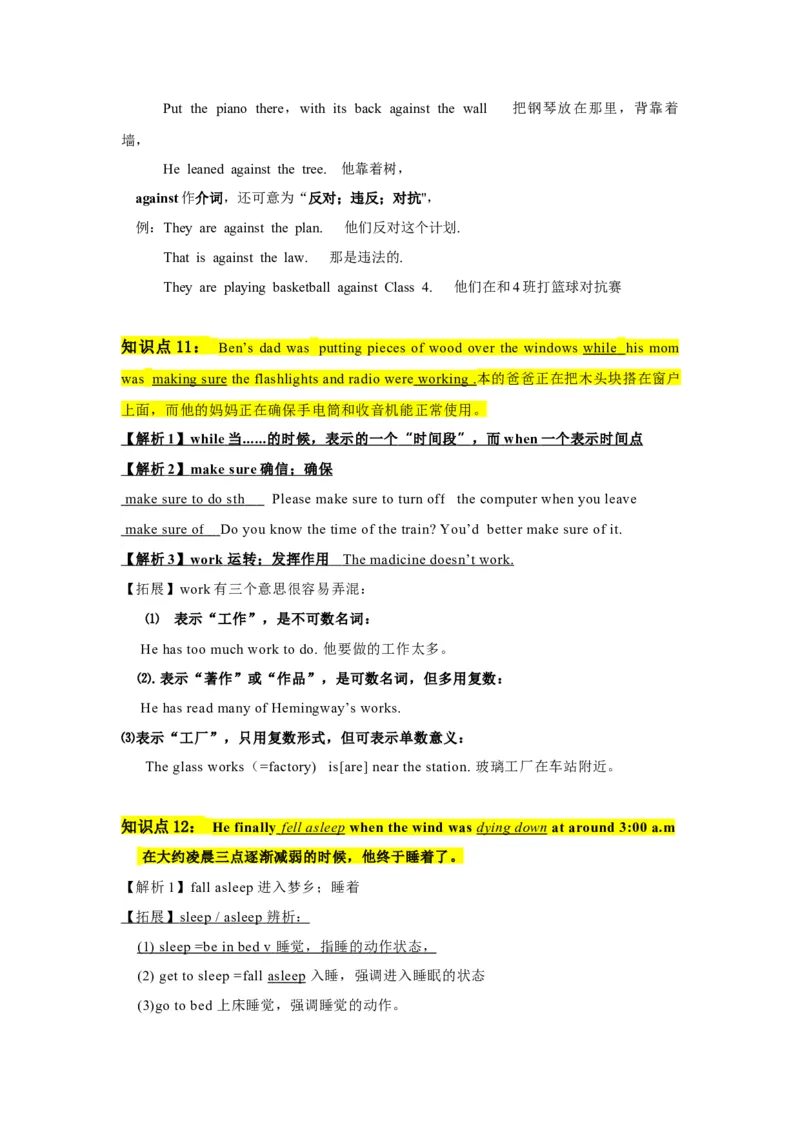
against作介词,还可意为“反对;违反;对抗",
例:They are against the plan. 他们反对这个计划.
That is against the law. 那是违法的.
They are playing basketball against Class 4. 他们在和4班打篮球对抗赛
知识点 11: Ben’s dad was putting pieces of wood over the windows while his mom
was making sure the flashlights and radio were working . 本的爸爸正在把木头块搭在窗户
上面,而他的妈妈正在确保手电筒和收音机能正常使用。
【解析 1 】 whil e 当 ..... . 的时候,表示的一个 “ 时间段 ” ,而 when 一个表示时间点
【解析 2 】 make sur e 确信;确保
make sure to do sth Please make sure to turn off the computer when you leave
make sure of Do you know the time of the train? You’d better make sure of it.
【解析 3 】 work 运转;发挥作用 The madicine doesn’t work .
【拓展】work有三个意思很容易弄混:
⑴ 表示“工作”,是不可数名词:
He has too much work to do. 他要做的工作太多。
⑵. 表示“著作”或“作品”,是可数名词,但多用复数:
He has read many of Hemingway’s works.
⑶表示“工厂”,只用复数形式,但可表示单数意义:
The glass works(=factory) is[are] near the station. 玻璃工厂在车站附近。
知识点12: He finally fell asleep when the wind was dying down at around 3:00 a.m
在大约凌晨三点逐渐减弱的时候,他终于睡着了。
【解析1】fall asleep 进入梦乡;睡着
【拓展】 sleep / asleep 辨析:
(1) sleep =be in bed v 睡觉,指睡的动作状态,
(2) get to sleep =fall asleep 入睡,强调进入睡眠的状态
(3)go to bed 上床睡觉,强调睡觉的动作。【记】 He went to bed at ten last night , but he didn’t go to sleep until . He
only fell asleep for 5 hours.
be asleep 强调睡着的状态 The baby is asleep
fall asleep 强调入睡的动作 My father was so tired that he fell asleep quickly
【拓展】 fall asleep, sleep, go to sleep, get to sleep, go to bed 用法区别。
⑴ fall aslee p 属“连系动词 + 表语”结构,“入睡;睡着”,指进入梦乡,往往含有“不
知不觉就睡着了“的意思。 aslee p 在此作表语形容词。
He was just falling asleep when there was a loud knock at the door.
他刚要入睡时,这时传来了响亮的敲门声。
⑵ slee p 指睡觉时的一种状态,是一个延续性的动词。
He likes to sleep for an hour in the afternoon.
他喜欢在下午睡上一个小时。
⑶ go to sleep 意为“入睡,睡着”,强调从开始睡到睡着的过程。
I just want to close my eyes and go to sleep as quickly as possible.
我只是想闭上眼睛,尽快地睡上一觉。
⑷ get to sleep 与 go to sleep 意思相近,但它强调的是进入睡眠状态。
She was too excited to get to sleep last night. 她昨晚因太激动而不能入睡。
⑸ go to be d “ 就寝”,“上床睡觉”,指上床去睡这个动作,与 get u p 相对应。
【解析 2 】 die dow n 逐渐变弱;逐渐消失
【拓展】 die dow n 与 die ou t 的用法区别:
指火的熄灭时,用 die down 或 die ou t 皆可。
die down 往往指火势由强到弱慢慢熄灭,植物慢慢死亡这一过程;
die out 则指熄灭这一事实,而且不及 die down 用的普遍。
die down: 反映风、声音、愤怒、掌声、战斗等平息下来。
die out: 指家庭、种族、物种、组织、信仰等的消失或消亡。
This kind of birdhas died out in the world.这种鸟已经在世界上灭绝了。
知识点13: When he woke up . the sun was rising 当他醒来的时候,太阳已经升起来了。
【解析 1 】 wake up (v+ adv ) 醒来;睡醒
【解析2】rise 增加;提高;增强;上升,升起rise 升起;上升 主语自身移向较高位置 Price rose gradually
raise 举起;提高 主语发出的动作作用于其他事物 Let’s raise our glasses to Tom.
知识点14:Fallen trees, broken windows and rubbish were everywhere.
【解析1】过去分词做定语 fallen leaves 落叶
【解析2】everywhere 处处,到处;各个地方
词条 含义 用法 例句
everywhere 处处;到处; 可用于任何 We have many friends everywhere in the
各个地方 句式 world
somewhere 某个地方 多用于肯定 You can go somewhere you like to.
句中
anywhere 任何地方 否定句 You can’t go anywhere
疑问句 Can I go anywhere I choose
知识点15:They joined the neighbors to help clean up theneigh hood together.
他们加入到邻居们中,一起打扫社区。
【解析】 join 加入;参加
【辨析】 join/join in/take part in
(1) join=be a member of 参加,指加入某种组织,并成为其中的一员。
Join the army / party 入伍/ 党 join the club 加入俱乐部
◆ join in 后接活动名称
◆ join sb. 加入到某个人群之中
(2) take part in 参加,指加入群体活动中并在活动中发挥重要作用。
三、 语法清单
语法①:过去进行时
一、定义及结构
1. 定义过去进行时,是表示过去某个具体时刻正在进行的事情或动作。
2. 结构:be (过去式)+ 动词-ing
二、用法
1. 过去进行时的主要用法是描述一件事情发生的背景;一个长动作发生的时候,另一
个短动作发生。常用的时间状语when,while。
☞ My brother fell while he was riding his bicycle. 我哥哥骑自行车的时候从车上摔了下
来。
☞ It was raining when they left the station. 他们离开车站的时候天正在下雨。
☞ They left the station while it was raining. 天正在下雨的时候他们离开了车站。
☞ When I got to the top of the mountain, the sun was shining. 当我到达山顶的时候,阳
光灿烂。
【易混辨析】
when和while的区别
(1)when意为"在……时;当……的时候",常指在某个时间点,可表示时间点
或时间段,由when引导的时间状语从句,主句用过去进行时,从句用一般过去
时。从句中的谓语动词可以是延续性动词,也可以是瞬间动词。
☞ I was just reading a book when she came into my room. 她走进我房间时,我正
在看书。
(2)while意为"当……的时候",只表示时间段,常指某个时间段,由while引
导的时间状语从句,主句用一般过去时,从句用过去进行时。从句谓语动词必须用
延续性动词,且多用于进行时态。强调主句与从句的动作同时发生或主句的动作发
生在从句的动作过程中。
☞ While Jim was mending his bike, Lin Tao came to see him. 吉姆正在修他的自
行车时,林涛来看他了。
2. 过去进行时可以表示在过去某个时间点发生的事情。时间点可以用介词短语、副词
或从句来表示。常用的时间状语:this morning,the whole morning,all day yesterday,from
nine to ten last evening。
☞ What was she doing at nine o’clock yesterday? 昨天晚上九点她在做什么?(介词短
语表示时间点)
☞ When I saw him he was decorating his room. 当我看见他的时候他正在装饰房间。(when从句表示时间点)
☞ We were watching TV from seven to nine last night. 昨天晚上七点到九点的时候我们
在看电视。
☞ What was he researching all day last Sunday? 上周日他一整天都在研究什么?
3. 在复合句中,如果主要动作和背景动作都是延续的或同时发生的,那么主从句的动
词都可用过去进行时。
☞ While he was waiting for the bus, he was reading a newspaper. 他边等车边看报纸。
(两个动作都是延续性的)
☞ He was cleaning his car while I was cooking. 他擦车时我在做饭。(两个动作同时进
行)
4. 通常不能用于过去进行时的动词主要有:agree,be,believe,belong,care,
forget,hate,have(拥有),hear,know,like,love,mean,mind,notice,own,
remember,seem,suppose,understand,want,wish等。学科&网
误:I was knowing the answer.
正:I knew the answer. 我知道答案。
误:I wasn’t understanding him.
正:I didn’t understand him. 我不明白他的意思。
三、与一般过去时的区别
1. 一般过去时叙述旧事,过去进行时描述背景。
A. 一般过去时
(1)叙述过去状态、动作或事件
☞ He went to Beijing the other day.(带具体时间)
(2)表示过去的习惯
①would,used to与过去时
would 表间断性不规则的习惯,常带频率时间;used to 表一贯性有规律的习惯。
☞ They used to meet and would sometimes exchange one or two words.
☞ He smoked a lot two years ago. (过去行为)
② would不可用于句首,只表示过去的习惯。used to表示今昔对比的含义,叙述习惯
动作时可与would 换用。☞ When he was a boy, he would often go there. (叙述过去)
☞ She isn’t what she used to be. (今昔对比)
③表示状态时一般只用used to
☞ Tom used to be fat /There used to stand a tree there. (状态)
④was (were) used to +v-ing表示"合适于,适应于……"
☞ He used to work at night. ("习惯",表经常)
[来源:学#科#网Z#X#X#K]
☞ He was used to working at night. ("习惯",表适应)
(3)表示过去的经历,平行动作,依次事件用一般过去时。
☞ He sat there and listened to the radio. (依次发生)
(4)表示客气委婉的语气,用于情态动词,助动词和want,wonder,hope等
☞ How did you like the film?
☞ Could you help me?
B. 过去进行时
(1)表示在过去某阶段或某一时刻正在发生的动作
☞ What were you doing at 8:30 last night? (过去某时刻正在发生)
(2)与always,often,usually等连用表示喜爱、讨厌等感情色彩。
☞ He was always changing his mind.
C. 进行时表某一行为的"片断";一般时表示行为的"整体"和存在的状态。
☞ I was reading the book at that time. (未读完,"读"的片段)
☞ I read the book yesterday. (已读完,表整个"读")
D. 表示在过去的某段时间里一直反复持续进行的动作。
☞ It was raining all night.
☞ He was writing a letter the whole of afternoon.
E. while时间状语从句中用短暂动词时只能用进行时。
☞ He broke a chair while he was jumping up and down.
[来源:学.科.网]
F. while 所在主从句动作大致持续相等时主从句一般都用进行时,但若是持续动词可都
用一般过去时,两个动作一长一短时短的用一般时,长的用进行时。
☞ I was cooking the dinner while he was playing the piano. (平行)
☞ I cooked the dinner while he played the piano.☞ I saw him while I was walking to the station.
【注意】
英语中有四类动词一般不用进行时(不用现在进行时和过去进行时)
(1)表心理状态、情感的动词,如love,hate,like,care,respect,please,prefer,
know等,若用进行时则词意改变。
☞ I’m forgetting it. ( =beginning to forget )
(2)表示存在、状态的动词,如appear,exist,lie,remain,stand,seem等。
(3)表示感觉的动词,如see,hear,feel,smell,sound,taste等。
(4)表示人的期待、允诺、拒绝、结束的词,如accept,allow,admit,decide,
end,refuse,permit,promise等。