Unit 5 What were you doing when the rainstorm came?
第5课时 Section B(3a-Self Check)
1.过去进行时
重点语法
2.when和while的区别
重点写作 难忘的事件
1.能够用一般过去时和过去进行时记录自己难忘的事件。学会表示事件的时间、地
点、经过、结果和感受等。
技能目标 2.有意识地运用知识迁移策略来介绍令自己印象最深的重大事件,并且描述当时自
己在干什么以及感受如何。阐述事件事件的重要性。
重难单词、短语默写
(一)动作类短语
1. 步行回家 _________________________
2. 去上班 _________________________
3. 入睡 _________________________
4. 下大雨 _________________________
5. 洗热水澡 _________________________
6. 发出响声 _________________________
7. 接电话 _________________________
8. 逐渐变弱 _________________________
9. 确认;确信 _________________________
(二)时间类短语
1. 当暴风雨来的时候 _________________________
科网]
2. 在那个时候 _________________________
3. 在地震时 _________________________
(三)其他短语1. 沉默地_________________________
2. 做某事有困难_________________________
3. 一团糟 ______________________
4. 首先;起初 _________________________
经典句型过关:
It happened in/on…
I was doing…when…
While I was doing…, he….
What a pleasant day I have!
This is a day I will never forget.
答案:
(一)动作类短语
1. 步行回家 walk home 2. 去上班 go to work 3. 入睡 fall asleep 4. 下大雨 rain heavily
5. 洗热水澡 take a hot shower 6. 发出响声 go off 7. 接电话 pick up 8. 逐渐变弱 die down
9. 确认;确信 make sure
(二)时间类短语
1. 当暴风雨来的时候 at the time of the rainstorm[来源:学科网]
2. 在那个时候 at that time 3. 在地震时 at the time of the earthquake
(三)其他短语
1. 沉默地 in silence 2. 做某事有困难 have trouble doing sth
3. 一团糟 in a mess 4. 首先;起初 at first
1.过去进行时 2.when和while的区别 3.单元写作指导
过去进行时
一、定义及结构
1. 定义
过去进行时,是表示过去某个具体时刻正在进行的事情或动作。
2. 结构:be (过去式)+ 动词-ing
二、用法
1. 过去进行时的主要用法是描述一件事情发生的背景;一个长动作发生的时候,另一个短动作发生。
常用的时间状语when,while。
☞ My brother fell while he was riding his bicycle. 我哥哥骑自行车的时候从车上摔了下来。☞ It was raining when they left the station. 他们离开车站的时候天正在下雨。
☞ They left the station while it was raining. 天正在下雨的时候他们离开了车站。
☞ When I got to the top of the mountain, the sun was shining. 当我到达山顶的时候,阳光灿烂。
【易混辨析】
when和while的区别
(1)when意为"在……时;当……的时候",常指在某个时间点,可表示时间点或时间段,由
when引导的时间状语从句,主句用过去进行时,从句用一般过去时。从句中的谓语动词可以是
延续性动词,也可以是瞬间动词。
☞ I was just reading a book when she came into my room. 她走进我房间时,我正在看书。
(2)while意为"当……的时候",只表示时间段,常指某个时间段,由 while引导的时间状语
从句,主句用一般过去时,从句用过去进行时。从句谓语动词必须用延续性动词,且多用于进行
时态。强调主句与从句的动作同时发生或主句的动作发生在从句的动作过程中。
☞ While Jim was mending his bike, Lin Tao came to see him. 吉姆正在修他的自行车时,林
涛来看他了。
2. 过去进行时可以表示在过去某个时间点发生的事情。时间点可以用介词短语、副词或从句来表示。
常用的时间状语:this morning,the whole morning,all day yesterday,from nine to ten last evening。
☞ What was she doing at nine o’clock yesterday? 昨天晚上九点她在做什么?(介词短语表示时间点)
☞ When I saw him he was decorating his room. 当我看见他的时候他正在装饰房间。(when从句表示时
间点)
☞ We were watching TV from seven to nine last night. 昨天晚上七点到九点的时候我们在看电视。
☞ What was he researching all day last Sunday? 上周日他一整天都在研究什么?
3. 在复合句中,如果主要动作和背景动作都是延续的或同时发生的,那么主从句的动词都可用过去进
行时。
☞ While he was waiting for the bus, he was reading a newspaper. 他边等车边看报纸。(两个动作都是延
续性的)
☞ He was cleaning his car while I was cooking. 他擦车时我在做饭。(两个动作同时进行)
4. 通常不能用于过去进行时的动词主要有:agree,be,believe,belong,care,forget,hate,have(拥
有),hear,know,like,love,mean,mind,notice,own,remember,seem,suppose,understand,
want,wish等。学科&网
误:I was knowing the answer.
正:I knew the answer. 我知道答案。误:I wasn’t understanding him.
正:I didn’t understand him. 我不明白他的意思。
三、与一般过去时的区别
1. 一般过去时叙述旧事,过去进行时描述背景。
A. 一般过去时
(1)叙述过去状态、动作或事件
☞ He went to Beijing the other day.(带具体时间)
(2)表示过去的习惯
①would,used to与过去时
would 表间断性不规则的习惯,常带频率时间;used to 表一贯性有规律的习惯。
☞ They used to meet and would sometimes exchange one or two words.
☞ He smoked a lot two years ago. (过去行为)
② would不可用于句首,只表示过去的习惯。used to表示今昔对比的含义,叙述习惯动作时可与would
换用。
☞ When he was a boy, he would often go there. (叙述过去)
☞ She isn’t what she used to be. (今昔对比)
③表示状态时一般只用used to
☞ Tom used to be fat /There used to stand a tree there. (状态)
④was (were) used to +v-ing表示"合适于,适应于……"
☞ He used to work at night. ("习惯",表经常)
[来源:学#科#网Z#X#X#K]
☞ He was used to working at night. ("习惯",表适应)
(3)表示过去的经历,平行动作,依次事件用一般过去时。
☞ He sat there and listened to the radio. (依次发生)
(4)表示客气委婉的语气,用于情态动词,助动词和want,wonder,hope等
☞ How did you like the film?
☞ Could you help me?
B. 过去进行时
(1)表示在过去某阶段或某一时刻正在发生的动作
☞ What were you doing at 8:30 last night? (过去某时刻正在发生)
(2)与always,often,usually等连用表示喜爱、讨厌等感情色彩。
☞ He was always changing his mind.
C. 进行时表某一行为的"片断";一般时表示行为的"整体"和存在的状态。
☞ I was reading the book at that time. (未读完,"读"的片段)
☞ I read the book yesterday. (已读完,表整个"读")D. 表示在过去的某段时间里一直反复持续进行的动作。
☞ It was raining all night.
☞ He was writing a letter the whole of afternoon.
E. while时间状语从句中用短暂动词时只能用进行时。
☞ He broke a chair while he was jumping up and down.
[来源:学.科.网]
F. while 所在主从句动作大致持续相等时主从句一般都用进行时,但若是持续动词可都用一般过去时,
两个动作一长一短时短的用一般时,长的用进行时。
☞ I was cooking the dinner while he was playing the piano. (平行)
☞ I cooked the dinner while he played the piano.
☞ I saw him while I was walking to the station.
【注意】
英语中有四类动词一般不用进行时(不用现在进行时和过去进行时)
(1)表心理状态、情感的动词,如love,hate,like,care,respect,please,prefer,know等,若用进
行时则词意改变。
☞ I’m forgetting it. ( =beginning to forget )
(2)表示存在、状态的动词,如appear,exist,lie,remain,stand,seem等。
(3)表示感觉的动词,如see,hear,feel,smell,sound,taste等。
(4)表示人的期待、允诺、拒绝、结束的词,如 accept,allow,admit,decide,end,refuse,
permit,promise等。
单元写作指导
本单元的话题是“谈论过去发生的事情”。此类文章常见的出题形式之一是看图作文。题目通常会给出 3
-5幅图片,要求讲述过去发生的事情,通常要使用一般过去时和过去进行时。
二、写作方法
“5W1H”法写叙事记叙文
“5W1H”指的是: 时间(when)、地点 (where)、人物(who)、事件 (what)、 原因(why)和结局 (how)。
首先交代清楚事件的时间、地点、人物; 然后详细地讲述故事的经过; 最后介绍故事的结局。
2. 写叙事记叙文常用句型:
It happened in/on…
I was doing…when…
While I was doing…, he….
What a pleasant day I have!
This is a day I will never forget.
(2022·广西桂林·统考中考真题)
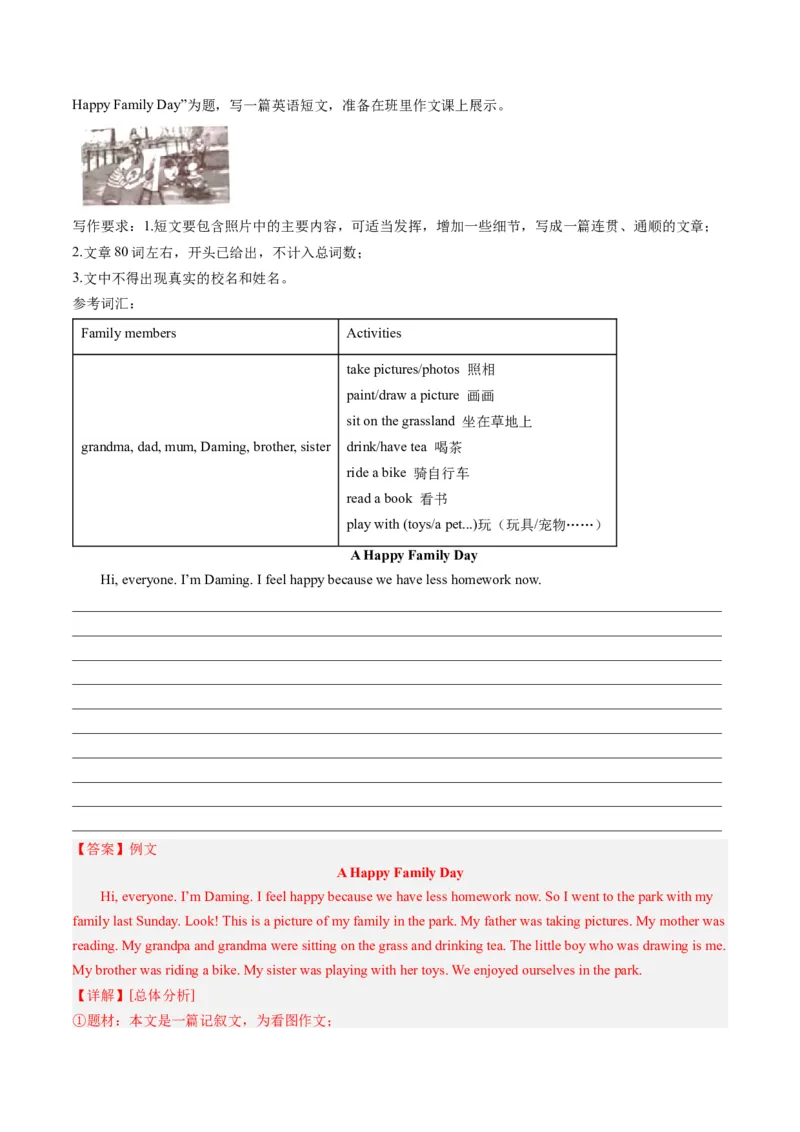
看图作文:自从2021年党中央颁布“双减”政策以来,孩子们的课余生活变得丰富多彩了。请看下面这张
照片,这是大明一家在公园里度周末时照的。假如你是照片中画画的男孩大明(Daming),请以“AHappy Family Day”为题,写一篇英语短文,准备在班里作文课上展示。
写作要求:1.短文要包含照片中的主要内容,可适当发挥,增加一些细节,写成一篇连贯、通顺的文章;
2.文章80词左右,开头已给出,不计入总词数;
3.文中不得出现真实的校名和姓名。
参考词汇:
Family members Activities
take pictures/photos 照相
paint/draw a picture 画画
sit on the grassland 坐在草地上
grandma, dad, mum, Daming, brother, sister drink/have tea 喝茶
ride a bike 骑自行车
read a book 看书
play with (toys/a pet...)玩(玩具/宠物……)
A Happy Family Day
Hi, everyone. I’m Daming. I feel happy because we have less homework now.
____________________________________________________________________________________________
____________________________________________________________________________________________
____________________________________________________________________________________________
____________________________________________________________________________________________
____________________________________________________________________________________________
____________________________________________________________________________________________
____________________________________________________________________________________________
____________________________________________________________________________________________
____________________________________________________________________________________________
____________________________________________________________________________________________
【答案】例文
A Happy Family Day
Hi, everyone. I’m Daming. I feel happy because we have less homework now. So I went to the park with my
family last Sunday. Look! This is a picture of my family in the park. My father was taking pictures. My mother was
reading. My grandpa and grandma were sitting on the grass and drinking tea. The little boy who was drawing is me.
My brother was riding a bike. My sister was playing with her toys. We enjoyed ourselves in the park.
【详解】[总体分析]
①题材:本文是一篇记叙文,为看图作文;②时态:时态为“一般过去时和过去进行时”;
③提示:写作要点已给出,要求根据图片,结合提示内容进行写作,适当添加细节,并突出写作重点。
[写作步骤]
第一步,表明写作意图。借用“简单介绍周末活动”来引出重点介绍的内容;
第二步,具体阐述写作内容。要分别介绍每位家庭成员做了什么;
第三步,书写结语。表达“玩得很开心”的感受。
[亮点词汇]
①a picture of一张……的照片
②sit on the grass坐在草地上
③enjoyed ourselves玩得开心
[高分句型]
①I feel happy because we have less homework now.(because引导的原因状语从句)
②The little boy who was drawing is me.(who引导的定语从句)
1.过去进行时 2.when和while的区别 3.单元写作指导
一、单项选择
1.I hated learning English ________, but I am good at it now.
A.at last B.at first C.at least D.at most
2.When it suddenly rained, I ________ the ball with my friends in the park.
A.kick B.kicked C.am kicking D.was kicking
3.—What’s the matter with Tom?
—He hurt his leg while he ________ football yesterday afternoon.
A.was playing B.played C.is playing D.plays
4.He ________ when the police arrived.
A.is cooking B.were cooking C.has cooked D.was cooking
5.My mother was cooking while I ________ English songs.
A.was hearing B.heard C.was listening to D.listened
6.—What about a cup of coffee? You’ll feel better.
—Thanks. I am ______. I really need one.
A.asleep B.sleepy C.sleeping D.sleep
7.While Helen ________ TV last night, she ________ a strange sound outside.A.was watching; heard B.was watching; was hearing C.watched; heard
8.The boy with his two dogs ________ in the yard when the storm hit the city.
A.are playing B.were playing C.was playing
9.—I don’t know which high school to choose.
—Whatever your choice is, we are _________ you all the way.
A.under B.over C.against D.behind
10.—Why are you so late today?
—Three buses went by without stopping while I ________ at the bus stop.
A.am waiting B.wait C.waited D.was waiting
11.When the teacher came into the classroom, I ________ the class project with my team.
A.discuss B.discussed C.was discussing D.will discuss
12.The students _________ when the teacher came into the classroom.
A.are talking B.talk C.talked D.were talking
13.—Could you please pass me my book?
—________.
A.Yes, I could B.No, I couldn’t C.No problem
14.The driver ________ on his phone while he was driving.
A.will talk B.was talking C.talks D.is talking
15.My classmates cheered me on loudly while I ________ at the sports meeting.
A.run B.am running C.was running D.will run
二、完型填空
Nevado Del Ruiz is a mountain in Colombia. It is 5,425 meters high and it is popular with climbers. It is beautiful,
but it is 16 , too. The weather can change 17 on the mountain.
One minute it is sunny, and the next minute it is cloudy. One minute it is warm, and the next minute it is 18
. On a sunny morning in June, Leonardo Diaz began climbing Nevado Del Ruiz with some friends. On the second day
of their climb, there was a snowstorm. It was difficult to walk in the 19 , and it was difficult to see. The
climbers decided to 20 and walk down the mountain. Leonardo stopped for a minute to get something
out of his backpack. When he looked 21 , his friends were gone. He couldn’t see them or their footprints
in the snow. “Wait!” Leonardo shouted. But his friends couldn’t hear him in the storm.
All day Leonardo continued down the mountain alone. That night he put up his tent, crawled inside, and slept.
He was in big 22 when he woke up the next morning. His clothes were not 23 enough, so he
was very cold. He was hungry, too, 24 he had no food left. He decided to 25 for help. He
opened his backpack and took out his cell phone. It didn’t work. Leonardo had no more prepaid minutes (预付话
费) on his phone.
All morning Leonardo stayed in his tent and the cell phone didn’t 26 . He began to think, “Maybe I’ll
27 on this mountain.” Then his cell phone 28 . “Hello?” he answered. “Good afternoon,” a womansaid. “I’m calling from Bell South Phone Company. You have no minutes left on your cell phone. Would you like to
buy more minutes?” “Yes, but not now!” Leonardo said. “I need help. I’m 29 on a mountain.”
“Stay where you are,” the woman said. “I’ll 30 help.” Late that night, a rescue team arrived and
helped Leonardo down the mountain. Leonardo says he will probably try again to climb Nevado Del Ruiz. But the
next time, he will bring plenty of warm clothes and plenty of food. He will also bring a cell with plenty of prepaid
minutes.
16.A.tall B.wild C.dangerous D.short
17.A.clearly B.quickly C.slowly D.quietly
18.A.wet B.cold C.nice D.dry
19.A.snow B.desert C.rain D.sun
20.A.sit down B.go on C.turn around D.sleep over
21.A.out B.up C.in D.on
22.A.trouble B.mistakes C.crowd D.state
23.A.smart B.cheap C.warm D.clean
24.A.unless B.until C.so D.because
25.A.shout B.call C.write D.storm
26.A.song B.cry C.radio D.work
27.A.play B.grow C.die D.walk
28.A.dropped B.broke C.disappeared D.rang
29.A.lost B.found C.drank D.hurt
30.A.care for B.send for C.leave for D.pay for
三、短文填空
阅读下面短文,根据语境、音标或所给单词的提示,在每个空格内填入一个恰当的词,要求所填的词意义
准确、形式正确,使短文意思完整、行文连贯。
In ancient China, there were two great poets who were also good friends—Li Bai and Du Fu. They lived during
the Tang Dynasty. Li Bai was famous 31 his love for nature. He often wrote about his travels 32 the
beauty he found in the world. Du Fu, was a 33 /’sɪəriəs/ poet. He wrote about the struggles (挣扎) and
difficulties of the people.
They have different styles (风格) in 34 (write), but Li Bai and Du Fu read each other’s poems and talked
about their ideas 35 (usual). They built a deep bond (纽带) through their love for poems. Both Li Bai andDu Fu thought poems can bring 36 (change) to the world. They saw their poems 37 /æz/ a way to
tell people their ideas and feelings.
During difficult times, Du Fu had a hard time. Li Bai would often 38 /send/ him money and things he
needed. Du Fu, in return, showed his thanks in poems to his friend.
The friendship between Li Bai and Du Fu was 39 beautiful example of how two persons with different
styles and personalities (个性) can come together. 40 (they) friendship was not only because of poems,
but also because they knew about each other well.
参考答案:
1.B
【详解】句意:起初我讨厌学英语,但现在我很擅长了。
考查短语辨析。at last最后;at first起初;at least至少;at most最多。根据“I hated learning English...but I
am good at it now.”可知,此处指刚开始讨厌英语。故选B。
2.D
【详解】句意:突然下雨时,我正和朋友们在公园里踢球。
考查动词时态。根据“When it suddenly rained, I ... the ball with my friends in the park.”可知,此处表示过去
某一时刻正在发生的事情,应该用过去进行时。故选D。
3.A
【详解】句意:——汤姆怎么了?——昨天下午他踢足球时伤了腿。
考查时态。根据“He hurt his leg while he...football”可知此处表示当时正在踢足球,用过去进行时was/were
doing。故选A。
4.D
【详解】句意:警察来的时候他正在做饭。
考查过去进行时。is cooking正在做饭,现在进行时;were cooking正在做饭,过去进行时;has cooked已
经做饭,现在完成时;was cooking正在做饭,过去进行时。根据“when the police arrived”可知,警察来的
时候,所以应是过去进行时,表示警察来的时刻他正在干什么。过去进行时的基本结构:主语+was/were+
doing+其它。主语He是第三人称单数,所以be动词用was。故选D。
5.C
【详解】句意:我在听英文歌的时候,我妈妈在做饭。
考查动词形式。was hearing听,过去进行时;heard过去式;was listening to听,过去进行时;listened过
去式。listen to songs“听歌”;根据“My mother was cooking while I”可知表示妈妈在做饭时我正在听歌,用
过去进行时表示过去某个时刻正在进行的动作。故选C。
6.B
【详解】句意:——来杯咖啡怎么样?你会感觉好些的。——谢谢。我很困。我真的需要一杯咖啡。
考查形容词辨析。asleep睡着的;sleepy困倦的,想睡的;sleeping睡着的;sleep睡觉(动词原形或名
词)。根据“What about a cup of coffee? You’ll feel better.”和“I really need one.”可知,现在很困,所以需要
一杯咖啡来提神。故选B。
7.A【详解】句意:昨晚Helen正在看电视时,她听见外面有奇怪的声音。
考查动词时态。while引导的时间状语从句用进行时“be doing”,空处应是was watching,故排除C项;
hear“听见”是一个短暂性动词,结合“last night”,主句应用一般过去时,谓语动词hear用过去式heard。
故选A。
8.C
【详解】句意:暴风雨袭击城市时,那个男孩带着两只狗正在院子里玩耍。
考查过去进行时。根据时间状语“when the storm hit the city”是一般过去时,可知主句用过去进行时,其结
构是were/was+doing sth.,此句主语是“The boy”,介词短语“with his two dogs”作伴随状语,“The boy”
是第三人称单数,be应用was。故选C。
9.D
【详解】句意:——我不知道该选哪所高中。——无论你的选择是什么,我们都支持你。
考查介词辨析。under在下面;over多于,超过;against反对;behind在后面,支持。根据“Whatever
your choice is, we are...you all the way.”可知,是在背后支持你,故选D。
10.D
【详解】句意:——你今天为什么怎么晚?——当我正在公交车站等车的时候,有三辆车经过但都没有停。
考查动词时态。am waiting正在等,现在进行时态;wait动词原形;waited是过去式,一般过去时态;was
waiting过去进行时。根据对话的意思可知,等车是过去发生的事情,并且这里表示“正在等车的时候有三
辆车经过但都没有停。”故应用过去进行时,选D。
11.C
【详解】句意:当老师走进教室时,我和我的团队正在讨论班级项目。
考查动词时态。本句是when引导的时间状语从句,从句用一般过去时,主句用过去进行时(was/were
doing),表示“从句动作发生时,主句动作正在进行”,故选C。
12.D
【详解】句意:当老师走进教室时,学生们正在讲话。
考查时态。根据“when the teacher came into the classroom.”可知当老师进入教室时,学生正在说话,表示
过去某个时间点正在做某事,用过去进行时was/were doing。故选D。
13.C
【详解】句意:——可以麻烦你把我的书递给我吗?——没问题。
考查情景交际。Yes, I could是的,我能;No, I couldn’t不,我不能;No problem没问题。根据“Could you
please pass me my book?”可知此处是在给对方答复,肯定回答应用No problem。故选C。
14.B
【详解】句意:司机开车时正在打电话。
考查过去进行时。will talk一般将来时;was talking过去进行时;talks一般现在时;is talking现在进行时。
根据“while he was driving”可知,while“当……时候”后接延续性动词,且主从句动作同时发生,故主句与
从句时态保持一致,用过去进行时。故选B。
15.C【详解】句意:当我在运动会上跑步时,我的同学大声为我加油。
考查动词时态。根据“My classmates cheered me on loudly while I ... at the sports meeting.”可知,此处为
while“当……的时候”引导的时间状语从句,时态应用过去进行时“was/were doing”。故选C。
16.C 17.B 18.B 19.A 20.C 21.B 22.A 23.C 24.D 25.B
26.D 27.C 28.D 29.A 30.B
【导语】本文是一篇记叙文。文章主要讲述了登山爱好者莱昂纳多·迪亚兹攀登内瓦多·德·鲁伊斯火山时的
一次遇险和获救的经历。
16.句意:它很漂亮,但是也很危险。
tall高的;wild野生的;dangerous危险的;short短的。根据“It is 5,425 meters high and it is popular with
climbers. It is beautiful, but it is..., too.”可知,这座火山很高,登山爱好者都喜欢攀登,可推测火山既漂亮又
危险。故选C。
17.句意:在山上天气可以很快地变化。
clearly清晰地;quickly很快地;slowly缓慢地;quietly安静地。根据上文“It is beautiful, but it is..., too.”可
知,火山既漂亮又危险,可推测山上天气变化快。故选B。
18.句意:前一分钟它是暖和的,下一分钟它是寒冷的。
wet湿的;cold寒冷的;nice美好的;dry干的。根据“One minute it is sunny, and the next minute it is
cloudy. One minute it is warm, and the next minute it is...”可知,山上气候变化无常,前一刻阳光明媚,下一
刻就乌云密布,可推测此处应与前一分钟的温暖相反,cold“寒冷的”符合语境。故选B。
19.句意:在雪地里行走很困难,并且很难看清。
snow雪;desert沙漠;rain雨;sun太阳。根据“On the second day of their climb, there was a snowstorm. It
was difficult to walk in the...”可知,他们遇到了暴风雪,可推测雪中行走很困难。故选A。
20.句意:登山者们决定调转方向并且下山。
sit down坐下;go on继续;turn around调转方向;sleep over在外过夜。根据“It was difficult to walk in
the..., and it was difficult to see. The climbers decided to...and walk down the mountain.”可知,因为雪中难行,
所以他们决定返回,turn around“调转方向”符合语境。故选C。
21.句意:当他抬头看时,他的朋友们都走了。
out向外;up向上;in进;on向前。根据上文“Leonardo stopped for a minute to get something out of his
backpack.”可知,Leonardo低头在背包里找东西,可推测当他抬头看时,发现朋友都走了,look up表示
“抬头看”,up“向上”,副词。故选B。
22.句意:当他第二天早上醒来时,他有一个很大的麻烦。
trouble麻烦;mistakes错误;crowd人群;state状态。根据下文“...so he was very cold. He was hungry,
too,...”可知,他又冷又饿,可推测他遇到了一个大麻烦。故选A。
23.句意:他的衣服不够暖和,所以他非常冷。
smart聪明的;cheap廉价的;warm暖和的;clean干净的。根据“His clothes were not...enough, so he wasvery cold.”可知,他很冷,因为衣服不足以保暖,warm“暖和的”符合语境。故选C。
24.句意:他也很饿,因为他没有食物了。
unless除非;until直到……为止;so所以;because因为。根据“He was hungry, too,...he had no food left.”
可知,他饿是因为没有食物了,前后为因果关系,且后句为原因,because“因为”符合语境。故选D。
25.句意:他决定呼救。
shout大喊;call呼叫;write写;storm突袭。根据“He decided to...for help...took out his cell phone.”可知,
他决定拿出电话呼救,call for help表示“呼救”,call“呼叫”,动词。故选B。
26.句意:整个上午,Leonardo都待在他的帐篷里并且手机停机了。
song唱歌;cry哭;radio传送;work工作。根据“It didn’t work. Leonardo had no more prepaid minutes on
his phone.”可知,Leonardo没有付话费,手机停机了,wrok“工作”,动词。故选D。
27.句意:也许我会死在山上。
play玩;grow长大;die死;walk步行。根据“All morning Leonardo stayed in his tent and the cell phone
didn’t...”可知,手机停机,无法呼救,可推测他觉得自己可能会死在山上,die“死”,动词。故选C。
28.句意:然后他的手机响了。
dropped下降;broke打破;disappeared消失;rang响起铃声。根据“Then his cell phone... ‘Hello?’ he
answered.”可知,他接听了电话,可推测手机响了,rang为动词ring“响起铃声”的过去式。故选D。
29.句意:我在山上迷路了。
lost迷路的,形容词;found创建,动词;drank为动词drink“喝”的过去式;hurt受伤的,形容词。根据
“Leonardo said. ‘I need help. I’m...on a mountain.’”可知,Leonardo在山上迷路了,需要帮助,空处需填形容
词,作表语,形容词lost“迷路的”符合语境。故选A。
30.句意:我将寻求帮助。
care for照顾;send for派人去叫;leave for去某地;pay for支付。根据“‘Stay where you are,’ the woman
said. ‘I’ll...help.’”可知,女人让他待在那里,她去找人来帮他,send for help表示“寻求帮助”。故选B。
31.for 32.and 33.serious 34.writing 35.usually 36.changes 37.as 38.
send 39.a 40.Their
【导语】本文主要介绍了李白和杜甫两位诗人的不同之处,以及他们的友谊。
31.句意:李白以热爱自然而闻名。根据“Li Bai was famous ... his love for nature.”可知,be famous
for“因……而著名”,固定短语。故填for。
32.句意:他经常写他的旅行和他在世界上发现的美。根据“his travels”和“the beauty he found in the
world”是并列关系可知,应用and连接。故填and。
33.句意:杜甫是一位严肃的诗人。根据音标应填serious“严肃的”,形容词作定语。故填serious。
34.句意:他们有不同的写作风格,但李白和杜甫经常读对方的诗,谈论他们的想法。in为介词,后接
write的动名词形式writing。故填writing。
35.句意:他们有不同的写作风格,但李白和杜甫经常读对方的诗,谈论他们的想法。usual“通常的,惯常的”,形容词;根据“Li Bai and Du Fu read each other’s poems and talked about their ideas”可知,应用副
词usually“通常地,经常地”修饰。故填usually。
36.句意:李白和杜甫都认为诗能给世界带来变化。change“改变,变化”,名词,此处应用复数changes
表示泛指。故填changes。
37.句意:他们把他们的诗看作是告诉人们他们的想法和感受的一种方式。根据音标应填as“作为”,介
词。故填as。
38.句意:李白经常给他寄钱和他需要的东西。根据音标应填send“邮寄,发送”,动词;情态动词would
后接动词原形。故填send。
39.句意:李白和杜甫之间的友谊是一个很好的例子,说明了两个不同风格和个性的人是如何走到一起的。
根据“beautiful example”可知,此处表示泛指,且“beautiful”以辅音音素开头,不定冠词用a。故填a。
40.句意:他们的友谊不仅是因为诗歌,还因为他们彼此了解。根据空后的“friendship”是名词可知,应
用they的形容词性物主代词their修饰,句首首字母大写。故填Their。