











文档内容
Unit 6 An old man tried to move the mountains.(人教版)
人与社会: 文学艺术之中外传统故事中的文化价值与作品欣赏
目录 内容
板块一 话题词汇积累
板块二 话题短语句式积累
板块三 话题经典小故事
板块四 话题时文阅读
板块五 话题题型训练
名词 12. symbol 象征
1. folktale 民间故事 13. tradition 传统
2. legend 传说 14. community 社区
3. character 角色 15. faith 信念
4. mountain 山 16. villager 村民
5. spi 话 rit 题精词神汇积累 17. task 任务
6. obstacle 障碍 18. challenge 挑战
7. perseverance 坚持 19. journey 旅程
8. courage 勇气 20. success 成功
9. wisdom 智慧 21. failure 失败
10. moral 寓意 22. effort 努力
11. ending 结局 23. miracle 奇迹24. custom 习俗 2. brave 勇敢的
25. belief 信仰 3. determined 坚定的
动词 4. meaningful 有意义的
1. attempt 尝试 5. hopeless 无望的
2. overcome 克服 6. ridiculous 荒谬的
3. describe 描述 7. symbolic 象征性的
4. achieve 实现 8. traditional 传统的
5. inspire 激励 9. wise 智慧的
6. continue 继续 10. impossible 不可能的
7. succeed 成功 11. unbelievable 难以置信的
8. fail 失败 12. generous 慷慨的
9. persuade 说服 13. honest 诚实的
10. represent 代表 14. selfish 自私的
11. struggle 奋斗 15. loyal 忠诚的
12. defeat 击败 副词
13. refuse 拒绝 1. patiently 耐心地
14. support 支持 2. bravely 勇敢地
15. encourage 鼓励 3. successfully 成功地
16. explain 解释 4. slowly 缓慢地
17. realize 意识到 5. finally 最终
18. admire 钦佩 6. suddenly 突然地
19. respect 尊重 7. hardly 几乎不
20. share 分享 8. truly 真正地
21. protect 保护 9. together 一起
22. discover 发现 10. carefully 仔细地
23. create 创造 11. proudly 自豪地
24. imagine 想象 12. quietly 安静地
25. repeat 重复 13. easily 容易地
形容词 14. honestly 诚实地
1. patient 耐心的 15. generously 慷慨地话题短语句式积累
1. pass down from generation to generation 代代相传
2. full of wisdom 充满智慧
3. never give up 永不放弃
4. make a plan 制定计划
5. work as a team 团队合作
6. teach a lesson 传授道理
7. believe in oneself 相信自己
8. face difficulties 面对困难
9. move mountains 移山(比喻巨大努力)
10. in the end 最终
11. day after day 日复一日
12. lose hope 失去希望
13. achieve the goal 实现目标
14. magical power 神奇力量
15. traditional values 传统价值观
16. cultural heritage 文化遗产
17. ancient story 古老故事
18. make progress 取得进步
19. set an example 树立榜样
20. be worth reading 值得一读
21. The story of... teaches us the importance of perseverance.
这个故事……教会了我们坚持不懈的重要性。
22. This traditional tale shows how ancient people understood...
这个传统故事展现了古代人们如何理解……
23. By describing..., the writer wants to tell us...
通过描述……,作者想告诉我们……
24. Although the task seemed impossible, they kept working hard.
尽管任务看似不可能完成,他们依然坚持努力。
25. The characters' courage inspires readers to...角色的勇气激励读者去……
26. Folktales like this help us pass down cultural values.
这样的民间故事帮助我们传承文化价值观。
27. What impresses me most is the symbolic meaning of...
最让我印象深刻的是……的象征意义。
28. Compared with Western stories, Chinese folktales pay more attention to...
与西方故事相比,中国民间故事更注重……
29. This story makes me realize that teamwork leads to success.
这个故事让我意识到团队合作会带来成功。
30. The wise old man's actions prove that...
这位智慧老人的行为证明了……
31. Through simple language, the story conveys deep moral lessons.
通过简单的语言,这个故事传递了深刻的道德启示。
32. Reading traditional stories helps us better understand our culture.
阅读传统故事能帮助我们更好地理解自己的文化。
Fun, Friends and a Future for Mengzi 孟母三迁
Mengzi was a great Chinese thinker. But his life was very different when he was a small boy.
This is his story . . .
孟子是中国伟大的思想家。但小时候,他的生活却截然不同。这是他的故事……
“Goodbye! Goodbye!” Mengzi called, waving to his friends. “I’m leaving for my new
home!” He got into the cart with his mother, holding on tightly to his small bundle of belongings.
“再见!再见!”孟子挥着手向朋友们喊道,“我要搬新家啦!”他和母亲坐上马车,
紧紧抓着自己的小包裹。
Mengzi felt a little sad, but he was also excited by the new adventure.
孟子有些伤感,但也对新冒险感到兴奋。
Mengzi and his mother settled into a small house near a cemetery in the next town. He liked to
play hide-and-seek with his new friends.
孟子和母亲在邻镇墓地旁的一间小屋里安顿下来。他喜欢和新朋友们玩捉迷藏。
He found Xiao Ming behind a tree, next to the fence by the cemetery. “Got you! I’m the bestat this game!” boasted Mengzi. He rested against the fence and looked into the cemetery.
他在墓地栅栏边的树后找到了小明。“抓到你了!我最擅长这游戏了!”孟子得意地
说着,靠在栅栏上望向墓地。
“Hey! What’s that old man doing?” asked Mengzi. “He’s putting a bun in front of that
marker,” said Xiao Ming. “And bowing.” All the friends laughed and pretended to do the same.
“嘿!那老头在干嘛?”孟子问。“他在墓碑前放包子,”小明说,“还鞠躬呢。”
朋友们都笑起来,模仿着老人的动作。
After breakfast the next day, Mengzi asked, “May I have an extra bun, Mama?” “We don’t
have many to spare,” replied his mother. But if you’re still hungry, all right,”
第二天早餐后,孟子问:“妈妈,能多给我一个包子吗?”“我们没多少余粮了,”
母亲回答,“但如果你还饿,就拿去吧。”
“Bye, Mama!” Mengzi yelled. Excited that he had a real bun, Mengzi raced to the cemetery,
laughing.
“再见,妈妈!”孟子喊着。他因拿到真正的包子而兴奋,大笑着冲向墓地。
Later, Mengzi’s mother was walking by the cemetery and spotted Mengzi. “Mengzi, what are
you doing?” she asked. “I’m bowing Mama. I’m offering my bun,” replied Mengzi.
后来,孟子的母亲路过墓地时发现了他。“孟子,你在做什么?”她问。“我在鞠躬,
妈妈。我在献上我的包子,”孟子回答。
“Mengzi, you should not do those things. It is not our place. We do not know those people,”
his mother explained. “But Mama, everyone else does it,” he answered.
“孟子,你不该这样做。这不是我们的本分,我们也不认识那些人,”母亲解释道。
“可是妈妈,别人都这么做啊,”他回答。
Mengzi’s mother realized that this neighborhood was not right for her son. It was time to move
again.
孟子的母亲意识到这里的环境不适合儿子。是时候再次搬家了。
“Goodbye! Goodbye!” Mengzi called, waving to the friends he was leaving behind. “I’m
leaving for my new home!” Mengzi felt a little sad, but he was also excited by the new adventure.
“再见!再见!”孟子向留下的朋友们挥手告别,“我要搬新家啦!”他有些难过,
但新冒险又让他充满期待。
Mengzi and his mother moved near the town market. He liked to play catch with his new
friends. “Got it, Xiao Liu! I’m the best at this game!” he boasted. He and his friends dashed aroundthe market.
孟子和母亲搬到了镇上的集市附近。他喜欢和新朋友们玩接球游戏。“接住了,小刘!
我最擅长这游戏了!”他得意地说着,和朋友们在集市里跑来跑去。
They stopped and watched the merchants calling to the shoppers. “Shoes!” cried the
shoemaker. “Hey, man, I’ve got shoes for your fat feet!” “Cheap fabric!” shouted a woman. “Stop
walking around in rags!”
他们停下来看商贩们吆喝顾客。“卖鞋咯!”鞋匠喊道,“嘿,伙计,我这有适合你
胖脚丫的鞋!”“便宜布料!”一个女人嚷嚷,“别穿得破破烂烂到处晃了!”
Mengzi’s mother was surprised to hear Mengzi’s voice while she was shopping for vegetables.
“Old Man, you haven’t shaved. You look like a horse!” yelled Mengzi. “Clean up. I have razors to
sell,” he pretended. His friends laughed.
孟子的母亲在买菜时惊讶地听到了他的声音。“老头,你胡子没刮,看起来像匹
马!”孟子喊道,“收拾干净!我有剃刀卖!”他模仿着商贩的样子,朋友们哈哈大笑。
Mengzi’s mother ran over to him. “Mengzi, you should not say those things! It is rude and
wrong.” “But Mama,” Mengzi replied, “Everyone else does it.”
母亲跑过去说:“孟子,你不该说这种话!太粗鲁了。”“可是妈妈,”孟子回答,
“别人都这么做啊。”
Mengzi’s mother realized that this neighborhood was not the right place for her son. It was
time to move again.
孟子的母亲意识到这里的环境也不适合儿子。是时候再次搬家了。
“Goodbye! Goodbye!” Mengzi called, waving to the friends he was leaving behind. “I’m
leaving for my new home!” Mengzi felt a little sad, but he was also excited by the new adventure.
“再见!再见!”孟子向留下的朋友们挥手告别,“我要搬新家啦!”他有些难过,
但新冒险又让他充满期待。
Mengzi and his mother moved to a tiny hut next to a school. Mengzi’s mother could not afford
to send her son to school. Each day, Mengzi peeked through the school’s doorway or listened from
an open window. He even climbed a tree to watch the students listen, learn, read, and write.
孟子和母亲搬到了学校旁的一间小茅屋。母亲没钱送他上学。每天,孟子从门缝偷看,
或趴在窗外听讲,甚至爬树观察学生们听课、学习、读书、写字。
Mengzi had no money for writing tools, so he used sticks to write on the ground. Mengzi made
friends with the students. A girl named Xiao Mei taught him a simple poem. The students laughedwhen Mengzi mixed up the verses. But they helped correct him.
孟子没钱买文具,就用树枝在地上写字。他和学生们交上了朋友。一个叫小梅的女孩
教他简单的诗。孟子背错诗句时,大家会笑,但也帮他纠正。
When Mengzi’s mother went outside, she saw Mengzi and his friends playing school. Xiao
Mei gave Mengzi a mock exam like the one she had taken in class.
母亲出门时,看到孟子和小伙伴们玩“上课游戏”。小梅还给他模拟考试,就像她在
课堂上考过的那样。
His mother smiled and said, “Mengzi, these are the things that you should do.” “Yes, Mama,
you’re right. And I want to be the best at this game!” replied Mengzi.
母亲笑着说:“孟子,这才是你该做的事。”“是的,妈妈,您说得对。我要做这个
游戏里最棒的!”孟子回答。
Even though Mengzi’s mother did not have a lot of money, she led him to a future of wisdom
and knowledge, because a mother’s love has no limits.
尽管孟子的母亲并不富裕,但她引领他走向智慧与知识的未来,因为母爱永无止境。
文章生词
tight adj. 紧的 spare v. 用不着,省掉
bundle n. 包裹,包袱 spot v. 发觉,辨认
cemetery n. 墓地 dash v. 猛冲,飞奔
fence n. 篱笆 rag n.破布,碎布
boast v. 自吹自擂 shave v. 剃……的胡须
bun n. 小面包 razor n. 剃刀
marker n.标志物 hut n. 小茅屋
bow v. 鞠躬 peek v. 偷看,窥视
pretend to do sth 假装做某事 verse n. 诗句
mock v. 嘲笑
长难句分析
"Even though Mengzi’s mother did not have a lot of money, she led him to a
future of wisdom and knowledge, because a mother’s love has no limits."
翻译:尽管孟子的母亲并不富裕,但她引领他走向智慧与知识的未来,因为母爱永
无止境。
让步状语从句: Even though Mengzi’s mother did not have a lot of money
主句: she led him to a future of wisdom and knowledge
补语:to a future of wisdom and knowledge
原因状语从句: because a mother’s love has no limitsPangu Separates the Sky and the Earth盘古开天
It was the beginning. There was no sky. There was no Earth. The universe was a big black
egg.
这是万物的开端。没有天,没有地。宇宙像一颗巨大的黑色巨卵。
Inside the egg it was dark. It was still. Something grew inside the black egg. It was not a
baby bird. It was not a baby snake. What was it?
巨卵内一片漆黑,寂静无声。某物在黑暗中生长——它不是雏鸟,也不是幼蛇。它究
竟是什么呢?
Something grew for 18,000 years. Something slept. Something dreamed. It was the dream of
the universe.
这个东西生长了一万八千年。它沉睡,它做梦,那是宇宙的梦境。
Finally, something stopped dreaming inside the black egg. Something woke up. It was
Pangu! In the darkness, his eyes shone like the sun and moon. He stretched. Bump! He hit his
head on the egg. Pangu yawned.
终于,黑暗中的梦境停止了。某物苏醒了——是盘古!黑暗中,他的双眼如日月般闪
耀。他伸了个懒腰。咚!头撞到了蛋壳上。盘古打了个哈欠。
Good morning, Pangu!
早安,盘古!
Pangu moved around in the darkness. He was too big for the egg. He felt trapped inside. He
tried to break free. He reached out his hand and touched something sharp. Ouch!
盘古在黑暗中挪动。他的身躯已比巨卵还要庞大,感到被困其中。他奋力挣扎,伸手
摸到一件锋利的东西。“哎哟!”
It was an axe! Great! It was just what he needed!
是一把斧头!太好了!这正是他需要的!
Swing! Pangu hit the egg with his axe. The egg got a crack. Swing! Pangu hit it again. Pangu
broke the egg!
唰!盘古挥斧劈向巨卵,蛋壳裂开一道缝隙。唰!他又是一斧——巨卵彻底破碎!
He took a deep breath. He pushed up. Above him it became light and airy. He pushed higher
and higher. It became the sky.
盘古深吸一口气,向上托举。头顶变得轻而明亮,他越推越高——形成了天空。Pangu pushed down. Below him it was dark and heavy. He pushed lower and lower. It
became the Earth.
他又向下按压。脚下变得暗而沉重,他越压越低——形成了大地。
Pangu did not let the egg close. He pushed apart the sky and the earth. He kept pushing for
18,000 years. The sky became thicker. It spread out. The Earth became thicker. It got bigger.
盘古不让天地重新闭合,用身躯撑开它们。他坚持托举了一万八千年,天空愈发厚重,
向四周延展;大地愈发坚实,不断扩张。
The more Pangu grew, the farther apart he pushed the Earth and the sky. The sky grew very
high. The Earth grew very big. In between the Earth and the sky, Pangu grew very tall. He spread
the Earth and sky apart once more.
盘古越长越高,天地相隔越来越远。天变得极高,地变得极广。立于天地之间的盘古,
身躯巍峨如山,再次将天地撑开。
Finally, Pangu got tired. He died. Then . . . His head and body became the Five Sacred
Mountains. They are Mount Tai, Mount Heng in Hunan, Mount Hua, Mount Heng in Shanxi, and
Mount Song. Pangu’s eyes turned into the sun and moon. His blood changed into water. It filled
the river and sea. His hair turned into stars.
最终,盘古筋疲力竭,倒下了。他的头颅与身躯化作五岳:泰山、湖南衡山、华山、
山西恒山与嵩山。双眼化作日月,血液化作江河湖海,发丝化作星辰。
The universe and Pangu became one.
宇宙与盘古融为一体。
文章生词
universe n. 宇宙 swing v. 挥动(棍棒)打击
still adj. 静止的,平静的,寂静的 crack v. 裂开,爆裂
stretch v. 舒展,伸展 airy adj. 通风的,有微风的
yawn v. 打呵欠,欠伸 apart adv. 分离着,在一边
trap v. 使陷于困境,使受限制 spread v. 摊开,铺开
reach out 伸出(肢体、树枝等) earth n. 陆地,地面
sharp adj. 锋利的,锐利的 sacred adj. 神圣的
axe n. 斧,斧头 fill v. 填充,填满
长难句分析
"The more Pangu grew, the farther apart he pushed the Earth and the sky."
中文翻译:“盘古长得越高,天地就被他推得越远。”时文阅读 01—曹冲称象
主句: the farther apart he pushed the Earth and the sky
比较状语从句: The more Pangu grew
结构:"The + 比较级..., the + 比较级..."(越……,越……)
"His head and body became the Five Sacred Mountains. They are Mount Tai,
Mount Heng in Hunan, Mount Hua, Mount Heng in Shanxi, and Mount Song."
中文翻译:“他的头颅与身躯化作五岳:泰山、湖南衡山、华山、山西恒山与嵩山。”
主句 1: His head and body became the Five Sacred Mountains
主语:His head and body
系动词:became
表语:the Five Sacred Mountains
主句 2: They are [具体名称]
主语:They(指代 Five Sacred Mountains)
系动词:are
表语:Mount Tai...(同位语,解释五岳名称)
One day, Cao Cao got an elephant as a gift from another country. Before that, no one in his
country had ever seen one.People were very glad to see this big animal. Everyone was curious(好奇的)about it and
had a question: How much did it weigh? Then came the problem: How to weigh it? At that time, no
scales(秤)could weigh such a big animal. All of the ministers(大臣)had no idea how to do
it.
At that moment, Cao Cao's six-year-old son Cao Chong said, "Father, I know how to weigh
it." At first, nobody believed the boy. But after he told the ministers his idea, they all thought it was
a good one.
"Here's what you should do. Follow me," the boy said to the ministers. "Let the elephant stand
in a big boat on the water. Draw a line on the side of the boat to mark the water level. Then lead the
elephant back. Later, put a lot of big stones on the boat until the boat sinks (下沉)to the same
water level. Take the stones out of the boat and weigh them one by one. Finally, add up the weight
of each stone. Now you know how much the elephant weighs."
"Wonderful! Wonderful!" shouted the ministers.
1.Who got an elephant as a gift?
A. Cao Chong. B. A minister. C. Cao Cao. D. Cao Cao's father.
2.Why couldn't the ministers weigh the elephant at first?
A. Because the scales were not big enough.
B. Because they were not strong enough.
C. Because the elephant was hard to control.
D. Because they were afraid of the elephant.
3.What does the underlined word "it" in Paragraph 3 refer to?
A. The elephant. B. The scale. C. Cao Chong's idea. D. The minister's
advice.
4.Which is the right order of weighing the elephant?
① Let the elephant stand in a big boat on the water.
②Take the stones out of the boat and weigh the stones.
③Mark the water level and lead the elephant off the boat.
④Put stones on the boat until the boat sinks to the same level.
A. ①④③② B. ①③④② C. ④①③② D. ④ ②
①③
5.What is Cao Chong like according to the passage?A. Brave. B. Careful. C. Smart. D. Honest.
语篇解读:本文主要叙述了“曹冲称象”的起因、经过和结果,赞扬了曹冲的聪明才
智。
1. C细节理解题。根据文章第一句“"One day, Cao Cao got an elephant as a gift from
another country.可知,曹操得到了一头大象作为礼物。
2. A 细节理解题。根据第二段中的“At that time, no scales could weigh such a big
animal."可知,在那个时候,没有秤可以称体格如此庞大的动物。由此可知,一开始不能给
大象称重是因为没有足够大的秤。
3.C代词指代题。根据画线词前的“But it after he told ministers his idea”可知,曹冲给大
臣们讲了自己的想法;再结合画线词后的was a good one可知,此处指大臣们都认为曹冲的
想法很好,故it指代的是曹冲的想法。
4.B细节理解题。通读倒数第二段可知,曹冲的想法是:先让大象站在水面的大船上;
在船舷上画线标记水位,然后把大象引下船;之后往船上放很多石头,直到船下沉到相同
的水位;再把石头从船上拿出来,一块一块地称;最后将石头的重量相加,就可以知道大
象有多重了。故正确的顺序是①③④②.
5.C推理判断题。通读全文可知,曹冲用机智的办法解决了“称象”的问题,获得了
大臣们的一致认可。由此可推知,曹冲是个聪明的孩子。
时文阅读 02—杯弓蛇影
In the Jin Dynasty, a man named Yue Guang made many friends. He often asked his
friends to drink wine.
One day Yue Guang invited a friend to drink together in the hall of his house. As
they were drinking, the friend found a small snake swimming in his cup. Though he felt
uncomfortable, he drank up the wine. After returning home, the friend always thought of
the snake and finally got ill in bed.
A few days later, Yue Guang heard about his friend's illness and the reason. He
thought it couldn't be a snake in the wine cup, ★ . He found there was a bow(弓)
on the wall of the hall, and it happened to throw a shadow just right at his friend's wine
cup. Yue Guang ran to his friend's house and told him about this. As soon as the friendknew it was not a snake but the reflection(映像)of a bow, he felt nothing terrible at
once.
Now, we use the idiom 成语)"mistaking the reflection of a bow in the cup for a
snake" to tell the story. It tells us not to be suspicious(多疑的), and never scare ourselves
by imagination.
1.Where did Yue Guang invite a friend to drink?
_______________________________________________________________________
2.What did Yue Guang's friend find in the cup while drinking?
_______________________________________________________________________
3.What should be filled in the "★" in Paragraph 3?
_______________________________________________________________________
4.What happened to the friend after he heard Yue Guang's words?
_______________________________________________________________________
5.What can we learn from the story?
_______________________________________________________________________
语篇解读:“杯弓蛇影”的故事讲述了一个人在饮酒时,酒杯中映入了弓的影子,这
个人误以为是蛇,因而感到恐惧。这个故事反映了人们常常因为主观想象而产生不必要的
恐慌和误解,提醒我们要理性对待事物。
1. In the hall of his house.根据第二段第一句“One day Yue Guang invited a friend to drink
together in the hall of his house."”可知,乐广邀请朋友到他家的大殿一起喝酒。
2. He found a small snake swimming in his cup.根据第二段中As they were drinking, the
friend found a small snake swimming in his cup.'”可知,在他们喝酒的时候,朋友发现自己的
酒杯里有一条小蛇在游动。
3. so he went to the hall to find out the truth空前提到乐广认为酒杯里不可能有蛇,空后
提到乐广发现酒杯里确实不是蛇而是墙上的弓的影子。由此可推知,乐广去了他家大殿查
找真相。(答案不唯一,合理即可)
4. He felt nothing terrible at once.根据第三段中的"Yue Guang ran to his friend's house and
told... he felt nothing terrible at once."’可知,乐广告诉了朋友“蛇”的真相,朋友立刻不害怕
了。
5. Don't be suspicious and never scare ourselves by imagination.根据最后一段最后一句“1
It tells us not to be suspicious, and never scare ourselves by imagination."”可知,“杯弓蛇影”的故事告诉我们,不要多疑,永远不要用想象力吓唬自己。
话题题型训练板块
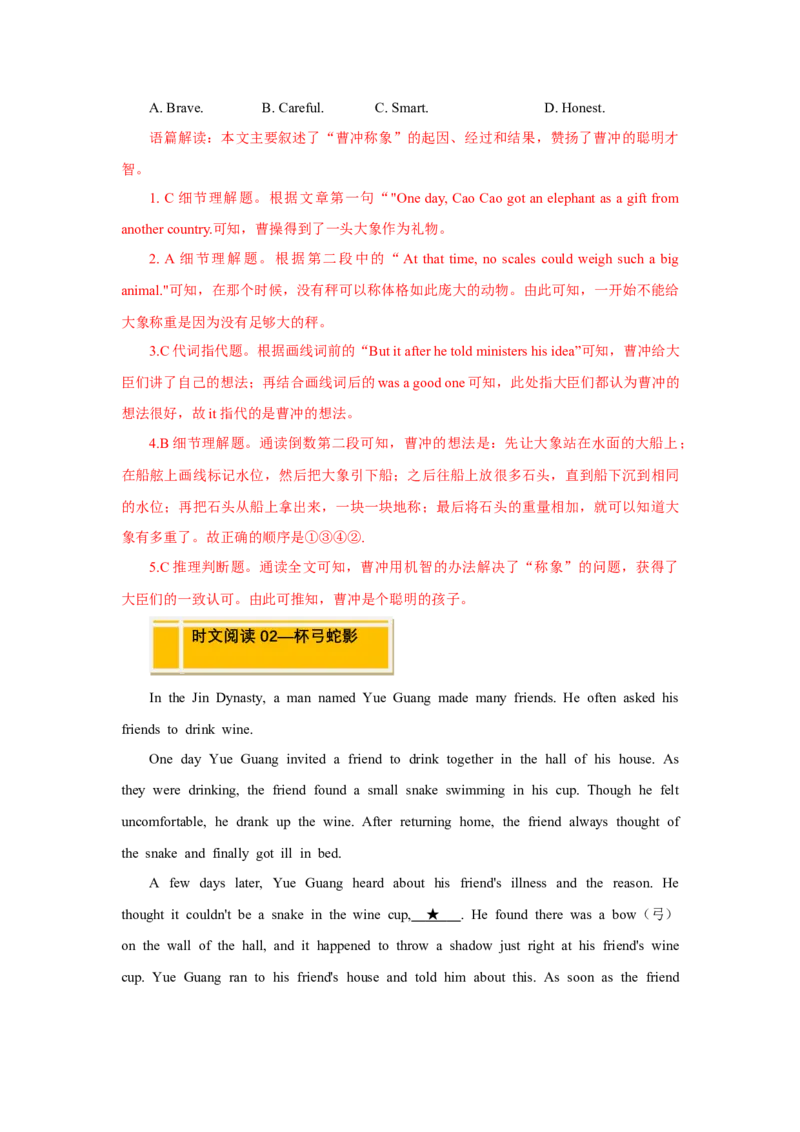
In the story, a witch puts a curse(诅咒)on the King and Queen’s newly born baby, Aurora.
When Aurora pricks (刺破) her fingers on her 15th birthday, she falls into a deep sleep. Years past,
a young prince gives a kiss to her. Then Aurora quickly opens her eyes and wakes up. Finally they
live happily ever after.
Snow White is too beautiful. Her step-mother hates others who are more beautiful than her.
When Snow White’s dangerous step-mother tries to kill her, she hides out with seven dwarves(小矮
人). One day, when the dwarves go out, her step-mother arrives. She gives Snow White an apple,
and she doesn’t know it is poisoned (有毒的). With one bite, she becomes unconscious (无意识的).
One year later, her prince arrives to wake her. And of course, they live happily ever after. And when
Snow White’s father knows the fact, he drives her step-mother away.
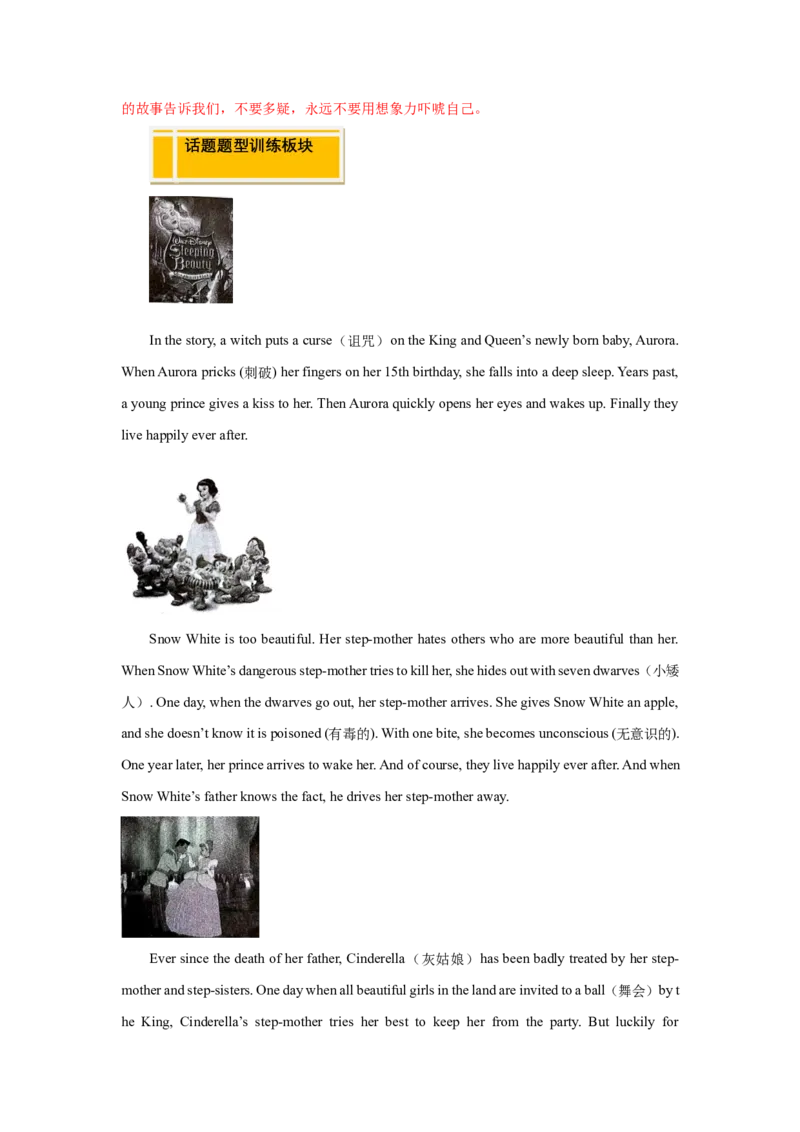
Ever since the death of her father, Cinderella(灰姑娘)has been badly treated by her step-
mother and step-sisters. One day when all beautiful girls in the land are invited to a ball(舞会)by t
he King, Cinderella’s step-mother tries her best to keep her from the party. But luckily forCinderella, a fairy arrives and changes the situation. Finally Cinderella and the prince hold a grand
wedding and they lead a happy life.
1.From the passage we know that ________ is awakened by the kiss of the prince.
A.Cinderella B.Aurora
C.Snow White’s step-mother D.Cinderella’s step-sister
2.________ is NOT mentioned in the passage.
A.A step-mother B.A step-sister C.A fairy D.A step-father
3.Cinderella’s step-mother treats her badly ________.
A.after Cinderella’s father’s death B.because she is too beautiful
C.until a fairy arrives D.because she is too lazy
4.Which of the following is NOT true?
A.Aurora pricks her fingers on her 15th birthday.
B.Cinderella finally arrives at the party.
C.Snow White knows the apple is poisoned.
D.The above stories all get a happy ending.
【答案】1.B 2.D 3.A 4.C
【导语】本文介绍了三个童话故事,《睡美人》、《白雪公主》和《灰姑娘》。
1.细节理解题。由第一个故事“Years past, a young prince gives a kiss to her. Then Aurora
quickly opens her eyes and wakes up.”知,Aurora因王子的吻而苏醒,故选B。
2.推理判断题。由第一个故事“In the story, a witch puts a curse(诅咒)on the King and
Queen’s newly born baby”和“Years past, a young prince gives a kiss to her”,第二个故事“Her
step-mother hates others who are more beautiful than her”和第三个故事“Ever since the death of
her father, Cinderella(灰姑娘)has been badly treated by her step-mother and step-sisters”知,
文章中没有提到继父,故选D。
3.细节理解题。由最后一个故事“Ever since the death of her father, Cinderella(灰姑
娘)has been badly treated by her step-mother and step-sisters”知,灰姑娘的父亲去世后,一直
受到继母和继姐妹的虐待,故选A。
4.细节理解题。由第二个故事“She gives Snow White an apple, and she doesn’t know it
is poisoned (有毒的)”知,白雪公主不知道苹果有毒,故选C。
To Borrow Arrows with Thatched BoatsOne day, Zhou Yu ordered Zhuge Liang to make 100,000 arrows ((箭)in ten days. Zhou
Yu thought it was impossible, but Zhuge Liang said, "Give me three days." Then he asked Lu Su to
lend him 20 boats, and the soldiers put some scarecrows(稻草人)in line on the boats. He
reminded Lu Su not to tell Zhou Yu what was happening.
When Lu Su came again to see Zhuge Liang, he found nothing unusual. Nothing happened on
the second day, either. In the small hours(凌晨)of the third day, Zhuge Liang invited Lu Su for
a boat ride. The 20 boats were tied together with strong ropes. Zhuge's fleet went towards the camp
of Cao Cao. The surface of the river was covered with thick mist(雾) all over. People could
hardly see each other on the river. When Zhuge's fleet got close to the Cao camp before dawn(黎
明),Zhuge Liang ordered his soldiers to shout and beat drums heavily to pretend an attack. But
Zhuge and Lu Su only sat inside one boat, drinking wine to enjoy themselves.
As soon as the Cao camp heard the shouting and drum beating, they mistook it for a surprise
attack by the Zhou Yu camp. Since they could see nobody on the river, they had to order 3,000
soldiers to shoot arrows to stop the unexpected attack. The front of the scarecrows was quickly full
of arrows. After a while, Zhuge Liang had his fleet turned around to get the other side of the
scarecrows to face the Cao camp. When both sides were full of arrows, the day broke. Zhuge Liang
ordered his soldiers to return. The soldiers shouted in excitement, "Thank you, Cao Cao, for your
arrows." After they got back to their camp, they collected more than 100,000 arrows in total from
the scarecrows.
1.How many days did Zhuge Liang need to make 100,000 arrows?
A. One day. B. Two days. C. Three days. D. Ten
days.
2.Who created the idea of getting the arrows?
A. Zhou Yu. B. Zhuge Liang. C. Lu Su. D. Cao Cao.
3.The underlined word "fleet" probably means"_____" in Chinese.
A.船帆 B.甲板 C.船柴 D.船队
4.The soldiers in the Cao camp shot arrows because______.
A. Lu Su beat the drums
B. the Zhou Yu camp started an attack
C. they could see each other on the riverD. they mistook the shouting and beating for a surprise attack
5.How did Zhou Yu probably feel after Zhuge Liang returned with over 100,000 arrows?
A. Surprised. B. Bored. C. Tired. D. Lonely.
语篇解读本文主要讲述了“草船借箭”的故事。诸葛亮利用大雾天气和曹操的多疑心
理,借用草船诱敌,轻而易举获得了十万余支箭。
1. C 细节理解题。根据第一段第二句中的“but t Zhuge Liang said, 'Give me three
days."’可知,诸葛亮认为他需要三天来造十万支箭。
2.B细节理解题。根据第一段最后两句可知,是诸葛亮想出了这个借箭的主意。
3. D词义猜测题。根据画线词所在句的前两句可知,第三天凌晨,诸葛亮邀请鲁肃坐
船,这二十条船用结实的绳子系在一起。由此可推知,诸葛亮带着自己的船队驶向曹操的
营地。故fleet意为“船队”。
4. D细节理解题。根据第三段前两句可知,曹军一听到呐喊声和鼓声,就误以为是一
次突然袭击,所以他们不得不射箭。故选D项。
5.A推理判断题。根据第一段第一句和第二句中的"Zhou Yu thought it was impossible"知,
周瑜认为在十天内造十万支箭是不可能的。由此可推知,当诸葛亮成功地带回十万余支箭
时,他会感到很惊讶。
Modesty(谦逊)is a valuable quality in many cultures around the world. In China, this is no
different. However, the phrase "Mao Sui Recommends Himself" seems to disagree with this.
During the Warring States Period, the Qin army marched(进军)on Handan, the capital
of Zhao. Seeing that Handan was in danger, Prince Pingyuan decided to ask the state of Chu for
help. He wanted to choose 20 talented people to go with him. However, he could only find 19 people
who were good enough. Then, a man named Mao Sui volunteered.
Prince Pingyuan looked at Mao Sui with doubt, "How long have you been here with
me?""Three years," Mao Sui answered. "I hear that a person with talent is like an awl(锥子) in
a cloth bag. Its sharp point will soon pierce through the bag. You've been here for a long time, but I
haven't seen any of your achievements. Maybe you don't have any talent," said Prince Pingyuan.
"What I'm asking you now is to put me into that bag. If you do that, I will pierce through it.
But not only the pointthe whole awl," Mao Sui said confidently.
Impressed, Prince Pingyuan allowed Mao Sui to join his team. However, as they arrived in
Chu, the king was ★ about helping Zhao. Mao Sui stood up and walked to him with a sword(剑)in his hand. Then he told the king why he should help Zhao and the benefits he could get from doing
so. The king was shocked and agreed to help.
Now the phrase "Mao Sui Recommends Himself" ibe someone who volunteers to do a task.
1.Prince Pingyuan asked Chu for help to_______.
A. march on the capital of Qin B. choose 20 talented people
C. get help from Mao Sui D. protect Zhao from Qin's attack
2.Which paragraph shows Prince Pingyuan's distrust of Mao Sui?
A. Paragraph 2. B. Paragraph 3.
C. Paragraph 4. D. Paragraph 5.
3.Which of the following words can be put in" ★ "?
A. uncertain B. glad C. curious D. hopeful
4.What is the phrase "Mao Sui Recommends Himself" used to describe now?
A. Feeling powerful. B. Volunteering for a task.
C. Being honest enough. D. Showing modesty.
语篇解读:本文讲述了“毛遂自荐”的由来。现在,这个成语用来形容自告奋勇地要
求担任某项工作。
1.D细节理解题。根据第二段前两句可知,秦军进军赵国的都城邯郸,这令邯郸处于
危险之中,所以平原君决定向楚国求助,保护赵国免受秦军的攻击。
2. B段落大意题。通读第三段可知,平原君质疑毛遂的才能,他说有才能的人就像布
袋里的锥子,它的尖很快就会刺穿布袋。毛遂在他身边已经很长时间了,但他没有看到毛
遂的任何成就。
3.A词语还原题。根据上文可知,平原君带领二十名有才之士去向楚国求救;根据下
文可知,毛遂站起身来,手持宝剑走到楚王面前。然后,他告诉楚王为什么要帮助赵国,
以及这样做能给他带来的好处。楚王很震惊,同意帮助(赵国)。结合空前的However可
推知,楚王刚开始不确定要不要帮助赵国,故选A项。
4.B细节理解题。根据最后一段可知,现在,“毛遂自荐”这个成语被用来形容自告
奋勇地要求担任某项工作。
It was a warm summer day. A mother duck hid her nest in the long grass. She sat on her eggs,
1 . for the eggs to hatch(孵化). Finally, the eggs hatched. A group of golden ducklings(小鸭
子) appeared.
The mother duck was so happy to 2 . her ducklings. But the largest egg was still there.Suddenly the large egg cracked(裂) open. The duckling was big, grey and 3 . . Other
ducklings don't like him 4 . he was ugly.
A few days later, the mother duck took her ducklings for a swim. As the other birds saw the
grey duckling, they all 5 . him. They made fun of him every day. The poor ugly duckling
couldn't 6 . it anymore, so he ran away from his home. 7 . , he found a pond and lived
there. As it was winter, the water was so cold. He spent a long and lonely winter struggling(挣扎)
to live.
When the spring was coming, the duckling was bigger and stronger than before. He 8 .
high in the air, and he landed by a lovely lake with white and beautiful 9 . .
The ugly duckling thought they would also make fun of him. He felt sorry for himself and
bowed his head low. When he bent his head, he saw himself in the water and was 10 . . His
ugly feathers were now snowy white. His neck was long and beautiful. He had grown into a swan,
too!
1.A. looking B. waiting C. standing
2.A. introduce B. leave C. see
3.A. shy B. ugly C. beautiful
4.A. as B. unless C. if
5.A. smiled at B. took care of C. laughed at
6.A. take B. forget C. like
7.A. At first B. At present C. At once
8.A. jumped B. stood C. flew
9.A. ducks B. chickens C. birds
10.A. excited B. angry C. nervous
【答案】1.B;2.C;3.B;4.A;5.C;6.A;7.B;8.C;9.B;10.A
【解析】【分析】这是一个关于丑小鸭的故事。一只被其他鸭子和小鸟嘲笑为丑陋的
鸭子,在经历了一个漫长、孤独和艰难的冬天后,最终发现自己其实是一只美丽的天鹅。
这个故事告诉我们不要以貌取人,并且每个生物都有其独特的价值和美丽。
1.句意:她坐在蛋上,等待着蛋孵化。A 看,B 等,C 站,根据 sat on her
eggs...hatch,可知是等着孵化,故选B。
2.句意:母鸭看到她的孩子们非常高兴。A介绍,B离开,C看见,根据ducklings,
可是看到的结果,故选C。3.句意:小鸭子很大,灰色的,而且长得很丑。A害羞的,B丑陋的,C美丽的,根
据he was ugly,可知长得很丑,故选B。
4.句意:其他的小鸭子不喜欢他,因为他很丑。A因为,B除非,C如果,根据
Other ducklings don't like him 4 he was ugly,可知用连词因为,表示不喜欢的原因,故选
A。
5.句意:当其他鸟类看到这只灰色的小鸭子时,他们都嘲笑他。A朝......微笑,B照
顾,C嘲笑,根据They made fun of him every day,可知嘲笑他,故选C。
6.句意:可怜的丑小鸭再也受不了了,所以他离家出走了。A承担,B忘记,C喜欢,
根据he ran away from his home,可知无法忍受了,承担不了,故选A。
7.句意:偶然间,他发现了一个池塘并住在那里。A起初,B有时,偶尔,C马上,
根据he found a pond and lived there,可知是不经意间发现的,故用偶然间,故选B。
8.句意:他飞得很高,降落在了一个可爱的湖边,那里有白色而美丽的天鹅。A跳,
B站,C飞,根据high in the air,可知是飞得很高,故选C。
9.句意:他飞得很高,降落在了一个可爱的湖边,那里有白色而美丽的天鹅。A鸭子,
B天鹅,C鸟,根据with white and beautiful,可知这是天鹅,故选B。
10.句意:当他低下头时,他在水中看到了自己,感到很激动。A激动的,B生气的,
C紧张的,根据His ugly feathers were now snowy white. His neck was long and beautiful,可
知变美了很激动,故选A。
This is a Chinese fairy tale (童话故事) about the fantastic bird Jingwei.
The Yan Emperor has a younger daughter 1 . (name) Nü Wa. She is a lively girl and
enjoys
2 . (play) in the sea. One day, she goes to the Eastern Sea 3 . (find ) something
new. As she goes much 4 . (far) away from the shore (海岸), the water becomes more and
more violent(猛烈的). Big waves come one after another. After a serious fight 5 . the angry
sea, the little girl loses all of her strength and drowns (溺水).
After she dies, her soul turns into 6 . bird called "Jingwei". Unlike usual birds, Jingwei
looks like a crow (乌鸦) 7 . a white beak(喙) and red feet. It makes the sad sound "Jingwei"
and gets 8 . (it) name from the sound. The little bird has a strange habit. It always carries
small 9 . (stone) from the Western Mountains to fill up the Eastern Sea. And Jingwei won't
stop 10 . she feels tired. Why does Jingwei do that? There are many ideas, but no oneknows the real answer.
【答案】1.named;2.playing;3.to find;4.farther;5.with;6.a;
7.with;8.its;9.stones;10.unless
【解析】【分析】主要讲了精卫填海的故事。
46.句意:炎帝有一个小女儿,名叫女娲。name叫做,实义动词,是daughter的承受
者,所以用过去分词作后置定语,name的过去分词是named。故填named。
47.句意:她是一个活泼的女孩,她喜欢在海里玩。play玩,实义动词。enjoy doing
sth.喜欢做某事,固定搭配,所以用playing,故填playing。
48.句意:有一天,她去东海找新东西。find发现,实义动词。she goes to the Eastern
Sea她去东海,可知目的是找新东西,所以用 to do不定式表目的,所以用to find,故填to
find。
49.句意:随着她离海岸越来越远,水变得越来越猛烈。far远,副词,much修饰比
较级,far的比较级是farther,更远,故填farther。
50.句意:在与愤怒的大海搏斗之后,小女孩失去了所有的力量,淹死了。fight
with...和......抗争,固定搭配,故填with。
51.句意:她死后,她的灵魂变成了一只叫做"精卫"的鸟。bird鸟,可数名词单数,
以辅音音素开头,所以用a表示数量一,故填a。
52.句意:与普通鸟类不同,精卫看起来像一只乌鸦,长着嘴白色,脚红色。根据a
white beak(喙) and red feet可知此处表伴随,with带有,介词,故填with。
53.句意:它发出悲伤的声音:"精卫",并从这个声音中得名。it它,主格,做主语。
name名字,此处使用形容词性物主代词修饰名词。it的形容词性物主代词是its,它的,故
填its。
54.句意:它总是从西山运来小石子来填满东海。stone石头,可数名词,前面没有表
示单数的a或者one,所以用复数stones,故填stones。
55.句意:除非感到疲倦,否则精卫不会停下脚步。she feels tired 感到疲倦,
AndJingwei won't stop精卫不会停下脚步,结合句子可知讲的是除非感到疲倦,否则精卫不
会停下脚步,unless除非......否则......,连词,故填unless。
A boy was once taking care of some sheep, not far from a forest. Nearby was a village, and
he was told to call for help if there was any danger.
One day, in order to have some fun, he cried out, with all his might,“The wolf is coming! The
wolf is coming!”The men came running with clubs and axes to destroy the wolf. As they saw nothing, they
went home, and left the boy laughing up his sleeve.
As he had had so much fun this time, the boy cried out again the next day,“The wolf! The
wolf!”
The men came again, but not so many as the first time. Again they saw no trace of the wolf, so
they shook their heads, and went back.
On the third day, the wolf came in earnest. The boy cried with dismay,“Help! Help! The
wolf! The wolf!” But not a single man came to help him.
The wolf broke into the flock, and killed a great many sheep. Among them was a beautiful
lamb, which was his pet.
Then he felt very sorry that he had deceived( 欺 骗 )his friends and neighbors, and
grieved(因……而悲伤)over the loss of his pet lamb.
1.What was the boy doing near the forest?
2.What should he do if there was any danger?
3.Why did the boy cry out “The wolf is coming!” for the first time?
4.Whom did the beautiful lamb belong to?
5.What do you think of the boy in this story?
[语篇解读] 短文讲述了“狼来了”的故事。
1.He was taking care of some sheep. 根据文章第一句可知答案。not far from 与near同
义。
2.He should call for help. 根据第一段中的“he was told to call for help if there was any
danger(他被告知如果有危险就呼救)”可知答案。
3.To have fun. 根据第二段第一句可知,他是为了好玩。
4.It belonged to the boy. 根据倒数第二段中的“Among them was a beautiful lamb,
which was his pet.(其中有一只漂亮的羔羊,它是他的宠物)”可知答案。
5.He is dishonest.(言之有理即可)假如你是李梅。你的美国笔友Tom 在昨天的邮件中告诉你, 最近他对中国文化产生了浓
厚的兴趣, 希望你能给他介绍一些经典故事。请你根据下面所给图画, 给Tom 回复一封邮件,
向他讲述司马光砸缸的故事。
要求: 不少于80 词(邮件的开头、结尾已给出, 不计入总词数)。
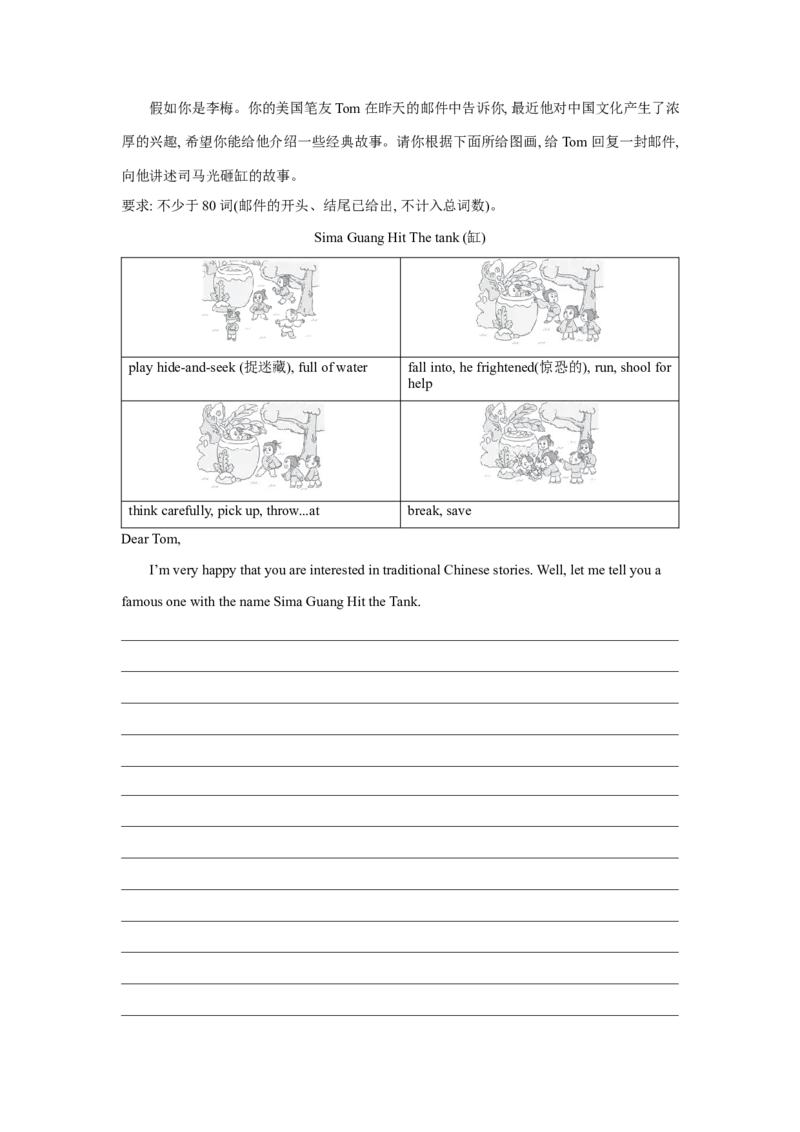
Sima Guang Hit The tank (缸)
play hide-and-seek (捉迷藏), full of water fall into, he frightened(惊恐的), run, shool for
help
think carefully, pick up, throw...at break, save
Dear Tom,
I’m very happy that you are interested in traditional Chinese stories. Well, let me tell you a
famous one with the name Sima Guang Hit the Tank.
_______________________________________________________________________________
_______________________________________________________________________________
_______________________________________________________________________________
_______________________________________________________________________________
_______________________________________________________________________________
_______________________________________________________________________________
_______________________________________________________________________________
_______________________________________________________________________________
_______________________________________________________________________________
_______________________________________________________________________________
_______________________________________________________________________________
_______________________________________________________________________________
_______________________________________________________________________________Do you like the story? What do you think of Sima Guang? I am looking forward to hearing
from you.
Yours,
Li Mei
Dear Tom,
I’m very happy that you are interested in traditional Chinese stories. Well, let me tell you a
famous one with the name Sima Guang Hit the Tank.
Once upon a time, there was a boy named Sima Guang. One day, Sima Guang was playing
hide-and-seek with several children in the yard. There was a large tank full of water. When they
were playing, one child accidentally fell into the tank.Other children were so frightened that they
started to cry, running for help. However, Sima Guang thought it over and then had an idea. He
picked up a big stone and threw it at the tank. “Bang!” The tank broke and the water ran out. The
child was saved. How brave and clever the boy was!From the story I know that we should calm
down in the face of difficulties and danger. Then we can come up with good ways to solve
problems.
Do you like the story? What do you think of Sima Guang? I am looking forward to hearing
from you.
Yours,
Li Mei
假设你是阳光中学八年级的学生李平,你的英国笔友 Henry向你请教成语“守株待
兔”。请你给他写一封邮件,内容包括:
1. 描述故事;2. 概括寓意。
注意: 1. 词数90左右;2. 邮件中不得出现真实姓名、校名和地名。
参考词汇:野兔hare;树桩tree stump
___________________________________________________________________________
_______________________________________________________________________________
_______________________________________________________________________________
_______________________________________________________________________________
_______________________________________________________________________________
______________________________________________________________________________________________________________________________________________________________
_______________________________________________________________________________
_______________________________________________________________________________
_______________________________________________________________________________
_______________________________________________________________________________
_______________________________________________________________________________
_______________________________________________________________________________
Dear Henry,
I’m glad to tell you the story of Wait for Wind Falls. In ancient China, there was a poor
farmer. He was too lazy to work hard every day.
One day, while the farmer was working on the farm, a hare ran so fast that it bumped into the
tree stump and died. The farmer was very happy to take the hare home and cooked a delicious
meal. From then on, he didn’t work anymore. He waited near the tree stump for hares day after
day until he was dying. Also, the crops in the field all died because of lack of care.
This story tells us we should not always depend on good luck. The past experience doesn’t
always work. Happy life comes from hard work.
Yours,
Li Ping
【详解】[总体分析]
①题材:本文是一篇应用文,为电子邮件;
②时态:时态为“一般过去时”;
③提示:注意不要遗漏材料中给出的要点,注意标点符号及大小写等问题,不要犯语法错
误。注意上下文之间的逻辑关系,语意连贯。
[写作步骤]
第一步:表明写作意图。内容是给你的英国笔友Henry介绍成语“守株待兔”的故事内容和
寓意。
第二步:具体阐述写作内容。首先描述故事;其次概括寓意。
第三步:书写结语。过去的经验并不总是有效的。幸福的生活来自努力工作。
[亮点词汇]
①too…to…太……而不能……
②from then on从那时起③day after day日复一日
④because of因为,由于
⑤depend on依靠
[高分句型]
①One day, while the farmer was working on the farm, a hare ran so fast that it bumped into the
tree sturmp and died.(while引导的时间状语从句)
②He waited near the tree sturmp for hares day after day until he was dying.(until引导的时间
状语从句)