Unit 6 Crossing Cultures
完形填空10篇
内容导航
单元话题 基础语篇练习 重难语篇练习
单元话题聚焦
文化差异
基础语篇练习
稳扎稳打 必拿分数:聚焦稳拿分数题目,确保基础分值
重难语篇练习
突破瓶颈 争夺高分:聚焦高难度题目,争夺关键分数
基础语篇练习
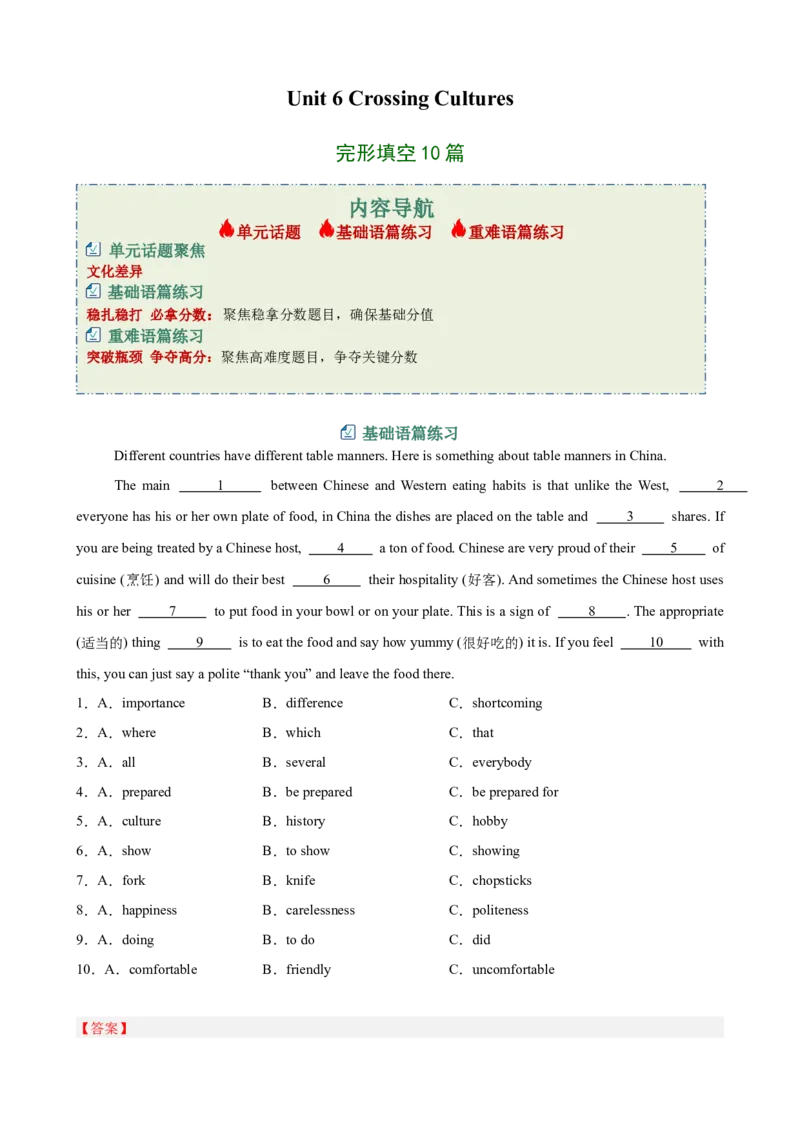
Different countries have different table manners. Here is something about table manners in China.
The main 1 between Chinese and Western eating habits is that unlike the West, 2
everyone has his or her own plate of food, in China the dishes are placed on the table and 3 shares. If
you are being treated by a Chinese host, 4 a ton of food. Chinese are very proud of their 5 of
cuisine (烹饪) and will do their best 6 their hospitality (好客). And sometimes the Chinese host uses
his or her 7 to put food in your bowl or on your plate. This is a sign of 8 . The appropriate
(适当的) thing 9 is to eat the food and say how yummy (很好吃的) it is. If you feel 10 with
this, you can just say a polite “thank you” and leave the food there.
1.A.importance B.difference C.shortcoming
2.A.where B.which C.that
3.A.all B.several C.everybody
4.A.prepared B.be prepared C.be prepared for
5.A.culture B.history C.hobby
6.A.show B.to show C.showing
7.A.fork B.knife C.chopsticks
8.A.happiness B.carelessness C.politeness
9.A.doing B.to do C.did
10.A.comfortable B.friendly C.uncomfortable
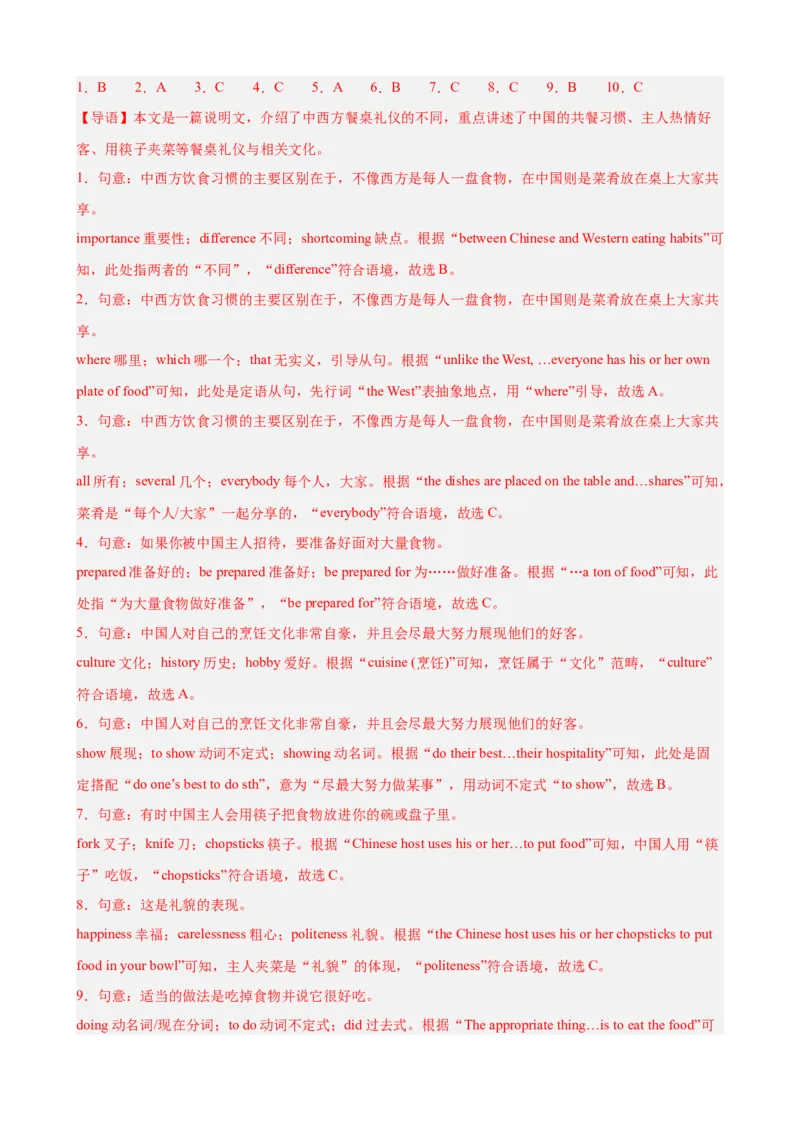
【答案】1.B 2.A 3.C 4.C 5.A 6.B 7.C 8.C 9.B 10.C
【导语】本文是一篇说明文,介绍了中西方餐桌礼仪的不同,重点讲述了中国的共餐习惯、主人热情好
客、用筷子夹菜等餐桌礼仪与相关文化。
1.句意:中西方饮食习惯的主要区别在于,不像西方是每人一盘食物,在中国则是菜肴放在桌上大家共
享。
importance重要性;difference不同;shortcoming缺点。根据“between Chinese and Western eating habits”可
知,此处指两者的“不同”,“difference”符合语境,故选B。
2.句意:中西方饮食习惯的主要区别在于,不像西方是每人一盘食物,在中国则是菜肴放在桌上大家共
享。
where哪里;which哪一个;that无实义,引导从句。根据“unlike the West, …everyone has his or her own
plate of food”可知,此处是定语从句,先行词“the West”表抽象地点,用“where”引导,故选A。
3.句意:中西方饮食习惯的主要区别在于,不像西方是每人一盘食物,在中国则是菜肴放在桌上大家共
享。
all所有;several几个;everybody每个人,大家。根据“the dishes are placed on the table and…shares”可知,
菜肴是“每个人/大家”一起分享的,“everybody”符合语境,故选C。
4.句意:如果你被中国主人招待,要准备好面对大量食物。
prepared准备好的;be prepared准备好;be prepared for为……做好准备。根据“…a ton of food”可知,此
处指“为大量食物做好准备”,“be prepared for”符合语境,故选C。
5.句意:中国人对自己的烹饪文化非常自豪,并且会尽最大努力展现他们的好客。
culture文化;history历史;hobby爱好。根据“cuisine (烹饪)”可知,烹饪属于“文化”范畴,“culture”
符合语境,故选A。
6.句意:中国人对自己的烹饪文化非常自豪,并且会尽最大努力展现他们的好客。
show展现;to show动词不定式;showing动名词。根据“do their best…their hospitality”可知,此处是固
定搭配“do one’s best to do sth”,意为“尽最大努力做某事”,用动词不定式“to show”,故选B。
7.句意:有时中国主人会用筷子把食物放进你的碗或盘子里。
fork叉子;knife刀;chopsticks筷子。根据“Chinese host uses his or her…to put food”可知,中国人用“筷
子”吃饭,“chopsticks”符合语境,故选C。
8.句意:这是礼貌的表现。
happiness幸福;carelessness粗心;politeness礼貌。根据“the Chinese host uses his or her chopsticks to put
food in your bowl”可知,主人夹菜是“礼貌”的体现,“politeness”符合语境,故选C。
9.句意:适当的做法是吃掉食物并说它很好吃。
doing动名词/现在分词;to do动词不定式;did过去式。根据“The appropriate thing…is to eat the food”可知,此处用动词不定式“to do”作后置定语修饰“thing”,表示“要做的事”,故选B。
10.句意:如果你对此感到不舒服,你可以礼貌地说“谢谢”并把食物留在那里。
comfortable舒服的;friendly友好的;uncomfortable不舒服的。根据“you can just say a polite ‘thank you’
and leave the food there”可知,这种情况是“不舒服”时的做法,“uncomfortable”符合语境,故选C。
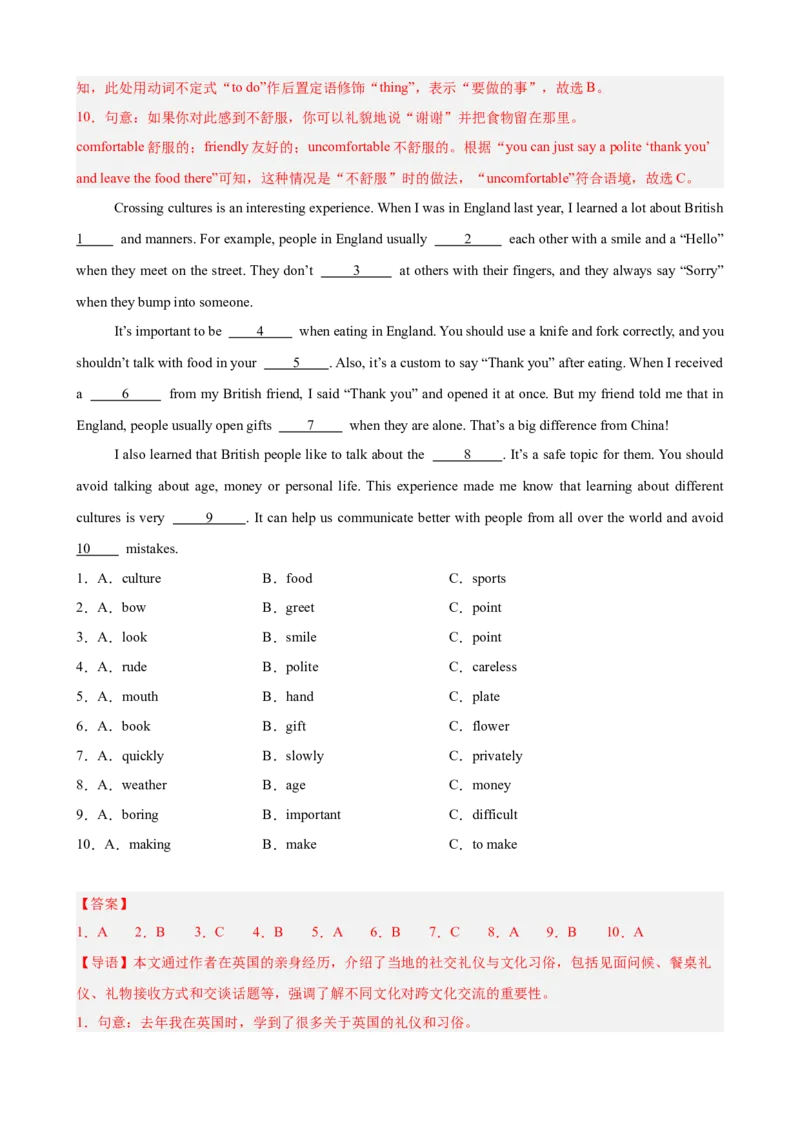
Crossing cultures is an interesting experience. When I was in England last year, I learned a lot about British
1 and manners. For example, people in England usually 2 each other with a smile and a “Hello”
when they meet on the street. They don’t 3 at others with their fingers, and they always say “Sorry”
when they bump into someone.
It’s important to be 4 when eating in England. You should use a knife and fork correctly, and you
shouldn’t talk with food in your 5 . Also, it’s a custom to say “Thank you” after eating. When I received
a 6 from my British friend, I said “Thank you” and opened it at once. But my friend told me that in
England, people usually open gifts 7 when they are alone. That’s a big difference from China!
I also learned that British people like to talk about the 8 . It’s a safe topic for them. You should
avoid talking about age, money or personal life. This experience made me know that learning about different
cultures is very 9 . It can help us communicate better with people from all over the world and avoid
10 mistakes.
1.A.culture B.food C.sports
2.A.bow B.greet C.point
3.A.look B.smile C.point
4.A.rude B.polite C.careless
5.A.mouth B.hand C.plate
6.A.book B.gift C.flower
7.A.quickly B.slowly C.privately
8.A.weather B.age C.money
9.A.boring B.important C.difficult
10.A.making B.make C.to make
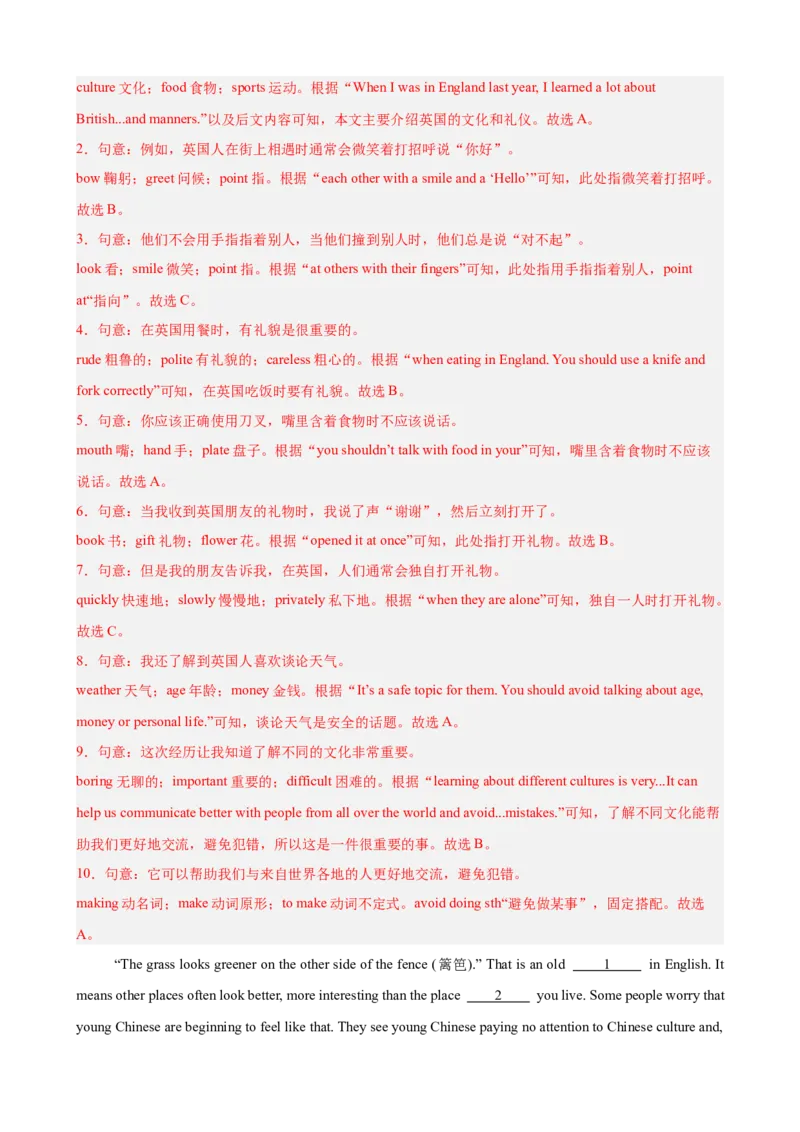
【答案】
1.A 2.B 3.C 4.B 5.A 6.B 7.C 8.A 9.B 10.A
【导语】本文通过作者在英国的亲身经历,介绍了当地的社交礼仪与文化习俗,包括见面问候、餐桌礼
仪、礼物接收方式和交谈话题等,强调了解不同文化对跨文化交流的重要性。
1.句意:去年我在英国时,学到了很多关于英国的礼仪和习俗。culture文化;food食物;sports运动。根据“When I was in England last year, I learned a lot about
British...and manners.”以及后文内容可知,本文主要介绍英国的文化和礼仪。故选A。
2.句意:例如,英国人在街上相遇时通常会微笑着打招呼说“你好”。
bow鞠躬;greet问候;point指。根据“each other with a smile and a ‘Hello’”可知,此处指微笑着打招呼。
故选B。
3.句意:他们不会用手指指着别人,当他们撞到别人时,他们总是说“对不起”。
look看;smile微笑;point指。根据“at others with their fingers”可知,此处指用手指指着别人,point
at“指向”。故选C。
4.句意:在英国用餐时,有礼貌是很重要的。
rude粗鲁的;polite有礼貌的;careless粗心的。根据“when eating in England. You should use a knife and
fork correctly”可知,在英国吃饭时要有礼貌。故选B。
5.句意:你应该正确使用刀叉,嘴里含着食物时不应该说话。
mouth嘴;hand手;plate盘子。根据“you shouldn’t talk with food in your”可知,嘴里含着食物时不应该
说话。故选A。
6.句意:当我收到英国朋友的礼物时,我说了声“谢谢”,然后立刻打开了。
book书;gift礼物;flower花。根据“opened it at once”可知,此处指打开礼物。故选B。
7.句意:但是我的朋友告诉我,在英国,人们通常会独自打开礼物。
quickly快速地;slowly慢慢地;privately私下地。根据“when they are alone”可知,独自一人时打开礼物。
故选C。
8.句意:我还了解到英国人喜欢谈论天气。
weather天气;age年龄;money金钱。根据“It’s a safe topic for them. You should avoid talking about age,
money or personal life.”可知,谈论天气是安全的话题。故选A。
9.句意:这次经历让我知道了解不同的文化非常重要。
boring无聊的;important重要的;difficult困难的。根据“learning about different cultures is very...It can
help us communicate better with people from all over the world and avoid...mistakes.”可知,了解不同文化能帮
助我们更好地交流,避免犯错,所以这是一件很重要的事。故选B。
10.句意:它可以帮助我们与来自世界各地的人更好地交流,避免犯错。
making动名词;make动词原形;to make动词不定式。avoid doing sth“避免做某事”,固定搭配。故选
A。
“The grass looks greener on the other side of the fence (篱笆).” That is an old 1 in English. It
means other places often look better, more interesting than the place 2 you live. Some people worry that
young Chinese are beginning to feel like that. They see young Chinese paying no attention to Chinese culture and,3 , buying Japanese cartoon books, watching Korean soap operas and even 4 Western holidays.
Foreign books and soap operas are good, 5 Chinese writers and actors are just as good. As for
holidays, some may be nice, but for Chinese, they 6 have the special meaning like the Spring Festival,
and the West has 7 to compare with the Mid-Autumn Festival. Don’t forget the best part of Chinese
culture: Friendliness! Not all countries are as 8 as China.
It’s good to enjoy other cultures and 9 from them, but they can’t take the place of your own
culture. It’s good to look on the other side of the fence, but 10 you look carefully and closely, and you
will find that the grass isn’t always greener on the other side of the fence.
1.A.word B.saying C.sentence D.rule
2.A.when B.where C.why D.how
3.A.beside B.besides C.instead D.then
4.A.celebrating B.to celebrate C.celebrated D.celebrate
5.A.if B.so C.but D.or
6.A.still B.never C.always D.ever
7.A.everything B.something C.anything D.nothing
8.A.warm B.warmer C.cold D.colder
9.A.learns B.learning C.in learning D.to learn
10.A.make up B.make up of C.make sure D.be sure to
【答案】
1.B 2.B 3.C 4.A 5.C 6.B 7.D 8.A 9.D 10.C
【导语】本文通过“篱笆另一边的草看起来更绿”这句英语谚语,探讨了部分年轻人追捧外国文化而忽
视本民族文化的现象,并强调了中华文化的独特价值。
1.句意:“篱笆另一边的草看起来更绿。”那是一句古老的英语谚语。
word单词;saying谚语;sentence句子;rule规则。根据“The grass looks greener on the other side of the
fence (篱笆).”可知,这是一句古老的英语谚语。故选B。
2.句意:这意味着其他地方常常看起来比你住的地方更好、更有趣。
when什么时候;where哪里;why为什么;how如何。根据“It means other places often look better, more
interesting than the place...you live.”可知,此处指比你住的地方,用where引导定语从句。故选B。
3.句意:他们看到中国年轻人忽视中国文化,转而购买日本漫画书、看韩剧甚至庆祝西方节日。
beside在……旁边;besides此外;instead相反;then然后。根据“They see young Chinese paying no
attention to Chinese culture and...buying Japanese cartoon books, watching Korean soap operas andeven...Western holidays.”可知,此处指相反的行为,用instead。故选C。
4.句意:他们看到中国年轻人忽视中国文化,转而购买日本漫画书、看韩剧甚至庆祝西方节日。
celebrating庆祝,动名词或现在分词;to celebrate庆祝,不定式;celebrated庆祝,过去式或过去分词;
celebrate庆祝,动词原形。根据“buying Japanese cartoon books, watching Korean soap operas and
even...Western holidays.”可知,此处与buying和watching并列,用动名词形式。故选A。
5.句意:外国的书和肥皂剧是好的,但中国的作家和演员也同样好。
if如果;so所以;but但是;or或者。根据“Foreign books and soap operas are good...Chinese writers and
actors are just as good.”可知,前后句是转折关系,用but连接。故选C。
6.句意:但对中国人来说,它们永远没有春节那样的特殊意义。
still 仍然;never 从不;always 总是;ever 曾经。根据语境,西方节日对于中国人来说“从不”具备春
节的意义。故选B。
7.句意:西方没有什么能与中秋节相比。
everything一切;something某物;anything任何东西;nothing没有什么。根据“and the West has...to
compare with the Mid-Autumn Festival.”可知,西方没有什么能与中秋节相比。故选D。
8.句意:不是所有的国家都像中国一样温暖。
warm温暖的;warmer更温暖的;cold寒冷的;colder更寒冷的。根据本段主题“Friendliness”以及下文的
比较,此处指中国的人情温暖,as...as中间用形容词原级。故选A。
9.句意:享受其他文化并从中学习是好的,但它们不能取代你自己的文化。
learns学习,第三人称单数;learning学习,动名词或现在分词;in learning在学习中;to learn学习,不定
式。and连接并列结构,前面是“to enjoy”,后面也用不定式to learn。故选D。
10.句意:看看篱笆的另一边是好的,但一定要仔细看,你会发现篱笆另一边的草并不总是更绿。
make up编造;make up of由……组成;make sure确保;be sure to一定要。根据“but...you look carefully
and closely, and you will find that the grass isn’t always greener on the other side of the fence.”可知,此处指一
定要仔细看,用make sure。故选C。
Bill and Jill were going to visit Dawei and Li Hua in Taiwan for several days. Before they 1
America, they tried to learn about Taiwanese food and Taiwanese ways of doing things. They 2 to be
polite. They learned that most people in Taiwan 3 rice, drink tea, and take off their shoes when they go
into a friend’s home. Bill and Jill even learned to 4 chopsticks.
At the same time, Dawei and Li Hua 5 American food and American ways of doing things. They
wanted to be 6 . When Bill and Jill came to Li Hua’s 7 , Dawei and Li Hua told them to keep
their shoes on. Later they went out for dinner. They ate pizza and drank Coke. The next few 8 , they had
breakfast in a coffee shop and ate hamburgers in a fast-food restaurant.On their way back to America, Bill and Jill were thinking about why they had 9 eaten rice or
drunk tea or eaten with chopsticks. They didn’t need to take off their 10 when they visited Li Hua’s
family. They thought that living in Taiwan was just like living in America.
1.A.reached B.visited C.found D.left
2.A.asked B.lived C.wanted D.hated
3.A.drink B.grow C.sell D.eat
4.A.make B.use C.buy D.break
5.A.talked about B.heard from C.learned about D.felt like
6.A.friendly B.angry C.excited D.happy
7.A.school B.office C.house D.restaurant
8.A.days B.minutes C.years D.centuries
9.A.often B.usually C.sometimes D.never
10.A.shirts B.blouses C.shoes D.socks
【答案】
1.D 2.C 3.D 4.B 5.C 6.A 7.C 8.A 9.D 10.C
【导语】本文讲述了住在美国的Bill和Jill将去拜访台湾的Dawei和Li Hua,在台湾的Dawei和Li Hua以
美国人的做事方式接待了他们,因此他们觉得在台湾生活跟美国生活一样。
1.句意:在他们离开美国之前,他们尝试了解台湾的食物和做事方式。
reached到达;visited拜访;found发现;left离开。根据“Bill and Jill were going to visit Dawei and Li Hua
in Taiwan”可知,他们是要离开美国去台湾。故选D。
2.句意:他们想要表现得礼貌。
asked询问;lived居住;wanted想要;hated讨厌。根据“they tried to learn about Taiwanese food and
Taiwanese ways of doing things”可知,他们了解当地习俗是因为他们想要表现得有礼貌。故选C。
3.句意:他们了解到台湾大多数人吃米饭、喝茶,去朋友家时脱鞋。
drink喝;grow种植;sell售卖;eat吃。根据“rice”可知,此处指吃米饭。故选D。
4.句意:Bill和Jill甚至学会了使用筷子。
make制作;use使用;buy购买;break打破。根据“chopsticks”可知,此处指他们学会了用筷子。故选
B。
5.句意:与此同时,Dawei和Li Hua了解了美国的食物和做事方式。
talked about谈论;heard from收到……来信;learned about了解;felt like想要。根据前文“they tried to
learn about Taiwanese food and Taiwanese ways of doing things”和“...American food and American ways ofdoing things”可知,此处指Dawei和Li Hua了解美国的饮食和做事方式。故选C。
6.句意:他们想表现得友好。
friendly友好的;angry生气的;excited兴奋的;happy开心的。根据“...American food and American ways
of doing things”可知,Dawei和Li Hua了解美国的习俗是想要友好待人。故选A。
7.句意:当Bill和Jill来到Li Hua的家时,Dawei和Li Hua告诉他们不用脱鞋。
school学校;office办公室;house家;restaurant餐厅。根据前文“take off their shoes when they go into a
friend’s home”可知,这里是来到朋友家。故选C。
8.句意:接下来的几天,他们在咖啡店吃早餐,在快餐店吃汉堡。
days天;minutes分钟;years年;centuries世纪。根据前文“for several days”可知,他们在台湾待几天,
此处指接下来的几天。故选A。
9.句意:在回美国的路上,Bill和Jill在想为什么他们从来没吃过米饭、喝过茶或用筷子吃饭。
often经常;usually通常;sometimes有时;never从未。根据后文“living in Taiwan was just like living in
America”可知,他们在台湾的饮食和美国一样,所以从未吃米饭、喝茶或用筷子。故选D。
10.句意:当他们拜访Li Hua家时,他们不需要脱鞋。
shirts衬衫;blouses女式衬衫;shoes鞋子;socks袜子。根据前文“take off their shoes when they go into a
friend’s home”可知,前文提到拜访朋友家时脱鞋的习俗,此处指他们拜访Li Hua家时不用脱鞋。故选
C。
Chinese food is very famous in the world. Chinese people think 1 is one of the most important
things during their lives. They do not 2 each other with “How are you?”, but they ask “Have you
eaten?”
Since table manners are part of Chinese cooking culture, Chinese people still 3 their table manners
today.
There is a seat for the “guest of honour” or the 4 person in the family. In most parts of China, the
“seat of honour” is 5 the one facing the front door of the room. The 6 of honour can also be
the one in the middle facing the east of the room if there is no seat facing the door.
As for the host, he or she may take the most 7 seat. It is always the nearest to the kitchen or the
service (服务) door. It is better to sit after the elder or the “guest of honour” sits down. Guests should 8
the host to invite them to sit down.
Chinese people like having meals together and they 9 all the dishes on a round table. There is
sometimes a round rotating disc (旋转盘) in the 10 of the dining table. It makes sure that all the diners
can enjoy the meal and feel respected.
1.A.knowledge B.money C.food D.health2.A.greet B.introduce C.attract D.teach
3.A.break B.follow C.create D.explore
4.A.richest B.youngest C.poorest D.oldest
5.A.slowly B.normally C.finally D.quickly
6.A.seat B.friend C.map D.time
7.A.convenient B.expensive C.different D.comfortable
8.A.talk with B.think of C.wait for D.look for
9.A.show B.grow C.wash D.put
10.A.corner B.west C.east D.centre
【答案】
1.C 2.A 3.B 4.D 5.B 6.A 7.A 8.C 9.D 10.D
【导语】本文是一篇说明文,主要介绍了中国饮食文化中的餐桌礼仪,包括座次安排、问候方式以及用
餐习惯等。
1.句意:中国人认为食物是他们生活中最重要的事情之一。
knowledge知识;money金钱;food食物;health健康。根据“Chinese food is very famous in the world.”以
及“They do not…each other with ‘How are you?’, but they ask ‘Have you eaten?’”可知,中国人很重视食物,
认为食物是生活中重要的事情之一,故选C。
2.句意:他们不会用“你好吗?”来问候对方,而是问“你吃了吗?”。
greet问候;introduce介绍;attract吸引;teach教。根据“They do not…each other with ‘How are you?’, but
they ask ‘Have you eaten?’”可知,此处指中国人不会用“你好吗?”来问候对方,而是用“你吃了吗?”
来问候,故选A。
3.句意:由于餐桌礼仪是中国烹饪文化的一部分,中国人至今仍遵循他们的餐桌礼仪。
break打破;follow遵循;create创造;explore探索。根据“Since table manners are part of Chinese cooking
culture”可知,餐桌礼仪是中国烹饪文化的一部分,所以中国人至今仍遵循他们的餐桌礼仪,故选B。
4.句意:有一个座位是给“贵宾”或家里最年长的人的。
richest最富有的;youngest最年轻的;poorest最贫穷的;oldest最年长的。根据“It is better to sit after the
elder or the ‘guest of honour’ sits down.”可知,有一个座位是给家里最年长的人或“贵宾”的,故选D。
5.句意:在中国的大部分地区,“上座”通常是面对房间前门的那个座位。
slowly慢慢地;normally通常;finally最后;quickly快速地。根据“In most parts of China, the ‘seat of
honour’ is…the one facing the front door of the room.”可知,在中国的大部分地区,“上座”通常是面对房
间前门的那个座位,故选B。6.句意:如果没有面对门的座位,上座也可以是坐在房间中间面向东方的座位。
seat座位;friend朋友;map地图;time时间。根据“The…of honour can also be the one in the middle facing
the east of the room if there is no seat facing the door.”可知,此处指上座,故选A。
7.句意:至于主人,他或她可能会坐在最方便的座位上。
convenient方便的;expensive昂贵的;different不同的;comfortable舒适的。根据“It is always the nearest
to the kitchen or the service (服务) door.”可知,主人会坐在最方便的座位上,这个座位离厨房或服务门最近,
故选A。
8.句意:客人应该等待主人邀请他们坐下。
talk with与……交谈;think of想起;wait for等待;look for寻找。根据“Guests should…the host to invite
them to sit down.”可知,客人应该等待主人邀请他们坐下,故选C。
9.句意:中国人喜欢一起吃饭,他们把所有的菜都放在圆桌上。
show展示;grow种植;wash洗;put放。根据“Chinese people like having meals together and they…all the
dishes on a round table.”可知,中国人喜欢一起吃饭,他们把所有的菜都放在圆桌上,故选D。
10.句意:有时在餐桌的中央有一个圆形的旋转盘。
corner角落;west西方;east东方;centre中心。根据“There is sometimes a round rotating disc (旋转盘) in
the…of the dining table.”可知,有时在餐桌的中央有一个圆形的旋转盘,故选D。
阅读下面短文, 从每题所给的A、B、C、D四个选项中选出最佳选项。
A gift is necessary when one is invited to visit friends in China. After greetings, the gift should be passed
immediately to the host. Remember that usually Chinese people will not open the gift in front of the person who
gave 1 . To show the respect, it may be 2 to explain what the gift is. Bringing some nutrients
(营养品) and tonics (补品) to the elders in the family is a good idea. You can 3 prepare some small
gifts for the spouse (配偶) or kids of the host. The host usually makes full 4 by carefully tidying up the
house. Also, 5 a lot of delicious dishes is necessary. 6 the meal is well prepared, the host
may say to the guest politely, “I haven’t prepared enough. Please excuse me for my poor treat. “As a guest, you
should praise the food to show the host that you think the meal is abundant (丰盛的) and delicious.
While eating, the elders will use chopsticks to 7 food for guests as a tradition and ask them to eat
8 . As a guest, you should accept their goodwill readily. But nowadays, the younger people do the traditional
way less.
After dinner, tea and fruit are usually served. When the guests are to leave, the host may still politely ask
them to stay. They don’t have to take it 9 and can try to find a good time to leave. This doesn’t mean
that leaving early is always a good idea as the host may feel that the guests are not satisfied with the treat. Finding
the right time to leave 10 the situation.1.A.it B.them C.that D.us
2.A.necessary B.careful C.comfortable D.exciting
3.A.too B.also C.either D.neither
4.A.plans B.decisions C.preparations D.weeks
5.A.enjoying B.cooking C.washing D.taking
6.A.But B.Although C.Because D.If
7.A.cut up B.eat up C.pick up D.take up
8.A.more B.less C.most D.least
9.A.completely B.seriously C.probably D.carefully
10.A.works out B.sticks to C.depends on D.turns on
【答案】
1.A 2.A 3.B 4.C 5.B 6.B 7.C 8.A 9.B 10.C
【导语】本文主要介绍了在中国拜访朋友时的相关习俗,包括送礼物的注意事项、主人的准备工作以及
用餐和告辞时的礼仪。
1.句意:记住,中国人通常不会当着送礼人的面打开礼物。
it它,指代单数名词或不可数名词;them它们,指代复数名词;that那个,指代特指的单数名词;us我们,
指代第一人称复数。根据“Remember that usually Chinese people will not open the gift in front of the person
who gave….”可知,此处指代前面提到的单数名词“the gift”,应用it来指代,符合语境。故选A。
2.句意:为表尊重,可能有必要解释一下礼物是什么。
necessary必要的;careful仔细的;comfortable舒适的;exciting令人兴奋的。根据“To show the respect, it
may be…to explain what the gift is.”可知,此处表示为了体现尊重,解释礼物是什么是有必要的,necessary
符合语境。故选A。
3.句意:你也可以为主人的配偶或孩子准备一些小礼物。
too也,用于肯定句末尾;also也,用于肯定句中间;either也,用于否定句末尾;neither两者都不。根据
“You can…prepare some small gifts for the spouse or kids of the host.”可知,此处表示“也”,句子是肯定
句,且空格位于情态动词can之后、实义动词prepare之前,应用also。故选B。
4.句意:主人通常会通过仔细打扫房子来做好充分准备。
plans计划;decisions决定;preparations准备;weeks星期。根据“The host usually makes full…by
carefully tidying up the house.”可知,此处考查固定搭配make full preparations,意为“做好充分准备”,
carefully tidying up the house是准备工作的一部分,preparations符合语境。故选C。
5.句意:此外,做很多美味的菜肴是必要的。enjoying享受;cooking烹饪,做;washing洗;taking拿,带。根据“Also,…a lot of delicious dishes is
necessary.”可知,招待客人时,做美味的菜肴是必要的,cooking符合语境,此处是动名词短语作主语。
故选B。
6.句意:虽然饭菜准备得很好,但主人可能会礼貌地对客人说:“我准备得不够,请原谅我招待不
周。”
But但是,表转折;Although虽然,表让步;Because因为,表原因;If如果,表条件。根据“…the meal
is well prepared, the host may say to the guest politely…”可知,前后两句是让步关系,即尽管饭菜准备得好,
主人还是会谦虚地说招待不周,Although符合语境。故选B。
7.句意:用餐时,按照传统,长辈会用筷子为客人夹菜,并让他们多吃点。
cut up切碎;eat up吃完;pick up夹起,拿起;take up占据。根据“While eating, the elders will use
chopsticks to…food for guests as a tradition”可知,在中国习俗中,长辈会用筷子给客人夹菜,pick up符合
语境。故选C。
8.句意:用餐时,按照传统,长辈会用筷子为客人夹菜,并让他们多吃点。
more更多;less更少;most最多;least最少。根据“ask them to eat…”可知,长辈为客人夹菜,通常会让
客人多吃一些,more符合语境,此处是隐含的比较含义。故选A。
9.句意:他们不必当真,可以试着找个合适的时间离开。
completely完全地;seriously认真地,当真;probably可能;carefully仔细地。根据“When the guests are
to leave, the host may still politely ask them to stay. They don’t have to take it…”可知,主人挽留客人是礼貌之
举,客人不必当真,考查固定搭配take it seriously,意为“当真”,seriously符合语境。故选B。
10.句意:找到合适的离开时间要取决于具体情况。
works out解决,算出;sticks to坚持;depends on取决于;turns on打开。根据“Finding the right time to
leave…the situation.”可知,合适的离开时间没有固定标准,要根据具体情况来定,depends on符合语境。
故选C。
In China, drinking hot water is very common. We all know that in China, when we are waiting for the food
in a restaurant, the waiter 1 gives us hot water to drink, but foreign friends don’t know it. They may be
2 and ask, “Why is the water so hot?” They usually ask the waiter 3 some cold water to drink.
For Chinese people, drinking more hot water can make us 4 and strong. When we are ill, doctors
5 us to drink hot water. Our parents tell us not to eat 6 ice cream. They think cold food can cause
illness easily. But in foreign countries, some people may not have the 7 of drinking hot water. So when
they see many Chinese people 8 a cup with hot water, they feel surprised. Next time when you go to a
friend’s 9 in America, don’t be surprised if he or she gives you a cup of cold water. Different histories
and cultures lead to different eating habits. We can’t understand the difference between each other, but we can10 it.
1.A.usually B.seldom C.never
2.A.happy B.sad C.surprised
3.A.to B.for C.at
4.A.cute B.clever C.healthy
5.A.choose B.wish C.ask
6.A.too many B.too much C.much too
7.A.dream B.chance C.habit
8.A.take B.buy C.pick
9.A.classroom B.school C.home
10.A.become B.respect C.lose
【答案】
1.A 2.C 3.B 4.C 5.C 6.B 7.C 8.A 9.C 10.B
【导语】本文是一篇说明文,介绍了中国人喝热水的普遍习惯,对比了中外在饮水和饮食温度上的差异,
解释了这种习惯背后的文化原因,并倡导尊重不同的饮食习惯。
1.句意:我们都知道,在中国的餐馆里等餐时,服务员通常会给我们热水喝。
usually通常;seldom很少;never从不。 根据“In China, drinking hot water is very common. We all know
that in China, when we are waiting for the food in a restaurant, the waiter ... gives us hot water to drink”可知,喝
热水在中国很普遍,所以服务员通常会提供热水。故选A。
2.句意:他们可能会感到惊讶,然后问:“水为什么这么热?”
happy开心的;sad难过的;surprised惊讶的。 根据“but foreign friends don’t know it. They may be ... and
ask, ‘Why is the water so hot?’”可知,外国朋友不了解喝热水的习惯,所以会感到惊讶。故选C。
3.句意:他们通常会让服务员拿一些冷水来喝。
to到;for为了;at在。 根据“They usually ask the waiter ... some cold water to drink”可知,ask sb. for sth.
是固定搭配,意为“向某人要某物”。故选B。
4.句意:对中国人来说,多喝热水可以让我们健康又强壮。 cute可爱的;clever聪明的;healthy健康的。
根据“For Chinese people, drinking more hot water can make us ... and strong”可知,喝热水被认为有益健康,
healthy与strong呼应。故选C。
5.句意:当我们生病时,医生会让我们喝热水。
choose选择;wish希望;ask要求、让。 根据“When we are ill, doctors ... us to drink hot water”可知,ask
sb. to do sth.是固定搭配,意为“让某人做某事”,符合医生建议病人的语境。故选C。6.句意:我们的父母告诉我们不要吃太多冰淇淋。
too many太多(可数名词);too much太多(不可数名词);much too太。 根据“Our parents tell us not
to eat ... ice cream”可知,ice cream是不可数名词,用too much修饰。故选B。
7.句意:但在国外,有些人可能没有喝热水的习惯。
dream梦想;chance机会;habit习惯。 根据“But in foreign countries, some people may not have the ... of
drinking hot water”可知,此处指喝热水的习惯,the habit of是固定搭配。故选C。
8.句意:所以当他们看到很多中国人拿着一杯热水时,会感到惊讶。
take拿着;buy买;pick捡起。 根据“So when they see many Chinese people ... a cup with hot water, they
feel surprised”可知,此处指拿着热水杯,take a cup符合语境。故选A。
9.句意:下次当你去美国朋友家时,如果他或她给你一杯冷水,不要感到惊讶。
classroom教室;school学校;home家。 根据“Next time when you go to a friend’s ... in America, don’t be
surprised if he or she gives you a cup of cold water”可知,去朋友家做客时会被招待饮水,home符合语境。
故选C。
10.句意:我们可能无法理解彼此的差异,但我们可以尊重它。
become成为;respect尊重;lose失去。 根据“Different histories and cultures lead to different eating habits.
We can’t understand the difference between each other, but we can ... it”可知,面对文化差异,我们应该尊重
它。故选B。
British people are famous for apologizing in almost every situation.
British people take pride in 1 on their polite manners towards one another in public. As a result,
they often use the word “sorry”—even when they don’t really 2 it! Usually, if they want to ask a
stranger for the time, they will 3 by saying “Sorry to trouble you.” If they’re five minutes late 4
an appointment, they will generally greet the person by saying “Sorry I’m late!” If they’re 15 minutes late, they
might want to be even more apologetic and say, “I’m 5 sorry I’m late!”
6 do British people use “sorry” so much? Well, in the British culture, saying “sorry” is a way to
be polite, 7 to people whom they don’t know very well. It’s also a very smart way to get what they
want. In recent research, an actor got close to 8 strangers on a rainy day to ask if he could use their
mobile phones. When he walked to one group of strangers and asked them without apologizing first, he was only
9 percent successful in 9 their phones. 10 , when he said “Sorry” or “Excuse me” to another
group of strangers before asking, he was 47 percent successful.
1.A.themselves B.yourselves C.ourselves
2.A.prefer B.mean C.know
3.A.stop B.leave C.start4.A.before B.for C.of
5.A.just B.only C.so
6.A.When B.Why C.How
7.A.recently B.especially C.suddenly
8.A.same B.strange C.different
9.A.buying B.keeping C.borrowing
10.A.However B.Because C.So
【答案】
1.A 2.B 3.C 4.B 5.C 6.B 7.B 8.C 9.C 10.A
【导语】本文是一篇说明文,介绍了英国人几乎在任何情况下都会道歉的文化现象,分析了他们频繁使
用“sorry”的原因,并通过一个实验展示了道歉在社交中的积极作用。
1.句意:英国人以他们在公共场合对彼此的礼貌举止为荣。
themselves他们自己;yourselves你们自己;ourselves我们自己。根据“British people take pride in ... on
their polite manners towards one another in public”可知,此处指代“British people”,用反身代词
themselves,take pride in oneself on sth.表示“为自己的某事感到自豪”。故选A。
2.句意:结果,他们经常使用“sorry”这个词——即使他们并不是真的这个意思!
prefer更喜欢;mean意味着、意思是;know知道。根据“As a result, they often use the word ‘sorry’—even
when they don’t really ... it!”可知,这里是说英国人说“sorry”时,有时并不是真的想道歉,即“不是那个
意思”。故选B。
3.句意:通常,如果他们想问陌生人时间,他们会以“抱歉打扰你”开始。
stop停止;leave离开;start开始。根据“Usually,if they want to ask a stranger for the time,they will ... by
saying‘Sorry to trouble you.’”可知,他们会用道歉的话来开启对话,“start by doing sth.”表示“以做某事开
始”。故选C。
4.句意:如果他们约会迟到五分钟,他们通常会说“对不起,我迟到了!”来问候对方。
before在……之前;for为了;of属于。 根据“If they’re five minutes late ... an appointment, they will
generally greet the person by saying ‘Sorry I’m late!’”可知,be late for an appointment是固定搭配,意为“约
会迟到”。故选B。
5.句意:如果他们迟到15分钟,他们可能会更歉意地说:“我非常抱歉,我迟到了!”
just只是;only仅仅;so非常、很。根据“If they’re 15 minutes late, they might want to be even more
apologetic and say, ‘I’m ... sorry I’m late!’”可知,迟到更久时会更歉意,so sorry表示“非常抱歉”。故选
C。6.句意:为什么英国人这么频繁地使用“sorry”?
When何时;Why为什么;How如何。根据“... do British people use‘sorry’so much? Well, in the British
culture, saying ‘sorry’ is a way to be polite ... ”可知,后文是解释原因,所以这里是提问“为什么”。故选
B。
7.句意:在英国文化中,说“sorry”是一种礼貌的方式,尤其是对不太熟悉的人。
recently最近;especially尤其;suddenly突然。根据“Well, in the British culture, saying‘sorry’is a way to be
polite, ... to people whom they don’t know very well.”可知,此处强调“尤其”是对不太熟悉的人,用
especially来突出这种情况。故选B。
8.句意:在最近的一项研究中,一名演员在雨天接近不同的陌生人,问他是否可以使用他们的手机。
same相同的;strange奇怪的;different不同的。根据“In recent research,an actor got close to ... strangers on
a rainy day to ask if he could use their mobile phones. When he walked to one group of strangers and asked them
without apologizing first ... ”可知,研究中演员接触了不同的陌生人分组,所以用different。故选C。
9.句意:当他走向一组陌生人,没有先道歉就问他们时,他只有9%的成功借到手机。
buying购买;keeping保持;borrowing借。根据“ask if he could use their mobile phones”可知,他是想借手
机,所以是“成功借到”。故选C。
10.句意:然而,当他在询问前对另一组陌生人说“对不起”或“打扰一下”时,他的成功率为47%。
However然而;Because因为;So所以。根据“he was only 9 percent successful ... when he said ‘Sorry’ or
‘Excuse me’ to another group of strangers before asking, he was 47 percent successful.”可知,前后是转折关系,
用However。故选A。
重难语篇练习
Most cultures in the world have some similarities. However, there are often some big differences that go
with these similarities. These 1 differences can cause some very embarrassing moments. It is something
that 2 wants to experience.
My grandfather is from Italy, so I live in an environment rich in Italian culture. In Italian culture, kissing
each other hello and goodbye is 3 . You’ll see family members hug and kiss each other goodbye, 4
you’ll see best friends give a kiss on the cheek. I do this all the time to my family members. 5 , one
night I decided I’d try it among all my friends who are mainly Irish people and come from a strong American
background. What 6 was really embarrassing.
A girl, who I have known for a long time, came up to me to say hello at a party. I gave her a hug and a 7
on the cheek. The reaction (反应) I got was something out of a comedy movie. She gave me a 8 as if to
say, “Joe, what the hell was that?” All my friends began to think I 9 her past the point of friends, but in
fact it was not that case. Rumours (谣言) began to spread, and I had to 10 myself. It was such a(n)11 situation if you ask me.
I often 12 cultural differences. They’re not fun, 13 when someone from a different
background misunderstands the total situation. The best thing to do is to try and understand the other person’s
cultural norms (行为规范), and try not to 14 them. However, every person is different and it’s fairly
difficult to read a person when you’re just meeting them. As life goes on, we’ll have the 15 to learn
about other people and their cultures.
1.A.normal B.cultural C.boring D.special
2.A.no one B.someone C.anyone D.everyone
3.A.helpful B.private C.common D.polite
4.A.as B.so C.but D.or
5.A.Actually B.However C.Luckily D.Besides
6.A.happened B.disappeared C.changed D.continued
7.A.kiss B.smile C.touch D.look
8.A.choice B.try C.look D.suggestion
9.A.believed B.liked C.trusted D.worried
10.A.protect B.explain C.control D.train
11.A.exciting B.unreasonable C.dangerous D.uncomfortable
12.A.deal with B.agree with C.turn down D.stick to
13.A.only B.probably C.especially D.even
14.A.discover B.break C.miss D.waste
15.A.decision B.argument C.trouble D.chance
【答案】
1.B 2.A 3.C 4.D 5.B 6.A 7.A 8.C 9.B 10.B 11.D
12.A 13.C 14.B 15.D
【导语】本文主要讲述了作者因祖父来自意大利,生活在意大利文化环境中,在朋友聚会中因文化差异
做出意大利式的问候方式而引发尴尬,最后作者意识到要理解他人文化规范并避免误解。
1.句意:这些文化差异会导致一些非常尴尬的时刻。
normal正常的;cultural文化的;boring无聊的;special特别的。根据“However, there are often some big
differences that go with these similarities.”以及后文描述的因文化差异产生的尴尬可知,这里说的是文化差
异,故选B。
2.句意:这是没有人想经历的事情。no one没有人;someone某人;anyone任何人;everyone每个人。根据“cause some very embarrassing
moments”可知,尴尬的时刻是没人想经历的,故选A。
3.句意:在意大利文化中,亲吻彼此作为问候和道别是常见的。
helpful有帮助的;private私人的;common常见的;polite礼貌的。根据“You’ll see family members hug
and kiss each other goodbye”可知,在意大利文化中亲吻彼此问候和道别很常见,故选C。
4.句意:你会看到家庭成员拥抱亲吻彼此道别,或者你会看到最好的朋友亲吻脸颊。
as当……时;so所以;but但是;or或者。根据“family members hug and kiss each other goodbye”和“best
friends give a kiss on the cheek”可知,二者是选择关系,用or连接,故选D。
5.句意:然而,一天晚上我决定在我主要是爱尔兰人且有着强烈美国背景的朋友中尝试一下。
Actually实际上;However然而;Luckily幸运地;Besides此外。根据“I do this all the time to my family
members…one night I decided I’d try it among all my friends who are mainly Irish people and come from a
strong American background.”可知,前后是转折关系,故选B。
6.句意:发生的事情真的很尴尬。
happened发生;disappeared消失;changed改变;continued继续。根据“was really embarrassing”可知,是
发生的事情很尴尬,故选A。
7.句意:我给了她一个拥抱并在脸颊上亲了一下。
kiss亲吻;smile微笑;touch触摸;look看。根据“give a kiss on the cheek”可知,是在脸颊上亲一下,故
选A。
8.句意:她给了我一个像是说“乔,那是什么鬼东西”的表情。
choice选择;try尝试;look表情;suggestion建议。根据“as if to say, ‘Joe, what the hell was that?’”可知,
是她的表情像是这么说,故选C。
9.句意:我所有的朋友开始认为我喜欢她超出了朋友界限,但事实上并非如此。
believed相信;liked喜欢;trusted信任;worried担心。根据“her past the point of friends”可知,朋友认为
我喜欢她超出了朋友界限,故选B。
10.句意:谣言开始传播,我不得不解释自己。
protect保护;explain解释;control控制;train训练。根据“Rumours began to spread”可知,谣言传播要解
释自己,故选B。
11.句意:如果你问我,这是一个非常不舒服的情况。
exciting令人兴奋的;unreasonable不合理的;dangerous危险的;uncomfortable不舒服的。根据前文描述
的尴尬情况可知,这是不舒服的,故选D。
12.句意:我经常处理文化差异。
deal with处理;agree with同意;turn down拒绝;stick to坚持。根据“cultural differences”可知,是处理文化差异,故选A。
13.句意:它们不好玩,尤其是当来自不同背景的人误解了整个情况时。
only仅仅;probably可能;especially尤其;even甚至。根据“when someone from a different background
misunderstands the total situation”可知,这种情况不好玩,尤其是被误解时,强调程度,故选C。
14.句意:最好的做法是尝试理解对方的文化规范,并且尽量不要违背它们。
discover发现;break违背;miss错过;waste浪费。根据“try and understand the other person’s cultural
norms”可知,是不要违背文化规范,故选B。
15.句意:随着生活继续,我们将有机会了解其他人及其文化。
decision决定;argument争论;trouble麻烦;chance机会。根据“to learn about other people and their
cultures”可知,是有机会了解他人和文化,故选D。
先通读短文,掌握其大意,然后从A、B、C、D四个选项中选出一个可以填入相应空白处的最佳选项,
并在答题卡上将该项涂黑。
Kimi was a middle school student. He had always been attracted by Chinese culture. He loved learning
about the 1 , traditions, and customs of his country. One day, while looking through the Internet, he
noticed some information 2 Western culture. He was surprised to find that there were many differences
between Chinese and Western 3 .
Kimi couldn’t believe what he was reading. He found it 4 to understand why people in the West
did things so differently from people in China. He thought that Western culture was strange. He decided to 5
about it with his best friend, Jack.
“Jack, have you ever noticed how different Western culture is from Chinese culture?” Kimi asked.
“Yeah, I have,” Jack replied. “But that doesn’t mean we should think it’s strange. We should try to 6
and appreciate (欣赏) it.”
“But 7 do they do things so differently?” Kimi asked.
“Well, different cultures have 8 values,” Jack explained. “For example, in the West,
individualism (个人主义) is 9 valued, while in China, collectivism (集体主义) is more important.”
Kimi thought about what Jack had 10 . He found that he had been too quick to judge (评价)
Western culture. He decided to learn more about it.
Over the next few weeks, Kimi tried many 11 to help himself understand Western culture, such
as reading books and watching movies about it. And he had learned a great deal. He knew that things could not be
said to be strange and bad just because they were different from yours. Kimi 12 that it was very
common to find differences. Everyone is different, so how could two countries with totally different backgrounds
be the same?In the end, Kimi changed 13 attitude (态度) towards Western culture. By learning about the
differences, he could understand the 14 better and become a more open-minded person. He was 15
to continue learning about different cultures and exploring the world around him.
1.A.art B.math C.science D.history
2.A.about B.with C.for D.like
3.A.songs B.pictures C.cities D.cultures
4.A.hard B.special C.brave D.safe
5.A.think B.talk C.learn D.worry
6.A.imagine B.explain C.understand D.receive
7.A.what B.where C.why D.When
8.A.similar B.different C.common D.important
9.A.lightly B.slowly C.highly D.totally
10.A.made B.said C.looked D.asked
11.A.ways B.skills C.plans D.moments
12.A.heard B.realized C.suggested D.guessed
13.A.their B.his C.her D.its
14.A.life B.world C.nature D.mood
15.A.happy B.sorry C.moved D.surprised
【答案】
1.D 2.A 3.D 4.A 5.B 6.C 7.C 8.B 9.C 10.B 11.A
12.B 13.B 14.B 15.A
【导语】本文讲述了中学生Kimi对中国文化感兴趣,后通过网络了解到中西方文化差异,起初觉得西方
文化奇怪,后经过与朋友Jack讨论并学习,改变了态度,认识到文化差异的普遍性,成为更开放的人并
继续学习不同文化。
1.句意:他喜欢学习他国家的历史、传统和习俗。
art艺术;math数学;science科学;history历史。根据前文“He had always been attracted by Chinese
culture.”以及后文“traditions, and customs”可知,此处应填入与中国文化相关的名词,且与“传统、习
俗”并列,history“历史”是文化的重要组成部分,符合语境。故选D。
2.句意:一天,在浏览互联网时,他注意到一些关于西方文化的信息。
about关于;with和……一起;for为了;like像。information about...意为“关于……的信息”,固定搭配,
此处表示“关于西方文化的信息”。故选A。3.句意:他惊讶地发现中西方文化之间有很多不同之处。
songs歌曲;pictures图片;cities城市;cultures文化。前文提到“some information...Western culture”,且
全文围绕中西方文化差异展开,因此此处应指“中西方文化之间的不同”。故选D。
4.句意:他发现很难理解为什么西方人做事的方式和中国人如此不同。
hard困难的;special特别的;brave勇敢的;safe安全的。根据前文“He was surprised to find that there
were many differences...”可知,Kimi对中西方文化差异感到惊讶,因此理解这些差异应该是“困难的”。
故选A。
5.句意:他决定和他最好的朋友Jack谈论这件事。
think思考;talk谈论;learn学习;worry担心。根据后文Kimi与Jack的对话“Jack, have you ever noticed
how different Western culture is from Chinese culture?”可知,Kimi是想和Jack“谈论”这件事。talk about sth.
with sb.意为“和某人谈论某事”,符合语境。故选B。
6.句意:我们应该尝试去理解并欣赏它。
imagine想象;explain解释;understand理解;receive收到。根据“appreciate it”可知,Jack认为应该尝试
“理解”并欣赏。故选C。
7.句意:但是为什么他们做事的方式如此不同?
what什么;where哪里;why为什么;When什么时候。根据后文Jack的解释“Well, different cultures
have...”可知,Kimi是在询问“为什么”西方人做事方式不同,因此应用疑问词“why”。故选C。
8.句意:不同文化有不同的价值观。
similar相似的;different不同的;common共同的;important重要的。前文Kimi询问“为什么做事方式不
同”,Jack解释原因,结合常识可知,不同文化通常有“不同的”价值观。故选B。
9.句意:例如,在西方,个人主义被高度重视,而在中国,集体主义更重要。
lightly轻微地;slowly慢慢地;highly高度地;totally完全地。be highly valued意为“被高度重视”,固
定搭配,符合西方文化重视个人主义的特点。故选C。
10.句意:Kimi思考了Jack说的话。
made制作;said说;looked看;asked问。前文Jack对Kimi的问题进行了解释,因此Kimi思考的是
Jach“说”的话。故选B。
11.句意:在接下来的几周里,Kimi尝试了很多方法来帮助自己理解西方文化,比如阅读关于它的书籍
和观看电影。
ways方法;skills技能;plans计划;moments时刻。后文“such as reading books and watching movies”是具
体的“方法”,ways to do sth.意为“做某事的方法”。故选A。
12.句意:Kimi意识到发现差异是很常见的。
heard听到;realized意识到;suggested建议;guessed猜测。经过学习西方文化,Kimi对文化差异有了新的认识,因此是“意识到”差异很常见。故选B。
13.句意:最后,Kimi改变了他对西方文化的态度。
their他们的;his他的;her她的;its它的。主语Kimi是男性,因此形容词性物主代词用his表示“他
的”,his attitude“他的态度”,符合语境。故选B。
14.句意:通过学习差异,他能更好地理解世界,并成为一个更开放的人。
life生活;world世界;nature自然;mood情绪。文化差异是世界的一部分,学习文化差异有助于更好地
理解“世界”。故选B。
15.句意:他很高兴能继续学习不同的文化并探索他周围的世界。
happy开心的;sorry抱歉的;moved感动的;surprised惊讶地。Kimi改变了态度,成为更开放的人,因
此继续学习不同文化应该是“开心的”。故选A。