文档文本内容
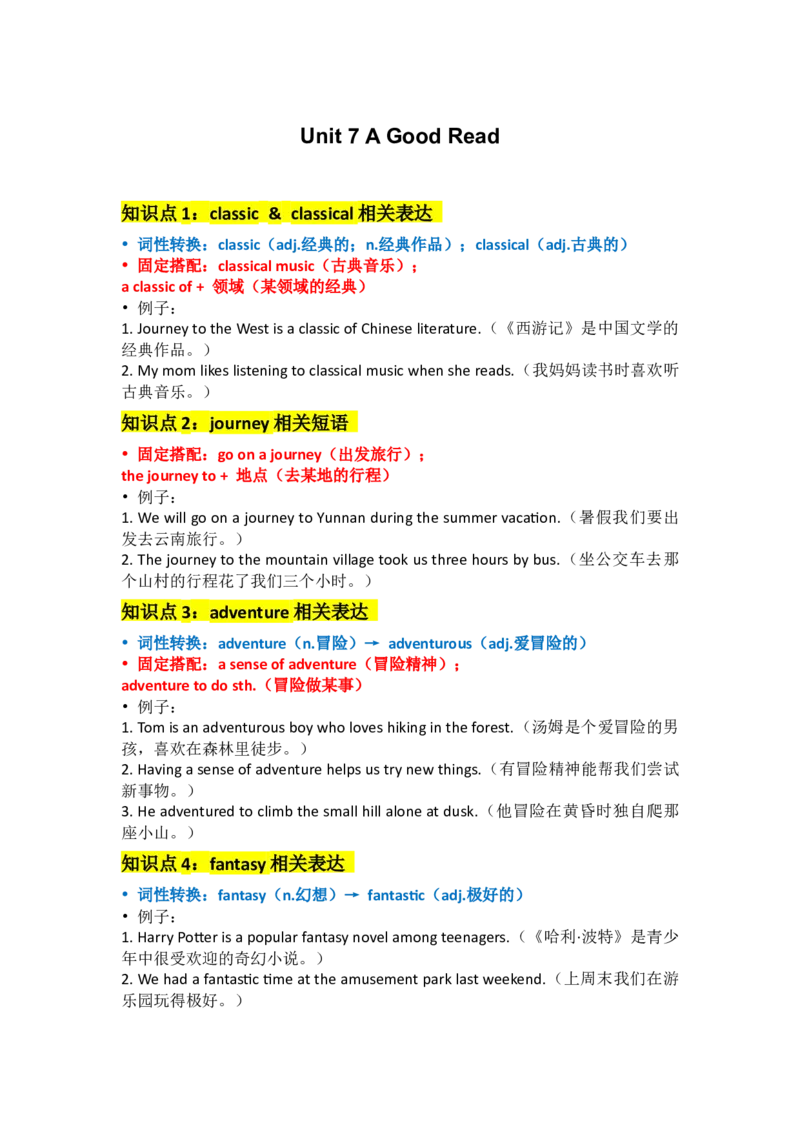
Unit 7 A Good Read
知识点1:classic & classical相关表达
• 词性转换:classic(adj.经典的;n.经典作品);classical(adj.古典的)
• 固定搭配:classical music(古典音乐);
a classic of + 领域(某领域的经典)
• 例子:
1. Journey to the West is a classic of Chinese literature.(《西游记》是中国文学的
经典作品。)
2. My mom likes listening to classical music when she reads.(我妈妈读书时喜欢听
古典音乐。)
知识点2:journey相关短语
• 固定搭配:go on a journey(出发旅行);
the journey to + 地点(去某地的行程)
• 例子:
1. We will go on a journey to Yunnan during the summer vacation.(暑假我们要出
发去云南旅行。)
2. The journey to the mountain village took us three hours by bus.(坐公交车去那
个山村的行程花了我们三个小时。)
知识点3:adventure相关表达
• 词性转换:adventure(n.冒险)→ adventurous(adj.爱冒险的)
• 固定搭配:a sense of adventure(冒险精神);
adventure to do sth.(冒险做某事)
• 例子:
1. Tom is an adventurous boy who loves hiking in the forest.(汤姆是个爱冒险的男
孩,喜欢在森林里徒步。)
2. Having a sense of adventure helps us try new things.(有冒险精神能帮我们尝试
新事物。)
3. He adventured to climb the small hill alone at dusk.(他冒险在黄昏时独自爬那
座小山。)
知识点4:fantasy相关表达
• 词性转换:fantasy(n.幻想)→ fantastic(adj.极好的)
• 例子:
1. Harry Potter is a popular fantasy novel among teenagers.(《哈利·波特》是青少
年中很受欢迎的奇幻小说。)
2. We had a fantastic time at the amusement park last weekend.(上周末我们在游
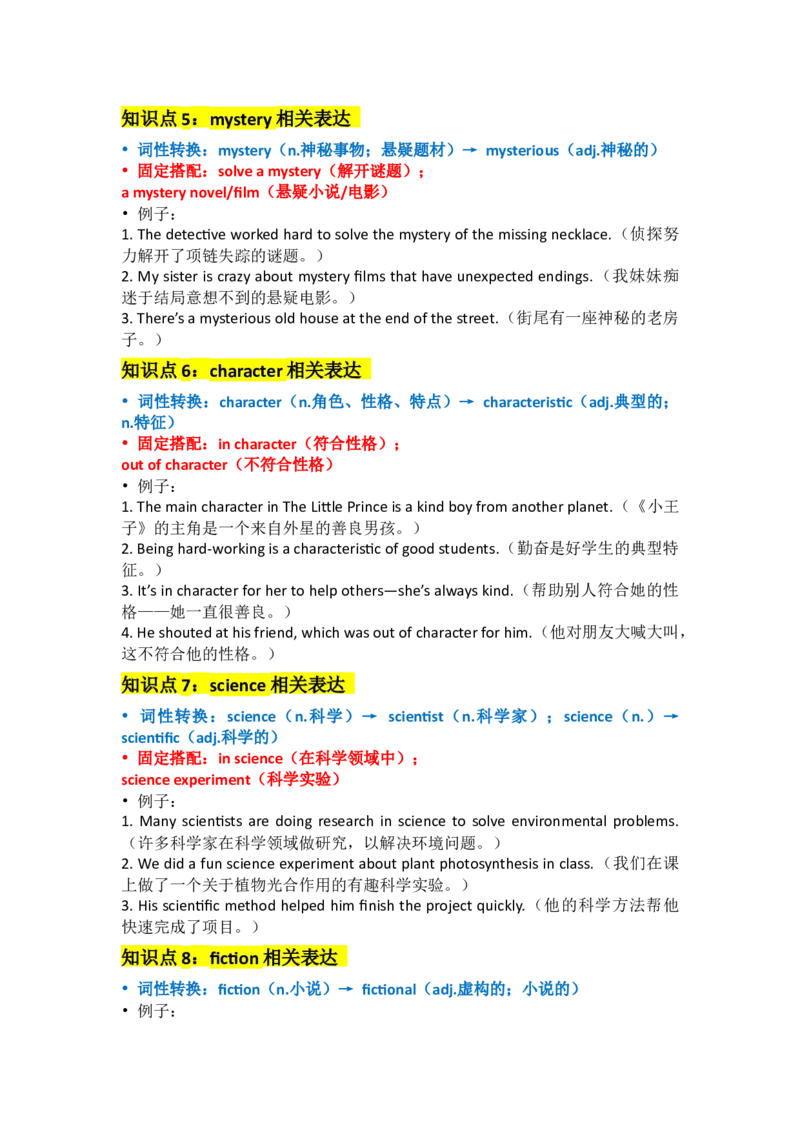
乐园玩得极好。)知识点5:mystery相关表达
• 词性转换:mystery(n.神秘事物;悬疑题材)→ mysterious(adj.神秘的)
• 固定搭配:solve a mystery(解开谜题);
a mystery novel/film(悬疑小说/电影)
• 例子:
1. The detective worked hard to solve the mystery of the missing necklace.(侦探努
力解开了项链失踪的谜题。)
2. My sister is crazy about mystery films that have unexpected endings.(我妹妹痴
迷于结局意想不到的悬疑电影。)
3. There’s a mysterious old house at the end of the street.(街尾有一座神秘的老房
子。)
知识点6:character相关表达
• 词性转换:character(n.角色、性格、特点)→ characteristic(adj.典型的;
n.特征)
• 固定搭配:in character(符合性格);
out of character(不符合性格)
• 例子:
1. The main character in The Little Prince is a kind boy from another planet.(《小王
子》的主角是一个来自外星的善良男孩。)
2. Being hard-working is a characteristic of good students.(勤奋是好学生的典型特
征。)
3. It’s in character for her to help others—she’s always kind.(帮助别人符合她的性
格——她一直很善良。)
4. He shouted at his friend, which was out of character for him.(他对朋友大喊大叫,
这不符合他的性格。)
知识点7:science相关表达
• 词性转换:science(n.科学)→ scientist(n.科学家);science(n.)→
scientific(adj.科学的)
• 固定搭配:in science(在科学领域中);
science experiment(科学实验)
• 例子:
1. Many scientists are doing research in science to solve environmental problems.
(许多科学家在科学领域做研究,以解决环境问题。)
2. We did a fun science experiment about plant photosynthesis in class.(我们在课
上做了一个关于植物光合作用的有趣科学实验。)
3. His scientific method helped him finish the project quickly.(他的科学方法帮他
快速完成了项目。)
知识点8:fiction相关表达
• 词性转换:fiction(n.小说)→ fictional(adj.虚构的;小说的)
• 例子:1. Science fiction is my favorite type of fiction.(科幻小说是我最喜欢的小说类
型。)
2. The characters in this story are fictional—they aren’t real people.(这个故事里的
角色是虚构的——他们不是真实的人。)
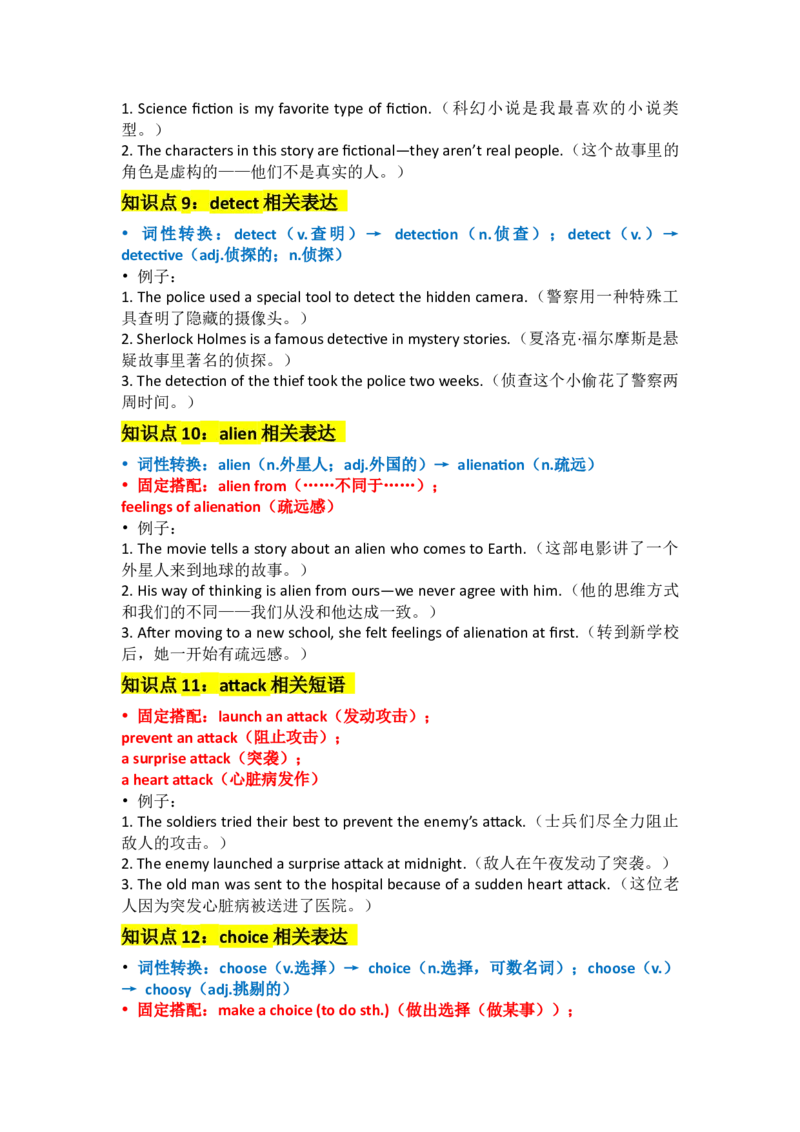
知识点9:detect相关表达
• 词性转换:detect(v.查明)→ detection(n.侦查);detect(v.)→
detective(adj.侦探的;n.侦探)
• 例子:
1. The police used a special tool to detect the hidden camera.(警察用一种特殊工
具查明了隐藏的摄像头。)
2. Sherlock Holmes is a famous detective in mystery stories.(夏洛克·福尔摩斯是悬
疑故事里著名的侦探。)
3. The detection of the thief took the police two weeks.(侦查这个小偷花了警察两
周时间。)
知识点10:alien相关表达
• 词性转换:alien(n.外星人;adj.外国的)→ alienation(n.疏远)
• 固定搭配:alien from(……不同于……);
feelings of alienation(疏远感)
• 例子:
1. The movie tells a story about an alien who comes to Earth.(这部电影讲了一个
外星人来到地球的故事。)
2. His way of thinking is alien from ours—we never agree with him.(他的思维方式
和我们的不同——我们从没和他达成一致。)
3. After moving to a new school, she felt feelings of alienation at first.(转到新学校
后,她一开始有疏远感。)
知识点11:attack相关短语
• 固定搭配:launch an attack(发动攻击);
prevent an attack(阻止攻击);
a surprise attack(突袭);
a heart attack(心脏病发作)
• 例子:
1. The soldiers tried their best to prevent the enemy’s attack.(士兵们尽全力阻止
敌人的攻击。)
2. The enemy launched a surprise attack at midnight.(敌人在午夜发动了突袭。)
3. The old man was sent to the hospital because of a sudden heart attack.(这位老
人因为突发心脏病被送进了医院。)
知识点12:choice相关表达
• 词性转换:choose(v.选择)→ choice(n.选择,可数名词);choose(v.)
→ choosy(adj.挑剔的)
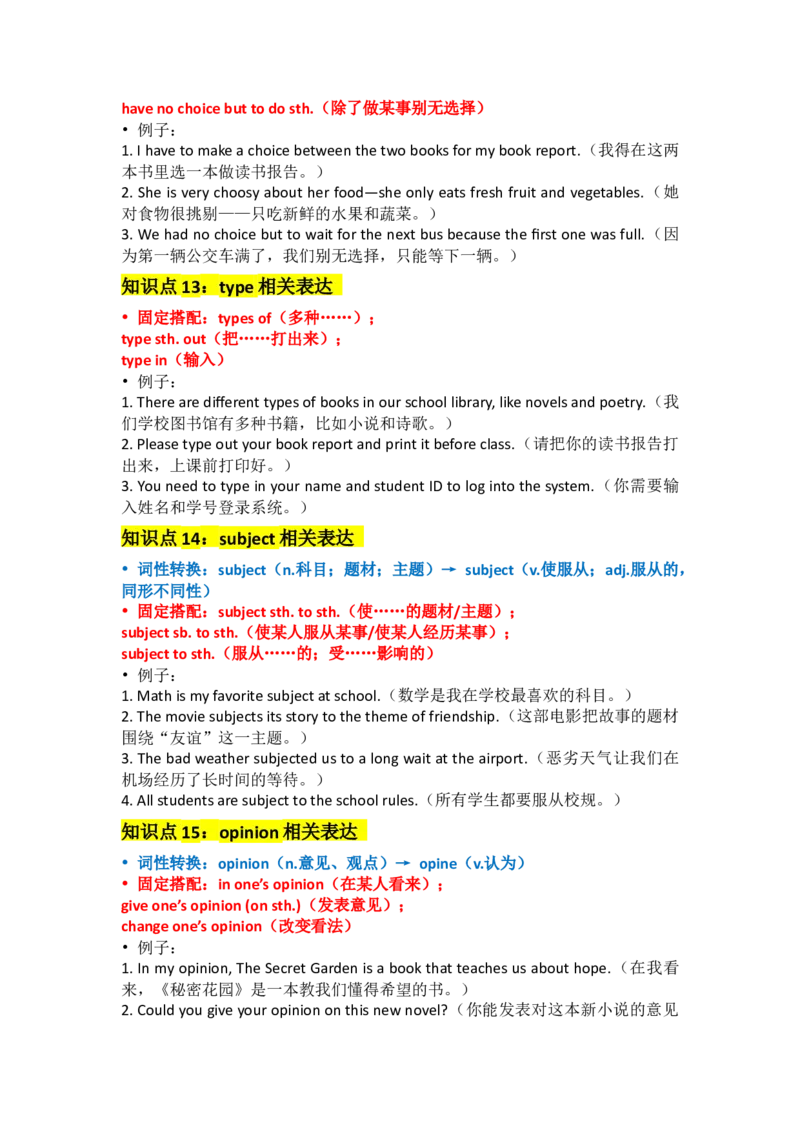
• 固定搭配:make a choice (to do sth.)(做出选择(做某事));have no choice but to do sth.(除了做某事别无选择)
• 例子:
1. I have to make a choice between the two books for my book report.(我得在这两
本书里选一本做读书报告。)
2. She is very choosy about her food—she only eats fresh fruit and vegetables.(她
对食物很挑剔——只吃新鲜的水果和蔬菜。)
3. We had no choice but to wait for the next bus because the first one was full.(因
为第一辆公交车满了,我们别无选择,只能等下一辆。)
知识点13:type相关表达
• 固定搭配:types of(多种……);
type sth. out(把……打出来);
type in(输入)
• 例子:
1. There are different types of books in our school library, like novels and poetry.(我
们学校图书馆有多种书籍,比如小说和诗歌。)
2. Please type out your book report and print it before class.(请把你的读书报告打
出来,上课前打印好。)
3. You need to type in your name and student ID to log into the system.(你需要输
入姓名和学号登录系统。)
知识点14:subject相关表达
• 词性转换:subject(n.科目;题材;主题)→ subject(v.使服从;adj.服从的,
同形不同性)
• 固定搭配:subject sth. to sth.(使……的题材/主题);
subject sb. to sth.(使某人服从某事/使某人经历某事);
subject to sth.(服从……的;受……影响的)
• 例子:
1. Math is my favorite subject at school.(数学是我在学校最喜欢的科目。)
2. The movie subjects its story to the theme of friendship.(这部电影把故事的题材
围绕“友谊”这一主题。)
3. The bad weather subjected us to a long wait at the airport.(恶劣天气让我们在
机场经历了长时间的等待。)
4. All students are subject to the school rules.(所有学生都要服从校规。)
知识点15:opinion相关表达
• 词性转换:opinion(n.意见、观点)→ opine(v.认为)
• 固定搭配:in one’s opinion(在某人看来);
give one’s opinion (on sth.)(发表意见);
change one’s opinion(改变看法)
• 例子:
1. In my opinion, The Secret Garden is a book that teaches us about hope.(在我看
来,《秘密花园》是一本教我们懂得希望的书。)
2. Could you give your opinion on this new novel?(你能发表对这本新小说的意见吗?)
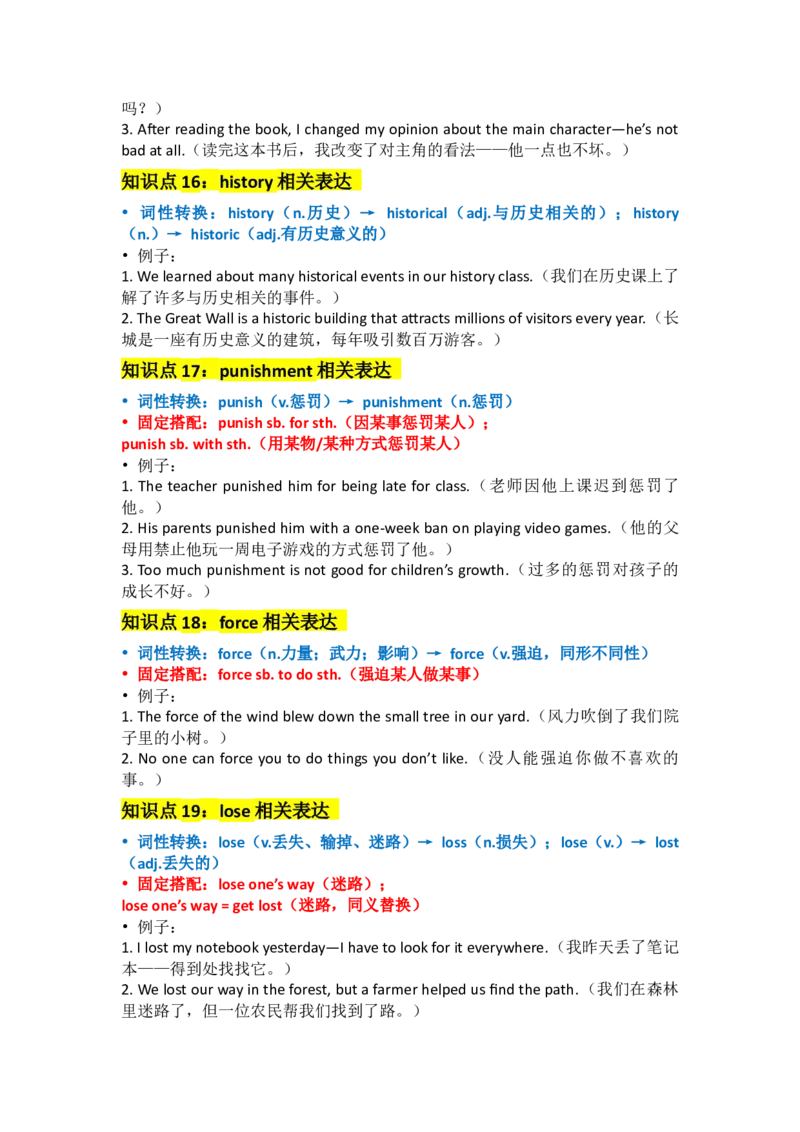
3. After reading the book, I changed my opinion about the main character—he’s not
bad at all.(读完这本书后,我改变了对主角的看法——他一点也不坏。)
知识点16:history相关表达
• 词性转换:history(n.历史)→ historical(adj.与历史相关的);history
(n.)→ historic(adj.有历史意义的)
• 例子:
1. We learned about many historical events in our history class.(我们在历史课上了
解了许多与历史相关的事件。)
2. The Great Wall is a historic building that attracts millions of visitors every year.(长
城是一座有历史意义的建筑,每年吸引数百万游客。)
知识点17:punishment相关表达
• 词性转换:punish(v.惩罚)→ punishment(n.惩罚)
• 固定搭配:punish sb. for sth.(因某事惩罚某人);
punish sb. with sth.(用某物/某种方式惩罚某人)
• 例子:
1. The teacher punished him for being late for class.(老师因他上课迟到惩罚了
他。)
2. His parents punished him with a one-week ban on playing video games.(他的父
母用禁止他玩一周电子游戏的方式惩罚了他。)
3. Too much punishment is not good for children’s growth.(过多的惩罚对孩子的
成长不好。)
知识点18:force相关表达
• 词性转换:force(n.力量;武力;影响)→ force(v.强迫,同形不同性)
• 固定搭配:force sb. to do sth.(强迫某人做某事)
• 例子:
1. The force of the wind blew down the small tree in our yard.(风力吹倒了我们院
子里的小树。)
2. No one can force you to do things you don’t like.(没人能强迫你做不喜欢的
事。)
知识点19:lose相关表达
• 词性转换:lose(v.丢失、输掉、迷路)→ loss(n.损失);lose(v.)→ lost
(adj.丢失的)
• 固定搭配:lose one’s way(迷路);
lose one’s way = get lost(迷路,同义替换)
• 例子:
1. I lost my notebook yesterday—I have to look for it everywhere.(我昨天丢了笔记
本——得到处找找它。)
2. We lost our way in the forest, but a farmer helped us find the path.(我们在森林
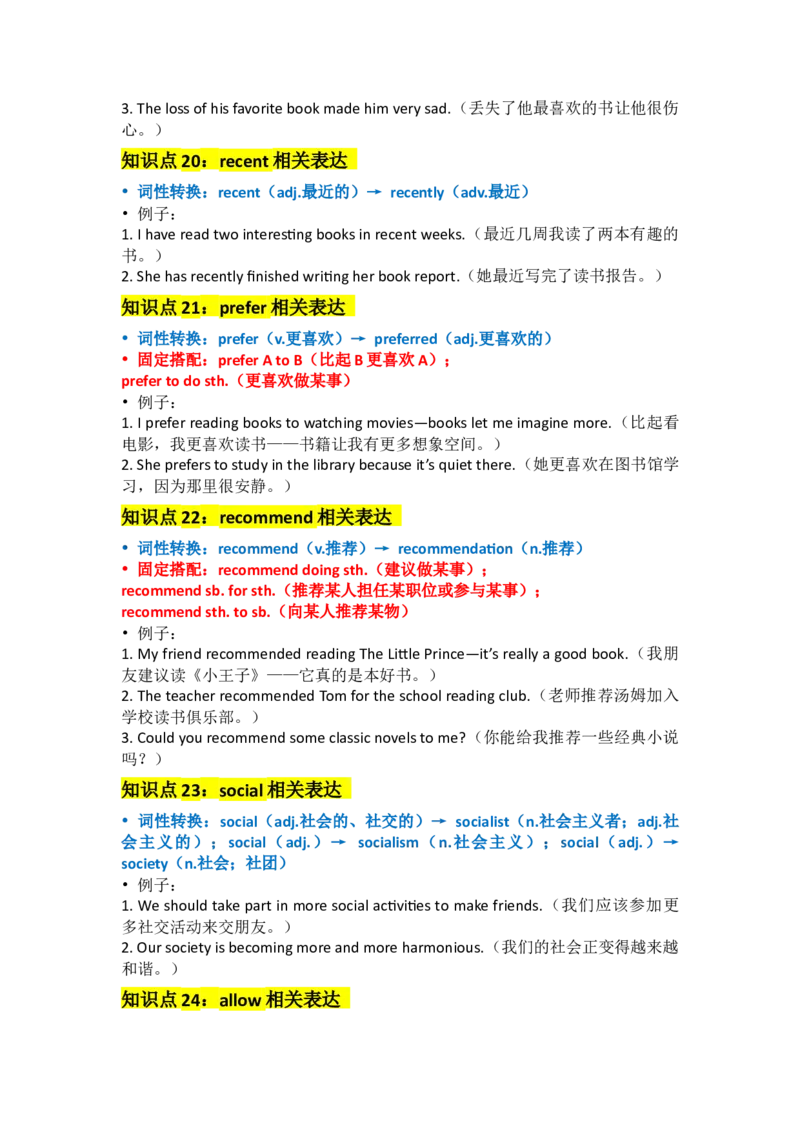
里迷路了,但一位农民帮我们找到了路。)3. The loss of his favorite book made him very sad.(丢失了他最喜欢的书让他很伤
心。)
知识点20:recent相关表达
• 词性转换:recent(adj.最近的)→ recently(adv.最近)
• 例子:
1. I have read two interesting books in recent weeks.(最近几周我读了两本有趣的
书。)
2. She has recently finished writing her book report.(她最近写完了读书报告。)
知识点21:prefer相关表达
• 词性转换:prefer(v.更喜欢)→ preferred(adj.更喜欢的)
• 固定搭配:prefer A to B(比起B更喜欢A);
prefer to do sth.(更喜欢做某事)
• 例子:
1. I prefer reading books to watching movies—books let me imagine more.(比起看
电影,我更喜欢读书——书籍让我有更多想象空间。)
2. She prefers to study in the library because it’s quiet there.(她更喜欢在图书馆学
习,因为那里很安静。)
知识点22:recommend相关表达
• 词性转换:recommend(v.推荐)→ recommendation(n.推荐)
• 固定搭配:recommend doing sth.(建议做某事);
recommend sb. for sth.(推荐某人担任某职位或参与某事);
recommend sth. to sb.(向某人推荐某物)
• 例子:
1. My friend recommended reading The Little Prince—it’s really a good book.(我朋
友建议读《小王子》——它真的是本好书。)
2. The teacher recommended Tom for the school reading club.(老师推荐汤姆加入
学校读书俱乐部。)
3. Could you recommend some classic novels to me?(你能给我推荐一些经典小说
吗?)
知识点23:social相关表达
• 词性转换:social(adj.社会的、社交的)→ socialist(n.社会主义者;adj.社
会主义的);social(adj.)→ socialism(n.社会主义);social(adj.)→
society(n.社会;社团)
• 例子:
1. We should take part in more social activities to make friends.(我们应该参加更
多社交活动来交朋友。)
2. Our society is becoming more and more harmonious.(我们的社会正变得越来越
和谐。)
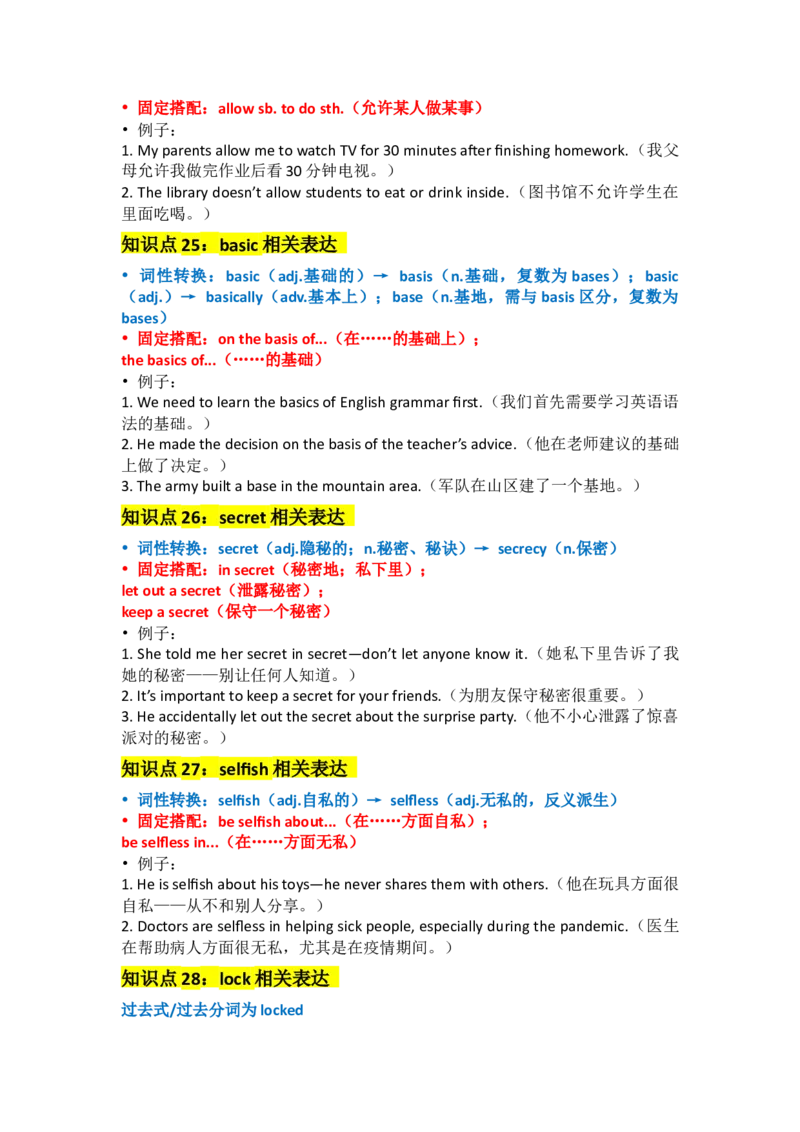
知识点24:allow相关表达• 固定搭配:allow sb. to do sth.(允许某人做某事)
• 例子:
1. My parents allow me to watch TV for 30 minutes after finishing homework.(我父
母允许我做完作业后看30分钟电视。)
2. The library doesn’t allow students to eat or drink inside.(图书馆不允许学生在
里面吃喝。)
知识点25:basic相关表达
• 词性转换:basic(adj.基础的)→ basis(n.基础,复数为 bases);basic
(adj.)→ basically(adv.基本上);base(n.基地,需与 basis区分,复数为
bases)
• 固定搭配:on the basis of...(在……的基础上);
the basics of...(……的基础)
• 例子:
1. We need to learn the basics of English grammar first.(我们首先需要学习英语语
法的基础。)
2. He made the decision on the basis of the teacher’s advice.(他在老师建议的基础
上做了决定。)
3. The army built a base in the mountain area.(军队在山区建了一个基地。)
知识点26:secret相关表达
• 词性转换:secret(adj.隐秘的;n.秘密、秘诀)→ secrecy(n.保密)
• 固定搭配:in secret(秘密地;私下里);
let out a secret(泄露秘密);
keep a secret(保守一个秘密)
• 例子:
1. She told me her secret in secret—don’t let anyone know it.(她私下里告诉了我
她的秘密——别让任何人知道。)
2. It’s important to keep a secret for your friends.(为朋友保守秘密很重要。)
3. He accidentally let out the secret about the surprise party.(他不小心泄露了惊喜
派对的秘密。)
知识点27:selfish相关表达
• 词性转换:selfish(adj.自私的)→ selfless(adj.无私的,反义派生)
• 固定搭配:be selfish about...(在……方面自私);
be selfless in...(在……方面无私)
• 例子:
1. He is selfish about his toys—he never shares them with others.(他在玩具方面很
自私——从不和别人分享。)
2. Doctors are selfless in helping sick people, especially during the pandemic.(医生
在帮助病人方面很无私,尤其是在疫情期间。)
知识点28:lock相关表达
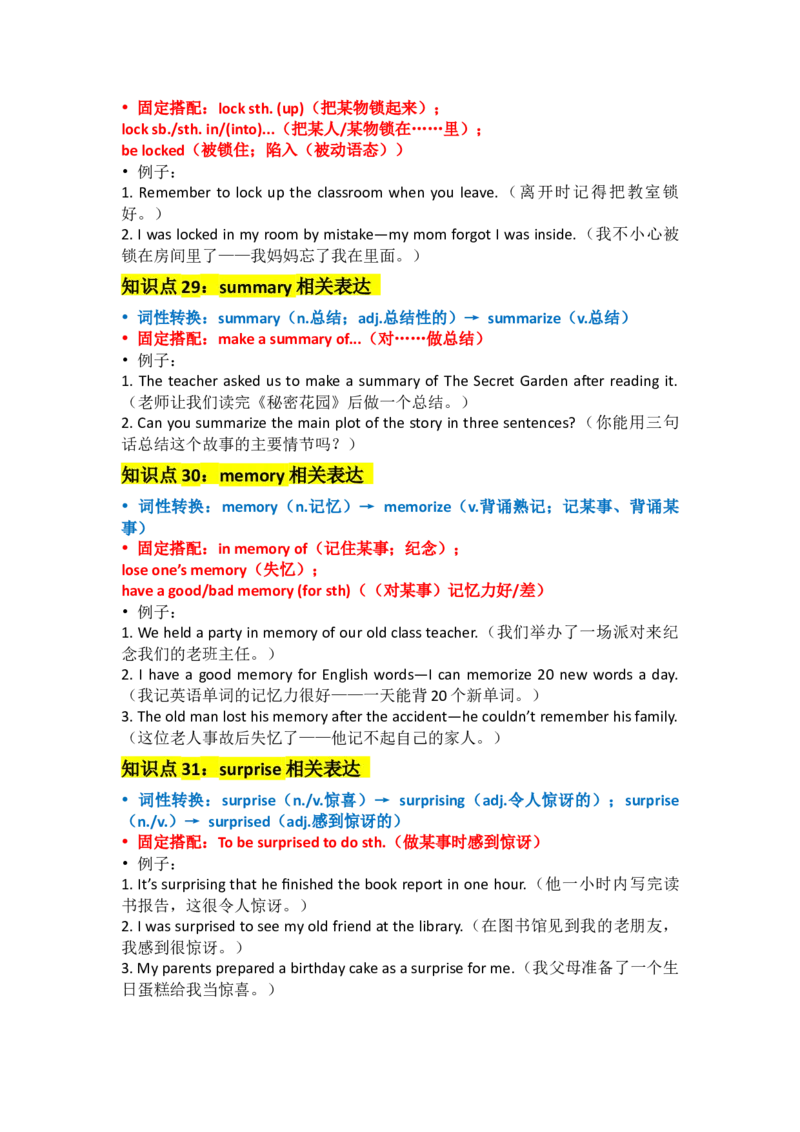
过去式/过去分词为locked• 固定搭配:lock sth. (up)(把某物锁起来);
lock sb./sth. in/(into)...(把某人/某物锁在……里);
be locked(被锁住;陷入(被动语态))
• 例子:
1. Remember to lock up the classroom when you leave.(离开时记得把教室锁
好。)
2. I was locked in my room by mistake—my mom forgot I was inside.(我不小心被
锁在房间里了——我妈妈忘了我在里面。)
知识点29:summary相关表达
• 词性转换:summary(n.总结;adj.总结性的)→ summarize(v.总结)
• 固定搭配:make a summary of...(对……做总结)
• 例子:
1. The teacher asked us to make a summary of The Secret Garden after reading it.
(老师让我们读完《秘密花园》后做一个总结。)
2. Can you summarize the main plot of the story in three sentences?(你能用三句
话总结这个故事的主要情节吗?)
知识点30:memory相关表达
• 词性转换:memory(n.记忆)→ memorize(v.背诵熟记;记某事、背诵某
事)
• 固定搭配:in memory of(记住某事;纪念);
lose one’s memory(失忆);
have a good/bad memory (for sth)((对某事)记忆力好/差)
• 例子:
1. We held a party in memory of our old class teacher.(我们举办了一场派对来纪
念我们的老班主任。)
2. I have a good memory for English words—I can memorize 20 new words a day.
(我记英语单词的记忆力很好——一天能背20个新单词。)
3. The old man lost his memory after the accident—he couldn’t remember his family.
(这位老人事故后失忆了——他记不起自己的家人。)
知识点31:surprise相关表达
• 词性转换:surprise(n./v.惊喜)→ surprising(adj.令人惊讶的);surprise
(n./v.)→ surprised(adj.感到惊讶的)
• 固定搭配:To be surprised to do sth.(做某事时感到惊讶)
• 例子:
1. It’s surprising that he finished the book report in one hour.(他一小时内写完读
书报告,这很令人惊讶。)
2. I was surprised to see my old friend at the library.(在图书馆见到我的老朋友,
我感到很惊讶。)
3. My parents prepared a birthday cake as a surprise for me.(我父母准备了一个生
日蛋糕给我当惊喜。)知识点32:effort相关短语
• 固定搭配:make an effort to do sth.(努力做某事);
spare no effort to do sth.(不遗余力做某事);
put effort into (doing) sth.(把精力投入到(做)某事中)
• 例子:
1. I will make an effort to finish reading the classic book this week.(我会努力这周
读完这本经典书。)
2. We should spare no effort to protect the environment.(我们应该不遗余力地保
护环境。)
3. She put a lot of effort into writing her book report.(她把很多精力投入到写读书
报告中。)
知识点33:used相关表达
• 固定搭配:be used to do sth.(被用来做某事);
used to do sth.(过去常常做某事(现在不做了));
be used to (doing) sth.(习惯于(做)某事)
• 例子:
1. Pens are used to write.(钢笔是用来写字的。)
2. I used to read comic books, but now I prefer classic novels.(我过去常常看漫画
书,但现在更喜欢经典小说。)
3. I am used to reading for 30 minutes before going to bed.(我习惯于睡前读30分
钟书。)
知识点34:consider相关表达
• 固定搭配:consider doing sth.(考虑做某事)
• 例子:
1. I am considering reading Journey to the West for my book report.(我正在考虑读
《西游记》来写读书报告。)
2. They are considering holding a reading party next month.(他们正在考虑下个月
举办一场读书派对。)
知识点35:weak相关表达
• 固定搭配:weak point(弱点);
weak voice(虚弱的声音);
be weak in sth.(不擅长某事)
• 例子:
1. My weak point in English is writing— I need to practice more.(我英语的弱点是
写作——我需要多练习。)
2. She spoke in a weak voice because she had a cold.(她因为感冒,说话声音很虚
弱。)
3. I am weak in math, so I often ask my deskmate for help.(我不擅长数学,所以经
常向同桌求助。)知识点36:defeat相关表达
• 固定搭配:suffer a defeat(遭受失败);
in defeat(处于失败状态中)
• 例子:
1. Our class suffered a defeat in the basketball game, but we will try harder next
time.(我们班在篮球赛中遭受了失败,但下次我们会更努力。)
2. He didn’t give up even in defeat—he kept practicing.(即使处于失败状态,他也
没放弃——继续练习。)
知识点37:drama相关表达
• 词性转换:drama(n.话剧)→ dramatic(adj.戏剧的);drama(n.)→
dramatist(n.剧作家);dramatic(adj.)→ dramatically(adv.戏剧性地)
• 例子:
1. We watched a wonderful drama about friendship at the theater.(我们在剧院看
了一场关于友谊的精彩话剧。)
2. The story has a dramatic ending that no one expected.(这个故事有一个没人预
料到的戏剧性结局。)
知识点38:achieve相关表达
• 词性转换:achieve(v.实现;取得)→ achievement(n.成就;实现)
• 固定搭配:make an achievement(取得一项成就);
the achievement of sth.(某事的实现/完成)
• 例子:
1. I hope to achieve good grades in the final exam.(我希望在期末考试中取得好成
绩。)
2. Finishing reading 10 classic books this semester is a big achievement for me.(这
学期读完10本经典书对我来说是一项大成就。)
3. The achievement of our team goal made everyone happy.(我们团队目标的实现
让每个人都很开心。)
单元短语
1. the main character of(……的主 9. historical fiction(历史小说)
角) 10. force sb. to do sth.(强迫某人做某
2. plan to do sth.(计划做某事) 事)
3. read all of(读完……的全部) 11. In the end(最终)
4. choose...for...(为……选择……) 12. a lot of(许多)
5. be about(是关于……的) 13. in one’s opinion(在某人看来)
6. have ever read(曾经读过) 14. give one’s opinion (on sth.)(就某事
7. How did you find it?(你觉得它怎么 发表意见)
样?) 15. main subject(s) of the book(书的
8. have heard of(听说过) 主题)16. lose one’s way(迷路) 47. lock up(锁起来)
17. get lost(迷路) 48. take care of(照顾)
18. finish doing sth.(完成做某事) 49. lose one’s memory(失忆)
19. have never read(从未读过) 50. have a good/bad memory (for sth.)
20. prefer A to B(比起B更喜欢A) (对某事记忆力好/差)
21. What’s your favourite part of...(你 51. know a lot about(对……很了解)
最喜欢……的哪个部分) 52. work together to do sth.(一起努力
22. have never heard of(从未听说 做某事)
过) 53. live alone(独自生活)
23. finish reading sth.(读完某事) 54. since one’s death(自从某人去
24. learn a lot from(从……中学到很 世)
多) 55. Over time(随着时间推移)
25. recommend one(推荐一个) 56. be good for(对……有好处)
26. have ever tried (to do sth.)(曾经尝 57. get to one’s feet(站起来)
试做某事) 58. day by day(一天天地)
27. at the start of(在……开头) 59. To one’s great surprise(令某人非
28. decide to do sth.(决定做某事) 常惊讶的是)
29. begin with(以……开始) 60. as...as it ever was ( 和 以 前 一
30. in the past(在过去) 样……)
31. so far(到目前为止) 61. use force to do sth.(用暴力做某
32. have never realized(从未意识到) 事)
33. read all four... ( 读 完 所 有 四 62. pretend to do sth.(假装做某事)
本……) 63. search for the truth(寻找真相)
34. read a book in (a different language) 64. cover up one’s actions(掩盖某人
(用不同语言读一本书) 的行为)
35. read a book with more than...(读 65. in time(及时)
一本超过……的书) 66. report on sth.(就某事报告/分
36. watch a movie based on a novel 享)
(看一部基于小说改编的电影) 67. use sth. to do sth.(用某物做某
37. read a book more than twice(把一 事)
本书读不止两次) 68. be in a... state(处于……状态)
38. join a reading club(加入读书俱乐 69. base... on...(以……为基础)
部) 70. consider... to be... ( 认 为 … …
39. make a summary of(对……做总 是……)
结) 71. of all time(有史以来)
40. in summary(总之) 72. be on an adventure(经历一场冒
41. spend time + 形容词(度过……状 险)
态的时间) 73. on one’s journey(在某人的旅途
42. pass away(去世) 中)
43. spend a lot of time(花费很多时 74. work together(共同协作)
间) 75. achieve one’s goal(实现某人的目
44. in memory of(为了纪念) 标)
45. keep sth. in memory(记住某事) 76. prove oneself to be...(证明自己
46. belong to(属于) 是……)77. fight for(为……而战) 85. even though(尽管)
78. pull... onto...(把……拉到…… 86. be tired of(对……感到厌倦)
上) 87. recommend sth.(推荐某物)
79. on one’s way back(在某人回来的 88. help sb. to do sth.(帮助某人做某
路上) 事)
80. leave nothing but...(只留下……) 89. do the best one can(尽某人所
81. teach sb. (not) to do sth.(教某人 能)
(不)做某事) 90. even when(即使当……时)
82. give up(放弃) 91. carry a weight on one’s shoulders
83. doubt oneself(自我怀疑) (肩负重任)
84. be inspired by(被……鼓舞)
单元语法
语法点1:“too+形容词+to+动词原形”句型
• 内容:句型结构为“too + 形容词 + to + 动词原形”,核心含义是“太……
而不能……”,表示因形容词所描述的程度过高,导致后面的动作无法实现
(否定含义);其中“to + 动词原形”作结果状语。
• 例子:
1. He is too short to reach the top shelf.(他太矮了,够不到最上层的架子。)
2. This math problem is too difficult to work out in five minutes.(这道数学题太难
了,五分钟内算不出来。)
3. The water is too hot to drink right now.(水太烫了,现在不能喝。)
语法点2:“spend time + 形容词”结构
• 内容:结构为“spend time + 形容词”,其中形容词作伴随状语,用于描述
“度过时间时的状态”(如孤独、无聊、安静等),强调动作“spend time”发
生时伴随的主观感受或客观状态;常见搭配的形容词有 alone(独自的)、
bored(无聊的)、quiet(安静的)、peaceful(平静的)等。
• 例子:
1. She often spends her weekends alone at home reading books.(她经常独自在家
看书度过周末。)
2. We spent two hours bored while waiting for the delayed train.(我们等晚点的火
车时,无聊地度过了两个小时。)
3. He likes to spend his evenings quiet in the study writing.(他喜欢在书房里安静
地度过夜晚,写写东西。)
语法点3:“such”引导的感叹句型
• 内容:“such”引导的感叹句型核心含义是“如此……以至于……”,分两种
具体结构:
1. 修饰可数名词单数:such + a/an + 形容词 + 可数名词单数(注意:形容词
以元音音素开头时,a改为an);
2. 修饰不可数名词/可数名词复数:such + 形容词 + 不可数名词/可数名词复数(无需加a/an)。
• 例子:
(修饰可数名词单数)
3. It is such an interesting story that everyone wants to read it again.(这是一个如
此有趣的故事,以至于每个人都想再读一遍。)
4. She is such a kind girl that she always helps her classmates with their homework.
(她是一个如此善良的女孩,总是帮同学辅导作业。)
(修饰不可数名词/可数名词复数)
3. We have such good weather today that we can go for a picnic.(今天天气如此好,
我们可以去野餐了。)(不可数名词:weather)
4. They are such cute puppies that all the kids in the neighborhood love them.(这些
小狗如此可爱,小区里所有孩子都喜欢它们。)(可数名词复数:puppies)
5. He has such useful information that it helps us solve the problem quickly.(他有如
此有用的信息,帮我们很快解决了问题。)(不可数名词:information)
语法点4:名词变形容词构词法
1. 后缀 -ful:表“充满……的”
例:care(关心)→careful(细心的);help(帮助)→helpful(有帮助的)
2. 后缀 -less:表“没有……的”
例:hope(希望)→hopeless(无望的);home(家)→homeless(无家可归
的)
3. 后缀 -y:表“有……特质的;多……的”
例:sun(太阳)→sunny(晴朗的);rain(雨)→rainy(下雨的)
4. 后缀 -ly:表“具有……性质的”(多修饰人)
例:friend(朋友)→friendly(友好的);brother(兄弟)→brotherly(兄弟
般的)
5. 后缀 -ous:表“具有……特征的”
例:danger(危险)→dangerous(危险的);fame(名声)→famous(著名
的)
6. 后缀 -ish:表“略带……的;像……的”
例:child(孩子)→childish(孩子气的);red(红色)→reddish(略带红色
的)
7. 后缀 -en:表“由……制成的;使……的”
例:wood(木头)→wooden(木制的);wool(羊毛)→woolen(羊毛制
的)
8. 后缀 -al:表“与……相关的”
例:nation(国家)→national(国家的);culture(文化)→cultural(文化
的)
9. 后缀 -ive:表“有……能力的;与……有关的”
例:act(行动)→active(积极的);create(创造)→creative(有创造力的)
语法点5:过去完成时
一、核心定义(本质特征)
表示在过去某个动作或时间点之前就已经完成的动作,即“过去的过去”。必须存在“过去的参照点”(参照动作/时间),否则无法使用。
二、基本结构(4种句式,初中全考)
肯定句 主语 + had + 动词过去分词(done) She had cleaned her room before 8
pm.
否定句 主语 + hadn’t(had not) + done They hadn’t watched the movie yet.
一般疑问句 Had + 主语 + done? Had you finished homework by then?
特殊疑问句 特殊疑问词 + Had + 主语 + done? What had he eaten before he
came?
三、4大核心用法(初中必考场景)
1. 对比“两个过去动作”:先发生的用过去完成时,后发生的用一般过去时
常用连词:before, after, when, while
例:When I arrived at the park(后发生,一般过去时),my friends had already
waited for 20 minutes(先发生,过去完成时).
2. 搭配“by + 过去时间点”:表示“到过去某时间为止,动作已完成”
例:By the end of last month(过去时间点),we had learned 3 English units.
3. 宾语从句中:当主句谓语是过去式(told, said, knew等),从句描述“主句
动作之前的事”
例:He said(主句过去式) he had visited the Great Wall twice(从句“过去的
过去”).
4. 表示“过去未曾实现的愿望/打算”:用 had hoped/wanted/planned/meant +
to do
例:I had hoped to go to the party(未实现的打算),but I was ill.
四、常见时间状语(初中高频)
1. by + 过去时间:by yesterday(到昨天)、by 9 o’clock last night(到昨晚 9
点)
2. before + 过去时间/过去动作:before last week(上周前)、before she left
(她离开前)
3. 其他标志:already(已,肯定句)、yet(还未,否定/疑问句)、never(从
未)、just(刚)、by the time + 过去从句(到……时候为止)
例:By the time I woke up(过去从句),my dad had gone to work.
五、3大易错点(避坑指南)
1. 不能单独使用:必须有“过去的参照点”,绝不能说“He had eaten.”(错
误),需补充:He had eaten before I came.(正确)
2. 不与“现在时间”搭配:如“by now(到现在)”“since 2020(自从2020
年)”需用现在完成时,不用过去完成时(例:He has lived here since 2020,而
非had lived)。
3. 区分“过去完成时vs一般过去时”:若两个过去动作用 and/then连接,且
先后顺序明确,可都用一般过去时(例:She bought a pen and wrote a letter,不
用had bought);若顺序不明确,需用过去完成时(例:She had written a letter
before she bought a pen)。
六、
• ever: 用于一般疑问句,表“曾经”,放在“have/has”与过去分词之间。
• never: 用于否定句,表“从未”,放在“have/has”与过去分词之间(本身含
否定定义)。• just: 用于肯定句,表“刚刚”,放在“have/has”与过去分词之间,强调动作
刚完成。
• already: 用于肯定句,表“已经”,放在“have/has”与过去分词之间(或句
末),强调动作早完成。
• yet: 用于一般疑问句/否定句,表“已经/还没”,放在句末。