Unit 7 A Good Read
核心语法精练(现在完成时(1))
目录
A 考点概览·知识回顾..............................................................................................................................................1
B 考点夯基·专项突破..............................................................................................................................................2
一、单项选择.........................................................................................................................................................2
二、用所给单词的正确形式填空........................................................................................................................6
C 综合攻坚·能力跃升..............................................................................................................................................8
题型一 语法填空.................................................................................................................................................8
题型二 阅读理解.................................................................................................................................................10
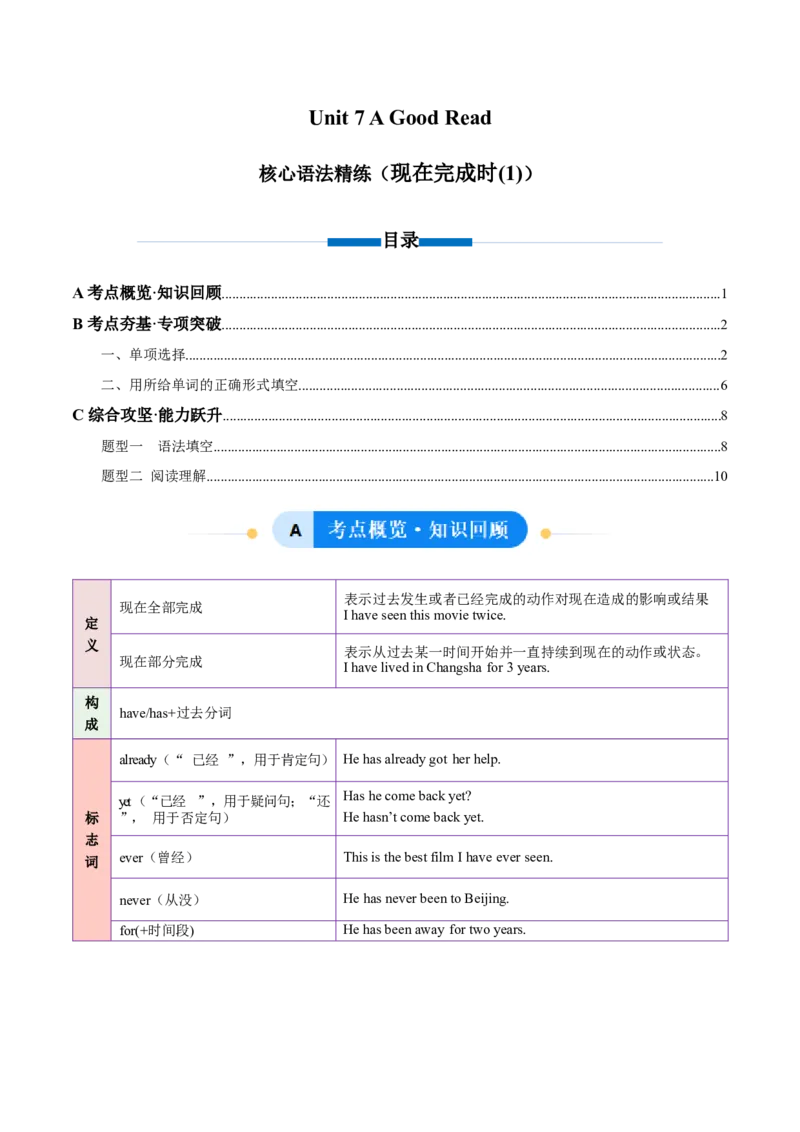
定
表示过去发生或者已经完成的动作对现在造成的影响或结果
现在全部完成
I have seen this movie twice.
义
表示从过去某一时间开始并一直持续到现在的动作或状态。
现在部分完成
I have lived in Changsha for 3 years.
构
have/has+过去分词
成
标
志
already(“ 已经 ”,用于肯定句) He has already got her help.
Has he come back yet?
yet(“已经 ”,用于疑问句;“还
”, 用于否定句) He hasn’t come back yet.
词
ever(曾经) This is the best film I have ever seen.
never(从没) He has never been to Beijing.
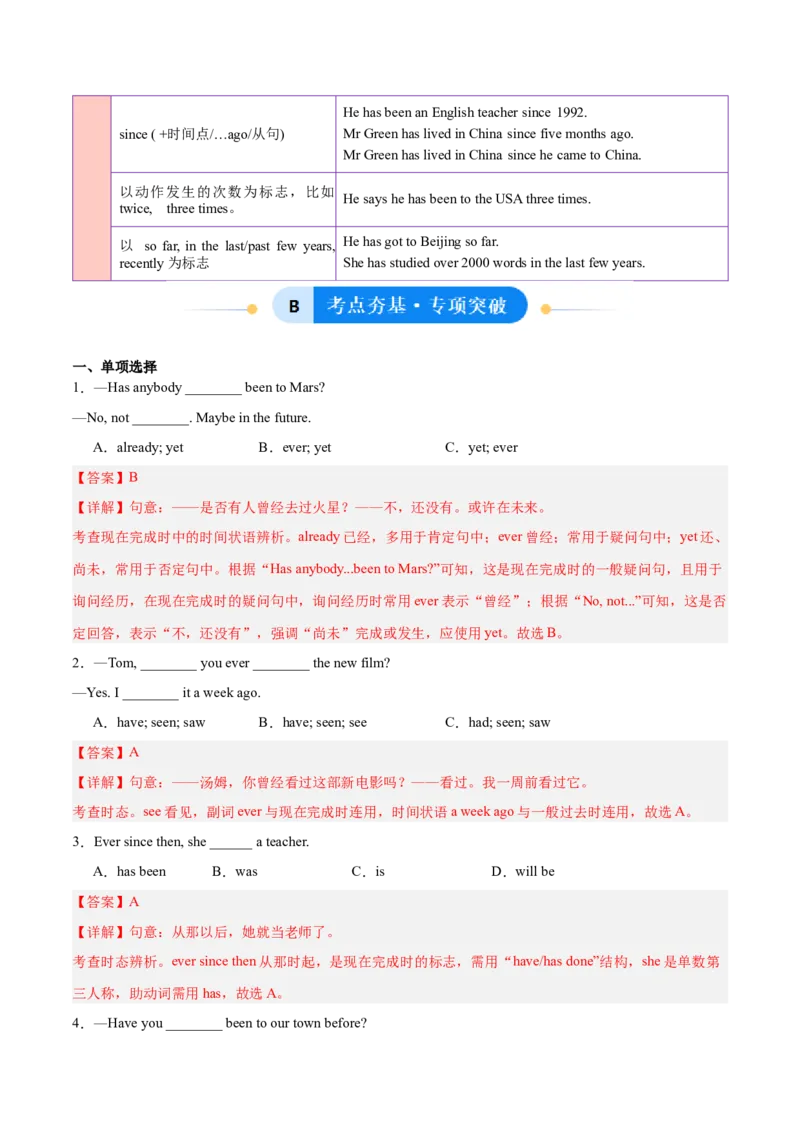
for(+时间段) He has been away for two years.He has been an English teacher since 1992.
since ( +时间点/…ago/从句) Mr Green has lived in China since five months ago.
Mr Green has lived in China since he came to China.
以动作发生的次数为标志,比如
He says he has been to the USA three times.
twice, three times。
以 so far, in the last/past few years, He has got to Beijing so far.
recently 为标志 She has studied over 2000 words in the last few years.
一、单项选择
1.—Has anybody ________ been to Mars?
—No, not ________. Maybe in the future.
A.already; yet B.ever; yet C.yet; ever
【答案】B
【详解】句意:——是否有人曾经去过火星?——不,还没有。或许在未来。
考查现在完成时中的时间状语辨析。already已经,多用于肯定句中;ever曾经;常用于疑问句中;yet还、
尚未,常用于否定句中。根据“Has anybody...been to Mars?”可知,这是现在完成时的一般疑问句,且用于
询问经历,在现在完成时的疑问句中,询问经历时常用ever表示“曾经”;根据“No, not...”可知,这是否
定回答,表示“不,还没有”,强调“尚未”完成或发生,应使用yet。故选B。
2.—Tom, ________ you ever ________ the new film?
—Yes. I ________ it a week ago.
A.have; seen; saw B.have; seen; see C.had; seen; saw
【答案】A
【详解】句意:——汤姆,你曾经看过这部新电影吗?——看过。我一周前看过它。
考查时态。see看见,副词ever与现在完成时连用,时间状语a week ago与一般过去时连用,故选A。
3.Ever since then, she ______ a teacher.
A.has been B.was C.is D.will be
【答案】A
【详解】句意:从那以后,她就当老师了。
考查时态辨析。ever since then从那时起,是现在完成时的标志,需用“have/has done”结构,she是单数第
三人称,助动词需用has,故选A。
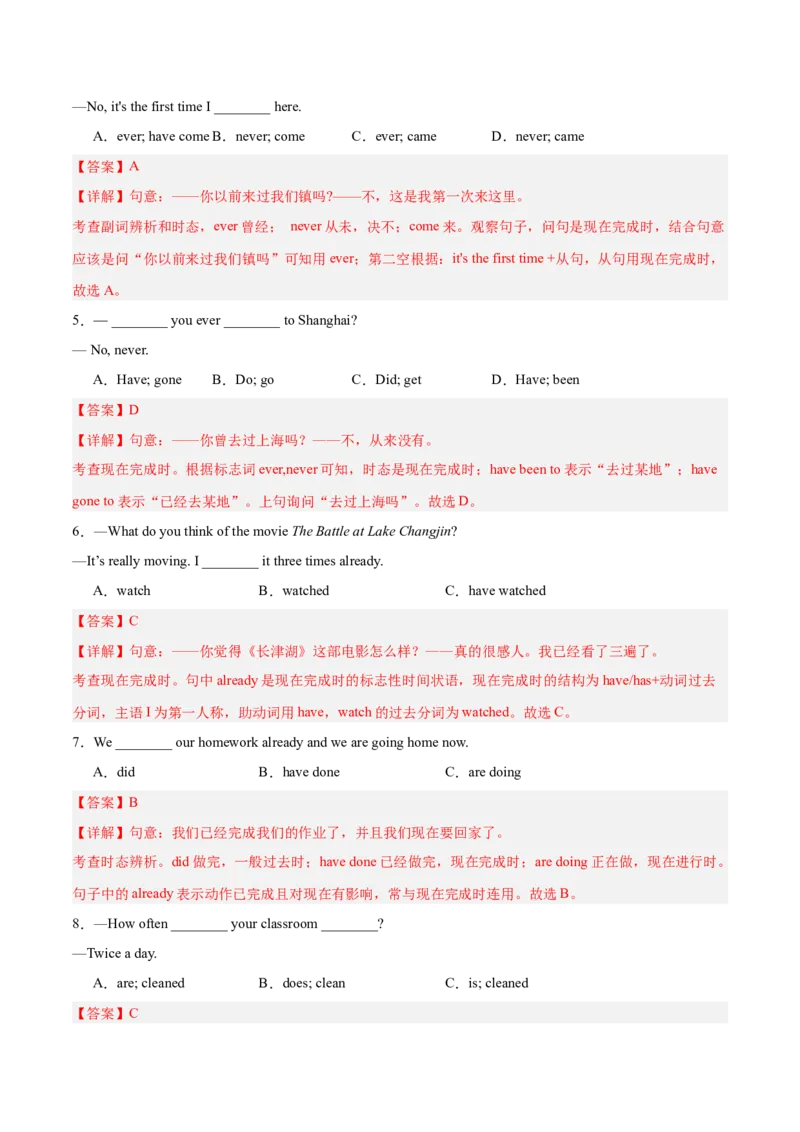
4.—Have you ________ been to our town before?—No, it's the first time I ________ here.
A.ever; have comeB.never; come C.ever; came D.never; came
【答案】A
【详解】句意:——你以前来过我们镇吗?——不,这是我第一次来这里。
考查副词辨析和时态,ever曾经; never从未,决不;come来。观察句子,问句是现在完成时,结合句意
应该是问“你以前来过我们镇吗”可知用ever;第二空根据:it's the first time +从句,从句用现在完成时,
故选A。
5.— ________ you ever ________ to Shanghai?
— No, never.
A.Have; gone B.Do; go C.Did; get D.Have; been
【答案】D
【详解】句意:——你曾去过上海吗?——不,从来没有。
考查现在完成时。根据标志词ever,never可知,时态是现在完成时;have been to表示“去过某地”;have
gone to表示“已经去某地”。上句询问“去过上海吗”。故选D。
6.—What do you think of the movie The Battle at Lake Changjin?
—It’s really moving. I ________ it three times already.
A.watch B.watched C.have watched
【答案】C
【详解】句意:——你觉得《长津湖》这部电影怎么样?——真的很感人。我已经看了三遍了。
考查现在完成时。句中already是现在完成时的标志性时间状语,现在完成时的结构为have/has+动词过去
分词,主语I为第一人称,助动词用have,watch的过去分词为watched。故选C。
7.We ________ our homework already and we are going home now.
A.did B.have done C.are doing
【答案】B
【详解】句意:我们已经完成我们的作业了,并且我们现在要回家了。
考查时态辨析。did做完,一般过去时;have done已经做完,现在完成时;are doing正在做,现在进行时。
句子中的already表示动作已完成且对现在有影响,常与现在完成时连用。故选B。
8.—How often ________ your classroom ________?
—Twice a day.
A.are; cleaned B.does; clean C.is; cleaned
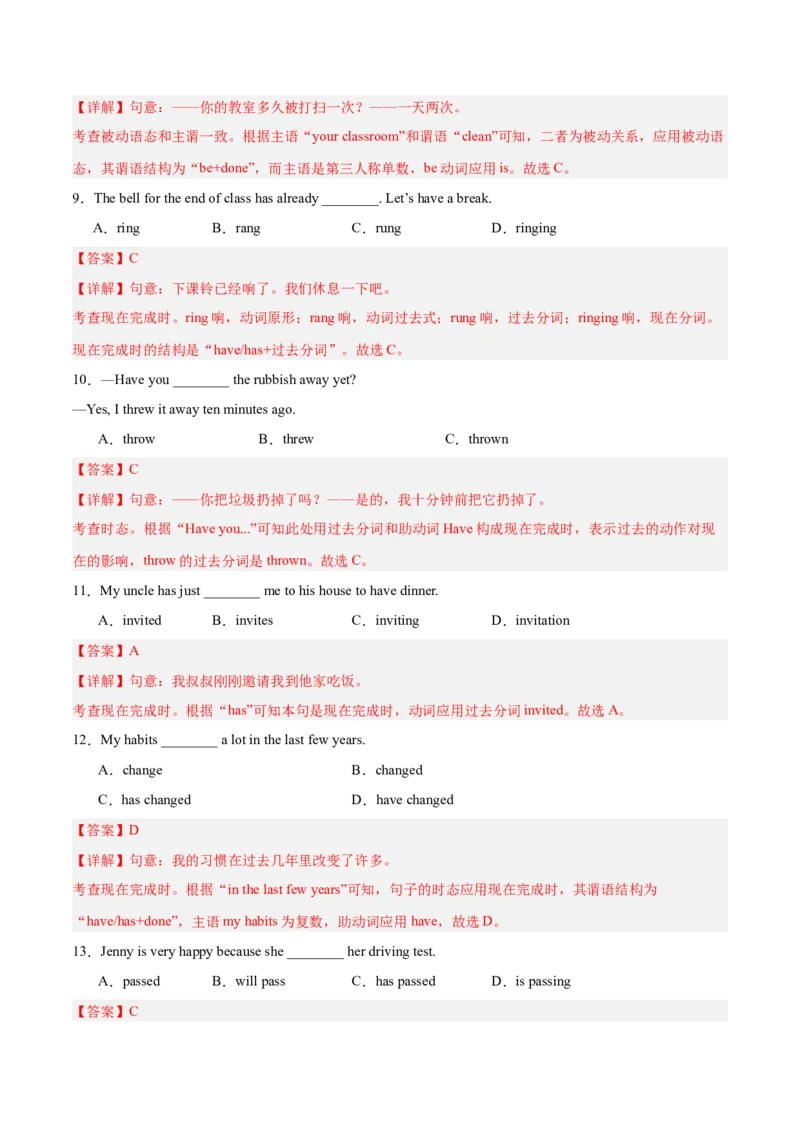
【答案】C【详解】句意:——你的教室多久被打扫一次?——一天两次。
考查被动语态和主谓一致。根据主语“your classroom”和谓语“clean”可知,二者为被动关系,应用被动语
态,其谓语结构为“be+done”,而主语是第三人称单数,be动词应用is。故选C。
9.The bell for the end of class has already ________. Let’s have a break.
A.ring B.rang C.rung D.ringing
【答案】C
【详解】句意:下课铃已经响了。我们休息一下吧。
考查现在完成时。ring响,动词原形;rang响,动词过去式;rung响,过去分词;ringing响,现在分词。
现在完成时的结构是“have/has+过去分词”。故选C。
10.—Have you ________ the rubbish away yet?
—Yes, I threw it away ten minutes ago.
A.throw B.threw C.thrown
【答案】C
【详解】句意:——你把垃圾扔掉了吗?——是的,我十分钟前把它扔掉了。
考查时态。根据“Have you...”可知此处用过去分词和助动词Have构成现在完成时,表示过去的动作对现
在的影响,throw的过去分词是thrown。故选C。
11.My uncle has just ________ me to his house to have dinner.
A.invited B.invites C.inviting D.invitation
【答案】A
【详解】句意:我叔叔刚刚邀请我到他家吃饭。
考查现在完成时。根据“has”可知本句是现在完成时,动词应用过去分词invited。故选A。
12.My habits ________ a lot in the last few years.
A.change B.changed
C.has changed D.have changed
【答案】D
【详解】句意:我的习惯在过去几年里改变了许多。
考查现在完成时。根据“in the last few years”可知,句子的时态应用现在完成时,其谓语结构为
“have/has+done”,主语my habits为复数,助动词应用have,故选D。
13.Jenny is very happy because she ________ her driving test.
A.passed B.will pass C.has passed D.is passing
【答案】C【详解】句意:Jenny是非常高兴的因为她通过了她的驾照考试。
考查现在完成时。根据“Jenny is very happy”可知此处强调已经发生的事对现在的影响,所以句子时态为现
在完成时,其谓语结构为“have/has+done”,故选C。
14.Train and plane tickets __________ online. It’s convenient.
A.sell B.sold C.have sold D.are sold
【答案】D
【详解】句意:火车票和飞机票被在网上销售。它是方便的。
考查一般现在时的被动语态。根据情境可知时态为一般现在时,而主语Train and plane tickets和谓语动词
sell之间为逻辑上的动宾关系,应用被动语态,其谓语结构为“be+done”,故选D。
15.—Let’s go to see that movie!
—Sorry, I won’t. I ________ it twice already.
A.see B.have seen C.saw D.will see
【答案】B
【详解】句意:——我们去看那部电影吧!——对不起,我不去了。我已经看过两次了。
考查时态辨析。根据句意以及“twice already”可知此处应用现在完成时结构“have+动词过去分词”。故选
B。
16.—Amy, you must be hungry after waiting for us for such a long time.
—Don’t worry. I ________ some cookies already.
A.am eating B.will eat C.was eating D.have eaten
【答案】D
【详解】句意:——埃米,等我们这么久,你一定饿了吧。——别担心。我已经吃过一些饼干了。
考查动词的时态。根据后者说的 “Don’t worry” 以及 “already” 可知,后者已经吃了一些饼干,应用现在
完成时。结构为have/has done。故选D。
17.The report has ________ questions about pollution.
A.rise B.risen C.raise D.raised
【答案】D
【详解】句意:这份报告已经提出了关于污染的问题。
考查现在完成时态及动词辨析。rise上升,动词原形;risen上升,过去分词;raise提出,动词原形;raised
提出,过去分词。根据“The report has...questions about pollution.”可知,此处表示提出关于污染的问题,应
用raise,且句子是现在完成时,动词用过去分词。故选D。
18.—Look! Someone ________ the room up!—Well, it wasn’t me. I didn’t do it.
A.tidies B.has tidied C.will tidy D.is tidying
【答案】B
【详解】句意:——看!有人已经打扫了房间!——嗯,那不是我。我没做。
考查动词时态。tidies打扫(一般现在时);has tidied已经打扫(现在完成时);will tidy将要打扫(一般
将来时);is tidying正在打扫(现在进行时)。根据答语“it wasn’t me”可知,动作已完成并对现在有影响,
时态用现在完成时。故选B。
19.—What’s up, Lily?
—The school art competition is coming, but I ________ an idea for my painting yet.
A.won’t get B.don’t get C.haven’t got D.am not getting
【答案】C
【详解】句意:——莉莉,怎么了?——学校的美术比赛就要来了,但我还没有想出我画画的灵感。
考查动词时态辨析。won’t get为一般将来时;don’t get为一般现在时;haven’t got为现在完成时;am not
getting为现在进行时。根据“...an idea for my painting yet”可知,这里表示“到现在还没想到主意”,强调
对现在的影响,应使用现在完成时。故选C。
20.Actually, she ________ Maddie the whole story yet.
A.told B.hasn’t told C.tells D.didn’t tell
【答案】B
【详解】句意:实际上,她还没有把整个故事告诉Maddie。
考查现在完成时与“yet”的用法。“yet”表示“还”,常用于否定句或疑问句,且多与现在完成时连用。根
据“yet”提示,句子需用现在完成时否定形式。故选B。
二、单词拼写
21.Great changes (take) place in our town so far.
【答案】have taken
【详解】句意:迄今为止,我们的小镇已经发生了巨大的变化。根据“so far”可知本句用现在完成时,谓
语结构为“have/has+过去分词”;主语“Great changes”为复数,因此用have;take的过去分词为taken。
故填have taken。
22.The news has all over the village. (spread)
【答案】spread
【详解】句意:这个消息传遍了整个村庄。根据“has”可知,句子是现在完成时态,谓语动词用过去分词
形式。spread的过去分词形式是spread。故填spread。23.The little girl has the poem by heart. (learn)
【答案】learnt/learned
【详解】句意:这个小女孩已经牢记这首诗了。助动词has后加过去分词,构成现在完成时。learn的过去
分词是learnt/learned。故填learnt/learned。
24.Has your brother (make) a lot of new friends in London?
【答案】made
【详解】句意:你的哥哥在伦敦结交了很多新朋友吗?make friends“交朋友”;根据“Has”可知,此处应
用make的过去分词形式,和助动词has构成现在完成时。故填made。
25.Tom has already (build) a house on the island.
【答案】built
【详解】句意:Tom已经在岛上建了个房子。根据“has already”可知,该句为现在完成时,现在完成时的
结构为have/has+过去分词,build的过去分词为built,故填built。
26.I’ve always to go on a dream holiday. But I can’t afford the time. (want)
【答案】wanted
【详解】句意:我一直想去度一个梦想中的假期。但是我抽不出时间。have后接动词过去分词构成现在完
成时结构,故填wanted。
27.The government (try) to stop people from littering recently.
【答案】has tried
【详解】句意:政府最近试图阻止人们乱扔垃圾。根据“recently”可知,句子时态为现在完成时,其结构
为have/has done;主语“The government”为第三人称单数,助动词用has,动词try的过去分词为tried。故
填has tried。
28.They have (hang) the picture on the wall where everyone can see it.
【答案】hung
【详解】句意:他们把画挂在人人都能看到的墙上。根据“have”可知此处是现在完成时,have后用过去分
词hung。故填hung。
29.I’ve never (hear)of this story before.
【答案】heard
【详解】句意:我以前从未听说过这个故事。根据“I’ve”可知,本句是现在完成时,动词用过去分词。故
填heard。
30.The students (learn) nearly 100 words in the last ten days.
【答案】have learned/have learnt【详解】句意:最近10天学生们学了差不多100个单词。根据“in the last ten days”可知,时态为现在完成
时,其构成为主语+have/has+过去分词,主语为复数,故此处用have,learn“学习”,动词,其过去分词为
learned/learnt。故填have learned/have learnt。
题型一 语法填空
If you love reading books, you must know about the book The Adventures of Tom Sawyer by Mark Twain. The
book is 1 (success). And it is popular among kids at home and abroad. Even if I am an adult now, I’m still a fan
of this book. After re-reading the book 2 (recent), I have learned an important lesson from Tom Sawyer.
In our daily lives, we are often given some boring 3 tiring tasks. Have you ever wanted to complain? I
think 4 (many) people have.
Tom Sawyer, however, had 5 different thought when he was given a boring task. One day, Aunt Polly told
Tom to paint the fence (篱笆). Tom was 6 (do) his job when his friend Ben Rogers happened to pass by. Instead
of complaining, Tom 7 (introduce) the task and told that he felt “excited” about it. “Only one in a thousand—
maybe even two thousand—boys can do this! ” Tom said.
Tom’s words made Ben become interested 8 the task. He even gave Tom his apple so that he could have
a chance to paint the fence. If Tom had 9 (think) about nothing but complaining, he would have had a bad day
painting the fence.
This story 10 (teach) me a valuable lesson: Complaining is useless.
【答案】
1.successful 2.recently 3.or 4.most 5.a 6.doing 7.introduced 8.in 9.thought 10.
teaches
【导语】本文主要介绍了作者读完《汤姆索亚历险记》后的感想,告诉我们抱怨是无用的。
1.句意:这本书很成功。此处作be动词的表语用形容词successful“成功的”。故填successful。
2.句意:最近重读了这本书,我从汤姆·索耶那里学到了一个重要的教训。此处修饰动词用副词
recently“最近”。故填recently。
3.句意:在我们的日常生活中,我们经常被赋予一些无聊或疲惫的任务。根据“boring...tiring”可知此处
表示选择,用or连接。故填or。
4.句意:我想大多数人都有。此处表示“大多数人”,most“大多数”。故填most。5.句意:然而,当汤姆·索耶被赋予一项无聊的任务时,他却有了不同的想法。此处指“一个不同的想
法”,different以辅音音素开头,用不定冠词a。故填a。
6.句意:汤姆正在工作时,他的朋友本·罗杰斯正好路过。此处用现在分词doing和be动词构成过去进行
时。故填doing。
7.句意:汤姆没有抱怨,而是介绍了这项任务,并表示他对此感到“兴奋”。句子用一般过去时,动词
用过去式introduced“介绍”。故填introduced。
8.句意:汤姆的话使本对这项任务产生了兴趣。become interested in“对……感兴趣”。故填in。
9.句意:如果汤姆除了抱怨什么都不想的话,他今天油漆篱笆的日子就不好过了。此处用过去分词
thought和助动词had构成过去完成时。故填thought。
10.句意:这个故事给了我一个宝贵的教训:抱怨是无用的。此处描述客观情况,用一般现在时,主语是
名词单数,谓语动词用单三teaches“教”。故填teaches。
阅读下面短文,根据语境、音标或所给单词的提示,在每个空格内填入适当的单词,要求所填的词意义准
确,形式正确,使短文意思完整、行文连贯。 (最多两个词)
Do you like Journey to the West? It is 1 traditional Chinese book. This famous novel was written by Wu
Cheng’en, a great 2 (write) in the Ming Dynasty. He spent many years 3 (create) this wonderful story.
The Monkey King or Sun Wukong is one of the main 4 (role) in the book. The Monkey King, who is
loved by Chinese children, is not just a normal monkey. He was born from a magic stone on Huaguoshan Mountain.
He can make 72 changes and turn 5 (he) into different animals and objects. The Monkey King uses a stick 6
(fight) bad people bravely. Sometimes, he can make the stick so small that he can keep it in his ear.
As soon as the TV programme came out more than 30 years ago, children became interested 7 reading
this story. The Monkey King is 8 (real) smart. He keeps fighting to help the weak (弱小的) and never 9 (give)
up.
10 the Monkey King, the book also tells about his other teammates: Tang Seng, Zhu Bajie and Sha Wujing.
They travel together to the West to get sacred scriptures (佛经). This story not only brings joy to kids but also teaches
people to be brave and kind.
【答案】1.a 2.writer 3.creating 4.roles 5.himself 6.to fight 7.in 8.really 9.gives 10.
Besides
【导语】本文主要介绍了中国古典名著《西游记》及其作者吴承恩,重点描述了主角孙悟空的形象、能力,
同时说明了该作品的影响与意义。
1.句意:它是一本中国传统书籍。根据“traditional Chinese book”可知,是可数名词单数,且traditional以
辅音音素开头,需用不定冠词a修饰。故填a。
2.句意:这部著名的小说是明代伟大的作家吴承恩所写。根据“Wu Cheng’en”可知,此处指“作
家”writer,前有冠词a修饰,用单数。故填writer。
3.句意:他花了很多年创作这个精彩的故事。根据固定搭配“spend+时间+(in) doing sth.”可知,应用
create的动名词形式creating。故填creating。
4.句意:美猴王或孙悟空是书中的主要角色之一。根据“one of+可数名词复数”可知,此处应该填role
的复数形式roles。故填roles。
5.句意:他会 72 变,把自己变成不同的动物和物体。turn oneself into表示“把自己变成……”,he的反
身代词是himself,表示“他自己”。故填himself。
6.句意:美猴王用棍子勇敢地对抗坏人。固定搭配“use sth. to do sth.”表示“用某物做某事”,此处应该
使用动词不定式。故填to fight。
7.句意:30多年前这部电视节目一播出,孩子们就对阅读这个故事产生了兴趣。固定搭配“become
interested in doing sth.”表示“对……产生兴趣”,应该使用介词in。故填in。
8.句意:美猴王真的很聪明。此处需用real的副词形式really,修饰形容词smart。故填really。
9.句意:他一直为帮助弱小而战斗,从不放弃。根据“He keeps fighting”可知,主语是第三人称单数,时
态为一般现在时,且and连接两个并列结构,所以谓语动词give用第三人称单数形式gives。故填gives。
10.句意:除了美猴王,这本书还讲述了他的其他队友:唐僧、猪八戒和沙悟净。根据“also”可知,此处
表“除了……之外(还)”,用介词besides,句首首字母大写。故填Besides。
题型二 阅读理解
The next day they set off again very early. They walk a few miles and then come to a big ditch (沟). It’s verywide. There are a lot of rocks (岩石) in the ditch.
“How can we cross the ditch?” Dorothy asks her friends.
“We can’t fly over it,” the Scarecrow says. “And we can’t jump over it. So we must stay here.”
The Lion looks at the ditch and says, “I can jump over it.”
“Can you?” the Scarecrow says. “ That’s good! You can take us across on your back, one by one.”
“Who wants to go first? ”the Lion says. He’s a little afraid first but he wants to help his friends.
“Me!” the Scarecrow says and he gets on the Lion’s back. The Lion jumps across the ditch easily. Then he
jumps back and takes Dorothy and Toto. Finally he takes the Tin Woodman (铁皮人) across the ditch.
The Lion is tired after his five big jumps.
“Let’s have a rest before we start walking again,” he says.
Later in the afternoon they come to a wide river. They can see a beautiful country on the other side of it.
There are green fields and a lot of flowers. They can also see the yellow brick (砖) road.
(Adapted from The Wonderful Wizard of Oz)
1.How many characters (角色) are there in the passage?
A.3 B.4 C.5 D.6
2.How do they cross the ditch?
A.They jump over the ditch by themselves.B.They just stay where they are.
C.They fly over the ditch. D.They make it on the Lion’s back.
3.What is the Lion in the story like?
A.He is always afraid to do things. B.He is brave to go first.
C.He is easy to play with. D.He is ready to help.
4.What will they do next according to the passage?
A.They will try to go across the wide river.
B.They will walk past the beautiful country.
C.They will go along the yellow brick road.
D.They will pick flowers on the green fields.
【答案】1.C 2.D 3.D 4.A
【导语】本文是小说《绿野仙踪》中的节选片段,主要介绍了多萝西、狮子、稻草人和铁皮人在路上穿过
大沟的故事。
1.细节理解题。根据文章中提到的“Dorothy”、“the Scarecrow”、“the Lion”、“Toto”和“the TinWoodman”可知,文中总共有五个人物角色。故选C。
2.细节理解题。根据稻草人对狮子说的话“You can take us across on your back, one by one.”可知,它们是
骑在狮子的背上过的沟。故选D。
3.推理判断题。根据“He’s a little afraid first but he wants to help his friends.”可知,狮子想帮助他的朋友。
联系下文“The Lion is tired after his five big jumps.”可知,狮子把它们挨个儿背过了沟,所以在故事中狮子
是乐于助人的。故选D。
4.推理判断题。根据“Later in the afternoon they come to a wide river.They can see a beautiful country on the
other side of it. There are green fields and a lot of flowers. They can also see the yellow brick (砖) road.”可知,后
来在下午的时候,它们来到了一条宽阔的河边,要想去对面,必须穿过这条河,由此可推断,它们接下来
会穿过宽阔的河流。故选A。
Once upon a time there lived two brothers named Jacob and William in Germany. They liked to listen to old
stories and then write them down. Then they had enough stories to make a book. You can guess the name of their
book! It is Grimms’ Fairy Tales.
The story of this little book began when the brothers were still in school. And it started with a good teacher.
This teacher liked to find out how things happened. Soon the two brothers were doing the same thing.They asked
questions and then looked for answers to them.
Among the questions the brothers asked, “Who made up the old fairy tales? Who first told about Cinderella
(灰姑娘)? Who made up the story of Snow White and the story of Sleeping Beauty?”
They found that no one knew the answers to such questions. The tales were made up in very early times. Most
of them were made up in days before people knew how to write. People told the stories to one another and to their
children. But only a few old people still remembered them.
“When these old people die, the stories will die with them.” said the brothers. “We must write down all the
stories we can find.”
Jacob and William hunted for stories for five years, at last they had 86 tales written. Just before Christmas, in
1812, the first book was published. People loved the book! They asked for more fairy stories. So the Grimms put
tales into two more books. In all, they collected 210 stories to put into their books.
1.Who was the book Grimms’ Fairy Tales written by?
A.The Grimm brothers and the teacher.
B.The Grimm brothers and some old people.
C.Jacob and William.D.Some old people.
2.What did the brothers learn from the teacher?
A.They learned to ask questions and then look for the answers.
B.They learned to do everything that the teacher did.
C.They learned to listen to some stories.
D.They learned to write down the stories.
3.Which of the following stories is NOT in the book?
A.Cinderella. B.Nu Wa. C.Snow White. D.Sleeping Beauty.
4.What does the underlined word “hunted” mean in the last paragraph?
A.打猎 B.制作 C.编写 D.寻找
5.Why did the two brothers write down the old fairy tales?
A.Because the good teacher taught them to write down stories.
B.Because they didn’t want the stories to die with the old people.
C.Because some old people asked them to do so.
D.Because they liked writing stories.
【答案】1.C 2.A 3.B 4.D 5.B
【导语】本文讲述了《格林童话》的作者、所受启发及出版原因和过程。
1.细节理解题。根据“Once upon a time there lived two brothers named Jacob and William in Germany. They
liked to listen to old stories and then write them down. Then they had enough stories to make a book. You can guess
the name of their book! It is Grimms’ Fairy Tales.”可知《格林童话》的作者是Jacob and William。故选C。
2.细节理解题。根据“This teacher liked to find out how things happened. Soon the two brothers were doing the
same thing.They asked questions and then looked for answers to them.”可知,老师喜欢问问题和找答案。故选
A。
3.细节理解题。根据“Who made up the old fairy tales? Who first told about Cinderella (灰姑娘)? Who made
up the story of Snow White and the story of Sleeping Beauty?”可知,这些都在书中,不包含女娲的故事。故选
B。
4.词句猜测题。根据“Jacob and William hunted for stories for five years, at last they had 86 tales written.”雅各
布和威廉花了五年时间寻找故事,最后他们写了86个故事。可知,这里的hunted意为“寻找”。故选D。
5.细节理解题。根据“‘When these old people die, the stories will die with them,’ said the brothers. ‘We must
write down all the stories we can find.’”可知,他们不想让这些故事失传,所以就写了下来。故选B。