Unit7 What’s the highest mountain in the world?
Unit 7 课时2 Section A(3a-4c)
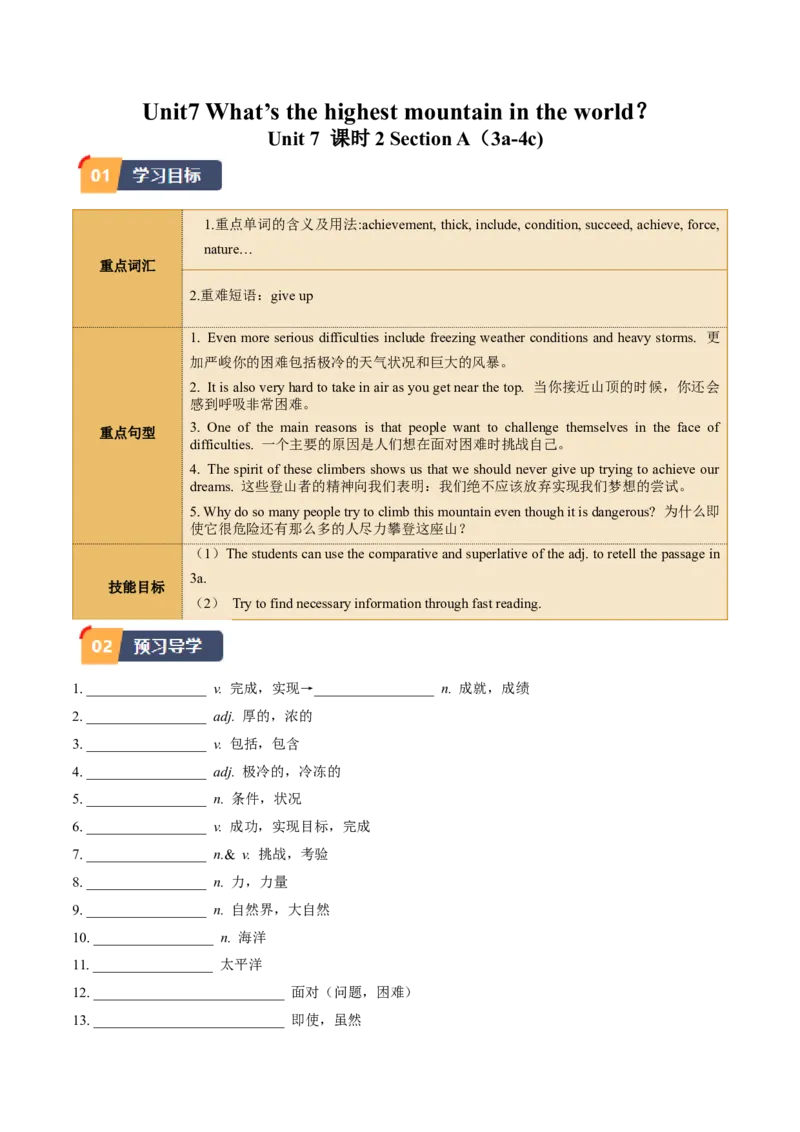
1.重点单词的含义及用法:achievement, thick, include, condition, succeed, achieve, force,
nature…
重点词汇
2.重难短语:give up
1. Even more serious difficulties include freezing weather conditions and heavy storms. 更
加严峻你的困难包括极冷的天气状况和巨大的风暴。
2. It is also very hard to take in air as you get near the top. 当你接近山顶的时候,你还会
感到呼吸非常困难。
3. One of the main reasons is that people want to challenge themselves in the face of
重点句型
difficulties. 一个主要的原因是人们想在面对困难时挑战自己。
4. The spirit of these climbers shows us that we should never give up trying to achieve our
dreams. 这些登山者的精神向我们表明:我们绝不应该放弃实现我们梦想的尝试。
5. Why do so many people try to climb this mountain even though it is dangerous? 为什么即
使它很危险还有那么多的人尽力攀登这座山?
(1)The students can use the comparative and superlative of the adj. to retell the passage in
3a.
技能目标
(2) Try to find necessary information through fast reading.
1. _________________ v. 完成,实现→_________________ n. 成就,成绩
2. _________________ adj. 厚的,浓的
3. _________________ v. 包括,包含
4. _________________ adj. 极冷的,冷冻的
5. _________________ n. 条件,状况
6. _________________ v. 成功,实现目标,完成
7. _________________ n.& v. 挑战,考验
8. _________________ n. 力,力量
9. _________________ n. 自然界,大自然
10. _________________ n. 海洋
[来源:学科网ZXXK]
11. _________________ 太平洋
12. ___________________________ 面对(问题,困难)
13. ___________________________ 即使,虽然答案:
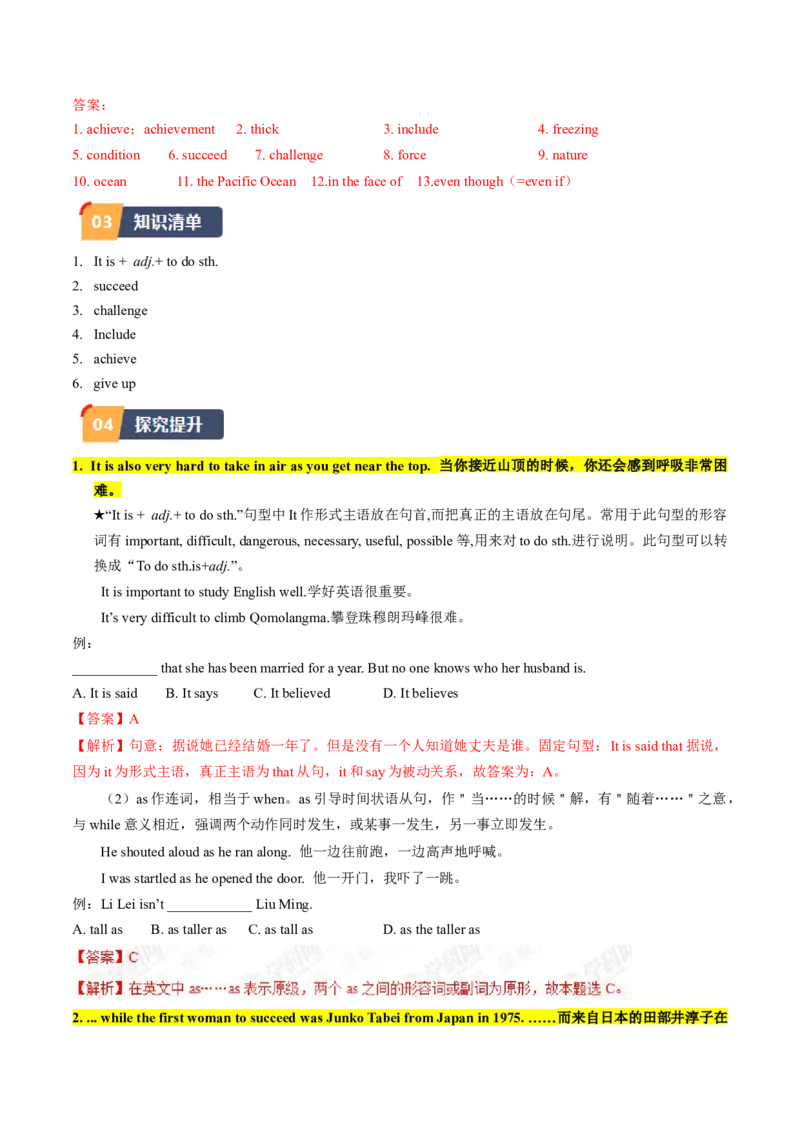
1. achieve;achievement 2. thick 3. include 4. freezing
5. condition 6. succeed 7. challenge 8. force 9. nature
10. ocean 11. the Pacific Ocean 12.in the face of 13.even though(=even if)
1. It is + adj.+ to do sth.
2. succeed
3. challenge
4. Include
5. achieve
6. give up
1. It is also very hard to take in air as you get near the top. 当你接近山顶的时候,你还会感到呼吸非常困
难。
★“It is + adj.+ to do sth.”句型中It作形式主语放在句首,而把真正的主语放在句尾。常用于此句型的形容
词有important, difficult, dangerous, necessary, useful, possible等,用来对to do sth.进行说明。此句型可以转
换成“To do sth.is+adj.”。
It is important to study English well.学好英语很重要。
It’s very difficult to climb Qomolangma.攀登珠穆朗玛峰很难。
例:
____________ that she has been married for a year. But no one knows who her husband is.
A. It is said B. It says C. It believed D. It believes
【答案】A
【解析】句意:据说她已经结婚一年了。但是没有一个人知道她丈夫是谁。固定句型:It is said that据说,
因为it为形式主语,真正主语为that从句,it和say为被动关系,故答案为:A。
(2)as作连词,相当于when。as引导时间状语从句,作"当……的时候"解,有"随着……"之意,
与while意义相近,强调两个动作同时发生,或某事一发生,另一事立即发生。
He shouted aloud as he ran along. 他一边往前跑,一边高声地呼喊。
I was startled as he opened the door. 他一开门,我吓了一跳。
例:Li Lei isn’t ____________ Liu Ming.
A. tall as B. as taller as C. as tall as D. as the taller as
2. ... while the first woman to succeed was Junko Tabei from Japan in 1975. ……而来自日本的田部井淳子在1975年成为第一个成功的女登山者。
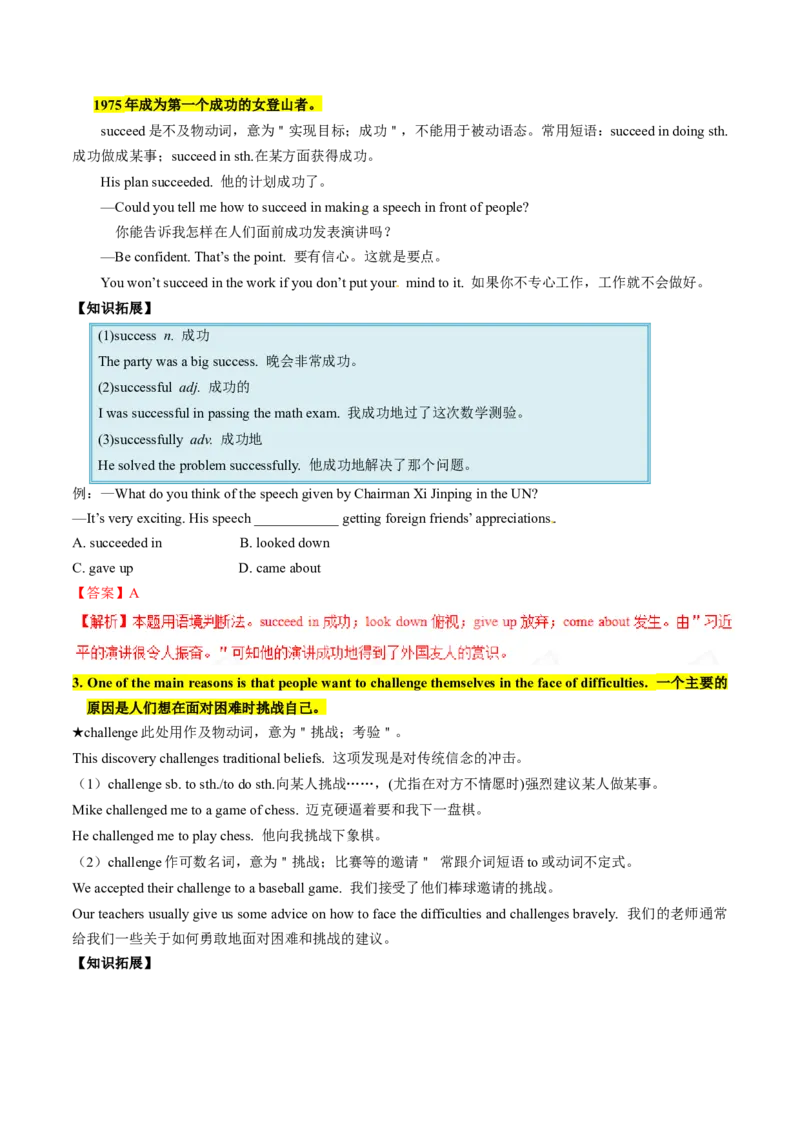
succeed是不及物动词,意为"实现目标;成功",不能用于被动语态。常用短语:succeed in doing sth.
成功做成某事;succeed in sth.在某方面获得成功。
His plan succeeded. 他的计划成功了。
—Could you tell me how to succeed in making a speech in front of people?
你能告诉我怎样在人们面前成功发表演讲吗?
—Be confident. That’s the point. 要有信心。这就是要点。
You won’t succeed in the work if you don’t put your mind to it. 如果你不专心工作,工作就不会做好。
【知识拓展】
(1)success n. 成功
The party was a big success. 晚会非常成功。
(2)successful adj. 成功的
I was successful in passing the math exam. 我成功地过了这次数学测验。
(3)successfully adv. 成功地
He solved the problem successfully. 他成功地解决了那个问题。
例:—What do you think of the speech given by Chairman Xi Jinping in the UN?
—It’s very exciting. His speech ____________ getting foreign friends’ appreciations.
A. succeeded in B. looked down
C. gave up D. came about
【答案】A
3. One of the main reasons is that people want to challenge themselves in the face of difficulties. 一个主要的
原因是人们想在面对困难时挑战自己。
★challenge此处用作及物动词,意为"挑战;考验"。
This discovery challenges traditional beliefs. 这项发现是对传统信念的冲击。
(1)challenge sb. to sth./to do sth.向某人挑战……,(尤指在对方不情愿时)强烈建议某人做某事。
Mike challenged me to a game of chess. 迈克硬逼着要和我下一盘棋。
He challenged me to play chess. 他向我挑战下象棋。
(2)challenge作可数名词,意为"挑战;比赛等的邀请" 常跟介词短语to或动词不定式。
We accepted their challenge to a baseball game. 我们接受了他们棒球邀请的挑战。
Our teachers usually give us some advice on how to face the difficulties and challenges bravely. 我们的老师通常
给我们一些关于如何勇敢地面对困难和挑战的建议。
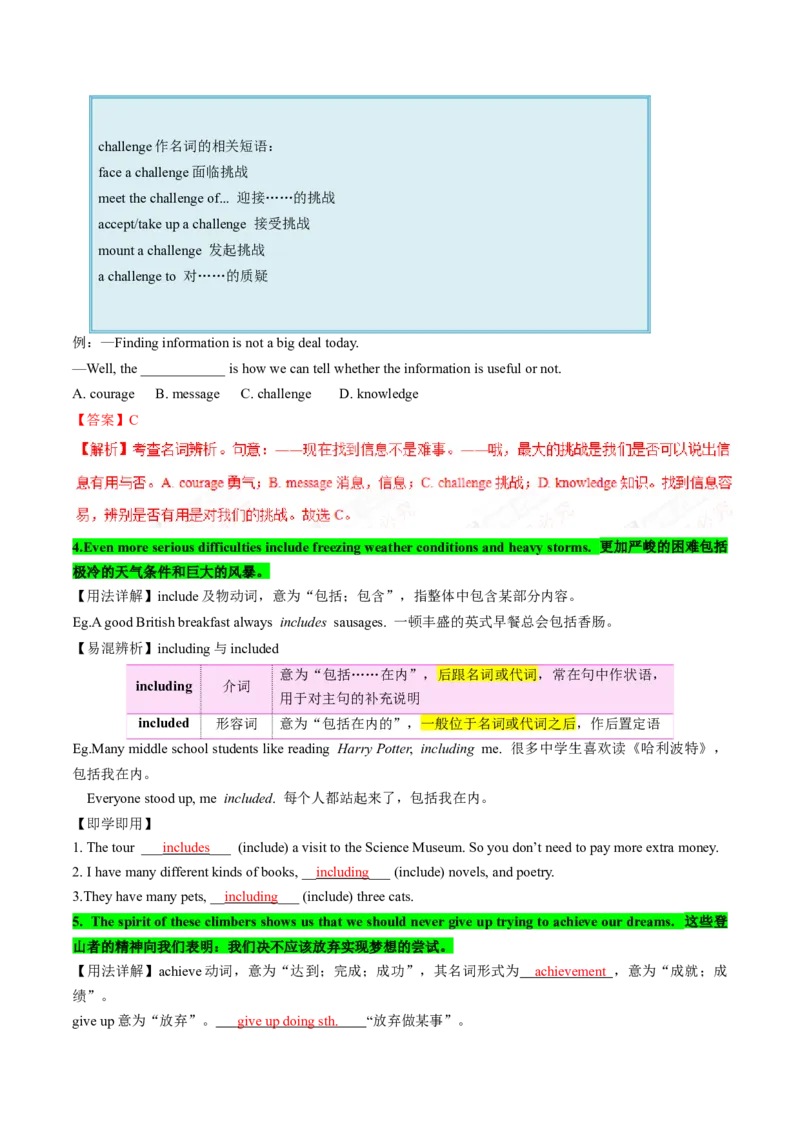
【知识拓展】challenge作名词的相关短语:
face a challenge面临挑战
meet the challenge of... 迎接……的挑战
accept/take up a challenge 接受挑战
mount a challenge 发起挑战
a challenge to 对……的质疑
例:—Finding information is not a big deal today.
—Well, the ____________ is how we can tell whether the information is useful or not.
A. courage B. message C. challenge D. knowledge
【答案】C
4.Even more serious difficulties include freezing weather conditions and heavy storms. 更加严峻的困难包括
极冷的天气条件和巨大的风暴。
【用法详解】include及物动词,意为“包括;包含”,指整体中包含某部分内容。
Eg.A good British breakfast always includes sausages. 一顿丰盛的英式早餐总会包括香肠。
【易混辨析】including与included
意为“包括……在内”,后跟名词或代词,常在句中作状语,
including 介词
用于对主句的补充说明
included 形容词 意为“包括在内的”,一般位于名词或代词之后,作后置定语
Eg.Many middle school students like reading Harry Potter, including me. 很多中学生喜欢读《哈利波特》,
包括我在内。
Everyone stood up, me included. 每个人都站起来了,包括我在内。
【即学即用】
1. The tour ___includes___ (include) a visit to the Science Museum. So you don’t need to pay more extra money.
2. I have many different kinds of books, __including___ (include) novels, and poetry.
3.They have many pets, __including___ (include) three cats.
5. The spirit of these climbers shows us that we should never give up trying to achieve our dreams. 这些登
山者的精神向我们表明:我们决不应该放弃实现梦想的尝试。
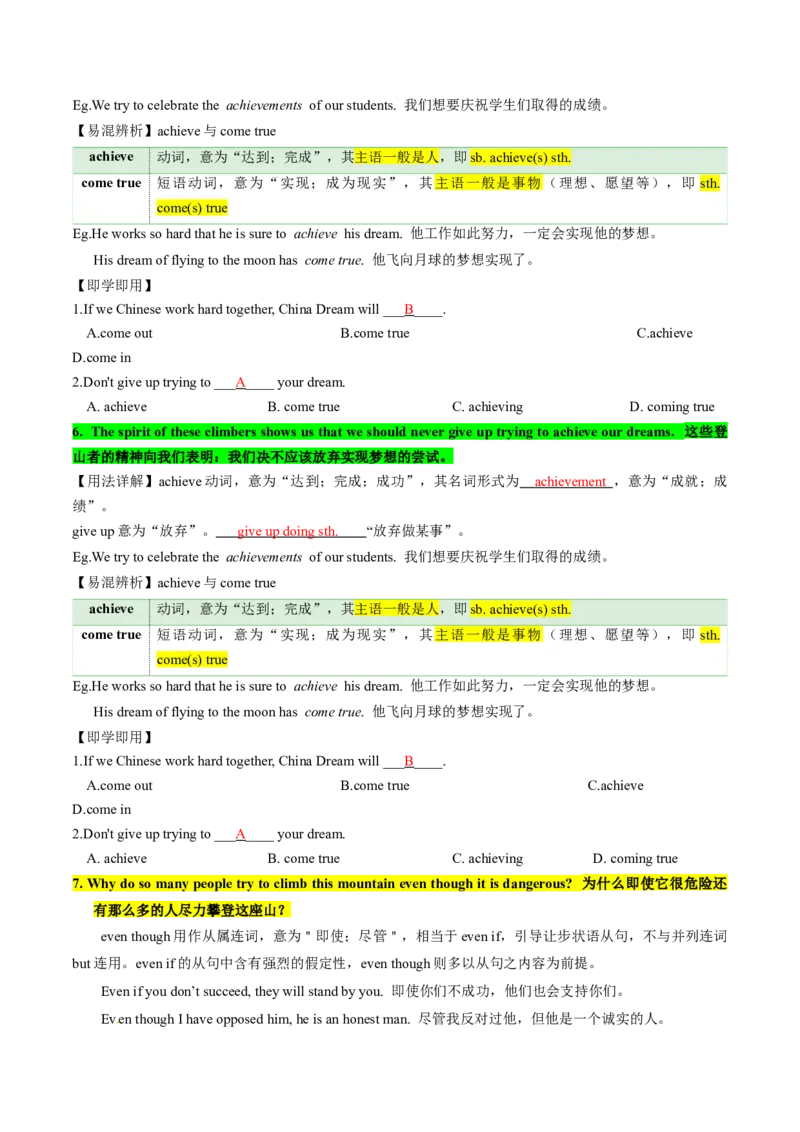
【用法详解】achieve动词,意为“达到;完成;成功”,其名词形式为 achievement ,意为“成就;成
绩”。
give up意为“放弃”。 give up doing sth. “放弃做某事”。Eg.We try to celebrate the achievements of our students. 我们想要庆祝学生们取得的成绩。
【易混辨析】achieve与come true
achieve 动词,意为“达到;完成”,其主语一般是人,即sb. achieve(s) sth.
come true 短语动词,意为“实现;成为现实”,其主语一般是事物(理想、愿望等),即 sth.
come(s) true
Eg.He works so hard that he is sure to achieve his dream. 他工作如此努力,一定会实现他的梦想。
His dream of flying to the moon has come true. 他飞向月球的梦想实现了。
【即学即用】
1.If we Chinese work hard together, China Dream will ___B____.
A.come out B.come true C.achieve
D.come in
2.Don't give up trying to ___A____ your dream.
A. achieve B. come true C. achieving D. coming true
6. The spirit of these climbers shows us that we should never give up trying to achieve our dreams. 这些登
山者的精神向我们表明:我们决不应该放弃实现梦想的尝试。
【用法详解】achieve动词,意为“达到;完成;成功”,其名词形式为 achievement ,意为“成就;成
绩”。
give up意为“放弃”。 give up doing sth. “放弃做某事”。
Eg.We try to celebrate the achievements of our students. 我们想要庆祝学生们取得的成绩。
【易混辨析】achieve与come true
achieve 动词,意为“达到;完成”,其主语一般是人,即sb. achieve(s) sth.
come true 短语动词,意为“实现;成为现实”,其主语一般是事物(理想、愿望等),即 sth.
come(s) true
Eg.He works so hard that he is sure to achieve his dream. 他工作如此努力,一定会实现他的梦想。
His dream of flying to the moon has come true. 他飞向月球的梦想实现了。
【即学即用】
1.If we Chinese work hard together, China Dream will ___B____.
A.come out B.come true C.achieve
D.come in
2.Don't give up trying to ___A____ your dream.
A. achieve B. come true C. achieving D. coming true
7. Why do so many people try to climb this mountain even though it is dangerous? 为什么即使它很危险还
有那么多的人尽力攀登这座山?
even though用作从属连词,意为"即使;尽管",相当于even if,引导让步状语从句,不与并列连词
but连用。even if的从句中含有强烈的假定性,even though则多以从句之内容为前提。
Even if you don’t succeed, they will stand by you. 即使你们不成功,他们也会支持你们。
Even though I have opposed him, he is an honest man. 尽管我反对过他,但他是一个诚实的人。【知识拓展】
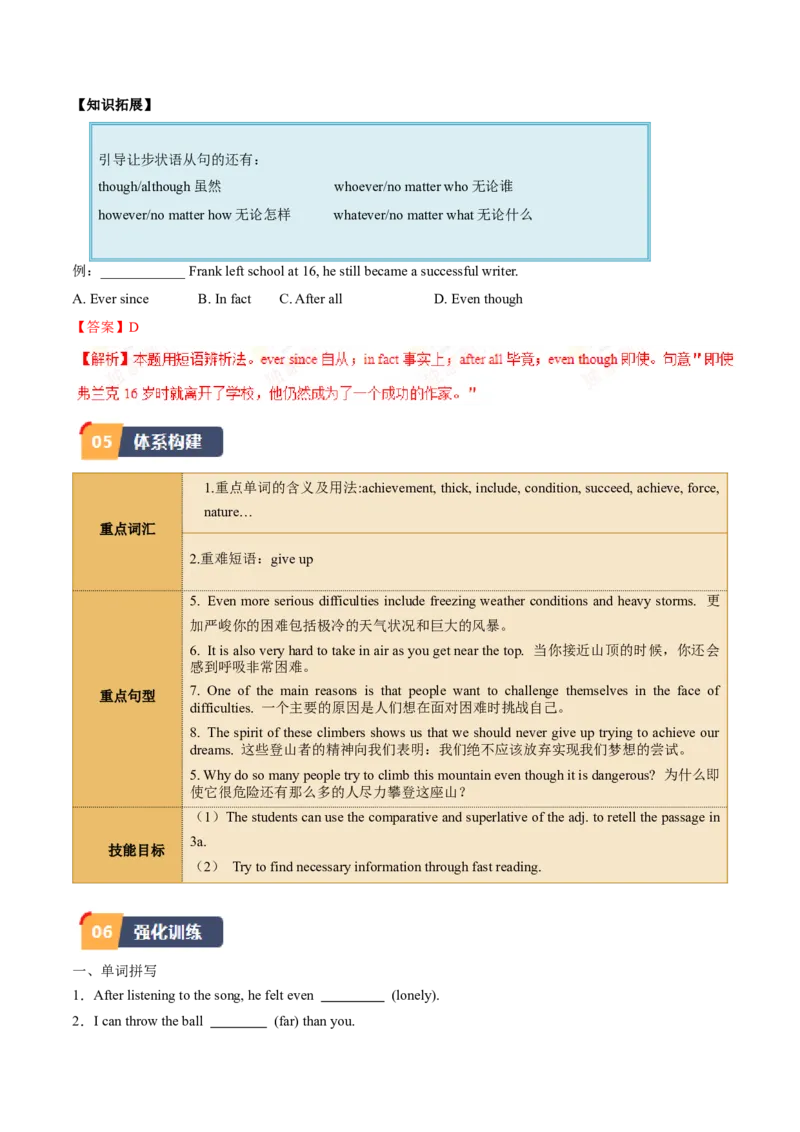
引导让步状语从句的还有:
though/although虽然 whoever/no matter who无论谁
however/no matter how无论怎样 whatever/no matter what无论什么
例:____________ Frank left school at 16, he still became a successful writer.
A. Ever since B. In fact C. After all D. Even though
【答案】D
1.重点单词的含义及用法:achievement, thick, include, condition, succeed, achieve, force,
nature…
重点词汇
2.重难短语:give up
5. Even more serious difficulties include freezing weather conditions and heavy storms. 更
加严峻你的困难包括极冷的天气状况和巨大的风暴。
6. It is also very hard to take in air as you get near the top. 当你接近山顶的时候,你还会
感到呼吸非常困难。
7. One of the main reasons is that people want to challenge themselves in the face of
重点句型
difficulties. 一个主要的原因是人们想在面对困难时挑战自己。
8. The spirit of these climbers shows us that we should never give up trying to achieve our
dreams. 这些登山者的精神向我们表明:我们绝不应该放弃实现我们梦想的尝试。
5. Why do so many people try to climb this mountain even though it is dangerous? 为什么即
使它很危险还有那么多的人尽力攀登这座山?
(1)The students can use the comparative and superlative of the adj. to retell the passage in
3a.
技能目标
(2) Try to find necessary information through fast reading.
一、单词拼写
1.After listening to the song, he felt even (lonely).
2.I can throw the ball (far) than you.3.Habit is second (nature)
4.Things are much (light) on the moon than on the earth.
5.There will be (many) people than last year.
6.The bag is (cheap) than any other bag in the store, but it is the nicest.
7.After reading this book, I found it was as (interesting) as I thought.
8.The more we help others, the (happy) we will be.
9.This course (include) all kinds of ways to practice your English.
10.Sally is (smart) than her sister.
二、完型填空
Jumbo is an elephant. He is very big. He has a 11 trunk (象鼻), four strong legs, and two big ears.
Jumbo lives 12 his parents in a forest in India.
One day Jumbo went for a walk. He 13 slowly to the river and saw a little girl. She was crying.
“ 14 are you crying?” asked Jumbo.
“My mother is ill. I want 15 something delicious for her. I have to take water to my house first,
16 my bucket (桶) has a big hole in it,” cried the little girl.
“Don’t cry,” said Jumbo. “Let me help you”.
Jumbo came up with 17 idea and went to the river. He put his long trunk into the water. “Look,” said
Jumbo, “my trunk is full of water. I will bring it to 18 house.”
The little girl was happy. She clapped (拍) her hands and jumped high. “Thank you. It’s very 19 to
meet you,” she said.
Jumbo smiled and went to the girl’s house. The girl found some pots. Jumbo poured all the water into the pots.
“You are very kind,” said the little girl. “Thanks a lot.”
“No problem,” answered the big 20 . “I hope your mother will be better soon.”
11.A.long B.longer C.longest
12.A.for B.with C.from
13.A.walk B.walks C.walked
14.A.Why B.When C.Where
15.A.make B.making C.to make
16.A.so B.if C.but
17.A.an B.a C./
18.A.you B.your C.yours
19.A.luck B.lucky C.luckily
20.A.elephant B.elephants C.elephant’s
三、阅读理解
It was half past five in the afternoon when Sarah came home from work. She walked into the living room and
looked at her three children.
The children were fourteen, thirteen and nine years old. They were happily watching TV. The room was dirtyand untidy. There were empty glasses and dirty clothes on the floor. Toys were everywhere.
Sarah got angry. “What a mess!” she said to her children. “I work all day and have to do the housework all
evening. I’m very tired. I need to have a good rest. I won’t do the housework anymore!”
Sarah did as she said. She didn’t do any housework. Every evening, she sat on the sofa and watched TV. A week
later, every dish in the kitchen was dirty. All the children’s clothes were dirty, too. Every trash can was full. The whole
house was out of order.
Then one day when Sarah got home, she got very surprised. The kitchen was clean. The children had cleaned
it!
The second day, when Sarah got home, she found the living room was clean, and the children were washing
their clothes. Sarah was happy and went to help them.
Now Sarah and her three children do the housework together. Then they all sit on the sofa and watch TV.
21.What did Sarah usually do in the evening before she got angry?
A.Clean the house. B.Sit on the sofa and talk to her children.
C.Watch TV all the time. D.Do the housework with her children.
22.How old was Sarah’s youngest child?
A.Fourteen years old. B.Thirteen years old.
C.Nine years old. D.Six years old.
23.Every day when Sarah got home, _________.
A.the dishes were clean B.the room was dirty
C.the children were studying D.her mother was looking after her children
24.Sarah’s children all felt _________ when Sarah got angry and didn’t do any housework.
A.happy B.sad C.sorry D.unlucky
25.Which of the following is NOT true?
A.Sarah came home from work at 5:30 p.m.
B.Sarah didn’t do the housework for over a week.
C.The children were too young to wash their clothes.
D.Now Sarah and her children do chores together before watching TV.
四、语法填空
根据下面短文内容,用括号内所给单词的正确形式填空。
One Day, Bill went to the beach with his friends Jim and Bob. After playing for a while, Bill fell 26
(sleep) on the comfortable beach. After an hour, he 27 (wake) up. He found his friends playing volleyball.
Bill walked towards them and began to play with them.
Bob 28 (hit) the ball too hard and it fell into the sea. Just as Bob was going to pick up the ball, a strong wind
blew it away. Bill wanted to show off (炫耀) his swimming skills, so he decided to get the ball back for 29 (they).
After swimming for about ten 30 (minute), Bill became tired. He realized it was impossible for him to
get the ball. But he tried his best 31 (swim) to it. At that moment, some black clouds appeared in the sky.
Oh, 32 strange weather it was! It started to rain 33 (heavy).At that time Jim and Bob were completely 34 (surprise) because they couldn’t see Bill. They shouted
for help. 35 (luck), a young man saved Bill.
五、补全对话
根据下面的情景,在每个空白处填上适当的句子,使对话的意思完整、通顺。
A: Hi. Linda. What are you going to do this Sunday?
B: I’m going to Zhengzhou Wildlife Zoo.
A: Zhengzhou Wildlife Zoo? 36 ?
B: It’s in the northwest of the city.
A: 37 ? I am new here.
B: Of course. It’s very large. There are over 1000 kinds of animals, such as tigers, elephants, pandas and so on.
A: Wow! 38 ?
B: It’s about fifteen minutes by bus. Would you like to go with me?
A: Of course. How can we go there?
B: 39 . I know the way well.
A: I can’t wait. 40 ?
B: Let’s meet at 8:00 at my house, OK?
A: All right. See you then.
参考答案:
1.lonelier
【详解】句意:听了这首歌,他感到更加孤独。此处指“更孤独”,even修饰比较级lonelier,形容词作表
语。故填lonelier。
2.farther
【详解】句意:我能把球扔得比你远。根据than可知,此空应填比较级,强调距离上的远,比较级是
farther,故填farther。
3.nature
【详解】句意:习惯是第二天性。nature表示“天性,自然”,是名词,根据“second”可知,此处填名词。
故填nature。
4.lighter
【详解】句意:月球上的东西比地球上的轻得多。根据“than”可知,应该填形容词比较级lighter。故填
lighter。
5.more
【详解】句意:今年人将比去年多。根据题干中“than last year.”可知,本句中表示和去年的对比,故用形
容词many的比较级more作定语。故填more。
6.cheaper
【详解】句意:这个包比店里其他任何包都便宜,但它是最好的。此处在句中作表语,结合“than”可知,
用形容词比较级,故填cheaper。
7.interesting
【详解】句意:看完这本书后,我发现它和我想的一样有趣。as+形容词原级/副词原级+as…:和……一样,同级比较,interesting有趣的,形容词。故填interesting。
8.happier
【详解】句意:我们帮助别人越多,我们就会越快乐。根据“The more we help others, the...we will be.”可知,
此处是“The+比较级,the+比较级”结构,故填happier。
9.includes
【详解】句意:这门课程包括各种练习英语的方法。本句时态是一般现在时,主语是“This course”,动词
用三单,故填includes。
10.smarter
【详解】句意:Sally比她姐姐更聪明。根据“than her sister”可知,此处应用形容词smart的比较级
smarter,意为“更聪明的”。故填smarter。
11.A 12.B 13.C 14.A 15.C 16.C 17.A 18.B 19.B 20.A
【导语】本文讲述了大象Jumbo帮助小女孩把水弄回家的故事。
11.句意:他有长长的鼻子,四条强壮的腿和两只大耳朵。
long长的;longer更长的;longest最长的。根据“four strong legs, and two big ears”可知,此处指Jumbo的
鼻子很长,不含比较,应用原级long。故选A。
12.句意:Jumbo和他的父母住在印度的森林里。
for为了;with和;from来自。根据“his parents”可知,此处指和父母住在印度的一个森林里。故选B。
13.句意:他慢慢地走到河边,看到一个小女孩。
walk步行,动词原形;walks第三人称单数;walked过去式。根据“went”可知,时态为一般过去时,动词
应用过去式。故选C。
14.句意:Jumbo问:“你为什么在哭?”
Why为什么;When什么时候;Where在哪里。根据下文“My mother is ill. I want ...”可知,小女孩解释了
哭的原因,此处是问为什么。故选A。
15.句意:我想给她做点好吃的。
make制作,动词原形;making动名词;to make动词不定式。want to do sth.“想做某事”。故选C。
16.句意:我得先把水拿回家,但是我的水桶上有一个大洞。
so因此;if如果;but但是。根据“I have to take water to my house first, ... my bucket (桶) has a big hole in it”
可知,前后句为转折关系,应用转折连词but。故选C。
17.句意:Jumbo有了一个主意,他来到河边。
an用在以元音音素开头的单词前,表泛指;a用在以辅音音素开头的单词前,表泛指;/不填。idea以元音
音素开头,应用不定冠词an。故选A。
18.句意:我会把它带到你家。
you你,主格;your你的,形容词性物主代词;yours你的,名词性物主代词。根据“home”是名词可知,
应用形容词性物主代词your修饰。故选B。19.句意:遇见你很幸运。
luck运气;lucky幸运的;luckily幸运地。根据“It’s very ... to meet you”可知,此处应用形容词作表语。故
选B。
20.句意:“没问题,”大象回答。
elephant大象,单数;elephants大象,复数;elephant’s大象的,名词所有格。由空前的定冠词the可知,此
处是特指帮助小女孩的大象Jumbo,应用单数名词。故选A。
21.A 22.C 23.B 24.C 25.C
【导语】本文主要讲述了萨拉每天工作回来,家里都很凌乱,三个孩子谁也不收拾。于是她很生气,一个
多星期都没有再做家务。孩子们都很愧疚,都开始收拾房间。萨拉很高兴。
21.细节理解题。根据“I work all day and have to do the housework all evening.”可知,在发怒之前,萨拉下
班回到家的晚上通常要做家务,包括打扫屋子。故选A。
22.细节理解题。根据“The children were fourteen, thirteen and nine years old.”可知,萨拉最小的孩子九岁。
故选C。
23.细节理解题。根据第二段的描述可知,每天萨拉下班回家后家里都乱糟糟的。故选B。
24.推理判断题。根据故事情节发展可知,当萨拉一个多星期没做任何家务后,她的孩子们开始自觉地做
家务。由此推断,孩子们感觉很“内疚”。故选C。
25.细节理解题。根据第“The children were fourteen, thirteen and nine years old.”和“…and the children were
washing their clothes. Sarah was happy and went to help them”可知,孩子们足够大,可以洗衣服。故选C。
26.asleep 27.woke 28.hit 29.them 30.minutes 31.to swim 32.what 33.
heavily 34.surprised 35.Luckily
【导语】本文主要介绍Bill和朋友们在海滩的游玩情况。
26.句意:玩了一会儿后,比尔在舒适的海滩上睡着了。考查短语“fall asleep”入睡,所以将sleep变为形
容词asleep。故填asleep。
27.句意:一个小时后,他醒来了。描述过去事件,所以时态为一般过去时,所以将wake变为woke。故
填woke。
28.句意:鲍勃击球太用力,球掉进了海里。描述过去的事件,所以时态为一般过去时,hit的过去式是
hit。故填hit。
29.句意:比尔想炫耀他的游泳技巧,所以他决定为他们夺回球。分析句子可知,横线前是介词,所以横
线上是宾格,所以将they变为宾格them。故填them。
30.句意:游了大约十分钟后,比尔感到累了。根据横线前是ten,所以横线上是名词复数,所以将minute
变为复数minutes。故填minutes。
31.句意:但他尽力向它游。考查“try one’s best to do”尽力做某事,所以将swim变为to swim。故填to
swim。
32.句意:哦,天气真奇怪!考查感叹句“what+形容词+不可数名词+主谓”,所以是what。故填what。33.句意:天开始下大雨。横线上是副词修饰动词rain,所以将heavy变为heavily。故填heavily。
34.句意:当时吉姆和鲍勃完全惊讶因为他们看不到比尔。根据横线前是were,主语是人,所以横线上是
形容词surprised“感到惊讶的”。故填surprised。
35.句意:幸运的是,一个年轻人救了比尔。横线上是副词修饰整个句子,横线上表示“幸运地”,所以
将luck变为luckily。故填Luckily。
36.Where is it 37.Could you tell me something about it 38.How far is it from your home 39.We
can go there by bike 40.When and where shall we meet
【导语】本文是一则对话。对话主要谈论了去动物园的事情。
36.根据“It’s in the northwest of the city”可知,此处应询问它在哪儿。故填Where is it。
37.根据“I am new here”和“Of course. It’s very large. There are over 1000 kinds of animals, such as tigers,
elephants, pandas and so on”可知,此处应询问对方能否告知有关它的事情。故填Could you tell me something
about it。
38.根据“It’s about fifteen minutes by bus. Would you like to go with me”可知,此处应询问从对方家到动物
园要多久。故填How far is it from your home。
39.根据“How can we go there”和“I know the way well”可知,此处应介绍骑车去那里。故填We can go
there by bike。
40.根据“Let’s meet at 8:00 at my house, OK”可知,此处应在询问什么时候在哪儿见面。故填When and
where shall we meet。