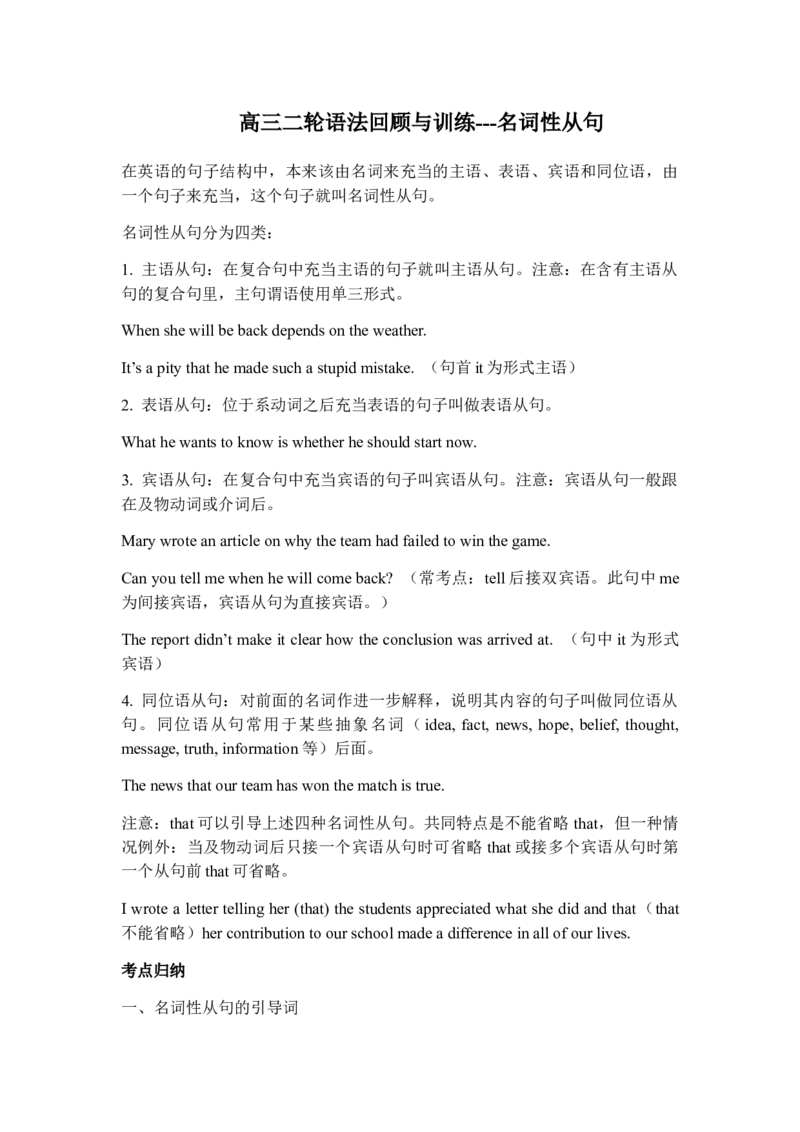
高三二轮语法回顾与训练---名词性从句
在英语的句子结构中,本来该由名词来充当的主语、表语、宾语和同位语,由
一个句子来充当,这个句子就叫名词性从句。
名词性从句分为四类:
1. 主语从句:在复合句中充当主语的句子就叫主语从句。注意:在含有主语从
句的复合句里,主句谓语使用单三形式。
When she will be back depends on the weather.
It’s a pity that he made such a stupid mistake. (句首it为形式主语)
2. 表语从句:位于系动词之后充当表语的句子叫做表语从句。
What he wants to know is whether he should start now.
3. 宾语从句:在复合句中充当宾语的句子叫宾语从句。注意:宾语从句一般跟
在及物动词或介词后。
Mary wrote an article on why the team had failed to win the game.
Can you tell me when he will come back? (常考点:tell后接双宾语。此句中me
为间接宾语,宾语从句为直接宾语。)
The report didn’t make it clear how the conclusion was arrived at. (句中it为形式
宾语)
4. 同位语从句:对前面的名词作进一步解释,说明其内容的句子叫做同位语从
句。同位语从句常用于某些抽象名词(idea, fact, news, hope, belief, thought,
message, truth, information等)后面。
The news that our team has won the match is true.
注意:that可以引导上述四种名词性从句。共同特点是不能省略 that,但一种情
况例外:当及物动词后只接一个宾语从句时可省略 that或接多个宾语从句时第
一个从句前that可省略。
I wrote a letter telling her (that) the students appreciated what she did and that(that
不能省略)her contribution to our school made a difference in all of our lives.
考点归纳
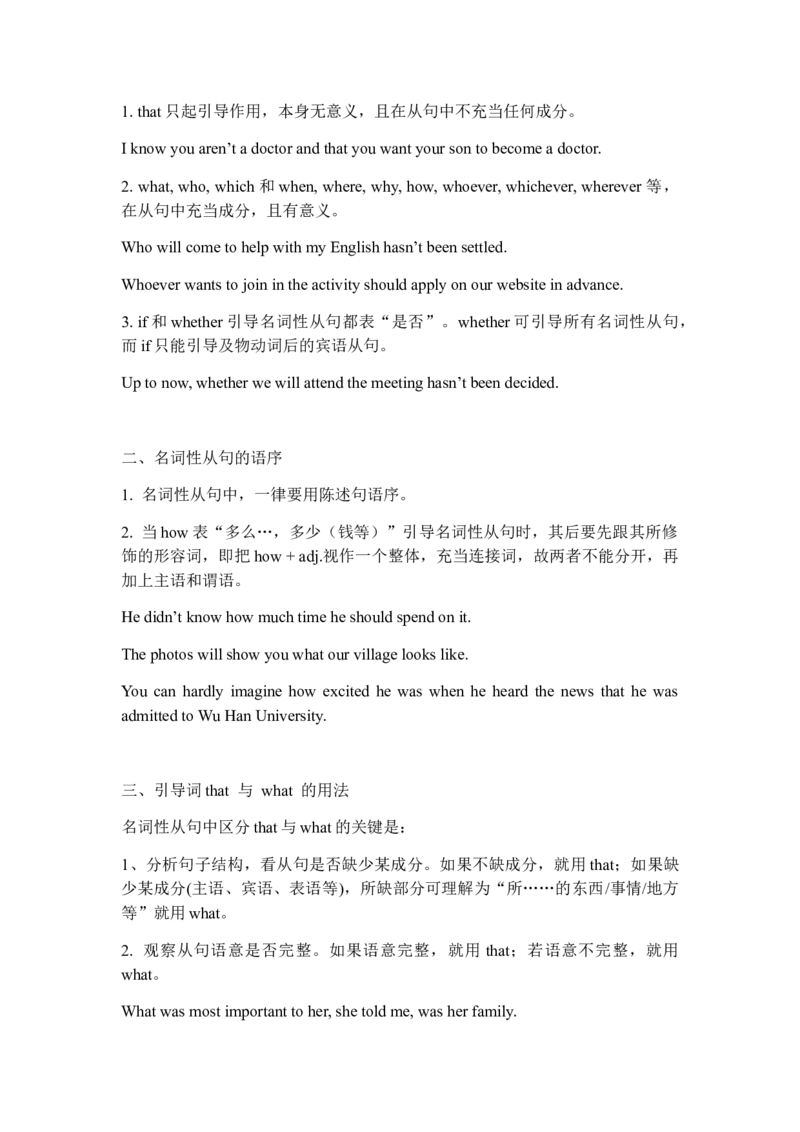
一、名词性从句的引导词1. that只起引导作用,本身无意义,且在从句中不充当任何成分。
I know you aren’t a doctor and that you want your son to become a doctor.
2. what, who, which 和 when, where, why, how, whoever, whichever, wherever 等,
在从句中充当成分,且有意义。
Who will come to help with my English hasn’t been settled.
Whoever wants to join in the activity should apply on our website in advance.
3. if和whether引导名词性从句都表“是否”。whether可引导所有名词性从句,
而if只能引导及物动词后的宾语从句。
Up to now, whether we will attend the meeting hasn’t been decided.
二、名词性从句的语序
1. 名词性从句中,一律要用陈述句语序。
2. 当how表“多么…,多少(钱等)”引导名词性从句时,其后要先跟其所修
饰的形容词,即把how + adj.视作一个整体,充当连接词,故两者不能分开,再
加上主语和谓语。
He didn’t know how much time he should spend on it.
The photos will show you what our village looks like.
You can hardly imagine how excited he was when he heard the news that he was
admitted to Wu Han University.
三、引导词that 与 what 的用法
名词性从句中区分that与what的关键是:
1、分析句子结构,看从句是否缺少某成分。如果不缺成分,就用that;如果缺
少某成分(主语、宾语、表语等),所缺部分可理解为“所……的东西/事情/地方
等”就用what。
2. 观察从句语意是否完整。如果语意完整,就用 that;若语意不完整,就用
what。
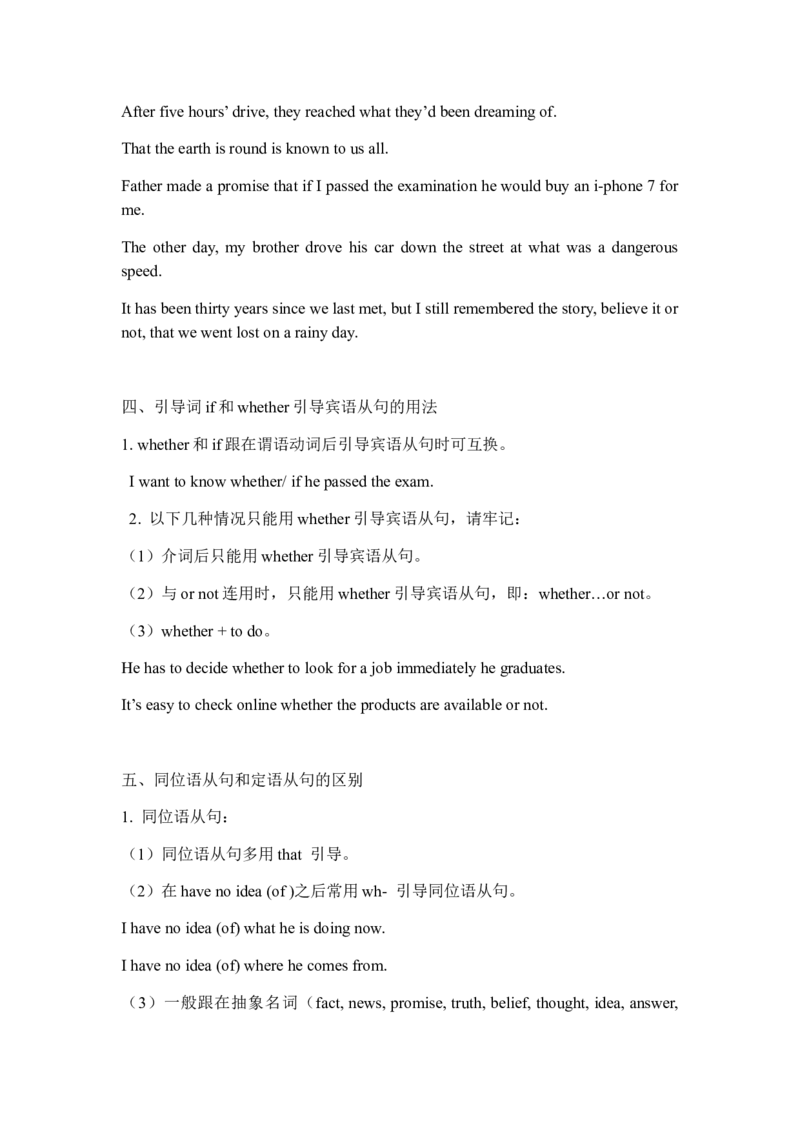
What was most important to her, she told me, was her family.After five hours’ drive, they reached what they’d been dreaming of.
That the earth is round is known to us all.
Father made a promise that if I passed the examination he would buy an i-phone 7 for
me.
The other day, my brother drove his car down the street at what was a dangerous
speed.
It has been thirty years since we last met, but I still remembered the story, believe it or
not, that we went lost on a rainy day.
四、引导词if和whether引导宾语从句的用法
1. whether和if跟在谓语动词后引导宾语从句时可互换。
I want to know whether/ if he passed the exam.
2. 以下几种情况只能用whether引导宾语从句,请牢记:
(1)介词后只能用whether引导宾语从句。
(2)与or not连用时,只能用whether引导宾语从句,即:whether…or not。
(3)whether + to do。
He has to decide whether to look for a job immediately he graduates.
It’s easy to check online whether the products are available or not.
五、同位语从句和定语从句的区别
1. 同位语从句:
(1)同位语从句多用that 引导。
(2)在have no idea (of )之后常用wh- 引导同位语从句。
I have no idea (of) what he is doing now.
I have no idea (of) where he comes from.
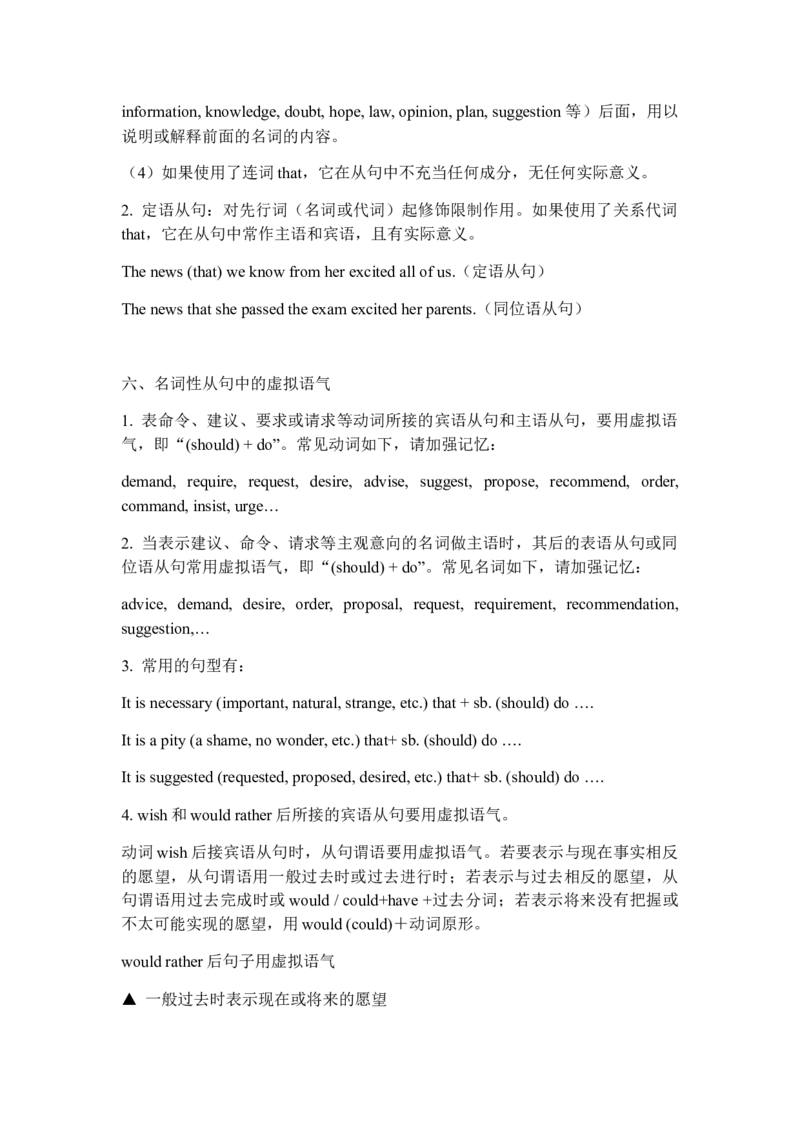
(3)一般跟在抽象名词(fact, news, promise, truth, belief, thought, idea, answer,information, knowledge, doubt, hope, law, opinion, plan, suggestion 等)后面,用以
说明或解释前面的名词的内容。
(4)如果使用了连词that,它在从句中不充当任何成分,无任何实际意义。
2. 定语从句:对先行词(名词或代词)起修饰限制作用。如果使用了关系代词
that,它在从句中常作主语和宾语,且有实际意义。
The news (that) we know from her excited all of us.(定语从句)
The news that she passed the exam excited her parents.(同位语从句)
六、名词性从句中的虚拟语气
1. 表命令、建议、要求或请求等动词所接的宾语从句和主语从句,要用虚拟语
气,即“(should) + do”。常见动词如下,请加强记忆:
demand, require, request, desire, advise, suggest, propose, recommend, order,
command, insist, urge…
2. 当表示建议、命令、请求等主观意向的名词做主语时,其后的表语从句或同
位语从句常用虚拟语气,即“(should) + do”。常见名词如下,请加强记忆:
advice, demand, desire, order, proposal, request, requirement, recommendation,
suggestion,…
3. 常用的句型有:
It is necessary (important, natural, strange, etc.) that + sb. (should) do ….
It is a pity (a shame, no wonder, etc.) that+ sb. (should) do ….
It is suggested (requested, proposed, desired, etc.) that+ sb. (should) do ….
4. wish和would rather后所接的宾语从句要用虚拟语气。
动词wish后接宾语从句时,从句谓语要用虚拟语气。若要表示与现在事实相反
的愿望,从句谓语用一般过去时或过去进行时;若表示与过去相反的愿望,从
句谓语用过去完成时或would / could+have +过去分词;若表示将来没有把握或
不太可能实现的愿望,用would (could)+动词原形。
would rather后句子用虚拟语气
▲ 一般过去时表示现在或将来的愿望I’d rather you went tomorrow (now). 我宁愿你明天(现在)去。
▲ 用过去完成时表过去的愿望
I’d rather you hadn’t said it. 我真希望你没有这样说过。
强化训练
一、填空:在空白处填入适当的内容(1个单词)或括号内单词的适当形式。
1. By paying children for chores with an allowance, you’ll also be sending the
message __________ work isn’t worth doing _________ they are getting paid for it.
2. It remains to be seen _________ people really want to carry both a smart phone
_________ a smart watch.
3. Pick yourself up. Courage is doing _________ you’re afraid to do.
4. The suggestion _________ the students should learn something useful is worth
_________ (consider). 学生们要学点有用的东西的建议是值得考虑的。
5. Whether we can live in harmony with nature depends on _________ effective
measures will _________ (take) to reduce pollution.
6. _________ is strongly advised that the contracts _________ (read) through
thoroughly.
7. We take it for granted _________ with memory we can remember most of things
_________ (happen) in our life.
8. _________ puzzles scientists how these creatures can survive in such severe
conditions _________ described here.
9. _________ amazed us was _________ he managed to work out such a hard maths
problem in _________ a short time.
10. He became interested in two _________ (theory) that possibly explained
_________ cholera killed people.
11. _________ (prevent) this from happening again, John Snow suggested that the
source of all the water supplies _________ (examine).
12. Exactly _________ the potato _________ (introduce) into Europe is uncertain, butit was probably around 1565.
二、改错:每句错误最多有两处。错误涉及一个单词的增加、删除和修改。
1. What is known to us all that it’s great importance to improve working conditions
for factory workers.
2. The notice came around two o’clock in this afternoon the meeting would be put off.
3. Some people have the idea you can cross Canada in little than five days.
4. What’s even more importance is as the earth cooled down, water began to appear
on its surface.
5. Being Senior 3 student, I often quarrel with my mother over if I can watch TV after
school.
6. I am very glad to have read the notice what you posted the other day for several
places of interests to visit during your stay in China.
7. Helen, a author and expert in Japanese cartoons, explained that the character is so
popular.
8. The reason why Tom didn’t attend to school is because he got ill.
9. How we understand things have a lot of to do with what we feel.
10. We must find out how Karl is coming, so we can book room for him in advance.
三、翻译。
1. 最重要的是,作为一名交换生我已经接触了美国文化。
2. 真诚地希望我能被给予这次机会。
3. 人们普遍认为教育不应该仅仅通过考试结果来衡量。
4. 相反,其他人认为经常做运动与健康息息相关。
5. 我想要知道,除了合理的价格,是否还有其他的好处。
6. 我坚信:如果你考虑我的建议,你将取得巨大进步。
7. 我不知道成为一名好老师需要什么。
8. 我们必须记住浪费时间等于浪费生命。参考答案:
一、填空
1. that; unless 2. whether; and 3. what 4. that; considering 5. whether; be taken 6.
It; (should) be read 7. that; happening 8. It; as 9. What; how; such 10. theories; why
11. To prevent; (should) be examined 12. when; was introduced
二、改错
1. What - It或all后面加is; great前加of
2. 去掉in; afternoon后加that
3. idea后加that; little-less
4. importance - important; as前加that
5. Being后加a; if - whether
6. what - that; interests - interest
7. a - an; that - why
8. 去掉to; because - that
9. have - has; 去掉of
10. how - when; room前加a
三、翻译
1. What matters most is that I have been exposed to the American culture as an
exchange student.
2. I sincerely hope that I can be given this opportunity.
3. It’s universally / generally / commonly / acknowledged / believed that educationshouldn’t be
measured only by exam results.
4. On the contrary, the rest hold the view that taking regular exercise is closely related
to health.
5. I’d like to know if/whether there are any other benefits besides reasonable fees.
6. I firmly believed that /am greatly convinced that you will make big/great progress
if you take my suggestions into consideration/account.
7. I have no idea what it takes to become a good teacher.
8. We must keep in mind that wasting time is equal to wasting our life.