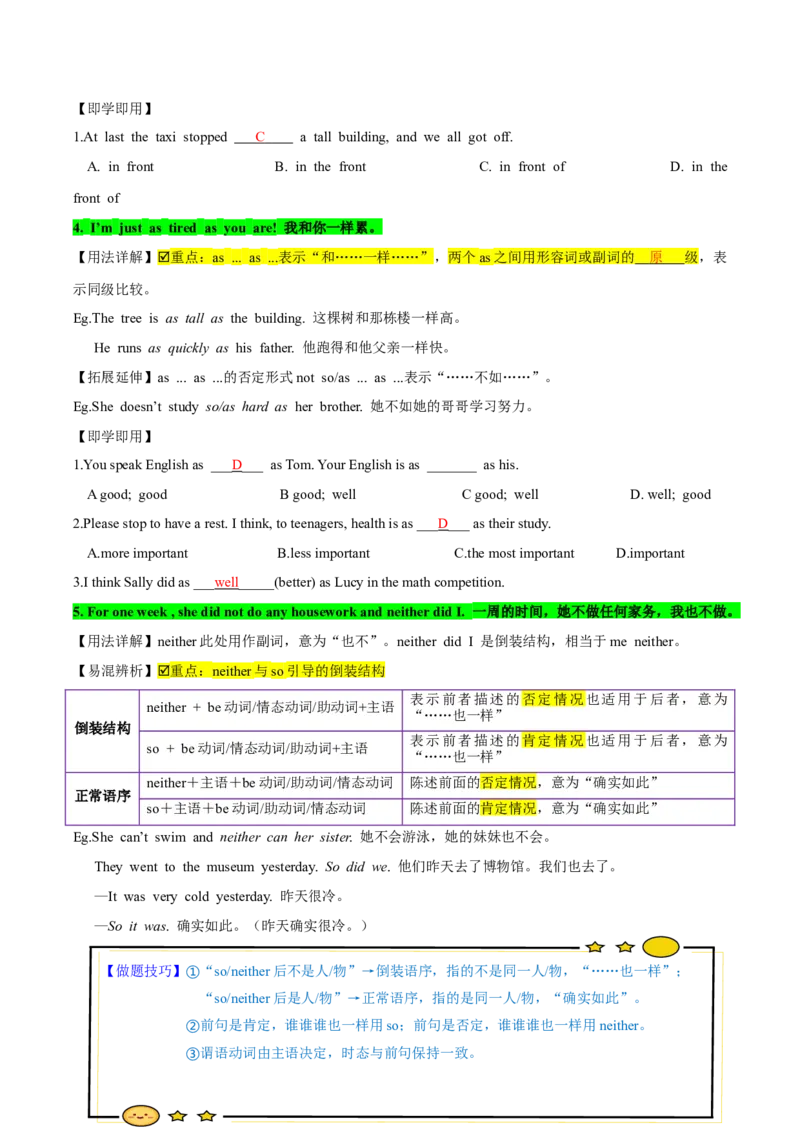
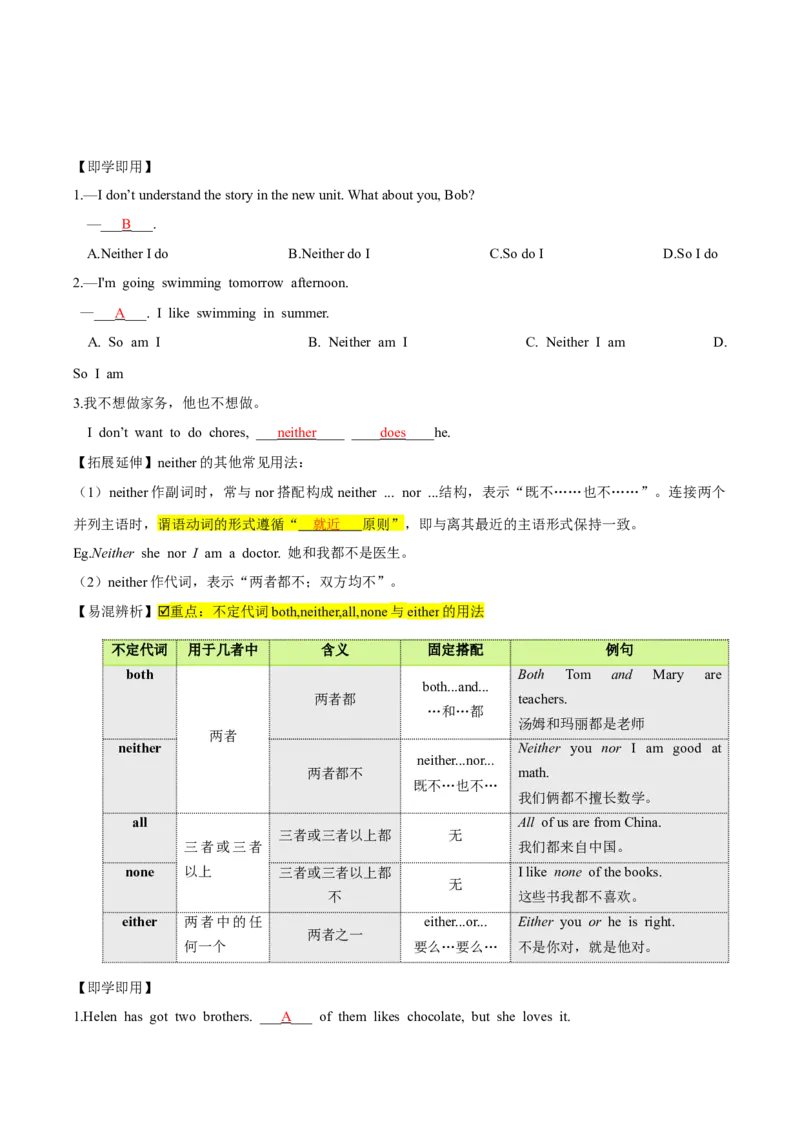
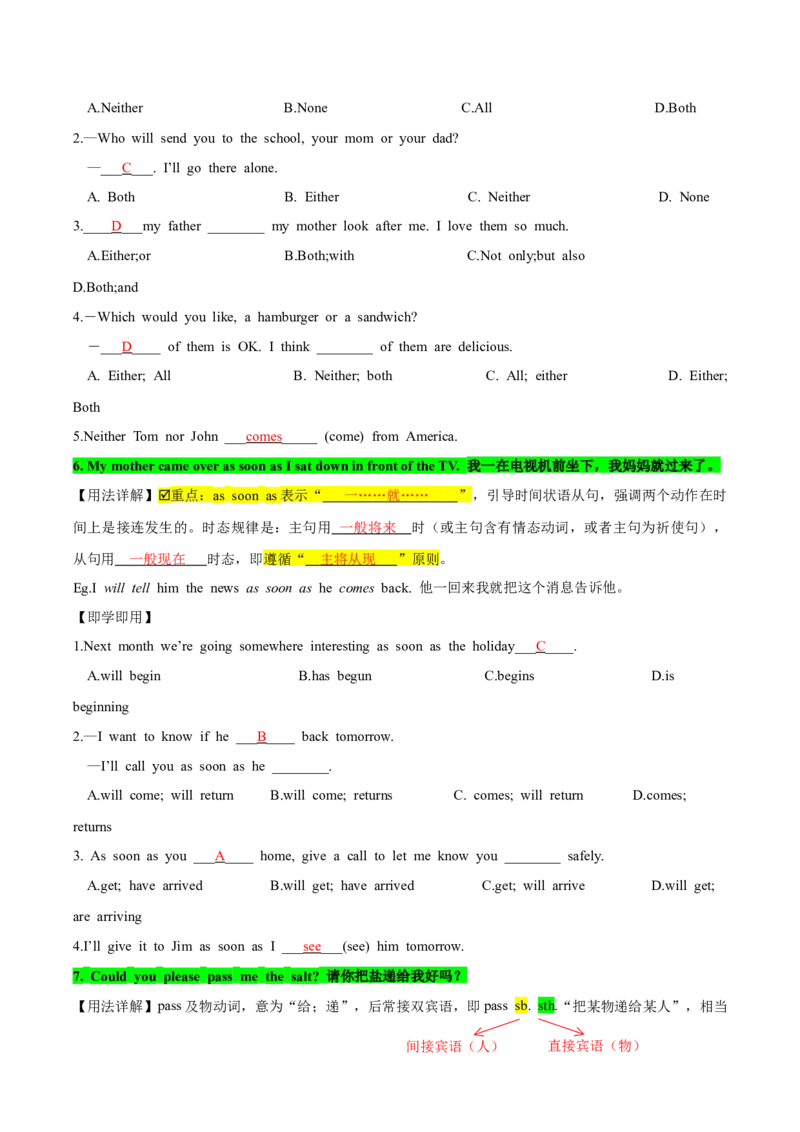
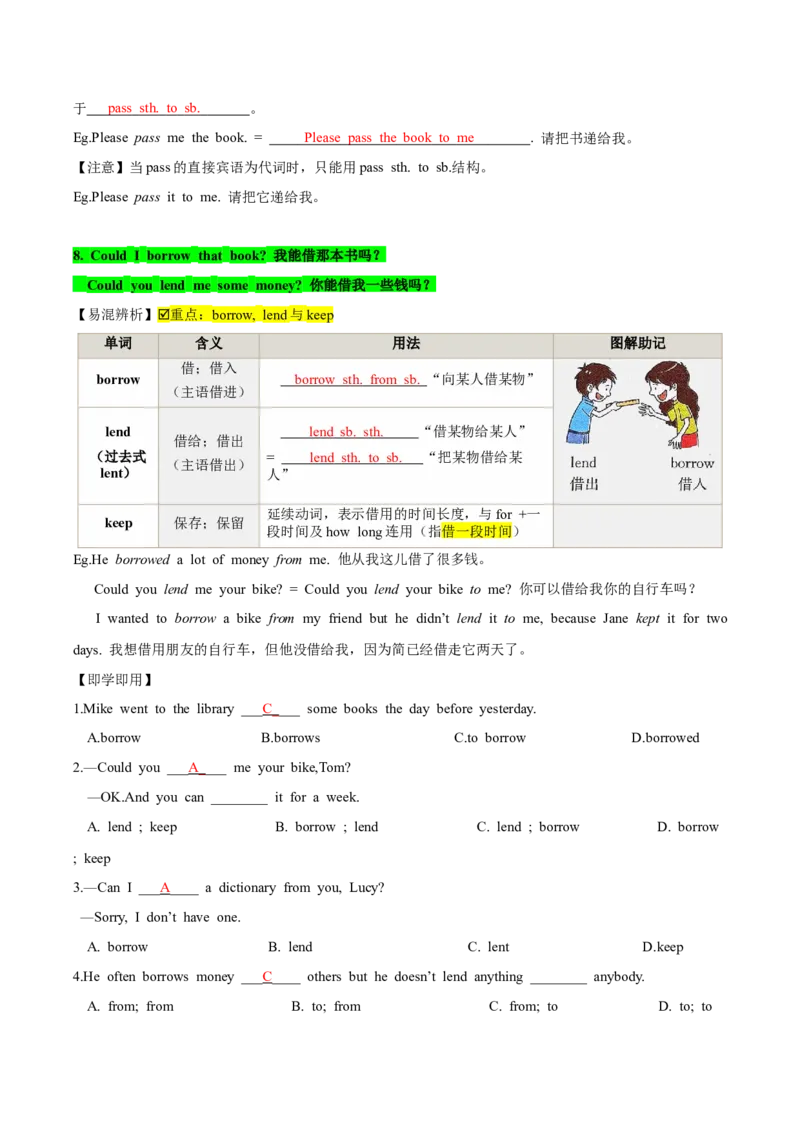
八年级下册英语 Unit 3 知识点与语法精讲精练
词汇梳理
(一)完成单词梳理:
名词:1. rubbish 垃圾;废弃物 2. floo r 地板 3. mes s 杂乱;不整
洁
4. shir t 衬衫 5. finge r 手指 6. chor e 杂务;乏味无聊的工
作
7. snack 点心;小吃;快餐 8. stres s 精神压力;心理负担 9. independenc e 独
立
10. fairnes s 公正性;合理性 11. neighbo r 邻居
动词:1. fol d 折叠;对折 2. swee p 扫;打扫 3. throw 扔;
掷
4. pas s 给;递;走过;通过 5. borrow 借;借用 6. lend 借给;借
出
7. hat e 厌恶;讨厌 8. provid e 提供;供应 9. depen d 依靠;依
赖
10. develo p 发展;壮大 11. dro p 落下;掉下
副词:1. anywa y 而且;加之
连词:1. whil e 与……同时;当……时候;而;然而
形容词:1. il l 有病;不舒服 2. independen t 独立的;自主的
3. fai r 合理的;公正的 4. unfai r 不合理的;不公正的
兼类词:1. neithe r (adv)也不(pron)两者都不
2. wast e (n)浪费;垃圾(v)浪费;滥用
3. sinc e (conj)因为;既然(prep)从……以后;自……以来
(二)词汇变形小结:
1. sweep 打扫(v.) → ____swept______ (过去式)
2. throw 扔(v.) → ____threw______ (过去式)3. lend 借给;借出(v.) → _____lent______ (过去式)
4. depend 依赖(v.) → ___dependence____ (n.)依赖→ ___dependent___ (adj.)依赖的
5. independence 独立(n.)→ ___independent____ (adj.)独立的
6. develop发展;培养(v.) → development (n.) 发展→_developing_(adj.)发展中的→_developed_(adj.) 发达
的
7. fair 公平的(adj.) →___fairness___ (n.)公平→___unfair____ (反义词)不公平的→__unfairness_ (n.)不公
平
8. ill 生病的(adj.)→ ___illness_____ (n.)疾病
9. drop 落下(v.) → ___dropped____ (过去式)→ ___dropping____(现在分词)
【练一练】用所给词的适当形式填空
1. The boy came up with the idea of ___fairness____ (fair).
2. Amy was unlucky that she ___dropped_____ (drop) her sunglasses into the water.
3. The fourth day of July is the National ___independence___ (independent) Day of the US.
4. The __development__ (develop) of 5G makes people’s life more convenient.
5. The boy ____threw______ (throw) a small stone at a dog. And then he ran away.
6. I think it’s ____unfair______ (fair) for him to do all the housework.
7. Could you please do the ____dishes______ (dish) after you have dinner?
8. Last Sunday I ____lent______ (lend) some books to my brother.
9. Please don't tell him about his ____illness______ (ill). It's a secret.
10. The students in our class are old enough to take care of ___themselves___(they).
(三)短语攻关:
tak e ou t th e rubbis h 倒垃圾 d o chore s 做家务
d o th e dishe s 洗餐具 fol d on e ’ s clothe s 叠衣服
swee p th e floo r 扫地 mak e the/on e ’ s be d 整理床铺
al l th e tim e 频繁;反复 a s soo n a s 一……就……
g o t o th e movie s 去看电影 ge t a rid e 搭车
b e angr y wit h sb . 生某人的气 throw dow n 扔下;扔掉
han g ou t 闲逛 g o ou t fo r dinne r 出去吃(晚饭)
i n orde r t o 目的是;为了 depen d o n 依靠;依赖tak e car e o f 照顾;处理 provid e sth . fo r sb . 为某人提供某物
知识点梳理
1.Peter, could you please take out the rubbish? 彼得,请你把垃圾倒掉好吗?
【用法详解】知识点1: 重点:“Could you please ...?”表示“请你……好吗?”,后接动词 原形
,否定形式为 Coul d yo u pleas e no t do... ? 。其中could表示委婉语气,不表示过去时态。
其答语如下:
肯定回答,如Yes, sure./Sure./Certainly./OK./No problem.等;
否定回答,如Sorry, I can’t./Sorry, I’m afraid not. Because ...等。
Eg.—Could you please pass me the spoon? 请你把勺子递给我好吗?
—Sure. Here you are. 当然可以,给你。
Could you please not play computer games? 请你不要玩电脑游戏了好吗?
知识点2: take out表示“取出;拿出”,是“动词+副词”构成的短语。当宾语是名词时,置于out前后
均可;当宾语是代词时,只能放在take和out之间。
Eg.Please take a pen and paper out. = Please take out a pen and paper. 请把钢笔和纸拿出来。
The new book is in the box. Please take it out. 那本新书在箱子里,请把它拿出来。
【即学即用】
1.—Could I borrow your camera?
—____B____, but please give it back by Saturday.
A. I am sorry B. Of course C. Certainly not D. No, thanks
2.—Sir, could you please put out your cigarette(香烟)? This is a smoke-free(无烟的)school.
—____A____
A. I'm sorry about this. B. No problem.
C. Sure, I'd love to D. Never mind.
3.Here’s so much rubbish. Could you please ____D____?
A. give out it B. give it out C. take out it D. take it out
4.Could you please ____C____ your bike here?A. don’t stop B. not to stop C. not stop D. not
stopping
5.Could you please ___lend____ (lend) me your bike?
2. I think two hours of TV is enough for you! 我觉得你看两个小时的电视已经足够了。
【用法详解】(1)这是一个含有宾语从句的复合句。主句是I think,其后为宾语从句,省略了引导词
that。
Eg.I think (that) it will rain tomorrow. 我认为明天会下雨。
(2)two hours of TV在从句中作主语,谓语动词用单数形式。在英语中,表示时间、距离、金额、度量等
词语作主语时,通常被视作整体,谓语动词用单数形式。
Eg.Thirty miles is a long way to walk. 三十英里路是要步行很远的一段路。
—How much are the shoes? 这双鞋多少钱?
—Fifteen dollars is enough. 十五美元足够了。
【即学即用】
1.For kids of this age, two hours of sitting in a classroom A too long.
A. is B. are C. was D. were
2.How time flies! Three years i s (be) really a short time.
3.Emma thinks two kilometers of running every day make s ( make) her healthier.
3. The minute I sat down in front of the TV, my mom came over. 我刚坐在电视机前,妈妈就走了过
来。
【用法详解】the minute...表示“一……就……”,常用于引导时间状语从句,相当于as soon as。
Eg.The minute I got to school, I realized I had left my pen at home. 我刚到学校就意识到我把钢笔落在
家里了。
【易混辨析】in front of与in the front of
介词短语 用 法 举 例 图 解 记 忆
在 物 体 外 部 There is a girl in front of
in front of (内部/外部)的 the car. 轿车的前面有一个
前面 女孩。
在 物 体 内 部 Mike and Lucy sit in the front
in the front of (内部/外部)的 of the bus.迈克和露西坐在
前面 轿车前面。【即学即用】
1.At last the taxi stopped C a tall building, and we all got off.
A. in front B. in the front C. in front of D. in the
front of
4. I’m just as tired as you are! 我和你一样累。
【用法详解】重点:as ... as ...表示“和……一样……”,两个as之间用形容词或副词的 原 级,表
示同级比较。
Eg.The tree is as tall as the building. 这棵树和那栋楼一样高。
He runs as quickly as his father. 他跑得和他父亲一样快。
【拓展延伸】as ... as ...的否定形式not so/as ... as ...表示“……不如……”。
Eg.She doesn’t study so/as hard as her brother. 她不如她的哥哥学习努力。
【即学即用】
1.You speak English as ___D___ as Tom. Your English is as _______ as his.
A good; good B good; well C good; well D. well; good
2.Please stop to have a rest. I think, to teenagers, health is as ___D___ as their study.
A.more important B.less important C.the most important D.important
3.I think Sally did as ___well_____(better) as Lucy in the math competition.
5. For one week , she did not do any housework and neither did I. 一周的时间,她不做任何家务,我也不做。
【用法详解】neither此处用作副词,意为“也不”。neither did I 是倒装结构,相当于me neither。
【易混辨析】重点:neither与so引导的倒装结构
表示前者描述的否定情况也适用于后者,意为
neither + be动词/情态动词/助动词+主语
“……也一样”
倒装结构
表示前者描述的肯定情况也适用于后者,意为
so + be动词/情态动词/助动词+主语
“……也一样”
neither+主语+be动词/助动词/情态动词 陈述前面的否定情况,意为“确实如此”
正常语序
so+主语+be动词/助动词/情态动词 陈述前面的肯定情况,意为“确实如此”
Eg.She can’t swim and neither can her sister. 她不会游泳,她的妹妹也不会。
They went to the museum yesterday. So did we. 他们昨天去了博物馆。我们也去了。
—It was very cold yesterday. 昨天很冷。
—So it was. 确实如此。(昨天确实很冷。)
【做题技巧】①“so/neither后不是人/物”→倒装语序,指的不是同一人/物,“……也一样”;
“so/neither后是人/物”→正常语序,指的是同一人/物,“确实如此”。
②前句是肯定,谁谁谁也一样用so;前句是否定,谁谁谁也一样用neither。
③谓语动词由主语决定,时态与前句保持一致。【即学即用】
1.—I don’t understand the story in the new unit. What about you, Bob?
—___B___.
A.Neither I do B.Neither do I C.So do I D.So I do
2.—I'm going swimming tomorrow afternoon.
—___A___. I like swimming in summer.
A. So am I B. Neither am I C. Neither I am D.
So I am
3.我不想做家务,他也不想做。
I don’t want to do chores, ___neither____ ____does____he.
【拓展延伸】neither的其他常见用法:
(1)neither作副词时,常与nor搭配构成neither ... nor ...结构,表示“既不……也不……”。连接两个
并列主语时,谓语动词的形式遵循“ 就近 原则”,即与离其最近的主语形式保持一致。
Eg.Neither she nor I am a doctor. 她和我都不是医生。
(2)neither作代词,表示“两者都不;双方均不”。
【易混辨析】重点:不定代词both,neither,all,none与either的用法
不定代词 用于几者中 含义 固定搭配 例句
both Both Tom and Mary are
both...and...
两者都 teachers.
…和…都
汤姆和玛丽都是老师
两者
neither Neither you nor I am good at
neither...nor...
两者都不 math.
既不…也不…
我们俩都不擅长数学。
all All of us are from China.
三者或三者以上都 无
三者或三者 我们都来自中国。
none 以上 三者或三者以上都 I like none of the books.
无
不 这些书我都不喜欢。
either 两者中的任 either...or... Either you or he is right.
两者之一
何一个 要么…要么… 不是你对,就是他对。
【即学即用】
1.Helen has got two brothers. ___A___ of them likes chocolate, but she loves it.A.Neither B.None C.All D.Both
2.—Who will send you to the school, your mom or your dad?
—___C___. I’ll go there alone.
A. Both B. Either C. Neither D. None
3.____D___my father ________ my mother look after me. I love them so much.
A.Either;or B.Both;with C.Not only;but also
D.Both;and
4.―Which would you like, a hamburger or a sandwich?
―___D____ of them is OK. I think ________ of them are delicious.
A. Either; All B. Neither; both C. All; either D. Either;
Both
5.Neither Tom nor John ___comes_____ (come) from America.
6. My mother came over as soon as I sat down in front of the TV. 我一在电视机前坐下,我妈妈就过来了。
【用法详解】重点:as soon as表示“ 一……就…… ”,引导时间状语从句,强调两个动作在时
间上是接连发生的。时态规律是:主句用 一般将来 时(或主句含有情态动词,或者主句为祈使句),
从句用 一般现在 时态,即遵循“ 主将从现 ”原则。
Eg.I will tell him the news as soon as he comes back. 他一回来我就把这个消息告诉他。
【即学即用】
1.Next month we’re going somewhere interesting as soon as the holiday___C____.
A.will begin B.has begun C.begins D.is
beginning
2.—I want to know if he ___B____ back tomorrow.
—I’ll call you as soon as he ________.
A.will come; will return B.will come; returns C. comes; will return D.comes;
returns
3. As soon as you ___A____ home, give a call to let me know you ________ safely.
A.get; have arrived B.will get; have arrived C.get; will arrive D.will get;
are arriving
4.I’ll give it to Jim as soon as I ___see___(see) him tomorrow.
7. Could you please pass me the salt? 请你把盐递给我好吗?
【用法详解】pass及物动词,意为“给;递”,后常接双宾语,即pass sb. sth.“把某物递给某人”,相当
间接宾语(人) 直接宾语(物)于 pas s sth . t o sb . 。
Eg.Please pass me the book. = Pleas e pas s th e boo k t o m e . 请把书递给我。
【注意】当pass的直接宾语为代词时,只能用pass sth. to sb.结构。
Eg.Please pass it to me. 请把它递给我。
8. Could I borrow that book? 我能借那本书吗?
Could you lend me some money? 你能借我一些钱吗?
【易混辨析】重点:borrow, lend与keep
单词 含义 用法 图解助记
借;借入
borrow borrow sth . from sb . “向某人借某物”
(主语借进)
lend len d sb . sth . “借某物给某人”
借给;借出
(过去式 = len d sth . t o sb . “把某物借给某
(主语借出)
lent) 人”
延续动词,表示借用的时间长度,与for +一
keep 保存;保留
段时间及how long连用(指借一段时间)
Eg.He borrowed a lot of money from me. 他从我这儿借了很多钱。
Could you lend me your bike? = Could you lend your bike to me? 你可以借给我你的自行车吗?
I wanted to borrow a bike from my friend but he didn’t lend it to me, because Jane kept it for two
days. 我想借用朋友的自行车,但他没借给我,因为简已经借走它两天了。
【即学即用】
1.Mike went to the library ___C____ some books the day before yesterday.
A.borrow B.borrows C.to borrow D.borrowed
2.—Could you ___A____ me your bike,Tom?
—OK.And you can ________ it for a week.
A. lend ; keep B. borrow ; lend C. lend ; borrow D. borrow
; keep
3.—Can I ___A____ a dictionary from you, Lucy?
—Sorry, I don’t have one.
A. borrow B. lend C. lent D.keep
4.He often borrows money ___C____ others but he doesn’t lend anything ________ anybody.
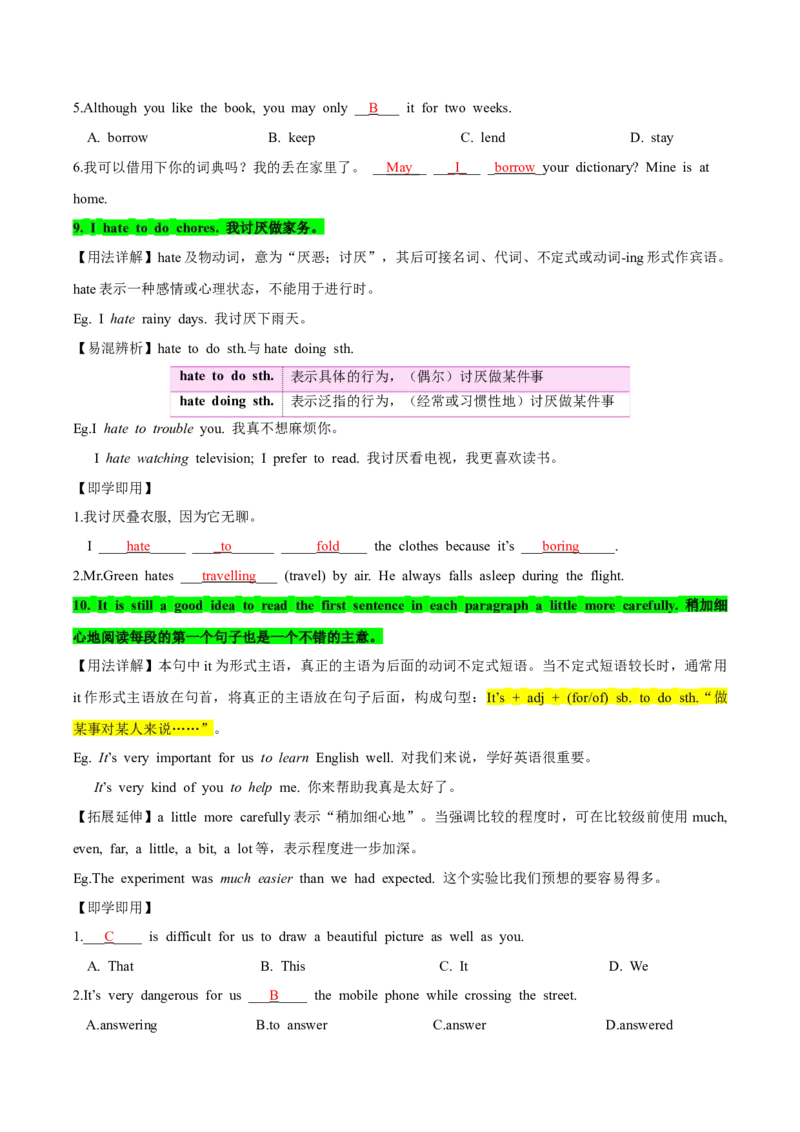
A. from; from B. to; from C. from; to D. to; to5.Although you like the book, you may only __B___ it for two weeks.
A. borrow B. keep C. lend D. stay
6.我可以借用下你的词典吗?我的丢在家里了。 __ May _ ___I___ _borrow_your dictionary? Mine is at
home.
9. I hate to do chores. 我讨厌做家务。
【用法详解】hate及物动词,意为“厌恶;讨厌”,其后可接名词、代词、不定式或动词-ing形式作宾语。
hate表示一种感情或心理状态,不能用于进行时。
Eg. I hate rainy days. 我讨厌下雨天。
【易混辨析】hate to do sth.与hate doing sth.
hate to do sth. 表示具体的行为,(偶尔)讨厌做某件事
hate doing sth. 表示泛指的行为,(经常或习惯性地)讨厌做某件事
Eg.I hate to trouble you. 我真不想麻烦你。
I hate watching television; I prefer to read. 我讨厌看电视,我更喜欢读书。
【即学即用】
1.我讨厌叠衣服, 因为它无聊。
I ____hate_____ ___ _ to ______ _____fold____ the clothes because it’s ___boring_____.
2.Mr.Green hates ___travelling___ (travel) by air. He always falls asleep during the flight.
10. It is still a good idea to read the first sentence in each paragraph a little more carefully. 稍加细
心地阅读每段的第一个句子也是一个不错的主意。
【用法详解】本句中it为形式主语,真正的主语为后面的动词不定式短语。当不定式短语较长时,通常用
it作形式主语放在句首,将真正的主语放在句子后面,构成句型:It’s + adj + (for/of) sb. to do sth.“做
某事对某人来说……”。
Eg. It’s very important for us to learn English well. 对我们来说,学好英语很重要。
It’s very kind of you to help me. 你来帮助我真是太好了。
【拓展延伸】a little more carefully表示“稍加细心地”。当强调比较的程度时,可在比较级前使用 much,
even, far, a little, a bit, a lot等,表示程度进一步加深。
Eg.The experiment was much easier than we had expected. 这个实验比我们预想的要容易得多。
【即学即用】
1.___C____ is difficult for us to draw a beautiful picture as well as you.
A. That B. This C. It D. We
2.It’s very dangerous for us ___B____ the mobile phone while crossing the street.
A.answering B.to answer C.answer D.answered3.It is important for children __ to learn ____(learn) how to do chores at home.
11. They should spend their time on schoolwork in order to get good grades and get into a good
university. 为了取得好成绩并考入好大学,他们应该把时间花在学业上。
【用法详解】知识点1: “四个花费”(pay, cost, spend与take)
单词 用法 结构
pay 花钱,主语是人 某人花多少钱买某物
sb. pay +钱 for sth.
cost 花钱,主语是物 某物花了某人多少钱
sth. cost sb. +钱
spend 花钱/时间,主语是人 某人在某物上花费时间/金钱
sb. spend +钱/时间 on sth.
某人花费多少时间/金钱做某事
sb. spend +钱/时间(in)doing sth.
take 花时间,it作形式主语 做某事花费某人多长时间
It takes/took sb. +时间 to do sth.
►I spent 100 yuan on the present. 我花了100元买这件礼物。
►It took me 20 minutes to get to school. 我花了20分钟到达学校。
►We paid 150 yuan for the meal. 这顿饭我们花了150元。
►The schoolbag cost me 50 yuan. 这个书包花了我50元。
知识点2: in order to表示“目的是;为了”,后跟动词 原形 ,表示目的。其否定结构为 in order not
to do 。
Eg.People must eat in order to live. 为了生存,人必须吃东西。
In order not to wake the children, they spoke in a low voice. 为了不弄醒孩子们,他们小声说话。
【拓展延伸】如果后接目的状语从句,则可用in order that或so that。
so that +句子 = in order that +句子 = in order to + do,三者可互换。
Eg. He works hard in order that he may succeed. 他为求成功而努力工作。
= H e work s har d s o tha t h e ma y succee d . / H e work s har d i n orde r t o succee d .
【即学即用】
1.Roy works in London. It ___C____ him about half an hour to get to work by bus every day.
A.costs B.spends C.takes D.pays
2.—Do you often read books?
—Yes. I ___B____ most of my time on it. It’s a good way to relax myself.
A.cost B.spend C.pay D.take
3.She got up early this morning ___B____ she could catch the first bus.
A. in order to B. in order that C. as soon as D. whether
4.The parents have to work harder ___in____ ___order___ ___to____ (为了) have a better life.12. It is the parents’ job to provide a clean and comfortable environment at home for their
children. 在家中给他们的孩子提供一个干净、舒适的环境是家长们的事情。
【用法详解】provide及物动词,意为“提供;供应”,其后常接名词或代词作宾语。
常用结构:provide sb. wit h (for/with) sth. / provide sth. fo r (for/with) sb.“为某人提供某物”
Eg.The parents provide their children with food and clothes.
= The parents provide food and clothes for their children. 父母供孩子吃穿。
【即学即用】
1.I can't write a complete report unless you provide me ___B____ enough information about the
competition.
A. for B. with C. to D. of
2.To protect the environment, supermarkets don’t provide free plastic bags ___C____ shoppers.
A. with B. to C. for D. in
3.去年这家工厂为一些残疾人提供了工作。
The factory __provided___ work ____for_____ some disabled people last year.
13. It is the parents’ job to provide a clean and comfortable environment at home for their
children. 在家中给他们的孩子提供一个干净、舒适的环境是家长们的事情。
【用法详解】该句为“the +比较级... , the +比较级...”句式结构,意为“ 越……,就越…… ”,表示一
方随另一方程度的变化而变化。
Eg.The healthier food we eat, the stronger we will be. 我们吃的食物越健康,我们就会越强壮。
【即学即用】
1.在考试中,你越细心,出的错误就越少。
In the exam, ___the_____ ___more____ __careful___ you are, ___the_____ ___fewer___ mistakes you’ll
make.
2.The earlier you learn to be independent, the ___better___ (good) it is for your future.
课堂小测
一、单项选择
1.It’s ___C____ unfair rule that my parents don’t allow me to shop with friends on weekends.
A.a B.the C.an D./
2.Every student can ___C____ two books from the school library at a time and ________ for twoweeks.
A.borrow; lend B.lend; borrow C.borrow; keep D.lend; keep
3.Miss Zheng saves all her money ___A____ buy a gift for her mother on Mother’s Day.
A.in order to B.so that C.in order that D.such as
4.You are old enough to make a living by yourself. You can’t ___B____ your family any more .
A. hear from B. depend on C. take care of D. give up
5.—Which of the two pairs of shoes will you buy?
—___D____. They’re too small for me.
A. Both B. All C. Either D. Neither
6.—Gina , could you please play the drums on the art festival?
—___A____. I can only play the guitar.
A. I’m afraid I can’t B. Yes, I can C. Sure, I’d love to D. Sorry, I
couldn’t
7.Young people hate ___A____ chores because it’s boring.
A. to do B. to doing C. did D. to be doing
8. It only___A____ him 20 minutes ________ to his office every day.
A. takes; to drive B. took; drive C. takes; drive D. took; to
drive
9.Paul isn’t as ___D____ as Sandy. He often makes mistakes in his homework.
A. careless B. more careless C. more careful D. careful
10. He is going to call you as soon as he ___B____ his work.
A. finish B. finishes C. finishing D. will finish
11.Remember to spend some time ___D____ your loved ones, because they’re not going to be around
forever.
A. from B. with C. in D. on
12.—You shouldn’t eat too much junk food. It’s bad for your health.
—You’re right.___A____ junk food eat, ________ I will be.
A. The less; the healthier B. The less; the healthy
C. The more; the healthier D. The more; the healthy
13.—What language is that guy(家伙) speaking? I can hardly catch a single word!
—___B____. He’s from India, so I guess it is Hindi.A.Neither I can B.Neither can I C.So I can D.So can I
14. I’d invite her ___B____ dinner at my house tomorrow.
A. have B. to have C. having D. had
15.—Could you ___A____ please?
—No problem. Here you are.
A. pass it to me B. pass me it C. pass me for it D. pass it
for me
二、用所给词的适当形式填空
1. Three hours of exercise ____is_____ (be) too much for him.
2. I __ will write _ __ (write) to you as soon as I get there.
3. It's important for students __ _ to get _ ___ (get) into a good college.
4. The harder you work, the ___better____ (good) grades you will get.
5. They were very tired, but they didn’t stop ___working___(work).
6. It’s ___unfair____ (fair) that girls aren’t allowed to take part in (允许参加) the sports meeting.
7. It took me an hour __ to write ____ (write) the letter.
8. Linda is a careful girl. She hates ___making___ (make) mistakes.
9. As a student, you should know how to develop your own _independence_(independent).
10. Let’s wait for my mother. She will be back from __shopping___(shop) any minute.
三、完形填空
When I had something difficult to do, I liked to ask my mother for 1 .But she always said,“Do it yourself,
dear.” I was not happy about this at all. I thought she was the 2 mother I had ever seen!
For example, one day, I decided to 3 some friends to my home. My bedroom was not in order. My books
were 4 , and I didn’t make the bed. I asked my mother to help me clean it, but she 5 said,“ Do it yourself.”
Because of my“lazy mother”, I had to 6 my clothes and clean my room. I had to help my parents do 7 .
I even had to go to the doctor by myself. It was really difficult for me to do a good job, but I 8 a lot.
As time goes by, I start to understand my mother. She made 9 clever and hard-working. A 10 mother
is worth(值得)100 teachers! Do you think so?
( B )1. A. money B. help C. time D. sleep
( C )2.A. tallest B. happiest C. laziest D. thinnest
( B )3. A. leave B. invite C. visit D. help
( A )4. A. everywhere B. somewhere C. nowhere D. anywhere( C )5. A. never B. sometimes C. still D. ever
( A )6. A. wash B. move C. buy D. sell
( C )7. A. job B. homework C. housework D. work
( A )8. A. learned B. told C. showed D. saw
( C )9. A. I B. mine C. me D. my
( D )10.A. young B. old C. happy D. good
四、阅读理解
Wang Xinwei lives with his uncle in the village. His parents left him at home and went to work in the city
when he was six. So Wang started doing chores at an early age. Every morning after Wang gets up, he cooks
breakfast for his uncle and himself.Then he takes a mantou to school. It's his lunch. After lunch, Wang usually
plays football with his classmates. Wang goes home as soon as the school is over. He has to help his uncle feed the
chickens and pigs. They usually have dinner at about eight, and then Wang does his homework. On weekends,
Wang washes both his and his uncle's clothes, cuts grass for the pigs and helps his uncle work on the farm.
Wang's parents come back to visit him once a year. Wang wants to visit them during the holidays, but they
are too busy to stay with him. He can only hear his parents' voices on the phone once a week. He misses them a
lot.
( C )1.How old was Wang Xinwei when his parents left him?
A.Four. B.Five. C.Six. D.Seven.
( D )2.What does Wang Xinwei do after he gets up?
A.He takes out the rubbish. B.He takes a shower.
C.He feeds the chickens. D.He cooks breakfast.
( A )3.What does Wang Xinwei usually do at 8:00 p.m.?
A.He usually has dinner. B.He usually does homework.
C.He usually does the dishes. D.He usually does the laundry.
( B )4.Which of the following is TRUE about Wang Xinwei?
A.He eats noodles for lunch. B.He helps work on the farm on the weekend.
C.He stays with his parents during the holidays. D.He writes to his parents once a week.
( B )5.What can we learn about Wang Xinwei?
A.He hates his parents. B.He is an independent boy.
C.He studies very well. D.He wants to be a football player.
五、根据汉语意思完成句子,每空一词1.琳达每天早晨起床后整理床铺。Linda ___makes___ ____her____ ___bed_____ after getting up every
morning.
2.现在的孩子太依赖他们的父母。The children these days ___depend___ ____on_____ their parents too
much.
3.为了取得好的成绩,我在学习上花费了大量的时间。
I spend much time on schoolwork ____in_____ ___order_____ ____to_____ get good glades.
语法精讲
情态动词could的用法
一、情态动词could作为can的过去式时,表示过去的能力和可能性,其否定形式为could not,可缩写为
couldn’t。
Eg.He could write poems when he was 10. 他十岁时就会写诗了。
Judy couldn’t have enough money for a car. 朱迪不可能有足够的钱买汽车。
二、情态动词could可用于礼貌地提出要求或征询许可,此时并非can的过去式。
用法和句式 示例
提出请求: Could you please take the dog for a walk?
Could you please (not) do ...? 请你去遛遛狗好吗?
征询许可: Could I go out for dinner with my friends?
Could I/we do ... ? 我能和朋友一起出去吃(晚)饭吗?
肯定回答常用语: —Could you please clean the room?
Of course./Certainly./OK./Sure./No problem. 请你打扫一下房间好吗?
等
—Sure. 当然可以。
否定回答常用语:
—Could you open the windows? 你能打开窗户吗?
Sorry./Certainly not./I’m afraid I can’t./No,
you can’t等.+说明理由 —Sorry, but I have a cold. 抱歉,我感冒了。
【拓展延伸】
1.对提出请求或征询许可的句型做否定回答时,通常以sorry或I’m sorry开头。
Eg.—Could you help me with my English now? 你现在能帮我学英语吗?
—I’m sorry, but I have a football match ten minutes later. 抱歉,我十分钟后要参加一场足球赛。
2.如果问句中使用could,回答时要用can或can’t,不能用could或couldn’t。
Eg.—Could I use your bike? 我能用一下你的自行车吗?
—Sure, you can. 当然可以。3.其他常见的表示委婉请求或征询许可的句型:
(1)Will/Would you please do ...? 表示“请你做……好吗?”
(2)Would you mind (not) doing ...? 表示“你介意(不)做……吗?”
(3)May I ...? 表示“我可以……吗?”
语法小测
一、单项选择
1.—Could you ride a bike when you were 5 years old?
—___B___. But I could sing some songs.
A.No, I can't. B.No, I couldn't. C.Yes, I can. D.Yes, I
could.
2. At the age of five, Allen ___A___ tell some famous Chinese stories.
A. could B. must C. need D. might
3.—Could you please wash the fruit?
—___A___. I cut my finger and I'm trying not to get it wet.
A. No, I can't B. Yes, sure C.No, you can't D.Yes, you
can
4.—Could I borrow the book?
—___D___, that would be OK. I finished reading it yesterday.
A. Thank you B. I'm sorry C. Never mind D. Of course
5.Kim ___B___ play the violin five years ago,but now he can play it well.
A. mustn't B. couldn't C. needn't D.shouldn't
6. ---Could you please buy ___A___ drinks and snacks?
--- Sorry. I don’t have _______ money.
A. some, any B. any, any C. some, some D. any, some
7.---Could you help me with the math problem?
---___D____. I'm too busy now.
A .Yes, please B. No, sure C. Yes, you could D. Sorry, I can't
8.—Could you finish the task in two days?
—___D____. I have something else to do these days.
A. I could not B. Yes, I think so C. I’m afraid so D. I’m
afraid not9.—Could I use your bike?
—Yes, of course you ___A____.
A. can B. could C. must D. will
10.—Would you mind ___C____ the window? It’s very hot.
—No, not at all.
A. open B.to open C. opening D. opens
11.—Could I borrow your car?
—___B___, I need it. I _______ go to school.
A. Certainly; don’t B. Sorry; have to
C. Certainly; don’t have to D. Sure; have to
12.—Could you lend me the book you bought last week?
—___A___.
A. Yes, here you are B. No, I can’t lend
C. It’s not interesting D. A good idea
13.—Paul, could you please ___C___ the TV? Jim is sleeping now.
—Sorry. I’ll do it right now.
A. turn up B. turning up C. turn down D. turning down
14.---Lily, could you help to feed my cat while I’m away?
---___B___.
A. No, I don’t B. Yes, I will C. No, I mustn’t D.
Yes, I must
15.—Would you mind my smoking here?
—___D____. Can’t you see the sign “No smoking”?
A.Of course not B.No C.Never mind D.You’d better
not
二、语法填空
Ladies and gentlemen,
Good morning! I’ m Li Ping. It’ s my honor to give you a speech. My topic is “ We should help parents do
housework”. Now many of us hate 1. doing (do) housework. Some students think it’s bad for our development.
In my view, we should help parents do some housework .
I often help my parents do some chores such as making the bed and 2. folding (fold) myclothes. They are relaxing and 3. interesting (interest). I also sweep the floor and take 4.
out the rubbish as often as possible. I don’ t think it is 5. a waste of time. Doing
chores can help me be independent. We can’ t depend on our parents 6. all the time.
What’s more, it’s 7. fair (fairness) for us to share the housework 8. because we
are a member of the family. Anyway, we can relax ourselves 9. by doing chores. When I
see the tidy room, I feel proud of myself. My parents are pleased with me. I think it’s 10.
our (us) duty to help our parents do some chores.