Unit 5 语法篇
__________________________________________________________________________________
__________________________________________________________________________________
学生通过本讲学习,能够掌握本单元的重点语法,并在综合能力上有一定的拓展。
when while 的区别和用法
一、while的意思是“在……同时(at the same time that )”“在……期间(for as long as, during the time
that)”。从while的本身词义来看,它只能表示一段时间,不能表示具体的时间点。在时间上可以
是“线线重合”或“点线重合”,但不能表示“点点重合”。例如:
1、He was watching TV while she was cooking. 她做饭时,他在看电视。(线线重合)
2、 He was waiting for me while I was working. 我工作的时候,他正等着我。(线线重合)
3、 He asked me a question while I was speaking. 我在讲话时,他问了我一个问题。(点线重合)
二、when的意思是“当……时候(at the time that)”“无论什么时候(whenever)” “一……
就……(as soon as )” “在……以后(after)”。它表示的时间概念比较广泛,上述例句中的as
或while均可用when代替,因为when不但可以表示具体的时间点,而且也可以表示一段时间。在
时间上它既能表示“点点重合”“线线重合”,又能表示“点线重合”。例如:
1、When he came in,she went out. 他进来,她出去。(点点重合)
此句中when从句的动作表示的是一个时间点,when可以用as代替,但不能用while代替。
2、When he came back,I was doing some washing. 他回来时,我在洗衣服。(点线重合)
此句中when从句的动作表示的是一个时间点,所以只能用as代替,不能用while代替。
as when while的区别
一、根据从句动作的持续性来区分
1、“主短从长”型:即主句是一个短暂性动作,而从句是一个持续性动作,此时三者都可用。
如:
Jim hurt his arm while[when, as] he was playing tennis. 吉姆打网球时把手臂扭伤了。As[When, While] she was waiting for the train, she became very impatient. 她在等火车时,
变得很不耐烦。
注意:as 用于引出一个持续性动词表示“在……期间”时,其谓语通常只能是那些含有动作
(action)和发展(development)意味的动词,一般不能是那些不用于进行时态的动词(如 be,seem,
love,want,agree,see,know,have等),所以下面一句中的 while 不能换为 as:
A:I’m going to the post office. 我要去邮局。
B:While you are there, can you get me some stamps?当你在邮局时,能帮我买几张邮票吗?
2、“主长从长”型:即主句和从句为两个同时进行的动作或存在的状态,且强调主句动作或
状态延续到从句所指的整个时间,此时通常要用while。
I always listen to the radio while I’m driving. 我总是一边开车一边听收音机。
He didn’t ask me in; he kept me standing at the door while he read the message. 他没有让我进去,
他只顾看那张条子,让我站在门口等着。
但是,若主句和从句所表示的两个同时进行的动作含有“一边……一边”之意时,则习惯上要
用as。如:
He swung his arms as he walked. 他走路时摆动着手臂。
I couldn’t remember a story to tell the children, so I made one up as I went along. 我想不出有什么故
事可给孩子讲了,只好现编现讲。
3、“主长从短”型:即主句是一个持续性动作,而从句是一个短暂性动作,此时可以用as或
when,但不能用while。如:
It was raining hard when [as] we arrived. 我们到达时正下着大雨。
When [As] he came in, I was listening to the radio. 他进来时,我在听收音机。
二、根据主句与从句动作是否同时发生来区分
1、若主句与从句表示的是两个同时发生的短暂性动作,含有类似汉语“一……就”的意思,
英语一般要用as (也可用when)。如:
The ice cracked as [when] I stepped onto it. 我一踩冰就裂了。
He jumped to his feet as the boss came in. 老板一进来他立刻站了起来。
但是,在hardly [scarcely]…when…句式中,不能将when换成as。如:
Scarcely had we arrived, when it began to rain. 我们刚一到就下起雨来了。
2、若主句与从句表示的是两个几乎同时发生的短暂性动作,含有类似汉语“刚要……就”
“正要……却”的意思,英语一般要用as(也可用when),且此时通常连用副词just。如:
I caught him just when [as] he was leaving the building. 他正要离开大楼的时候,我把他截住了。
Just as [when] the two men were leaving, a message arrived. 就在这两个人要离开的时候,突然有
了消息。
三、根据是否具有伴随变化来区分
若要表示主句动作伴随从句动作同时发展变化,有类似汉语“随着”的意思,英语习惯上要用
as,而不用when或while。如:
The room grew colder as the fire burnt down. 随着炉火逐渐减弱,房间越来越冷。
As time goes by my memory seems to get worse. 随着时间的流逝,我的记忆力似乎越来越差。注:若不是引导从句,而是引出一个短语,则用with,不用as。如:
With winter coming on, it’s time to buy warm clothes. 随着冬天到来,该买暖和衣裳了。
The shadows lengthened with the approach of sunset. 随着太阳下落,影子也逐渐伸长。
四、根据从句动作的规律性来区分
若暗示一种规律性,表示“每当……的时候”,英语一般要用when。如:
It’s cold when it snows. 下雪时天冷。
He smiles when you praise him. 你夸奖他时他总是笑笑。
五、根据主从句动作的先后顺序来区分
若主句与从句所表示的动作不是同时发生,而是有先后顺序时,一般要用when。如:
When he arrives he’ll tell us all about the match. 等他到了,他会好好给我们讲讲那场比赛的情况。
When she had finished she waited as though for a reply. 她讲完之后等了等,仿佛是在等候回答似
的。
六、根据是否具有“趁机”意味来区分
1、若从句所表示的“当……的时候”具有“趁机”的意味,则通常用while。如:
Strike while the iron is hot. 趁热打铁。
1. --- I telephoned you yesterday afternoon but nobody answered.
--- Oh, I a film at that time.
A. see B. saw C. is seeing D. was seeing
2. While the woman , the accident happened.
A. shopped B. is shopping C. was shopping D. shops
3. He home it began to rain.
A. is walking; when B. was walking; while
C. was walking; when D. is walking; while
4. I the charity show on TV when the telephone rang.
A. watch B. watched C. am watching D. was watching
5. While my parents TV last night, I a new computer game in my
bedroom.
A. watched; have played B. were watching; was playing
C. had watched; was playing D. would watch; was playing
基础演练
一、用所给词的适当形式填空1.The car ______ (sudden) stopped in front of me.
2.The girl began to dream when she fell _______ (sleep).
3.It’s snowing _______ (heavy). You’d better not go out.
4.Don’t talk with _______ (strange) on the Internet. They may be bad men.
5.Lisa dreams of being a ______ (report).
6. If you don’t tell me the _______ (true), I will break up with you.
7. They didn’t say any words. They went home in _______ (silent).
8. Great changes have taken place _______ (recent).
9. The lady was _____ (kill) last night. Nobody knew who killed her.
10. Excuse me, but I must say you are ______ (complete) wrong.
二、翻译(根据中文提示完成句子)
11. 昨天晚上八点你和你妈妈在干什么?
What you and your mother at eight o'clock yesterday evening?
12. 当琳达睡觉的时候,詹妮正在帮玛丽做作业。
While Linda , Jenny
Mary with her homework.
13. 当我们在广播上听到这个消息的时候,我们正在厨房吃晚餐。
We dinner in the kitchen we heard the news
on the radio.
14. 我正做饭的时候伤到了自己。
I hurt myself I .
15. 那是在她吃午饭的时候发生的事。
She was eating her lunch .
巩固提高
翻译(根据中文提示完成句子)
1. 我不知道他的主意是否有效。
I don't know if his idea will .
2. 如果你那样做,你就会使她陷入困境。
If you do that, you might her .
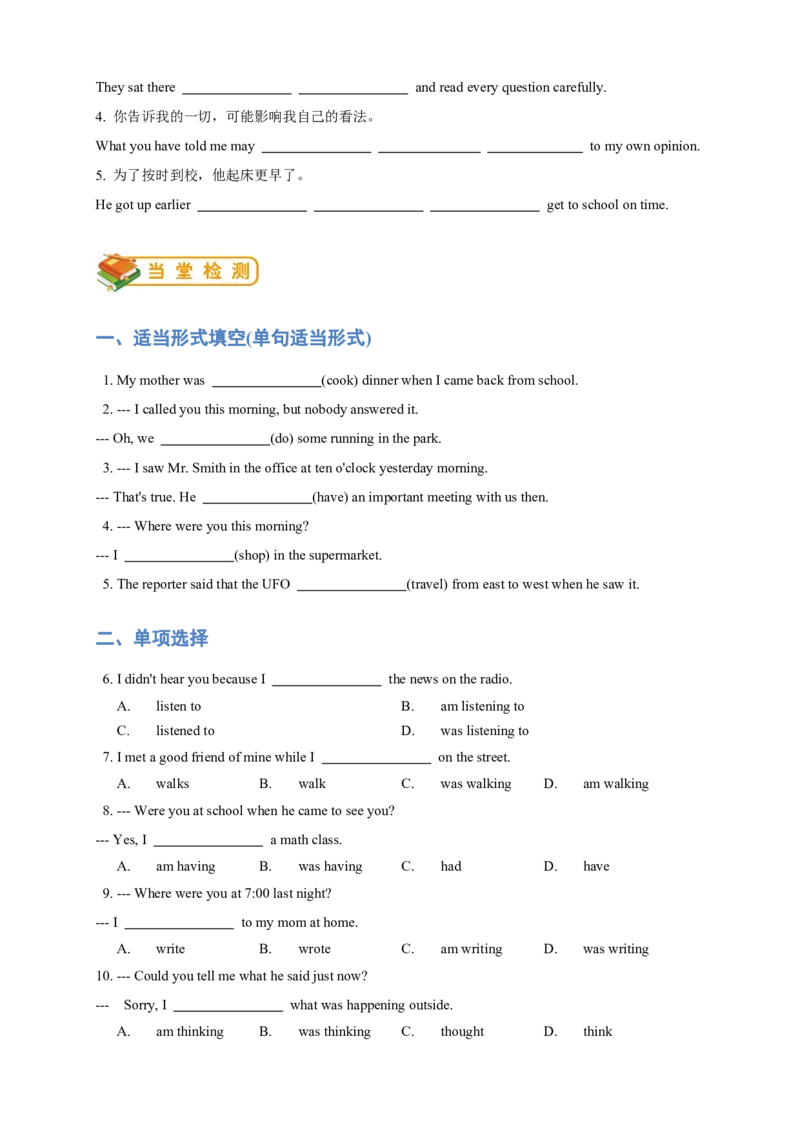
3. 他们静静地坐在那里,仔细阅读每一个问题。They sat there and read every question carefully.
4. 你告诉我的一切,可能影响我自己的看法。
What you have told me may to my own opinion.
5. 为了按时到校,他起床更早了。
He got up earlier get to school on time.
一、适当形式填空(单句适当形式)
1. My mother was (cook) dinner when I came back from school.
2. --- I called you this morning, but nobody answered it.
--- Oh, we (do) some running in the park.
3. --- I saw Mr. Smith in the office at ten o'clock yesterday morning.
--- That's true. He (have) an important meeting with us then.
4. --- Where were you this morning?
--- I (shop) in the supermarket.
5. The reporter said that the UFO (travel) from east to west when he saw it.
二、单项选择
6. I didn't hear you because I the news on the radio.
A. listen to B. am listening to
C. listened to D. was listening to
7. I met a good friend of mine while I on the street.
A. walks B. walk C. was walking D. am walking
8. --- Were you at school when he came to see you?
--- Yes, I a math class.
A. am having B. was having C. had D. have
9. --- Where were you at 7:00 last night?
--- I to my mom at home.
A. write B. wrote C. am writing D. was writing
10. --- Could you tell me what he said just now?
--- Sorry, I what was happening outside.
A. am thinking B. was thinking C. thought D. think三、完形填空
Last Friday a storm visited villages in Honolulu. It destroyed fourteen houses. Seven others were so
badly 11 that their owners had to leave them, and fifteen others had 12 windows,
doors or roofs. One person was 13 , several were badly wounded and taken to 14 , and a number
of other people got 15 . Altogether over two hundred people were 16 as a result of the storm.
A farmer, Mr. Sabin, said that the 17 began early in the morning and lasted for over an hour.
"I was in the kitchen with my wife and children," he said, "when we heard a loud 18 . A few
minutes later our house fell down on top of us. We 19 to climb out but very frightened."
Mrs. Roland said that her husband had just 20 work when she noticed her house 21
. She rushed outside immediately with her children.
"There was no 22 to take anything," she said. "A few minutes later, the roof 23 ."
Soldiers helped to bring 24 out of the flooded area and the government 25 them
with food, clothes and tents.
11. A. damaged B. hurt C. harmed
12. A. repaired B. broken C. opened
13. A. saved B. killed C. stolen
14. A. cinema B. school C. hospital
15. A. tired B. injured C. excited
16. A. sad B. bored C. homeless
17. A. snow B. storm C. earthquake
18. A. cry B. voice C. noise
19. A. managed B. wanted C. searched
20. A. looked for B. left for C. waited for
21. A. sleeping B. running C. shaking
22. A. work B. time C. people
23. A. fell down B. stood up C. fixed up
24. A. food B. animals C. people
25. A. remembered B. provided C. produced
_________________________________________________________________________________
_________________________________________________________________________________阅读理解
What are you going to do if you are in a burning house? How will you escape? Do you know how to
save yourself? Please read the following passage.
Escaping from a fire is a serious matter. Knowing what to do during a fire can save your life. It is
important to know the ways you can use and show them to everyone in the family, such as stairways(楼梯)
and fire escapes, but not lifts.
From the lower floors of the buildings, escaping through windows is possible. Learn the best way of
leaving by windows with the least chance of serious injury(受伤).
The second floor window is usually not very high from the ground. Of course, it is safer to jump a
short way than to stay in a burning building.
Windows are also useful when you are waiting for help. Be sure to keep the door closed. Or smoke
and fire may be drawn into the room. Keep your head low at the window to be sure you get fresh air rather
than smoke that may leak(渗) into the room.
On a second or third floor, the best windows for escape are those that open onto a roof. From the roof
a person can drop to the ground more safely. Dropping onto hard ground might end in injury. Bushes(灌木
丛) and grass can help to break a fall (使势头减弱).
1. It is important to .
A. put out the big fire in the burning house
B. jump off a high burning house
C. know the ways to escape from the fire
D. keep the door open
2. From Paragraph 3, we know that it is possible to escape through the windows .
A. if there are no bushes on the ground
B. if you live on a lower floor
C. if you live on a higher floor
D. if you have no rope
3. Which of the following escaping way is NOT right?
A. You can escape through stairways.
B. You can choose fire escape.
C. Escape from the windows that open onto a roof.
D. Use a lift to come down at once.
4. Of course, it is to jump a short way than to stay in a building on fire.
A. safer B. easier
C. more dangerous D. more difficult5. The best title of the passage is .
A. Escaping from the Windows
B. Waiting for Help
C. Knowledge on Fire
D. Saving Yourself in the Burning House
B
If you find yourself in the middle of an active shooter event (枪击案现场), your safety may depend on
whether or not you have a plan.
The plan doesn't have to be difficult to follow. There are three things you could do to make a
difference: Run, hide, fight.
Run
First and for most, if we can get out, do it! Always try to escape(逃生) even when others insist on(坚
持) staying. Encourage others to leave with us, but do not let them slow us down with the decision. Leave
our things behind, and try to find out a way to get out safely. Try to get ourselves out from the harmed way.
Try to stop others walking into a dangerous area and call 110. Here are some tips for the situation when an
active shooter is around you.
● If there is an escape path, try to evacuate(疏散).
● Evacuate whether others agree to or not.
● Leave your things behind.
● Help others escape if possible.
● Stop others entering the area.
● Call 110 when you are safe.
Hide
If we can't get out safely, we need to find a place to hide. Act quickly and quietly. Try to make sure
our hiding place is good. Turn off lights and if possible, remember to lock doors. Silence our cell phones,
and if we can't find a safe room, try to hide behind a large object(物体) that may protect us. Remember the
following tips:
● Lock and/or blockade (put the things against) the door.
● Silence your cell phone.
● Hide behind large objects.
● Stay very quiet.
FightAs a last resort (万不得已), only if our life is in danger, whether we are alone or working together as a
group, fight! We should try to do the following:
● Look for something that can be used to fight.
● Try your best to protect yourself.
Remember these and you will be safe.
6. The first thing is to in the middle of an active shooter event.
A. run B. hide C. fight D. shout
7. When you find a place to hide, you should .
A. call 110 B. silence your cell phones
C. fight with the shooter D. leave your things behind
8. You have to fight .
A. when you see the shooter
B. if evacuation is impossible
C. only if your life is in danger
D. when you are with your friends
9. How many key ways can help you when this kind of event happens?
A. Three. B. Four. C. Five. D. Six.
C
How many things can you see in the night sky? A lot! On a clear night you might see the Moon, some
planets, and thousands of shining stars.
You can see even more with the help of new inventions. You might see stars where before you only
saw dark space. You might see that many stars look larger than others. You might see that some stars that
look white are really red or blue. With bigger and bigger telescopes you can see more and more objects in
the sky. You can find out more about those objects.
But scientists believe there are some things in the sky that we will never see. We won't see them with
the biggest telescope in the world, on the clearest night of the year.
That's because they can't be seen. They're the mysterious(神秘的) dead stars called black holes.
You might find it hard to imagine that stars die. But stars do burn out and die after billions of years.
As a star burns, it gives off light and heat. But when the star burns out, it begins to die.
As the star cools, the outer parts of the star pull in toward the center. The star squashes into a smaller
and smaller ball. If the star was very small, the star ends up as a cold, dark ball called a black dwarf (黑矮
星). If the star was very big, it keeps squashing inward until it's packed together tighter(紧的) than
anything in the universe.Imagine if the Earth were squashed until it was the size of a tiny ball. That's how tightly this dead star,
a black hole, is packed. What pulls the star in toward its center with such power? It's the same force(力量)
that pulls you down when you jump—the force called gravity(重力). A black hole is so tightly packed that
its gravity sucks(吸收) in everything—even light. The light from a black hole can never come back to your
eyes. That's why you see nothing but blackness.
So the next time you look up into the night sky, remember: there's more in the sky! All over in the
darkness are black holes—the great mystery of space.
10. From the passage we know a black hole is .
A. a huge hole in the universe
B. a group of stars packed together
C. a dead star that is packed tightly
D. complete silent darkness in space
11. When a star squashes it will .
A. turn into a ball B. suck in everything
C. get smaller and smaller D. become darker and darker
12. The passage is mainly about .
A. how stars burn out B. what dead stars are
C. how we can see more stars D. why stars give heat and light