2025-2026 学年八年级下册英语单元自测(安徽卷专用)
Unit 6·培优卷
学校:___________班级:___________姓名:___________分数:___________
注意事项:
1.本试卷满分120分,考试时间120分钟。
2.考生务必用黑色字迹的签字笔或钢笔在答题卡上填写自己的考号、姓名、试室号、座位号,用 2B铅
笔把对应该号码的标号涂黑。
3.选择题每小题选出答案后,用 2B铅笔把答题卡上对应题目选项的答案信息点涂黑,如需改动,用橡
皮擦干净后,再选涂其他答案,答案不能答在试题上。
4.非选择题必须用黑色字迹钢笔或签字笔作答,答案必须写在答题卡各题目指定区域内相应位置上;如
需改动,先划掉原来的答案,然后再写上新的答案;不准使用铅笔、涂改液,不按以上要求作答的答
案无效。
5.考生务必保持答题卡的整洁,考试结束时,将答题卡交回。
第一部分 听力(共四大题,满20分)
Ⅰ.短对话理解(共5小题:每小题1分,满分5分)
你将听到五段对话,每段对话后有一个小题。请在每小题所给的A、B、C三个选项中选出一个最佳选项。
每段对话读两遍。
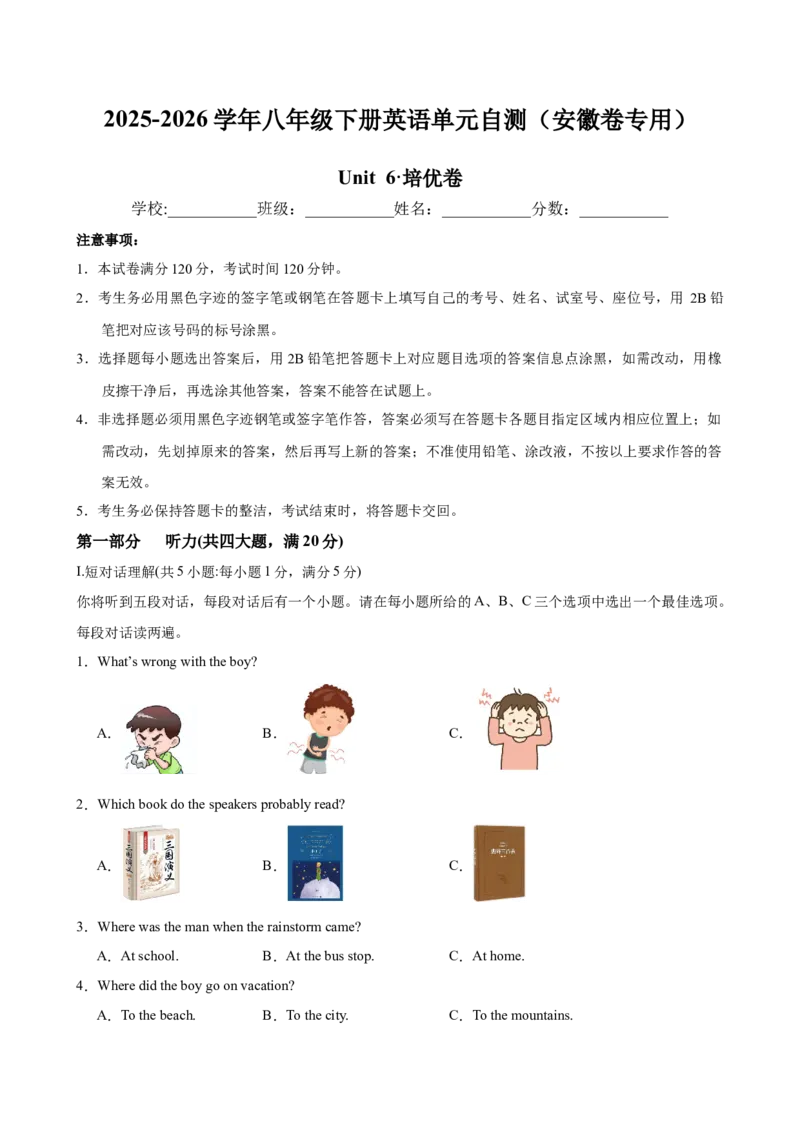
1.What’s wrong with the boy?
A. B. C.
2.Which book do the speakers probably read?
A. B. C.
3.Where was the man when the rainstorm came?
A.At school. B.At the bus stop. C.At home.
4.Where did the boy go on vacation?
A.To the beach. B.To the city. C.To the mountains.5.Who is Mr. Green?
A.Tom’s classmate. B.Tom’s teacher. C.Tom’s parent.
听对话,回答下列小题。
6.What was Cathy doing when the light went out?
A.Doing her homework. B.Listening to music. C.Watching TV.
7.Where did Cathy’s parents go last night?
A.To the supermarket. B.To her grandma’s house. C.To the hospital.
听对话,回答下列小题。
8.What’s wrong with Miss Wang?
A.She didn’t have time to watch movies.
B.She didn’t get the ticket of her favorite movie.
C.She didn’t have friends to watch movies with.
9.What’s the woman’s favorite movie?
A.Avatar. B.Titanic. C.Toy Story.
10.What does the man think of Beijing Opera?
A.Colorful. B.Boring. C.Interesting.
你将听到一篇短文,短文后有小题。请根据短文内容,在每小题所给的A、B、C三个选项中选出一个最
佳选项。短文读两遍。
11.What is Karl?
A.A cat. B.A dog. C.A bird.
12.How often does Mrs. Liu play with Karl?
A.Every day. B.Twice a week. C.Three times a week.
13.When does Mrs. Liu take a walk?
A.At 4:00 pm. B.At 6:00 pm. C.At 7:00 pm.
14.What does the shop at the end of the road sell?
A.Clothes. B.Animal food. C.Animal books.
15.Where was Mrs. Liu’s money at last?
A.At her home. B.In her wallet. C.In Karl’s mouth.
IV. 信息转换(共5小题,每小题1分,满分5分)你将听到一篇短文。请根据短文内容,写出下面表格中所缺的单词,每空仅填一词。短文读两遍。
Bill’s trip to Hainan
Who went with Bill? His 16 .
How long did they stay? They stayed there for 17 weeks.
What was the weather like there? It was warm, just like 18
What did Bill do there? He visited a 19 museum.
How was Bill’s trip to Hainan? It was really a 20 trip.
第二部分 英语知识运用(共两大题,满分30分)
V. 单项填空(共10小题;每小题1分,满分10分)
从每小题所给的人B、C、D四个选项中选出一个可以填入空白处的最佳选项。
21.Indian ________ is famous for its special taste and many kinds of spices.
A.fork B.salad C.curry D.pizza
22.It’s ________ to talk with your mouth full of food at formal dinners.
A.polite B.rude C.common D.easy
23.—Sandy can’t pass the exam ________ she studies hard.
—Exactly! Let’s remind her to focus on her studies.
A.when B.if C.unless D.because
24.— You played the piano piece ________ at the concert!
— Thank you! I practiced every day to get it right.
A.quickly B.nicely C.badly D.loudly
25.In some European countries, people ________ each other to show warmth when they meet.
A.hug B.shake C.bow D.fist
26.—I ________ my friend in London yesterday.
—Great! How’s your friend doing over there?
A.heard from B.worried about C.listened to D.looked for
27.The students were ________ when their teacher showed them an ________ science experiment.
A.excited; excited B.exciting; exciting
C.excited; exciting D.exciting; excited
28.The city Nanchang is ________ popular ________ many people want to go there for a trip this year.A.so; that B.such; that C.too; to D.very; that
29.—Will you call me back later?
—Of course. I’ll give you a ring as soon as I ________ the bus.
A.got off B.will get off C.get off D.gets off
30.—I don’t know how to greet the Indian teacher.
—________ You can do namaste and smile.
A.No way! B.Me too! C.Take it easy! D.I’m sorry.
VI. 完形填空(共20小题;每小题1分,满分20分)
阅读下列短文,从每小题所给的A、B、C、D四个选项中选出一个最佳选项。
A
Bill and Jill were going to visit Dawei and Li Hua in Taiwan for several days. Before they 31
America, they tried to learn about Taiwanese food and Taiwanese ways of doing things. They 32 to be
polite. They learned that most people in Taiwan 33 rice, drink tea, and take off their shoes when they go
into a friend’s home. Bill and Jill even learned to 34 chopsticks.
At the same time, Dawei and Li Hua 35 American food and American ways of doing things.
They wanted to be 36 . When Bill and Jill came to Li Hua’s 37 , Dawei and Li Hua told them
to keep their shoes on. Later they went out for dinner. They ate pizza and drank Coke. The next few 38 ,
they had breakfast in a coffee shop and ate hamburgers in a fast-food restaurant.
On their way back to America, Bill and Jill were thinking about why they had 39 eaten rice or
drunk tea or eaten with chopsticks. They didn’t need to take off their 40 when they visited Li Hua’s
family. They thought that living in Taiwan was just like living in America.
31.A.reached B.visited C.found D.left
32.A.asked B.lived C.wanted D.hated
33.A.drink B.grow C.sell D.eat
34.A.make B.use C.buy D.break
35.A.talked about B.heard from C.learned about D.felt like
36.A.friendly B.angry C.excited D.happy
37.A.school B.office C.house D.restaurant
38.A.days B.minutes C.years D.centuries
39.A.often B.usually C.sometimes D.never
40.A.shirts B.blouses C.shoes D.socksB
Last month, our school held a “Cross-Cultural Week” activity. All students 41 to learn about
different cultures around the world.
On Monday, we 42 a lecture from a teacher who had lived in France for 10 years. She told us that
in France, people usually greet each other with a kiss on the cheek, not a handshake. We also learned that 43
on time is very important for meetings there.
On Wednesday, we joined a food fair. I tried making sushi with a Japanese student. It was 44 but
fun. The sushi looked nice and tasted great. On Friday, we 45 our own cultural stories with each other.
My friend Tom shared how his family celebrates the Spring Festival, which was 46 interesting for all of
us.
The activity made me realize that 47 different cultures isn’t just about knowing facts, but also
about respecting others. I plan to 48 more books about different countries and learn a new language. I
hope everyone can 49 interested in cross-cultural communication and make friends from all over the
50 !
41.A.invited B.asked C.wanted D.refused
42.A.gave B.listened C.attended D.taught
43.A.being B.be C.to be D.been
44.A.easy B.difficult C.boring D.relaxing
45.A.shared B.wrote C.read D.heard
46.A.really B.real C.true D.truly
47.A.learn B.learning C.to learn D.learned
48.A.read B.write C.watch D.see
49.A.get B.got C.getting D.gets
50.A.country B.city C.world D.town
第三部分 阅读理解(共两大题,满分45分)
VII. 补全对话 (共5小题;每小题1分,满分5分)
根据对话内容,从下面选项中选出能填入空白处的最佳选项,其中有两个为多余选项。
A: Lingling, would you like to come to my home for afternoon tea tomorrow?
В: 51 But what is that, Diana? A kind of tea?A: No, it’s different from Chinese tea. 52
B: Light meal? 53
A: We eat sandwiches and fruit cakes. 54
B: Sounds nice! Do you drink tea?
A: 55 It’s great. You must try it tomorrow.
B: OK. I’m looking forward to having afternoon tea with you.
A: Ha-ha...
A.Sure. I’d love to.
B.Tell me more please!
C.What should I do then?
D.Sure. But we drink tea with milk.
E.People in London like tea.
F.Sometimes we cat cookies.
G.It’s a light meal at around 4 p.m.
VIII. 阅读理解(共20小题;每小题2分,满分40分)
阅读下列短文,从每小题所给的A、B、C、D四个选项中选出一个最佳选项。
A
We’d better know some culture shock in our lives, because every tradition can teach us something different
about the country and its culture.
Mexico No yellow roses
Roses are great gifts to show feelings in the world.
However, different colours of roses may have different
meanings. In Mexico, it’s better to choose a traditional red
rose but not a yellow one, because the yellow rose means
death (死亡) in Mexican culture.
Venezuela—Arriving late
Venezuelans enjoy a relaxing life. When they’re joining a
meeting or a party in Venezuela, it’s common for them to
arrive a little late.
The Middle East No left hands
In many Middle Eastern countries, greeting someone or
eating with one’s left hand is not polite or healthy. People
there have special use of left hands after going to the
bathroom, so they take the left hand as the dirty hand.
56.If you want to give roses as gifts to your Mexican friend, the colour should not be ________.A.pink B.red C.yellow D.white
57.What do people think of arriving late in Venezuela?
A.Terrible. B.Usual. C.Serious. D.Impolite.
58.What can you do if you want to greet or eat with someone in the Middle East?
A.Greet and eat with your right hand.
B.Greet and eat with your left hand.
C.Greet with your right hand and eat with your left hand.
D.Greet with your left hand and eat with your right hand.
B
Thailand is known as the “Land of Smiles”. When you spend your holiday in Thailand, you’d better keep in
mind these simple tips.
Personal image is very important in Thailand as a sign of respect for other people. Your clothes should be
tidy, clean and free from holes. Shorts and sleeveless (无袖的) shirts are not welcomed in temples. Remember that
you need to take off your shoes when entering rooms. So don’t wear shoes that are not easy to get on and off. The
rules are even stricter with foreign visitors, so even if you see a local in shorts, it’s not OK for everyone.
It’s not polite to touch a Thai on the head, including children. For Thais, the head is the most sacred (神圣
的) part of the body. At the same time, don’t t… people with your feet, or even point with them because they think
feet are the lowest and dirtiest. When sitting on the ground, try to sit in a way that doesn’t show others the bottoms
of your feet.
Always keep in mind the rules of saving face. Keep your cool even when things go wrong; you’ll be
respected for doing so. For example, don’t complain when your bus breaks down. Instead, smile and say “mai pen
rai”.
59.Which of the following are bad manners in Thailand?
①Wear clean and tidy clothes.
②Touch a lovely baby’s head.
③Show someone the bottoms of your feet.
④Take off your shoes before entering a temple.
⑤Wear shorts or jeans with holes.
⑥Avoid showing strong anger or shouting in public places.
A.①④⑤⑥ B.③④⑥ C.②③⑤ D.②③⑥60.What is the proper word in the sentence “At the same time, don’t t… people with your feet…”?
A.Turn. B.Touch. C.Test. D.Tie.
61.Which of the following has the closest meaning to “mai pen rai”?
A.My pleasure. B.I’m sorry about that.C.It’s OK. Don’t worry. D.That’s great.
C
Do you want to know about my staying in America? It was really an eye-opening experience. In China, I
had English classes five times a week. However, I didn’t know how different textbook English was from daily
English until I went to Hotchkiss School, Connecticut.When I first studied English, I was told to say “I’m fine.”
when people say “How are you?” But in America, I found that people said “I’m good.” or “I’m tired.” One day,
someone greeted me with “What’s up?” It made me confused. I thought for a moment and then smiled because I
didn’t know what to say.
Since then, I have discovered more and more differences between Chinese and US cultures. To my surprise,
American girls spend a lot of time in the burning sun. However, in China, girls try every possible way to get their
skin whiter. I’m also surprised by how hard-working American students are. In China, schoolwork is almost
everything, so we study hard. But in America, a good student gets good grades, does a lot for the public and plays
sports or music. The kids here are so talented. I am starting to be sorry that I gave up playing the piano at an early
age and that I have never thought about sports.
62.According to the writer, textbook English is ________ daily English.
A.different from B.the same as C.more difficult than D.as easy as
63.Which of the following is NOT true according to the passage?
A.The writer has returned from America.
B.American girls love to have white skin.
C.Schoolwork is almost everything for Chinese students.
D.American students are hard-working.
64.What’s the best title of the passage?
A.My travelling in the US B.My opinions about the US
C.My studying in the US D.My friends in the US
D
①As more and more people travel around the world, it is necessary (必要的) for them to know what to do indifferent countries and how to deal with cultural differences. Here are different cultures from three countries.
②Canadians are easy to get along with and they usually say hello to each other even if they are strangers.
When men and women meet, women usually hold out their hands first. If a woman doesn’t want to shake hands,
she can just nod and smile. If a man wears gloves, he should take them off before shaking hands.
③Brazilians are very friendly and they always get ready to say hello to others. They stand very close to each
other when speaking and may touch each other’s arms or backs. And if you go to a business meeting in Brazil, you
are not expected to take a present.
④When you meet Indians, it is important to say hello to the oldest person first. But you’d better not hold out
your left hand when you say hello, because it is impolite. Also, many Indians are enthusiastic and they like to say
hello actively and have a conversation with you when you travel in India.
⑤Customs in different countries are like different flowers, forming a beautiful garden together. Learning to
respect others’ ways is like giving a friendly smile. It can bring people’s hearts closer.
65.Match the countries with the customs and choose the right answer.
①India②Canada③Brazil
a. Men take off gloves before shaking hands.
b. People stand very close when speaking.
c. Greet the oldest person first.
A.①-c;②-b;③-a B.①-b;②-c;③-a
C.①-c;②-a;③-b D.①-a;②-c;③-b
66.What does the underlined word “enthusiastic” mean?
A.Polite. B.Shy.
C.Rude. D.Warm.
67.What can we learn from the passage?
A.Women in India usually hold out their hands first.
B.Men in India usually hold out their left hands to say hello.
C.People in Brazil don’t often touch each other when speaking.
D.People in Brazil needn’t take a gift to a business meeting.
68.What’s the structure of the passage?
A. B. C. D.E
Hey! I’m Peter Brown. In China, we pay for everything with our mobile phones. When I went back home
to the UK for a holiday, I had some culture shock in my own country.
Suddenly, I couldn’t use my phone to pay for things. I got out my wallet and went back to using notes and
coins.
Of course, we can pay for things with bank cards in the UK, and some use Google Pay on their phones or
watches. But most people still use cash. And many are wary of putting too much trust in going electronic with
payments.
My parents believe that using digital payments could lead to their whole savings being stolen by online
criminals (犯罪分子). In 2022, more than £4 billion was stolen by fraudsters (诈骗犯) and cybercriminals (网络
罪犯) in the UK. In 2022, the online financial (金融的) service website money.co.uk reported a 63% increase in
fraud and cybercrime from 2021, and online buying was the biggest source of the thefts (盗窃).
So, the dangers are real. But it seems that mobile or at least digital payments will lead the way in the future
in the UK, just as it is here now in China. According to the gov.uk website, the Bank of England is now looking at
using a digital pound. But the real question is: Will the British public trust it?
69.Why did the writer have culture shock after returning to the UK?
A.Because most people still use cash to buy things.
B.Because people have to bring a bank card in their wallet.
C.Because people can pay for things with digital payments.
D.Because most people like to use coins more than notes.
70.What can we learn about the writer’s parents?
A.They use Google Pay on their phones or watches.
B.They once lost all their savings to online criminals.
C.They used to work for the website money.co.uk.
D.They don’t trust the digital payment method.
71.In Paragraph 4, we know many British people worry about ________.
A.online buying
B.online thefts
C.online financial service
D.digital payments72.What does Peter think of the Bank of England’s idea of “a digital pound”?
A.It will soon become popular.
B.It is what people are hoping for.
C.It is very convenient.
D.It is uncertain (不确信) if British people will want to use it.
F
The Spring Festival is coming. It’s time to give gifts to your family and friends. But there are some taboos (禁
忌) on gift giving. What are those in China?
Chinese people don’t give a clock to others. A clock sounds like “zhong” in Chinese. So giving a clock is like
saying “your time is up”. People will think it’s not lucky, especially for old people.
Buying pears and shoes is also not a good choice. Pears sound like “li” and shoes sound like “xie” in Chinese.
They are not good gifts for friends or parents, because they mean something bad in Chinese.
What is a good gift then? Money can be the answer! A “red envelope” (红包) with money is the best gift in
China. People give red envelopes to show their love. People have a “lucky” number of money in the red
envelopes. The numbers six and eight are always the lucky numbers in China. So we must avoid giving the wrong
gifts to others.
73.What gift can’t we give to old people? (不超过10个词)
74.How many bad gifts are there in the passage? (不超过5个词)
75.What is the passage mainly about? (不超过10个词)
第四部分 写作(共两大题,满分25分)
IX. 单词拼写(共5小题;每小题1分,满分5分)
根据首字母及汉语提示,完成下列单词的拼写,使句意明确,语言通顺。76.Different countries have different table m (礼仪).
77.It’s a t (传统) to eat mooncakes on Mid-Autumn Festival in China.
78.We often s (握手) with each other when we meet for the first time.
79.You should b (鞠躬) when you meet people in Japan and Korea.
80.It’s a custom to give g (礼物) at Christmas in some countries.
X. 书面表达(共1小题;满分20分)
81.假设你是李华,你的新西兰笔友 Nancy近期计划到中国游学。她给你发来邮件向你询问中国
的礼仪习俗。请你根据以下思维导图给她回复一封邮件。
注意:语句连贯,词数80左右,开头和结尾已给出,不计入总词数。
Dear Nancy,
I’m glad to hear that you are coming to China. Let me tell you some customs in China.
___________________________________________________________________________________________
___________________________________________________________________________________________
___________________________________________________________________________________________
___________________________________________________________________________________________
___________________________________________________________________________________________
_____________
I hope that the advice is helpful. Please feel free to ask me if you want to know more.
Yours,
Li Hua