
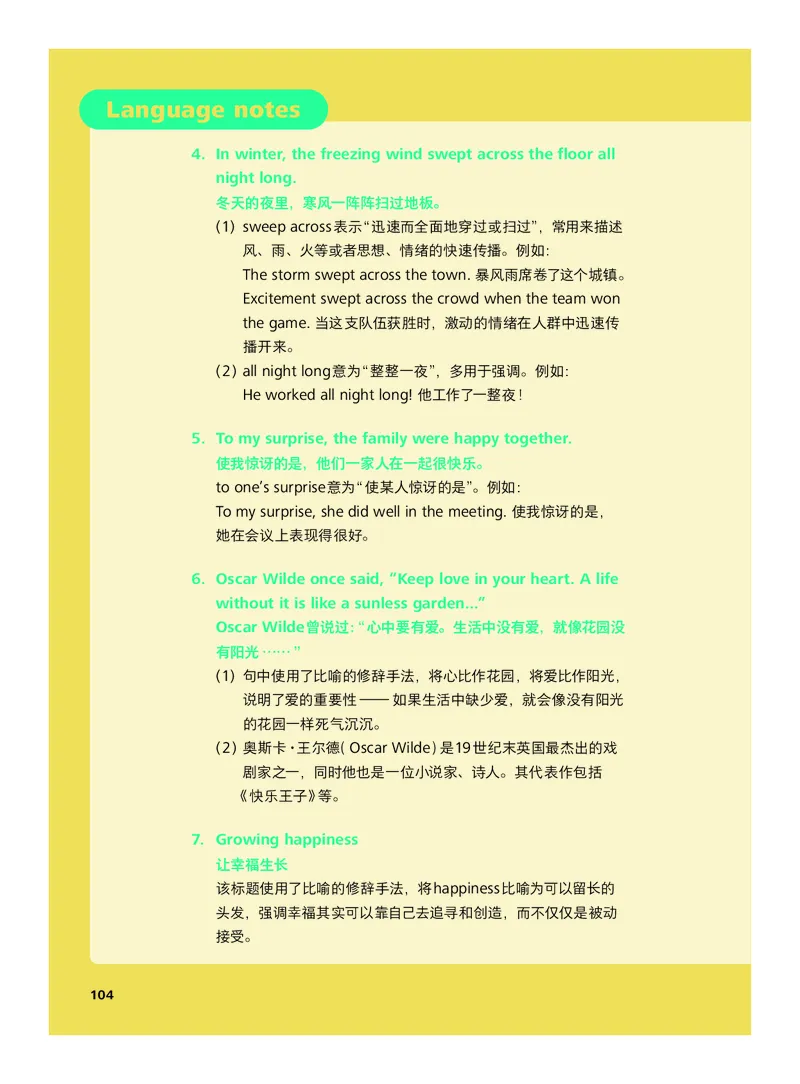
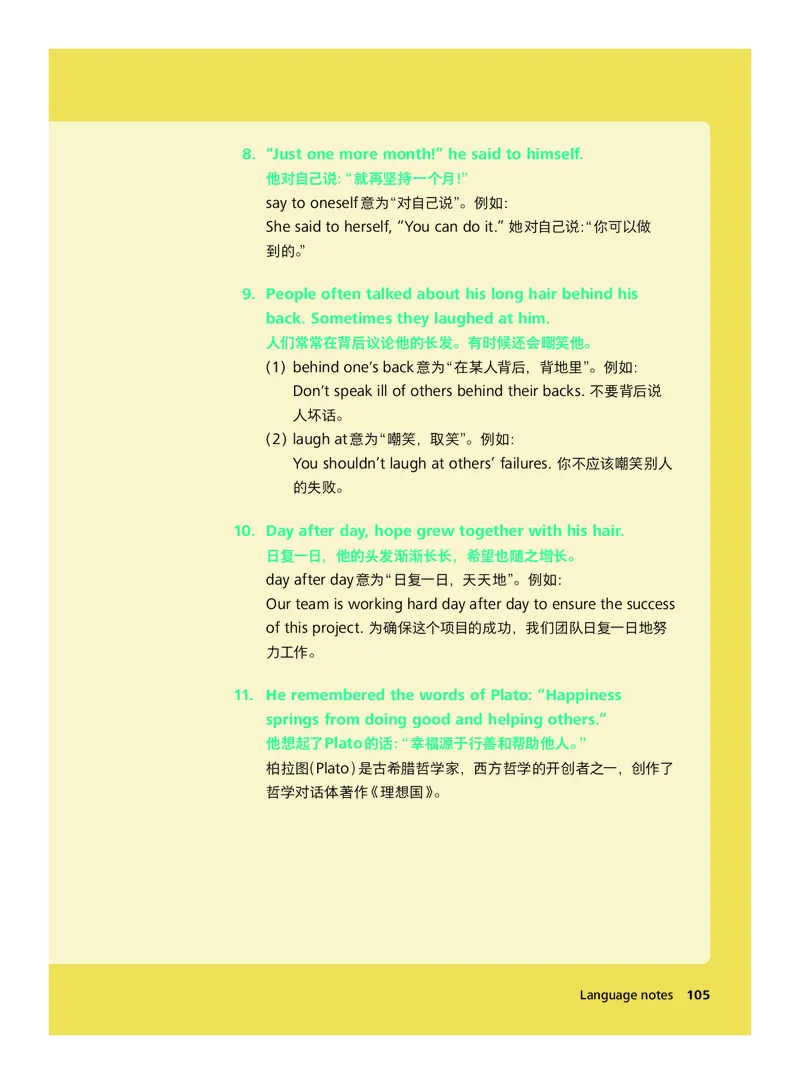
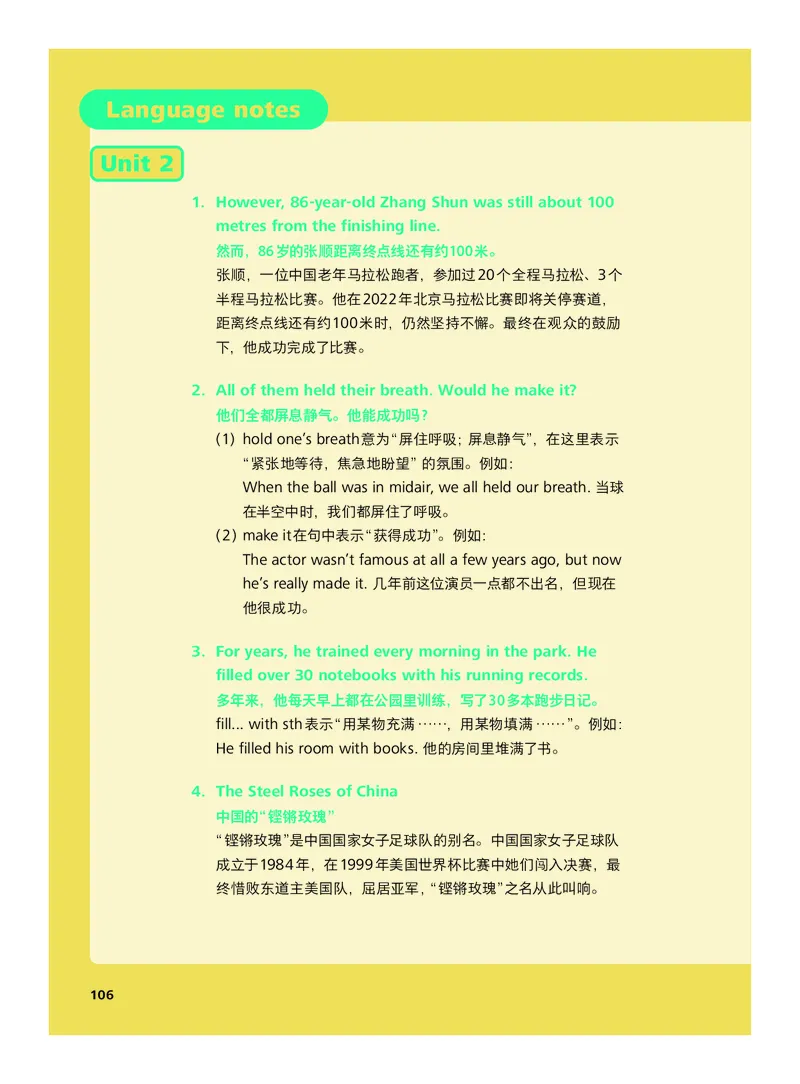
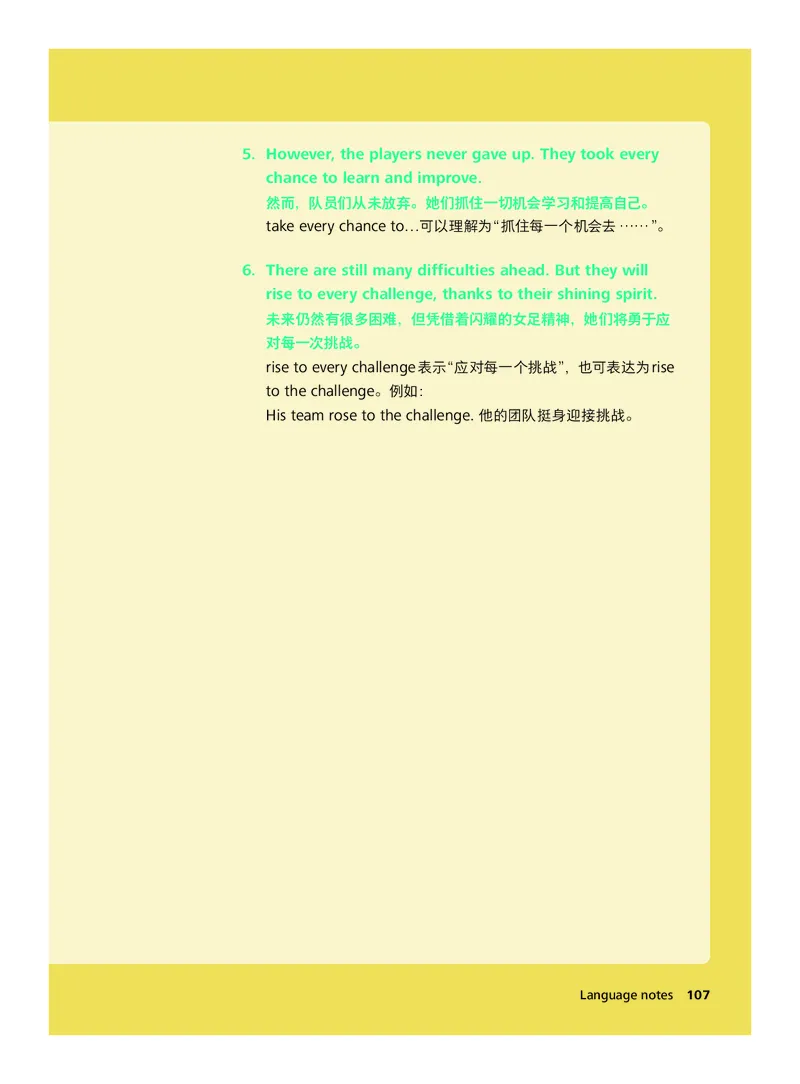

文档内容
C
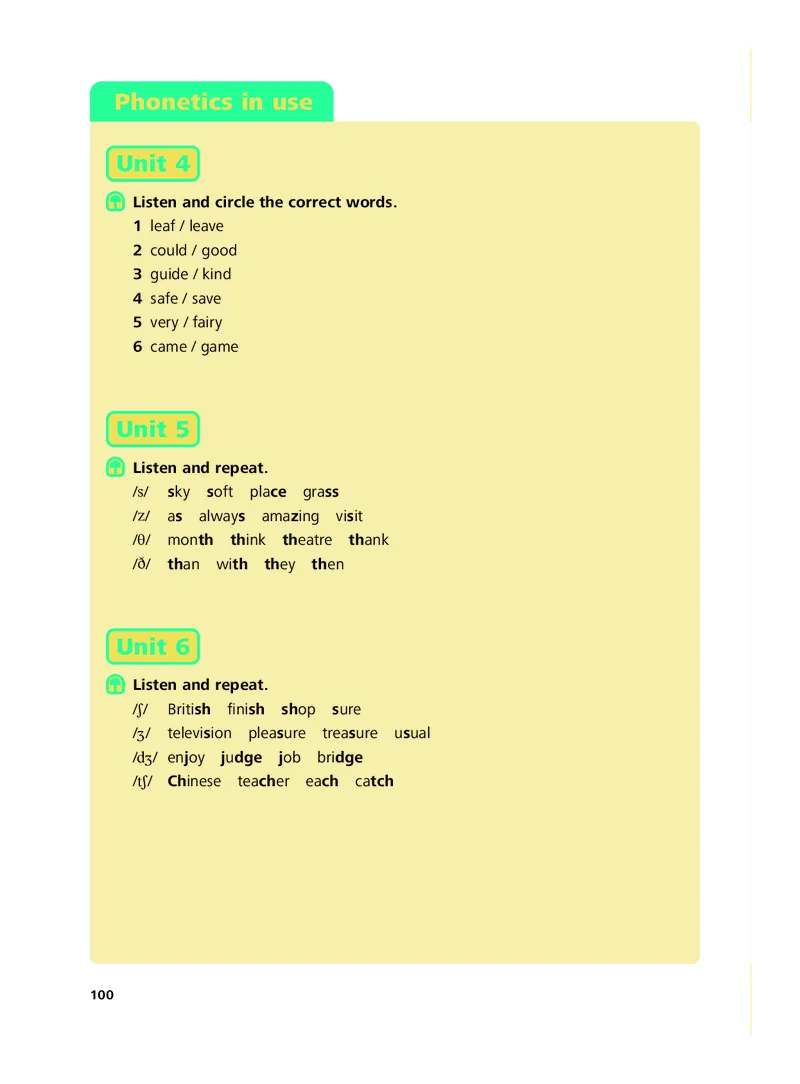
M
Y
CM
MY
CY
CMY
KC
M
Y
CM
MY
CY
CMY
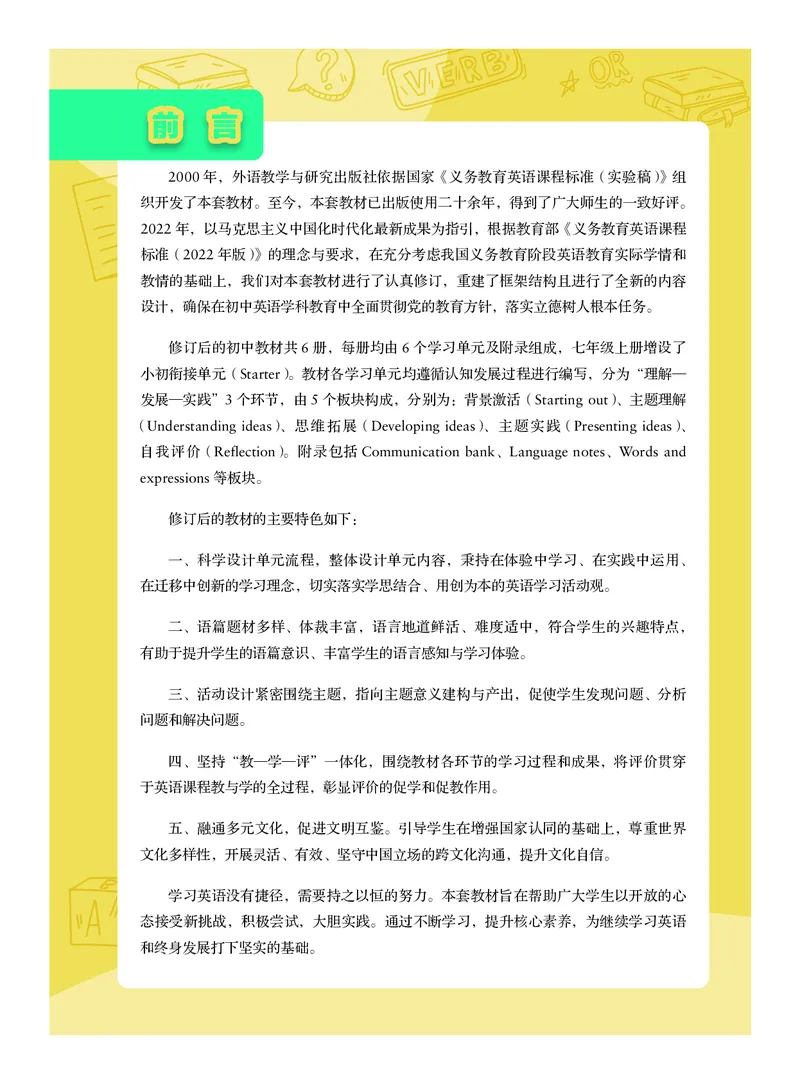
K前前 言言
2000年,外语教学与研究出版社依据国家《义务教育英语课程标准(实验稿)》组
织开发了本套教材。至今,本套教材已出版使用二十余年,得到了广大师生的一致好评。
2022年,以马克思主义中国化时代化最新成果为指引,根据教育部《义务教育英语课程
标准(2022年版)》的理念与要求,在充分考虑我国义务教育阶段英语教育实际学情和
教情的基础上,我们对本套教材进行了认真修订,重建了框架结构且进行了全新的内容
设计,确保在初中英语学科教育中全面贯彻党的教育方针,落实立德树人根本任务。
修订后的初中教材共6册,每册均由6个学习单元及附录组成,七年级上册增设了
小初衔接单元(Starter)。教材各学习单元均遵循认知发展过程进行编写,分为“理解—
发展—实践”3个环节,由5个板块构成,分别为:背景激活(Starting out)、主题理解
(Understanding ideas)、思维拓展(Developing ideas)、主题实践(Presenting ideas)、
自我评价(Reflection)。附录包括Communication bank、Language notes、Words and
expressions等板块。
修订后的教材的主要特色如下:
一、科学设计单元流程,整体设计单元内容,秉持在体验中学习、在实践中运用、
在迁移中创新的学习理念,切实落实学思结合、用创为本的英语学习活动观。
二、语篇题材多样、体裁丰富,语言地道鲜活、难度适中,符合学生的兴趣特点,
有助于提升学生的语篇意识、丰富学生的语言感知与学习体验。
三、活动设计紧密围绕主题,指向主题意义建构与产出,促使学生发现问题、分析
问题和解决问题。
四、坚持“教—学—评”一体化,围绕教材各环节的学习过程和成果,将评价贯穿
于英语课程教与学的全过程,彰显评价的促学和促教作用。
五、融通多元文化,促进文明互鉴。引导学生在增强国家认同的基础上,尊重世界
文化多样性,开展灵活、有效、坚守中国立场的跨文化沟通,提升文化自信。
学习英语没有捷径,需要持之以恒的努力。本套教材旨在帮助广大学生以开放的心
态接受新挑战,积极尝试,大胆实践。通过不断学习,提升核心素养,为继续学习英语
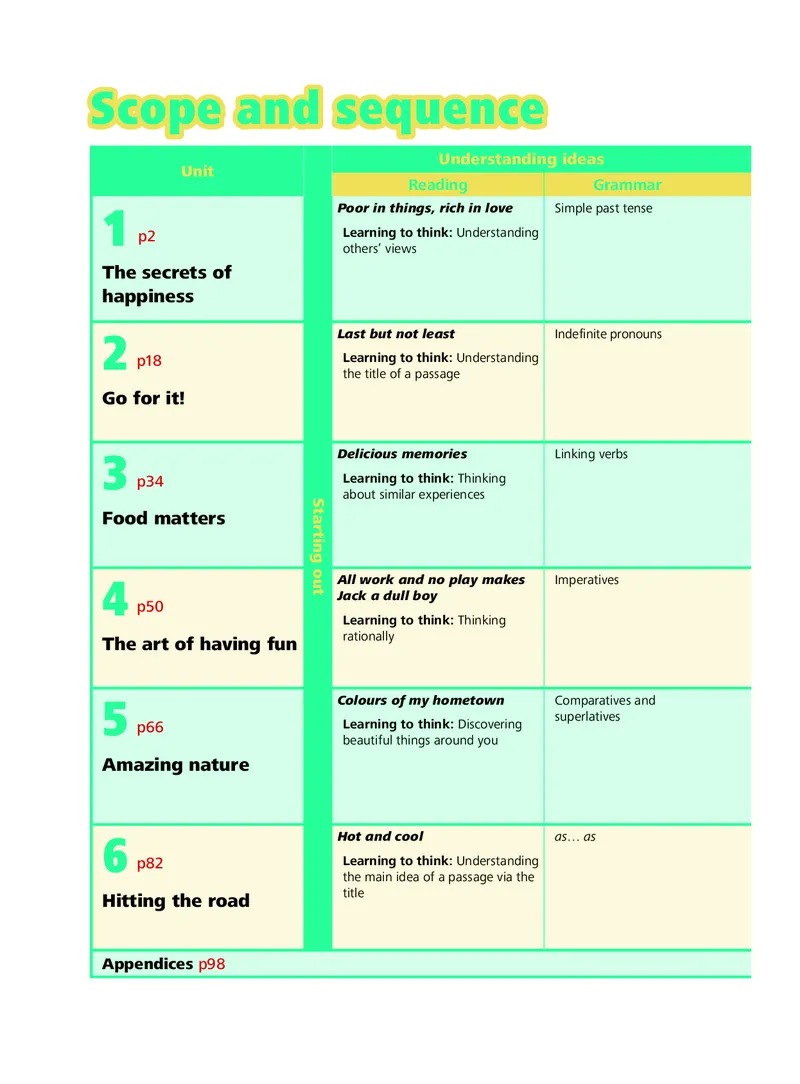
和终身发展打下坚实的基础。SSccooppee aanndd sseeqquueennccee
Understanding ideas Developing ideas Presenting
Unit
Reading Grammar Listening and speaking Reading for writing ideas
1 Poor in things, rich in love Simple past tense How to look at things in a bright way Growing happiness Making a book
page about
p2 Learning to think: Understanding Phonetics: Pronunciation: / əʊ / / aʊ / Learning to think: Reflecting on the ways to be
others’ views writing purpose
Learning to learn: Listening for an happy
The secrets of experience analysis Writing:
Write a short story about feeling happy
happiness Learning to learn: Giving examples
through helping others
2 Last but not least Indefinite pronouns A good swimmer The Steel Roses of China Making a
poster of a
p18 Learning to think: Understanding Phonetics: Pronunciation: / / / / / / Learning to think: Understanding the
ɪə eə ʊə sports moment
the title of a passage story behind
Learning to learn: Giving positive replies
Go for it! Writing:
Writing a short paragraph about a
sports team
3 Delicious memories Linking verbs A balanced diet Food across borders Making a fact
sheet about
p34 Learning to think: Thinking Phonetics: Pronunciation: / / / / / / / / Learning to think: Expressing
p b t d your favourite
about similar experiences agreement or disagreement
Learning to learn: Listening for disagreeing food
Food matters Writing:
Learning to learn: Correcting false
Writing a short paragraph about a
information
food across borders
4 All work and no play makes Imperatives Turning an interest into a career The time-eating monster Making a
Jack a dull boy report on fun
p50 Phonetics: Pronunciation: / / / / / / / / Learning to think: Understanding the
k ɡ f v activities
Learning to think: Thinking theme of a passage
Learning to learn: Listening for information
rationally
The art of having fun Writing:
Learning to learn: Using guiding language
Writing a short paragraph about not
having fun properly
5 Colours of my hometown Comparatives and Amazing life in nature Natural wonders crying aloud for Making a
superlatives help poster about a
p66 Learning to think: Discovering Phonetics: Pronunciation: / / / / / / / /
s z θ ð natural wonder
beautiful things around you Learning to think: Thinking from
Learning to learn: Interrupting politely
different sides
Amazing nature
Writing:
Writing a short paragraph of another
natural wonder crying for help
6 Hot and cool as… as A travel vlogger and his vlog Exploring the unexplored Making a travel
plan
p82 Learning to think: Understanding Phonetics: Pronunciation: / / / / / / / / Learning to think: Making comments
ʃ ʒ dʒ tʃ
the main idea of a passage via the on a person
Learning to learn: Listening for specific
title
Hitting the road information Writing:
Writing a short introduction to another
Learning to learn: Expressing surprise
great traveller
Appendices p98
Starting
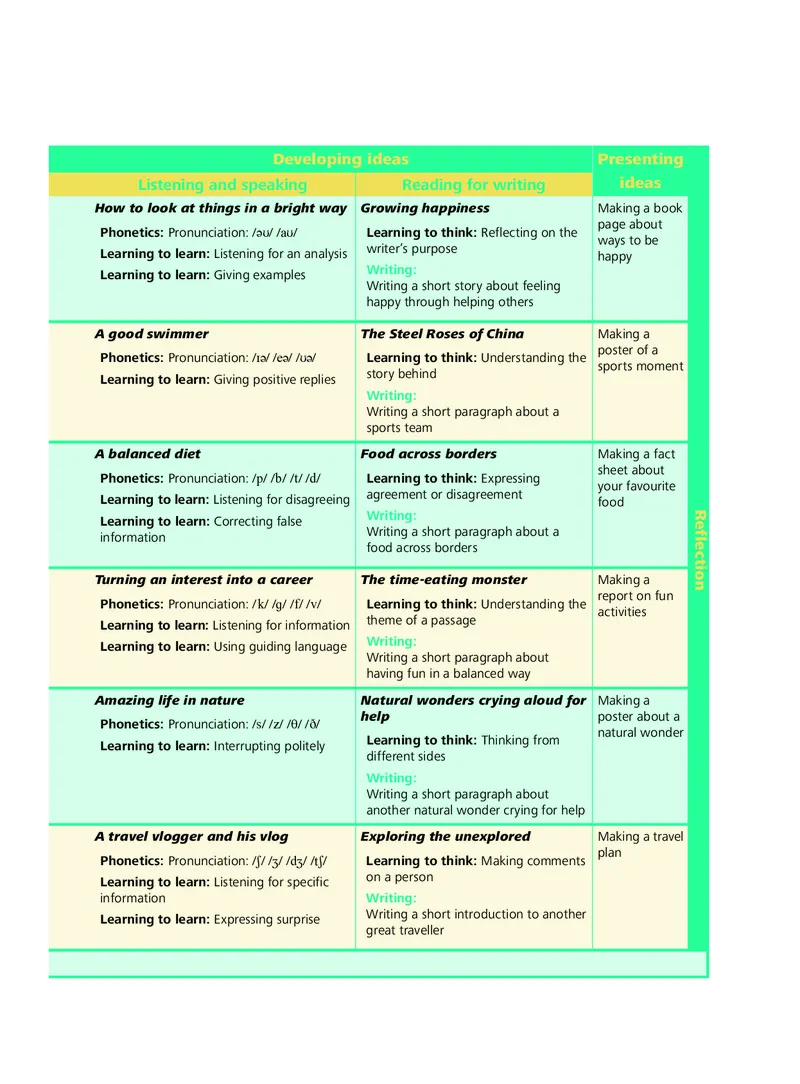
outUnderstanding ideas Developing ideas Presenting
Unit
Reading Grammar Listening and speaking Reading for writing ideas
1 Poor in things, rich in love Simple past tense How to look at things in a bright way Growing happiness Making a book
page about
p2 Learning to think: Understanding Phonetics: Pronunciation: / əʊ / / aʊ / Learning to think: Reflecting on the ways to be
others’ views writer’s purpose
Learning to learn: Listening for an analysis happy
The secrets of Writing:
Learning to learn: Giving examples
Writing a short story about feeling
happiness
happy through helping others
2 Last but not least Indefinite pronouns A good swimmer The Steel Roses of China Making a
poster of a
p18 Learning to think: Understanding Phonetics: Pronunciation: / / / / / / Learning to think: Understanding the
ɪə eə ʊə sports moment
the title of a passage story behind
Learning to learn: Giving positive replies
Go for it! Writing:
Writing a short paragraph about a
sports team
3 Delicious memories Linking verbs A balanced diet Food across borders Making a fact
sheet about
p34 Learning to think: Thinking Phonetics: Pronunciation: / / / / / / / / Learning to think: Expressing
p b t d your favourite
about similar experiences agreement or disagreement
Learning to learn: Listening for disagreeing food
Food matters Writing:
Learning to learn: Correcting false
Writing a short paragraph about a
information
food across borders
4 All work and no play makes Imperatives Turning an interest into a career The time-eating monster Making a
Jack a dull boy report on fun
p50 Phonetics: Pronunciation: / / / / / / / / Learning to think: Understanding the
k ɡ f v activities
Learning to think: Thinking theme of a passage
Learning to learn: Listening for information
rationally
The art of having fun Writing:
Learning to learn: Using guiding language
Writing a short paragraph about
having fun in a balanced way
5 Colours of my hometown Comparatives and Amazing life in nature Natural wonders crying aloud for Making a
superlatives help poster about a
p66 Learning to think: Discovering Phonetics: Pronunciation: / / / / / / / /
s z θ ð natural wonder
beautiful things around you Learning to think: Thinking from
Learning to learn: Interrupting politely
different sides
Amazing nature
Writing:
Writing a short paragraph about
another natural wonder crying for help
6 Hot and cool as… as A travel vlogger and his vlog Exploring the unexplored Making a travel
plan
p82 Learning to think: Understanding Phonetics: Pronunciation: / / / / / / / / Learning to think: Making comments
ʃ ʒ dʒ tʃ
the main idea of a passage via the on a person
Learning to learn: Listening for specific
title
Hitting the road information Writing:
Writing a short introduction to another
Learning to learn: Expressing surprise
great traveller
Appendices p98
ReflectionUnit
TThhee sseeccrreettss ooff
1
hhaappppiinneessss
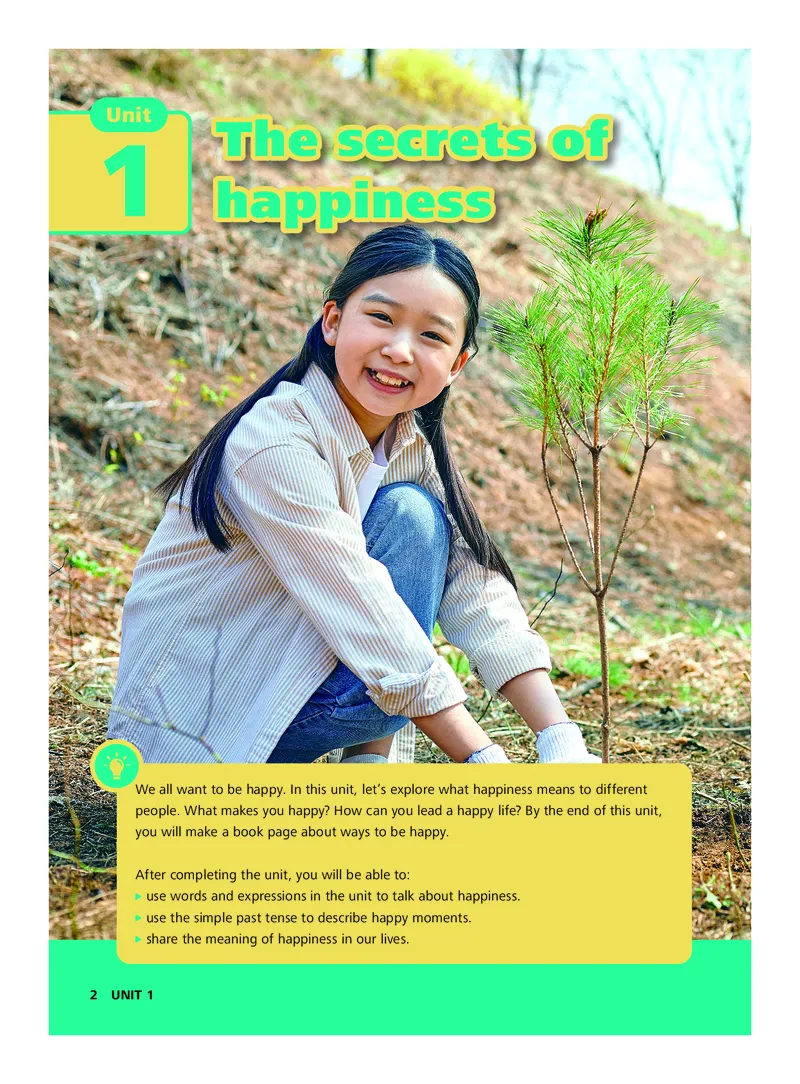
We all want to be happy. In this unit, let’s explore what happiness means to different
people. What makes you happy? How can you lead a happy life? By the end of this unit,
you will make a book page about ways to be happy.
After completing the unit, you will be able to:
use words and expressions in the unit to talk about happiness.
use the simple past tense to describe happy moments.
share the meaning of happiness in our lives.
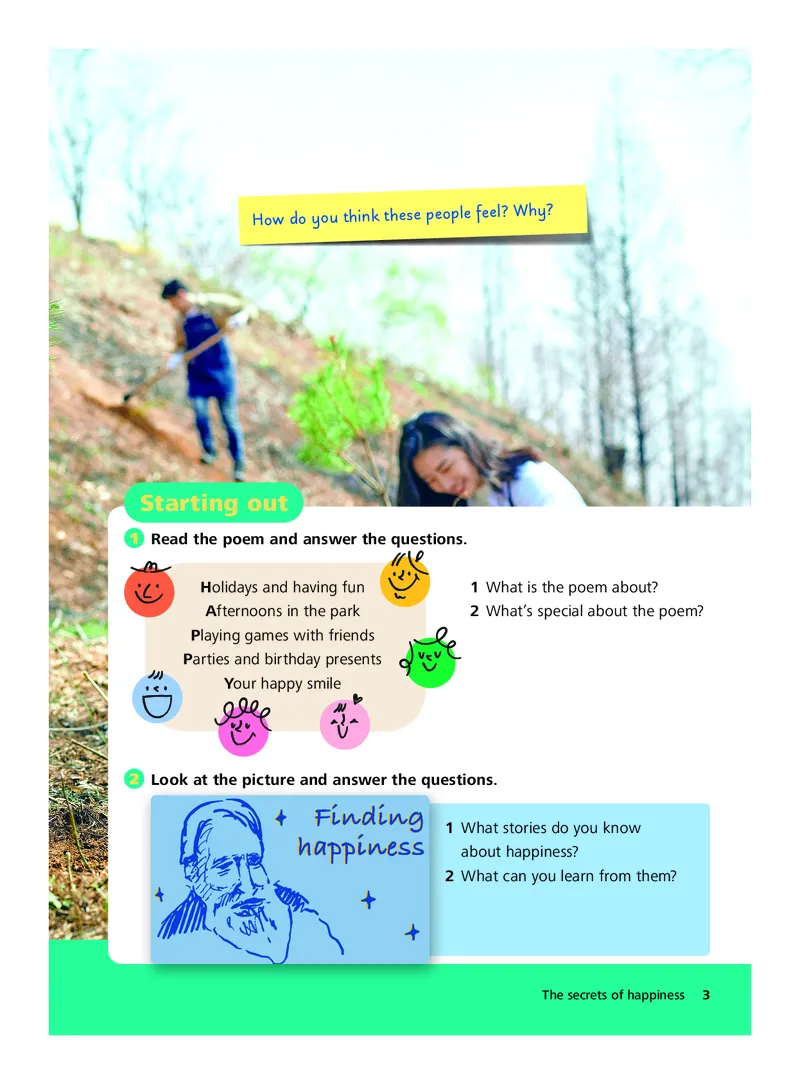
2 UNIT 1How do you think these people feel? Why?
Starting out
1 Read the poem and answer the questions.
Holidays and having fun 1 What is the poem about?
Afternoons in the park 2 What’s special about the poem?
Playing games with friends
Parties and birthday presents
Your happy smile
2 Look at the picture and answer the questions.
1 What stories do you know
about happiness?
2 What can you learn from them?
The secrets of happiness 3Understanding ideas
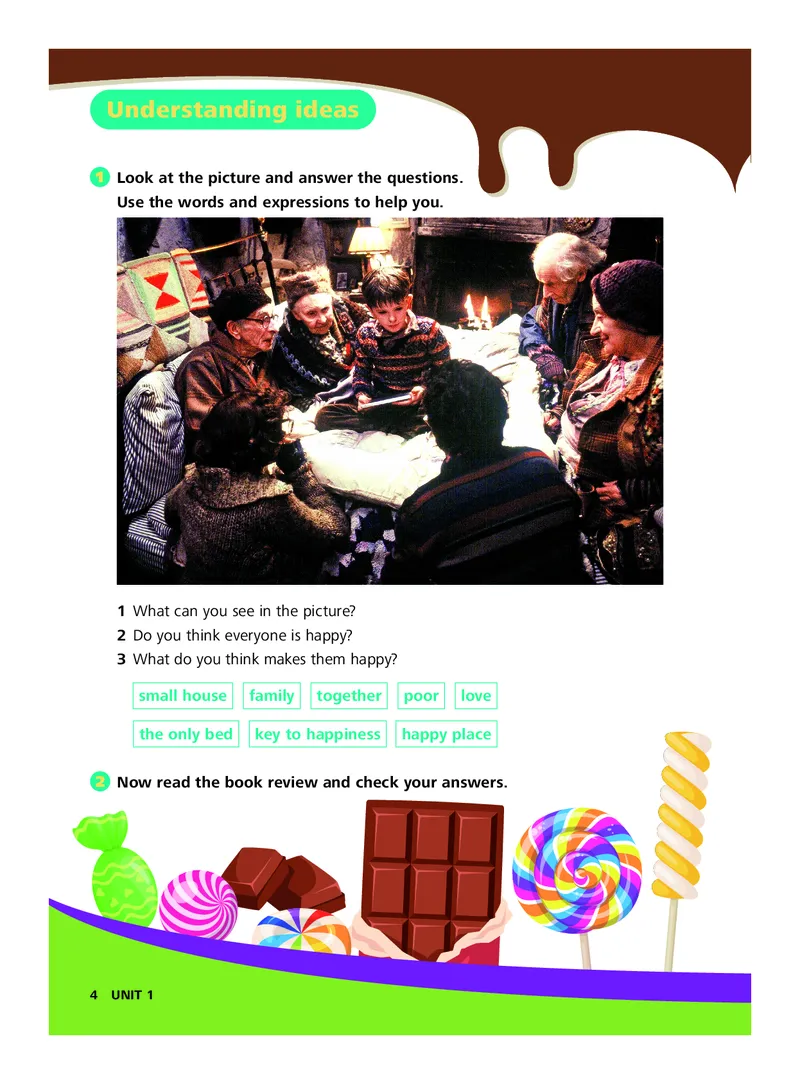
1 Look at the picture and answer the questions.
Use the words and expressions to help you.
1 What can you see in the picture?
2 Do you think everyone is happy?
3 What do you think makes them happy?
small house family together poor love
the only bed key to happiness happy place
2 Now read the book review and check your answers.
4 UNIT 11 I put down Charlie and the Chocolate Factory. But I kept going over
the exciting story in my mind. The book was full of magic. But
Charlie’s happy family was the most magical part of the story.
2 Charlie’s home was a small house at the side of a big town. His
family was very poor. His four grandparents stayed in the only
bed in the house. The family never had enough food. They always
ate watery cabbage soup for dinner. In winter, the freezing wind
swept across the floor all night long.
3 To my surprise, the family were happy together. In the evenings,
Charlie sat with his grandparents in bed and listened to their
stories. Charlie’s parents often joined in. Every night, the room
became a happy place. The whole family forgot about their hungry
and poor life.
4 This touched me greatly. In some people’s minds, happiness
comes from things like money. But love, in fact, is the key to
happiness. Oscar Wilde once said, “Keep love in your heart. A life
without it is like a sunless garden…” There are so many reasons
to be happy. I think love is the most important one. It can move
us, change us and give us a life full of happiness.
The secrets of happiness 53 Choose the best title for the review.
a Money cannot buy everything
b Poor in things, rich in love
c A family with magic power
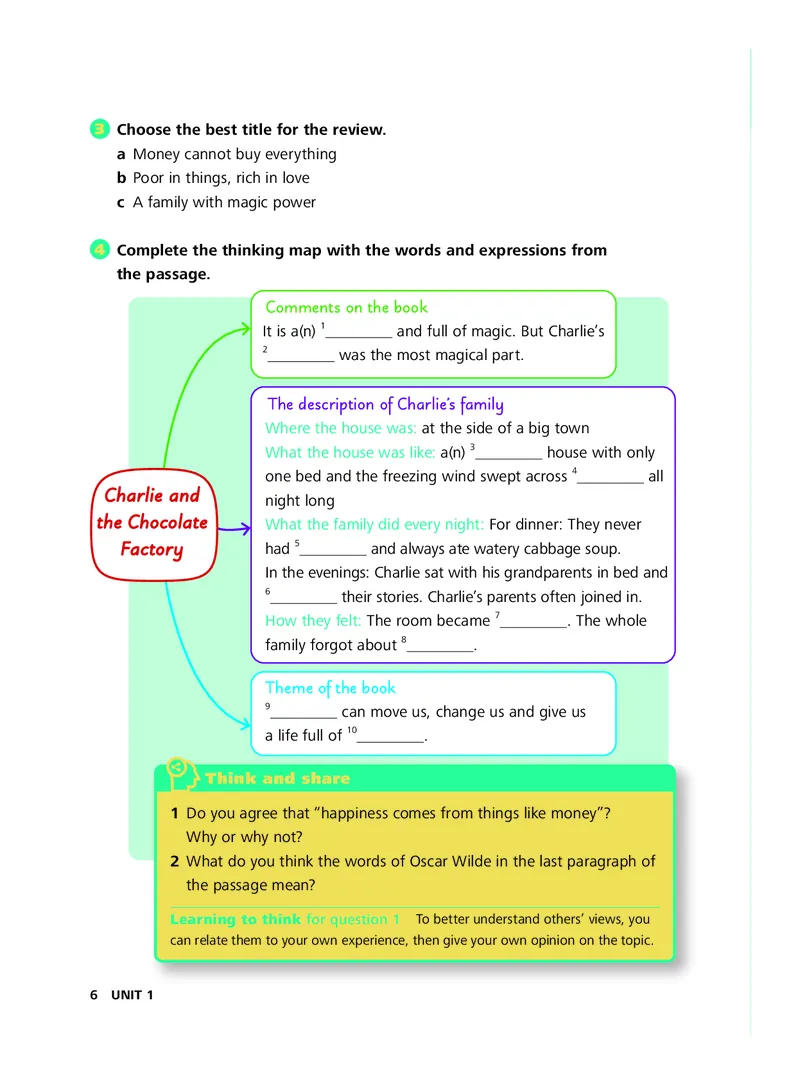
4 Complete the thinking map with the words and expressions from
the passage.
Comments on the book
It is a(n) 1 and full of magic. But Charlie’s
2 was the most magical part.
The description of Charlie’s family
Where the house was: at the side of a big town
What the house was like: a(n) 3 house with only
one bed and the freezing wind swept across 4 all
CChhaarrlliiee aanndd
night long
tthhee CChhooccoollaattee
What the family did every night: For dinner: They never
FFaaccttoorryy had 5 and always ate watery cabbage soup.
In the evenings: Charlie sat with his grandparents in bed and
6 their stories. Charlie’s parents often joined in.
How they felt: The room became 7 . The whole
family forgot about 8 .
Theme of the book
9 can move us, change us and give us
a life full of 10 .
Think and share
1 Do you agree that “happiness comes from things like money”?
Why or why not?
2 What do you think the words of Oscar Wilde in the last paragraph of
the passage mean?
Learning to think for question 1 To better understand others’ views, you
can relate them to your own experience, then give your own opinion on the topic.
6 UNIT 1Grammar rules⇢ p119
5 Read the sentences from the reading passage and summarise the
grammar rules.
(a) The book was full of magic.
(b) The family never had enough food.
(c) To my surprise, the family were happy together.
Now find more sentences with these structures in the reading passage.
6 Complete the sentences with the correct form of the verbs in brackets.
1 Sarah (be) happy to play chess with her brother yesterday.
2 Emily (make) a cake for her grandpa last night for his 70th birthday.
3 Last weekend, our family trip to the park (fill) us with happiness.
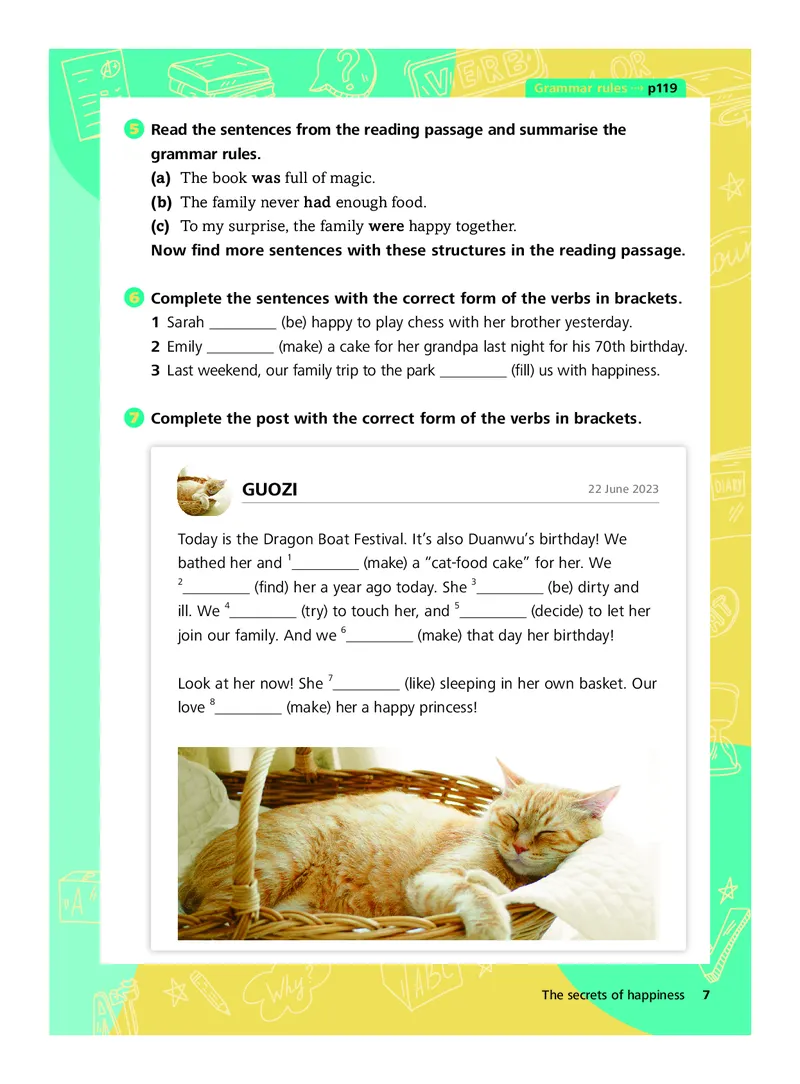
7 Complete the post with the correct form of the verbs in brackets.
GUOZI 22 June 2023
Today is the Dragon Boat Festival. It’s also Duanwu’s birthday! We
bathed her and 1 (make) a “cat-food cake” for her. We
2 (find) her a year ago today. She 3 (be) dirty and
ill. We 4 (try) to touch her, and 5 (decide) to let her
join our family. And we 6 (make) that day her birthday!
Look at her now! She 7 (like) sleeping in her own basket. Our
love 8 (make) her a happy princess!
GUOZI
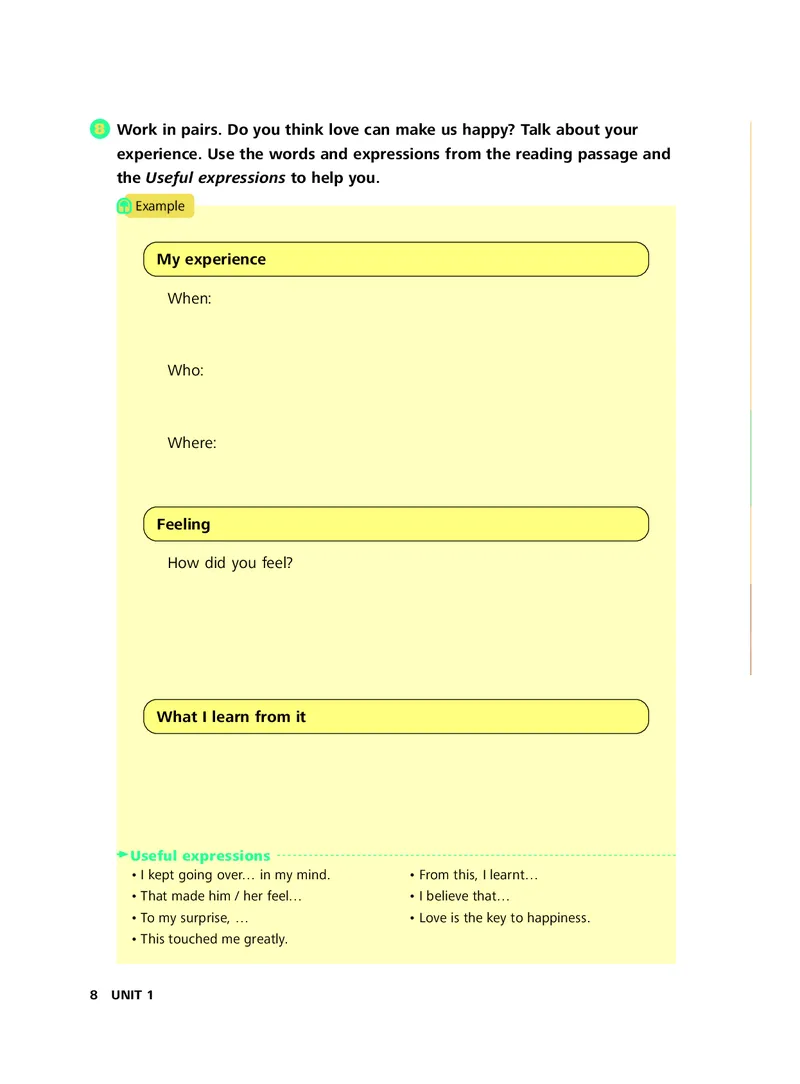
The secrets of happiness 78 Work in pairs. Do you think love can make us happy? Talk about your
experience. Use the words and expressions from the reading passage and
the Useful expressions to help you.
Example
My experience
When:
Who:
Where:
Feeling
How did you feel?
What I learn from it
Useful expressions
• I kept going over… in my mind. • From this, I learnt…
• That made him / her feel… • I believe that…
• To my surprise, … • Love is the key to happiness.
• This touched me greatly.
8 UNIT 1Developing ideas
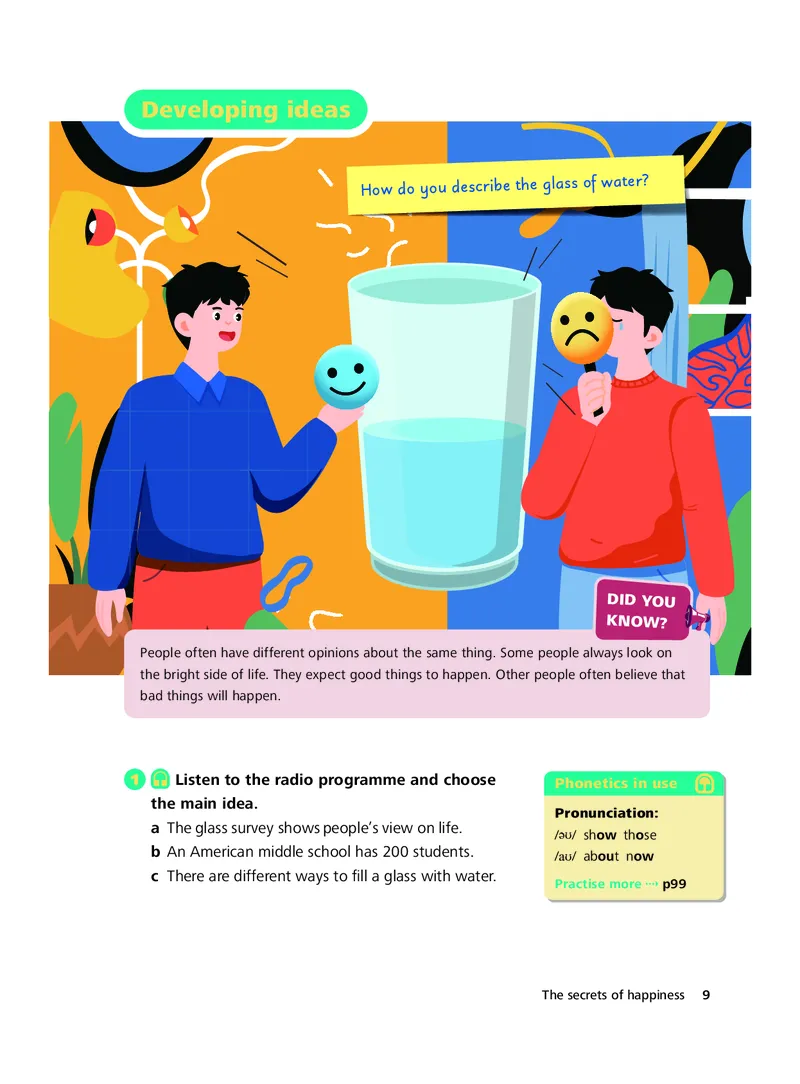
How do you describe the glass of water?
DID YOU
KNOW?
People often have different opinions about the same thing. Some people always look on
the bright side of life. They expect good things to happen. Other people often believe that
bad things will happen.
1 Listen to the radio programme and choose
Phonetics in use
the main idea.
Pronunciation:
a The glass survey shows people’s view on life.
/ / show those
əʊ
b An American middle school has 200 students.
/ / about now
aʊ
c There are different ways to fill a glass with water.
Practise more⇢ p99
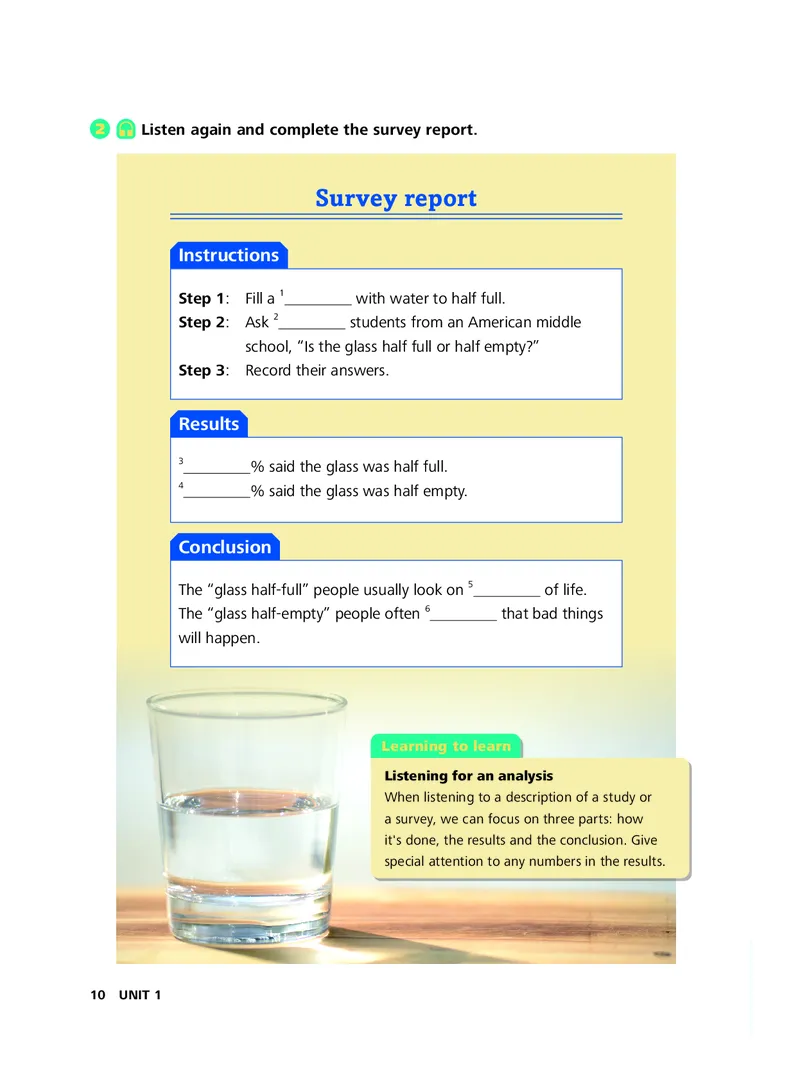
The secrets of happiness 92 Listen again and complete the survey report.
Survey report
Instructions
Step 1: Fill a 1 with water to half full.
Step 2: Ask 2 students from an American middle
school, “Is the glass half full or half empty?”
Step 3: Record their answers.
Results
3 % said the glass was half full.
4 % said the glass was half empty.
Conclusion
The “glass half-full” people usually look on 5 of life.
The “glass half-empty” people often 6 that bad things
will happen.
Learning to learn
Listening for an analysis
When listening to a description of a study or
a survey, we can focus on three parts: how
it's done, the results and the conclusion. Give
special attention to any numbers in the results.
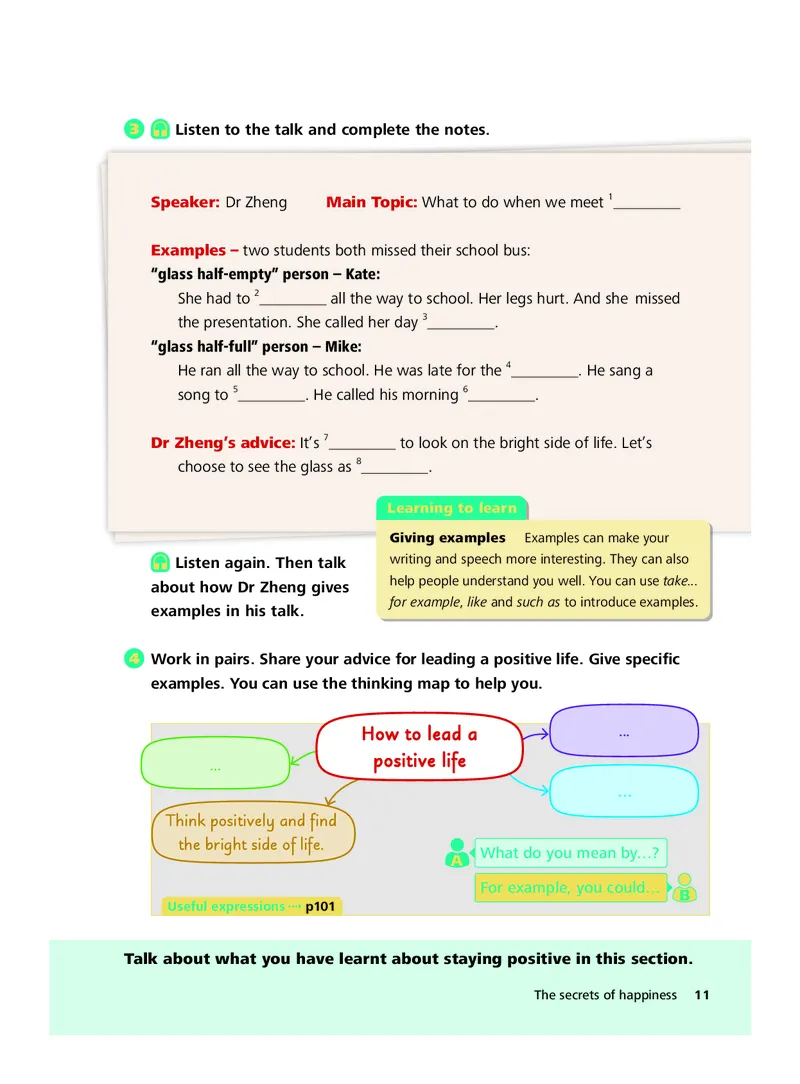
10 UNIT 13 Listen to the talk and complete the notes.
Speaker: Dr Zheng Main Topic: What to do when we meet 1
Examples – two students both missed their school bus:
“glass half-empty” person – Kate:
She had to 2 all the way to school. Her legs hurt. And she missed
the presentation. She called her day 3 .
“glass half-full” person – Mike:
He ran all the way to school. He was late for the 4 . He sang a
song to 5 . He called his morning 6 .
Dr Zheng’s advice: It’s 7 to look on the bright side of life. Let’s
choose to see the glass as 8 .
Learning to learn
Giving examples Examples can make your
Listen again. Then talk writing and speech more interesting. They can also
help people understand you well. You can use take...
about how Dr Zheng gives
for example, like and such as to introduce examples.
examples in his talk.
4 Work in pairs. Share your advice for leading a positive life. Give specific
examples. You can use the thinking map to help you.
HHooww ttoo lleeaadd aa ...
ppoossiittiivvee lliiffee
...
…
Think positively and find
the bright side of life.
What do you mean by…?
A
For example, you could…
B
Useful expressions⇢ p101
Talk about what you have learnt about staying positive in this section.
The secrets of happiness 11Reading for writing
1 Look at the pictures and predict what the passage is about. Use the
words and expressions to help you.
keep one’s hair long happiness grow smile
help others do good laugh at cut it short
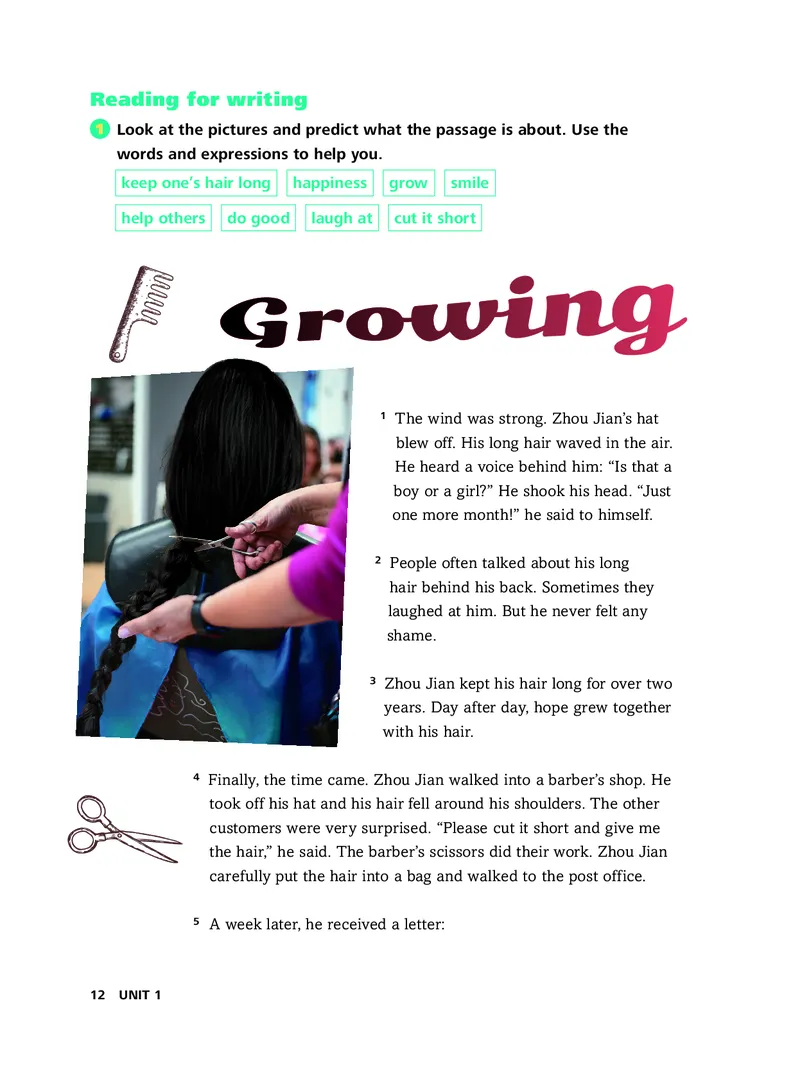
1 The wind was strong. Zhou Jian’s hat
blew off. His long hair waved in the air.
He heard a voice behind him: “Is that a
boy or a girl?” He shook his head. “Just
one more month!” he said to himself.
2 People often talked about his long
hair behind his back. Sometimes they
laughed at him. But he never felt any
shame.
3 Zhou Jian kept his hair long for over two
years. Day after day, hope grew together
with his hair.
4 Finally, the time came. Zhou Jian walked into a barber’s shop. He
took off his hat and his hair fell around his shoulders. The other
customers were very surprised. “Please cut it short and give me
the hair,” he said. The barber’s scissors did their work. Zhou Jian
carefully put the hair into a bag and walked to the post office.
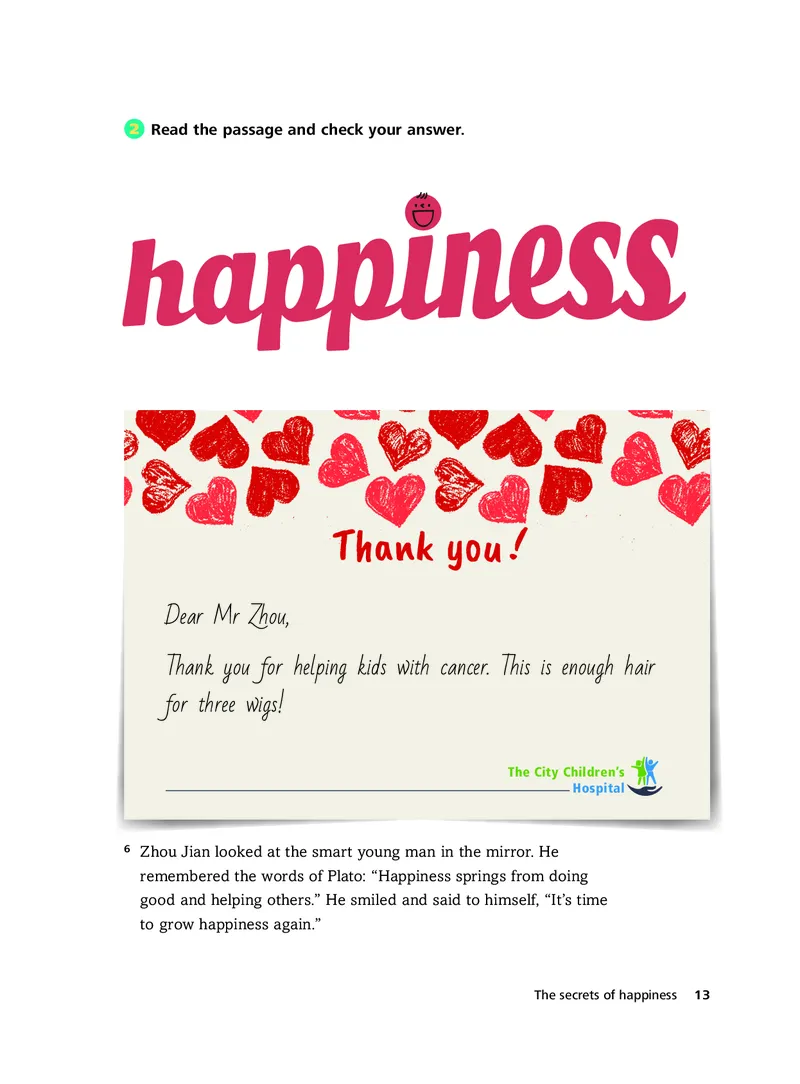
5 A week later, he received a letter:
12 UNIT 12 Read the passage and check your answer.
Thank you!
Dear Mr Zhou,
Thank you for helping kids with cancer. This is enough hair
for three wigs!
The City Children’s
Hospital
6 Zhou Jian looked at the smart young man in the mirror. He
remembered the words of Plato: “Happiness springs from doing
good and helping others.” He smiled and said to himself, “It’s time
to grow happiness again.”
The secrets of happiness 133 Complete the notes with the words and expressions from the passage.
What was Zhou Jian’s hair like?
He had 1 hair.
How did people react?
• They 2 his long hair behind his back.
• They 3 at him.
What did he do with his hair?
• He 4 for over two years.
• He went to a barber’s shop to 5 .
• He put the hair into a bag.
Why did he do so?
He wanted to help 6 .
What did he do next?
He 7 and said to himself, “It’s time to 8 again.”
4 Answer the questions.
1 What do you think “hope grew together with his hair” means?
2 What will Zhou Jian do to “grow happiness again”?
3 Why does the writer use the words of Plato in the last paragraph?
Think and share
1 How do you feel when you read the letter in the passage?
2 What can you learn from the passage?
Learning to think for question 1 Sometimes the writer puts the key
information at the end of the story. This keeps us reading on!
14 UNIT 15 Write a short story about feeling happy through helping others.
1
Step
Organise your ideas by answering the following questions.
Who is the main character of the story?
When and where did the story happen?
What did he / she do and what challenge(s) did he / she face?
How did he / she react to the challenge(s)?
What did he / she feel?
2
Step
Use your ideas to write your story.
3
Step
Check. Did you: ☐ include characters, a setting and events?
☐ use the words and expressions from the reading passage?
☐ give your opinion about the secrets of happiness?
4
Step
Share your story with the class.
The secrets of happiness 15Presenting ideas
Make a book page about ways to be happy.
1
Step
Work in groups. Search for information about ways to be happy. Then decide
which ways you will include in your book page. Consider:
• What makes you happy?
• How can we help others be happy?
• What is your advice for unhappy people?
2
Step
Organise your ideas with the help of the following outline and write your book
page. You may use the following language tips or find useful expressions or
sentences from this unit.
Introduction Stating the purpose of your book page
– In this book page, we are going to introduce…
– A happy life means…
Body
Listing three things to make you happy Giving reasons
– … is the key to happiness. – A life without… is like a(n)…
– It helps / It’s important to… – … can move us, change us and
– We can be happy by… give us a life full of happiness.
– You could start… – In fact, people often think…
– The first / second / third way that – Happiness comes / springs from…
people can be happy is…
Conclusion Giving a brief summary
– There are many ways people can be happy. They include…
– Remember to stay positive and…
16 UNIT 13
Step
E x t r a !
Practise and present your book page to Collect all the pages and make a “Happiness
the class. handbook” for the class.
4
Step
Vote on the best three book pages and the best three presentations.
Reflection
1 After completing this unit, I understand more about what makes us
happy.
What are the secrets of happiness?
Love. Staying . Helping .
2 To express my understanding, I can…
☐ use words and expressions in the unit to talk about happiness:
☐ use the simple past tense to describe happy moments.
☐ share the meaning of happiness in our lives.
*1=excellent, 2=good, 3=not yet
3 I still need to improve:
The secrets of happiness 17Unit
2
GGoo ffoorr iitt!!
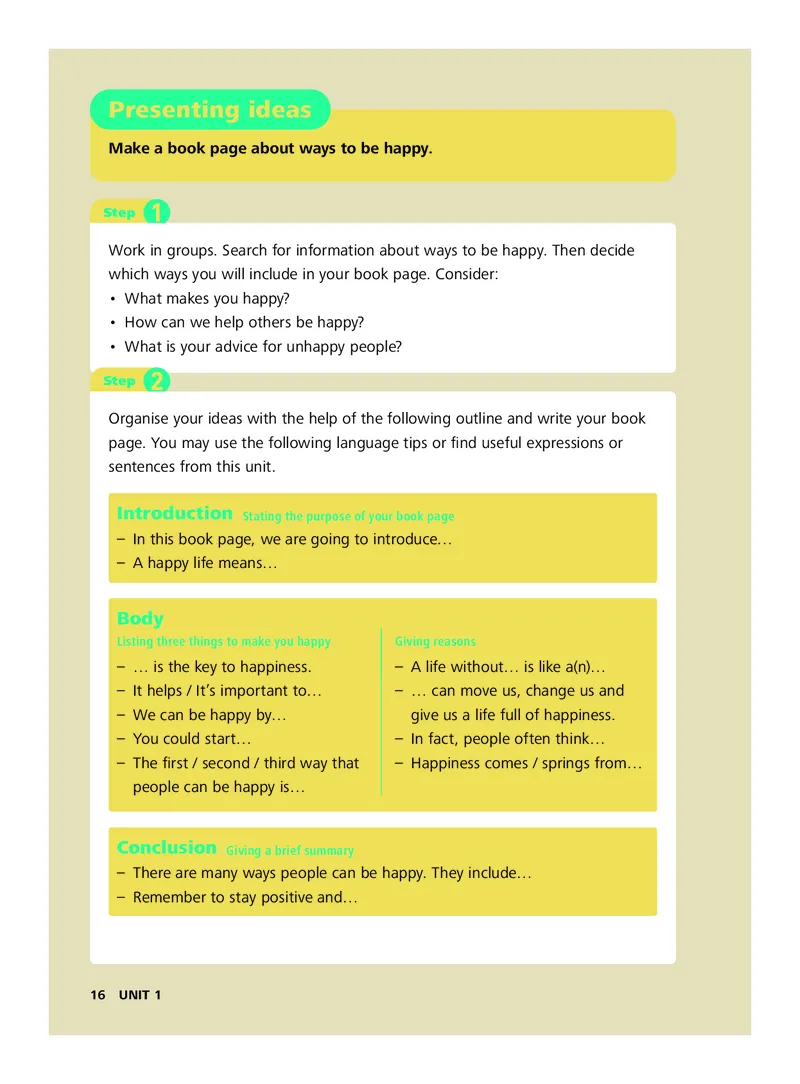
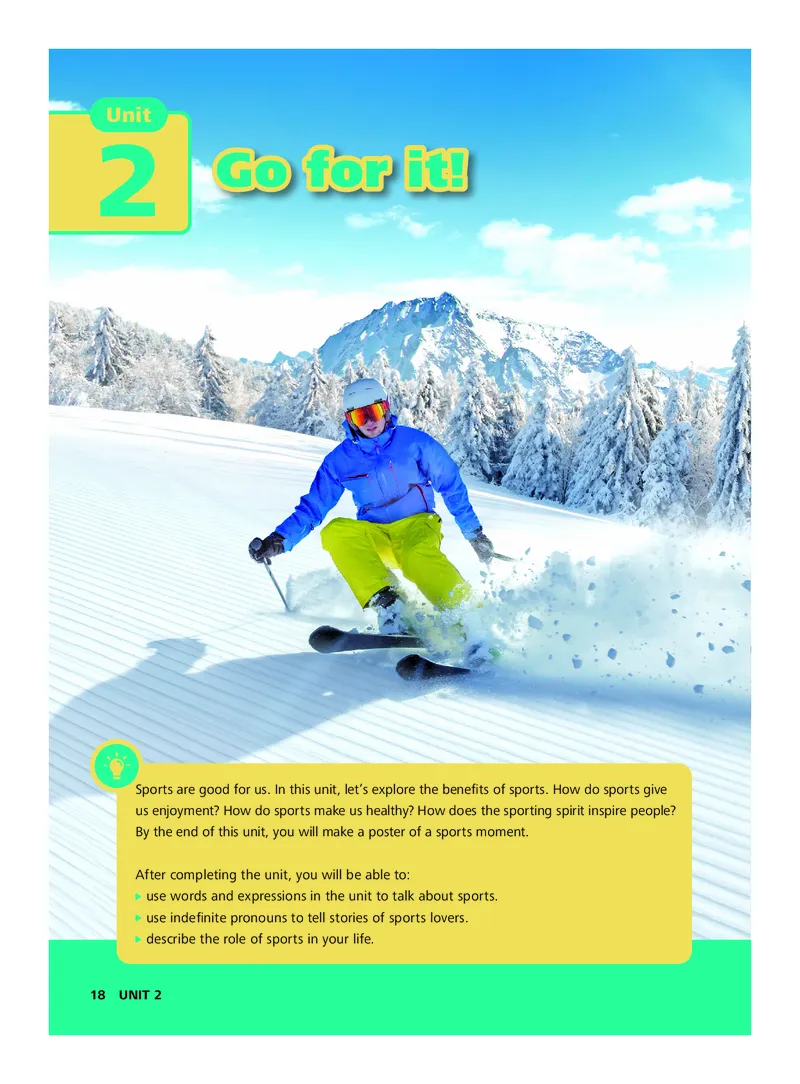
Sports are good for us. In this unit, let’s explore the benefits of sports. How do sports give
us enjoyment? How do sports make us healthy? How does the sporting spirit inspire people?
By the end of this unit, you will make a poster of a sports moment.
After completing the unit, you will be able to:
use words and expressions in the unit to talk about sports.
use indefinite pronouns to tell stories of sports lovers.
describe the role of sports in your life.
18 UNIT 2How do you like this sport?
Starting out
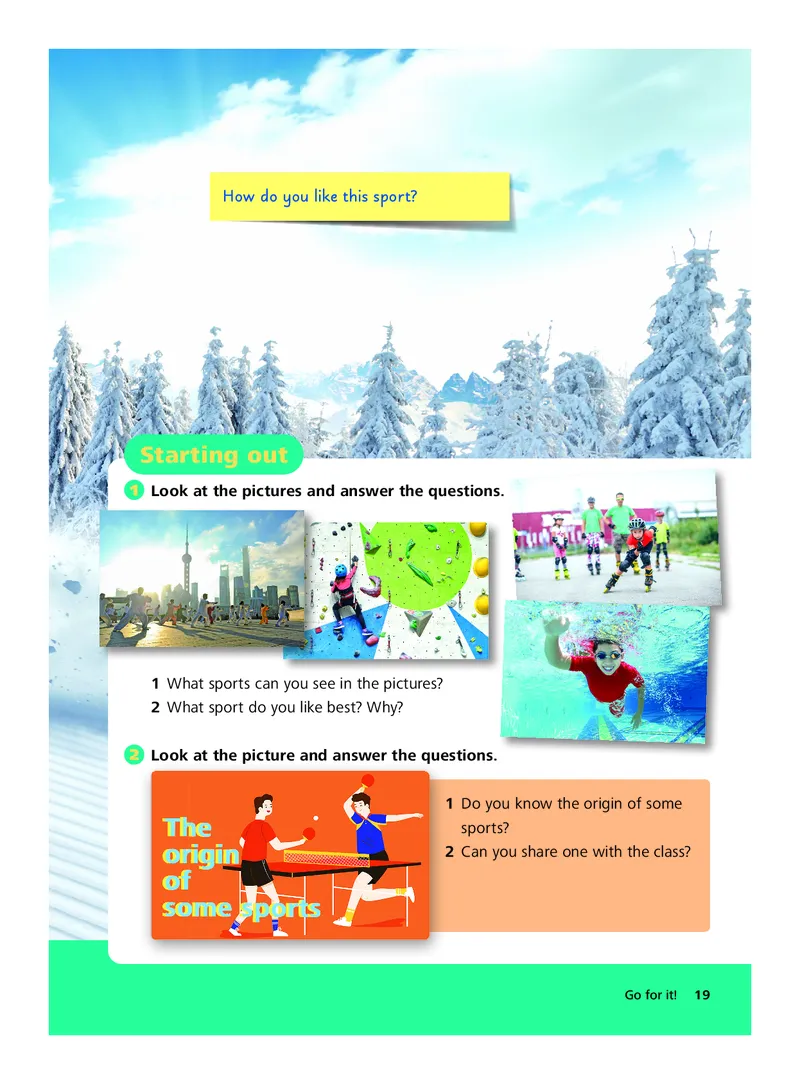
1 Look at the pictures and answer the questions.
1 What sports can you see in the pictures?
2 What sport do you like best? Why?
2 Look at the picture and answer the questions.
1 Do you know the origin of some
sports?
2 Can you share one with the class?
Go for it! 19Understanding ideas
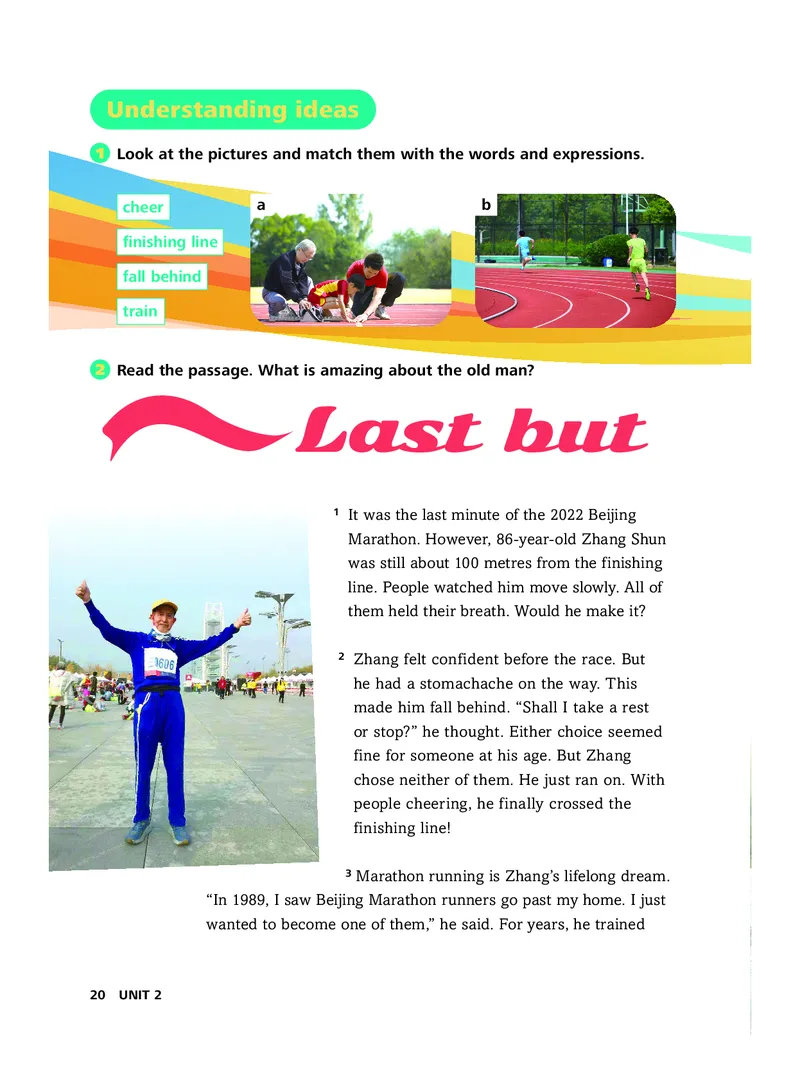
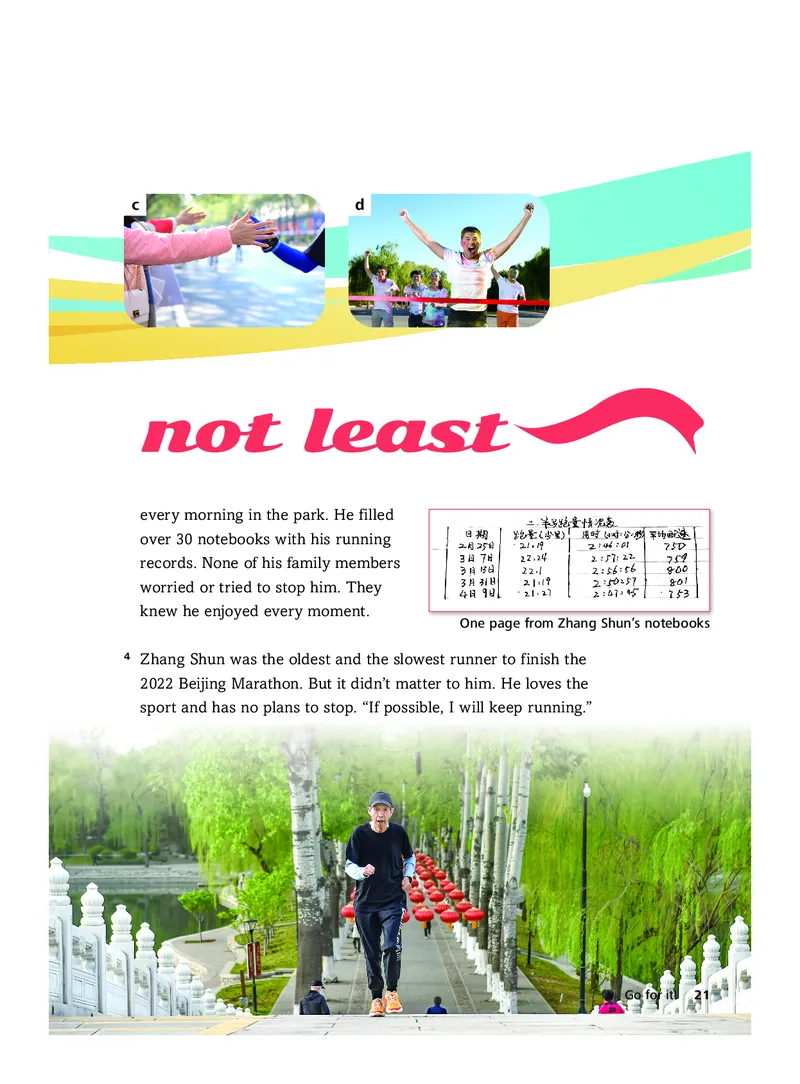
1 Look at the pictures and match them with the words and expressions.
cheer a b
finishing line
fall behind
train
2 Read the passage. What is amazing about the old man?
Last but not least
1 It was the last minute of the 2022 Beijing
Marathon. However, 86-year-old Zhang Shun
was still about 100 metres from the finishing
line. People watched him move slowly. All of
them held their breath. Would he make it?
2 Zhang felt confident before the race. But
he had a stomachache on the way. This
made him fall behind. “Shall I take a rest
or stop?” he thought. Either choice seemed
fine for someone at his age. But Zhang
chose neither of them. He just ran on. With
people cheering, he finally crossed the
finishing line!
3 Marathon running is Zhang’s lifelong dream.
“In 1989, I saw Beijing Marathon runners go past my home. I just
wanted to become one of them,” he said. For years, he trained
20 UNIT 2c d
Last but not least
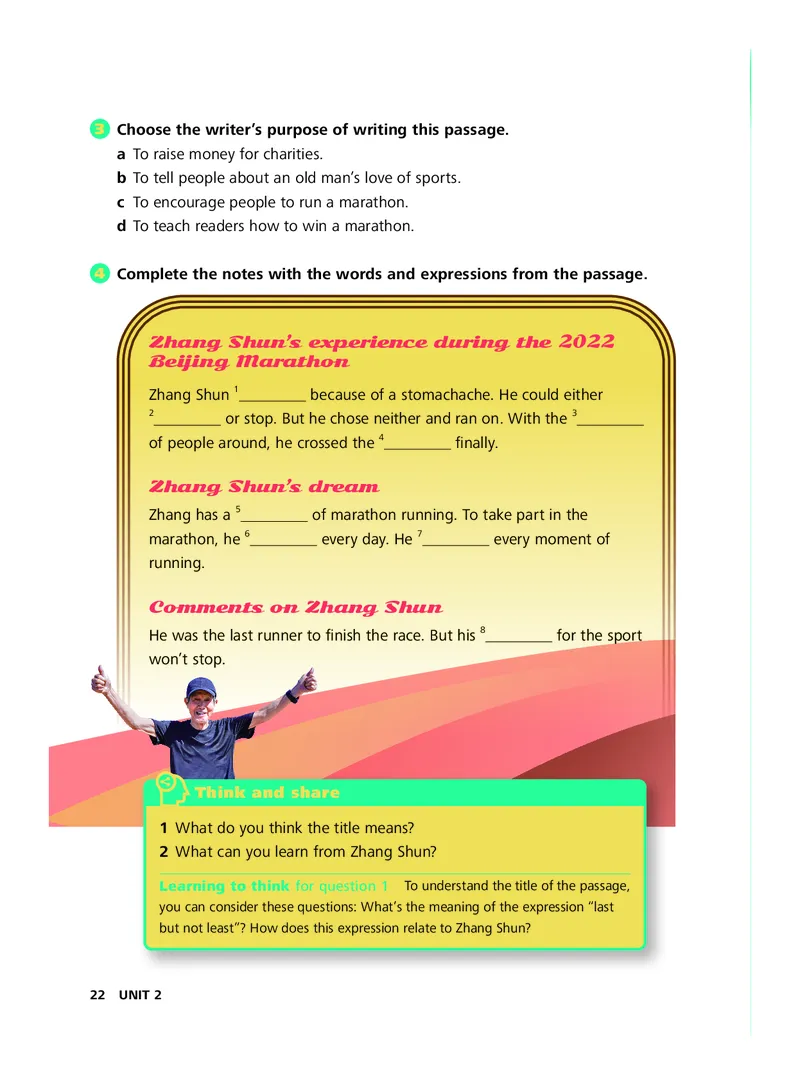
every morning in the park. He filled
over 30 notebooks with his running
records. None of his family members
worried or tried to stop him. They
knew he enjoyed every moment.
One page from Zhang Shun’s notebooks
4 Zhang Shun was the oldest and the slowest runner to finish the
2022 Beijing Marathon. But it didn’t matter to him. He loves the
sport and has no plans to stop. “If possible, I will keep running.”
Go for it! 213 Choose the writer’s purpose of writing this passage.
a To raise money for charities.
b To tell people about an old man’s love of sports.
c To encourage people to run a marathon.
d To teach readers how to win a marathon.
4 Complete the notes with the words and expressions from the passage.
Zhang Shun’s experience during the 2022
Beijing Marathon
Zhang Shun 1 because of a stomachache. He could either
2 or stop. But he chose neither and ran on. With the 3
of people around, he crossed the 4 finally.
Zhang Shun’s dream
Zhang has a 5 of marathon running. To take part in the
marathon, he 6 every day. He 7 every moment of
running.
Comments on Zhang Shun
He was the last runner to finish the race. But his 8 for the sport
won’t stop.
Think and share
1 What do you think the title means?
2 What can you learn from Zhang Shun?
Learning to think for question 1 To understand the title of the passage,
you can consider these questions: What’s the meaning of the expression “last
but not least”? How does this expression relate to Zhang Shun?
22 UNIT 2Grammar rules⇢ p123
5 Read the sentences from the reading passage and summarise the
grammar rules.
(a) All of them held their breath.
(b) Either choice seemed fine for someone at his age. But Zhang chose
neither of them.
(c) None of his family members worried or tried to stop him.
6 Match the pictures with the words. Then make a sentence with each
word.
+ + / +
× × × × ×
both neither either none all
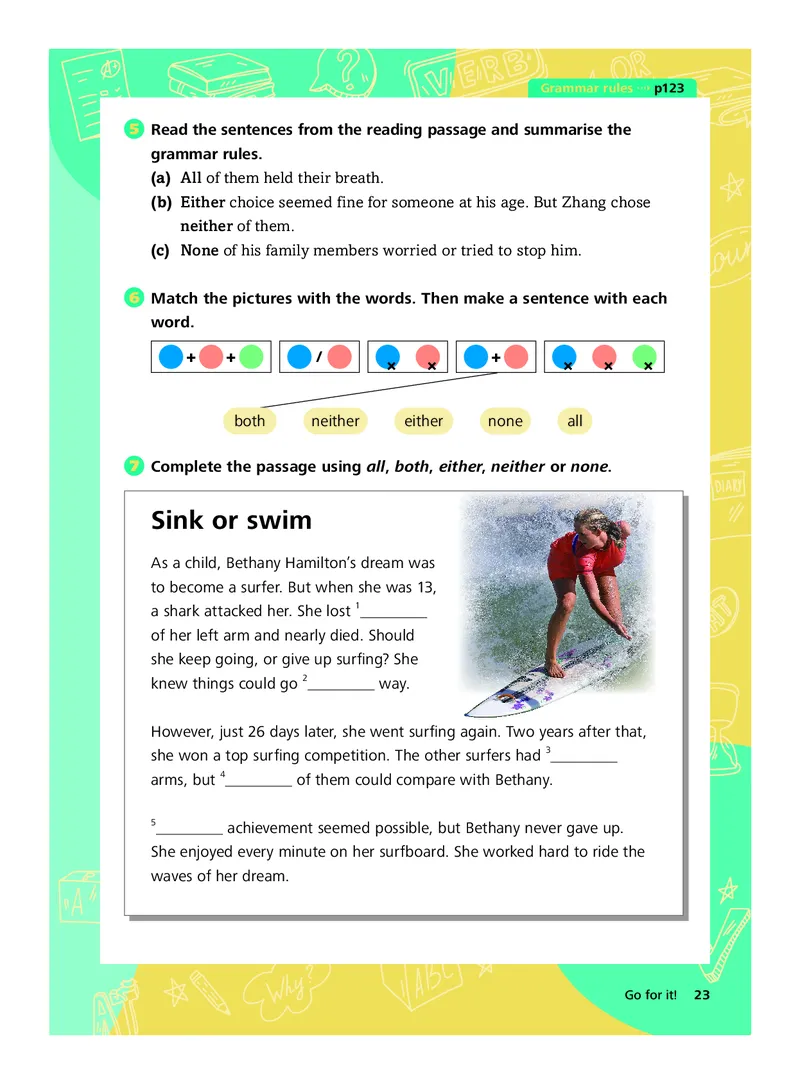
7 Complete the passage using all, both, either, neither or none.
Sink or swim
As a child, Bethany Hamilton’s dream was
to become a surfer. But when she was 13,
a shark attacked her. She lost 1
of her left arm and nearly died. Should
she keep going, or give up surfing? She
knew things could go 2 way.
However, just 26 days later, she went surfing again. Two years after that,
she won a top surfing competition. The other surfers had 3
arms, but 4 of them could compare with Bethany.
5 achievement seemed possible, but Bethany never gave up.
She enjoyed every minute on her surfboard. She worked hard to ride the
waves of her dream.
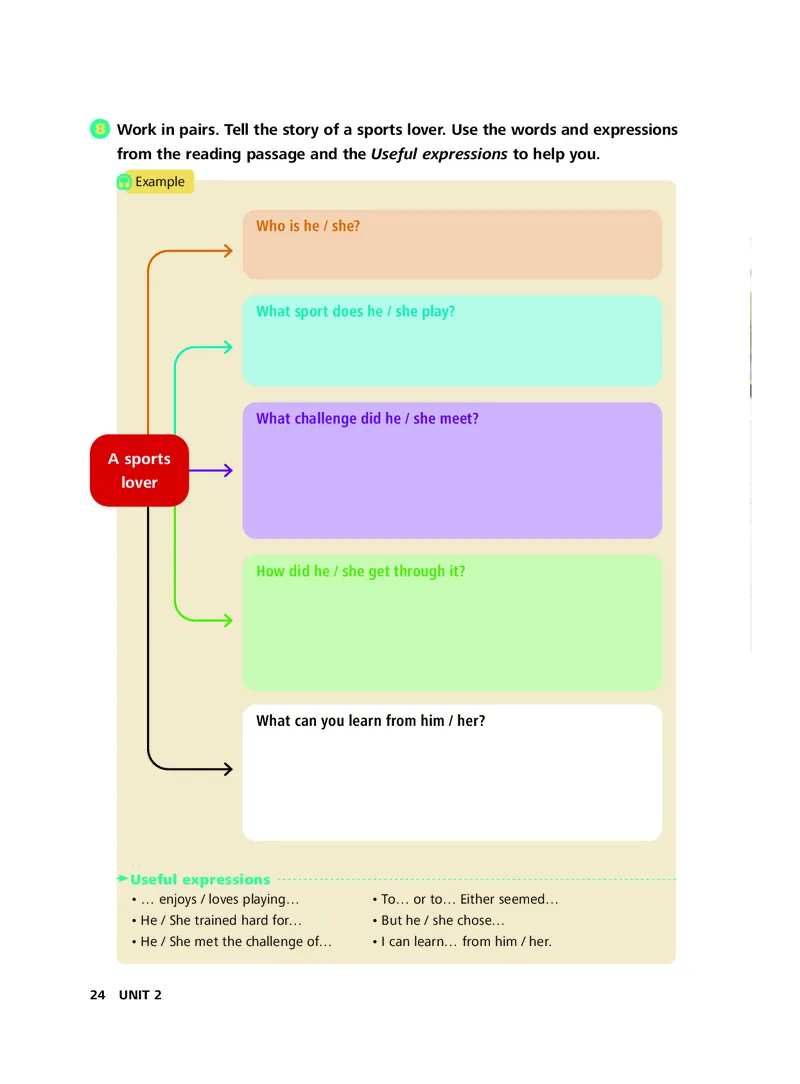
Go for it! 238 Work in pairs. Tell the story of a sports lover. Use the words and expressions
from the reading passage and the Useful expressions to help you.
Example
Who is he / she?
What sport does he / she play?
What challenge did he / she meet?
A sports
lover
How did he / she get through it?
What can you learn from him / her?
Useful expressions
• … enjoys / loves playing… • To… or to… Either seemed…
• He / She trained hard for… • But he / she chose…
• He / She met the challenge of… • I can learn… from him / her.
24 UNIT 2Developing ideas
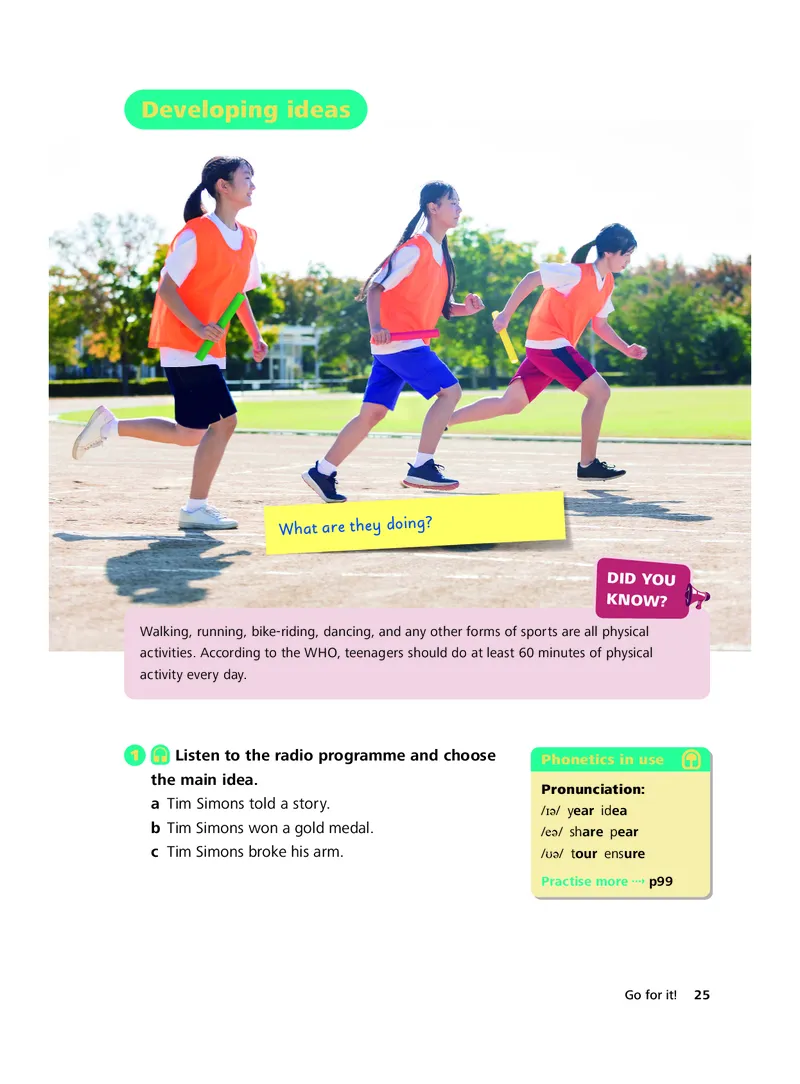
What are they doing?
DID YOU
KNOW?
Walking, running, bike-riding, dancing, and any other forms of sports are all physical
activities. According to the WHO, teenagers should do at least 60 minutes of physical
activity every day.
1 Listen to the radio programme and choose
Phonetics in use
the main idea.
Pronunciation:
a Tim Simons told a story.
/ / year idea
ɪə
b Tim Simons won a gold medal.
/ / share pear
eə
c Tim Simons broke his arm. / / tour ensure
ʊə
Practise more⇢ p99
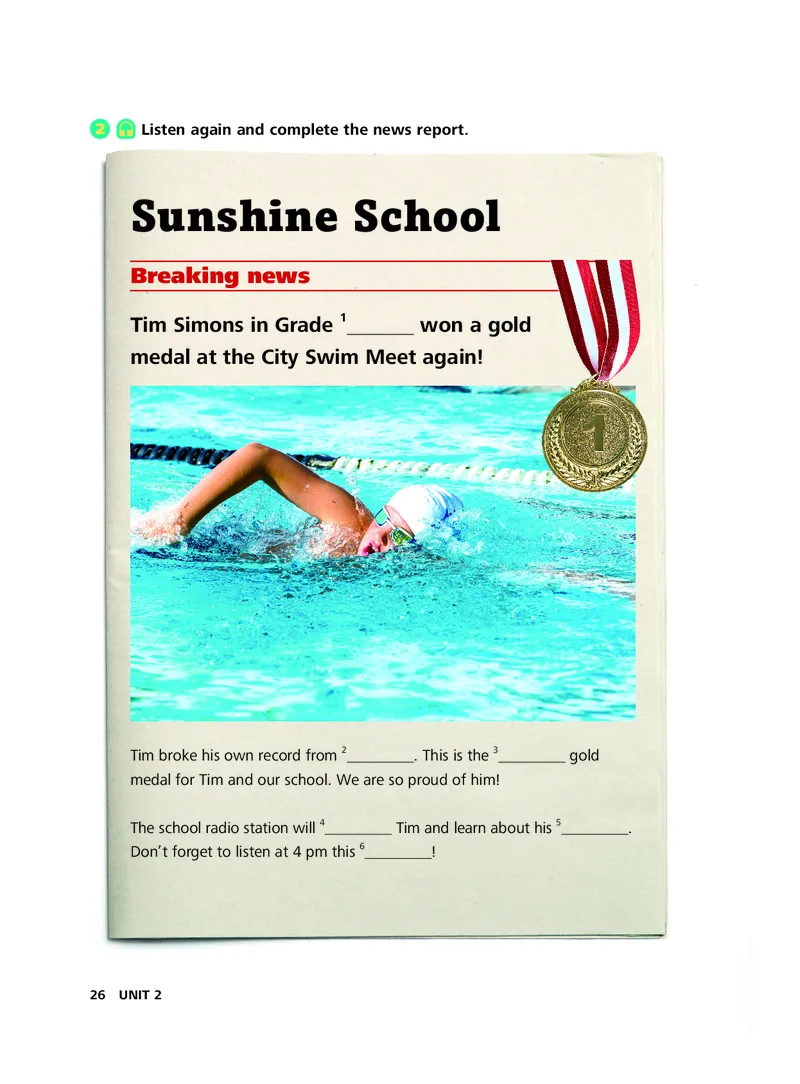
Go for it! 252 Listen again and complete the news report.
Sunshine School
Breaking news
Tim Simons in Grade 1 won a gold
medal at the City Swim Meet again!
Tim broke his own record from 2 . This is the 3 gold
medal for Tim and our school. We are so proud of him!
The school radio station will 4 Tim and learn about his 5 .
Don’t forget to listen at 4 pm this 6 !
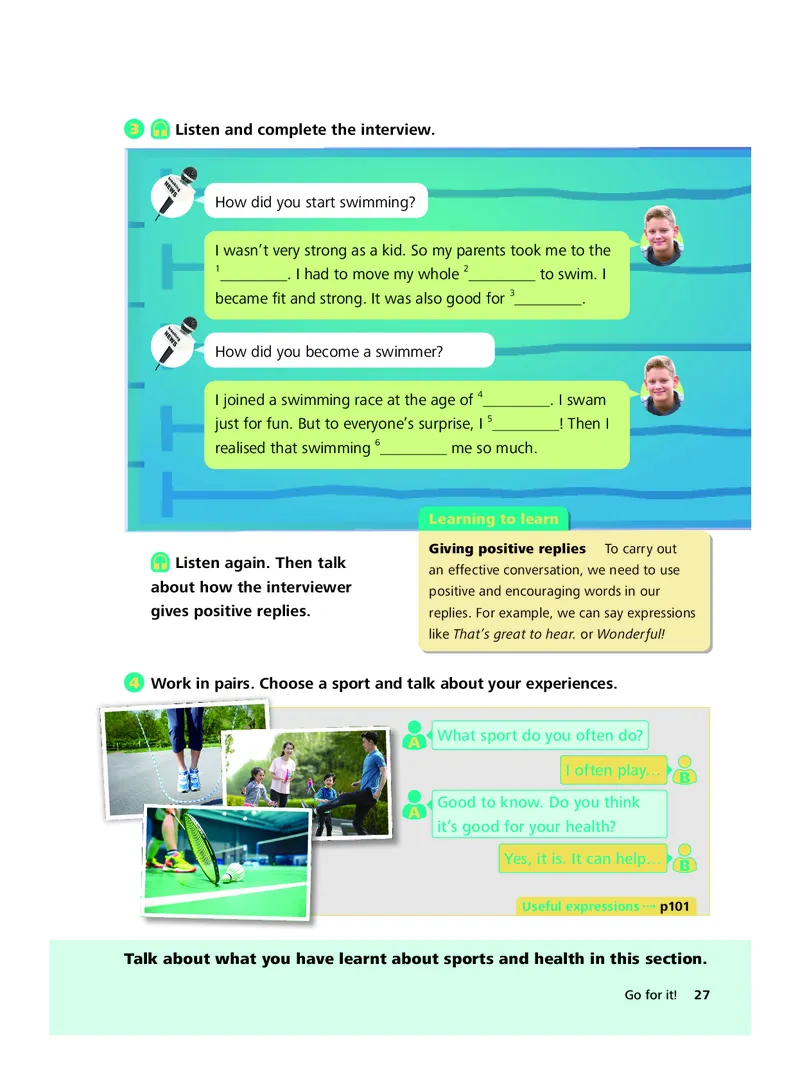
26 UNIT 23 Listen and complete the interview.
How did you start swimming?
I wasn’t very strong as a kid. So my parents took me to the
1 . I had to move my whole 2 to swim. I
became fit and strong. It was also good for 3 .
How did you become a swimmer?
I joined a swimming race at the age of 4 . I swam
just for fun. But to everyone’s surprise, I 5 ! Then I
realised that swimming 6 me so much.
Learning to learn
Giving positive replies To carry out
Listen again. Then talk
an effective conversation, we need to use
about how the interviewer
positive and encouraging words in our
gives positive replies. replies. For example, we can say expressions
like That’s great to hear. or Wonderful!
4 Work in pairs. Choose a sport and talk about your experiences.
What sport do you often do?
A
I often play…
B
Good to know. Do you think
A
it’s good for your health?
Yes, it is. It can help…
B
Useful expressions⇢ p101
Talk about what you have learnt about sports and health in this section.
Go for it! 27Reading for writing
1 Look at the pictures below and describe them with the words and
expressions.
fight hard work football team courage never give up
The
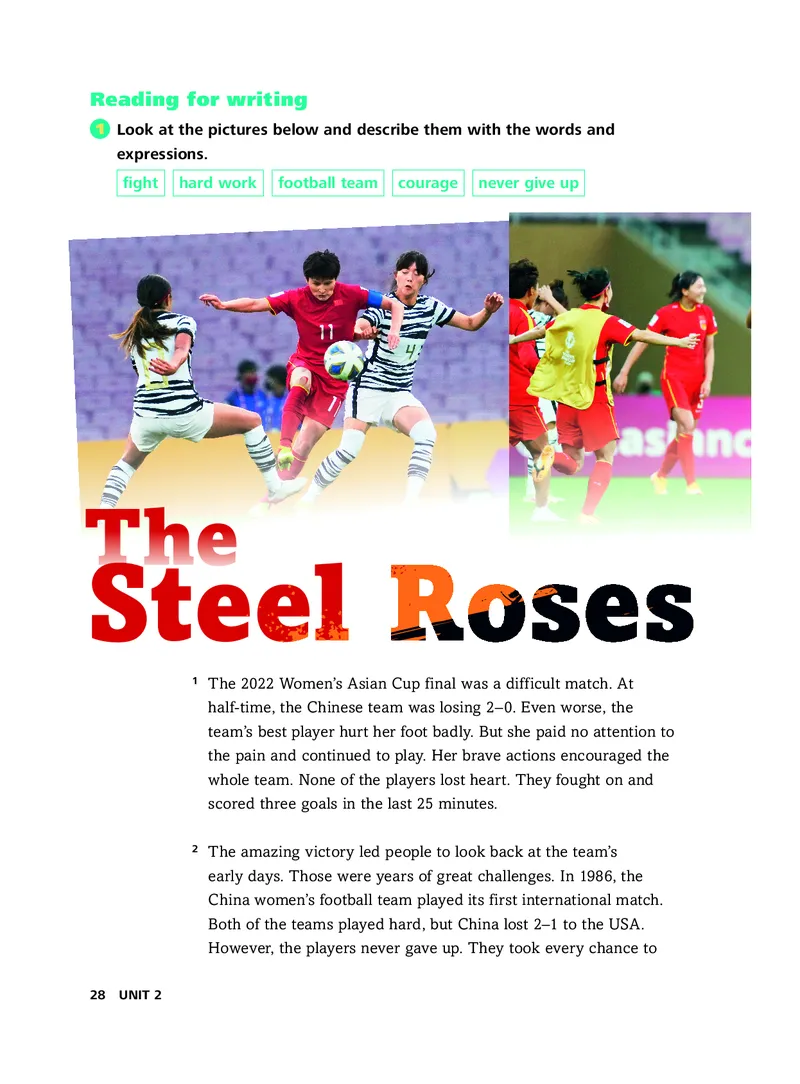
1 The 2022 Women’s Asian Cup final was a difficult match. At
half-time, the Chinese team was losing 2–0. Even worse, the
team’s best player hurt her foot badly. But she paid no attention to
the pain and continued to play. Her brave actions encouraged the
whole team. None of the players lost heart. They fought on and
scored three goals in the last 25 minutes.
2 The amazing victory led people to look back at the team’s
early days. Those were years of great challenges. In 1986, the
China women’s football team played its first international match.
Both of the teams played hard, but China lost 2–1 to the USA.
However, the players never gave up. They took every chance to
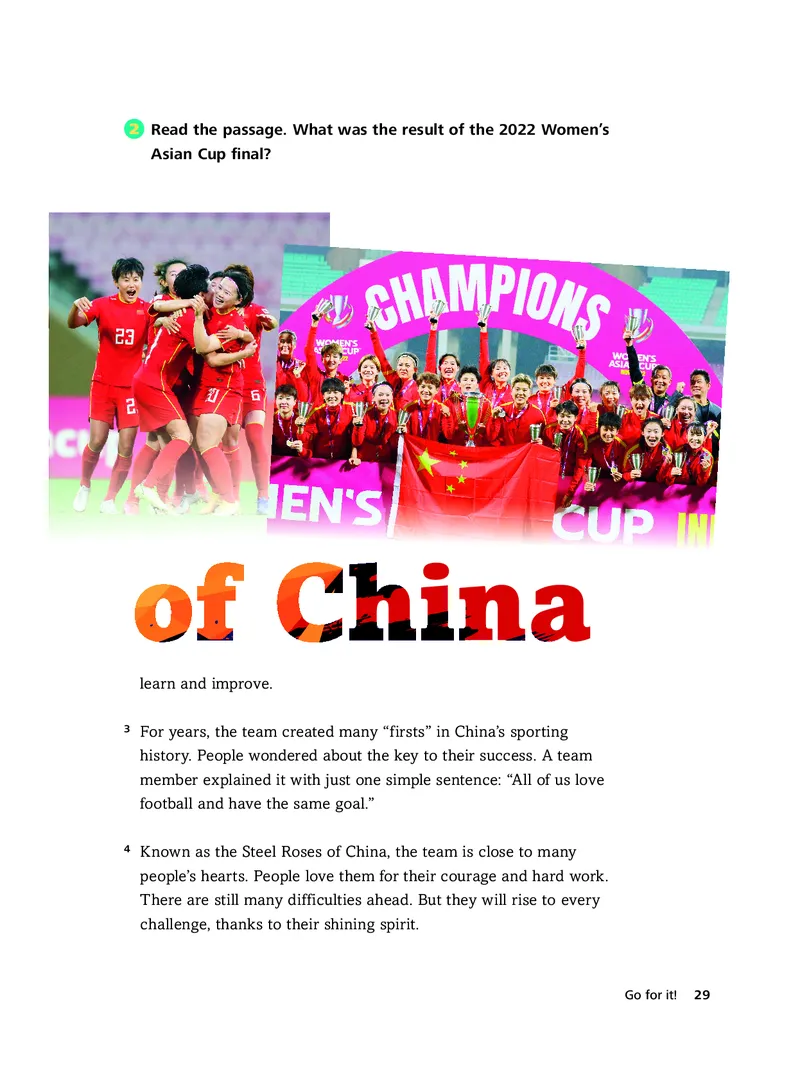
28 UNIT 22 Read the passage. What was the result of the 2022 Women’s
Asian Cup final?
learn and improve.
3 For years, the team created many “firsts” in China’s sporting
history. People wondered about the key to their success. A team
member explained it with just one simple sentence: “All of us love
football and have the same goal.”
4 Known as the Steel Roses of China, the team is close to many
people’s hearts. People love them for their courage and hard work.
There are still many difficulties ahead. But they will rise to every
challenge, thanks to their shining spirit.
Go for it! 293 Complete the notes with the words and expressions from the passage.
The victory at
the 2022 Women’s Asian Cup
At half-time, the Chinese team was losing. A key player hurt her foot
badly but 1 to play. None of the players lost heart. They
just 2 . In the last 25 minutes, they scored three goals.
The spirit of
the Steel Roses
• The team never 3 .
• They 4 to learn and improve.
• All of the team members love 5 and have 6 .
Comments on
the Steel Roses
The team is close to many people’s hearts. People love them for
their 7 . With their 8 , they will rise to every
challenge.
4 Answer the questions.
1 What does “lost heart” mean?
2 What does “firsts” mean?
3 Why is the team “close to many people’s hearts”?
Think and share
1 Why do you think people call the team the Steel Roses?
2 Do you want to play a team sport? Why or why not?
Learning to think for question 1 Consider these questions: What kind of people
does “steel” describe? What kind of people does “roses” describe? What’s the story
behind the team? How does it relate to the name?
30 UNIT 25 Write a short paragraph about a sports team.
1
Step
Think of some sports teams. Choose one to write about.
Complete the boxes.
Name of the team
Their history / story
Their spirit
Your comments
2
Step
Write your paragraph with the help of the boxes.
3
Step
Check. Did you: ☐ include all the ideas from Step 1?
☐ use the words and expressions from the reading passage?
☐ give your opinion about the team?
4
Step
Share your paragraph with the class.
Go for it! 31Presenting ideas
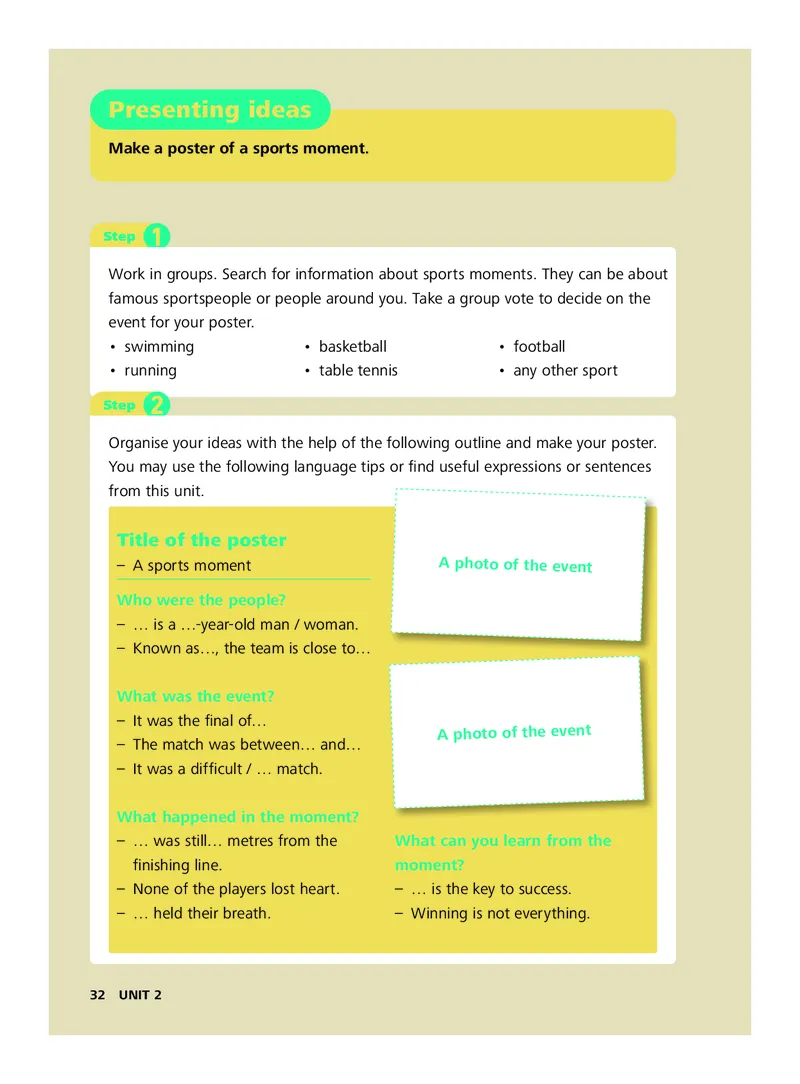
Make a poster of a sports moment.
1
Step
Work in groups. Search for information about sports moments. They can be about
famous sportspeople or people around you. Take a group vote to decide on the
event for your poster.
• swimming • basketball • football
• running • table tennis • any other sport
2
Step
Organise your ideas with the help of the following outline and make your poster.
You may use the following language tips or find useful expressions or sentences
from this unit.
Title of the poster
– A sports moment A photo of the event
Who were the people?
– … is a …-year-old man / woman.
– Known as…, the team is close to…
What was the event?
– It was the final of…
A photo of the event
– The match was between… and…
– It was a difficult / … match.
What happened in the moment?
– … was still… metres from the What can you learn from the
finishing line. moment?
– None of the players lost heart. – … is the key to success.
– … held their breath. – Winning is not everything.
32 UNIT 23
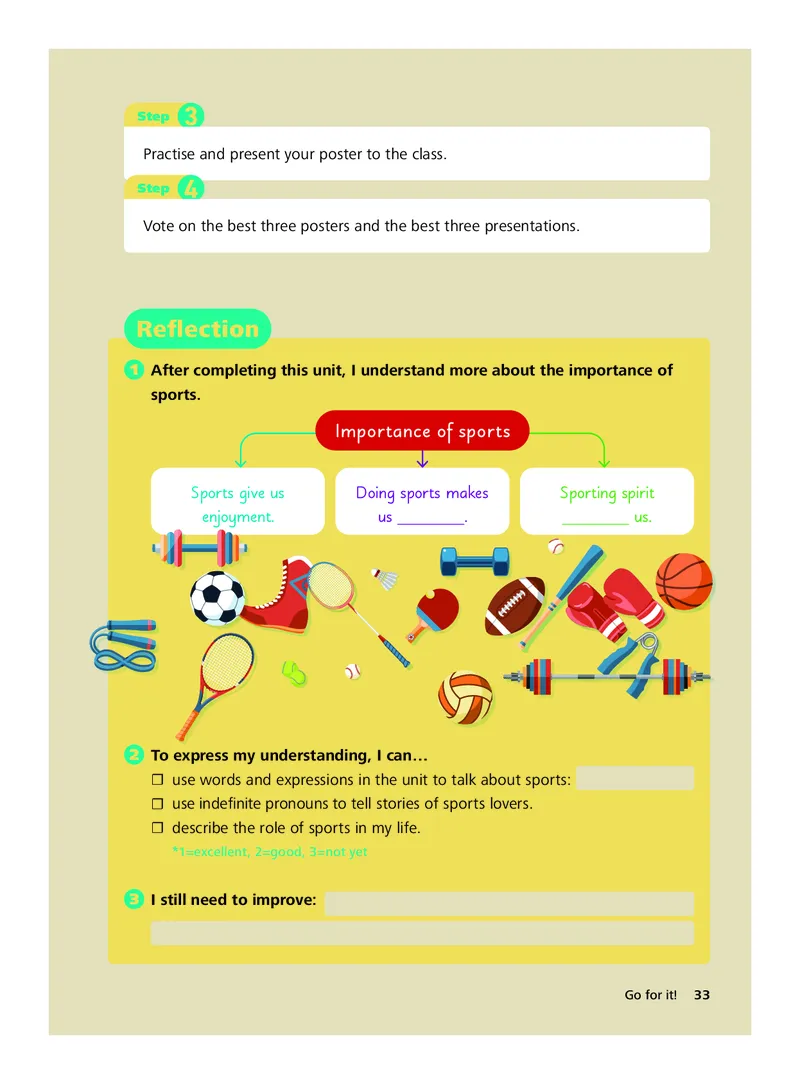
Step
Practise and present your poster to the class.
4
Step
Vote on the best three posters and the best three presentations.
Reflection
1 After completing this unit, I understand more about the importance of
sports.
Importance of sports
Sports give us Doing sports makes Sporting spirit
enjoyment. us . us.
2 To express my understanding, I can…
☐ use words and expressions in the unit to talk about sports:
☐ use indefinite pronouns to tell stories of sports lovers.
☐ describe the role of sports in my life.
*1=excellent, 2=good, 3=not yet
3 I still need to improve:
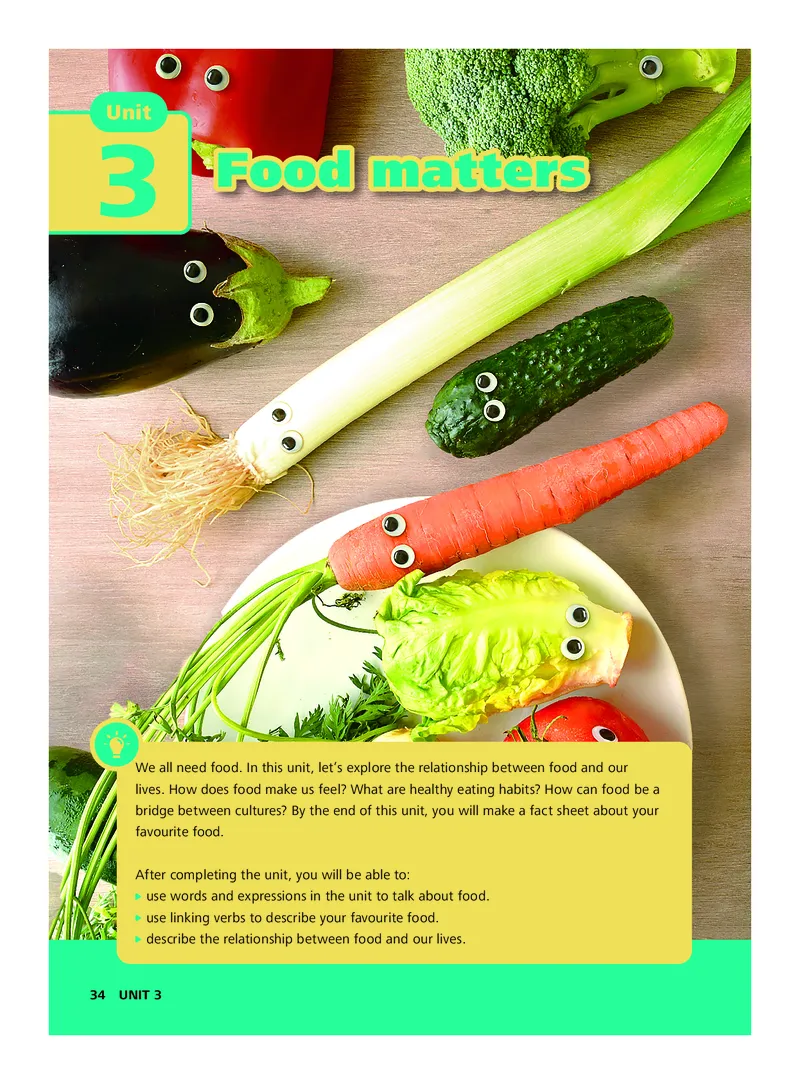
Go for it! 33Unit
3
FFoooodd mmaatttteerrss
We all need food. In this unit, let’s explore the relationship between food and our
lives. How does food make us feel? What are healthy eating habits? How can food be a
bridge between cultures? By the end of this unit, you will make a fact sheet about your
favourite food.
After completing the unit, you will be able to:
use words and expressions in the unit to talk about food.
use linking verbs to describe your favourite food.
describe the relationship between food and our lives.
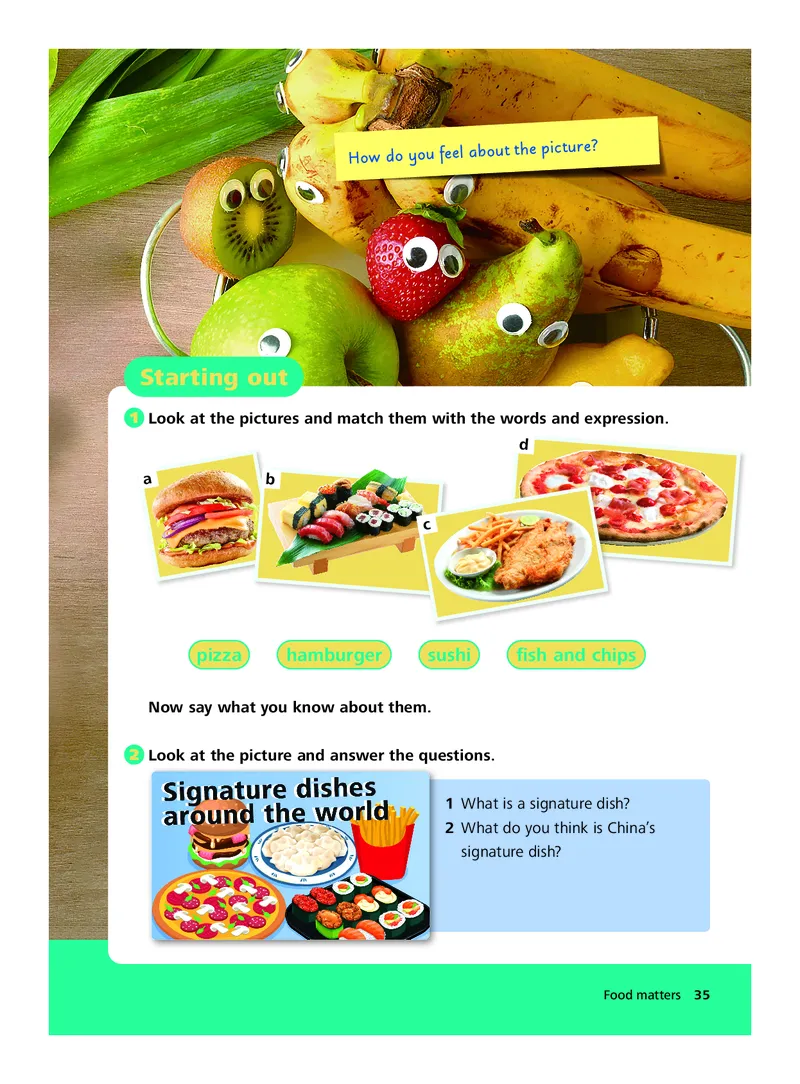
34 UNIT 3How do you feel about the picture?
Starting out
1 Look at the pictures and match them with the words and expression.
d
a b
c
pizza hamburger sushi fish and chips
Now say what you know about them.
2 Look at the picture and answer the questions.
1 What is a signature dish?
2 What do you think is China’s
signature dish?
Food matters 35Understanding ideas
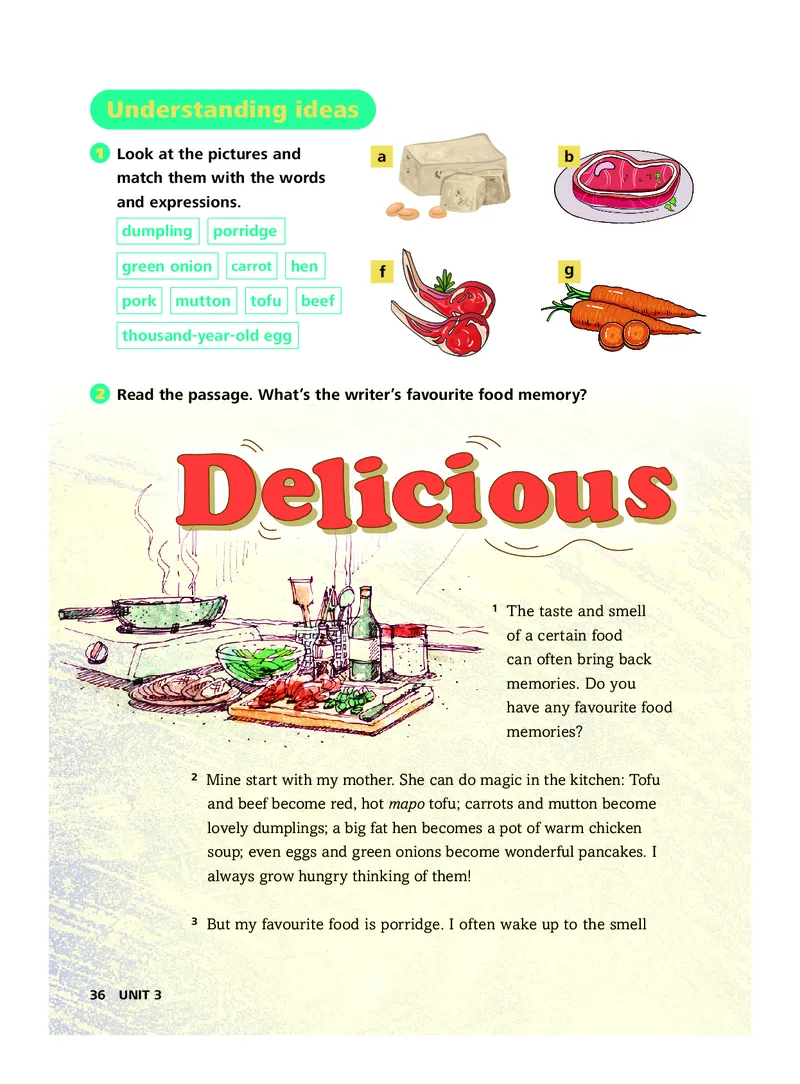
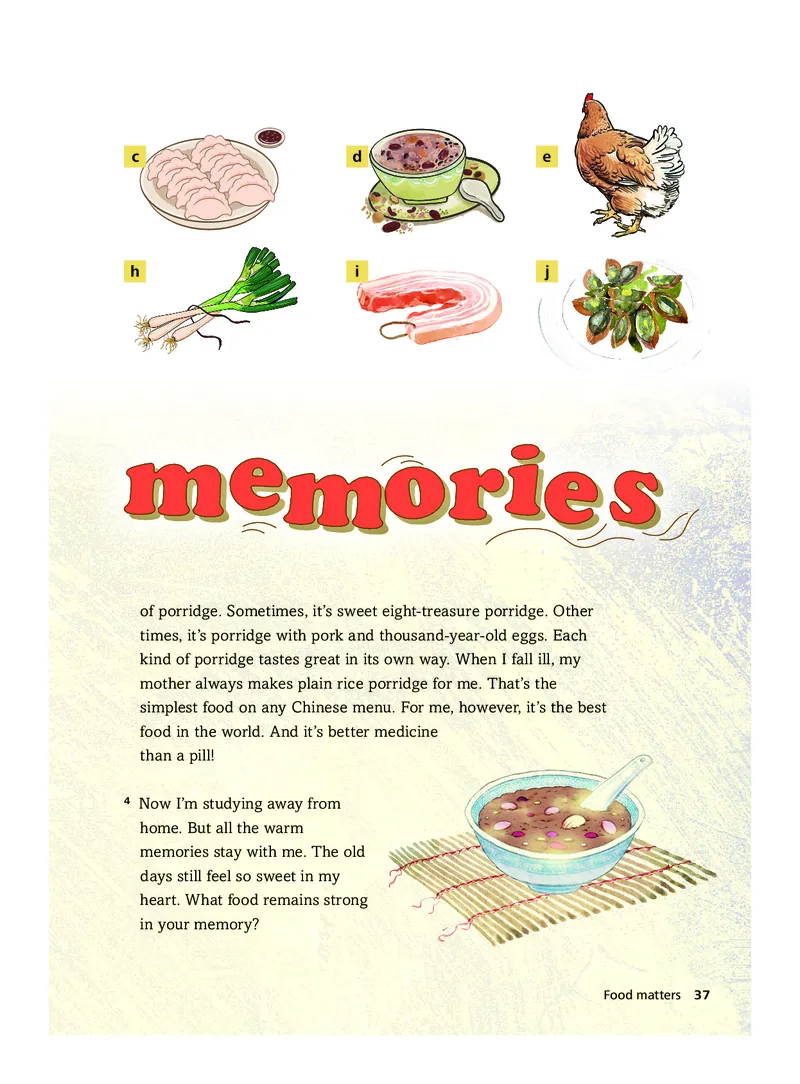
1 Look at the pictures and a b
match them with the words
and expressions.
dumpling porridge
green onion carrot hen f g
pork mutton tofu beef
thousand-year-old egg
2 Read the passage. What’s the writer’s favourite food memory?
1 The taste and smell
of a certain food
can often bring back
memories. Do you
have any favourite food
memories?
2 Mine start with my mother. She can do magic in the kitchen: Tofu
and beef become red, hot mapo tofu; carrots and mutton become
lovely dumplings; a big fat hen becomes a pot of warm chicken
soup; even eggs and green onions become wonderful pancakes. I
always grow hungry thinking of them!
3 But my favourite food is porridge. I often wake up to the smell
36 UNIT 3c d e
h i j
of porridge. Sometimes, it’s sweet eight-treasure porridge. Other
times, it’s porridge with pork and thousand-year-old eggs. Each
kind of porridge tastes great in its own way. When I fall ill, my
mother always makes plain rice porridge for me. That’s the
simplest food on any Chinese menu. For me, however, it’s the best
food in the world. And it’s better medicine
than a pill!
4 Now I’m studying away from
home. But all the warm
memories stay with me. The old
days still feel so sweet in my
heart. What food remains strong
in your memory?
Food matters 373 Choose another suitable title for the passage.
a Rice porridge: the best food
b The taste of home
c Memories of my mother
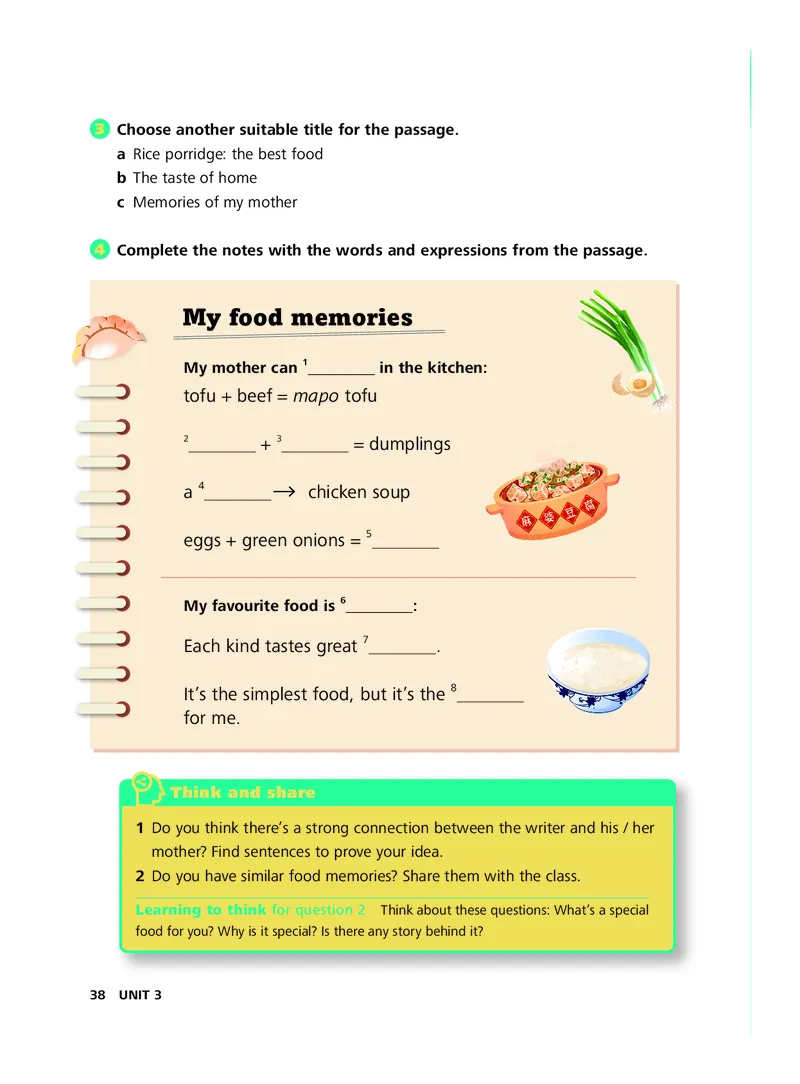
4 Complete the notes with the words and expressions from the passage.
My food memories
My mother can 1 in the kitchen:
tofu + beef = mapo tofu
2 + 3 = dumplings
a 4 chicken soup
eggs + green onions = 5
My favourite food is 6 :
Each kind tastes great 7 .
It’s the simplest food, but it’s the 8
for me.
Think and share
1 Do you think there’s a strong connection between the writer and his / her
mother? Find sentences to prove your idea.
2 Do you have similar food memories? Share them with the class.
Learning to think for question 2 Think about these questions: What’s a special
food for you? Why is it special? Is there any story behind it?
38 UNIT 3Grammar rules⇢ p124
5 Read the sentences from the reading passage and summarise the
grammar rules.
(a) Each kind of porridge tastes great in its own way.
(b) The old days still feel so sweet in my heart.
Now find more sentences with this structure in the reading passage.
6 Put the words and expressions in the correct order.
1 smells / my grandma’s apple pie / great
2 delicious / my sandwich / tastes
3 the smell of coffee / strong / remained
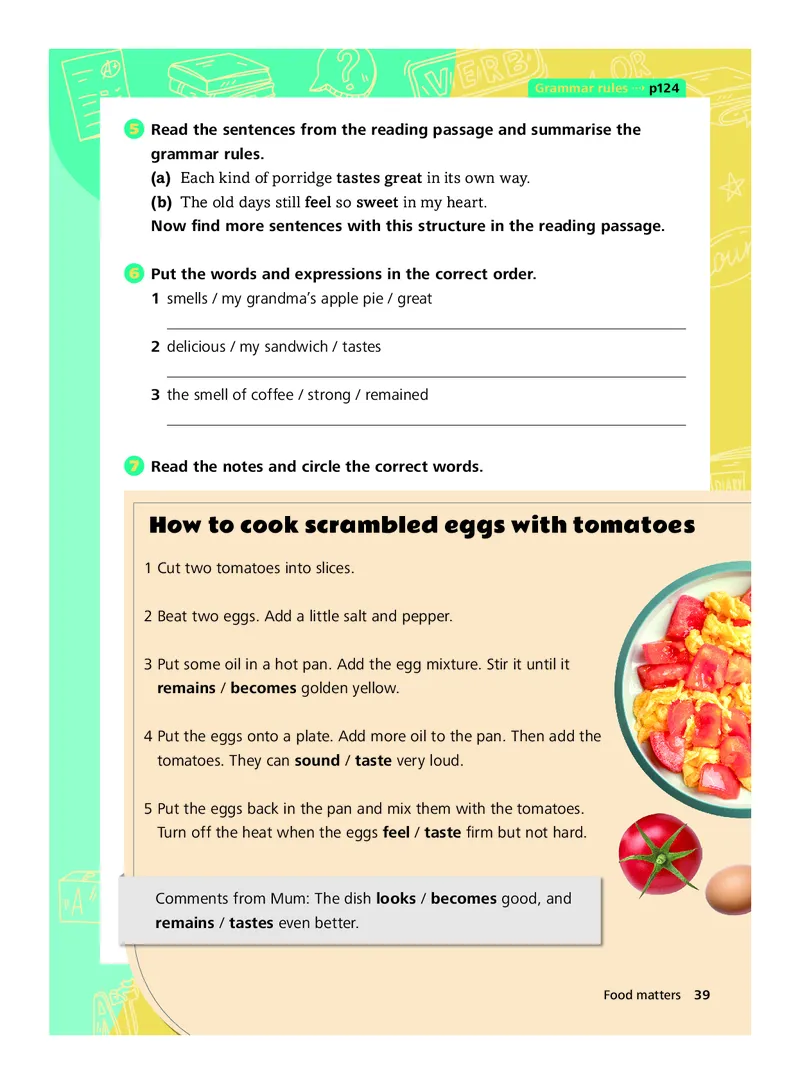
7 Read the notes and circle the correct words.
How to cook scrambled eggs with tomatoes
1 Cut two tomatoes into slices.
2 Beat two eggs. Add a little salt and pepper.
3 Put some oil in a hot pan. Add the egg mixture. Stir it until it
remains / becomes golden yellow.
4 Put the eggs onto a plate. Add more oil to the pan. Then add the
tomatoes. They can sound / taste very loud.
5 Put the eggs back in the pan and mix them with the tomatoes.
Turn off the heat when the eggs feel / taste firm but not hard.
Comments from Mum: The dish looks / becomes good, and
remains / tastes even better.
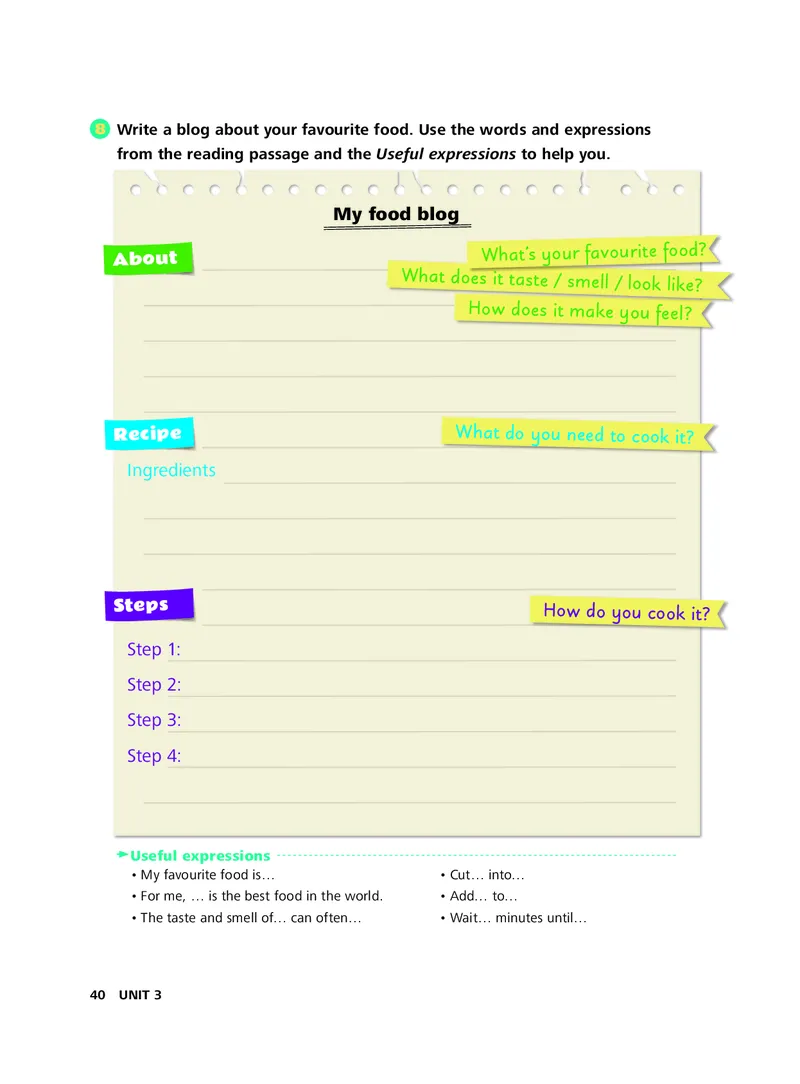
Food matters 398 Write a blog about your favourite food. Use the words and expressions
from the reading passage and the Useful expressions to help you.
My food blog
What’s your favourite food?
About
What does it taste / smell / look like?
How does it make you feel?
Recipe What do you need to cook it?
Ingredients
Steps How do you cook it?
Step 1:
Step 2:
Step 3:
Step 4:
Useful expressions
• My favourite food is… • Cut… into…
• For me, … is the best food in the world. • Add… to…
• The taste and smell of… can often… • Wait… minutes until…
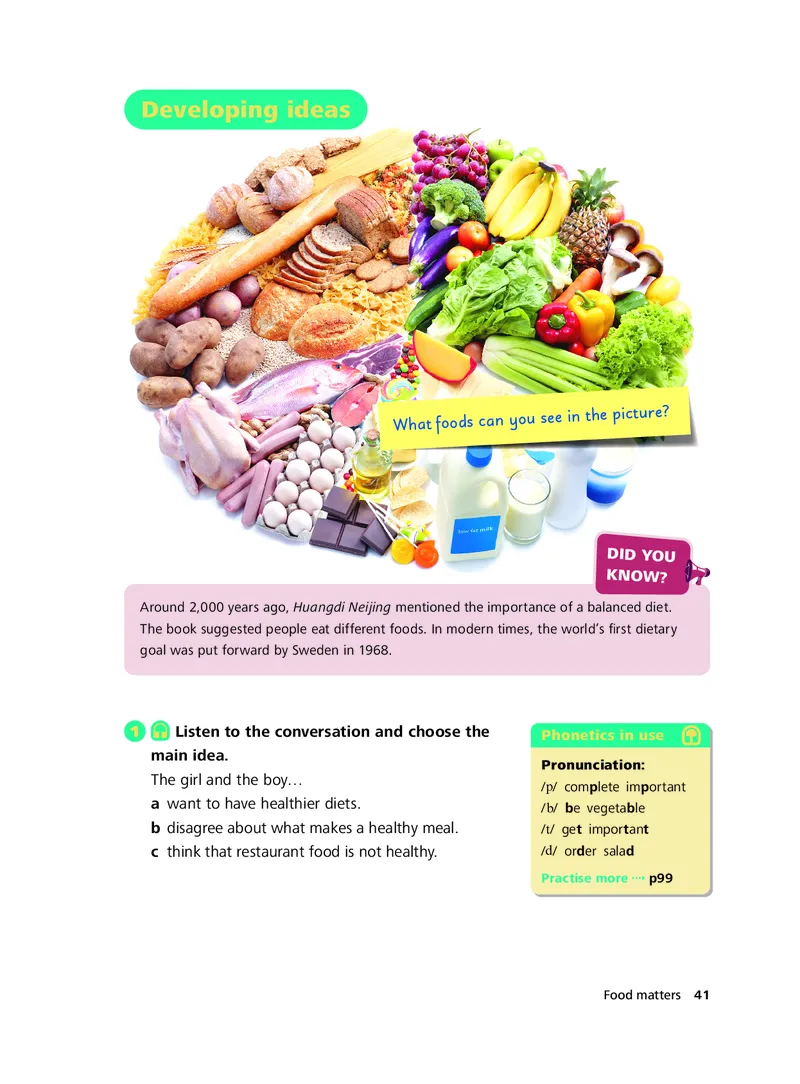
40 UNIT 3Developing ideas
What foods can you see in the picture?
DID YOU
KNOW?
Around 2,000 years ago, Huangdi Neijing mentioned the importance of a balanced diet.
The book suggested people eat different foods. In modern times, the world’s first dietary
goal was put forward by Sweden in 1968.
1 Listen to the conversation and choose the
Phonetics in use
main idea.
Pronunciation:
The girl and the boy…
/ / complete important
p
a want to have healthier diets.
/ / be vegetable
b
b disagree about what makes a healthy meal. / / get important
t
c think that restaurant food is not healthy. / / order salad
d
Practise more⇢ p99
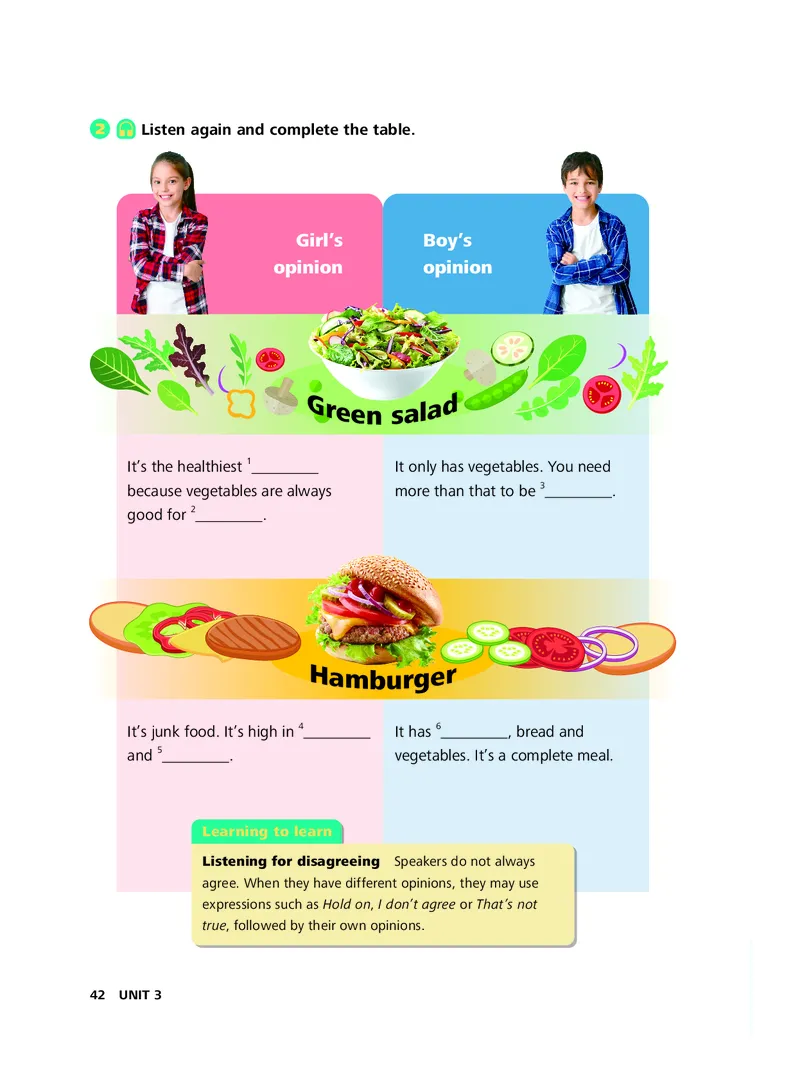
Food matters 412 Listen again and complete the table.
Girl’s Boy’s
opinion opinion
G d
reen sala
It’s the healthiest 1 It only has vegetables. You need
because vegetables are always more than that to be 3 .
good for 2 .
Hamburger
It’s junk food. It’s high in 4 It has 6 , bread and
and 5 . vegetables. It’s a complete meal.
Learning to learn
Listening for disagreeing Speakers do not always
agree. When they have different opinions, they may use
expressions such as Hold on, I don’t agree or That’s not
true, followed by their own opinions.
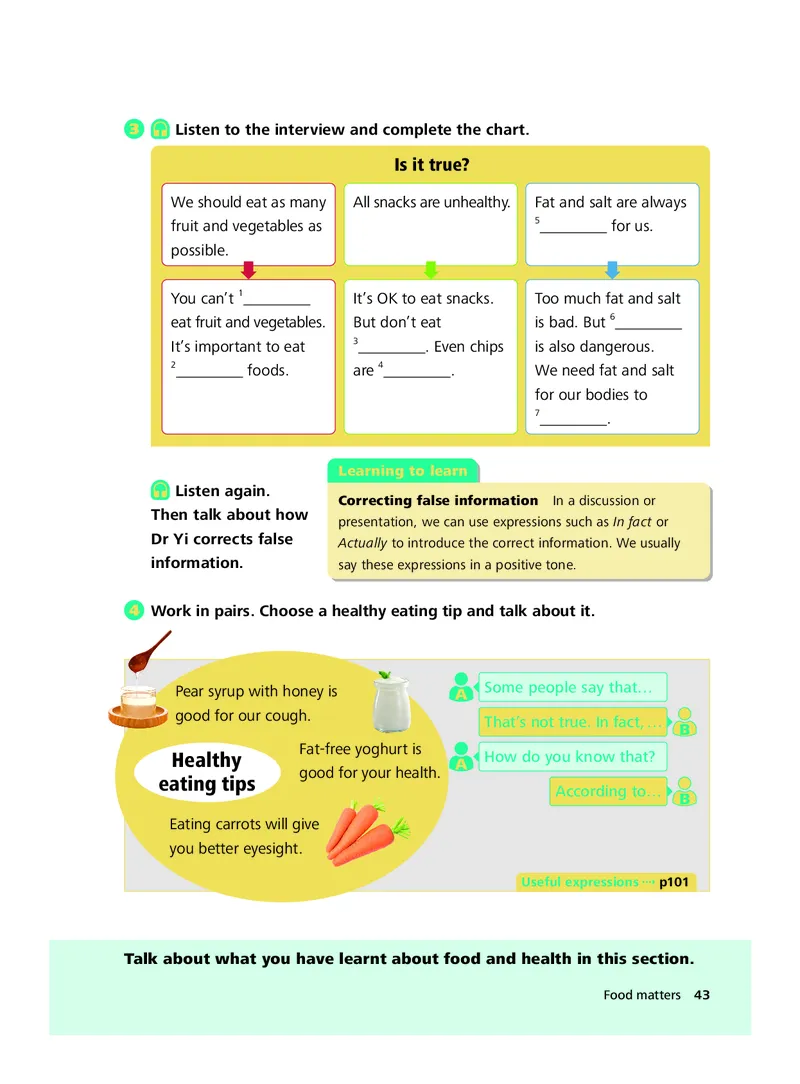
42 UNIT 33 Listen to the interview and complete the chart.
Is it true?
We should eat as many All snacks are unhealthy. Fat and salt are always
fruit and vegetables as 5 for us.
possible.
You can’t 1 It’s OK to eat snacks. Too much fat and salt
eat fruit and vegetables. But don’t eat is bad. But 6
It’s important to eat 3 . Even chips is also dangerous.
2 foods. are 4 . We need fat and salt
for our bodies to
7 .
Learning to learn
Listen again.
Correcting false information In a discussion or
Then talk about how
presentation, we can use expressions such as In fact or
Dr Yi corrects false
Actually to introduce the correct information. We usually
information. say these expressions in a positive tone.
4 Work in pairs. Choose a healthy eating tip and talk about it.
Some people say that…
Pear syrup with honey is A
good for our cough.
That’s not true. In fact, …
B
Fat-free yoghurt is
Healthy How do you know that?
A
good for your health.
eating tips
According to…
B
Eating carrots will give
you better eyesight.
Useful expressions⇢ p101
Talk about what you have learnt about food and health in this section.
Food matters 43Reading for writing
1 Look at the pictures and answer the questions. Use the expressions to
help you.
1 What foods can you see?
2 What’s their relationship with cultures?
stone pancake Chinese hamburger
a bridge between cultures ice cream
2 Read the passage. What did Marco Polo do?
dd
aaccrroossss
oo oo bboorrddeerrss
FF
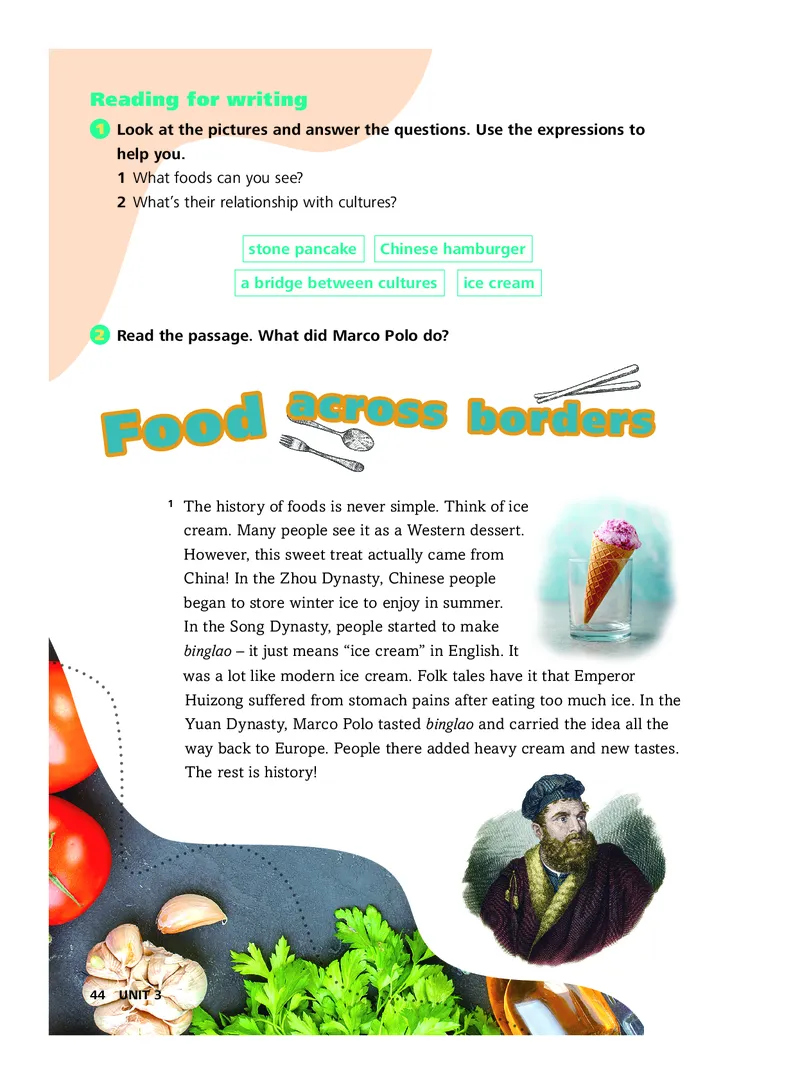
1 The history of foods is never simple. Think of ice cream.
Many people see it as a Western dessert. However,
this sweet treat actually came from China! In the Zhou
Dynasty, Chinese people began to store winter ice to
1 The history of foods is never simple. Think of ice
enjoy in summer. In the Song Dynasty, people started
cream. Many people see it as a Western dessert.
to make binglao – it just means “ice cream” in English.
However, this sweet treat actually came from
It was a lot like modern ice cream. Folk tales have it
China! In the Zhou Dynasty, Chinese people
that Emperor Huizong suffered from stomach pains
began to store winter ice to enjoy in summer.
after eating too much ice. In the Yuan Dynasty, Marco
In the Song Dynasty, people started to make
Polo tasted binglao and carried the idea all the way back
binglao – it just means “ice cream” in English. It
to Europe. People there added heavy cream and new
was a lot like modern ice cream. Folk tales have it that Emperor
tastes. The rest is history!
Huizong suffered from stomach pains after eating too much ice. In the
Yuan Dynasty, Marco Polo tasted binglao and carried the idea all the
way back to Europe. People there added heavy cream and new tastes.
NNThe rest is history!
oo
““
II ”” iinn
““ttee
aa
mm
””
44 UNIT 31 The history of foods is never simple. Think of ice cream.
Many people see it as a Western dessert. However,
this sweet treat actually came from China! In the Zhou
Dynasty, Chinese people began to store winter ice to
enjoy in summer. In the Song Dynasty, people started
to make binglao – it just means “ice cream” in English.
It was a lot like modern ice cream. Folk tales have it
that Emperor Huizong suffered from stomach pains
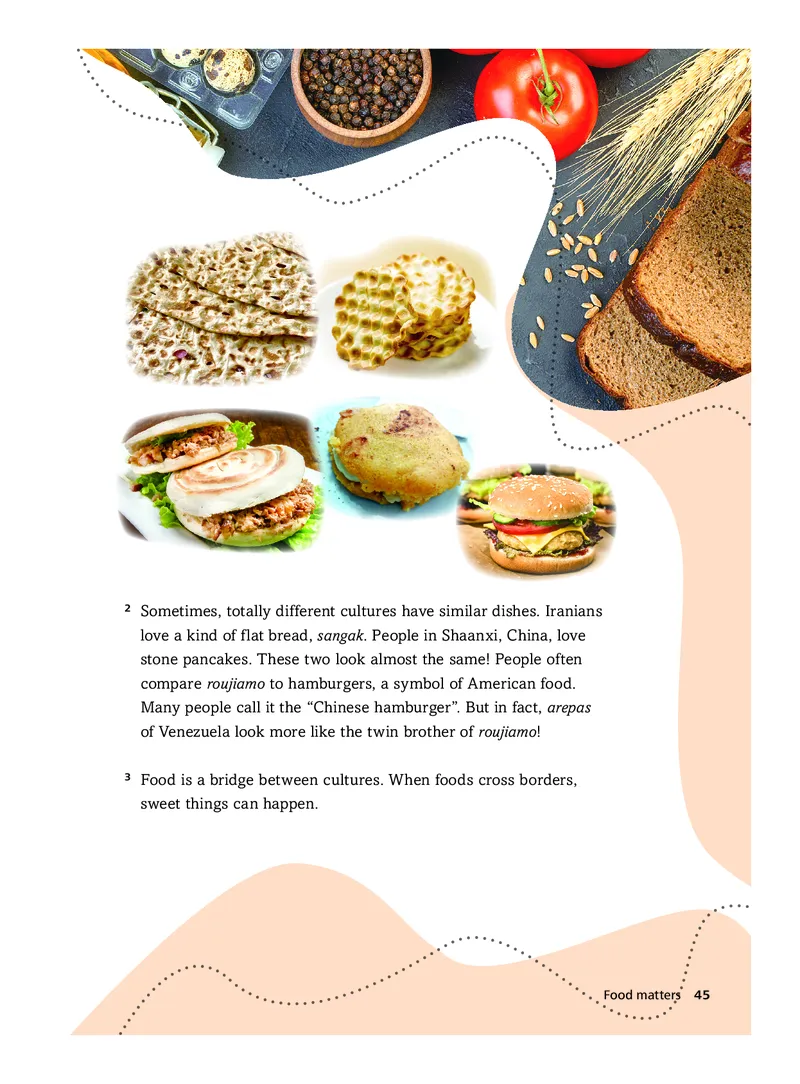
2 Sometimes, totally different cultures have similar dishes. Iranians
after eating too much ice. In the Yuan Dynasty, Marco
love a kind of flat bread, sangak. People in Shaanxi, China, love
Polo tasted binglao and carried the idea all the way back
stone pancakes. These two look almost the same! People often
to Europe. People there added heavy cream and new
compare roujiamo to hamburgers, a symbol of American food.
tastes. The rest is history!
Many people call it the “Chinese hamburger”. But in fact, arepas
of Venezuela look more like the twin brother of roujiamo!
NN
oo
3 Food is a bridge between cultures. When foods cross borders,
““
II ”” iinn
““ttee
aa sweet things can happen.
mm
””
Food matters 453 Complete the table with the words and expressions from the passage.
Chinese people in the Zhou Dynasty began to
1 to enjoy in summer. In the Song
Dynasty, people made binglao. It means
IIccee ccrreeaamm
2 in English. Marco Polo brought the
idea back to 3 . People there added to
the idea.
It is a kind of 4 in Iran. But the 5
SSaannggaakk
in Shaanxi, China, looks very much like it.
Many people call it 6 . But arepas look
RRoouujjiiaammoo
more like it.
4 Answer the questions.
1 What does “this sweet treat” mean? Why does the writer use this expression?
2 What is the meaning of “The rest is history!”?
3 What is the writer trying to say in the last sentence of the passage?
Think and share
1 Why do you think Marco Polo brought the idea of binglao back to Europe?
2 Do you agree that food is a bridge between cultures? Why or why not?
Learning to think for question 2 To express your agreement or disagreement
with an idea, you need to give your opinion and support it with examples. You can use
your own experiences, historical events, or personal stories of others.
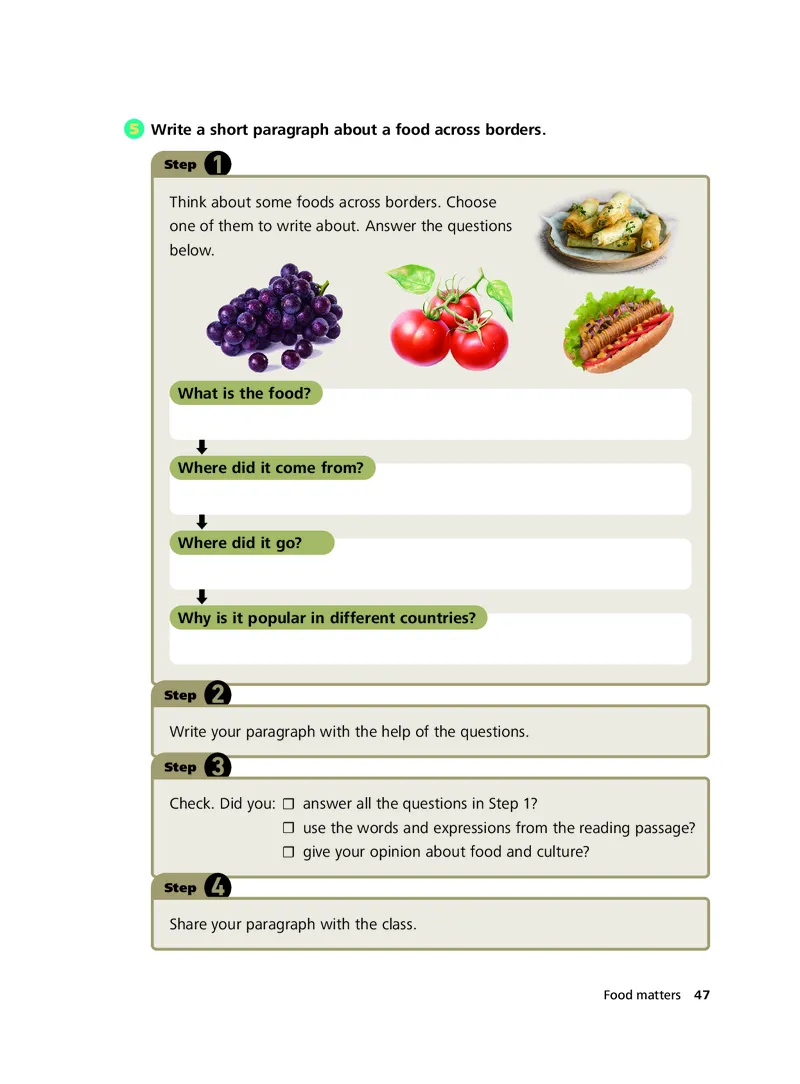
46 UNIT 35 Write a short paragraph about a food across borders.
1
Step
Think about some foods across borders. Choose
one of them to write about. Answer the questions
below.
What is the food?
Where did it come from?
Where did it go?
Why is it popular in different countries?
2
Step
Write your paragraph with the help of the questions.
3
Step
Check. Did you: ☐ answer all the questions in Step 1?
☐ use the words and expressions from the reading passage?
☐ give your opinion about food and culture?
4
Step
Share your paragraph with the class.
Food matters 47Presenting ideas
Make a fact sheet about your favourite food.
1
Step
Think about your favourite food and search for information.
• look • taste • place • history and culture • health benefits
2
Step
Organise your ideas with the help of the following outline and write your fact
sheet. You may use the following language tips or find useful expressions or
sentences from this unit.
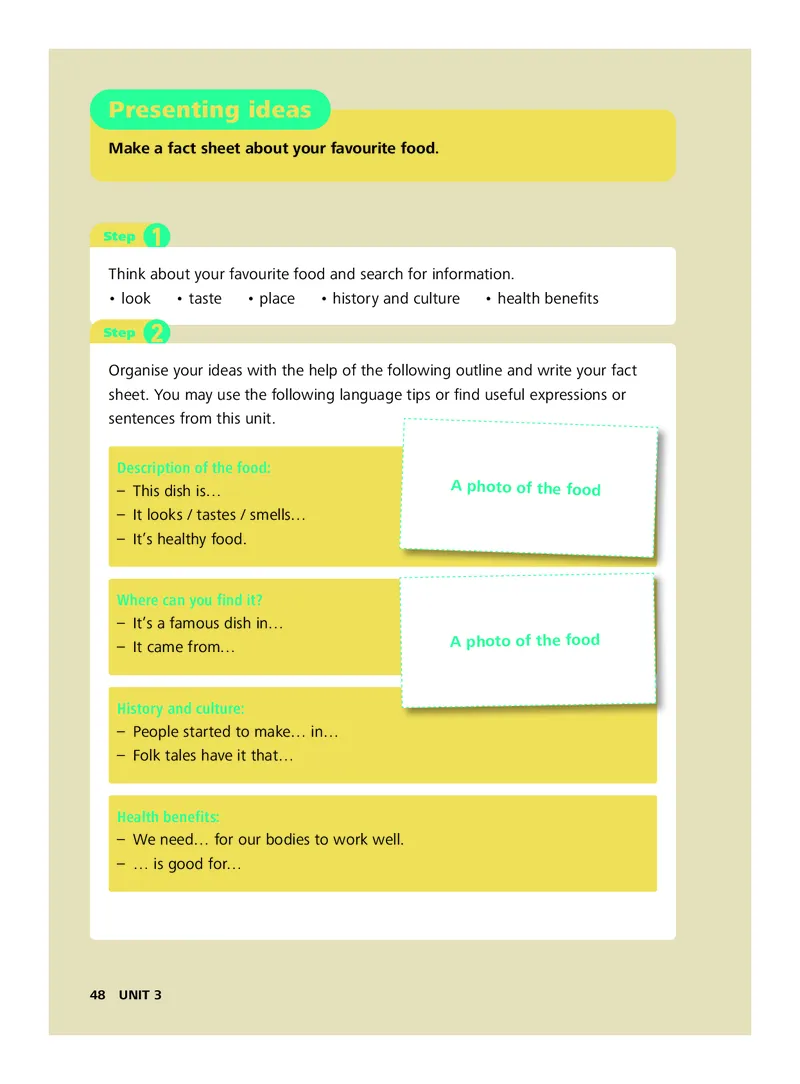
Description of the food:
– This dish is… A photo of the food
– It looks / tastes / smells…
– It’s healthy food.
Where can you find it?
– It’s a famous dish in…
A photo of the food
– It came from…
History and culture:
– People started to make… in…
– Folk tales have it that…
Health benefits:
– We need… for our bodies to work well.
– … is good for…
48 UNIT 33
Step
Practise and present your fact sheet to the class.
4
Step
Vote on the best three fact sheets and the best three presentations.
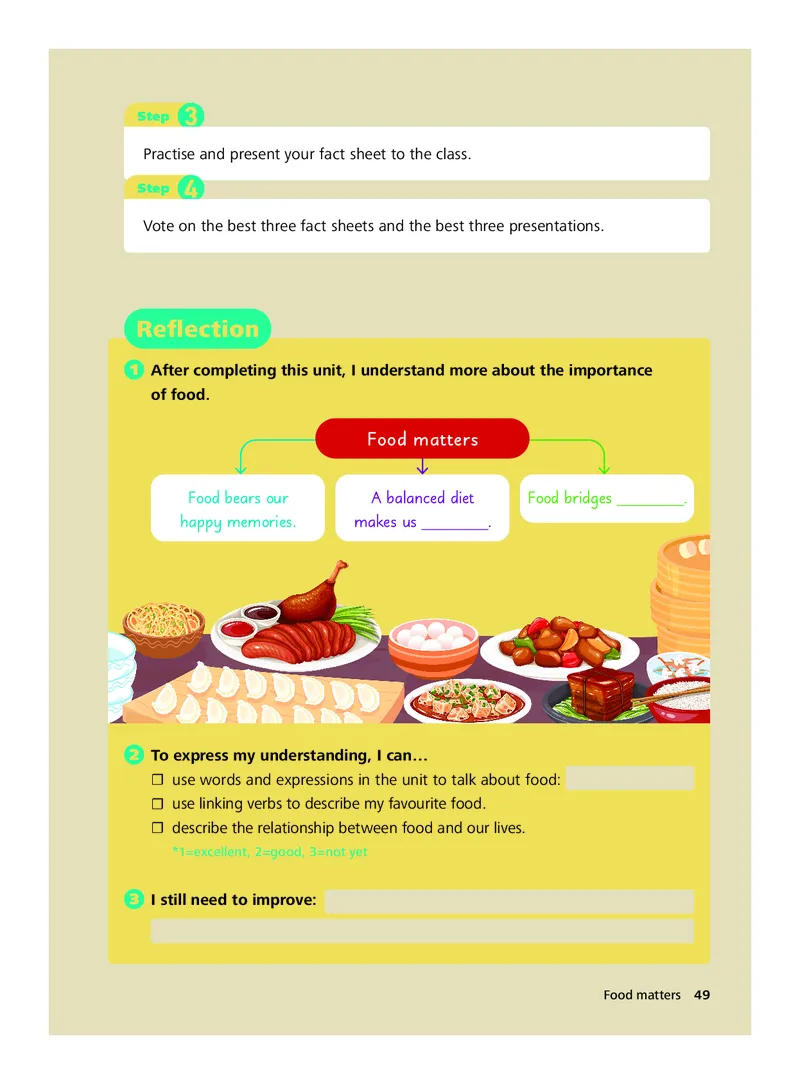
Reflection
1 After completing this unit, I understand more about the importance
of food.
Food matters
Food bears our A balanced diet Food bridges .
happy memories. makes us .
2 To express my understanding, I can…
☐ use words and expressions in the unit to talk about food:
☐ use linking verbs to describe my favourite food.
☐ describe the relationship between food and our lives.
*1=excellent, 2=good, 3=not yet
3 I still need to improve:
Food matters 49Unit
TThhee aarrtt ooff
4
hhaavviinngg ffuunn
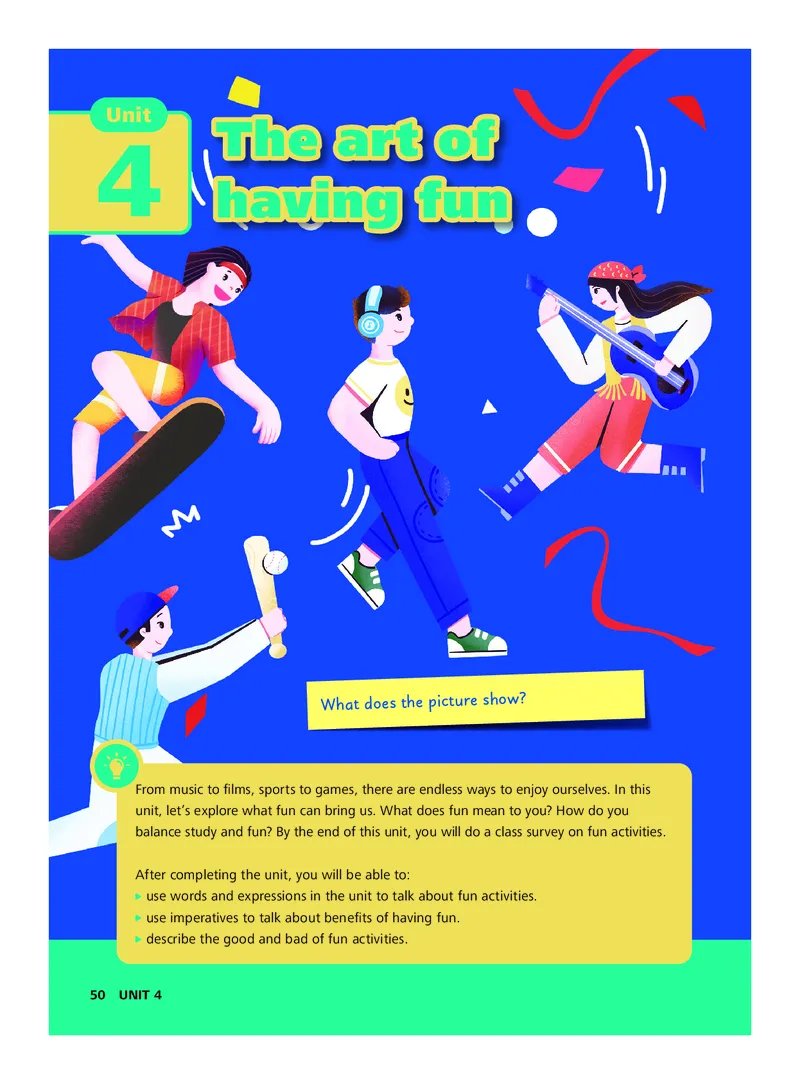
What does the picture show?
From music to films, sports to games, there are endless ways to enjoy ourselves. In this
unit, let’s explore what fun can bring us. What does fun mean to you? How do you
balance study and fun? By the end of this unit, you will do a class survey on fun activities.
After completing the unit, you will be able to:
use words and expressions in the unit to talk about fun activities.
use imperatives to talk about benefits of having fun.
describe the good and bad of fun activities.
50 UNIT 4Starting out
1 Look at the picture and answer the questions.
1 What activities did ancient people
do for fun?
2 Which activity is the most
interesting one to you?
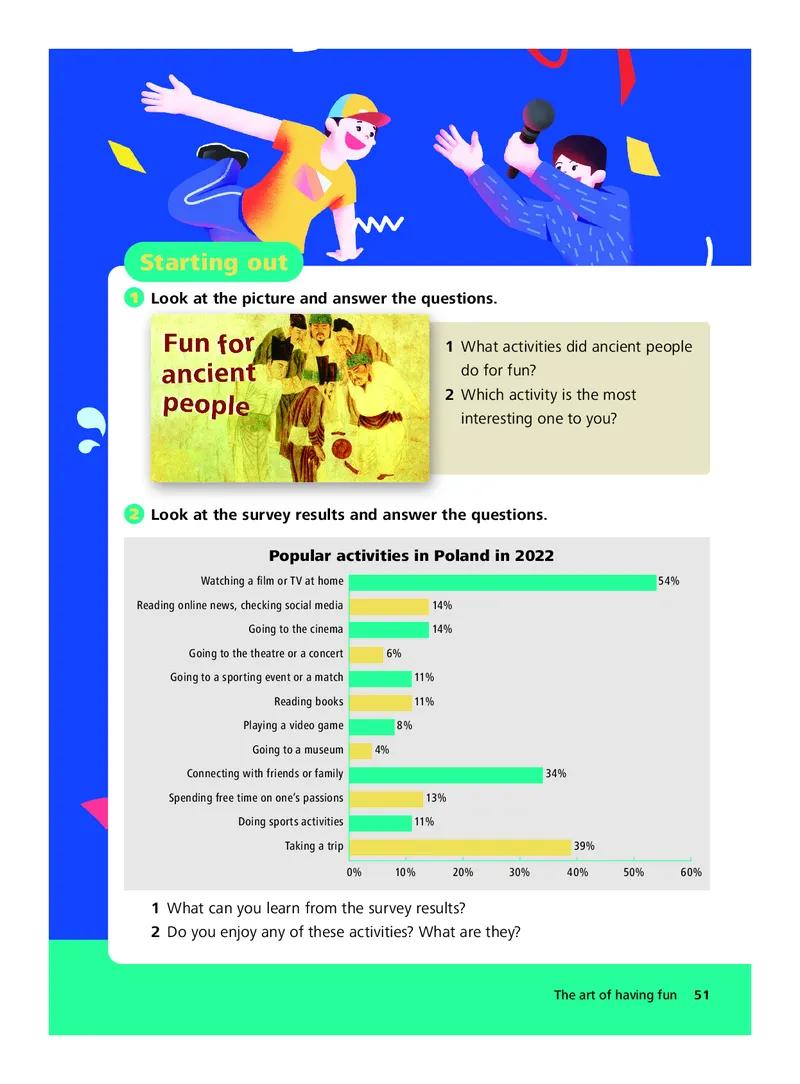
2 Look at the survey results and answer the questions.
Popular activities in Poland in 2022
Watching a film or TV at home 54%
Reading online news, checking social media 14%
Going to the cinema 14%
Going to the theatre or a concert 6%
Going to a sporting event or a match 11%
Reading books 11%
Playing a video game 8%
Going to a museum 4%
Connecting with friends or family 34%
Spending free time on one’s passions 13%
Doing sports activities 11%
Taking a trip 39%
0% 10% 20% 30% 40% 50% 60%
1 What can you learn from the survey results?
2 Do you enjoy any of these activities? What are they?
The art of having fun 51Understanding ideas
1 Look at the title and predict what the passage is about. Use the
expressions to help you.
have fun a moment of joy lift sb’s spirits feel youthful
bring people closer enjoy life
All work and no play
1 Imagine staying on an island alone. You can only take five things
with you. You might put food, water, tools and clothes on your
list. But what about the fifth one? Most people would choose
something for fun, like a novel, a magazine or a solar media
player. After all, no one wants to get bored!
2 Fun can do away with bad feelings and lift our spirits. Just picture
yourself watching a funny film on that island. Sitting under the
trees will not be boring at all. It becomes a moment of joy.
3 Fun also keeps us feeling youthful. As George Bernard Shaw once
said, “We don’t stop playing because we grow old; we grow old
52 UNIT 42 Read the passage and check your answer.
makes Jack a dull boy
?
because we stop playing.”
4 Research also shows that fun brings people closer. No one is
an island. Having fun is a good way to connect with others. So,
next time, invite your friends to enjoy live music together. It’s not
just about having fun – you will be closer because of the shared
experience!
5 Fun is important in a number of ways. Don’t forget to take some
time out to have fun and enjoy life! We need to work
hard. But we should be able to play hard, too.
The art of having fun 533 Choose another suitable title for the passage.
a The importance of having fun
b Different ways of having fun
c Having fun in your own way
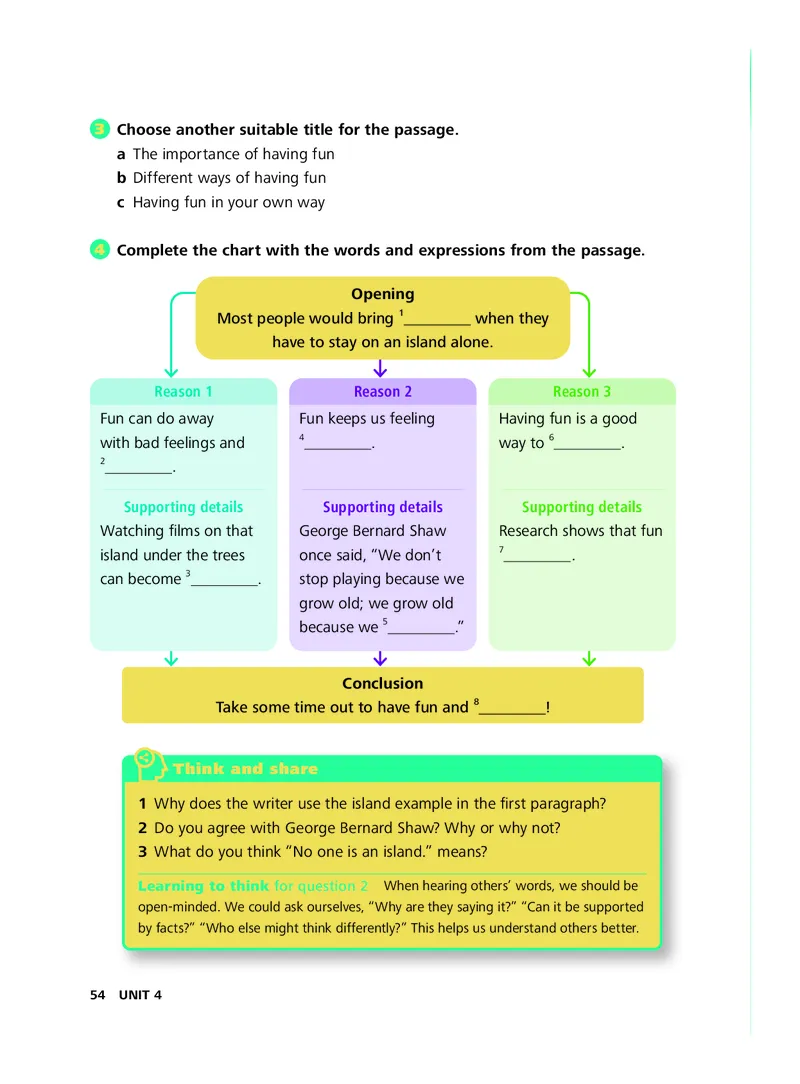
4 Complete the chart with the words and expressions from the passage.
Opening
Most people would bring 1 when they
have to stay on an island alone.
Reason 1 Reason 2 Reason 3
Fun can do away Fun keeps us feeling Having fun is a good
with bad feelings and 4 . way to 6 .
2 .
Supporting details Supporting details Supporting details
Watching films on that George Bernard Shaw Research shows that fun
island under the trees once said, “We don’t 7 .
can become 3 . stop playing because we
grow old; we grow old
because we 5 .”
Conclusion
Take some time out to have fun and 8 !
Think and share
1 Why does the writer use the island example in the first paragraph?
2 Do you agree with George Bernard Shaw? Why or why not?
3 What do you think “No one is an island.” means?
Learning to think for question 2 When hearing others’ words, we should be
open-minded. We could ask ourselves, “Why are they saying it?” “Can it be supported
by facts?” “Who else might think differently?” This helps us understand others better.
54 UNIT 4Grammar rules⇢ p125
5 Read the sentences from the reading passage and summarise the
grammar rules.
(a) Imagine staying on an island alone.
(b) Don’t forget to take some time out to have fun and enjoy life!
Now find more sentences with these structures in the reading passage.
6 Complete the instructions with the verbs in brackets. Use don’t
appropriately.
1 (worry) about winning – just enjoy yourself in sports.
2 (try) to put fun into your daily life, like listening to music while
doing housework.
3 (read) this passage to find why we should have fun.
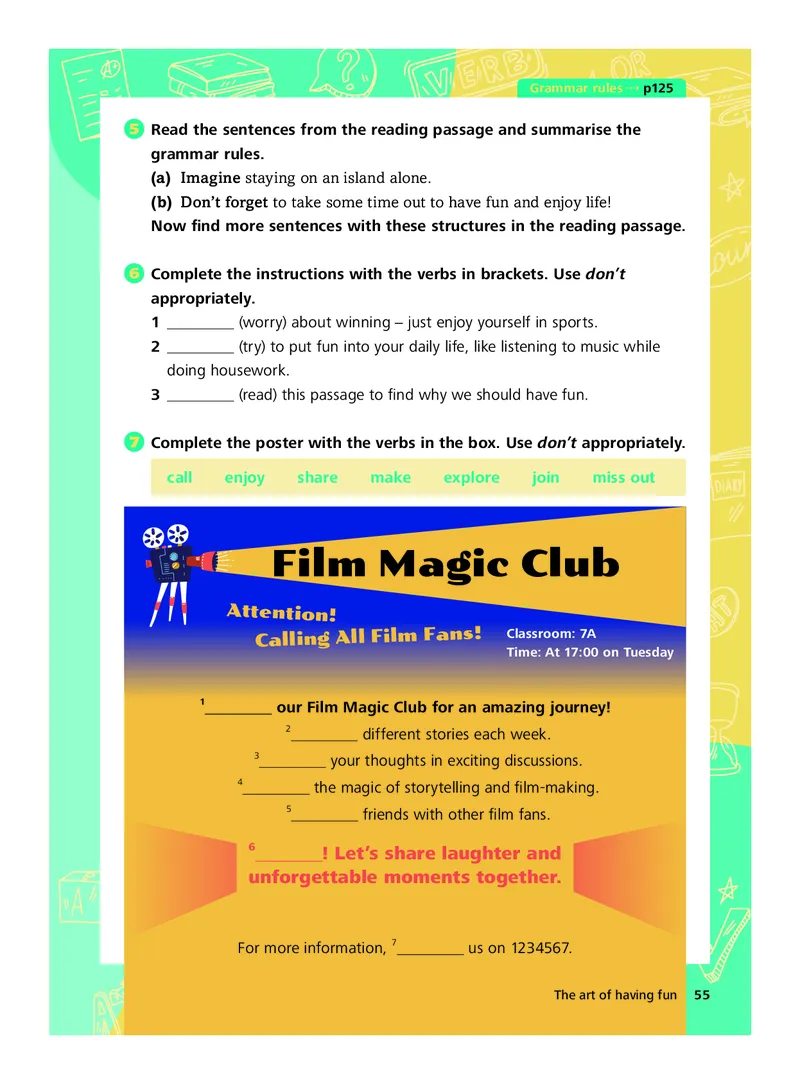
7 Complete the poster with the verbs in the box. Use don’t appropriately.
call enjoy share make explore join miss out
Film Magic Club
Attention!
Calling All Film Fans! Classroom: 7A
Time: At 17:00 on Tuesday
1 our Film Magic Club for an amazing journey!
2 different stories each week.
3 your thoughts in exciting discussions.
4 the magic of storytelling and film-making.
5 friends with other film fans.
6 ! Let’s share laughter and
unforgettable moments together.
For more information, 7 us on 1234567.
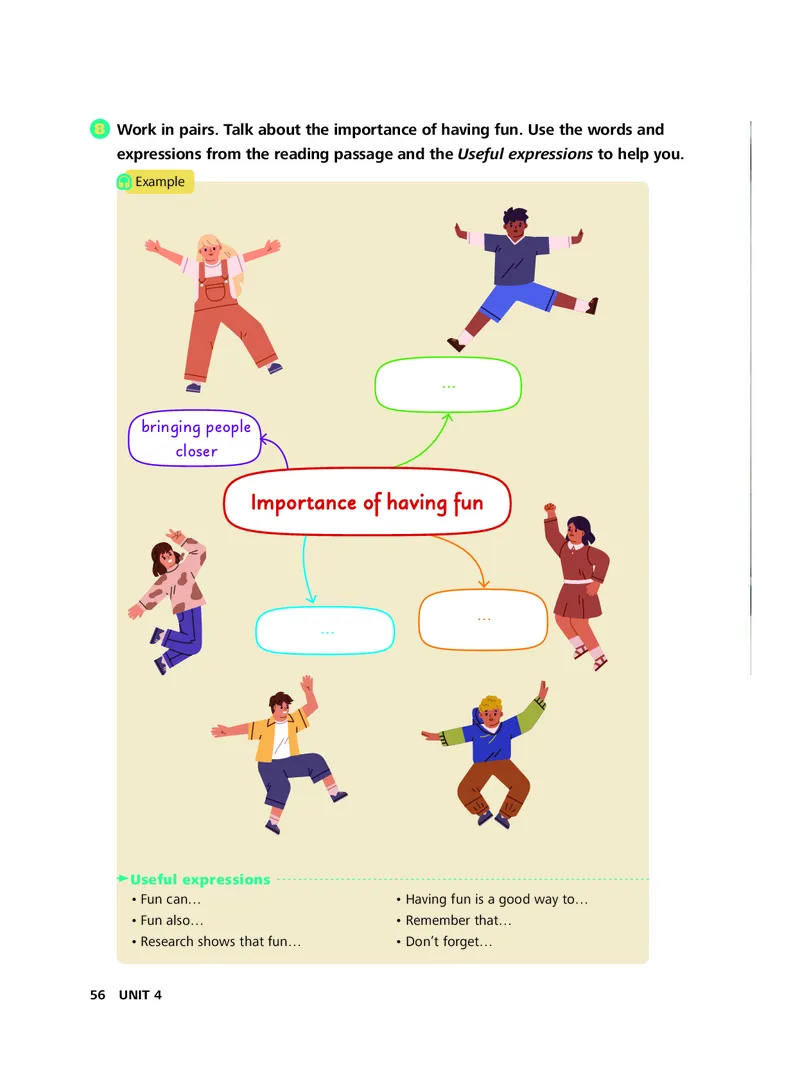
The art of having fun 558 Work in pairs. Talk about the importance of having fun. Use the words and
expressions from the reading passage and the Useful expressions to help you.
Example
…
bringing people
closer
IImmppoorrttaannccee ooff hhaavviinngg ffuunn
…
…
Useful expressions
• Fun can… • Having fun is a good way to…
• Fun also… • Remember that…
• Research shows that fun… • Don’t forget…
56 UNIT 4Developing ideas
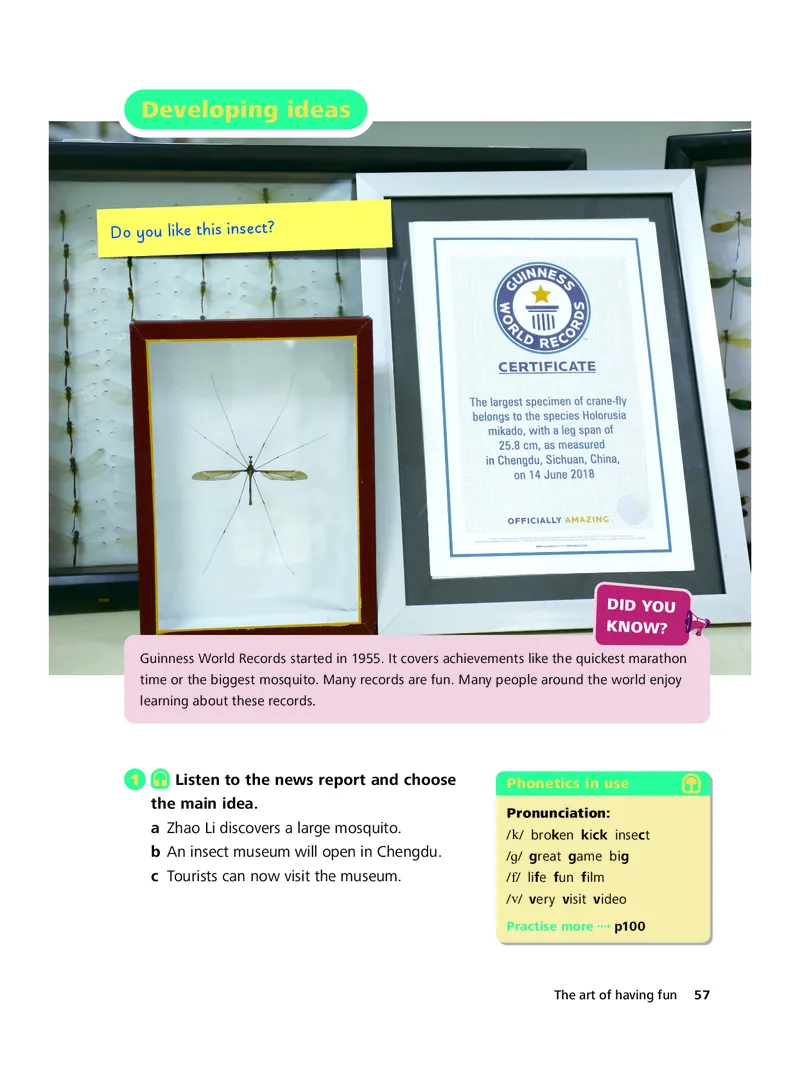
Do you like this insect?
DID YOU
KNOW?
Guinness World Records started in 1955. It covers achievements like the quickest marathon
time or the biggest mosquito. Many records are fun. Many people around the world enjoy
learning about these records.
1 Listen to the news report and choose
Phonetics in use
the main idea.
Pronunciation:
a Zhao Li discovers a large mosquito.
/ / broken kick insect
k
b An insect museum will open in Chengdu.
/ / great game big
ɡ
c Tourists can now visit the museum. / / life fun film
f
/ / very visit video
v
Practise more⇢ p100
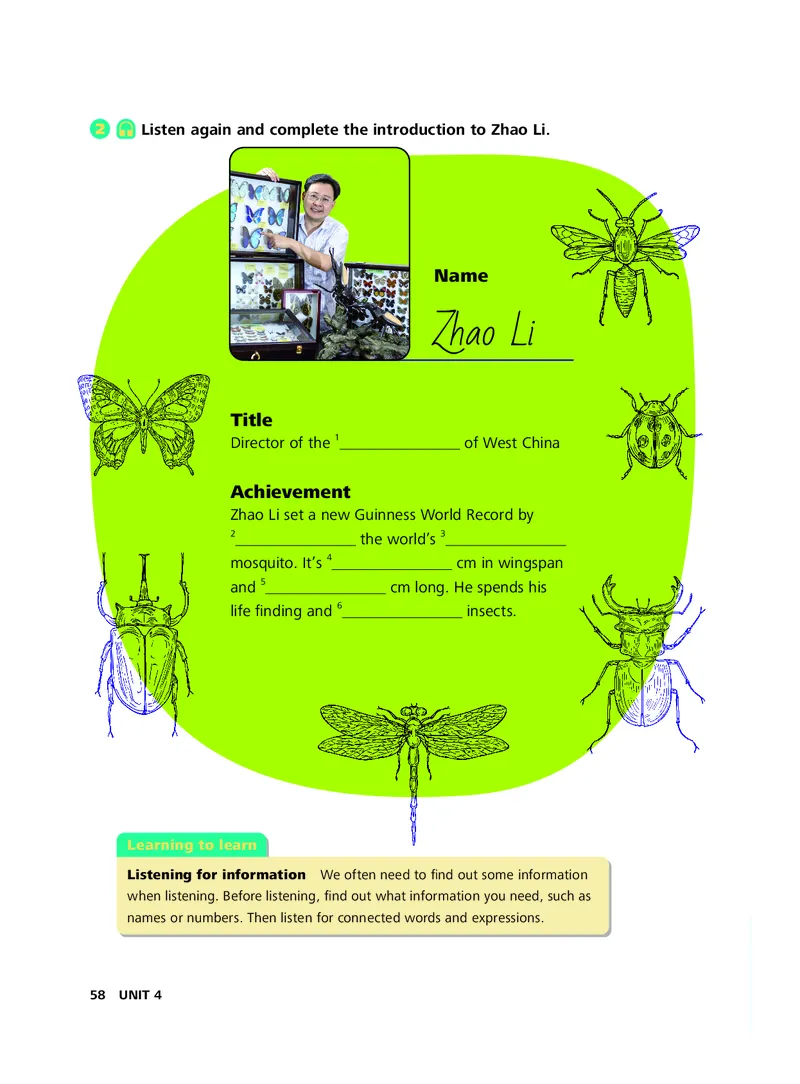
The art of having fun 572 Listen again and complete the introduction to Zhao Li.
Name
Zhao Li
Title
Director of the 1 of West China
Achievement
Zhao Li set a new Guinness World Record by
2 the world’s 3
mosquito. It’s 4 cm in wingspan
and 5 cm long. He spends his
life finding and 6 insects.
Learning to learn
Listening for information We often need to find out some information
when listening. Before listening, find out what information you need, such as
names or numbers. Then listen for connected words and expressions.
58 UNIT 43 Listen to the interview and complete the notes.
When did your interest in insects start? Why did you make it your job then?
When l was 1 . Because 6 ! Studying insects
gives me 7 . I’ve also 8
What do you like most about insects? a museum to encourage people like me.
2 ! I really enjoy
3 . Do you like this name “the Prince of
Butterflies”?
Is it challenging to study insects?? I’m not a prince, just an
I think so. I used to ride my bike insect 9 .
4 kilometres to find insects.
Learning to learn
Sometimes, I had to wait for days just to
5 of a butterfly. Using guiding language We use
guiding language to introduce a subject
or move onto another subject. It includes
expressions like Now, We’re going to…, and
Listen again. Then talk
Next. We can also guide listeners through
about how the interviewer
the subjects by asking specific questions.
changes the subject.
Guiding language makes conversations
easier to follow.
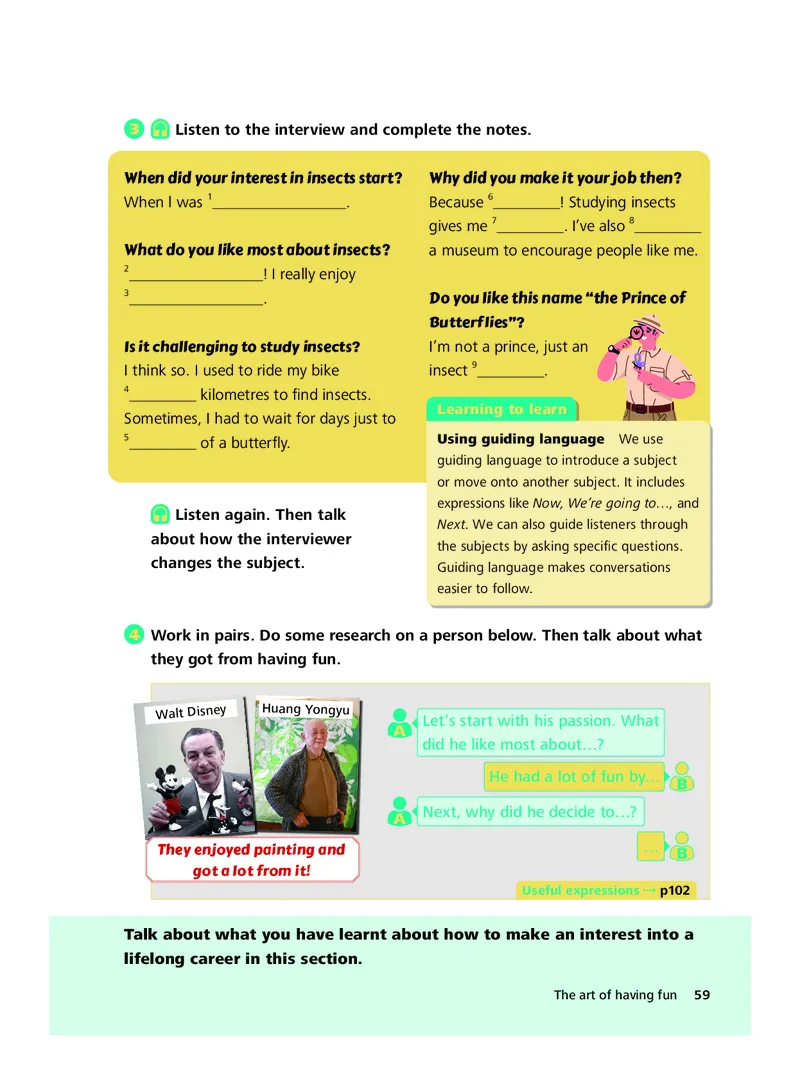
4 Work in pairs. Do some research on a person below. Then talk about what
they got from having fun.
Walt Disney Huang Yongyu
Let’s start with his passion. What
A
did he like most about…?
He had a lot of fun by…
B
Next, why did he decide to…?
A
…
They enjoyed painting and B
got a lot from it!
Useful expressions⇢ p102
Talk about what you have learnt about how to make an interest into a
lifelong career in this section.
The art of having fun 59Reading for writing
1 Look at the pictures below and answer the questions. Use the expressions
to help you.
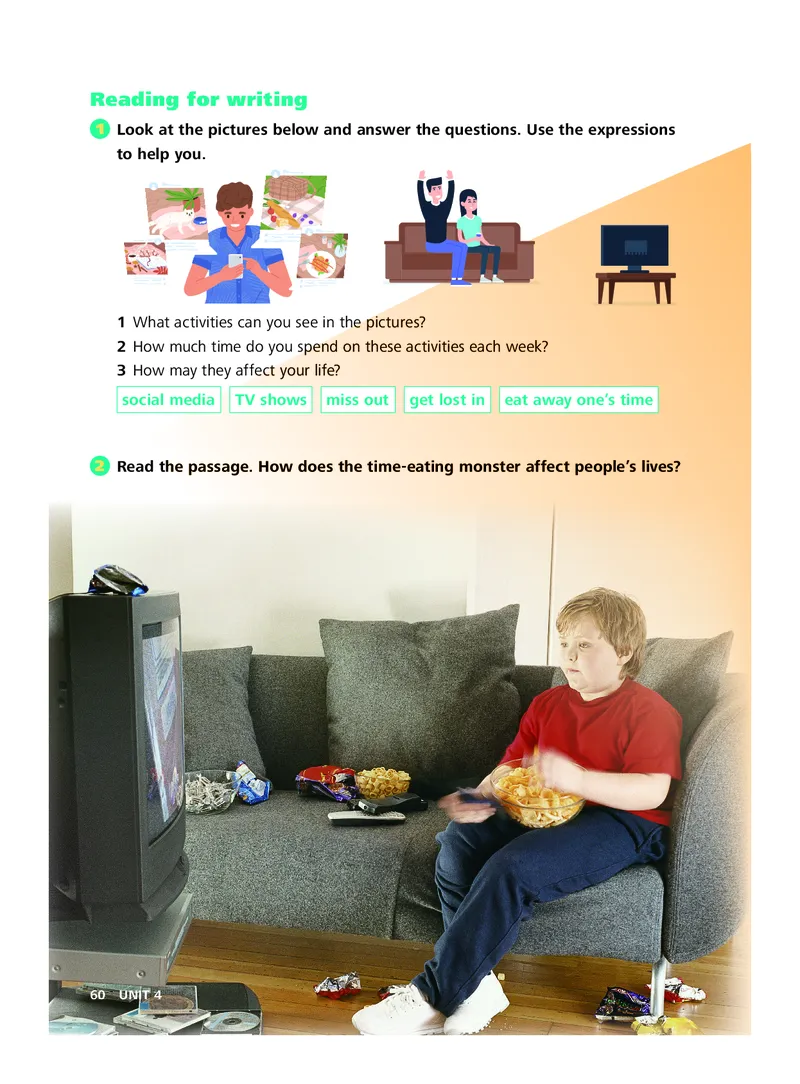
1 What activities can you see in the pictures?
2 How much time do you spend on these activities each week?
3 How may they affect your life?
social media TV shows miss out get lost in eat away one’s time
2 Read the passage. How does the time-eating monster affect people’s lives?
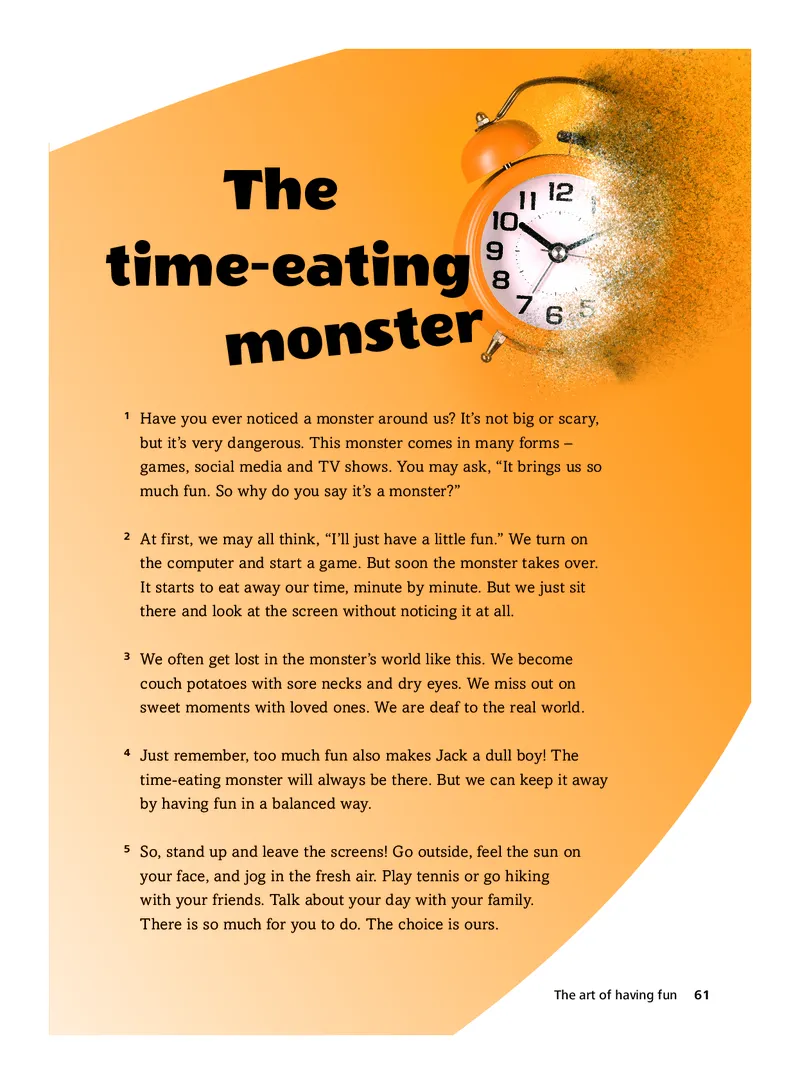
60 UNIT 4The
time-eating
monster
1 Have you ever noticed a monster around us? It’s not big or scary,
but it’s very dangerous. This monster comes in many forms –
games, social media and TV shows. You may ask, “It brings us so
much fun. So why do you say it’s a monster?”
2 At first, we may all think, “I’ll just have a little fun.” We turn on
the computer and start a game. But soon the monster takes over.
It starts to eat away our time, minute by minute. But we just sit
there and look at the screen without noticing it at all.
3 We often get lost in the monster’s world like this. We become
couch potatoes with sore necks and dry eyes. We miss out on
sweet moments with loved ones. We are deaf to the real world.
4 Just remember, too much fun also makes Jack a dull boy! The
time-eating monster will always be there. But we can keep it away
by having fun in a balanced way.
5 So, stand up and leave the screens! Go outside, feel the sun on
your face, and jog in the fresh air. Play tennis or go hiking
with your friends. Talk about your day with your family.
There is so much for you to do. The choice is ours.
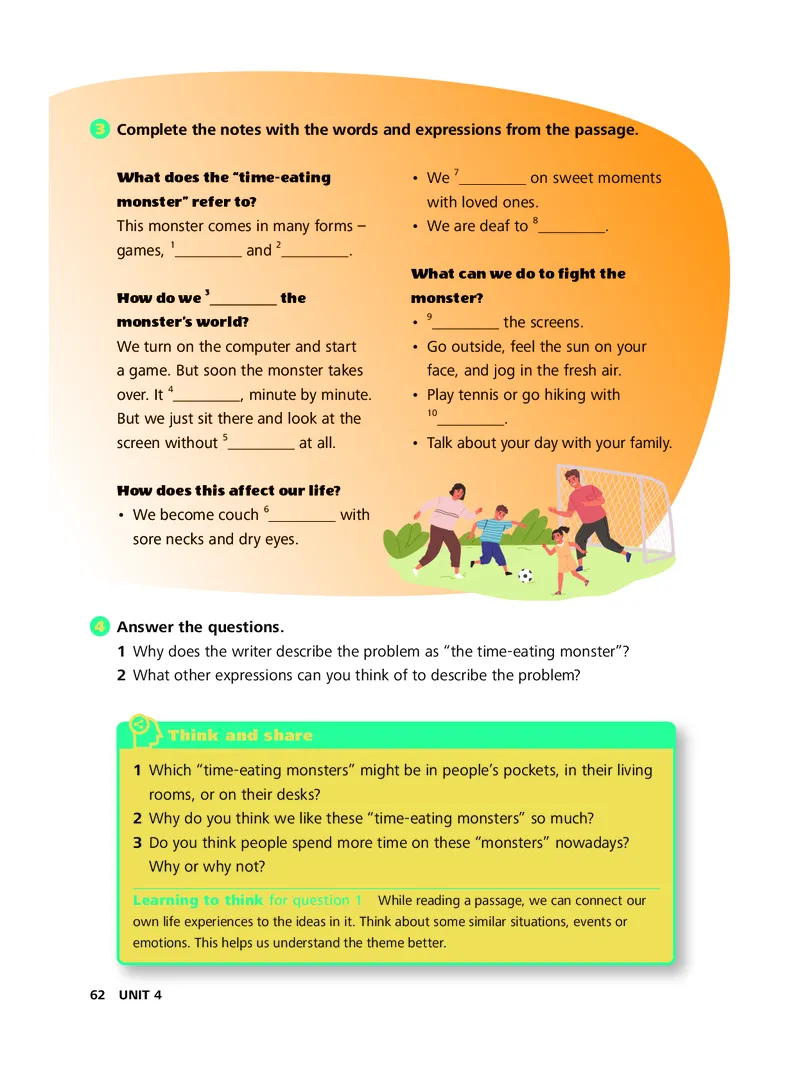
The art of having fun 613 Complete the notes with the words and expressions from the passage.
What does the “time-eating • We 7 on sweet moments
monster” refer to? with loved ones.
This monster comes in many forms – • We are deaf to 8 .
games, 1 and 2 .
What can we do to fight the
How do we 3 the monster?
monster’s world? • 9 the screens.
We turn on the computer and start • Go outside, feel the sun on your
a game. But soon the monster takes face, and jog in the fresh air.
over. It 4 , minute by minute. • Play tennis or go hiking with
But we just sit there and look at the 10 .
screen without 5 at all. • Talk about your day with your family.
How does this affect our life?
• We become couch 6 with
sore necks and dry eyes.
4 Answer the questions.
1 Why does the writer describe the problem as “the time-eating monster”?
2 What other expressions can you think of to describe the problem?
Think and share
1 Which “time-eating monsters” might be in people’s pockets, in their living
rooms, or on their desks?
2 Why do you think we like these “time-eating monsters” so much?
3 Do you think people spend more time on these “monsters” nowadays?
Why or why not?
Learning to think for question 1 While reading a passage, we can connect our
own life experiences to the ideas in it. Think about some similar situations, events or
emotions. This helps us understand the theme better.
62 UNIT 45 Write a short paragraph about having fun in a balanced way.
1
Step
Answer the questions to help you plan your paragraph.
What fun activities do you like to do?
When you don’t have fun in a balanced way, how can it be harmful?
What can you do to solve the problem?
2
Step
Write your paragraph with the help of the questions.
3
Step
Check. Did you: ☐ include problems and solutions?
☐ use the words and expressions from the reading passage?
☐ give your opinion about having fun in a balanced way?
4
Step
Share your paragraph with the class.
The art of having fun 63Presenting ideas
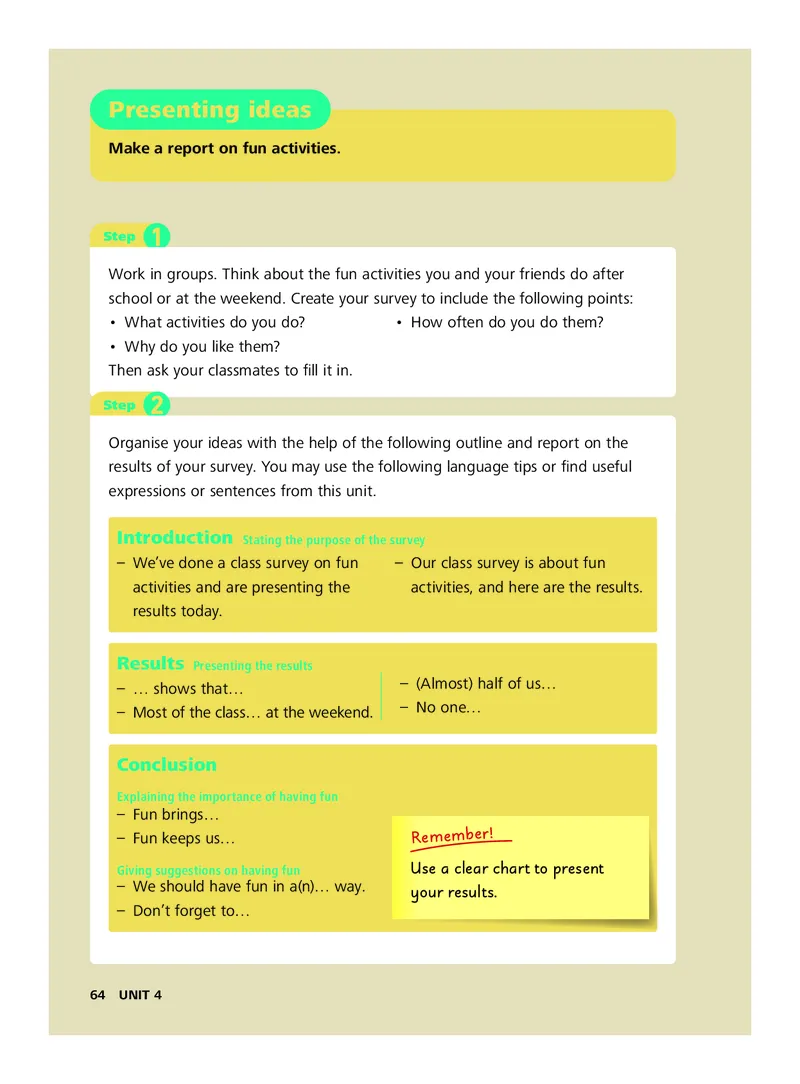
Make a report on fun activities.
1
Step
Work in groups. Think about the fun activities you and your friends do after
school or at the weekend. Create your survey to include the following points:
• What activities do you do? • How often do you do them?
• Why do you like them?
Then ask your classmates to fill it in.
2
Step
Organise your ideas with the help of the following outline and report on the
results of your survey. You may use the following language tips or find useful
expressions or sentences from this unit.
Introduction Stating the purpose of the survey
– We’ve done a class survey on fun – Our class survey is about fun
activities and are presenting the activities, and here are the results.
results today.
Results Presenting the results
– (Almost) half of us…
– … shows that…
– No one…
– Most of the class… at the weekend.
Conclusion
Explaining the importance of having fun
– Fun brings…
– Fun keeps us…
Remember!
Use a clear chart to present
Giving suggestions on having fun
– We should have fun in a(n)… way. your results.
– Don’t forget to…
64 UNIT 43
Step
Practise and present your report to the class.
4
Step
Vote on the best three reports and the best three presentations.
Reflection
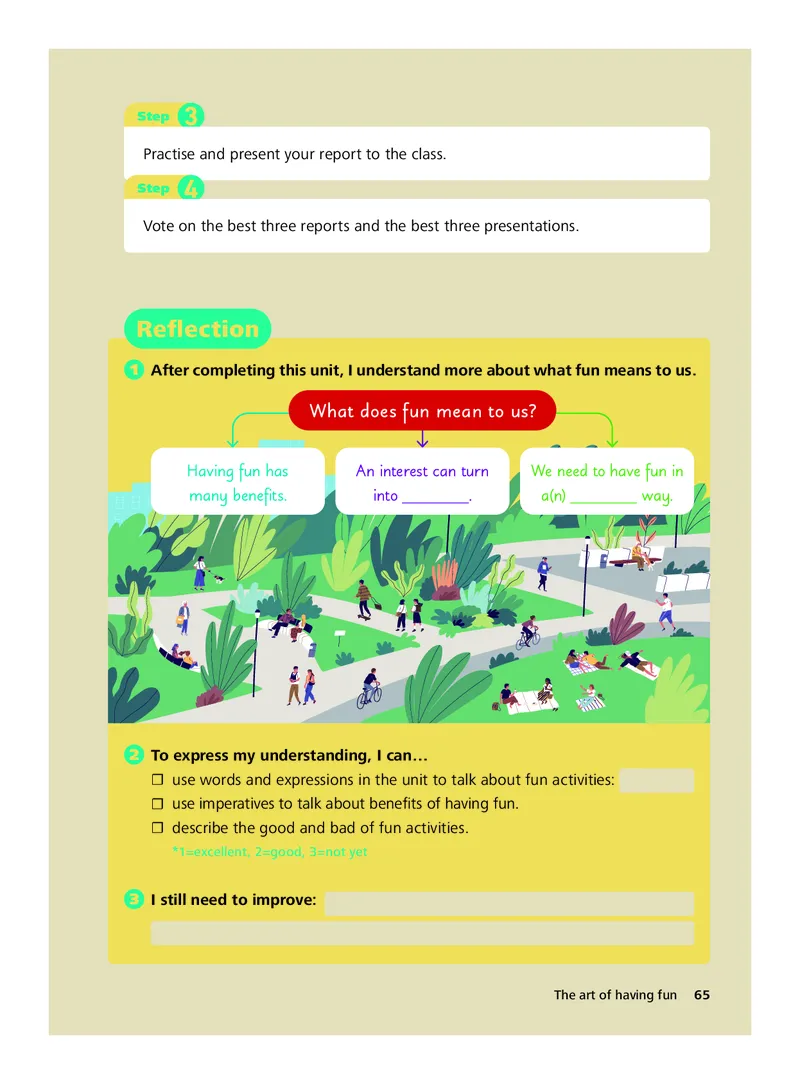
1 After completing this unit, I understand more about what fun means to us.
What does fun mean to us?
Having fun has An interest can turn We need to have fun in
many benefits. into . a(n) way.
2 To express my understanding, I can…
☐ use words and expressions in the unit to talk about fun activities:
☐ use imperatives to talk about benefits of having fun.
☐ describe the good and bad of fun activities.
*1=excellent, 2=good, 3=not yet
3 I still need to improve:
The art of having fun 65Unit
AAmmaazziinngg
5
nnaattuurree
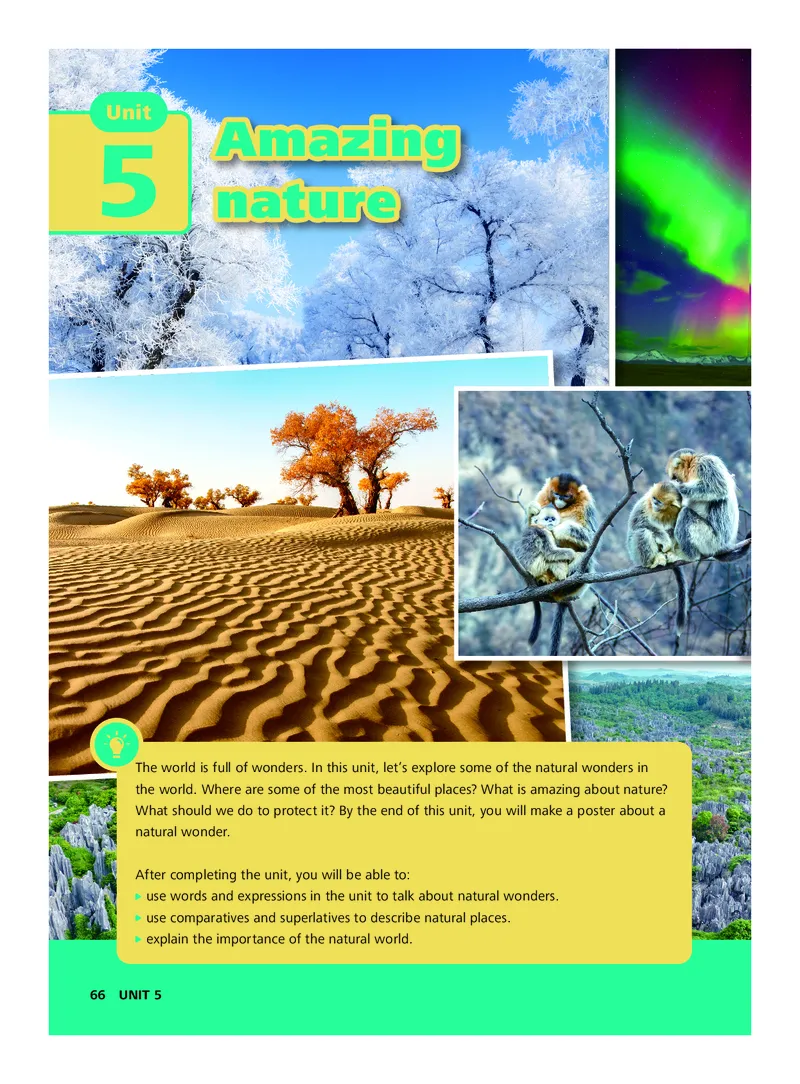
The world is full of wonders. In this unit, let’s explore some of the natural wonders in
the world. Where are some of the most beautiful places? What is amazing about nature?
What should we do to protect it? By the end of this unit, you will make a poster about a
natural wonder.
After completing the unit, you will be able to:
use words and expressions in the unit to talk about natural wonders.
use comparatives and superlatives to describe natural places.
explain the importance of the natural world.
66 UNIT 5What can you see in the pictures?
How do they make you feel?
Starting out
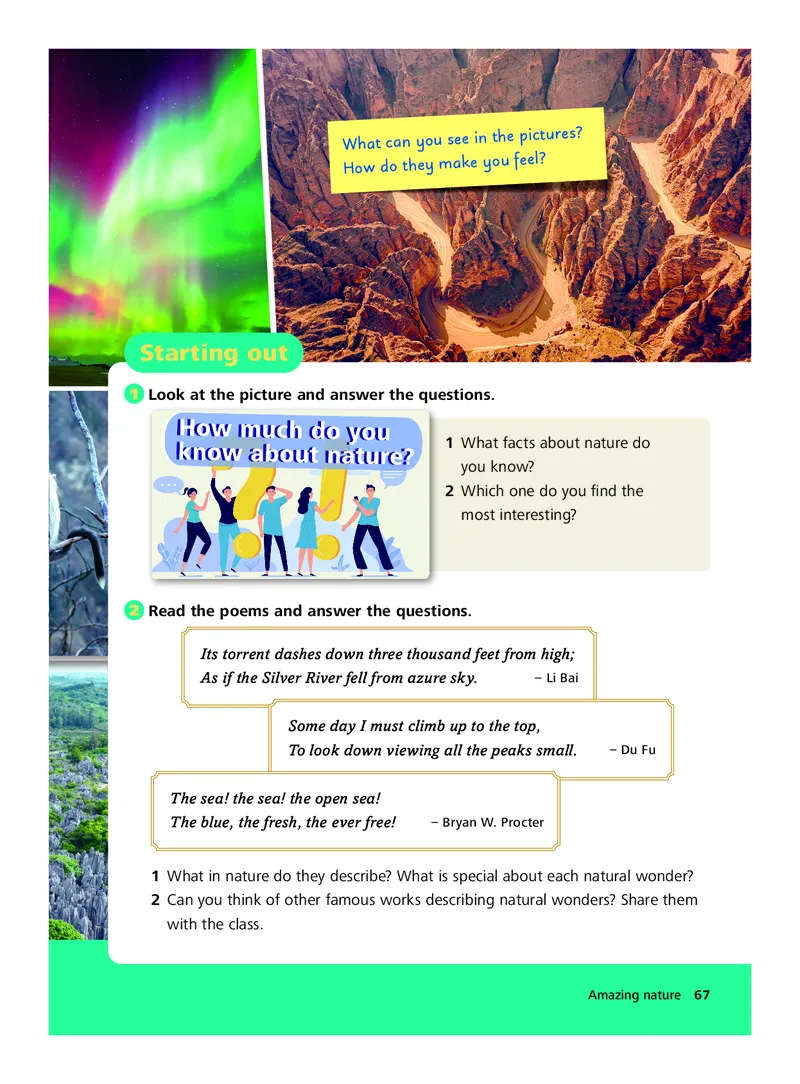
1 Look at the picture and answer the questions.
1 What facts about nature do
you know?
2 Which one do you find the
most interesting?
2 Read the poems and answer the questions.
Its torrent dashes down three thousand feet from high;
As if the Silver River fell from azure sky. – Li Bai
Some day I must climb up to the top,
To look down viewing all the peaks small. – Du Fu
The sea! the sea! the open sea!
The blue, the fresh, the ever free! – Bryan W. Procter
1 What in nature do they describe? What is special about each natural wonder?
2 Can you think of other famous works describing natural wonders? Share them
with the class.
Amazing nature 67Understanding ideas
1 Look at the pictures and answer the questions. Use the words to help you.
1 What can you see in the pictures? What colour are they?
2 How do you feel about them?
clean soft nature calm cloud mountain sky river
lake grassland field
2 Read the passage and find out the writer’s favourite colour.
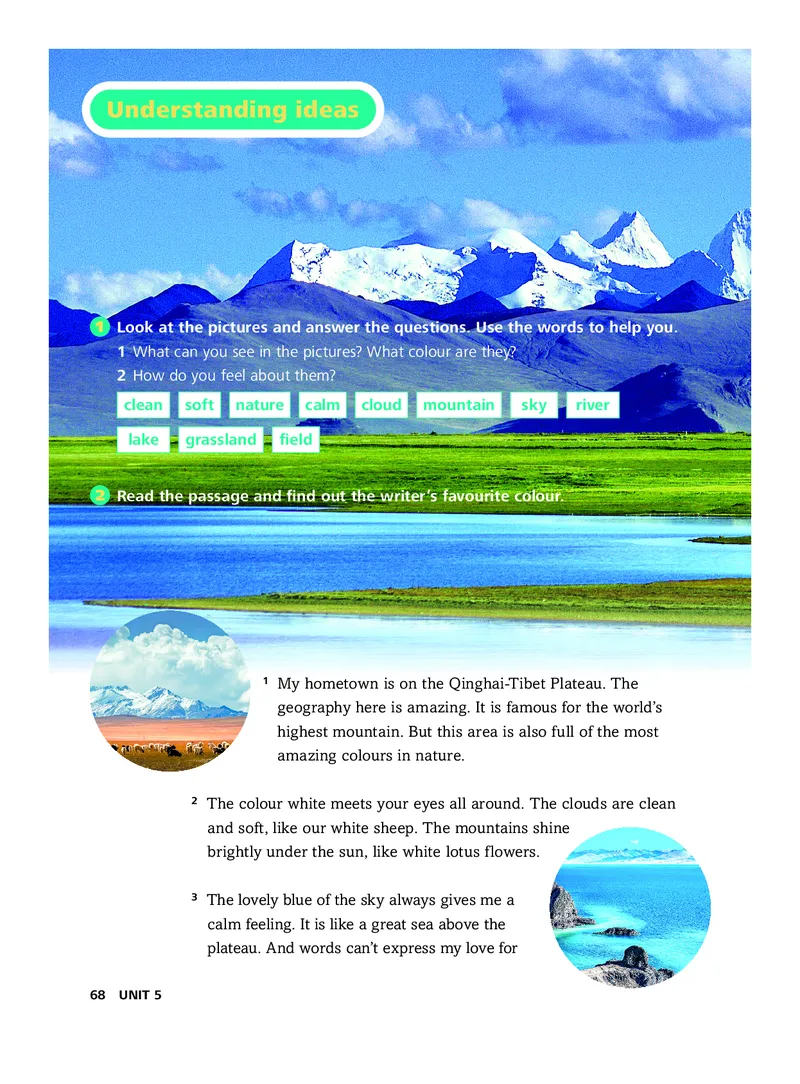
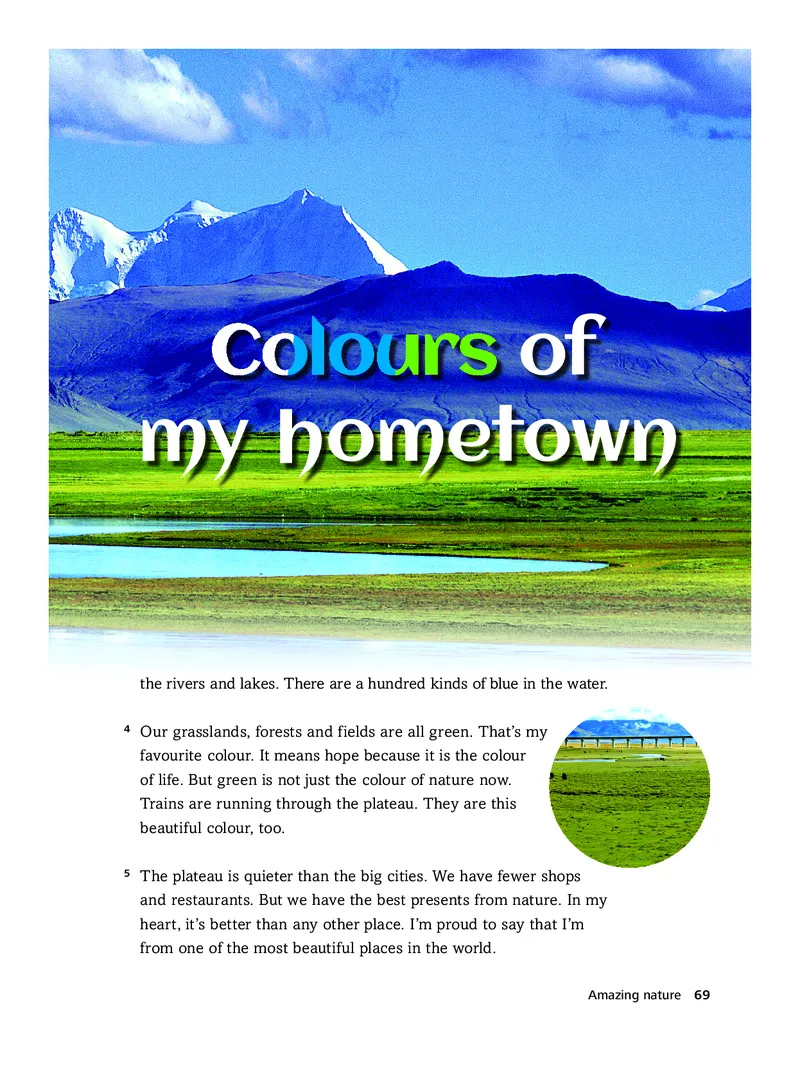
1 My hometown is on the Qinghai-Tibet Plateau. The
geography here is amazing. It is famous for the world’s
highest mountain. But this area is also full of the most
amazing colours in nature.
2 The colour white meets your eyes all around. The clouds are clean
and soft, like our white sheep. The mountains shine
brightly under the sun, like white lotus flowers.
3 The lovely blue of the sky always gives me a
calm feeling. It is like a great sea above the
plateau. And words can’t express my love for
68 UNIT 5the rivers and lakes. There are a hundred kinds of blue in the water.
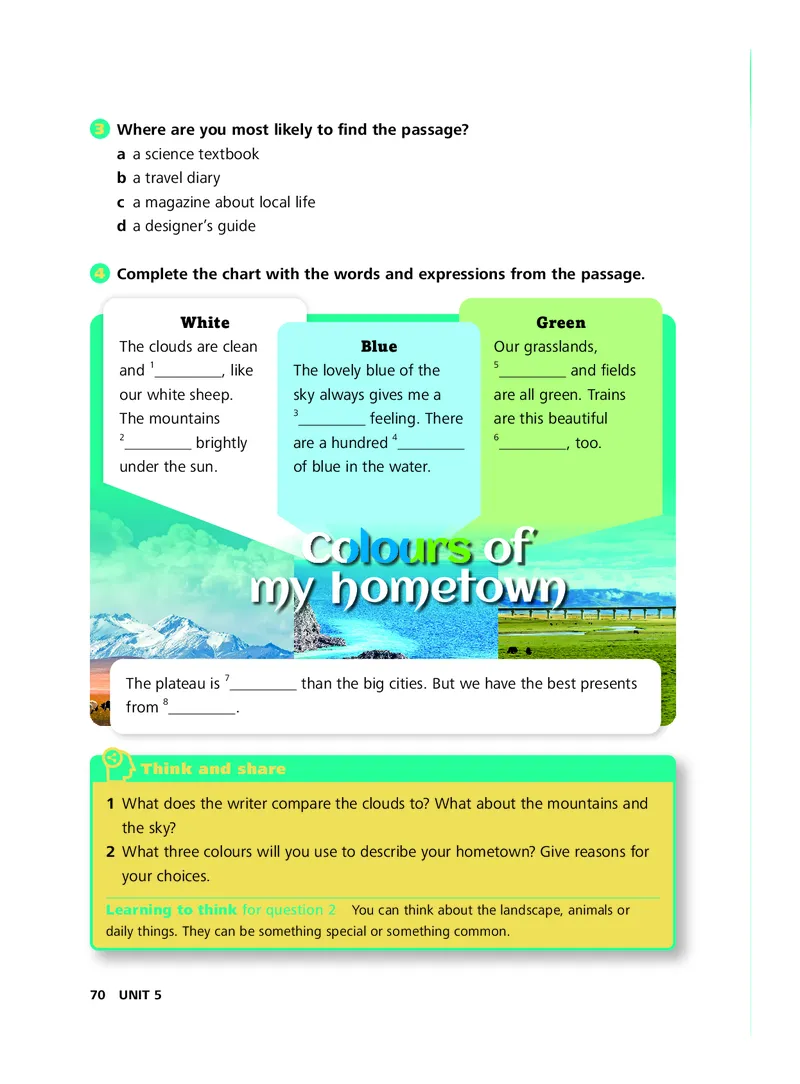
4 Our grasslands, forests and fields are all green. That’s my
favourite colour. It means hope because it is the colour
of life. But green is not just the colour of nature now.
Trains are running through the plateau. They are this
beautiful colour, too.
5 The plateau is quieter than the big cities. We have fewer shops
and restaurants. But we have the best presents from nature. In my
heart, it’s better than any other place. I’m proud to say that I’m
from one of the most beautiful places in the world.
Amazing nature 693 Where are you most likely to find the passage?
a a science textbook
b a travel diary
c a magazine about local life
d a designer’s guide
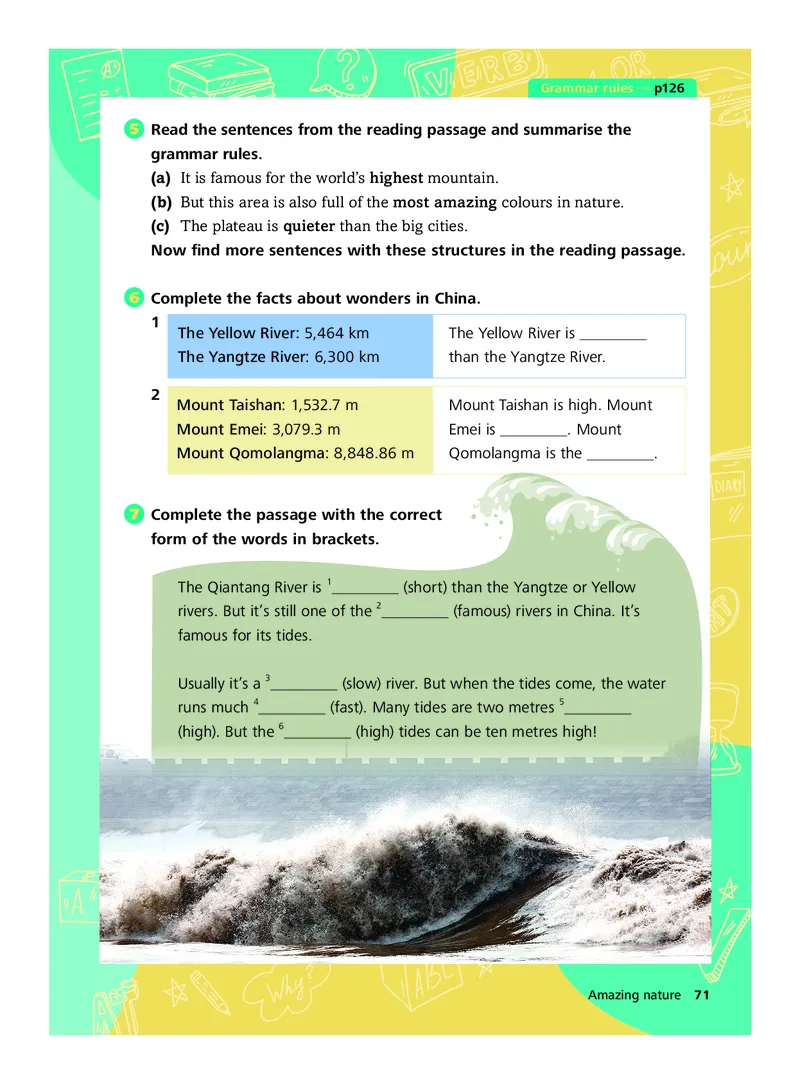
4 Complete the chart with the words and expressions from the passage.
White Green
The clouds are clean Blue Our grasslands,
and 1 , like The lovely blue of the 5 and fields
our white sheep. sky always gives me a are all green. Trains
The mountains 3 feeling. There are this beautiful
2 brightly are a hundred 4 6 , too.
under the sun. of blue in the water.
The plateau is 7 than the big cities. But we have the best presents
from 8 .
Think and share
1 What does the writer compare the clouds to? What about the mountains and
the sky?
2 What three colours will you use to describe your hometown? Give reasons for
your choices.
Learning to think for question 2 You can think about the landscape, animals or
daily things. They can be something special or something common.
70 UNIT 5Grammar rules⇢ p126
5 Read the sentences from the reading passage and summarise the
grammar rules.
(a) It is famous for the world’s highest mountain.
(b) But this area is also full of the most amazing colours in nature.
(c) The plateau is quieter than the big cities.
Now find more sentences with these structures in the reading passage.
6 Complete the facts about wonders in China.
1
The Yellow River: 5,464 km The Yellow River is
The Yangtze River: 6,300 km than the Yangtze River.
2
Mount Taishan: 1,532.7 m Mount Taishan is high. Mount
Mount Emei: 3,079.3 m Emei is . Mount
Mount Qomolangma: 8,848.86 m Qomolangma is the .
7 Complete the passage with the correct
form of the words in brackets.
The Qiantang River is 1 (short) than the Yangtze or Yellow
rivers. But it’s still one of the 2 (famous) rivers in China. It’s
famous for its tides.
Usually it’s a 3 (slow) river. But when the tides come, the water
runs much 4 (fast). Many tides are two metres 5
(high). But the 6 (high) tides can be ten metres high!
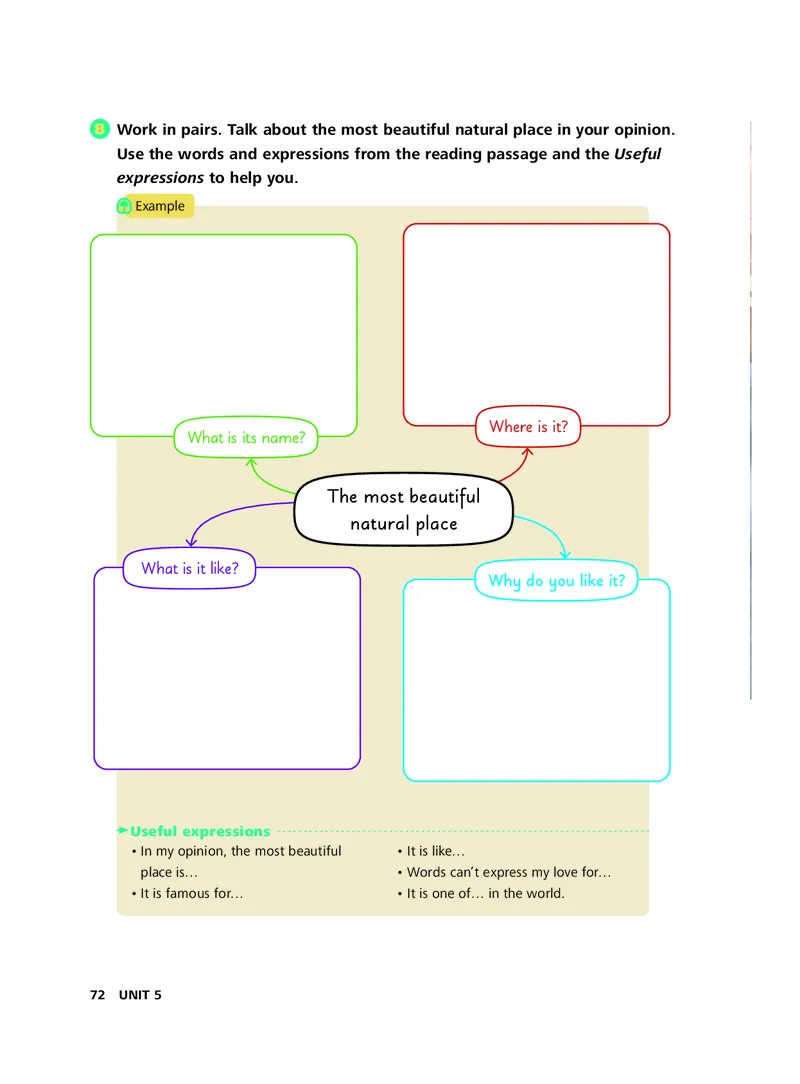
Amazing nature 718 Work in pairs. Talk about the most beautiful natural place in your opinion.
Use the words and expressions from the reading passage and the Useful
expressions to help you.
Example
Where is it?
What is its name?
The most beautiful
natural place
What is it like?
Why do you like it?
Useful expressions
• In my opinion, the most beautiful • It is like…
place is… • Words can’t express my love for…
• It is famous for… • It is one of… in the world.
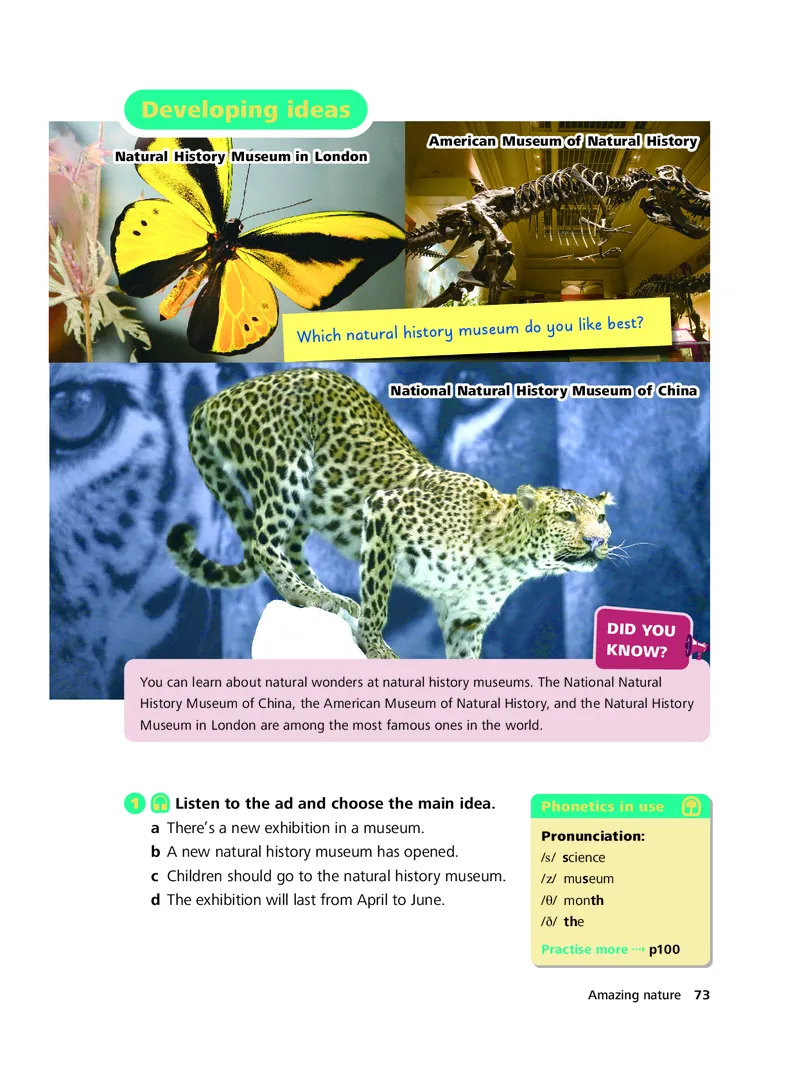
72 UNIT 5Developing ideas
AAmmeerriiccaann MMuusseeuumm ooff NNaattuurraall HHiissttoorryy
NNaattuurraall HHiissttoorryy MMuusseeuumm iinn LLoonnddoonn
Which natural history museum do you like best?
NNaattiioonnaall NNaattuurraall HHiissttoorryy MMuusseeuumm ooff CChhiinnaa
DID YOU
KNOW?
You can learn about natural wonders at natural history museums. The National Natural
History Museum of China, the American Museum of Natural History, and the Natural History
Museum in London are among the most famous ones in the world.
1 Listen to the ad and choose the main idea. Phonetics in use
a There’s a new exhibition in a museum.
Pronunciation:
b A new natural history museum has opened.
/ / science
s
c Children should go to the natural history museum. / / museum
z
d The exhibition will last from April to June. / / month
θ
/ / the
ð
Practise more⇢ p100
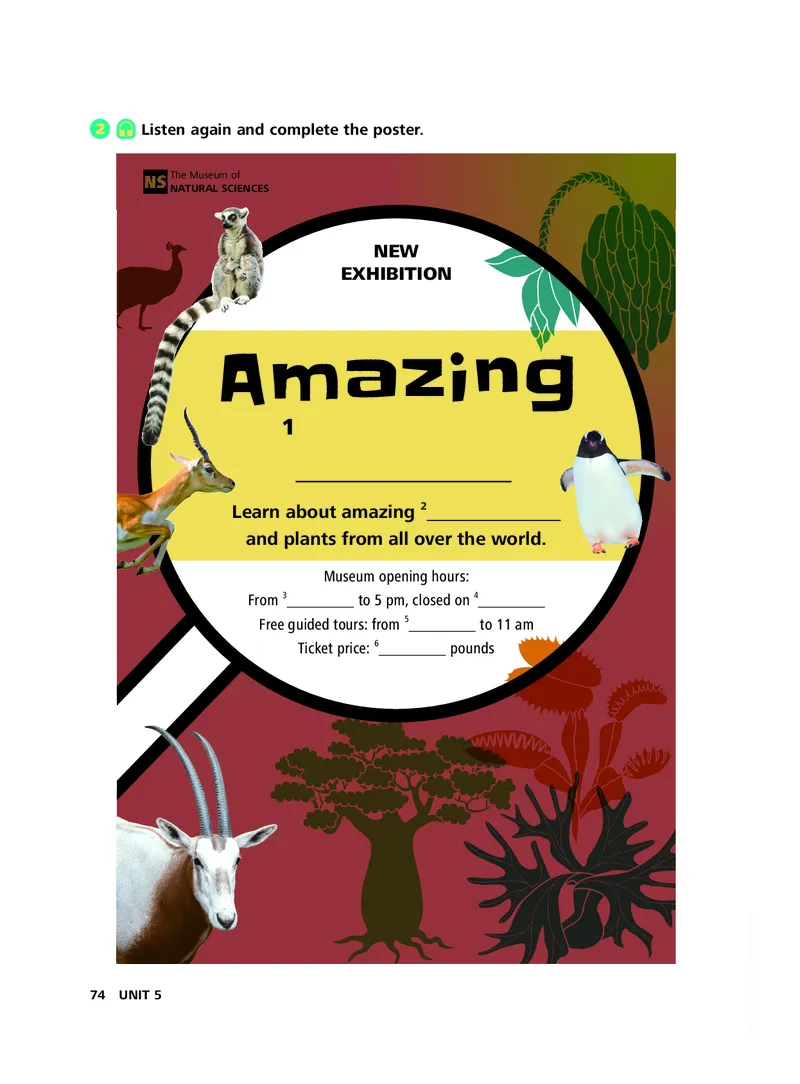
Amazing nature 732 Listen again and complete the poster.
NSThe Museum of
NATURAL SCIENCES
NEW
EXHIBITION
Amazing
1
Learn about amazing 2
and plants from all over the world.
Museum opening hours:
From 3 to 5 pm, closed on 4
Free guided tours: from 5 to 11 am
Ticket price: 6 pounds
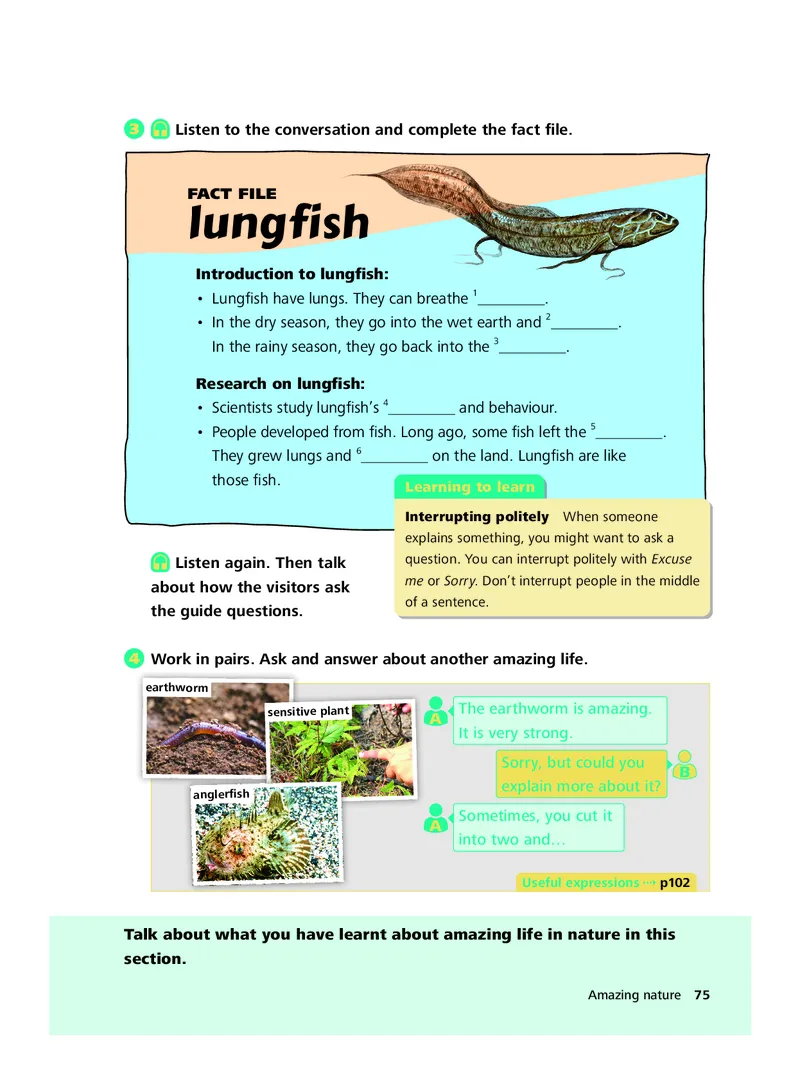
74 UNIT 53 Listen to the conversation and complete the fact file.
FACT FILE
lungfish
Introduction to lungfish:
• Lungfish have lungs. They can breathe 1 .
• In the dry season, they go into the wet earth and 2 .
In the rainy season, they go back into the 3 .
Research on lungfish:
• Scientists study lungfish’s 4 and behaviour.
• People developed from fish. Long ago, some fish left the 5 .
They grew lungs and 6 on the land. Lungfish are like
those fish.
Learning to learn
Interrupting politely When someone
explains something, you might want to ask a
Listen again. Then talk question. You can interrupt politely with Excuse
me or Sorry. Don’t interrupt people in the middle
about how the visitors ask
of a sentence.
the guide questions.
4 Work in pairs. Ask and answer about another amazing life.
earthworm
sensitive plant The earthworm is amazing.
A
It is very strong.
Sorry, but could you
B
explain more about it?
anglerfish
Sometimes, you cut it
A
into two and…
Useful expressions⇢ p102
Talk about what you have learnt about amazing life in nature in this
section.
Amazing nature 75Reading for writing
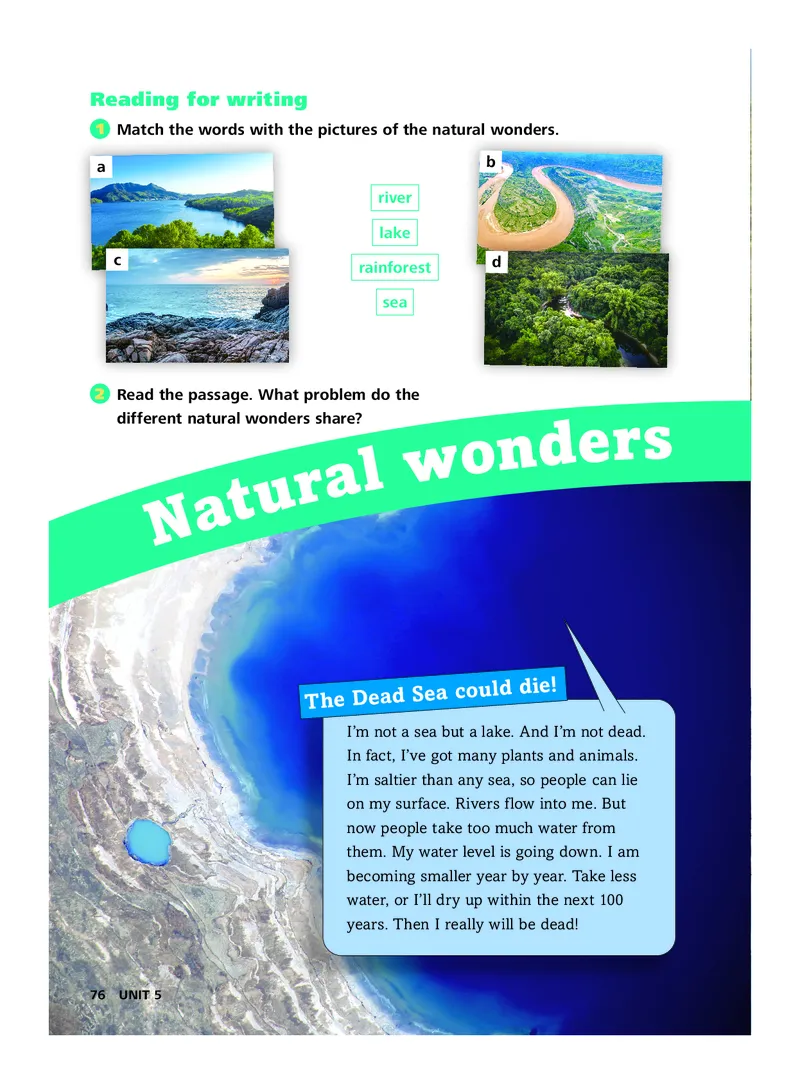
1 Match the words with the pictures of the natural wonders.
b
a
river
lake
c d
rainforest
sea
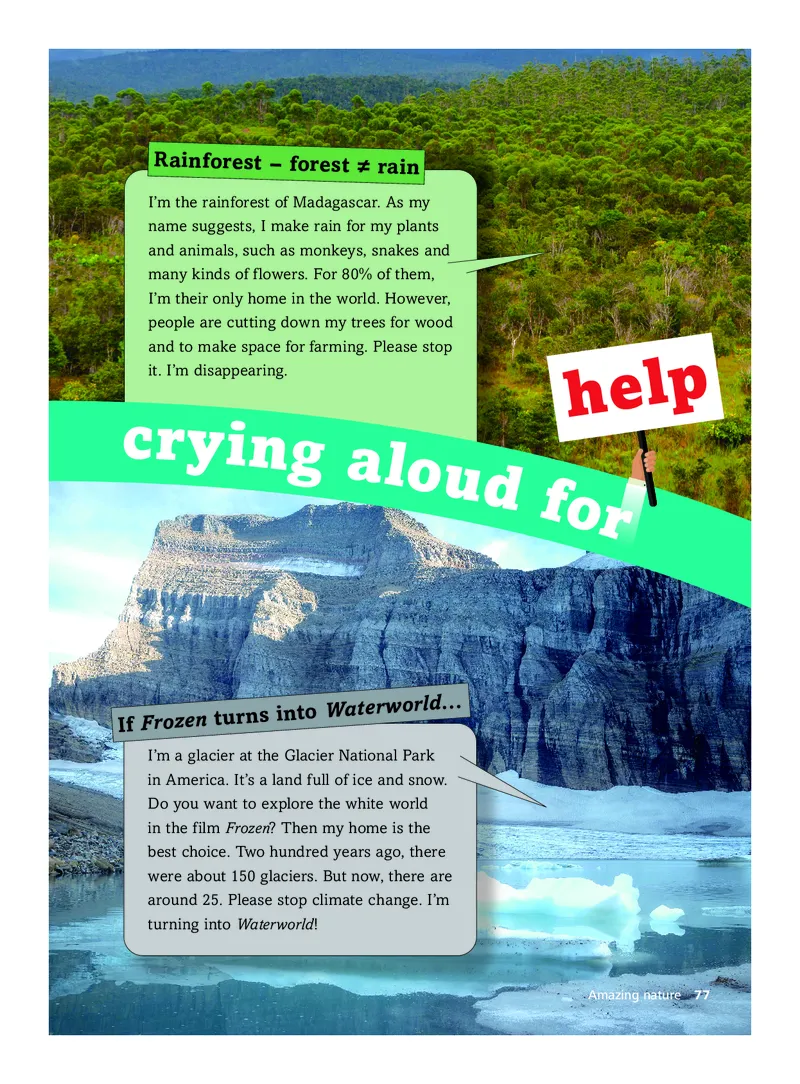
2 Read the passage. What problem do the
different natural wonders share? nders cryin
o g
w a
l
lo
a u
u r d
t f
a o
N r
The
Dead Sea
could die!
I’m not a sea but a lake. And I’m not dead.
In fact, I’ve got many plants and animals.
I’m saltier than any sea, so people can lie
on my surface. Rivers flow into me. But
now people take too much water from
them. My water level is going down. I am
becoming smaller year by year. Take less
water, or I’ll dry up within the next 100
years. Then I really will be dead!
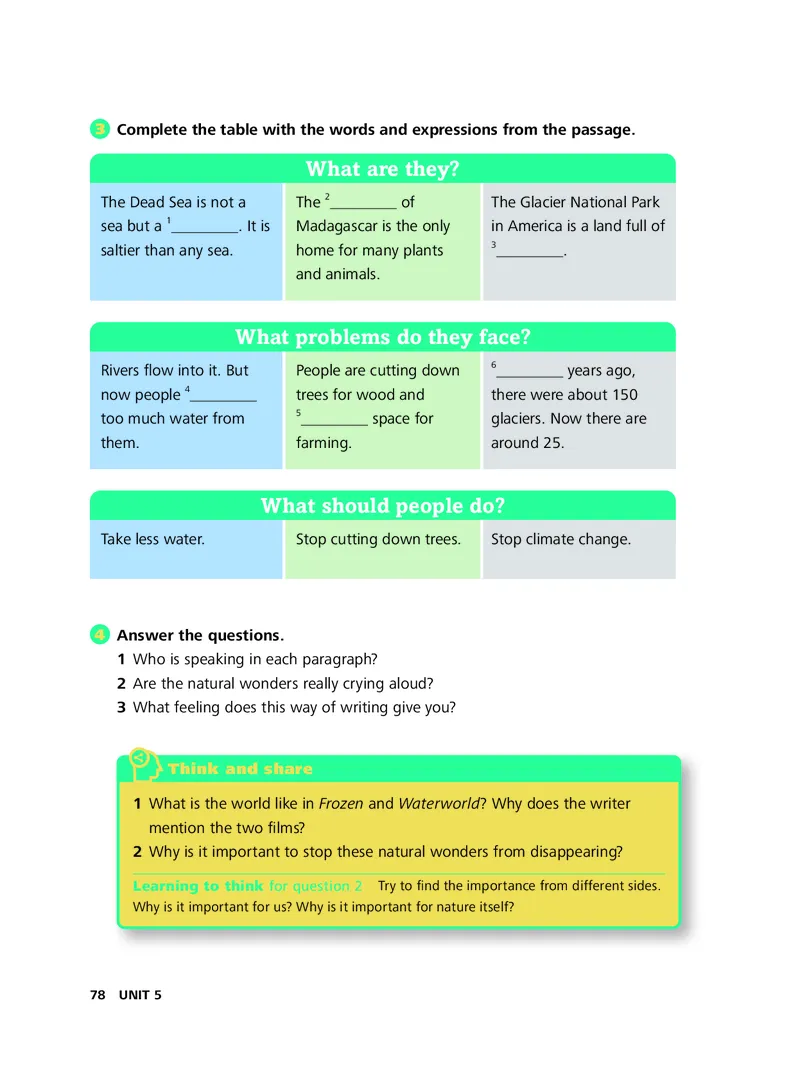
76 UNIT 5Rainforest - forest ≠ rain
I’m the rainforest of Madagascar. As my
name suggests, I make rain for my plants
and animals, such as monkeys, snakes and
many kinds of flowers. For 80% of them,
I’m their only home in the world. However,
people are cutting down my trees for wood
and to make space for farming. Please stop
p
it. I’m disappearing. h
el
nders cryin
o g
w a
l
lo
a u
u r d
t f
a o
N r
If
Frozen turns into
Waterworld…
I’m a glacier at the Glacier National Park
in America. It’s a land full of ice and snow.
Do you want to explore the white world
in the film Frozen? Then my home is the
best choice. Two hundred years ago, there
were about 150 glaciers. But now, there are
around 25. Please stop climate change. I’m
turning into Waterworld!
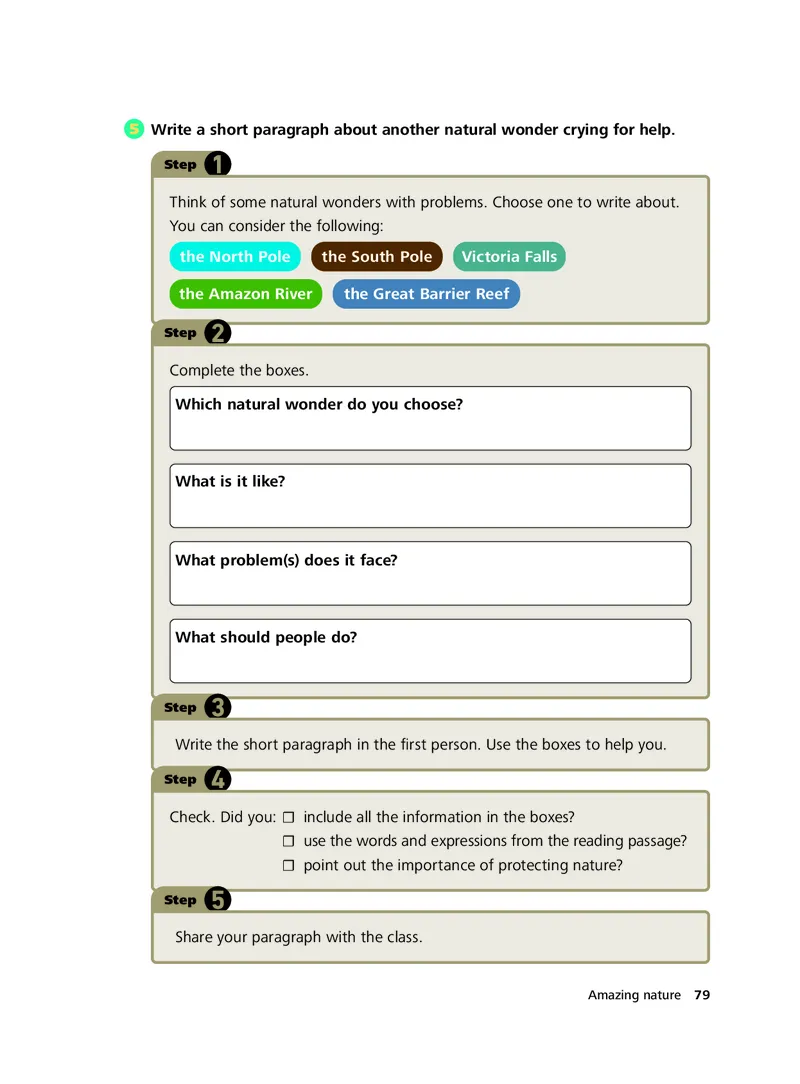
Amazing nature 773 Complete the table with the words and expressions from the passage.
What are they?
The Dead Sea is not a The 2 of The Glacier National Park
sea but a 1 . It is Madagascar is the only in America is a land full of
saltier than any sea. home for many plants 3 .
and animals.
What problems do they face?
Rivers flow into it. But People are cutting down 6 years ago,
now people 4 trees for wood and there were about 150
too much water from 5 space for glaciers. Now there are
them. farming. around 25.
What should people do?
Take less water. Stop cutting down trees. Stop climate change.
4 Answer the questions.
1 Who is speaking in each paragraph?
2 Are the natural wonders really crying aloud?
3 What feeling does this way of writing give you?
Think and share
1 What is the world like in Frozen and Waterworld? Why does the writer
mention the two films?
2 Why is it important to stop these natural wonders from disappearing?
Learning to think for question 2 Try to find the importance from different sides.
Why is it important for us? Why is it important for nature itself?
78 UNIT 55 Write a short paragraph about another natural wonder crying for help.
1
Step
Think of some natural wonders with problems. Choose one to write about.
You can consider the following:
the North Pole the South Pole Victoria Falls
the Amazon River the Great Barrier Reef
2
Step
Complete the boxes.
Which natural wonder do you choose?
What is it like?
What problem(s) does it face?
What should people do?
3
Step
Write the short paragraph in the first person. Use the boxes to help you.
4
Step
Check. Did you: ☐ include all the information in the boxes?
☐ use the words and expressions from the reading passage?
☐ point out the importance of protecting nature?
5
Step
Share your paragraph with the class.
Amazing nature 79Presenting ideas
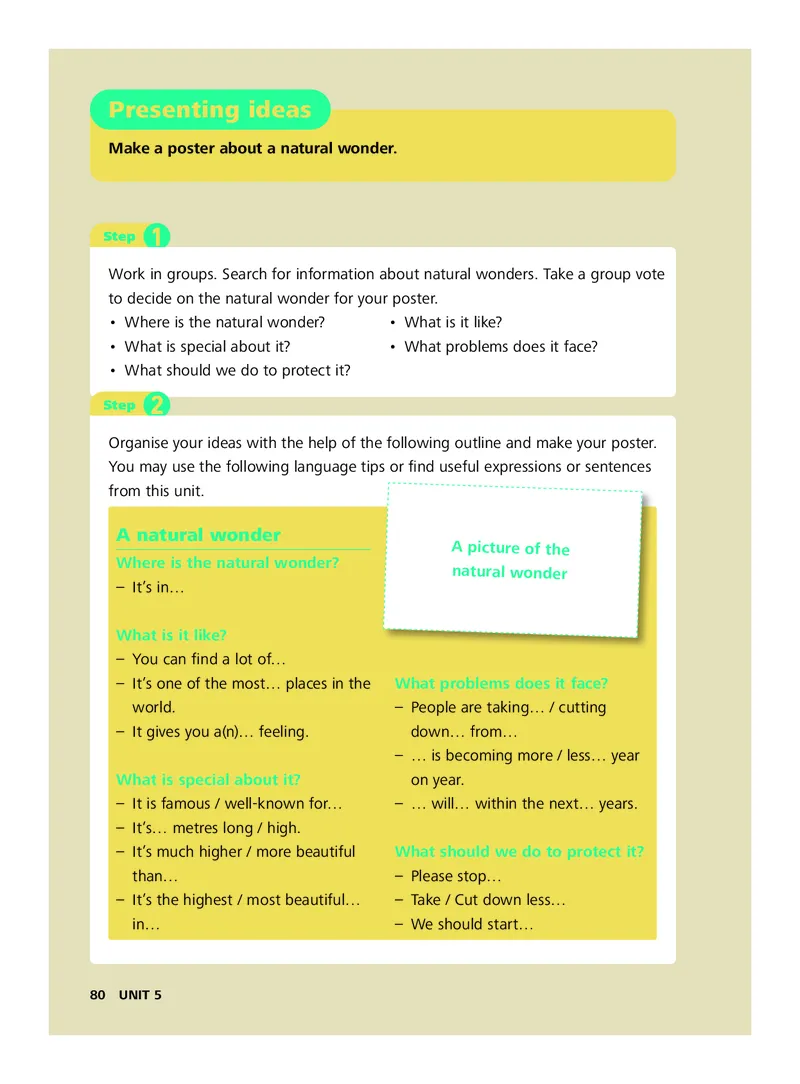
Make a poster about a natural wonder.
1
Step
Work in groups. Search for information about natural wonders. Take a group vote
to decide on the natural wonder for your poster.
• Where is the natural wonder? • What is it like?
• What is special about it? • What problems does it face?
• What should we do to protect it?
2
Step
Organise your ideas with the help of the following outline and make your poster.
You may use the following language tips or find useful expressions or sentences
from this unit.
A natural wonder
A picture of the
Where is the natural wonder?
natural wonder
– It’s in…
What is it like?
– You can find a lot of…
– It’s one of the most… places in the What problems does it face?
world. – People are taking… / cutting
– It gives you a(n)… feeling. down… from…
– … is becoming more / less… year
What is special about it? on year.
– It is famous / well-known for… – … will… within the next… years.
– It’s… metres long / high.
– It’s much higher / more beautiful What should we do to protect it?
than… – Please stop…
– It’s the highest / most beautiful… – Take / Cut down less…
in… – We should start…
80 UNIT 53
Step
Practise and present your poster to the class.
4
Step
Vote on the best three posters and the best three presentations.
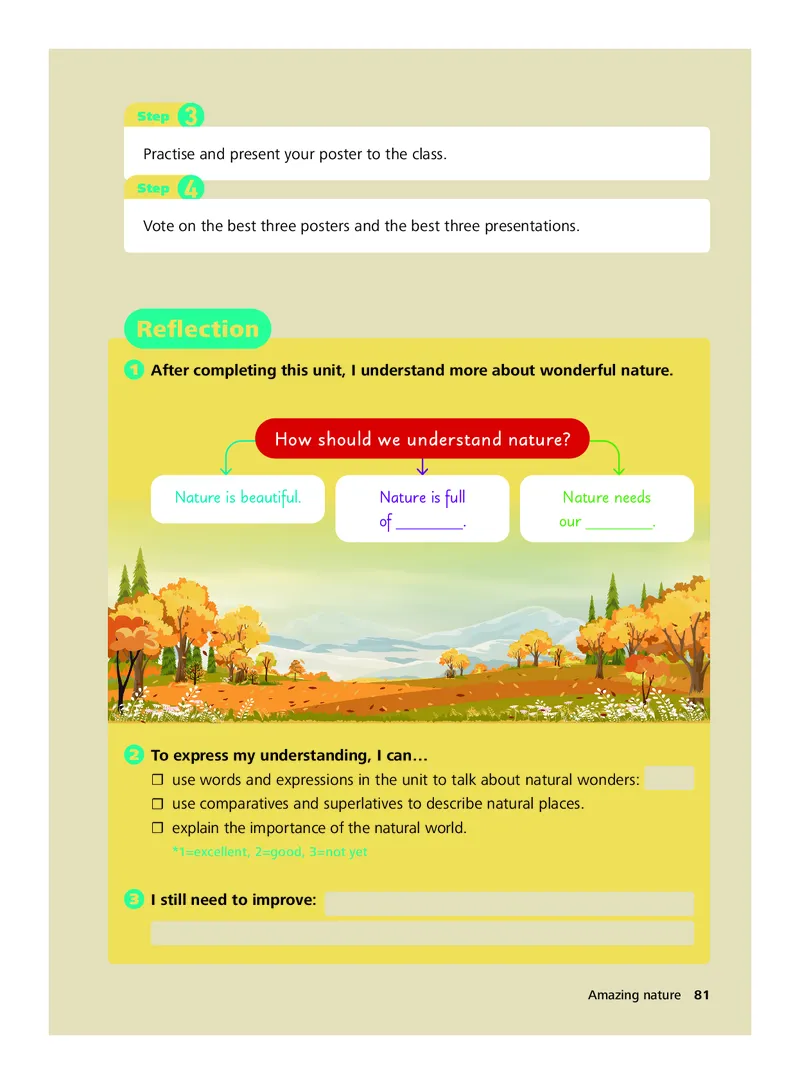
Reflection
1 After completing this unit, I understand more about wonderful nature.
How should we understand nature?
Nature is beautiful. Nature is full Nature needs
of . our .
2 To express my understanding, I can…
☐ use words and expressions in the unit to talk about natural wonders:
☐ use comparatives and superlatives to describe natural places.
☐ explain the importance of the natural world.
*1=excellent, 2=good, 3=not yet
3 I still need to improve:
Amazing nature 81Unit
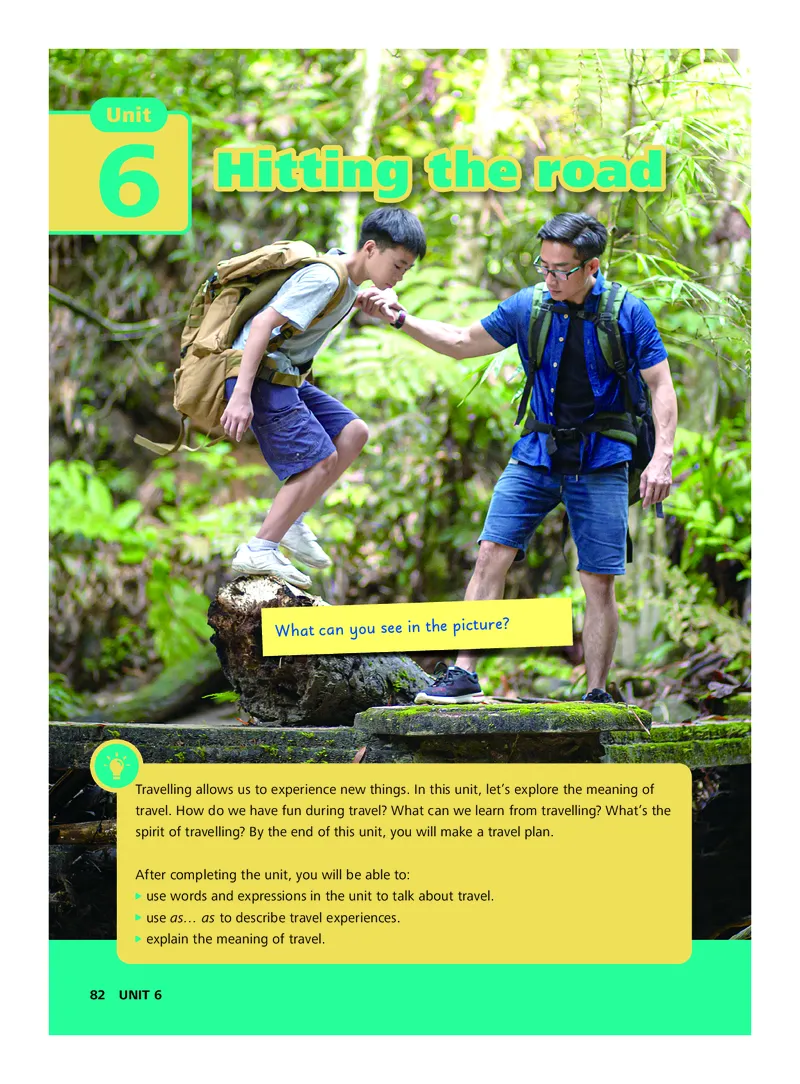
6
HHiittttiinngg tthhee rrooaadd
What can you see in the picture?
Travelling allows us to experience new things. In this unit, let’s explore the meaning of
travel. How do we have fun during travel? What can we learn from travelling? What’s the
spirit of travelling? By the end of this unit, you will make a travel plan.
After completing the unit, you will be able to:
use words and expressions in the unit to talk about travel.
use as… as to describe travel experiences.
explain the meaning of travel.
82 UNIT 6Starting out
HHiittttiinngg tthhee rrooaadd
1 Read the quotes and answer the questions.
You will not know the height of the sky if you do
not climb a high mountain.
Xunzi
故不登高山,不知天之高也。
荀子
Travel and change of place refresh the mind.
Seneca
Travelling can help you realise how small you are in the world.
Gustave Flaubert
11 W Whhaat td dooees se eaacchh q quuootete s asayy a abboouut tt rtaravveel?l?
22 W Whhicihch q quuootete d doo y oyouu a aggrereee w witihth m moosts?t ?
2 Look at the picture and answer the questions.
1 Do you know the book Around the World in
Eighty Days?
2 What do you think of the ways the characters
travelled in the book?
Hitting the road 83Understanding ideas
1 Look at the pictures and answer the questions.
Use the words to help you.
1 What can you see in the pictures?
2 What do you expect from a trip?
food museum
hot cool fun
and
1 At last, I arrived in Chengdu. My friend Haoyu took me to a
restaurant right from the airport. I just couldn’t wait to try Sichuan
hot pot!
2 But the first taste made my mouth burn! The food was much
hotter than I expected. I took a deep breath and drank a whole
glass of iced lemon tea.
3 “Do you want something less hot?” Haoyu said.
84 UNIT 62 Read the passage. What did the
writer eat and see?
4 “No,” I replied. “When in China, do as the
Chinese do!” I carefully took a small mouthful.
Surprisingly, I started to enjoy the taste. And
cooking hot pot was just as fun as eating it!
5 After lunch, things went from
really hot to totally cool – we
went to the new Sanxingdui
Museum! The masks were
fantastic. “Why are their eyes
and ears much bigger than
normal ones? Were ancient Shu
people able to see and hear further
than us?” I wondered. I wanted to stay in
the museum for a week!
6 My first day in China was full of fun: I
tried new food and went to an exciting
place. I’m really looking forward to the
rest of my trip around China!
Hitting the road 853 Tick the ideas in the passage.
☐ The weather was very hot in Chengdu.
☐ In general, the writer enjoyed the hot pot.
☐ The writer was curious about Sanxingdui.
☐ The writer does not want to stay in China.
4 Complete the chart with the words and expressions from the passage.
My “hot” experiences: My “cool” experiences:
• I wanted to try 1 , so • The new Sanxingdui Museum is
Haoyu took me to a restaurant. totally 6 .
• The food made 2 burn • I had so many questions about
and I 3 all my tea. the 7 masks.
• Then I started to 4 • A different cultural experience
the taste. makes travelling exciting.
• 5 hot pot was as fun as
eating it.
My first day in China was 8 .
Think and share
1 What do you think the title means?
2 Would you like to travel in Sichuan? Why or why not?
Learning to think for question 1 A title often shows the main idea of the passage.
Pay attention to the words in a title. Some words may have more than one meaning.
86 UNIT 6Grammar rules⇢ p130
5 Read the sentences from the reading passage and summarise the
grammar rules.
(a) The food was much hotter than I expected.
(b) And cooking hot pot was just as fun as eating it!
Now find more sentences with these structures in the reading passage.
6 Rewrite the sentences using (more / less)… than or as… as.
1 I prefer trying local food to visiting places of interest in a trip.
To me, trying local food is visiting places of interest in a trip.
2 The hotel room was very comfortable, just like my own home.
The hotel room was my own home.
7 Complete the postcard using as… as or (more)… than.
Hi Jane,
We visited Iguazu Falls today. It is 1
(big) any other waterfall in South America. The
running water sounds 2 (powerful) thunder, and it
looks 3 (beautiful) a painting.
We took a boat ride into the heart of the falls. It was 4
(interesting) any boat ride for me before. Rushing down the water
was 5 (exciting) taking a roller coaster ride. In the
middle of the huge falls, I felt myself 6 (little) an ant.
Iguazu Falls is really a natural wonder.
Maybe one day you can come here
and enjoy the beauty yourself.
Love from,
Haoyu
Hitting the road 878 Work in pairs. Discuss fun things to do while travelling. Put them in the
thinking map. Use the words and expressions from the reading passage
and the Useful expressions to help you.
Example
trying new food
going to exciting places
FFuunn tthhiinnggss
dduurriinngg ttrraavveell
Useful expressions
• … is much… than… • I tried… and went to…
• Surprisingly, I started to enjoy… • I’m really looking forward to…
• … is just as fun as…
88 UNIT 6Developing ideas
What is the
woman doing?
DID YOU
KNOW?
A vlog is a blog in the form of a video. It’s a popular way of sharing information and
experiences. People sharing vlogs online are called vloggers.
1 Listen to the speech and choose
Phonetics in use
the correct situation.
Pronunciation:
a The speaker is accepting an award on
/ / share should
ʃ
the stage.
/ / usually decision
ʒ
b The speaker is making a travel vlog in / / Jack just
dʒ
the street. / / much watch
tʃ
c The speaker is talking to local people in Practise more⇢ p100
a restaurant.
Hitting the road 892 Listen again and complete the personal homepage.
319k subscribers 127 videos Subscribed
Name: 1
Award: Best 2 Vlogger
How I travel:
During my travels, I don’t just go to the 3 .
I 4 talking to local people.
It helps me learn about their 5 and understand their 6 .
The latest vlog:
SSwwiimm ttoo
wwoorrkk?? AA
ssppeecciiaall cciittyy ttoo
vviissiitt!!
Learning to learn
Listening for specific information We often
need to listen for certain details. The details are often
names, objects, places and numbers. Check the kinds of
information you need before you listen.
10k 13:19
90 UNIT 63 Listen to the vlog and complete the notes.
Where is Jack?
He’s in Bern. It’s a beautiful place with a 1 history.
What does he find?
There are lots of people 2 .
What is the lady doing?
She’s going to 3 by swimming.
Why is it a wonderful way to start the day?
There are no traffic jams or noise. You can also 4 to people.
What does the lady do with her clothes and things?
She puts them in a waterproof 5 . They won’t get wet.
Is it a popular way to get around Bern?
In 6 , yes. People can get a waterproof bag and have a 7 at
the city down the river.
Learning to learn
Expressing surprise If you hear something positive,
Listen again. Then
you can use expressions such as Really? or Amazing! If you
talk about how Jack
hear something negative, you can use expressions such as
expresses surprise. Oh dear! or How awful!
4 Work in pairs. Talk about your favourite kind of travelling and share what
you can learn from it.
What’s your favourite kind of travelling?
A
I like to travel in a… way.
B
Amazing! What can you learn from it?
A
A lot of things. For example, I can…
B
Useful expressions⇢ p102
Talk about what you have learnt about travelling and learning in this
section.
Hitting the road 91Reading for writing
1 Look at the pictures and guess this person’s experiences. Use the words
and expressions to help you.
traveller walk through seas and mountains
geographical discovery explore climb
1 In 1640, a man was seriously ill. He had to end the last trip of his
life. Back home, people asked him, “You spent your whole life on
the road. Do you regret it?”
2 “I walked through many fantastic places in China,” he replied.
“People say I’m as great as Zhang Qian and Xuanzang. So I have
no regrets at all.” This man was Xu Xiake, the greatest traveller in
Chinese history.
3 From an early age, Xu dreamed of visiting China’s seas and
mountains. But at the time, it was very difficult to travel far. This
didn’t stop him, however. At 22, he set out on his life’s journey. He
travelled for about 30 years, and achieved his dream.
92 UNIT 62 Read the passage and check your answer.
4 Xu made many geographical discoveries during his journey.
Once, he visited Mount Huangshan. People then thought
Tiandu Peak was higher than Lianhua Peak. To find out the
truth, Xu climbed both peaks. He discovered that Lianhua
Peak gave a wider view, so it must be higher. He was right!
5 Xu recorded his travel experiences in his diary. This later
became Xu Xiake’s Travel Notes. Thanks to this book, we
can learn about China almost 400 years ago.
“Exploring the unexplored” is the best
description of Xu’s life.
Hitting the road 933 Complete the chart with the words and expressions from the passage.
Who He was the greatest 1 in Chinese
was he? history.
He dreamed of visiting China’s 2
What was
from an early age. At 22, he 3 on
his dream?
his life’s journey.
Xu Xiake
He made 4 during his journey.
What did he
For example, he discovered that Lianhua
find out?
Peak was 5 than Tiandu Peak.
What’s his Thanks to Xu Xiake’s Travel Notes, we can
gift to us? 6 China almost 400 years ago.
Think and share
1 What do you think of Xu Xiake?
2 Do you want to be someone like Xu Xiake?
Learning to think for question 1 To make comments on a
person, it’s important to be respectful and objective.
4 Answer the questions.
1 Why does the writer start from Xu Xiake’s last year?
2 Why does the writer mention Tiandu Peak and Lianhua Peak?
3 Can you think of another title for the passage?
94 UNIT 65 Write a short introduction to another great traveller.
1
Step
Plan your introduction and answer the questions.
Who is this person?
Why is this person famous?
What are this person’s achievements?
What are people’s comments on this person?
What’s your opinion of this person?
2
Step
Write your introduction as a paragraph with the help of the questions.
3
Step
Check. Did you: ☐ cover the key information about the traveller?
☐ use the words and expressions from the reading passage?
☐ give your opinion of the great traveller?
4
Step
Share your short introduction with the class.
Hitting the road 95Presenting ideas
Make a travel plan.
1
Step
Work in groups. Search for information on places of interest in your city / town.
Make a one-day travel plan for a foreign friend. Take a group vote to decide on
the activities.
• What are the activities? • Why did you choose them?
• What can your friend get from the trip?
2
Step
Organise your ideas with the help of the following outline and create your travel
plan. You may use the following language tips or find useful expressions or
sentences from this unit.
Places
Names of:
– a restaurant – a park – a museum
Activities
– First, have breakfast / lunch / dinner at… – Then, take a boat / train…
– Next, visit…
Reasons
– When in…, do as the… do!
– … is really a natural wonder.
Remember!
– … is a beautiful place with a
Think about the time for each activity.
long history.
Make sure your friend can do all the
activities in one day.
What can your friend get?
– A(n)… experience makes travelling…
– He / She can learn about… and understand the culture of…
96 UNIT 63
Step
Practise and present your travel plan to the class.
4
Step
Vote on the best three travel plans and the best three presentations.
Reflection
1 After completing this unit, I understand more about the meaning
of travel.
What can travel bring us?
Travel gives us Travel helps us The spirit of great
new experiences. the world. travellers .
2 To express my understanding, I can…
☐ use words and expressions in the unit to talk about travel:
☐ use as… as to describe travel experiences.
☐ explain the meaning of travel.
*1=excellent, 2=good, 3=not yet
3 I still need to improve:
Hitting the road 97AAppppeennddiicceess
Phonetics in use
Communication bank
Language notes
Guide to the language use
Words and expressions
Proper nouns
Names, Places, Others
Vocabulary
Pronunciation guide
Irregular verbs
NNSSEE__JJHH 77BB 附附录录--1100校校pprr11--DDOO..iinndddd 9988 22002244//33//1122 1155::2255::1144Phonetics in use
Unit 1
Put the words in the correct boxes.
how grow proud down cold
mouth alone house hope town
/ / / /
əʊ aʊ
Now listen and check.
Unit 2
Listen and repeat.
/ / here near really clear
ɪə
/ / there bear care chair
eə
/ / tourist
ʊə
Unit 3
Listen and repeat.
/ / parent potato help prepare
p
/ / boy brother hamburger body
b
/ / tea tomato water salt
t
/ / bad food idea doctor
d
Phonetics in use 99Phonetics in use
Unit 4
Listen and circle the correct words.
1 leaf / leave
2 could / good
3 guide / kind
4 safe / save
5 very / fairy
6 came / game
Unit 5
Listen and repeat.
/ / sky soft place grass
s
/ / as always amazing visit
z
/ / month think theatre thank
θ
/ / than with they then
ð
Unit 6
Listen and repeat.
/ / British finish shop sure
ʃ
/ / television pleasure treasure usual
ʒ
/ / enjoy judge job bridge
dʒ
/ / Chinese teacher each catch
tʃ
100
NNSSEE__JJHH 77BB 附附录录--1100校校pprr11--DDOO..iinndddd 110000 22002244//33//1122 1155::2255::1144Communication bank
Unit 1
Useful expressions
• What do you think are some ways to stay • In my opinion, being positive means…
positive? • I find that when I…, it helps me stay
• What are some ways we can encourage positive.
each other to stay positive? • Overall, I believe that…
• I think one key aspect of staying positive
is…
Unit 2
Useful expressions
• One benefit is… • Really? Could you tell me more about…?
• By playing…, you can… • That’s a good / an important / a relevant
• The health benefits of… include… point.
Unit 3
Useful expressions
• Did you know that…? • I don’t think that’s right.
• That’s false. • In reality, …
• The truth is that… • Research shows that…
Communication bank 101
NNSSEE__JJHH 77BB 附附录录--1111校校--博博文文..iinndddd 110011 22002244//33//1144 11::0088::4444CCoommmmuunniiccaattiioonn bbaannkk
Unit 4
Useful expressions
• Let’s talk about… • He was passionate about… because…
• Why did he choose to…? • He got a lot of fun from…
• I’d like to talk about… • Finally, could you tell me about…?
Unit 5
Useful expressions
• … is an amazing animal. • Sorry, but could you explain…?
• One surprising thing about… is… • May I ask something?
• Actually, it can… • Excuse me. Why…?
• Did you know that…? • Sorry to interrupt, but…
Unit 6
Useful expressions
• … is my favourite kind of travelling.
• When I travel, I’m always interested to know about…
• By…, it’s possible to learn…
• Wow, that’s interesting. What else can you learn?
• There are many. For example, …
102Language notes
Unit 1
1. Poor in things, rich in love
于物贫瘠,于爱富足
该标题使用了对比的修辞手法,poor和rich这对反义词分别用来
形容代表物质的things和代表精神的love,使两者之间差异鲜
明。本文通过Charlie的故事强调了即使缺乏物质财富,人们依然
可以依靠爱的力量过得富有和快乐。
2. I put down Charlie and the Chocolate Factory.
我放下《查理和巧克力工厂》这本书。
《查理和巧克力工厂》是英国儿童文学作家罗尔德·达尔(Roald
Dahl)创作的童话,故事讲述了一个名叫Charlie的小男孩赢得了
参观神秘巧克力工厂的机会。罗尔德的其他作品还包括《詹姆斯
与大仙桃》《了不起的狐狸爸爸》和《好心眼儿巨人》等。
3. But I kept going over the exciting story in my mind.
脑海中却不断回想着那个激动人心的故事。
(1) keep doing sth意为“继续做某事,重复做某事”。例如:
You have to keep practising your spoken English if you
want to get good at it. 如果你想要提升英语口语,就必须
坚持练习。
(2) go over sth在句中可以意为“仔细考虑某事”。例如:
She had gone over and over what happened in her
mind. 她把发生的事情在心里想了又想。
此外,go over sth也意为“仔细搜查(检查)某物;重复某事,
练习某事”。例如:
Could you go over this report and correct any mistake?
你能仔细看一下这个报告并把错误改过来吗?
Once again he went over exactly what he needed to say.
他把要说的话又一字不差地重复了一遍。
Language notes 103Language notes
4. In winter, the freezing wind swept across the floor all
night long.
冬天的夜里,寒风一阵阵扫过地板。
(1) sweep across表示“迅速而全面地穿过或扫过”,常用来描述
风、雨、火等或者思想、情绪的快速传播。例如:
The storm swept across the town. 暴风雨席卷了这个城镇。
Excitement swept across the crowd when the team won
the game. 当这支队伍获胜时,激动的情绪在人群中迅速传
播开来。
(2) all night long意为“整整一夜”,多用于强调。例如:
He worked all night long! 他工作了一整夜!
5. To my surprise, the family were happy together.
使我惊讶的是,他们一家人在一起很快乐。
to one’s surprise意为“使某人惊讶的是”。例如:
To my surprise, she did well in the meeting. 使我惊讶的是,
她在会议上表现得很好。
6. Oscar Wilde once said, “Keep love in your heart. A life
without it is like a sunless garden...”
Oscar Wilde曾说过:“心中要有爱。生活中没有爱,就像花园没
有阳光……”
(1) 句中使用了比喻的修辞手法,将心比作花园,将爱比作阳光,
说明了爱的重要性—如果生活中缺少爱,就会像没有阳光
的花园一样死气沉沉。
(2) 奥斯卡·王尔德(Oscar Wilde)是19世纪末英国最杰出的戏
剧家之一,同时他也是一位小说家、诗人。其代表作包括
《快乐王子》等。
7. Growing happiness
让幸福生长
该标题使用了比喻的修辞手法,将happiness比喻为可以留长的
头发,强调幸福其实可以靠自己去追寻和创造,而不仅仅是被动
接受。
104
NNSSEE__JJHH 77BB 附附录录--1100校校pprr11--DDOO..iinndddd 110044 22002244//33//1122 1155::2255::11558. “Just one more month!” he said to himself.
他对自己说:“就再坚持一个月!”
say to oneself意为“对自己说”。例如:
She said to herself, “You can do it.” 她对自己说“:你可以做
到的。”
9. People often talked about his long hair behind his
back. Sometimes they laughed at him.
人们常常在背后议论他的长发。有时候还会嘲笑他。
(1) behind one’s back意为“在某人背后,背地里”。例如:
Don’t speak ill of others behind their backs. 不要背后说
人坏话。
(2) laugh at意为“嘲笑,取笑”。例如:
You shouldn’t laugh at others’ failures. 你不应该嘲笑别人
的失败。
10. Day after day, hope grew together with his hair.
日复一日,他的头发渐渐长长,希望也随之增长。
day after day意为“日复一日,天天地”。例如:
Our team is working hard day after day to ensure the success
of this project. 为确保这个项目的成功,我们团队日复一日地努
力工作。
11. He remembered the words of Plato: “Happiness
springs from doing good and helping others.”
他想起了Plato的话:“幸福源于行善和帮助他人。”
柏拉图(Plato)是古希腊哲学家,西方哲学的开创者之一,创作了
哲学对话体著作《理想国》。
Language notes 105Language notes
Unit 2
1. However, 86-year-old Zhang Shun was still about 100
metres from the finishing line.
然而,86岁的张顺距离终点线还有约100米。
张顺,一位中国老年马拉松跑者,参加过20个全程马拉松、3个
半程马拉松比赛。他在2022年北京马拉松比赛即将关停赛道,
距离终点线还有约100米时,仍然坚持不懈。最终在观众的鼓励
下,他成功完成了比赛。
2. All of them held their breath. Would he make it?
他们全都屏息静气。他能成功吗?
(1) hold one’s breath意为“屏住呼吸;屏息静气”,在这里表示
“紧张地等待,焦急地盼望”的氛围。例如:
When the ball was in midair, we all held our breath. 当球
在半空中时,我们都屏住了呼吸。
(2) make it在句中表示“获得成功”。例如:
The actor wasn’t famous at all a few years ago, but now
he’s really made it. 几年前这位演员一点都不出名,但现在
他很成功。
3. For years, he trained every morning in the park. He
filled over 30 notebooks with his running records.
多年来,他每天早上都在公园里训练,写了30多本跑步日记。
fill... with sth表示“用某物充满……,用某物填满……”。例如:
He filled his room with books. 他的房间里堆满了书。
4. The Steel Roses of China
中国的“铿锵玫瑰”
“铿锵玫瑰”是中国国家女子足球队的别名。中国国家女子足球队
成立于1984年,在1999年美国世界杯比赛中她们闯入决赛,最
终惜败东道主美国队,屈居亚军,“铿锵玫瑰”之名从此叫响。
1065. However, the players never gave up. They took every
chance to learn and improve.
然而,队员们从未放弃。她们抓住一切机会学习和提高自己。
take every chance to…可以理解为“抓住每一个机会去……”。
6. There are still many difficulties ahead. But they will
rise to every challenge, thanks to their shining spirit.
未来仍然有很多困难,但凭借着闪耀的女足精神,她们将勇于应
对每一次挑战。
rise to every challenge表示“应对每一个挑战”,也可表达为rise
to the challenge。例如:
His team rose to the challenge. 他的团队挺身迎接挑战。
Language notes 107Language notes
Unit 3
1. Delicious memories
美味的记忆
该标题使用了通感的修辞手法。“通感”又称“移觉”,简单来说,
就是用一种感官来描述另一种感官的体验。如有些颜色引起“冷”
或“暖”的感觉,就是用触觉(冷或暖)来描述视觉(颜色)。
memory本身没有味道,但是用delicious这种味觉表达词来修
饰,使读者更能够感同身受。
同时,本文也大量使用味觉、嗅觉以及视觉感知来描述自己对食
物的感受,使食物形象更有质感,给人以身临其境的感觉,更容
易引起读者的共鸣。比如:I often wake up to the smell of
porridge.以及Tofu and beef become red, hot mapo tofu.
2. The taste and smell of a certain food can often bring
back memories.
某种食物的味道和气味常常能唤起回忆。
bring back意为“使想起(回忆起)”。例如:
This film brought back a lot of happy memories. 这部电影唤
起了许多美好的回忆。
My trip to France brought back all my old French-speaking
skills. 法国之行让我重新拾起了之前放下的法语口语。
3. Sometimes, it’s sweet eight-treasure porridge. Other
times, it’s porridge with pork and thousand-year-old
eggs.
有时是香甜的八宝粥,有时是皮蛋瘦肉粥。
(1) eight-treasure porridge指“八宝粥”,又名“腊八粥”,是中
国传统节日“腊八节”的食品,由多种食材熬制而成。“腊八粥”
的传统食材包括大米、小米、江米、黄米、红枣、莲子、栗
子等和各种豆类。
(2) thousand-year-old egg指“皮蛋”,又称“松花蛋”。外国人
初到中国不知“皮蛋”为何物,认为它一定是储存了很长时间
才变黑,所以英语又称之为“千年蛋”。
1084. Many people see it as a Western dessert.
许多人认为它是西式甜点。
see... as...意为“认为……是……,把……看作……”。例如:
I see the event as a challenge. 我把这个活动看成是一个挑战。
I see him as a good friend. 我视他为好朋友。
5. In the Yuan Dynasty, Marco Polo tasted binglao and
carried the idea all the way back to Europe.
元朝时,Marco Polo品尝到了冰酪,并把这个美食的点子一路
带回了欧洲。
(1) all the way back表示“全程;一直”,all the way后也可跟
down / across / through等词表示同样的含义。例如:
Did you really run all the way across? 你真的是一路跑过去
的吗?
(2) 马可·波罗(Marco Polo)是意大利旅行家、商人。其代表作
《马可·波罗游记》记述了他在中国的所见所闻,在欧洲流传
甚广,激起了欧洲人对东方的向往,对新航路的开辟产生了
巨大的影响。
6. People often compare roujiamo to hamburgers, a
symbol of American food.
人们经常将肉夹馍和美国的代表食物汉堡包做类比。
compare... to...意为“把……比作……”。例如:
In the novel, the author compares life to a journey. 在这本小
说中,作者把人生比作一场旅行。
7. Food is a bridge between cultures.
食物是文化之间的桥梁。
句子使用了暗喻的修辞手法,将食物比喻为桥梁,表达的是食物
在不同文化之间的交流、传播和重要性。此处表示食物可以连接
不同的文化,促进不同文化间的理解和交流。
Language notes 109
NNSSEE__JJHH 77BB 附附录录--1100校校pprr11--DDOO..iinndddd 110099 22002244//33//1122 1155::2255::1155Language notes
Unit 4
1. All work and no play makes Jack a dull boy
只工作不玩耍,聪明孩子也变傻
该标题强调了工作和娱乐(休息、玩耍)之间的平衡对一个人的身
心和智力发展的重要性,意在告诉人们要适当放松、适当休息。
2. Fun can do away with bad feelings and lift our spirits.
娱乐可以消除不良情绪、提振精神。
(1) do away with意为“摆脱,废除”。例如:
We should do away with the rule. 我们应该废除这条规则。
(2) lift sb’s spirits意为“使某人开心起来,使某人振奋”。例如:
The warm morning sunshine lifted her spirits. 早晨温暖的
阳光使她精神为之一振。
3. As George Bernard Shaw once said, “We don’t stop
playing because we grow old; we grow old because
we stop playing.”
正如George Bernard Shaw曾经说过的:“我们不是因为变老了
才停止玩耍,而是因为不再玩耍才变老。”
萧伯纳(George Bernard Shaw)是爱尔兰剧作家、评论家和社
会改革者。其代表作包括《伤心之家》《皮格马利翁》等。
4. Research also shows that fun brings people closer.
研究也表明,娱乐活动能拉近人与人之间的距离。
句型research shows that...表示“研究表明……”,常用于学术
文章、新闻报道或正式语境中。例如:
Research has shown that students learn best when they are
actively engaged in the learning process. 研究表明,当学生们
主动投入到学习过程中时,他们的学习效果最好。
110
NNSSEE__JJHH 77BB 附附录录--1111校校--博博文文..iinndddd 111100 22002244//33//1144 11::0088::44665. No one is an island.
没有人是一座孤岛。
句中的an island表示“一座孤岛”,比喻人的孤立。“ 没有人是一
座孤岛。”这句话强调了社会联系的重要性,以及人类互动和支持
的必要性。
6. The time-eating monster
吞噬时间的怪兽
本文使用了比喻的修辞手法,将游戏、社交媒体和电视节目这些
生活中非常容易让人沉迷的事物比喻为怪兽,因为它们占据了我
们生活中的大量时间。通过比喻的修辞手法,文章显得更生动形
象,读者能更加直观地认识到过度沉迷于屏幕的危害,从而以更
加理智和健康的方式去享受生活,并勇敢地与这个“吞噬时间的怪
兽”抗争。
7. But soon the monster takes over.
但是很快,这只怪兽就会控制我们。
take over意为“接管,取得对……的控制”。例如:
Can you take over the cooking while I walk the dog? 我遛狗
时你能把饭做了吗?
In the novel, robots take over the world. 在这部小说中,机器
人控制了整个世界。
8. We become couch potatoes with sore necks and dry
eyes.
我们变成了脖子酸痛、眼睛干涩的窝在沙发里不愿运动的人。
couch potato是一个固定表达,原意为“老泡在电视机前的人”,
也可指代“久坐不动、不愿运动的人”。例如:
I don’t want to be a couch potato on my days off. I want to
do something active. 我不想在休息日当一个电视迷。我想做一
些积极的事情。
Language notes 111Language notes
9. We miss out on sweet moments with loved ones. We
are deaf to the real world.
我们错过了与亲人在一起的甜蜜时刻。我们对现实世界充耳不闻。
miss out意为“错失机会”,后面常跟on表示某个具体的机会。
例如:
He narrowly missed out on the world record. 他险些打破世界
纪录。
be deaf to sth意为“不愿听某事,不肯听取某事”,通常用于形
容忽视的状态。例如:
It’s not right to be deaf to his advice. 不听他的建议是不对的。
112Unit 5
1. My hometown is on the Qinghai-Tibet Plateau.
我的家乡在青藏高原。
青藏高原是世界最高、最年轻的高原,有“世界屋脊”之称。青藏
高原绝大部分位于中国境内。中国境内部分包括西藏自治区全
部,以及青海省、新疆维吾尔自治区、甘肃省、四川省、云南省
的部分地区,约占中国陆地总面积的四分之一。
2. It is famous for the world’s highest mountain.
它因拥有世界上最高的山脉而闻名。
be famous for...意为“因……出名,以……闻名”,后跟名词或
动词的-ing形式。例如:
Italy is famous for its food. 意大利以其美食闻名。
3. The colour white meets your eyes all around.
白色随处可见。
meet your eyes是固定短语,意为“进入眼帘”,其中your可以根
据人称进行替换。例如:
A beautiful painting met our eyes as we entered the room.
我们进屋时看到了一幅美丽的画。
4. There are a hundred kinds of blue in the water.
在水中有一百种蓝色。
句子中a hundred kinds of blue是一个夸张的表达方式,用来
强调水的颜色变化丰富。这个句子生动地体现了作者对家乡的湖
泊和河流的热爱。
5. Trains are running through the plateau.
火车在高原上穿行。
run through sth意为“贯穿于某事物之中”。例如:
A small river runs through my village. 一条小河流经我们村。
此外,run through sth也意为“复习,反复练习;排练;快速地读
(看,解释)某事物”。例如:
Language notes 113Language notes
I need to run through my notes before the exam. 我需要在考
试前复习下我的笔记。
Briefly, he ran through details of the events. 他简单地介绍了
活动的细节。
6. I’m proud to say that I’m from one of the most beautiful
places in the world.
我为自己来自世界上最美丽的地方之一而感到骄傲。
be proud to do sth表示“对做某事而感到骄傲”。例如:
She was proud to have finished the marathon. 她为自己完成
了马拉松而感到骄傲。
He is proud to be part of such a great team. 他为自己是这个
优秀团队中的一员而感到骄傲。
7. Natural wonders crying aloud for help
“大声呼救”的自然奇观
(1) cry在这里意为“喊叫”,cry for help则意为“呼救”。标题中
crying aloud for help采用了拟人的修辞手法,呼应了正文
中自然奇观正在消失的情形,表达了强烈的情感,引发共鸣。
cry for...还可以表示“需要……,亟需……”。例如:
The disaster-stricken area is crying for help. 灾区迫切需要
援助。
(2) 本文大量使用了拟人的修辞手法,如:标题中自然奇观在“大
声呼救”;文中的I’m not a sea but a lake,I’m the rainforest
of Madagascar和I’m a glacier at the...。第一人称的使用使
文章读起来像是这些自然奇观的自我介绍,有一种这些自然
奇观和人类面对面谈话的感觉,这使文章更具生动性和感染
力,也使读者更能身临其境地感受到环境问题的严重性。
8. The Dead Sea could die!
死海可能会死亡!
死海湖面海拔约–430米,是世界陆地表面的最低点。同时,死
海无出海口,进水主要靠约旦河。
1149. Take less water, or I’ll dry up within the next 100 years.
少抽些水吧,不然用不了一百年我就干涸了。
(1) 句中的or用作并列连词,意为“否则,要不然”,后面跟的句
子往往表示一种不好的结果。例如:
Wear your jacket or you’ll catch a cold. 穿上夹克,要不你
会感冒的。
Walk faster or we’ll be late. 走快一点,不然我们就迟到了。
(2) dry up意为“干涸;(供应等)耗尽,枯竭”。例如:
As the climate changed, the lake began to dry up. 随着
气候变化,这个湖开始干涸。
10. I’m the rainforest of Madagascar.
我是马达加斯加的雨林。
马达加斯加共和国(简称“马达加斯加”),位于非洲大陆以东、印
度洋西部,是非洲第一大、世界第四大岛。该国森林面积约占国
土面积的21%,珍稀动植物种类繁多,一些动植物为马达加斯加
独有。位于马达加斯加岛东部的阿钦安阿纳雨林被联合国教科文
组织世界遗产委员会批准作为自然遗产列入《世界遗产名录》。
11. If Frozen turns into Waterworld...
如果《冰雪奇缘》变成《未来水世界》……
(1) 电影《冰雪奇缘》改编自安徒生的童话《冰雪女王》,讲述了
一个奇幻的故事。一个王国的长公主因为自己的魔法意外失
控将整个王国冰冻起来,随后逃进雪山,最后在妹妹的帮助
下破解了冰封魔咒。
(2) 电影《未来水世界》讲述了一个末日生存的故事。未来地球臭
氧层遭破坏,两极冰川融化,地球变成一片汪洋大海,人们
只能建起水上浮岛,在水上生存。
12. I’m a glacier at the Glacier National Park in America.
我是美国冰川国家公园中的一座冰川。
美国冰川国家公园位于美国蒙大拿州西北部,这里冰川众多。有
研究表明,公园内冰川从一个多世纪前的约150个减少到约25
个,预计所有冰川都将在本世纪消失。
Language notes 115Language notes
Unit 6
1. I just couldn’t wait to try Sichuan hot pot!
我迫不及待地想要试一试四川火锅!
can’t wait to do表示“迫不及待地想要做”。例如:
She can’t wait to start her new job. 她迫不及待地想要开始新
的工作。
2. When in China, do as the Chinese do!
在中国,就入乡随俗吧!
本句改编自谚语When in Rome, do as the Romans do,意为
“入乡随俗”。例如:
-Are you sure we should eat this with our hands? 你确定我
们要用手拿着吃吗?
-Why not? When in Rome, do as the Romans do. 当然,入乡
随俗嘛。
3. Surprisingly, I started to enjoy the taste. And cooking
hot pot was just as fun as eating it!
令人意外的是,我开始喜欢这个味道了。而且,我发现煮火锅和
吃火锅一样有趣!
surprisingly意为“惊人地,使人吃惊地,出人意料地”,常出现
在句首,用于表达一种令人意外的感觉。例如:
Surprisingly, he got a very good job. 令人惊讶的是,他找到了
一份很好的工作。
4. After lunch, things went from really hot to totally cool –
we went to the new Sanxingdui Museum!
午饭后,我们从热辣的火锅店到了一个完全不同的凉爽且很酷的
地方 —我们去参观了三星堆博物馆新馆!
(1) 这个句子中,hot和cool两个词都使用了双关的修辞手法。
hot既体现了火锅店的热闹场景,又体现了火锅的辣。cool既
体现了三星堆博物馆新馆的凉爽,也体现了展览内容令人印
116象深刻。
(2) 三星堆博物馆位于四川省广汉市三星堆遗址东北角。三星堆
是我国西南地区迄今所知规模最大、延续时间最长、出土文
物最丰富的先秦时期遗址。遗址内的古城面积约3.6平方千
米,盛极于距今3,000多年的商代中晚期,被誉为20世纪
人类最重大的考古发现之一。
5. I’m really looking forward to the rest of my trip around
China!
我真的很期待接下来的中国之旅!
look forward to意为“(兴奋地)期待,盼望”,后面常跟名词或动
词的-ing形式。例如:
I look forward to meeting you. 我期待着与你见面。
6. “I walked through many fantastic places in China,” he
replied. “People say I‘m as great as Zhang Qian and
Xuanzang. So I have no regrets at all.”
他回道:“我走遍了中国的大好河山。人们说我是一位像张骞和玄
奘那样伟大的旅行者。 所以我一点也不后悔。”
张骞,中国西汉外交家。汉能通西域,由张骞创立首功。张骞对
开辟从中国通往西域的丝绸之路有卓越贡献,至今举世称道。西
域诸国当时无史籍记载,张骞所报道,备载于《史记》《汉书》中,
是治中亚史所根据的原始资料,具有重要价值。
玄奘(602—664),通称三藏法师,俗称唐僧,唐佛教学者、旅
行家。唐太宗贞观三年西行赴天竺,贞观十九年回到长安。记旅
行见闻,撰成《大唐西域记》。元吴昌龄的《唐三藏西天取经》杂
剧,明吴承恩的《西游记》小说等,都从他的故事发展而来。
7. This man was Xu Xiake, the greatest traveller in
Chinese history.
这个人就是中国历史上最伟大的旅行家徐霞客。
(1) 徐霞客(1587—1641),名弘祖,字振之,号霞客。明代地理
学家、旅行家和文学家,被称为“千古奇人”。他人生的绝大
Language notes 117
NNSSEE__JJHH 77BB 附附录录--1100校校pprr11--DDOO..iinndddd 111177 22002244//33//1122 1155::2255::1166Language notes
部分时间都在旅行考察,足迹遍及大半个中国,最终留下了
地理名著《徐霞客游记》,被誉为“千古奇书”。
(2)《 徐霞客游记》被学术界列为中国最有影响力的20部著作之
一,是中国旅游走向全球的重要文化基石之一。其中关于石
灰岩地貌的记述,早于欧洲人一个多世纪。《徐霞客游记》开
篇之日(5月19日)也被定为“中国旅游日”。
8. From an early age, Xu dreamed of visiting China’s seas
and mountains.
自年少时起,徐霞客就梦想着访遍中国的山海。
“丈夫当朝碧海而暮苍梧,乃以一隅自限耶?”体现了徐霞客早年
立下的远大志向。“朝碧海而暮苍梧”意思是早上还在碧海游玩,
晚上就回到了苍梧(现湖南省永州市九嶷山一带)住宿。整句话言
外之意是说大丈夫要心怀天下,志在四方。
9. At 22, he set out on his life’s journey.
22岁时,他开始了自己一生的旅程。
set out on sth意为“开始做某事”。例如:
They set out on a journey to the South Pole. 他们开始了前往
南极的旅程。
118
NNSSEE__JJHH 77BB 附附录录--1100校校pprr11--DDOO..iinndddd 111188 22002244//33//1122 1155::2255::1166Guide to the language use
Unit 1
一般过去时
如果想要表达与出生相关的信息,应该怎么说呢?请看下面的例句:
I was born in a small village in Shanxi Province. 我出生在山西省的一个小
村庄。
They were born in the same year. 他们是同一年出生的。
从以上例句可以看出,要表达过去的事情,如自己的出生信息等,就要用到动词的
过去式,be的过去式为was / were,请看下表:
原形 am is are
过去式 was was were
如果问某人是否在某年出生,是否在某地出生,可以说:
Were you born in 2008? 你是2008年出生的吗?
Were you born in Beijing? 你是在北京出生的吗?
其实不仅表示出生要用一般过去时,只要是表达过去的状态、特征、行为等,就需
要用一般过去时。例如:
My primary school teacher was very strict. 我的小学老师很严格。
He was a doctor from 1797 to 1801. 他在1797年至1801年期间是一名医生。
很多一般过去时的句子中包含了表示过去的时间状语,如上面出现的from 1797 to
1801。由谓语动词be构成的一般过去时的肯定、否定、一般疑问和回答句式如下
表所示:
Guide to the language use 119Guide to the language use
肯定句 否定句 一般疑问句 回答
I was born in I was not (wasn’t) Was I born in Yes, I was.
Beijing. born in Beijing. Beijing? No, I wasn’t.
You were not
You were busy Were you busy Yes, you were.
(weren’t) busy last
last week. last week? No, you weren’t.
week.
He / She was not
He / She was Was he / she Yes, he / she was.
(wasn’t) born in
born in 2008. born in 2008? No, he / she wasn’t.
2008.
It was a small It was not (wasn’t) Was it a small Yes, it was.
village then. a small village then. village then? No, it wasn’t.
We were not
We were good Were we good
(weren’t) good Yes, we were.
friends in primary friends in primary
friends in primary No, we weren’t.
school. school?
school.
They were not
They were in the Were they in the Yes, they were.
(weren’t) in the
country in 1990. country in 1990? No, they weren’t.
country in 1990.
以上总结的是be的过去式。
通过学习,我们掌握了be的过去式,那么一般动词的过去式是如何构成的
呢?请同学们观察下面两个例句:
He often goes to school by bike, but today he walked to school. 他
经常骑自行车去学校,但是今天他是走路去的学校。
I live in Beijing now, but I lived in Shanghai three years ago. 我现在
住在北京,但是三年前我住在上海。
从上面的两个例句中我们不难看出,walked, lived所表达的都是过去的事情。
也就是说,当我们谈论过去的动作或状态时,常常使用一般过去时,句中的
谓语要用动词的过去式。
从上面的两个例句中,我们看到walk→walked, live→lived,那么我们可以
推论,动词过去式的构成大致是在动词后加-ed / -d。这类变化被称为动词
的规则变化。更详细的变化方式请见下表:
120
NNSSEE__JJHH 77BB 附附录录--1100校校pprr11--DDOO..iinndddd 112200 22002244//33//1122 1155::2255::1166变化规则 原形 过去式
walk, listen, look, walked, listened,
一般动词结尾加-ed
finish looked, finished
以“不发音的字母e”结尾的动词后 lived, noticed,
live, notice, decide
加-d decided
以“辅音字母 + y”结尾的动词,y变
hurry, marry hurried, married
为i,再加-ed
以“一个元音字母 + 一个辅音字母”
结尾的重读闭音节动词,先双写辅音 stop, step stopped, stepped
字母,再加-ed
如果要表示过去没有做某事或某事没有发生,则要用一般过去时的否定形式。根据
行为动词一般现在时否定形式的构成规律,同学们可能猜得到,行为动词过去式的
否定形式也要加助动词。不过不是加do / does,而是加do / does的过去式did,请
看下列各例:
She didn’t like the food in that restaurant. 她不喜欢那家餐馆的食物。
They didn’t notice the sign at first. 他们一开始没注意到那块指示牌。
Baby Bear didn’t look in the bedroom. 熊宝宝没有往卧室里看。
从以上例句可以看出,一般过去时的否定助动词didn’t没有人称和数的变化。我们
还可以看到,否定句中由于加了didn’t,原来的谓语动词变成了原形。试比较:
I walked to school today. 我今天步行去的学校。
I didn’t walk to school today. 我今天没有走路上学。
Baby Bear noticed the little girl in his bed. 熊宝宝看到了躺在他床上的小
女孩。
Baby Bear didn’t notice the little girl in his bed. 熊宝宝没有看到躺在他床上
的小女孩。
如果要询问别人早晨是否听新闻了,昨晚是否看电视了,应该怎么说呢?这时我们
需要采用疑问形式。例如:
Did you listen to the news in the morning? 你早上听新闻了吗?
Did you watch TV yesterday evening? 你昨天晚上看电视了吗?
很显然,一般过去时的疑问形式同一般现在时的一样,也是通过在句首加助动词构
Guide to the language use 121
NNSSEE__JJHH 77BB 附附录录--1100校校pprr11--DDOO..iinndddd 112211 22002244//33//1122 1155::2255::1166Guide to the language use
成的。所不同的是,一般现在时的疑问形式采用的助动词是do / does,而一
般过去时使用的是did。请大家注意,在一般过去时的疑问句中,谓语动词
变成了原形。试比较:
I telephoned my parents yesterday. 我昨天给父母打电话了。
Did you telephone your parents yesterday? 你昨天给父母打电话了吗?
Yes, I did. 是的,我打了。
No, I didn’t. 没有,我没打。
He visited his aunt last weekend. 他上周末去看望他的姑姑了。
Did he visit his aunt last weekend? 他上周末去看望他的姑姑了吗?
Yes, he did. 是的,他去了。
No, he didn’t. 没有,他没去。
从以上例句我们还可以看出一般疑问句的回答方式。现将一般过去时的各种
形式及回答总结如下:
肯定句 否定句 一般疑问句 回答
I did not (didn’t)
I started school at Did I start school Yes, I did.
start school at
three. at three? No, I didn’t.
three.
You did not (didn’t)
You took a walk Did you take a Yes, you did.
take a walk this
this morning. walk this morning? No, you didn’t.
morning.
He / She went He / She did not Did he / she go
Yes, he / she did.
to the library (didn’t) go to the to the library
No, he / she didn’t.
yesterday. library yesterday. yesterday?
It did not (didn’t) Yes, it did.
It rained heavily. Did it rain heavily?
rain heavily. No, it didn’t.
They did not
They played Did they play
(didn’t) play Yes, they did.
basketball after basketball after
basketball after No, they didn’t.
school. school?
school.
122
NNSSEE__JJHH 77BB 附附录录--1100校校pprr11--DDOO..iinndddd 112222 22002244//33//1122 1155::2255::1166Unit 2
不定代词
英语中的不定代词有很多,用法也比较灵活,这里只介绍常用的几个。
(1) neither和none
neither和none都表示否定的意思,它们的区别在于:neither表示对两者的否
定,而none用于表示对三者及以上的否定。例如:
I saw two boys at the door, but neither (of them) is my brother. 我看
到门口有两个男孩,但他们都不是我哥哥。
None (of the students) in my class wants / want to give up. 我们班没
有学生想放弃。
另外,none除指可数的人和物外,还可以表示不可数的东西。none还可以表
示“零”这一数字概念。例如:
I thought there was some coffee in my office, but there’s none there.
我以为办公室里有些咖啡,可一点都没有。
-How many postcards have you sent? 你寄出了多少张明信片?
-None. 一张都没寄。
(2) both和all
both表示“两者”,而all表示“全体,一切”,指三者及以上。all还可以指不可数
的事物。例如:
-Which of the two shirts do you like? 这两件衬衫你喜欢哪件?
-I like both. 两件都喜欢。
All of the students went to the cinema yesterday evening. 昨晚所有的
学生都去电影院看电影了。
All was changed. 一切都被改变了。
both和all还可以用于主语之后。例如:
We both / all passed the exam. 我们俩/大家都通过了考试。
(3) either
either表示两者中的“任何一个”。例如:
You can use either of the bathrooms. 这两个卫生间你用哪一个都可以。
Guide to the language use 123
NNSSEE__JJHH 77BB 附附录录--1100校校pprr11--DDOO..iinndddd 112233 22002244//33//1122 1155::2255::1166Guide to the language use
Either plan sounds great to me. 对我来说,这两个计划听起来都
很好。
-Which of the two shirts do you want? 这两件衬衫你想要哪件?
-Either will do. 哪件都行。
注意:either表示二选一,如在最后一个例句中,either表示“哪个都可以”,
说明购物者要买一件衬衫而不是两件都要。如表示两件都要,则用both。
Unit 3
系动词
英语动词中,有的动词后面要接名词或代词等作宾语,有的可以单独作谓语,
而有的则要接形容词或名词等作主语的补充成分。我们把后面接主语补充成
分的动词称为系动词。同学们最熟悉、最常用的系动词就是be。除be以外,
很多感官动词,如feel, taste, look等,也可以当系动词使用。例如:
This bed feels hard. 这张床摸起来硬邦邦的。
The biscuits taste sweet. 饼干吃起来甜甜的。
You look tired. 你看上去累了。
The milk smells sour. 牛奶闻起来有股馊味儿。
The idea sounds good. 这主意听起来不错。
上面用到的系动词feel, taste, look, smell, sound相当于汉语中的“摸起
来”“尝起来”“看上去”“闻起来”和“听起来”。
除be和感官动词以外,go, get, become, remain等动词也可以作为系动
词使用。其中,go, get, become用于描述人或事物的状态发生某种变化。
例如:
The meat goes bad. 肉变质了。
It was getting very dark. 天越来越黑了。
Leaves become yellow in autumn. 叶子在秋天会变黄。
He becomes excited before the match. 他在比赛前变得很兴奋。
在表示人或事物的状态保持一致、没有发生变化时,则需要使用remain。
124
NNSSEE__JJHH 77BB 附附录录--1100校校pprr11--DDOO..iinndddd 112244 22002244//33//1122 1155::2255::1166例如:
Her room remains clean and tidy. 她的房间一直保持干净整洁的状态。
He remains calm in trouble. 在遇到麻烦时,他仍保持冷静。
要注意,除be以外的系动词,其否定形式和疑问形式的构成要借助助动词do, does
等。例如:
The dishes do not smell very nice. 这些菜肴闻起来不太好。
Does he look worried? 他看起来担心吗?
The cake does not taste very good. 这个蛋糕不是很好吃。
Does she get angry? 她生气了吗?
Life does not remain the same. 生活不是一成不变的。
Unit 4
祈使句
首先请看下面的句子:
Give them more personal space. 多给他们点个人空间。
Wave to say goodbye. 挥手说再见。
Be careful! 小心!
Don’t stand too close to the river bank. 不要站得离河边太近。
这些句子叫作祈使句。祈使句用来表达叮嘱、劝告、希望、禁止、请求或命令等。
那么祈使句都有哪些特点呢?通过观察,我们可以总结出以下特点:
• 祈 使句一般没有主语,说话的对象都是第二人称“你”或“你们”,所以也可以
理解为省略了主语you;
• 以动词原形开头,无时态和数的变化;
• 祈 使句的否定形式是在动词原形前加don’t;
• 在 表达请求时,可以加上please;表达比较强烈的语气时,可以用感叹号。
请同学们看下面更多的例句,体会祈使句的结构和功能,请特别注意其否定形式的
用法:
Please close the door. 请把门关上。
Sit down, please. 请坐。
Guide to the language use 125Guide to the language use
Come to my office. 到我办公室来。
Stop! 停!
Hurry up! 快点!
Please don’t do it. 请不要这么做。
Don’t worry. Be happy. 不要担心,高兴点。
Don’t bring any food or drink into the lab next time. 下次不要把任何
食物或饮料带到实验室来。
Don’t be late again. 不要再迟到了。
需要注意的是,虽然do及其否定形式don’t一般不能作助动词与be连用,但
从最后一个例句可以看出,在be构成的祈使句中,可以出现二者连用的情
况,即在be前加don’t构成该祈使句的否定形式。
Unit 5
形容词、副词的比较级和最高级
形容词的比较级
英语中应该怎样表达比较呢?首先请大家看下面的例句:
The Yangtze River is longer than the Yellow River. 长江比黄河长。
London is bigger than Cambridge. 伦敦比剑桥大。
从以上例句可以看出,在对两者进行比较时,形容词要用比较级的形式,形
容词比较级之后要用than引出比较的对象。形容词的比较级在形式上有一
定的变化规律,大体上分为规则变化和不规则变化两种。我们首先介绍第一
种—规则变化,请看下表:
126
NNSSEE__JJHH 77BB 附附录录--1100校校pprr11--DDOO..iinndddd 112266 22002244//33//1122 1155::2255::1177构成方法 原级 比较级
taller, longer,
tall, long, short,
一般在词尾加-er shorter, older,
old, small
smaller
单音节
以字母e结尾的形容词直接加-r nice, fine, large nicer, finer, larger
和少数
以重读闭音节结尾的形容词,如
双音节 bigger, hotter,
末尾只有一个辅音字母,应先双 big, hot, thin
单词 thinner
写该字母,再加-er
以“辅音字母 + y”结尾的形容 busier, easier,
busy, easy, early
词,先把y变成i,再加-er earlier
请同学们注意,表示比较时,原来的句子结构并没有改变,只是将形容词变成比
较级的形式,然后在后面用than引出所比较的对象。例如,原来的句式是The
Yangtze River is long,在与另一条河进行比较时,则只将long变成longer,后面
加上“than + 比较的对象(如the Yellow River)”即可。
如果基本句式是Summer is a hot season,在与其他季节比较时,只需将形容词变
成比较级的形式,其他结构不变,即Summer is a hotter season,然后接“than +
比较的对象”即可。例如:
Summer is a hotter season than spring. 夏天比春天热。
Tom is a taller boy than my son. Tom比我儿子高。
以上为单音节形容词和少数双音节形容词的比较级的构成形式和比较级句子的表
达方式。那么,还有部分双音节形容词和多音节形容词,它们的比较级是如何构成
的呢?一般这类形容词的比较级是在其前加more。例如:
Try to make the story more moving. 请使这个故事更加感人。
Nothing is more enjoyable than playing tennis. 没有什么比打网球更令人愉
快的了。
It is more difficult to practise in winter (than in summer). 冬季训练(要比夏
季训练)难度更大。
可以看出,这部分形容词构成比较级的句式和上一知识点中的一样,只是形容词比
较级的构成方法不同而已。
Guide to the language use 127
NNSSEE__JJHH 77BB 附附录录--1111校校--博博文文..iinndddd 112277 22002244//33//1144 11::0088::4488Guide to the language use
副词的比较级
副词比较级和形容词比较级的变化形式大致相同,请看下表:
构成方法 原级 比较级
一般在词尾加-er hard, fast harder, faster
以字母e结尾的副词直接
单音节和少 late later
加-r
数双音节单词
以“辅音字母 + y”结尾的副
early earlier
词,先把y变成i,再加-er
more quickly,
大部分双音节 quickly, strongly,
在单词前加more more strongly,
和多音节单词 carefully
more carefully
在使用副词比较级构成句子时,其结构也与形容词比较级大致相同。例如:
We are training harder because we want to win. 我们想获胜,所以我们
训练得更刻苦。
This year we are training more carefully. 今年我们训练得更认真了。
有些形容词和副词有不规则的比较级形式,请看下表:
原级 比较级
good, well better
bad / ill, badly worse
many / much more
little less
far farther / further
128
NNSSEE__JJHH 77BB 附附录录--1100校校pprr11--DDOO..iinndddd 112288 22002244//33//1122 1155::2255::1177形容词和副词的最高级
当我们要将三个或三个以上的事物进行比较时,可以用形容词或副词的最高级形式
来表达。例如:
My home is the closest to school. 我家离学校最近。
It is the most comfortable way, but it is also the most expensive. 这是最舒
适的方式,但也是最贵的。
He lives the farthest from school. 他住得离学校最远。
Of all the students in my class, she writes the most carefully. 在班里所有的
学生中,她写得最仔细。
形容词和副词的最高级的规则变化请看下表:
构成方法 原级 最高级
tallest, longest,
tall, long, short, old,
一般在词尾加-est shortest, oldest,
hard, fast
hardest, fastest
nicest, finest,
单音节 nice, fine, large,
以字母e结尾的词直接加-st largest, closest,
和少数 close, late
latest
双音节
以重读闭音节结尾的词,如
单词 biggest, hottest,
末尾只有一个辅音字母,应 big, hot, thin
thinnest
先双写该字母,再加-est
以“辅音字母 + y”结尾的词, busiest, easiest,
busy, easy, early
先把y变成i,再加-est earliest
most careful,
大部分 most carefully,
careful, carefully,
双音节 most dangerous,
在单词前加most dangerous, slowly,
和多音 most slowly,
beautiful, beautifully
节单词 most beautiful,
most beautifully
Guide to the language use 129
NNSSEE__JJHH 77BB 附附录录--1100校校pprr11--DDOO..iinndddd 112299 22002244//33//1122 1155::2255::1177Guide to the language use
请注意:在表示“A比B……”时, 我们用A is... than B,但最高级表达的是三
个及三个以上事物的比较状况,所以后面通常用in / of / among...来表示比
较的范围。例如:
He is the tallest in our class. 他是我们班个子最高的。
She lives (the) closest to school of all my classmates. 在我所有的同班
同学中,她住得离学校最近。
另外,请同学们注意:形容词的最高级前通常要加定冠词the;副词的最高级
前可加,也可不加。
常见形容词、副词最高级不规则变化如下:
原级 最高级
good, well best
bad / ill, badly worst
many / much most
little least
far farthest / furthest
Unit 6
平级的比较
在上一单元中,我们学习了形容词和副词用于表达比较时的变化形式。在表
示其中一方比另一方“更……”时,形容词要用比较级形式,形容词比较级之
后要用than引出比较的对象。例如:
The Yangtze River is longer than the Yellow River. 长江比黄河长。
本单元中,我们将学习形容词同级比较的句式表达。这种句式最明显的标志
是as... as...,表示“和……一样……”,它的否定形式为not as / so... as...,
表示“不像……那样……”。请看例句:
Some day she will become as successful as her role model. 总有一天,
她会变得像她的榜样那样成功。
130
NNSSEE__JJHH 77BB 附附录录--1100校校pprr11--DDOO..iinndddd 113300 22002244//33//1122 1155::2255::1177I was as happy as you yesterday. 昨天我和你一样高兴。
My sister is not as careful as my brother. 我妹妹不像我哥哥那样细心。
It isn’t so cold as yesterday. 今天没有昨天那么冷。
从以上例句中可以看出,当使用as... as...或者它的否定形式进行平级比较时,两个
as之间的形容词需要使用原级形式。这一点与使用than的比较句型有所不同,请同
学们注意区分。
Guide to the language use 131
NNSSEE__JJHH 77BB 附附录录--1100校校pprr11--DDOO..iinndddd 113311 22002244//33//1122 1155::2255::1177Words and expressions
comment / / n. 意见,评论 6
ˈkɒment
Unit 1
description / / n. 描述,描写,叙
dɪˈskrɪpʃən
review / / n. 书评 4 述,形容 6
rɪˈvjuː
chocolate / / n. 巧克力,朱古力 5 theme / / n. 主题 6
ˈtʃɒklət θiːm
factory / / n. 工厂,制造厂 5 agree / / v. 同意,赞同 6
ˈfæktəri əˈɡriː
exciting / / adj. 令人兴奋的;使人激 paragraph / / n. ( 文章的)段,段落 6
ɪkˈsaɪtɪŋ ˈpærəɡrɑːf
动的;刺激的 5 understand / / v. 理解 6
ˌʌndəˈstænd
most / / adv. 最 5 other / / pron. 另外的人,其他的人 6
məʊst ˈʌðə
magical / / adj. 奇异的,美妙的, relate / / v. 把……联系起来 6
ˈmædʒɪkəl rɪˈleɪt
迷人的 5 experience / / n. 经验;经历 6
ɪkˈspɪəriəns
part / / n. 部分 5 opinion / / n. 意见,看法 6
pɑːt əˈpɪnjən
side / / n. 边,面,侧 5 topic / / n. 话题,论题 6
saɪd ˈtɒpɪk
town / / n. 镇,城镇,市镇 5 grammar / / n. 语法 7
taʊn ˈɡræmə
poor / / adj. 贫穷的,贫困的 5 rule / / n. 规则 7
pɔː ruːl
stay / / v. 停留 5 more / / det. 另外的,更多的 7
steɪ mɔː
only / / adj. 唯一的,仅有的 5 correct / / adj. 正确的 7
ˈəʊnli kəˈrekt
watery / / adj.( 食物)稀薄的, form / / n. 形式 7
ˈwɔːtəri fɔːm
含水太多的;(饮料)味淡的 5 chess / /n. 国际象棋 7
tʃes
cabbage / / n. 卷心菜,洋白菜,甘蓝 5 trip / / n. 旅游;旅行,出行 7
ˈkæbɪdʒ trɪp
freezing / / adj. 极冷的,严寒的 5 post / / n. 帖子 7
ˈfriːzɪŋ pəʊst
forget / / v. 忘记,遗忘 5 dragon / / n. 龙 7
fəˈɡet ˈdræɡən
touch / / v. 感动,触动,打动 5 bath / /v. 给……洗澡 7
tʌtʃ bɑːθ
once / / adv. 曾经,过去 5 decide / / v. 决定,决断,判断 7
wʌns dɪˈsaɪd
sunless / / adj. 无阳(日)光的 5 basket / /n. 篮子;篓子;筐子 7
ˈsʌnləs ˈbɑːskɪt
choose / / v. 选择 6 princess / / n. 公主 7
tʃuːz ˌprɪnˈses
everything / / pron. 每件事物;所有事物 6 example / / n. 例子 8
ˈevriθɪŋ ɪɡˈzɑːmpəl
rich / / adj. 有钱的,富有的 6 believe / / v. 认为 8
rɪtʃ bɪˈliːv
complete / / v. 完成 6 survey / /n. 调查 9
kəmˈpliːt ˈsɜːveɪ
expression / / n. 词组 6 empty / / adj. 空的 10
ɪkˈspreʃən ˈempti
passage / / n. 一段,一节 6 happen / / v. 发生 10
ˈpæsɪdʒ ˈhæpən
注:加粗词汇为义务教育英语课程标准三级词汇。
132presentation / / n. 报告 11 line / / n. 线 20
ˌprezənˈteɪʃən laɪn
positive / / adj. 有信心的;积极乐观的 11 breath / / n. 呼出的气;吸入的气 20
ˈpɒzətɪv breθ
blow / / v. 吹动;刮动 12 hold your breath 屏住呼吸;屏息静气 20
bləʊ
wave / / v. 挥动,摆动(某物);(某物) would / / v. 会 20
weɪv wʊd
上下起伏,左右摇晃 12 confident / / adj. 有信心的,自信的 20
ˈkɒnfɪdənt
voice / / n. 说话声,嗓音;发声能力 12 stomachache / / n. 胃痛;肚子痛 20
vɔɪs ˈstʌmək-eɪk
just / / adv. 只不过,只是 12 shall / / v. 要不要……? 20
dʒəst ʃəl
himself / / pron. 他自己 12 either / / pron.( 两者中的)任何一个 20
hɪmˈself ˈaɪðə
shame / / n. 羞愧,羞耻,惭愧 12 choice / / n. 选择;选择权 20
ʃeɪm tʃɔɪs
finally / / adv. 最后,终于 12 seem / / v. 看来,似乎,好像 20
ˈfaɪnəl-i siːm
into / / prep. 进入,到……里面 12 someone / / pron. 某人,有人 20
ˈɪntə ˈsʌmwʌn
barber/ / n. 男理发师 12 neither / / pron. 两者都不(的),两者
ˈbɑːbə ˈnaɪðə
fall / / v. 落下,降落,跌落 12 中无一的 20
fɔːl
shoulder / / n. 肩膀 12 cheer / / v.( 为……)欢呼,喝彩;
ˈʃəʊldə tʃɪə
customer / / n. 顾客,客户 12 (为……)加油 20
ˈkʌstəmə
surprised / / adj. 吃惊的,惊奇的, cross / / v. 穿过,越过,跑过(终点线、
səˈpraɪzd krɒs
惊讶的,诧异的 12 小径等) 20
scissors / /n. 剪刀;剪子 12 lifelong / / adj. 终身的,毕生的 20
ˈsɪzəz ˈlaɪflɒŋ
office / / n. 办公楼,办事处,公司 12 dream / / n. 梦想,愿望,理想 20
ˈɒfɪs driːm
receive / / v. 得到,收到 12 past / / prep. 经过 20
rɪˈsiːv pɑːst
cancer / / n. 癌(症) 13 record / / n. 记录,记载 21
ˈkænsə ˈrekɔːd
wig/ / n. 假发 13 none / / pron. 全无,没有一点 21
wɪɡ nʌn
smart / / adj. 聪颖的,机灵的;明智的 13 member / / n. 成员 21
smɑːt ˈmembə
smile / / v. 微笑 13 moment / / n. 某一时刻 21
smaɪl ˈməʊmənt
if / / conj. 假若,要是,如果 21
ɪf
possible / / adj. 可能的,可能做到
ˈpɒsəbəl
Unit 2
的,可能实现的 21
last but not least 最后但同样重要的(一点) 20 purpose / / n. 目的,意图 22
ˈpɜːpəs
marathon/ / n. 马拉松赛跑 20 raise / / v. 筹集;筹募 22
ˈmærəθən reɪz
however / / adv. 然而 20 charity / / n. 慈善机构 22
haʊˈevə ˈtʃærəti
still / / adv. 还,仍然 20 encourage / / v. 鼓励,激励 22
stɪl ɪnˈkʌrɪdʒ
metre / / n.( 书面缩写为m)米,公尺 20 teach / / v. 教 22
ˈmiːtə tiːtʃ
Words and expressions 133Words and expressions
note / / n. 笔记 22 fight / / v. 努力争取,为(……)斗争 28
nəʊt faɪt
during / / prep. 在……期间 22 score / / v.( 在运动、比赛或考试中)得(分) 28
ˈdjʊərɪŋ skɔː
consider / / v. 考虑,细想 22 goal / / n. 进球;进球得分 28
kənˈsɪdə ɡəʊl
both / / pron. 两者,双方,两个都 23 victory / / n. 胜利,成功,赢 28
bəʊθ ˈvɪktəri
sink/ / v. 下沉,沉没 23 lead / / v. 带路,领路;引领 28
sɪŋk liːd
sink or swim 自生自灭,成败全靠自己 23 international / / adj. 国际的 28
ˌɪntəˈnæʃənəl
as / / prep. 在某一年龄段时 23 chance / / n. 机会 28
əz tʃɑːns
surfer/ / n. 冲浪者 23 improve / / v. 改善,改进;变得更好 29
ˈsɜːfə ɪmˈpruːv
shark / / n. 鲨(鱼) 23 create / / v. 创造 29
ʃɑːk kriˈeɪt
attack / / v. 袭击,殴打;破坏 23 wonder / / v. 想要知道 29
əˈtæk ˈwʌndə
nearly / / adv. 几乎,差不多,将近 23 success / / n. 成功,胜利,成就 29
ˈnɪəli səkˈses
die / / v. 死去,死亡 23 explain / / v. 解释,说明 29
daɪ ɪkˈspleɪn
surfing / / n. 冲浪(运动) 23 simple / / adj. 简单的 29
ˈsɜːfɪŋ ˈsɪmpəl
competition / / n. 比赛 23 same / / adj. 相同的,同一个的 29
ˌkɒmpəˈtɪʃən seɪm
compare / / v. 相比较;可媲美 23 courage / / n. 勇气,胆量,勇敢 29
kəmˈpeə ˈkʌrɪdʒ
achievement / / n. 成绩;成就 23 ahead / / adv. 在前面 29
əˈtʃiːvmənt əˈhed
surfboard / / n. 冲浪板 23 spirit / / n.( 某一特定历史时期、地方
ˈsɜːfbɔːd ˈspɪrɪt
ride / / v. 漂浮 23 或群体的)精神,风气 29
raɪd
lover / / n. 爱好者 24
ˈlʌvə
gold / / adj. 金质的 25
ɡəʊld
Unit 3
medal / / n. 奖牌;勋章 25
ˈmedl
proud / / adj. 自豪的,得意的 26 delicious / / adj. 令人愉快的;美味的 36
praʊd dɪˈlɪʃəs
fit / / adj. 健壮的,健康的 27 certain / / adj. 某个;某些 36
fɪt ˈsɜːtn
final / / n. 决赛 28 mine / / pron. 我的(东西) 36
ˈfaɪnəl maɪn
team / / n.( 游戏或体育比赛的)队 28 beef / / n. 牛肉 36
tiːm biːf
even / / adv. 甚至 28 carrot / / n. 胡萝卜 36
ˈiːvən ˈkærət
worse / / adv.( badly的比较级)更严重 mutton / / n. 羊肉 36
wɜːs ˈmʌtn
地;更厉害地 28 fat / / adj. 肥胖的 36
fæt
pay attention 认真看,仔细听,用心思考 28 hen / /n. 母鸡 36
hen
continue / / v.( 使)继续;(使)延续 28 pot / / n.( 通常为金属制成的圆而深的)锅 36
kənˈtɪnjuː pɒt
brave / / adj. 勇敢的,无畏的 28 onion / / n. 洋葱(头) 36
breɪv ˈʌnjən
action / / n. 行为 28 pancake / / n. 薄煎(烤,烙)饼 36
ˈækʃən ˈpænkeɪk
134porridge / / n. 粥 36 until / / conj. 直到……为止 39
ˈpɒrɪdʒ ʌnˈtɪl
sweet / / adj. 甜的 37 golden / / adj. 金色的,金黄色的 39
swiːt ˈɡəʊldən
plain/ / adj. 无装饰的,简单的,朴素 plate / / n. 盘,碟 39
pleɪn pleɪt
的,单纯的 37 loud / / adj. 大声的,喧闹的 39
laʊd
menu / / n.( 尤指餐馆的)菜单 37 heat / / n.( 烹饪或加热时的)温度 39
ˈmenjuː hiːt
medicine / / n. 药,药物(尤指口服的 firm / / adj. 结实的,坚实的 39
ˈmedsən fɜːm
药水) 37 recipe / / n. 烹饪法;食谱 40
ˈresəpi
than / / prep. 比 37 ingredient/ / n.( 烹调用的)成
ðən ɪnˈɡriːdiənt
pill / /n. 药丸;药片 37 分,食材 40
pɪl
remain / / v. 继续,依然(保持某种 step / / n. 步骤 40
rɪˈmeɪn step
状态) 37 diet / / n. 节食;规定饮食 41
ˈdaɪət
another / / det. 另一个,别的 38 restaurant / / n. 饭店,餐馆 41
əˈnʌðə ˈrestərɒnt
connection / / n.( 两个事实、观点、 salad / / n.( 生吃的)蔬菜沙拉 41
kəˈnekʃən ˈsæləd
事件等之间的)联系,关联 38 hamburger / / n. 汉堡包 42
ˈhæmbɜːɡə
prove / / v. 证明,证实 38 snack / / n.( 正餐以外的)小吃,点心 43
pruːv snæk
similar / / adj. 相似的,近似的,类似的 38 chip / / n. 炸马铃薯条 43
ˈsɪmələ tʃɪp
special / / adj. 特殊的,特别的 38 dangerous / / adj. 危险的,有危
ˈspeʃəl ˈdeɪndʒərəs
order / / n. 顺序,次序 39 害的 43
ˈɔːdə
pie / /n. 水果馅饼,派 39 border/ / n. 边界;边境 44
paɪ ˈbɔːdə
sandwich / /n. 三明治,夹心面包 39 Western / / adj.( 观念或方式)西方
ˈsænwɪdʒ ˈwestən
circle / / v. 圈出 39 的,欧美的 44
ˈsɜːkəl
scramble / / v. 炒(蛋) 39 dessert/ / n.( 饭后的)甜点,甜食,
ˈskræmbəl dɪˈzɜːt
slice/ / n. 片,薄片,切片 39 甜品 44
slaɪs
beat / / v. 搅拌,搅打 39 actually / / adv. 实际上,事实上 44
biːt ˈæktʃuəli
add / / v. 添加,增加 39 dynasty/ / n. 朝代 44
æd ˈdɪnəsti
salt / / n. 盐,食盐 39 store / / v. 贮藏,贮存,积蓄 44
sɔːlt stɔː
pepper / /n. 胡椒粉 39 mean / / v. 意思是 44
ˈpepə miːn
oil / / n. 植物油,动物油 39 modern / / adj. 现代的,近代的 44
ɔɪl ˈmɒdn
pan/ / n.( 长柄有盖的)锅,平底锅 39 folk / / adj. 民间的,民俗的 44
pæn fəʊk
mixture / / n.( 尤指烹饪中的)混合 tale / / n. 故事 44
ˈmɪkstʃə teɪl
液,混合料 39 emperor / /n. 皇帝 44
ˈempərə
stir/ / v. 搅,搅拌,搅动 39
stɜː
Words and expressions 135Words and expressions
suffer / / v.( 身体或精神上)受苦, youthful / / adj. 年轻的 52
ˈsʌfə ˈjuːθfəl
遭受(痛苦) 44 invite / / v. 邀请 53
ɪnˈvaɪt
stomach / / n. 胃 44 number / / n. 数目,数量 53
ˈstʌmək ˈnʌmbə
totally / / adv. 完全地,彻底地 45 a number of 一些 53
ˈtəʊtl-i
Iranian / / n. 伊朗人 45 able / / adj. 有能力做……的,
ɪˈreɪniən ˈeɪbəl
flat / / adj. 平的,平坦的 45 会做……的 53
flæt
stone / / n. 石块,石子 45 importance / / n. 重要(性) 54
stəʊn ɪmˈpɔːtəns
symbol / / n. 代表性人物(事物) 45 detail / / n. 细节,细微之处 54
ˈsɪmbəl ˈdiːteɪl
American / / adj. 美国的;美国人的 45 conclusion/ / n. 结论 54
əˈmerɪkən kənˈkluːʒən
twin/ / adj. 双胞胎之一的 45 open-minded / / adj. 愿意考虑
twɪn ˌəʊpən ˈmaɪndɪd
bridge / / n.( 事物之间的)桥梁,纽带 45 不同意见的;思想开明的 54
brɪdʒ
ourselves / / pron. 我们自己 54
aʊəˈselvz
else / / adv. 另外,其他;别的,另外的
els
Unit 4
(用于表示不同的人、事物、地方等) 54
dull/ / adj. 愚笨的,迟钝的 53 differently / / adv. 不同地;相异地 54
dʌl 'dɪfrəntlɪ
imagine / / v. 想象 52 instruction / / n. 命令,指示 55
ɪˈmædʒɪn ɪnˈstrʌkʃən
alone / / adv. 单独,独自 52 daily / / adj. 每日,每天 55
əˈləʊn ˈdeɪli
might / / v. 也许,可能,大概 52 daily life 日常生活 55
maɪt
tool / / n. 工具 52 while / / conj. 当……时,在……时 55
tuːl waɪl
list / / n. 名单,清单,目录 52 housework / / n. 家务(劳动) 55
lɪst ˈhaʊswɜːk
something / / pron. 某物;某事; explore / / v. 探讨,探究 55
ˈsʌmθɪŋ ɪkˈsplɔː
某种东西 52 discussion / / n. 讨论,谈论,商讨 55
dɪˈskʌʃən
novel / /n.( 长篇)小说 52 unforgettable / / adj. 难以忘怀的 55
ˈnɒvəl ˌʌnfəˈɡetəbəl
magazine / / n. 杂志,期刊 52 discover / / v. 发现,找到 57
ˌmæɡəˈziːn dɪˈskʌvə
solar/ / adj. 利用太阳能的 52 large / / adj. 巨大的 57
ˈsəʊlə lɑːdʒ
media / / n. 媒介物 52 mosquito / / n. 蚊子 57
ˈmiːdiə məˈskiːtəʊ
bored / / adj. 厌烦的,不感兴趣的; insect / / n. 昆虫 57
bɔːd ˈɪnsekt
烦闷的 52 set / / v. 确立 58
set
feeling / / n. 感觉 52 butterfly / / n. 蝴蝶 59
ˈfiːlɪŋ ˈbʌtəflaɪ
lift sb’s spirits 使某人开心起来 52 prince / / n. 王子 59
prɪns
funny / / adj. 使人发笑的,有趣的;滑 monster / / n. 妖怪;怪兽,怪物 61
ˈfʌni ˈmɒnstə
稽的 52 ever / / adv. 在任何时候 61
ˈevə
136notice / / v. 看到;听到;感觉到; present / / n. 礼物,赠品 69
ˈnəʊtɪs ˈprezənt
注意到 61 likely / / adj. 可能的;可能发生的;可
ˈlaɪkli
social / / adj. 社交的 61 能属实的 70
ˈsəʊʃəl
screen / / n. 屏幕 61 local / / adj. 地方性的,当(本)地的 70
skriːn ˈləʊkəl
couch/ / n. 长沙发 61 designer / / n.( 服装、家具、设备
kaʊtʃ dɪˈzaɪnə
couch potato 老泡在电视机前的人 61 等的)设计师,设计者 70
sore / /adj. 疼痛的;酸痛的 61 guide / / n. 指南,指南手册 70
sɔː ɡaɪd
neck / /n. 颈,脖子 61 describe / / v. 描述,描写 70
nek dɪˈskraɪb
deaf / / adj. 不愿听的,不肯听取的 61 landscape / / n.( 陆上的)风景,
def ˈlændskeɪp
real / / adj. 实际存在的,非想象的 61 景致,景色 70
rɪəl
balanced / / adj. 均衡的 61 common / / adj. 常见的,普遍的 70
ˈbælənst ˈkɒmən
outside / / adv. 在室外 61 Mount / / n.( 书面缩写为Mt)(用作
aʊtˈsaɪd maʊnt
jog / / v. 慢跑 61 山名的一部分)……山,……峰 71
dʒɒɡ
fresh / / adj. 新鲜的 61 tide/ / n. 海潮,潮汐 71
freʃ taɪd
tennis / /n. 网球(运动) 61 exhibition / / n. 展览(会) 73
ˈtenɪs ˌeksəˈbɪʃən
hike / /v.( 在……)徒步旅行,远足 61 tour / / n. 参观,游览 74
haɪk tʊə
ours / / pron.( 属于)我们的 61 pound / / n. 英镑 74
aʊəz paʊnd
lungfish / / n. 肺鱼 75
ˈlʌŋfɪʃ
lung / / n. 肺 75
lʌŋ
Unit 5
scientist / / n. 科学家 75
ˈsaɪəntɪst
plateau / / n. 高原 68 behaviour / / n. 行为,举止 75
ˈplætəʊ bɪˈheɪvjə
cloud / / n. 云 68 develop / / v.( 使)成长,(使)发展 75
klaʊd dɪˈveləp
soft / / adj. 柔软的 68 land / / n. 陆地 75
sɒft lænd
brightly / / adv. 明亮地 68 aloud / /adv. 出声地 77
ˈbraɪtli əˈlaʊd
lotus / / n. 莲花(图案),荷花(图案) 68 salty / / adj. 咸的,含盐的 76
ˈləʊtəs ˈsɔːlti
sky / / n. 天,天空 68 lie / / v. 躺,平卧 76
skaɪ laɪ
calm / / adj. 镇静的,沉着的;心平气和的 68 surface / / n. 表面,面 76
kɑːm ˈsɜːfɪs
above / / prep. 在(……)上方 68 level / / n. 水平高度;相对高度 76
əˈbʌv ˈlevəl
express / / v. 表达;表示;表现 68 less / / det. 不那么多,更(较)少 76
ɪkˈspres les
grassland / / n. 草原 69 suggest / / v. 暗示,暗指 77
ˈɡrɑːslænd səˈdʒest
field / / n. 田地,田野 69 such as 像,诸如,例如 77
fiːld
few / / adj. 很少,不多 69 snake / /n. 蛇 77
fjuː sneɪk
Words and expressions 137Words and expressions
wood / / n. 木头;木材,木料 77 places of interest 名胜 87
wʊd
disappear / / v. 消失,不见 77 hotel / / n. 宾馆,酒店 87
ˌdɪsəˈpɪə həʊˈtel
glacier / / n. 冰川 77 comfortable / / adj. 舒适的,令
ˈɡlæsiə ˈkʌmftəbəl
national / / adj. 国家的,全国性的 77 人舒服的 87
ˈnæʃənəl
postcard / / n. 明信片 87
ˈpəʊstkɑːd
waterfall / / n. 瀑布 87
ˈwɔːtəfɔːl
Unit 6
south / / adj. 在南方的 87
saʊθ
airport / /n. 机场,航空站(港) 84 powerful / / adj. 猛烈的,有力的 87
ˈeəpɔːt ˈpaʊəfəl
burn / / v.( 使)(身体部位)灼痛,(使) thunder / /n. 雷声 87
bɜːn ˈθʌndə
火辣辣地痛 84 painting / / n. 绘画(作品) 87
ˈpeɪntɪŋ
expect / / v. 预料,预期,预计 84 roller coaster 过山车,云霄飞车 87
ɪkˈspekt
deep / / adj.( 呼吸或叹息)深深的 84 huge / / adj. 巨大的,庞大的;极大
diːp hjuːdʒ
lemon / /n. 柠檬 84 量的 87
ˈlemən
reply / / v. 回答,答复 85 ant / / n. 蚂蚁 87
rɪˈplaɪ ænt
mouthful / / n.( 食物或饮料的)一 beauty / / n. 美,美丽,漂亮 87
ˈmaʊθfʊl ˈbjuːti
口,一满口 85 discuss / / v. 商讨,谈论,讨论 88
dɪˈskʌs
surprisingly / / adv. 惊人地,使人 accept / / v. 接受;同意做 89
səˈpraɪzɪŋli əkˈsept
吃惊地,出人意料地 85 award / / n. 奖,奖赏;奖品;奖金 89
əˈwɔːd
mask/ / n. 假面具,假面 85 traffic / / n. 路上行驶的车辆,交通 91
mɑːsk ˈtræfɪk
normal / / adj. 正常的 85 unexplored / / adj.( 地方)未曾
ˈnɔːməl ˌʌnɪkˈsplɔːd
ancient / / adj. 古代的 85 探索的,未经勘察的 92
ˈeɪnʃənt
further / / adv. 更远 85 seriously / / adv. 严重地,非常 92
ˈfɜːðə ˈsɪəriəsli
look forward to( 兴奋地)期待,盼望 85 achieve / / v. 实现;(尤指经过努力)
əˈtʃiːv
general / /adj. 大体的,大致的 86 取得,达到 92
ˈdʒenərəl
in general 通常,一般情况下;普遍地, geographical / / adj. 地理的;
ˌdʒiːəˈɡræfɪkəl
总的说来 86 地理学的 93
curious / / adj. 好奇的,好打听的 86 discovery / / n. 被发现的事实(事物) 93
ˈkjʊəriəs dɪsˈkʌvəri
cultural / / adj. 文化的;文化上的 86 peak/ / n. 山顶,山峰;山,山岳 93
ˈkʌltʃərəl piːk
main / / adj. 最大的,最重要的 86 truth / / n. 事实,真相,实情 93
meɪn truːθ
prefer / / v. 更喜欢 87 climb / / v. 爬(山),登(山) 93
prɪˈfɜː klaɪm
interest / / n. 吸引力 87
ˈɪntrɪst
138Proper nouns
Names
Charlie / / 查理 4
ˈtʃɑːli
Oscar Wilde / / 奥斯卡·王尔德 5
ˌɒskə ˈwaɪld
Sarah / / 萨拉 7
ˈseərə
Emily / / 埃米莉 7
ˈeməli
Plato / / 柏拉图 13
ˈpleɪtəʊ
Bethany Hamilton / / 贝萨妮·汉密尔顿 23
ˌbeθəni ˈhæməltən
Marco Polo / / 马可·波罗 44
ˌmɑːkəʊ ˈpəʊləʊ
George Bernard Shaw / / 萧伯纳 52
ˌdʒɔːdʒ ˌbɜːnəd ˈʃɔː
Walt Disney / / 沃尔特·迪斯尼 59
ˌwɔːlt ˈdɪzni
Jane / / 简 87
dʒeɪn
Places
the USA 美国 28
Europe / / 欧洲 44
ˈjʊərəp
Venezuela / / 委内瑞拉 45
venəˈzweɪlə
the Qinghai-Tibet Plateau / / 青藏高原 68
ˈplætəʊ
the Yellow River 黄河 71
the Yangtze / / River 长江 71
ˈjæŋtsi
Mount Taishan 泰山 71
Mount Emei 峨眉山 71
Mount Qomolangma / / 珠穆朗玛峰 71
ˌtʃəʊməˈlʊŋmə
the Qiantang River 钱塘江 71
London / / 伦敦 73
ˈlʌndən
the Dead Sea 死海 76
Madagascar / / 马达加斯加 77
ˌmædəˈɡæskə
Glacier / / National Park 冰川国家公园 77
ˈɡlæsiə
America / / 美国 77
əˈmerɪkə
Sanxingdui Museum 三星堆博物馆 85
ancient / / Shu 古蜀(中国古族名兼国名) 85
ˈeɪnʃənt
Iguazu / / Falls 伊瓜苏大瀑布 87
i:gwəˈsu:
Bern / / 伯尔尼 91
bɜːn
Proper nouns 139Proper nouns
Mount Huangshan 黄山 93
Tiandu Peak / / 天都峰(黄山第三高峰) 93
piːk
Lianhua Peak 莲花峰(黄山第一高峰) 93
Others
Charlie and the Chocolate Factory《 查理和巧克力工厂》 4
Steel / / Roses 铿锵玫瑰 28
stiːl
Women’s Asian / / Cup 女子亚洲杯 28
ˈeɪʃən
tofu / / 豆腐 36
ˈtəʊfuː
eight-treasure porridge / / 八宝粥,腊八粥 37
eɪt ˈtreʒə ˈpɒrɪdʒ
thousand-year-old egg / / 皮蛋,松花蛋 37
ˈθaʊzənd jɪə əʊld eɡ
Huangdi Neijing《 黄帝内经》 41
sangak / / 桑加克面包 45
ˈsængæk
arepa / / 阿瑞巴玉米饼 45
əˈreɪpə
Guinness World Record 吉尼斯世界纪录 57
Frozen / /《 冰雪奇缘》 77
ˈfrəʊzən
Waterworld《 未来水世界》 77
Xu Xiake’s Travel Notes《 徐霞客游记》 93
140Vocabulary
bath / /v. 给……洗澡 7
bɑːθ
A
beat / / v. 搅拌,搅打 39
biːt
able / / adj. 有能力做……的, beauty / / n. 美,美丽,漂亮 87
ˈeɪbəl ˈbjuːti
会做……的 53 beef / / n. 牛肉 36
biːf
above / / prep. 在(……)上方 68 behaviour / / n. 行为,举止 75
əˈbʌv bɪˈheɪvjə
accept / / v. 接受;同意做 89 believe / / v. 认为 8
əkˈsept bɪˈliːv
achieve / / v. 实现;(尤指经过努力) blow / / v. 吹动;刮动 12
əˈtʃiːv bləʊ
取得,达到 92 border/ / n. 边界;边境 44
ˈbɔːdə
achievement / / n. 成绩;成就 23 bored / / adj. 厌烦的,不感兴趣的;
əˈtʃiːvmənt bɔːd
action / / n. 行为 28 烦闷的 52
ˈækʃən
actually / / adv. 实际上,事实上 44 both / / pron. 两者,双方,两个都 23
ˈæktʃuəli bəʊθ
add / / v. 添加,增加 39 brave / / adj. 勇敢的,无畏的 28
æd breɪv
agree / / v. 同意,赞同 6 breath / / n. 呼出的气;吸入的气 20
əˈɡriː breθ
ahead / / adv. 在前面 29 bridge / / n.( 事物之间的)桥梁,纽带 45
əˈhed brɪdʒ
airport / /n. 机场,航空站(港) 84 brightly / / adv. 明亮地 68
ˈeəpɔːt ˈbraɪtli
alone / / adv. 单独,独自 52 burn / / v.( 使)(身体部位)灼痛,(使)
əˈləʊn bɜːn
aloud / /adv. 出声地 77 火辣辣地痛 84
əˈlaʊd
American / / adj. 美国的;美国人的 45 butterfly / / n. 蝴蝶 59
əˈmerɪkən ˈbʌtəflaɪ
ancient / / adj. 古代的 85
ˈeɪnʃənt
another / / det. 另一个,别的 38
əˈnʌðə
C
ant / / n. 蚂蚁 87
ænt
a number of 一些 53 cabbage / / n. 卷心菜,洋白菜,甘蓝 5
ˈkæbɪdʒ
as / / prep. 在某一年龄段时 23 calm / / adj. 镇静的,沉着的;心平气和的 68
əz kɑːm
attack / / v. 袭击,殴打;破坏 23 cancer / / n. 癌(症) 13
əˈtæk ˈkænsə
award / / n. 奖,奖赏;奖品;奖金 89 carrot / / n. 胡萝卜 36
əˈwɔːd ˈkærət
certain / / adj. 某个;某些 36
ˈsɜːtn
chance / / n. 机会 28
tʃɑːns
B
charity / / n. 慈善机构 22
ˈtʃærəti
balanced / / adj. 均衡的 61 cheer / / v.( 为……)欢呼,喝彩;
ˈbælənst tʃɪə
barber/ / n. 男理发师 12 (为……)加油 20
ˈbɑːbə
basket / /n. 篮子;篓子;筐子 7 chess / /n. 国际象棋 7
ˈbɑːskɪt tʃes
Vocabulary 141Vocabulary
chip / / n. 炸马铃薯条 43
tʃɪp
D
chocolate / / n. 巧克力,朱古力 5
ˈtʃɒklət
choice / / n. 选择;选择权 20 daily / / adj. 每日,每天 55
tʃɔɪs ˈdeɪli
choose / / v. 选择 6 daily life 日常生活 55
tʃuːz
circle / / v. 圈出 39 dangerous / / adj. 危险的,有危
ˈsɜːkəl ˈdeɪndʒərəs
climb / / v. 爬(山),登(山) 93 害的 43
klaɪm
cloud / / n. 云 68 deaf / / adj. 不愿听的,不肯听取的 61
klaʊd def
comfortable / / adj. 舒适的,令 decide / / v. 决定,决断,判断 7
ˈkʌmftəbəl dɪˈsaɪd
人舒服的 87 deep / / adj.( 呼吸或叹息)深深的 84
diːp
comment / / n. 意见,评论 6 delicious / / adj. 令人愉快的;美味的 36
ˈkɒment dɪˈlɪʃəs
common / / adj. 常见的,普遍的 70 describe / / v. 描述,描写 70
ˈkɒmən dɪˈskraɪb
compare / / v. 相比较;可媲美 23 description / / n. 描述,描写,叙
kəmˈpeə dɪˈskrɪpʃən
competition / / n. 比赛 23 述,形容 6
ˌkɒmpəˈtɪʃən
complete / / v. 完成 6 designer / / n.( 服装、家具、设备
kəmˈpliːt dɪˈzaɪnə
conclusion/ / n. 结论 54 等的)设计师,设计者 70
kənˈkluːʒən
confident / / adj. 有信心的,自信的 20 dessert/ / n.( 饭后的)甜点,甜食,
ˈkɒnfɪdənt dɪˈzɜːt
connection / / n.( 两个事实、观点、 甜品 44
kəˈnekʃən
事件等之间的)联系,关联 38 detail / / n. 细节,细微之处 54
ˈdiːteɪl
consider / / v. 考虑,细想 22 develop / / v.( 使)成长,(使)发展 75
kənˈsɪdə dɪˈveləp
continue / / v.( 使)继续;(使)延续 28 die / / v. 死去,死亡 23
kənˈtɪnjuː daɪ
correct / / adj. 正确的 7 diet / / n. 节食;规定饮食 41
kəˈrekt ˈdaɪət
couch/ / n. 长沙发 61 differently / / adv. 不同地;相异地 54
kaʊtʃ 'dɪfrəntlɪ
couch potato 老泡在电视机前的人 61 disappear / / v. 消失,不见 77
ˌdɪsəˈpɪə
courage / / n. 勇气,胆量,勇敢 29 discover / / v. 发现,找到 57
ˈkʌrɪdʒ dɪˈskʌvə
create / / v. 创造 29 discovery / / n. 被发现的事实(事物) 93
kriˈeɪt dɪsˈkʌvəri
cross / / v. 穿过,越过,跑过(终点线、 discuss / / v. 商讨,谈论,讨论 88
krɒs dɪˈskʌs
小径等) 20 discussion / / n. 讨论,谈论,商讨 55
dɪˈskʌʃən
cultural / / adj. 文化的;文化上的 86 dragon / / n. 龙 7
ˈkʌltʃərəl ˈdræɡən
curious / / adj. 好奇的,好打听的 86 dream / / n. 梦想,愿望,理想 20
ˈkjʊəriəs driːm
customer / / n. 顾客,客户 12 dull/ / adj. 愚笨的,迟钝的 53
ˈkʌstəmə dʌl
during / / prep. 在……期间 22
ˈdjʊərɪŋ
dynasty/ / n. 朝代 44
ˈdɪnəsti
142final / / n. 决赛 28
ˈfaɪnəl
E
finally / / adv. 最后,终于 12
ˈfaɪnəl-i
either / / pron.( 两者中的)任何一个 20 firm / / adj. 结实的,坚实的 39
ˈaɪðə fɜːm
else / / adv. 另外,其他;别的,另外的 fit / / adj. 健壮的,健康的 27
els fɪt
(用于表示不同的人、事物、地方等) 54 flat / / adj. 平的,平坦的 45
flæt
emperor / /n. 皇帝 44 folk / / adj. 民间的,民俗的 44
ˈempərə fəʊk
empty / / adj. 空的 10 forget / / v. 忘记,遗忘 5
ˈempti fəˈɡet
encourage / / v. 鼓励,激励 22 form / / n. 形式 7
ɪnˈkʌrɪdʒ fɔːm
even / / adv. 甚至 28 freezing / / adj. 极冷的,严寒的 5
ˈiːvən ˈfriːzɪŋ
ever / / adv. 在任何时候 61 fresh / / adj. 新鲜的 61
ˈevə freʃ
everything / / pron. 每件事物;所有事物 6 funny / / adj. 使人发笑的,有趣的;滑
ˈevriθɪŋ ˈfʌni
example / / n. 例子 8 稽的 52
ɪɡˈzɑːmpəl
exciting / / adj. 令人兴奋的;使人激 further / / adv. 更远 85
ɪkˈsaɪtɪŋ ˈfɜːðə
动的;刺激的 5
exhibition / / n. 展览(会) 73
ˌeksəˈbɪʃən
G
expect / / v. 预料,预期,预计 84
ɪkˈspekt
experience / / n. 经验;经历 6 general / /adj. 大体的,大致的 86
ɪkˈspɪəriəns ˈdʒenərəl
explain / / v. 解释,说明 29 geographical / / adj. 地理的;
ɪkˈspleɪn ˌdʒiːəˈɡræfɪkəl
explore / / v. 探讨,探究 55 地理学的 93
ɪkˈsplɔː
express / / v. 表达;表示;表现 68 glacier / / n. 冰川 77
ɪkˈspres ˈɡlæsiə
expression / / n. 词组 6 goal / / n. 进球;进球得分 28
ɪkˈspreʃən ɡəʊl
gold / / adj. 金质的 25
ɡəʊld
golden / / adj. 金色的,金黄色的 39
ˈɡəʊldən
F
grammar / / n. 语法 7
ˈɡræmə
factory / / n. 工厂,制造厂 5 grassland / / n. 草原 69
ˈfæktəri ˈɡrɑːslænd
fall / / v. 落下,降落,跌落 12 guide / / n. 指南,指南手册 70
fɔːl ɡaɪd
fat / / a dj. 肥胖的 36
fæt
feeling / / n. 感觉 52
ˈfiːlɪŋ
H
few / / adj. 很少,不多 69
fjuː
field / / n. 田地,田野 69 hamburger / / n. 汉堡包 42
fiːld ˈhæmbɜːɡə
fight / / v. 努力争取,为(……)斗争 28 happen / / v. 发生 10
faɪt ˈhæpən
heat / / n.( 烹饪或加热时的)温度 39
hiːt
Vocabulary 143Vocabulary
hen / /n. 母鸡 36
hen
L
hike / /v.( 在……)徒步旅行,远足 61
haɪk
himself / / pron. 他自己 12 land / / n. 陆地 75
hɪmˈself lænd
hold your breath 屏住呼吸;屏息静气 20 landscape / / n.( 陆上的)风景,
ˈlændskeɪp
hotel / / n. 宾馆,酒店 87 景致,景色 70
həʊˈtel
housework / / n. 家务(劳动) 55 large / / adj. 巨大的 57
ˈhaʊswɜːk lɑːdʒ
however / / adv. 然而 20 last but not least 最后但同样重要的(一点) 20
haʊˈevə
huge / / adj. 巨大的,庞大的;极大 lead / / v. 带路,领路;引领 28
hjuːdʒ liːd
量的 87 lemon / /n. 柠檬 84
ˈlemən
less / / det. 不那么多,更(较)少 76
les
level / / n. 水平高度;相对高度 76
ˈlevəl
I
lie / / v. 躺,平卧 76
laɪ
if / / conj. 假若,要是,如果 21 lifelong / / adj. 终身的,毕生的 20
ɪf ˈlaɪflɒŋ
imagine / / v. 想象 52 lift sb’s spirits 使某人开心起来 52
ɪˈmædʒɪn
importance / / n. 重要(性) 54 likely / / adj. 可能的;可能发生的;可
ɪmˈpɔːtəns ˈlaɪkli
improve / / v. 改善,改进;变得更好 29 能属实的 70
ɪmˈpruːv
in general 通常,一般情况下;普遍地, line / / n. 线 20
laɪn
总的说来 86 list / / n. 名单,清单,目录 52
lɪst
ingredient/ / n.( 烹调用的)成 local / / adj. 地方性的,当(本)地的 70
ɪnˈɡriːdiənt ˈləʊkəl
分,食材 40 look forward to( 兴奋地)期待,盼望 85
insect / / n. 昆虫 57 lotus / / n. 莲花(图案),荷花(图案) 68
ˈɪnsekt ˈləʊtəs
instruction / / n. 命令,指示 55 loud / / adj. 大声的,喧闹的 39
ɪnˈstrʌkʃən laʊd
interest / / n. 吸引力 87 lover / / n. 爱好者 24
ˈɪntrɪst ˈlʌvə
international / / adj. 国际的 28 lung / / n. 肺 75
ˌɪntəˈnæʃənəl lʌŋ
into / / prep. 进入,到……里面 12 lungfish / / n. 肺鱼 75
ˈɪntə ˈlʌŋfɪʃ
invite / / v. 邀请 53
ɪnˈvaɪt
Iranian / / n. 伊朗人 45
ɪˈreɪniən
M
magazine / / n. 杂志,期刊 52
ˌmæɡəˈziːn
J
magical / / adj. 奇异的,美妙的,
ˈmædʒɪkəl
jog / / v. 慢跑 61 迷人的 5
dʒɒɡ
just / / adv. 只不过,只是 12 main / / adj. 最大的,最重要的 86
dʒəst meɪn
144marathon/ / n. 马拉松赛跑 20 neither / / pron. 两者都不(的),两者
ˈmærəθən ˈnaɪðə
mask/ / n. 假面具,假面 85 中无一的 20
mɑːsk
mean / / v. 意思是 44 none / / pron. 全无,没有一点 21
miːn nʌn
medal / / n. 奖牌;勋章 25 normal / / adj. 正常的 85
ˈmedl ˈnɔːməl
media / / n. 媒介物 52 note / / n. 笔记 22
ˈmiːdiə nəʊt
medicine / / n. 药,药物(尤指口服的 notice / / v. 看到;听到;感觉到;
ˈmedsən ˈnəʊtɪs
药水) 37 注意到 61
member / / n. 成员 21 novel / /n.( 长篇)小说 52
ˈmembə ˈnɒvəl
menu / / n.( 尤指餐馆的)菜单 37 number / / n. 数目,数量 53
ˈmenjuː ˈnʌmbə
metre / / n.( 书面缩写为m)米,公尺 20
ˈmiːtə
might / / v. 也许,可能,大概 52
maɪt
O
mine / / pron. 我的(东西) 36
maɪn
mixture / / n.( 尤指烹饪中的)混合 office / / n. 办公楼,办事处,公司 12
ˈmɪkstʃə ˈɒfɪs
液,混合料 39 oil / / n. 植物油,动物油 39
ɔɪl
modern / / adj. 现代的,近代的 44 once / / adv. 曾经,过去 5
ˈmɒdn wʌns
moment / / n. 某一时刻 21 onion / / n. 洋葱(头) 36
ˈməʊmənt ˈʌnjən
monster / / n. 妖怪;怪兽,怪物 61 only / / adj. 唯一的,仅有的 5
ˈmɒnstə ˈəʊnli
more / / det. 另外的,更多的 7 open-minded / / adj. 愿意考虑
mɔː ˌəʊpən ˈmaɪndɪd
mosquito / / n. 蚊子 57 不同意见的;思想开明的 54
məˈskiːtəʊ
most / / adv. 最 5 opinion / / n. 意见,看法 6
məʊst əˈpɪnjən
Mount / / n.( 书面缩写为Mt)(用作 order / / n. 顺序,次序 39
maʊnt ˈɔːdə
山名的一部分)……山,……峰 71 other / / pron. 另外的人,其他的人 6
ˈʌðə
mouthful / / n.( 食物或饮料的)一 ours / / pron.( 属于)我们的 61
ˈmaʊθfʊl aʊəz
口,一满口 85 ourselves / / pron. 我们自己 54
aʊəˈselvz
mutton / / n. 羊肉 36 outside / / adv. 在室外 61
ˈmʌtn aʊtˈsaɪd
N P
national / / adj. 国家的,全国性的 77 painting / / n. 绘画(作品) 87
ˈnæʃənəl ˈpeɪntɪŋ
nearly / / adv. 几乎,差不多,将近 23 pan/ / n.( 长柄有盖的)锅,平底锅 39
ˈnɪəli pæn
neck / /n. 颈,脖子 61 pancake / / n. 薄煎(烤,烙)饼 36
nek ˈpænkeɪk
paragraph / / n. ( 文章的)段,段落 6
ˈpærəɡrɑːf
Vocabulary 145Vocabulary
part / / n. 部分 5
pɑːt
R
passage / / n. 一段,一节 6
ˈpæsɪdʒ
past / / prep. 经过 20 raise / / v. 筹集;筹募 22
pɑːst reɪz
pay attention 认真看,仔细听,用心思考 28 real / / adj. 实际存在的,非想象的 61
rɪəl
peak/ / n. 山顶,山峰;山,山岳 93 receive / / v. 得到,收到 12
piːk rɪˈsiːv
pepper / /n. 胡椒粉 39 recipe / / n. 烹饪法;食谱 40
ˈpepə ˈresəpi
pie / /n. 水果馅饼,派 39 record / / n. 记录,记载 21
paɪ ˈrekɔːd
pill / /n. 药丸;药片 37 relate / / v. 把……联系起来 6
pɪl rɪˈleɪt
places of interest 名胜 87 remain / / v. 继续,依然(保持某种
rɪˈmeɪn
plain/ / adj. 无装饰的,简单的,朴素 状态) 37
pleɪn
的,单纯的 37 reply / / v. 回答,答复 85
rɪˈplaɪ
plate / / n. 盘,碟 39 restaurant / / n. 饭店,餐馆 41
pleɪt ˈrestərɒnt
plateau / / n. 高原 68 review / / n. 书评 4
ˈplætəʊ rɪˈvjuː
poor / / adj. 贫穷的,贫困的 5 rich / / adj. 有钱的,富有的 6
pɔː rɪtʃ
porridge / / n. 粥 36 ride / / v. 漂浮 23
ˈpɒrɪdʒ raɪd
positive / / adj. 有信心的;积极乐观的 11 roller coaster 过山车,云霄飞车 87
ˈpɒzətɪv
possible / / adj. 可能的,可能做到 rule / / n. 规则 7
ˈpɒsəbəl ruːl
的,可能实现的 21
post / / n. 帖子 7
pəʊst
S
postcard / / n. 明信片 87
ˈpəʊstkɑːd
pot / / n.( 通常为金属制成的圆而深的)锅 36 salad / / n.( 生吃的)蔬菜沙拉 41
pɒt ˈsæləd
pound / / n. 英镑 74 salt / / n. 盐,食盐 39
paʊnd sɔːlt
powerful / / adj. 猛烈的,有力的 87 salty / / adj. 咸的,含盐的 76
ˈpaʊəfəl ˈsɔːlti
prefer / / v. 更喜欢 87 same / / adj. 相同的,同一个的 29
prɪˈfɜː seɪm
present / / n. 礼物,赠品 69 sandwich / /n. 三明治,夹心面包 39
ˈprezənt ˈsænwɪdʒ
presentation / / n. 报告 11 scientist / / n. 科学家 75
ˌprezənˈteɪʃən ˈsaɪəntɪst
prince / / n. 王子 59 scissors / /n. 剪刀;剪子 12
prɪns ˈsɪzəz
princess / / n. 公主 7 score / / v.( 在运动、比赛或考试中)得(分) 28
ˌprɪnˈses skɔː
proud / / adj. 自豪的,得意的 26 scramble / / v. 炒(蛋) 39
praʊd ˈskræmbəl
prove / / v. 证明,证实 38 screen / / n. 屏幕 61
pruːv skriːn
purpose / / n. 目的,意图 22 seem / / v. 看来,似乎,好像 20
ˈpɜːpəs siːm
146seriously / / adv. 严重地,非常 92 stomach / / n. 胃 44
ˈsɪəriəsli ˈstʌmək
set / / v. 确立 58 stomachache / / n. 胃痛;肚子痛 20
set ˈstʌmək-eɪk
shall / / v. 要不要……? 20 stone / / n. 石块,石子 45
ʃəl stəʊn
shame / / n. 羞愧,羞耻,惭愧 12 store / / v. 贮藏,贮存,积蓄 44
ʃeɪm stɔː
shark / / n. 鲨(鱼) 23 success / / n. 成功,胜利,成就 29
ʃɑːk səkˈses
shoulder / / n. 肩膀 12 such as 像,诸如,例如 77
ˈʃəʊldə
side / / n. 边,面,侧 5 suffer / / v.( 身体或精神上)受苦,
saɪd ˈsʌfə
similar / / adj. 相似的,近似的,类似的 38 遭受(痛苦) 44
ˈsɪmələ
simple / / adj. 简单的 29 suggest / / v. 暗示,暗指 77
ˈsɪmpəl səˈdʒest
sink/ / v. 下沉,沉没 23 sunless / / adj. 无阳(日)光的 5
sɪŋk ˈsʌnləs
sink or swim 自生自灭,成败全靠自己 23 surfing / / n. 冲浪(运动) 23
ˈsɜːfɪŋ
sky / / n. 天,天空 68 surface / / n. 表面,面 76
skaɪ ˈsɜːfɪs
slice/ / n. 片,薄片,切片 39 surfboard / / n. 冲浪板 23
slaɪs ˈsɜːfbɔːd
smart / / adj. 聪颖的,机灵的;明智的 13 surfer/ / n. 冲浪者 23
smɑːt ˈsɜːfə
smile / / v. 微笑 13 surprised / / adj. 吃惊的,惊奇的,
smaɪl səˈpraɪzd
snack / / n.( 正餐以外的)小吃,点心 43 惊讶的,诧异的 12
snæk
snake / /n. 蛇 77 surprisingly / / adv. 惊人地,使人
sneɪk səˈpraɪzɪŋli
social / / adj. 社交的 61 吃惊地,出人意料地 85
ˈsəʊʃəl
soft / / adj. 柔软的 68 survey / /n. 调查 9
sɒft ˈsɜːveɪ
solar/ / adj. 利用太阳能的 52 sweet / / adj. 甜的 37
ˈsəʊlə swiːt
someone / / pron. 某人,有人 20 symbol / / n. 代表性人物(事物) 45
ˈsʌmwʌn ˈsɪmbəl
something / / pron. 某物;某事;
ˈsʌmθɪŋ
某种东西 52
T
sore / /adj. 疼痛的;酸痛的 61
sɔː
south / / adj. 在南方的 87 tale / / n. 故事 44
saʊθ teɪl
special / / adj. 特殊的,特别的 38 teach / / v. 教 22
ˈspeʃəl tiːtʃ
spirit / / n.( 某一特定历史时期、地方 team / / n.( 游戏或体育比赛的)队 28
ˈspɪrɪt tiːm
或群体的)精神,风气 29 tennis / /n. 网球(运动) 61
ˈtenɪs
stay / / v. 停留 5 than / / prep. 比 37
steɪ ðən
step / / n. 步骤 40 theme / / n. 主题 6
step θiːm
still / / adv. 还,仍然 20 thunder / /n. 雷声 87
stɪl ˈθʌndə
stir/ / v. 搅,搅拌,搅动 39 tide/ / n. 海潮,潮汐 71
stɜː taɪd
Vocabulary 147Vocabulary
tool / / n. 工具 52 voice / / n. 说话声,嗓音;发声能力 12
tuːl vɔɪs
topic / / n. 话题,论题 6
ˈtɒpɪk
totally / / adv. 完全地,彻底地 45
ˈtəʊtl-i
W
touch / / v. 感动,触动,打动 5
tʌtʃ
tour / / n. 参观,游览 74 waterfall / / n. 瀑布 87
tʊə ˈwɔːtəfɔːl
town / / n. 镇,城镇,市镇 5 watery / / adj.( 食物)稀薄的,
taʊn ˈwɔːtəri
traffic / / n. 路上行驶的车辆,交通 91 含水太多的;(饮料)味淡的 5
ˈtræfɪk
trip / / n. 旅游;旅行,出行 7 wave / / v. 挥动,摆动(某物);(某物)
trɪp weɪv
truth / / n. 事实,真相,实情 93 上下起伏,左右摇晃 12
truːθ
twin/ / adj. 双胞胎之一的 45 Western / / adj.( 观念或方式)西方
twɪn ˈwestən
的,欧美的 44
while / / conj. 当……时,在……时 55
waɪl
U
wig/ / n. 假发 13
wɪɡ
understand / / v. 理解 6 wonder / / v. 想要知道 29
ˌʌndəˈstænd ˈwʌndə
unexplored / / adj.( 地方)未曾 wood / / n. 木头;木材,木料 77
ˌʌnɪkˈsplɔːd wʊd
探索的,未经勘察的 92 worse / / adv.( badly的比较级)更严重
wɜːs
unforgettable / / adj. 难以忘怀的 55 地;更厉害地 28
ˌʌnfəˈɡetəbəl
until / / conj. 直到……为止 39 would / / v. 会 20
ʌnˈtɪl wʊd
V Y
victory / / n. 胜利,成功,赢 28 youthful / / adj. 年轻的 52
ˈvɪktəri ˈjuːθfəl
148Pronunciation guide
( I )
Consonants Vowels
Symbol Keyword Symbol Keyword
pen bit
p ɪ
b back e desk
ten
t cat
æ
day
d dog
ɒ
keyboard
k short but
ʌ
get
ɡ
put
ʊ
fat
f
about
ə
visit
v
happy
thing i
θ
actual
then u
ð
soup iː
bean
s
zoo father
z ɑː
∫ shop long four
ɔː
ʒ usually uː pool
hot
h bird
ɜː
∫ chair
t make
eɪ
job
dʒ lie
aɪ
some
m
boy
ɔɪ
sun
n
home
əʊ
ŋ spring diphthongs
now
war aʊ
w
idea
let ɪə
l
chair
red eə
r
year tour
j ʊə
Pronunciation guide 149
NNSSEE__JJHH 77BB 附附录录--1100校校pprr11--DDOO..iinndddd 114499 22002244//33//1122 1155::2255::1199Pronunciation guide
( II )
green he me meet
/iː/
busy country family happy
/i/
big live sit trip
/ɪ/
desk let pen red
/e/
at bag cat lab
/æ/
about across teacher mother
/ə/
bird girl shirt thirty
/ɜː/
luck much mum sun
/ʌ/
card farm park start
/ɑ:/
box dog hot job
/ɒ/
forty important morning sport
/ɔː/
book cook football good
/ʊ/
actually situation
/u/
cool food room tooth
/uː/
cake date game name
/eɪ/
fine like nice time
/aɪ/
boy enjoy join
/ɔɪ/
close home open those
/əʊ/
brown down how now
/aʊ/
dear hear near year
/ɪə/
chair share their where
/eə/
tour tourist
/ʊə/
help map pen put
/p/
bean bear bit bus
/b/
cut let tall tea
/t/
dad desk good hand
/d/
150back chick kilo kind
/k/
bag egg girl green
/ɡ/
leaf family father friend
/f/
five have very visit
/v/
thank thing think thirty
/θ/
brother mother that then
/ð/
sale see send sit
/s/
eggs is labs these
/z/
∫ fish shall she wash
/ /
usually
/ʒ/
home house how hurry
/h/
read red rice run
/r/
∫ chair check search such
/t /
January job join juice
/dʒ/
home make meat time
/m/
can name now run
/n/
coming eating standing talking
/ŋ/
call leave luck wall
/l/
what when where which
/w/
year yes you your
/j/
Pronunciation guide 151Irregular verbs
Infinitive Past tense
am / is was / /
wəz; wɒz
are were / /
wə; wɜː
awake awoke / /
əˈwəʊk
bear bore / /
bɔː
beat beat / /
biːt
become became / /
bɪˈkeɪm
begin began / /
bɪˈɡæn
bleed bled / /
bled
blow blew / /
bluː
break broke / /
brəʊk
bring brought / /
brɔːt
build built / /
bɪlt
burn burnt / /, burned
bɜːnt
buy bought / /
bɔːt
can could / /
kəd; kʊd
catch caught / /
kɔːt
choose chose / /
tʃəʊz
come came / /
keɪm
cost cost / /
kɒst
cut cut / /
kʌt
deal dealt / /
delt
dig dug / /
dʌɡ
do did / /
dɪd
draw drew / /
druː
152
NNSSEE__JJHH 77BB 附附录录--1111校校--博博文文..iinndddd 115522 22002244//33//1144 11::0088::5511Infinitive Past tense
dream dreamt / /, dreamed
dremt
drink drank / /
dræŋk
drive drove / /
drəʊv
eat ate / /
et; eɪt
fall fell / /
fel
feed fed / /
fed
feel felt / /
felt
fight fought / /
fɔːt
find found / /
faʊnd
fly flew / /
fluː
forget forgot / /
fəˈɡɒt
freeze froze / /
frəʊz
get got / /
ɡɒt
give gave / /
ɡeɪv
go went / /
went
grow grew / /
ɡruː
hang ( 悬挂 ) hung / /
hʌŋ
have / has had / /
həd; hæd
hear heard / /
hɜːd
hide hid / /
hɪd
hit hit / /
hɪt
hold held / /
held
hurt hurt / /
hɜːt
keep kept / /
kept
Irregular verbs 153
NNSSEE__JJHH 77BB 附附录录--1100校校pprr11--DDOO..iinndddd 115533 22002244//33//1122 1155::2255::1199Irregular verbs
Infinitive Past tense
know knew / /
njuː
lay laid / /
leɪd
lead led / /
led
learn learnt / /, learned
lɜːnt
leave left / /
left
lend lent / /
lent
let let / /
let
lie ( 躺 ) lay / /
leɪ
light lit / /, lighted
lɪt
lose lost / /
lɒst
make made / /
meɪd
may might / /
maɪt
mean meant / /
ment
meet met / /
met
mistake mistook / /
məˈstʊk
must had to
pay paid / /
peɪd
put put / /
pʊt
read / / read / /
riːd red
ride rode / /
rəʊd
ring rang / /
ræŋ
rise rose / /
rəʊz
run ran / /
ræn
say said / /
sed
154Infinitive Past tense
see saw / /
sɔː
sell sold / /
səʊld
send sent / /
sent
set set / /
set
shake shook / /
ʃʊk
shall should / /
ʃəd; ʃʊd
shine shone / /
ʃɒn
shoot shot / /
ʃɒt
shut shut / /
ʃʌt
sing sang / /
sæŋ
sit sat / /
sæt
sleep slept / /
slept
smell smelt / /, smelled
smelt
speak spoke / /
spəʊk
speed sped / /, speeded
sped
spell spelt / /, spelled
spelt
spend spent / /
spent
spread spread / /
spred
stand stood / /
stʊd
steal stole / /
stəʊl
stick stuck / /
stʌk
sweep swept / /
swept
swim swam / /
swæm
take took / /
tʊk
Irregular verbs 155Irregular verbs
Infinitive Past tense
teach taught / /
tɔːt
tell told / /
təʊld
think thought / /
θɔːt
throw threw / /
θruː
understand understood / /
ˌʌndəˈstʊd
wake woke / /
wəʊk
wear wore / /
wɔː
will would / /
wʊd
win won / /
wʌn
write wrote / /
rəʊt
156
NNSSEE__JJHH 77BB 附附录录--1111校校--博博文文..iinndddd 115566 22002244//33//1144 11::0088::5511后后 记记
在建设教育强国、推进义务教育优质均衡发展的时代背景下,外语教学与研究
出版社一直致力于用心打造培根铸魂、启智增慧的精品教材,以最高的标准和最严
格的要求推进教材编修工作。
在本套教材的修订过程中,为积极落实党的教育方针,发展学生核心素养,编
者团队、编辑团队和设计团队付出了巨大的努力。经过他们的系统规划和反复打
磨,修订后的教材呈现出全新的面貌。在此,我们向整个团队表示由衷的感谢,他
们的专业投入和辛勤付出是教材品质的坚实保障。
此次修订也得到了广大教研员和一线教师的持续关心和热情帮助。他们全面、
细致的意见和建议使教材的内容安排和版面设计更加科学合理,更加贴合一线教学
需求。我们向各位可敬的教研员和老师致以诚挚的谢意。
此次修订还得到了众多专家学者、社会各界人士及组织的大力支持。本册第二
单元Understanding ideas板块文章的第一、二幅配图由张顺先生提供,第三幅配
图、活动4的配图由新华社提供。第四单元Developing ideas板块的听力内容与人
物照片由赵力先生授权使用。他们的无私帮助保证了教材的语言真实地道、内容鲜
活多样。在此,我们一并向他们表示真诚的感谢。
教材是学生学习与教师教学的重要内容和手段,是落实学科课程标准的重要介
质。时代在前进,教材的建设也将持续发展。我们热切期待本套教材能得到业内专
家持续指正,在未来的实践中亦将广泛征求使用者的意见,使之更加完善,适应我
国初中英语教育的不断发展,为学生英语学习和终身发展打下良好基础,为培养学
生适应未来发展的正确价值观、必备品格和关键能力,引导学生明确人生发展方
向,成长为德智体美劳全面发展的社会主义建设者和接班人做出应有的贡献。
我们的联系方式是:
电 话:400 898 7008
电子邮箱:beed@fltrp.com
外语教学与研究出版社C
M
Y
CM
MY
CY
CMY
K