2024-2025 学年八年级下学期第一次月考(湖北统考卷)
英语
(考试时间:100分钟 试卷满分:90分)
★祝考试顺利★
_____________________________________________________________________________
注意事项:
1.答卷前,考生务必将自己的姓名、准考证号填写在试卷和答题卡上,并将准考证号条形码粘
贴在答题卡上指定位置。
2.选择题的作答:每小题选出答案后,用2B铅笔把答题卡上对应题目的答案标号涂黑。写在试
卷、草稿纸和答题卡上的非答题区域均无效。
3.非选择题的作答:用黑色签字笔直接答在答题卡上对应的答题区域内。写在试卷、草稿纸
和答题卡上的非答题区域均无效。
4.考试结束后,请将本试卷和答题卡一并交回。
____________________________________________________________________________
笔试部分(90 分)
一、完形填空(共 15 小题,每小题 1 分,满分 15 分)
阅读短文,从每小题所给的A、B、C、D四个选项中,选出可以填入空白处的最佳选项。
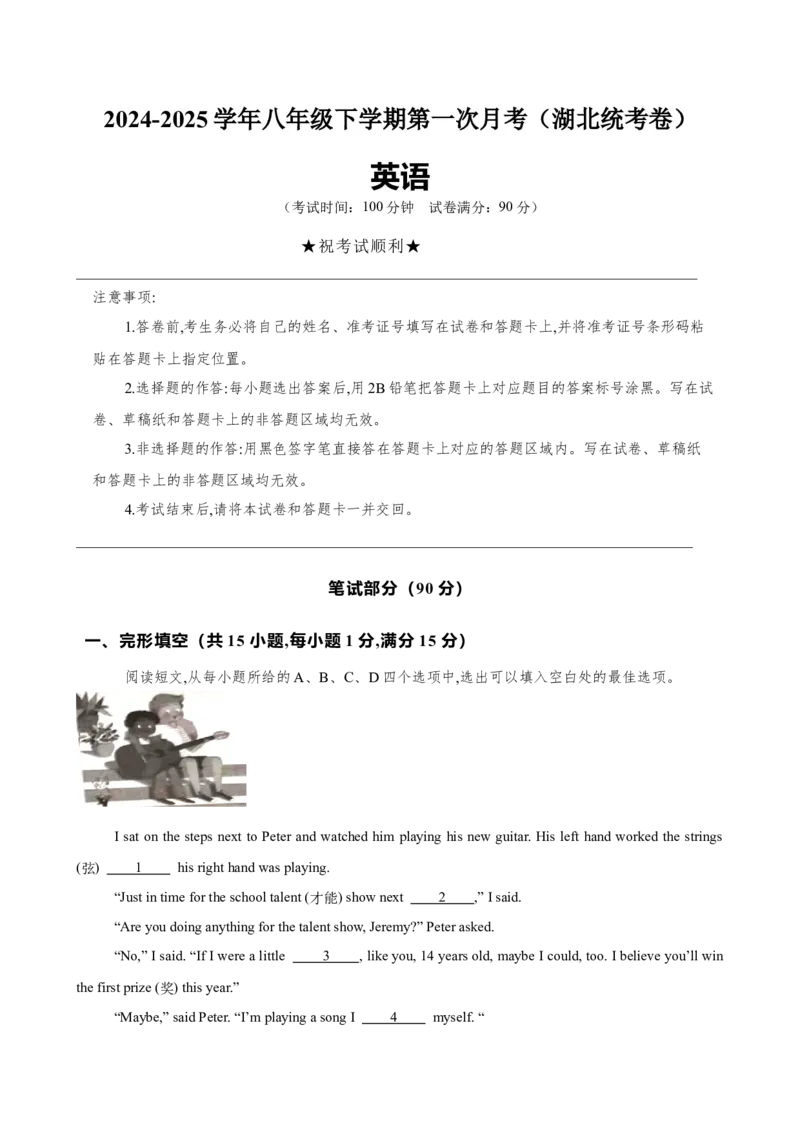
I sat on the steps next to Peter and watched him playing his new guitar. His left hand worked the strings
(弦) 1 his right hand was playing.
“Just in time for the school talent (才能) show next 2 ,” I said.
“Are you doing anything for the talent show, Jeremy?” Peter asked.
“No,” I said. “If I were a little 3 , like you, 14 years old, maybe I could, too. I believe you’ll win
the first prize (奖) this year.”
“Maybe,” said Peter. “I’m playing a song I 4 myself. ““You write your own song?”
“It’s not 5 ,” he said. “I call my song ‘Two for One’. I got the 6 easily from a two-for-
one sale (买一送一促销) at the store. And 7 like the sound of ‘Two for One’. My song goes like this,
‘Two for one, two for one, that’s the way to have some fun.’ I have not written all the words yet.”
The next morning, I saw Peter was so 8 . His right arm was broken.
“I 9 hurt when playing baseball yesterday.” he said. “Now I can’t be in the talent show next
week.”
Peter and I looked at each other worriedly. 10 I had an idea.
“We could sit 11 each other on the stage.” I said. “You could play the left hand parts, and I’ll
play with my right hand.”
Peter’s eyes were 12 and lively.
“It might work,” he said.
I sat next to him on the top step.
“Where can I put my right hand when we 13 ?”
“Put it on my shoulder,” I told him. “We’ re 14 , aren’t we?”
Our song answered that question. We finished writing the words together 15 .
“Two for one, one for two, see what two good friends can do!”
1.A.before B.while C.until D.after
2.A.week B.month C.season D.year
3.A.better B.older C.richer D.stricter
4.A.chose B.sang C.taught D.wrote
5.A.helpful B.possible C.difficult D.proper
6.A.idea B.habit C.role D.joke
7.A.You B.I C.We D.They
8.A.surprised B.frightened C.upset D.lonely
9.A.looked B.seemed C.felt D.got
10.A.Now B.Then C.Once D.First
11.A.next to B.in front of C.across from D.on the right of
12.A.calm B.peaceful C.funny D.bright
13.A.sing B.chat C.play D.rest
14.A.students B.classmates C.children D.friends15.A.happily B.safely C.suddenly D.slowly
二、阅读理解(共 20 小题,每小题 2 分,满分 40 分)
第一节(共 15 小题,每小题 2 分,满分 30 分)
阅读三篇短文,从每小题所给的A、B、C、D四个选项中,选出一个与短文内容相符的最佳选项。
A
Interesting Museums in Beijing
Besides the famous Great Wall and Tiananmen Square, what other places do you want to visit in Beijing?
How about visiting some interesting museums? Here are three of them.
China Bee Museum
Bees are very small insects (昆虫), but this museum is quite large. There are about 600
bee specimens (标本) in the museum. Do you want to know where honey comes from? Do you
want to know how honey is made? Come here, and you will find the answers to these
questions.
Beijing Diabolo (空竹) Museum
The diabolo is one of the most popular outdoor activities in Beijing. This museum has
more than 400 diabolos. If you visit this museum, you can learn about different kinds of
diabolos. You will also learn some diabolo skills.
China Watermelon Museum
This is a museum for people who love watermelons. There are a lot of watermelon
exhibitions (展览品). If you come here, you will know about different kinds of watermelons
and their differences. You will also learn how watermelons are planted and grow. Visitors can
also see a lot of paintings and other art pieces about watermelons.16.How many bee specimens are there in China Bee Museum?
A.About 400. B.About 500. C.About 600. D.About 800.
17.If you go to China Bee Museum, you can know ________.
A.where bees live B.how honey is made
C.how long bees sleep D.what bees usually eat
18.In China Watermelon Museum, we can’t see the _______ ab out watermelons.
A.poems B.exhibitions C.paintings D.art pieces
19.What can we know from the passage?
A.The three museums’phone numbers are given.
B.Visitors can learn diabolo skills in Beijing Diabolo Museum.
C.The tickets for the three museums are not expensive.
D.The diabolo is a popular outdoor activity in any place of China.
20.The purpose (目的) of the passage is to ________.
A.invite more people to learn about diabolos
B.explain why Beijing is a popular city
C.explain why people love to visit museums
D.invite more people to visit these interesting museums
B
Sally grew up in a small country in Southeast Asia. She wanted very much to explore (探索) the big world
one day. When she was in her late twenties, she got a scholarship (奖学金) to study films in England.
However, life in England was different from the films and television shows. Everything was expensive. Not
understanding the culture, she made many mistakes. With only a little English, she felt separated from others.
Finally, Sally moved to London and met different people from other parts of the world. Like her, they were still
learning English and dealing with culture shocks (文化冲击). Those made her decide to try writing real growing-
up stories in English, which moved many people who had similar situations like her. Sally was not lonely any
more.
When Sally turned 30, she believed, “It is when you start achieving your goals: the films you wanted tomake, the books you wanted to write, the places you still wanted to see.” Sally wrote more books in English and
won several awards. More people enjoyed her books, and she was invited to talk at writers’ festivals and teach in
universities. Her writing and her films had connected her to the world!
Though she was in England, her heart was deeply rooted (根植) in her hometown. After Sally gave birth to
her son at 40 in 2013. She decided to visit her hometown more often and spared no effort on film education there.
21.Sally hoped to explore the outside world because ________.
A.she was not satisfied with her life B.she wanted to be a director
C.she was interested in it D.she had a scholarship
22.After going abroad, Sally ________.
A.lived in London all the time B.met many challenges at first
C.got used to living there at once D.was regretful and went home later
23.What made Sally’s life turning point in England?
A.Learning languages. B.Meeting Londoners.C.Making films. D.Writing
stories.
24.When Sally was in her thirties, she ________.
A.became confident and successful B.made mistakes in cross-culture study
C.still felt lonely and homesick D.traveled lo many foreign countries
25.What would be the best title for the passage?
A.A Growing-up Journey B.A World-changing girl
C.Go Home or Stay Abroad D.Remember Who You Are
C
“Colour” and “color”, “favourite” and “favorite”, “neighbour” and “neighbor”… Do you wonder why
Americans spell those words without a “u”? Is it because they are lazy?
Of course not. In fact, the difference in spelling was started by Noah Webster (1758-1843). He was a
teacher who reformed (改革) English to make American identity (特征) stronger.
After the Revolutionary War (1775-1783), Webster believed that Americans shouldn’t rely on British
dictionaries anymore but have their own dictionary. So he started to make a new one.
He dropped the British “u” in some words. And he changed “centre” into “center” for children to learn
English by spelling words more like what they sounded. He used “subway” to take the place of the British word
“underground”. Some other examples are “soccer” and “football”, “fall” and “autumn”.Webster spent 28 years on the project before finishing the 70, 000-word dictionary with his American-style
spelling in 1828. He also added local words that only Americans used.
Schools across the country started to use his dictionary. Experts in languages believed it helped a new
country get unity (统一) and cultural independence at a time when most people cared about political freedom. “He
was the creator of our language and the creator of American identity,” said Joshua Kendall, who is working on a
book about Webster. “He at last brought us together through our language.”
26.Why do Americans spell some words without a “u”?
A.Because Americans are very lazy.
B.Because American English developed when people used it.
C.Because America reformed the spelling of words.
D.Because Noah Webster started the reform in spelling.
27.Which is NOT true about Webster’s dictionary?
A.It has local words in it. B.It is a 70,000-word dictionary.
C.All the words are spelled without “u”. D.Its words are in American-style spelling.
28.What does the underlined phrase “rely on” in Paragraph 3 mean?
A.依赖 B.信任 C.容忍 D.放弃
29.What do people think of Webster’s dictionary?
A.It is the only dictionary that Americans still use today.
B.It helped to bring Americans together besides its cultural independence.
C.It makes no difference to the development of American English.
D.It helped to make American English more useful than British English.
30.What’s the main idea of the passage?
A.The development of the British English.
B.American English is better than British English.
C.Noah Webster added local words to the dictionary.
D.Noah Webster wrote an American English dictionary and reformed English.
第二节(共 5 小题,每小题 2 分,满分 10 分)
阅读短文,从方框内所给的选项中选出能填入空白处的最佳选项,使短文通顺、连贯。选项中有
一项为多余选项。
Do you have any difficulties while studying? In fact, to learn with success is not a very difficult task if you
follow some basic rules. 31All problems can be solved by working hard. It makes the fool wise, the poor rich, the weak strong. 32
In learning, a hard-working fool gets more than a lazy wise.
To set our heart on one thing at a time and give up all other thoughts is also a good way. 33 For this
reason, while you are learning one subject, don’t consider learning another one in order to be successful.
Constancy (持之以恒) makes success a certain. 34 If we study day after day, there will be nothing
that can not be achieved. We should remember a worthy saying “Constant dropping of water wears away a stone.”
35 It helps to achieve your dream. The habit of keeping certain hours is of importance to successful
learning. Work while you work; play while you play. Every man will certainly become strong and wise as long as
he does so.
A.It makes a wonderful difference.
B.Besides, to be on time is another rule.
C.I hope they will help you study successfully.
D.Those who often change their subjects will never succeed.
E.On the other hand, inconstancy often results in failure (失败).
F.Learn from your mistakes instead of being afraid of making mistakes.
三、短文填空(共 10 小题,每小题 1 分,满分 10 分)
从方框中选择适当的词并其正确形式填空,每空一词。
older, shoes, stand, foot, pick, small, feel, clear, need, use
Learn to share
One day, while I was sitting in my car in a parking area, I noticed a young boy in front of my car. “What is
the boy doing?” I asked myself and looked closely. “Oh, he is 36 up a coin from the ground.” When he
37 up, we saw each other 38 . He was not 39 than ten and was wearing one blue glove and one
brown glove. His coat was too 40 for him.
As he walked away, I saw his 41 , which were too old to wear. I rolled down my window and called
him over.
I asked him if he 42 some money. He replied, “No. That’s OK.”
The parking area was wet. I could tell that his 43 were cold because he kept moving his weight from
one foot to the other. “Please,” I held out a five-dollar bill(钞票), “It’s not much, but when the money is shared, it
is much more 44 .” I said.
He took off one of his gloves and took the money from my hand. His small hand was red and cold.He smiled and went away after saying “Thank you!” to me. That smile made me 45 warm in the
cold winter.
四、读写结合(共两节,满分 25 分)
第一节任务型阅读(共 5 小题,每小题 2 分,满分 10 分)
阅读短文,用英文填空或回答问题(请注意每小题的词数要求)。
Labor (劳动) education has become more and more important in recent years. It is very close to our lives.
As students, doing housework is really helpful for us. But some people think that students only need to
study hard and should not waste time doing housework. I think this idea is wrong. Here are my reasons.
First, teachers often ask students to clean the classroom at school. This is because what the school teaches
is not only knowledge (知识), but also how to adapt to (适应) society. The same is true for the family. Doing
housework shows duty towards the family.
Second, doing housework can help us develop a hard-working spirit and help us learn some labor skills. In
the future, these will be helpful to us.
Finally, the purpose (目的) of getting knowledge is to learn the skills we will need in the future. The more
skills students have, the better they will be. No one wants to be useless in the society.
President Xi Jinping once said, “The people’s life lies in hard work, and hard work leads to prosperity (繁
荣).” The same is true for students. Labor education is also the first test for students to enter society.
46.The passage mainly talks about
. (10词以内)
47.Teachers often ask students to clean the classroom at school. This is because what the school teaches
.(15词内)
48.Doing housework can help us
. (10词以内)
49.How many reasons are there in the passage to support (支撑) the writer’s opinion? Give an example. (请先回
答问题然后列举其中的任何一种理由即可)
(15词以内)
50.What did President Xi Jinping once say?
(20词内)
第二节 书面表达(共 1 题,满分 15 分)
51.假如你是李明,本周班会上,你将代表老师用英语通知学生参加一次敬老院的公益活动。要点如下:
1. 星期天早上8:30在校门口集合,乘公共汽车前往敬老院;
2. 帮老人打扫卫生、整理房间;
3. 唱歌、跳舞、讲故事、聊天,给老人们带去快乐;
4. 给老人们赠送班级礼物;
5. 活动很有意义,希望大家积极参加;
6. 补充一至两点你对本次活动的看法。
要求: 词数70左右,开头已给出,不计入总词数。
Fellow students,
We will pay a visit to the old people’s home this Sunday. We’ll meet at the school
___________________________________________________________________________________________
___________________________________________________________________________________________
___________________________________________________________________________________________
___________________________________________________________________________________________
___________________________________________________________________________________________
___________________________________________________________________________________________
___________________________________________________________________________________________
___________________________________________________________________________________________
___________________________________________________________________________________________
___________________________________________________________________________________________
___________________________________________________________________________________________
___________________________________________________________________________________________
___________________________________________________________________________________________
___________________________________________________________________________________________
________________________________________________________《八年级湖北月考1》参考答案
题号 1 2 3 4 5 6 7 8 9 10
答案 B A B D C A B C D B
题号 11 12 13 14 15 16 17 18 19 20
答案 A D C D A C B A B D
题号 21 22 23 24 25 26 27 28 29 30
答案 C B D A A D C A B D
题号 31 32 33 34 35
答案 C A D E B
1.B 2.A 3.B 4.D 5.C 6.A 7.B 8.C 9.D
10.B 11.A 12.D 13.C 14.D 15.A
【导语】本文主要讲述了彼得不小心摔伤了自己的右臂,没法完成学校的才艺表演,作者
答应和他一起参加学校的表演,并共同完成歌曲“Two for One”。
1.句意:他左手拨弦,右手弹琴。
before在……之前;while与……同时;until直到;after在……以后。根据“His left hand
worked the strings”和“his right hand was playing”以及选项可知,应选while,表示两个动作
同时进行。故选B。
2.句意:“正好赶上下周学校的才艺表演,”我说道。
week周;month月;season季节;year年。根据下文“Now I can’t be in the talent show next
week.”可知,才艺表演在下周。故选A。
3.句意:如果我再大一点,像你一样,14岁,也许我也能。
better更好的;older更老的;richer更富有的;stricter更严格的。根据“like you, 14 years
old”和选项可知,是希望自己年龄更大点。故选B。
4.句意:我要弹一首我自己写的歌。
chose选择;sang唱;taught教;wrote写。根据下文“You write your own song?”可知,是
自己写的一首歌。故选D。
5.句意:“这并不难,”他说。
helpful有帮助的;possible可能;difficult困难的;proper适当的。根据“I got the ... easily
from a two-for-one sale at the store.”和选项可知,他认为写歌不难。故选C。
6.句意:我很容易就从店里买一送一的促销活动中得到了这个想法。
idea想法;habit习惯;role角色;joke笑话。根据前文“I’m playing a song I ... myself.”可知,
此处是指写歌的想法。故选A。
7.句意:我喜欢“二送一”的声音。You你(们);I我;We我的;They他(她/它)们。根据“ I got the ... easily from a
two-for-one saleat the store.”可知,是指我喜欢。故选B。
8.句意:第二天早上,我看到彼得很难过。
surprised惊讶的;frightened害怕的;upset难过的;lonely孤独的。根据下文“His right arm
was broken.”可知,手臂断了,因此很难过。故选C。
9.句意:“我昨天打棒球时受伤了。”他说。
looked看;seemed似乎;felt感到;got达到。根据“His right arm was broken.”可知,此处
指受伤了;get hurt“受伤”。故选D。
10.句意:然后,我有了个主意。
Now现在;Then然后;Once一次;First首先。根据“Peter and I looked at each other
worriedly”和“I had an idea”以及选项可知然后有了一个想法,应选Then,表示时间顺序。
故选B。
11.句意:我们可以在舞台上并排坐着。
next to紧邻……附近;in front of在……前面;across from在……对面;on the right of
在……右边。根据下文“You could play the left hand parts, and I’ll play with my right hand.”和
“I sat next to him on the top step.”可知,是指两人并排坐着,一人用左手,另一人用右手。
sit next to each other“并排坐、挨着坐”。故选A。
12.句意:彼得的眼睛明亮而活泼。
calm平静的;peaceful和平的;funny有趣的;bright明亮的。根据“Peter’s eyes”和选项可
知是眼睛明亮,应选bright,和lively并列。故选D。
13.句意:我们弹奏的时候我的右手放在哪里?
sing唱;chat聊天;play演奏;rest休息。根据上文“You could play the left hand parts, and
I’ll play with my right hand.”可知,是指弹奏的时候。故选C。
14.句意:我们是朋友,不是吗?
students学生;classmates同学;children孩子;friends朋友。根据下文“Two for one, one
for two, see what two good friends can do!”可知,我们是朋友。故选D。
15.句意:我们一起愉快地写完了歌词。
happily高兴地;safely安全地;suddenly突然地;slowly慢地。根据上文内容可知,想出了
办法应对下周的才艺表演,因此两人很开心。故选A。
16.C 17.B 18.A 19.B 20.D
【导语】本文主要介绍了北京的三个博物馆。16.细节理解题。根据“There are about 600 bee specimens (标本) in the museum.”可知大约
有600只蜜蜂标本在博物馆里。故选C。
17.细节理解题。根据“Do you want to know how honey is made? Come here, and you will
find the answers to these questions.”可知在中国蜜蜂博物馆可以知道蜂蜜是怎样制成的。故
选B。
18.细节理解题。根据“There are a lot of watermelon exhibitions…Visitors can also see a lot
of paintings and other art pieces about watermelons.”可知在中国西瓜博物馆可以看到展览品、
画和艺术作品。故选A。
19.细节理解题。根据“If you visit this museum, you can learn about different kinds of
diabolos. You will also learn some diabolo skills.”可知如果你参观这个博物馆,你可以了解不
同种类的空竹,还将学习一些空竹技巧。故选B。
20.主旨大意题。通读全文,可知文章主要介绍了几个博物馆的特点来吸引大家去参观这
些博物馆。故选D。
21.C 22.B 23.D 24.A 25.A
【导语】本文主要讲述了Sally的成长经历,包括她从小地方来到英国留学,遇到文化冲击,
但最终通过写作找到自己的方向,赢得了成功。
21.推理判断题。根据“Sally grew up in a small country in Southeast Asia and wanted very
much to explore the big world one day”说明Sally对探索外面的世界很感兴趣,因此她希望探
索外部世界。故选C。
22.推理判断题。根据“However, life in England was different from the films and television
shows. Everything was expensive. Not understanding the culture, she made many mistakes. With
only a little English, she felt separated from others.” Sally在国外遇到很多挑战,如不了解当地
文化、只会说一点英语等,这让她感到与他人隔阂。因此,她最初在国外遇到了很多挑战。
故选B。
23.推理判断题。根据“Those made her decide to try writing real growing-up stories in
English, which moved many people who had similar situations like her. Sally was not lonely any
more.” Sally在英国写了很多真实成长故事的书,这些书打动了和她有相似经历的人,这成
为了她生活的转折点。因此,写作故事是让她在英国生活发生转折的关键。故选D。
24.推理判断题。根据“Sally wrote more books in English and won several awards. More
people enjoyed her books, and she was invited to talk at writers’ festivals and teach inuniversities.” Sally在三十岁的时候写了更多的英文书籍,赢得了几个奖项,被邀请在作家
节上发言,并在大学教书。这显示出她在这一时期变得自信和成功。因此,选项A是正确
答案。选项B、C和D在文中并未提及。故选A。
25.最佳标题。文章主要讲述了Sally的成长经历,包括她从小地方来到英国留学,遇到文
化冲击,但最终通过写作找到自己的方向,赢得了成功。因此,最适合这篇文章的标题是
“成长之旅”,即A选项。B选项“改变世界的女孩”过于夸张,C选项“回家还是留在
国外”和D选项“记住你是谁”都与文章内容不符。故选A。
26.D 27.C 28.A 29.B 30.D
【导语】本文介绍了Noah Webster编制字典,研究美式英语,希望美式英语有自己的特点
以及他对美国的影响。
26.细节理解题。根据第二段中的“Of course not. In fact, the difference in spelling was
started by Noah Webster (1758-1843).”可知,美国人拼写那些没有“u”的单词是因为Noah
Webster开创了拼写改革。故选D。
27.细节理解题。根据第四段中的“He dropped the British ‘u’ in some words.”可知,他在一
些单词中去掉了英式的“u”,所以C项错误。故选C。
28.词句猜测题。根据“Webster believed that Americans shouldn’t rely on British
dictionaries anymore but have their own”可知,Webster认为美国人应该有自己的字典,而不
是依赖于英国的字典,所以划线部分的含义指的是“依靠,依赖”。故选A。
29.细节理解题。根据最后一段中的“Schools across the country started to use his dictionary.
Experts in languages believed it helped a new country get unity (统一) and cultural independence
at a time when most people cared about political freedom.”可知,专家认为这本字典帮助一个
新国家实现了统一和文化独立。故选B。
30.主旨大意题。通读全文可知,本文介绍了Noah Webster编制字典,研究美式英语,希
望美式英语有自己的特点以及他对美国的影响。故选D。
31.C 32.A 33.D 34.E 35.B
【导语】本文主要讲述了成功地学习并不是一件难事,并且就如何成功地学习给出一些方
法。
31.根据“In fact, to learn with success is not a very difficult task if you follow some basic
rules.”可知,此处是总的说这些基本规则,选项C“我希望它们能够帮助你成功学习。”符
合语境,故选C。32.根据“In learning, a hard-working fool gets more than a lazy wise.”可知,此处是说勤奋和
懒惰有很大不同,选项A“它带来了巨大的不同。”符合语境,故选A。
33.根据“For this reason, while you are learning one subject, don’t consider learning another
one in order to be successful.”可知,此处是说学习时不要经常换学科,选项D“那些经常改变
主题的人永远不会成功。”符合语境,故选D。
34.根据“Constancy (持之以恒) makes success a certain.”和“If we study day after day, there
will be nothing that can not be achieved.”可知,不坚持会导致失败,选项E“另一方面,不坚
持往往会导致失败。”符合语境,故选E。
35.根据“It helps to achieve your dream. The habit of keeping certain hours is of importance to
successful learning.”可知,此处是说要有时间观念,选项B“此外,准时是另一条规则。”
符合语境,故选B。
36.picking 37.stood 38.clearly 39.older 40.small 41.shoes
42.needed 43.feet 44.useful 45.feel
【导语】本文是一篇记叙文。讲述了作者亲身经历的一件小事,一个小男孩在停车场的地
上正在捡一枚硬币,天气很冷,这个孩子穿着破旧的衣服,作者给了小男孩一张5美元的
钞票,作者认为钱虽然不多,但当钱被分享后,会更有用。小男孩感激的微笑使作者在寒
冷的冬天感受到温暖。
36.句意:哦,他正在从地上捡起一枚硬币。根据“What is the boy doing?”和“is”可知,
此处应用动词的现在分词构成现在进行时态,pick的现在分词picking。故填picking。
37.句意:当他站起来时,我们清楚地看到了对方。根据语境可知,这个小男孩捡完硬币
后,站了起来。应用stand,结合语境可知,此句是一般过去时,应用stand的过去式
stood。故填stood。
38.句意:当他站起来时,我们清楚地看到了对方。此处应用副词修饰动词saw,结合语
境和选词可知,应用clear的副词clearly。故填clearly。
39.句意:他不超过十岁,戴着一只蓝色手套和一只棕色手套。根据空后的“than ten”可
知,此处说的应是年龄,因为有“than”,应用old的比较级older。故填older。
40.句意:他的外套对他来说太小了。根据“which were too old to wear”可知,这个孩子很
穷,结合语境和选词可知,此处应用small小的。故填small。
41.句意:当他走开的时候,我看到他的鞋子太旧了,穿不上了。根据选词和后面的“which were too old to wear”可推知此处应是指看到了鞋。故填shoes。
42.句意:我问他是否需要一些钱。结合语境和选词可知,此处应是“需要一些钱”,此
句是一般过去时,应用need的过去式needed。故填needed。
43.句意:停车场很湿,我可以看出他的脚很冷,因为他不停地把重心从一只脚移到另一
只脚。根据“because he kept moving his weight from one foot to the other.”可知此处应是指脚,
根据“were”可知,应用foot的复数feet。故填feet。
44.句意:虽然不多,但当钱被分享时,它会更有用。根据前面的“it is much more”可知,
此处应是much修饰形容词的比较级,结合语境和选词可知,应用use的形容词useful。故
填useful。
45.句意:那微笑让我在寒冷的冬天感到温暖。此处考查make sb do sth“让某人做某事”,
结合语境和选词可知,应用feel原形。故填feel。
46.
the reasons why doing housework is helpful for students./the importance of doing housework for
students 47.is not only knowledge, but also how to adapt to society 48.develop a hard-
working spirit and learn some labor skills 49.Three. Doing housework shows duty towards
the family./Help to develop a hard-working spirit and learn some labor skills./The more skills
students have, the better they will be. 50.The people’s life lies in hard work, and hard work
leads to prosperity.
【导语】本文讲述了劳动教育,做家务对学生的重要性。
46.根据“Labor (劳动) education has become more and more important in recent years. It is
very close to our lives.”以及“As students, doing housework is really helpful for us.”可知本文讲
述了劳动教育,做家务对学生的重要性。故填the reasons why doing housework is helpful for
students./the importance of doing housework for students。
47.根据“First, teachers often ask students to clean the classroom at school. This is because
what the school teaches is not only knowledge (知识), but also how to adapt to (适应) society.”可
知老师经常要求学生打扫学校的教室。这是因为学校教授的不仅仅是知识,更重要的是如
何适应社会。故填is not only knowledge, but also how to adapt to society。
48.根据“Second, doing housework can help us develop a hard-working spirit and help us learn
some labor skills.”可知做家务可以帮助我们培养吃苦耐劳的精神,帮助我们学习一些劳动技
能。故填develop a hard-working spirit and learn some labor skills。49.根据“First, teachers often ask students to clean the classroom at school…Doing housework
shows duty towards the family.”、“Second, doing housework can help us develop a hard-
working spirit and help us learn some labor skills.”以及“Finally, the purpose (目的) of getting
knowledge is to learn the skills we will need in the future…The more skills students have, the
better they will be.”可知本文介绍了做家务体现了对家庭的责任;做家务可以帮助我们培养
吃苦耐劳的精神,帮助我们学习一些劳动技能;获取知识的目的是学习我们将来需要的技
能,学生拥有的技能越多,他们就会越好。总共三点原因。故填Three. Doing housework
shows duty towards the family./Help to develop a hard-working spirit and learn some labor
skills./The more skills students have, the better they will be.
50.根据“President Xi Jinping once said, ‘The people’s life lies in hard work, and hard work
leads to prosperity (繁荣).’”可知,曾说:“人民的生活在于勤劳,勤劳致富。”,故填The
people’s life lies in hard work, and hard work leads to prosperity.
51.例文
Fellow students,
We will pay a visit to the old people’s home this Sunday. We’ll meet at the school gate at 8:30
on Sunday morning and then go there by bus. There we will do some cleaning and tidy the rooms.
After that we will have many activities, such as singing, dancing, telling stories and chatting to
cheer up the old. Before we leave, we’ll give our presents to them.
I hope all of us can take an active part. Through the meaningful activity, we can learn to care
for the old.
【详解】[总体分析]
①题材:本文是一篇应用文,为通知;
②时态:时态为“一般将来时”;
③提示:写作要点已给出,考生注意不要遗漏要点,并注意适当添加细节,突出写作要点。
[写作步骤]
第一步,介绍出行安排,包括交通工具,时间安排等;
第二步,介绍活动安排;
第三步,号召希望全体学生积极参加活动。
亮点词汇]
①pay a visit to拜访
②do some cleaning打扫[高分句型]
①Before we leave, we’ll give our presents to them.(before引导时间状语从句)
②I hope all of us can take an active part.(省略that的宾语从句)