2025-2026 学年八年级下学期第一次月考(山东济南卷)
英语试题
本试题共分为四部分, 满分为150分, 考试用时120分钟。
答题前, 请考生务必将自己的姓名、座号和准考证号填写在答题卡上, 并同时将考点、姓名、
准考证号和座号填写在试卷规定的位置。
答题时, 选择题部分每小题选出答案后, 用2B铅笔把答题卡上对应题目的答案标号涂黑; 如
需改动, 用橡皮擦干净后, 再选涂其他答案标号。非选择题部分, 用0.5毫米黑色签字笔在答
题卡上题号所提示的答题区域作答。直接在试题上作答无效。
考试结束后, 将本试题和答题卡一并交回。
第一部分 听力(共四节, 满分30分)
第一节听录音, 从每组句子中选出一个你所听到的句子。每个句子听一遍。(共5小题, 每
小題1.5分, 满分 7.5分)
1.
A.What are you busy doing? B.What’s wrong with you? C.What did you do yesterday?
2.
A.I used to live here with my parents.
B.I’d like to volunteer there on weekends.
C.I went home as soon as I finished homework.
3.
A.It’s time to clean up your room. B.You could call them up C.They are going to set up a group.
4.
A.These tools are useful.
B.They should know the idea of fairness.
C.Life is full of stress.
5.
A.She lived alone in a small house.
B.It must be an interesting place.
C.She likes to listen to traditional music.
第二节在录音中, 你将听到五段对话, 每段对话后有一个小题, 从每小题A、B、C中选出能回答所给问题的正确答案。每段对话听两遍。(共5小题, 每小题1.5分, 满分7.5分)
6.What’s wrong with Jack?
A.He has a fever. B.He has a headache. C.He has a toothache.
7.How went to the food bank with Ted?
A.His mother B.His father C.His classmate.
8.When does the girl have to come back home?
A.Before 6:00. B.Before 8:30. C.Before 9:30.
9.Where are they going to volunteer?
A.At school B.At the Old people’s home C.At the Children’s home
10.Do many Americans take interest in the Monkey King?
A.Yes, they do. B.No, they don’t. C.We don’t know.
第三节在录音中, 你将听到一段对话, 对话后有五个小题, 从每小题A、B、C中选出能回答
所给问题的正确答案。听对话前, 你将有40秒钟的读题时间; 听完后, 你将有40秒钟的答题
时间。对话听两遍。(共5小题, 每小题1.5分, 满分7.5分)
11.What’s Lily doing?
A.She is doing her homework. B.She is reading a book. C.She is helping her mother with housework.
12.What’s the name of the book Lily reads?
A.Harry Potter. B.Peter’s Mom. C.Peter and Mom.
13.What does Lily think of the book?
A.Terrible. B.Wonderful. C.Boring.
14.What’s Lily’s father doing?
A.He is washing the clothes. B.He is making dumplings. C.He is cleaning the house.
15.Does Lily like dumplings?
A.Yes, she does. B.No, she doesn’t. C.We don’t know.
第四节在录音中, 你将听到一篇短文, 短文后有五个小题, 从每小题A、B、C中选出能回答
所给问题的正确答案。听短文前, 你将有 40 秒钟的读题时间; 听完后, 你将有40 秒钟的答
题时间。短文听两遍。(共5小题, 每小题 1.5分, 满分 7.5分)
16.How old is Tom?
A.9. B.10. C.11.
17.What subject does Tom think he is good at?A.Chinese. B.Science. C.Math.
18.How did Tom feel when he got home?
A.He felt angry. B.He felt hungry. C.He felt tired.
19.Where were the two bananas?
A.In the bowl. B.On the plate. C.In the box.
20.Who will eat the second banana?
A.Tom. B.Tom’s mother. C.Tom’s father.
第二部分 阅读(共两节, 满分50分)
第一节 阅读理解 阅读下列短文, 从每题A、B、C、D四个选项中, 选出一个能回答所提问
题或完成所给句子的最佳答案。(共20小题, 每小题2分, 满分40分)
A
Relax & Have Fun!
Do you feel tired after a long week of study? Come and join our weekend activities! We have two great
choices for you to relax and learn something new.
A Chinese Calligraphy Class A Fun Hiking Trip
What you will do: What you will do:
· Learn about the history of Chinese calligraphy. · Meet at the school gate at 8 am.
· Practice writing basic strokes (笔画). · Walk along the beautiful forest path.
· Write a simple Chinese character with a brush, ink
· Enjoy the fresh air and bird songs.
and paper.
· Have a picnic lunch at the top of the
· Take your work home as a gift.
hill.
Time: 9:00 am—11:00 am on Saturday Time: 8:00 am—3:00 pm on Sunday
Place: The Art Room Place: Green Hill Park
Teacher: Ms. Wang (She is great at helping Guide: Mr. Li (A very experienced
beginners!) hiker)
21.What do students need for the calligraphy class?
a. A brush. b. Ink. c. A ball. d. Paper.
A.a, b, c B.a, b, d C.b, c, d D.a, c, d
22.If Tom wants to relax in the park on Sunday, who can he go with?A.Ms. Wang. B.His art teacher. C.Mr. Li. D.His classmates only.
23.How long does the hiking trip last?
A.For 2 hours. B.For 5 hours. C.For 7 hours. D.For 8 hours.
24.Which of the following is TRUE according to the text?
A.Students will hike in a forest on Saturday.
B.Students can learn to write characters in the calligraphy class.
C.The hiking trip starts in the afternoon.
D.Ms. Wang will guide the hiking trip.
25.Where can we probably see this text?
A.In a storybook. B.In a school notice. C.In a diary. D.In a dictionary.
B
Emma is a 14-year-old girl who loves the water. Her favorite hobby is ice-skating. However, her road to
becoming a good skater was not easy. When she first stepped onto the ice at the age of seven, she was so scared
that she held the side tightly and refused to let go.
“I was full of fear,” Emma remembers. “I thought I would fall at any time. I wanted to give up many
times.” But her instructor, Mrs. Smith, was very patient and strict. She always told Emma, “The first step is
always the hardest. Don’t be scared. Just try to push yourself a little every day. You can manage it.”
Following Mrs. Smith’s advice, Emma didn’t give up. She practiced for hours, falling down and getting up
again. It was laborious work. Slowly, she got over her fear. By the age of ten, she could skate beautifully and even
do some simple turns.
Last month, Emma took part in a city-wide skating competition. Although she didn’t win the first prize, she
performed perfectly without falling once. She felt a great sense of achievement. “I didn’t win, but I overcame my
biggest fear,” Emma said with a bright smile. “Ice-skating teaches me that if you work hard, you can get over any
difficulty. It’s not just a sport; it’s an inspiration.”
26.What was Emma’s biggest problem when she first started ice-skating?
A.She didn’t have a good instructor. B.She was scared and afraid of falling.
C.Her parents didn’t allow her to skate. D.She thought it was boring.
27.What does the underlined word “laborious” in paragraph 3 probably mean?
A.Easy and relaxing. B.Interesting and exciting.
C.Needing a lot of effort. D.Quick and fast.28.What happened at the city-wide competition?
A.Emma won the first prize. B.Emma fell down many times.
C.Emma did a great job without falling. D.Emma gave up halfway.
29.Which word can best describe Emma according to the text?
A.Shy. B.Patient. C.Weak. D.Strong-minded.
30.What can we learn from Emma’s story?
A.It’s easy to learn ice-skating. B.Good instructors are the most important.
C.We should face our fears and never give up. D.Winning is everything in a competition.
C
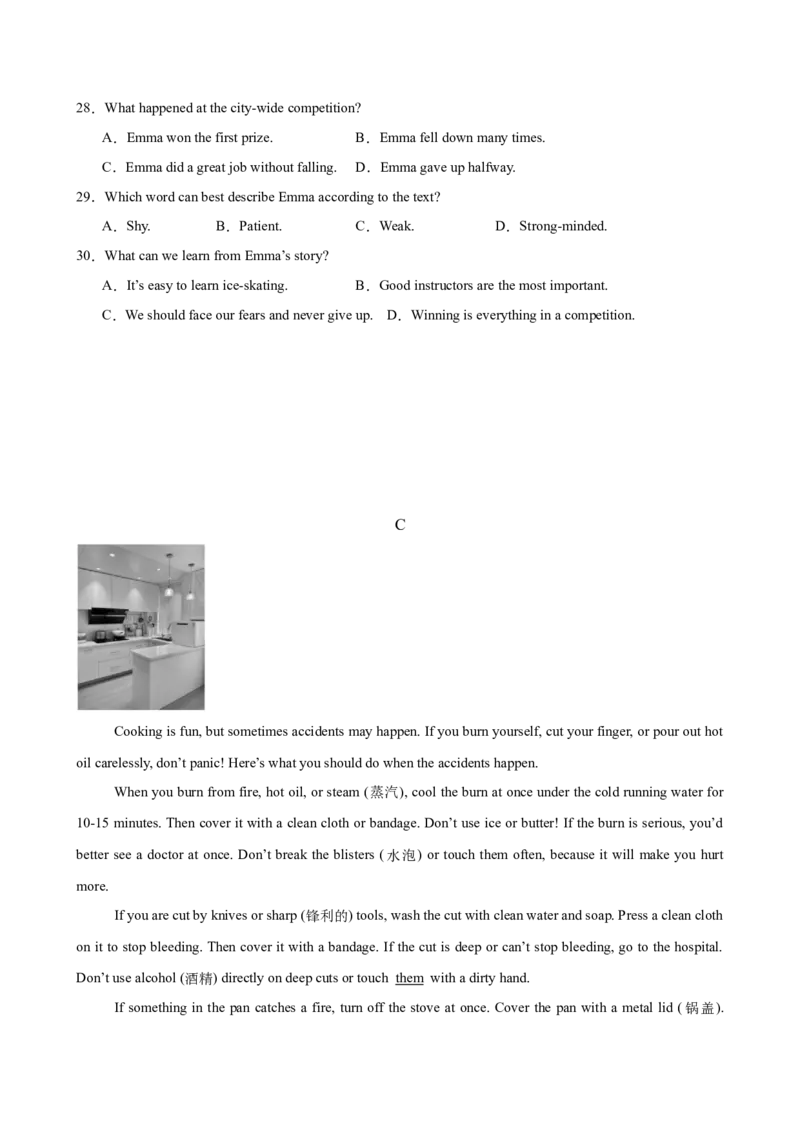
Cooking is fun, but sometimes accidents may happen. If you burn yourself, cut your finger, or pour out hot
oil carelessly, don’t panic! Here’s what you should do when the accidents happen.
When you burn from fire, hot oil, or steam (蒸汽), cool the burn at once under the cold running water for
10-15 minutes. Then cover it with a clean cloth or bandage. Don’t use ice or butter! If the burn is serious, you’d
better see a doctor at once. Don’t break the blisters (水泡) or touch them often, because it will make you hurt
more.
If you are cut by knives or sharp (锋利的) tools, wash the cut with clean water and soap. Press a clean cloth
on it to stop bleeding. Then cover it with a bandage. If the cut is deep or can’t stop bleeding, go to the hospital.
Don’t use alcohol (酒精) directly on deep cuts or touch them with a dirty hand.
If something in the pan catches a fire, turn off the stove at once. Cover the pan with a metal lid (锅盖).When there is no oxygen, the fire will die soon. If the fire becomes bigger or covers other things, leave the kitchen
and call 119 as soon as possible. Do remember, don’t pour water on an oil fire or try to carry a burning pan
outside.
To stay away from cooking accidents, we must always be careful when using knives or fire. Most cooking
accidents are small if we treat them in a right way. Knowing these tips will help us stay safe in the kitchen!
31.What should you do first if you burn yourself from a fire?
A.Go to see a doctor at once.
B.Break the blisters at once.
C.Cool the burn under the cold water.
D.Cover it with a clean cloth or bandage.
32.What does the underlined word “them” refer to?
A.Cuts. B.Knives. C.Hands. D.Sharp tools.
33.What can stop the burning pan?
①Water. ②Oxygen. ③Firefighters. ④A metal lid. ⑤Turning off the stove.
A.①③⑤ B.③④⑤ C.①④⑤ D.②③④
34.What would be the best structure of the passage?
A.①②③④/⑤ B.①/②③④/⑤ C.①/②③/④⑤ D.①/②③④⑤
35.What is the passage mainly about?
A.How to cook delicious food.
B.How to keep safe in the kitchen.
C.How to have a healthy lifestyle.
D.How to deal with the accidents in the kitchen.
D
Many students stay up late to study, especially before exams. They think sacrificing sleep will help them
remember more information, but science tells a different story. A study by the University of California tracked 500
middle school students for a year, comparing their sleep habits with their test scores. The results were clear:
students who slept 7-9 hours nightly scored 20% higher on average than those who slept less than 6 hours.
Why is sleep so important? During deep sleep, the brain reviews and stores information from the day,
turning short-term memories into long-term ones. This process is like filing papers—without it, your brain
becomes too cluttered to find what it needs. Students who pull all-nighters might cram facts temporarily, but mostwill forget them within days.
Lack of sleep also affects mood and focus. Teachers often report that sleep-deprived students are more
irritable, struggle to sit still, and miss important instructions. “I used to stay up until 2 a.m. studying,” said 14-
year-old Jason. “But then I’d zone out in class and have to ask friends for notes. Now I go to bed at 10 p.m., and I
get more done in less time.”
Our school library has plenty of books on sleep science, including Teens and Sleep by Dr. Maria Gomez. It
explains how screens disrupt sleep hormones, why regular bedtimes matter, and simple relaxation techniques. The
school nurse also offers “sleep workshops” every month, teaching students to create a bedtime routine: no phones
an hour before bed, reading a physical book, or listening to calm music.
“Sleep isn’t a waste of time,” the nurse told a group of students last week. “It’s the best study tool you have.
Your brain works harder while you sleep than you think!”
36.What did the University of California study find?
A.Students who sleep less score higher. B.Students who slept 7-9 hours scored about 20% higher than
those who slept less than 6 hours.
C.500 students failed their exams. D.Studying at night improves focus.
37.Why is deep sleep compared to “filing papers”?
A.It organizes and stores memories. B.It cleans the brain of useless information.
C.It helps students write better essays. D.It makes room for new facts.
38.How did Jason’s study efficiency change after adjusting his sleep?
A.He scored 20% lower than before. B.He had to ask friends for notes.
C.He became more efficient in studying. D.He forgot information faster.
39.What does Dr. Gomez’s book explain?
A.How to study all night effectively. B.Why screens affect sleep quality.
C.Ways to stay awake during classes. D.How to memorize facts quickly.
40.What is the main message of the passage?
A.All students need 9 hours of sleep nightly. B.Sleep is more important than studying.
C.Good sleep improves learning and health. D.Schools should ban late-night studying.
第二节 阅读理解七选五 (共5小题, 每小题2分, 满分10分)
根据短文内容,从短文后的选项中选出能填入空白处的最佳选项,选项中有两项为多余选项。
Stomach flu is one of the most common illnesses. 41 So you’ll soon catch it if someone around youhas it.
Stomach flu is caused by a virus. Because of that, there’s no medicine to make it go away. 42
It is helpful to wash your hands often with soap under running water. The virus that causes stomach flu is
hard to kill. 43 Mix disinfectant (消毒剂) with water, and use that to clean the rooms. If someone in your
family gets the stomach flu, remember to clean the things he or she touched.
If you do get the stomach flu, drink as much water as possible. 44 But when you feel ready to eat, try
bananas, rice or bread.
When you’re feeling better, don’t return to work or school right away. 45 If you have a fever, wait at
least 24 hours after it ends before going out. This will help protect (保护) other people from getting sick.
Stomach flu is terrible, but if you follow the advice, you can help stop it from spreading (传播).
A.It spreads very easily.
B.It can’t kill viruses very well.
C.You probably won’t want to eat much.
D.So cleaning your house is also important.
E.That’s because they keep the water hotter.
F.But there are some things you can do to avoid (避免) catching it.
G.You can still spread the illness for a few days after you feel better.
第三部分 语言运用(共两节, 满分35分)
第一节 补全对话(共5小题, 每小题1分, 满分5分)
阅读对话,从每题 A、B、C、D 四个选项中, 选出一个最佳答案完成对话。
A: Hi, Mark. How’s it going?
B: Hi, John. Everything goes well.
A: I’m going to run.
B: Are you sure? But it’s windy outside.
A: Because I really love running.
B: You are great!
A: 5 kilometers.
B: You must be very tired each time.
A: Well, when it becomes a habit, it is easy for me.
B: I agree.A: Yes. I’m in a running club, and we often run together. Would you like to join us?
B: But I’m afraid it’s too difficult for me.
A: Don’t worry. Rome isn’t built in one day.
46.A.Where are you living? B.When are you going? C.What are you going to do? D.How’s the
weather?
47.A.I don’t mind it.B.I can’t stand it. C.I like the rain. D.I have no idea.
48.A.Where do you often run? B.How often do you run? C.How far do you usually run? D.How
many hours do you run?
49.A.When do you exercise? B.Do you have breakfast? C.What time do you run? D.Do you run
with others?
50.A.I’m afraid not. B.I’d love to. C.I’m not free. D.No, thanks.
第二节 完形填空
阅读短文, 从每题A、B、C、D四个选项中, 选出一个能填入文章中相应空白处的最佳
答案。(共 15 小题, 每小题 1 分, 满分 15 分)
On January 25, 2026, Alex Honnold climbed Taipei 101 without any safety ropes or equipment. Taipei 101
is a 508-meter-tall 51 and one of the most famous skyscrapers in the world. It took him 91 52
to get to the top. As the first person to finish this 53 climb, he has become a new legend in extreme
sports around the world.
Alex was born in California, America, in 1985. He loved outdoor 54 when he was very young.
He started climbing at the age of five and soon 55 in love with this exciting sport. As a teenager, he
practiced 56 in local clubs every day. He kept improving his 57 skills and never gave up,even when he faced difficulties.
Alex is 58 for free solo climbing, which means climbing without any 59 tools. In
2017, he made 60 by climbing El Capitan alone. Later, his story was made into a great documentary
called Free Solo, which 61 an Oscar and encouraged many people.
After reaching the top of Taipei 101, Alex told reporters that 62 the wind was strong and he felt
tired, the view was amazing. He said he loved climbing not for 63 , but for the challenge and the joy of
pushing 64 . He also told us that if we work hard, stay focused and never give up, we can make our
65 dreams come true.
51.A.bridge B.building C.palace D.mountain
52.A.minutes B.hours C.days D.weeks
53.A.boring B.relaxing C.annoying D.challenging
54.A.shows B.lessons C.activities D.tasks
55.A.brought B.took C.fell D.got
56.A.hard B.fast C.early D.simply
57.A.swimming B.climbing C.chatting D.programming
58.A.convenient B.meaningful C.famous D.normal
59.A.expensive B.protective C.creative D.positive
60.A.history B.money C.news D.mistakes
61.A.bought B.won C.left D.chose
62.A.if B.unless C.although D.however
63.A.purpose B.spirit C.respect D.fame
64.A.herself B.himself C.myself D.yourself
65.A.comfortable B.available C.impossible D.reasonable
第三节 阅读填空 (共10小题, 每小题1.5分, 满分15分)
阅读下面短文,在空白处填入一个适当的单词或括号内单词的正确形式。
In China, schools usually have 66 10-minute break between classes. Sometimes, students can’t
go outside for safety. That’s to say, they might not get enough outdoor time. But this autumn, some cities are
changing that.
Beijing, Tianjin and Qingdao make breaks 5 minutes 67 (long) than before to help students get
more exercise and fresh air. In Beijing, this hasn’t changed the school day much for younger kids, but middleschool students finish a bit later.
A school in Qingdao has cool ideas for these longer breaks. It organize many 68 (activity) for
students during breaks. Schools introduce several games to make the breaks more 69 (colour). Some
students like quiet activities. For 70 (they), there are books and board games (棋盘游戏). These games
are easy 71 (start) and finish in 15 minutes, and they help students relax and get ready 72 the
next class.
This change is good for students 73 it makes their school days more fun and healthier. Now, they
can have more active breaks and feel better when they go back 74 (study). It’s a nice way for schools to
75 (real) care about students’ well-being and make the school a better place.
第四部分 书面表达(共两节, 满分 35 分)
第一节 情境运用 (共5小题, 每小题2分, 满分 10 分)
根据所提供的图片,用一个完整的句子提问或应答。
76. —What’s the matter with you?
—
77. —What should I do to relax?
—
78. —Why don’t you have any free time to do what you like?
—79. —What’s your sister doing?
—
80. —What can he do at the city park?
—
第二节 写作(25分)
81.请以“How to Stay Healthy”为题,用英语写一篇短文,谈谈你认为保持健康的重要方法(至少三个方
面),并给出建议。要求:
1. 根据所给题目,写一篇短文,词数不少于80;
2. 语言流畅、书写规范、卷面整洁;
3. 文中不得使用真实姓名、校名,否则以零分计;
4. 请将短文写在答题卡上,写在本试卷上无效。
___________________________________________________________________________________________
___________________________________________________________________________________________
___________________________________________________________________________________________
___________________________________________________________________________________________
___________________________________________________________________________________________
_________________________________________________________________