高考英语语法词汇专项突破:01 表解情态动词八大要点+巩固练习+答案
【要点速览】
一、can和could,be able to 二、may和 might
三、must和have to 四、shall和should
五、will和would, used to 六、need和dare
七、ought to的用法: 八、“情态动词+have done”用法
附:情态动词精题精析
【表解情态动词重难点】
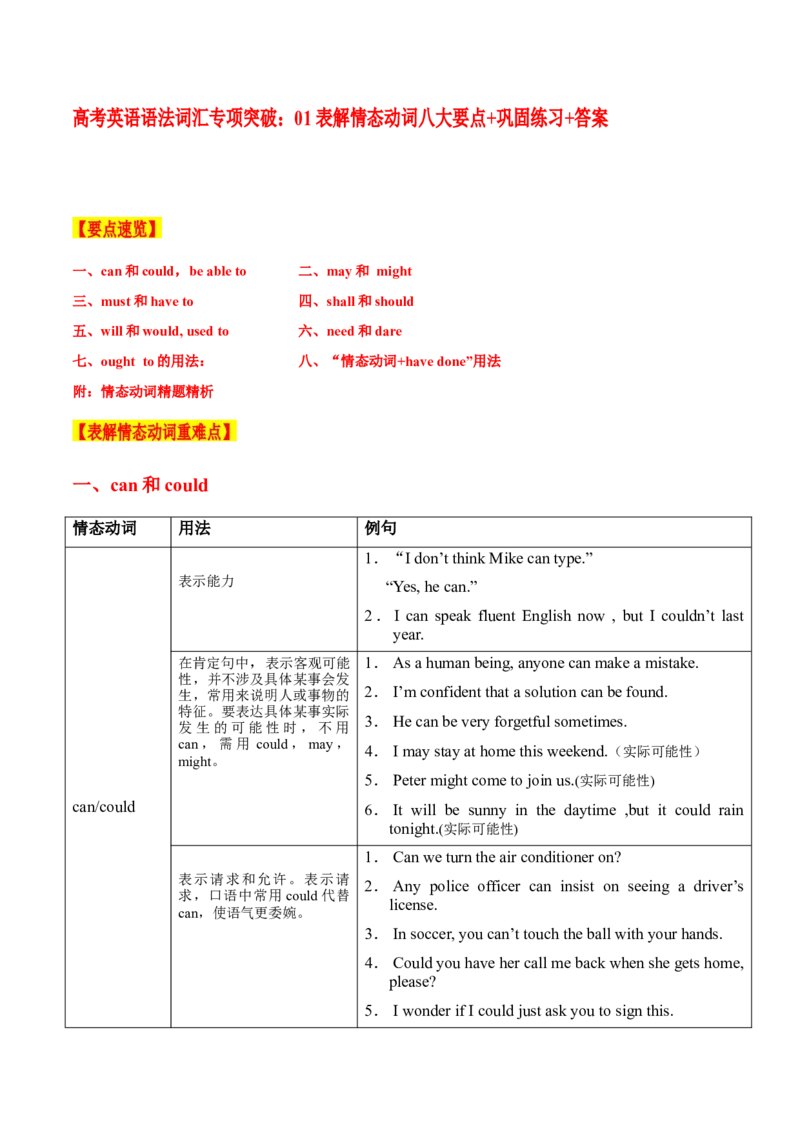
一、can和could
情态动词 用法 例句
1.“I don’t think Mike can type.”
表示能力
“Yes, he can.”
2.I can speak fluent English now , but I couldn’t last
year.
在肯定句中,表示客观可能 1.As a human being, anyone can make a mistake.
性,并不涉及具体某事会发
生,常用来说明人或事物的 2.I’m confident that a solution can be found.
特征。要表达具体某事实际
3.He can be very forgetful sometimes.
发生的可能性时,不用
can,需用 could,may,
4.I may stay at home this weekend.(实际可能性)
might。
5.Peter might come to join us.(实际可能性)
can/could 6.It will be sunny in the daytime ,but it could rain
tonight.(实际可能性)
1.Can we turn the air conditioner on?
表示请求和允许。表示请
2.Any police officer can insist on seeing a driver’s
求,口语中常用could代替
license.
can,使语气更委婉。
3.In soccer, you can’t touch the ball with your hands.
4.Could you have her call me back when she gets home,
please?
5.I wonder if I could just ask you to sign this.表示对现在的动作或状态进 1.It can’t be easy caring for a man and a child who are
行主观的猜测,主要用在否 not your own.
定句和疑问句中。
2.Can the man over there be our head master?
表示惊异、怀疑、不相信等 1.Can this be an excuse for not giving them help?
态度,主要用在否定句、疑
问句和感叹句中。 2.This can’t be true.
3.How can you be so crazy.
特别说明:
(1) could用来表示请求时,语气委婉,主要用于疑问句,不能用于肯定句,答语应用 can(即:could
不能用于现在时态的简略答语中)。如:
——Could I use your dictionary?
——Yes, you can.(否定回答可用:No, I’m afraid not.)
(2) can和be able to辨析
can(could)和be able to都可以表示能力,意思上没有区别。但 can只有现在式和过去式,而be able
to则有更多的形式。如:
I’ve always wanted to able to speak fluent English.
Those bags look really heavy, are you sure you’ll be able to carry them on your own?
但是,表示在过去某时的某一场合经过一番努力,终于做成了某事,通常不用 could,而用was/
were able to来表示。这时,was/were able to相当于managed to do或succeed in doing。如:
After the accident it was a long time before she was able to walk again.
The fire was very big, but most people were able to escape from the building.
(3) 惯用形式“cannot …too…”表示“无论怎么……也不(过分)”。如:
You cannot be too careful.你越小心越好。
惯用形式“cannot but+ 不定式(不带to)”表示“不得不,只好”。如:
I cannot but admire her determination.我不得不钦佩你的决心。
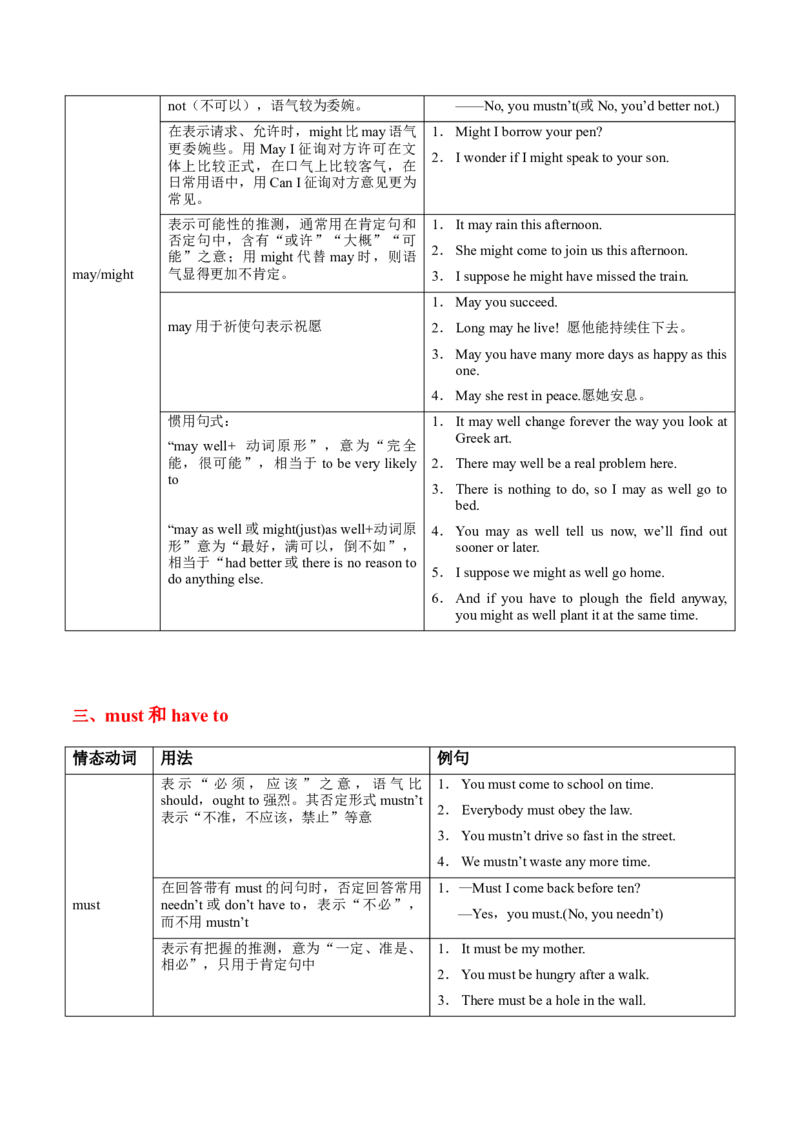
二、may和 might
情态动词 用法 例句
表示允许、许可。否定回答一般用must 1.May I come in and wait?
not/mustn’t,表示“禁止、阻止”之意,
2.——May I smoke here?
但也可以用had better not (最好别)或maynot(不可以),语气较为委婉。 ——No, you mustn’t(或No, you’d better not.)
在表示请求、允许时,might比may语气 1.Might I borrow your pen?
更委婉些。用May I征询对方许可在文
2.I wonder if I might speak to your son.
体上比较正式,在口气上比较客气,在
日常用语中,用Can I征询对方意见更为
常见。
表示可能性的推测,通常用在肯定句和 1.It may rain this afternoon.
否定句中,含有“或许”“大概”“可
2.She might come to join us this afternoon.
能”之意;用might代替may时,则语
may/might 气显得更加不肯定。 3.I suppose he might have missed the train.
1.May you succeed.
may用于祈使句表示祝愿 2.Long may he live! 愿他能持续住下去。
3.May you have many more days as happy as this
one.
4.May she rest in peace.愿她安息。
惯用句式: 1.It may well change forever the way you look at
Greek art.
“may well+ 动词原形”,意为“完全
能,很可能”,相当于 to be very likely 2.There may well be a real problem here.
to
3.There is nothing to do, so I may as well go to
bed.
“may as well或might(just)as well+动词原 4.You may as well tell us now, we’ll find out
形”意为“最好,满可以,倒不如”, sooner or later.
相当于“had better或there is no reason to
5.I suppose we might as well go home.
do anything else.
6.And if you have to plough the field anyway,
you might as well plant it at the same time.
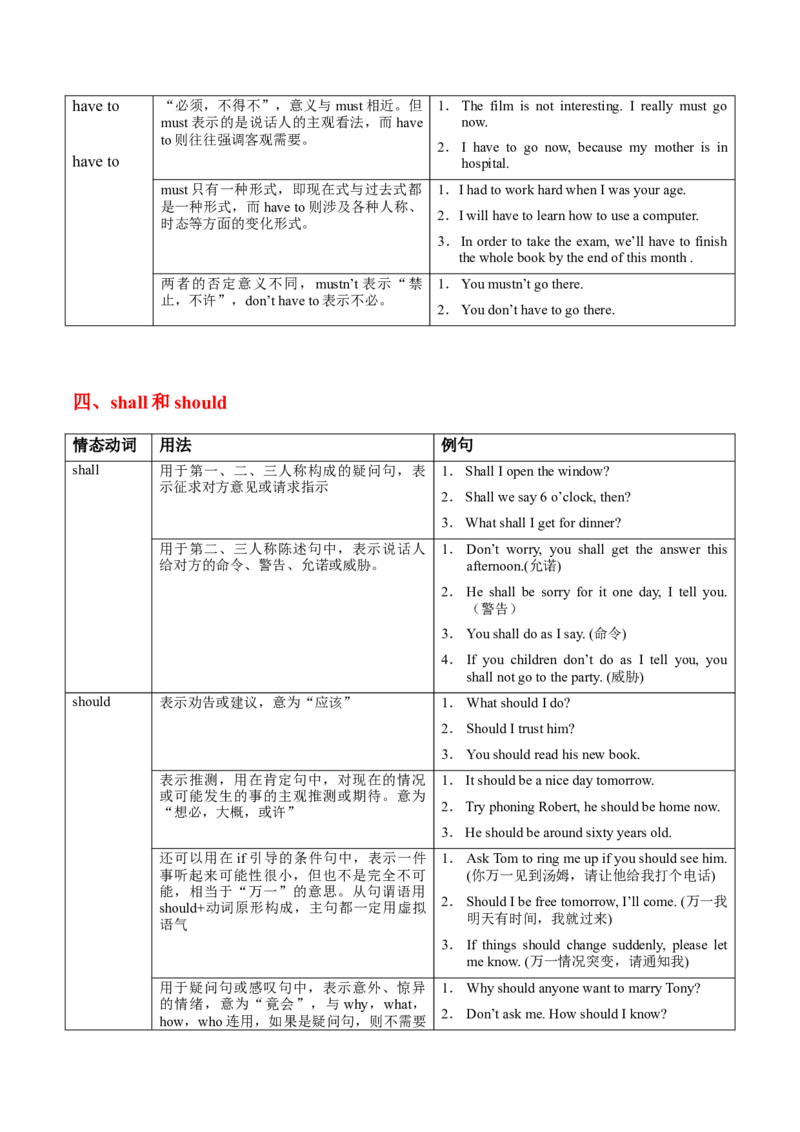
三、must和have to
情态动词 用法 例句
表示“必须,应该”之意,语气比 1.You must come to school on time.
should,ought to强烈。其否定形式mustn’t
2.Everybody must obey the law.
表示“不准,不应该,禁止”等意
3.You mustn’t drive so fast in the street.
4.We mustn’t waste any more time.
在回答带有must的问句时,否定回答常用 1.—Must I come back before ten?
must needn’t或don’t have to,表示“不必”,
—Yes,you must.(No, you needn’t)
而不用mustn’t
表示有把握的推测,意为“一定、准是、 1.It must be my mother.
相必”,只用于肯定句中
2.You must be hungry after a walk.
3.There must be a hole in the wall.have to “必须,不得不”,意义与must相近。但 1.The film is not interesting. I really must go
must表示的是说话人的主观看法,而have now.
to则往往强调客观需要。
2.I have to go now, because my mother is in
have to hospital.
must只有一种形式,即现在式与过去式都 1.I had to work hard when I was your age.
是一种形式,而have to则涉及各种人称、
2.I will have to learn how to use a computer.
时态等方面的变化形式。
3.In order to take the exam, we’ll have to finish
the whole book by the end of this month .
两者的否定意义不同,mustn’t 表示“禁 1.You mustn’t go there.
止,不许”,don’t have to表示不必。
2.You don’t have to go there.
四、shall和should
情态动词 用法 例句
shall 用于第一、二、三人称构成的疑问句,表 1.Shall I open the window?
示征求对方意见或请求指示
2.Shall we say 6 o’clock, then?
3.What shall I get for dinner?
用于第二、三人称陈述句中,表示说话人 1.Don’t worry, you shall get the answer this
给对方的命令、警告、允诺或威胁。 afternoon.(允诺)
2.He shall be sorry for it one day, I tell you.
(警告)
3.You shall do as I say. (命令)
4.If you children don’t do as I tell you, you
shall not go to the party. (威胁)
should 表示劝告或建议,意为“应该” 1.What should I do?
2.Should I trust him?
3.You should read his new book.
表示推测,用在肯定句中,对现在的情况 1.It should be a nice day tomorrow.
或可能发生的事的主观推测或期待。意为
2.Try phoning Robert, he should be home now.
“想必,大概,或许”
3.He should be around sixty years old.
还可以用在if引导的条件句中,表示一件 1.Ask Tom to ring me up if you should see him.
事听起来可能性很小,但也不是完全不可 (你万一见到汤姆,请让他给我打个电话)
能,相当于“万一”的意思。从句谓语用
2.Should I be free tomorrow, I’ll come. (万一我
should+动词原形构成,主句都一定用虚拟
明天有时间,我就过来)
语气
3.If things should change suddenly, please let
me know. (万一情况突变,请通知我)
用于疑问句或感叹句中,表示意外、惊异 1.Why should anyone want to marry Tony?
的情绪,意为“竟会”,与 why,what,
2.Don’t ask me. How should I know?
how,who连用,如果是疑问句,则不需要回答。
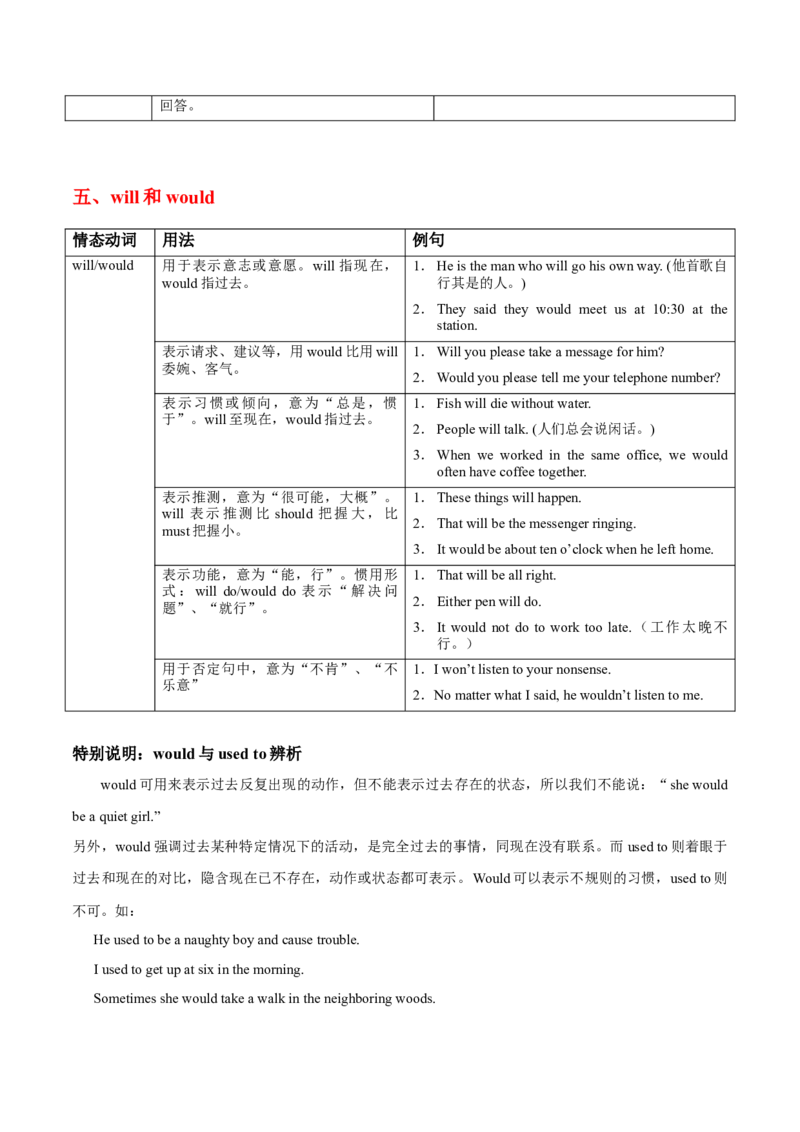
五、will和would
情态动词 用法 例句
will/would 用于表示意志或意愿。will指现在, 1.He is the man who will go his own way. (他首歌自
would指过去。 行其是的人。)
2.They said they would meet us at 10:30 at the
station.
表示请求、建议等,用would比用will 1.Will you please take a message for him?
委婉、客气。
2.Would you please tell me your telephone number?
表示习惯或倾向,意为“总是,惯 1.Fish will die without water.
于”。will至现在,would指过去。
2.People will talk. (人们总会说闲话。)
3.When we worked in the same office, we would
often have coffee together.
表示推测,意为“很可能,大概”。 1.These things will happen.
will 表示推测比 should 把握大,比
2.That will be the messenger ringing.
must把握小。
3.It would be about ten o’clock when he left home.
表示功能,意为“能,行”。惯用形 1.That will be all right.
式:will do/would do 表示“解决问
2.Either pen will do.
题”、“就行”。
3.It would not do to work too late.(工作太晚不
行。)
用于否定句中,意为“不肯”、“不 1.I won’t listen to your nonsense.
乐意”
2.No matter what I said, he wouldn’t listen to me.
特别说明:would与used to辨析
would可用来表示过去反复出现的动作,但不能表示过去存在的状态,所以我们不能说:“she would
be a quiet girl.”
另外,would强调过去某种特定情况下的活动,是完全过去的事情,同现在没有联系。而used to则着眼于
过去和现在的对比,隐含现在已不存在,动作或状态都可表示。Would可以表示不规则的习惯,used to则
不可。如:
He used to be a naughty boy and cause trouble.
I used to get up at six in the morning.
Sometimes she would take a walk in the neighboring woods.In those days, whenever I had difficulties, I would go to Mr. Chen for help.
六、need和dare
情态动词 用法 例句
用于表示“需要,必要”之意。做情态 1.—Need we leave soon?
动词时,仅用于否定句和疑问句,只有
—Yes, you must.(No, you needn't)
现在时,过去式要用needn't have,疑问
式用 need+人称?,否定式用 need not(即 2.You needn't have hurried.
needn't),
(=It was not necessary for you to hurry,but you
did).你当时不必这么匆忙。
做实义动词时,其变化与一般的实义动 1. A job like nursing needs patience and
词相同,后接带to的不定式(need understanding.(need+ 名 词 , need
doing = need to be done ),过去式用 understanding=need to be understood,需要被理
need needed、did you need?和didn't need,肯定 解)
式用needs/needed/need,疑问式用do、
2.He needs to see a doctor.(need to do)
does、did提问,否定式要在前面加
don't、doesn't、didn't 3.Do you still need volunteers to help clean up after
the party?(need somebody to do something)
4.They didn't need to start so early.(do not need to
do)
dare 用于表示“敢于”之意。做情态动词, 1.—Dare you tell her the truth?
没有人称和数的变化,主要用于否定
—Yes, I dare. /No, I daren’t.
句、疑问句和条件状语从句中
3.How dare you accuse me of lying!
4.He daren’t admit this.
用作实义动词时,其变化与一般的实义 1.Only a few journalists dared to cover the story.
动词相同。在肯定句中,dare后接带to
2.He doesn’t dare (to) go there alone.
的不定式;否定句中,dare后既可接带
to的不定式,也可接不带to的不定式。 3.Don’t you dare (to) touch it?
七、ought to的用法:
情 态 动 用法 例句
词
表示“应该”之意 1.You ought to take care of him.
2.—Ought I go now?
ought to —Yes, you ought to. /No, you oughtn’t to.
do
表示推测。注意与must表示推测是的区 1.He must be home by now. (断定他已到家)别
2.He ought to be home by now. (不十分肯定)
3.This is where the oil must be. (比较直率)
4.This is where the oil ought to be. (比较含蓄)
说明:should与ought to 表示“应该”时的区别
should 表示自己的主观看法,而ought to的语气中,含有“按道理应该……”之意。若要反映客观情
况或涉及法律义务和规定,一般用ought to。如:
You should help them with their work.
You are his father. You ought to get him to receive good education.
八、“情态动词+have done”用法
情态动词+have done 用法 例句
must have done 表示主观上对过去已经发生的行为进 1.She must have gone through a
行推测,意为“想必,准是,一定做 lot.
了某事”
2.He must have visited the White
House during his stay in the
United States.
may/might have done 表示对过去已发生行为的推测,意为 1.You may have learnt the news.
“也许/或许已经(没有)……“。
一般用于肯定句或否定句中,不用于 2.He may not have heard his
疑问句。用might则表示语气更加不 name called.
肯定。
3.Sorry I’m late. I might have
turned off the alarm clock and
gone back to sleep again.
can…have done 表示对过去发生的行为的怀疑和不肯 1.Where can she have gone?
定,通常用在否定句和疑问句中。
cannot have done (can换成could时语气委婉) 2.Could he have done such a
foolish thing?
3.The boy can’t have finished
reading the book so soon
because it is difficult even to an
adult.
could have done 可用于肯定句中,表示“可能已 1.He could have killed himself
经……”之意,此外,还可以表示过 driving at a dangerous speed.
去能做而没做的事,有一种对过去为
付诸实施的事情的惋惜。 2.You could have been more
considerate.3.You could have done better, but
you were too careless.
might have done 表示“本来可能……,但实际上没有 1.You should not swim in that
发生的事情”。另外,还可以表示 sea. You might have been eaten
“本来应该或可以做某事”之意,含
by a shark.
有轻微的责备语气。
2.He might have given him more
help, thought he was busy.
should/ought to have 用于肯定句时,表示本该做某事,而 1.He should have known that the
done 实际上未做;用于否定句时,则表示 police would never allow this
不该做的事反而做了。
sort of thing.
2.You shouldn’t have done it so
carelessly.
3.You ought to have returned the
book earlier.
4.You ought not to have refused
his offer.
needn’t have done 表示做了本来不必去做的事。注意: 1.You needn’t have watered the
didn’t need to do表示“没必要做而实 plants, for it is going to rain.
际上也没有做某事”
2.I didn’t need to buy the
dictionary. I had a copy at home.
had better have done 用于事后的建议,含轻微责备的口 1.You had better have started
吻,意为“当时最好做了某事”,其 earlier.
否定式 had better not have done 表示
相反的含义。 2.You had better not have scolded
her.
would rather have done 表示“当时宁愿做了某事”,其否定 1.I would rather have taken his
式 would rather not have done 表示相 advice.
反的含义,两者都表示“后悔”之
意。 2.I would rather not have told him
the truth.
附:情态动词精题精析
1.---- It’s said that Mary went to that small mountain village yesterday evening.
---- Yes, though she ______, she _____ go.
A. needn’t; had to B. didn’t need to; must
C. need to; must D. need; has to
[答案与分析] B。need作为情态动词用于疑问句和否定句中,排除D。C中need是实意动词,但是与
第三人称代词she的人称不一致。根据第一句知道 Mary已经去过,由though看出主从句是让步关系,
“没有必要”与“不得不”之间矛盾,“不得不去”就意味着“有必要去”, must有“偏偏”的意思,所以选B。句意是:虽然她不用去,她却偏偏要去。
2. She _______ the book sometimes in the past, or she ______ the question so well.
A. must read; mustn’t have answered B. must have read; couldn’t answer
C. must have read; couldn’t have answered D. must read; must have read
[答案与分析] C。根据so well的提示知道answer的动作已经发生,前面的in the past说明read动作已
经发生,根据must have done表示对过去事实的肯定推测排除A和D。后面是对过去事实的否定推测,用
couldn’t have done。故选B。句意是:他一定在过去某个时候读过这本书,不然,这个问题他不会回答这
么好的。
3. He has suffered a lot these years. He _______ my advice.
A. should follow B. ought to follow
C. should to have followed D. ought to have followed
[答案与分析] D。“他这些年吃了许多苦”是已经发生的事实,“听从建议”应该在以前发生,所以
用should have done或者ought to have done表示“过去本来该做某事”,但是实际上没有做。故选D,此处
的ought to have followed=should have followed。
4. ---- Please give my sincere regards to all the members of your family.
---- Thank you, I _____.
A. am going to B. can C. will D. have to
[答案与分析] C。be going to一般指已经计划好的事情,表示在说话时作出的决定时一般用will。本题
是听到上句后做出的决定,所以选C。
5. He was a good swimmer so he ____ swim to the river bank when the boat sank.
A. was able to B. could C. can D. could be able to
[答案与分析] A。当表示过去做某事的具体能力,尤其指在一定场合经过努力才成功的某一次动作,
不用could,而用was/were able to。从“船沉时他游泳到岸上”看出是过去经过努力做成具体事情,故选
A。注意在否定句中wasn’t able to或者couldn’t都可以。
【牛刀小试】从所给的A,B,C,D四个答案中选出最佳答案。
1. ---- Could I use your car?
---- Yes, of course, you _____.
A. should B. ought C. could D. can
2. The car ____ break down just as we were going on our holiday.
A. would B. must C. had to D. should3. --- _____ you like to have lunch with me today?
--- Yes, of course. It’s kind of you.
A. Will B. Could C. Would D. May
4. --- They _____ be in such a hurry for there is enough time
--- But they want to find a better place where they ____ can see the film more clearly.
A. needn’t; can B. aren’t need; can C. hadn’t better; shall D. must; will
5. ---Don't forget to come to my birthday party tomorrow and bring your camera?
---______.
A. I don't B. I won't C. I can't D. I haven't
Key: 1-5 DBCAB