高考英语语法词汇专项突破:02 重点语法易错易混点(时态、非谓语动词和系动词)
本文重点辨析相关时态(一般现在时、现在进行时、现在完成时、一般将来时、一般过去时、过去完
成时、过去进行时)、的用法,现将它们的易错易混点总结如下:
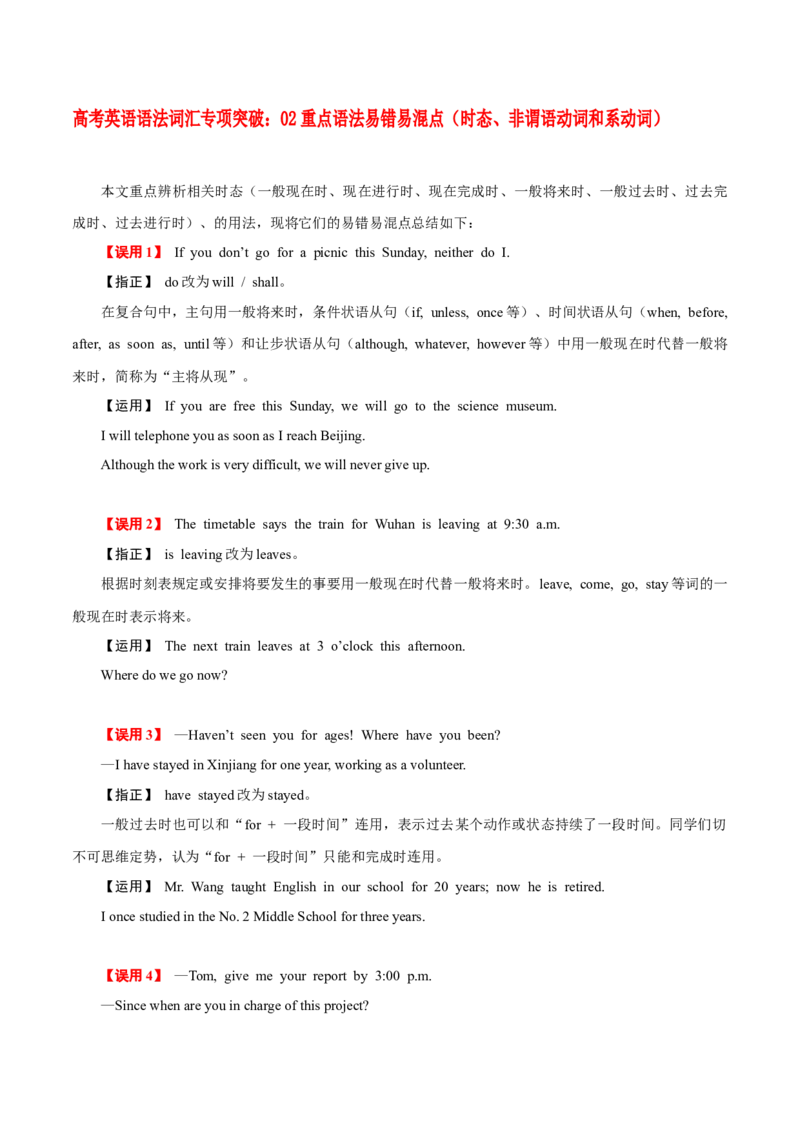
【误用1】 If you don’t go for a picnic this Sunday, neither do I.
【指正】 do改为will / shall。
在复合句中,主句用一般将来时,条件状语从句(if, unless, once等)、时间状语从句(when, before,
after, as soon as, until等)和让步状语从句(although, whatever, however等)中用一般现在时代替一般将
来时,简称为“主将从现”。
【运用】 If you are free this Sunday, we will go to the science museum.
I will telephone you as soon as I reach Beijing.
Although the work is very difficult, we will never give up.
【误用2】 The timetable says the train for Wuhan is leaving at 9:30 a.m.
【指正】 is leaving改为leaves。
根据时刻表规定或安排将要发生的事要用一般现在时代替一般将来时。leave, come, go, stay等词的一
般现在时表示将来。
【运用】 The next train leaves at 3 o’clock this afternoon.
Where do we go now?
【误用3】 —Haven’t seen you for ages! Where have you been?
—I have stayed in Xinjiang for one year, working as a volunteer.
【指正】 have stayed改为stayed。
一般过去时也可以和“for + 一段时间”连用,表示过去某个动作或状态持续了一段时间。同学们切
不可思维定势,认为“for + 一段时间”只能和完成时连用。
【运用】 Mr. Wang taught English in our school for 20 years; now he is retired.
I once studied in the No. 2 Middle School for three years.
【误用4】 —Tom, give me your report by 3:00 p.m.
—Since when are you in charge of this project?【指正】 are you改为have you been。
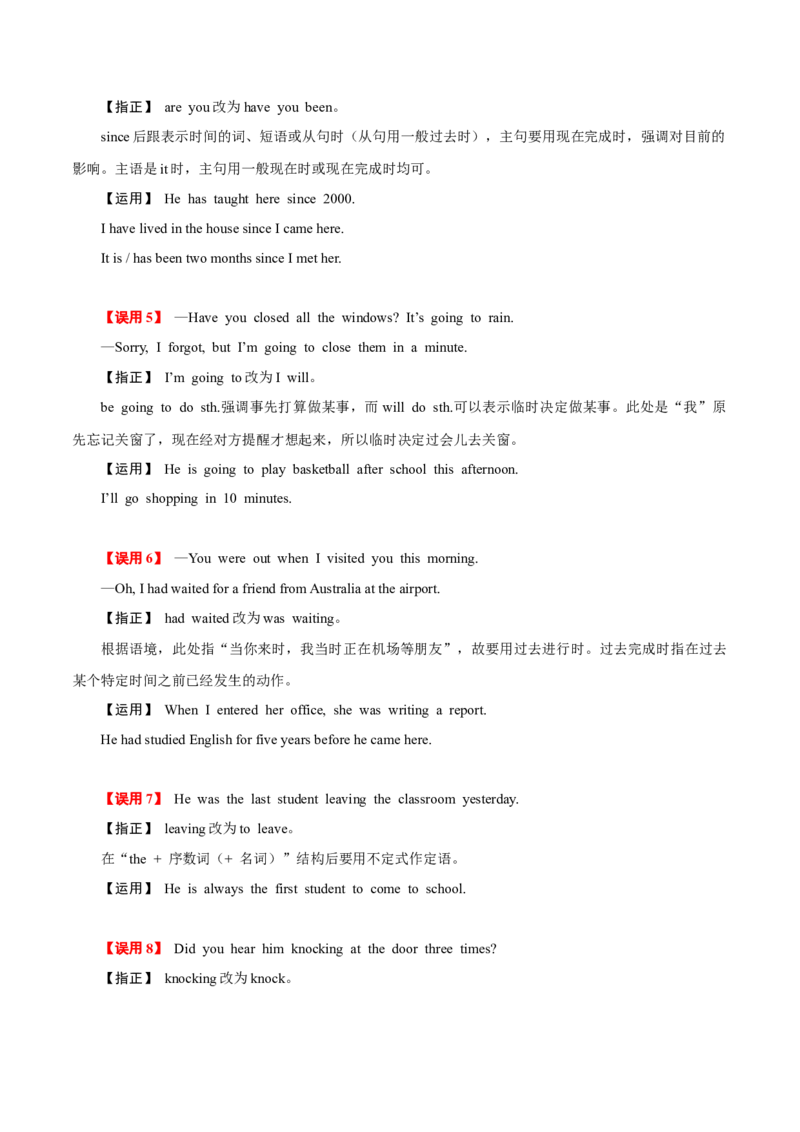
since后跟表示时间的词、短语或从句时(从句用一般过去时),主句要用现在完成时,强调对目前的
影响。主语是it时,主句用一般现在时或现在完成时均可。
【运用】 He has taught here since 2000.
I have lived in the house since I came here.
It is / has been two months since I met her.
【误用5】 —Have you closed all the windows? It’s going to rain.
—Sorry, I forgot, but I’m going to close them in a minute.
【指正】 I’m going to改为I will。
be going to do sth.强调事先打算做某事,而will do sth.可以表示临时决定做某事。此处是“我”原
先忘记关窗了,现在经对方提醒才想起来,所以临时决定过会儿去关窗。
【运用】 He is going to play basketball after school this afternoon.
I’ll go shopping in 10 minutes.
【误用6】 —You were out when I visited you this morning.
—Oh, I had waited for a friend from Australia at the airport.
【指正】 had waited改为was waiting。
根据语境,此处指“当你来时,我当时正在机场等朋友”,故要用过去进行时。过去完成时指在过去
某个特定时间之前已经发生的动作。
【运用】 When I entered her office, she was writing a report.
He had studied English for five years before he came here.
【误用7】 He was the last student leaving the classroom yesterday.
【指正】 leaving改为to leave。
在“the + 序数词(+ 名词)”结构后要用不定式作定语。
【运用】 He is always the first student to come to school.
【误用8】 Did you hear him knocking at the door three times?
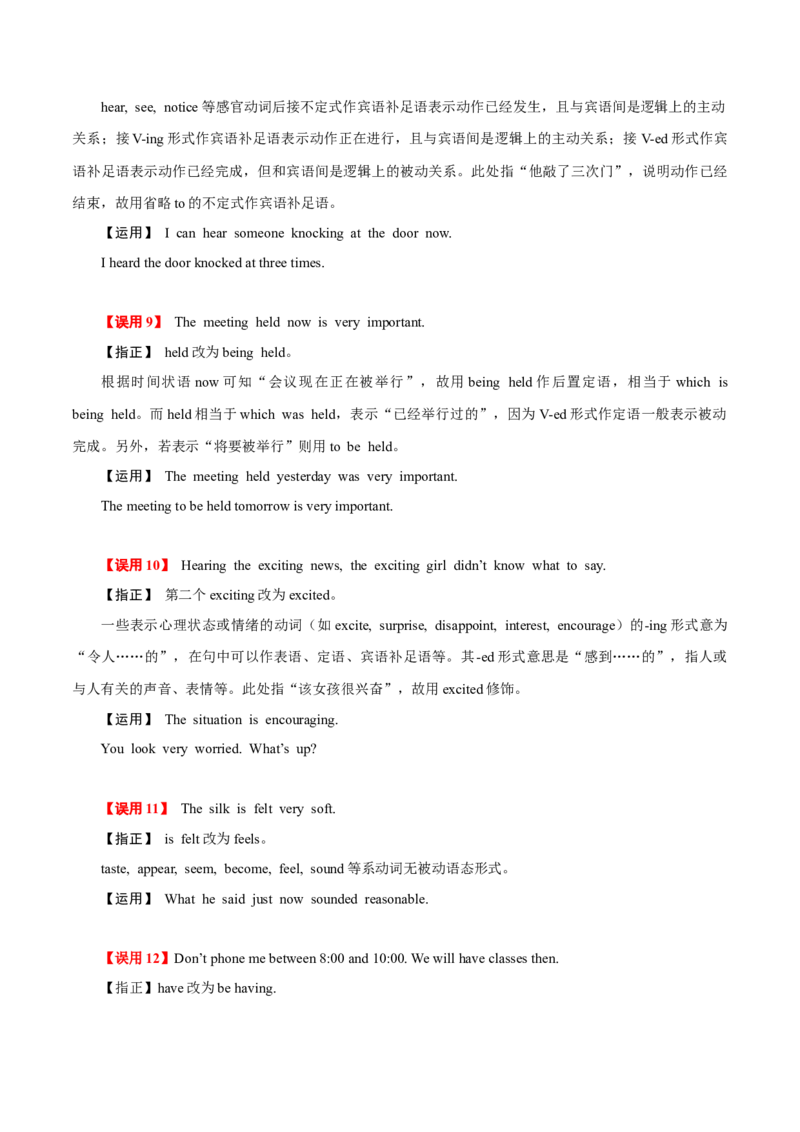
【指正】 knocking改为knock。hear, see, notice等感官动词后接不定式作宾语补足语表示动作已经发生,且与宾语间是逻辑上的主动
关系;接V-ing形式作宾语补足语表示动作正在进行,且与宾语间是逻辑上的主动关系;接 V-ed形式作宾
语补足语表示动作已经完成,但和宾语间是逻辑上的被动关系。此处指“他敲了三次门”,说明动作已经
结束,故用省略to的不定式作宾语补足语。
【运用】 I can hear someone knocking at the door now.
I heard the door knocked at three times.
【误用9】 The meeting held now is very important.
【指正】 held改为being held。
根据时间状语now可知“会议现在正在被举行”,故用 being held作后置定语,相当于 which is
being held。而held相当于which was held,表示“已经举行过的”,因为 V-ed形式作定语一般表示被动
完成。另外,若表示“将要被举行”则用to be held。
【运用】 The meeting held yesterday was very important.
The meeting to be held tomorrow is very important.
【误用10】 Hearing the exciting news, the exciting girl didn’t know what to say.
【指正】 第二个exciting改为excited。
一些表示心理状态或情绪的动词(如excite, surprise, disappoint, interest, encourage)的-ing形式意为
“令人……的”,在句中可以作表语、定语、宾语补足语等。其-ed形式意思是“感到……的”,指人或
与人有关的声音、表情等。此处指“该女孩很兴奋”,故用excited修饰。
【运用】 The situation is encouraging.
You look very worried. What’s up?
【误用11】 The silk is felt very soft.
【指正】 is felt改为feels。
taste, appear, seem, become, feel, sound等系动词无被动语态形式。
【运用】 What he said just now sounded reasonable.
【误用12】Don’t phone me between 8:00 and 10:00. We will have classes then.
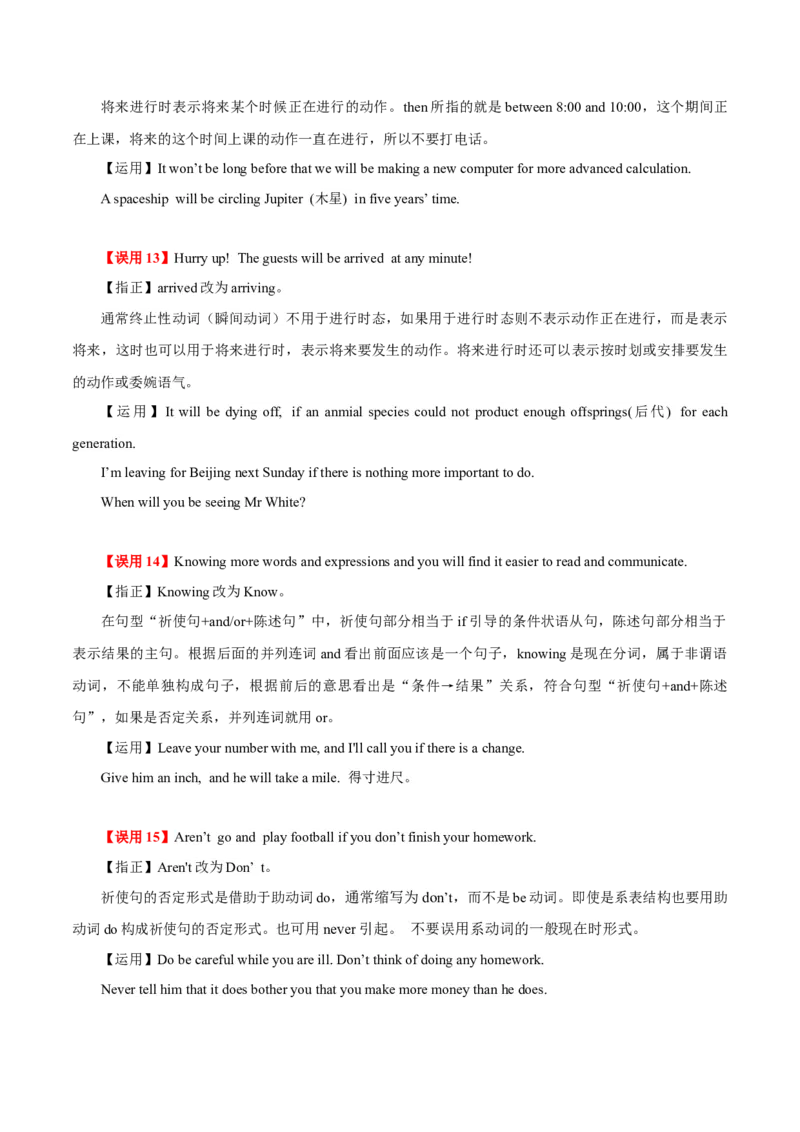
【指正】have改为be having.将来进行时表示将来某个时候正在进行的动作。then所指的就是between 8:00 and 10:00,这个期间正
在上课,将来的这个时间上课的动作一直在进行,所以不要打电话。
【运用】It won’t be long before that we will be making a new computer for more advanced calculation.
A spaceship will be circling Jupiter (木星) in five years’ time.
【误用13】Hurry up! The guests will be arrived at any minute!
【指正】arrived改为arriving。
通常终止性动词(瞬间动词)不用于进行时态,如果用于进行时态则不表示动作正在进行,而是表示
将来,这时也可以用于将来进行时,表示将来要发生的动作。将来进行时还可以表示按时划或安排要发生
的动作或委婉语气。
【运用】It will be dying off, if an anmial species could not product enough offsprings(后代) for each
generation.
I’m leaving for Beijing next Sunday if there is nothing more important to do.
When will you be seeing Mr White?
【误用14】Knowing more words and expressions and you will find it easier to read and communicate.
【指正】Knowing改为Know。
在句型“祈使句+and/or+陈述句”中,祈使句部分相当于if引导的条件状语从句,陈述句部分相当于
表示结果的主句。根据后面的并列连词and看出前面应该是一个句子,knowing是现在分词,属于非谓语
动词,不能单独构成句子,根据前后的意思看出是“条件→结果”关系,符合句型“祈使句+and+陈述
句”,如果是否定关系,并列连词就用or。
【运用】Leave your number with me, and I'll call you if there is a change.
Give him an inch, and he will take a mile. 得寸进尺。
【误用15】Aren’t go and play football if you don’t finish your homework.
【指正】Aren't改为Don’ t。
祈使句的否定形式是借助于助动词do,通常缩写为don’t,而不是be动词。即使是系表结构也要用助
动词do构成祈使句的否定形式。也可用never引起。 不要误用系动词的一般现在时形式。
【运用】Do be careful while you are ill. Don’t think of doing any homework.
Never tell him that it does bother you that you make more money than he does.【误用16】 (1) I’m calling about the apartment you the other day. Could you tell me more about
it?
(2) 变式1:I’m calling about the apartment you in a few days. Could you tell me more about it?
(3) 变式2:Look! How beautiful the apartment they on TV now! It’s more beautiful than expected.
(4) 变式3:She called about the apartment you a few days before. She wanted to know more about
it.
A. advertised B. had advertised C. are advertising D. will advertise
【参考答案】(1)A (2) D (3) C (4) B
【考点设置】①动词时态辨析;②时间状语区别。
【答案解析】本组试题主要考查定语从句的时态问题,解题关键看句子前后的逻辑关系和时间状语的
不同。题(1)的the other day的意思是a few days ago“几天前”,是典型的一般过去时的时间状语,故选
A;题(2)的in a few days意思是“几天后”,是跟一般将来时连用的时间状语,如果是after a few days
就是与一般过去时连用的时间状语,故选D。题(3)根据Look!和now的提示看出是电视节目中正在播出
的广告,所以是正在进行的事情,用现在进行时,故选C。题(3)主句的谓语动词called是一般过去时,
从句的时间状语的before提示其动作发生在called之前,即“过去的过去”,故选B。
【误用17】 (1) The room is empty except for a bookshelf _____ in one corner.
(2) 变式1:The room is empty except for a bookshelf which _____ in one corner.
(3) 变式2:The room was empty except for a bookshelf which _____ in one corner.
A. standing B. to stand C. stands D. stood
【参考答案】(1)A (2) C (3) D
【考点设置】①现在分词与不定式作定语区别;②定语从句与短语区别;③动词时态辨析。
【答案解析】题(1)“拐角现在有个书架”,所以现在的事实情况是“书房并非空无一物”,现在
分词作定语表示当前的情况,不定式表示将来,故选A。题(2)根据连词which看出是定语从句,由主句
的谓语动词是现在时得出C正确。题(3)解题关键是要注意到主句的谓语动词是一般过去时,由此得出定
语从句的谓语动词用过去时,如果用一般现在时,则主语的过去时与从句的现在时之间没有联系,不符合
逻辑,故选D。
【误用18】 (1) _____ these pictures, I couldn’t help thinking of those days when I was in London.
(2) _____ from the top of a thirty-storied building, London looks magnificent.
A. Seeing B. To see C. Seen D. Saw【答案】(1) A (2) C
【解析归纳】过去分词作状语与现在分词一样要求其逻辑主语与句子主语保持一致。(1)中的主语I是
see动作的执行者,用现在分词作状语,故选A。(2)的主语London与see之间是动宾关系,所以用过去分
词,故选C。
【误用19】 (1) The question _______ now at the meeting is very important.
(2) The question _______ at the meeting last week is very important.
A. discussing B. discussed C. being discussed D. to be discussed
【答案】(1) C (2) B
【解析归纳】过去分词作定语表示与被修饰词之间是动宾关系,时间上表示已经发生,如(2)。现在分
词作定语表示正在进行,与被修饰词之间是动宾关系时用现在分词的被动形式作定语,如(1)。
【误用20】(1) The streets are brightly ____D___ up.
(2) The ____B____ candle in the room gave poor light.
A. light B. lighted C. lit D. B and C
【答案】(1) D (2) B
【解析归纳】有些动词的过去分词有两种形式,构成被动语态或完成形式都可以用,如(1)。但是作为
定语时则有所限制,对于light而言作定语用lighted,而不是lit,如(2)。
【误用21】(1) Faced with a bill for $10,000, ________. (XXXX全国卷II)
(2) To help John, who is faced with a bill for $10,000, _________.
A. John has taken an extra job B. the boss has given John an extra job
C. an extra job has been taken D. an extra job has been given to John
【答案】(1) A (2) B
【解析归纳】分词作状语要求与句子的逻辑主语一致,在命题的时候可以用分词作为已知条件。(1)的
过去分词作状语,表示原因,补全是 sb. is faced with…,与A项符合,故选A。(2)根据句意看出help应
该是the boss发出的动作,故选B。
【误用 22】 (1) The children went home from the grammar school, their lessons ______ for the day.
(2007重庆卷)
(2) The children went home from the grammar school, for their lessons _______ for the day.
(3) The children went home from the grammar school, all of them _______ their lessons for the
day.
(4) When _______ their lessons for the day, the children went home from the grammar school.
A. finishing B. finished C. had finished D. were finished【答案】(1) B (2) D (3) A (4) A
【解析归纳】在独立主格结构中,过去分词与逻辑主语是被动关系,表示动作完成,如(1);现在分词
表示与逻辑主语是主谓关系,如(3)。注意(1)与(2)不同的是(2)中有连词for,是并列分句,所以用谓语动
词。当时间状语从句的主语与句子的主语一致的时候可以省掉从句的主语,用“连词+分词”,如(4)。
【跟踪练习】
根据汉语提示完成句子。
1. The students ____________ (在朗读) when Mr. Black got into the classroom.
2. He ____________ (在那个工厂工作) for 10 years by the end of XXXX.
3. —Did you tell Mary about the result?
—Oh, no, I forgot. I ____________ (打电话给她) now.
4. How can you ____________ (保持如此冷静) after such a hot argument?
5. A modern stadium in that city, ____________ (完成) soon, will be a good place for people to have
different kinds of sports in.
6. Professor Smith is said ____________ (设计) a new computer programme recently.
7. When I get home, my wife ______ ______ _____ _____ ______ (很可能正在看电视) .
8. The people who _____ _____ _____ ______ _____ _____ ____ _____ (明天生活在这个地球上的) are they
young of today.
9. If I fail to appear by 7 o’clock, I _____ ____ _____ ______ (就不会来了) at all.
10. My duties will end in July and I _____ _____ ______ _____ (将回到) Arizona in the US.
11. My wife and I ____ _____ _____ ____ ____ _____ ______ (会一直盼望着见到你) when you come with the
Chinese medical delegation(代表团).
Keys:
1. were reading aloud
2. had worked in that factory
3. will call her
4. stay / keep so cool / calm
5. to be completed
6. to have designed7. will probably be watching television
8.will be living in the world of tomorrow
9.will not be coming
10. will be returning to
11. will be looking forward to seeing you