高考英语语法词汇专项突破:探究连系动词 解读高考热点
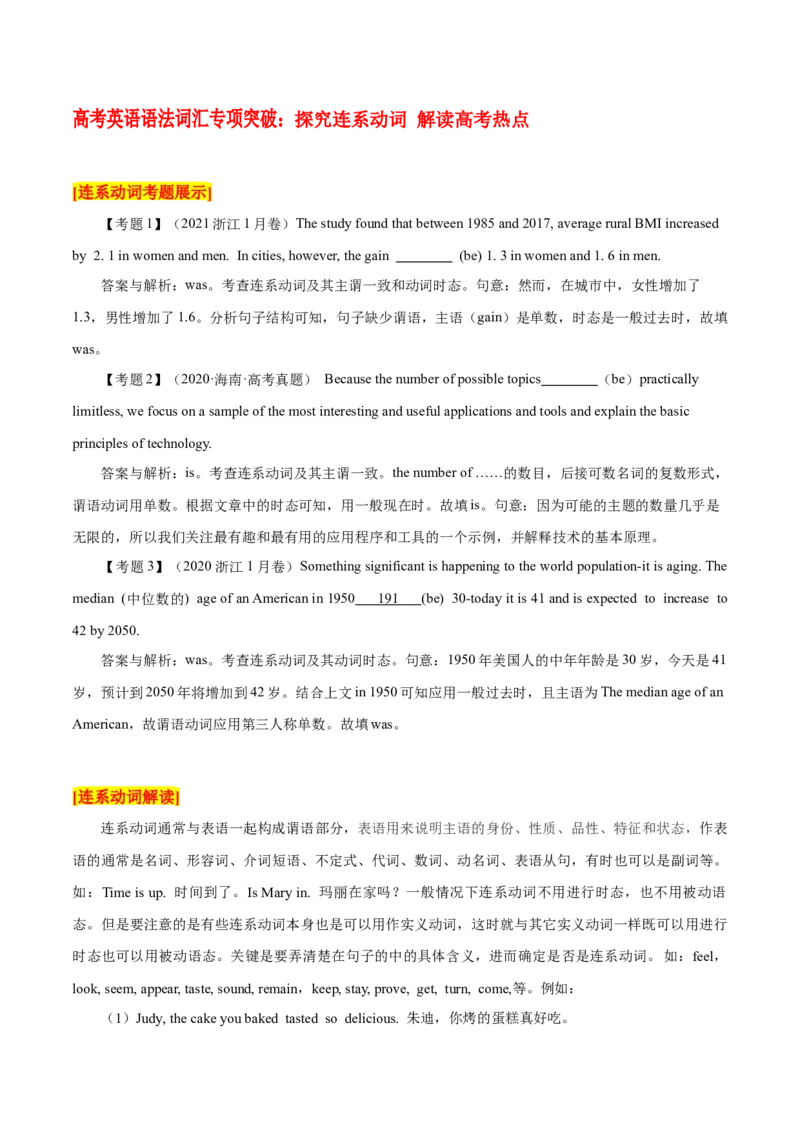
[连系动词考题展示]
【考题1】(2021浙江1月卷)The study found that between 1985 and 2017, average rural BMI increased
by 2. 1 in women and men. In cities, however, the gain (be) 1. 3 in women and 1. 6 in men.
答案与解析:was。考查连系动词及其主谓一致和动词时态。句意:然而,在城市中,女性增加了
1.3,男性增加了1.6。分析句子结构可知,句子缺少谓语,主语(gain)是单数,时态是一般过去时,故填
was。
【考题2】(2020·海南·高考真题) Because the number of possible topics (be)practically
limitless, we focus on a sample of the most interesting and useful applications and tools and explain the basic
principles of technology.
答案与解析:is。考查连系动词及其主谓一致。the number of ……的数目,后接可数名词的复数形式,
谓语动词用单数。根据文章中的时态可知,用一般现在时。故填is。句意:因为可能的主题的数量几乎是
无限的,所以我们关注最有趣和最有用的应用程序和工具的一个示例,并解释技术的基本原理。
【考题3】(2020浙江1月卷)Something significant is happening to the world population-it is aging. The
median (中位数的) age of an American in 1950 191 (be) 30-today it is 41 and is expected to increase to
42 by 2050.
答案与解析:was。考查连系动词及其动词时态。句意:1950年美国人的中年年龄是30岁,今天是41
岁,预计到2050年将增加到42岁。结合上文in 1950可知应用一般过去时,且主语为The median age of an
American,故谓语动词应用第三人称单数。故填was。
[连系动词解读]
连系动词通常与表语一起构成谓语部分,表语用来说明主语的身份、性质、品性、特征和状态,作表
语的通常是名词、形容词、介词短语、不定式、代词、数词、动名词、表语从句,有时也可以是副词等。
如:Time is up. 时间到了。Is Mary in. 玛丽在家吗?一般情况下连系动词不用进行时态,也不用被动语
态。但是要注意的是有些连系动词本身也是可以用作实义动词,这时就与其它实义动词一样既可以用进行
时态也可以用被动语态。关键是要弄清楚在句子的中的具体含义,进而确定是否是连系动词。如:feel,
look, seem, appear, taste, sound, remain,keep, stay, prove, get, turn, come,等。例如:
(1)Judy, the cake you baked tasted so delicious. 朱迪,你烤的蛋糕真好吃。(2)Whether Captain Turnbill or I were right, remains to be proved later. 究竟是特恩比尔船长对还是我
对,尚待日后加以证实。(其中prove作为及物动词可以用被动语态)
一、连系动词分类解读
根据连系动词的含义可以分为表示状态、像、感官、变化、终止六类。
(一)表示状态的系动词
be动词作为连系动词,用来表示主语状态,其一般现在时、一般过去时可以直接构成疑问句或否定句,
而其他的连系动词需要借助于助动词才可以。例如:
(1)Are you sure you want to print? 你真的想打印吗?
(2)It has been 10 years since "Friends" ended its decade long run dominating Thursday nights on NBC as
well as pop culture. 《老友记》曲终人散已十年。这部每周四霸占荧屏长达十年的NBC剧集,随着时间的
积淀,已然成为流行文化的象征。
(二)表“像”系动词
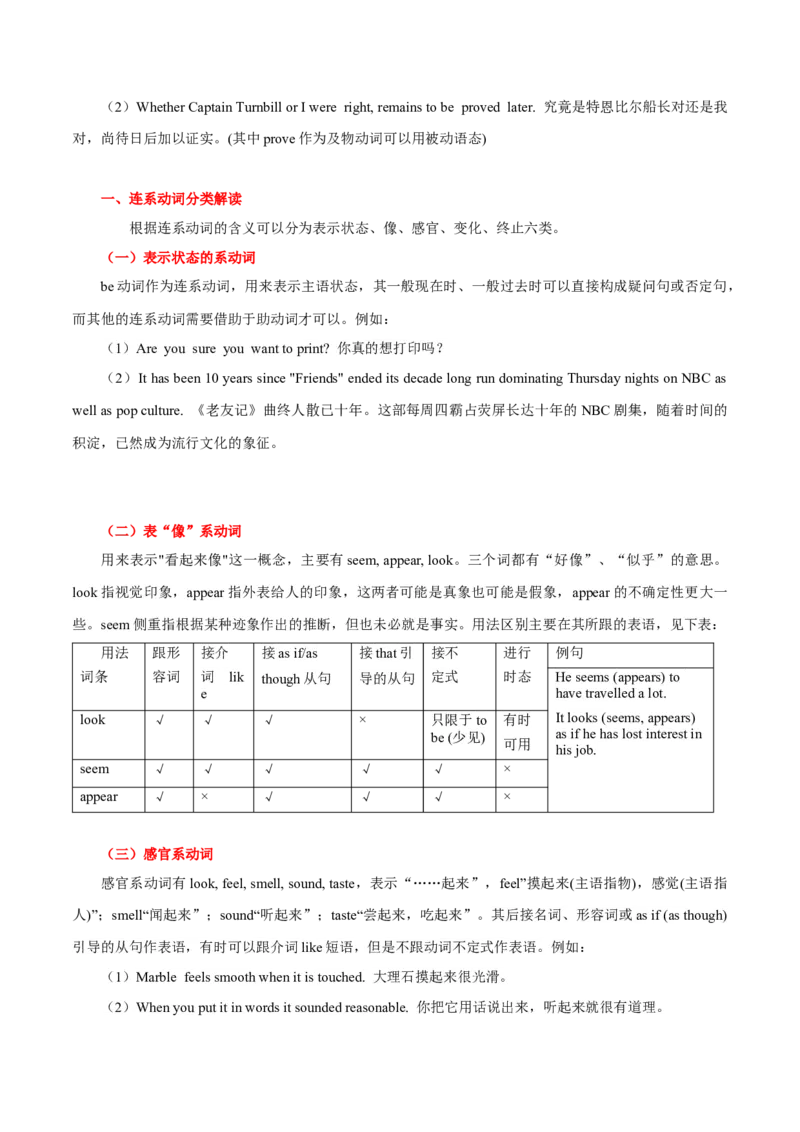
用来表示"看起来像"这一概念,主要有seem, appear, look。三个词都有“好像”、“似乎”的意思。
look指视觉印象,appear 指外表给人的印象,这两者可能是真象也可能是假象,appear 的不确定性更大一
些。seem 侧重指根据某种迹象作出的推断,但也未必就是事实。用法区别主要在其所跟的表语,见下表:
用法 跟形 接介 接as if/as 接that引 接不 进行 例句
词条 容词 词 lik though从句 导的从句 定式 时态 He seems (appears) to
e have travelled a lot.
look √ √ √ × 只限于to 有时 It looks (seems, appears)
be (少见) as if he has lost interest in
可用
his job.
seem √ √ √ √ √ ×
appear √ × √ √ √ ×
(三)感官系动词
感官系动词有look, feel, smell, sound, taste,表示“……起来”,feel”摸起来(主语指物),感觉(主语指
人)”;smell“闻起来”;sound“听起来”;taste“尝起来,吃起来”。其后接名词、形容词或as if (as though)
引导的从句作表语,有时可以跟介词like短语,但是不跟动词不定式作表语。例如:
(1)Marble feels smooth when it is touched. 大理石摸起来很光滑。
(2)When you put it in words it sounded reasonable. 你把它用话说出来,听起来就很有道理。(3)The hamburger not only smells good but also tastes delicious. 这只汉堡包不但气味好闻而且味道好
吃。
(4)I don’t want to sound like a busybody,but didn't you plan to go abroad? 我并不想瞎打听,可你原来
不是打算出国吗?
(四)变化系动词
此类系动词表示主语变成什么样,表示由一种情况或状态变化成另一种情况或状态。常见有:
become,turn,come, go, run,fall, grow,get等。
1. become,get,turn
become和get表示的变化可以是由好到坏,也可以是由坏到好,强调变化过程的完成。用作连系动词
意为“成为”,其后可接名词、形容词、过去分词,不接不定式。
turn作连系动词时意为“变得;成为”,表示变为完全不同的事物,强调变化的结果。一般通过改变
状态或形式(如:变颜色、变质、变味等)。后面一般接形容词作表语,跟名词作表语时省略冠词。
(1)The atmosphere of the earth becomes thinner and the planet becomes much warmer than before. 大气
层越来越稀薄,地球也变得越来越暧。
(2)He studied hard when he was young and finally became a talented person/turned talented person. 他从
小发奋苦读, 长大终于成了有用之才!
(3)In spring the trees turn green and the flowers start to come out. 春天,树变绿了,花儿开了。
(4)He used to be a doctor and then turned teacher. 他过去是个医生,后来当了老师。(turn+n. 要省略
冠词)
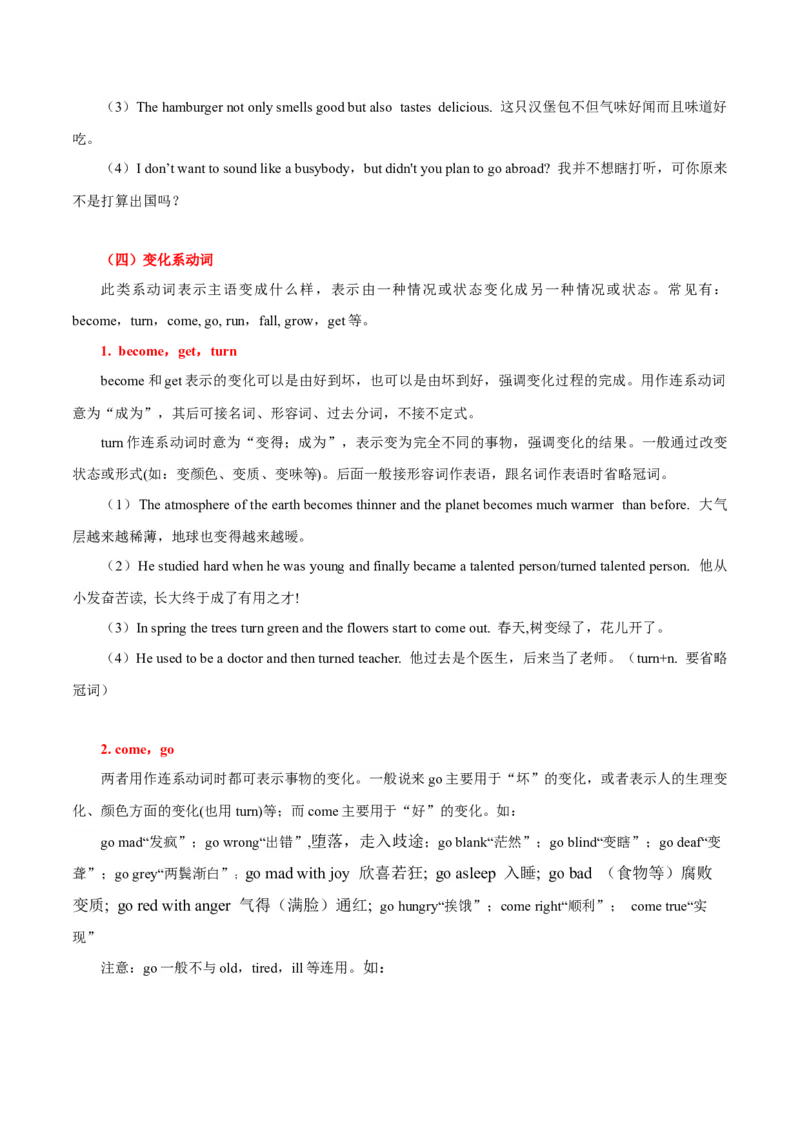
2. come,go
两者用作连系动词时都可表示事物的变化。一般说来go主要用于“坏”的变化,或者表示人的生理变
化、颜色方面的变化(也用turn)等;而come主要用于“好”的变化。如:
go mad“发疯”;go wrong“出错”,堕落,走入歧途;go blank“茫然”;go blind“变瞎”;go deaf“变
聋”;go grey“两鬓渐白”;go mad with joy 欣喜若狂; go asleep 入睡; go bad (食物等)腐败
变质; go red with anger 气得(满脸)通红; go hungry“挨饿”;come right“顺利”; come true“实
现”
注意:go一般不与old,tired,ill等连用。如:(1)Mo Yan was awarded the Nobel Prize for Literature in 2012, which made one of the Chinese people’s
long-held dreams come true.莫言荣获2012年诺贝尔文学奖,圆了中国人长久以来的梦想。
(2)He had already been learning the piano for a year, and when he went blind, his mother knew this would
be the only way he would make any money in the future. 他已经学了一年钢琴,当他失明的时候,他的母亲
知道这是他将来赚钱的唯一途径。
(3)We've discovered what went wrong and are going to put it right. 我们已经发现错误所在并会将其纠
正。
3. run
run用作连系动词只限于和少数形容词或副词搭配。如:run dry(信息或金钱的来源)枯竭,用完; run
high (情绪)激动,高涨,强烈; run short不足;不多;所剩无几; run out 用完,耗完
run dry 变干 run cold 变冷
run low 不够了 run short 缺乏
run smooth 进展顺利 run wild 无人管
(1)Feelings there have been running high in the wake of last week's killing. 上周的谋杀案发生后,那里
的人们群情激愤。
(2)Streams had run dry for the first time in memory. 记忆中,小溪第一次干涸了。
(3)Food supplies in the flood-stricken area are running out .We must act immediately before there’s none
left.
(4)在洪水灾区的食品供应也将告罄。我们必须立即在还没有完全短缺之前采取行动。
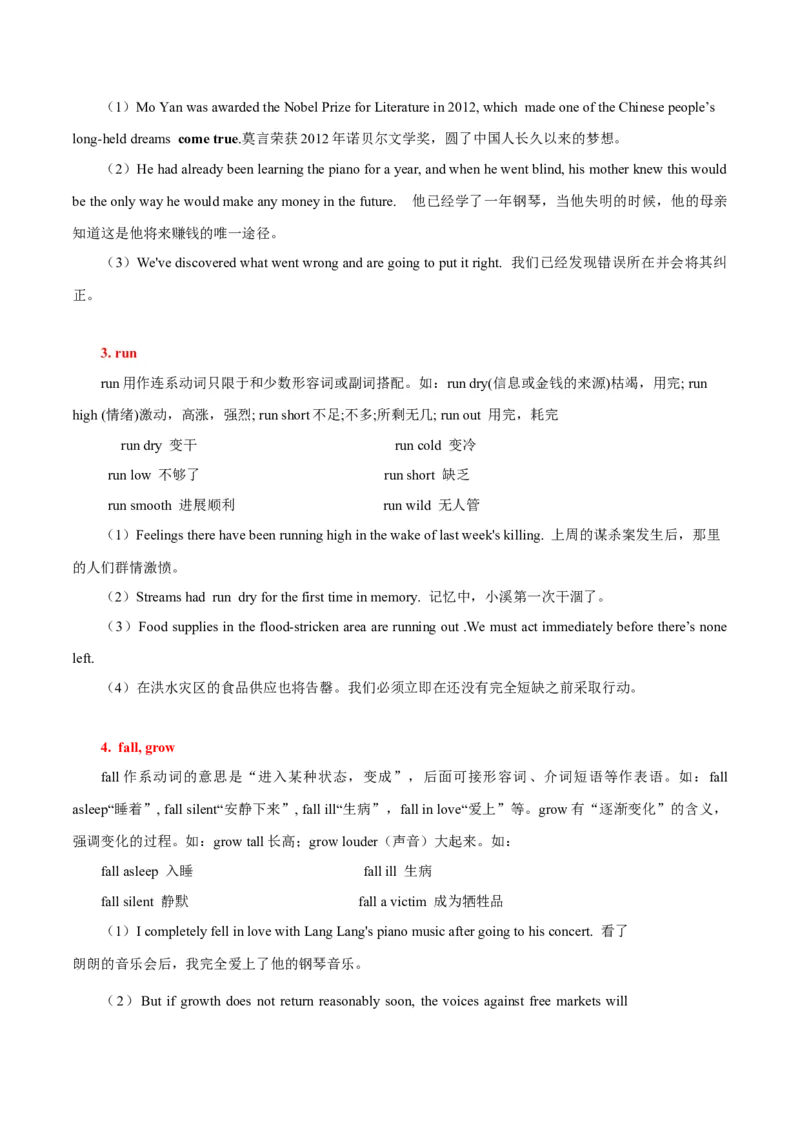
4. fall, grow
fall作系动词的意思是“进入某种状态,变成”,后面可接形容词、介词短语等作表语。如:fall
asleep“睡着”, fall silent“安静下来”, fall ill“生病”,fall in love“爱上”等。grow有“逐渐变化”的含义,
强调变化的过程。如:grow tall长高;grow louder(声音)大起来。如:
fall asleep 入睡 fall ill 生病
fall silent 静默 fall a victim 成为牺牲品
(1)I completely fell in love with Lang Lang's piano music after going to his concert. 看了
朗朗的音乐会后,我完全爱上了他的钢琴音乐。
(2)But if growth does not return reasonably soon, the voices against free markets willgrow ever louder. 但是倘若不能迅速并合理地恢复经济增长,这些反对自由市场的声音将
会更加响亮。
(3)Some teachers complain that a few students feel sleepy or even fall asleep in class. 一
些老师抱怨说,一些学生上课犯困,甚至睡着了。
(五)持续系动词
用来表示主语继续或保持一种状况或态度,这类连系动词强调“持续”。主要有remain(依然),
keep,stay,continue (继续、仍旧),stand (处于某状况或情形)等。例如:
keep silent/silence 保持安静 keep fit 保持健康
keep quiet 保持安静 keep warm 保暖
lie unknown 未知的 stand still 站立不动
stay awake 保持清醒 stay open 开业中
(1)Why don't you put the meat in the fridge? It will stay fresh for several days.把肉放在冰箱里吧,能保
鲜好几个月呢。
(2)It's already ten in the morning. The store remains closed. What's the matter? 都到上午十点了,店门依
然管着,怎么回事?
(3)She fancied that she heard a slight noise out of doors, and stood still. 她确信自己听见门外有一种轻
微的响动,于是她便站住不动了。
(4)Whether the buildings in this area should be pulled down has remained controversial; people are still
looking for other possible solutions. 这一地区的建筑是否应该拆除一直有争议;人们仍在寻找其他可能的解决
方案。
(5)Tom is sitting still, listening to his teacher. Tom坐在那儿一动也不动,专心听着老师讲课。
(六)终止系动词
表示主语已终止动作,主要有prove, turn out, 表达“证实,变成”之意,
prove 作“证明是,结果是,事实说明”解时,用作连系动词可用形容词、副词、名词、介词短语或不
定式(to be)作表语。turn out作连系动词用时,表示“原来是;结果是”,后面所接的表语形式与prove的
表语基本相同,也可以用于it turned out that…结构中。如:
(1)She proved/ turned out (to be) a very strict teacher. 结果证明她是一位非常严格的老师。
(2)As time went on, Einstein's theory proved correct.随着时间的推移,爱因斯坦的理论证明是正确的.
(3)She turned out to be a friend of my sister/It turned out that she was a friend of my sister. 她原来是我妹妹的朋友。
(4)The exam turned out (to be) easy. 这次考试证明很容易。
二、连系动词特殊用法解读
(一)可以用动词不定式作表语的连系动词
连系动词be,seem,appear,prove,turn out,grow等词后可接不定式短语作表语,若所接to be不定
式为,通常可省略to be。如:
1. be to do
★可以表示计划、打算、命令、安排要发生的事。如:
(1)Here she was to stay for seven years without meat or drink, and die of hunger. 她要在这里被关七年,
没有吃喝,最后饿死。
(2)He will have to make major adjustments to his thinking if he is to survive in office. 他要想继续任职的
话,就得对他的思维方式作大的调整。
(3)He is to return to Hawaii, where he grew up, for a holiday next month. 他下月将回到他长大的地方
——夏威夷,好好地来一次休假。
★表示理想、计划、打算、目的等意义的名词作主语时候跟非谓语动词作表语通常用be to do动词不
定式。常用的名词有dream, wish, hope, aim, purpose, ambition, target, plan等。如:
(1)Their greatest ambition is to stop you causing them any discomfort. 他们最大的希望就是希望你能停
止带给他们不便。
(2)My ambition is to get a lot of money so that I can lead a better life. 我的雄心是得到一大笔钱,以便
可以过上好日子。
(3)The main purpose is to let enough time pass so the two people are sure that they want to marry each
other. 但主要目的是让他们相处足够久的时间,让两个人确定他们的结婚意向。
(4)My dream is to be a scientist.我的梦想是当一名科学家。
(5)My plan was to go from London to Paris.我计划从伦敦去巴黎。
(2)seem,appear,prove,turn out,grow等词后可接不定式短语作表语。
(1)The man seemed to be ill.这个人好像病了。
(2)The vote yesterday appears to mark a turning point in the war. 昨天的投票似乎标志
着这场战争的一个转折点。
(3)The new buyer identified a dozen new sources for the material, most of which proved
to be reliable. 新买家为这种材料确定了十几个新货源,其中大多数证明是可靠的。
(4)Given the failure of the previous plan, this turned out to be a relative success. 由于前面那个计划失败了,这个计划算是比较成功的。
(5)He has grown to like studying English.他渐渐喜欢学英语了。
注意:sound,smell,feel,taste,become,look后接形容词作表语,而不接不定式。
This flower smells very sweet.这朵花闻起来很香。不说:This flower smells to be very
sweet.
(二)有些表面上是被动结构,事实上体现的是系表的含义如:
尤其要注意的是一些带有过去分词的系表结构中有固定的介词搭配,形成了固定短语,需要强记,对
此类短语的考查涉及到被动语态、过去分词、介词、词义辨析等。如:
be married to与...结婚;be known for/as 因(以)......而著名;be supposed to do应该...; be devoted to
专心致志于,奉献于;be impressed with/by 对印象深刻; be used/ accustomed /adjusted to 习惯于; be
equipped with装备着, 配备着; be lost in迷失于, 沉浸于; be buried in埋头于;be absorbed in全神贯注于;be
occupied with 忙于;be engaged in全身投入于;be based on 基于,在...基础上;be involved in/with参与,
牵涉到;be exposed to暴露于,接触; be linked /related to与...有联系;be associated/ connected/ concerned
with与...有联系;be made of由...制成;be trapped/stuck/caught in陷于...之中;be seated at/in/on坐在;be
dressed in穿着...;be set in 背景设置在...;be aimed at旨在;be covered with 覆盖着...;be addicted to对...
上瘾;be filled with 充满着...;be crowded with 挤满着...;be known for (as) 因/以...而闻名;be tired with/of
对...身体累/心理累;be interested in对...感兴趣; be pleased /satisfied with 对...满意;be concerned/worried
about对...担忧;be fed up with 对...厌恶;be faced with 面临着...;be located/situated in/on 位于/坐落于;be
armed with 武装着,配备着;be adapted to适应,习惯于;be decorated with装饰着...;be compared with/to
与...相比;be prepared for为...做好准备;be burdened with肩负着,负担着;be furnished with配备着;be
intended/designed for专为...而设计,专为...提供;be regarded/treated as被认为...,被当作。例句:
(1)Shuai Yunyun, 21, from Shanghai University of Engineering Science found that her friends were
all occupied with their smartphones during a high school friends meeting. 21岁的帅芸芸(音译)来自上海工
程技术大学。在一次高中同学聚会上,她发现很多朋友都只顾着玩自己的智能手机。
(2)"Children who are often exposed to a variety of vegetables are more likely to try new foods," explains
Dr. Kerry Jones. “经常接触各种蔬菜的孩子更有可能尝试新的食物。”凯利·琼斯博士解释道。
(3)Traditional red pockets are often decorated with gold Chinese characters, such as happiness and wealth.
传统的红包通常饰有金色的汉字,比如福和富。
(4)Only when your approach to good health is adapted to your own requirements will your reallysucceed in obtaining your goals. 只有你的保健方法适合于你的身体需要,那么,你就会真正成功地达到目
的。
(5)These workers are fed up with being at the bottom of the pile when it comes to pay. 这些工
人受够了收入水平处于底层的苦恼。
(6)It's well-known that they are regarded as junk food, but they are a real "hunger killer". 大家都
知道它们被认为是垃圾食品,但它们是真正的“饥饿杀手”。
(三)常用的be... to do句型
1.Be about to用于讨论即将发生的事, 经常和“just”一起出现,在过去时中,be about to后面可以跟
“(过去)要发生,但是实际没有发生的事情”。该结构后面不能跟时间。如:
(2)I’m about to eat. Can I phone you back?我要吃饭了。我一会儿给你(电话)回过去,好吗?
We’re just about to set off for a walk. Do you want to come?我们正准备出去散会儿步。你要一起吗?
I was about to complain but he came over and apologised.我正要跟他抱怨一通,但是他过来道歉了。
I was about to call you.我准备给你打电话。Not: I was about to call you in ten minutes.
2.Be able to 用于描述“能力”, 比can更加正式。经常用于不能使用“can”的地方。例如,在情态动
词之后往往不能用 can。在肯定句中,当描述“过去的成就”时,经常用“was/were able to”,而不是
“could”。在否定句中,couldn’t 和 wasn’t/weren’t able to 都可以使用,后者相对更正式。
She won’t be able to concentrate.她将无法集中精力。Not: She won’t can concentrate.
I am very sorry but I am not able to give you that information. (or, less formal: I cannot give you that
information.)非常抱歉,我不能给你提供那些信息。
Only one person was able to beat the record.只有一个人能打破记录。Not: Only one person could beat the
record.
We weren’t able to finish the marathon in under four hours. (or We couldn’t finish the marathon …)我们无法
完成在4小时内跑完马拉松。
3.Be due to用于谈论在计划/预期在某个时间将要发生的事情。句子中一般会出现“时间”。
The train is due to arrive at Glasgow Central at 12:12.这趟列车将在12点12抵达格拉斯哥中央站。
The cargo was due to be offloaded in Singapore three days later. 这艘货轮本定于3天后在新加坡卸载。
My dislike of thunder and even small earthquakes was due to Mother. 我对雷声甚至于轻微地震的厌恶都归
因于我的母亲。
4.Be likely to用于描述事情发生的概率, 经常与“more”“less”同时出现, 可跟that从句。否定表达:not
likely to 或者 unlikely,都可以。Are parents who have a lot of money likely to spoil their children?有钱的父母会溺爱孩子吗?
I think men are more likely to spend a lot of money on food than women are.我认为,男生比女生更可能会
在食物上花钱。
It’s likely that sales will rise.销量很可能会提高。
The company is not likely to make a profit in the second half of the year.这家公司今年下半年不太可能会盈
利。
5.Be meant to用于描述想要、期待的事情。
These batteries are meant to last for a year.这些电池应该能用一年。
The United Nations is an international organization, which is meant to encourage countries to work together
on different opinions without the use of war. 联合国是一个国际组织,旨在鼓励各国在不使用武力的情况下就
不同的意见达成合作。
6. Be supposed to用于描述义务、安排
You’re supposed to have an hour for lunch. That’s the law.你有一个小时的时间吃午饭。这是规定。
You are supposed to participate in some international events to accumulate a wealth of practical experience.
你应该参加一些国际活动,积累丰富的实践经验。
Nowadays you are supposed to have your temperature taken before you enter the school. 现在进学校前应该
量体温。
(四)带有过去分词系表结构与被动结构的异同
“系动词+用作表语的过去分词”称为系表结构,它与被动语态的形式完全一致。但有以下几点不同:
1. 被动语态中的过去分词是动词,表动作;系表结构中的过去分词相当于形容词,表状态。如:
The composition was written with great care. 这篇作文写得很用心。(被动语态)
These goods are all sold out. 这些货物全部出售了。(系表结构)
2. 被动语态可用by短语表动作的执行者;系表结构通常不用by短语。如:
The man was offended by the woman. 那个男人被那个女人激怒了。(被动语态)
The man was offended. 那个人很生气。(系表结构)
3. 系表结构一般只用于一般现在时或一般过去时;被动语态除可用于上述两种时态之外,还
可用于其他时态。如:
The flowers will be planted next week. 下周种花。(被动语态)
Museums are closed to the public on Mondays. 博物馆每逢星期一闭馆。(系表结
构)4. 系表结构中的过去分词可被 very 修饰;被动语态中的过去分词可用 much 修饰。如:He
was very agitated. 他很激动。(系表结构)
He was much agitated by the news. 这消息使他很激动。(被动语态)
5. 有些句子既可是被动语态,也可是系表结构,应根据上下文去理解。如:
The door was closed. 门关上了。
The road was mended. 路修好了。