高考英语语法词汇专项突破:13 全解读动非谓语动词之不定式+巩固练习及答案与解析
[命题热点]
考点一、不定式的时态
考点二、不定式的被动语态
考点三、不定式的否定形式
考点四、不定式的功能: 作主语、作宾语、作表语、作定语、作补足语、作状语
考点五、连词+不定式
考点六、不定式to的省略。
[不定式考题展示]
【考例 1】(2023·全国甲卷)For thousands of years, people have told fables (寓言) ______ (teach) a
lesson or to pass on wisdom.
答案与解析:to teach。考查不定式做目的状语。根据空后的or to pass on wisdom可知,此处和后文是并
列关系,都作目的状语。故填to teach。句意:几千年来,人们讲寓言故事或为了教课或为了传递智慧。
【考例2】(2023·新高考Ⅰ卷)Nanxiang aside, the best Xiao long bao have a fine skin, allowing them
_________ (lift) out of the steamer basket without tearing or spilling any of their contents.
答案与解析:to be lifted。考查非谓语动词不定式作宾语补足语。根据固定搭配allow sb to do sth“允许
某人做某事”,空处需用动词不定式作宾语补足语,补足语与宾语是逻辑上的动宾关系,空处需填动词不定式
的被动形式to be lifted。句意:除了南翔,最好的小笼包有精美的外皮,可以让它们从蒸笼篮中拿出来,而不会
撕裂或溢出里面的馅。
【考例3】(2019新课标II卷)Picking up her "Lifetime Achievement" award,proud Irene declared she
had no plans _____________(retire) from her 36-year-old business.
答案与解析:to retire。考查不定式作定语。此处用to do sth做后置定语,用来修饰前面的名词plan,表示
“…的计划”,故填to retire。句意:获得“终身成就”奖时,艾琳骄傲地宣布她没有从 36年的公司退休
的计划。
【考例4】(2023·新高考Ⅰ卷 )The dumplings arrive steaming and dangerously hot. To eat one, you have
to decide whether _______ (bite) a small hole in it first, releasing the stream and risking a spill(溢出), or to putthe whole dumpling in your mouth, letting the hot soup explode on your tongue.
答案与解析:to bite。考查动词不定式作宾语。空处与后面to put 并列,充当decide的宾语。句意:吃小
笼包的时候,你必须要决定是先咬一个小口,释放蒸汽,让里面的汤汁流出来还是把整个小笼包放进嘴里,让热
汤在舌头上爆掉。
【考例5】(2021·英语全国甲卷)It is possible ______ (walk) or bike the entire 14 kilometers.
答案与解析:to walk。考查动词不定式作主语。分析句子可知,此处为句型“it +be+adj+to do sth.”,it
为形式主语,动词walk的不定式短语作真正主语。故填to walk。句意:步行或骑自行车跑完整个14公里
是可能的。
[基本概况]
动词不定式(Infinitive)是一种非限定动词,通常由"to+动词原形"构成, ,不定式属于非谓语动词范
畴,在句中不可以作谓语动词。他具有动词的特点,体现在可以有自己的宾语或状语,通常还具有名词、
形容词或副词的特点,在句中可以作主语、宾语、表语、定语、补足语或状语等。从历年的高考试题可以
看出对不定式的考查涉及到不定式的时态、语态、功能、省略、连词+不定式等方面。
[考点突破]
考点一、不定式的时态
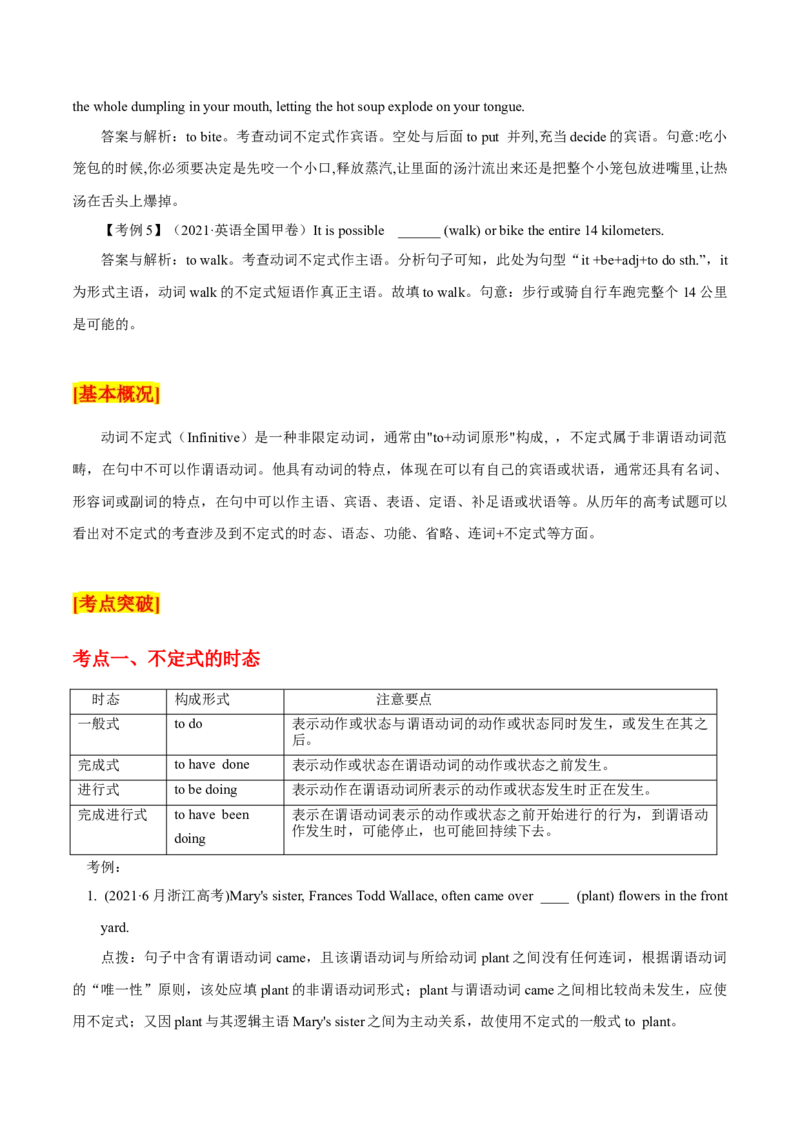
时态 构成形式 注意要点
一般式 to do 表示动作或状态与谓语动词的动作或状态同时发生,或发生在其之
后。
完成式 to have done 表示动作或状态在谓语动词的动作或状态之前发生。
进行式 to be doing 表示动作在谓语动词所表示的动作或状态发生时正在发生。
完成进行式 to have been 表示在谓语动词表示的动作或状态之前开始进行的行为,到谓语动
作发生时,可能停止,也可能回持续下去。
doing
考例:
1. (2021·6月浙江高考)Mary's sister, Frances Todd Wallace, often came over ____ (plant) flowers in the front
yard.
点拨:句子中含有谓语动词came,且该谓语动词与所给动词plant之间没有任何连词,根据谓语动词
的“唯一性”原则,该处应填plant的非谓语动词形式;plant与谓语动词came之间相比较尚未发生,应使
用不定式;又因plant与其逻辑主语Mary's sister之间为主动关系,故使用不定式的一般式to plant。(2022天津卷·第一次)This old castle is said_________ from designs by a famous architect in the 16th
century.
/A. to have been built B. to have built C. to be built D. to build
3. (安徽.XXXX) The man we followed suddenly stopped and looked as if _____ whether he was going in the
right direction.
A. seeing B. having seen C. to have seen *D. to see
点拨:as if可以跟不定式,从句意“突然停下来看看,好像是看看是否走对了方向”,题中的stop与
see的动作同时发生,故选不定式的一般式,选D。
4. (NMETXXXX) Robert is said _____ abroad, but I don’t know what country he studied in.
*A. to have studied B. to study C. to be studying D. to have been studying
点拨:根据but后what country he studied in中的谓语动词过去式studied可知出国留学是以前的事,发
生在is said 之前,所以用不定式的完成时,由于仅指过去,并没有强调当时进行的情况,故选A。
5. (NMETXXXX) I would love ______ to the party last night but I had to work extra hours to finish a report.
A. to go B. having gone C. going *D. to have gone
点拨:根据but I had to work extra hours中的过去式谓语动词had to可知动作已经发生,所以would
love to后跟不定式的完成时本来想做某事,但是实际上没有做成,故选D。
6. The meeting _______ tomorrow is of great importance.
*A. to be held B. held C. being D. to have been held
点拨:根据时间状语tomorrow可知会议实际上还没有召开,因此要用能表示将来意义的不定式来表
示,而对于会议来说应该是“被召开”,用不定式的被动语态形式,故选A。
考点二、不定式的被动语态
不定式不仅有事态的变化,而且还有语态的变化。不定式的被动语态是通过在 to后面加上be动词,
然后把动词变成过去分词构成的,各种时态的不定式的被动语态形式见下表:
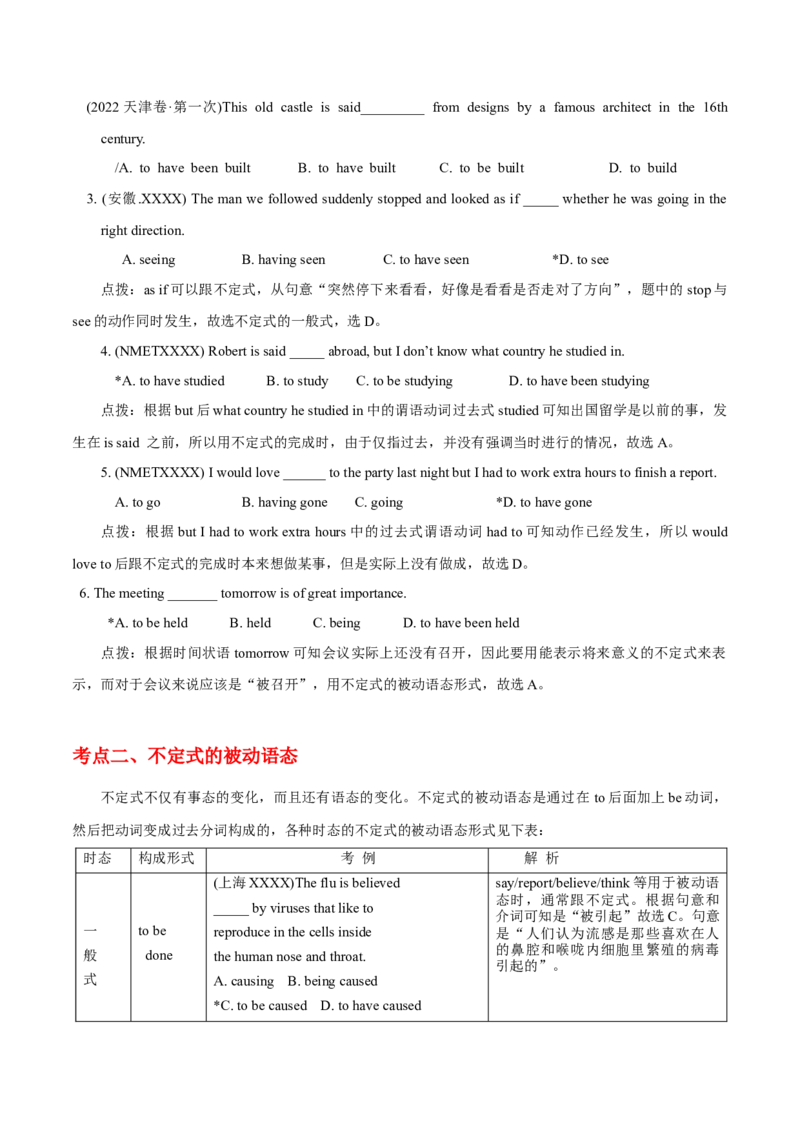
时态 构成形式 考 例 解 析
(上海XXXX)The flu is believed say/report/believe/think等用于被动语
态时,通常跟不定式。根据句意和
_____ by viruses that like to
介词可知是“被引起”故选C。句意
一 to be reproduce in the cells inside 是“人们认为流感是那些喜欢在人
的鼻腔和喉咙内细胞里繁殖的病毒
般 done the human nose and throat.
引起的”。
式 A. causing B. being caused
*C. to be caused D. to have caused(上海 XXXX) Do let your mother know all 从第一句的提示可知母亲已经知
the truth. She appears ______ everything. 道,用完成式,而她知道是由于被
to
人告知,故用不定式的被动语态形
A. to tell B. to be told
完 have 式。
C. to be telling
成 been
*D. to have been told
式 done
考点三、不定式的否定形式
动词不定式的否定形式是在不定式的标志to前直接加上not,有时为了强调也可以用否定副词never来
否定。考例:
1. (METXXXX) Tom kept quiet about the accident ______ lose his job.
A. so not as to *B. so as not to C. so as to not D. not so as to
点拨:短语so as to do sth.的意思是“为了做某事”,在句中作目的状语,to do sth. 是不定式,如果用
否定形式在to前直接加上not,即so as not to, 故选B。注意一般不定式的否定形式用so as not to或in order
not to来表示,极少用not to形式。同时要注意in order to可以置于句首,而so as to不可以。
2. (METXXXX) Mrs. Smith warned her daughter ______ after drinking.
*A. never to drive B. to never drive C. never drinking D. never drive
点拨:本题包含短语warn sb. not to do sth.= warn sb. against doing sth.,意思是“警告/提醒某人不要做某
事”,动词不定式作宾语补足语,本题用否定副词not进行否定。
考点四、不定式的功能
不定式是非谓语动词的一种形式,它具有名词的特征,在句中可以作主语或宾语;具有形容词的特
征,在句中可以作表语、定语或补足语;具有副词的特征,在句中可以作状语。从高考热点解读如下:
热点一、作主语
不定式作主语时通常由于不定式较长,为了避免“头重脚轻”的现象而用it作为形式主语,而把真正
的不定式主语置于句尾。考例:
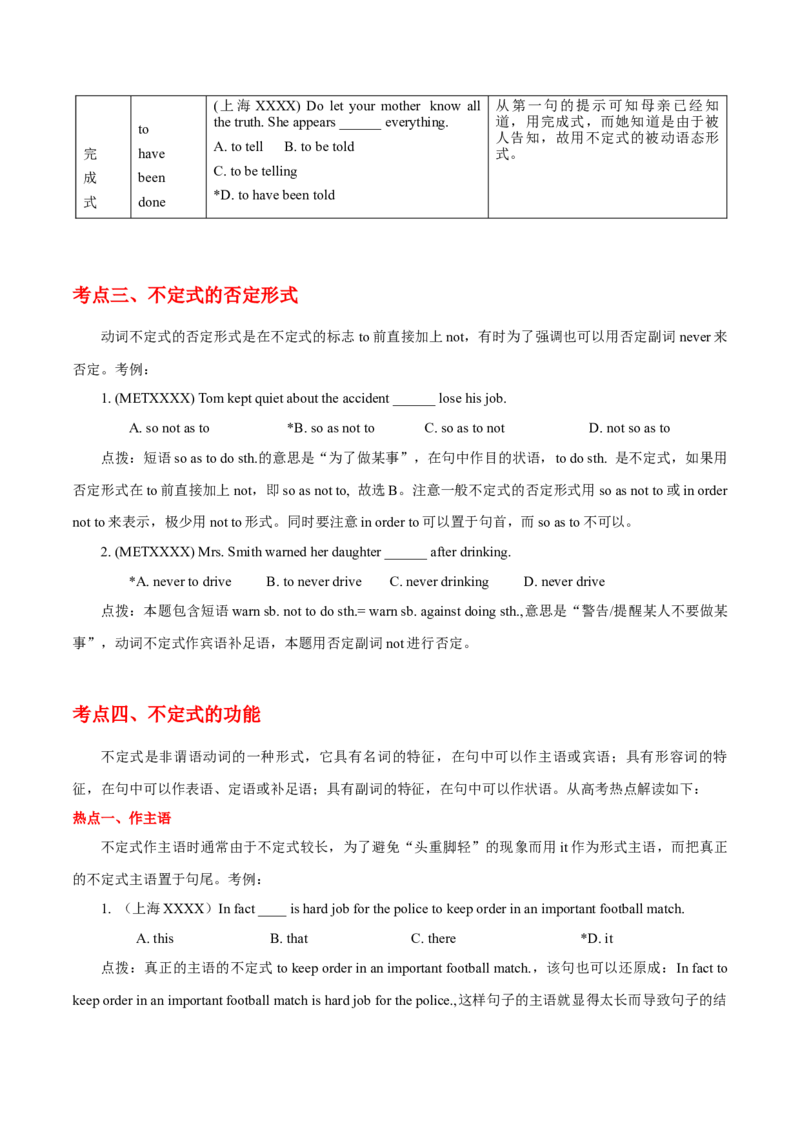
1. (上海XXXX)In fact ____ is hard job for the police to keep order in an important football match.
A. this B. that C. there *D. it
点拨:真正的主语的不定式to keep order in an important football match.,该句也可以还原成:In fact to
keep order in an important football match is hard job for the police.,这样句子的主语就显得太长而导致句子的结构不平衡,所以用D为最佳答案。
2. (METXXXX) Is ______ necessary to complete the design before National day?
A. this B. that *C. it D. he
再如:1)To know something about English is one thing; to know English is quite another. 懂一点英语是一
回事;掌握英语完全是另一回事。
2) To see is to believe. 眼见为实。
用it作为形式主语,而把真正的不定式主语放到句尾的常用句子类型有:
1) It +be+形容词+to do sth. 如:
It is nice not to be dependent on others. 不依靠别人是好的。
It would be foolish not to accept their offer.不接受他们的帮助是愚蠢的。
2) It +be+形容词+ for sb. to do sth.
以下形容词通常多数情况用for sb作逻辑主语:easy, hard, difficult, important, necessary, impossible, possible,
safe, dangerous, unusual, wonderful…。如:
It is not hard for one to do a bit of good.一个人做点好事并不难。
What time it would be convenient for me to come again? 我们什么时候再来比较方便?
3) It +be+形容词+ of sb. to do sth.
此处的形容词往往修饰不定式的逻辑主语,形容词多是表示赞扬、责备的形容词,通常用of sb作逻辑
主语:即 wrong, right, kind, nice, brave, careful, careless, greedy, honest, lazy, modest, selfish, thoughtful,
impolite, polite, clever, foolish, silly, stupid, cruel, rude, generous,considerate… 如:
It was selfish of him not to contribute anything. 他门自私,什么也不捐。
It was silly of you to believe him.= You are silly to…你相信他是愚蠢的。
4) It+be+名词 + to do sth. 如:
It was not his habit to ask people for things. 他没有向别人借东西的习惯。
It’s a shame to behave like that. 这样的行为是很可耻的。
It has been a pleasure to be with you.和你字一起很愉快。
5) It+动词+(+宾语)to do sth. 如:
It takes a lot of more guts for a woman to resign than for a man.女人辞去工作比男人需要跟大的勇气。
It took me a year to save up for a new coat.我用了一年时间才省出钱买一件新大衣。
6)It +be+ 介词短语+to do sth. 如:
It is beyond my power to answer this question. 我没有能力回答这个问题。
It’s just like her to think of others before thinking of herself.她就是这个样子,总是先想到别人后想到自己。
热点二、作宾语
不定式作宾语通常不作介词的宾语,如果用介词也仅限于 but/except/besides等几个有限的介词。不
定式主要用来作动词的宾语。
有些动词用不定式和ing形式作宾语意义区别不大,有的有明显的区别;有的只用不定式作宾语。
分解成高考热点如下:
I、跟不定式作宾语与跟动词ing形式意义区别不大的及物动词
像continue, like, start, begin等词跟不定式或动词ing形式作宾语区别不大,但是对于start, begin在下列
两种情况下用不定式。1)当其本身是进行时态 2)当所跟的非谓语动词是表示认知的动词。如:
1. She was beginning to work on his novel that summer vacation.那年暑假她开始写小说。
2. She began to realize it was Tom who did wrong to her.她开始认识到是汤姆冤枉了她。
II、有些动词跟不定式作宾语与跟动词ing形式意义较大(所跟ing形式见〈动名词〉)
1. remember/ forget/regret跟不定式时,表示不定式的动作发在其之后,译作:记得要做某事;忘记要
做某事;因要做某事而感到遗憾。考例:
1.(METXXXX) --- The light in the office is still on. --- Oh, I forget ______.
A. turning it off B. turn it off *C. to turn it off D. having turned it off
点拨:根据第一句is still on“灯仍然亮着”可以知道电灯可以关,所以是“忘记要做某事”,用不定
式,故选C。
2. try to do sth.“努力做某事”;mean to do sth.“打算做某事”;如:
(XXXX上海) The little time we have together we try ______ wisely.
A. spending it B. to spend it *C. try to spend D. spending that
点拨:try to do sth.的意思是“努力做某事”;try doing sth.的意思是“试着做某事”,由little time可
知选C。本句实际上是一个前置句,正常的语序是:W try to spend the little time we have together wisely.
请注意以下接不定式与动名词作宾语意义不同的动词:III、有些动词只能跟不定式作宾语
ask/ want(想要)/pretend/ agree/ wish/ ask/ afford/expect/ refuse/ demand/ decide/ plan/ seem/ promise/
happen/ beg/ offer/ manage/afford/ help/ intend/ strive等。考例:
1. (METXXXX) He pretended ______ me when I passed by.
*A. not to see B. not seeing C. to not see D. having not seen
点拨:及物动词pretend“假装”,表示假装做某事跟不定式作宾语,再根据不定式的否定构成可以
得出A正确。
2. (NMETXXXX) We agreed _____ here but so far she hasn’t turned up yet.
A. having met B. meeting *C. to meet D. to have meet
点拨:及物动词agree“同意”,表示同意某人做某事用不定式作宾语,从but so far she hasn’t turned
up yet“可是到现在他还没有出现”可以看出不定式的动作还没有发生,不可以用完成时,故选C。
3. (上海XXXX) In order to gain a big share in the international market, many state-run companies are striving
______ their products more competitive.
*A. to make B. making C. to have made D. having made.
IV、有些介词可以用不定式作宾语
像except/but/besides等部分介词也可以用介词作宾语,此种用法比较特殊,需要特殊记,通常情况下
不定式是不可以作介词宾语的。考例:
(上海XXXX) Sandy could do nothing but ____ to his teacher that he was wrong.
*A. admit B. admitted C. admitting D. to admit
点拨:but后面跟动词不定式作介词宾语,但是当其前面有实意动词 do的时候,如本题的do nothing
或nothing to do,则不定式to要省掉。
IV、有些介词可以用不定式作宾语
不定式作宾语时,如果是后面跟有宾语补足语,如形容词,名词等,通常由于不定式较长,为了避
免“头重脚轻”的现象而用it作为形式宾语,而把真正的不定式宾语置于句尾。考例:
(METXXXX) I don’t think ______ necessary to master a foreign language without much memory work.
A. this B. that C. its *D. it
点拨:由于动词不定式作宾语后面跟的宾语补足语 necessary太短,而不定式宾语to master a foreign
language without much memory work太长,所以就需要借助于形式宾语it,故选D.
热点三、作表语不定式可以作表语,而且用“be+不定式”结构还可以表示将来时,在不定式作表语的句子中,
不定式依然保留有作作目的状语时的表示目的的倾向,比如当用desire/ hope/ wish/ aim/ purpose等表示
目的、愿望的词作主语时,其表语多用不定式形式。
1. (上海XXXX) In such a dry weather, the flowers will have to be watered if they _____.
A. have survived *B. are to survive C. would survive D. will survive
点拨:根据句意可以看出从句是将来时的意义,但是由于状语从句不可以用将来时,而常用现在
时代替,排除C、D;A项的完成时不符合句意,所以选B,实际上是现在时表示将来时的一种用
法。
2. (NMETXXXX) The purpose of new technologies is to make life easier, ____ it more difficult.
A. not make *B. not to make C. not making D. do not make
点拨:题中的主语purpose的意思是“目的”,此处是两个不定式作并列表语,由于是对比关系,
所以不定式的标志to接没有省掉,故选B。
3. (上海XXXX) I feel it is your husband who _____ for the spoiled child.
*A. is to blame B. is going to blame C. is to be blamed D. should blame
点拨:be to blame的意思是“应该受到责怪”,其中的不定式作表语,此处的“be to”的意思是“应
该”,根据blame词汇用法,需用主动形式表示被动意义,故选A。
热点四、作定语
动词不定式作定语时,在时间上倾向于表示将来。不定式与其所修饰的词之间往往是动宾关系,若
该不定式是不及物动词,其后应有必要的介词。
(上海XXXX) When I handed the report to John, he said that George was the person ________.
A. to send B. for sending it *C. to send it to D. for sending it to
点拨:根据短语send sth. to sb可以选出C正确。不定式作定语。
(一)在“have(有)+名词/代词+不定式”结构中,作定语的不定式的动作执行者如果是句子里的主
语或某一个人称代词时,不定式要用主动形式表示被动意义。考例:
1.(2017天津卷)I was watching the clock all through the meeting, as I had a train_________ .
A.catching B.caught *C.to catch D.to be caught
2.(上海.XXXX)She will tell us why she feels so strongly each of us has a role _____ in making the earth a
better place to live.
A. to have played *B. to play C. to be played D. to be playing
点拨:本题实际上包含这样一个短语:play a role in“在……中起作用”,role本来是及物动词play的
动作对象,但是由于句子的谓语动词是表示“有”的have, 而play的动作执行者就是句子的其所在句中的主语each of us,故选B。
3. (上海 XXXX) There are five pairs ______, but I’m at a loss which to buy.
A. to be chosen *B. to choose from C. to choose D. for choosing
点拨:根据句意可知不会是five pairs都买,只是买five pairs中的其中之一,因此应该是从其中选择,
故选B。
(二)在序数词,形容词最高级,the last, the only 等后或被这些词修饰的名词/代词后,常用不定式
作定语。
He is always the first to arrive at the school and the last to leave the school.他总是第一个到校,最
后一个离校。
(三)被修饰词是ability, chance, idea, hope, wish, fact, excuse, promise, attempt, way 等抽象名词
时,常用不定式作定语。如:
And the best way to strengthen willpower is to make it into a habit.增强意志力最好的方法就是让意
志力成为一种习惯。
The ability to express an idea is as important as the idea itself表达观点的能力与观点本身同等重
要。
热点五、作补足语
有些及物动词像 ask/ invite/ warn/ cause/ advise/ permit/ encourage/ persuade/ tell/ teach/ would like/
remind/ cause/ urge/ want/ desire/ prefer/ expect/ request/ order/ allow/ consider(认为)/force/ teach/ beg/ get/
oblige等常跟带不定式标志to的不定式作宾语补足语(有关涉及到不定式to 省略的情况见后面)。考例:
1. (北京XXXX)My advisor encouraged _____ a summer course to improve my writing skills.
A. for me taking B. me taking C. for me to take *D. me to take
2. (北京XXXX)21. The teacher asked us _____ so much noise.
A. don’t make B. not make C. not making *D. not to make
3. (上海XXXX)43. An army spokesman stressed that all the soldiers had been ordered _____ clear warnings
before firing any shots.
*A. to issue B. being issued C. to have issued D. to be issued
4. (NMETXXXX) The patient was warned _____ oily food after the operation.
A. to eat not B. eating not *C. not to eat D. not eating
热点六、作状语
I. 不定式作状语主要作目的状语,可以置于句尾,此时不用逗号与句子隔开,如果置于句首通常用逗号与句子隔开。当用so as to和in order to的时候,要考虑到so as to一般不以置于句首。考例:
1.(2022·全国高考乙卷)_____ (strengthen)the connection with young people, the event included a number
of public promotional activities on social media, inviting twenty-nine tea professionals from around the world to
have thirty-six hours of uninterrupted live broadcasts.
点拨:根据句意可知,此处表达“为了加强与年轻人的联系”,需要用不定式作目的状语。故填To
strengthen。句意:为了加强与年轻人的联系,活动包括在社交媒体上的一系列公共宣传活动,邀请了来自
世界各地的29名茶叶专业人士进行36小时不间断的直播。
2.(2022•新高考Ⅰ卷)The plan will extend protection to a significant number of areas that were previously
unprotected, bringing many of the existing protected areas for giant pandas under one authority ______ (increase)
effectiveness and reduce inconsistencies in management.
点拨:设空处在句中作非谓语,做目的状语,应用动词的不定式的形式。故填 to increase。句意:该
计划将把保护范围扩大到大量以前未受保护的地区,将许多现有的大熊猫保护区纳入一个管理机构,以提
高效率,减少管理上的不一致性。
3.(2022•新高考Ⅱ卷)Eric woke up a little later when he heard children playing outside. He pushed
a chair onto the balcony, and climbed up ______ (see) them.
点拨:climb up为谓语动词,所以设空处see应该使用非谓语动词。根据句意,他要爬到阳台去看
他们(外面玩闹的孩子们。),故应该使用to do不定式作目的状语。故填to see。句意:过了一会儿,艾
瑞克听到孩子们在外面玩耍的声音,醒了过来。他把一把椅子推到阳台上,爬上去看他们。
4. (京皖卷.XXXX) _______ late in the morning, Bob turned off the alarm.
*A. To sleep B. Sleeping C. Sleep D. Having slept
5. (上海XXXX)--- Mm, why do you always make me eat an egg every day?
--- _______ enough protein and nutrition as you are growing up.
A. Get B. Getting *C. To get D. To be getting
6.(上海.XXXX)In order to make our city green, _____.
A. it is necessary to have planted more trees B. many more trees need to plant
C. our city needs more trees *D. we must plant more trees *
7. (METXXXX) Go on _____ the other exercise after you have finished this one.
*A. to do B. doing C. with D. to be doing
8.(2021天津卷·第二次)Mary became a baker at age 14, because her grandfather paid the local
baker_________ her all the skills.
A. to have taught /B. to teach C. teaching D. having taughtII. 不定式也可以作结果状语,但是与动词ing形式不同,不定式所表示的结果往往是出乎意料之外。考
例:
(福建XXXX) The news reporters hurried to the airport, only _______ the film stars had left.
A. to tell *B. to be told C. telling D. told
点拨:根据hurried to the airport“匆匆忙忙地到机场”可以推定记者门原以为能够赶得上,但是实际上
“电影明星门已经离开”,这种结果是记者门没有料到的,否则就不必要忙了,only to do sth.也可以看作
是一个固定结构,意思是“没料到……”,故选B。
2. (2014天津卷) Anxiously, she took the dress out of the package and tried it on, only _________ it didn't
fit.
/A.to fin B.found C.finding D.having found
III. 有些形容词后面跟不定式,这种结构从意义上判断更像是宾语从句,但是多数语法家都把其划入
状语从句,常用在“主语+系动词+形容词+to do”结构中。常用形容词多与表示情感或心理状态有关,
如 sorry, glad, determined, willing, ready, easy, difficult, hard, cheap,expensive,fit,comfortable,
dangerous,heavy,good,important,impossible,surprised,astonished, delighted, disappointed 等。考例:
We were astonished to find the temple still in its original condition.令我们吃惊的是,这座寺庙仍保持着最
初的样子。
(湖南XXXX) You were silly not _____ your cat.
A. to lock *B. to have locked C. locking D. having locked
再如:I was surprised ________.
A. watching him to eat so quickly B. watch him eat so quickly
C. watching his eat so quickly *D. to watch him eat so quickly
考点五、连词+不定式
“疑问词+不定式”结构实际上相当于名词的作用,在句中可以作主语、宾语和表语。要注意与“连
词+分词”结构的区别,其中的不定式主要用一般式。不定式作动词(短语)learn, decide, know, wonder, show,
tell, understand, explain, teach, advise, find out 等的宾语时,前面常带引导词how, what, whether, where, when,
who等。考例:
1.(NMETXXXX)It is said that in Australia there is more land than the government knows _________.
A. it what to so with B. what to do it with *C. what to do with it D. to do what with it
点拨:本题考查“疑问词+不定式”和动词短语do with的用法,根据本题的意思可以看出,由于know不可以直接跟动词不定式而排除 D,“疑问词+不定式”结构当然要把疑问词置于前面,从而排除 A,
what…do with…实际上是一个常用的短语,在短语中what作do的宾语,句中的it作介词with的宾语,故
选C。
2. (NMETXXXX) I’ve worked with children before, so I know what ______ in my new job.
A. expected *B. to expect C. to be expecting D. expects
点拨:根据“疑问词+不定式”结构的原则可以排除C,根据句意可以看出expect 应该用被动语态,排
除A、D,故选B。
3. (METXXXX) Last summer I took a course on ______.
*A. how to make dresses B. how dresses be made
C. how to be made dresses D. how dresses to be made
点拨:从句意可以看出题中的“how+不定式”作介词on的宾语,根据句意“我去年夏天选修了一门如何
做衣服的课程”,可以推出A正确。
考点六、不定式to的省略。
动词不定式不带to,那么它就是动词原形,因此可以构成祈使句。就我们目前在中学阶段所接触到的
to的用法来看,在以下的情况通常省去to(要注意有时带与不带to都是可以接受的,笔者将在文中注
出)。
1.在助动词、情态动词之后(had to, used to, ought to, be able to等除外,因为它们本身皆带有to)如:
1) (上海XXXX)Oh, I’m not feeling well in the stomach. I shouldn’t have eaten so much fried chicken
just now.
2) (.XXXX)---I hear you’ve got a set of valuable Australian coins. May I have a look?
--- Yes, certainly.
3) (上海XXXX)I wonder how he dared say that to the teacher.
4) (上海XXXX) An awful accident did, however, occur the other day.
5) (上海XXXX)Sir, you oughtn’t to be sitting in this waiting room. It is for women and children only.
6) (NMETXXXX) The fire spread through the hotel quickly but everyone was able to get out
7) (METXXXX) Mother used to tell us stories when we were young.
2.在 had better, would rather…than…., …rather than…, do nothing other than…, might as well(不妨、还是……的好), cannot help but/ cannot choose but/ cannot but (不得不)等搭配之后,不定式习惯上要省去
to。如:
8)(京皖XXXX) In that case, there is nothing you can do _____ than wait.
A. more *B. other C. better D. any
9) (NMETXXXX) Rather than _____ on a crowded bus, he always prefers _____ a bicycle.
A. ride; ride B. riding; ride *C. ride; to ride D. to ride; riding
10) (METXXXX) --- Shall we go skating or stay at home?
--- Which _____ do yourself?
A. do you rather *B. would you rather C. will you rather D. should you rather
11)(METXXXX) It’s freezing outside, you ____ put on your overcoat.
A. had better to *B. had better C. would better D. would better to
12) might as well give the sweet course a miss.这道点心我还是不吃吧。
3.不定式一般不可以作介词的宾语,但是介词but/ except/ besides等词可以用不定式作其宾语,而且如果
其前有实义动词do的某种形式时,不定式的标志to一般要省掉;如果前面谓语动词没有do的形式,
则to必须要带上,(注:如果but前的do不作谓语,则to带与不带均可)如:
13)Now we could do nothing but wait for him here.(试比较XXXX上海考题)
14)I hardly remember what I did besides read.
15) She had no choice but to fight to the end.她没别无选择,只有斗争底。
16) There was nothing left to do but (to) give up the plan. (but前的to不作谓语,而是作定语)
4. 在have, let, make和感官动词hear, feel, see, watch, observe, notice, listen to, look at, observe 等词后作宾语
补足语时不带to,但是当它们用于被动语态时,则to应加上。如:
17) (北京.XXXX)--- When shall we start? ---- Let’s _______ it 8:30. Is that all right?
A. set B. meet *C. make D. take
18) (NMETXXXX) Paul doesn’t have to be made ____. He always works hard.
A. learn *B. to learn C. learning D. learned
19) (NMETXXXX) --- I must apologize for _____ ahead of time.
--- That’s all right.
A. letting you not know *B. not letting you know
C. letting you know not D. letting not you know
20) (METXXXX) They know her well. They had seen her ______ up from childhood.
*A. grow B. grew C. was growing D. to grow21) (METXXXX) Though he had often made his little sister ____ today he was made_____ by his little sister.
*A. cry; to cry B. to cry; cry C. cry: cry D. crying; crying
5. 当help后面跟不定式作宾语或作宾语补足语时,小品词to用与不用都可以,但是如果help用于被动语
态或help的行为主体没有参与宾语补足语不定式表示的活动时,不定式的to必须用。如:
22) Can anyone help me (to) carry the suitcase upstairs?
23) Then he helped sweep the floors of the waiting rooms.
24) This book helps me to see the truth.
这本书有助于我了解真实的情况
6. 在祈使句中用动词原形,即用不带to的动词不定式。如:
25) (上海.XXXX)Don’t be discouraged. ______ things as they are and you’ll enjoy every day of your life.
A. Taking B. To take *C. Take D. Taken
26) (京皖.XXXX) _____ some of this juice---perhaps you’ll like it.
A. Trying *B. Try C. To try D. Having tried
27) (METXXXX) ______ it with me and I’ll see what I can do.
A. When left B. Leaving C. If you leave D. Leave
28) (METXXXX) ____ down the radio--- the baby’s asleep in the next room.
A. Turning B. To turn C. Turned *D. Turn
7. 在why not或why引起的疑问句中用动词原形,该结构的否定式表示建议,肯定形式表示不满或委婉的
批评。如:
29) (METXXXX) ---I usually go there by train. --- Why not _____ by boat for a change?
A. to try going B. trying to go C. to try and go *D. try going
30) Why stand up if you can sit down? 要是你能够坐下,为什么还站着?
8.如果两个或两个以上的具有同样功能的不定式并列,to只用在第一个不定式前,其余的to省略,以避
免重复,但是表示对比关系的除外。如:
31) His wish is to enter this college and study English.
32) (NMETXXXX) The purpose of new technologies is to make life easier, ____ it more difficult. (本句
表示对比关系)
A. not make *B. not to make C. not making D. do not make
33) He hasn’t decided whether to go home or to stay at school during the vacation.
34) They will be encouraged to eat healthy foods, not to smoke and to drink less beer and wine.(Lesson67
Unit 17 SBII)9. 当dare用作情态动词时,只用于疑问句和否定句中;而用作实义动词时与其它实义动词一样可以用于
各种句式。作实义动词接不定式作宾语,如果用于疑问句或否定句中,此时作宾语的不定式to可以省
去,而在肯定句中to不省,如:
35) All didn’t dare (to) try a shot.
36) Did he dare (to) jump over the fence?
10. 当不定式作表语时,如果句中的主语是all或what引导的从句或者主语受only, first, one, least及形容词
最高级修饰,并且后面的从句或短语中有实义动词do时,作表语的不定式前一般可以不用to,此时的
不定式是用来解释实义动词“do”的确切含义。如:
35)(Lesson 35 Unit9 SBIII) The first thing she did was go up to her trainer and thank her for all her
help during her training.她要做的第一件事就是走到她的教练面前,感谢她在训练期间给予她的帮
助。
36) The only thing I can do now is (to) turn to him for help.
37) What he really hoped to do was (to) stay up late.
38)The best way to do is (to) wait until she returns.
11. 在以下的固定搭配中不用to: make do(凑合、应付),let go(放开、松手、轻松), make believe
(假装),go hang(听其自然、被忘却、不再被关心),I dare say(我看、可能、也许)等。如:
39) Let’s make believe that we’re police officers.
40) We’ll have to make do with what we have now. 现在我们必须凑合着用。
41) I dare say my uncle will. I have no other relatives.(Less58 SBIII)
42) Mr. Brown let go at the reunion of his old class and had a good time.布朗先生与老同学重聚时玩得轻
松愉快。
43)If you don’t have the right tool for the job, we’ll have to make do without it.假如你没有干这活的适
当工具,咱们只得对付着干。
牛刀小试
从下列A、B、C、D四个选项中选出可以填入空白处的正确选项。
1. Did you find out ______the pie out of the oven?
A. to take B. have taken C. when to take D. being taken
2. We shall get Jim ______the passage.A. explaining B. explained C. to explain D. explain
3. He kept it a secret ______lose his job.
A. so not as to B. so as not to C. so as to not D. not so as to
4. I warn my son ______after drinking.
A. never to drive B. to never drive C. never driving D. never drive
5. The Chinese are generally considered ______ printing.
A. to invent B. inventing C. to have invented D. having invented
6. Tom should love ______ to the cinema tonight.
A. to be taken B. to take C. being taken D. taking
7. Rather than ______on a slow bus, he always prefers ______a bike.
A. ride, ride B. riding, ride C. to ride, riding D. ride, to ride
8. She has no pencil ______
A. to write about B. to write with C. to write D. to write in
9. She could do nothing but ______her name under the circumstances.
A. to change B. charging C. to be changing D. change
10. Mary was seriously ill ,so we arranged ______by the best doctors.
A. for her to be examined B. for her to examine C. her to be examined D. her examined
11. Without facts, We can not form a worthwhile opinion, for we need factual knowledge ______our thinking.
A. which to be based on B. upon which to base C. which to base upon D. to which to be based
12. We agreed ______at 8 o’clock but so far she hasn’t turned up yet.
A. having met B. meeting C. to meet D. to have met
13. The boy wanted to swim in the lake, but his mother told him ______.
A. not to B. not to do C. not to do it D. do not to
14. When I handed the report to John, he said that George was the person ___
A. to send B. for sending C. to send it toD. for sending it to
15. The matter had better ______as it is.
A. leave B. be left C. leaving D. being left
16. He had no choice but ______hard.
A. work B. to work C. working D. to be working
17. He loves parties, he is always the first ______and the last ______.
A. coming, leaving B. to come, to leave C. come leave D. comes, leaves
18. Do you think him easy ______?A. to deal with B. to deal C. to be dealt with D. having dealt with
19. I feel it an honour ______to speak here.
A. to ask B. asking C. to be asked D. having asked
20. I went to the post office, only ______it was closed.
A. finding B. to find C. having found D. found
21. Now the need ______other peoples’ languages is becoming greater and greater.
A. to learn B. learning C. t be learning D. learned
22. When the child ______of her mother’s hand, she fell down.
A. let to go B. let going C. let go D. lets go
23. The teacher told the students to stop ______to him.
A. to write and listen B. writing and listening C. to write and listening D. writing and to listen
24. We are planning ______Europe this summer.
A. to pay a visit B. pay a visit to C. to pay a visit to D. visiting
25. I can’t but ______to hear such a story.
A. to laugh B. laugh C. laughing D. laughed
26. Shall we go and listen to the reviewers ______on the new film?
A. to comment B. comment C. to commenting D. being comment
27. Goodbye, Mr Smith. I’m pleased ______.
A. for meeting you B. to have you C. to have been meeting you D. to have met you
28. I regret ______you that we are unable to offer you the job.
A. inform B. having informed C. to inform D. informed
29.It’s said that he is the first one ______ at the medical conference.
A. speaks B. spoken C. to speak D. speaking
30.If you go to the post office, would you like _____ this letter for me?
A. posting B. to post C. posted D. post
31.The party was successful, but we thought it a pity not ____ you.
A. to have invited B. inviting C. to invite D. invited
32.Which do you enjoy _________, playing cards or taking a walk?
A. to have spent B. spending C. having send D. to spend
33.She came back in a hurry to watch the football, only ___ the door locked.
A. finding B. having found C. to find D. have found
34.All the buildings burnt down in the big fire remain _____.A. rebuilding B. to be rebuilt C. having rebuilt D. to have been rebuilt
35.With so much homework ______, I have to stay at home, giving up the idea of playing video games with Peter.
A. to do B. being done C. done D. doing
36. --- If Mary doesn’t come to work on time, she may be fired.
--- Surely she is not so foolish ______ it.
A. as not to realize B. not as to realize C. that she didn’t realize D. as not realizing
37. All of them have already known the problems ____ at the meeting which will be held the day after tomorrow.
A. discussed B. being discussed C. to be discussed D. to discuss
38. (METXXXX) Little Jim should love _____ to the theatre this evening.
A. to be taken B. to take C. being taken D. taking
39. (NMETXXXX) Having a trip abroad is certainly good for the old couple, but it remains _____ whether thy will
enjoy it.
A. to see B. to be seen C. seeing D. seen
40. (上海XXXX) She can’t help ______ the house because she’s busy making a cake.
A. to clean B. cleaning C. cleaned D. being cleaned
41. (METXXXX) Charles Babbage is generally considered ____ the first computer.
A. to invent B. inventing C. to have invented D. having invented
42. (METXXXX) She reached the top of the hill and stopped ____ on a big rock by the side of the path.
A. to have rested B. resting C. to rest D. rest
KEY: 1-5 CCBAC 6-10 ADBDA 11-15 BCACB 16-20 BBACB
21-25 ACDCB 26-30 BDCCB 31-35 ADCBA 36-40 ACABA 41-42 CC
解题思路点拨
1. 点拨: 选C 动词不定式短语作宾语
2. 点拨:选C 动词不定式作宾补
3. 点拨:选B so as to用作否定时,应用so as not to
4. 点拨:选A 用never否定,语气更强
5. 点拨:选C 不定式完成式作主语补足语,表示invent动作先于谓语动词而发生。
6. 点拨:选A 表示“今晚被带去看电影”7. 点拨:选D rather than后须跟动词原形,prefer to do为固定搭配
8. 点拨:选B 不定式短语作定语
9. 点拨:选D but后接不定式时,若前面有行为动词do 省略to
10. 点拨:选A 不定式复合结构作宾语,被动式表示被检查。
11. 点拨:选B 不定式短语作定语,常用主动式表被动,且介词upon提前,须加which.
12. 点拨:选C agree to do为固定搭配。
13. 点拨:选A not to在此处是省略形式。
14. 点拨:选C 不定式短语作定语,表示尚未发生的动作。
15. 点拨:选B had better+动词原形,此处应用被动。
16. 点拨:选B but介词后跟不定式
17. 点拨:选B 当名词前有序数词作定语时,常用不定式作定语。
18. 点拨:选A 不定式作状语,修饰补语形容词,常用主动式表被动含义。
19. 点拨:选C 不定式作宾语,这里为“被邀请在这里发言很荣幸”。
20. 点拨:选B,不定式作结果状语,表示意外。
21. 点拨:选A the need后接不定式作定语。
22. 点拨:选C let go“放开”
23. 点拨:选D stop doing停下(手中的事)
24. 点拨:选C plan跟不定式作宾语,短语pay a visit to表示“拜访……”。
25. 点拨:选B can’t but do只能做…
26. 点拨:选B 感官动词后面的不定式作宾补,省去to
27. 点拨:选D 告别语,所以用不定式的完成式
28. 点拨:选C regret to do遗憾地要做……
29. 点拨:点拨:被序数词修饰的名词或代词跟非谓语动词作定语时用不定式,故选C。
30. 点拨:like后可以跟动词 -ing形式或不定式作宾语,但是would (should) like后不可以跟-ing形式,可
以跟名词、代词或不定式,故选B。
31. 点拨:不定式的完成时表示不定式的动作先于句子的谓语而发生,根据句意应该是在晚会前邀请,所
以用不定式完成时,故选A。
32. 点拨:通常认为enjoy跟动词ing形式作宾语,但是根据句意可知其宾语特殊疑问词 which, 而which
就是后面的playing cards at or taking a walk,因此“_____ your spare time”可以理解为目的状语,而不
定式通常作目的状语,故选D。
33. 点拨:不定式作状语主要表示目的,但是也可以表示结果,此时不可以置于句首,而且所表示的结果往往是意料之外的。only to do译作“没料到……”,根据in a hurry“匆忙地”可知结是没有想到的,
故选C。
34. 点拨:remain to do的意思是“有待于”,根据句意应该是“有待于建设”,而建设是被动的,故选
B。
35. 点拨:本题是“with+复合宾语”,根据have to stay at home可知“有许多作业需要做”,是将来意义,
用不定式,但此处的with体现出“有”的意思是,而do的动作就是句子的主语“I”发出的,所以选
A,不定式主动表示被动。
36. 点拨:so as to do表示目的,so…as to do表示结果,不定式的否定词应该置于不定式 to之前,故选
A。
37. 点拨:会议还没有召开,“讨论”应该是在将来,不定式表示将来,而“问题”是“讨论”的动作对
象,故选C。
38. 点拨:从Little的提示可知Jim想“被带去听戏”,所以用被动语态,故选A。
39. remain to do的意思是“有待于”,根据句意可以看出是被动语态,故选B,
40.根据原因状语从句的“忙于做蛋糕”可知“不能帮着打扫房间了”,用不定式,选A,不要误选成B。
41.consider在此的意思是“认为”,句子用的是被动语态,而 computer已经发明过,动作先于consider发
生,不定式用完成时,故选C。
42. 句意是“停下来休息”所以用stop to do sth.,不定式看作是表示目的的状语,可以理解成stop in order
to rest,故选C。