文档文本内容
【同步 100 分背默】Unit6 An old man tried to move the mountains
知识清单
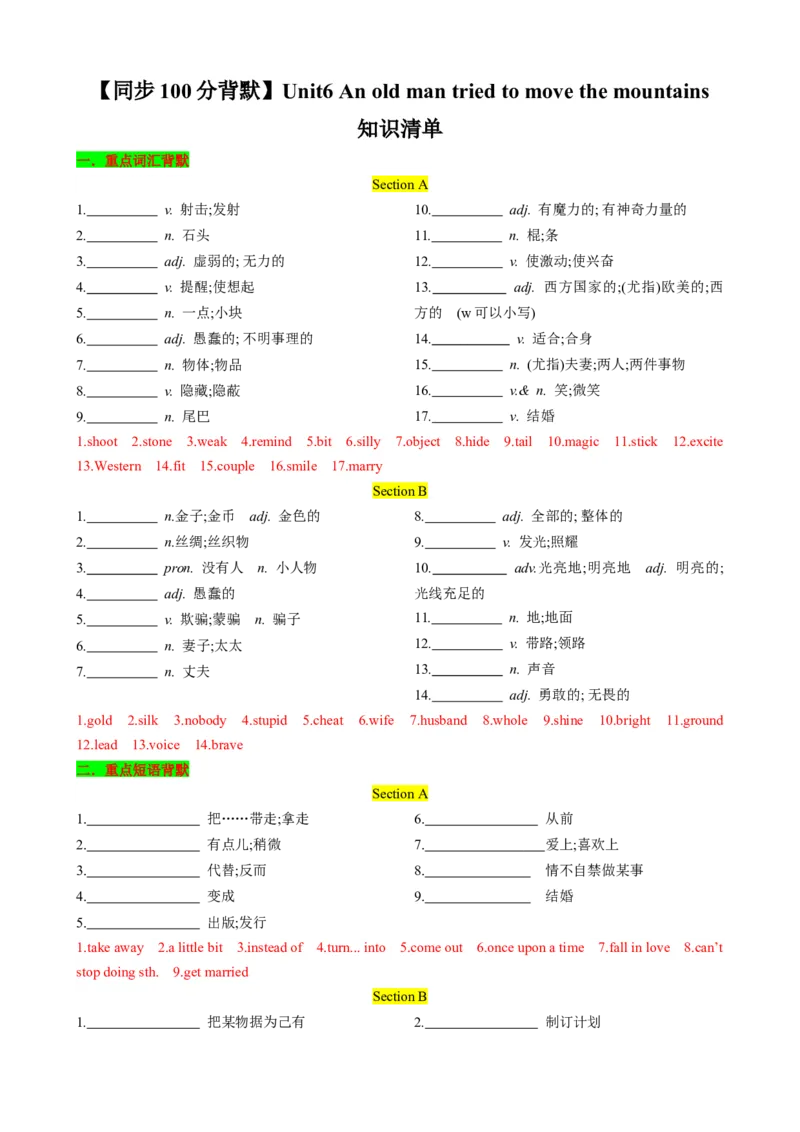
一.重点词汇背默
Section A
1. v. 射击;发射 10. adj. 有魔力的; 有神奇力量的
2. n. 石头 11. n. 棍;条
3. adj. 虚弱的; 无力的 12. v. 使激动;使兴奋
4. v. 提醒;使想起 13. adj. 西方国家的;(尤指)欧美的;西
5. n. 一点;小块 方的 (w可以小写)
6. adj. 愚蠢的; 不明事理的 14. v. 适合;合身
7. n. 物体;物品 15. n. (尤指)夫妻;两人;两件事物
8. v. 隐藏;隐蔽 16. v.& n. 笑;微笑
9. n. 尾巴 17. v. 结婚
1.shoot 2.stone 3.weak 4.remind 5.bit 6.silly 7.object 8.hide 9.tail 10.magic 11.stick 12.excite
13.Western 14.fit 15.couple 16.smile 17.marry
Section B
1. n.金子;金币 adj. 金色的 8. adj. 全部的; 整体的
2. n.丝绸;丝织物 9. v. 发光;照耀
3. pron. 没有人 n. 小人物 10. adv.光亮地;明亮地 adj. 明亮的;
4. adj. 愚蠢的 光线充足的
5. v. 欺骗;蒙骗 n. 骗子 11. n. 地;地面
6. n. 妻子;太太 12. v. 带路;领路
7. n. 丈夫 13. n. 声音
14. adj. 勇敢的; 无畏的
1.gold 2.silk 3.nobody 4.stupid 5.cheat 6.wife 7.husband 8.whole 9.shine 10.bright 11.ground
12.lead 13.voice 14.brave
二.重点短语背默
Section A
1. 把……带走;拿走 6. 从前
2. 有点儿;稍微 7. 爱上;喜欢上
3. 代替;反而 8. 情不自禁做某事
4. 变成 9. 结婚
5. 出版;发行
1.take away 2.a little bit 3.instead of 4.turn... into 5.come out 6.once upon a time 7.fall in love 8.can’t
stop doing sth. 9.get married
Section B
1. 把某物据为己有 2. 制订计划3. 迷路 4. 给某人指明去……的路
1.keep sth. for oneself 2.make a plan 3.get/be lost 4.show sb. the way to...
四.重点句子背默
Section A
1. 愚公继续努力并不放弃。
2. 故事是如何开始的?
3. 接下来发生了什么?
4. 美猴王不能做什么?
1.Yu Gong kept trying and didn’t give up. 2.How does the story begin? 3.What happened next? 4.What can’t
the Monkey King do?
Section B
1. 你们在森林里睡了那么久!
2. 我们以为你们再也不回来了。
3. 谁足够勇敢来吃我的房子?
1.What a long time you slept in the forest! 2.We thought you were never coming back. 3.Who is brave
enough to eat my house?
五.易错点背默
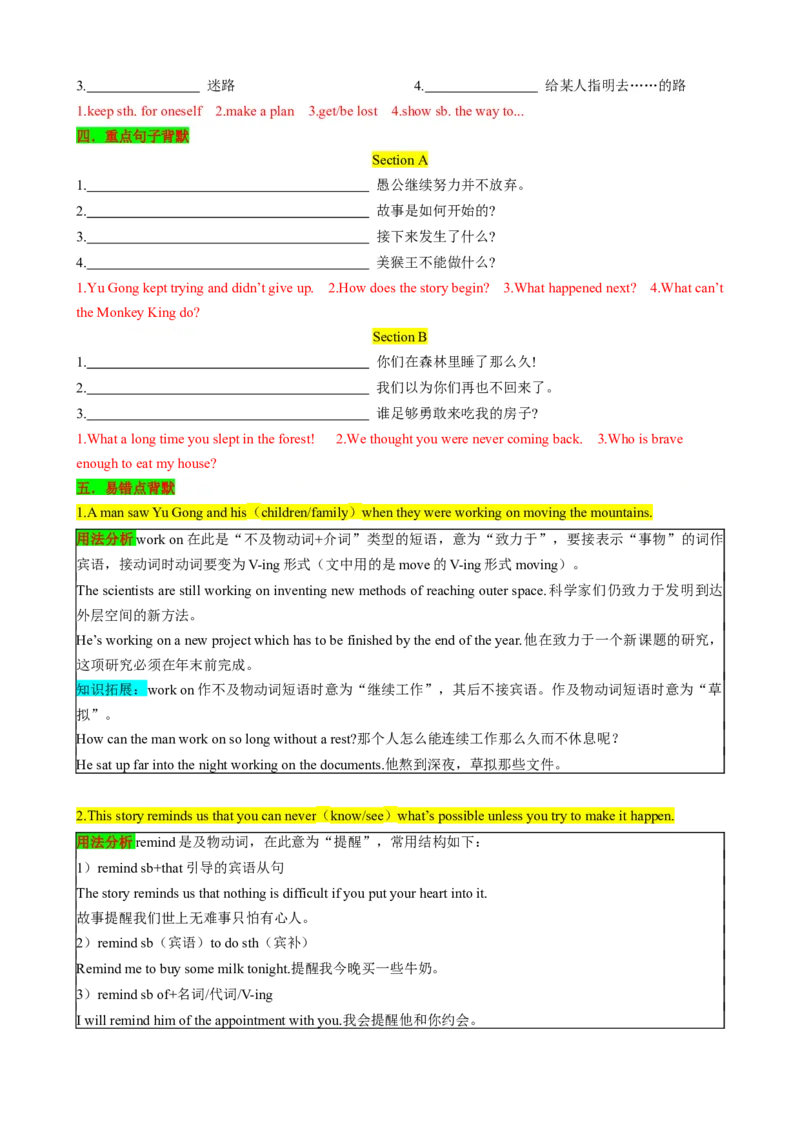
1.A man saw Yu Gong and his(children/family)when they were working on moving the mountains.
用法分析work on在此是“不及物动词+介词”类型的短语,意为“致力于”,要接表示“事物”的词作
宾语,接动词时动词要变为V-ing形式(文中用的是move的V-ing形式moving)。
The scientists are still working on inventing new methods of reaching outer space.科学家们仍致力于发明到达
外层空间的新方法。
He’s working on a new project which has to be finished by the end of the year.他在致力于一个新课题的研究,
这项研究必须在年末前完成。
知识拓展:work on作不及物动词短语时意为“继续工作”,其后不接宾语。作及物动词短语时意为“草
拟”。
How can the man work on so long without a rest?那个人怎么能连续工作那么久而不休息呢?
He sat up far into the night working on the documents.他熬到深夜,草拟那些文件。
2.This story reminds us that you can never(know/see)what’s possible unless you try to make it happen.
用法分析remind是及物动词,在此意为“提醒”,常用结构如下:
1)remind sb+that引导的宾语从句
The story reminds us that nothing is difficult if you put your heart into it.
故事提醒我们世上无难事只怕有心人。
2)remind sb(宾语)to do sth(宾补)
Remind me to buy some milk tonight.提醒我今晚买一些牛奶。
3)remind sb of+名词/代词/V-ing
I will remind him of the appointment with you.我会提醒他和你约会。He reminded me of closing all the windows.他提醒我关掉所有窗户。
知识拓展:remind作及物动词时还可以意为“使想起”,结构是remind sb of+名词/代词。
You hair and eyes remind me of your mother.你的头发和眼睛使我想起了你的母亲。
This song reminds me of the life in the USA.这首歌使我想起了在美国的生活。
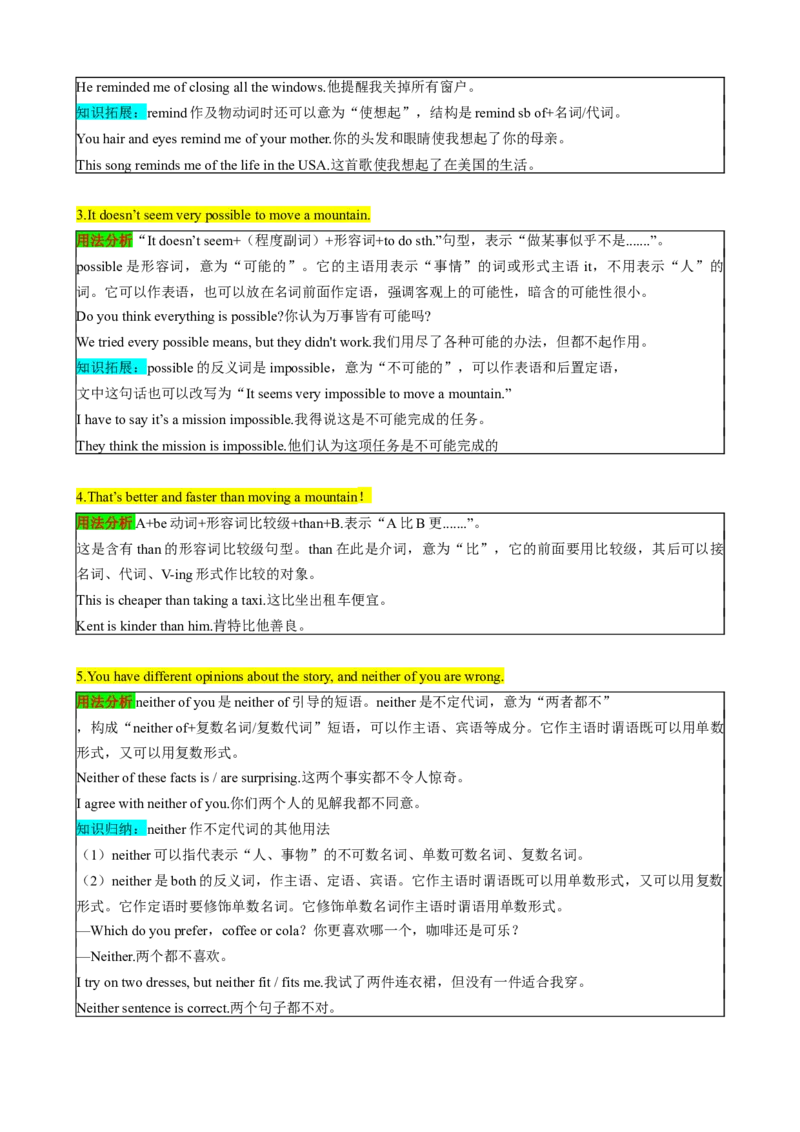
3.It doesn’t seem very possible to move a mountain.
用法分析“It doesn’t seem+(程度副词)+形容词+to do sth.”句型,表示“做某事似乎不是.......”。
possible是形容词,意为“可能的”。它的主语用表示“事情”的词或形式主语 it,不用表示“人”的
词。它可以作表语,也可以放在名词前面作定语,强调客观上的可能性,暗含的可能性很小。
Do you think everything is possible?你认为万事皆有可能吗?
We tried every possible means, but they didn't work.我们用尽了各种可能的办法,但都不起作用。
知识拓展:possible的反义词是impossible,意为“不可能的”,可以作表语和后置定语,
文中这句话也可以改写为“It seems very impossible to move a mountain.”
I have to say it’s a mission impossible.我得说这是不可能完成的任务。
They think the mission is impossible.他们认为这项任务是不可能完成的
4.That’s better and faster than moving a mountain!
用法分析A+be动词+形容词比较级+than+B.表示“A比B更.......”。
这是含有than的形容词比较级句型。than在此是介词,意为“比”,它的前面要用比较级,其后可以接
名词、代词、V-ing形式作比较的对象。
This is cheaper than taking a taxi.这比坐出租车便宜。
Kent is kinder than him.肯特比他善良。
5.You have different opinions about the story, and neither of you are wrong.
用法分析neither of you是neither of引导的短语。neither是不定代词,意为“两者都不”
,构成“neither of+复数名词/复数代词”短语,可以作主语、宾语等成分。它作主语时谓语既可以用单数
形式,又可以用复数形式。
Neither of these facts is / are surprising.这两个事实都不令人惊奇。
I agree with neither of you.你们两个人的见解我都不同意。
知识归纳:neither作不定代词的其他用法
(1)neither可以指代表示“人、事物”的不可数名词、单数可数名词、复数名词。
(2)neither是both的反义词,作主语、定语、宾语。它作主语时谓语既可以用单数形式,又可以用复数
形式。它作定语时要修饰单数名词。它修饰单数名词作主语时谓语用单数形式。
—Which do you prefer,coffee or cola?你更喜欢哪一个,咖啡还是可乐?
—Neither.两个都不喜欢。
I try on two dresses, but neither fit / fits me.我试了两件连衣裙,但没有一件适合我穿。
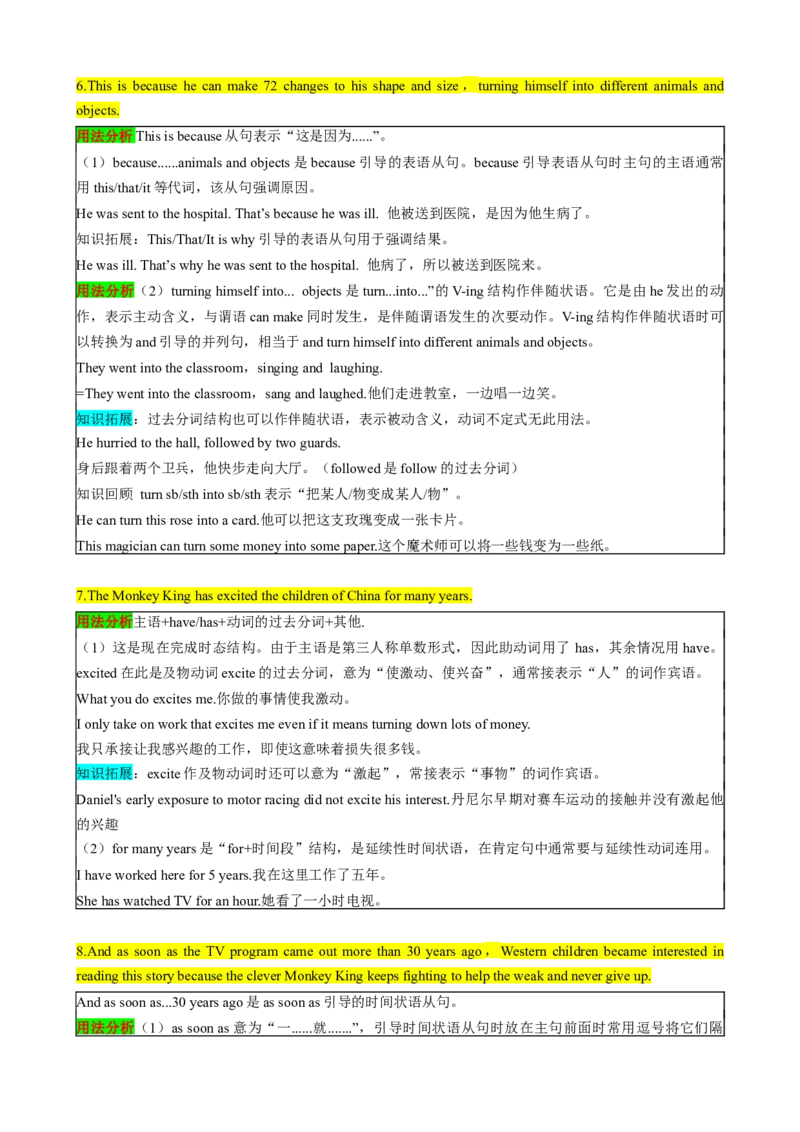
Neither sentence is correct.两个句子都不对。6.This is because he can make 72 changes to his shape and size,turning himself into different animals and
objects.
用法分析This is because从句表示“这是因为......”。
(1)because......animals and objects是because引导的表语从句。because引导表语从句时主句的主语通常
用this/that/it等代词,该从句强调原因。
He was sent to the hospital. That’s because he was ill. 他被送到医院,是因为他生病了。
知识拓展:This/That/It is why引导的表语从句用于强调结果。
He was ill. That’s why he was sent to the hospital. 他病了,所以被送到医院来。
用法分析(2)turning himself into... objects是turn...into...”的V-ing结构作伴随状语。它是由he发出的动
作,表示主动含义,与谓语can make同时发生,是伴随谓语发生的次要动作。V-ing结构作伴随状语时可
以转换为and引导的并列句,相当于and turn himself into different animals and objects。
They went into the classroom,singing and laughing.
=They went into the classroom,sang and laughed.他们走进教室,一边唱一边笑。
知识拓展:过去分词结构也可以作伴随状语,表示被动含义,动词不定式无此用法。
He hurried to the hall, followed by two guards.
身后跟着两个卫兵,他快步走向大厅。(followed是follow的过去分词)
知识回顾 turn sb/sth into sb/sth表示“把某人/物变成某人/物”。
He can turn this rose into a card.他可以把这支玫瑰变成一张卡片。
This magician can turn some money into some paper.这个魔术师可以将一些钱变为一些纸。
7.The Monkey King has excited the children of China for many years.
用法分析主语+have/has+动词的过去分词+其他.
(1)这是现在完成时态结构。由于主语是第三人称单数形式,因此助动词用了 has,其余情况用have。
excited在此是及物动词excite的过去分词,意为“使激动、使兴奋”,通常接表示“人”的词作宾语。
What you do excites me.你做的事情使我激动。
I only take on work that excites me even if it means turning down lots of money.
我只承接让我感兴趣的工作,即使这意味着损失很多钱。
知识拓展:excite作及物动词时还可以意为“激起”,常接表示“事物”的词作宾语。
Daniel's early exposure to motor racing did not excite his interest.丹尼尔早期对赛车运动的接触并没有激起他
的兴趣
(2)for many years是“for+时间段”结构,是延续性时间状语,在肯定句中通常要与延续性动词连用。
I have worked here for 5 years.我在这里工作了五年。
She has watched TV for an hour.她看了一小时电视。
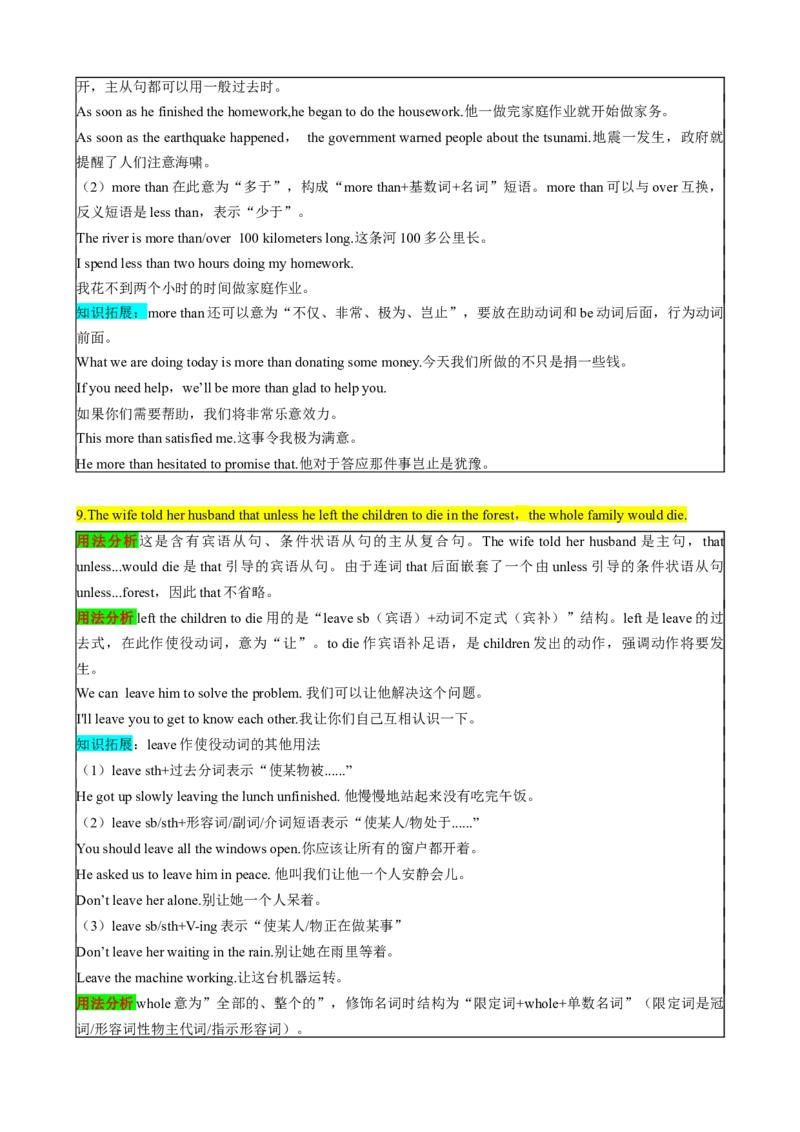
8.And as soon as the TV program came out more than 30 years ago,Western children became interested in
reading this story because the clever Monkey King keeps fighting to help the weak and never give up.
And as soon as...30 years ago是as soon as引导的时间状语从句。
用法分析(1)as soon as意为“一......就.......”,引导时间状语从句时放在主句前面时常用逗号将它们隔开,主从句都可以用一般过去时。
As soon as he finished the homework,he began to do the housework.他一做完家庭作业就开始做家务。
As soon as the earthquake happened, the government warned people about the tsunami.地震一发生,政府就
提醒了人们注意海啸。
(2)more than在此意为“多于”,构成“more than+基数词+名词”短语。more than可以与over互换,
反义短语是less than,表示“少于”。
The river is more than/over 100 kilometers long.这条河100多公里长。
I spend less than two hours doing my homework.
我花不到两个小时的时间做家庭作业。
知识拓展:more than还可以意为“不仅、非常、极为、岂止”,要放在助动词和be动词后面,行为动词
前面。
What we are doing today is more than donating some money.今天我们所做的不只是捐一些钱。
If you need help,we’ll be more than glad to help you.
如果你们需要帮助,我们将非常乐意效力。
This more than satisfied me.这事令我极为满意。
He more than hesitated to promise that.他对于答应那件事岂止是犹豫。
9.The wife told her husband that unless he left the children to die in the forest,the whole family would die.
用法分析这是含有宾语从句、条件状语从句的主从复合句。The wife told her husband 是主句,that
unless...would die是that引导的宾语从句。由于连词that后面嵌套了一个由unless引导的条件状语从句
unless...forest,因此that不省略。
用法分析left the children to die用的是“leave sb(宾语)+动词不定式(宾补)”结构。left是leave的过
去式,在此作使役动词,意为“让”。to die作宾语补足语,是children发出的动作,强调动作将要发
生。
We can leave him to solve the problem. 我们可以让他解决这个问题。
I'll leave you to get to know each other.我让你们自己互相认识一下。
知识拓展:leave作使役动词的其他用法
(1)leave sth+过去分词表示“使某物被......”
He got up slowly leaving the lunch unfinished. 他慢慢地站起来没有吃完午饭。
(2)leave sb/sth+形容词/副词/介词短语表示“使某人/物处于......”
You should leave all the windows open.你应该让所有的窗户都开着。
He asked us to leave him in peace. 他叫我们让他一个人安静会儿。
Don’t leave her alone.别让她一个人呆着。
(3)leave sb/sth+V-ing表示“使某人/物正在做某事”
Don’t leave her waiting in the rain.别让她在雨里等着。
Leave the machine working.让这台机器运转。
用法分析whole意为”全部的、整个的”,修饰名词时结构为“限定词+whole+单数名词”(限定词是冠
词/形容词性物主代词/指示形容词)。I spent the whole winter at home. 整个冬天我都是在家里度过的。
He locked himself in the room for a whole day. 他把自己关在房里一整天。
My whole family went there in the morning. 早上我们一家全去了那里。
知识回顾:all意为“全部的”,作定语修饰名词时名词前面可以用限定词(定冠词/形容词性物主代词/指
示形容词),也可以不用。
You can stay here all the time.你可以一直呆在这里。
He watches TV all morning.整个早上他都在看电视。
10.Did you hear our stepmother planning to kill us?
用法分析(1)句中用了“hear sb(宾语)doing sth(宾补)”结构,表示“听到某人正在做某事”。
planning to kill us是V-ing短语,作hear的宾语补足语,是由our stepmother发出的动作。该结构强调听到
的动作正在进行。
I heard someone singing when I passed by.我路过时听到某人正在唱歌。
I heard her crying in the next room.我听到她在隔壁房间哭泣。
知识拓展:hear sb(宾语)do sth(宾补)表示“听到某人做了某事”,do sth前面必须省略动词不定式符
号to。该结构强调听到的动作已经完成。
I heard someone sing the song.我听到某人唱了这首歌。
用法分析(2)planning to kill us用的是plan to do sth短语,表示“计划做某事”。plan作及物动词时意为
“计划”,接动词作宾语时动词必须变为动词不定式。
I plan to visit Shanghai.我计划游览北京。
I plan to go on a holiday and put all my troubles behind me.我计划去度假,把所有的烦恼都抛在脑后。
11.What a long time you slept in the forest!
用法分析这是由 what 引导的感叹句,句型为“What a/an+形容词+单数可数名词+主语+谓语(+其
他)!”如果形容词首字母发辅音,不定冠词用a;形容词首字母发元音则用an。
What an interesting book it is!多么有趣的一本书啊!
What a tall boy he is!多么高的男孩啊!
知识归纳:
1.what引导感叹句时要修饰名词,还可以构成“What+形容词+不可数名词/复数名词+主语+谓语!(在口
语中,也可以省略主语和谓语)。
What delicious food(it is)!多么可口的食物啊!
What beautiful girls(they are!)多么漂亮的女孩子啊!
1.how引导感叹句时要修饰形容词原级和副词原级,句型如下:
(1)How+形容词原级(+主语+谓语!)
How boring the story is! 这个故事多么无聊啊!
How cold(it is)!今天多么冷啊!
(2)How+副词(+主语+谓语)!
How carefully he works!他工作多么认真啊!12.It’s leading us to that wonderful house made of bread,cake and candy.
用法分析(1)’s leading us to用的是lead sb to短语,表示“把某人带到”,要接地点名词。lead在此为
及物动词,意为“带领”,过去式为led。
She led me to her classroom.她把我带到她的教室。
用法分析(2)made of bread,cake and candy是过去分词短语作后置定语,修饰wonderful house,相当于
定语从句that/which is made of bread,cake and candy 。(be)made of表示“由......制成”,强调制成的
物品看得出原材料。
Those flowers are made of plastics.那些花是塑料做的。
知识拓展:(be)made from表示“由......做成”,强调制成的物品看不出原材料。
Any kind of alcoholic drink made from grapes is called wine.任何一种使用葡萄制成的含酒精的饮料都叫作葡
萄酒。
13.Then they heard an old woman’s voice from inside the house.
用法分析词语辨析:sound、voice、noise都与声音有关,区别如下:
1)sound表示某种特殊的声音时为可数名词,泛指自然界能听到的一切声音时为不可数名词。
Light travels much faster than sound.光的传播速度比声音要快得多。
We heard a strange sound outside. 我们听到外面有一种奇怪的声音。
2)noise泛指任何噪音时为不可数名词,作可数名词时常用复数形式,指间断的、一下下的噪音。
Your voice is a kind of sound, but it is noise to me.你的嗓音是一种声音,可它对我来说是噪音。
He can’t bear city noises. 他受不了城市的噪音。
14.Who is brave enough to eat my house?
用法分析句中用了“be +形容词+ enough +动词不定式”结构,表示“足够......做某事”。
该结构的主语可以是“人、事物”。be动词的形式由主语来确定,形容词必须放在enough之前。动词不
定式部分作结果状语。
The hall is big enough to hold 1000 persons大厅足以容纳1000人。
You are old enough to decide what you should do and what you shouldn't.你已经到了判断什么该做,什么不该
做的年龄了。
特别关注:so/such...that引导的结果状语从句可以转换为“too+形容词+to+动词原形”/“not+形容词
+enough+动词不定式”结构。
He is such a young boy that he can’t dress himself.
=He is so young that he can’t dress himself.
=He is not old enough to dress himself.
=He is too young to dress himself.他太小了,无法自己穿衣服。
六.语法点记忆
unless、as soon as 和so...that...引导的状语从句一.unless引导条件状语从句
unless作连词,意为"除非;如果不",引导条件状语从句,常可以与if...not ...句型互换。在含有unless引
导的状语从句的主从复合句中,如果主句为一般将来时,从句通常用一般现在时,即"主将从现"。
Don’t go outdoors unless you take an umbrella. = Don’t go outdoors if you don’t take an umbrella. 除非你带伞,
否则不要出门。
Unless it rains tomorrow, we will go camping.如果明天不下雨,我们就去野营。
二.as soon as引导时间状语从句
as soon as意为"一……就……",引导时间状语从句,含有该从句的主从复合句表示从句的动作一发生,
主句的动作马上发生,强调动作的紧密性。如果主句为一般将来时, 从句要用一般现在时。
He will visit you as soon as he gets there.他一到那里就会去拜访你。
三.so...that...引导结果状语从句
so...that... 意为"如此……以至于……", 引导结果状语从句。 其中so作副词, 后面跟形容词或副词,
that后跟从句。
He was so outgoing that he made more friends than I did. 他如此外向,以至于他交的朋友比我多。
Miss Yang spoke so quickly that I didn’t catch what she said. 杨老师说得太快了,我没听清楚她说的话。
1. Jerry will cussed in working out the problem D he gives up.
A. if B. because C. so D. unless
2. In summer, food will go bad quickly B we put it into a fridge.
A. if B. unless C. as soon as D. while
3. —I think the environment is terrible these years.
—Yes, it will be even worse B the government takes action ______ it.
A. until; protect B. unless; to protect C. if; protecting
4. I sleep with the window open A it's really cold.
A. unless B. till C. or
5. The river will become dirtier and dirtier D we take action to protect it.
A. since B. if C. until D. unless
6. Your dream will not come true B you keep trying your best.
A. when B. unless C. whether D. because
7. I will call you as soon as he C here.
A. arrive B. will arrive C. arrives D. arrived
8. Please give me call B you come back.
A. until B. as soon as C. while
9. —What's your opinion on friends?
—They are like books. We don't need a lot of them A they're good.
A. as long as B. as soon as C. so that D. as if
10. She stopped talking A her mother came into the room.
A. as soon as B. unless C. though
11. Your aunt will call you as soon as she B to Baise.
A. will get B. gets C. got D. would getⅡ. 翻译句子
12. 他说得太快,不能清楚地表达自己的想法。
He spoke so fast that he couldn't express himself clearly. / He spoke too fast to express himself clearly.
13. 他年龄够大了,可以上学了。
He is old enough to go to school.
14. 大自然如此重要以至于我们都在合理保护它。
Nature is so important that we are all protecting it properly.
15. 他够认真,对所有事三思而后行。
He is serious enough to think twice about everything.
七.写作背默
本单元的写作内容是用英语讲故事,此类话题的主要时态为一般过去时。写此类文章可以从以下几
方面作为切入点:
一是叙述故事时应包含人物、事件、时间、地点和原因五个要素;二是通常按照故事的开头、经过
和结果的顺序进行详细叙述。在写作时,若有图片,则需要认真读图,根据文字或图片情景提示写出事
情或故事的经过,可适当增加情节和过渡性词语。
如何写好这类文章,主要需要掌握以下词汇和句型句式:
※常用的词汇
once upon time/long long ago从前
pick up捡起
unluckily不幸地
be interested in对……感兴趣
however然而
look forward to期待期望
※常用的句型句式
I want to know your view about this traditional Chinese story. 我想知道你关于这个中国传统故事的看法。
Can you share your ideas about the story with me? 你能和我分享一下关于这个故事的想法吗?
What do you think of sb.' action? 你觉得……的行为怎么样?
One day,...一天,……
As soon as...一……就……
※常用开头结尾句
Once upon time, there was a(n)...从前……
It happened on the night of...它发生在一个……晚上。
This story reminds us that...这个故事提醒我们
The story tells us that...这个故事告诉我们……
假如你是李华。请给你加拿大的笔友Eric写一封80词左右的邮件,介绍你和你的朋友的一次志愿者活动
的情况。要点如下:
时间 上周日地点 学校附近的街区
上午:打扫街道,帮助老人做家务
活动内容
下午:给小朋友们讲故事
感受 帮助别人是快乐的
参考词汇:
志愿者活动:volunteer work 街区:neighborhood 打扫街道:clean the street 做家务:do housework
讲故事:tell stories 帮助他人:help others
Dear Eric,
How’s it going? You want to know what I’ve done these days. Now let me tell you.
Last Sunday, my friends and I did some volunteer work in the neighborhood near our school. In the morning,
we cleaned the street. And then we went to the old people’s home and helped the old there do housework. In the
afternoon, we told stories to the kids in the children’s home. That day, I was busy but very happy. I think helping
others can bring happiness not only to others but also to ourselves.
Yours,
Li Hua