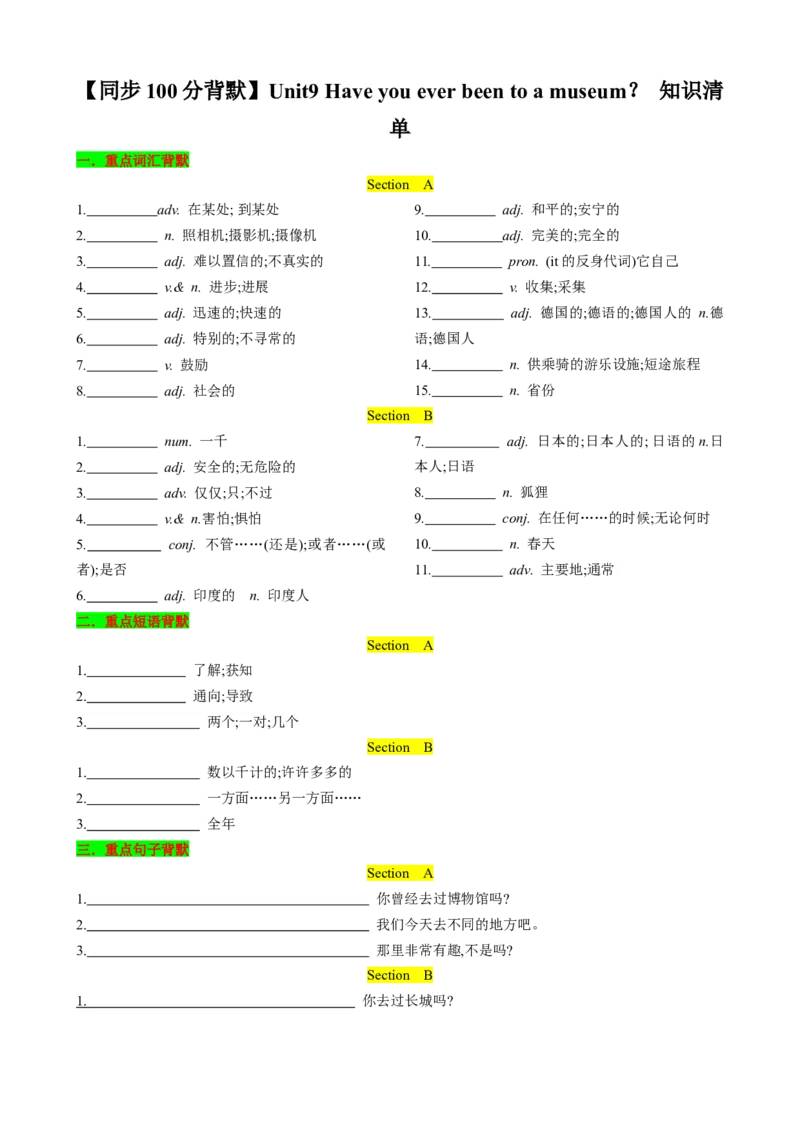
【同步 100 分背默】Unit9 Have you ever been to a museum? 知识清
单
一.重点词汇背默
Section A
1. adv. 在某处; 到某处 9. adj. 和平的;安宁的
2. n. 照相机;摄影机;摄像机 10. adj. 完美的;完全的
3. adj. 难以置信的;不真实的 11. pron. (it的反身代词)它自己
4. v.& n. 进步;进展 12. v. 收集;采集
5. adj. 迅速的;快速的 13. adj. 德国的;德语的;德国人的 n.德
6. adj. 特别的;不寻常的 语;德国人
7. v. 鼓励 14. n. 供乘骑的游乐设施;短途旅程
8. adj. 社会的 15. n. 省份
Section B
1. num. 一千 7. adj. 日本的;日本人的; 日语的n.日
2. adj. 安全的;无危险的 本人;日语
3. adv. 仅仅;只;不过 8. n. 狐狸
4. v.& n.害怕;惧怕 9. conj. 在任何……的时候;无论何时
5. conj. 不管……(还是);或者……(或 10. n. 春天
者);是否 11. adv. 主要地;通常
6. adj. 印度的 n. 印度人
二.重点短语背默
Section A
1. 了解;获知
2. 通向;导致
3. 两个;一对;几个
Section B
1. 数以千计的;许许多多的
2. 一方面……另一方面……
3. 全年
三.重点句子背默
Section A
1. 你曾经去过博物馆吗?
2. 我们今天去不同的地方吧。
3. 那里非常有趣,不是吗?
Section B
1 . 你去过长城吗?四.易错点背默
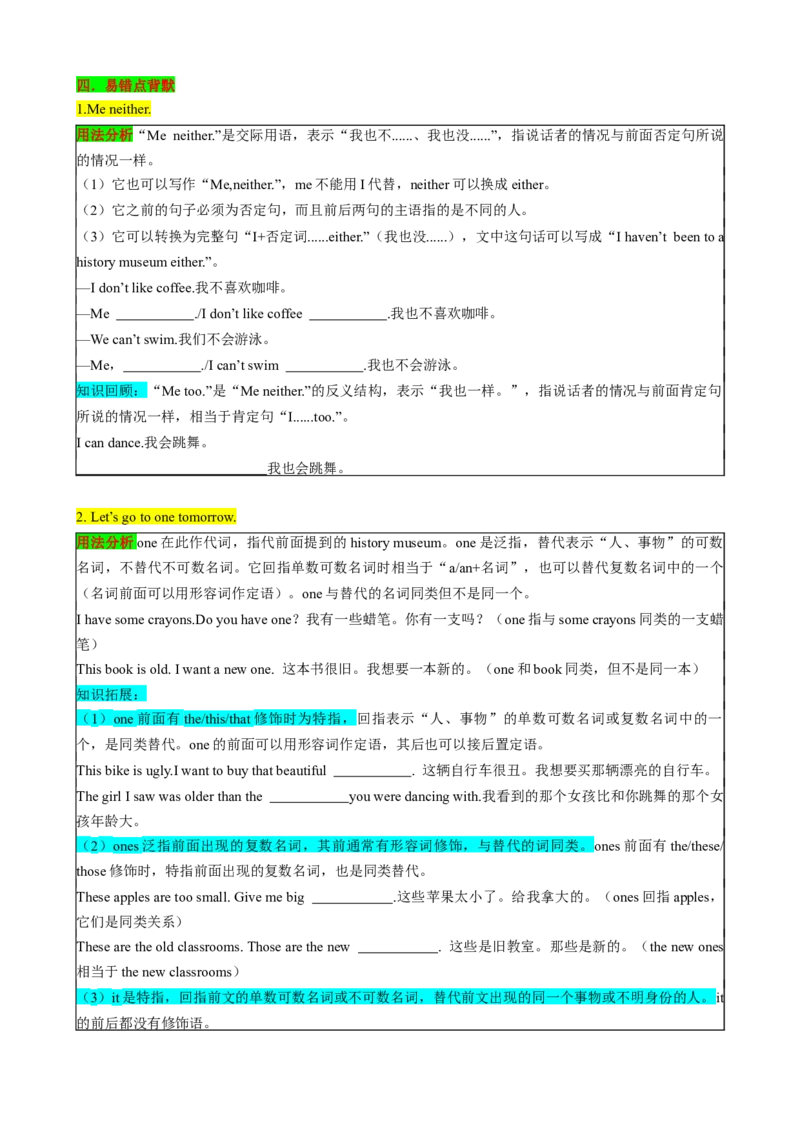
1.Me neither.
用法分析“Me neither.”是交际用语,表示“我也不......、我也没......”,指说话者的情况与前面否定句所说
的情况一样。
(1)它也可以写作“Me,neither.”,me不能用I代替,neither可以换成either。
(2)它之前的句子必须为否定句,而且前后两句的主语指的是不同的人。
(3)它可以转换为完整句“I+否定词......either.”(我也没......),文中这句话可以写成“I haven’t been to a
history museum either.”。
—I don’t like coffee.我不喜欢咖啡。
—Me ./I don’t like coffee .我也不喜欢咖啡。
—We can’t swim.我们不会游泳。
—Me, ./I can’t swim .我也不会游泳。
知识回顾:“Me too.”是“Me neither.”的反义结构,表示“我也一样。”,指说话者的情况与前面肯定句
所说的情况一样,相当于肯定句“I......too.”。
I can dance.我会跳舞。
我也会跳舞。
2. Let’s go to one tomorrow.
用法分析one在此作代词,指代前面提到的history museum。one是泛指,替代表示“人、事物”的可数
名词,不替代不可数名词。它回指单数可数名词时相当于“a/an+名词”,也可以替代复数名词中的一个
(名词前面可以用形容词作定语)。one与替代的名词同类但不是同一个。
I have some crayons.Do you have one?我有一些蜡笔。你有一支吗?(one指与some crayons同类的一支蜡
笔)
This book is old. I want a new one. 这本书很旧。我想要一本新的。(one和book同类,但不是同一本)
知识拓展:
(1)one前面有the/this/that修饰时为特指,回指表示“人、事物”的单数可数名词或复数名词中的一
个,是同类替代。one的前面可以用形容词作定语,其后也可以接后置定语。
This bike is ugly.I want to buy that beautiful . 这辆自行车很丑。我想要买那辆漂亮的自行车。
The girl I saw was older than the you were dancing with.我看到的那个女孩比和你跳舞的那个女
孩年龄大。
(2)ones泛指前面出现的复数名词,其前通常有形容词修饰,与替代的词同类。ones前面有the/these/
those修饰时,特指前面出现的复数名词,也是同类替代。
These apples are too small. Give me big .这些苹果太小了。给我拿大的。(ones回指apples,
它们是同类关系)
These are the old classrooms. Those are the new . 这些是旧教室。那些是新的。(the new ones
相当于the new classrooms)
(3)it是特指,回指前文的单数可数名词或不可数名词,替代前文出现的同一个事物或不明身份的人。it
的前后都没有修饰语。I can’t find my watch. Do you see ? 我的表找不到了,你看见了吗?(it指前句中的my watch)
The soup is delicious.Please taste .这道汤很美味。请尝尝它。(it指前句中的the soup)
What a lovely baby! Is a boy ?好可爱的宝宝啊!是男孩吗?(it指前句中的a lovely baby)
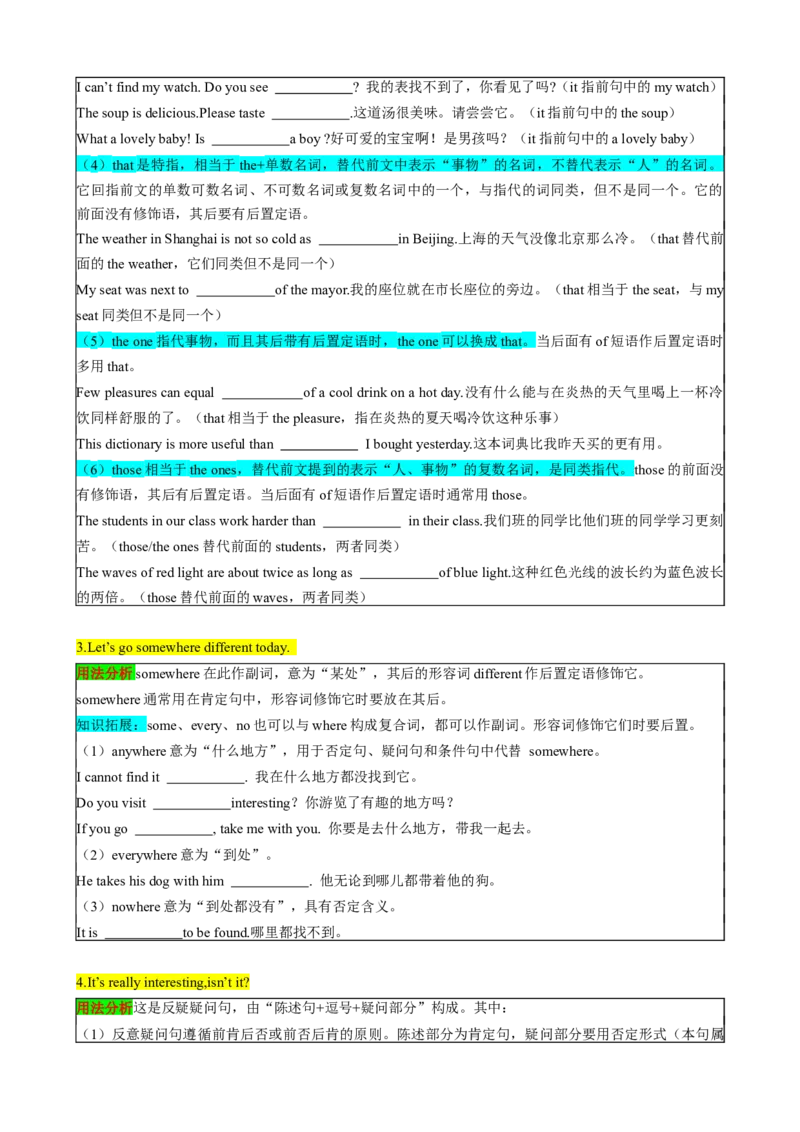
(4)that是特指,相当于the+单数名词,替代前文中表示“事物”的名词,不替代表示“人”的名词。
它回指前文的单数可数名词、不可数名词或复数名词中的一个,与指代的词同类,但不是同一个。它的
前面没有修饰语,其后要有后置定语。
The weather in Shanghai is not so cold as in Beijing.上海的天气没像北京那么冷。(that替代前
面的the weather,它们同类但不是同一个)
My seat was next to of the mayor.我的座位就在市长座位的旁边。(that相当于the seat,与my
seat同类但不是同一个)
(5)the one指代事物,而且其后带有后置定语时,the one可以换成that。当后面有of短语作后置定语时
多用that。
Few pleasures can equal of a cool drink on a hot day.没有什么能与在炎热的天气里喝上一杯冷
饮同样舒服的了。(that相当于the pleasure,指在炎热的夏天喝冷饮这种乐事)
This dictionary is more useful than I bought yesterday.这本词典比我昨天买的更有用。
(6)those相当于the ones,替代前文提到的表示“人、事物”的复数名词,是同类指代。those的前面没
有修饰语,其后有后置定语。当后面有of短语作后置定语时通常用those。
The students in our class work harder than in their class.我们班的同学比他们班的同学学习更刻
苦。(those/the ones替代前面的students,两者同类)
The waves of red light are about twice as long as of blue light.这种红色光线的波长约为蓝色波长
的两倍。(those替代前面的waves,两者同类)
3.Let’s go somewhere different today.
用法分析somewhere在此作副词,意为“某处”,其后的形容词different作后置定语修饰它。
somewhere通常用在肯定句中,形容词修饰它时要放在其后。
知识拓展:some、every、no也可以与where构成复合词,都可以作副词。形容词修饰它们时要后置。
(1)anywhere意为“什么地方”,用于否定句、疑问句和条件句中代替 somewhere。
I cannot find it . 我在什么地方都没找到它。
Do you visit interesting?你游览了有趣的地方吗?
If you go , take me with you. 你要是去什么地方,带我一起去。
(2)everywhere意为“到处”。
He takes his dog with him . 他无论到哪儿都带着他的狗。
(3)nowhere意为“到处都没有”,具有否定含义。
It is to be found.哪里都找不到。
4.It’s really interesting,isn’t it?
用法分析这是反疑疑问句,由“陈述句+逗号+疑问部分”构成。其中:
(1)反意疑问句遵循前肯后否或前否后肯的原则。陈述部分为肯定句,疑问部分要用否定形式(本句属于这种情况)。陈述部分为否定句或含有否定词,疑问部分要用肯定形式。
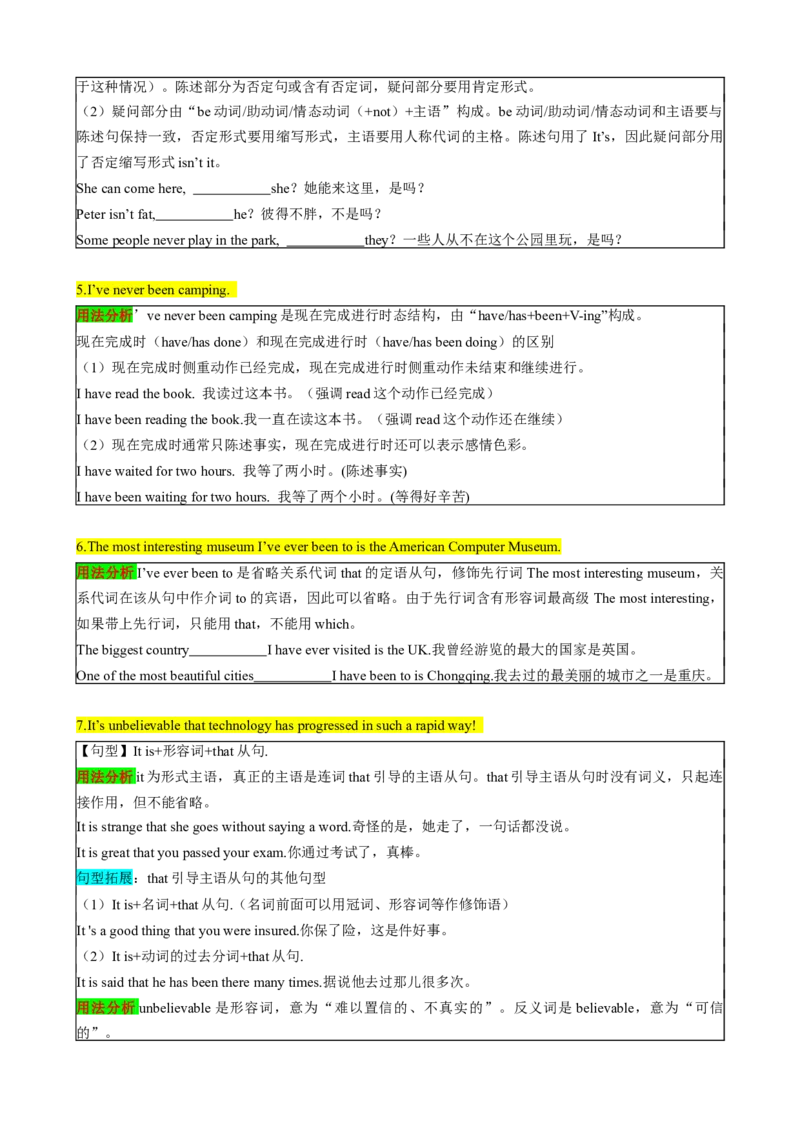
(2)疑问部分由“be动词/助动词/情态动词(+not)+主语”构成。be动词/助动词/情态动词和主语要与
陈述句保持一致,否定形式要用缩写形式,主语要用人称代词的主格。陈述句用了It’s,因此疑问部分用
了否定缩写形式isn’t it。
She can come here, she?她能来这里,是吗?
Peter isn’t fat, he?彼得不胖,不是吗?
Some people never play in the park, they?一些人从不在这个公园里玩,是吗?
5.I’ve never been camping.
用法分析’ve never been camping是现在完成进行时态结构,由“have/has+been+V-ing”构成。
现在完成时(have/has done)和现在完成进行时(have/has been doing)的区别
(1)现在完成时侧重动作已经完成,现在完成进行时侧重动作未结束和继续进行。
I have read the book. 我读过这本书。(强调read这个动作已经完成)
I have been reading the book.我一直在读这本书。(强调read这个动作还在继续)
(2)现在完成时通常只陈述事实,现在完成进行时还可以表示感情色彩。
I have waited for two hours. 我等了两小时。(陈述事实)
I have been waiting for two hours. 我等了两个小时。(等得好辛苦)
6.The most interesting museum I’ve ever been to is the American Computer Museum.
用法分析I’ve ever been to是省略关系代词that的定语从句,修饰先行词The most interesting museum,关
系代词在该从句中作介词to的宾语,因此可以省略。由于先行词含有形容词最高级The most interesting,
如果带上先行词,只能用that,不能用which。
The biggest country I have ever visited is the UK.我曾经游览的最大的国家是英国。
One of the most beautiful cities I have been to is Chongqing.我去过的最美丽的城市之一是重庆。
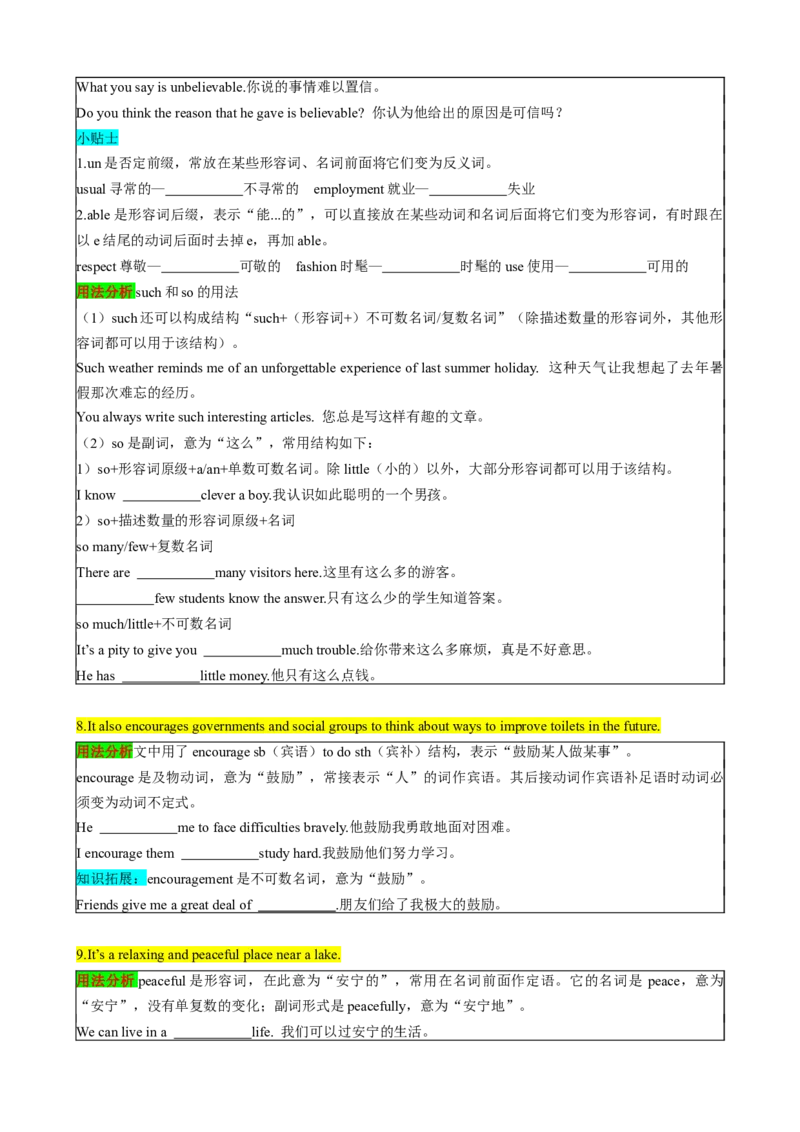
7.It’s unbelievable that technology has progressed in such a rapid way!
【句型】It is+形容词+that从句.
用法分析it为形式主语,真正的主语是连词that引导的主语从句。that引导主语从句时没有词义,只起连
接作用,但不能省略。
It is strange that she goes without saying a word.奇怪的是,她走了,一句话都没说。
It is great that you passed your exam.你通过考试了,真棒。
句型拓展:that引导主语从句的其他句型
(1)It is+名词+that从句.(名词前面可以用冠词、形容词等作修饰语)
It 's a good thing that you were insured.你保了险,这是件好事。
(2)It is+动词的过去分词+that从句.
It is said that he has been there many times.据说他去过那儿很多次。
用法分析unbelievable是形容词,意为“难以置信的、不真实的”。反义词是believable,意为“可信
的”。What you say is unbelievable.你说的事情难以置信。
Do you think the reason that he gave is believable? 你认为他给出的原因是可信吗?
小贴士
1.un是否定前缀,常放在某些形容词、名词前面将它们变为反义词。
usual寻常的— 不寻常的 employment就业— 失业
2.able是形容词后缀,表示“能...的”,可以直接放在某些动词和名词后面将它们变为形容词,有时跟在
以e结尾的动词后面时去掉e,再加able。
respect尊敬— 可敬的 fashion时髦— 时髦的use使用— 可用的
用法分析such和so的用法
(1)such还可以构成结构“such+(形容词+)不可数名词/复数名词”(除描述数量的形容词外,其他形
容词都可以用于该结构)。
Such weather reminds me of an unforgettable experience of last summer holiday. 这种天气让我想起了去年暑
假那次难忘的经历。
You always write such interesting articles. 您总是写这样有趣的文章。
(2)so是副词,意为“这么”,常用结构如下:
1)so+形容词原级+a/an+单数可数名词。除little(小的)以外,大部分形容词都可以用于该结构。
I know clever a boy.我认识如此聪明的一个男孩。
2)so+描述数量的形容词原级+名词
so many/few+复数名词
There are many visitors here.这里有这么多的游客。
few students know the answer.只有这么少的学生知道答案。
so much/little+不可数名词
It’s a pity to give you much trouble.给你带来这么多麻烦,真是不好意思。
He has little money.他只有这么点钱。
8.It also encourages governments and social groups to think about ways to improve toilets in the future.
用法分析文中用了encourage sb(宾语)to do sth(宾补)结构,表示“鼓励某人做某事”。
encourage是及物动词,意为“鼓励”,常接表示“人”的词作宾语。其后接动词作宾语补足语时动词必
须变为动词不定式。
He me to face difficulties bravely.他鼓励我勇敢地面对困难。
I encourage them study hard.我鼓励他们努力学习。
知识拓展:encouragement是不可数名词,意为“鼓励”。
Friends give me a great deal of .朋友们给了我极大的鼓励。
9.It’s a relaxing and peaceful place near a lake.
用法分析peaceful是形容词,在此意为“安宁的”,常用在名词前面作定语。它的名词是 peace,意为
“安宁”,没有单复数的变化;副词形式是peacefully,意为“安宁地”。
We can live in a life. 我们可以过安宁的生活。Except for traffic noise the night passed .除了交通噪音,那夜安宁地过去了。
All I want is to have some and quiet and spend a couple of nice days with my grandchildren.
我只想有一些安宁与平静并和我的孙子孙女们过几天好日子。
知识拓展:
(1)ful是形容词后缀,表示“富有...的、具有...性质的”,可以放在某些名词后面将名词变为形容词。
它还可以表示“易于......的”,放在某些动词后将动词变为形容词。
care小心— 小心的 forget忘记— 易忘的
(2)peace作不可数名词时还可以意为“和平”,peaceful作形容词还可以意为“和平的”,peacefully
作副词时还可以意为“和平地”。
We all hanker for . 我们都渴望和平。
He achieved his goal by means. 他通过和平手段达到了他的目的。
They've been living and working with members of various ethnic groups.他们一直与各种族群的
成员们和平地生活和工作
10.On the one hand,more than three quarters of the population are Chinese
用法分析(1)on the one hand与下文的on the other hand是一组搭配,表示“一方面...另一方面...”,用于
引出对立的观点。
On the one hand, you shouldn't be shy. , you mustn't forget your manners. 一方面你不
应当拘束,另一方面也不要放肆无礼。
On the one hand, a lot of people are going to the US.But , a lot of people are coming
back from there. 一方面,许多人前往美国。但另一方面,很多人又从那回来。
小贴士:in the first place......in the second place也表示“一方面...另一方面...”。
In the first place you accept her presents but in the second place,you are rude to her whole family.
一方面你接受她的礼物,但另一方面,你对她家人很无礼。
用法分析(2)more than three quarters of the population表示“大于四分之三的人口”。
1)three quarters是固定表达法,表示“四分之三”。表示“四分之一”要用a quarter或one quarter。它们
的后面常接“介词of+名词”结构。
2)尽管three quarters of后面接了单数名词population,但是表示“人口的几分之几”的结构强调的是人
口的个体概念,作主语时谓语要用复数形式,因此谓语be动词用了are。
Three quarters of the population of the country workers.这个国家有四分之三的人口是工人。
One(a) quarter of the population of the world like TV.全球四分之一的人口喜欢看电视。
特别关注:基数词+quarter(s)+of可以接复数名词和不可数名词。通常情况下,该结构作主语时谓语的单
复数形式由of后面的名词来确定。该名词是复数形式,谓语用复数形式;名词是单数形式,谓语用单数
形式。
One quarter of the lakes in this area polluted.这个地区四分之一的湖泊被污染了。
Three quarters of the work done.四分之三的工作完成了。
小贴士:a/one quarter的同义表达是one fourth,three quarters的同义表达是three fourths。它们的用法相
同。分数可以用基数词(分子)+序数词(分母)表示(分子大于1,分母要加-s)。One fourth of the water in the city dirty.这个城市四分之一的水是脏的。
Three fourths of milk in the bottle drunk by him.瓶子里四分之三的牛奶被他喝了。
11.So you can choose to go whenever you like—spring, summer, autumn or winter.
用法分析(1)So you can choose to go是主句,用了“choose+动词不定式”结构,表示“选择做某事”。
choose是及物动词,意为“选择”,接动词作宾语时动词要变为动词不定式。
I don't choose to eat alone.我不选择一个人吃。
We choose to play here.我们选择在这里玩。
知识归纳:choose意为“选择”,过去式是chose,过去分词是chosen。它指在所提供的多个对象中,根
据自己的好恶、判断能力进行选择,还可以构成下列结构:
1)choose sb to do sth表示“选某人做某事”。
They him to represent them.他们选择他代表他们。
2)be chosen to do sth表示“被选出来做某事”。
I am to give a talk.我被选出来做演讲。
用法分析whenever...winter是whenever引导的让步状语从句。whenever意为“无论何时、在任何......的时
候”,相当于no matter when。它引导状语从句时既可以放在主句前面,又可以放在主句后面,放在主句
前面时用逗号隔开它们。谓语动词like后面省略了与前文重复的to go,使表达更简洁。
we have a meeting,Tom is always the last one to turn up. 无论我们什么时候开会,汤姆总是最
后一个露面。
You can visit me you are free.你可以在你方便的任何时候来拜访我。
知识拓展:whenever意为“每当”,引导时间状语从句。如果主句用一般将来时,从句要用一般现在
时。
She will turn to the police for help she is in trouble.每当她遇上麻烦的时候,她总是向警方求
助。
五.语法点记忆
现在完成时(二)
一. have/has been to、 have/has gone to与have/has been in的用法区别
短语 用法 例句
He has been to the amusement park many
表示"曾经到过某地",说话时该人已经不在
have/has times. 他去过游乐场好多次。
某地。have/has been to常与ever、 never、
been to I’ve never been to South Africa. 我从没去过
once、 twice、 four times等连用。
南非。
—Where is your brother, Daniel? 丹尼尔,你哥
have/has 表示"已经去某地了",说话时该人不在现场, 哥在哪儿?
gone to 可能到某地了,也可能在去某地的途中。 —He has gone to the school library. 他已经去
校图书馆了。
have/has 表示"已经待在某地",强调状态。 Lily has been in China for two years.莉莉已经been in 在中国两年了。
当have/has been to和have/has gone to后接表示地点的副词there, here等时, to要省略。
I won’t go to the new park, because I have been there twice. 我不会去那个新公园,因为我已经去过那儿两次
了。
二. ever与never的用法
单词 用法 例句
Have you ever visited the Great Wall? 你曾参观过
ever 意为"曾经",常用于疑问句或否定句中。
长城吗?
意为"从未",常用于现在完成时中,表示否定含 I’ve never heard of that man before.我以前从未听
never
义。 说过那个人。
1. —Where's your brother?
—Oh, he the library and ______.
A. has been to; so Lucy is B. has gone to; so Lucy has
C. has gone to; so has Lucy D. has been in; so has Lucy
2. —Where is your father, Jenny?
—He isn't at home; he to Shanghai on business.
A. has been B. has gone C. went D. will go
3. —Where is your uncle? I haven't seen him for a long time.
—He Beijing for about half a year. He moved there in January.
A. has gone B. has been to C. has arrived in D. has been in
4. The shopping mall for two years, but I ______there only once.
A. has opened; have gone B. has opened; have been
C. has been open; have gone D. has been open; have been
5. —Where is Zhang Hua?
—He Beijing to see his parents and he'll be back tomorrow.
A. has gone to B. has been in C. has been to D. has been
6. —I saw Mr. White in his office just now.
—No, it be him. He has ______ Beijing and will come back next Friday.
A. mustn't; gone to B. mustn't; been to C. can't; been to D. can't; gone to
7. —May I speak to Mr. Lee?
—Sorry, he Harbin; he ______ the city for two days.
A. has been to; has been in B. has gone to; has been to
C. has gone to; has been in D. has been to; has been to
8. —May I speak to Mr. Smith?
—Sorry, he isn't in. He Changsha.
A. has been to B. has gone to C. went to D. has been in
9. — you ever ______ to the Great Wall?
—Yes. Three times.A. Has; been B. Have; been C. Have; gone D. Has; gone
10. — Hobo and Eddie the cinema to watch the film Zootopia.
—Oh, that's why I can't find them now.
A. have gone to B. have been to C. has gone to D. has been to
11. — you ever ______ to Zhangjiajie?
—Yes, I went there last summer.
A. Do; go B. Have; been C. Have; gone D. Do; been
12. —Yunnan is very beautiful. I there last year.
—Yes, I ______ there twice.
A. went; have gone B. went; have been
C. have gone; went D. have been; went
13. —Lucy has to London. How can I get in touch with her?
—Don't worry. She will phone you as soon as she ______ there.
A. been; will get B. been; gets C. gone; will get D. gone; gets
14. "I want to go to Mars (火星), because it's place that no one to before," said Carson.
A. has gone B. has been C. was D. went
15. This museum here for over 80 years. It ______ one of the oldest buildings in this city.
A. is; was B. had been; is C. was; have been D. has been; is
六.写作背默
本单元的写作内容是用现在完成时谈论自己曾经去过的地方。此类文章属于记叙文。写此类文章可
以从下面作为切入点:
首先介绍一个去过的地方,然后具体描述该地方,最后谈一谈自己去该地方的感受。
如何写好这类文章,主要需要掌握以下词汇和句型句式:
※常用的词汇
sunny晴朗的
wonder奇迹
arrive in/at到达
take a bus to...乘公共汽车去……
see the beautiful scenery看到美景
※常用的句型句式
I have been to...我去过……
Have you ever been to...你曾经去过……吗?
It's best to visit...最好是去参观……
※常用开头结尾句
Have you ever been to...? 你曾经去过……吗?
I have been to... many times.我曾经去过……很多次。
I fell in love with it when…当……我爱上了它。
I hope you can have a great time there.我希望你在那里能玩得愉快。
经典试题假如你去过长城,请以“Have you ever been to the Great Wall?”为题写一篇游记。
引出话题——长城之旅 Have you ever been to...? I have ever been there.
...took a bus to...; When we got to the foot of...,we saw...; We
思路点拨 具体描述长城之旅
began to...;…is like...;...is famous for...; It is said that...
旅行之感 I'm proud that...;Though we were tired, we all felt...
Have you ever been to the Great Wall?
Have you ever been to the Great Wall? I have ever been there.