课时 01 考点拓展 1&名词、代词&写作指导(自我介绍)
目录
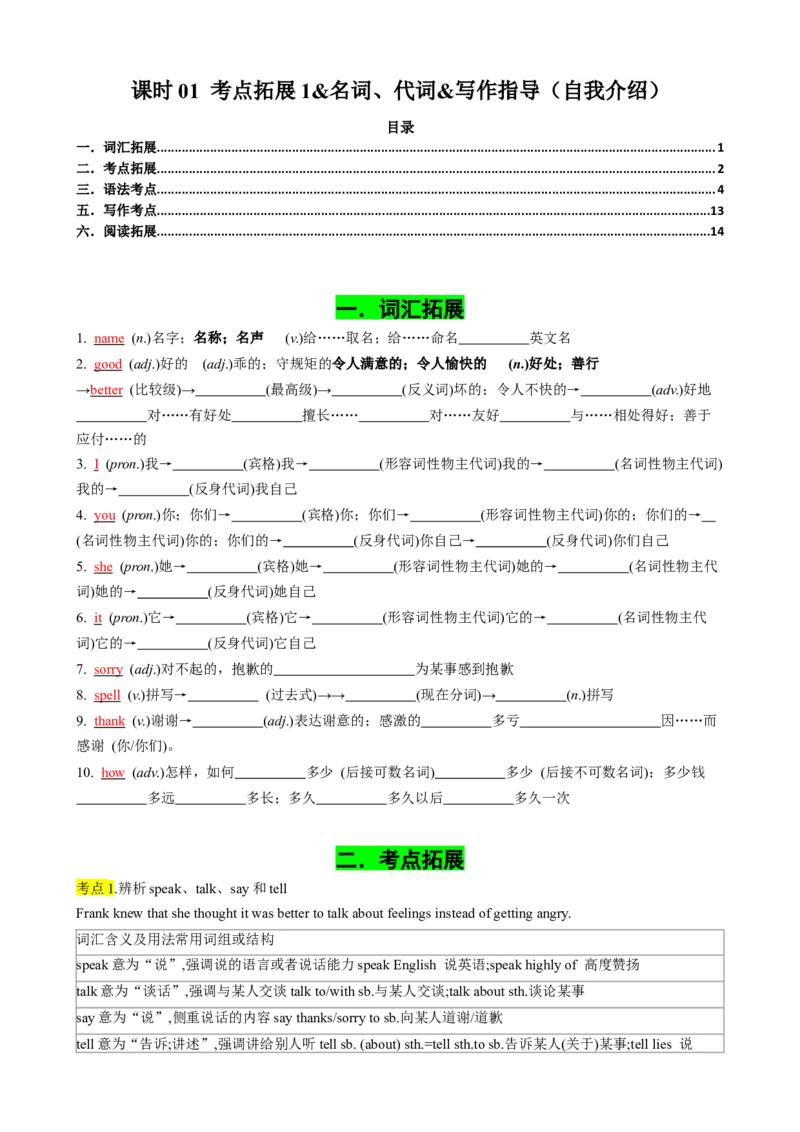
一.词汇拓展.............................................................................................................................................................1
二.考点拓展.............................................................................................................................................................2
三.语法考点.............................................................................................................................................................4
五.写作考点...........................................................................................................................................................13
六.阅读拓展...........................................................................................................................................................14
一.词汇拓展
1. name (n.)名字;名称;名声 (v.)给……取名;给……命名 英文名
2. good (adj.)好的 (adj.)乖的;守规矩的令人满意的;令人愉快的 (n.)好处;善行
→better (比较级)→ (最高级)→ (反义词)坏的;令人不快的→ (adv.)好地
对……有好处 擅长…… 对……友好 与……相处得好;善于
应付……的
3. I (pron.)我→ (宾格)我→ (形容词性物主代词)我的→ (名词性物主代词)
我的→ (反身代词)我自己
4. you (pron.)你;你们→ (宾格)你;你们→ (形容词性物主代词)你的;你们的→
(名词性物主代词)你的;你们的→ (反身代词)你自己→ (反身代词)你们自己
5. she (pron.)她→ (宾格)她→ (形容词性物主代词)她的→ (名词性物主代
词)她的→ (反身代词)她自己
6. it (pron.)它→ (宾格)它→ (形容词性物主代词)它的→ (名词性物主代
词)它的→ (反身代词)它自己
7. sorry (adj.)对不起的,抱歉的 为某事感到抱歉
8. spell (v.)拼写→ (过去式)→→ (现在分词)→ (n.)拼写
9. thank (v.)谢谢→ (adj.)表达谢意的;感激的 多亏 因……而
感谢 (你/你们)。
10. how (adv.)怎样,如何 多少 (后接可数名词) 多少 (后接不可数名词);多少钱
多远 多长;多久 多久以后 多久一次
二.考点拓展
考点1.辨析speak、talk、say和tell
Frank knew that she thought it was better to talk about feelings instead of getting angry.
词汇含义及用法常用词组或结构
speak意为“说”,强调说的语言或者说话能力speak English 说英语;speak highly of 高度赞扬
talk意为“谈话”,强调与某人交谈talk to/with sb.与某人交谈;talk about sth.谈论某事
say意为“说”,侧重说话的内容say thanks/sorry to sb.向某人道谢/道歉
tell意为“告诉;讲述”,强调讲给别人听tell sb. (about) sth.=tell sth.to sb.告诉某人(关于)某事;tell lies 说谎;tell jokes 讲笑话
用方框中所给单词的正确形式填空(每个单词只能用一次)。
speak talk say tell
1.—An English corner was set up in our school yesterday.
—It's good for us to practice English there.
2.Seeing the offer from the university which she was looking forward to, Lily was too excited to
anything.
3.Mr. Li will give us a next week.All of us are looking forward to it.
4.The idiom (成语) “Mengzi's mother makes three moves” us about a mother who tried her
best to provide the best environment for her child.
考点2.辨析family、home和house
After knowing the reason, the family had a meeting.
词汇含义及用法
family作集体名词,意为“家庭”,作主语时,谓语动词用单数;作个体名词,意为“家人”,作主语时,谓语动词
用复数
home意为“家”,指一个人出生或居住的地方
house意为“房子”,即居住的房屋
用方框中所给单词的正确形式填空(每个单词只能用一次)。
home house family
1.Since I was born, my have lived in the same flat.
2.Tom likes the with a big garden very much, but its price goes beyond his ability to pay.
3.Thanks to the internet, we can do shopping at .
考点3.辨析look、watch、see和read
They would look at all the technologies a person could use and advise on the best ones and how to get the most
out of them.
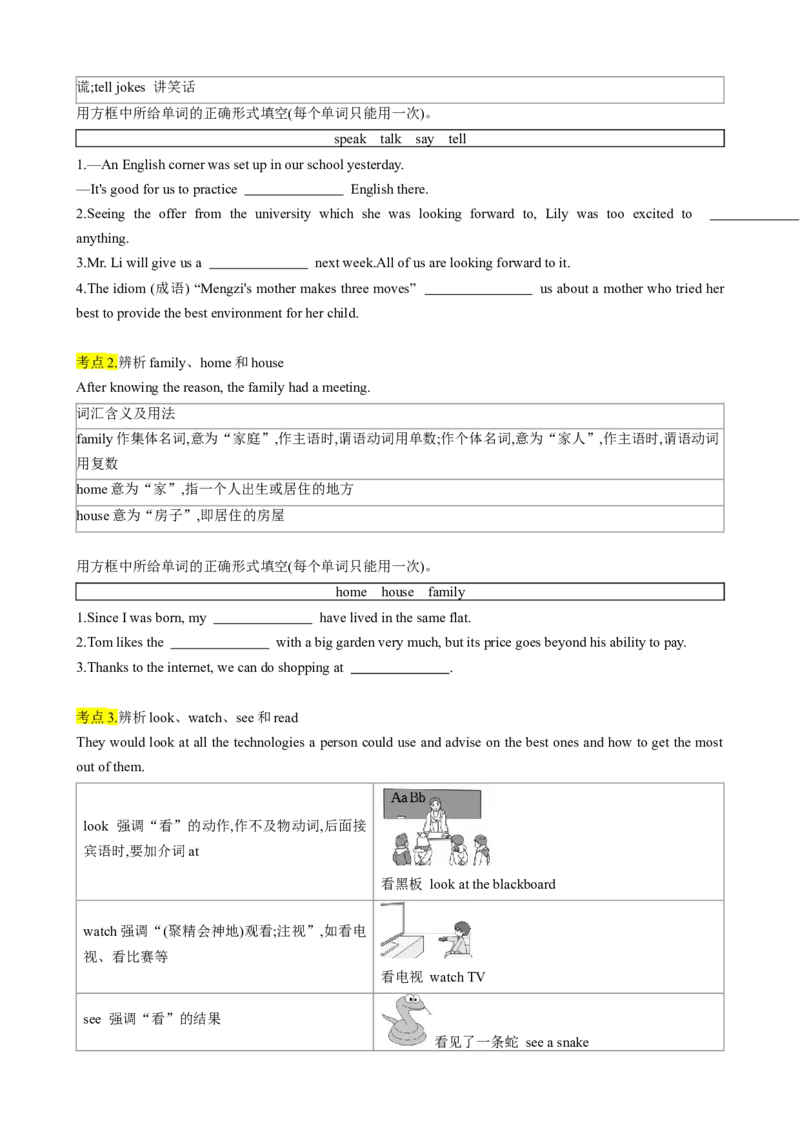
look 强调“看”的动作,作不及物动词,后面接
宾语时,要加介词at
看黑板 look at the blackboard
watch强调“(聚精会神地)观看;注视”,如看电
视、看比赛等
看电视 watch TV
see 强调“看”的结果
看见了一条蛇 see a snakeread意为“阅读”,如看书、看报纸、看杂志
等
看报纸 read the newspaper
watch 专注用时长,比赛影视常登场。
see 以结果为导向,看到内容心中藏。
look 动作要先想,单独使用不恰当。
look at 搭配强,指向目标不能忘。
read 文字书中躺,阅读书籍心欢畅。
用方框中所给单词的正确形式填空(每个单词只能用一次)。
watch see look read
1. ! The children are listening to the teacher carefully. They are interested in the colorful culture
in our country.
2.—While , the more careful you are, the more easily you can find answers in the article.
—That's true.
3.The documentary(纪录片) A Plastic Ocean is so educational that I have it several times so
far.
4.I didn't you yesterday morning. Where were you?
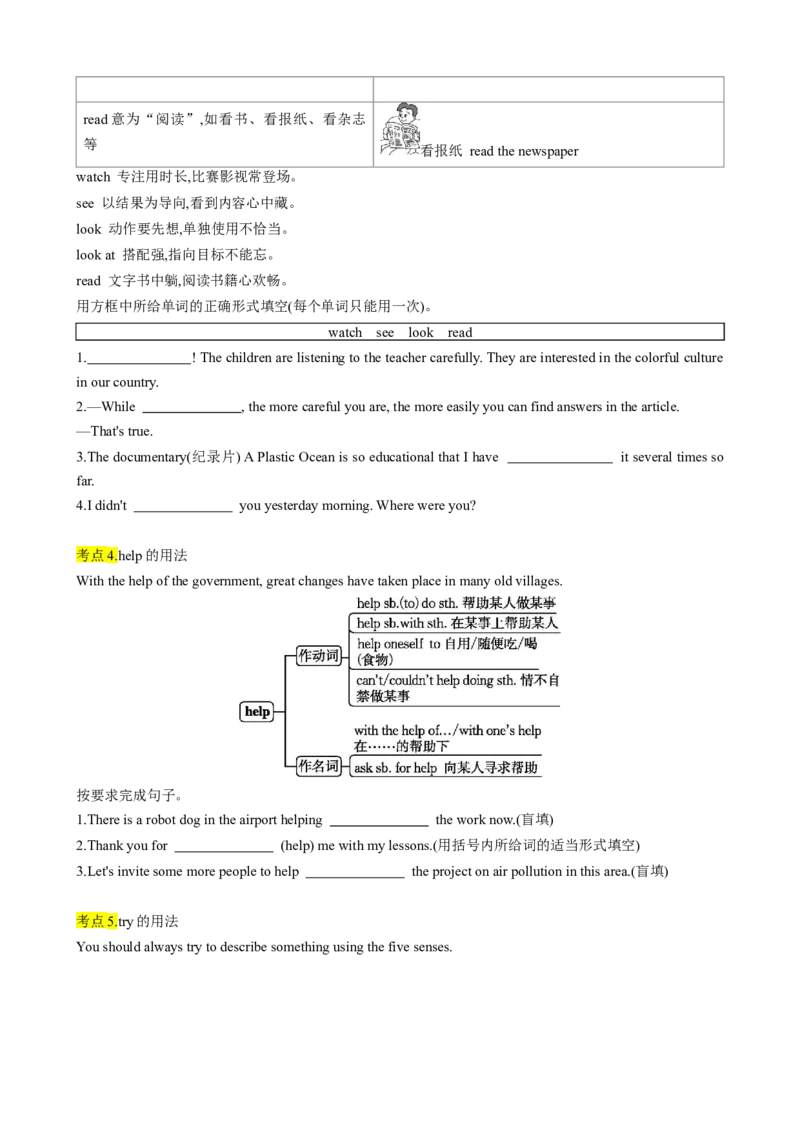
考点4.help的用法
With the help of the government, great changes have taken place in many old villages.
按要求完成句子。
1.There is a robot dog in the airport helping the work now.(盲填)
2.Thank you for (help) me with my lessons.(用括号内所给词的适当形式填空)
3.Let's invite some more people to help the project on air pollution in this area.(盲填)
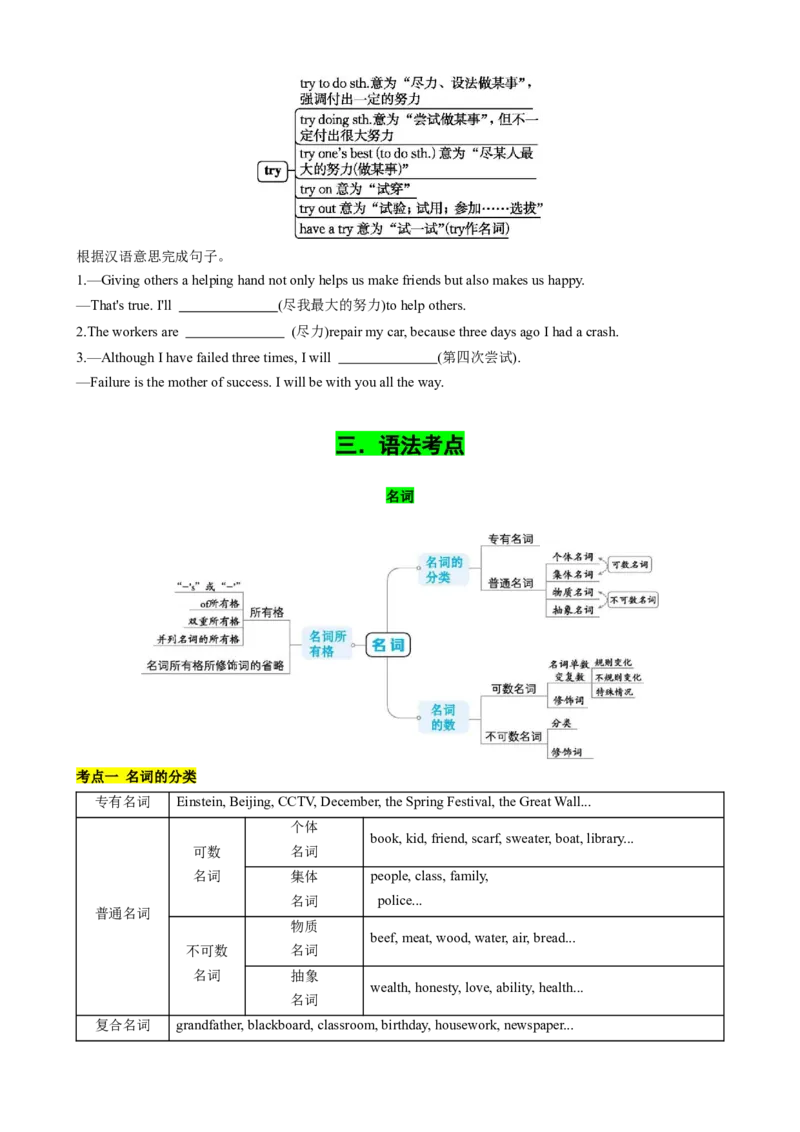
考点5.try的用法
You should always try to describe something using the five senses.根据汉语意思完成句子。
1.—Giving others a helping hand not only helps us make friends but also makes us happy.
—That's true. I'll (尽我最大的努力)to help others.
2.The workers are (尽力)repair my car, because three days ago I had a crash.
3.—Although I have failed three times, I will (第四次尝试).
—Failure is the mother of success. I will be with you all the way.
三.语法考点
名词
考点一 名词的分类
专有名词 Einstein, Beijing, CCTV, December, the Spring Festival, the Great Wall...
个体
book, kid, friend, scarf, sweater, boat, library...
可数 名词
名词 集体 people, class, family,
名词 police...
普通名词
物质
beef, meat, wood, water, air, bread...
不可数 名词
名词 抽象
wealth, honesty, love, ability, health...
名词
复合名词 grandfather, blackboard, classroom, birthday, housework, newspaper...考点二 名词的数
1.可数名词单数变复数的规则变化
一般情况直接加-s map/maps, Indian/Indians, book/books, pencil/pencils
以s、 x、 ch、 sh等结尾
brush/brushes, church/churches,watch/watches, dish/dishes
的单词加-es
以元音字母+y 结尾的单
词,直接加-s; 以辅音字母+y
story/stories, baby/babies, key/keys, city/cities, day/days
结尾的单词,变y为i, 再加-
es
以f,fe 结尾的单词,将f或
half/halves, leaf/leaves, shelf/shelves, life/lives, wife/wives
fe改为v再加-es
表示有生命的事物名 tomato/tomatoes, hero/heroes, potato/potatoes,
词,构成复数时加-es Negro/Negroes
以字母o结尾的可数名词
表示无生命的事物名 radio/radios, piano/pianos, photo/photos, zoo/zoos
词,构成复数时加-s 注意:zero的复数形式有两种,即zeros/zeroes
★元音字母o结尾的名词变复数
小贴士:
名词词尾字母o,名词+es变复数也不多。英雄爱吃土豆和西红柿,剩下“零”也不出错。例如:
hero/heroes、 tomato/tomatoes、 potato/potatoes、 zero/zeros或zeroes
★以f,fe结尾的名词变复数
以f, fe结尾的名词,多数是将f, fe变为v,再加-es。这类词可这样串联记忆:
小贴士:
树叶(leaf)半数(half)自己黄,妻子(wife)拿刀(knife)去割粮,架(shelf)后窜出一只狼(wolf),就像小偷(thief)逃
命(life)忙。例如:
leaf/leaves、 half/halves、 wife/wives、 knife/knives
2.可数名词复数的不规则变化
单复数同形 sheep, Chinese, Japanese, deer, fish
man/men, woman/women, policeman/policemen, Englishman/Englishmen,
把a改为e
Frenchman/Frenchmen
oo变ee式 tooth/teeth, foot/feet, goose/geese
词尾加-ren child/children
只有复数式 trousers, clothes, glasses, congratulations, pants, scissors, gloves
易混易错
man 和 woman 作定语时,修饰单数名词用单数,修饰复数名词用复数,如 a man teacher、 two women
doctors。注意:有些名词如学科类名词maths、 physics、 politics,虽以s结尾,但不是复数形式。★有些名词单数与复数形式相同
小贴士:
单数复数不变形,特殊词语记一记。“中”“日”友好不变,“鱼”“鹿”“绵羊”来作证。例如:
Chinese、 Japanese、 fish、 deer、 sheep
★有关国籍的复数形式构成(表示“某国人”的名词)
小贴士:
世界要友好,国籍要分清。中日不变,英法变,其他加-s来转变,特殊情况记心间。例如:
Chinese 、 Japanese; Englishman/Englishmen 、 Frenchman/Frenchmen;Indian/Indians 、
American/Americans。特例:German的复数形式是Germans。
考点三 不可数名词的分类
物质 食物 bread, meat, rice, food, salt, wheat, cheese, fish, chicken...
名词 饮料 juice, milk, tea, water, cola, coffee...
自然物质 air, soil, sand, wood...
情感、概念 peace, love, friendship, joy, happiness, time, news, population, knowledge...
抽象
学科 Chinese, English, maths, physics, chemistry, politics, history...
名词
国家、城市
China, England, Japan, Sydney...
等专有名词
小贴士:
不可数名词成员多,常用词语记心头。茶水牛奶兑橘汁,米肉面包和食品;作业家务工作忙,幸福时间钱
财多。即 tea、 water、 milk、 orange、 rice、 meat、 bread、 food、 homework、 housework、
work、 happiness、 time、 money。
4.既可作可数名词又可作不可数名词的名词
名词 用作可数名词 用作不可数名词
表示条数,单数复数形式相同
fish 意为“鱼肉”
表示各种各样的鱼,fish加-es
“玻璃杯”,其复数形式为glasses;glasses还可
glass 意为“玻璃”
意为“眼镜”
orange 意为“橘子;橙子”,复数加-s 意为“橙汁;橙色”
room 意为“房间”,复数加-s 意为“余地;地方;空间”
意为“文件;试卷;
paper 意为“纸”
报纸”,复数加-s
work 意为“著作”,复数加-s 意为“工作”
chicken 意为“小鸡”,复数加-s 意为“鸡肉”
light 意为“灯;灯具”,复数加-s 意为“光线”考点四 名词的所有格
有生命的名词单数 在词尾加“'s” Lucy's cat
(1)以-s结尾加“'” the teachers' office
有生命的名词复数 her children's
(2)不以-s结尾的加“'s”
homework
表示两者或多者共同
在最后一个名词后加“'s” Lucy and Lily's desk(Lucy和Lily共同的课桌)
拥有
表示两者或多者各自 Jim's and Sam's
各名词后都要加上“'s”
拥有 bikes (Jim和Sam各自的自行车)
表示时间、距离、国 单数加“'s” an hour's walk
家、机构等无生命的
复数加“'” ten minutes' walk
名词
of +'s所有格 two students of Mr. Wu's
双重所有格 of +名词性物主代词 a friend of mine
of+one's own a house of my own
易混易错
's不全是名词所有格
It looks like Lily's hat! 它看起来像Lily的帽子。(此句话中的Lily's是所有格,而不是Lily is的缩写。)
My dog is from China, but her dog's from Japan. 我的狗来自中国,但是她的狗来自日本。(此句中的dog's应
是dog is的缩写,而不是名词所有格。)
根据句意,用所给单词的适当形式填空
1.Johnny is so hungry that he can eat up all the (bread).
2.This morning market sells different kinds of fresh (fish).
3.How amazing! The little cat caught two (mouse) last night.
4.The little boy has to peel three baskets of (potato) before lunch.
5.Jack spent about two hours sweeping (leaf) in the back garden.
6.It's about twenty (minute) drive from my house to the park.
7.There are few spelling and grammar (mistake) in Lily's homework.
8.The old man likes reading books very much.He owns two private (library).
9.There are more than one hundred teachers in our school, and most of them are (man) teachers.
10.The worst thing about working in the shopping mall is that you're on your (foot) all day.
11.Different people have different (hobby).
12.You can look for (information) about the shop on the Internet.
13.She bought a pair of (glove).
14.—Are those (sheep)?
—No, they aren't.They're (cow).
15. 15 , 15 . ( Lucy and Lily ) room is on the 5th floor.代词
考点一人称代词、物主代词与反身代词一览表
单 数 复 数
数人称
第一人称 第二人称 第三人称 第一人称 第二人称 第三人称
人称 主格 I you he she it we you they
代词 宾格 me you him her it us you them
形容词性物主代
my your his her its our your their
词
名词性物主代词 mine yours his hers its ours yours theirs
反身代词 myself yourself himself herself itself ourselves yourselves themselves
考点二 人称代词的用法
1.人称代词有单数和复数之分。人称代词主格用作主语,置于谓语动词之前。例如:
She is a good teacher. 她是一名好老师。
They are good teachers. 他(她)们是好老师。
小贴士:
开头主语用主格,主格常置谓语前, 复数概念全用are。
2.几个人称代词并列充当主语时,它们的顺序是:
单数:“二、三、一”(单数人称为you、 he/she/it、 I)
复数:“一、二、三”(复数人称为we、you、 they);在自我批评或承担责任时则把I放在前面。例如:
Sorry, I and he have made a mistake. 对不起,我和他犯了个错误。
小贴士:代词并列作主语,排列顺序记心间。复数人称一二三,单数人称二三一。承担责任I领先,you站后面I
心安。
3.人称代词宾格的用法。人称代词宾格常用作宾语,置于动词和介词后,构成动宾和介宾结构。有时在口语
中还用作表语,也可以放在be动词之后作主语补足语。例如:
Let me help you.(you用作宾语,构成动宾结构)
The new bag is for him.(him用作宾语,构成介宾结构)
Who's that? It's me, Tom.(me作表语,用于非正式语体中)
小贴士:
宾格充当宾和表。宾格处在介动后。
考点三 物主代词的用法
1.物主代词的构成
小贴士:
物主代词有两类,一是“形”二是“名”。我的my,你的your,男的his,女的her,它的its别加点,我们的
our,你们的your,他们的their别混用。见到“名词”就上前,“形代”总站名词前,转变“名代”加个-s。留下
his与its,唯独my变为mine。
2.物主代词的用法
(1)形容词性物主代词与名词性物主代词的关系。
形容词性物主代词后面要跟名词,而名词性物主代词后则不能再跟名词,它们的关系可以理解为“形容词性
物主代词+名词=名词性物主代词”。例如:
This is my pen. That isn't mine.这是我的钢笔。那不是我的。(mine相当于my pen)
(2)名词性物主代词常用于指代上下文所提到的东西,以避免重复。例如:
This is his bag.=This bag is his.这个包是他的。
That is her book.= That book is hers. 那本书是她的。
小贴士:
“形代”爱交友,单独它不走。和冠词,不相连,“形代”总在名词前。没有“形物”用“名代”,单数复
数要分清。作主语,数一致,单复数看后面的“名”。
易混易错
his和its既可作形容词性物主代词,也可作名词性物主代词。在使用上要区分。例如:
This is its bone. / This bone is its. 这个骨头是它的。
3.含有物主代词的固定短语
on one's way to 在某人去……的路上;with one's help 在某人的帮助下;all one's life 一生,终生;to one's
surprise 使某人感到惊讶的是;to one's joy 使某人高兴的是;change one's mind 改变主意;take one's time 不
急;try / do one's best 尽某人最大的努力;in one's way 挡路,妨碍。
考点四 反身代词的用法
1.反身代词的构成
反身代词随着人称变化而变化。反身代词由第一人称、第二人称形容词性物主代词以及第三人称代词宾格词尾加-self或-selves构成,有单数、复数之分。
易混易错
反身代词有规律,第三人称宾格加,其余开头用“形物”,复数-ves代替f。
2.反身代词的常用短语
by oneself=on one's own 单独,靠某人自己;all by oneself 全靠自己;enjoy oneself=have a good time 玩得高兴,
过得愉快;teach oneself=learn by oneself 自学;help oneself to 随便吃,自己吃;hurt oneself 伤着自己;for
oneself 为自己;devote oneself 献身于;come to oneself 恢复常态;say to oneself 自言自语;dress oneself 给自
己穿衣服; lose oneself 失去自我。
考点五 指示代词的用法
指示代词 近指 远指 单数 复数
this √ √
that √ √
these √ √
those √ √
小贴士:
指示代词四兄弟,近指远指有规律。this、 that 是单数,these、 those 是复数;this、 these 说“近
处”,that、 those表“远处”。
易混易错
1.在回答this或that(指物时)为主语的疑问句时,用it代替this或that。that is可以缩写成that's,而this is却不
能缩写为this 's。在回答主语是these或those的一般疑问句或特殊疑问句时,通常用they来代替问句的
these或those,以避免重复。例如:
—Are those her books? 那些是她的书吗?
—Yes, they are./No, they aren't. 是的, 它们是。/ 不, 它们不是。
2.在电话用语中,用this指代自己,that指代对方。例如:
—Hello! This is Li Ping. Who's that? 你好,我是李平。你是哪位?
—Hey, Li Ping. This is Wang Hai. 嘿,李平。我是王海。
考点六 疑问代词的用法
疑问代词 意义 基本用法 例句
who是主格,询问人的身份或对句子中的人 —Who is not here? (who作主语)
进行提问,在句子中充当主语或表语的角 —Han Meimei isn't here.
who 谁
色。who与is相连可缩写成who's(谁是), —Who's that? (who作表语)
与whose同音 —That's Lucy.
whom是宾格,用作宾语,但在口语中,也可
Whom did you go to the park with?你和谁
whom 谁 用who作宾语,但是在介词的后面只能用
一起去的公园?
whom
whose 谁的 whose既可作形容词性物主代词,也可作名 Whose bike is this? 这是谁的自行车?词性物主代词,不可与who's混在一起
What color bike do you have? 你有什么
what 什么 指物,对句子中的事物或一些名词进行提问
颜色的自行车?
—Which color is your bike, black or blue?
用于对“定语”进行提问,通常用于在一个 你的自行车是哪种颜色,黑色的还是蓝色
which 哪个
确定的、有限的范围内做出选择 的?
—The black one. 黑色的。
考点七 it用作形式主语的用法
(1)It's time for sb. to do sth./ It's time for sth.;(2)It takes sb. some time to do sth.;(3)It costs/cost sb. some money
to do sth.;(4)It seems/seemed that...;(5)It is one's turn to do sth.;(6)It is / has been +时间段+ since +一般过去时;
(7)It's said /reported that...;(8)It's+名词/形容词+ that 从句;(9)It's +名词/形容词+(for/ of sb.)+不定式;(10)It
looks (seems) as if...
一.根据句意,用所给单词的适当形式填空
1.This isn't Julie's notebook. (she) is in her schoolbag.
2.You have to ask Mike (he).Nobody else knows his address.
3.These flowers belong to Miss Wang.They are as beautiful as (we).
4.“Sit down and make (you) at home, boys and girls!” said Mrs.Li kindly.
5.George introduced us to some friends of (he) at the party.
6.—Oh, I'm feeling so thirsty and tired.
— (I), too.
7.This physics problem isn't hard at all.I can work it out (I).
8. (I) Chinese teacher asked me with whom I had discussed the problem.
9.—Do you know Alice?
—Yes.I know (she) very well.We have been friends for long.
10.This English dictionary is not mine.It must be (Tom).
11.Lily's backpack is much bigger than (me).
12.Mrs.Guo teaches (we) history.
13.We should always keep (we) away from danger.
14.I found it impossible for (he) to work out the maths problem.
15.The boy who comes to the party is given a wooden apple with (he) own name in it as a souvenir.
16.These boys have been able to dress (them) at the age of five.
17.Betty and her sister went to the museum with a relative of (them).
18.—Is this your cousin's sweater?
—No. (she) is on the chair behind the desk.
五.写作考点
Self Introduction自我介绍
我的人名叫王明。我的生日是6月5日。我是中国人。我是个学生。我非常努力地学习。我最喜欢的科目
是英语。我喜欢它是因为它很有趣。我可能会弹钢琴和吹小号,但不是很好。我喜欢游泳,我很擅长。
在所有类型的电影中,我最喜欢喜剧。我觉得它们很有趣。我是我班上最好的学生之一。我的老师都说
我是个好学生。他们都喜欢我,我也喜欢他们。
Self Introduction
我的朋友
莎莉是我的好朋友。她今年13岁。她有很多爱好。她喜欢唱歌和跳舞。她最喜欢的科目是英语和音乐。
她喜欢英语,因为她认为英语既有用又有趣。她的音乐老师,李小姐,很有趣。而李小姐则是她最喜欢
的老师。她最喜欢的食物是鸡蛋和汉堡包。她喜欢蔬菜和水果,因为她认为它们是健康的食物。她最喜
欢的颜色是白色、红色和蓝色。她最喜欢的运动是网球。她经常在下课后和我一起打网球。 这是我的好
朋友。我非常喜欢她。
My Good Friend
六.阅读拓展
一
People spend their holiday in 1 ways. Some people may go home to get together with their family
members or do some shopping. Others may 2 some places of interest with friends or family members. There
are so many people in these places. And this will bring some 3 . For example, food in these places will 4
much more.But at the Laojunshan scenic spot(景点) in Henan, visitors can have a good time eating the 5 lunch.
The workers in parks make special local food for them. The most interesting thing is that visitors 6 the
delicious food with only one yuan. The one-yuan lunch has been helping hungry visitors since 2017.
During the National Day holiday in 2021, the workers made 25,320 bowls of lunch. 7 they made
26,147yuan, 827 yuan more than they thought. They felt quite 8 and tried to find the reasons(原因). 9
they knew that was because some visitors wanted to thank these workers for their help and 10 .
1. A. different B. difficult C. special D. important
2. A. find B. visit C. have D. walk
3. A. ideas B. news C. orders D. problems
4. A. spend B. take C. cost D. pay
5. A. easiest B. earliest C. cheapest D. greatest
6. A. make B. enjoy C. know D. watch
7. A. But B. So C. Or D. When
8. A. afraid B. worried C. excited D. surprised
9. A. Usually B. Luckily C. Finally D. Quickly
10. A. happiness B. kindness C. time D. practice
二
Msituni is a giraffe. She was born at the San Diego Zoo Safari Park in
California(加利福尼亚).There was a problem with her front legs. It was
difficult for her to stand. She couldn't even eat food because of
that.___★___
To save Msituni, the workers made leg braces(支架)to help support(支
撑) her body,but they didn't work long. Next, they asked Dr. Ara Mirzaian
for help. Mirzaian is good at making braces for people. He did a lot of work to study giraffes and tried to solve
this problem with a company that can make braces for horses.
In about a week, they made a new pair of braces for Msituni's legs. The braces were stronger but not very
heavy. By wearing those braces for just two months, Msituni could then walk on her own. She now can walk
around easily with the other giraffes!
1. What's the problem with the giraffe?
A. She couldn't sleep easily. B. She couldn't stand easily.
C. She couldn't see clearly D. She couldn't hear clearly.
2. Which of the following is the best to fill in the blank“__★__ ”?
A. She didn't like the food in the zoo.
B. So the workers sent her to a zoo in the UK.
C. She would have died if the workers hadn't helped her.
D. She still wanted to live with the other animals.
3. What is the right order of what happened in the story?
a. Msituni could walk on her own with new braces.
b. There was something wrong with Msituni's front legs.c. Mirzaian tried to make a new pair of braces with a company.
d. The workers asked Dr. Ara Mirzaian to help save the giraffe.
A. b-d-c-a B. d-a-b-c C. b-a-d-c D. c-d-a-b
4. How long did it take Msituni to get used to(适应) the braces?
A. A week. B. Two weeks. C. A month. D. Two months.
5. Where can you probably read the passage?
A. In a newspaper. B. In a storybook.
C. In a sports magazine. D. In a travel diary.
三
Tomatoes are good for us and they are delicious. That's why many people
love eating them. Usually, we buy big and good-looking tomatoes .But in
Tudela, Spain, there is a special competition(比赛)about tomatoes called
Ugly Tomato of Tudela every year. People will find the ugliest tomatoes in
the competition. Sounds interesting, doesn't it?
The competition was on September 12 this year. On this day, quite a lot of farmers in Spain brought their
ugly tomatoes to Tudela. Farmers Marisol and Vincente Martinez became the winners. “We never thought about
growing ugly tomatoes for the competition. They just grew like that. When we found how ugly some of our
tomatoes were, we brought them to Tudela. We couldn't believe these ugly tomatoes helped us win the
competition," they said.
Most people don't know why some tomatoes grow ugly. Someone thinks it has something to do with bees(蜜
蜂).Do you want to know why? Why not find it out by yourself?
1. What does the writer think of Ugly Tomato of Tudela?
A. Cool. B. Boring. C. Important D. Funny.
2. What does the underlined word “They” refer to?
A. Bees. B. Ugly tomatoes. C. Farmers. D. Marisol and Vincente.
3.Which of the following is TRUE?
A. Tudela has the competition every month.
B. Only farmers in Tudela can take part in the competition.
C. Marisol and Vincente knew that they would win.
D. People thought Marisol and Vincente's tomatoes were ugly.
4. What does the passage mainly tell us?
A. Why tomatoes sometimes grow ugly. B. Some interesting things about farmers.
C. A special competition about tomatoes. D. Where we can find the ugliest tomatoes.