课时 04 考点拓展 4&肯定句、否定句、疑问句及转化方法&写作指导
(家庭生活)
目录
一.词汇拓展...............................................................................................................................................................1
二.考点拓展...............................................................................................................................................................2
三.语法考点...............................................................................................................................................................6
四.写作考点.............................................................................................................................................................11
五.阅读拓展.............................................................................................................................................................12
一.词汇拓展
1. eight (num.)八→eighth (序数词)第八
2. nine (num.)九→ninth (序数词)第九
3. number (n.)号码;数量;数字 (v.)数;算;给……编号
telephone number 电话号码a number of 大量的 the number of .. .……的数量
4. write (v.)写→wrote (过去式)→writing (现在分词)→writer (n.)作家
write down 写下;记下write a diary/diaries 写日记write to sb/write a letter to sb 给某人写信
5. do (v.aux.) (用于构成疑问句和否定句) (v.)做;干→did (过去式)
6. help (v.)帮助 (n.)帮助;援助 →helpful (adj.)有用的;提供帮助的→helpless (adj.)无助的
help ( sb ) out 帮助 (某人)分担工作、解决难题with one's help/with the help of sb 在某人的帮助下
help oneself to .. . 随便做 (或用)吧;请自便 help ( to ) do sth 帮助做某事 help sb ( to ) do sth 帮助某人做
某事can't help doing sth 情不自禁做某事 help ( sb ) with sth 在某方面帮助 (某人)
7. know (v.)知道,懂得→knew (过去式)→→known (adj.)出名的
know of/about 了解be known/famous for 因……而出名 be known/famous as .. . 作为……而出名
be known to .. . 为……所熟知as far as I know 据我所知
8. say (v.)说;讲→said (过去式)→saying (n.)谚语;格言;警句
say to oneself 自言自语 It is said that .. . 据说…… As a saying goes .. . 俗话说……;常言道……
9. that (pron.)那,那个 (指较远的人或事物)→those (pl.)那些
10. again (adv.)再 (次),又 (一次)over and over again 多次;反复地once again 又一次;再一次
二.考点拓展
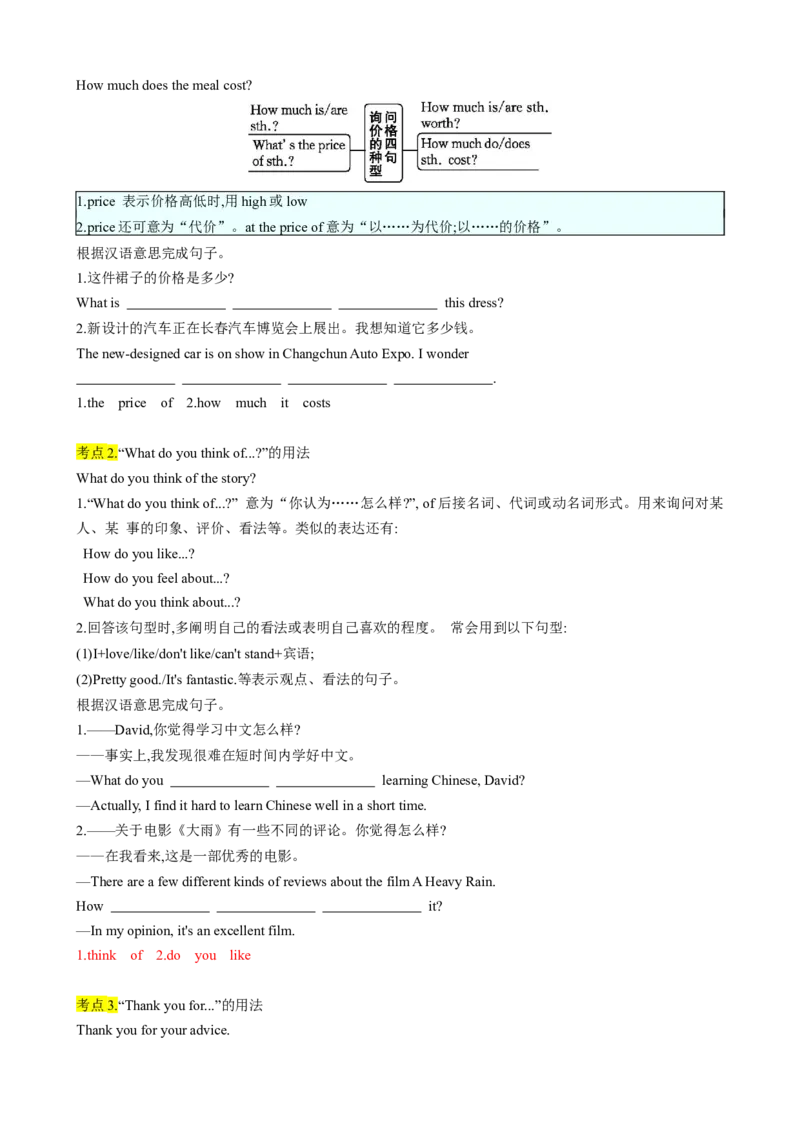
考点1.询问价格的句型How much does the meal cost?
1.price 表示价格高低时,用high或low
2.price还可意为“代价”。at the price of意为“以……为代价;以……的价格”。
根据汉语意思完成句子。
1.这件裙子的价格是多少?
What is this dress?
2.新设计的汽车正在长春汽车博览会上展出。我想知道它多少钱。
The new-designed car is on show in Changchun Auto Expo. I wonder
.
1.the price of 2.how much it costs
考点2.“What do you think of...?”的用法
What do you think of the story?
1.“What do you think of...?” 意为“你认为……怎么样?”, of后接名词、代词或动名词形式。用来询问对某
人、某 事的印象、评价、看法等。类似的表达还有:
How do you like...?
How do you feel about...?
What do you think about...?
2.回答该句型时,多阐明自己的看法或表明自己喜欢的程度。 常会用到以下句型:
(1)I+love/like/don't like/can't stand+宾语;
(2)Pretty good./It's fantastic.等表示观点、看法的句子。
根据汉语意思完成句子。
1.——David,你觉得学习中文怎么样?
——事实上,我发现很难在短时间内学好中文。
—What do you learning Chinese, David?
—Actually, I find it hard to learn Chinese well in a short time.
2.——关于电影《大雨》有一些不同的评论。你觉得怎么样?
——在我看来,这是一部优秀的电影。
—There are a few different kinds of reviews about the film A Heavy Rain.
How it?
—In my opinion, it's an excellent film.
1.think of 2.do you like
考点3.“Thank you for...”的用法
Thank you for your advice.1.“Thank you for...=Thanks for...”意为“因……而感 谢你(们)”。for为介词,后接名词或动名词,表示感谢的
理由。
2.常用答语有:
You are welcome./It's my pleasure./Glad to help./No problem./It's all right./Not at all.
用所给词的适当形式填空。
1.—Thank you for (help)me with my lessons.
—You are welcome!
2. (thank) for lending me your camera. I will return it to you on time pretty soon.
1.helping 2.Thanks
考点4.与how相关的疑问词组
How long will the activity last?
疑问词组含义用法
how old多大提问年龄;答语为数词(+名词)
how many多少提问数量,后跟可数名词复数;答语为数词(+名词)
how much多少(钱)①提问数量,后跟不可数名词;答语为数词+名词;②提问价格;答语为数词+货币单位。③
表示程度
how far多远提问距离;答语为数词+名词
how often多久一次提问频率;答语为频度副词
how long多长时间提问持续的时间;答语用“for+一段时间”或“since+过去的时间点”
how soon多久提问将来的时间;答语用“in+一段时间”
用恰当的疑问词组填空。
1.—Tim, is your home from our school?
—It's about five minutes' walk.
2.— do you go to the Science Club?
—Twice a week.
3.— have you stayed in Kaiping?
—For a month.
4.— will he get well, Doctor?
—In about a week, I think.
1.how far 2.How often 3.How long 4.How soon
考点5.mean的用法
A red sky at sunset may mean that there are clear skies to the west, where the sun sets.
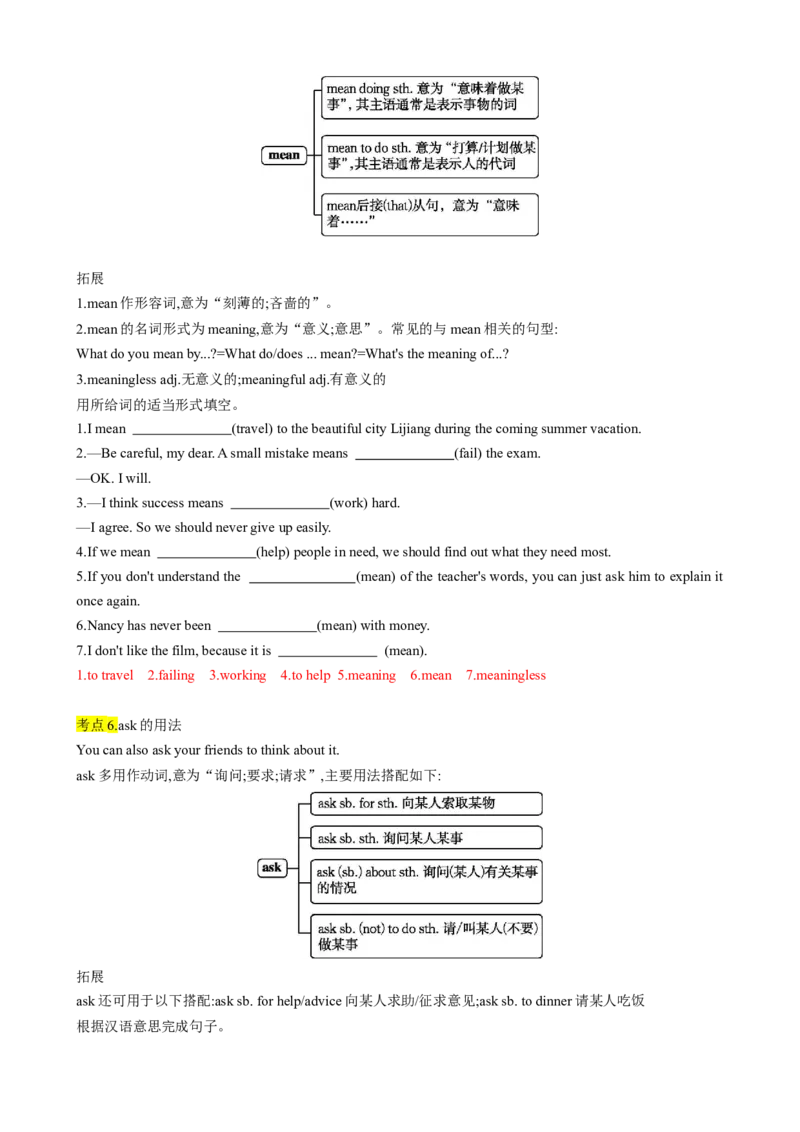
mean既可以用作动词,也可以用作形容词,主要用法如下:拓展
1.mean作形容词,意为“刻薄的;吝啬的”。
2.mean的名词形式为meaning,意为“意义;意思”。常见的与mean相关的句型:
What do you mean by...?=What do/does ... mean?=What's the meaning of...?
3.meaningless adj.无意义的;meaningful adj.有意义的
用所给词的适当形式填空。
1.I mean (travel) to the beautiful city Lijiang during the coming summer vacation.
2.—Be careful, my dear. A small mistake means (fail) the exam.
—OK. I will.
3.—I think success means (work) hard.
—I agree. So we should never give up easily.
4.If we mean (help) people in need, we should find out what they need most.
5.If you don't understand the (mean) of the teacher's words, you can just ask him to explain it
once again.
6.Nancy has never been (mean) with money.
7.I don't like the film, because it is (mean).
1.to travel 2.failing 3.working 4.to help 5.meaning 6.mean 7.meaningless
考点6.ask的用法
You can also ask your friends to think about it.
ask多用作动词,意为“询问;要求;请求”,主要用法搭配如下:
拓展
ask还可用于以下搭配:ask sb. for help/advice向某人求助/征求意见;ask sb. to dinner请某人吃饭
根据汉语意思完成句子。1.你应该要求Bob自己洗衣服。毕竟他现在十岁了。
You should Bob his own clothes. After all, he is ten
years old now.
2.当我们身处险境时,我们可以向警察求助。
We can the police when we are in danger.
3.我可以问你一个问题吗?
May I you ?
4.这件事你可以问李明。他会告诉你。
You can Li Ming it. He will tell you.
1.ask to wash 2.ask for help 3.ask a question 4.ask about
三.语法考点
肯定句、否定句、疑问句及转化方法
考点一 陈述句的否定式
① be动词的否定式:在be动词后面直接加not
如:I am a student. → I am not a student.
He is reading. → He isn't reading.
They are working. → They are not(aren't) working.
② 情态动词的否定式:在情态动词后面直接加not
如:He can dance. → He can not (can't) dance.
You should go to bed early. → You should not (shouldn't) go to bed early.
③ 实义动词的否定式:在实义动词前加don't、doesn't或者didn't
如:I like pop music. →I do not (don't) like pop music.
He likes running. →He does not (doesn't) like running.
He went to the zoo yesterday. →He did not (didn't) go to the zoo yesterday.
如:Mr. Hu is having a rest in his bedroom.(改为否定句)
→Mr. Hu is not having a rest in his bedroom.
如:Li Lin listens to English on the radio every day. (改为否定句)
→Li Lin doesn’t listen to English on the radio every day.
She had a great time at the party yesterday. (改为否定句)
→She didn’t have a great time at the party yesterday.
一、按要求写句子。
1. There's some rice in the bowl.(改为否定句)
_____________________________________________________________________
【答案】There isn't any rice in the bowl. (注意some要变any)
2. That is a kite.(改为复数句)
_____________________________________________________________________【答案】Those are (some) kites.
3. This is a book. It's my sister's.(将两句话合并成一句话)
_____________________________________________________________________
【答案】This is my sister’s book.
4. They did a lot of homework at school.(改为否定句)
_____________________________________________________________________
【答案】They didn’t do a lot of homework at school.(容易漏写didn't后面的原形do)
5. I have some books in my backpack.(改为否定句)
_____________________________________________________________________
【答案】I don't have any books in my backpack. (注意some要变any; 这里容易把否定写成haven't,但have
是实义动词“有”不是助动词have got结构,不能变成haven't)
考点二 陈述句改为一般疑问句
1.一般疑问句
① 由be动词构成
如:I am a student. 我是一个学生。
—Are you a student? 你是一个学生吗?
—Yes, I am. / No, I'm not. 是的,我是。/ 不,我不是。
② 由实义动词构成的一般疑问句,在句首加助动词Do,Does,Did(助动词的使用要与人称及时态一致)
如:I often go to school on foot. 我经常走路去上学。
—Do you often go to school on foot? 你经常走路去上学吗?
—Yes, I do. / No, I don't. 是的,我经常走路上学。/ 不,我不走路去上学。
如:Mary likes playing the piano. 玛丽喜欢弹钢琴。
— Does Mary like playing the piano? 玛丽喜欢弹钢琴吗?
— Yes, she does. / No, she doesn't. 是的,她喜欢。/ 不,她不喜欢。
如:She saw a beautiful picture yesterday. 她昨天看到了一张漂亮的图片。
— Did she see a beautiful picture yesterday? 她昨天看到了一张漂亮图片吗?
—Yes, she did. / No, she didn't. 是的,她看到了。/ 不,她没看到。
③ 含有情态动词的一般疑问句
如:I can play basketball. 我会打篮球。
— Can you play basketball? 你会打篮球吗?
—Yes, I can. / No, I can't. 是的,我会。/ 不,我不会。
按要求写句子。
1. He is a teacher.(改为一般疑问句)
__________________________________________________________________
【答案】Is he a teacher?2. Jim can help his mother with housework.(改为一般疑问句)
__________________________________________________________________
【答案】Can Jim help his mother with housework?
3. This is a nice watch.(改为一般疑问句)
__________________________________________________________________
【答案】Is this a nice watch?
4.The newly-opened supermarket had something on sale last Sunday.(改为一般疑问句)
the newly-opened supermarket anything on sale last Sunday?
【答案】Did;have
【详解】had是谓语动词,改为一般疑问句时,需要在句首加Did,且将had还原为have。
考点三 特殊疑问句
特殊疑问句是由疑问词提问的句子。疑问词包括疑问代词(what,which,whose,who) 和疑问副词
(where, when, why, how 等) 。其基本结构是: 疑问词 + 一般疑问句 。
常见的疑问词以及提问方式有:
(1)What (什么)
This is a map. 这是一张地图。 (对划线部分提问) — What is this?
(2)Who(谁)
This is my mother. 这是我的妈妈。(对划线部分提问) — Who is this?
(3)When(什么时候)
I go to work at 8:00 every morning. 我每天早上八点去上班。(对划线部分提问) —When do you go to
work?
(4)How(怎样)
Jim goes to school by bus. 吉姆坐公车去学校。(对划线部分提问) —How does Jim go to school?
(5)Which(哪一个)
The boy in black is my brother. 穿黑色衣服的男孩是我哥哥。(对划线部分提问) —Which boy is your
brother?
(6)Where (哪里)
I am going to go to Beijing. 我将要去北京。(对划线部分提问) —Where are you going to go?
温馨提示:除了上述的常考点外,还有几个常见的特殊疑问句的用法。如:
What color (询问颜色) How much (询问价格) How many (询问多少)
How old ( 询问年龄) How long (询问长短) How often ( 询问频率)等。
对划线部分提问步骤:
① 就画线部分选择一个疑问词,并放在句首
② 去掉划线部分
③ 把其余部分变成一般疑问句
一.
1. We do morning exercises every day. (对画线部分提问)
_____________________________ you __________ morning exercises?
【答案】 ①. How often do ②. do【解析】句意:我们每天做早操。划线部分表示频率,疑问句用 how often来提问,句首首字母h大写;
原句是一般现在时,主语是复数形式,动词是实义动词,故疑问句的助动词应用do,谓语动词还要原形
do。故填How often do;do。
2. The horse weighed 200g when it was born. (对画线部分提问)
____________ was _________ ___________ of the horse when it was born?
【答案】 ①. What ②. the ③. weight
【解析】句意:这匹马出生时重200克。划线部分表示重量,应用句型“What is/was the weight of sth.?”来
提问,意为:某物的重量是多少?weight“重量”,名词。故填What;the;weight。
3. Lucy is a quiet and shy girl.(对画线部分提问)
_________________________ is Lucy _____________________________?
【答案】 ①. What ②. like
【解析】句意:Lucy是一个安静而害羞的女孩。 对“a quiet and shy girl”提问,此处是询问她是什么样的
人,故用句型What is sb. like?“某人怎么样?”故填What;like。
4. He does his homework every day.(对画线部分提问)
___________________ he ______ every day?
【答案】 ①. What does ②. do
【解析】句意:他每天做作业。对“his homework”提问,用特殊疑问词what 。主语he是第三人称单数
形式,变成疑问句要借助助动词does,后面谓语用动词原形do。故填What does;do。
5. I live from my school about 8 kilometers. (对画线部分提问)
____________ ________________ you __________ from your school?
【答案】 ①. How far ②. do ③. live
【解析】句意:我住在离学校大约8千米的地方。画线部分是距离,对其提问用特殊疑问词how far“多
远”。疑问句中的主语是you,助动词要用do,后面的谓语用动词用原形,故填How far;do;live。
二.选择适当的疑问词完成对话。
when, what, who, where, how
1.- ____________are you, Helen? -I'm fine, thank you.
2.- ____________is that, Gina? -It's a map of China.
3.- ____________ is Kate's history teacher? -Mrs. Miller.
4.- ____________is my hat? -It's on the sofa.
5.- ____________ is your birthday party, Jenny?
-It's on Friday evening.
1.How 2.What 3.Who 4.Where 5.When
二、在横线上填入适当的单词完成对话,每空一词。
1.- ____________ ____________is Tim's ruler? -It's yellow.
2.- ____________ ____________is your grandma, Cindy? -She is 88.
3.- ____________ ____________is the TV? -1,200 dollars. It's very nice.
4.- ____________ ____________playing soccer with us after class? -That sounds good.
5.- ____________ ____________ have hamburgers for lunch? -No, you can't.1.What color 2.How old 3.How much 4.What/How about 5.Can I
三、根据要求改写句子,每空一词。
1.What's the price of these socks? (改为同义句)
____________ ____________ ____________these socks?
2.Jane's dog is on the chair. (改为一般疑问句)
____________ ____________ ____________ on the chair?
3.The soccer star likes fruit and vegetables. (改为一般疑问句)
____________ the soccer star ____________ fruit and vegetables?
4.Grace has chicken and rice for lunch. (对画线部分提问)
____________ ____________ Grace ____________ for lunch?
5. Dale likes basketball because it's relaxing. (对画线部分提问)
____________ ____________ Dale____________ basketball?
1.How much are 2.Is Jane's dog 3.Does;like 4.What does;have 5.Why does;like
四、句型转换
1. The children like games. (改为一般疑问句)
_______ the children _______ games?
【答案】Do, like
2. My father is a doctor. (就画线部分提问)
_______ _______ your father ?
【答案】What is
3. I am eleven years old. (改为特殊疑问句)
_______ _______ are you?
【答案】How old
4. Jim goes to school by bike. (改为特殊疑问句)
_______ _______ Jim _______ to school?
【答案】How does, go
5. Mrs. White is watching TV .(对划线部分提问)
__________________________________________________
【答案】What is Mrs White doing?
6. I live in the bedroom with my sister. (同义句)
I ________ the bedroom _________ my sister.
【答案】 ①. share ②. with
【解析】句意:我和姐姐住在这个卧室里。原句还可以表达为:我和姐姐共用这个卧室。share sth. with
sb.“与某人分享某物”;原句是一般现在时,故改写后的句子也应用一般现在时,主语是第一人称单数形
式,故动词应用原形。故填share;with。
7. It takes me about one hour to do some housework every day. (改为同义句)
I _______ about one hour ______ some housework every day.
【答案】 ①spend ②. doing
【解析】句意:我每天花大约一个小时做家务。It takes sb. time to do sth.“做某事花费了某人时间”=sb.spend time doing sth.“某人花费时间做某事”。时态为一般现在时,主语为 I,因此谓语用动词原形。故填
spend;doing。
8. His round glasses make him look smart. (改同义句)
He ____________________ in his round glasses.
【答案】looks smart
【解析】句意:他圆眼镜使他看起来很聪明。His round glasses make him look smart.表示“他的圆眼镜使
他看起来聪明”,也就是“他戴着圆眼镜看起来聪明”,句中时态为一般现在时,主语 he是第三人称单
数,故谓语用第三人称单数。故填looks smart。
四.写作考点
介绍家庭
Dear Tom,
Thank you for your letter and the photo of your family. It’s a nice photo. I like it very much.
Now let me tell you about my family. There are three people in my family. They are my father, my mother
and I. Here is my family photo. This is my father. He is a worker. This is my mother. She is a nurse. This is me. I
am a middle school student. I love my family. Wish you happy every day!
See you soon!
亲爱的汤姆,
谢谢你的来信和你的家人的照片。这是一张不错的照片。我非常喜欢它。 现在让我告诉你我的家
庭。我家有三个人。他们是我的父亲,我的母亲和我。这是我的全家福。这是我父亲。他是个工人。这
是我妈妈。她是一名护士。这是我。我是一名中学生。我爱我的家人。祝你每天都感到快乐!
再见!
家庭生活
Doing housework
There are three members in my family-my father, my mother and I.
My parents are both so busy with their work that they have little time to do housework. So I often help them
do the housework at home.I often help cook dinner, wash the dishes, clean the room and wash the clothes when I
am free. Doing housework is not easy and I am tired sometimes. But I always feel happy when I see everything is
tidy and clean in my house. My parents often praise me but I usually tell them that it is my duty to share
housework at home.
The more housework I share, the happier I am.
做家务活
我的家庭有三个成员,我的父亲,我的母亲和我。
我父母都忙于工作,几乎没有时间做家务。所以我经常在家帮他们做家务,我经常在有空的时候帮
他们做饭,洗碗,打扫房间,洗衣服。做家务不容易,有时我很累。但当我看到家里的一切都是干净整
洁的时候,我总是很开心。我父母经常表扬我,但我经常告诉他们,我有责任在家里分担家务。
我分担的家务越多,我就越快乐。五.阅读拓展
一
Can sharks(鲨鱼)draw? Are they good at drawing? Well, the
answers can be “YES”! Some time ago, a great white shark named
Breton showed off his drawing talent(天赋) by“ drawing” a picture of
himself.
Breton is about four meters long. He was first tagged(给......装追
踪器) back in 2020.From then on, scientists have been keeping watching him.The tag helps scientists to
study great white sharks and know more about their habits.
Every time Breton gets out of the water long enough,scientists can know the path(路线)he swims
from the tag. It seems that Breton just swims to anywhere he wants to go. Once scientists sent a photo of
Breton's path on the Internet, people got quickly astonished. Breton“ drew” a picture of himself during
his journey(旅程).Look at the photo on the right and you can see it clearly.
1.What does the writer intend (企图;想要)to do in the first paragraph____.
A. telling a story B. giving examples
C. answering questions D. telling the topic
2.Scientists may have watched Breton for____ until now.
A. more than ten months B. less than twelve months
C. about two to three years D. over six years
3.When Breton_____ ,the scientists can know about his swimming path.
A. gets food from the water
B. swims to anywhere he wants to go
C. draws a picture of himself
D. leaves the water long enough
4.What does the underlined word“ astonished” mean?
A. 悲伤的 B. 尴尬的 C. 惊讶的 D. 愉快的
5.What's the best title for the passage?
A. A talented “artist” B. A friendly shark
C. A shark's swimming skill D. A shark's hobby
长难句分析
原句:(第三段第一句)Every time Breton gets out of the water long enough, scientists can know the path he
swims from the tag.
译文:每当Breton浮出水面足够长的时间时,科学家们就可以通过追踪器知道它游泳的路线。
分析:本句是一个复合句。Every time Breton gets out of the water long enough是every time引导的时间状语
从句。在主句中,he swims是省略了引导词的定语从句,修饰先行词the path。
答案详析
1.D细节理解题。根据第一段中的“Can sharks draw? Are they good at drawing? Well, the answers can be‘
YES'!”可知,作者首先提出两个问题并作出回答,指出鲨鱼是会画画、并且擅长画画的;下文又接着介绍了大白鲨Breton画画这件事。由此可知,作者是通过回答问题的方式来介绍本文的主题的。
2. C 细节理解题。根据第二段中的“He was first tagged back in 2020. From then on, scientists have been
keeping watching him.”可知,Breton在2020年被安装上追踪器,自那以后,科学家们一直密切观察它。由
此可知,直到现在,科学家可能已经观察它2年至3年的时间了。
3.D 细节理解题。根据第三段第一句“Every time Breton gets out of the water long enough, scientists can
know the path he swims from the tag.”可知,每次Breton浮出水面足够长的时间,科学家就能从追踪器上知
道它游泳的路线。
4.C 词义猜测题。根据画线词所在句的下一句“Breton‘ drew’ a picture of himself during his journey.”可知,
Breton在旅程中“画”了一幅自己的自画像;画线词前的内容又提到科学家在互联网上发了 Breton 游过
的路线的照片。由此可推知,人们看到那幅照片应该是感到惊讶的。与surprised意义相近。故选C
5.A 主旨大意题。通读全文可知,科学家们利用追踪器观察大白鲨 Breton,他们惊喜地发现Breton游过
的路线连起来正好是大白鲨的一幅自画像。由此推测,A项“一个‘有天赋的’画家”最适合作本文标
题。
二
1 . However, it is not always easy for children to make
friends. Luckily, scientists make a special app to solve the problem.
The app is called Play: Date. 2
Parents in countries like the US and the UK can use this special app.
They make online profiles(简介)for their children through writing
some information 3 . The app helps find children with similar(相似的)hobbies and then they
can meet and play together. Some parents say that it is the best chance(机会)to meet people with similar
hobbies.
4 If you want to use it, you must pay for it. Now about 3,500 people pay for using the
app. They can share stories and photos about their children.
A.It is for children up to12 years old.
B.However, you can't use this app for free.
C. such as their language, age and hobbies
D. Everyone all has friends.
E.Friends are important in our life
长难句分析
原句:(第二段最后一句)Some parents say that it is the best chance to meet people with similar
hobbies.
译文:一些家长说,这是结识爱好相似的人的最佳机会。
分析:本句是一个复合句。that it is...hobbies是that引导的宾语从句,作say的宾语。
答案详析
对于孩子们来说,交朋友有时并不是非常容易的。为此,科学家们研发了一款应用软件,可以帮助孩子
们找到与自己兴趣相投的朋友。
1:E;Friends are important in our life(朋友在我们的生活中非常重要)根据后文的however转折内容(对于孩子们来说,交朋友并不总是那么容易。)可知;该句填写朋友对于我们的好处及意义;即选E。
2:A;该句是对前一句的补充说明(The app is called Play: Date. 该应用软件叫“Play: Date”。)后文接的
是受众人群;即A。(It is for children up to12 years old. 它适用于12岁及以下的儿童。)
3:C;该空是对前半句话They make online profiles(简介)for their children through writing some information
(他们通过写一些关于孩子们的信息)进行举例补充(such as their language, age and hobbies例如语言、
年龄和爱好的信息)即选C。
4:B;该空与后句(If you want to use it, you must pay for it. 如果你想使用它,就必须为它付费)形成因
果关系;即(However, you can't use this app for free.你不能免费使用这款应用软件)即选B.
三
It's an exciting picture. The sun, the moon and seven other
planets of our solar system(太阳系)stand side by side as a
1 (love)family.
The picture was taken by Wang Zhipu, at the age of 15. And it
helped 2 (he)win the top prize(奖) in the Young
Competition category at the Astronomy Photographer(天文摄影师)of the Year competition in 2021.
Wang loved looking up at the sky 3 he was a little kid. In Grade 8, he got his 4
(one)telescope(望远镜).“Astrophotography needs lots of time and effort(精力).You may need to
take hundreds or even 5 (thousand)of photos, then make them one picture," said Wang.
In 2019, Wang started to take pictures of Saturn and Jupiter. He always got up 6 (early)than
others in the morning to get the best places. In 2020,he got pictures of all the planets in the solar system.
“I tried three times 7 (take)the photos of Mercury. The first two tries were not good
because they were not clear enough,” said Wang. The 8 time he took more than 10,000 pictures
of Mercury and 9 (choose)thousands of them to make.
"I didn't believe that I could win the top Prize," Wang said. “It encourages me to take 10
(good)pictures in the future!”
长难句分析
原句:(最后一段第一句)“I didn't believe that I could win the top prize,"Wang said.
译文:王至璞说:“我不敢相信我能获得最高奖项。”
分析:直接引语部分是一个复合句。that I could win the top prize 为that 引导的宾语从句,作didn't believe
的宾语。
答案详析
1.loving 根据空前的“The sun,the moon and seven other planets of our solar system"和选项可知,此处指太
阳、月亮和太阳系的其他七颗行星并排在一起,就像一个充满爱的家庭。故填形容词loving
2.him根据空前helped及空后的win the top prize 可知,这张照片帮王至璞获得了最高奖项;缺乏宾语;
所以填he的宾格him。
3.when根据空后的“he was a little kid”可知,此处指当王至璞还是一个孩子时,他就喜欢仰望天空。
4.first 根据空前的“he was a little kid. In Grade 8, he got his telescope "可知,8 年级时,他得到了他的第一
台望远镜;故填first。
5.thousands。根据“Astrophotography needs lots of time and effort(精力).You may need to take hundreds oreven 5 (thousand)of photos, then make them one picture(“天文摄影需要大量的时间和精力。你
可能需要拍摄成百上千,甚至上万张照片)可知此处填概数;前面的hundreds也有提示。
6.earlier 根据空后的“in the morning to get the best places”可知,此处指王至璞总是比别人早起以获得拍照
的最佳位置。后文的than也提示这一点。
7. to take根据下文中的 The first two tries 和The last time 可知,为了拍摄水星的照片,王至璞尝试了三
次。此处作目的状语;故填to take。
8.last根据空前的“The first two tries were not good”可知,前两次拍摄的照片不好,该段第一句提到尝试了
three time ;故这是最后一次;故填last。
9.chose根据语境可知,此处指最后一次他拍摄了一万多张水星的照片,并从中挑选了数千张来制作最终
的照片。前文took拍摄为过去时;所以该空填choose过去时chose
10.better 根据语境并结合常识可知,此处指这次获奖会激励王至璞在将来拍摄更好的照片。所以该空填
good比较级better