® YIWU JIAOYU JIAOKESHU
YINGYU 义
务
九年级
教
义务教育教科书
育
教
科
全一册
书
英语 九年级 全一册
英 o
G
英语
语
fo
r
九
年
级
全
一
!
册 t
i
绿色印刷产品
未命名-11 1 19-12-12 上午10:23义 务 教 育 教 科 书
英语
九年级
全一册
人民教育出版社 课程教材研究所
(中国)
英语课程教材研究开发中心 编著
(美国) 圣 智 学 习 集 团
·北 京·Copyright © 2014 by People’s Education Press Ltd. and Cengage Learning Asia Pte Ltd.
No part of this publication may be reproduced or transmitted in any form or by any means,
without permission in writing from the publisher.
版权共有,未经出版社书面同意,任何人不得以任何形式或方式复制或转换本作品的任何部分。
主 编:刘道义 郑旺全
David Nunan
副主编:张献臣 张雅君
主要编写人员:肖 菲 辜翔宇 熊金霞 陆锡钦 张琳琳 龚亚夫 李静纯
郭 娟 庄 力 Eden Brough Edward Yoshioka Hoi Kin Chiu
Yuan Ting Soh Jacqueline Eu Andrew Robinson Guy de Villiers
Edward Vickers
责任编辑:肖 菲 辜翔宇 熊金霞
美术编辑:张 蓓
版面设计:马仕睿
插 图:严 峥(含封面) Edwin Ng 陈 刚
义务教育教科书 英语 九年级 全一册
(中国) 人民教育出版社 课程教材研究所
英语课程教材研究开发中心 编著
(美国) 圣 智 学 习 集 团
出 版
(北京市海淀区中关村南大街17号院1号楼 邮编:100081)
网 址 http://www.pep.com.cn
版权所有·未经许可不得采用任何方式擅自复制或使用本产品任何部分·违者必究
如发现内容质量问题,请登录中小学教材意见反馈平台:jcyjfk.pep.com.cn
如发现印、装质量问题,影响阅读,请与×××联系调换。电话:×××-××××××××致同学
同学们,你们好!欢迎你们进入九年级的英语学习!
本套教材是根据你们的心理特点、认知水平和兴趣爱好来编写的。
相信在新学年,教材的以下特点会继续帮助你们学好英语:
1. 教材不仅要帮助你们学习英语语言知识,更重要的是要帮助你们
发展语言运用能力,让你们学会用英语表达思想、与人交流。
2. 教材充分考虑了你们的生活实际和学习需求,教材的内容和活动
都与你们的生活和兴趣紧密相连,目的是让你们在英语学习中不感到枯
燥乏味,而是有话可说、有话想说、有话能说。
3. 教材在重视培养你们的语言运用能力的同时,更加重视培养你们
的语言学习策略和技能。这些策略和技能是帮助你们进一步学好英语的
基础。
4. 教材为你们设计了许多具有交际意义的任务或活动,目的是让你
们在英语课堂上“活”起来、“动”起来。英语课堂教学需要你们的充分
参与,英语学习需要你们与老师合作、与同学交流。通过参与和互动,
你们的英语水平才会得到不断提高。
5. 教材进一步丰富了文化教学的内容,包括我们的民族文化、英语国
家的文化和非英语国家的文化。通过文化内容的学习,你们的视野会更开
阔,思想会更丰富,思维会更活跃,交流会更得体。
要想学好英语,光靠课本是不够的,你们还需要继续接触更多的英语
学习资源。学习英语没有捷径,只有多听、多说、多读、多写、多记、多
用才是最有效的办法。因此,你们要充分利用各种资源和机会来学习英
语。
同学们,继续努力吧!祝你们英语学习取得更大进步!
编者
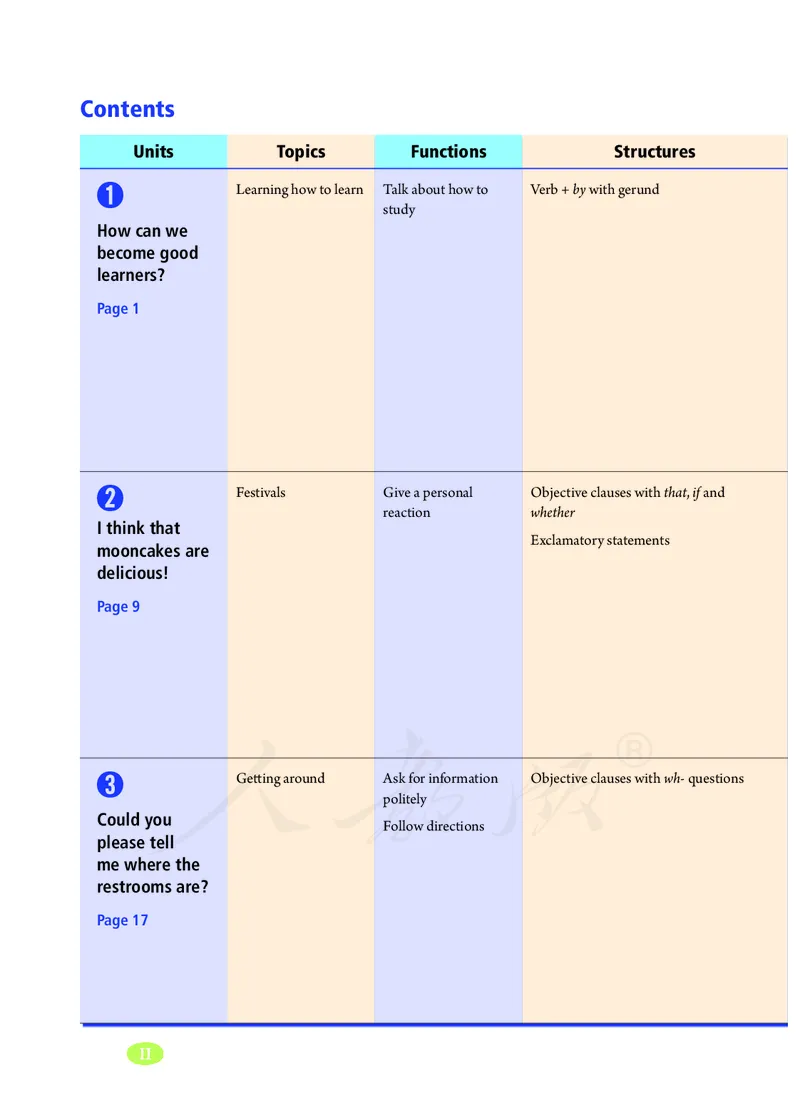
2014年3月Contents
Units Topics Functions Structures Target Language Vocabulary Recycling
Learning how to learn Talk about how to Verb + by with gerund How do you learn English? textbook, conversation, work, read, listen, ask, help,
➊
study I learn by studying with a group. pronunciation, sentence, study, watch, practice, improve,
How can we expression, secret, grammar, note, understand, learn, develop,
Do you learn English by reading
become good physics, chemistry, partner, speed, remember, prepare
aloud?
learners? Yes, I do. It helps my pronunciation. ability, brain, att ention, knowledge be interested in, be good at, in
discover, repeat, pronounce, common, get bored, fi nd out, learn
Page 1 How can I read faster?
increase, born, create, connect, from, fall in love with, because of
You can read faster by reading word
review
groups. How questions
patient, active
How can I improve my
pronunciation? aloud, wisely
One way is by listening to tapes.
pay att ention to, connect ... with
Festivals Give a personal Objective clauses with that, if and I know that the Water Festival is really stranger, relative, pound, dessert, fantastic, crowded, delicious,
➋
reaction whether fun. garden, tie, treat, Christmas, novel, fun, traditional, prett y, beautiful,
I think that
business, warmth exciting, interesting, special, scary,
Exclamatory statements I wonder if they’ll have the races again
mooncakes are popular
next year. steal, lay, admire, lie, punish, warn,
delicious!
spread be similar to, remind ... of, so ... that
I wonder whether June is a good time
Page 9 to visit Hong Kong. dead, present
I believe that April is the hott est put on, lay out, end up
month in Th ailand.
What fun the Water Festival is!
How prett y the dragon boats were!
Gett ing around Ask for information Objective clauses with wh- questions Excuse me, do you know where I can restroom, stamp, postcard, money, magazine, dictionary,
➌
politely buy some medicine? bathroom, rush, staff , grape, east, dinner, newspaper, information,
Could you Sure. Th ere’s a supermarket down the mall, clerk, corner, speaker, request, town, shoes, bookstore, supermarket,
Follow directions
please tell street. direction, address, course bank, park, ride, restaurant, library,
me where the Could you please tell me how to get to pardon, suggest, mail museum
restrooms are? the post offi ce? post offi ce
central, convenient, polite,
Sorry, I’m not sure how to get there.
impolite, direct, correct, excuse me, go along, turn right/
Page 17
I wonder where we should go next. underground left , second/third fl oor, next to
You should try that new ride over
pass by, pardon me Modal verbs
there.
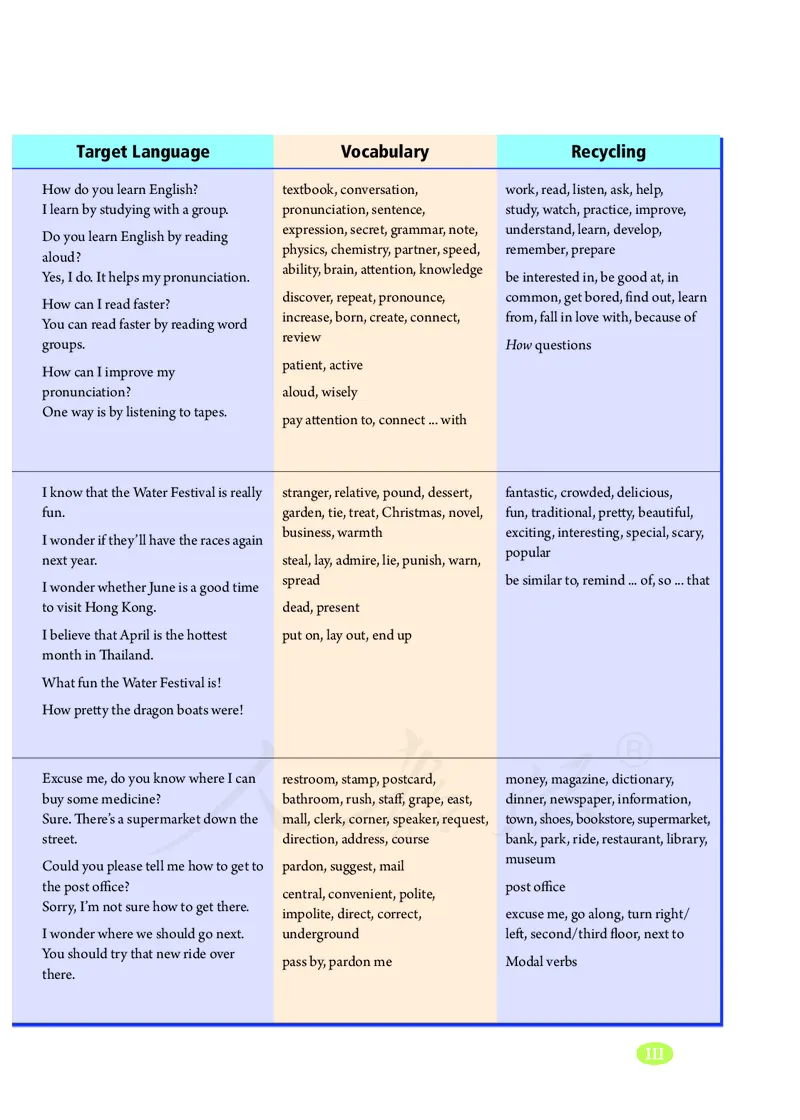
IIIIUnits Topics Functions Structures Target Language Vocabulary Recycling
Learning how to learn Talk about how to Verb + by with gerund How do you learn English? textbook, conversation, work, read, listen, ask, help,
➊
study I learn by studying with a group. pronunciation, sentence, study, watch, practice, improve,
How can we expression, secret, grammar, note, understand, learn, develop,
Do you learn English by reading
become good physics, chemistry, partner, speed, remember, prepare
aloud?
learners? Yes, I do. It helps my pronunciation. ability, brain, att ention, knowledge be interested in, be good at, in
discover, repeat, pronounce, common, get bored, fi nd out, learn
Page 1 How can I read faster?
increase, born, create, connect, from, fall in love with, because of
You can read faster by reading word
review
groups. How questions
patient, active
How can I improve my
pronunciation? aloud, wisely
One way is by listening to tapes.
pay att ention to, connect ... with
Festivals Give a personal Objective clauses with that, if and I know that the Water Festival is really stranger, relative, pound, dessert, fantastic, crowded, delicious,
➋
reaction whether fun. garden, tie, treat, Christmas, novel, fun, traditional, prett y, beautiful,
I think that
business, warmth exciting, interesting, special, scary,
Exclamatory statements I wonder if they’ll have the races again
mooncakes are popular
next year. steal, lay, admire, lie, punish, warn,
delicious!
spread be similar to, remind ... of, so ... that
I wonder whether June is a good time
Page 9 to visit Hong Kong. dead, present
I believe that April is the hott est put on, lay out, end up
month in Th ailand.
What fun the Water Festival is!
How prett y the dragon boats were!
Gett ing around Ask for information Objective clauses with wh- questions Excuse me, do you know where I can restroom, stamp, postcard, money, magazine, dictionary,
➌
politely buy some medicine? bathroom, rush, staff , grape, east, dinner, newspaper, information,
Could you Sure. Th ere’s a supermarket down the mall, clerk, corner, speaker, request, town, shoes, bookstore, supermarket,
Follow directions
please tell street. direction, address, course bank, park, ride, restaurant, library,
me where the Could you please tell me how to get to pardon, suggest, mail museum
restrooms are? the post offi ce? post offi ce
central, convenient, polite,
Sorry, I’m not sure how to get there.
impolite, direct, correct, excuse me, go along, turn right/
Page 17
I wonder where we should go next. underground left , second/third fl oor, next to
You should try that new ride over
pass by, pardon me Modal verbs
there.
IIIIII
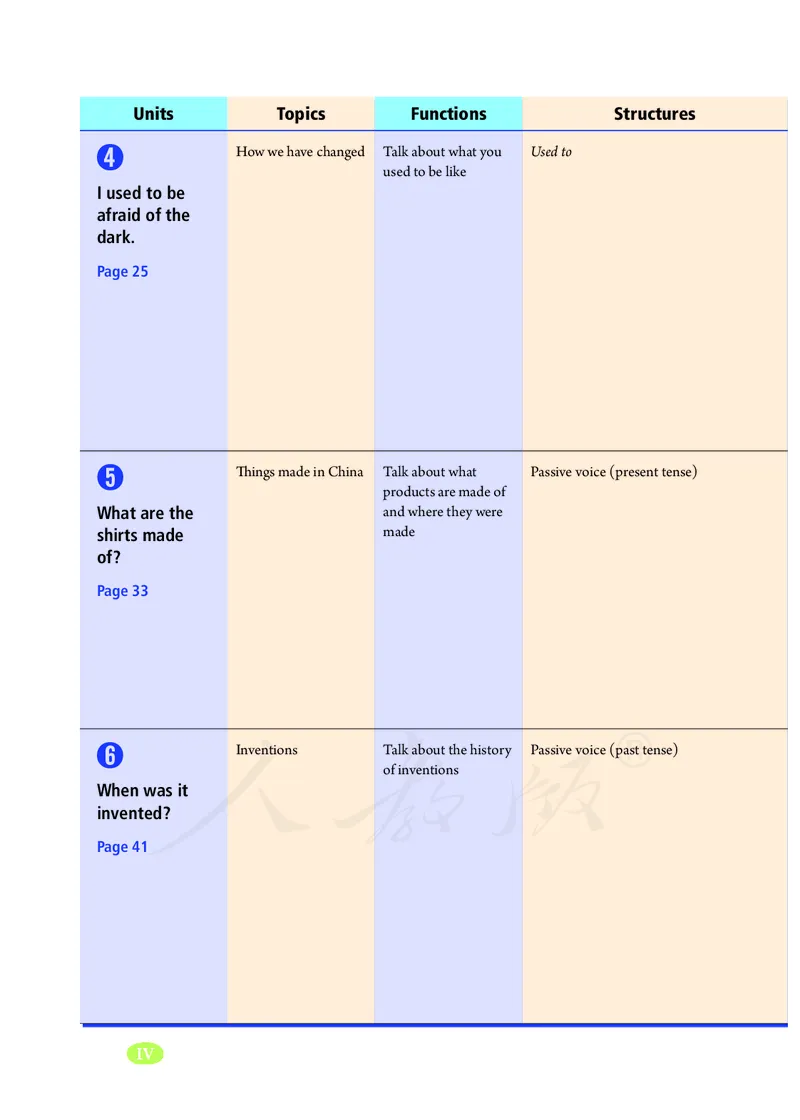
Page PBUnits Topics Functions Structures Target Language Vocabulary Recycling
How we have changed Talk about what you Used to I used to be short. score, background, guard, speech, tall, short, outgoing, funny, shy,
➍
used to be like I didn’t use to be popular in school. public, ant, examination, pride, serious, quiet, friendly, active,
I used to be introduction brave, thin, strong, famous,
You used to be short, didn’t you?
afraid of the popular, afraid, normal
Yes, I did. / No, I didn’t. interview, dare, require, infl uence,
dark. fail straight/curly hair, wear glasses,
Did he use to wear glasses?
pay att ention to
Page 25 Yes, he did. / No, he didn’t. humorous, silent, helpful, Asian,
European, African, British Present perfect tense
private, proud, absent, general
seldom, exactly
from time to time, deal with, in
public, be proud of, in person,
take pride in
Th ings made in China Talk about what Passive voice (present tense) Are your shirts made of cott on? chopstick, coin, fork, blouse, silver, stamp, wood, gold, paper, silk,
➎
products are made of Yes, they are. And they were made in glass, cott on, steel, grass, leaf, painting, tea, mountain, health,
What are the and where they were the US. product, handbag, boss, surface, business, camera, clothes, watch,
shirts made made material, traffi c, postman, cap, toy, kite, festival, competition, art,
What’s the model plane made of?
of? It’s made of used wood and glass. glove, form, balloon, scissors, heat, bamboo
France, Germany
model plane
Page 33 How is tea produced?
produce, process, avoid, polish,
Tea plants are grown on the sides of Objective clauses
complete
mountains.
local, mobile, everyday,
When the leaves are ready, they are
international, lively
picked by hand and then are sent for
processing. be known for, no matt er
Inventions Talk about the history Passive voice (past tense) When was the zipper invented? style, project, pleasure, website, invention, TV, car, telephone,
➏
of inventions It was invented in 1893. pioneer, ruler, smell, doubt, special, ice-cream, shoes, tea,
When was it Who was it invented by? fridge, earthquake, biscuit, cookie, century, country, potato chip,
invented? history, mistake, basketball, idea
It was invented by Whitcomb Judson. instrument, customer, basket, hero
invent, discover, create
Page 41 What is the hot ice-cream scoop used list, mention, boil, translate, lock,
for? divide popular, sweet
It’s used for serving really cold
It is said that ...
daily, national, low, sour
ice-cream.
It is believed that ...
by accident, take place, without
doubt, all of a sudden, by mistake,
divide ... into, look up to, not only ...
but also
IIVVUnits Topics Functions Structures Target Language Vocabulary Recycling
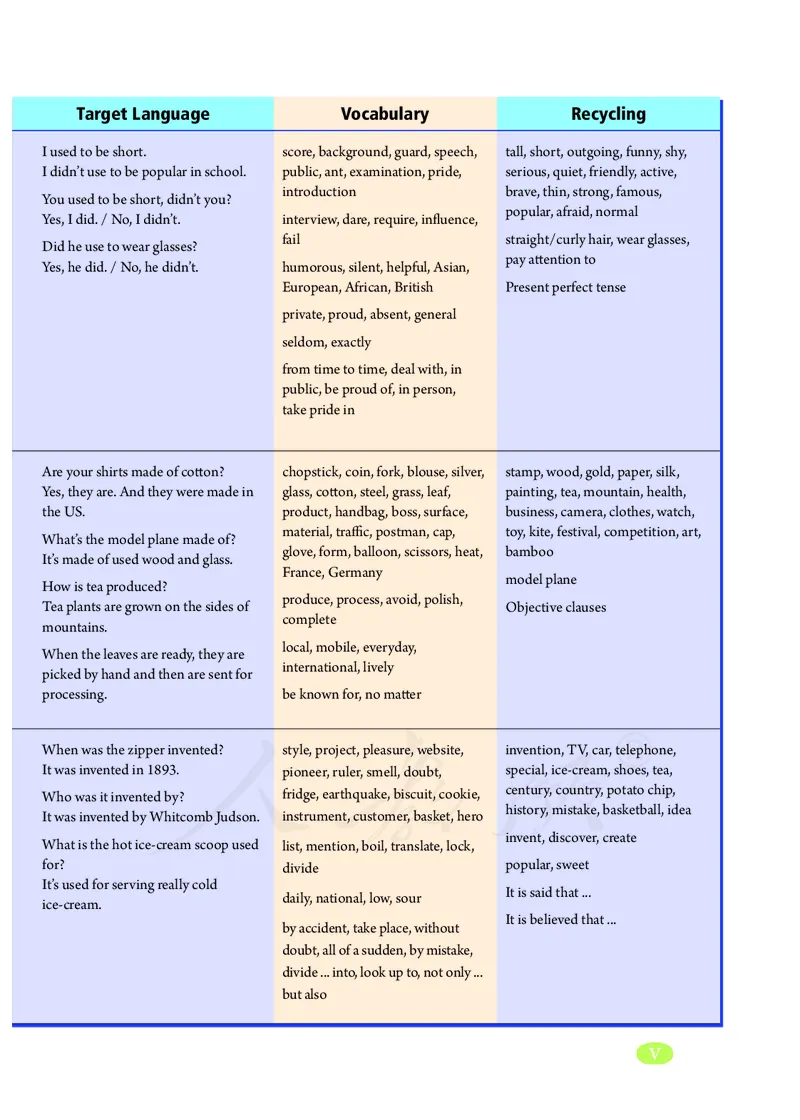
How we have changed Talk about what you Used to I used to be short. score, background, guard, speech, tall, short, outgoing, funny, shy,
➍
used to be like I didn’t use to be popular in school. public, ant, examination, pride, serious, quiet, friendly, active,
I used to be introduction brave, thin, strong, famous,
You used to be short, didn’t you?
afraid of the popular, afraid, normal
Yes, I did. / No, I didn’t. interview, dare, require, infl uence,
dark. fail straight/curly hair, wear glasses,
Did he use to wear glasses?
pay att ention to
Page 25 Yes, he did. / No, he didn’t. humorous, silent, helpful, Asian,
European, African, British Present perfect tense
private, proud, absent, general
seldom, exactly
from time to time, deal with, in
public, be proud of, in person,
take pride in
Th ings made in China Talk about what Passive voice (present tense) Are your shirts made of cott on? chopstick, coin, fork, blouse, silver, stamp, wood, gold, paper, silk,
➎
products are made of Yes, they are. And they were made in glass, cott on, steel, grass, leaf, painting, tea, mountain, health,
What are the and where they were the US. product, handbag, boss, surface, business, camera, clothes, watch,
shirts made made material, traffi c, postman, cap, toy, kite, festival, competition, art,
What’s the model plane made of?
of? It’s made of used wood and glass. glove, form, balloon, scissors, heat, bamboo
France, Germany
model plane
Page 33 How is tea produced?
produce, process, avoid, polish,
Tea plants are grown on the sides of Objective clauses
complete
mountains.
local, mobile, everyday,
When the leaves are ready, they are
international, lively
picked by hand and then are sent for
processing. be known for, no matt er
Inventions Talk about the history Passive voice (past tense) When was the zipper invented? style, project, pleasure, website, invention, TV, car, telephone,
➏
of inventions It was invented in 1893. pioneer, ruler, smell, doubt, special, ice-cream, shoes, tea,
When was it Who was it invented by? fridge, earthquake, biscuit, cookie, century, country, potato chip,
invented? history, mistake, basketball, idea
It was invented by Whitcomb Judson. instrument, customer, basket, hero
invent, discover, create
Page 41 What is the hot ice-cream scoop used list, mention, boil, translate, lock,
for? divide popular, sweet
It’s used for serving really cold
It is said that ...
daily, national, low, sour
ice-cream.
It is believed that ...
by accident, take place, without
doubt, all of a sudden, by mistake,
divide ... into, look up to, not only ...
but also
VV
Page PBUnits Topics Functions Structures Target Language Vocabulary Recycling
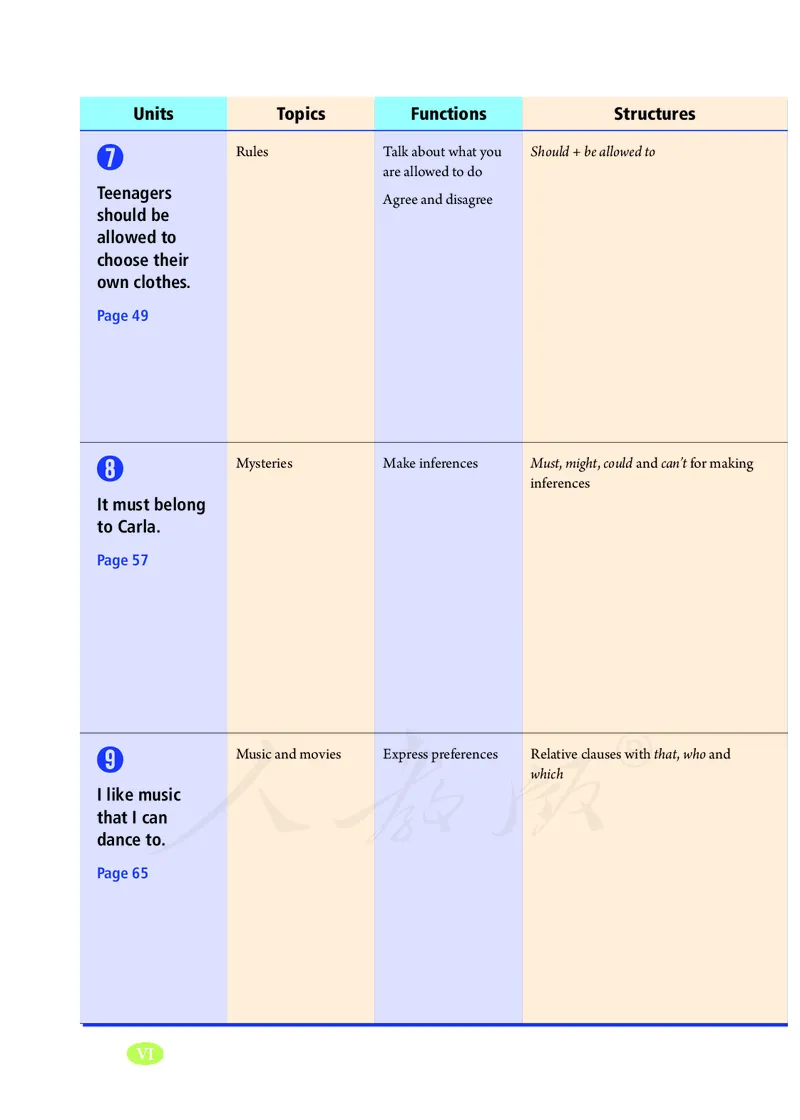
Rules Talk about what you Should + be allowed to I don’t think sixteen-year-olds should license, safety, fi eld, hug, poem, parent, decision, rule, test
➐
are allowed to do be allowed to drive. community, chance, society, choice
drive, choose, work, agree, disagree,
Teenagers I agree. Th ey aren’t serious enough.
Agree and disagree smoke, cry, lift , regret, manage, decide
should be
Teenagers should not be allowed to
educate, enter, support young, silly, serious, old, strict,
allowed to have part-time jobs.
worried
choose their I disagree. Th ey can learn a lot from tiny, awful
take photos, move out, take care of,
own clothes. working.
talk back, keep ... away from, make
look aft er, care about
one’s own decision, get in the way
Page 49
Adverbial clauses with when
of
Mysteries Make inferences Must, might, could and can’t for making Whose volleyball is this? truck, rabbit, picnic, noise, volleyball, magazine, book, CD,
➑
inferences It must be Carla’s. She loves volleyball. policeman, wolf, laboratory, coat, toy, music, schoolbag, idea
It must belong
Whose hair band is this? suit, circle, leader, purpose, energy, remember, believe, think, agree
to Carla.
It could be Mei’s hair band. Or it position, victory, enemy, period
favorite, unusual, strange, special,
might belong to Linda. Th ey both
Page 57 att end, express, receive, prevent nervous, worried
have long hair.
valuable, pink, sleepy, medical thousands of
What did you see that night?
Adverbial clauses with but, however
I’m not sure, but it can’t be a dog. whose, anybody
and as
run aft er, at the same time
Music and movies Express preferences Relative clauses with that, who and What kind of music do you like? case, war, director, dialog, pain, dance, sing, relax, laugh, enjoy, like,
➒
which I love music that/which I can sing pity, total, master, wound love, record
I like music along with.
prefer, suppose, stick, shut, sense, loud, quiet, slow, funny,
that I can
What kind of movies do you like? serious, tired, sad, exciting, scary,
refl ect, perform, praise
dance to. I prefer movies that/which give me happy, comfortable, sweet, salty,
something to think about. electronic, smooth, spare, down interesting, beautiful
Page 65
What kind of musicians does Carmen in that case, stick to, plenty of, shut don’t mind, feel like, cheer up
like? off , once in a while, in total
not ... anymore, in time,
She likes musicians who play diff erent
not only ... but also
kinds of music.
VVIIUnits Topics Functions Structures Target Language Vocabulary Recycling
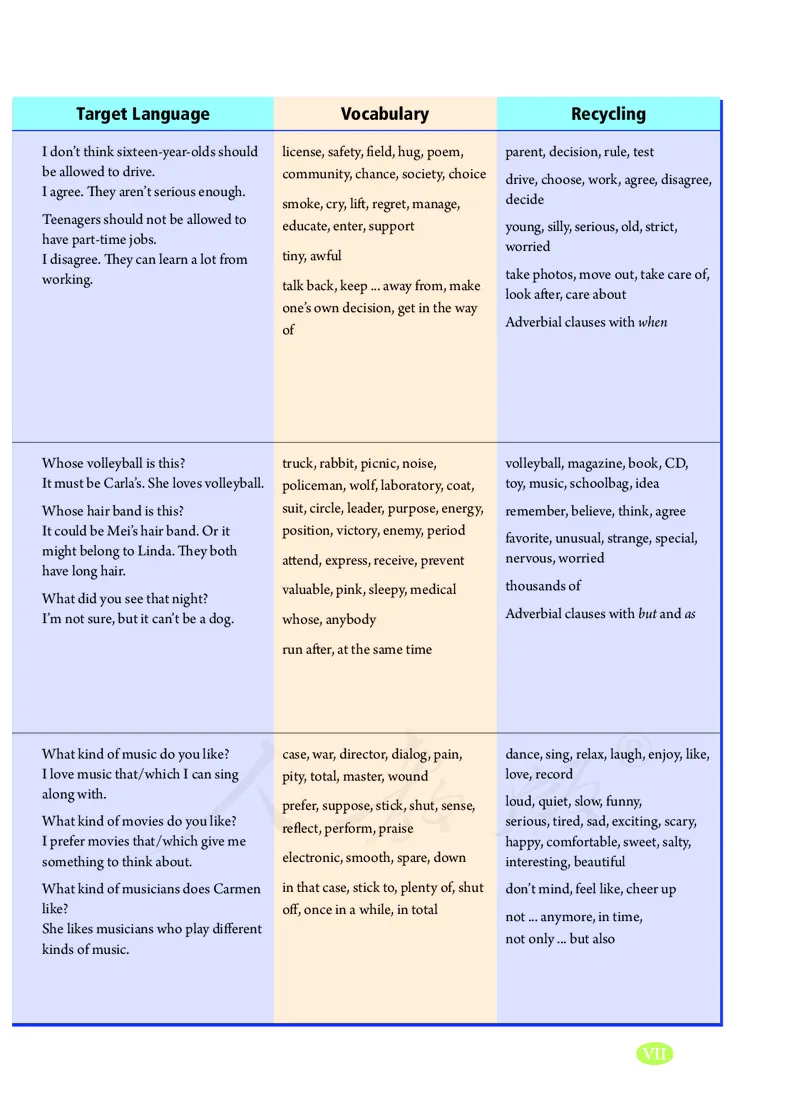
Rules Talk about what you Should + be allowed to I don’t think sixteen-year-olds should license, safety, fi eld, hug, poem, parent, decision, rule, test
➐
are allowed to do be allowed to drive. community, chance, society, choice
drive, choose, work, agree, disagree,
Teenagers I agree. Th ey aren’t serious enough.
Agree and disagree smoke, cry, lift , regret, manage, decide
should be
Teenagers should not be allowed to
educate, enter, support young, silly, serious, old, strict,
allowed to have part-time jobs.
worried
choose their I disagree. Th ey can learn a lot from tiny, awful
take photos, move out, take care of,
own clothes. working.
talk back, keep ... away from, make
look aft er, care about
one’s own decision, get in the way
Page 49
Adverbial clauses with when
of
Mysteries Make inferences Must, might, could and can’t for making Whose volleyball is this? truck, rabbit, picnic, noise, volleyball, magazine, book, CD,
➑
inferences It must be Carla’s. She loves volleyball. policeman, wolf, laboratory, coat, toy, music, schoolbag, idea
It must belong
Whose hair band is this? suit, circle, leader, purpose, energy, remember, believe, think, agree
to Carla.
It could be Mei’s hair band. Or it position, victory, enemy, period
favorite, unusual, strange, special,
might belong to Linda. Th ey both
Page 57 att end, express, receive, prevent nervous, worried
have long hair.
valuable, pink, sleepy, medical thousands of
What did you see that night?
Adverbial clauses with but and as
I’m not sure, but it can’t be a dog. whose, anybody
run aft er, at the same time
Music and movies Express preferences Relative clauses with that, who and What kind of music do you like? case, war, director, dialog, pain, dance, sing, relax, laugh, enjoy, like,
➒
which I love music that/which I can sing pity, total, master, wound love, record
I like music along with.
prefer, suppose, stick, shut, sense, loud, quiet, slow, funny,
that I can
What kind of movies do you like? serious, tired, sad, exciting, scary,
refl ect, perform, praise
dance to. I prefer movies that/which give me happy, comfortable, sweet, salty,
something to think about. electronic, smooth, spare, down interesting, beautiful
Page 65
What kind of musicians does Carmen in that case, stick to, plenty of, shut don’t mind, feel like, cheer up
like? off , once in a while, in total
not ... anymore, in time,
She likes musicians who play diff erent
not only ... but also
kinds of music.
VVIIII
Page PBUnits Topics Functions Structures Target Language Vocabulary Recycling
Customs Talk about customs Supposed + infinitive What are you supposed to do when capital, noon, passport, chalk, meet, wear, arrive
➓
and what you are you meet someone for the first time? blackboard, coast, season, manner,
Expected + infinitive late, polite, impolite, important,
You’re supposed to do You’re supposed to shake hands.
granddaughter, suggestion strange
It is + adj. + infinitive
supposed to
Am I supposed to wear jeans?
kiss, greet, value, knock, exchange, shake hands, on time, make friends,
shake hands. No, you’re expected to wear a suit
behave to one’s surprise, be used to
and tie.
Page 73 mad, northern, eastern, worth, Should for advice
Is it important to be on time?
empty, basic If clauses
Yes, it’s important to be on time.
except Passive voice
drop by, after all, get mad, make an Adverbial clauses
effort, clean ... off, take off, go out
of one’s way, make ... feel at home,
get used to
Feelings Talk about how things Make + sb. + infinitive without to The loud music makes me nervous. friendship, king, queen, palace, rainy, cloudy, sad, soft, relaxed,
affect you power, wealth, lemon, weight, loud, nervous, sleepy, mad,
Make + sb. + adj. Money and fame don’t always make
Sad movies people happy. shoulder, goal, coach, courage, unhappy, worried, angry, lucky
make me cry.
agreement in common, even though
She said that the sad movie made her
Page 81 cry. examine, kick, pull, nod, disappoint Passive voice
pale, grey
drive sb. crazy, the more ... the more,
be friends with, leave out,
neither ... nor, to start with,
let ... down, kick sb. off, pull together
Unexpected events Narrate past events Past perfect tense When I got to school, I realized that I backpack, block, worker, airport, bus, shower, key, clock, plane, bus
had left my backpack at home. fool, cream, pie, bean, market, stop, earthquake, joke
Review of key structures
Life is full of
By the time I got back to school, the discovery, lady, officer wake up, brush one’s teeth, wash
the unexpected.
bell had rung. one’s face, miss, go off, get dressed,
oversleep, burn, cancel, disappear
get up late, stay up, put on
Page 89 Before I got to the bus stop, the bus
unexpected, alive, west,
had already left. Simple past tense
embarrassed, believable,
As I was waiting in line with the other embarrassing Adverbial clauses
office workers, I heard a loud sound.
above, till
give ... a lift, show up, sell out
VIIIUnits Topics Functions Structures Target Language Vocabulary Recycling
Customs Talk about customs Supposed to + infi nitive What are you supposed to do when capital, noon, passport, chalk, meet, wear, arrive
➓
and what you are you meet someone for the fi rst time? blackboard, coast, season, manner,
Expected to + infi nitive late, polite, impolite, important,
You’re supposed to do You’re supposed to shake hands.
granddaughter, suggestion strange
It is + adj. + infi nitive
supposed to
Am I supposed to wear jeans?
kiss, greet, value, knock, exchange, shake hands, on time, make friends,
shake hands. No, you’re expected to wear a suit
behave to one’s surprise, be used to
and tie.
Page 73 mad, northern, eastern, worth, Should for advice
Is it important to be on time?
empty, basic If clauses
Yes, it’s important to be on time.
except Passive voice
drop by, aft er all, get mad, make an Adverbial clauses
eff ort, clean ... off , take off , go out
of one’s way, make ... feel at home,
get used to
Feelings Talk about how things Make + sb. + infi nitive without to Th e loud music makes me nervous. friendship, king, queen, palace, rainy, cloudy, sad, soft , relaxed,
aff ect you power, wealth, lemon, weight, loud, nervous, sleepy, mad,
Make + sb. + adj. Money and fame don’t always make
Sad movies people happy. shoulder, goal, coach, courage, unhappy, worried, angry, lucky
make me cry.
agreement in common, even though
She said that the sad movie made her
Page 81 cry. examine, kick, pull, nod, disappoint Passive voice
pale, grey
drive sb. crazy, the more ... the more,
be friends with, leave out,
neither ... nor, to start with,
let ... down, kick sb. off , pull together
Unexpected events Narrate past events Past perfect tense When I got to school, I realized that I backpack, block, worker, airport, bus, shower, key, clock, plane, bus
had left my backpack at home. fool, cream, pie, bean, market, stop, earthquake, joke
Review of key structures
Life is full of
By the time I got back to school, the discovery, lady, offi cer wake up, brush one’s teeth, wash
the unexpected.
bell had rung. one’s face, miss, go off , get dressed,
oversleep, burn, cancel, disappear
get up late, stay up, put on
Page 89 Before I got to the bus stop, the bus
unexpected, alive, west,
had already left . Simple past tense
embarrassed, believable,
As I was waiting in line with the other embarrassing Adverbial clauses
offi ce workers, I heard a loud sound.
above, till
give ... a lift , show up, sell out
IIXX
Page PBUnits Topics Functions Structures Target Language Vocabulary Recycling
Protecting the Talk about pollution Review of key structures We’re trying to save the earth. bott om, fi sherman, coal, advantage, clean up, take the bus/subway, ride
environment and environmental industry, law, gate, bott le, president, a bike, cut down, set up
Th e river used to be so clean.
We’re trying to protection
work, metal Present progressive tense
Th e air is badly polluted.
save the earth!
litt er, cost, aff ord, recycle Present perfect tense
No scientifi c studies have shown that
Page 97
shark fi ns are good for health. ugly, wooden, plastic, cruel, Passive voice
harmful
take part in, turn off , pay for, throw
away, put sth. to good use, pull ...
down
School days Share past memories Review of key structures I think that I’ll have to study much survey, standard, row, keyboard, no matt er, full of, deal with, be
and experiences harder for exams. instruction, text, level, degree, proud of, give up, grow up, work
I remember Look ahead to the I’m going to join the school volleyball manager, gentleman, task, wing out
meeting all of
future team. Objective clauses
double, shall, overcome,
you in Grade 7.
I remember being a volunteer. congratulate Be going to
Page 105 I’m looking forward to going to senior caring, senior, thirsty, thankful,
high school.
separate, lastly, ahead
in a row, make a mess, keep one’s
cool, senior high (school), believe
in, fi rst of all, be thirsty for, ahead of,
separate from, set out
Page 113 Notes on the Text
Page 133 Tapescripts
Page 150 Grammar
Page 156 Words and Expressions in Each Unit
Page 171 Vocabulary Index
Page 184 Irregular Verbs
XXUnits Topics Functions Structures Target Language Vocabulary Recycling
Protecting the Talk about pollution Review of key structures We’re trying to save the earth. bott om, fi sherman, coal, advantage, clean up, take the bus/subway, ride
environment and environmental industry, law, gate, bott le, president, a bike, cut down, set up
Th e river used to be so clean.
We’re trying to protection
work, metal Present progressive tense
Th e air is badly polluted.
save the earth!
litt er, cost, aff ord, recycle Present perfect tense
No scientifi c studies have shown that
Page 97
shark fi ns are good for health. ugly, wooden, plastic, cruel, Passive voice
harmful
take part in, turn off , pay for, throw
away, put sth. to good use, pull ...
down
School days Share past memories Review of key structures I think that I’ll have to study much survey, standard, row, keyboard, no matt er, full of, deal with, be
and experiences harder for exams. instruction, text, level, degree, proud of, give up, grow up, work
I remember Look ahead to the I’m going to join the school volleyball manager, gentleman, task, wing out
meeting all of
future team. Objective clauses
double, shall, overcome,
you in Grade 7.
I remember being a volunteer. congratulate Be going to
Page 105 I’m looking forward to going to senior caring, senior, thirsty, thankful,
high school.
separate, lastly, ahead
in a row, make a mess, keep one’s
cool, senior high (school), believe
in, fi rst of all, be thirsty for, ahead of,
separate from, set out
Page 113 Notes on the Text
Page 133 Tapescripts
Page 150 Grammar
Page 156 Words and Expressions in Each Unit
Page 171 Vocabulary Index
Page 184 Irregular Verbs
XXII
Page PBU 1
NIT
Section
A How can we become good
learners?
Language Goal:
1a Check (✔) the ways you study English. Th en add
Talk about how
other ways you sometimes study.
to study
a. by working with friends e. by asking the teacher for help
b. by making word cards
c. by reading the textbook
d. by listening to tapes
I study by making
word cards.
1b Listen. How do these students study for a test? Write lett ers from 1a above.
1. Meiping 2. Peter 3. Tony
1c Make conversations about how you study for a test.
A: How do you study for a test?
B: I study by working with a group.
1
Page PBUNIT 1
2a Listen and check Questions Answers
(4) the questions
1. Does anyone learn English by watching
you hear. videos?
2. Do you have conversations with friends
in English?
3. What about listening to tapes?
4. What about reading aloud to practice
pronunciation?
5. Have you ever studied with a group?
2b Listen again. Match each answer below with a question above.
a. Yes, I have. I’ve learned a lot that way.
b. Oh, yes. It really improves my speaking skills.
c. I do that sometimes. I think it helps.
d. No. It’s too hard to understand spoken English.
2c Make conversations using the information in 2a and 2b.
A: Have you ever studied with a group?
B: Yes, I have. I’ve learned a lot that way.
2d Role-play the conversation.
Jack: Annie, I’m a little nervous. I have to finish reading a book and give a
report next Monday.
Annie: That doesn’t sound too bad.
Jack: But I’m a very slow reader.
Annie: Just read quickly to get the main ideas at first. Don’t read word by word.
Read word groups.
Jack: But I don’t understand many of the words. I have to use a dictionary.
Annie: Try to guess a word’s meaning by reading the sentences before and after
it. You probably understand more than you think.
Jack: That sounds difficult!
Annie: Well, be patient. It takes time. You can become better by reading
something you enjoy every day. The more you read, the faster you’ll be.
2How can we become good learners? UNIT 1
3a Read the passage about Wei Fen and answer the questions.
1. Why did Wei Fen fi nd it diffi cult to learn English?
2. What did she do in English class?
3. What is the secret to language learning?
How I Learned to Learn English
Last year, I did not like my English class. Every class was like a bad dream. Th e teacher
spoke so quickly that I did not understand her most of the time. I was afraid to ask
questions because of my poor pronunciation. I just hid behind my textbook and
never said anything.
Th en one day I watched an English movie called Toy Story. I fell in love with this
exciting and funny movie! So I began to watch other English movies, too. Although
I could not understand everything the characters said, their body language and the
expressions on their faces helped me to get the meaning. I also realized I could get
the meaning by listening for just the key words. My pronunciation improved as
well by listening to the conversations in English movies. I discovered that listening
to something interesting is the secret to language learning. I also
learned useful sentences like “It’s a piece of cake” or “It serves you
right”. I did not understand these sentences at fi rst. But because I
wanted to understand the story, I looked them up in a dictionary.
Now I really enjoy my English class. I want to learn new words
and more grammar so that I can have a bett er understanding of
English movies.
3b Complete the sentences with what Wei Fen learned from watching
movies. Use words and phrases from the passage.
1. I can understand the meaning by watching their and the
on their faces.
2. I can get the meaning by listening for just the .
3. My pronunciation improved by listening to the in English
movies.
4. I learned sentences like “It’s a piece of cake” by watching
the movies.
5. I can fi nd the meaning of new words by looking them up in a
.
3
Page PBUNIT 1
Grammar
Focus
How do you learn English? I learn by studying with a group.
Do you learn English by reading aloud? Yes, I do. It helps my pronunciation.
How can I read faster? You can read faster by reading word groups.
How can I improve my pronunciation? One way is by listening to tapes.
4a Match the questions and answers.
1. How do you practice speaking? a. By watching English programs.
2. How do you learn new words? b. By listening to a tape and repeating out loud.
3. How do you improve your writing? c. By having conversations with friends.
4. How do you practice listening? d. By taking notes, doing exercises and reading a lot.
5. How do you improve your pronunciation? e. By making word cards.
6. How do you learn grammar? f. By writing e-mails to my pen pals.
4b Make sentences using the structure “do sth. by doing” with the subjects
in the box and information that is true for you.
math physics chemistry Chinese history geography
e.g. I usually practice my English by taking notes / reading books and newspapers /
speaking English with my classmates / memorizing sentence patterns.
4c Check (✔) what you A: Do you learn English by doing grammar exercises?
do to learn English. B: Yes, I do.
Th en interview your A: How oft en do you do them?
partner. B: ...
My partner
I learn English by ...
learns English by ...
yes no how often yes no how often
doing grammar exercises
taking notes in English
reading English books/magazines
keeping a diary in English
using an English dictionary
...
4How can we become good learners? UNIT 1
1a Learning English can be diffi cult. What things
Section are diffi cult for you? Read the list. Check (✔) the
statements that are true for you.
B
I can’t pronounce some of the words.
I can’t always understand spoken English.
I don’t know how to increase my reading speed.
I can’t spell some English words.
I oft en make mistakes in grammar.
1b What other things are diffi cult for you? Make a list.
1. I don‛t know enough words to write well.
2.
3.
1c Paul fi nds it diffi cult to learn English. Listen and complete the
learning challenges he talks about.
Challenges
1. He can’t get the right.
2. He a lot of new words.
3. He can’t always when people talk to him.
4. He doesn’t get much practice.
1d Listen again. Complete the solutions.
Solutions
1. can help.
2. He can always in his notebook and study them at home.
3. He can to practice speaking.
4. He should fi nd a to practice writing.
1e Role-play conversations using the information in 1c and 1d.
A: I don’t have a partner to practice English with.
B: Maybe you should join an English club.
5
Page PBUNIT 1
2a What good learning habits can you think of? Make a list and discuss
them with your partner.
2b Read the passage quickly and check if any of the habits you listed in 2a
are mentioned. Which four habits of successful learners can you fi nd
from the passage?
USING DICTIONARIES
This can help you fi nd the
How Can You Become
defi nition that matches the
a Successful Learner?
context of the word in the text.
Everyone is born with the ability to learn.
BBuutt wwhheetthheerr oorr nnoott yyoouu ccaann ddoo tthhiiss wweellll ddeeppeennddss oonn yyoouurr lleeaarrnniinngg hhaabbiittss.. RReesseeaarrcchh
shows that successful learners have some good habits in common.
Creating an interest in what they learn
Studies show that if you are interested in something, your brain is more active
and it is also easier for you to pay att ention to it for a long time. Good learners
oft en connect what they need to learn with something interesting. For example, if
they need to learn English and they like music or sports, they can listen to English
songs or watch sports programs in English. Th is way they will not get bored.
Practicing and learning from mistakes
Good learners think about what they are good at and what they need to practice more.
Remember, “Use it or lose it.” Even if you learn something well, you will forget it
unless you use it. “Practice makes perfect.” Good learners will keep practicing what
they have learned, and they are not afraid of making mistakes. Alexander Graham Bell
did not invent the telephone overnight. He succeeded by trying many times and learning
from his mistakes.
Developing their study skills
It is not enough to just study hard. Good learners know the best way they can study.
For example, they may take notes by writing down key words or by drawing mind
maps. Th ey also look for ways to review what they have learned. Th ey may do this by
reading their notes every day or by explaining the information to another student.
Asking questions
Good learners oft en ask questions during or aft er class.
Th ey even ask each other and try to fi nd out the answers.
Knowledge comes from questioning.
Learning is a lifelong journey because every day brings
something new. Everything that you learn becomes a
part of you and changes you, so learn wisely and learn
well.
6How can we become good learners? UNIT 1
2c Read the passage again and answer the questions.
1. Does the writer think that everyone is born with the ability to learn well?
Do you agree? Why or why not?
2. Why is it a good idea to connect something you need to learn with
something you are interested in?
3. What do the sayings “Use it or lose it” and “Practice makes perfect” mean?
Do you agree with them?
4. Do good learners learn from mistakes, or are they afraid of making
mistakes?
5. What study skills does the writer talk about? Do you have those study
skills?
6. Do you agree that learning is a lifelong journey? Why or why not?
2d Look up the following words from the passage in the dictionary. Th en
write a sentence for each word.
brain n. connect v. overnight adv.
att ention n. review v. knowledge n.
ability n. active adj. wisely adv.
e.g. brain: A good way to train the brain is to do some math exercises every day.
2e Do you think you are a good learner? What learning habits do you think
are useful? Discuss with your group and share your ideas with the class.
3a Your friend wants to improve his/her English and asks you for help. What
are the three best ways to learn and why? Make some notes in the chart.
Best ways to learn Reasons Examples
1. Being interested in what If you are interested in If you like music, you can
you do something, your brain will learn English by listening to
be more active and ... English songs.
2.
3.
7
Page PBUNIT 1
3b Write a lett er to your
Use the following expressions to help
friend. Give him/her
you:
some advice about the
There are three good ways to ...
best ways to learn
I think you should ...
English. Use your notes
If you do this, you will ...
in 3a.
It is also a good idea to ... because ...
You could try to improve your English by ...
This will help you to ...
Self Check
1 Fill in the blanks with the words in the box.
practice develop remember prepare
take notes until worry about everything
Are you stressed out each time you have a test? You don’t have to be
if you smart study skills. Remember to in
class and review them on your own or with friends aft er class. Th en
what you learned by doing exercises. Try to study and
information bit by bit instead of waiting the
last minute to study at once. If you well for a
test, then there’s nothing to !
2 Number these sentences in order to make a conversation.
What’s the matt er?
Well, I practice my listening by listening to the tape over and over
again until I can understand everything.
So you want to practice your listening?
Hi, Jake. I need your help.
Uh-huh. Do you have any advice?
OK, I’ll try that.
I have a listening test next week.
3 Give advice to these people.
1. Jane is a very slow reader.
She should improve her reading speed .
2. Li Ming wants to improve his listening.
He could practice his listening .
3. Meiping doesn’t know many English words.
She could learn more words .
8U 2
NIT
Section
A
I think that mooncakes are
delicious!
Language Goal:
1a Match the pictures with the descriptions.
Give a personal
reaction 1. The Water Festival in Thailand
2. The Dragon Boat Festival in Hong Kong
3. The Chinese Spring Festival in Beijing
4. The Lantern Festival in Jiangxi
a
c
d
b
What a great
day! What did you
like best?
I loved the races!
But I guess it was a
little too crowded.
1b Listen and circle T for true or F for false.
1. Bill thinks that the races were not that interesting to watch. T F
2. Mary thinks that the teams were fantastic. T F
3. Bill wonders whether they’ll have zongzi again next year. T F
4. Bill and Mary believe that they’ll be back next year to watch the races. T F
1c Talk about the festivals in 1a.
A: What do you like best about the Dragon Boat Festival?
B: I love the races. I think that they’re fun to watch.
9
Page PBUNIT 2
2a Listen to the conversation between Wu Ming and Harry and circle the
correct words in the sentences.
1. Wu Ming and Harry are cousins / strangers / friends.
2. Wu Ming went to Singapore / Hong Kong / Macao for his vacation.
3. Wu Ming visited his relatives / friends / classmates.
4. Wu Ming liked eating out / shopping / the Dragon Boat Festival best.
2b Wu Ming did a lot of fun activities, but there were also downsides.
Listen again and fi ll in the chart.
Fun activities Downsides
Eating out
Shopping
Dragon Boat Festival in June
2c Role-play conversations between Wu Ming and Harry. Use the
information in 2a and 2b or make your own conversations.
A: What did you do on your vacation?
B: I visited my cousins. I think that we ate fi ve meals a day!
I’ve put on fi ve pounds!
A: I guess the food was delicious, right?
2d Role-play the conversation.
Clara: Guess what? I’m going to Chiang
Mai in two weeks.
Ben: Wow, sounds like fun! But I believe
that April is the hott est month of the
year there.
Clara: Yes, that’s true. But there’s a water
festival there from April 13th to 15th.
Ben: I wonder if it’s similar to the Water
Festival of the Dai people in Yunnan Province.
Clara: Yes, I think so. Th is is the time of the Th ai New Year. People go on the
streets to throw water at each other.
Ben: Cool! But why do they do that?
Clara: Because the new year is a time for cleaning and washing away bad
things. Th en you’ll have good luck in the new year.
10I think that mooncakes are delicious! UNIT 2
3a Read the passage about the Mid-Autumn Festival and answer the
questions.
1. How do people celebrate the Mid-Autumn Festival?
2. What story is the reading about?
Full Moon, Full Feelings
Chinese people have been celebrating the Mid-Autumn Festival and enjoying
mooncakes for centuries. Mooncakes are in the shape of a full moon on the
Mid-Autumn night. They carry people’s wishes to the families they love and miss.
There are many traditional folk stories about this festival. However, most people
think that the story of Chang’e is the most touching. Chang’e was Hou Yi’s beautiful
wife. After Hou Yi shot down the nine suns, a goddess gave him magic medicine to
thank him. Whoever took this could live forever, and Hou Yi planned to take it with
Chang’e. However, a bad man, Pang Meng, tried to steal the medicine when Hou
Yi was not home. Chang’e refused to give it to him and took it all. She became very
light and flew up to the moon. Hou Yi was so sad that he
called out her name to the moon every night. One night,
he found that the moon was so bright and round that he
could see his wife there. He quickly laid out her favorite
fruits and desserts in the garden. How he wished that
Chang’e could come back!
After this, people started the tradition of admiring the
moon and sharing mooncakes with their families.
3b Read the passage again. Put the events in the correct order.
Pang Meng tried to steal the medicine.
A goddess thanked Hou Yi by giving him magic medicine.
Chang’e refused to give Pang Meng the medicine and took it all.
1 Hou Yi shot down the nine suns and saved the people on the earth.
Hou Yi was very sad and watched the moon at night, and wished his
wife could come back.
As a result, Chang’e became light and flew up to the sky.
Hou Yi planned to take the medicine with his wife.
3c Without looking at the passage, try to complete the sentences with the
correct words.
1. People like to a the full moon on the Mid-Autumn night.
2. The story of Chang’e is one of many t folk stories.
3. Hou Yi got m medicine for shooting down the nine suns.
4. Pang Meng wanted to s the medicine.
5. Hou Yi l out fruits and desserts in the garden.
11
Page PBUNIT 2
Grammar
Focus
I know that the Water Festival is really fun. What fun the Water Festival is!
I wonder if they’ll have the races again How fantastic the dragon boat teams
next year. were!
I wonder whether June is a good time to How pretty the dragon boats were!
visit Hong Kong.
I believe that April is the hottest month in How delicious the food is in Hong
Thailand. Kong!
4a Write sentences using the words given.
1. think / Lantern Festival / beautiful
I think that the Lantern Festival is beautiful.
2. don’t know / whether / he / come home / for the festival
3. believe / Water Festival / most / fun
4. wonder / if / mooncakes / delicious
5. how / exciting / races
6. what / interesting / city
4b Read the passage below and underline the objective clauses. If possible,
write your own sentences about Mother’s Day and Father’s Day using
objective clauses.
Dear Xia Yu,
Do you know that there are two special days for parents in America? One is
Mother’s Day on the second Sunday of May, and the other is Father’s Day on
the third Sunday of June. On these two days, American children oft en give gift s
to their parents or take them out for lunch or dinner. Common gift s are fl owers
and cards for mothers and shirts or ties for fathers. I heard that it is becoming
more and more popular to celebrate Mother’s Day and Father’s Day in China. I
wonder if children over there also give similar gift s to their parents. I believe that
there are many ways to show our love. Actually, we don’t have to spend a lot of
money. It is also a good idea to help parents to do something instead.
June
4c Which festival do you like best? Ask your group and report to the class.
e.g. In our group, David‛s favorite festival is ... He thinks that ...
12I think that mooncakes are delicious! UNIT 2
1a Look at the pictures and words related to Halloween.
Section
What do you think this festival is about?
B
scary dress up haunted house black cat candy
ghost trick or treat October spider
1b Listen and answer the questions.
1. Where is Halloween popular?
2. When do people celebrate Halloween?
3. What does Wu Yu think of this festival?
1c Listen again and fi ll in the blanks.
1. Many people make their look scary. Th ey may
the lights and light candles. Th ey sometimes also put
things like spiders and ghosts around the doors and .
2. Litt le kids and even parents as ghosts or black cats. Th ey
can also dress up as fun things like characters.
3. Parents take their children around the neighborhood to ask for
and treats.
4. “Trick or treat” means kids will a trick on you if you
don’t them a treat.
1d Th ink about the Halloween activities that interest you most. Discuss
what you have learned with a partner.
A: What have you learned about Halloween?
B: Oh, I know it’s a popular festival in North
America and it’s on October 31st.
A: What do you like most about this festival?
B: I think it’s fun to dress up as cartoon characters!
13
Page PBUNIT 2
2a What do you know about
Christmas? Discuss in Date Activities
groups and create a mind
map.
Christmas
2b Read the passage about Symbols Stories
Christmas and answer
the questions.
1. What are the common things that people think of for Christmas?
2. Who wrote A Christmas Carol?
3. What is the true meaning of Christmas?
INFERRING
A Christmas Carol
This means you have to
Many would agree that when we think of
“read between the lines” to
Christmas, we probably think of gift s,
get the meanings that are
Christmas trees and Santa Claus. But behind
not clearly stated in a text.
all these things lies the true meaning of
Christmas: the importance of sharing and
ggiivviinngg lloovvee aanndd jjooyy ttoo ppeeooppllee aarroouunndd uuss.. ThTh ee ssttoorryy iinn AA CChhrriissttmmaass CCaarrooll is perhaps
the best example of this.
A Christmas Carol is a famous short novel writt en by Charles Dickens. It is about an
old man named Scrooge who never laughs or smiles. He is mean and only thinks
about himself. He doesn’t treat others nicely. He just cares about whether he can make
more money and he hates Christmas. One Christmas Eve, Scrooge sees the ghost of
Jacob Marley, his dead business partner. Marley used to be just like Scrooge, so he was
punished aft er he died. He warns Scrooge to change his ways if he doesn’t want to end
up like him. He also tells Scrooge to expect three spirits to visit him.
Th at night, three ghosts visit Scrooge. First, the Ghost of Christmas Past takes
him back to his childhood and reminds Scrooge of his happier days as a child.
Th en the second spirit, the Ghost of Christmas Present, takes him to see how
others are spending Christmas this year. Everyone
is happy, even poor people. Th e last one, the Ghost
of Christmas Yet to Come, takes him to the future.
Scrooge sees that he is dead, but nobody cares. He is
so scared that he wakes up in his bed and fi nds out it
is only the next morning — Christmas Day!
He decides to change his life and promises to be a
bett er person. He happily celebrates Christmas with
his relatives. He also gives gift s to people in need.
He now treats everyone with kindness and warmth,
spreading love and joy everywhere he goes. And that
is the true spirit of Christmas!
14I think that mooncakes are delicious! UNIT 2
2c Read the passage again and complete the chart.
What does Scrooge see when he’s with ...
the Ghost of Christmas Past?
the Ghost of Christmas Present?
the Ghost of Christmas Yet to Come?
2d Answer the questions. Some answers need to be inferred.
1. Why does Scrooge hate Christmas?
2. Does Scrooge have a lot of friends? Why or why not?
3. Why was Jacob Marley punished aft er he died?
4. Does Jacob Marley want to help Scrooge? How do you know?
5. How does Scrooge feel when he wakes up on Christmas Day?
6. What does Scrooge do aft er seeing the three spirits?
2e What do you think the three ghosts say to Scrooge when they visit him?
In groups of four, make a conversation between the three ghosts and
Scrooge. Role-play the conversation in front of the class.
3a Your English-speaking pen pal wants to know about your favorite
Chinese festival. Make some notes about the festival.
What is the name of the festival?
When is it?
What do people eat?
What do people do?
Why do you like it so much?
15
Page PBUNIT 2
3b Write a lett er to your pen pal and tell
In your letter:
him/her about your favorite Chinese
First, introduce the festival and
festival. Use your notes in 3a.
when it is celebrated.
Use the following expressions to Th en talk about what people
help you: do and eat.
My favorite Chinese festival is ... Finally, explain why you like it
It is celebrated in/on ...
best and how it makes you feel.
During this festival, people ...
It‛s my favorite festival because ...
It makes me feel ...
Self Check
1 Complete the passage with the words in the box.
Many Western countries celebrate Easter. Th is holiday is always on a
SSuunnddaayy March 22nd April 25th. It celebrates
spread ... around
tthhee bbeeggiinnnniinngg ooff nneeww lliiffee.. HHeennss eggs, giving birth to life,
between ... and
ssoo aann eegggg iiss aa ssyymmbbooll ooff nneeww lliiffee.. AA ppooppuullaarr aaccttiivviittyy dduurriinngg EEaasstteerr iiss
give out ttoo hhiiddee eeggggss aarroouunndd yyoouurr hhoommee oorr ggaarrddeenn ffoorr ffrriieennddss oorr
business ttoo fifi nndd.. ThTh eessee ccaann bbee rreeaall eeggggss,, bbuutt tthheeyy aarree mmoorree ooftft eenn cchhooccoollaattee
eeggggss.. NNoott oonnllyy ddoo ppeeooppllee them in diff erent
lay
hhiiddiinngg ppllaacceess ffoorr aann eegggg hhuunntt,, bbuutt tthheeyy aallssoo these treats
relatives
aass ggiiftft ss.. SSoo jjuusstt lliikkee CChhrriissttmmaass,, EEaasstteerr ccrreeaatteess ggoooodd for
ssuuppeerrmmaarrkkeettss aanndd cchhooccoollaattee ssttoorreess..
2 Rewrite these sentences as exclamations.
1. Th e mooncakes are delicious. ➠ !
2. Th e festival will be fun. ➠ !
3. Th is concert is boring. ➠ !
4. I’m really excited. ➠ !
5. Th e band played really loud music. ➠ !
3 Make sentences about a festival/festivals you like using these
words + that/whether/if.
I think .
I know .
I believe .
I wonder .
16U 3
NIT
Section
A Could you please tell me
where the restrooms are?
Language Goals:
1a Where can you do the things below? Match each
Ask for
thing with a place in the picture. Many diff erent
information
answers are possible.
politely;
f
Follow directions
c
a
b
Sure. There‛s
a
Excuse me,
(5)
do you know where I
on .
can ?
(6)
(4)
d
Yes. There‛s
a
e (2)
Excuse me, could
on .
you tell me where
(3)
I can ?
(1)
b get some money get some information about the town
get some magazines buy a newspaper
have dinner buy some stamps
get a dictionary get a pair of shoes
1b Listen and complete the conversations in the picture in 1a.
1c Make conversations using the information in 1a. Th en talk about your
own town/city.
A: Excuse me, could you please tell me how to get to the bookstore?
B: Sure, just go along Main Street until you pass Center Street. Th e
bookstore is on your right, beside the bank.
A: Th anks. Do you know when the bookstore closes today?
B: It closes at 7:00 p.m. today.
17
Page PBUNIT 3
2a Listen. You will hear some of the
directions below. Number the directions
in the order you hear them.
Go to the third fl oor.
Turn left .
1 Go to the second fl oor.
Turn right.
Th e supermarket is between the
fl ower store and the bookstore.
Go past the bookstore.
2b Listen again. Draw a line in the picture above to show how the boy
walks to the supermarket.
2c Make conversations about the other places in the picture in 2a.
A: Excuse me, do you know where I can get some postcards?
B: Sure. Go to the second fl oor. Th ere’s a bookstore between the bank
and the supermarket.
2d Role-play the conversation.
He Wei: Th is is Fun Times Park, the biggest
amusement park in our city!
Alice: I’m excited to try the rides!
He Wei: What should we start with?
Th ere’s Space World, Water
World, Animal World ...
Alice: Before we decide, could you fi rst
tell me where the restrooms are?
He Wei: Pardon? Restroom? You want to rest? But we haven’t even started yet!
Alice: Oh no, I don’t mean that. I mean ... you know, a washroom or bathroom.
He Wei: Hmm ... so you mean ... the toilet?
Alice: Yes! Sorry, maybe people in China don’t oft en use the word “restroom”
when they speak English.
He Wei: Th at’s right. In China, we normally say “toilet” or “washroom” in English.
Anyway, they’re over there.
Alice: OK. I’ll be quick!
He Wei: No problem. You don’t need to rush!
18Could you please tell me where the restrooms are? UNIT 3
3a Read the conversation and answer the questions below.
1. Why did Alice not want to go on the new ride? How did she feel
aft er the ride?
2. What is special about Uncle Bob’s restaurant? Should Alice and
He Wei get there early for dinner? Why?
Fun Times Park — Always a Fun Time!
[Alice and He Wei are in Space World.]
Alice: I wonder where we should go next.
He Wei: How about that new ride over there?
Alice: Well ... it looks scary.
He Wei: Come on! I promise it’ll be exciting! If you’re scared, just shout or hold
my hand.
[Aft er the ride …]
Alice: You were right! Th at was fun! I was scared at fi rst, but shouting did help.
He Wei: See, that wasn’t so bad, right? You never know until you try something.
Alice: Yes, I’m so glad I tried it!
He Wei: Do you want to go to Water World now?
Alice: Sure, but I’m gett ing hungry. Do you know where we can get some good
food quickly?
He Wei: Of course! I suggest Water City Restaurant in Water World. It serves
delicious food.
Alice: Great! Let’s go!
[On their way to Water City Restaurant, Alice and He Wei pass by Uncle Bob’s.]
Alice: Look! Th is restaurant looks interesting. Th e sign says a rock band plays
here every evening.
He Wei: Why don’t we come back here for dinner later? Let’s ask what time the
band starts playing.
[Alice and He Wei walk up to a staff person at the door.]
He Wei: Excuse me, could you tell us when the band starts playing this evening?
Staff : Eight o’clock. Th e restaurant is always busy at that time, so come a litt le
earlier to get a table.
He Wei: OK. Th ank you!
3b Underline the questions or statements in the conversation that ask for
information. Rewrite them in a diff erent way.
e.g. I wonder where we should go next.
Could you tell me where we could go next?
19
Page PBUNIT 3
Grammar
Focus
Excuse me, do you know where I can buy Sure. There’s a supermarket down the
some medicine? street.
Could you please tell me how to get to Sorry, I’m not sure how to get there.
the post offi ce?
Could you tell us when the band starts It starts at 8:00 p.m.
playing this evening?
I wonder where we should go next. You should try that new ride over there.
4a Rewrite the questions to make them more polite.
1. Where can I buy some grapes or other fruit?
2. How does this CD player work?
3. How do I get to the Central Library?
4. Is the Italian restaurant nearby open on Mondays?
4b What should each person ask in the following situations?
1. Tim is very hungry.
Could you tell me where I can get something to eat?
Excuse me, can you tell me how I can get to a nearby restaurant?
Pardon me, do you know if there’s a restaurant around here?
2. Sally needs to mail a lett er.
3. Helen needs to know when the bike shop closes.
4. Ben is wondering if there’s a bank in the shopping center.
4c Write four questions that a tourist might ask about your town/city.
Th en role-play conversations with your partner.
A: Excuse me, could you please 1. ?
tell me where the nearest
2. ?
bank is?
3. ?
B: Sure. You go east along this
street ... 4. ?
20Could you please tell me where the restrooms are? UNIT 3
1a What qualities are important for each place? Write
Section
the words from the box next to each place below.
Write the most important words fi rst.
B
Places Qualities
1. restroom clean,
interesting fascinating 2. museum
inexpensive quiet 3. restaurant
uncrowded big 4. park
beautiful convenient
5. subway
safe clean
6. mall
A: Th e Fine Arts Museum is
1b Talk about places in your city using the
really interesting.
words in 1a.
B: Yes, and it’s beautiful, too.
1c Listen to the conversations and complete the sentences.
Conversation 1
Th e boy asks about , and the clerk tells him to go to Green Land.
Conversation 2
Th e girl asks about , and the clerk tells her to go to the corner of Market
and Middle Streets.
Conversation 3
Th e mother asks about . Th e father wants to go to a museum.
Th e younger girl wants to go to a museum. Th e boy wants to go to a
museum. Th e older girl wants to go to an museum. Th e
clerk suggests they go to the museum.
1d Listen again. Check your answers in 1c.
1e Role-play the
A: Can you tell me where there’s a good
conversations
place to eat?
between the clerk
B: Of course. What kind of food do you like?
and the tourists.
A: ...
21
Page PBUNIT 3
2a Where do you need to make polite requests? Th ink of some possible
situations. Discuss them with your partner.
2b Read the article and underline the topic sentence for each paragraph.
USING SUITABLE LANGUAGE
In different situations, you
Could You Please ...?
need to choose and use
When you visit a foreign country, it is suitable language based on
important to know how to ask for help cultural knowledge.
politely. For example, you may ask “Where
are the restrooms?” or “Could you please tell me where the restrooms are?” Th ese
are similar requests for directions. Both are correct, but the fi rst one sounds less
polite. Th at is because it is a very direct question. It is not enough to just ask a
question correctly. We also need to learn how to be polite when we ask for help.
Good speakers change the way they speak in diff erent situations. Th e expressions
they use might depend on whom they are speaking to or how well they know
each other. It is all right to ask your classmates direct questions because you know
them well. However, if you say to your teacher, “When is the school trip?”, this
might sound impolite. But if you say, “Excuse me, Mr. West. Do you know when
the school trip is?”, this will sound much more polite.
Usually polite questions are longer. Th ey include expressions such as “Could you
please ...?” or “May I ask ...?” It sounds more polite to say, “Peter, could you please
tell me your e-mail address?” than “Peter, tell me your e-mail address.” Sometimes
we even need to spend time leading into a request. For example, we might fi rst say
to a stranger, “Excuse me, I wonder if you can help me” or “I’m sorry to trouble you,
but ...” before asking for help.
It might seem more diffi cult to speak politely than directly. However, it is important
to learn how to use the right language in diff erent situations. Th is will help you
communicate bett er with other people.
Pardon me, could you Where‛s the post offi ce?
please tell me where to
park my car?
Sure. There‛s an underground
parking lot over there. Sorry. I can‛t help you.
22Could you please tell me where the restrooms are? UNIT 3
2c Find the direct questions and polite requests from the passage.
Direct questions Polite requests
1. 1.
2. 2.
3. 3.
2d Read the requests below. In the second column, write A if you would
say it to someone you know and B if you would say it to a stranger. In
the last column, write where you think these people are.
Request Person Place
1. Will you pass the salt?
2. Do you know where I can change some money, please?
3. Could you tell me what just happened?
4. Can you please tell me where the nearest station is?
5. Excuse me, do you know what time it begins, please?
6. Let me know when you’re ready, OK?
7. Could you possibly tell me the way to the village school?
3a Imagine you are going on a short study vacation at a school in an
English-speaking country. What would you like to know before you go?
Write some polite, indirect questions about the following topics.
Topic Question
The course you will study
The time of the course
Where and what you can eat
Where you will stay
What activities you can do
Travel to the school
Other
23
Page PBUNIT 3
3b Write a polite lett er to the school In your lett er, you should:
asking for the information you • introduce yourself
wwaanntt ttoo kknnooww.. UUssee yyoouurr nnootteess iinn 33aa.. • say when you are coming
• politely ask for information
• thank the person for helping you
Use the following expressions to help you:
My name is ... and I‛m from ...
I‛ll be coming to your school for ...
I‛d like to know about ...
I would like to thank you for ...
I‛m looking forward to your reply.
Self Check
1 Fill in the blanks with the words in the box.
1. A: Could you tell me where the library is?
B: It’s on the of Main and Center Streets.
corner 2. A: I wonder why you don’t wake up earlier in the morning. You’re always
in a to get to school on time.
direct
B: Yes, you’re right. I need to my time bett er.
polite
3. A: I want to buy some winter clothes. Could you tell me which place
rush
would be a good choice for me to go to?
suggest
B: I Jenny’s Clothes Store in Century Shopping Mall. It’s
plan
convenient to get to.
4. In many countries, it is oft en not to ask very
questions when you meet someone for the fi rst time.
2 Write questions and answers using the words given.
1. buy a magazine / bookstore on the third fl oor
Q: Could you please tell me where I can buy a magazine?
A: There‛s a bookstore on the third fl oor.
2. get some stamps / post offi ce on Green Street
Q:
A:
3. shopping center opens / 10:00 a.m.
Q:
A:
4. get to the Japanese restaurant / go along Main Street and turn right on
Lake Street
Q:
A:
24U 4
NIT
Section
A I used to be afraid of the dark.
1a Fill in the chart with words to describe people.
Language Goal: Appearance Personality
Talk about what tall outgoing
you used to be straight hair funny
like
Mario, you used to
be short, didn‛t you?
Yes,
I did.
1b Listen. Bob is seeing some friends for the fi rst time in four years. What
did his friends use to look like?
1. Mario used to be . He used to wear .
2. Amy used to be . She used to have hair.
3. Tina used to have and hair.
A: Did Mario use to be short?
1c Look at the picture in 1a B: Yes, he did. He used to be really short.
and make conversations. A: What’s he like now?
B: He’s tall now.
25
Page PBUNIT 4
2a Listen and check (✔) the words you hear.
friendly outgoing serious
humorous silent active
brave quiet helpful
2b Listen again and complete the chart about how Paula has changed.
In the past Now
1. Paula used to be really . She 1. Now she’s more interested in
was always silent in class. She wasn’t . She plays
very . She was never brave almost every day. She’s also on a
enough to ask questions. team.
2. She got good grades in . 2. She still plays the from
She was also good in . She time to time.
used to play the .
2c Make conversations about
A: Paula used to be really quiet.
Paula using the information
B: I know. She was always silent in class.
in 2b.
2d Role-play the conversation.
Alfred: Th is party is such a great idea!
Gina: I agree. It’s been three years since we last
saw our primary school classmates.
Alfred: It’s interesting to see how people have
changed.
Gina: Billy has changed so much! He used to be
so shy and quiet.
Alfred: Yeah, his face always turned red when he talked to girls!
Gina: I used to see him reading in the library every day.
Alfred: Th at’s because he was a really good student. He studied hard and got
good scores on his exams.
Gina: Did he use to wear glasses?
Alfred: Yes, and he used to be thin, too. But look how big and strong he is now!
Gina: He’s so popular now. Look at all the girls around him!
26I used to be afraid of the dark. UNIT 4
3a Read the article and identify
how Candy’s life has changed
the paragraphs [1–3] in which
the information appears. Candy’s advice to young people
Candy’s background
From Shy Girl to Pop Star
1 For this month’s Young World magazine, I interviewed 19-year-old Asian pop
star Candy Wang. Candy told me that she used to be really shy and took up singing
to deal with her shyness. As she got better, she dared to sing in front of her class,
and then for the whole school. Now she’s not shy anymore and loves singing in
front of crowds.
2 I asked Candy how life was different after she became famous. She explained
that there are many good things, like being able to travel and meet new people
all the time. “I didn’t use to be popular in school, but now I get tons of attention
everywhere I go.” However, too much attention can also be a bad thing. “I
always have to worry about how I appear to others, and I have to be very careful
about what I say or do. And I don’t have much private time anymore. Hanging
out with friends is almost impossible for me now because
there are always guards around me.”
3 What does Candy have to say to all those young people
who want to become famous? “Well,” she begins slowly,
“you have to be prepared to give up your normal life. You
can never imagine how difficult the road to success is.
Many times I thought about giving up, but I fought on.
You really require a lot of talent and hard work to succeed.
Only a very small number of people make it to the top.”
3b Read the article again and complete the sentences about Candy.
1. She used to be shy, but now she’s not shy .
2. She didn’t use to be in school, but now she gets lots of attention.
3. She used to with friends, but it is almost impossible now.
4. She didn’t use to how she appeared to others, but now she
does.
3c Suppose you are the interviewer and your partner is Candy. Ask and
answer questions.
27
Page PBUNIT 4
Grammar
Focus
I used to be short. I didn’t use to be popular in school.
Paula used to be really quiet. She didn’t use to like tests.
You used to be short, didn’t you? Yes, I did. / No, I didn’t.
Did he use to wear glasses? Yes, he did. / No, he didn’t.
4a Write sentences about the past using used to.
1. Grace / watch a lot of TV / watch a lot of movies
Grace used to watch a lot of TV. She didn‛t use to watch a lot of movies.
2. my mom / have curly hair / have straight hair
3. Jerry / read books on European history / read books on African culture
4. Sandy / teach British English / teach American English
4b Look at the Five years ago Now
information didn’t eat a lot of vegetables loves carrots and tomatoes
and write listened to pop music enjoys country music
sentences
watched scary movies hates scary movies
about Emily.
didn’t read a lot of books reads at least six books a year
e.g. Emily didn‛t use to eat a lot of vegetables, but now
she loves carrots and tomatoes.
4c Which of these things did you use to be afraid of? Which ones are you
still afraid of? Check the boxes and then ask your partner.
Me My partner
My partner My partner is
I used to be I’m still
used to be still afraid of
afraid of ... afraid of ...
afraid of ... ...
the dark
being alone
fl ying
high places
giving a speech in public
28I used to be afraid of the dark. UNIT 4
1a Check (✔) the things you used to like when you
Section
were a child.
B
P.E. class painting pictures music class
ants and other insects
1b What other things did you use to like when you were a child? Write
sentences in the box above. Th en discuss them with a partner.
1c Listen and check (✔) the sentences you hear.
1. I didn’t use to like tests. 3. I used to hate P.E. class.
2. We used to walk to school. 4. I used to be on the soccer team.
1d Listen again. What do the girl and the boy say about things in the past
and now? Fill in the chart.
In the past Now
I didn’t use to like . I don’t worry about .
Girl
We used to wear to We can wear to school.
school.
We used to every day We all the time.
Boy aft er school.
I used to hate . I P.E. class.
A: I used to be nervous about
tests all the time. What about
1e Compare yourself with your partner. you?
B: Yes, me too. And I used to ...
29
Page PBUNIT 4
2a Li Wen is a 15-year-old boy from the countryside. His parents are
working in the city. Look at the title of the passage and the picture
below. What problems do you think he might have?
2b Read the passage and put the sentences [A-D] in the correct places.
USING CONTEXT
Using the sentence context
He Studies Harder Th an He Used to may help you guess and learn
the meanings of new words
Li Wen is a normal 15-year-old boy from
and phrases.
the countryside. He works very hard and
ddooeess wweellll iinn sscchhooooll.. IItt iiss hhaarrdd ttoo bbeelliieevvee tthhaatt hhee uusseedd ttoo hhaavvee ddiiffiffi ccuullttiieess iinn sscchhooooll..
When he was a litt le boy, he seldom caused any problems, and his family spent a
lot of time together. . His parents moved to the city to look for
jobs, and his grandparents came to take care of him. But he missed his parents so
much and he oft en felt lonely and unhappy.
Li Wen’s unhappiness began to infl uence his schoolwork. He became less interested
in studying. Sometimes he was absent from classes and failed his examinations.
Finally, Li Wen’s parents made the decision to send him to a boarding school.
However, Li Wen was shy and was not able to make friends quickly in school. He
found life there diffi cult. One day he told his teacher that he wanted to leave the
school. and she called his parents. She advised them to talk with
their son in person. So his parents took a 24-hour train and a 5-hour bus ride to get
to Li Wen’s school.
. “It was exactly what I needed,” he said. “Now I understand
that even though they are busy, they are always thinking of me. Th ey take pride in
everything good that I do.”
Aft er that, Li Wen’s parents had much more communication with their son than they
used to. . He has become
more outgoing and made some good friends
in school. He has even joined the school
basketball team and become active in many
other activities. “I’m much happier now, and
I work even harder than I used to. I know my
parents love me and they’re always proud
of me,” says Li Wen. “It’s very important for
parents to be there for their children.”
30I used to be afraid of the dark. UNIT 4
Missing language
A. Th ey had a long talk
B. Now Li Wen has really changed
C. However, things began to change a few years ago
D. His teacher was worried about him
2c Read the passage again and underline the problems that Li Wen used to
have.
2d Use clues from the passage to help you guess the meanings of the words
in the box.
infl uence absent boarding school in person
2e Complete the passage with the proper forms of the words and phrases
in the box.
be proud of / take pride in make a decision / decide miss / be absent from
change / infl uence look aft er / take care of
Li Wen is a 15-year-old boy. He works hard and does well in school. It is hard to
believe that he used to have diffi culties in school. When his parents moved to
the city to work, they could not be at home to him. So
he became less interested in studying and classes. Th en
his parents to send him to a boarding school. He found
life there diffi cult. One day he told his teacher he wanted to leave the school. His
teacher advised his parents to talk with their son in person. Th is conversation
his life. He realized that his parents would always love
him, and they would everything good that he did. Now
he is much happier and more outgoing than he used to be.
2f What do you think Li Wen and his parents talked about in their
conversation? Write a conversation and role-play it with your group.
ThTh iinnkk ooff tthhee ffoolllloowwiinngg tthhiinnggss::
• Possible questions Li Wen might ask his parents
• Questions his parents might ask Li Wen
• Possible answers from Li Wen and his parents
3a Write notes about how you have changed in your appearance,
personality and hobbies. Th en talk with a partner about your changes.
31
Page PBUNIT 4
3b Write about how you have changed. What did you use to be like? Which
change is the most important one, and why?
Try to write two paragraphs.
Paragraph 1: General introduction about the changes in your life
Paragraph 2: Th e most important change and how it happened
How I’ve Changed!
My life has changed a lot in the last few years. I used to
.
Now I‛m .
The biggest change in my life was .
This is the most important change because
.
Self Check
1 Fill in the blanks with the correct forms of the words in the box.
silent require absent fail interview take pride in
be proud of in person infl uence humorous seldom
1. Th e mother traveled for many hours to return home to talk to her child
.
2. He used to be a very quiet teenager. He remained most of the
time and talked to other people.
3. If you are always from class, you will the
examinations.
4. Th e teacher helping his students win the English competition.
5. Kate’s grandparents have had a great on her.
6. Th at British teacher is very . He always tells us interesting jokes.
7. People are usually to give a general self-introduction in a job
.
8. Tina played very well in the basketball game and her parents
her.
2 What did you use to be like when you were in primary school?
Complete these statements.
I used to wear .
My hair used to be .
I used to watch .
I used to play .
I used to be .
32U 5
NIT
Section
A What are the shirts made of?
1a What are these things usually made of? Match them
with the materials. More than one answer is possible.
Language Goal:
Things Materials
Talk about what
1. chopsticks 4. stamp a. wood d. paper
products are
2. window 5. fork b. gold e. silk
made of and
3. coin 6. blouse c. silver f. glass
where they were
made
Hey, do you think Hmm ... yes,
this ring looks OK? I think it‛s quite pretty.
Is it made of silver?
Yes, and
it was made in
Thailand.
Things Made of Made in
1b Listen and match the products
with what they are made of shirts cott on Korea
and where they were made. chopsticks silver Th ailand
ring steel America
1c Practice the conversation in 1a. Th en make conversations using the
information in 1b.
A: Th is ring looks nice. Is it made of silver?
B: Yes, and it was made in Th ailand.
33
Page PBUNIT 5
2a Listen and check (4) the main topic of Nick and Marcus’ conversation.
the science museum
the art and science fair
environmental protection
a model plane
a beautiful painting
grass and leaves
2b Listen again. Write short answers to the questions.
1. Where is the art and science fair?
2. Do Nick and Marcus have to pay to go?
3. What is the model plane made of?
4. What is the painting made from?
A: What did you see at the
art and science fair?
2c Make conversations using the
B: I saw ...
information in 2a and 2b.
A: What is it made of/from?
B: ...
2d Role-play the conversation.
Pam: China is famous for tea, right?
Liu Jun: Yes, both in the past and now.
Pam: Where is tea produced in China?
Liu Jun: Well, in many different areas. For
example, Anxi and Hangzhou are
widely known for their tea.
Pam: How is tea produced?
Liu Jun: Well, as far as I know, tea plants are grown on the sides of mountains.
When the leaves are ready, they are picked by hand and then are sent
for processing.
Pam: What happens next?
Liu Jun: The tea is packed and sent to many different countries and places
around China.
Pam: It seems that many people all over the world drink Chinese tea.
Liu Jun: Yes, people say that tea is good for both health and business!
34What are the shirts made of? UNIT 5
3a Read the passage. What two things did Kang Jian want to buy in
America? Where were they made?
The Difficult Search for
American Products in the US
If you go to another country, what kinds of things would you buy? Would you buy
a camera in Japan, some beautiful clothes in France, or a watch in Switzerland? No
matter what you may buy, you might think those products were made in those
countries. However, you could be wrong. Kang Jian is a 17-year-old student from
Shanghai. Last year he went to visit his aunt and uncle in San Francisco. He found it
interesting that so many products in the local shops were made in China. “I wanted
to buy a toy car for my cousin, but even though most of the toys were American
brands, they were made in China.”
Toys are not the only things made in China. “I wanted to buy a pair of basketball
shoes,” he explains. “But I had to visit five or six stores before finding a pair made
in America!” He realized that Americans can hardly avoid buying products made
in China. “In fact,” he continues, “there were many other things there made in
China — footballs, handbags, pet food, mobile phones. Even American flags are
made in China!” Kang Jian thinks it’s great that China is so good at making these
everyday things. However, he hopes that in the future China will also get better at
making high-technology products that people can buy in all parts of the world.
3b Read the passage and answer the questions.
1. Where did Kang Jian go to visit his aunt and uncle?
2. What did he discover in the toy stores?
3. Why did he have to visit many stores before buying a pair of basketball shoes?
4. What did he realize after his shopping experiences?
5. Why do you think so many products in America are made in China? How
do you feel about this?
3c Read the passage again and write what the words in bold refer to.
those (products):
those (countries):
it:
they:
35
Page PBUNIT 5
Grammar
Focus
Are your shirts made of cotton? Yes, they are. And they were made in the US.
What’s the model plane made of? It’s made of used wood and glass.
Where is tea produced in China? It’s produced in many different areas.
Tea plants are grown on the sides of
mountains. When the leaves are ready, they
How is tea produced?
are picked by hand and then are sent for
processing.
Active Voice: People grow tea in Hangzhou.
Passive Voice: Tea is grown (by people) in Hangzhou.
4a Complete the sentences with the correct forms of the verbs in brackets.
1. Children under 18 (not allow) to watch this show without
their parents.
2. We (pay) by the boss on the last Friday of each month.
3. A: What language (speak) in Germany?
B: Most people speak German, but many can speak English, too.
4. Most of the earth’s surface (cover) by water.
5. Th e classroom (clean) by the students every day.
4b Rewrite the sentences using the passive voice.
1. Farmers plant the tea on the sides of mountains.
The tea is planted on the sides of mountains by farmers.
2. Th is shop uses the best materials to make dresses.
3. Careless driving causes many traffi c accidents.
4. Th e postman brings lett ers and postcards to people’s homes.
5. Our family does not use this silver plate very oft en.
4c Ask fi ve classmates about something they are wearing or have in their
schoolbags. Th e list of words below may help you.
A: What’s your pencil made of?
pencil, jacket, sweater,
B: It’s made of wood.
T-shirt, shoes, cap,
A: Where was it made?
gloves, ring ...
B: It was made in Shanghai.
36What are the shirts made of? UNIT 5
1a Do you know how to fl y a kite? What are kites made
Section
of? Write down some materials used in making kites.
B
1b Listen to a conversation between Laura and Zheng Yun and circle
the correct answers.
1. Laura is trying to fi nd out more about 2. Zheng Yun tells Laura
. about .
A. what Zheng Yun did on his vacation A. a kite festival
B. what Zheng Yun thinks about Weifang B. how to make a kite
1c Listen again and write L for Laura or Z for Zheng Yun.
1. went on a vacation to Weifang.
2. wants to know more about the kite festival.
3. saw many diff erent kinds of kites at the festival.
4. didn’t know that kite fl ying could be so exciting.
5. wants to learn to fl y a kite.
1d Listen again. Fill in the blanks with what you hear.
1. Weifang is a city in Shandong. It is famous for .
2. Th e international kite festival is held in every year.
3. Th e competitors at the festival are from .
4. Th ere are for the best kites.
5. Some of the kites Zheng Yun saw were made of . Some were
painted with colorful .
A: Where did you go on vacation?
1e Role-play a conversation
B: I went to an international kite festival.
between Laura and Zheng
A: Th at sounds interesting. What did
Yun using the information
you see there?
in 1b–1d.
B: ...
37
Page PBUNIT 5
2a What do you know about folk or traditional art, like paper cutt ing? Tell
your partner about it.
2b Read the passage and complete the chart below.
MOVING FROM GENERAL TO SPECIFIC
A general introduction of the topic is
Beauty in Common Th ings
usually followed by specifi c details and
examples.
Each diff erent part of China has its
own special forms of traditional art.
Th ese usually try to show the things that are important in life, such as love, beauty
and family. Th e most common things, from paper to clay to bamboo, are turned
into objects of beauty.
According to Chinese history, sky lanterns were fi rst used by
Zhuge Kongming. He sent them out to ask for help when in
trouble. Today, sky lanterns are used at festivals and other
celebrations. Th ey are made of bamboo and covered with
paper. When the lanterns are lit, they slowly rise into the air
like small hot-air balloons for all to see. Th ey are seen as bright
symbols of happiness and good wishes.
Paper cutt ing has been around for over
1,500 years. Paper cutt ing sounds very easy but it can be diffi cult
to do. Th e paper, usually red, is folded before it is cut with scissors.
Th e most common pictures are fl owers, animals, and things
about Chinese history. During the Spring Festival, they are put
on windows, doors and walls as symbols of wishes for good
luck and a happy new year.
Chinese clay art is famous because
the clay pieces are so small but they look very real. Th e
pieces are usually cute children or lively characters from
a Chinese fairy tale or historical story. Th e pieces are
carefully shaped by hand from a very special kind of clay
and then allowed to air-dry. Aft er drying, they are fi red
at a very high heat. Th ey are then polished and painted. It takes several weeks to
complete everything. Th ese small pieces of clay art show the love that all Chinese
people have for life and beauty.
Traditional art form Materials used
1.
2.
3.
38What are the shirts made of? UNIT 5
2c Read the passage again and answer the questions.
1. What do traditional Chinese art forms try to show?
2. What were sky lanterns used for before and what are they used for now?
3. What kinds of pictures are usually found on paper cutt ings?
4. How do people use paper cutt ings during the Spring Festival?
5. What are the steps for making clay art pieces?
6. Which art form do you think is the most interesting? Why?
2d Complete the sentences using the correct forms of the phrases in the
box.
such as turn ... into send out cover with rise into put ... on
1. People used to sky lanterns when they were in
trouble. But today, people light the lanterns and watch them
the sky with their wishes.
2. Th e art of paper cutt ing a simple thing like a piece
of paper a beautiful piece of art. People oft en
these art pieces the doors, windows
and walls of their homes to celebrate the Spring Festival.
3. To make Chinese clay art, the clay is shaped by hand into things
cute children or characters from Chinese fairy tales
and stories. Th ey are then paint.
2e Discuss the questions in your group.
1. Which art form do you think is the easiest? Which is the most diffi cult? Why?
2. Which art form would you like to learn? Why?
3a What are some special things that your town/city is famous for?
Th ese can be food, artwork or any other products. Discuss them with
a partner and take notes.
What the product is
What it is made of/from
Who it is made by
Where it is made
What it can do
Why it is special
39
Page PBUNIT 5
3b Write a paragraph about the product. Use your notes in 3a.
Use the following expressions to help you:
My town/city is famous for ...
... is famous in my town/city.
... is/are made of/from/with/by/in ...
... is/are used for ...
... is/are known for ...
... is/are special because ...
Self Check
1 List some things you use every day. Write down what they are
made of/from and where they were made.
Things Made of/from ... Made in ...
2 Use the information above to write full sentences.
1.
2.
3.
4.
5.
3 Complete the sentences using the correct forms of the words in
brackets.
1. Cheese (make) from milk.
2. Parents and students (invite) to the school concert last
night.
3. Th e underground parking lot (close) at midnight every day.
4. Th ere is a lot of research on how languages (learn).
5. Some classic fi lms (show) at that cinema last week.
40U 6
NIT
Section
A When was it invented?
1a Look at the things below. In what order do you
think they were invented? Discuss them with your
Language Goal:
group. Th en number them [1–4] (1 = fi rst, 4 = last).
Talk about the
history of
inventions
A: I think the TV was
invented before the
car.
B: Well, I think the TV
was invented aft er
the car.
1b Listen and match the inventions with the years.
b c
a
1876
d
1885
1927
1971
1c Student B, cover the dates. Student A, ask A: When was the
Student B when the things in the picture in telephone invented?
1b were invented. Th en change roles and B: I think it was invented
practice again. in 1876.
41
Page PBUNIT 6
2a Listen and number the inventions [1–3] in the order you hear them.
hot
ice-cream
shoes
shoes scoop,
with special
with lights runs on
heels
electricity
2b Listen again and complete the chart below.
Invention What is it / are they used for?
shoes with special heels the style of the shoes
shoes with lights seeing
hot ice-cream scoop really cold ice-cream
2c Make conversations using the A: What are they used for?
information in 2b. B: Th ey’re used for ...
2d Role-play the conversation.
Paul: Hey Roy, the subject for my school project is
“Small inventions that changed the world”. Can
you help me think of an invention?
Roy: With pleasure! Let me think ... hmm ... I know!
Th e zipper!
Paul: Th e zipper? Is it really such a great invention?
Roy: Th ink about how oft en it’s used in our daily lives. You can see zippers on
dresses, trousers, shoes, bags ... almost everywhere!
Paul: Well, you do seem to have a point ...
Roy: Of course! I thought about it because I saw a website last week. The
pioneers of diff erent inventions were listed there. For example, it mentioned
that the zipper was invented by Whitcomb Judson in 1893. But at that
time, it wasn’t used widely.
Paul: Really? So when did it become popular?
Roy: Around 1917.
42When was it invented? UNIT 6
3a Read the passage
Paragraph 1 Lu Yu and his book Cha Jing
quickly and match
Paragraph 2 How tea spread to other countries
each paragraph with
Paragraph 3 How tea was invented by accident
its main idea.
An Accidental Invention
Did you know that tea, the most popular drink in the world (aft er water), was
invented by accident? Many people believe that tea was fi rst drunk about 5,000
years ago. It is said that a Chinese ruler called Shen Nong was the fi rst to discover
tea as a drink. One day Shen Nong was boiling drinking water over an open fi re.
Some leaves from a tea plant fell into the water and remained there for some time.
It produced a nice smell so he tasted the brown water. It was quite delicious, and
so, one of the world’s favorite drinks was invented.
A few thousand years later, Lu Yu, “the saint of tea”,
mentioned Shen Nong in his book Cha Jing. Th e book
describes how tea plants were grown and used to make
tea. It also discusses where the fi nest tea leaves were
produced and what kinds of water were used.
It is believed that tea was brought to Korea and Japan
during the 6th and 7th centuries. In England, tea didn’t
appear until around 1660, but in less than 100 years,
it had become the national drink. Th e tea trade from
China to Western countries took place in the 19th century. Th is helped to spread
the popularity of tea and the tea plant to more places around the world. Even
though many people now know about tea culture, the Chinese are without doubt
the ones who best understand the nature of tea.
1. When was tea fi rst drunk?
3b Read the passage again 2. How was tea invented?
aanndd aannsswweerr tthhee qquueessttiioonnss.. 3. Who is called “the saint of tea”?
4. What is Cha Jing about?
5. When was tea brought to other countries?
3c Complete the sentences with the correct forms of the verbs in the box.
invent 1. One of the world’s favorite drinks was by accident.
drink 2. Tea was fi rst by Shen Nong about 5,000 years ago.
bring 3. A nice smell was when the tea leaves dropped into the hot water.
produce 4. Tea was to Korea and Japan during the 6th and 7th centuries.
trade 5. Tea is now between many diff erent countries.
43
Page PBUNIT 6
Grammar
Focus
When was the zipper invented? It was invented in 1893.
Who was it invented by? It was invented by Whitcomb Judson.
It was brought to Korea during the 6th
When was tea brought to Korea?
and 7th centuries.
What is the hot ice-cream scoop used for? It’s used for serving really cold ice-cream.
Active Voice: Alexander Graham Bell invented the telephone in 1876.
Passive Voice: The telephone was invented (by Alexander Graham Bell) in 1876.
4a Rewrite the sentences using the passive voice.
1. Th ey sold the fridge at a low price.
The fridge was sold at a low price.
2. Somebody stole my camera from my hotel room.
3. Where did you take these photos?
4. Our parents advised us not to go out alone.
5. Diff erent writers translated the book into diff erent languages.
4b Complete the sentences with the correct forms of the verbs in the box.
1. You to the party last night, weren’t you? Why didn’t you go?
2. Th e earthquake happened all of a sudden, but luckily the villagers
eat lock to a safe place.
like ring 3. Th e door when we arrived, so we the bell.
invite break 4. Th e students not to eat or drink in class, but Ruby
tell bring the rule when she started eating a biscuit in science class.
5. Th e cookies by the hungry kids in less than 20 minutes, and
they really them.
4c Decide whether active or passive forms should be used in these sentences.
Write the correct forms in the blanks.
Th e telephone (invent) by Alexander Graham Bell. He
(born) in 1847. Mr. Bell (work) on the invention of the telephone
with Th omas Watson. In 1875, Mr. Bell (learn) how to send
musical notes through an instrument similar to a telephone. Finally, the telephone
(invent) in 1876. Th e fi rst sentence that (say) on the
telephone by Mr. Bell was “Mr. Watson, come here; I want to see you.” Today
the telephone (use) around the world.
44When was it invented? UNIT 6
1a Th e words in the box describe how food can taste.
Section
Write them under the correct pictures. Some
pictures have more than one word.
B
sweet crispy
crispy
salty sour
1b Write the name of a diff erent food aft er each word.
sweet banana crispy salty sour
1c Listen and circle T for true or F for false.
1. Potato chips were invented by mistake. T F
2. Th ey were invented in 1863. T F
3. Th e customer thought the potatoes were not
thin enough. T F
4. Th e customer said they were not salty enough. T F
5. George wanted to make the customer happy. T F
6. Th e customer was happy in the end. T F
1d Listen again. Complete the sentences.
Th e History of Potato Chips
Do you know how potato chips were invented? Potato chips
by a cook called George Crum. Th ey were invented in .
George Crum cut the potatoes really, really and then cooked
them for a long time until they were . Finally he put lots of
salt on them so they were .
A: Did you know potato chips
1e Make a conversation about the were invented by mistake?
invention of potato chips. Use the B: Wow, I didn’t know that.
information in 1c and 1d. Who invented them?
A: ...
45
Page PBUNIT 6
2a Do you like basketball? Do you watch basketball games? How much do
you know about this sport? Discuss the sport with your partner and
share your ideas with the class.
2b Read the passage quickly. What is the main idea of each paragraph?
MIND-MAPPING
Changing the information you
read into a mind map may
Do You Know When Basketball
help you remember it more
Was Invented?
easily.
Basketball is a much-loved and active sport
tthhaatt iiss eennjjooyyeedd bbyy mmaannyy ffoorr ffuunn aanndd eexxeerrcciissee.. IItt iiss oovveerr 110000 yyeeaarrss oolldd aanndd iiss ppllaayyeedd bbyy
more than 100 million people in over 200 countries. It is believed that the fi rst basketball
game in history was played on December 21, 1891. Th en in 1936 in Berlin, it became an
event at the Olympics.
Basketball was invented by a Canadian doctor named James Naismith, who was
born in 1861. When he was a college teacher, he was asked to think of a game that
could be played in the winter. Dr. Naismith created a game to be played inside on
a hard fl oor. Dr. Naismith divided the men in his class into two teams and taught
them to play his new game. Players on the same team must work together to get the
ball in the other team’s basket. At the same time, they need to stop the competing
team from gett ing the ball into their own basket.
Today, the popularity of basketball has risen around the world, with many young
people dreaming of becoming famous players. In China, you can sometimes see
people playing basketball in parks, schools and
even factories. Basketball has not only become
a popular sport to play, but it has also become a
popular sport to watch. Although America’s NBA
games are the most famous, the CBA games are
becoming more popular in China. Th e number of
foreign players, including Chinese players, in the
NBA has increased. Th ere are also more and more
foreign players in the CBA. Many young people
look up to these basketball heroes and want to
become like them. Th ese stars encourage young
people to work hard to achieve their dreams.
46When was it invented? UNIT 6
2c Complete the mind map with the information in the passage. What else
can you add to the mind map?
Game Development
• played inside on a hard • invented by
• fi rst game on
• teams • became an Olympic event
• get in in the year
into the other team’s
Popularity • most famous games:
• popular games in China:
• played by people
• over countries
2d Use the mind map to summarize what you and your partner remember
about the development of basketball. Use the following questions to
help you.
1. Who invented basketball and how is it played?
2. When was the fi rst basketball game in history played?
3. Why were the Berlin Olympics important for basketball?
4. What are the professional basketball groups in America and China?
5. How popular is basketball?
2e What do you think of famous basketball players? Make a list of good
and diffi cult things about being a famous basketball player.
3a Th ink of something that you do not like to do. Th en think of an
invention that could help you. Make notes.
Problem: quickly taking notes in class
New invention: a special pen
What it is used for:
47
Page PBUNIT 6
3b Imagine you are a business person. Write a description of your new
invention. Try to sell the invention to the class.
This special pen was invented by Liu Jie. It has
three colors and is used for ...
Self Check
1 Complete the passage with the correct forms of the words in
the box.
invent doubt mention website all of a sudden
It is oft en diffi cult to decide on the inventor of certain inventions.
Th is is because sometimes a few people may things
which are nearly the same. It’s hard to tell who came up with the
idea fi rst. Some inventions can also lead to other inventions
. So some people whether the inventor
came up with the idea himself or herself. Th ey think that the
inventor used someone else’s idea to create his or her invention.
Th at is why books or usually more
than one inventor when giving information about inventions.
2 Rewrite these sentences using the passive voice.
1. Someone stole my watch.
2. Th ey used fi ve eggs to make this big cake.
3. When did they invent the personal computer?
4. Th ey asked us not to run in the hallway.
5. Someone took the video back to the store.
3 Find out information about an invention you would like to
know more about and write sentences below.
Invention:
When:
Who:
Purpose:
48U 7
NIT
Section
A Teenagers should be allowed
to choose their own clothes.
Language Goals:
1a Read the statements below. Circle A for agree or
Talk about what
D for disagree.
you are allowed
to do;
Agree and
disagree
No way!
I don‛t think
sixteen-year-olds
should be
allowed to drive.
Can I go to I‛m worried about
the shopping your safety.
center with John?
He just got
his driver‛s
license.
1. Teenagers should not be allowed to smoke. A D
2. Sixteen-year-olds should be allowed to drive. A D
3. Students should not be allowed to have part-time jobs. A D
4. Sixteen-year-olds should be allowed to get their ears pierced. A D
5. Teenagers should be allowed to choose their own clothes. A D
1b Listen and circle T for true or F for false.
1. Anna can go to the shopping center by bus. T F
2. Anna wants to get her ears pierced. T F
3. Anna wants to choose her own clothes. T F
A: I don’t think sixteen-year-olds
1c Look at the statements in 1a and should be allowed to drive.
make conversations. B: I agree. Th ey aren’t serious
enough.
49
Page PBUNIT 7
2a What does Molly think of Kathy’s
statements? Listen and circle A for
Agree, D for Disagree or DK for Don’t
Know.
Kathy Molly
1. Sixteen-year-olds should not be allowed to work at night. A D DK
2. Larry shouldn’t work every night. A D DK
3. He should cut his hair. A D DK
4. He should stop wearing that silly earring. A D DK
5. He doesn’t seem to have many friends. A D DK
2b Listen again. What are It looks cool.
Kathy’s and Molly’s Young people need to sleep.
He needs to spend time with friends.
reasons? Number their
He needs time to do homework.
reasons in the correct
It doesn’t look clean.
order.
2c Make a list of things teenagers
should and should not be allowed A: Do you think teenagers should ...?
to do. Discuss your list with your B: Yes, I ... / No, I ...
partner.
2d Role-play the conversation.
Sandy: I’m really excited about seeing the famous paintings by Picasso.
Wu Lan: Me, too! I’m glad Mr. Smith chose the art museum for our school trip
this year.
Sandy: I’m going to bring my new camera to take lots of photos!
Wu Lan: Oh, no. Mr. Smith says we must not take photos. It’s not allowed in the
museum.
Sandy: Th at’s too bad! Do you think we may be allowed to take photos if we
don’t use a fl ash?
Wu Lan: Hmm ... I think they just want to
protect the paintings. So if you don’t
use a fl ash, then it may be OK.
Sandy: Yeah. I think we should be allowed
to do that. I’ll bring my camera
anyway.
50Teenagers should be allowed to choose their own clothes. UNIT 7
3a Read the poem aloud and discuss what the title means with your partner.
Mom Knows Best
When I was a tiny baby crying all night, my mom sang to me and stayed by my side.
When I was tired and hungry, she gave me food and warm arms to sleep in.
When I was two running through the fi eld, she made sure I was safe and kept me fr om
danger.
When I fell and hurt myself, she gave me a hug and lift ed me up.
When I was seven coughing badly, she said no ice-cream for me.
But I talked back loudly, “I should be allowed to eat some! Give it to me now!”
When I was nine watching scary movies, she said it’d give me awful dreams.
But I shouted back angrily, “I should be allowed to watch it! I’m not a baby!”
When I was a teen going out with fr iends, she said, “Please be
back by ten!”
But I talked back again — “I should not be told what to do!
I’m seventeen now!”
Now I’m an adult, thinking back to those times.
I coughed for days aft er eating that ice-cream
And had scary dreams aft er watching that fi lm.
I was late for school fr om staying out past ten.
I regret talking back, not listening to Mom.
Mom knows best, and for me she wanted only the best!
3b Read the poem again and answer the questions.
1. What did the mom do when the writer was a baby and a small child?
2. Why do you think the writer talked back to his mom when he was seven and
nine years old?
3. How did the writer feel when he was a teenager and his mom said “Please be
back by ten”?
4. Aft er reading the whole poem, how do you think the writer feels about his mom?
3c Th ink about a time you did something even though your mom or dad
told you not to do it. Share your story with your partner.
51
Page PBUNIT 7
Grammar
Focus
I don’t think sixteen-year-olds should be I agree. They aren’t serious enough.
allowed to drive.
Do you think teenagers should be No, I don’t agree with this. Teenagers are
encouraged to make their own decisions? too young to make their own decisions.
Teenagers should not be allowed to have I disagree. They can learn a lot from
part-time jobs. working.
Do you think we may be allowed to take If you don’t use a fl ash, then it may be
photos if we don’t use a fl ash? OK.
4a Rewrite the sentences according to the example.
1. You must clean your bedroom every day.
Your bedroom must be cleaned every day .
2. I will do the housework in the aft ernoon.
Th e housework will be done in the afternoon .
3. Parents will encourage their children to do social work for their community.
Children .
4. Do you think we must keep teenagers away from the Internet?
Do you think teenagers ?
5. Parents should give teenagers chances to make their own decisions.
Teenagers .
4b Fill in the blanks with the correct forms of the words in brackets.
Should teenagers (ask) to move out when they start working? In many
Western countries, teenagers (allow) to move out at eighteen. Th eir
parents believe that they should be educated to take care of themselves from a
young age. Th is way, when they (start) working they can manage their
own lives. However, in most Asian societies, it is not common for teenagers to
(move) out. Chinese parents believe that it is bett er for children to
live with parents who can (take) care of them. But the young should
then look aft er their parents as they get older. Th at is why many Chinese adults
(continue) to live with their parents.
4c You and your friend are starting an A: Members should be allowed
English club. Make a list of rules to use dictionaries.
about what should and should not be B: Yes, but they should only use
allowed. English-English dictionaries.
52Teenagers should be allowed to choose their own clothes. UNIT 7
1a Read the questions. How oft en do you do these
Section
things? Write A for always, U for usually, S for
sometimes and N for never. Th en talk with a partner
B
about other things you do.
Do you ever ...
1. get to class late?
2. study with friends?
3. fi nish a test early?
4. worry about failing a test?
5. ...
A: Do you ever get to class late?
1b Talk about your answers in 1a.
B: Yes, I sometimes get to class late.
1c Listen and circle the things in 1a that Peter talks about.
1d Listen again. Match these sentence parts.
1. Peter is going to ... c a. take the test.
2. He isn’t allowed to ... b. pass the test.
3. Peter wasn’t allowed to ... c. fail a math test.
4. He could ... d. take the test later.
5. He should be allowed to ... e. get to class late.
1e Read the statements. Th en discuss them with your group.
1. Peter should be allowed to take the test later. A: I think Peter should ...
2. Students need strict rules. B: I don’t agree.
3. Parents should not be too strict with teenagers. C: I think ...
53
Page PBUNIT 7
2a Discuss the questions
Are you allowed to make your own decisions
in your groups.
at home? What kinds of decisions?
2b First, look at the title of the passage. Answer “yes” or “no”. Find out
how many in your group agree with you. Th en read the passage. Does
your answer change?
LEARNING ACTIVELY
When you learn any new
language, actively use it in
Should I Be Allowed to Make
new sentences of your own.
My Own Decisions?
MMaannyy tteeeennaaggeerrss hhaavvee hhoobbbbiieess.. BBuutt ssoommeettiimmeess tthheessee ccaann ggeett iinn tthhee wwaayy ooff tthheeiirr
schoolwork, and parents might worry about their success at school. Teenagers
oft en think they should be allowed to practice their hobbies as much as they want.
Do you agree?
Liu Yu, a fi ft een-year-old boy from Shandong, is
a running star. He is on his school team and has
always wanted to be a professional runner when
he grows up. However, his parents won’t allow
him to train so much. “Of course we want to
see him achieve his dreams,” says Mr. Liu. “And
we know how much he loves running. My wife
and I have supported every one of his races. We
have nothing against running! But we think our
son needs to think about other possible jobs. He’s gett ing older now, so he needs
to think about what will happen if he doesn’t end up as a professional runner.”
Liu Yu doesn’t really agree. “Well, I think I should be allowed to decide for myself,”
he says. “My parents have always taught me how important it is to work hard at
school and enter university. I understand this, but I’m serious about running. It’s
the only thing I’ve ever wanted to do.”
His parents believe that Liu Yu should study hard in the evenings so they don’t
allow him to practice running at night. “Maybe he thinks it’s too strict or unfair,”
says Mrs. Liu. “But we think we’re doing the right thing. He needs to spend more
time on his homework because it is diffi cult to become a professional sports star.”
But Liu Yu still disagrees. “I know my parents care about me. Th ey always talk
about what will happen if I don’t succeed. But I will! I’m a quick runner! I think
I should be allowed to make this choice myself. Only then will I have a chance to
achieve my dream.”
54Teenagers should be allowed to choose their own clothes. UNIT 7
2c Read the passage again and answer the questions.
1. What is Liu Yu’s hobby?
2. What does Liu Yu want to be when he grows up?
3. Why do Liu Yu’s parents not allow Liu Yu to practice his hobby at
night?
4. Do you think Liu Yu should be allowed to practice his hobby as
much as he wants? Why or why not?
2d Look in the passage for the words in bold. Th en use them to complete
sentences of your own.
1. My parents worry about .
2. My parents have always taught me how important it is to
.
3. I am serious about .
4. I think it is unfair .
5. I have always wanted to be .
6. My parents have nothing against .
7. I need to think about what will happen if .
8. I need to spend more time on .
2e Discuss the questions with a partner. Use the information in the
ppaassssaaggee ttoo ssuuppppoorrtt yyoouurr ooppiinniioonn..
What is your dream job? Do your parents support your dream?
3a With a partner, discuss some rules at home that you agree or disagree
with. Make some notes in the chart.
Why you agree or How you think the rule
Rule
disagree with it should be changed
can’t play computer games
can’t watch TV
55
Page PBUNIT 7
3b Write a diary entry explaining which rule(s) you do not agree with at
home and how you think the rule(s) should be changed.
Use the following expressions to help you:
● I do not agree with ...
● I think I should be allowed to ...
● I would like to ...
● I could ... if I ...
Self Check
1 Match the words in the two columns and choose fi ve phrases to
make sentences.
take shopping
do photos
get my dream
achieve ears pierced
make part-time work
go a choice
2 Complete the sentences using the correct forms of the words in
brackets. Translate them into Chinese.
1. No matt er how many diffi culties we have, I believe all problems can
(solve) in the end.
2. Mobile phones should (keep) off during the
meeting.
3. Teenagers under eighteen must (not allow) to
smoke or drink.
4. Many parents think going to school must
(put) fi rst, so teenagers should (not encourage) to
work part-time.
56U 8
NIT
Section
A It must belong to Carla.
1a Look at the picture. Write the things you see in the
correct columns in the chart.
Language Goal:
Clothing Fun things Kitchen things
Make inferences
hat volleyball plate
Whose
It must be Carla‛s.
volleyball
She loves volleyball.
is this?
1b Listen and match
each person with
a thing and a
reason.
Person Thing Reason
Jane’s litt le brother volleyball J. K. Rowling is her favorite writer.
Mary toy truck She loves volleyball.
Carla magazine He was the only litt le kid at the picnic.
Deng Wen book She always listens to pop music.
Grace CD He loves rabbits.
1c Practice the conversation in the
A: Whose book is this?
picture above. Th en make
B: It must be Mary’s. J. K. Rowling
conversations using the information
is her favorite writer.
in 1b.
57
Page PBUNIT 8
Th ings in the schoolbag
2a Bob and Anna found a
schoolbag at the park. Listen 1. T-shirt
and write down the things in 2.
the schoolbag.
3.
2b Listen again. Fill in the blanks.
1. Th e person go to our
school. Use “must” to show that you think
something is probably true.
2. Th e person be a boy.
Use “might” or “could” to show that
3. It be Mei’s hair band.
you think something is possibly true.
4. Th e hair band belong to
Use “can’t” to show that you are
Linda.
almost sure something is not true.
5. It be Linda’s schoolbag.
A: Look! Th ere’s a schoolbag here.
2c Make conversations using the
B: What’s inside?
information in 2a and 2b.
A: Th ere’s a T-shirt, ...
2d Role-play the conversation.
Linda: Mom, I’m really worried.
Mom: Why? What’s wrong?
Linda: I can’t fi nd my schoolbag.
Mom: Well, where did you last put it?
Linda: I can’t remember! I att ended a concert yesterday so it might still be in
the music hall.
Mom: Do you have anything valuable in your schoolbag?
Linda: No, just my books, my pink hair band and some tennis balls.
Mom: So it can’t be stolen.
Linda: Oh, wait! I went to a picnic aft er the concert. I remember I had my
schoolbag with me at the picnic.
Mom: So could it still be at the park?
Linda: Yes. I left early, before the rest of my friends. I think somebody must
have picked it up. I’ll call them now to check if anybody has it.
58It must belong to Carla. UNIT 8
3a Read the article and decide A. A Small and Quiet Town
which might be the best title. B. Strange Happenings in My Town
C. Animals in Our Neighborhood
We live in a small town and almost everyone knows each other. It used to be very
quiet. Nothing much ever happened around here. However, these days, something
unusual is happening in our town. Victor, a teacher at my school, is really nervous.
When he was interviewed by the town newspaper, he said, “Every night we hear
strange noises outside our window. My wife thinks that it could be an animal, but
my friends and I think it must be teenagers having fun. My parents called the
policemen, but they couldn’t fi nd anything strange. Th ey think it might be the wind.
I don’t think so!”
Victor’s next-door neighbor Helen is worried, too. “At fi rst, I thought that it might
be a dog, but I couldn’t see a dog or anything else, either. So I guess it can’t be a
dog. But then, what could it be?” One woman in the area saw something running
away, but it was dark so she is not sure. “I think it was too big to be a dog,” she
said. “Maybe it was a bear or a wolf.”
Everyone in our town is feeling uneasy, and everyone has
his or her own ideas. Th ere must be something visiting
the homes in our neighborhood, but what is it? We have
no idea. Most people hope that this animal or person will
simply go away, but I do not think that is going to happen.
Th e noise-maker is having too much fun creating fear in the
neighborhood.
3b Read the article again and fi nd words to match the meanings.
nervous or worried area where people live
young people animal like a very large dog
person in the next house person who makes noise
3c Read the article carefully and write what people think about the strange
noises.
Who gave opinions? What are the opinions?
Victor’s wife She thinks that it could be an animal.
Victor and his friends
Th e policemen
Helen
One woman in the area
Th e writer himself
59
Page PBUNIT 8
Grammar
Focus
Whose volleyball is this? It must be Carla’s. She loves volleyball.
It could be Mei’s hair band. Or it might belong to
Whose hair band is this?
Linda. They both have long hair.
I’m not sure, but it can’t be a dog. It was bigger. I
What did you see that night?
think it might be a bear or a wolf.
4a Choose the best way to complete each sentence using the words in
brackets.
1. A: Where’s Jean?
B: I’m not sure. She (is / might be / must be) in the laboratory.
2. A: Everyone is going to the pool aft er school.
B: Really? It (must be / can’t be / could be) hot outdoors.
3. A: Th at’s the phone.
B: Hmm. I wonder who it (must be / could be / should be).
4. A: I wonder if these are Jim’s glasses.
B: Th ey (can’t be / might be / could be) his. He doesn’t wear
glasses.
5. A: I hear water running in the bathroom.
B: It (could be / must be / can’t be) Carla. She was thinking of
taking a shower.
4b Complete these responses.
1. A: Many people are wearing coats.
B: Th e weather must be .
2. A: Sally has been coughing a lot.
B: She might be .
3. A: Th is restaurant is always very crowded.
B: Th e food .
4. A: Whenever I try to read this book, I feel sleepy.
B: It can’t .
4c Look at this picture of a room. How much can you tell about the person
who lives here? Is it a boy or a girl? What are his/her hobbies? Discuss
your ideas with a partner.
A: It could be a girl’s room because it’s very tidy.
B: I guess so. But it might be a boy’s room
because the clothes look like boys’ clothes.
60It must belong to Carla. UNIT 8
1a Look at the pictures. Th en use the words in the box
Section
to write a sentence about each picture.
B land man UFO run alien run aft er
a b c
a. A UFO is landing.
b.
c.
1b Listen and number the pictures [1–3] in 1a. Th en write two or three
sentences to fi nish the story.
1c Listen again. Complete the sentences.
They see ... The man says ... The woman says ...
1. a man running he might be he could be
2. something in the sky it could be it must be
3. something strange it must be I must be
4. a woman with a camera she could be they must be
1d Role-play a conversation between the man and the woman.
A: Why do you think the man is running?
B: He could be running for exercise.
A: No, he’s wearing a suit. He might be running to catch a bus to work.
61
Page PBUNIT 8
2a Match each linking word or phrase with its purpose.
Linking word or phrase Purpose of linking word or phrase
so expressing a diff erence
as, because, since giving a choice
but, however, though expressing a result
not only ... but also expressing two things happening at the same time
or giving reasons
when, while adding information
2b Read the article below and underline the linking words and phrases.
Do you think you have made correct matches in 2a?
IDENTIFYING LINKING LANGUAGE
Identifying conjunctions or phrases
Stonehenge — Can Anyone
that link ideas together will help
Explain Why It Is Th ere?
you understand what you read.
Stonehenge, a rock circle, is not only one
of Britain’s most famous historical places but also one of its greatest mysteries.
Every year it receives more than 750,000 visitors. People like to go to this place
especially in June as they want to see the sun rising on the longest day of the year.
For many years, historians believed Stonehenge was a temple where ancient leaders
tried to communicate with the gods. However, historian Paul Stoker thinks this
can’t be true because Stonehenge was built so many centuries ago. “Th e leaders
arrived in England much later,” he points out.
Another popular idea is that Stonehenge might be a kind of calendar. Th e large
stones were put together in a certain way. On midsummer’s morning, the sun
shines directly into the center of the stones. Other people believe the stones have
a medical purpose. Th ey think the stones can prevent illness and keep people
healthy. “As you walk there, you can feel the energy from your feet move up your
body,” said one visitor. No one is sure what Stonehenge was used for, but most
agree that the position of the stones must be for a special purpose. Some think it
might be a burial place or a place to honor ancestors. Others think it was built to
celebrate a victory over an enemy.
Stonehenge was built slowly over a long period of time. Most historians believe it
must be almost 5,000 years old. One of the greatest mysteries is how it was built
because the stones are so big and heavy. In
2001, a group of English volunteers tried to
build another Stonehenge, but they couldn’t.
“We don’t really know who built Stonehenge,”
says Paul Stoker. “And perhaps we might never
know, but we do know they must have been
hard-working — and great planners!”
62It must belong to Carla. UNIT 8
2c Read the article again and complete the chart.
Mysteries about Stonehenge What Stonehenge might have been used for ...
Who built it?
2d Complete the sentences with the correct linking words.
1. Midsummer day is in June a lot of people go to Stonehenge
during this month.
2. Th e sun shines straight into the center of Stonehenge the
stones were put in a special position.
3. Some people think the rocks can stop people from becoming
ill keep them healthy.
4. We don’t know who built Stonehenge how it was built.
5. Historians think Stonehenge was built about 5,000 years ago; ,
they are not sure.
2e Can you think of any other mysteries, either in China or another part
of the world, that are similar to Stonehenge? What do you know about
these mysteries? What is mysterious about them? Discuss them with
your group.
3a Read through the article in 3a on page 59 again. What do you think the
noises could be? List all your ideas. See who in your group can come up
with the most imaginative explanation.
What could the noises be? Why do you think so?
63
Page PBUNIT 8
3b Look at this newspaper headline and fi nish the article about the strange
happenings.
No More Mystery in the Neighborhood
Last week, in a quiet
Writing tips
neighborhood, something
First part: background information
strange happened ...
about the mystery
We now know what was
Second part: how the mystery was
happening in the
solved
neighborhood ...
Th ird part: how the people in the
Now the mystery is solved.
neighborhood now feel
People in the neighborhood ...
Self Check
1 Fill in the blanks with must, might or can’t.
1. Th at bright light be a UFO — there’s no such thing!
2. I’m still waiting for the bus, so I be a bit late for the party.
3. Th at sweater be Carla’s. She’s the only one who wears such
colorful clothes.
4. Tony want to go to the concert. He likes music, but I’m not
sure if he likes rock music.
5. Th e person you saw at the supermarket be Susan. I just
talked to her on the phone, and she’s at work right now.
2 Look at the chart and write sentences for the things below.
Name Likes Dislikes
Jessica take photos run
Todd play the piano eat sweet food
Mike play tennis watch movies
Annie read cook
1. DVD It can‛t be Mike‛s. He doesn‛t like to watch movies.
2. bowl of ice-cream
3. camera
4. cookbook
5. tennis ball
6. running shoes
64U 9
NIT
Section
A I like music that I can dance to.
1a What kind of music do you like? Look at the
picture and circle the sentences you agree with.
Language Goal:
Th en write your own sentence.
Express
preferences
Your sentence: I like music that .
I prefer music that I love music that I
has great lyrics. can sing along with.
I like music that I like music that
isn‛t too loud. I can dance to.
1b Listen and check (✔) the kinds of music Tony and Bett y like.
Music that I can Music that has great Music that I can sing
dance to lyrics along with
Tony
Betty
A: What kind of music do you like?
1c Make conversations about the
B: I like music that I can sing along with.
music that you like.
What about you?
A: I prefer music that has great lyrics.
65
Page PBUNIT 9
2a Listen and circle T for true or F for false.
1. Carmen likes musicians who play diff erent
kinds of music. T F
2. Xu Fei likes the Australian singer
Dan Dervish. T F
3. Carmen likes electronic music that’s loud. T F
4. Xu Fei prefers groups that play quiet and
slow songs. T F
2b Listen again. Complete the sentences.
1. I really love Dan Dervish. I like musicians .
Carmen says
2. Th e Modern are really great. I love electronic music .
3. I like musicians .
Xu Fei says
4. I think Th e Modern are too noisy. I prefer groups .
2c Make conversations using the A: Does Xu Fei like Th e Modern?
information in 2a and 2b. B: No, he doesn’t. He prefers ...
2d Role-play the conversation.
Jill: What are you doing this weekend, Scott ?
Scott: Not much. I suppose I’ll just listen to this new CD I bought.
Jill: Oh, what CD is this?
Scott: Well, it’s all music. Th ere’s no singing. I like smooth music that helps me
relax aft er a long week at work.
Jill: Sounds nice. Well, if you have spare time, do you want to watch a movie
with me? Th e director is really famous.
Scott: Hmm, depends which movie. I only like
movies that are funny. I just want to laugh
and not think too much. You know what I
mean?
Jill: Oh, in that case, I’ll ask someone who likes
serious movies.
Scott: What’s the movie about?
Jill: It’s about World War II. I prefer movies
that give me something to think about.
66I like music that I can dance to. UNIT 9
3a Read the passage. Underline the diff erent kinds of movies and
circle the movie names.
What Do You Feel Like Watching Today?
While some people stick to only one kind of movie, I like to watch diff erent
kinds depending on how I feel that day.
When I’m down or tired, I prefer movies that can cheer me up. Comedies
like Men in Black or cartoons like Kung Fu Panda have funny dialog and
usually have a happy ending. Th e characters may not be perfect, but they
try their best to solve their problems. Aft er I watch them, my problems
suddenly seem less serious and I feel much bett er again. Laughing for two
hours is a good way to relax!
I don’t watch dramas or documentaries when I’m sad or tired. Dramas
like Titanic make me feel even sadder. Documentaries like March of the
Penguins which provide plenty of information about a certain subject can
be interesting, but when I’m tired I don’t want to think too much. I don’t
mind action movies like Spider-Man when I’m too tired to think. I can just
shut off my brain, sit back and enjoy watching an exciting superhero who
always saves the world just in time.
Once in a while, I like to watch
movies that are scary. Th ey can be
fun, but I’m too scared to watch
them alone. I always bring a friend
who isn’t afraid of these kinds of
movies, and it doesn’t feel so scary
anymore.
3b Read the passage again and answer the questions.
1. How does the writer describe each kind of movie?
2. What kinds of movies does the writer prefer to watch when he or she is sad
or tired?
3. How does the writer feel aft er watching these movies?
4. Does the writer like scary movies? When does he or she watch them?
3c What kinds of movies do you like to watch? Complete the chart.
When I’m ... I like/prefer to watch movies that/which ... Examples (movie names)
happy
sad
tired
bored
67
Page PBUNIT 9
Grammar
Focus
I love music that/which I can sing along
What kind of music do you like?
with.
He prefers groups that/which play quiet
What kind of groups does Xu Fei like?
and slow songs.
I prefer movies that/which give me
What kind of movies do you like?
something to think about.
What kind of musicians does Carmen She likes musicians who play different
like? kinds of music.
4a Choose words from the diff erent columns to make sentences.
funny/comfortable/
food/clothes/
I/You/ like(s)/ that/ inexpensive/slow/
people/music/
He/She/ love(s)/ which/ is/are sweet/salty/loud/
actors/singers/
We/Th ey prefer(s) who interesting/
movies
intelligent
11..
2.
3.
4.
4b Read Jennifer’s CD review. Th en complete the sentences using that,
which or who.
1. It’s the kind of music
2. It’s a CD
3. She likes musicians
4. She doesn’t like the songs
5. She likes singers
4c Make conversations about the A: What kind of food do you enjoy?
kind of things you like and dislike. B: I enjoy food that is sweet.
68I like music that I can dance to. UNIT 9
1a Fill in the chart. Write names of your favorite book,
Section
movie and band.
B
Movie
Book
Band
1b Listen and write the three things that Michael likes in the fi rst column
of the chart.
What Michael likes Why he likes it
jacket He likes clothes that are unusual .
He likes writers .
He likes movies .
1c Listen again. Write why Michael likes each thing in the second column
of the chart in 1b.
A: I like movies that are sad. I
1d Discuss your favorite things in 1a
love Titanic.
with your group. Say why you like
B: Oh, I don’t. I like movies
each thing.
that are scary. I really like ...
69
Page PBUNIT 9
2a How many Chinese musical instruments do you know about? Do you
know any famous pieces of music that are played on these instruments?
Make a list with your partner.
2b Read the passage and answer the questions.
1. Which musician does the passage mainly talk about?
2. What is the name of his most famous piece of music?
3. How does the writer feel about this piece of music?
NOTING SUPPORTING DETAILS
Supporting details can be examples,
Sad but Beautiful
reasons, opinions or other detailed
Last night one of my Chinese friends information in each paragraph.
took me to a concert of Chinese folk
music. The piece which was played on the erhu especially moved me. The music was
strangely beautiful, but under the beauty I sensed a strong sadness and pain. The
piece had a simple name, Erquan Yingyue (Moon Reflected on Second Spring), but it
was one of the most moving pieces of music that I’ve ever heard. The erhu sounded
so sad that I almost cried along with it as I listened. Later I looked up the history of
Erquan Yingyue, and I began to understand the sadness in the music.
The music was written by Abing, a folk musician who was born in the city of Wuxi
in 1893. His mother died when he was very young. Abing’s father taught him to
play many musical instruments, such as the drums, dizi and erhu, and by age 17,
Abing was known for his musical ability. However, after his father died, Abing’s
life grew worse. He was very poor. Not only that, he developed a serious illness
and became blind. For several years, he had no home. He lived on the streets and
played music to make money. Even after Abing got married and had a home again,
he continued to sing and play on the streets. He performed in this way for many
years.
Abing’s amazing musical skills made him very popular during his lifetime. By the
end of his life, he could play over 600 pieces of music. Many of these were written
by Abing himself. It is a pity that only six pieces of music in total were recorded for
the future world to hear, but his popularity
continues to this day. Today, Abing’s Erquan
Yingyue is a piece which all the great erhu
masters play and praise. It has become one
of China’s national treasures. Its sad beauty
not only paints a picture of Abing’s own life
but also makes people recall their deepest
wounds from their own sad or painful
experiences.
70I like music that I can dance to. UNIT 9
2c Read the passage again and use suitable words to complete the main idea
of each paragraph. Th en list the supporting details in each paragraph.
Paragraph Main idea Supporting details
The music was strangely beautiful ...
I was by a piece of
1
music named Erquan Yingyue.
2 Abing lived a very life.
Abing’s musical skills made him
3
very .
2d Circle that or who and fi ll in the blanks with the words in the box.
AAbbiinngg ppllaayyeedd mmuussiicc ((tthhaatt//wwhhoo)) ccoouulldd ttoouucchh tthhee hheeaarrttss ooff ppeeooppllee.. WWhheenn
pain
wwee lliisstteenn ttoo hhiiss mmuussiicc,, wwee ccaann both the beauty and the sadness
wounds
in it. It makes us think about the and (that/who)
sense
wwee hhaavvee eexxppeerriieenncceedd iinn tthhee ppaasstt.. FFoorr tthhiiss rreeaassoonn,, mmaannyy ppeeooppllee
pity
praise him as the musician who has greatly infl uenced erhu music. So it is really a
that not many pieces of his music were recorded.
2e Student A is a foreign visitor who
A: What kind of musical instruments
is interested in Abing and his
did Abing play?
music. Student B is a Chinese
B: He could play many instruments,
student who knows about Abing.
but he is best known for playing
Use the information in the passage
the erhu.
to make a conversation.
3a What kind of music or movies do you like best? What is your favorite
song/movie? Make notes in the chart below.
Favorite kind of music/movie
Why I like this kind of music/movie
Favorite song/movie
Why I like this song/movie
How this song/movie makes me feel
Why I think others should listen to/watch this
song/movie
71
Page PBUNIT 9
3b Use your notes to write an article for a newspaper or magazine to
tell people about your favorite kind of music/movie and your
favorite song/movie.
Use the following expressions to help you:
● My favorite kind of music/movie is ...
● I like ... because ...
● It was ... by ...
● When I listen to / watch it, I feel ...
● I think you should listen to / watch it too because ...
Self Check
1 Fill in the blanks with the words in the box.
1. Th e comedy has dialog which is very humorous.
plenty of 2. Since you prefer music that is relaxing, I don’t you
suppose would want to buy this music CD.
war 3. Christmas is a time for spreading joy, so you should fi nd some
electronic time to spend with your loved ones.
actor 4. Although he is an who does not have much
spare experience, he did an excellent job in the new fi lm.
2 Fill in the blanks with who, that or which. More than one
answer may be possible.
A: Hi, Cindy! Would you like to see Sky High in 2050 this weekend?
B: Hmm … no, I don’t think movies try to describe the future
are very interesting. Could we see City Danger instead?
A: You mean, the new police story was fi lmed in fi ve countries?
B: Yes, that’s the one. Th e actor plays the hero used to be a
schoolteacher!
A: OK, sure. It sounds like something we both will enjoy!
3 Complete the sentences about yourself.
1. I don’t like music
2. I enjoy spending time in places
3. I have friends
4. I like movie stars
72U 10
NIT
Section
A You’re supposed to shake hands.
1a What do people do when they meet for the fi rst
time? Match the countries with the customs.
Language Goal:
Countries Customs
Talk about
1. Brazil
customs and
2. b the United States a. bow
what you are
3. Japan b. shake hands
supposed to do
4. Mexico c. kiss
5. Korea
In your country, what are you
You‛re supposed to
supposed to do when you meet
shake hands.
someone for the fi rst time?
1b Listen and check your answers in 1a.
1c Make conversations about A: What are people in Korea supposed to
what people in diff erent do when they meet for the fi rst time?
countries do when they meet B: Th ey’re supposed to bow. How about
for the fi rst time. Talk about in the United States?
the countries in 1a or other A: In the United States, they’re expected
countries. to shake hands.
73
Page PBUNIT 10
2a Maria is an exchange student. Last night she had dinner at an American
friend’s house. Listen and check (✔) the mistakes Maria made.
Maria’s mistakes
arrived late
ate the wrong food
greeted Paul’s mother the wrong way
wore the wrong clothes
2b Listen again. Fill in the blanks.
1. Maria was supposed to arrive at 7:00, but she .
2. In Maria’s country, when you’re invited for 7:00, you’re expected to
.
3. When Maria met Paul’s mom, she was supposed to .
4. Maria should ask what she is supposed to if she
is invited to a party next time.
2c Role-play a conversation between Maria and Dan. Use the information in
2a and 2b.
Dan: How was the dinner at Paul’s house last night?
Maria: Well, it was OK, but I made some mistakes. I was
supposed to arrive at 7:00, but ...
2d Role-play the conversation.
Katie: How was the welcome party for foreign students last night?
John: Great! I made some new friends. But a funny thing happened.
Katie: What?
John: I met a Japanese boy called Sato, and as soon as I held out my hand, he
bowed.
Katie: Th at’s how people in Japan are expected to greet each other. It’s impolite
if you don’t bow.
John: I didn’t know that. So I just stood there with my hand out. Finally, I
returned the bow.
Katie: I remember when I fi rst met Marie last
year, I did the same thing. I held out
my hand and to my surprise, she kissed
me on both sides of my face!
John: I wouldn’t mind that!
Katie: Very funny. Later I found out French
people are supposed to kiss when they
see each other.
74You’re supposed to shake hands. UNIT 10
3a Read the following opinions of a Colombian and a Swiss student. In
which country is it OK to be 15 minutes late for dinner?
Where I’m from, we’re In Switzerland,
prett y relaxed about it’s very important
Teresa Lopez Marc LeBlanc
time. We don’t like to to be on time.
Cali, Colombia Lausanne, Switzerland
rush around, so we We’re the capital
don’t mind if people are a litt le late of clocks and watches, aft er all! If
sometimes. If you tell a friend you’re someone invites you to meet him or
going to their house for dinner, it’s OK her at noon, then you’re expected to be
if you arrive a bit late. We like to enjoy there at noon. If you’re even 15 minutes
our time slowly. We value the time we late, your friend may get mad. So I make
spend with our family and friends in an eff ort to be on time when I meet my
our everyday lives. We oft en just drop friends. I always leave the house early
by our friends’ homes if we have time. to avoid heavy traffi c because I think it’s
We don’t usually have to make plans impolite to keep others waiting. Also,
to meet our friends. When we see we never visit a friend’s house without
each other, it’s polite for boys to shake calling fi rst. We almost always make
hands and for girls to kiss each other plans to see friends. We usually plan to
on the side of the face. We oft en just do something interesting, or go
walk around the town center, seeing as somewhere together.
many of our friends as we can!
3b Read the passage again and complete the chart.
Ideas and customs about ... Colombia Switzerland
being on time
visiting a friend’s house
making plans with friends
3c Role-play a conversation. Student A is Teresa and Student B is Marc.
Teresa is late and Marc is mad.
A: Hi, Marc. Sorry I’m a litt le late.
B: Teresa, you’re 10 minutes late!
A: It’s just 10 minutes! It’s no big deal!
B: Well, in Switzerland, you’re supposed to ...
75
Page PBUNIT 10
Grammar
Focus
What are you supposed to do when you You’re supposed to shake hands.
meet someone for the fi rst time? You’re not supposed to kiss.
When were you supposed to arrive? I was supposed to arrive at 7:00.
No, you’re expected to wear a suit
Am I supposed to wear jeans?
and tie.
Yes, it’s very impolite to keep others
Is it impolite to keep others waiting?
waiting.
Is it important to be on time? Yes, it’s important to be on time.
4a Complete the sentences with the phrases in the box.
1. When you go abroad, it bring your passport.
2. Aft er class, students clean the chalk off the
blackboard.
be supposed to 3. If you visit the northern coast of Norway during the winter
be expected to season, it pack warm clothes.
be important to 4. If there are people in the meeting room, you
knock before entering.
5. In many eastern European countries, you take
off your gloves before shaking hands.
4b Fill in the blanks with the correct forms of the words in brackets.
Each country has diff erent rules about social situations. A traveler
(not expect; know) all of these, but it is helpful
(learn) as many of these customs as possible. One of the best ways to be
accepted in a foreign country is to try (understand) how
people think. Learning what you (suppose; do) and
(not suppose; do) in social situations may be diffi cult, but it is
worth the trouble if you want to understand another culture.
4c Make a list of advice for someone coming to your country as an exchange
student for the fi rst time. Work with your group to give advice about:
• time • what to do for someone’s birthday
• meeting people • visiting someone’s home
• table manners • giving gift s
76You’re supposed to shake hands. UNIT 10
1a How much do you know about table manners
Section
around the world? Take the following quiz.
B Circle T for true or F for false after each sentence.
Mind your manners!
1. In India, you’re supposed to eat with your
hands. T F
2. In China, you’re not supposed to stick your
chopsticks into the food. T F
3. In Korea, the youngest person is expected to
start eating first. T F
4. In France, you’re supposed to put your bread
on the table. T F
5. In China, it’s impolite to use your chopsticks to
hit an empty bowl. T F
1b Steve is going to China to study. His friend Yang Ming is telling him
about the table manners in China. Listen and number the pictures in the
order you hear them.
1c Listen again. Match these sentence parts.
1. You’re not supposed to ... a. stick your chopsticks into your food.
2. It’s impolite to ... b. point at anyone with your chopsticks.
3. You shouldn’t ... c. start eating first if there are older people
at the table.
1d Talk about other table manners in your A: We’re supposed to ...
country. B: Yes, and it’s impolite to ...
77
Page PBUNIT 10
2a What do you know about customs in foreign countries? What do you
think is the biggest challenge when visiting a foreign country?
e.g. My cousin went to America, and she said that learning basic table
manners was her biggest challenge. She never knew what she was
supposed to do at the dinner table.
2b Read the lett er and answer the questions.
1. Why is Lin Yue in France?
2. Does she enjoy staying with her host family? How do you know?
3. How does she feel about making mistakes when she speaks French?
4. What is the biggest challenge she is facing?
REVIEWING
Taking notes or summarizing the main
Dear Laura, ideas can help you move language from
your short-term to long-term memory.
Th anks for your message. Yes, I’m
having a great time on my student
exchange program in France. I was a bit nervous before I arrived here, but there was
no reason to be. My host family is really nice. Th ey go out of their way to make me
feel at home. Th e grandmother knows that I miss Chinese food a lot. So she actually
learned how to make Chinese food! She also has a teenage granddaughter about
my age who is really kind. She always talks to me in French to help me practice. You
wouldn’t believe how quickly my French has improved because of that. I’m very
comfortable speaking French now. Although I still make lots of mistakes, it doesn’t
worry me as it used to.
My biggest challenge is learning how to behave at the dinner table. As you can imagine,
things are very diff erent from the way they are at home. For example, you’re not
supposed to put your bread on your plate. You’re supposed to put it on the table! I
thought that was prett y strange at fi rst, but now I’m used to it. Another example is
that you’re not supposed to eat anything with your hands except bread, not even
fruit. You have to cut it up and eat it with a fork. Another thing is that it is impolite
to say you’re full. If you don’t want any more food, you should just say, “Th at was
delicious.” Also, you’re not supposed to put your elbows on the table. I have to say
that I fi nd it diffi cult to remember everything, but I’m gradually gett ing used to it. I
don’t fi nd French customs so strange anymore.
I’ll write again soon and tell you more about
my life in France. Hope you’re having a good
school year.
Yours,
Lin Yue
78You’re supposed to shake hands. UNIT 10
2c Read the sentences and replace the underlined words with the phrases
in the box.
1. Making mistakes in French used
went out of their way
to make Lin Yue nervous.
be comfortable (doing)
2. It was quite hard for her to feel
gradually gott en used to being
good about speaking French.
(something) worry (someone)
3. Th e host family tried very hard to
help Lin Yue.
4. Lin Yue has slowly learned how to be like her French friends.
2d Review the passage and make notes about French customs in the chart.
Dos Don’ts
You‛re expected to put your bread You‛re not supposed to put your
on the table. bread on your plate.
2e Compare the table manners in France and China in your group. How
are they the same or diff erent? Make a list.
e.g. In France, people put their bread on the table. But in China, we always
put our food on a plate or in a bowl. We never put food on the table.
3a Your pen pal is coming to China on an exchange program. He/She is
asking you about Chinese customs and what he/she is supposed to do
or not. Make notes in the chart.
Table manners It‛s polite/impolite to ...
House rules You‛re supposed/not supposed to ...
Going out with people You should ...
79
Page PBUNIT 10
3b Write a lett er to your pen pal to give him/her advice and suggestions on
how to behave properly in China.
Dear ,
You must be excited about coming to China soon. Let me give you some
suggestions and advice about Chinese customs. When you‛re eating at the
table, it‛s impolite to
In our house, you‛re supposed to
When you go out with people, you should
Have a safe trip, and I look forward to meeting you soon!
Best wishes,
Self Check
1 Fill in the blanks with the words in the box.
1. In many countries, it is impolite to show up at someone’s
house for the fi rst time with hands. You should
always bring a small gift .
worth
2. Billy was very uncomfortable at a fi ne-dining restaurant last
capital
night because he didn’t know table manners.
basic
3. It is spending the time to learn about the customs
traffi c
of a country before you go there. Th at way, you will know what
empty
you are supposed to do in diff erent situations.
mad
4. Th e is always the worst in the city. It is
knocking
important to leave earlier if you are traveling by car.
5. Sandy went into her sister’s room without on the
door. Th at made her sister .
2 Th ink about your culture and make statements.
In my culture, when you ...
you’re supposed to .
you’re not supposed to .
you’re expected to .
it’s impolite to .
it’s important to .
80U 11
NIT
Section
A Sad movies make me cry.
1a Look at the two restaurants below. Which would
you like to go to? Why?
Language Goal:
Talk about how
things affect you
1b Listen and fi ll in the blanks. Th en match the restaurants with the
statements.
1. Th e pictures make Amy .
Rockin’ Restaurant
2. Th e music makes Amy .
3. Th e music makes Amy ,
Blue Ocean
but it makes Tina .
1c Role-play a conversation between Amy and Tina.
Amy: I’d rather go to Blue Ocean because I like to listen to
quiet music while I’m eating.
Tina: But that music makes me sleepy. I want to have the
hamburgers at Rockin’ Restaurant.
81
Page PBUNIT 11
2a Listen and number the pictures [1–4] in the order you hear them.
2b Listen again. Complete the statements.
1. Waiting for Amy drove Tina .
2. Amy didn’t want to at Rockin’ Restaurant.
3. Loud music makes John want to .
4. Th e movie was so sad that it made Tina and Amy .
5. Sad movies don’t make John cry. Th ey just make him want to .
2c Look at 2a and 2b. Role-play a conversation between Tina and John.
Use the example to begin your conversation.
John: Did you have fun with Amy last night?
Tina: Well ... yes and no. She was really late.
2d Role-play the conversation.
Nancy: Hey, Bert. I think I’ve made Alice mad
and I’m not sure what to do about it.
Bert: What happened?
Nancy: You know Julie is Alice’s best friend,
right?
Bert: Uh-huh.
Nancy: Well, the more I get to know Julie, the
more I realize that we have a lot in common. So we’ve been
spending more time together lately.
Bert: But what’s wrong with that?
Nancy: Umm ... it makes Alice unhappy because she thinks Julie is now bett er
friends with me than with her.
Bert: I see. Mmm ... why don’t you ask Alice to join you each time you do
something with Julie? Th en she won’t feel left out.
Nancy: Oh, good idea! Th at can make our friendship stronger.
82Sad movies make me cry. UNIT 11
3a Read the story and answer the questions. 1. Can medicine help the king?
Why or why not?
2. Why does power not make the
Th e Shirt of a Happy Man (Part I)
prime minister happy?
A long time ago, in a rich and beautiful country, 3. Why does money not make the
there lived an unhappy king. He slept badly and banker happy?
didn’t feel like eating. His face was always pale as
4. Why does fame not make the
chalk. He oft en cried for no reason. Th is made
singer happy?
the queen and his people worried.
One day, a doctor was called in to examine the king. But he found nothing wrong
with his body. “It’s all in his mind. Neither medicine nor rest can help him. What
he needs is the shirt of a happy person to wear. Th at’ll make him happy.”
Th e prime minister was called to the palace. But when they explained the king’s
situation to him, he said, “Although I have a lot of power, it doesn’t make me
happy. I’m always worried about losing my power. Many people are trying to
take my position.”
Th en, the king’s banker came to the palace. “Oh, I’m afraid I’m not happy either,”
he said. “I have a lot of wealth, but I’m always worried about
losing my money. Someone tries to steal my money every day.”
Next, the palace singer came to the king’s room. But this was
what he said: “It’s true that I’m famous and everyone loves my
songs. But I’m not happy because I’m always worried about
being followed by others. I cannot be free!”
Finally, the king’s top general was told to go out and fi nd a
happy man in three days’ time.
(To be continued)
3b Find words or phrases from the story with meanings similar to these
phrases.
1. did not want to eat
2. was asked to come and help
3. look carefully at
4. becoming less important
5. get my job
3c Role-play the story with your group.
83
Page PBUNIT 11
Grammar
Focus
The loud music makes me nervous.
Soft and quiet music makes me relax.
Money and fame don’t always make people happy.
She said that the sad movie made her cry.
4a Th ink of appropriate words for the blanks. Th en compare your choices
with your partner.
Dear Diary, June 29th
I thought today was going to be really bad. To start with, it was cloudy and
grey, and cloudy days make me . And this was the day we would get
our exam results back, but I didn’t answer the exam questions very well last
week. Th at made me . I walked to school with my best friend Holly.
She didn’t say much to me. Th at made me a litt le . In class, the teacher
handed back our exams. Th at made me . But I found out that I didn’t
do too badly. Th at made me very . Th en things got even bett er. Holly
bought me my favorite lemon drink and a turkey sandwich for lunch, and we
talked a lot. Th at made me .
4b Complete the survey. Th en ask two other students.
What makes you ...? You Student 1 Student 2
happy
want to cry
uncomfortable
angry
nervous
feel like dancing
A: What makes you angry?
B: When people throw rubbish on the streets, it makes me angry.
C: Me, too. It makes me want to tell them to clean up the streets.
84Sad movies make me cry. UNIT 11
1a Look at the possible endings to the story about the
Section
unhappy king. Do you think any of these is the right
one? If so, which one?
B
a. Th e general cannot fi nd a happy person and the king
remains unhappy forever.
b. Th e general fi nds a happy person with power and money.
c. Th e general realizes he is a happy person and gives his shirt
to the king to wear.
d. Th e king suddenly becomes happy without the shirt of a
happy person.
1b What are some other possible endings to the story? Discuss your ideas
with your partner.
1c Listen to Th e Shirt of a Happy Man (Part II) and check (✔) the things
that happened in the rest of the story.
Th e general searched for three
days and found a happy person.
Th e general could not fi nd a
happy person.
Th e general saw a poor man on
the street.
Th e poor man was a happy man.
Th e poor man gave the general
his shirt.
1d Listen again. Answer the questions.
1. How long did it take the general to fi nd the happy man?
2. What was the poor man doing on the street?
3. What made the poor man so happy even though he had no power, money
or fame?
4. Do you think the general will return to the king with the poor man’s shirt?
Why or why not?
1e Do you agree with the poor man’s thoughts about happiness? Discuss
your ideas with your group. Th en role-play the rest of the story.
85
Page PBUNIT 11
2a Have you ever made a mistake? How did it make you feel? Talk to your
partner about what happened.
2b Read the story and number the events in the correct order.
RECOGNIZING IDIOMS AND PHRASES
Knowing the meanings of idioms
Th e Winning Team
and verb phrases can improve your
Peter kept his eyes on the ground. He
English.
felt like there was a heavy weight on his
shoulders as he walked home alone. It
was the worst day of his life. His mind would not stop thinking about what happened
only just an hour ago on the school soccer fi eld. How could he have missed scoring
that goal? He had let his whole team down. His stupid mistake made him angry. His
team had lost the game because of him. He was really worried that his coach might
kick him off the team.
As soon as he walked through the door, his father asked, “What’s wrong, son?”
Peter’s feelings were writt en all over his face. “I lost the game,” Peter replied. Th en
he went into his room without another word. Ten minutes later, Peter heard his
father knocking on his bedroom door. He opened the door to let him in.
“Look, Peter. I don’t know what happened. But whatever it was, don’t be too hard
on yourself.”
“I lost the game, Dad. I failed my team. Th ey’ll probably never let me play again.”
“Soccer is about team eff ort. You’re not the only reason your team lost. If you have
a good team, you should support each other. Besides, winning or losing is only half
the game. Th e other half is learning how to communicate with your teammates and
learning from your mistakes.”
Peter didn’t say anything, but what his father said made him think carefully.
Th e next day, Peter went to soccer practice with courage rather than fear in his heart.
“Hey, guys,” he said to his teammates. “I’m really sorry about yesterday. We were
so close to winning that game. But I think if we continue to pull together, we’re
going to win the next one.”
To his surprise and relief, his teammates all
nodded in agreement.
“Yeah,” they said, “don’t worry about it. It’s
never just one person’s fault. We should think
about how we can do bett er next time.”
Peter smiled. It made him feel lucky to know
that he was on a winning team.
86Sad movies make me cry. UNIT 11
Peter got home and went into his room.
Peter talked to his teammates.
Peter missed a goal.
Peter’s father gave him advice.
Peter realized that he was worried for no reason.
2c Read the story again and answer the questions.
1. Why did Peter feel angry and worried?
2. What advice did Peter’s father off er him?
3. Do you agree with Peter’s father? Why or why not?
4. What happened aft er Peter told his teammates that he was sorry?
5. Why did Peter think that he was on a winning team even though they lost
the last game?
2d Find idioms or phrases from the story to replace the underlined parts
of these sentences.
1. He could not believe that he did not get the ball into the basket.
2. She was worried because she disappointed her parents.
3. Tony was sad that he was asked to leave the team.
4. You should learn to relax and not put so much pressure on yourself.
5. Th e teacher told the students to work hard together and not give up.
2e Role-play a conversation between Peter and his father.
Father: What’s wrong, Peter? You look sad.
Peter: I missed scoring a goal. I made my team lose the game.
...
3a Th ink of some experiences that made you feel very happy or sad. Tell
your partner about them. Use the following ideas to help you.
● winning/losing a competition
● gett ing good/bad grades on an exam
● performing something well/badly in front of a big group of people
● gett ing into a fi ght with your best friend
● your fi rst trip outside your hometown
87
Page PBUNIT 11
3b Write a story similar to the one in 2b using your notes in 3a.
In your story, try to explain the following:
● What happened?
● When did it happen?
● Where did it happen?
● How did it make you feel? Why?
● What did you learn from the experience?
Self Check
1 Put the words in the appropriate place in the chart.
Positive Negative
nervous unhappy
uncomfortable worried
comfortable relaxed
angry awful
happy uneasy
2 Write sentences using the words given.
1. sad movies / cry
Sad movies make me cry.
2. speaking in front of many people / nervous
3. money and fame / not always happy
4. soft piano music / relaxed
5. rainy days / stay at home and watch TV
3 Number the things [1–6] (1 = least important, 6 = most
important). Write a reason for each choice.
fame power friendship
wealth health family
e.g. Fame is not very important. It can make me nervous if too many
people follow me around.
88U 12
NIT
Section
A Life is full of the unexpected.
1a Look at the pictures.
What happened to
Language Goal:
the girl?
Narrate past
events
1
I‛m taking
a shower!
2 3
4 5
1b Listen to Mary talking about her morning. Complete the sentences.
1. By the time I got up, my brother already
in the shower.
2. By the time I got outside, the bus already .
3. When I got to school, I realized I my
backpack at home.
A: What happened?
1c Take turns being Mary. Look at
B: I overslept. By the time I got up,
the pictures above and talk about
my brother had already gott en
what happened this morning.
in the shower.
89
Page PBUNIT 12
2a Listen to Mary continue her story. Number the pictures [1–4] in the
correct order.
2b Fill in the blanks with the correct forms of the verbs in brackets. Th en
listen again and check your answers.
1. When I (get) home, I realized I (leave) my keys
in the backpack.
2. By the time I (get) back to school, the bell (ring).
3. By the time I (walk) into class, the teacher (start)
teaching already.
2c Make up an ending for the story
Th e teacher looked at Mary and ...
and share it with your partner.
2d Role-play the conversation.
Matt: Why were you late for class today, Kevin?
Kevin: My alarm clock didn’t go off ! I kept sleeping, and
when I woke up it was already 8:00 a.m.!
Matt: Oh, no!
Kevin: So I just quickly put on some clothes and rushed out
of the door.
Matt: You didn’t eat breakfast?
Kevin: No, I didn’t even brush my teeth or wash my face! But
before I got to the bus stop, the bus had already left .
Matt: Th en how did you get here?
Kevin: Luckily, Carl’s dad saw me on the street and gave me a lift in his car.
Matt: Well, at least by the time you got to school, you were only fi ve minutes
late for class.
90Life is full of the unexpected. UNIT 12
3a Read the passage and answer the questions.
1. Which two events does the writer mention?
Life Is Full of the Unexpected 2. How did the writer end up missing both events?
In May 2001, I found a job in New
York at the World Trade Center. On
September 11, 2001, I arrived at my building
at around 8:30 a.m. I was about to go up
when I decided to get a coff ee fi rst. I went
to my favorite coff ee place even though it
was two blocks east from my offi ce. As I
was waiting in line with other offi ce workers,
I heard a loud sound. Before I could join
the others outside to see what was going
on, the fi rst plane had already hit my offi ce building. We stared in disbelief at the
black smoke rising above the burning building. I felt lucky to be alive.
Almost 10 years later, I woke up at 10:00 a.m. on February 21, 2011 and realized
that my alarm had never gone off . I jumped out of bed and went straight to the
airport. But by the time I got to the airport, my plane to New Zealand had already
taken off . “Th is is the fi rst holiday I’ve taken in a year, and now I’ve missed my
plane. What bad luck!” I thought to myself. Th e other planes were full so I had
to wait till the next day. Th e next morning, I heard about the earthquake in New
Zealand the day before. My bad luck had unexpectedly turned into a good thing.
3b Find words from the passage with opposite meanings to the words
below. Th en write a sentence with each word.
1. lost:
2. west:
3. below:
4. dead:
5. empty:
3c Retell one of the events to your partner. Use these words and phrases
to help you.
stare in disbelief take off unexpected burn above
alive till/until arrive at be about to even though
e.g. On September 11, 2001, I arrived at my ...
91
Page PBUNIT 12
Grammar
Focus
When I got to school, I realized that I had left my backpack at home.
By the time I got back to school, the bell had rung.
Before I got to the bus stop, the bus had already left.
I was about to go up to my office when I decided to get a coffee first.
As I was waiting in line with other office workers, I heard a loud sound.
4a Make sentences using by the time or before.
1. Tim went into the bathroom. Mary got up.
By the time Mary got up, Tim had already gone into the bathroom.
2. The coffee became cold. I put cream in the coffee.
3. The teacher collected the math homework. I got to school.
4. I completed the work for my boss. The workday ended.
5. The movie started. I arrived at the cinema.
6. My mother finished making the apple pie. I got home from my language course.
4b Fill in the blanks with the correct forms of the words in the box.
1. By the time I arrived at the party, everyone else already .
2. When he put the noodles into a bowl, he realized he to add the
rush out
green beans.
forget
3. By the time my mother came back from the market, I already
arrive at
of the door to go to my piano lesson.
go into
4. Before she got to the airport, she about the earthquake.
show up
5. When she the movie theater, she remembered she had forgotten
find out
to feed her dog.
6. Before she got a chance to say goodbye, he the building.
4c Write two true statements and one false statement about your day
yesterday. Then ask your classmates to guess the false statement.
1. By the time I left for school in the morning,
2. By the end of the school day,
3. By dinner time, I
92Life is full of the unexpected. UNIT 12
1a Put these words in the correct columns in the chart.
Section
Some words can go in more than one column.
B Nouns Verbs Adjectives
(people, places, things) (action words) (description words)
fool fool embarrassed
fool invite
costume embarrassed
go off call
get dressed empty
4a Make sentences using by the time or before.
show up realize
change clock
1. Tim went into the bathroom. Mary got up.
By the time Mary got up, Tim had already gone into the bathroom.
tired stay up
2. Th e coff ee became cold. I put cream in the coff ee.
1b Tell your partner about something
Last Friday night, my friend
3. Th e teacher collected the math homework. I got to school. that happened to you recently. Use
invited me to his birthday party ...
two or more words in 1a.
4. I completed the work for my boss. Th e workday ended.
1c Dave, Nick and Joe are talking about April Fool’s Day. Listen and write
5. Th e movie started. I arrived at the cinema.
each person’s name under the correct picture.
6. My mother fi nished making the apple pie. I got home from my language course.
a b c d
1d Listen again. Who says each of the phrases below? Write D for Dave,
N for Nick and J for Joe.
1. D a costume party 4. was tired
2. my alarm went off 5. was really embarrassed
3. stayed up all night 6. the other kids showed up
A: What happened to Dave on
1e Tell April Fool’s Day stories in your
April Fool’s Day?
group. Use the information in 1c and
B: Well, a friend invited him to
1d.
a costume party ...
93
Page PBUNIT 12
2a Have you ever played jokes on others, especially on April Fool’s Day?
Have you ever been fooled by others? Tell your story to your partner.
2b Read the passage quickly. Th en match each paragraph with the main
idea.
Paragraph 1 One of the most famous tricks played
Paragraph 2 Examples of funny stories that happened on April Fool’s Day
Paragraph 3 An introduction to April Fool’s Day
Paragraph 4 A sad story that happened on April Fool’s Day
USING BACKGROUND KNOWLEDGE
April Fool’s Day is a celebration that takes
Carefully reading the fi rst sentence
place in diff erent countries around the
in each paragraph can activate your
world. It happens on April 1st every year
own knowledge of the topic and
and is a day when many people play all
help you guess what the whole text
kinds of tricks and jokes on each other.
is about.
One April Fool’s Day, a reporter in England
aannnnoouunncceedd tthhaatt tthheerree wwoouulldd bbee nnoo mmoorree ssppaagghheetttt ii bbeeccaauussee tthhee ssppaagghheetttt ii ffaarrmmeerrss iinn
Italy had stopped growing spaghett i. Many people ran to their local supermarkets to
buy as much spaghett i as they could. By the time people realized that the story was a
hoax, all of the spaghett i across the country had been sold out. In another famous trick
a TV show in England reported the discovery of special water. Th ey said this water
would help people lose weight and that one customer had already lost a lot of weight
in just four months. By the end of the day, more than 10,000 people had phoned the
TV station to fi nd out how to get this water.
Many April Fool’s jokes may end up being not very funny. A famous TV star once
invited his girlfriend onto his show on April Fool’s Day. He asked her to marry him.
Th e lady was so happy because she really wanted to get married. However, when she
said yes, he replied, “April Fool!” Th at litt le joke didn’t have a very happy ending.
Th e TV star lost his girlfriend and his show was canceled.
One of the world’s most famous tricks, however, happened in October rather than in
April. In that month in 1938, actor Orson Welles announced on his radio program
that aliens from Mars had landed on the earth. He
described where they had landed and told how
they were moving across the United States. Welles
made it sound so real that hundreds of people
believed the story, and fear spread across the
whole country. By the time police offi cers
announced that the story was a hoax, thousands
of people had left their homes.
94Life is full of the unexpected. UNIT 12
2c Read the passage again and answer the questions.
1. Why did the supermarkets run out of spaghett i one April Fool’s Day?
2. What did the TV show say the special water could do?
3. Why did the TV star’s joke have a bad ending?
4. When did Orson Welles tell people about aliens from Mars landing on the earth?
5. Why did so many people believe Orson Welles?
6. Which of these stories is the most believable? Which is the least believable? Why?
7. Would you be fooled by any of these stories?
2d Fill in the blanks with the correct forms of the verbs in brackets.
1. Aft er the spaghett i story (appear) in the news, everyone
(rush) to the supermarkets.
2. By the time people (fi nd out) the story was not true, all the
spaghett i in the supermarkets (disappear).
3. By the time the day (end), more than 10,000 people
(call) the TV station to ask about the special water.
4. By the time the show (end), the TV star (lose)
his girlfriend.
5. By the time police offi cers (tell) the country that the story
was a hoax, many people (run away) from their homes.
2e Tell your funny story from 2a to the class. Th e class will vote for:
A: What’s your story?
a. the funniest joke
B: Well, last year, on the fi rst day of
b. the most embarrassing joke school, my sister put a piece of
c. the most creative joke paper on my back that said “Please
say hello.” All morning at school ...
3a Can you remember a lucky or an unlucky day? What happened? Make
some notes about what you remember.
What was the date?
What happened fi rst?
Was this lucky or unlucky? Why?
What happened next?
How did the day end?
How did you feel about this day?
95
Page PBUNIT 12
3b Write a story about your lucky or unlucky day and tell your story to a
partner or the class.
My lucky/unlucky day
I will always remember the date ...
This was the luckiest/unluckiest day of my life ...
When I woke up that morning ...
Later that day, ...
I couldn‛t believe ...
Then/After that, ...
Finally, ...
I think ...
What a lucky / an unlucky day!
Self Check
1 Complete the passage with the correct form of the words in the
box.
Last Saturday aft er my French course, I decided to drive to the
to buy a meat pie for dinner. As I was heading
cancel
, I saw a huge truck in the middle of the road.
miss
Th ere had been a(n) and there were many police
west
around. I turned around and decided to go to a
accident
nearby mall. However, I the road that led to the
lady
mall. Th en I saw a restaurant that sold chicken noodles. I went
offi cer
inside and the , who was the owner, served me
market
the most delicious bowl of chicken noodles ever. I had made
unexpected
a(n) discovery! I’m so glad that I
my plan to go to the market.
2 Th ink of ways to fi nish the answers.
1. A: Why didn’t you hand in your science homework?
B: Before I could start working on it, .
2. A: Why didn’t you take a shower this morning?
B: By the time I got up, .
3. A: Why did you have to walk home from school?
B: By the time I left my school, .
96U 13
NIT
Section
A We’re trying to save the earth!
1a Here are some words related to diff erent kinds of
pollution. Write them in the box below. Th en add
Language Goal:
more words.
Talk about
pollution and loud music cars rubbish planes
litt ering ships factories smoking
environmental
building houses mobile phones
protection
noise pollution air pollution water pollution
1b Listen and complete the sentences.
Th e river was . Even the bott om of the
What was the problem? river was full of . Th ere were no more
for fi shermen to catch.
People are throwing into the river.
What caused the problem?
Factories are putt ing into the river.
We should write to the and ask them to
How should the problem be
the factories. Everyone should help to
solved?
the river.
11cc RRoollee--ppllaayy tthhee ccoonnvveerrssaattiioonn.. ThTh eenn mmaakkee yyoouurr oowwnn ccoonnvveerrssaattiioonnss aabboouutt
the kinds of pollution in 1a.
Mark: Th e river was dirty. Even the bott om of the river was full of rubbish.
Tony: But it used to be so clean!
Mark: Yes, but people are throwing litt er into the river.
Tony: Everyone in this town should play a part in cleaning it up!
97
Page PBUNIT 13
2a Listen to the interview. Circle the kinds of pollution that Jason and
Susan talk about.
A. land pollution B. air pollution C. noise pollution D. water pollution
2b Listen again and complete the sentences.
1. Th e air is badly polluted because there are on the road
these days.
2. Factories that burn coal also the air with a lot of black
smoke.
3. Th ere is also too much rubbish and waste. People
things every day.
4. People are also litt ering in like parks. Th is is turning
beautiful places into ugly ones.
2c Use the information in 2a and 2b to role-play conversations between
Jason and Susan.
Jason: Th e air has become really polluted around here.
I’m gett ing very worried.
Susan: Yes, I used to be able to see stars in the sky.
Jason: Th e problem is that ...
2d Role-play the conversation.
Interviewer: Jason and Susan, what are your ideas for solving these problems?
Jason: Well, to cut down air pollution, we should take the bus or subway
instead of driving.
Susan: Yeah, or ride a bike. Th ere are other advantages of bike riding. It’s
good for health and it doesn’t cost anything!
Interviewer: Great ideas! What about waste pollution?
Susan: Mmm, I think simple things like bringing
a bag to go shopping can help. I started
doing that a year ago.
Jason: Me, too. Also, I never take wooden
chopsticks or plastic forks when I buy
takeaway food. I use the ones at home.
Susan: And remember to throw rubbish in the
bins and keep public places clean and
beautiful for everyone.
Interviewer: So together, our actions can make a
diff erence and lead to a bett er future!
98We’re trying to save the earth! UNIT 13
3a Read the passage about sharks and complete the fact sheet below.
Save the Sharks!
Many have heard of shark fin soup. But do you
realize that you’re killing a whole shark each
time you enjoy a bowl of shark fin soup?
When people catch sharks, they cut off their
fins and throw the sharks back into the ocean.
This is not only cruel, but also harmful to the
environment. Without a fin, a shark can no longer swim and slowly dies. Sharks
are at the top of the food chain in the ocean’s ecosystem. If their numbers drop
too low, it will bring danger to all ocean life. Many believe that sharks can never be
endangered because they are the strongest in their food chain. But in fact, around
70 million sharks are caught and traded in this industry every year. The numbers of
some kinds of sharks have fallen by over 90 percent in the last 20 to 30 years.
Environmental protection groups around the world, such as WildAid and the
WWF, are teaching the public about “finning”. They have even asked governments
to develop laws to stop the sale of shark fins. So far, no scientific studies have shown
that shark fins are good for health, so why eat them? Help save the sharks!
Number of sharks caught and traded every year
How governments can help
Two environmental groups against “finning”
3b Read the passage again and fill in the blanks with the words in the box.
1. Many people do not realize they are killing a whole shark
they enjoy a bowl of shark fin soup.
2. Sharks are at the top of the food chain, if their numbers
so
drop, the ocean’s ecosystem will be in danger.
although
3. Many think that sharks are too strong to be endangered, they
if
are wrong.
but
4. there are no scientific studies to support this, a lot of
when
people believe that shark fins are good for health.
5. Sharks may disappear one day we do not do something to
stop the sale of shark fins.
99
Page PBUNIT 13
Grammar
Focus
We’re trying to save the earth. Present progressive
The river used to be so clean. used to
The air is badly polluted. Passive voice
No scientifi c studies have shown that shark fi ns are good for health. Present perfect
We should help save the sharks. Modal verbs
4a Fill in the blanks with the correct forms of the verbs in brackets.
Joe: you ever (take) part in an environmental project?
Ken: Yes, I have. I (help) with a Clean-Up Day last year. It was
(consider) the biggest clean-up project this city ever
(have).
Joe: How many people (take) part?
Ken: I (think) more than 1,000 people (come) to help out.
Joe: Th at’s fantastic! I guess everyone in this city is (try) to improve
the environment.
Ken: Yes, we can’t aff ord to (wait) any longer to take action!
4b Fill in the blanks with the appropriate modal verbs from the box.
People think that big things be done to save the
earth. Many forget that saving the earth begins with small things. For
can
example, you save electricity by turning off the lights when
would
could you leave a room. You also use reusable bags instead of plastic
have to bags. I think it’s a great idea that you now pay for plastic bags
should in some stores. And instead of driving to school or work, you
must
ride your bike or walk. If it’s far, you take the bus. All these
may/might
small things add up and become big things that
improve the environment. Let’s take action now!
4c Make a list of things that people
use public transportation
can do to help the environment and
discuss your list with your partner.
A: I think that everyone should use public transportation.
B: I disagree. It’s diffi cult for parents with young children to use public transportation ...
100We’re trying to save the earth! UNIT 13
1a What can we do to help save the earth? Rank these
Section
items from the easiest (1) to the most diffi cult (5).
B
stop riding in cars
recycle books and paper
turn off the lights when you leave a room
turn off the shower while you are washing
your hair
don’t use paper napkins
1b Compare your answers in A: Recycling paper is really easy.
1a with your partner. B: I agree. But it’s hard to stop riding in cars.
1c Listen and check (✔) the things that Julia and Jack talk about.
Things Julia and Jack talk Things Julia is Things Julia will Things Julia
about doing now do in the future would never do
✔ turning off the lights
turning off the shower
not using paper napkins
taking your own bags
when shopping
not riding in cars
riding a bike
recycling paper
1d Listen again. Check (✔) the things that Julia is doing now, the things
she will do in the future and the things she would never do.
1e Make a conversation using the information from the chart above. Say
what is true for you.
A: We really shouldn’t use paper napkins, you know.
B: I know. I stopped using them last year.
101
Page PBUNIT 13
2a Look at the title and the pictures in 2b. Can you guess what the passage
is about?
2b Read the passage and complete the chart below.
UNDERSTANDING PREFIXES AND
Rethink, Reuse, Recycle!
SUFFIXES
Do you oft en throw away things you Recognize how prefi xes and suffi xes
don’t need anymore? Have you ever
may change the meanings of words
thought about how these things can
and how they are used.
actually be put to good use? Nothing is a
waste if you have a creative mind.
You have probably never heard of Amy Hayes, but
she is a most unusual woman. She lives in a house
in the UK that she built herself out of rubbish.
Th e windows and doors come from old buildings
around her town that were pulled down. Th e top
of the house is an old boat turned upside down.
And the gate in front of her house is made of
rocks and old glass bott les. Amy recently won a
prize from the Help Save Our Planet Society. Th e president said, “Amy is an
inspiration to us all.”
Amy isn’t the only one who is good at recycling.
Jessica Wong from Hong Kong uses old clothes that
people don’t wear anymore to make bags. She has
been doing this for a few years now. She opened a
small shop where she sells her bags, and she has also
set up a website to sell them online. She especially
likes to use old jeans to make handbags. Her bags are
cute and useful. “I plan to write a book about new
ways to use old clothes,” she said. “I hope people can read my book and enjoy it!”
Wang Tao set up a small business in Shanghai four years ago. He is known for using
iron and other materials from old cars to make beautiful art pieces.
Some are large pieces that look like animals or humans, and
some are smaller pieces you can put at home. Th e more popular
works can even be seen in art shops around the city. Wang Tao
hopes to set up a “metal art” theme park to show people the
importance of environmental protection. Not only can the art
bring happiness to others, but it also shows that even cold, hard
iron can be brought back to life with a litt le creativity.
Names What materials did they use? What did they make?
102We’re trying to save the earth! UNIT 13
2c Fill in the blanks with the correct forms of the phrases in the box.
put to good use build ... out of pull down
set up known for not only ... but also
1. Amy Hayes lives in the UK. Many of the old buildings in her neighborhood
were .
2. All the rubbish and old things in Amy’s neighborhood were then
when Amy built her house.
3. Amy is very creative. She her front gate
rocks and old glass bott les. She put an old boat on top of her house.
4. Jessica Wong sells her bags in a small shop, but she has also
an online business to sell them.
5. Th ough Jessica’s bags are made from old clothes, her bags are
being cute and useful.
6. Wang Tao makes large pieces of metal art that look like
animals or humans, makes smaller pieces for the home.
2d Underline the words in the passage based on the words below. What are
the diff erences?
think use usual recycle build create
special recent environment important protect inspire
2e Make a list of things that need to be done to save the environment.
Which things can be done by common people every day? Which things
have to be done by governments and organizations? Discuss these with
your group.
3a Th ink about the environment in your town/city and complete the chart
below.
Which parts of the town/city have a nice environment? Why are they nice?
Which parts need to be improved? Why?
Good environment Why? Bad environment Why?
103
Page PBUNIT 13
3b Write a lett er to the city mayor about the problems and your suggestions.
In your lett er, describe the environmental problems in your town/city.
● What are the problems?
● Where are they?
● What or who is causing these problems?
Th en, give suggestions or possible ways to solve the problems.
I think that ...
We should/could ...
I suggest ...
Self Check
1 Write diff erent forms of the words. Th en add more to each
group.
v. — n. n. — adj. adj. — n. adj. — adv.
pollute— fame— diff erent— slow—
act— wood— important— wide—
protect— science— sudden—
inspire— health— real—
build— south—
create— care—
2 Match each statement with the grammar structure.
Statement Grammar
Th e river used to be so clean. Present progressive
We have seen many changes in the environment. Modal verbs
People should take public transportation more. Passive voice
Th e river is polluted by factories. used to
Th e air pollution is gett ing worse and worse. Present perfect
3 Write ways to cut down on these kinds of pollution.
Kinds of pollution Ways to cut down
water pollution
land pollution
noise pollution
air pollution
104U 14
NIT
Section
A I remember meeting all of you
in Grade 7.
Language Goals:
1a Check (✔) the things you remember doing at junior
Share past
high school. Add more to the list.
memories and
experiences;
Well, junior high
Look ahead to school days are over.
Do you have any
the future
special memories?
At junior high school,
I remember:
winning a prize
being a volunteer
doing a school survey
a friend helping me with
a problem
I remember
meeting all of you
in Grade 7.
1b Listen and match the memory with the person.
Mary a. did homework carefully to meet the standards of a strict teacher
Frank b. remembers losing a schoolbag
Sarah c. remembers meeting this group of friends
Peter d. has enjoyed every year of junior high school
Memories and experiences
1c List some
I remember ...
memories and
scoring two goals in a row during a soccer competition.
experiences
from junior
high school.
I have ...
Share your lists
learned to play the keyboard in music class.
with your
partner.
105
Page PBUNIT 14
2a Listen to the conversation. Check (✔) the facts you hear.
Someone didn’t like P.E.
Someone was advised to take a break from running by a teacher.
Someone had a health problem.
Someone joined the school band.
Someone liked Mr. Hunt’s teaching methods.
2b Listen again. Match each question with the name of the person.
Question Answer
1. Who wants to study medicine? a. Luke
2. Who told someone to take a break from running? b. Brian
3. Who hurt his or her knee? c. Mr. Hunt
4. Who thinks the Th at’s Life concert is the best memory? d. Lisa
A: Do you remember Mr. Hunt?
2c Role-play a conversation
B: Of course! He’s a great teacher. He gave
in your group using the
really clear instructions during P.E. class.
information in 2a and 2b.
C: Yeah, he ...
2d Role-play the conversation.
Judy: Which teachers will you miss the most aft er junior high school, Clara?
Clara: Ms. Lee and Mr. Brown.
Judy: I know that Ms. Lee was always patient with you in math class. She
helped you to work out the answers yourself no matt er how diffi cult they
were.
Clara: Yes, and Mr. Brown guided me to do a lot bett er in science. He always
took the time to explain things to me clearly whenever I couldn’t understand
anything. Who will you miss?
Judy: Ms. Griffi n. She encouraged me in English
class. She always told me, “You can do it!”
Because of her, I put in more eff ort and my
exam scores doubled.
Clara: Shall we get each of them a card and gift to
say thank you?
Judy: Good idea. Let’s go shopping tomorrow!
106I remember meeting all of you in Grade 7. UNIT 14
3a Read the passage and answer the questions.
1. What kind of writing is this?
2. What is the main subject of this writing?
3. Who do you think the writer is?
I Remember
Looking back at these past three years Preparing for art festivals
I remember many things And making a great big mess
Trying to be on time for morning readings Having fun at New Year’s parties
Running when the lunch bell rings Wishing everyone the best
I remember the excitement We have learned a different language
Of the school sports day each year That is from a foreign land
The many long hours of training English brings many challenges
Pride of overcoming fear We work hard to understand
I remember starting day one And now it’s time to graduate
The shyest in my whole class We will leave our lovely school
Never speaking to anyone I can’t believe it’s been three years
And thinking I would not pass I’m trying to keep my cool
Then slowly I made some new friends But it’s difficult not to cry
To remember forever I’ll miss the school trees and flowers
Helping each other with homework And our kind and caring teachers
Getting better together Wonderful memories of ours
3b Read the poem again. Write the words that rhyme with the words below.
things rings year class
land school fl owers
3c Have you experienced any of the following things? How did you feel?
How does the writer feel about them?
1. trying to be on time for morning readings
2. running to the dining hall when the lunch bell rings
3. training for sports day
4. starting the fi rst day in Grade 7
5. slowly making some new friends
6. helping classmates with homework
7. preparing for art festivals
8. going to New Year’s parties
9. learning English
107
Page PBUNIT 14
Grammar
Focus
What happened in Grade 7 that was Our team won the school basketball
special? competition.
How have you changed since you started I’ve become much better at speaking
junior high school? English.
How do you think things will be different I think that I’ll have to study much harder
in senior high school? for exams.
What are your plans for next year? I’m going to join the school volleyball
team.
What do you remember about Grade 8? I remember being a volunteer.
What did you use to do that you don’t I used to take dance lessons, but I don’t
do now? anymore.
What are you looking forward to? I’m looking forward to going to senior
high school.
4a Number the sentences to make a paragraph.
When I get to senior high, I will join the school swim team.
1 My time in junior high school has been enjoyable.
In Grade 8, I studied harder but I still got poor grades in English. I
had problems with pronunciation and reading texts. So the next year, I
worked much harder and got bett er grades.
Next year, I will be in senior high school. I can’t believe how fast the
time went by!
Th is year, with Mr. Trent’s help, my English level has been improving
and I hope to get good grades at the end of the year.
In the fi rst year, I didn’t work very hard in class, but I joined many
diff erent school clubs and had a lot of fun.
4b Write your own answers to the questions.
1. What do you remember about Grade 7?
2. What happened in Grade 8 that was special?
3. What did you use to do that you don’t do now?
4. How have you changed since you started junior high school?
5. How do you think things will be diff erent in senior high school?
6. What are your plans for next year?
7. What are you looking forward to?
108I remember meeting all of you in Grade 7. UNIT 14
1a Write about what you would like to do in the future.
Section
B
1. get a business degree and become a manager
2.
3.
1b Talk about what you hope to do in the future.
A: What do you hope to do in the future?
B: I hope to get a business degree and become a manager.
1c Listen to a class discussion. Check (✔) the hopes you hear.
✔
1d Listen again. Complete the passage.
Today is the students’ last class. Bob feels about it and
thinks Mrs. Chen’s classes have been . Th e students talk
about what they want to do in the future. Bob hopes to
the exam to get into senior high school. Shirley wants to get into a
school. Ken is good at and he won a
for it. So he wants to be a(n) .
Mrs. Chen believes in all of them and tells them to “ ”. To
celebrate the end of junior high, they are having a . Th ey
ask Mrs. Chen to come, and she is happy to accept the invitation.
1e Prepare a speech for your graduation. Use the questions to help you.
Present your speech to your group.
How have you changed since you started junior high school?
Who has helped you most?
What advice have your parents given you?
What will you do aft er you graduate?
What are you looking forward to?
109
Page PBUNIT 14
2a What is the most important thing you have learned in junior high
school? Discuss the question with a partner.
2b Read the passage and answer the questions.
1. What kind of text is this? Is it a story, a speech or a notice?
2. Who do you think wrote it?
3. Who is it for?
IDENTIFYING TEXT TYPE AND PURPOSE
Quickly read through a text to see what
kind of writing it is, who wrote it and
Ladies and gentlemen,
why it was written.
Th ank you for coming today to
att end the graduation ceremony at
No. 3 Junior High School. First of all, I’d like to congratulate all the students who
are here today. I remember meeting all of you when you were just starting Grade
7 at this school. You were all so full of energy and thirsty for knowledge. And yes,
some of you were a litt le diffi cult to deal with! But today I see a room full of talented
young adults who are full of hope for the future. You’ve all grown up so much and I’m
so proud of you.
Although you’ve all worked very hard over the last three
years, none of you did it alone. I hope you’ll remember the
important people in your lives who helped and supported
you — your parents, your teachers and your friends.
Please consider what they’ve done for you and what
they mean to you. Never fail to be thankful to the people
around you.
Lastly, the end of junior high school is the beginning of
a new life. I don’t need to tell you that life in senior high
school will be harder and that you have many diffi cult
tasks ahead of you. You’ll make mistakes along the way,
but the key is to learn from your mistakes and never give up. But along with
diffi culties, there will also be many exciting things waiting for you. Behind each
door you open are chances to learn new things, and you have the ability to make
your own choices. Choose wisely and be responsible for your decisions and
actions. Although you have to go your separate ways now, I hope that in a few years’
time, you’ll come back to visit our school. As you set out on your new journey, you
shouldn’t forget where you came from. Th e future is yours.
Good luck and hope to see you again sometime soon!
110I remember meeting all of you in Grade 7. UNIT 14
2c Read the passage again and answer the questions.
1. What were the students like in Grade 7?
2. How have the students changed?
3. Who should the students thank and why?
4. What will senior high be like?
5. How should the students deal with the future?
6. What advice would you give to students who are just starting junior high
school?
2d Fill in the blanks with the correct forms of the words in the box.
att end be thirsty for none set out be proud of
1. It is time to say goodbye, but of us want to leave.
2. It is always hard to separate from those whom you have spent so much time
with for the past three years. However, we are still excited to
on a new journey when we enter senior high school.
3. Th e teacher can see in our eyes that we knowledge. She tells
us that knowledge will give us wings to fl y.
4. We will the junior high graduation ceremony tomorrow. It
is a very special time for us.
5. Our teachers and parents will us because we have grown up
and can be responsible for ourselves.
2e Underline the sentences you like in the passage. Tell your partner what
they mean and why you like them.
3a Th ink of a person or an event from junior high school that you will
never forget. Make some notes about how this person or event changed
your life in some way.
Who is the person? / What is the event?
When and where did you fi rst meet this person? / When and where did
this event happen?
How did you feel when you met this person? / How did you feel when
this event happened?
How did this person help you? / What happened later?
How has this person’s advice/event changed your life?
111
Page PBUNIT 14
3b Write a passage about the person or event you thought about in 3a.
● Describe the person/event.
● Explain how you feel about this person/event.
● Describe how this person/event has changed your life.
Self Check
1 What happened in junior high that made you have these
feelings? Complete the chart.
Feelings Memories/Experiences
excited
happy
worried
sad
tired
proud
shy
2 Fill in the blanks with the correct forms of the verbs in brackets.
I can’t (believe) that today is the last day of junior high
school. I still (remember) the fi rst day of Grade 7 like
it was yesterday. I used to (be) a really shy person, so
on the fi rst day of junior high, I (be) so scared and
nervous. I (think) that I would never make any friends.
But now, I (realize) that I was just being silly. Since then, I
(make) so many good friends and I (share)
so many good memories with them. Even though I (be) sad
that junior high is over, I (look) forward to new experiences
in senior high!
112Notes on the Text
Notes on the Text
Unit 1 How can we become good learners?
1. Don’t read word by word. Read word groups. 不要一个字一个字地读,要按意群读。
1) 此句中介词by表示连续或反复,意为“(一个)接着(一个);(一个)又(一
个)”。例如:
one by one 一个接一个 little by little 一点一点
year by year 年复一年 step by step 一步一步
They went out of the classroom one by one. 他们一个接着一个走出了教室。
2) word group表示“词组;意群”,指语言使用中表达意思相对完整的一组词语。
在口语中,说话者应将其连贯说出,表达一个完整的意思。在阅读时,也应按意群读,以
便更好地理解文章意思,加快阅读速度。
2. It takes time. 这得慢慢来。
动词take可用来表示“花费;消耗”时间。但在It takes time.和Please take your
time.这样的句子中,它们所表达的意思是“不着急;慢慢来”。例如:
You can take your time. 你慢慢来。
A: These dresses are really nice and I can’t decide which one to buy. 这几条裙子都很
漂亮,我不知道该买哪一条。
B: Well, try them on and see how they look on you. Take your time. There’s no hurry.
嗯,把它们都试试,看看穿上怎么样。你慢慢来,不着急。
3. I also learned useful sentences like “It’s a piece of cake” or “It serves you right”.
我还学会了像“这简直是小菜一碟”和“你活该”这样的有用的句子。
a piece of cake和serve somebody right是英语中的两个习惯用语,也可称作习语
(idiom)。同汉语中的成语类似,习语是人们在长期的语言运用中确定或形成的一种固定
表达方式,其意思往往不是字面所表达的含义。如:a piece of cake 表示事情非常简单、
易于解决,相当于汉语的“小菜一碟;小事一桩”;serve somebody right则相当于汉语说
某人“活该”。再如:
It’s a piece of cake to you, but for me it’s quite different. 那对你来说是小菜一碟,但对
我而言却完全不同。
A: Tommy came late again and was punished by Mr. Morton. 汤米又迟到了,被莫顿
老师罚了。
113
Page PBNotes on the Text
B: Serves him right. I told him yesterday to arrive early. 他活该,我昨天还告诉他要早
到呢。
4. I can’t pronounce some of the words. 有些单词我不会读。
I can’t spell some English words. 有些英语单词我拼不出来。
以上两个否定句中,只能用some而不用any,因为some表示其中“一些”(单词),
并非“全部”单词;若用any,那么I can’t pronounce/spell any of the words.则表示“所
有的单词都不会读(拼写)”。any强调的是“任何的;所有的”。some和 any的运用要看
具体的语境和句子所要表达的意义,而不是简单认为否定句和疑问句中不可使用some。
在疑问句中,特别是在表示请求、建议和反问时,也往往使用some,因为some在这些语
句中体现的是说话者肯定的含义。例如:
Can I have some of your cake? 我可以吃些你的蛋糕吗?
Shall we try some local food? 我们尝试一下当地的食物如何?
Why can’t we just build some more parks? 为什么我们就不能修建更多的公园呢?
5. But whether or not you can do this well depends on your learning habits. 但是你
能否做好取决于你的学习习惯。
1) 此句中whether or not you can do this well是一个从句,用作整个句子的主语。这
种从句叫作“主语从句”。又如:
Whether you did it right or wrong isn’t so important. What’s important is the experience
you gained. 你做对做错都不重要,重要的是你从中获得了经验。
2) whether or not是英语从句的一个连词结构,意思和功能均相当于whether,表示
“是否”,常出现在宾语从句、主语从句中。使用时,也可把whether和or not分开,or
not 放到句尾。例如:
I can’t tell whether or not the teacher likes me. 我不知道老师喜不喜欢我。
此句也可以写成:I can’t tell whether the teacher likes me or not.
6. Alexander Graham Bell 亚历山大·格雷厄姆·贝尔
亚历山大·格雷厄姆·贝尔(1847-1922)是出生于苏格兰的美国电气工程学家、
发明家、企业家和聋哑教育家。贝尔以发明电话闻名于世。他在1876年申请并获得电话
专利权时仅29岁。贝尔电话公司(AT&T公司的前身)于1877年成立。贝尔一生致力于
科技发明和聋哑人教育领域,他还为创办美国“国家地理学会”(National Geographic
Society)和科普期刊《科学》(Science)杂志做出了贡献。
7. Knowledge comes from questioning. 知识源于质疑。
question 作动词,放在介词from后面要用它的-ing形式,在本句中是“质疑;质问”
的意思。例如:
I just accepted what he told me. I never thought to question it. 我只是相信了他告诉
114Notes on the Text
我的话,从来没有质疑过。
People would question whether we are telling them the truth. 人们会质问我们是否向
他们说了实话。
question用作动词还有“提问;讯问;审问”的意思。例如:
The police questioned him for three hours before letting him go. 警察询问了他三个
小时方让他离开。
Unit 2 I think that mooncakes are delicious!
1. People go on the streets to throw water at each other. 人们走上街头互相泼水。
本句中throw ... at ...意为“抛向;泼向;洒向”,动词throw后接所投掷的物体,用
介词at引入泼洒或抛的对象。又如:
On our way here, someone threw a stone at our car, but fortunately we were not hit.
在我们来的路上,有人向我们的车投掷石块,所幸的是我们没被砸中。
It’s the first snow of the year, and the children are happily throwing snowballs at each
other. 这是今年的第一场雪,孩子们高兴地互相扔雪球。
2. Charles Dickens and his novel A Christmas Carol 查尔斯·狄更斯和他的小说《圣
诞欢歌》
Charles Dickens(1812-1870)查尔斯·狄更斯是英国最受欢迎的作家之一。他的
代表作有《圣诞欢歌》《双城记》《远大前程》《大卫·科波菲尔》《艰难时世》《匹克威克
外传》和《奥列佛·特维斯特》(又译为《雾都孤儿》)等。这些作品是世界文学宝库中的
瑰宝,时至今日仍脍炙人口。除了作家之外,狄更斯还是著名的朗诵者、编辑、主编,并
且他还总是乐于为各种慈善事业奔忙。
A Christmas Carol《圣诞欢歌》创作于1843年,是狄更斯以圣诞题材创作的一部著名
小说。作品讲述了一个名叫斯克鲁奇(Scrooge)的商人,他为人吝啬、待人刻薄。三个
幽灵在圣诞前夜登门造访了他,让他看到了自己的过去、现在和未来。翌日,斯克鲁奇洗
心革面,痛改前非,转变成为一个慷慨大方、富有爱心的人。这部作品奠定了现代圣诞节
的寓意和内涵,同时也告诫人们要拥有一颗善良、仁慈、怜悯、包容之心。善良仁慈、乐
善好施才是幸福的源泉。
狄更斯这部作品对英语世界的影响深远,当代英语语汇中Scrooge(或scrooge)已成
为一个普通名词,意为“吝啬鬼”。这一语义就是源自《圣诞欢歌》中斯克鲁奇这一人物
形象。
3. He also tells Scrooge to expect three spirits to visit him. 他还让斯克鲁奇等待三个
幽灵的造访。
And that is the true spirit of Christmas. 这就是圣诞节真正的意义。
115
Page PBNotes on the Text
以上两个例子中的名词spirit的意思完全不一样:第一个句子中spirit是“灵魂;鬼
怪;幽灵”之意;第二个句子中spirit指与肉体相对而言的“精神;心灵”。试比较:
I shall be with you in spirit. 我在精神上与你们同在。
In the story, it is said that the area is haunted by evil spirits. 在故事里,据说那片地区
闹鬼。
4. He is mean and only thinks about himself. He doesn’t treat others nicely. 他十分
吝啬,只想着自己。他对待其他人也不友善。
mean在句中作形容词,意思是“吝啬的;小气的”。例如:
Mr. Smith is a mean old man. 史密斯先生是一个小气的老头。
He was mean to those who worked for him. 他对那些为他工作的人刻薄小气。
Some people around us are mean with money. 我们周围有些人在金钱方面十分吝啬。
Unit 3 Could you please tell me where the restrooms are?
1. I’m excited to try the rides! 要尝试些乘骑项目,我好兴奋呀!
英语名词ride有多种用法和意思。涉及游乐园主题时,往往笼统地指园中各种各样
“供玩乐的乘骑装置”,如:旋转木马、疯狂老鼠、过山车等。其具体的汉语译文要视情境
而定。例如:
a roller coaster ride 坐过山车
How about that new ride over there? 去玩玩那个新开的乘骑项目怎样?
My favorite ride is the Ferris Wheel. 我最喜欢的乘骑项目是“大转轮”。
The rides are free today. 今天这些乘骑项目免费。
2. Alice: ... could you first tell me where the restrooms are?艾丽斯:……你能先告诉
我哪儿有洗手间吗?
He Wei: Pardon? Restroom? You want to rest?何伟:什么?休息室?你想要休
息吗?
上面对话中何伟误解了艾丽斯,认为restroom是休息室,但实际上,restroom在
此处指的是“厕所;洗手间”。英语中常见的表达“厕所;洗手间”的词还有:toilet,
washroom,bathroom等。
3. I was scared at first, but shouting did help. 起初我好害怕,但大声喊还很管用。
此句相当于 I was scared at first, but shouting really helped. 原句是一种表示强调的句
式,英语中,可用助动词do对谓语动词进行强调,构成强调句。例如:
Please do be careful. 请一定小心呦。
I do agree with you. 我完全同意你的意见。
He did warn you the other day, remember? 他前两天就告诫过你,还记得吗?
116Notes on the Text
4. Both are correct, but the first one sounds less polite. 两种说法都正确,但是第一个
听起来没那么礼貌。
“less + 形容词或副词”构成降级比较形式,相当于汉语“不那么;稍许不……”之
意。例如:
His second movie is less interesting, I think. 我认为他的第二部影片就不那么有趣。
less后面常常接than,引入比较的对象。例如:
Some kinds of dogs are less friendly than others. 有些品种的狗不如其他品种那么友善。
5. It might seem more difficult to speak politely than directly. 看起来说得客气要比说
得直白更难一点。
1) 句中it虽然是主语,但并没有意义。句子的真正主语是动词不定式短语to speak
politely。it是“形式主语”,代替真实主语,放在句首,以免使句子有头重脚轻之感。
又如:
It is very helpful to be able to speak a foreign language. 能说一门外语是非常有用的。
It took me three days to finish the project. 完成这个项目花了我三天时间。
2) 情态动词might表达一种可能性及推测的不确定性,意思与表达可能性的may相
当,表示“有可能;也许会”,但语气却更加委婉、含蓄,更不确定。例如:
The train might be a few hours late. 火车也许会晚点几个小时。
Gina might not be able to go. 吉娜可能去不了。
6. There’s an underground parking lot over there. 那边有一个地下停车场。
parking lot意为“停车场”,属美语用法,其中lot为“土地”的意思。在英国,人们
将停车场称作car park。
Unit 4 I used to be afraid of the dark.
1. I get tons of attention everywhere I go. 无论我到哪里,总是被人关注。
get tons of attention在句中表示“被众人所关注;吸引无数目光”之意。其中tons of
something是一种非正式的表达法,相当于lots of something,但带有一定夸张和感情色
彩,表示“很多;极多”,具体翻译用词要根据上下文语境而定。再如:
They have tons of work to do every day. 他们每天有大量的工作要做。
The sports stars in America can make tons of money. 美国的体育明星能挣非常多的钱。
2. Hanging out with friends is almost impossible for me now because there are
always guards around me. 现在与朋友们外出对我来说几乎不再可能,因为老有保安守
在我的周围。
hanging out with friends在本句中是动词-ing形式作主语。又如:
Working together with them helped me know much more about their life. 与他们一
117
Page PBNotes on the Text
同劳动帮我更好地了解了他们的生活。
Walking in the park is one of my favorite activities. 在公园散步是我最喜欢的活动之一。
3. Many times I thought about giving up, but I fought on. 许多次我都想放弃,但我奋
力坚持了下来。
本句中的fight为“努力去做;尽力尝试”之意,副词on表示“继续(地);持续
(地)”。因此,fight on表示“奋力坚持下去”的意思。例如:
We must fight on until the end of the battle. 我们必须坚持到战斗结束。
4. She advised them to talk with their son in person. 她建议他们亲自与自己的儿子
谈谈。
in person为介词短语,表示“亲自;亲身”。例如:
I called him but he didn’t answer. So I decided to talk to him in person. 我给他打电
话,但他没接,所以我决定亲自去跟他谈谈。
You have to sign for it in person. 你必须亲自签收。
Unit 5 What are the shirts made of?
1. Where is tea produced in China? 中国哪里产茶?
英语中produce,grow和plant三个动词均可用来描述农作物及植物的“种植;生产;
生长”,但有所区别。produce指农作物成产量化地“出产”,或自然地“生长出;长出;
结出(果实)”。例如:
This region produces over 50% of the country’s rice. 这个地区出产整个国家50%以上
的大米。
These trees can produce very good apples. 这些树能结出优质的苹果。
grow 表示“种植;使生长”,着重指种植以后的栽培、生长过程。例如:
These plants grow from seeds. 这些植物从种子生长而来。
The villagers grow coffee and corn to sell in the market. 村民们种植咖啡和玉米好拿
到市场上去卖。
plant侧重“栽种;播种”这一行为,指把种子或秧苗栽种到土壤里使之生长。例如:
How many trees have you planted this year? 今年你们种了多少棵树?
They planted tomatoes and carrots in their backyard. 他们在后院栽种了西红柿和胡
萝卜。
2. He realized that Americans can hardly avoid buying products made in China. 他
意识到美国人几乎无法避免购买中国制造的产品。
动词avoid的意思是“回避;逃避;躲避”,其后可接名词、代词及动词-ing形式等
作宾语,但不可接动词不定式。例如:
118Notes on the Text
I can see she’s trying hard to avoid meeting my eyes. 我看得出来她极力回避我的目光。
avoid另有“避免;阻止发生(不好的事情)”的意思。例如:
Young children are taught road safety to avoid road accidents. 对孩子们进行道路安全
教育以避免交通事故的发生。
It’s not a bad idea to keep quiet to avoid a quarrel.保持沉默以避免吵架不是个坏主意。
3. Kang Jian thinks it’s great that China is so good at making these everyday things.
康健认为中国擅长制造这些日常商品是很了不起的。
everyday 是every和day构成的一个合成词,意为“每日的;每天的;日常的;平日
的”。everyday是形容词,仅用在名词之前作定语,不能单独使用。例如:
everyday life 日常生活 everyday English 日常英语
everyday activities 日常活动 everyday clothes 平日里穿的服装
注意:everyday 与every day有区别,every day是副词短语,意为“每天”,相当于
each day,通常用作句子的时间状语。例如:
We see each other every day. 我们俩每天见面。
The teacher asked us to read English books every day. 老师让我们每天都要读英语书。
4. The most common things, from paper to clay to bamboo, are turned into objects
of beauty. 最为普通的东西,从纸张到陶土再到竹子,都变成了精美的物品。
1) turn ... into ...表示“把……变成……;使……变成……”,而turn into表示
“转变;变成”等意思。例如:
Can you turn an egg into a flower? 你能把鸡蛋变成花朵吗?
In recent years, spring has quickly turned into hot summer in our area. 近年来,在我
们这个地区,春天很快就变成了炎热的夏天。
The sunny morning turned into a rainy day. 晴朗的早晨变成了雨天。
2) objects of beauty在此为“精美之物;精美物品”的意思。其中object指具体、实
际的“物品;东西”。例如:
an everyday object such as a spoon诸如勺子这样的日常物品
Look, there’s a strange object in the sky! 快瞧,天上有一个奇怪的东西!
5. The pieces are carefully shaped by hand from a very special kind of clay and then
allowed to air-dry. 这些作品通过手工用一种特殊的陶土精心塑型,然后再自然晾干。
1) 此句中名词piece意为“作品”,指由艺人、作家等创作出来的艺术品或文学作品。
例如:
Just take a look at this lovely clay piece. Doesn’t this boy look real! 看看这个可爱的小
陶人,这男孩看上去多么逼真啊!
Did you read that piece in today’s newspaper? 你看过今天报纸上的那篇文章了吗?
119
Page PBNotes on the Text
Liszt wrote lots of piano pieces. 李斯特写了许多钢琴曲。
2) air-dry是由air和dry复合而成的一个合成动词,意为“晾干”,类似的词还有
blow-dry吹干。
Unit 6 When was it invented?
1. Well, you do seem to have a point ... 嗯,看来你说的确实有点道理……
这句话中的助动词do放在动词seem前面主要用来加强语气,通常可译作“的确;确
实”。在谓语动词前添加助动词do表示强调的用法常见于肯定句和祈使句中,类似的例子
在本册第三单元中已出现。又如:
I do hope you can come to my party. 我真的希望你能来参加我的聚会。
在英语中,have a point通常指某人的说法或想法“有道理”。如:
Perhaps you have a point there, but the problem is that we don’t have a choice. 也许
你说的有道理,但问题是我们没有选择。
2. It is said that a Chinese ruler called Shen Nong was the first to discover tea as a
drink. 据说有一位叫作神农的中国统治者最早发现了茶可以饮用。
It is said that ...是一个常见句式,表示“据说……”, that后面接完整的句子。又如:
It is said that thirteen is an unlucky number in many Western countries. 据说在许多
西方国家,13是个不吉利的数字。
本单元还有一个类似的句式:It is believed that ..., 意思是“人们认为……”,其后同
样接完整的句子。例如:
It is believed that tea was brought to Korea and Japan during the 6th and 7th
centuries. 人们认为,茶在六至七世纪传到了朝鲜和日本。
3. Cha Jing《 茶经》
《茶经》是我国唐代一部有关茶叶及品茶的专著,作者陆羽。该书共分三卷十节,全
面叙述了茶叶生产的历史、源流、生产技术以及饮茶技艺和茶道原理,享有“茶叶百科全
书”之美誉。
4. In 1875, Mr. Bell learned how to send musical notes through an instrument
similar to a telephone. 1875年,贝尔先生学会用一种类似电话的器械发送乐符。
musical note意为“乐符”。作为术语,在音乐主题下常简写作note。如:high notes
为“高音符”,low notes为“低音符”。
5. Today, the popularity of basketball has risen around the world, with many young
people dreaming of becoming famous players. 如今,许多年轻人都梦想成为著名的篮
球运动员,篮球在世界各地也越来越普及。
1) 此处today用作副词,修饰整个句子,并非指具体的“今天;今日”,而是表示当
120Notes on the Text
前的一段时间,相当于汉语“如今;当今”的意思,这与汉语“今天”一词的使用十分相
似。再如:
Today, only a few kinds of these beautiful animals still live on the earth. 现今,这些美
丽的动物只有少数几种还生活在地球上。
It seems to me that kids today depend more on their parents. 在我看来,如今的孩子
更加依赖他们的父母。
2) 本句中,介词with与在意义上有主谓关系的复合结构many young people dreaming
of ...构成短语,用作状语。
6. The number of foreign players, including Chinese players, in the NBA has
increased. NBA中的外国球员数量有所增加,其中也包括中国球员。
1) 此句主语的核心名词是number,表示“数量”,由于是单数形式,谓语动词需要
与之相匹配,故为has increased。语法上,人们将这种主语和谓语在数上的匹配称作“主
谓一致”。当主语为复数概念时,谓语动词用复数形式与之匹配;当主语为单数概念时,
谓语动词则用单数形式。例如:
People there are very friendly. 那里的人们十分友善。(people为复数概念)
The United Nations is an international organization that tries to find peaceful
solutions to world problems. 联合国是一个尝试寻求和平解决世界问题的国际组织。(the
United Nations是一个组织,为单数概念)
2) 短语the number of ...意为“……的数量;……的数目”,如:the number of
students in the class(班级人数),the number of animals(动物的数量)。The number
of ...用作主语时,其谓语动词应用单数形式。英语另有a number of ...短语,表示“若
干的;一些”,用来修饰可数名词,如:a number of students(一些学生),a number of
mistakes(一些错误)。A number of ...用作主语时,其谓语动词应用复数形式。注意不要
将两者混淆。试比较:
The number of people killed in the accident hasn’t been announced yet. 这次事故中
死亡的人数尚未公布。
A number of people are unhappy with this decision. 一些人对这项决定并不满意。
Unit 7 Teenagers should be allowed to choose their own clothes.
1. No way! 不行!
这是英语口语中一个直接拒绝对方的表达用语,强调不赞同别人的观点,或根本没有
可能按其要求去做某事,具体意思类似于汉语的“不可能;不行”等。
另外,英语口语中还常用There’s no way ...这样的惯用表达,用以陈述某人无法做某
事。例如:
121
Page PBNotes on the Text
There’s no way I’m going to stay in a hotel for 800 yuan a night. That’s too expensive
for me. 我根本无法去住800元一晚的宾馆,那对我来说太贵了。
There is, of course, no way to know for sure. 当然,没有什么办法能够得到确切的答案。
2. Sixteen-year-olds should be allowed to get their ears pierced. 应该允许16岁的孩
子穿耳洞。
此句中的get是使役动词,其搭配用法多种多样,这里接的是带有过去分词的复合结
构。get something done是一个常见的固定搭配,常用来表达“请别人做某事;使某事完
成(自己也可能参与)”,something与其后所接的done(过去分词)存在逻辑上的动宾关
系。例如:
Go and get your hair cut. 去找人理一下发。(相当于Go and get someone to cut your
hair.)
3. When I was a tiny baby crying all night, my mom sang to me and stayed by my
side. 当我还是一个整夜哭闹的小宝宝时,妈妈会给我唱歌,陪伴在我身旁。
此句中的crying all night是一个动词-ing形式短语,用在名词baby后面作定语,起修
饰名词的作用。由于本单元的语篇Mom Knows Best属于诗歌体裁,文中运用了排比的修
辞手法,因此,动词-ing形式短语作后置定语的现象在文中出现了多次。在初中阶段,学
生只需要理解这一结构在句子中的作用和含义即可,不必要求掌握或运用。
4. Now I’m an adult, thinking back to those times. 现在我已长大成人,回想起那过去
的岁月。
此处名词times意指“时光;岁月;时代”。除times一词外,有时人们还会使用days
表达类似含义。例如:
People started to train and use the horse in ancient times. 在古代人们就开始驯养和
使用马匹了。
In those days, people used to write a lot more letters. 那时候人们更习惯写信。
5. Only then will I have a chance to achieve my dream. 只有那样我才会有机会实现我
的梦想。
这是一个倒装句,正常语序是I will have a chance to achieve my dream only then,
但由于与前文的连贯性及强调的需要,only then被置于句首。
英语的句子大多主语在前,谓语在后。但在一些句子中,由于修辞或句子结构上的需
要,谓语被部分或完全置于主语之前,构成“倒装语序”。
only用于句子的开头,后接副词、介词短语或状语从句时,句子应倒装。例如:
Only yesterday did he find out that his watch was lost. 直到昨天他才发现他的手表丢了。
Only after a year did I begin to see the results of my work. 直到一年后,我才开始看
到我工作的成果。
122Notes on the Text
Unit 8 It must belong to Carla.
1. Well, where did you last put it? 那么,最后一次你把它(书包)放在哪里了呢?
本句中last为副词,意思是“上次;最近的一次;最后一次”。last除用于句末外,还
常置于句子中间。例如:
When I last saw her, she was working in Shanghai. 我上次见她时,她在上海工作。
When did you see him last? 你最近见到他是什么时候?
2. I think somebody must have picked it up. 我想一定有人捡到它了。
此句情态动词must表示推测,意为“一定”。英语中当情态动词后接have done时,
表达对过去的事情进行推测,故must have done something表示“过去一定做过了”这样
的意思。例如:
He’s playing outside. He must have finished his homework. 他在外边玩,一定已经把
作业做完了。
3. Stonehenge 巨石阵
巨石阵位于英国伦敦西南100多公里索尔兹伯里平原上,是一处呈环形屹立的巍峨巨
石建筑遗迹,也是欧洲著名的史前时代文化神庙遗址。巨石阵是如何建造的、其目的何在
对现代人类来说仍是一个谜,这也正是巨石阵吸引人们之处。在英国人心目中,巨石阵是
一个神圣的地方,每年都有大量的游客前往观光,感受巨石阵的神奇魅力。
4. For many years, historians believed Stonehenge was a temple where ancient
leaders tried to communicate with the gods. 多年以来,历史学家们认为巨石阵是古代
首领用来与神灵沟通的一座神庙。
此句中的where ancient leaders tried to communicate with the gods是由关系副词
where引导的一个定语从句,修饰名词temple。
5. The large stones were put together in a certain way. 这些大块的石头以某种方式被
摆放在一起。
in a certain way表示“以某种方式”,其中certain表达“某一;某个;某些”的意
思,仅用于名词之前。例如:
The doctor is only at this hospital on certain days. 那位医生只有在某些日子才在这所
医院里。
The library is only open at certain times of the day. 图书馆仅在一天的某些时段开放。
It’s wrong and dangerous to leave children under a certain age alone in the house. 把
某个年龄以下的孩子独自留在家中是不对而且危险的。
6. As you walk there, you can feel the energy from your feet move up your body. 当
你走到那儿,你能感觉到(一股)能量从你的双脚上升到你的身体里。
123
Page PBNotes on the Text
此句中的feel是感官动词,其后可接宾语(the energy from your feet)和不带to的动
词不定式充当的宾语补足语(move up your body),其用法与see,hear,watch等词一
样。再如:
We felt the house shake. 我们感到房子在晃动。
Unit 9 I like music that I can dance to.
1. Hmm, depends which movie. 嗯,取决于哪部电影。
1) 本句省略了depends前的主语it和which movie后的从句部分we’ll watch,这是
典型的口语表达形式。在口语和非正式场合,为保持语言简洁明了,交流者往往会省略彼
此所知或逻辑上可明确推断的内容。例如:
Will come and meet you at around ten tomorrow morning. Hope you’ll get every-
thing ready. 明天上午10点左右前来见面。希望你把一切准备就绪。(省略will和hope前
的主语I)
Anything I can do for you? 我能为您做些什么吗?(省略句首部分Is there)
Please hand me one of those books; I don’t care which. 请把那些书递给我一本,不
管哪本都行。(省略句尾部分you hand me)
2) It depends (on) who/what/how/whether ...是一个常见句型。当depend后接短
语和从句时,口语中会省略depend后的介词on,以求话语简练。例如:
It depends what day you catch me, and at what time of day. 这取决于你哪天见我,以
及见我的时间。
Well, as for this matter, I can’t decide for now. Depends whether or not your dad will
say yes. 嗯,这件事我现在决定不了,取决于你老爸是否会同意。
2. I just want to laugh and not think too much. 我只想笑一笑,不想过多费神思考。
这句话中的to laugh和not think too much均为动词不定式,但后者在not和think之
间省略了to。英语语句中当多个不定式结构并列使用时,to出现在第一个结构中,后面的
往往会省略。再如:
She likes to sing, dance and hang out with her friends. 她喜欢唱歌、跳舞、与朋友们
外出消遣。
3. When I’m down or tired, I prefer movies that can cheer me up. 当我心情不好或疲
惫时,我更爱看那些能使我高兴起来的电影。
此句中down为形容词,表示“不高兴;心情不畅;伤心”等,仅用于连系动词之后
作表语。又如:
He’s been feeling a bit down ever since he got his exam results. 从他获知自己的考试
成绩以来,他一直感觉有些郁闷不快。
124Notes on the Text
She’s been really down since her husband died. 自从她丈夫去世后,她一直都很伤心
低落。
4. The piece which was played on the erhu especially moved me. 那首用二胡演奏的
乐曲尤其使我感动。
此句中piece表示音乐作品,相当于汉语的“一首歌;一支乐曲”等。例如:
When he was a small boy, he could hum songs and difficult pieces of music. 当他还是
个小孩子时,就会哼唱歌曲和颇有难度的乐曲。
I especially like that short piece by Beethoven. 我特别喜欢贝多芬的那首小曲。
5. It is a pity that only six pieces of music in total were recorded for the future world
to hear, but his popularity continues to this day. 遗憾的是,一共只有六首曲子被录了下
来得以传世,但时至今日,他(阿炳)依旧颇受欢迎。
popularity在此表示“声望;知名度”之意。当我们说to win popularity或to enjoy
popularity即指“享盛名;得众望;受欢迎”。再如:
Country music is growing in popularity. 乡村音乐正逐渐得到更多人的喜爱。
Unit 10 You’re supposed to shake hands.
1. I held out my hand and to my surprise, she kissed me on both sides of my face!
我伸出手来(想要握手),可令我吃惊的是,她居然亲吻了我的双颊!
kiss为“亲吻”之意,既可作动词,也可作名词。作动词使用时,后面可接某人作宾
语,若需进一步说出所亲吻的部位时,再用介词on引入,即形成kiss somebody on ... 结
构,本句便是如此。再如:
Will you kiss him? 你会吻他吗?
She kissed the child on the forehead. 她吻了孩子的额头。
当kiss用作名词时,常用于give somebody a kiss on ...,例如:
She gave me a quick kiss on the cheek and said goodbye. 她在我面颊上轻快一吻,向
我道别。
2. Where I’m from, we’re pretty relaxed about time. 在我们那个地方,我们的时间观
念比较随意。
此句中的where用作连词,引导地点状语从句,说明主句行为发生的地点。例如:
Where I live, there are plenty of peach trees. 在我住的地方有很多桃树。
Remember to keep the kids where you can see them. 记住让孩子们待在你能看得见
的地方。
3. We value the time we spend with our family and friends in our everyday lives. 我
们特别珍惜平日生活中和家人、朋友在一起的时光。
125
Page PBNotes on the Text
1) 动词value表示“珍视;珍重;重视”等含义。例如:
I’ve always valued my teachers’ advice. 我一直很重视老师们所给的建议。
2) life在此句中的意义是“生活”,用作可数名词。例如:
Many people make different kinds of friends in their social lives. 许多人在他们的社交
生活中结交了各种不同的朋友。
一些常用短语和表达,如live/have/lead a ... life,常用life的单数形式。如:
She just wanted to live a quiet life. 她只想过平静的生活。
4. Also, we never visit a friend’s house without calling first. 而且,我们也从不事先未
通电话便登门拜访朋友。
这是一个双重否定的句子,其中never和without均表示否定,合在一起表达肯定的
意义,即“一定会”。这一点,英、汉两种语言表现相近。再如:
Some girls would never go out without taking time to dress themselves up. 有些女孩
不花些时间穿着打扮一番是不会出门的。
You will hardly ever be able to speak good English without practicing. 你不练习几乎
是不可能把英语说好的。
5. Mind your manners! 注意你的礼仪!
1) Mind ... 是一个警示句型,相当于汉语的“注意……;当心;小心……”。例如:
Mind your head, please! 请当心碰头!
Mind your step! 小心台阶!
2) 此句中manners意为“礼貌;规矩;礼节;礼仪”,在表达这一意义时,manner
通常用复数形式。例如:
have (no) manners 讲(不讲)礼貌;有(没有)礼貌;懂(不懂)礼貌
It’s bad manners to talk with your mouth full. 满嘴食物时说话是不礼貌的行为。
6. You wouldn’t believe how quickly my French has improved because of that. 你简
直都想不到就因为这样我的法语提高得有多快。
You wouldn’t believe ...是一个常用句式,相当于汉语所说的“你无法想象……;你
想都想不到……;你绝不会相信……”,表示所陈述的事情超出想象之外。与此类似的
表达还有You would never believe ...或You would hardly believe ...。例如:
You wouldn’t believe that he found his long-lost sister in Taiwan! 你绝对想不到他在
台湾找到了失散多年的姐姐!
You would never believe what quick progress he’s made ever since he attended your
class. It is a miracle! 您根本无法想象,自从他听了您的讲课后进步有多大。简直是个奇迹!
7. My biggest challenge is learning how to behave at the dinner table. 我最大的挑战
是学习餐桌礼仪。
126Notes on the Text
learning how to behave at the dinner table是动词-ing形式短语,在句中作表语。
再如:
His main hobby is fishing. 他的主要爱好是钓鱼。
The most important thing is getting there in time. 最重要的事是及时到达那里。
Unit 11 Sad movies make me cry.
1. John: Did you have fun with Amy last night? 约翰:昨晚你和埃米玩得开心吗?
Tina: Well ... yes and no ... 蒂娜:嗯,既开心又不开心……
yes and no表示对某一问题的两可回答,意思是“既是又不是;不能说定”。例如:
A: Were you surprised when you received something from Andy?你收到安迪的东西时
惊讶吗?
B: Well, yes and no. I knew he would send me something. But I just wasn’t sure what it
would be.嗯,既惊讶又不惊讶。我知道他会给我送东西,但是不知道他会送什么。
2. Mmm ... why don’t you ask Alice to join you each time you do something with
Julie? 嗯……每次和朱莉在一起的时候,你何不邀请艾丽斯加入呢?
这里each time引导时间状语从句,类似each time引导时间状语从句的连词还有
every time,next time等。如:
Every time I come, he is busy. 每次我来他都很忙。
Next time you go skating, please wear warm clothes. 下次滑冰要穿暖和的衣服。
3. Then she won’t feel left out. 那么她就不会觉得自己被冷落。
to be/feel left out表示“被遗忘;被忽略;被冷落;被抛弃”之类的意思。例如:
New fathers often feel left out when their baby arrives. 当自己的孩子出生时,那些新
爸爸们往往有被冷落的感觉。
If you don’t catch up, you’ll be left out. 如果你不抓紧赶上大家,你就会落在我们之后啦。
4. His face was always pale as chalk. 他总是面色苍白。
(as) pale as chalk是一种明喻修辞结构,虽然英语把苍白比作chalk(白垩,一种白色
石灰岩),但汉语不可直译,相当于我们说的“惨白;苍白”。例如:
You look as pale as chalk today. What’s wrong? 今天你看着面色苍白,哪里不舒服?
另外值得注意的是,汉语描述不健康的人的面部颜色时常用“白”字,如“煞白;苍
白;灰白”等等,英语常用pale来表达。例如:
He suddenly went pale. 他突然面色变白。
5. How could he have missed scoring that goal? 他怎么没把球射进呢?
此句could have done表示“过去本能够做某事却未做”,包含“责备”意义。又如:
How could he have been such a fool? 他怎么这么糊涂?
127
Page PBNotes on the Text
How could she have forgotten what kind of man he was? 她怎么能忘记他是哪种人呢?
6. But whatever it was, don’t be too hard on yourself. 但不管结果怎样,不要对自己要
求太苛刻。
to be hard on somebody是一个常用短语,表示“过于严格地要求某人;对某人过于
严厉”或“以刻薄的方式批评、对待某人”。例如:
Some teachers today are too hard on their students. 如今一些老师对学生的要求过于
严厉。
Perhaps I’m too hard on my daughter. 或许我对我女儿要求过头了。
7. The next day, Peter went to soccer practice with courage rather than fear in his
heart. 第二天,彼得并没有害怕,而是勇敢地去参加足球训练。
rather than意思是“并非;而不是”。例如:
I, rather than you, should do the work. 该做这工作的是我,而不是你。
The most valuable thing is time, rather than money. 最珍贵的是时间,而不是金钱。
8. But I think if we continue to pull together, we’re going to win the next one. 但我
想只要我们继续团结一致,我们就会赢得下一场比赛。
pull together是一个常用短语,意思是“齐心协力;通力合作”。例如:
If all of us can pull together, there must be something we can do to improve the
environment. 如果我们都能齐心协力,我们一定能做点什么来改善环境。
Unit 12 Life is full of the unexpected.
1. I was about to go up when I decided to get a coffee first. 我正要上楼,这时我决定
先去买杯咖啡。
be about to do something是一种表达将来的结构。Somebody is about to do something
或Something is about to happen表示“某人即将做某事”或“某事就要发生”,表达的是一
种眼下的、最近的将来。例如:
We were just about to set off when Kate returned with the bad news. 我们正要出发,
这时凯特回来了,带来了坏消息。
Oh, I was just about to leave you a message. 噢,我正要给你写个留言条呢。
注意:be going to do something表达对未来的“计划;打算”。例如:
We’re going to have a picnic this weekend. 本周末我们打算进行一次野餐。
2. We stared in disbelief at the black smoke rising above the burning building. 我们
直愣愣地盯着燃烧着的大楼上升起的黑烟,无法相信(这一切)。
1) stare表示“(目不转睛地)盯着瞧;凝视”的意思,是不及物动词,用法与look
类似,接宾语时需要用介词at来引入所注视的内容。例如:
128Notes on the Text
What are you staring at? 你眼睛一动不动地在盯着看什么呢?
Don’t stare at people like that. It’s rude. 别那样盯着人看,这不礼貌。
2) 介词短语 in disbelief用来表示人们持有怀疑、疑虑的态度,常与stare at
somebody, shake one’s head等搭配使用。例如:
I stared at him in disbelief, shocked at what he had said. 我直盯着他,十分震惊,不
相信他说的一切。
My grandmother shook her head in disbelief. 我奶奶摇着头,丝毫不信。
3. April Fool’s Day 愚人节
这是英美等英语国家一个特有的娱乐性节日。每年4月1日,朋友、熟人间往往会无
中生有,编出一些玩笑来相互愚弄,人们一旦相信,便被大家嬉笑为“四月愚人”(April
fool)。由于其特定的愉悦氛围和文化特质,这一节日深受大众,尤其是青年人喜爱,也
逐渐流传到世界其他国家。
4. Many April Fool’s jokes may end up being not very funny. 许多愚人节玩笑的结局
并不是那么有趣。
end up意为“结束;以……告终”,后面常接介词短语或动词的-ing形式。例如:
Marley warns Scrooge to change his ways if he doesn’t want to end up like him. 马利
告诫斯克鲁奇,若是不想与他落得同样下场就得改变自己的行事方式。
He needs to think about what will happen if he doesn’t end up as a professional
runner. 他需要思考,如果最终不能成为职业赛跑运动员会怎么样。
Every time she went to see that movie, she ended up crying her eyes out. 每次她去看
那部电影,最后都哭得跟泪人似的。
Unit 13 We’re trying to save the earth!
1. So together, our actions can make a difference and lead to a better future! 因此,
我们齐心协力就能带来变化,创造更加美好的未来!
make a difference (to ...)表示“(对……)产生影响或作用”。例如:
Do you think his words would make any difference to the final decision? 你认为他的
话会对最后的决定产生影响吗?
The new teacher always encourages little Tom. This has made a big difference to him.
新来的老师总是鼓励小汤姆,这对他影响很大。
2. If their numbers drop too low, it will bring danger to all ocean life. 如果它们(鲨
鱼)的数目降至过低,会给所有海洋生物带来危险。
此句复数形式的numbers表达全球海洋中鲨鱼的总量。当表示数值的高或低时,
number要用high或low修饰。例如:
129
Page PBNotes on the Text
In that country, the number of children going to school is higher in cities than in
towns and villages. 在那个国家,城市儿童入学人数比乡镇及农村要高。
常与number搭配的动词有grow,fall等。例如:
The number of families that own cars has been growing quickly recently. 近来拥有轿
车的家庭数量增长很快。
3. Environmental protection groups around the world, such as WildAid and the
WWF, are teaching the public about “finning”. 世界各地的环境保护组织,如野生救援
协会和世界自然基金会,都在教育公众有关“猎翅”(获取鱼翅而猎杀鲨鱼)的行为。
1) 英语中fin本为名词,指“鱼鳍”。此句的finning由动词化的fin(割鲨鱼鳍以获
取鱼翅)的-ing形式转化而成,指课文中所陈述的“猎翅”(获取鱼翅而猎杀鲨鱼)这一
行为。
2) WildAid和WWF组织
WildAid(美国野生救援协会)是保护野生动物及栖息地环境的一个非营利性的机构,
1999年注册成立,其宗旨是保护及救助世界范围内的野生动物;WWF(世界自然基金会)
英文全称为World Wide Fund For Nature,成立于1961年,是享有国际盛誉、全球最大
的独立性非政府环境保护组织之一。
4. She lives in a house in the UK that she built herself out of rubbish. 她住在英国,
房子是她自己用废弃物建造而成。
that she built ...是一个定语从句,修饰前面的名词house。
build/make ... out of ...表示“用……建造/制作……”。例如:
This art piece is made out of glass. 这个艺术品是用玻璃做的。
5. The top of the house is an old boat turned upside down. 房子的顶部是一条翻转过
来的旧木船。
此处过去分词短语turned upside down意为“被翻转过来的;被颠倒过来的”,用作
后置定语,修饰名词boat。英语中短语和从句用作定语时,一般置于名词之后,作后置定
语。例如:
the sign on the wall 墙上的标志牌(介词短语后置作定语)
the children boating on the lake 湖上泛舟的孩子们(现在分词短语后置作定语)
the stories invented by eight- and nine-year-olds 八九岁小孩子编写的故事(过去分词
短语后置作定语)
a machine that can do many kinds of housework 一个能做多种家务的机器(句子后
置作定语)
6. Not only can the art bring happiness to others, but it also shows that even cold,
hard iron can be brought back to life with a little creativity. 艺术不但可以给他人带来
130Notes on the Text
快乐,而且也说明只需要一点创造力,即便是冰冷、坚硬的铁也可产生活力。
not only ... but also ...是一个并列连词,相当于汉语的“不但……而且……”。例如:
Basketball has not only become a popular sport to play but it has also become a
popular sport to watch. 篮球不仅成为一项人们喜欢玩的运动,也成为一项人们喜欢观看
的运动。
Stonehenge is not only one of Britain’s most famous historical places, but also one of
its greatest mysteries. 巨石阵不仅是英国最著名的历史古迹之一,也是英国最大的未解之
谜之一。
当not only ... but (also) ...连接两个并列分句时, not only后的分句用倒装语序。例如:
Not only did he hear it, but also he saw it. 他不但听见了,而且也看见了。
Not only does he speak English correctly, but he also speaks it fluently. 他不仅英语说
得正确,还说得流利。
Unit 14 I remember meeting all of you in Grade 7.
1. We have learned a different language 我们学习了一种不同的语言
That is from a foreign land 它来自异国他乡
这两行诗句实为一个句子,从句that is from a foreign land是language的定语,表示
“一门来自异国的不同语言”。land在此指“国家”,a foreign land便是“外国”之意,但
这种说法多见于诗歌或散文等文学语言中。
2. I’m trying to keep my cool 我在尽力保持冷静
keep one’s cool意思是“保持沉着;不让自己失去控制”,cool在此用作名词。例如:
“I must keep my cool,” she thought. “Losing my temper isn’t going to help.” 她想:
“我要保持冷静,发脾气是不会起作用的。”
与keep one’s cool意思相似的还有keep cool。如:Keep cool!保持冷静!
注意:keep cool中的cool用作形容词,而keep one’s cool中的cool为名词。
3. As you set out on your new journey, you shouldn’t forget where you came from.
在新的旅行启程之际,不应忘了你来自何处。
1) set out on something意思是“开始进行新的或重要的事情”。例如:
When we set out on this project, we knew it would be difficult. 我们开始着手这个项
目时就知道它的难处。
2) set out是一个常用短语,表示“出发”。例如:
After a three-day rest, the travelers set out again. 这些旅行者休息三天后又出发了。
3) journey的本义是“旅程”,此句里用的是它的引申义,即它的隐喻用法,意思是
“(人生的)阶段或行程”。隐喻在英语中很常见,例如:
131
Page PBNotes on the Text
Learning is a lifelong journey. 学习是终身旅程。
Time is money. 时间就是金钱。
The book is the fruit of the couple’s hard work. 这本书是这对夫妇辛苦付出的成果。
132Tapescripts
Tapescripts
Unit 1 How can we become good learners? Girl 1: No. It’s too hard to understand spoken
Section A, 1b English.
Boy: Hey, everybody. There’s a big test Boy 1: What about keeping a diary in English?
on Tuesday. I really need some help. Do you learn English that way?
Can you tell me how you study for a Girl 1: Yes, I do. It helps to write English every
big test? day.
Voices: Sure! Yes. Sure we will. Boy 2: Have you ever studied with a group?
Boy: You did really well on the last Girl 2: Yes, I have! I’ve learned a lot that way.
English test, didn’t you, Meiping? Boy 2: Do you have conversations with friends
Meiping: Yeah, I did OK. in English?
Boy: Well, how did you study for it? Girl 2: Oh, yes. It really improves my
Meiping: By making word cards. speaking skills.
Boy: Maybe I’ll try that. So, how do you Girl 1: What about reading aloud to practice
study for a test, Peter? pronunciation?
Peter: By asking the teacher for help. Boy 1: I do that sometimes. I think it helps.
She’s always happy to answer my Girl 2: I do, too. And I often look up new
questions. words in a dictionary.
Boy: That’s interesting. How do you Boy 2: That’s a great idea!
study, Tony? Section B, 1c, 1d
Tony: I like to study by listening to tapes. Ms. Manson: You look worried, Paul.
But sometimes my mother thinks Paul: I am, Ms. Manson. I’m having
I’m listening to music. And then she trouble learning English.
gets mad. Ms. Manson: You said you liked English.
Boy: Oh, maybe I won’t do that then. What’s the problem?
Section A, 2a, 2b Paul: I can’t get the pronunciation
Man: Welcome to the English club. Today right.
we’re going to talk about the best ways Ms. Manson: Well, listening can help. Why
to learn English. Does anyone learn don’t you listen to English songs
English by watching videos? on the radio and repeat the
133
Page PBTapescripts
difficult words? Mary: What did you like best?
Paul: That’s a good idea. But what Bill: I loved the races! They were really
about all the new words? I forget interesting to watch. How fantastic
a lot of the new words. the dragon boat teams were!
Ms. Manson: You can always write the new Mary: Yes! And look at the colors of the
words in your notebook and boats. How pretty they were!
review them from time to time. Bill: I agree! But I guess it was a little too
You can even study on the crowded.
subway on the way to school. Mary: I don’t know ... I kind of like to have
Paul: That might really help! Thanks. more people around. It makes things
Ms. Manson: Can you understand when more exciting.
people talk to you? Bill: That’s true. Oh, and I really liked
Paul: Well, not always. Sometimes eating zongzi.
I just don’t understand what Mary: Oh, me too! The sweet ones are my
people are saying. favorite.
Ms. Manson: Why don’t you join an English Bill: I wonder if they’ll have the races
language club to practice again next year.
speaking English? The English Mary : Of course! They have them every
club meets after school on year.
Tuesdays and Thursdays. Bill: Then I believe that I’ll be back again
Paul: Maybe I’ll go. The only other next year to watch the races!
problem is that I don’t get much Mary: Me, too!
writing practice. Section A, 2a, 2b
Ms. Manson: Maybe you should find a pen Harry: What did you do on your
pal. vacation, Wu Ming?
Paul: That sounds like a fun way to Wu Ming: I visited my aunt and uncle in
practice writing. Thanks, Ms. Hong Kong.
Manson. Harry: Wow! So what did you do?
Wu Ming: Well, we ate out a lot. I believe
Unit 2 I think that mooncakes are that we ate at least five meals a
delicious! day! How delicious the food is!
Section A, 1b I’ve put on five pounds!
Mary: What a great day! Harry: Haha! Yes, the food in Hong
Bill: Yes, it was really fun! Kong is delicious. What else did
134Tapescripts
you do? Jane: It’s not that bad. Even little kids
Wu Ming: Shopping, of course. Hong Kong dress up as ghosts or black cats. They
is a great place for shopping! I can also dress up as fun things like
spent so much money. cartoon characters. Some parents join
Harry: So what was the best part of the in the fun by dressing up, too!
trip? Wu Yu: Do parents take their children around
Wu Ming: Oh, the Dragon Boat Festival for the neighborhood to ask for candies
sure. They had teams from all over and treats?
the world! Jane: Yeah. Kids say “Trick or treat!” at
Harry: I’m planning a trip to Hong Kong every house. This means that if you
next year. I wonder whether June don’t give them a treat, they’ll play a
is a good time. trick on you!
Wu Ming: Yes, if you want to see the boat Wu Yu: It sounds like a really fun festival! I
races. But it’s quite hot in June. wonder if it’ll ever become popular in
That’s one thing I didn’t like. China.
Harry: Oh, I don’t mind hot weather.
Wu Ming: OK, then I think that June would Unit 3 Could you please tell me where the
be a perfect time for you to visit. restrooms are?
Section B, 1b, 1c Section A, 1b
Wu Yu: Hey Jane, what do you know about Conversation 1
Halloween? Girl: Excuse me, could you tell me where I
Jane: Oh, it’s a popular festival in North can buy some stamps?
America. Boy: Yes. There’s a post office on Center Street.
Wu Yu: We don’t really celebrate it in China. I Girl: Oh, could you tell me how to get to
know that it’s in October, right? Center Street?
Jane: Yes, October 31st. It’s a scary festival, Boy: Sure. You see that bank there?
but I think it’s fun! Girl: Hmm ... oh, yes.
Wu Yu: What do people do on that day? Boy: Just go past the bank and then turn right.
Jane: Many people make their houses look The post office is on the right, next to
scary. They may turn off the lights the library.
and light candles. They sometimes Girl: Thanks a lot!
also put things like spiders and ghosts Conversation 2
around the doors and windows. Boy: Excuse me, do you know where I can get
Wu Yu: Wow, that sounds quite scary! a dictionary?
135
Page PBTapescripts
Girl: Sure. There’s a bookstore on Main Street. restaurants in Sunville. What kind of
Boy: Oh, could you please tell me how to get food are you looking for?
there? Boy: I’d like fresh vegetables.
Girl: Yes. Go along Center Street and then Clerk: I’d try Green Land. They have delicious
turn left on Main Street. Then you will salads.
see the bookstore on the other side of Conversation 2
the street. Girl: Do you know if there are any public
Boy: Thanks! Do you know when the restrooms around here?
bookstore closes today? Clerk: Yes. You’ll find some at the corner of
Girl: I think it closes at 7:00 p.m. today. Market and Middle Streets.
Section A, 2a, 2b Girl: Umm ... are they clean?
Boy 1: Excuse me, can you tell me where I can Clerk: Oh, yes. They’re very clean.
buy some medicine? Conversation 3
Boy 2: Yes, there’s a supermarket in this shop- Mother: Could you tell me if there is a good
ping center. museum in Sunville?
Boy 1: Do you know how to go there? Clerk: Well, we have several. What kind of
Boy 2: Yes. Go to the second floor and then museums do you like - History?
... then turn left. Let’s see ... Then go Science? A children’s museum?
past the bookstore. And umm ... the Father: What about history? I like history
supermarket is between the flower museums. They’re fascinating.
store and the bookstore. You should be Girl 1: Oh, Dad! History museums are
able to get medicine there. boring. Let’s go to a science museum.
Boy 1: OK, great. Oh, and one more thing. Do Boy: Science? We always go to science
you know when this shopping center museums. I want to go to a children’s
closes tonight? museum. They’re more fun.
Boy 2: I’m not sure, but you can ask for Girl 2: Well, I’m too old for a children’s
information over there. museum. Why don’t we go to an art
Boy 1: OK, thanks a lot. museum?
Boy 2: You’re welcome. Clerk: Why don’t you go to the computer
Section B, 1c, 1d museum? There are a lot of fun
Conversation 1 things for children there. You can
Boy: Could you tell me where there’s a good learn all about the history of
place to eat? computers, as well as learn about
Clerk: Of course. There are a lot of good science.
136Tapescripts
Mother: That’s a great idea! Let’s go to the Tina: Yeah, it used to be curly.
computer museum. Section A, 2a, 2b
Paula: Hey, Steve! Over here! Don’t you
Unit 4 I used to be afraid of the dark. remember me?
Section A, 1b Steve: Oh, wow! You’re Paula, aren’t you?
Conversation 1 Paula: That’s right. We were in the same
Bob: Mario, is that you? science class during Grade 8.
Mario: Yeah, it is. It’s Bob! Hey guys, it’s Bob! Steve: Yes, now I remember. You used to be
I haven’t seen you for four years! really quiet, didn’t you? I remember
Bob: Yeah. I’m here with my parents. We’re you were always silent in class.
visiting for a couple of days. Wow, Paula: Yeah. I wasn’t very outgoing. I was
Mario, you look different! You used to never brave enough to ask the teachers
be short, didn’t you? any questions!
Mario: Yes, I did. Now I’m tall. And so are Steve: Well, but you were always friendly.
you! And you got a better grade in science
Bob: That’s true. And you used to wear than I did, haha. And I remember you
glasses. were really good in music class, too.
Conversation 2 Wait a minute! Did you use to play the
Bob: Hey, Amy, it’s great to see you. piano?
Amy: Hi, Bob. How are you? Paula: Yes, I did. But now I’m more interested
Bob: Fine. Wow, you’ve changed! in sports. I play soccer almost every
Amy: Really? How? day, and I’m on a swim team. But I still
Bob: You used to have short hair. play the piano from time to time.
Amy: You remember that? Yes, I did. Steve: Wow, you’re so active! People sure
Bob: And you used to be really tall! change.
Amy: Not anymore. You’re taller than me Section B, 1c, 1d
now, Bob. Girl: My six-year-old brother started school
Conversation 3 this week.
Tina: Hiya, Bob. Boy: Oh, that’s good. Life was great when I
Bob: Hi, Tina. You’ve changed, too. was six.
Tina: Oh, yeah? Girl: Really? Why?
Bob: You have blonde hair! Boy: Oh, school was really easy.
Tina: Yeah, it used to be red, didn’t it? Girl: Not for me. I didn’t use to like tests. Now
Bob: And it’s straight! I don’t worry about tests, but I really
137
Page PBTapescripts
used to be very nervous about them. aren’t they?
Boy: But the tests in primary school were Anita: Yeah. Chopsticks are usually made of
easy! wood. I’ve never seen steel ones before.
Girl: Well, yes, they weren’t too difficult. But I Susan: Oh, steel chopsticks are popular in
guess I wasn’t used to them yet. I think I Korea. Hey, do you think this ring
still like high school more than primary looks OK?
school. Anita: Hmm ... yes, I think it’s quite pretty. Is
Boy: But we used to play every day after it made of silver?
school. Now we just study all the time. Susan: Yes, and it was made in Thailand.
Girl: Yeah, but we used to have to wear the I’ll give it to my best friend for her
school uniform. Now we can wear birthday.
whatever we like. Anita: Oh, I’m sure she’ll love it.
Boy: I don’t mind wearing a school uniform. Section A, 2a, 2b
I don’t like thinking about what to wear Nick: Hey Marcus, have you heard about
every day! I do remember one bad thing the art and science fair?
about primary school though. I used to Marcus: You mean the one just outside the
hate P.E. class. Now I love it. science museum?
Girl: Oh, me, too! Nick: Yeah, that’s the one. The school
notice board says that all students are
Unit 5 What are the shirts made of? invited to attend for free! Our school
Section A, 1b is paying for it!
Susan: Hi, Anita. I bought three shirts for 29 Marcus: Wow, that’s great!
dollars yesterday! Nick: I went there yesterday.
Anita: Oh, really? What are they made of Marcus: Did you see anything cool?
though? Sometimes the cheap ones Nick: Of course! All the works there were
are made of materials that don’t feel made by university students.
very good. Marcus: What did you see?
Susan: A hundred percent cotton. They’re Nick: I saw a huge model plane. It’s made
nice and soft, and they were made in of used wood and glass. I also saw a
America. really beautiful painting. It’s made
Anita: Oh, OK. By the way, where did you from grass, leaves and flowers.
buy those chopsticks? They’re really Marcus: Oh, yeah, the fair is about
cool! environmental protection and
Susan: Oh, I got them in Korea. They’re nice, recycling, right?
138Tapescripts
Nick: Yes, and the students came up with Unit 6 When was it invented?
some really interesting and creative Section A, 1b
ideas. Alice: Was your life very difficult when
Section B, 1b, 1c, 1d you were a kid?
Laura: Hey, Zheng Yun! Grandma: Oh, not really. Why?
Zheng Yun: Hi, Laura. Alice: Well, you didn’t have modern
Laura: How was your vacation? inventions like a telephone, right?
Zheng Yun: It was great! I went to Weifang in Grandma: Of course we did! How old do you
Shandong. think I am? The telephone was
Laura: That’s the city famous for kites, invented in 1876. You need to take
right? a history class, Alice!
Zheng Yun: Yes. There’s an international kite Alice: Haha! How about cars? They
festival there every April. That’s weren’t invented yet, were they?
why I went there. Grandma: Yes, they were. Cars were invented
Laura: How interesting! What happens in 1885. My family had a car.
at the festival? Alice: Well, did you have a TV?
Zheng Yun: People from all over the world Grandma: No, we couldn’t afford one. They
compete in kite flying. There are were expensive in those days. The
also competitions for the best TV was invented around 1927, I
kites. think.
Laura: Were the kites nice? Alice: Well, I know that you didn’t have
Zheng Yun: They were beautiful. They were a computer, because we learned
made of different things like silk in school that personal computers
or paper. Some were painted with were invented in 1971.
colorful drawings. Grandma: You’re right. But I have one now!
Laura: Sounds like you really enjoyed it. Section A, 2a, 2b
I never thought that something as Alex: Hi, Carol. Wow, what are those?
simple as kite flying could be so Carol: Hello, Alex. Oh, these are some of the
exciting. interesting inventions that I’m writing
Zheng Yun: Yes, it was really fun to see which about for my English homework.
kite could fly the highest. Alex: I see ... What’s that, then?
Laura: I think I want to learn to fly a kite, Carol: They’re shoes with lights. You use
too! them for seeing in the dark when you
139
Page PBTapescripts
get up at night. Boy 2: So what happened?
Alex: Oh, that’s a cool idea! I always hit my Boy 1: Well, George was angry, so he cut
toe against something on the way to the potatoes really, really thin, and
the bathroom at night. he cooked them for a long time until
Carol: Next is a special ice-cream scoop. This they were crispy. And he put lots of
is my favorite invention. It runs on salt on them so they were really salty.
electricity and becomes hot. He thought the customer would hate
Alex: I know what it’s for! It’s used for them.
serving really cold ice-cream. Boy 2: And?
Carol: Yes, that’s right! The last invention Boy 1: And the customer loved them and
I’m going to write about is shoes with asked for more. He told the other
special heels. You can move the heels customers about them, and soon
up and down. everyone was ordering thinly cut,
Alex: What are they used for? crispy, salty potato chips.
Carol: Well, you can change the style of your Boy 2: And we’re still eating them today.
shoes. You can raise the heels if you are What a cool story!
going to a party or lower them if you
are just going out for shopping. Unit 7 Teenagers should be allowed to
Section B, 1c, 1d choose their own clothes.
Boy 1: Hey, did you know that potato chips Section A, 1b
were invented by mistake? Anna: Mom, can I go to the shopping center
Boy 2: Really? What do you mean? with John? He just got his driver’s
Boy 1: Well, here on the bag it says that they license.
were invented by a cook called George Mom: No way! I don’t think sixteen-year-
Crum. olds should be allowed to drive. They
Boy 2: When was that? aren’t serious enough. I’m worried
Boy 1: Oh, it was back in 1853. about your safety.
Boy 2: So, why was it an accident? Anna: But Gaby’s getting her ears pierced
Boy 1: Well, one day, a customer came into at the shopping center and I want to
the restaurant where George worked. watch.
He ordered a plate of fried potatoes. Mom: Sixteen-year-olds shouldn’t be
When the potatoes came, he said they allowed to get their ears pierced
were cut too thick and sent them back either. They’re too young.
to the kitchen. Anna: I agree, but it’s fun to watch. Can I
140Tapescripts
take the bus then? Molly: Hmm ... I disagree. I kind of like it. It
Mom: Well, OK. looks cool!
Anna: Great! I want to buy a new skirt, too. Kathy: You know another thing that worries
Mom: What kind of skirt? Maybe I should me? Larry doesn’t seem to have many
go with you. friends.
Anna: Aww, Mom. I’m not a child. I think Molly: Yeah, I know. I think he shouldn’t
teenagers should be allowed to work on weekends.
choose their own clothes. Kathy: That’s right. He needs to spend time
Mom: Well, I just want to make sure you get with friends.
something nice. Section B, 1c, 1d
Section A, 2a, 2b Dad: What’s the matter, Peter?
Kathy: Hi, Molly. Where’s your brother Peter: I think I’m going to fail a math test,
Larry? I thought he was joining us. Dad.
Molly: Hi, Kathy. I’m sorry. Larry can’t join Dad: You are? Why?
us after all. He is working late tonight. Peter: Well, I missed the bus and I had to walk
Kathy: Oh, Larry’s working late again? to school.
Molly: Yeah, he is. Dad: So?
Kathy: I see ... I really don’t think sixteen- Peter: I’m not allowed to get to class late, and
year-olds should be allowed to work there was a big test today.
at night. Young people need to sleep. Dad: And you weren’t allowed to take the
Molly: Oh, I disagree with you. Teenage boys test?
never get tired. Peter: That’s right. But I know I could pass
Kathy: Well, maybe. But Larry shouldn’t that test.
work every night. Dad: Well, Peter, the school has to have
Molly: That’s true. He needs time to do rules, you know.
homework. Peter: I know. But they should let me take the
Kathy: And you know, Molly ... he should test later. It’s not fair if they don’t even
really cut his hair. give me a chance!
Molly: Oh, I don’t know. Do you think it’s Dad: Well, you might still be allowed. Maybe
too long? you could talk to the teacher after
Kathy: Yes, I do. It doesn’t look clean. And I school.
think he should stop wearing that silly Peter: Yeah. Maybe if I explain what happened,
earring. she’ll understand.
141
Page PBTapescripts
Unit 8 It must belong to Carla. has long hair and she’s on the tennis
Section A, 1b team.
Girl 1: Whose volleyball is this? Bob: You’re right!
Boy: It must be Carla’s. She loves volleyball. Section B, 1b, 1c
Girl 1: How about this toy truck? Man: Hey, look at the man running
Girl 2: Hmm ... that toy truck must belong down the street. I wonder what’s
to Jane’s little brother. He was the happening.
only little kid at the picnic. And the Woman: He could be running for exercise.
magazine must belong to Deng Wen. Man: But he’s wearing a suit. He might be
He loves rabbits. late for work.
Boy: Oh, look, someone left a book. Woman: He looks kind of afraid. (pause) Oh,
Girl 2: That book must be Mary’s. J.K. no! What’s that?
Rowling is her favorite writer. Man: Where?
Girl 1: OK ... and how about this CD? Woman: There’s something in the sky.
Girl 2: Hmm ... The CD must belong to Man: It could be a plane.
Grace. She always listens to pop music. Woman: No, it can’t be a plane. It’s too big. It
Section A, 2a, 2b must be a UFO.
Bob: Hey, look! Whose schoolbag do you Man: A UFO? What’s going on?
think this is? Woman: Look, now the UFO is landing ...
Anna: I don’t know. Look, here’s a school Man: And there’s something strange
T-shirt. getting out. It must be an alien.
Bob: Well then, the person must go to our Woman: And the alien is running after the
school. Oh! Here is a hair band, so the man! I must be dreaming.
person can’t be a boy. Man: Maybe we should call the police.
Anna: It could be Mei’s hair band. She has (pause) Hey, wait a minute. What’s
long hair. that?
Bob: Or the hair band might belong to Woman: Where?
Linda. She was at the picnic, wasn’t Man: Over there.
she? Woman: It’s a woman with a camera.
Anna: Yes, she was. But then the schoolbag Man: She could be from the TV news.
could belong to Rita. She’s always Woman: No, look at all those other people.
forgetting things. They’re actors. Oh! They must be
Bob: Oh, look! Tennis balls. making a movie.
Anna: Then it must be Linda’s schoolbag. She
142Tapescripts
Unit 9 I like music that I can dance to. things. What a great jacket!
Section A, 1b Michael: Yeah, it’s new. I really like it. I like
Betty: Oh, look! There’s the new Cool Kids clothes that are unusual.
CD. Ali: Me, too. Say ... is that a new book
Tony: The Cool Kids? Do you like them? over there?
Betty: Oh, yeah. They’re my favorite band. I Michael: Yes, it is. It’s a book about
like music that I can dance to. volleyball. It tells you how you can
Tony: You’re kidding. I think they’re awful. be a good player.
I prefer music that has great lyrics ... Ali: Is it good?
music that I can sing along with. Michael: Yeah, it’s great. I like writers who
Betty: I like songs that I can sing along with, explain things well.
too. So what’s your favorite band? Ali: Me, too. Umm, Michael?
Tony: The Lions. They always have Michael: Yes?
interesting lyrics. Ali: Where did you get that movie
Section A, 2a, 2b poster?
Xu Fei: Look, Carmen. These T-shirts are Michael: Oh, my brother got it for me. He
great! Look at this one. works at a movie theater.
Carmen: What a great T-shirt, Xu Fei! I Ali: Wow, you’re so lucky. It’s a great
really love the Australian singer Dan poster!
Dervish. I like musicians who play Michael: Yes, it is. I love movies that are scary.
different kinds of music. What about you?
Xu Fei: Hmm ... I guess he’s OK ... Ali: I sure do. Say ... Michael ... Do you
Carmen: He’s only OK?! You must be joking. think your brother could get the
Xu Fei: Well, I like musicians who write same poster for me, too?
their own songs. Dan Dervish Michael: Probably. I’ll ask him.
doesn’t write his own music. Ali: Great, thanks!
Carmen: Hmm. Well, I think he’s great.
Xu Fei: The Modern’s T-shirt is interesting. Unit 10 You’re supposed to shake hands.
Carmen: The Modern are really great. I love Section A, 1b
electronic music that’s loud. Yoshi: What are people supposed to do
Xu Fei: I know you do ... but I prefer groups when they meet in your country,
that play quiet and slow songs. Rodrigo?
Section B, 1b, 1c Rodrigo: Do you mean when people meet
Ali: Wow, you sure have lots of cool for the first time?
143
Page PBTapescripts
Yoshi: Yeah. was in a T-shirt and jeans.
Rodrigo: In Mexico, we shake hands. Daisy: I guess next time you should ask what
Yoshi: What about in Brazil, Celia? you’re supposed to wear.
Celia: Well, in Brazil, people sometimes Section B, 1b, 1c
kiss. How about in Japan, Yoshi? Yang Ming: You must be excited about leaving
What are people expected to do for China tomorrow, Steve!
when they meet for the first time? Steve: Yeah, but I’m a little nervous, too.
Yoshi: We bow. Yang Ming: Why?
Kim: And in Korea we also bow. Steve: Well, for one thing, I don’t know
Mike: Well, I guess in most Western how to use chopsticks very well ...
countries we shake hands. and I don’t know how to behave
Section A, 2a, 2b at the dinner table.
Daisy: Hi, Maria. How was Paul’s party? Yang Ming: Oh, I see. Well, one important
Maria: Oh, Daisy, it was terrible. thing is that you’re not supposed
Daisy: It was? to start eating first if there are
Maria: Uh-huh. older people at the table.
Daisy: What happened? Steve: That’s interesting. In the United
Maria: Well, I was supposed to arrive at 7:00, States, it doesn’t matter.
but I arrived at 8:00. Yang Ming: Yeah, I know. It’s also impolite
Daisy: Oh, so you were late. to stick your chopsticks into
Maria: Yeah, but in my country, it’s your food. You shouldn’t point
different. When you’re invited for at anyone with your chopsticks,
7:00, you’re expected to come later! either.
It’s considered strange to turn up on Steve: Oh, OK.
time. Yang Ming: Oh, and there’s one more thing
Daisy: I see. you need to know. You’re not
Maria: Then when I met Paul’s mom, I kissed supposed to talk when you’re
her. eating dinner. Only parents are
Daisy: Oh ... you were supposed to shake expected to talk at the dinner
hands instead. table. Children are not allowed to
Maria: That’s right. And I wore a fancy dress. speak.
Daisy: What’s wrong with that? Steve: Wow! That’s ... that’s unusual!
Maria: Well, it turned out that it was an Yang Ming: Haha, I’m just kidding!
outdoor party, Daisy. Everyone else
144Tapescripts
Unit 11 Sad movies make me cry. John: Then did you go to the concert at the
Section A, 1b high school?
Tina: I’m hungry, Amy. Tina: No. We decided to go to the movies. We
Amy: So am I. Why don’t we get something saw Remember Me Forever. It was a
to eat? really good movie, but it was so sad that
Tina: Yeah. Let’s go to Rockin’ Restaurant. I it made us cry.
love their hamburgers. John: Sad movies don’t make me cry. They
Amy: Oh, Tina ... I hate Rockin’ Restaurant. just make me want to leave!
Tina: Why? The food is great, isn’t it? Tina: You sound just like my brother!
Amy: The food’s fine. I just don’t like the Section B, 1c, 1d
environment. Those awful pictures on The general searched and searched but
the walls make me uncomfortable, and couldn’t find anyone. It seemed that everyone
the loud music makes me nervous. had their own problems, and no one was truly
Tina: OK. So where do you want to go, Amy? happy. Two days passed. Just as he was about
Amy: Let’s go to Blue Ocean. The soft music to give up, he saw a poor man on the street. He
makes me relax. was eating with his hands and singing happily
Tina: Not me. It makes me sleepy. to himself. The general went up to him.
Section A, 2a, 2b General: Hello! I’m the king’s top general.
John: Did you and Amy have fun last night, Man: Hi, General. What can I do for you
Tina? today?
Tina: Well ... yes and no. General: I heard you singing just now, and
John: Was Amy late as usual? you sound very happy.
Tina: Yes, she was, and waiting for her drove Man: That’s because I am happy.
me crazy. General: But I don’t understand. What makes
John: Oh dear. Where did you go for dinner, you so happy? You have no power,
then? money or fame.
Tina: First we went to Rockin’ Restaurant, Man: I have everything I want, and I
but Amy didn’t want to stay. She said don’t want what I can’t have. So I’m
that the loud music made her nervous. happy, and my song comes from the
John: That’s funny. Loud music always makes happiness in my heart.
me want to dance. General: Then I need to give your shirt to the
Tina: Me, too. So we went to Blue Ocean. It king. Is it there in your bag? How
was quiet and the food was great. We much do you want for it?
had a good time. Man: Shirt? What shirt? I don’t own any
145
Page PBTapescripts
shirts! Section B, 1c, 1d
Nick: Has someone ever tricked you on April
Unit 12 Life is full of the unexpected. Fool’s Day, Dave?
Section A, 1b Dave: Yes. A friend once invited me to a
Boy: Hi, Mary. You look so tired. costume party. When I got there, I
Mary: I am. I had a bad morning. found that it wasn’t a costume party. I
Boy: Really? What happened? was the only person wearing a costume,
Mary: Well, first of all I overslept. By the time and I was really embarrassed. How
I got up, my brother had already gotten about you, Nick?
in the shower. Nick: Well, last April Fool’s Day, when my
Boy: Oh, what a pain! alarm went off, I got up, took a shower,
Mary: So, after he got out of the shower, I got dressed, and went to school. But
took a quick shower and got dressed. when I got there, the school was empty.
But by the time I went outside, the bus I was the only one there. After an hour,
had already left. the other kids showed up, and I realized
Boy: Oh, no! that my brother had fooled me.
Mary: Oh, yes! So I ran all the way to school. Dave: He had?
But when I got to school, I realized I Nick: Uh-huh. He had changed the clock to
had left my backpack at home. an hour earlier. What about you, Joe?
Boy: No wonder you look stressed. What happened to you on April Fool’s
Section A, 2a, 2b Day?
Boy: So then what did you do, Mary? Joe: Well, my friend called me on March
Mary: Well, I ran home to get my backpack. 31st last year and told me we had a
But when I got home, I realized I had math test the next day. By the time I
left my keys in the backpack. got to math class, I was tired because I
Boy: You’re kidding! had stayed up all night studying. Then
Mary: So I ran back to school without my I found out that my friend had fooled
keys or my backpack. But by the time I me. We didn’t have a test at all!
got back to school, the bell had rung.
Boy: Oh, no! Unit 13 We’re trying to save the earth!
Mary: And by the time I walked into class, Section A, 1b
the teacher had started teaching Tony: Hey, Mark, maybe we could go
already. She asked for our homework, swimming in the river later this
but of course I didn’t have it. afternoon.
146Tapescripts
Mark: I don’t think I want to go, Tony. road these days.
Tony: Why not? Jason: And factories that burn coal also
Mark: I was there last weekend and the river pollute the air with a lot of black
was really dirty. Even the bottom of smoke.
the river was full of rubbish, and there Interviewer: What other problems do you see?
were no more fish for fishermen to Susan: I guess there’s too much rubbish
catch. and waste in the streets.
Tony: No way! It used to be so clean. In fact, Jason: Yes! Every day people are throwing
it has always been the nicest river in away things like wooden chopsticks,
this town. plastic bowls and plastic bags.
Mark: Not anymore. I think people are Susan: They’re also littering in
throwing litter into the river. Factories public places, for example, during
are also putting waste into the river. picnics in parks. This is turning
Tony: That’s terrible! We should write to the beautiful places into ugly ones.
government. They should close down Interviewer: You’re right. These are serious
the factories. problems for our environment.
Mark: Good idea! But I think everyone in Next, let’s talk about the things
this town should help to clean up the we can do to help.
river, too. Everyone should play a part, Section B, 1c, 1d
not just the government. Jack: Turn off the lights, Julia. It saves
Section A, 2a, 2b electricity.
Interviewer: Today we’re talking to Jason Julia: Oh, I usually do that. I was just in a
and Susan about environmental hurry.
problems. Jason and Susan, can Jack: I see. I’ve just read a book which
you tell us about some of the gives ideas about how we can save
problems you’ve seen? the environment. For example, you
Jason: I think one problem is that the air should turn off the shower when you’re
is badly polluted. I hardly ever see washing your hair.
blue skies anymore. Julia: Oh, I would never do that. I have very
Susan: Yes, and I used to see the stars short hair. It only takes a few minutes
clearly. to wash. What else does it say?
Interviewer: What do you think has caused Jack: You should take your own bags when
this problem? you go shopping.
Susan: Well, there are more cars on the Julia: Oh, that’s easy. I’ll do that from now
147
Page PBTapescripts
on. What else? Frank: Yeah! I’ve enjoyed every year of junior
Jack: People should stop riding in cars and high school.
start riding bikes. Peter: And we’re all going to miss this place.
Julia: No way! It would take me 45 minutes Section A, 2a, 2b
to get to school by bike! Lisa: So Brian, here we are at the end of
Jack: But it’s good for the environment! junior high.
Besides, I like riding my bike. Brian: Yeah, I’m so happy I don’t have to do
Julia: Yes, and you also live close to school! P.E. again.
Lisa: Oh, Brian! But we did have a great
Unit 14 I remember meeting all of you P.E. teacher. He gave us really clear
in Grade 7. instructions so that we’d be safe when
Section A, 1b playing sports.
Mary: Hey, Frank! Peter, Sarah and I were Brian: Yeah, I remember Mr. Hunt was kind
just sharing memories of junior high when I hurt my knee. He told me to
school. take a break from running.
Frank: Great! Do you have any special Lisa: What about you, Luke? Do you have
memories, Mary? any special memories?
Mary: Oh yeah, lots ... I remember losing my Luke: My best memory is when That’s Life
schoolbag in Grade 7. played at school. Remember we wrote
Frank: I remember that! We all helped you to a letter to the band about our dream of
look for it, remember? hearing them play, and they offered to
Mary: Yes, and Peter found it. Thanks for come?
saving my life that day! Lisa: Yeah, that was so cool. Don’t you think
Peter: No problem! that junior high has been fun?
Mary: How about you, Peter? What do you Luke: Yes ... and a lot of hard work, too!
remember? What are you going to do after you
Peter: Hmm ... I used to be scared of Mr. graduate, Lisa?
Brown in Grade 8. He was so strict! I Lisa: I want to go to senior high and then
always did my homework carefully to university, so I can study medicine.
meet his standards. Section B, 1c, 1d
Sarah: Me, too. And I remember meeting all Class: Good morning, Mrs. Chen.
of you in Grade 7. And we’ve been Mrs. Chen: Morning, everyone! Well, today is
good friends ever since, haven’t we, our last class together.
Frank? Bob: That makes me sad, Mrs. Chen.
148Tapescripts
Your classes have been great. that.
Mrs. Chen: I’m glad to hear that. But the future Anna: I’m going to improve my English so
will be exciting, too. What do you that I can teach kids English in the
hope to do in the future, Bob? future.
Bob: I hope to pass the exam to get into Mrs. Chen: That’s an excellent plan, Anna. All
senior high school. of you should go for it. I believe in
Shirley: I’m going to try to get into a music you, all of you.
school. I want to play in a band. Shirley: Thank you, Mrs. Chen. Oh, this
Mrs. Chen: I think you can do it, Shirley. And weekend we’re celebrating the end
you, Ken? I remember you won a of junior high school. We’re having
prize for science ... a party ...
Ken: Yes, last year. I’d like to be an Ken: ... and we’d like you to come!
astronaut and go into space. It Mrs. Chen: Why, of course, I’d love to! I’ll
would be so exciting if I could do bring a graduation cake.
149
Page PBGrammar
Grammar
I. 动词(Verbs)
1. 被动语态(Passive Voice)
1) 主动语态和被动语态
英语动词有两种语态,即主动语态(Active Voice)和被动语态(Passive
Voice)。当主语为动作的执行者时,谓语的形式为主动语态;当主语为动作的
承受者时,谓语要用被动语态。例如:
Many people speak English(. 主动语态,句子的主语many people是动作speak
的执行者)
English is spoken by many people(. 被动语态,句子的主语English是动作speak
的承受者)
Bell invented the telephone in 1876(. 主动语态)
The telephone was invented by Bell in 1876(. 被动语态)
2) 被动语态的构成
被动语态由“助动词be +及物动词的过去分词”构成。助动词be 有人称、数
和时态的变化,其变化规则与be 作为连系动词时完全一样。现以动词ask为例,
将一般现在时和一般过去时被动语态的肯定式、否定式及疑问式列表如下:
肯定式 否定式 疑问式
I am asked … I am not asked … Am I asked …?
He/She is asked … He/She is not asked … Is he/she asked …?
一般现在时
We/You/They are We/You/They are not Are we/you/they
asked … asked … asked …?
I was asked … I was not asked … Was I asked …?
He/She was asked … He/She was not asked … Was he/she asked …?
一般过去时
We/You/They were We/You/They were not Were we/you/they
asked … asked … asked …?
3) 含有情态动词的被动语态
含有情态动词的被动语态由“情态动词+be+及物动词的过去分词”构成。例
如:
Teenagers should be allowed to make their own decisions.
150Grammar
Your room must be cleaned every day.
The trees may be planted behind the house.
This game can be played in the winter.
4) 被动语态的用法
当我们不知道谁是动作的执行者,或者没有必要说明谁是动作的执行者, 或者
只需强调动作的承受者时,要用被动语态。例如:
The blouse is made of silk.
The zipper is often used in our daily lives.
I think the TV was invented after the car.
被动语态常用于陈述事实,一般用在科技文章或新闻报道中。
*2. 过去完成时(Past Perfect Tense)
1) 过去完成时的构成
过去完成时由“助动词had(用于各种人称和数)+过去分词”构成。
2) 过去完成时的用法
用法 例句
By the time I got outside, the bus had
过去完成时表示在过去某一时间或动作 already left.
之前已经发生或完成了的动作。它表示 When I got to school, I realized I had left
动作发生的时间是“过去的过去”。表示 my backpack at home.
过去某一时间可用by, before等构成的短 The movie had started before I arrived at
语,也可用when, before等引导的从句, the cinema.
或者通过上下文表示。 By the time I got to the airport, my flight
had already taken off.
注:had not 常简略为hadn’t。
3. 情态动词( Modal Verbs)
很多情态动词都可以用于表达推测,但所包含的意义不尽相同。
1) must
must表示很大的可能性,意为“一定;必定”,只用于肯定句中。
The backpack must belong to Carla. 那个背包肯定是卡拉的。
It’s 10:00 p.m. He must be at home by now. 现在是晚上十点。他这会儿肯定在家。
2) can和can’t
can常用于否定句或疑问句中表示惊异、怀疑、不相信等。can’t表示“不大可
能”。例如:
Can it be true? 那可能是真的吗?
What can he mean? 他可能是什么意思呢?
151
Page PBGrammar
He can’t be more than 40. 他不可能超过四十岁。
I trust Joe. He can’t be lying. 我信任乔。他不大可能说谎。
除了上述情态动词以外,may, might, could都能表示“可能”。could, might语
气更委婉,might语气最为缓和,含义更不确定。例如:
She looks beautiful. I think she may be an actress. 她看起来很漂亮。我觉得她可
能是个演员。
It could be Mei’s hair band. Or it might belong to Linda. They both have long
hair. 这有可能是梅的发带,也有可能是琳达的。她们俩都是长发。
II. 宾语从句(Objective Clauses)
在复合句中,由一个句子充当宾语,这个句子叫作宾语从句。引导宾语从句的常见关
联词有that, if, whether, what, who, where, why和 how等。
关联词 例句
I think (that) Halloween is a fun festival.
that(在口语或非正式 Mary thinks (that) the teams were just fantastic.
文体中常省略) Many think (that) sharks are too strong to be
endangered.
I wonder if/whether they’ll have the races again
whether, if(在口语中 next year.
常用if) Ben wonders if/whether April is a good time to
visit Thailand.
Could you please tell me where the restrooms are?
Do you know when the bookstore closes today?
who, what, which,
I asked Candy how life was different after she
when, where, how, why
became famous.
Can you tell me who she is?
III. 定语从句(Attributive Clauses)
在复合句中,修饰某一名词或代词的从句叫作定语从句。定语从句通常置于它修饰的
名词或代词之后,被修饰的名词或代词叫先行词。例如:
I like music that I can dance to.
Carmen likes musicians who play different kinds of music.
上面两句中的music和musicians 是定语从句所修饰的词,叫作先行词,定语从句放
在先行词的后面。引导定语从句的词有关系代词that, which, who(宾格whom,所有格
whose)和关系副词where, when, why。关系代词和关系副词放在先行词和定语从句之间,
152Grammar
起联系作用,同时又作定语从句的一个成分。
由关系代词引导的定语从句:
关系代词 例 句
I love movies that are funny(. 作主语)
指
April Fool’s Day is a celebration that takes place in different
物
that在从句中作 countries around the world(. 作主语)
或
主语或宾语 Everything (that) you learn becomes a part of you and changes you.
指
(作宾语)
人
That’s the man (that) you are looking for(. 作宾语)
which 在从句中 指 The book which is on the table is mine(. 作主语)
作主语或宾语 物 The story (which) he told was very interesting(. 作宾语)
who, whom在从 I’d like to congratulate all the students who are here today(. 作主语)
指
句中分别作主语 I love singers who write their own music. (作主语)
人
和宾语 The person to whom you just spoke is Mr. Li(. 作宾语)
注:关系代词在句中作宾语时常可省略。
IV. 构词法(Word Formation)
英语中很多单词的构成形式是有规律的,掌握单词的构成规律有助于理解和记忆词汇。
英语的常见构词法有合成(Compounding)、派生(Derivation)和转化(Conversion)。
缩写和简写(Abbreviation and Simplification)也是构词法的一种。
1. 合成法(Compounding)
由两个或两个以上的词合成一个新词,这种构词法叫作合成法。例如:
复合名词 classroom(名词+名词) blackboard(形容词+名词)
复合形容词 worldwide(名词+形容词) good-looking(形容词+分词)
复合动词 overcome(副词+动词)
复合数词 fifty-four(数词+数词)
复合代词 everything, somebody, anything(不定代词+名词)
复合副词 downstairs(副词+名词)
2. 派生法(Derivation)
在一个单词前面或后面加上一个词缀构成新词,这种构词法叫作派生法。加在单词
前的词缀叫前缀,加在后面的词缀叫后缀。
153
Page PBGrammar
前 缀 示 例
un- ( 不、非,表示否定) unfriendly, unpleasant, uncomfortable
dis- ( 不、非,表示否定) disadvantage, dishonest, disagree
bi- ( 两个、双边的) bicycle
inter- (相互、交互、在一起) interview, international, Internet
re- ( 又、再、重新) review, return, rewrite
tele- ( 远) telephone, television
后 缀 示 例
-or / -er ( 从事某种职业的人,名词后 actor, visitor, director, singer, runner, worker,
缀) driver
-ist ( 人,名词后缀) artist, scientist, tourist, terrorist
-ese ( 民族、语言,名词后缀) Chinese, Japanese
-tion ( 表示动作、状态,名词后缀) invitation, attraction, population, pronunciation
-ful ( 充满,形容词后缀) successful, beautiful, colorful, wonderful
-y ( 表性质,形容词后缀) funny, healthy, cloudy, windy
-ing ( 形容词后缀) boring, exciting, interesting, outstanding
-ed ( 形容词后缀) surprised, balanced, relaxed, talented
-al ( ⋯⋯的,形容词后缀) traditional, international, natural
-able ( 能够,形容词后缀) comfortable, unforgettable
-less ( 没有、无,形容词后缀) homeless, helpless, careless
-ly ( 副词或形容词后缀) really, usually, finally, friendly
3. 转化法(Conversion)
一个单词由一种词类转换为另一种词类,这种构词法叫转化法。单词转化后的意义
往往与之前的意义联系密切。
名词转化为动词 show n. 展览;展示 → show v. 表演;展出
water n. 水 → water v. 浇水
形容词转化为动词 slow adj. 慢的 → slow v. 放慢
动词转化为名词 walk v. 散步;走 → take a walk n. 散步
look v. 看 → have a look n. 看一下,看一看
4. 缩写和简写(Abbreviation and Simplification)
缩写和简写(也被称为截断法或缩短法)主要采取“截头”“去尾”或者“既截头
又去尾”的方法来生成新词。例如:
telephone → phone airplane → plane laboratory → lab
mathematics → math advertisement → ad examination → exam
influenza → flu
154Grammar
另外,还有很多缩写词是由各个单词的首字母组成,例如:
CD (compact disk)
CCTV (China Central Television)
NBA (National Basketball Association)
UFO (unidentified flying object)
UN (United Nations)
USA (United States of America)
WWF (World Wide Fund for Nature or World Wildlife Fund)
155
Page PBWords and Expressions in Each Unit
Words and Expressions in Each Unit
(注:在本词表中,重点词汇用黑体标出。
在英式和美式发音有区别时,英式发音在前,美式发音在后。)
Unit 1 increase /Inkri:s/ v. 增加;增长 p.5
textbook /tekstbUk/ n. 教科书;课本 p.1 speed /spi:d/ n. 速度 p.5
conversation /kQnv@seISn/, partner /pA:(r)tn@(r)/ n. 搭档;同伴 p.5
/ kA:nv@rseISn/ n. 交谈;谈话 p.2 born /bO:(r)n/ v. 出生 adj. 天生的 p.6
aloud /@laUd/ adv. 大声地;出声地 p.2 be born with 天生具有 p.6
pronunciation /pr@nVnsieISn/ ability /@bIl@ti/ n. 能力;才能 p.6
n. 发音;读音 p.2 create /krieIt/ v. 创造;创建 p.6
sentence /sent@ns/ n.句子 p.2 brain /breIn/ n. 大脑 p.6
patient /peISnt/ adj.有耐心的 active /{ktIv/ adj. 活跃的;积极的 p.6
n.病人 p.2 attention /@tenSn/ n. 注意;关注 p.6
expression /IkspreSn/ pay attention to 注意;关注 p.6
n. 表情;表示;表达方式 p.3 connect /k@nekt/
discover /dIskVv@(r)/ v. 发现;发觉 p.3 v(. 使)连接;与⋯⋯有联系 p.6
secret /si:kr@t/ n. 秘密;秘诀 connect … with
adj. 秘密的;保密的 p.3 把⋯⋯和⋯⋯连接或联系起来 p.6
look up( 在词典、参考书中或通过 overnight /@Uv@(r)naIt/
电脑)查阅;抬头看 p.3 adv. 一夜之间;在夜间 p.6
grammar /gr{m@(r)/ n.语法 p.3 review /rIvju:/ v. & n. 回顾;复习 p.6
repeat /rIpi:t/ v.重复;重做 p.4 knowledge /nQlIdZ/, /nA:lIdZ/
note /n@Ut/ n.笔记;记录 n. 知识;学问 p.6
v. 注意;指出 p.4 lifelong /laIflQN/ adj. 终身的;毕生的 p.6
pal /p{l/ n. 朋友;伙伴 p.4 wisely /waIzli/ adv. 明智地;聪明地 p.6
physics /fIzIks/ n. 物理;物理学 p.4
chemistry /kemIstri/ n.化学 p.4 Annie /{ni/安妮(女名) p.2
memorize /mem@raIz/ v. 记忆;记住 p.4 Alexander /{lIgz{nd@(r)/ Graham
pattern /p{tn/, /p{t@rn/ /greI@m/ Bell /bel/
n. 模式;方式 p.4 亚历山大·格雷厄姆·贝尔 p.6
pronounce /pr@naUns/ v.发音 p.5
156Words and Expressions in Each Unit
Unit 2 eve /i:v/ n. 前夕;前夜 p.14
mooncake /mu:nkek/ n. 月饼 p.9 dead /ded/ adj. 死的;失去生命的 p.14
lantern /l{nt@(r)n/ n. 灯笼 p.9 business /bzn@s/ n. 生意;商业 p.14
stranger /strendZ@(r)/ n. 陌生人 p.10 punish /pVnS/ v. 处罚;惩罚 p.14
relative /rel@tv/ n.亲属;亲戚 p.10 warn /wO:(r)n/ v. 警告;告诫 p.14
put on 增加(体重);发胖 p.10 end up 最终成为;最后处于 p.14
pound /paUnd/ n.磅(重量单位); present /preznt/ n. 现在;礼物
英镑(英国货币单位) p.10 adj. 现在的 p.14
folk /f@Uk/ adj.民间的;民俗的 p.11 warmth /wO:(r)mT/ n. 温暖;暖和 p.14
goddess /gQdes/, /gA:d@s/ n. 女神 p.11 spread /spred/ v. (spread, spread)
whoever /hu:ev@(r)/ pron. 无论谁; 传播;展开 n.蔓延;传播 p.14
不管什么人 p.11
steal /sti:l/ v. (stole /st@Ul/, Macao /m@kaU/ 澳门 p.10
stolen /st@Ul@n/)偷;窃取 p.11 Chiang Mai /tSi{Nma/
lay /le/ v. (laid /led/, laid) 清迈(泰国城市) p.10
放置;安放;产(卵);下(蛋) p.11
lay out 摆开;布置 p.11 Water Festival 泼水节 p.9
dessert /dz3:(r)t/ n(. 饭后)甜点; Mid-Autumn /mdO:t@m/ Festival
甜食 p.11 中秋节 p.11
garden /gA:(r)dn/ n. 花园;园子 p.11 Mother’s Day 母亲节 p.12
tradition /tr@dSn/ n. 传统 p.11 Father’s Day 父亲节 p.12
admire /@dma@(r)/ v. 欣赏;仰慕 p.11 Halloween /h{l@Ui:n/ 万圣节前夕 p.13
tie /ta/ n. 领带 v. 捆;束 p.12 A Christmas Carol /k{r@l/《 圣诞欢歌》
haunted /hO:ntd/ adj.有鬼魂出没的; (小说名) p.14
闹鬼的 p.13 Easter /i:st@(r)/ 复活节 p.16
ghost /g@Ust/ n. 鬼;鬼魂 p.13
trick /trk/ n. 花招;把戏 p.13 Clara /klA:r@/, /kler@/克拉拉(女名) p.10
treat /tri:t/ n. 款待;招待 Santa /s{nt@/ Claus /klO:z/
v.招待;请(客) p.13 圣诞老人 p.14
spider /spad@(r)/ n. 蜘蛛 p.13 Charles /tSA:(r)lz/ Dickens /dknz/
Christmas /krsm@s/n. 圣诞节 p.14 查尔斯·狄更斯( 英国作家) p.14
lie /la/ v. (lay /le/, lain /len/) Scrooge /skru:dZ/ 斯克鲁奇
存在;平躺;处于 p.14 n.( 非正式)吝啬鬼 p.14
novel /nQvl/, /nA:vl/ Jacob /dZek@b/ Marley /mA:(r)li/
n(. 长篇)小说 p.14 雅各布·马利 p.14
157
Page PBWords and Expressions in Each Unit
Unit 3 inexpensive /nkspensv/
restroom /restru:m/ adj. 不昂贵的 p.21
n(. 美)洗手间;公共厕所 p.17 uncrowded /VnkraUdd/
stamp /st{mp/ n. 邮票;印章 p.17 adj. 不拥挤的;人少的 p.21
bookstore /bUkstO:(r)/ n. 书店 p.17 convenient /k@nvi:ni@nt/
beside /bsad/ prep. 在……旁边; adj. 便利的;方便的 p.21
在……附近 p.17 mall /mO:l/ n. 商场;购物中心 p.21
postcard /p@UstkA:(r)d/ n. 明信片 p.18 clerk /klA:k/, /kl3:rk/ n. 职员 p.21
corner /kO:(r)n@(r)/ n. 拐角;角落 p.21
pardon /pA:(r)dn/ v. 原谅
politely /p@latli/ adv. 礼貌地;
interj. 请再说一遍 p.18
客气地 p.22
washroom /wQSru:m/, /wA:Sru:m/
request /rkwest/
n. 洗手间;厕所 p.18
n. & v. 要求;请求 p.22
bathroom /bA:Tru:m/, /b{Tru:m/
direction /d@rekSn, darekSn/
n. 浴室;洗手间 p.18
n. 方向;方位 p.22
normally /nO:(r)m@li/ adv. 通常;
correct /k@rekt/ adj. 正确的;
正常情况下 p.18
恰当的 p.22
rush /rVS/ v. & n. 仓促;急促 p.18
polite /p@lat/ adj. 有礼貌的;
suggest /s@dZest/ v. 建议;提议 p.19
客气的 p.22
pass by 路过;经过 p.19
direct /d@rekt, darekt/ adj. 直接的;
staff /stA:f/, /st{f/ n. 管理人员;
直率的 p.22
职工 p.19
speaker /spi:k@(r)/
grape /grep/ n.葡萄 p.20
n. 讲(某种语言)的人;发言者 p.22
central /sentr@l/ adj.中心的;
whom /hu:m/ pron. 谁;什么人 p.22
中央的 p.20
impolite /mp@lat/
nearby /n@ba/ adj. 附近的;邻近的
adj. 不礼貌的;粗鲁的 p.22
adv. 在附近;附近 p.20 address /@dres/, /{dres/ n. 住址;
pardon me 抱歉,对不起;什么,
地址;通信处 p.22
请再说一遍 p.20 underground /Vnd@(r)graUnd/
mail /mel/ v. 邮寄;发电子邮件 adj. 地下的 n. 地铁 p.22
n. 邮件;信件 p.20 parking lot 停车场;停车区 p.22
east /i:st/ adj. 东方的;东部的 course /kO:(r)s/ n. 课程;学科 p.23
adv. 向东;朝东 n. 东;东方 p.20
fascinating /f{snetN/ Italian /t{li@n/ adj. 意大利(人)的
adj. 迷人的;极有吸引力的 p.21 n. 意大利人;意大利语 p.20
158Words and Expressions in Each Unit
Tim /tIm/蒂姆(男名) p.20 public /pVblIk/ n. 民众
adj. 公开的;公众的 p.28
Unit 4 in public 公开地;在别人(尤指生人)
humorous /hju:m@r@s/ 面前 p.28
adj. 有幽默感的;滑稽有趣的 p.26 ant /{nt/ n. 蚂蚁 p.29
silent /saIl@nt/ adj.不说话的; insect /Insekt/ n. 昆虫 p.29
沉默的 p.26 seldom /seld@m/ adv. 不常;很少 p.30
helpful /helpfl/adj. 有用的; influence /Influ@ns/ v. & n. 影响 p.30
有帮助的 p.26 absent /{bs@nt/ adj. 缺席;不在 p.30
from time to time 时常;有时 p.26 fail /feIl/ v. 不及格;失败;
score /skO:(r)/ n. & v. 得分;进球 p.26 未能(做到) p.30
background /b{kgraUnd/ n. 背景 p.27 examination /Igz{mIneISn/
interview /Int@(r)vju:/ v. 采访;面试 n. 考试;审查 p.30
n. 面试;访谈 p.27 boarding /bO:(r)dIN/ school
Asian /eISn, eIZn/ adj. 亚洲(人)的 寄宿学校 p.30
n. 亚洲人 p.27 in person 亲身;亲自 p.30
deal /di:l/ v.( dealt /delt/, dealt) exactly /Igz{ktli/ adv. 确切地;
对付;对待 p.27 精确地 p.30
deal with 应对;处理 p.27 pride /praId/ n. 自豪;骄傲 p.30
shyness /SaIn@s/ n. 害羞;腼腆 p.27 take pride in 为⋯⋯感到自豪 p.30
dare /de@/, /der/ v. 敢于;胆敢 p.27 proud /praUd/ adj. 自豪的;骄傲的 p.30
crowd /kraUd/ n. 人群;观众 p.27 be proud of 为⋯⋯骄傲;感到自豪 p.30
ton /tVn/ n. 吨;(pl.) 大量;许多 p.27 general /dZenr@l/ adj. 总的;普遍的;
private /praIv@t/ adj. 私人的; 常规的 n. 将军 p.32
私密的 p.27 introduction /Intr@dVkSn/ n. 介绍 p.32
guard /gA:(r)d/ n. 警卫;看守
v. 守卫;保卫 p.27 Paula /pO:l@/ 葆拉 (女名) p.26
require /rIkwaI@(r)/ v. 需要;要求 p.27 Alfred /{lfrId/艾尔弗雷德(男名) p.26
European /jU(@)r@pi:@n/ Billy /bIli/ 比利(男名) p.26
adj. 欧洲(人)的 n. 欧洲人 p.28 Candy /k{ndi/ 坎迪( 女名) p.27
African /{frIk@n/ adj. 非洲(人)的 Jerry /dZeri/ 杰里(男名);
n. 非洲人 p.28 杰丽 ( 女名) p.28
British /brItIS/ adj. 英国(人)的 p.28 Emily /emIli/ 埃米莉(女名) p.28
speech /spi:tS/ n. 讲话;发言 p.28
159
Page PBWords and Expressions in Each Unit
Unit 5 handbag /h{ndb{g/ n. 小手提包 p.35
chopstick /tSQpstk/, /tSA:pstk/ mobile /m@Ubal/, /m@Ubl/
n. 筷子 p.33 adj. 可移动的;非固定的 p.35
coin /kOn/ n. 硬币 p.33 everyday /evride/ adj. 每天的;
fork /fO:(r)k/ n. 餐叉;叉子 p.33 日常的 p.35
blouse /blaUz/, /blaUs/ boss /bQs/, /bO:s/ n. 老板;上司 p.36
n(. 女式)短上衣;衬衫 p.33 Germany /dZ3:(r)m@ni/德国 p.36
silver /slv@(r)/ n. 银;银器 surface /s3:(r)fs/ n. 表面;表层 p.36
adj. 银色的 p.33 material /m@t@ri@l/ n. 材料;原料 p.36
glass /glA:s/, /gl{s/ n. 玻璃 p.33 traffic /tr{fk/ n. 交通;路上行驶的
cotton /kQtn/, /"kA:tn/ n. 棉;棉花 p.33 车辆 p.36
steel /sti:l/ n. 钢;钢铁 p.33 postman /p@Ustm@n/ n. 邮递员 p.36
fair /fe@(r)/, /fer/ n. 展览会; cap /k{p/ n(. 尤指有帽舌的)帽子 p.36
交易会 p.34 glove /glVv/ n(. 分手指的)手套 p.36
environmental /nvar@nmentl/ international /nt@(r)n{Sn@l/
adj. 自然环境的;有关环境的 p.34 adj. 国际的 p.37
grass /grA:s/, /gr{s/ n. 草;草地 p.34 competitor /k@mpett@(r)/
leaf /li:f/ n(. pl. leaves /li:vz/) n. 参赛者;竞争者 p.37
叶;叶子 p.34 its /ts/ pron. 它的 p.38
produce /pr@dju:s/, /pr@du:s/ form /fO:(r)m/ n. 形式;类型 p.38
v. 生产;制造;出产 p.34 clay /kle/ n. 黏土;陶土 p.38
widely /wadli/ adv. 广泛地; celebration /selbreSn/ n. 庆典;
普遍地 p.34 庆祝活动 p.38
be known for 以……闻名;为人知晓 p.34 balloon /b@lu:n/ n. 气球 p.38
process /pr@Uses/ v. 加工;处理 paper cutting 剪纸 p.38
n. 过程 p.34 scissors /sz@(r)z/ n. (pl.) 剪刀 p.38
pack /p{k/ v. 包装;装箱 p.34 lively /lavli/ adj. 生气勃勃的;
product /prQdVkt/, /prA:dVkt/ (色彩)鲜艳的 p.38
n. 产品;制品 p.35 fairy /fe@ri/, /feri/ tale /tel/
France /frA:ns/, /fr{ns/ 法国 p.35 童话故事 p.38
no matter 不论;无论 p.35 historical /hstQrkl/, /hstO:rkl/
local /l@Ukl/ adj. 当地的;本地的 p.35 adj(. 有关)历史的 p.38
brand /br{nd/ n. 品牌;牌子 p.35 heat /hi:t/ n. 热;高温
avoid /@vOd/ v. 避免;回避 p.35 v. 加热;变热 p.38
160Words and Expressions in Each Unit
polish /pQlIS/, /pA:lIS/ ruler /ru:l@/ n. 统治者;支配者 p.43
v. 磨光;修改;润色 p.38 boil /bOIl/ v. 煮沸;烧开 p.43
complete /k@mpli:t/ v. 完成 p.38 remain /rImeIn/ v. 保持不变;剩余 p.43
smell /smel/ n. 气味
Korea /k@ri:@/ 朝鲜;韩国 p.33 v(. smelt /smelt/, smelt; smelled,
Switzerland /swIts@(r)l@nd/ 瑞士 p.35 smelled)发出⋯⋯气味;闻到 p.43
San Francisco /s{n fr@nsIsk@U/ saint /seInt/ n. 圣人;圣徒 p.43
圣弗朗西斯科 national /n{Sn@l/ adj. 国家的;
(旧金山,美国城市) p.35 民族的 p.43
trade /treId/ n. 贸易;交易
Marcus /mA:(r)k@s/ 马库斯(男名) p.34 v. 做买卖;从事贸易 p.43
Pam /p{m/ 帕姆( 女名) p.34 take place 发生;出现 p.43
popularity /pQpjul{r@ti/,
Unit 6 /pA:pjul{r@ti/
heel /hi:l/ n. 鞋跟;足跟 p.42 n. 受欢迎;普及 p.43
scoop /sku:p/ n. 勺;铲子 p.42 doubt /daUt/ n. 疑惑;疑问 v. 怀疑 p.43
electricity /IlektrIs@ti/ n. 电;电能 p.42 without doubt 毫无疑问;的确 p.43
style /staIl/ n. 样式;款式 p.42 fridge /frIdZ/ n. 冰箱 p.44
project /prQdZekt/, /prA:dZekt/ low /l@U/ adj. 低的;矮的 p.44
n. 项目;工程 p.42 somebody /sVmb@di/
pleasure /pleZ@(r)/ n. 高兴;愉快 p.42 pron. 某人 n. 重要人物 p.44
zipper /zIp@(r)/ n. (= zip) 拉链; translate /tr{nsleIt/ v. 翻译 p.44
拉锁 p.42 lock /lQk/, /lA:k/ v. 锁上;锁住
daily /deIli/ adj. 每日的;日常的 p.42 n. 锁 p.44
have a point 有道理 p.42 ring /rIN/ v(. rang /r{N/, rung /rVN/)
website /websaIt/ n. 网站 p.42 (使)发出钟声或铃声;打电话 p.44
pioneer /paI@nI@/, /paI@nIr/ earthquake /3:(r)TkweIk/n. 地震 p.44
n. 先锋;先驱 p.42 sudden /sVd@n/ adj. 突然(的) p.44
list /lIst/ v. 列表;列清单 all of a sudden 突然;猛地 p.44
n. 名单;清单 p.42 bell /bel/ n. 钟(声);铃(声) p.44
mention /menSn/ v. 提到;说到 p.42 biscuit /bIskIt/ n. 饼干 p.44
accidental /{ksIdentl/ adj. 意外的; cookie /kUki/ n. 曲奇饼 p.44
偶然的 p.43 musical /mju:zIkl/ adj. 音乐的;
by accident 偶然;意外地 p.43 有音乐天赋的 p.44
161
Page PBWords and Expressions in Each Unit
instrument /Instr@m@nt/ n. 器械; Ruby /ru:bi/ 鲁比(女名) p.44
仪器;工具 p.44 Thomas /tQm@s/ Watson /wQts@n/
crispy /krIspi/ adj. 脆的;酥脆的 p.45 托马斯·沃森 p.44
salty /sO:lti/ adj. 咸的 p.45 George /dZO:(r)dZ/ Crum /krVm/
sour /saU@(r)/ adj. 酸的;有酸味的 p.45 乔治·克拉姆 p.45
by mistake 错误地;无意中 p.45 James /dZeImz/ Naismith /neIsmIT/
customer /kVst@m@(r)/ n. 顾客;
詹姆斯·奈史密斯 p.46
客户 p.45
the Olympics /@lImpIks/
Unit 7
奥林匹克运动会 p.46
license /laIsns/n. (= licence) 证;
Canadian /k@neIdi@n/ adj. 加拿大的;
证件 p.49
加拿大人的 n. 加拿大人 p.46
safety /seIfti/ n. 安全;安全性 p.49
divide /dIvaId/ v. 分开;分散 p.46
smoke /sm@Uk/ v. 吸烟;冒烟
divide ... into 把⋯⋯分开 p.46
n. 烟 p.49
basket /bA:skIt/, /b{skIt/
part-time /pA:(r)t taIm/
n. 篮;筐 p.46
adj. & adv. 兼职(的) p.49
not only ... but also ...
pierce /pI@s/, /pIrs/ v. 扎;刺破;
不但……而且…… p.46
穿透 p.49
look up to 钦佩;仰慕 p.46
earring /I@rIN/, /IrIN/ n. 耳环;耳饰 p.50
hero /hI@r@U/, /hIr@U/ n. 英雄;
flash /fl{/ n. 闪光灯;闪光
男主角 p.46
v. 闪耀;闪光 p.50
professional /pr@fe@nl/
tiny /taIni/ adj. 极小的;微小的 p.51
adj. 职业的;专业的 p.47
cry /kraI/ v. & n. 哭;叫喊 p.51
nearly /nI@li/, /nIrli/ adv. 几乎 p.48
field /fi:ld/ n. 田野;场地 p.51
Berlin /b3:(r)lIn/ 柏林(德国城市) p.46 hug /hVg/ n. & v. 拥抱;搂抱 p.51
NBA (National Basketball
lift /lIft/ v. 举起;抬高
Association)国家篮球协会 n. 电梯;搭便车 p.51
(美国职业篮球联赛) p.46 badly /b{dli/ adv. 严重地;差;
CBA (China Basketball Association) 非常 p.51
中国篮球协会 talk back 回嘴;顶嘴 p.51
(中国职业篮球联赛) p.46 awful /O:fl/ adj. 很坏的;讨厌的 p.51
teen /ti:n/ n(. 13至19岁之间的)
Roy /rOI/ 罗伊(男名) p.42 青少年 p.51
Whitcomb /wItk@m/ Judson /dZVds@n/ regret /rIgret/ v. & n. 感到遗憾;
惠特科姆·贾德森 p.42 懊悔 p.51
162Words and Expressions in Each Unit
poem /p@UIm/ n. 诗;韵文 p.51 policeman /p@li:sm@n/
community /k@mju:n@ti/ n. 社区; n(. pl. policemen)男警察 p.59
社团 p.52 wolf /wUlf/ n. 狼 p.59
keep ... away from 避免接近;远离 p.52 uneasy /Vni:zi/ adj. 担心的;不安的 p.59
chance /tSA:ns/, /tS{ns/ n. 机会; laboratory /l@br@tri/, /l{br@tO:ri/
可能性 p.52 n. 实验室 p.60
make one’s own decision 自己做决定 p.52 outdoors /aUtdO:(r)z/ adv. 在户外;
educate /edZukeIt/ v. 教育;教导 p.52 在野外 p.60
manage /m{nIdZ/ v. 完成(困难的 coat /k@Ut/ n. 外套;外衣 p.60
事 ) ;应付(困难局面) p.52 sleepy /sli:pi/ adj. 困倦的;瞌睡的 p.60
society /s@saI@ti/ n. 社会 p.52 land /l{nd/ v. 着陆;降落 p.61
get in the way of 挡⋯⋯的路;妨碍 p.54 alien /eIli@n/ n. 外星人 p.61
support /s@pO:(r)t/ v. & n. 支持 p.54 run after 追逐;追赶 p.61
enter /ent@(r)/ v. 进来;进去 p.54 suit /sju:t/, /su:t/ n. 西服;套装
choice /tSOIs/ n. 选择;挑选 p.54 v. 适合 p.61
express /Ikspres/ v. 表示;表达 p.62
Picasso /pIk{s@U/, /pIkA:s@U/ at the same time 同时;一起 p.62
毕加索(西班牙画家) p.50 circle /s3:(r)kl/ n. 圆圈 v. 圈出 p.62
Britain /brItn/ (= Great Britain)
Unit 8 大不列颠 p.62
whose /hu:z/ adj. & pron. 谁的 p.57 mystery /mIstri/ n. 奥秘;神秘事物 p.62
truck /trVk/ n. 卡车;货车 p.57 receive /rIsi:v/ v. 接待;接受;收到 p.62
picnic /pIknIk/ n. 野餐 p.57 historian /hIstO:ri@n/ n. 历史学家;
rabbit /r{bIt/ n. 兔;野兔 p.57 史学工作者 p.62
attend /@tend/ v. 出席;参加 p.58 temple /templ/ n. 庙宇;寺院;圣殿 p.62
valuable /v{lju@bl/ adj. 贵重的; leader /li:d@(r)/ n. 领导;领袖 p.62
很有用的;宝贵的 p.58 midsummer /mIdsVm@(r)/
pink /pINk/ adj. 粉红色的 n. 仲夏;中夏 p.62
n. 粉红色 p.58 medical /medIkl/ adj. 医疗的;
anybody /enibdi/, /enibA:di/ 医学的 p.62
pron. 任何人 p.58 purpose /p3:(r)p@s/ n. 目的;目标 p.62
happening /h{p@nIN/ n. 事件; prevent /prIvent/ v. 阻止;阻挠 p.62
发生的事情(常指不寻常的) p.59 energy /en@(r)dZi/ n. 力量;精力 p.62
noise /nOIz/ n.声音;噪音 p.59 position /p@zISn/ n. 位置;地方 p.62
163
Page PBWords and Expressions in Each Unit
burial /beri@l/ n. 埋葬;安葬 p.62 in that case 既然那样;假使那样的话 p.66
honor /Qn@/, /A:n@r/ (= honour) war /wO:(r)/ n. 战争;战争状态 p.66
v. 尊重;表示敬意 n. 荣幸;荣誉 p.62 stick /stIk/ v. (stuck /stk/, stuck)
ancestor /{nsest@(r)/ n. 祖宗;祖先 p.62 粘贴;将……刺入 p.67
victory /vIkt@ri/ n. 胜利;成功 p.62 stick to 坚持;固守 p.67
enemy /en@mi/ n. 敌人;仇人 p.62 down /daUn/ adj. 悲哀;沮丧 p.67
period /pI@ri@d/, /pIri@d/ dialog /daI@lQg/, /daI@lA:g/ n.
n. 一段时间;时期 p.62 (=dialogue) 对话;对白 p.67
ending /endIN/ n(. 故事、电影等的)
Stonehenge /st@UnhendZ/ 巨石阵 p.62
结尾;结局 p.67
documentary /dQkjumentri/,
/dA:kjumentri/ n. 纪录片 p.67
Carla /kA:(r)l@/ 卡拉(女名) p.57
drama /drA:m@/ n. 戏;剧 p.67
J. K. Rowling /r@UlIN/
plenty /plenti/ pron. 大量;众多 p.67
J. K. 罗琳( 英国作家) p.57
plenty of 大量;充足 p.67
Victor /vIkt@(r)/ 维克托(男名) p.59
shut /St/ v. (shut, shut) 关闭;关上 p.67
Jean /dZi:n/琼(女名) p.60
shut off 关闭;停止运转 p.67
Paul Stoker /st@Uk@(r)/
superhero /su:p@(r)hI@r@U/
保罗·斯托克 p.62
n. 超级英雄 p.67
once in a while 偶尔地;间或 p.67
Unit 9
intelligent /IntelIdZ@nt/
prefer /prIf3:(r)/ v. 更喜欢 p.65
adj. 有才智的;聪明的 p.68
lyrics /lIrIks/ n. (pl.) 歌词 p.65
sense /sens/ v. 感觉到;意识到
Australian /QstreIli@n, O:streIli@n/
n. 感觉;意识 p.70
adj. 澳大利亚(人)的
sadness /s{dn@s/ n. 悲伤;悲痛 p.70
n. 澳大利亚人 p.66
pain /peIn/ n. 痛苦;疼痛;苦恼 p.70
electronic /IlektrQnIk/, /IlektrA:nIk/
reflect /rIflekt/ v. 反映;映出 p.70
adj. 电子的;电子设备的 p.66 moving /mu:vIN/ adj. 动人的;
suppose /s@p@Uz/ v. 推断;料想 p.66
令人感动的 p.70
smooth /smu:D/ adj. 悦耳的;平滑的 p.66 perform /p@(r)fO:(r)m/ v. 表演;
spare /spe@(r)/, /sper/ adj. 空闲的; 执行 p.70
不用的 v. 抽出;留出 p.66 lifetime /laIftaIm/ n. 一生;
director /d@rekt@(r), daIrekt@(r)/ 有生之年 p.70
n. 导演;部门负责人 p.66 pity /pIti/ n. 遗憾;怜悯
case /keIs/ n. 情况;实情 p.66 v. 同情;怜悯 p.70
164Words and Expressions in Each Unit
total /t@Utl/ n. 总数;合计 drop by 顺便访问;随便进入 p.75
adj. 总的;全体的 p.70 capital /k{pItl/ n. 首都;国都 p.75
in total 总共;合计 p.70 after all 毕竟;终归 p.75
master /mA:st@/, /m{st@r/ noon /nu:n/ n. 正午;中午 p.75
n. 大师;能手;主人 v. 掌握 p.70 mad /m{d/ adj. 很生气;疯的 p.75
praise /preIz/ v. & n. 表扬;赞扬 p.70 get mad 大动肝火;气愤 p.75
recall /rIkO:l/ v. 回忆起;回想起 p.70 effort /ef@(r)t/ n. 努力;尽力 p.75
wound /wu:nd/ n. 伤;伤口;创伤 make an effort 作出努力 p.75
v. 使(身体)受伤;伤害 p.70 passport /pA:spO:t/, /p{spO:rt/
painful /peInfl/ adj. 令人痛苦的; n. 护照 p.76
令人疼痛的 p.70 clean ... off 把……擦掉 p.76
chalk /tSO:k/ n. 粉笔 p.76
World War II 第二次世界大战 p.66 blackboard /bl{kbO:(r)d/ n. 黑板 p.76
Men in Black《 黑衣人》(电影名) p.67 northern /nO:(r)D@(r)n/
Kung Fu Panda《 功夫熊猫》(电影名) p.67 adj. 北方的;北部的 p.76
Titanic /taIt{nIk/ coast /k@Ust/ n. 海岸;海滨 p.76
《泰坦尼克号》(电影名) p.67 season /si:zn/ n. 季;季节 p.76
March of the Penguins /peNgwInz/ knock /nQk/, /nA:k/ v. 敲;击
《帝企鹅日记》(电影名) p.67 n. 敲击声;敲击 p.76
Spider-Man《 蜘蛛侠》(电影名) p.67 eastern /i:st@(r)n/ adj. 东方的;
东部的 p.76
Carmen /kA:(r)men/ 卡门(女名) p.66 take off 脱下(衣服);
Dan /d{n/ Dervish /d3:(r)vIS/ (飞机等)起飞 p.76
丹·德维什 p.66 worth /w3:(r)T/ adj. 值得;
有⋯⋯价值(的) p.76
Unit 10 manner /m{n@(r)/ n. 方式;方法
custom /kVst@m/ n. 风俗;习俗 p.73 (pl.) 礼貌;礼仪 p.76
bow /baU/ v. & n. 鞠躬 p.73 empty /empti/ adj. 空的;空洞的 p.77
kiss /kIs/ v. & n. 亲吻;接吻 p.73 basic /beIsIk/ adj. 基本的;基础的 p.78
greet /gri:t/ v. 和⋯⋯打招呼;迎接 p.74 exchange /IkstSeIndZ/ n. & v. 交换 p.78
relaxed /rIl{kst/ adj. 放松的; go out of one’s way
自在的 p.75 特地;格外努力 p.78
value /v{lju:/ v. 重视;珍视 make ... feel at home
n. 价值 p.75 使(某人)感到宾至如归 p.78
165
Page PBWords and Expressions in Each Unit
teenage /ti:neIdZ/ adj. 十几岁的; would rather( 通常缩写为’d rather)
青少年的 p.78 宁愿 p.81
granddaughter /gr{ndO:t@(r)/ drive /draIv/ v. 迫使 p.82
n(. 外)孙女 p.78 drive sb. crazy/mad 使人发疯/发狂 p.82
behave /bIheIv/ v. 表现;举止 p.78 the more ... the more ...
except /Iksept/ prep. 除⋯⋯之外 越⋯⋯越⋯⋯;愈⋯⋯愈⋯⋯ p.82
conj. 除了;只是 p.78 lately /leItli/ adv. 最近;不久前 p.82
elbow /elb@U/ n. 肘;胳膊 p.78 be friends with sb. 成为某人的朋友 p.82
gradually /gr{dZu@li/ leave out 忽略;不提及;不包括 p.82
adv. 逐步地;渐进地 p.78 friendship /frendSIp/ n. 友谊;友情 p.82
get used to 习惯于 p.78 king /kIN/ n. 国王;君主 p.83
suggestion /s@dZestS@n/ n. 建议 p.80 power /paU@(r)/ n. 权力;力量 p.83
prime /praIm/ adj. 首要的;基本的 p.83
Brazil /br@zIl/ 巴西 p.73 minister /mInIst@(r)/ n. 大臣;部长 p.83
Mexico /meksIk@U/ 墨西哥 p.73 prime minister 首相;大臣 p.83
Cali /kA:li/ 卡利(哥伦比亚城市) p.75 banker /b{Nk@(r)/ n. 银行家 p.83
Colombia /k@lVmbI@/ fame /feIm/ n. 名声;声誉 p.83
哥伦比亚(南美洲国家) p.75 pale /peIl/ adj. 苍白的;灰白的 p.83
Lausanne /l@Uz{n/, /l@UzA:n/ queen /kwi:n/ n. 王后;女王 p.83
洛桑(瑞士城市) p.75 call in 召来;叫来 p.83
Norway /nO:(r)weI/ 挪威 p.76 examine /Igz{mIn/ v(. 仔细地)检查;
检验 p.83
Maria /m@ri:@/ 玛丽亚(女名) p.74 nor /nO:(r)/ conj. & adv. 也不 p.83
Katie /keIti/ 凯蒂(女名) p.74 neither ... nor ... 既不⋯⋯也不…… p.83
Sato /sA:t@U/ 佐藤(日本姓氏) p.74 palace /p{l@s/ n. 王宫;宫殿 p.83
Marie /m@ri:/ 玛丽(女名) p.74 wealth /welT/ n. 财富 p.83
Teresa /t@ri:z@/, /t@reIz@/ to start with 起初;开始时 p.84
Lopez /l@Upez/特蕾莎·洛佩斯 p.75 grey /greI/ adj(. 天空)阴沉的;
Marc /mA:(r)k/ LeBlanc /l@blA:N/ 昏暗的;灰色的 p.84
马克·勒布朗 p.75 lemon /lem@n/ n. 柠檬 p.84
uncomfortable /VnkVmf@(r)t@bl/
Unit 11 adj. 使人不舒服的;令人不舒适的 p.84
rather /rA:D@/, /r{D@r/ adv. 相当; weight /weIt/ n. 重量;分量 p.86
相反 p.81 shoulder /S@Uld@(r)/ n. 肩;肩膀 p.86
166Words and Expressions in Each Unit
goal /g@Ul/ n. 球门;射门;目标 p.86 oversleep /@Uv@(r)sli:p/ v.
let ... down 使失望 p.86 (overslept /@Uv@(r)slept/, overslept)
coach /k@UtS/ n. 教练;私人教师 p.86 睡过头; 睡得太久 p.89
kick /kIk/ v. 踢;踹 p.86 give ... a lift 捎……一程 p.90
kick sb. off 开除某人 p.86 block /blQk/, /blA:k/ n. 街区 p.91
be hard on sb. 对某人苛刻;对某人 in line with 与……成一排 p.91
要求严厉 p.86 worker /w3:(r)k@(r)/ n. 工作者;
besides /bIsaIdz/ adv. 而且 p.86
工人 p.91
teammate /ti:mmeIt/ n. 同队队员;
stare /ste@/, /ster/ v. 盯着看;凝视 p.91
队友 p.86
disbelief /dIsbIli:f/ n. 不信;怀疑 p.91
courage /kVrIdZ/, /k3:rIdZ/
above /@bVv/ prep. 在⋯⋯上面
n. 勇敢;勇气 p.86
adv. 在上面 p.91
rather than 而不是 p.86
burn /b3:(r)n/ v. (burnt /b3:(r)nt/,
guy /gaI/ n(. 非正式)家伙
burnt; burned /b3:(r)nd/,
(pl.) 伙计们 p.86
burned) 着火;燃烧 p.91
pull /pUl/ v. 拉;拖 p.86
burning /b3:(r)nIN/adj. 着火的;燃烧的
pull together 齐心协力;通力合作 p.86
p.91
relief /rIli:f/ n. 轻松;解脱 p.86
alive /@laIv/adj. 活着;有生气的 p.91
nod /nQd/, /nA:d/ v. 点头 p.86
airport /e@pO:(r)t/n. 机场 p.91
agreement /@gri:m@nt/
till /tIl/ prep. & conj. 到;直到 p.91
n(. 意见或看法)一致;同意 p.86
west /west/ adv. 向西;朝西
fault /fO:lt/ n. 过失;缺点 p.86
adj. 向西的;西部的
disappoint /dIs@pOInt/ v. 使失望 p.87
n. 西;西方 p.91
Bert /b3:(r)t/ 伯特(男名) p.82 cream /kri:m/ n. 奶油;乳脂 p.92
Holly /hQli/, /hA:li/ 霍莉(女名) p.84 workday/w3:(r)kdeI/ n. 工作日 p.92
show up 赶到;露面 p.92
Unit 12 bean /bi:n/ n. 豆;豆荚 p.92
unexpected /VnIkspektId/ market /mA:(r)kIt/ n. 市场;集市 p.92
adj. 出乎意料的;始料不及的 p.89 by the end of 在(某时间点)以前 p.92
by the time ... 在……以前 p.89 fool /fu:l/ n. 蠢人;傻瓜 v. 愚弄 p.93
backpack /b{kp{k/ n. 背包; costume /kQstju:m/, /kA:stu:m/
旅行包 p.89 n(. 特定场合穿的)服装;装束 p.93
167
Page PBWords and Expressions in Each Unit
embarrassed /Imbr@st/ fisherman /fIS@(r)m@n/ n. 渔民;
adj. 窘迫的;害羞的 p.93 钓鱼的人 p.97
costume party 化装舞会 p.93 coal /k@Ul/ n. 煤;煤块 p.98
announce /@naUns/ v. 宣布;宣告 p.94 ugly /Vgli/ adj. 丑陋的;难看的 p.98
spaghetti /sp@geti/ n. 意大利面条 p.94 advantage /@dvA:ntIdZ/, /@dvntIdZ/
hoax /h@Uks/ n. 骗局;恶作剧 p.94 n. 优点;有利条件 p.98
sell out 卖光 p.94 cost /kQst/, /kO:st/ v. (cost, cost)花费
discovery /dIskVv@ri/ n. 发现; n. 花费;价钱 p.98
发觉 p.94 wooden /wUdn/ adj. 木制的;木头的 p.98
lady /leIdi/ n. 女士;女子 p.94
plastic /plstIk/ adj. 塑料的
cancel /knsl/ v. 取消;终止 p.94
n. 塑料;塑胶 p.98
officer /QfIs@/, /A:fIs@r/
takeaway /teIk@weI/ n. 外卖食物 p.98
n. 军官;官员 p.94
bin /bIn/ n. 垃圾箱 p.98
believable /bIli:v@bl/
shark /SA:(r)k/ n. 鲨鱼 p.99
adj. 可相信的;可信任的 p.95
fin /fIn/ n(. 鱼)鳍 p.99
disappear /dIs@pI@/ v. 消失;不见 p.95
cruel /kru:@l/ adj. 残酷的;残忍的 p.99
embarrassing /Imbr@sIN/
harmful /hA:(r)mfl/ adj. 有害的 p.99
adj. 使人害羞的(难堪的或
be harmful to 对……有害 p.99
惭愧的) p.95
at the top of 在……顶部或顶端 p.99
chain /tSeIn/ n. 链子;链条 p.99
New Zealand /nju:zi:l@nd/ 新西兰 p.91
the food chain 食物链 p.99
Italy /It@li/ 意大利 p.94
ecosystem /i:k@UsIst@m/
Mars /mA:(r)z/ 火星 p.94
n. 生态系统 p.99
industry /Ind@stri/ n. 工业;行业 p.99
Matt /mt/马特(男名) p.90
law /lO:/ n. 法律;法规 p.99
Kevin /kevIn/凯文(男名) p.90
scientific /saI@ntIfIk/
Carl /kA:(r)l/ 卡尔(男名) p.90
Orson /O:(r)s@n/ Welles /welz/ adj. 科学上的;科学的 p.99
奥森·韦尔斯 p.94
take part in 参加 p.100
afford /@fO:(r)d/ v. 承担得起(后
Unit 13 果);买得起 p.100
litter /lIt@(r)/ v. 乱扔 turn off 关掉 p.100
n. 垃圾;废弃物 p.97 reusable /ri:ju:z@bl/ adj.
bottom /bQt@m/, /bA:t@m/ 可重复使用的;可再次使用的 p.100
n. 底部;最下部 p.97 pay for 付费;付出代价 p.100
168Words and Expressions in Each Unit
take action 采取行动 p.100 Unit 14
transportation /tr{nspO:(r)teISn/ survey /s3:(r)veI/ n. 调查 p.105
n. 运输业;交通运输 p.100 standard /st{nd@(r)d/
recycle /ri:saIkl/ v. 回收利用; n. 标准;水平 p.105
再利用 p.101 row /r@U/ n. 一排;一列;一行 p.105
napkin /n{pkIn/ n. 餐巾;餐巾纸 p.101 in a row 连续几次地 p.105
throw away 扔掉;抛弃 p.102 keyboard /ki:bO:(r)d/ n. 键盘式
put sth. to good use 好好利用某物 p.102 电子乐器;键盘 p.105
pull ... down 拆下;摧毁 p.102 method /meT@d/ n. 方法;措施 p.106
upside /VpsaId/ down 上下颠倒; instruction /InstrVkSn/ n. 指示;
倒转 p.102 命令 p.106
gate /geIt/ n. 大门 p.102 double /dVbl/ v. 加倍;是⋯⋯的两倍
bottle /bQtl/, /bA:tl/ n. 瓶子 p.102 adj. 两倍的;加倍的 p.106
president /prezId@nt/ n. 负责人; shall /S{l, S@l/ modal v. 将要;将会 p.106
主席;总统 p.102 look back at 回首(往事);回忆;
inspiration /Insp@reISn/ n. 灵感; 回顾 p.107
鼓舞人心的人(或事物) p.102 overcome /@Uv@(r)kVm/ v.
iron /aI@n/ n. 铁 p.102 (overcame /@Uv@(r)keIm/,
work /w3:(r)k/ overcome) 克服;战胜 p.107
n(. 音乐、艺术)作品 p.102 make a mess 弄得一团糟(一塌糊涂)
metal /metl/ n. 金属 p.102 p.107
bring back 恢复;使想起;归还 p.102 graduate /gr{dZueIt/ v. 毕业;
creativity /kri:eItIv@ti/ n. 创造力; 获得学位 p.107
独创性 p.102 keep one’s cool 沉住气;保持冷静 p.107
caring /ke@rIN/ adj. 体贴人的;
WildAid /waIldeId/ 关心他人的 p.107
野生救援协会(美国) p.99 ours /aU@(r)z/ pron. 我们的 p.107
WWF (World Wide Fund for Nature) senior /si:ni@(r)/
世界自然基金会 p.99 adj. 级别(或地位)高的 p.108
senior high (school) 高中 p.108
Jason /dZeIs@n/贾森(男名) p.98 text /tekst/ n. 课文;文本 p.108
Hayes /heIz/ 海斯(姓) p.102 go by( 时间)逝去;过去 p.108
Jessica /dZesIk@/杰西卡(女名) p.102 level /levl/ n. 水平 p.108
169
Page PBWords and Expressions in Each Unit
degree /dIgri:/ n(. 大学)学位; lastly /lA:stli/, /lstli/ adv. 最后 p.110
度数;程度 p.109 task /tA:sk/, /tsk/ n. 任务;工作 p.110
manager /mnIdZ@(r)/ n. 经理; ahead /@hed/ adv. 向前面;在前面 p.110
经营者 p.109 ahead of 在……前面 p.110
believe in 信任;信赖 p.109 along with 连同;除……以外还 p.110
gentleman /dZentlm@n/ n. 先生; responsible /rIspQns@bl/,
绅士 p.110 /rIspA:ns@bl/adj. 有责任心的 p.110
graduation /grdZueISn/ n. 毕业 p.110 be responsible for 对……有责任;
ceremony /ser@m@ni/ n. 典礼; 负责任 p.110
仪式 p.110 separate /sep@r@t/ adj. 单独的;分离的
first of all 首先 p.110 /sep@reIt/ v. 分开;分离 p.110
congratulate /k@ngrtSuleIt/ set out 出发;启程 p.110
v. 祝贺 p.110 separate from 分离;隔开 p.111
thirsty /T3:(r)sti/ adj. 渴望的; wing /wIN/ n. 翅膀;翼 p.111
口渴的 p.110
be thirsty for 渴望;渴求 p.110 Luke /lu:k/ 卢克(男名) p.106
thankful /TNkf@l/ adj. 感谢; Brian /braI@n/ 布赖恩(男名) p.106
感激 p.110 Griffin /grIfIn/ 格里芬(姓) p.106
be thankful to sb. 对某人心存感激 p.110 Trent /trent/ 特伦特(姓) p.108
170Vocabulary Index
Vocabulary Index
(注:在本词表中,重点词汇用黑体标出。
在英式发音和美式发音有区别时,英式发音在前,美式发音在后。)
A ancestor /{nsest@(r)/ n. 祖宗;祖先 p.62
ability /@bIl@ti/ n. 能力;才能 p.6 announce /@naUns/ v. 宣布;宣告 p.94
above /@bVv/ prep. 在⋯⋯上面 ant /{nt/ n. 蚂蚁 p.29
adv. 在上面 p.91
anybody /enibdi/, /enibA:di/
absent /{bs@nt/ adj. 缺席;不在 p.30
pron. 任何人 p.58
Asian /eISn, eIZn/ adj. 亚洲(人)的
accidental /{ksIdentl/ adj. 意外的;
n. 亚洲人 p.27
偶然的 p.43
attend /@tend/ v. 出席;参加 p.58
active /{ktIv/ adj. 活跃的;积极的 p.6
attention /@tenSn/ n. 注意;关注 p.6
address /@dres/, /{dres/ n. 住址;
at the same time 同时;一起 p.62
地址;通信处 p.22
at the top of 在⋯⋯顶部或顶端 p.99
admire /@dmaI@(r)/ v. 欣赏;仰慕 p.11
Australian /streIli@n, O:streIli@n/
advantage /@dvA:ntIdZ/, /@dv{ntIdZ/ adj. 澳大利亚(人)的
n. 优点;有利条件 p.98 n. 澳大利亚人 p.66
afford /@fO:(r)d/ v. 承担得起(后 avoid /@vOId/ v. 避免;回避 p.35
果);买得起 p.100 awful /O:fl/ adj. 很坏的;讨厌的 p.51
African /{frIk@n/ adj. 非洲(人)的
n. 非洲人 p.28 B
background /b{kgraUnd/ n. 背景 p.27
after all 毕竟;终归 p.75
backpack /b{kp{k/ n. 背包;
agreement /@gri:m@nt/
旅行包 p.89
n(. 意见或看法)一致;同意 p.86
badly /b{dli/ adv. 严重地;差;
ahead /@hed/ adv. 向前面;在前面 p.110
非常 p.51
ahead of 在⋯⋯前面 p.110
balloon /b@lu:n/ n. 气球 p.38
airport /e@pO:(r)t/n. 机场 p.91
banker /b{Nk@(r)/ n. 银行家 p.83
alien /eIli@n/ n. 外星人 p.61
basic /beIsIk/ adj. 基本的;基础的 p.78
alive /@laIv/adj. 活着;有生气的 p.91 basket /bA:skIt/, /b{skIt/
all of a sudden 突然;猛地 p.44 n. 篮;筐 p.46
along with 连同;除⋯⋯以外还 p.110 bathroom /bA:Tru:m/, /b{Tru:m/
aloud /@laUd/ adv. 大声地;出声地 p.2 n. 浴室;洗手间 p.18
171
Page PBVocabulary Index
be born with 天生具有 p.6 bow /baU/ v. & n. 鞠躬 p.73
be friends with sb. 成为某人的朋友 p.82 brain /breIn/ n. 大脑 p.6
be hard on sb. 对某人苛刻;对某人 brand /br{nd/ n. 品牌;牌子 p.35
要求严厉 p.86 Britain /brItn/ (= Great Britain)
be harmful to 对⋯⋯有害 p.99 大不列颠 p.62
be known for 以⋯⋯闻名;为人知晓 p.34 bring back 恢复;使想起;归还 p.102
be proud of 为⋯⋯骄傲;感到自豪 p.30 British /brItIS/ adj. 英国(人)的 p.28
be responsible for 对⋯⋯有责任; burial /beri@l/ n. 埋葬;安葬 p.62
负责任 p.110 burn /b3:(r)n/ v. (burnt /b3:(r)nt/,
be thankful to sb. 对某人心存感激 p.110 burnt; burned /b3:(r)nd/,
be thirsty for 渴望;渴求 p.110 burned) 着火;燃烧 p.91
bean /bi:n/ n. 豆;豆荚 p.92 burning /b3:(r)nIN/adj. 着火的;
behave /bIheIv/ v. 表现;举止 p.78 燃烧的 p.91
believable /bIli:v@bl/ business /bIzn@s/ n. 生意;商业 p.14
adj. 可相信的;可信任的 p.95 by accident 偶然;意外地 p.43
believe in 信任;信赖 p.109 by mistake 错误地;无意中 p.45
bell /bel/ n. 钟(声);铃(声) p.44 by the end of 在(某时间点)以前 p.92
beside /bIsaId/ prep. 在⋯⋯旁边; by the time ... 在⋯⋯以前 p.89
在⋯⋯附近 p.17
besides /bIsaIdz/ adv. 而且 p.86 C
bin /bIn/ n. 垃圾箱 p.98 call in 召来;叫来 p.83
biscuit /bIskIt/ n. 饼干 p.44 Canadian /k@neIdi@n/ adj. 加拿大的;
blackboard /bl{kbO:(r)d/ n. 黑板 p.76 加拿大人的 n. 加拿大人 p.46
block /blk/, /blA:k/ n. 街区 p.91 cancel /k{nsl/ v. 取消;终止 p.94
blouse /blaUz/, /blaUs/ cap /k{p/ n(. 尤指有帽舌的)帽子 p.36
n(. 女式)短上衣;衬衫 p.33 capital /k{pItl/ n. 首都;国都 p.75
boarding /bO:(r)dIN/ school caring /ke@rIN/ adj. 体贴人的;
寄宿学校 p.30 关心他人的 p.107
boil /bOIl/ v. 煮沸;烧开 p.43 case /keIs/ n. 情况;实情 p.66
bookstore /bUkstO:(r)/ n. 书店 p.17 celebration /selIbreISn/ n. 庆典;
born /bO:(r)n/ v. 出生 adj. 天生的 p.6 庆祝活动 p.38
boss /bs/, /bO:s/ n. 老板;上司 p.36 central /sentr@l/ adj.中心的;
bottle /btl/, /bA:tl/ n. 瓶子 p.102 中央的 p.20
bottom /bt@m/, /bA:t@m/ ceremony /ser@m@ni/ n. 典礼;
n. 底部;最下部 p.97 仪式 p.110
172Vocabulary Index
chain /tSeIn/ n. 链子;链条 p.99 correct /k@rekt/ adj. 正确的;
chalk /tSO:k/ n. 粉笔 p.76 恰当的 p.22
chance /tSA:ns/, /tS{ns/ n. 机会; cost /kst/, /kO:st/ v. (cost, cost)花费
可能性 p.52 n. 花费;价钱 p.98
chemistry /kemIstri/ n.化学 p.4 costume /kstju:m/, /kA:stu:m/
choice /tSOIs/ n. 选择;挑选 p.54 n(. 特定场合穿的)服装;装束 p.93
chopstick /tSpstIk/, /tSA:pstIk/
costume party 化装舞会 p.93
n. 筷子 p.33 cotton /ktn/, /"kA:tn/ n. 棉;棉花 p.33
Christmas /krIsm@s/n. 圣诞节 p.14
courage /kVrIdZ/, /k3:rIdZ/
circle /s3:(r)kl/ n. 圆圈 v. 圈出 p.62
n. 勇敢;勇气 p.86
clay /kleI/ n. 黏土;陶土 p.38
course /kO:(r)s/ n. 课程;学科 p.23
clean ... off 把⋯⋯擦掉 p.76
cream /kri:m/ n. 奶油;乳脂 p.92
clerk /klA:k/, /kl3:rk/ n. 职员 p.21
create /krieIt/ v. 创造;创建 p.6
coach /k@UtS/ n. 教练;私人教师 p.86
creativity /kri:eItIv@ti/ n. 创造力;
coal /k@Ul/ n. 煤;煤块 p.98
独创性 p.102
coast /k@Ust/ n. 海岸;海滨 p.76
crispy /krIspi/ adj. 脆的;酥脆的 p.45
coat /k@Ut/ n. 外套;外衣 p.60
crowd /kraUd/ n. 人群;观众 p.27
coin /kOIn/ n. 硬币 p.33
cruel /kru:@l/ adj. 残酷的;残忍的 p.99
community /k@mju:n@ti/ n. 社区;
cry /kraI/ v. & n. 哭;叫喊 p.51
社团 p.52
custom /kVst@m/ n. 风俗;习俗 p.73
competitor /k@mpetIt@(r)/
customer /kVst@m@(r)/ n. 顾客;
n. 参赛者;竞争者 p.37
客户 p.45
complete /k@mpli:t/ v. 完成 p.38
congratulate /k@ngr{tSuleIt/
D
v. 祝贺 p.110
daily /deIli/ adj. 每日的;日常的 p.42
connect /k@nekt/
v(. 使)连接;与⋯⋯有联系 p.6 dare /de@/, /der/ v. 敢于;胆敢 p.27
connect … with
dead /ded/ adj. 死的;失去生命的 p.14
把⋯⋯和⋯⋯连接或联系起来 p.6 deal /di:l/ v(. dealt /delt/, dealt)
convenient /k@nvi:ni@nt/ 对付;对待 p.27
adj. 便利的;方便的 p.21 deal with 应对;处理 p.27
conversation /knv@seISn/, degree /dIgri:/ n(. 大学)学位;
/kA:nv@rseISn/ n. 交谈;谈话 p.2 度数;程度 p.109
cookie /kUki/ n. 曲奇饼 p.44 dessert /dIz3:(r)t/ n(. 饭后)甜点;
corner /kO:(r)n@(r)/ n. 拐角;角落 p.21 甜食 p.11
173
Page PBVocabulary Index
dialog /daI@lQg/, /daI@lA:g/ n. ecosystem /i:k@UsIst@m/
(=dialogue) 对话;对白 p.67 n. 生态系统 p.99
direct /d@rekt, daIrekt/ adj. 直接的; educate /edZukeIt/ v. 教育;教导 p.52
直率的 p.22 effort /ef@(r)t/ n. 努力;尽力 p.75
direction /d@rekSn, daIrekSn/ elbow /elb@U/ n. 肘;胳膊 p.78
n. 方向;方位 p.22 electricity /IlektrIs@ti/ n. 电;电能 p.42
director /d@rekt@(r), daIrekt@(r)/ electronic /IlektrQnIk/, /IlektrA:nIk/
n. 导演;部门负责人 p.66 adj. 电子的;电子设备的 p.66
disappear /dIs@pI@/ v. 消失;不见 p.95
embarrassed /Imb{r@st/
disappoint /dIs@pOInt/ v. 使失望 p.87
adj. 窘迫的;害羞的 p.93
embarrassing /Imb{r@sIN/
disbelief /dIsbIli:f/ n. 不信;怀疑 p.91
discover /dIskVv@(r)/ v. 发现;发觉 p.3
adj. 使人害羞的(难堪的或
惭愧的) p.95
discovery /dIskVv@ri/ n. 发现;
empty /empti/ adj. 空的;空洞的 p.77
发觉 p.94
ending /endIN/ n(. 故事、电影等的)
divide /dIvaId/ v. 分开;分散 p.46
结尾;结局 p.67
divide ... into 把⋯⋯分开 p.46
end up 最终成为;最后处于 p.14
documentary /dQkjumentri/,
enemy /en@mi/ n. 敌人;仇人 p.62
/dA:kjumentri/ n. 纪录片 p.67
energy /en@(r)dZi/ n. 力量;精力 p.62
double /dVbl/ v. 加倍;是⋯⋯的两倍
enter /ent@(r)/ v. 进来;进去 p.54
adj. 两倍的;加倍的 p.106
environmental /InvaIr@nmentl/
doubt /daUt/ n. 疑惑;疑问 v. 怀疑 p.43
adj. 自然环境的;有关环境的 p.34
down /daUn/ adj. 悲哀;沮丧 p.67
European /jU(@)r@pi:@n/
drama /drA:m@/ n. 戏;剧 p.67
adj. 欧洲(人)的 n. 欧洲人 p.28
drive /draIv/ v. 迫使 p.82
eve /i:v/ n. 前夕;前夜 p.14
drive sb. crazy/mad 使人发疯/发狂 p.82
everyday /evrideI/ adj. 每天的;
drop by 顺便访问;随便进入 p.75
日常的 p.35
exactly /Igz{ktli/ adv. 确切地;
E
精确地 p.30
earring /I@rIN/, /IrIN/ n. 耳环;耳饰 p.50 examination /Igz{mIneISn/
earthquake /3:(r)TkweIk/n. 地震 p.44 n. 考试;审查 p.30
east /i:st/ adv. 向东;朝东 adj. 东方的; examine /Igz{mIn/ v(. 仔细地)检查;
东部的 n. 东;东方 p.20 检验 p.83
eastern /i:st@(r)n/ adj. 东方的; except /Iksept/ prep. 除⋯⋯之外
东部的 p.76 conj. 除了;只是 p.78
174Vocabulary Index
exchange /IkstSeIndZ/ n. & v. 交换 p.78 gate /geIt/ n. 大门 p.102
express /Ikspres/ v. 表示;表达 p.62 general /dZenr@l/ adj. 总的;普遍的;
expression /IkspreSn/ 常规的 n. 将军 p.32
n. 表情;表示;表达方式 p.3 gentleman /dZentlm@n/ n. 先生;
绅士 p.110
F Germany /dZ3:(r)m@ni/德国 p.36
fail /feIl/ v. 不及格;失败; get in the way of 挡……的路;妨碍 p.54
未能(做到) p.30 get mad 大动肝火;气愤 p.75
fair /fe@(r)/, /fer/ n. 展览会; get used to 习惯于 p.78
交易会 p.34 ghost /g@Ust/ n. 鬼;鬼魂 p.13
fairy /fe@ri/, /feri/ tale /teIl/ give ... a lift 捎……一程 p.90
童话故事 p.38 glass /glA:s/, /gls/ n. 玻璃 p.33
fame /feIm/ n. 名声;声誉 p.83 glove /glVv/ n(. 分手指的)手套 p.36
fascinating /fsIneItIN/ go by( 时间)逝去;过去 p.108
adj. 迷人的;极有吸引力的 p.21 go out of one’s way 特地;格外努力 p.78
fault /fO:lt/ n. 过失;缺点 p.86 goal /g@Ul/ n. 球门;射门;目标 p.86
field /fi:ld/ n. 田野;场地 p.51 goddess /gQdes/, /gA:d@s/ n. 女神 p.11
fin /fIn/ n(. 鱼)鳍 p.99 gradually /grdZu@li/
first of all 首先 p.110 adv. 逐步地;渐进地 p.78
fisherman /fIS@(r)m@n/ n. 渔民; graduate /grdZueIt/ v. 毕业;
钓鱼的人 p.97 获得学位 p.107
flash /flS/ n. 闪光灯;闪光 graduation /grdZueISn/ n. 毕业 p.110
v. 闪耀;闪光 p.50 grammar /grm@(r)/ n.语法 p.3
folk /f@Uk/ adj.民间的;民俗的 p.11 granddaughter /grndO:t@(r)/
fool /fu:l/ n. 蠢人;傻瓜 v. 愚弄 p.93 n(. 外)孙女 p.78
fork /fO:(r)k/ n. 餐叉;叉子 p.33 grape /greIp/ n.葡萄 p.20
form /fO:(r)m/ n. 形式;类型 p.38 grass /grA:s/, /grs/ n. 草;草地 p.34
France /frA:ns/, /frns/ 法国 p.35 greet /gri:t/ v. 和……打招呼;迎接 p.74
fridge /frIdZ/ n. 冰箱 p.44 grey /greI/ adj(. 天空)阴沉的;
friendship /frendSIp/ n. 友谊;友情 p.82 昏暗的;灰色的 p.84
from time to time 时常;有时 p.26 guard /gA:(r)d/ n. 警卫;看守
v. 守卫;保卫 p.27
G guy /gaI/ n(. 非正式)家伙
garden /gA:(r)dn/ n. 花园;园子 p.11 (pl.) 伙计们 p.86
175
Page PBVocabulary Index
H in that case 既然那样;假使那样的话 p.66
handbag /h{ndb{g/ n. 小手提包 p.35 in total 总共;合计 p.70
happening /h{p@nIN/ n. 事件; increase /Inkri:s/ v. 增加;增长 p.5
发生的事情(常指不寻常的) p.59 industry /Ind@stri/ n. 工业;行业 p.99
harmful /hA:(r)mfl/ adj. 有害的 p.99 inexpensive /InIkspensIv/
haunted /hO:ntId/ adj.有鬼魂出没的; adj. 不昂贵的 p.21
闹鬼的 p.13
influence /Influ@ns/ v. & n. 影响 p.30
insect /Insekt/ n. 昆虫 p.29
have a point 有道理 p.42
inspiration /Insp@reISn/ n. 灵感;
heat /hi:t/ n. 热;高温
v. 加热;变热 p.38
鼓舞人心的人(或事物) p.102
instruction /InstrVkSn/ n. 指示;
heel /hi:l/ n. 鞋跟;足跟 p.42
命令 p.106
helpful /helpfl/adj. 有用的;
instrument /Instr@m@nt/ n. 器械;
有帮助的 p.26
仪器;工具 p.44
hero /hI@r@U/, /hIr@U/ n. 英雄;
intelligent /IntelIdZ@nt/
男主角 p.46
adj. 有才智的;聪明的 p.68
historian /hIstO:ri@n/ n. 历史学家;
international /Int@(r)n{Sn@l/
史学工作者 p.62
adj. 国际的 p.37
historical /hIstrIkl/, /hIstO:rIkl/
interview /Int@(r)vju:/ v. 采访;面试
adj(. 有关)历史的 p.38
n. 面试;访谈 p.27
hoax /h@Uks/ n. 骗局;恶作剧 p.94
introduction /Intr@dVkSn/ n. 介绍 p.32
honor /n@/, /A:n@r/ (= honour)
iron /aI@n/ n. 铁 p.102
v. 尊重;表示敬意 n. 荣幸;荣誉 p.62
its /Its/ pron. 它的 p.38
hug /hVg/ n. & v. 拥抱;搂抱 p.51
humorous /hju:m@r@s/
K
adj. 有幽默感的;滑稽有趣的 p.26
keep ... away from 避免接近;远离 p.52
keep one’s cool 沉住气;保持冷静 p.107
I keyboard /ki:bO:(r)d/ n. 键盘式
impolite /Imp@laIt/
电子乐器;键盘 p.105
adj. 不礼貌的;粗鲁的 p.22 kick /kIk/ v. 踢;踹 p.86
in a row 连续几次地 p.105 kick sb. off 开除某人 p.86
in line with 与⋯⋯成一排 p.91 king /kIN/ n. 国王;君主 p.83
in person 亲身;亲自 p.30 kiss /kIs/ v. & n. 亲吻;接吻 p.73
in public 公开地; knock /nk/, /nA:k/ v. 敲;击
在别人(尤指生人)面前 p.28 n. 敲击声;敲击 p.76
176Vocabulary Index
knowledge /nQlIdZ/, /nA:lIdZ/ lively /laIvli/ adj. 生气勃勃的;
n. 知识;学问 p.6 (色彩 ) 鲜艳的 p.38
local /l@Ukl/ adj. 当地的;本地的 p.35
L lock /lQk/, /lA:k/ v. 锁上;锁住
laboratory /l@bQr@tri/, /l{br@tO:ri/ n. 锁 p.44
n. 实验室 p.60 look back at 回首(往事);回忆;
lady /leIdi/ n. 女士;女子 p.94
回顾 p.107
land /l{nd/ v. 着陆;降落 p.61
look up( 在词典、参考书中或通过
lantern /l{nt@(r)n/ n. 灯笼 p.9
电脑)查阅;抬头看 p.3
lastly /lA:stli/, /l{stli/ adv. 最后 p.110
look up to 钦佩;仰慕 p.46
lately /leItli/ adv. 最近;不久前 p.82
low /l@U/ adj. 低的;矮的 p.44
law /lO:/ n. 法律;法规 p.99
lyrics /lIrIks/ n. (pl.) 歌词 p.65
lay /leI/ v. (laid /leId/, laid)
放置;安放;产(卵);下(蛋) p.11
M
lay out 摆开;布置 p.11
mad /m{d/ adj. 很生气;疯的 p.75
leader /li:d@(r)/ n. 领导;领袖 p.62
mail /meIl/ v. 邮寄;发电子邮件
leaf /li:f/ n(. pl. leaves /li:vz/)
n. 邮件;信件 p.20
叶;叶子 p.34
make ... feel at home
leave out 不包括;不提及;忽略 p.82
使(某人)感到宾至如归 p.78
lemon /lem@n/ n. 柠檬 p.84
make a mess
let ... down 使失望 p.86
弄得一团糟(一塌糊涂) p.107
level /levl/ n. 水平 p.108
make an effort 作出努力 p.75
license /laIsns/n. (= licence) 证;
make one’s own decision 自己做决定 p.52
证件 p.49
mall /mO:l/ n. 商场;购物中心 p.21
lie /laI/ v. (lay /leI/, lain /leIn/)
manage /m{nIdZ/ v. 完成(困难的
存在;平躺;处于 p.14
)
lifelong /laIflQN/ adj. 终身的;毕生的 p.6 事 ;应付(困难局面) p.52
lifetime /laIftaIm/ n. 一生; manager /m{nIdZ@(r)/ n. 经理;
有生之年 p.70 经营者 p.109
lift /lIft/ v. 举起;抬高 n. 电梯; manner /m{n@(r)/ n. 方式;方法
搭便车 p.51 (pl.) 礼貌;礼仪 p.76
list /lIst/ v. 列表;列清单 market /mA:(r)kIt/ n. 市场;集市 p.92
n. 名单;清单 p.42 master /mA:st@/, /m{st@r/
litter /lIt@(r)/ v. 乱扔 n. 大师;能手;主人 v. 掌握 p.70
n. 垃圾;废弃物 p.97 material /m@tI@ri@l/ n. 材料;原料 p.36
177
Page PBVocabulary Index
medical /medIkl/ adj. 医疗的; not only ... but also ...
医学的 p.62 不但……而且…… p.46
memorize /mem@raIz/ v. 记忆;记住 p.4 note /n@Ut/ n.笔记;记录
mention /menSn/ v. 提到;说到 p.42 v. 注意;指出 p.4
metal /metl/ n. 金属 p.102 novel /nQvl/, /nA:vl/
method /meT@d/ n. 方法;措施 p.106 n(. 长篇)小说 p.14
midsummer /mIdsVm@(r)/
n. 仲夏;中夏 p.62
O
minister /mInIst@(r)/ n. 大臣;部长 p.83
officer /QfIs@/, /A:fIs@r/
mobile /m@UbaIl/, /m@Ubl/
n. 军官;官员 p.94
adj. 可移动的;非固定的 p.35
once in a while 偶尔地;间或 p.67
mooncake /mu:nkeIk/ n. 月饼 p.9
ours /aU@(r)z/ pron. 我们的 p.107
moving /mu:vIN/ adj. 动人的;
outdoors /aUtdO:(r)z/ adv. 在户外;
令人感动的 p.70
在野外 p.60
musical /mju:zIkl/ adj. 音乐的;
overcome /@Uv@(r)kVm/ v.
有音乐天赋的 p.44
(overcame /@Uv@(r)keIm/,
mystery /mIstri/ n. 奥秘;神秘事物 p.62
overcome) 克服;战胜 p.107
overnight /@Uv@(r)naIt/
N
adv. 一夜之间;在夜间 p.6
napkin /npkIn/ n. 餐巾;餐巾纸 p.101
oversleep /@Uv@(r)sli:p/ v.
national /nSn@l/ adj. 国家的;
(overslept /@Uv@(r)slept/, overslept)
民族的 p.43
睡过头; 睡得太久 p.89
nearby /nI@baI/ adj. 附近的;邻近的
adv. 在附近;附近 p.20
P
nearly /nI@li/, /nIrli/ adv. 几乎 p.48
neither ... nor ... 既不……也不…… p.83
pack /pk/ v. 包装;装箱 p.34
no matter 不论;无论 p.35
pain /peIn/ n. 痛苦;疼痛;苦恼 p.70
nod /nQd/, /nA:d/ v. 点头 p.86 painful /peInfl/ adj. 令人痛苦的;
noise /nOIz/ n.声音;噪音 p.59 令人疼痛的 p.70
noon /nu:n/ n. 正午;中午 p.75 pal /pl/ n. 朋友;伙伴 p.4
nor /nO:(r)/ conj. & adv. 也不 p.83 palace /pl@s/ n. 王宫;宫殿 p.83
normally /nO:(r)m@li/ adv. 通常; pale /peIl/ adj. 苍白的;灰白的 p.83
正常情况下 p.18 paper cutting 剪纸 p.38
northern /nO:(r)D@(r)n/ pardon /pA:(r)dn/ v. 原谅
adj. 北方的;北部的 p.76 interj. 请再说一遍 p.18
178Vocabulary Index
pardon me 抱歉,对不起;什么, plenty of 大量;充足 p.67
请再说一遍 p.20 poem /p@UIm/ n. 诗;韵文 p.51
parking lot 停车场;停车区 p.22 policeman /p@li:sm@n/
partner /pA:(r)tn@(r)/ n. 搭档;同伴 p.5 n(. pl. policemen)男警察 p.59
polish /pQlIS/, /pA:lIS/
part-time /pA:(r)t taIm/
adj. & adv. 兼职(的) p.49
v. 磨光;修改;润色 p.38
polite /p@laIt/ adj. 有礼貌的;
pass by 路过;经过 p.19
客气的 p.22
passport /pA:spO:t/, /p{spO:rt/
politely /p@laItli/ adv. 礼貌地;
n. 护照 p.76
客气地 p.22
patient /peISnt/ adj.有耐心的
popularity /pQpjul{r@ti/,
n.病人 p.2
/pA:pjul{r@ti/
pattern /p{tn/, /p{t@rn/
n. 受欢迎;普及 p.43
n. 模式;方式 p.4
position /p@zISn/ n. 位置;地方 p.62
pay attention to 注意;关注 p.6 postcard /p@UstkA:(r)d/ n. 明信片 p.18
pay for 付费;付出代价 p.100 postman /p@Ustm@n/ n. 邮递员 p.36
perform /p@(r)fO:(r)m/ v. 表演; pound /paUnd/ n.磅(重量单位);
执行 p.70 英镑(英国货币单位) p.10
period /pI@ri@d/, /pIri@d/ power /paU@(r)/ n. 权力;力量 p.83
n. 一段时间;时期 p.62 praise /preIz/ v. & n. 表扬;赞扬 p.70
physics /fIzIks/ n. 物理;物理学 p.4 prefer /prIf3:(r)/ v. 更喜欢 p.65
picnic /pIknIk/ n. 野餐 p.57 present /preznt/ n. 现在;礼物
adj. 现在的 p.14
pierce /pI@s/, /pIrs/ v. 扎;刺破;
president /prezId@nt/ n. 负责人;
穿透 p.49
主席;总统 p.102
pink /pINk/ adj. 粉红色的
prevent /prIvent/ v. 阻止;阻挠 p.62
n. 粉红色 p.58
pride /praId/ n. 自豪;骄傲 p.30
pioneer /paI@nI@/, /paI@nIr/
prime /praIm/ adj. 首要的;基本的 p.83
n. 先锋;先驱 p.42
prime minister 首相;大臣 p.83
pity /pIti/ n. 遗憾;怜悯
private /praIv@t/ adj. 私人的;
v. 同情;怜悯 p.70
私密的 p.27
plastic /pl{stIk/ adj. 塑料的 process /pr@Uses/ v. 加工;处理
n. 塑料;塑胶 p.98 n. 过程 p.34
pleasure /pleZ@(r)/ n. 高兴;愉快 p.42 produce /pr@dju:s/, /pr@du:s/
plenty /plenti/ pron. 大量;众多 p.67 v. 生产;制造;出产 p.34
179
Page PBVocabulary Index
product /prQdVkt/, /prA:dVkt/ relative /rel@tIv/ n.亲属;亲戚 p.10
n. 产品;制品 p.35 relaxed /rIlkst/ adj. 放松的;
professional /pr@feS@nl/ 自在的 p.75
adj. 职业的;专业的 p.47 relief /rIli:f/ n. 轻松;解脱 p.86
project /prQdZekt/, /prA:dZekt/ remain /rImeIn/ v. 保持不变;剩余 p.43
n. 项目;工程 p.42 repeat /rIpi:t/ v.重复;重做 p.4
pronounce /pr@naUns/ v.发音 p.5 request /rIkwest/
pronunciation /pr@nVnsieISn/
n. & v. 要求;请求 p.22
n. 发音;读音 p.2
require /rIkwaI@(r)/ v. 需要;要求 p.27
proud /praUd/ adj. 自豪的;骄傲的 p.30
responsible /rIspQns@bl/,
public /pVblIk/ n. 民众
/rIspA:ns@bl/adj. 有责任心的 p.110
adj. 公开的;公众的 p.28
restroom /restru:m/
pull /pUl/ v. 拉;拖 p.86
n(. 美)洗手间;公共厕所 p.17
pull ... down 拆下;摧毁 p.102
reusable /ri:ju:z@bl/ adj.
pull together 齐心协力;通力合作 p.86
可重复使用的;可再次使用的 p.100
punish /pVnIS/ v. 处罚;惩罚 p.14
review /rIvju:/ v. & n. 回顾;复习 p.6
purpose /p3:(r)p@s/ n. 目的;目标 p.62
ring /rIN/ v(. rang /rN/, rung /rVN/)
put on 增加(体重);发胖 p.10
(使)发出钟声或铃声;打电话 p.44
put sth. to good use 好好利用某物 p.102
row /r@U/ n. 一排;一列;一行 p.105
ruler /ru:l@/ n. 统治者;支配者 p.43
Q
run after 追逐;追赶 p.61
queen /kwi:n/ n. 王后;女王 p.83
rush /rVS/ v. & n. 仓促;急促 p.18
R
S
rabbit /rbIt/ n. 兔;野兔 p.57
rather /rA:D@/, /rD@r/ adv. 宁愿;
sadness /sdn@s/ n. 悲伤;悲痛 p.70
相当 p.81
safety /seIfti/ n. 安全;安全性 p.49
saint /seInt/ n. 圣人;圣徒 p.43
rather than 而不是 p.86
recall /rIkO:l/ v. 回忆起;回想起 p.70 salty /sO:lti/ adj. 咸的 p.45
receive /rIsi:v/ v. 接待;接受;收到 p.62 scientific /saI@ntIfIk/
recycle /ri:saIkl/ v. 回收利用; adj. 科学上的;科学的 p.99
再利用 p.101 scissors /sIz@(r)z/ n. (pl.) 剪刀 p.38
reflect /rIflekt/ v. 反映;映出 p.70 scoop /sku:p/ n. 勺;铲子 p.42
regret /rIgret/ v. & n. 感到遗憾; score /skO:(r)/ n. & v. 得分;进球 p.26
懊悔 p.51 season /si:zn/ n. 季;季节 p.76
180Vocabulary Index
secret /si:kr@t/ n. 秘密;秘诀 sour /saU@(r)/ adj. 酸的;有酸味的 p.45
adj. 秘密的;保密的 p.3 spaghetti /sp@geti/ n. 意大利面条 p.94
seldom /seld@m/ adv. 不常;很少 p.30 spare /spe@(r)/, /sper/ adj. 空闲的;
sell out 卖光 p.94 不用的 v. 抽出;留出 p.66
senior /si:ni@(r)/ speaker /spi:k@(r)/
adj. 级别(或地位)高的 p.108 n. 讲(某种语言)的人;发言者 p.22
senior high (school) 高中 p.108 speech /spi:tS/ n. 讲话;发言 p.28
sense /sens/ v. 感觉到;意识到 speed /spi:d/ n. 速度 p.5
n. 感觉;意识 p.70
spider /spaId@(r)/ n. 蜘蛛 p.13
sentence /sent@ns/ n.句子 p.2
spread /spred/ v. (spread, spread)
separate /sep@r@t/ adj. 单独的;分离的
传播;展开 n.蔓延;传播 p.14
/sep@reIt/ v. 分开;分离 p.110
staff /stA:f/, /st{f/ n. 管理人员;
separate from 分离;隔开 p.111
职工 p.19
set out 出发;启程 p.110
stamp /st{mp/ n. 邮票;印章 p.17
shall /S{l, S@l/ modal v. 将要;将会 p.106
standard /st{nd@(r)d/
shark /SA:(r)k/ n. 鲨鱼 p.99
n. 标准;水平 p.105
shoulder /S@Uld@(r)/ n. 肩;肩膀 p.86
stare /ste@/, /ster/ v. 盯着看;凝视 p.91
show up 赶到;露面 p.92
steal /sti:l/ v. (stole /st@Ul/,
shut /SVt/ v. (shut, shut) 关闭;关上 p.67
stolen /st@Ul@n/)偷;窃取 p.11
shut off 关闭;停止运转 p.67
steel /sti:l/ n. 钢;钢铁 p.33
shyness /SaIn@s/ n. 害羞;腼腆 p.27
stick /stIk/ v. (stuck /stVk/, stuck) 粘贴;
silent /saIl@nt/ adj.不说话的;
将⋯⋯刺入 p.67
沉默的 p.26
stick to 坚持;固守 p.67
silver /sIlv@(r)/ n. 银;银器
stranger /streIndZ@(r)/ n. 陌生人 p.10
adj. 银色的 p.33
style /staIl/ n. 样式;款式 p.42
sleepy /sli:pi/ adj. 困倦的;瞌睡的 p.60
smell /smel/ n. 气味 sudden /sVd@n/ adj. 突然(的) p.44
v(. smelt /smelt/, smelt; smelled, suggest /s@dZest/ v. 建议;提议 p.19
smelled)发出⋯⋯气味;闻到 p.43 suggestion /s@dZestS@n/ n. 建议 p.80
smoke /sm@Uk/ v. 吸烟;冒烟 suit /sju:t/, /su:t/ n. 西服;套装
n. 烟 p.49 v. 适合 p.61
smooth /smu:D/ adj. 悦耳的;平滑的 p.66 superhero /su:p@(r)hI@r@U/
society /s@saI@ti/ n. 社会 p.52 n. 超级英雄 p.67
somebody /sVmb@di/ support /s@pO:(r)t/ v. & n. 支持 p.54
pron. 某人 n. 重要人物 p.44 suppose /s@p@Uz/ v. 推断;料想 p.66
181
Page PBVocabulary Index
surface /s3:(r)fIs/ n. 表面;表层 p.36 tiny /taIni/ adj. 极小的;微小的 p.51
survey /s3:(r)veI/ n. 调查 p.105 to start with 起初;开始时 p.84
ton /tVn/ n. 吨;(pl.) 大量;许多 p.27
T total /t@Utl/ n. 总数;合计
take action 采取行动 p.100
adj. 总的;全体的 p.70
trade /treId/ n. 贸易;交易
take off 脱下(衣服);
v. 做买卖;从事贸易 p.43
(飞机等)起飞 p.76
tradition /tr@dISn/ n. 传统 p.11
take part in 参加 p.100
traffic /trfIk/ n. 交通;
take place 发生;出现 p.43
路上行驶的车辆 p.36
take pride in 为……感到自豪 p.30
translate /trnsleIt/ v. 翻译 p.44
takeaway /teIk@weI/ n. 外卖食物 p.98
transportation /trnspO:(r)teISn/
talk back 回嘴;顶嘴 p.51
n. 运输业;交通运输 p.100
task /tA:sk/, /tsk/ n. 任务;工作 p.110
treat /tri:t/ n. 款待;招待
teammate /ti:mmeIt/ n. 同队队员; v.招待;请(客) p.13
队友 p.86 trick /trIk/ n. 花招;把戏 p.13
teen /ti:n/ n(. 13至19岁之间的) truck /trVk/ n. 卡车;货车 p.57
青少年 p.51 turn off 关掉 p.100
teenage /ti:neIdZ/ adj. 十几岁的;
青少年的 p.78 U
temple /templ/ n. 庙宇;寺院;圣殿 p.62 ugly /Vgli/ adj. 丑陋的;难看的 p.98
text /tekst/ n. 课文;文本 p.108 underground /Vnd@(r)graUnd/
textbook /tekstbUk/ n. 教科书;课本 p.1
adj. 地下的 n. 地铁 p.22
uncomfortable /VnkVmf@(r)t@bl/
thankful /TNkf@l/ adj. 感谢;
adj. 使人不舒服的;令人不舒适的 p.84
感激 p.110
uncrowded /VnkraUdId/
the food chain 食物链 p.99
adj. 不拥挤的;人少的 p.21
the more ... the more ... 越……越……;
uneasy /Vni:zi/ adj. 担心的;不安的 p.59
愈……愈…… p.82
unexpected /VnIkspektId/
the Olympics /@lImpIks/
adj. 出乎意料的;始料不及的 p.89
奥林匹克运动会 p.46
upside /VpsaId/ down 上下颠倒;
thirsty /T3:(r)sti/ adj. 渴望的;
倒转 p.102
口渴的 p.110
throw away 扔掉;抛弃 p.102 V
tie /taI/ n. 领带 v. 捆;束 p.12 valuable /vlju@bl/ adj. 贵重的;
till /tIl/ prep. & conj. 到;直到 p.91 很有用的;宝贵的 p.58
182Vocabulary Index
value /v{lju:/ v. 重视;珍视 wing /wIN/ n. 翅膀;翼 p.111
n. 价值 p.75 wisely /waIzli/ adv. 明智地;聪明地 p.6
victory /vIkt@ri/ n. 胜利;成功 p.62 without doubt 毫无疑问;的确 p.43
wolf /wUlf/ n. 狼 p.59
W wooden /wUdn/ adj. 木制的;木头的 p.98
war /wO:(r)/ n. 战争;战争状态 p.66 work /w3:(r)k/
warmth /wO:(r)mT/ n. 温暖;暖和 p.14 n(. 音乐、艺术)作品 p.102
warn /wO:(r)n/ v. 警告;告诫 p.14 workday/w3:(r)kdeI/ n. 工作日 p.92
washroom /wQSru:m/, /wA:Sru:m/ worker /w3:(r)k@(r)/ n. 工作者;
n. 洗手间;厕所 p.18 工人 p.91
wealth /welT/ n. 财富 p.83 worth /w3:(r)T/ adj. 值得;
website /websaIt/ n. 网站 p.42 有⋯⋯价值(的) p.76
weight /weIt/ n. 重量;分量 p.86 would rather( 通常缩写为’d rather)
west /west/ adv. 向西;朝西 宁愿 p.81
adj. 向西的;西部的 wound /wu:nd/ n. 伤;伤口;创伤
n. 西;西方 p.91 v. 使(身体)受伤;伤害 p.70
whoever /hu:ev@(r)/ pron. 无论谁;
不管什么人 p.11 Z
whom /hu:m/ pron. 谁;什么人 p.22 zipper /zIp@(r)/ n. (= zip) 拉链;
whose /hu:z/ adj. & pron. 谁的 p.57 拉锁 p.42
widely /waIdli/ adv. 广泛地;
普遍地 p.34
183
Page PBIrregular Verbs
Irregular Verbs
Verb Past tense Past participle Verb Past tense Past participle
be (am, fall fell fallen
was, were been
is, are)
feed fed fed
bear bore born feel felt felt
beat beat beaten fight fought fought
become became become find found found
begin began begun fly flew flown
blow blew blown forget forgot forgotten
break broke broken get got got/gotten
bring brought brought give gave given
build built built go went gone
burnt/ grow grew grown
burn burnt/burned
burned
hang
hung hung
buy bought bought (悬挂)
catch caught caught
have
had had
choose chose chosen (has)
come came come hear heard heard
cost cost cost hide hid hidden
cut cut cut hit hit hit
deal dealt dealt hold held held
dig dug dug hurt hurt hurt
do keep kept kept
did done
(does) know knew known
draw drew drawn lay laid laid
dreamt/ lead led led
dream dreamt/dreamed
dreamed
learnt/
learn learnt/learned
drink drank drunk learned
drive drove driven leave left left
eat ate eaten lend lent lent
184Irregular Verbs
Verb Past tense Past participle Verb Past tense Past participle
let let let sing sang sung
lie (躺) lay lain sit sat sat
light lit/lighted lit/lighted sleep slept slept
lose lost lost smelt/
smell smelt/smelled
make made made smelled
mean meant meant speak spoke spoken
meet met met sped/
speed sped/speeded
mistake mistook mistaken speeded
overcome overcame overcome spelt/
spell spelt/spelled
spelled
oversleep overslept overslept
pay paid paid spend spent spent
put put put spread spread spread
stand stood stood
read
read /red/ read /red/
/ri:d/ steal stole stolen
ride rode ridden stick stuck stuck
ring rang rung swim swam swum
rise rose risen take took taken
run ran run teach taught taught
say said said tell told told
see saw seen think thought thought
sell sold sold throw threw thrown
send sent sent under-
understood understood
set set set stand
shake shook shaken wake woke woken
shine shone shone wear wore worn
show showed shown win won won
shut shut shut write wrote written
185
Page PB后 记
本册教科书是人民教育出版社课程教材研究所英语课程教材研究开发中心
依据教育部《义务教育英语课程标准(2011年版)》与美国圣智学习集团合作
编写的,经国家基础教育课程教材专家工作委员会2013年审查通过。
本册教科书集中反映了基础教育教科书研究与实验的成果,凝聚了参与课
改实验的教育专家、学科专家、教研人员以及一线教师的集体智慧。我们感谢
所有对教科书的编写、出版提供过帮助与支持的同仁和社会各界朋友。
本册教科书出版之前,我们通过多种渠道与教科书选用作品(包括照片、
画作)的作者进行了联系,得到了他们的大力支持。对此,我们表示衷心的感
谢!但仍有部分作者未能取得联系,恳请入选作品的作者与我们联系,以便支
付稿酬。
我们真诚地希望广大教师、学生及家长在使用本册教科书的过程中提出宝
贵意见,并将这些意见和建议及时反馈给我们。让我们携起手来,共同完成义
务教育教材建设工作!
联系方式
电 话:010-58758266, 010-58758279
电子邮箱:jcfk@pep.com.cn
人民教育出版社 课程教材研究所
英语课程教材研究开发中心
2014年3月® YIWU JIAOYU JIAOKESHU
YINGYU 义
务
九年级
教
义务教育教科书
育
教
科
全一册
书
英语 九年级 全一册
英 o
G
英语
语
fo
r
九
年
级
全
一
!
册 t
i
绿色印刷产品
未命名-11 1 19-12-12 上午10:23