人教版(新标准)初中英语知识点精析
九年级下册 UNIT 10
You're supposed to shake hands.你应该握手。
重点
● arrive,get 与 reach
● lt +be +adj.+to do sth. 句型
难点
● be supposed to do sth.
● be expected to do sth.
语法
● be supposed to do sth.与 be expected to do sth. 结构;
● It +be+adj.+ to do sth.句型
Section A
重点单词
kiss v.& n.亲吻;接吻
greet v.和……打招呼;迎接
relaxed adj.放松的;自在的
value v.重视;珍视; n.价值
capital n.首都;国都
noon n.正午;中午
mad adj.很生气;疯的
passport n.护照
chalk n.粉笔
blackboard n.黑板
northern adj.北方的;北部的
coast n.海岸;海滨
season n.季;季节
knock v.敲;击; n. 敲击声;敲击
eastern adj.东方的;东部的
worth adj.值得;有 ……价值(的)manner n.方式;方法 (pl.) 礼貌;礼仪
重点短语
drop by 顺便访问;随便进入
after all 毕竟;终归
get mad 大动肝火;气愤
make an effort 作出努力
clean.off 把……擦掉
take off 脱下(衣服);(飞机等)起飞
重点句型
1.In your country, what are you supposed to do when you meet someone for
the first time? 在你们国家,当你初次与某人见面时你应该做什么?
2. In the United States, they're expected to shake hands.在美国,他们应该握
手。
3. That's how people in Japan are expected to greet each
other. 那就是在日本人们应该互相问候的方式。
4. Later I found out French people are supposed to kiss when they see
each other.后来我发现法国人见面时应该亲吻对方。
5. If you tell a friend you're going to their house for dinner, it's OK if you
arrive a bit late.如果你告诉一位朋友你要去他们家吃饭,如果你晚到一会也没关系。
6.We often just walk around the town center, seeing as many of our friends
as we can! 我们经常只是在城镇中心走走,尽可能多地见到我们的朋友!
7.So I make an effort to be on time when I meet my friends.
所以当我与朋友见面时,我努力做到守时。
2Section B
重点单词
basic adj.基本的;基础的
empty adj.空的;空洞的
granddaughter n.(外)孙女
exchange n.& v.交换
except prep.除……之外;conj. 除了;只是
behave v.表现;举止
suggestion n.建议
重点短语
go out of one's way 特地;格外努力
make… feel at home 使(某人)感到宾至如归
get used to 习惯于
重点句型
1. In Korea, the youngest person is expected to start eating
first. 在韩国,年龄最小的人应该先开始吃。
2. She never knew what she was supposed to do at the dinner
table. 她从来不知道在餐桌上她应该做什么。
3. I was a bit nervous before I arrived here, but there was no reason to
be. 我在到这里之前有点紧张,但那是没理由的。
4. They go out of their way to make me feel at
home. 他们尽力使我感到宾至如归。
5.So she actually learned how to make Chinese food!
所以她竟然学习如何做中国菜!
6.You wouldn't believe how quickly my French has improved because of that.
你简直都想不到就因为那样我的法语提高得有多快。
7. My biggest challenge is learning how to behave at the dinner table.
3我最大的挑战是学习如何在餐桌上举止得体。
8.As you can imagine, things are very different from the way they are at
home. 正如你想象的那样,这里的很多事情和在国内时截然不同。
9. I have to say that I find it difficult to remember everything, but I'm
gradually getting used to it.
我不得不说,我发现记住所有的事情是困难的,但是我正在逐渐习惯这些事情。
Section A 知识点精析
1.
Customs 风俗习惯
要点精析
custom 名词,意为“风俗,习俗“。指个人习惯时,常用作单数,相当于 habit。
例:Social customs are different from place to place.
各地的社会风俗是不一样的。
Do you know the custom of giving presents at Christmas?
你知道在圣诞节赠送礼物的习俗吗?
It is her custom/habit to take a walk after supper.晚饭后散步是她的习惯。
辨辨析:custom 与 habit
custom 指群体经过一段时期沿用并不断演变而形成的“习俗”或“风俗”,也可指
个人惯常的作风或行为
ha bit 指个人经常做某事,久而久之形成的“习惯”或“习性”
例:It's helpful to know local customs when you go to other countries.
当你去其他国家的时候,知道当地的风俗习惯是有帮助的。
He forms the habit of smoking.他养成了吸烟的习惯。
2. bow 鞠躬
要点精析
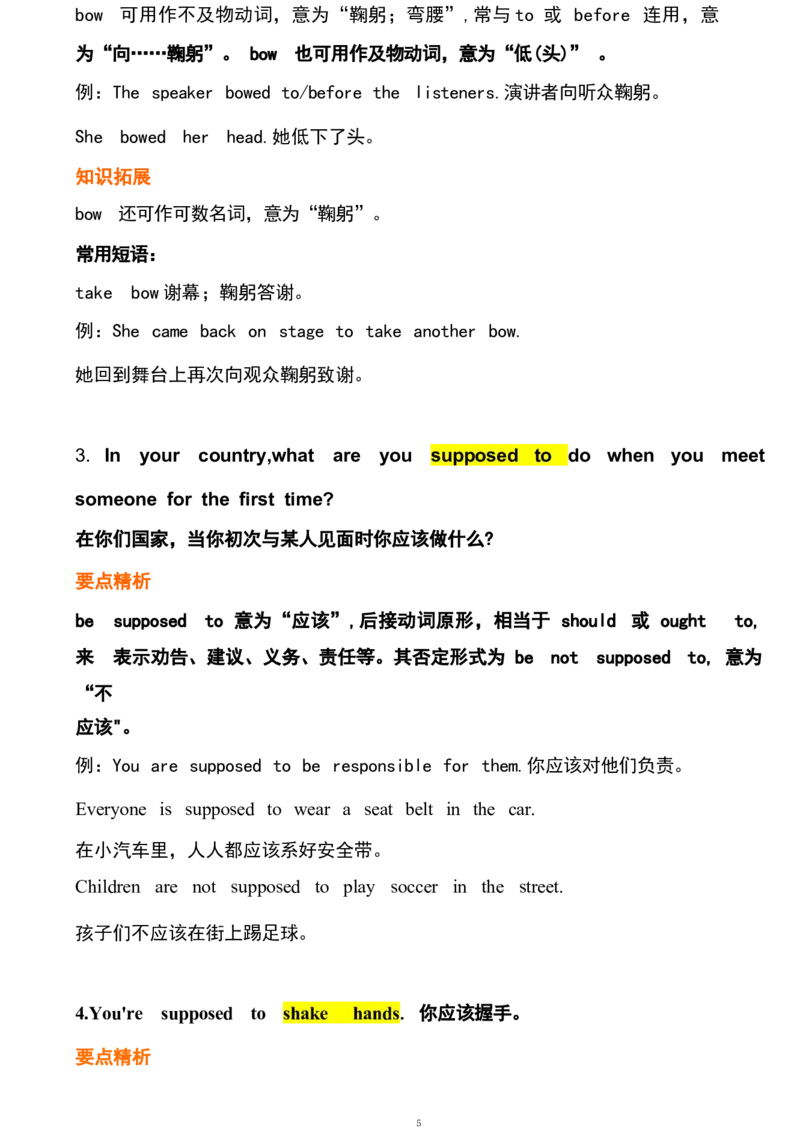
4bow 可用作不及物动词,意为“鞠躬;弯腰”,常与 to 或 before 连用,意
为“向……鞠躬”。 bow 也可用作及物动词,意为“低(头)” 。
例:The speaker bowed to/before the listeners.演讲者向听众鞠躬。
She bowed her head.她低下了头。
知识拓展
bow 还可作可数名词,意为“鞠躬”。
常用短语:
take bow谢幕;鞠躬答谢。
例:She came back on stage to take another bow.
她回到舞台上再次向观众鞠躬致谢。
3. In your country,what are you supposed to do when you meet
someone for the first time?
在你们国家,当你初次与某人见面时你应该做什么?
要点精析
be supposed to 意为“应该”,后接动词原形,相当于 should 或 ought to,
来 表示劝告、建议、义务、责任等。其否定形式为 be not supposed to, 意为
“不
应该"。
例:You are supposed to be responsible for them.你应该对他们负责。
Everyone is supposed to wear a seat belt in the car.
在小汽车里,人人都应该系好安全带。
Children are not supposed to play soccer in the street.
孩子们不应该在街上踢足球。
4.You're supposed to shake hands. 你应该握手。
要点精析
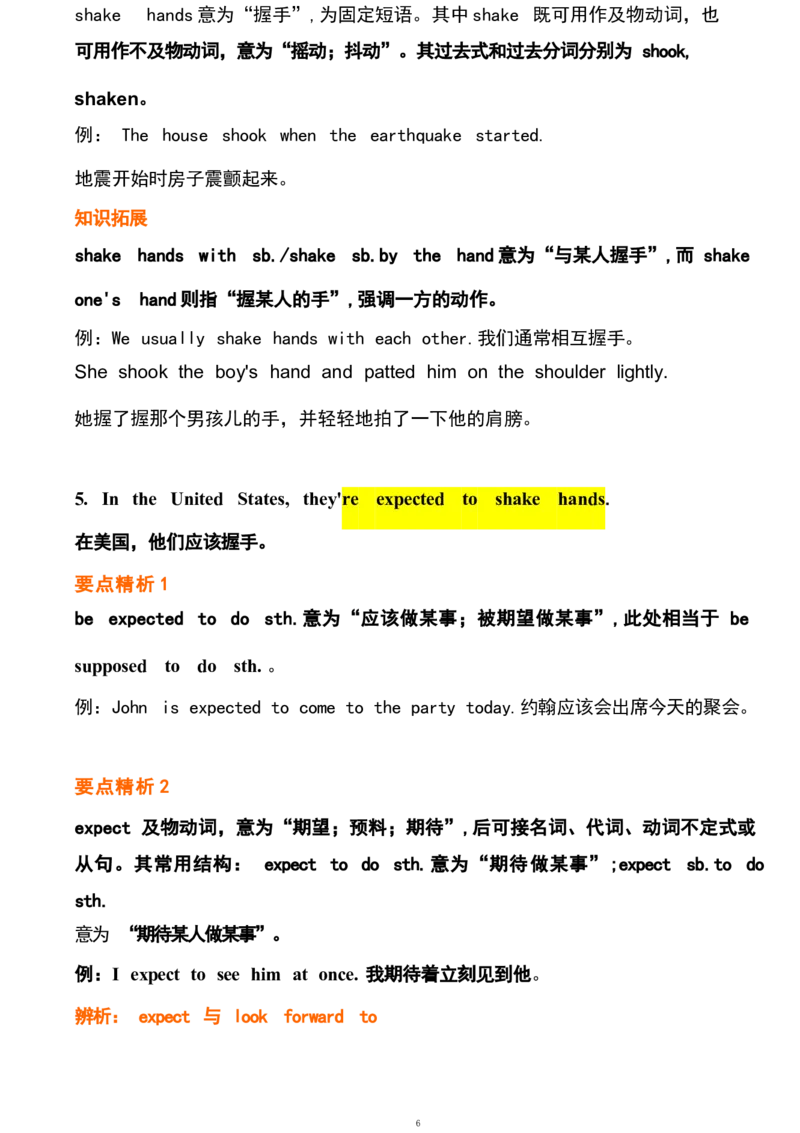
5shake hands意为“握手”,为固定短语。其中shake 既可用作及物动词,也
可用作不及物动词,意为“摇动;抖动”。其过去式和过去分词分别为 shook,
shaken。
例: The house shook when the earthquake started.
地震开始时房子震颤起来。
知识拓展
shake hands with sb./shake sb.by the hand 意为“与某人握手”,而 shake
one's hand则指“握某人的手”,强调一方的动作。
例:We usually shake hands with each other.我们通常相互握手。
She shook the boy's hand and patted him on the shoulder lightly.
她握了握那个男孩儿的手,并轻轻地拍了一下他的肩膀。
5. In the United States, they're expected to shake hands.
在美国,他们应该握手。
要点精析 1
be expected to do sth.意为“应该做某事;被期望做某事”,此处相当于 be
supposed to do sth. 。
例:John is expected to come to the party today.约翰应该会出席今天的聚会。
要点精析 2
expect 及物动词,意为“期望;预料;期待”,后可接名词、代词、动词不定式或
从句。其常用结构: expect to do sth.意为“期待做某事”;expect sb.to do
sth.
意为 “期待某人做某事”。
例:I expect to see him at once. 我期待着立刻见到他。
辨析: expect 与 look forward to
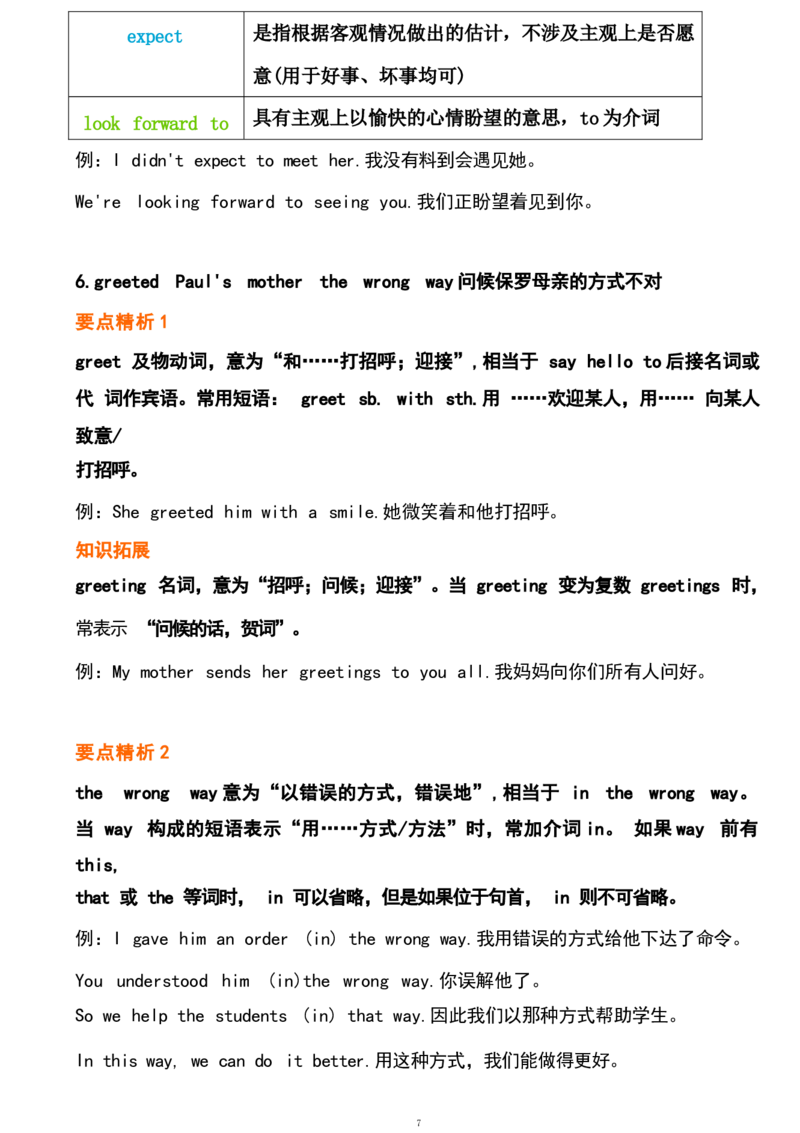
6expect 是指根据客观情况做出的估计,不涉及主观上是否愿
意(用于好事、坏事均可)
具有主观上以愉快的心情盼望的意思,to 为介词
look forward to
例:I didn't expect to meet her.我没有料到会遇见她。
We're looking forward to seeing you.我们正盼望着见到你。
6.greeted Paul's mother the wrong way 问候保罗母亲的方式不对
要点精析 1
greet 及物动词,意为“和……打招呼;迎接”,相当于 say hello to 后接名词或
代 词作宾语。常用短语: greet sb. with sth.用 ……欢迎某人,用…… 向某人
致意/
打招呼。
例:She greeted him with a smile.她微笑着和他打招呼。
知识拓展
greeting 名词,意为“招呼;问候;迎接”。当 greeting 变为复数 greetings 时,
常表示 “问候的话,贺词”。
例:My mother sends her greetings to you all.我妈妈向你们所有人问好。
要点精析 2
the wrong way 意为“以错误的方式,错误地”,相当于 in the wrong way。
当 way 构成的短语表示“用……方式/方法”时,常加介词 in。 如果 way 前有
this,
that 或 the 等词时, in 可以省略,但是如果位于句首, in 则不可省略。
例:I gave him an order (in) the wrong way.我用错误的方式给他下达了命令。
You understood him (in)the wrong way.你误解他了。
So we help the students (in) that way.因此我们以那种方式帮助学生。
In this way, we can do it better.用这种方式,我们能做得更好。
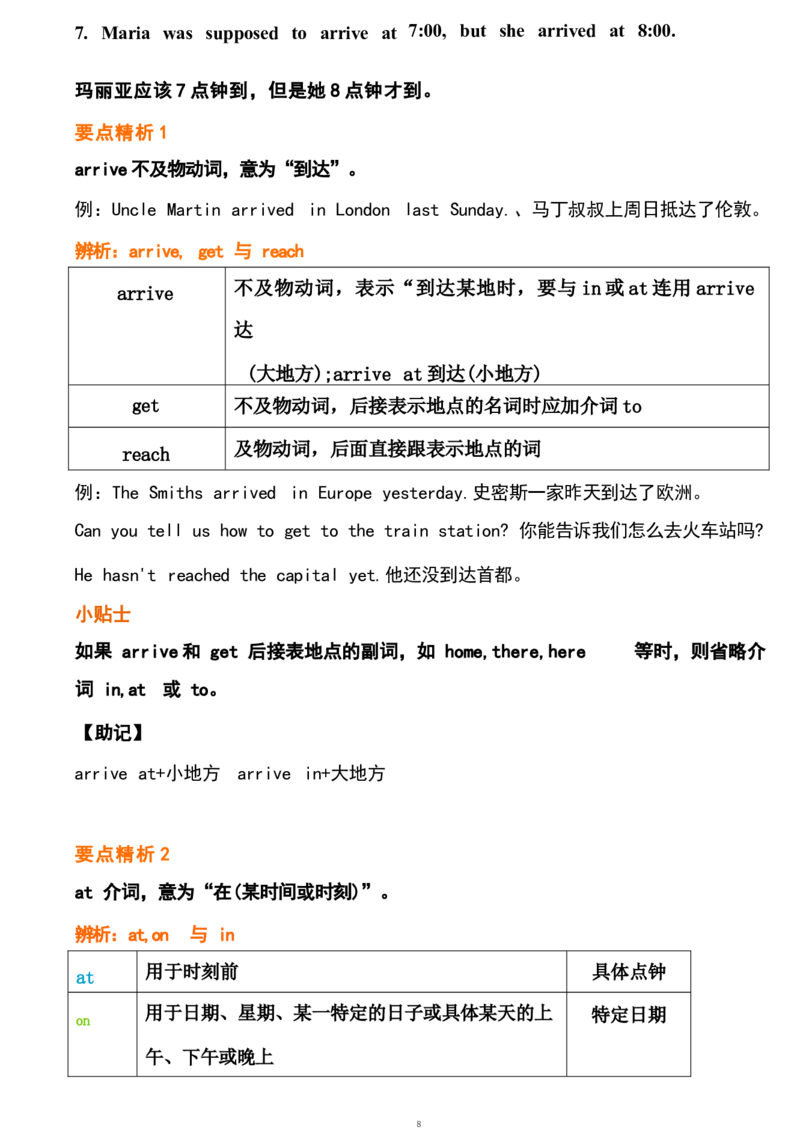
77. Maria was supposed to arrive at 7:00, but she arrived at 8:00.
玛丽亚应该 7 点钟到,但是她 8 点钟才到。
要点精析 1
arrive 不及物动词,意为“到达”。
例:Uncle Martin arrived in London last Sunday.、马丁叔叔上周日抵达了伦敦。
辨析:arrive, get 与 reach
不及物动词,表示“到达某地时,要与 in 或 at 连用 arrive
arrive
达
(大地方);arrive at 到达(小地方)
get 不及物动词,后接表示地点的名词时应加介词 to
及物动词,后面直接跟表示地点的词
reach
例:The Smiths arrived in Europe yesterday.史密斯一家昨天到达了欧洲。
Can you tell us how to get to the train station? 你能告诉我们怎么去火车站吗?
He hasn't reached the capital yet.他还没到达首都。
小贴士
如果 arrive和 get 后接表地点的副词,如 home,there,here 等时,则省略介
词 in,at 或 to。
【助记】
arrive at+小地方 arrive in+大地方
要点精析 2
at 介词,意为“在(某时间或时刻)”。
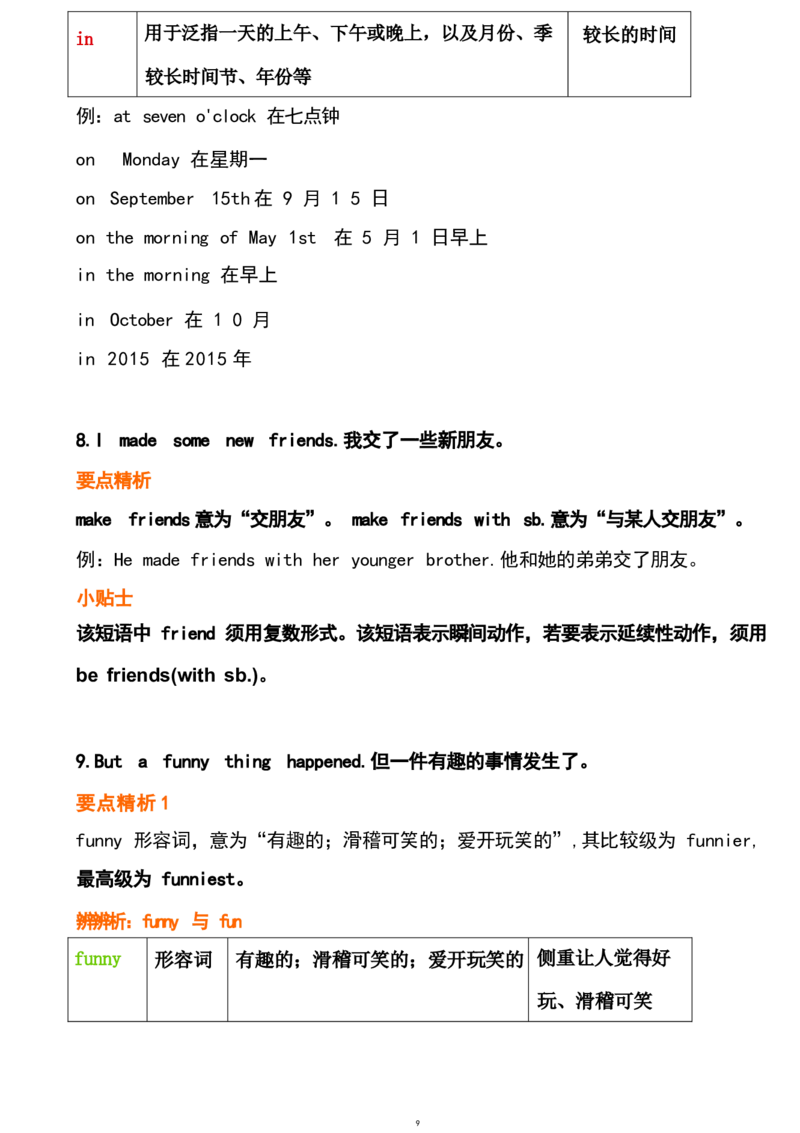
辨析:at,on 与 in
用于时刻前 具体点钟
at
用于日期、星期、某一特定的日子或具体某天的上 特定日期
on
午、下午或晚上
8in 用于泛指一天的上午、下午或晚上,以及月份、季 较长的时间
较长时间节、年份等
例:at seven o'clock 在七点钟
on Monday 在星期一
on September 15th 在 9 月 1 5 日
on the morning of May 1st 在 5 月 1 日早上
in the morning 在早上
in October 在 1 0 月
in 2015 在 2015 年
8.I made some new friends.我交了一些新朋友。
要点精析
make friends 意为“交朋友”。 make friends with sb.意为“与某人交朋友”。
例:He made friends with her younger brother.他和她的弟弟交了朋友。
小贴士
该短语中 friend 须用复数形式。该短语表示瞬间动作,若要表示延续性动作,须用
be friends(with sb.)。
9.But a funny thing happened.但一件有趣的事情发生了。
要点精析 1
funny 形容词,意为“有趣的;滑稽可笑的;爱开玩笑的”,其比较级为 funnier,
最高级为 funniest。
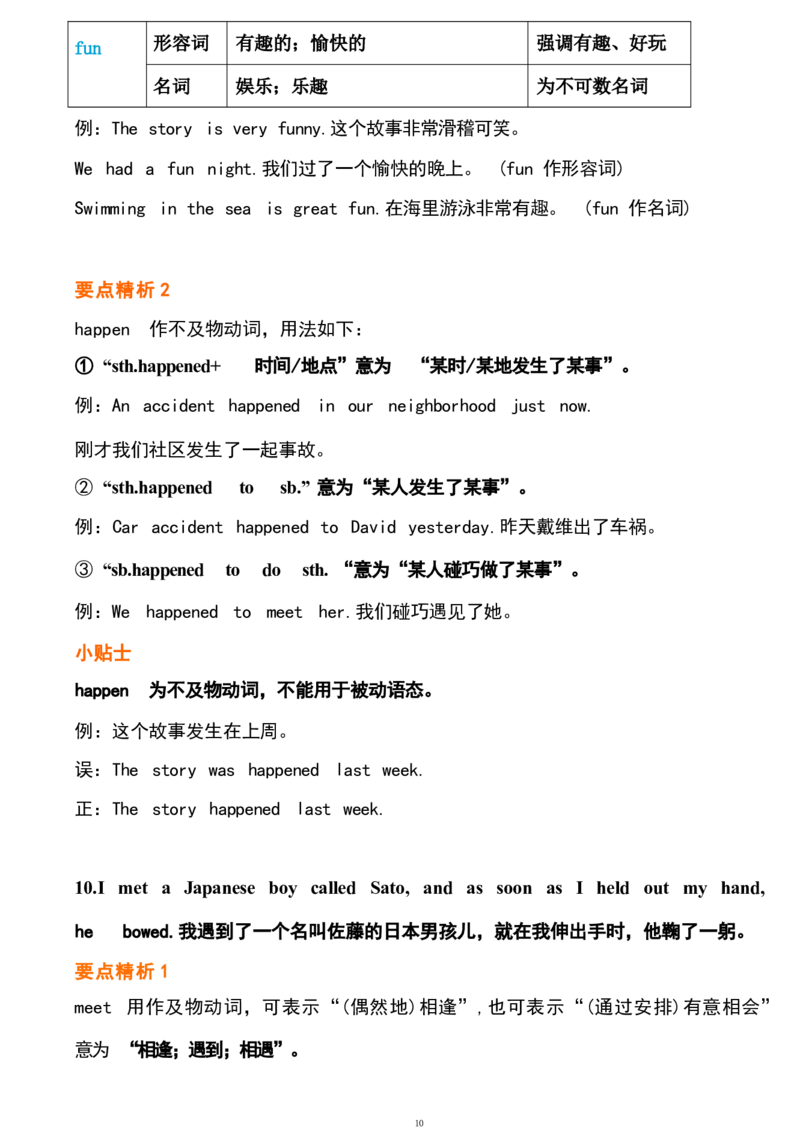
辨辨析:funny 与 fun
funny 形容词 有趣的;滑稽可笑的;爱开玩笑的 侧重让人觉得好
玩、滑稽可笑
9形容词 有趣的;愉快的 强调有趣、好玩
fun
名词 娱乐;乐趣 为不可数名词
例:The story is very funny.这个故事非常滑稽可笑。
We had a fun night.我们过了一个愉快的晚上。 (fun 作形容词)
Swimming in the sea is great fun.在海里游泳非常有趣。 (fun 作名词)
要点精析 2
happen 作不及物动词,用法如下:
① “sth.happened+ 时间/地点”意为 “某时/某地发生了某事”。
例:An accident happened in our neighborhood just now.
刚才我们社区发生了一起事故。
② “sth.happened to sb.” 意为“某人发生了某事”。
例:Car accident happened to David yesterday.昨天戴维出了车祸。
③ “sb.happened to do sth. “意为“某人碰巧做了某事”。
例:We happened to meet her.我们碰巧遇见了她。
小贴士
happen 为不及物动词,不能用于被动语态。
例:这个故事发生在上周。
误:The story was happened last week.
正:The story happened last week.
10.I met a Japanese boy called Sato, and as soon as I held out my hand,
he bowed.我遇到了一个名叫佐藤的日本男孩儿,就在我伸出手时,他鞠了一躬。
要点精析 1
meet 用作及物动词,可表示“(偶然地)相逢”,也可表示“(通过安排)有意相会”
意为 “相逢;遇到;相遇”。
10例:When else shall we meet again? 其他的什么时间我们再见面呢?
They'll meet him at the airport.他们将在机场接他。
要点精析 2
called Sato为过去分词短语作后置定语,修饰前面的名词boy。 此 处 called 相当
于 named 或 with the name of。
例:The girl called Jane is my sister.
= The girl named Jane is my sister.
=The girl with the name of Jane is my sister.那个叫简的女孩儿是我的妹妹。
11. That's how people in Japan are expected to greet each other.
那就是在日本人们应该互相问候的方式。
要点精析
本句含有how 引导的表语从句。表语从句常放在连系动词后。 how,where,wh y
等引导的从句作this/that is 的表语时, 表示具体的方式、地点、原因等。
例:That is why we come here.那就是我们来这里的原因。
知识拓展
表语从句还可用that,as if/though,because来引导。
例:My idea is that you should make good use of your time.
我的建议是你应该好好利用你的时间。
It looks as if it is going to snow.天看起来要下雪。
It is because he doesn't know her.这是因为他不认识她。
12.So I just stood there with my hand out.所以我只是伸着手站在那里。
要点精析
with my hand out是 “with+ 宾语+宾语补足语”结构。宾语补足语的形式有现在
11分词、过去分词、形容词、副词等,在句中作伴随状语。
例:He is sleeping in the bedroom with the windows open.
他正在卧室里开着窗户睡觉。
13.Finally, I returned the bow.最后我鞠躬还了礼。
要点精析
finally 副词,意为“最后;终于”,在句中作状语,通常位于句首、句末或实义动词
之前,连系动词 be、 助动词或情态动词之后。
例:The performance finally started half an hour later.
半小时后,演出终于开始了。
辨析:finally, at last 与 in the end
finally “最后”,通常只指一系列事物或论点的顺序, 一般不带感情色彩
有时可与finally换,但往往用于一番拖延或曲折之后,因而带
at last
有
较浓厚的感情色彩。如不耐烦、放心、如愿等
“终于”,可用于预测将来,finally,at last则不能
in the end
例:He tried many times and finally succeeded.他试了很多次,最后成功了。
When at last they found him, he was almost dead.
当他们最后找到他时,他已经奄奄一息了。
He will be a doctor in the end.最终他会成为一名医生。
14.I remember when I first met Marie last year, I did the same thing.
我记得去年我第一次遇到玛丽时,我做过同样的事。
要点精析
same 形容词,意为“(与……)相同的, 一模一样的”,常与定冠词 the 连用。其
反义词为 different (不同的)。
12例:The twin brothers are in the same class.这对孪生兄弟在同一个班里。
They often wear the same clothes.他们经常穿同样的衣服。
f
15.I held out my hand and to my surprise, she kissed me on both sides o
my face! 我伸出手来(想要握手),可让我吃惊的是,她亲吻了我的双颊!
要点精析 1
to one's surprise 意为“使让某人吃惊的是”。其中 surprise 用作名词意为“惊奇;
诧异”。
例:To our surprise, he failed in the exam.让我们吃惊的是,他考试不及格。
知识拓展
①surprise 也可用作动词,意为“使……吃惊”。
例:His words surprised me a lot.他的话让我很吃惊。
②surprised 形容词,意为“感到吃惊的”,常用于修饰人。 surprising 形容词,意
为“令人吃惊的”,常用于修饰事或物。
例:We are all surprised at the surprising news.
我们都对这个惊人的消息感到很吃惊。
【习惯搭配】
Be surprised at 对……感到吃惊
in surprise 惊奇地
be surprised to do sth.做某事令人感到惊讶
be surprised+从句 对……感到惊讶
要点精析 2
kiss 动词,意为“亲吻”,其后接名词或代词作宾语。
例:The mother kissed her baby and then went to work.
母亲亲吻了她的孩子,然后去上班了。
13知识拓展
①kiss sb.on … 亲吻某人的…… (部位)
例:The doctor kissed the child on the forehead.这位医生吻了孩子的额头。
②kiss 还可作名词,意为“吻”。常用短语: give sb.kiss(= kiss sb.) 亲吻某人
例:The father often gives his son a kiss before going to bed.
上床睡觉前,爸爸经常给儿子一个吻。
要点精析 3
both 此处用作限定词,意为“两个;双方;两者都”,其后接名词复数。其反义词
neither 意为“两者都不”。
例:Both his parents are still living.他的双亲都还健在。
知识拓展
both 的其他用法:
①both 用作代词时,常用于 “both of+代词”或 “both of +the/其他限定词+名
词复数”结构中。
例:Both of them are good at playing basketball.他们两个都擅长打篮球。
Both of the women are French.两名妇女都是法国人。
②both 通常放在连系动词be 、 助动词或情态动词之后,实义动词之前。
例:They are both too young.他们两个都太年轻了。
We both like swimming.我们俩都喜欢游泳。
辨析:both,neither 与 either
both 表示“两者都”,是复数概念
neither 表示“两者中无一”,是单数概念
either 表示“两者中任一”,是单数概念
例:Both of the answers are right.两个答案都对。
Neither of the answers is right.两个答案都不对。
14Either of the answers is right.两个答案都对。
链接中考
(贵州遵义中考)-Which of the two T-shirts will you take?
-|'l take . One is for my brother and the other is for myself.
A.either B. both C. all
解析: either意为“(两者之中)任何一个“; both 意为“两者都”; all意为“都;
全部”,强调三者或三者以上的人或事物。答语句意为“我将两件都买。 一件给我
弟
弟,另一件给我自己”。选 B。
16. Later I found out French people are supposed to kiss when they see
each other.后来我发现法国人见面时应该亲吻对方。
要点精析
find out意为“查明,找出”,其后常接that,what,when 或 how 引导的从句,
也可以接名词。
例:Please find out when the train leaves.请查一下火车什么时候离开。
You should find out about the news.你应当想办法查明那个消息。
辨析:find out, find与 look for
是动词短语,表示“搞清楚,弄明白”,多指经过研究、计算、探询
find out
等获知、得知,侧重找的过程
是及物动词,表示“找到”,主要强调“寻找”的结果
find
指有目的地找,强调“寻找”这一动作
look for
例:Please find out what on earth he is doing.请查明他究竟在做什么。
I have found my watch.我已经找到了我的手表。
They were looking for their teacher everywhere; at last they found him in the
15library.他们到处寻找老师,最后在图书馆里找到了他。
17. Where I'm from, we're pretty relaxed about time.
在我们那个地方,我们的时间观念比较随意。
要点精析 1
本句中的 where 用作连词,引导地点状语从句,说明主句行为发生的地点。
例:Where you live, there are many flowers.你住的地方有许多花。
要点精析 2
relaxed 形容词,意为“放松的,自在的”,此处作表语。 be relaxed about 意为
“对……感到放松/随意”。
例:Listening to music makes us feel relaxed.听音乐使我们感到放松。
He is relaxed about his breakfast.他对早餐比较随意。
辨析:relaxed 与 relaxing
relaxed 常作表语,修饰人,意为“(感到)放松的,自在的”,常与 feel 连用
relaxing 可作定语或表语,修饰物,意为“使人放松的”
例:I feel relaxed to do this relaxing sport.做这种使人放松的运动我感到很轻松。
18.We don't like to rush around, so we don't mind if people are a
e
littl late sometimes.我们不喜欢匆匆忙忙的,所以有时如果人们晚来一会儿,
我们也
不介意。
要点精析
a little 意为“有点儿, 一点儿”,相当于 a bit。
例:He knows a little English.他懂点儿英语。
知识拓展
a bit 和 a little 在某些时候可以互换,但有时又有区别。
16①a bit 和 a little 用于肯定句修饰形容词或副词时,都表示“一点儿,有点
儿”,此时可通用。
例:I'm a bit/a little hungry.我有点儿饿。
This shirt is a bit/a little small for him.这件衬衣对他来说有点儿小。
②a bit 后接名词时,与 of 构成短语,其用法与 a little 相似,都用来修饰不可数名
词。 例:Give me a bit of water, please.= Give me a little water,please.
请给我一点儿水。
③not a bit 和 not a little 的意思完全不同。 not a bit 表示“一点儿也不”;而 not
a little则表示“非常”,相当于very。
例: I'm not a bit hungry.我一点儿也不饿。
I'm not a little hungry.我非常饿。
19.If you tell a friend you're going to their house for dinner, it's OK if you
arrive a bit late.
如果你告诉一位朋友你要去他们家吃饭,如果你晚到一会儿也没关系。
要点精析
本句是含有两个 if 引导的条件状语从句的复合句。在含有 if 引导的条件状语从句的
复合句中,主句用一般将来时,从句用一般现在时表将来。
例:If it doesn't rain tomorrow, I will go to the zoo.
如果明天不下雨,我将去动物园。
知识拓展
if的另一个意思是“是否”,相当于 whether, 可引导宾语从句。
例:I wonder if you can tell me the truth.我想知道你能否告诉我真相。
20. We value the time we spend with our family and friends in our
everyday lives.我们珍惜在我们的日常生活中与家人、朋友一起共度的时光。
17要点精析 1
value 此处用作及物动词,意为“重视;珍视”。
例:We all value his advice.我们都很重视他的建议。
I value the opinion of my husband, and we agree on most things.
我重视我丈夫的意见,而且我们在大多数事情上能达成共识。
知识拓展
①value sth.at+价钱,估价某物多少钱。
例:The man valued the house at 30,000 yuan.这个人估价那所房子 3 万元。
②value 用作不可数名词,意为“价值”,指某物有一定的价值,值得人们去珍视。
常用短语: the value of… 意为“……的价值”。
例:I feel that I know about the value of my own work.
我觉得我知道关于自己工作的价值。
③valuable 形容词,意为“有价值的”,相当于 of great value.
例:I think your painting is very valuable.我认为你的画作很有价值。
要点精析 2
spend time with sb.意为“和某人一起度过时光”, spend 此处意为“度过”。
例:He usually spends time with his children on weekends.
在周末,他通常和他的孩子们一起度过时光。
要点精析 3
we spend with our family.everyday lives 是一个定语从句,修饰前面的名词
time 关系代词 that 在定语从句中作宾语,此处被省略。
21. We often just drop by our friends' homes if we have time.
如果有时间,我们经常顺便到朋友的家里拜访。
18要点精析
drop by 意为“顺便拜访”,可单独使用,也可接表示地点的名词。
例:She and Danny will drop by later.她和丹尼待会儿会顺便过来玩。
He often drops by Alan's.他经常顺便走访艾伦家。
知识拓展
①drop in on sb. 顺便拜访某人
例:Would you drop in on us tomorrow evening for a chat?
你明晚来和我们一起谈谈好吗?
②drop in at sp. 顺便拜访某地
例:Let's drop in at the Great Wall.让我们顺便去长城看看。
22. We don't usually have to make plans to meet our friends.
我们通常不必刻意安排与朋友见面。
要点精析
make plans 意为“制订计划”。 plan 此处为可数名词,意为“计划”; plan 还可用
作动词,意为“计划,打算”。 make plans/ a plan to do sth.意为“计划做某事”,
相当于 plan to do sth.。
例:We make plans to have good holiday.
= We plan to have a good holiday.
我们计划度过一个愉快的假期。
23.We often just walk around the town center, seeing as many of our
friends as we can! 我们经常只是在城镇中心走走,尽可能多地见到我们的朋友!
要点精析 1
本句是简单句, seeing as many of our friends as we can 是现在分词短语,在
句中作伴随状语。现在分词短语用作状语时可置于句首、句末,表示时间、原因、
19结果、条件、让步、方式或伴随情况。
例:The teacher went out, holding a book in his hand.
老师手里拿着一本书出去了。
Walking by the room, he saw a boy playing the guitar.
他走过那个房间时,看见一个男孩儿正在弹吉他。
Not knowing her address, I can't write to her.
我不知道她的地址,不能给她写信。
He comes home late every evening, making his wife very angry.
他每天晚上回家很晚,这使他的妻子很生气。
小贴士
现在分词短语作伴随状语可改成and 连接的并列谓语。
例:Tom woke up the other family members, calling “Merry Christmas!” =
Tom woke up the other family members and called,Merry Christmas!
汤姆叫醒家里的其他成员,大声说:“圣诞快乐!”
要点精析 2
as…as sb.can/could意为“尽可能……”,相当于as… as possible。
例: I'll return the book to you as early as I can.
= I'll return the book to you as early as possible.
我会尽早把这本书还给你。
24.In Switzerland, it's very important to be on time.
在瑞士,守时是非常重要的。
要点精析
on time意为“准时,按时”。
例:The passengers get on the plane on time.乘客准时登机。
20Please don't be late. Come to my party on time.
请别迟到,准时来参加我的聚会。
知识拓展
①at times 意为“有时”,相当于 sometimes。
例:I go to school without breakfast at times.有时我不吃早饭就去上学。
②by the time … 意为“到……时候;到……之前”。
例:By the time we got to the cinema, the film had begun.
我们到达电影院时,电影已经开始了。
③at the same time 意为“同时”。
例:The twins always get up at the same time.这对双胞胎总是同时起床。
25. We're the capital of clocks and watches, after all! 毕竟我们是钟表之都!
要点精析 1
the capital of 意为“……的首都/国都”。其中 capital 用作可数名词,意为“首都;
国都”。
例:Beijing is the capital of China.北京是中国的首都。
要点精析 2
after all 意为“毕竟,终归”。
①after all 可位于句首,含有“别忘了……”的意思,用来说服或提醒对方。
例:After all, facts are facts.事实终归是事实。
②after all 也可放在句末,表示和预期的情况相反或说话人意思的转折。
例:I'm sorry.I can't come after all.对不起,我还是不能来。
26. If someone invites you to meet him or her at noon, then you're
expected to be there at noon.
21如果有人邀请你在中午见面,那么你应该在中午到那里。
要点精析
at noon 意为“在中午”,其中 noon 为名词,意为“中午;正午”。
例:People often have lunch at noon.人们经常在中午吃午饭。
知识拓展
by noon (在)中午之前,到中午为止
例:Do you think the rain will stop by noon? 你认为雨在中午之前会停吗?
27. If you're even 15 minutes late, your friend may get mad.
即使你只迟到了 15 分钟,你的朋友也可能会很生气。
要点精析 1
get mad 意为“大动肝火;气愤”,强调动作和过程;而 be mad 意为“(感觉)
很生气”,表示状态。
例:His words made his father get mad.他的话让他爸爸大动肝火。
He must be mad,"said the old man. “他一定很生气。”那个老人说。
要点精析 2
mad 形容词,意为“很生气;疯的”。
例:She was mad at/with the boy.她生那个男孩儿的气。
28.So I make an effort to be on time when meet my friends.
所以当我与朋友见面时,我努力做到守时。
要点精析 1
make an effort to do sth.意为“努力做某事”。
例:He made an effort to support his family.他努力养家糊口。
22要点精析 2
effort名词,意为“努力;尽力”。
例:All their efforts were in vain.他们所有的努力都白费了。
知识拓展
有关 effort 的常用短语:
make every effort to do sth.尽一切努力做某事
spare no effort to do sth.不遗余力地做某事
beyond effort 力所不及
in a common effort 共同努力
without effort 毫不费力地,轻松地
29.I always leave the house early to avoid heavy traffic because I think
it's impolite to keep others waiting.
我总是早早离开家以避免交通拥挤,因为我认为让别人等待是不礼貌的。
要点精析 1
本句是一个含有原因状语从句的主从复合句, always leave …heavy traffic 为主句,
because think. others waiting 原因状语从句。其中在原因状语从句中又含有一
个宾语从句。
要点精析 2
avoid 及物动词,意为“避免;逃避”,指在做某事之前有意避开,其后可接名词、
代词或动词-ing 形式作宾语。
例:Learn from past mistakes and avoid future ones.惩前毖后。
Avoid eating a large meal before you start. (工作)开始前不要大吃一顿。
要点精析 3
23impolite 形容词,意为“无礼的”,它是由形容词 polite加前缀im 构成的。
例:It is impolite to shout at him.对他大声叫喊是不礼貌的。
【助记】
polite(adj.有礼貌的)+-ly-→ politely( adv.有礼貌地)
↓
反义词 个
反义词
impolite(adj. 无礼的)+-ly→
impolitely(adv.无礼地)
知识拓展
在英语中,某些以m,p 开头的单词前面加前缀 im-, 可构成其反义词。
例:moral 道德的 →immoral 不道德的
possible 可能的 →impossible 不可能的
要点精析 4
keep sb.doing sth.意为“让/使某人一直做某事”。
例:I'm sorry to keep you waiting for such a long time.很抱歉让你等这么长时
间。 知识拓展
在 “keep+ 宾语+宾语补足语”结构中, keep 为及物动词,意为“使……保持某种
状态”,宾语补足语可以是形容词、副词、动词-ing 形式或介词短语。
①keep+ 人/物+形容词
例:We should keep the river clean.我们应该保持河流干净。
②keep+ 人/物+副词
例:Don't keep him away from school.别让他离开学校。
③keep+ 人/物+介词短语
例:Don't keep your books in the box.别把你的书放在箱子里。
30.Also, we never visit a friend's house with our calling first.
而且,我们也从不事先未通电话便登门拜访朋友。
24要点精析 1
never 副词,意为“从不;从来没有”,表示否定意义。当陈述句中含有 never
时,其反意疑问句的附加疑问部分要用肯定形式。
例:I shall never forget your kindness.我永远不会忘记你的仁慈。
小贴士
表示否定意义的词还有 hardly “几乎不”; few/little “很少,几乎没有”; seldom
“不常,很少”等。
例:Few students can work out the difficult math problem.
几乎没有学生能算出这道数学难题。
知识拓展
①never 作副词,还可意为“不;决不”,用于加强语气。
例:Better late than never. [谚]迟做总比不做好。
②never mind 不要介意(没关系)
例:-I'm sorry for that.我对此非常抱歉。
-Never mind.没关系。
要点精析 2
without 介词,意为“没有,无”,其反义词为 with, 其后常接名词、代词或动词
- ing 形式表示伴随情况或条件,在句中作状语。
例:My younger sister went to school without having breakfast.
我妹妹没吃早饭就去上学了。
31. We usually plan to do something interesting,or go somewhere
together. 我们通常计划着一起去做有趣的事或一起去某个地方。
要点精析
something interesting 意为“有趣的事情”。在英语中,形容词修饰不定代词 some
25thing,anything,nothing 等时应后置。
例:I have something important to tell you.我有重要的事情要告诉你。
链接中考
(吉林长春中考) I bought for my mother on Mother's Day this year.
A. special anything B.anything special
C.special something D. something special
解析:something “某物”,通常用于肯定句中; anything “某物”,通常用于疑
问 句和否定句中。本句是肯定句,所以用不定代词 something, 排除 A、B 两
项。形 容词修饰不定代词时,放在不定代词之后,再排除 C 项。 something
special 意为
“特别的东西”,故选 D。
32. When you go abroad, it is important to bring your passport.
当你出国时,带护照是重要的。
要点精析
passport 可数名词,意为“护照”。
例:You need a passport to travel abroad.出国旅行时你需要护照。
知识拓展
passport 还可意为“(获得某事物的)手段,保障”。
例:I don't think that money is passport to happiness.
我认为金钱并非是获得幸福的保障。
33. After class, students are supposed to/are expected to clean the chalk
off the blackboard. 课后,学生们应该把黑板上的粉笔字擦掉。
要点精析 1
clean off 意为“把……擦掉”,为“动词+副词”型短语,人称代词作宾语时,只能
26放在两词中间;名词作宾语时,可放在两词中间,也可放在副词之后。
例:Please clean them off.请把它们擦掉。
I want to clean off these black marks.
= want to clean these black marks off.我想把这些黑点擦掉。
要点精析 2
chalk 名词,“粉笔”。表示数量时可用…piece(s) of chalk。
例:The teacher wrote on the blackboard with a piece of chalk.
老师用一支粉笔在黑板上写字。
34.If you visit the northern coast of Norway during the winter season, it
is important to pack warm clothes.
如果你在冬季游览挪威的北海岸,装上暖和的衣服是很重要的。
要点精析 1
northern 形容词,意为“北方的;北部的”。它是由名词 north (北,北方)加-ern
构成的形容词。
例:She has traveled in northern countries.她曾游历过北方诸国。
知识拓展
表示方位的名词,在词尾加ern 可构成形容词
例:east(n. 东,东方) →eastern (adj.东方的;东部的)
west(n. 西,西方) →western(adj. 西方的;西部的)
south(n. 南,南方) → southern(adj. 南方的;南部的)
要点精析 2
coast 可数名词,意为“海岸;海滨”。
常用短语:
27along the coast 沿海; at/on the coast 在海边。
例 :The southern coast is the warmest part of the country.
南海岸是这个国家最温暖的地方。
The town is on the coast.那个城镇坐落在海滨。
要点精析 3
season 可数名词,意为“季;季节”。
常用短语:
in season 当季的,应时的;在旺季的。
out of season不合时令的;在淡季的。
例:Winter is the coldest season in a year.冬季是一年中最冷的季节。
Strawberries are in season this month.这个月草莓要上市了。
Holiday prices are lower out of season.在淡季,度假费用较低。
e
35. If there are people in the meeting room,you are supposed to/ar
expected to knock before entering.如果会议室里有人,你进入之前应该敲门。
要点精析 1
knock 此处用作不及物动词,意为“敲(门等)”,其后常接介词 at/on。
例:Listen! There's someone knocking at the door.听!有人在敲门。
知识拓展
①knock 用作动词,还可意为“碰撞”,其短语 knock off 意为“碰掉”, knock
against 意为“撞击”,knock down 意为“撞倒”,knock into 意为“与……相撞”。
例:She knocked a glass off the table.她把玻璃杯从桌子上碰掉了。
The car knocked against the garage door and damaged it.
汽车撞在车库门上,把门撞坏了。
The boxer knocked his opponent down.那位拳击手把对手击倒了。
28The car knocked into the tree last night.那辆汽车昨天夜里撞到了树上。
②knock 用作名词,意为“敲击声;敲击”。
例:She gave three knocks on the window.她在窗户上敲了三下。
I heard a knock at the window just now.我刚才听到了敲窗户的声音。
【助记】
knock at /on the door 敲门
knock into 与……相撞
要点精析 2
before entering 是时间状语,相当于 before you enter。
例:He always washes his feet before going to bed.上床睡觉前他总是洗脚。
36. In many eastern European countries,you are supposed to/are
s.
expected to take off your gloves before shaking hand
在许多东欧国家,握手前你应该摘下手套。
要点精析
take off 此处意为“脱下(衣服)”,为“动词+副词”型短语。当人称代词作宾语时,
须置于两词之间;当名词作宾语时,置于两词之间或副词后面都可以。其反义词组
为 put on, 意为“穿上”。
例:Put on your clothes. Don't take them off.把你的衣服穿上,别把它们脱下来。
It's warm in the room.You can take your coat off.
=It's warm in the room.You can take off your coat.
房间里很暖和,你可以脱下你的外套。
知识拓展
①take off 还可意为“(飞机等)起飞”。
例 :When will the plane take off? 飞机何时起飞?
29②take+ 时间+off 意为“休假;休息”。
例:I'm taking the next week off.我下周要休假。
③与 take 相关的短语:
take after 与……相像
take apart 拆开,拆卸
take away 拿开,拿走
take back 收回,撤回
take in 欺骗,使上当,领会,理解
take out 把……带出去/拿出去
take up 拿起,举起,抱起
take…to… 带……到……
r
37.. but it is worth the trouble if you want to understand anothe
culture.
………但是如果你想了解另一种文化,麻烦一点儿也值得。
要点精析 1
worth 形容词,意为“值得;有……价值(的)”,一般作表语,其后常跟动词-ing
形式或表示金钱的名词,其用法有:
① “be worth doing” 意为“值得做”,句子的主语一般是 do 的宾语。
例:The book is worth reading.这本书值得一读。
② “be worth+钱”意为“值多少钱”。
例:The ring is worth $1,000.这枚戒指值 1000 美元。
③ “be worth+名词”意为“值得……”。
例:The exhibition is worth visit.这次展览值得一看。
小贴士
表示“很值得”,应说 well worth, 而不说 very worth。
30要点精析 2
another 意为“另一个,再一个”,后接可数名词单数,通常泛指三个或三个
以上中的任意一个人或物。
例:This pair of shoes is too small for me.Please show me another pair.
这双鞋我穿太小了,请给我拿另一双。
小贴士
another+ 数词+名词(复数)
=数词+more+ 名词(复数),意为“再来 ……个 ……“。
例:We need another five desks.= We need five more desks.
我们还需要五张课桌。
知识拓展
①表示两件东西或两个人中“一个……另一个”,用one …the other。
如图:
○
one the other
②表示不定数目中的“一个……另一个”,用one …another。
如图:
〇○●O○
one another
③强调确定数目中的“一个……其余的”,用one. the others。
如图:
O
one the others
④表示许多人或物中的“一部分……另一部分(并非全部)”,用some ….others。
31如图:
O〇O… O〇O
some others
⑤表示许多人或物中的“一部分……其余的全部”,用some … the others。
如图:
O〇○… …
some the others
⑥表示“一个接一个地”,用 one after another。
如图:
one after another
链接中考
(安徽中考) We can't do it that way-but whether it will work is
matter.
D. every
A. other B. another C. each
解析:other 意为“别的;其他的”;another 意为“另一”;each 意为“每个”;every
意为“每一个”。句意:我们不能用那种方法做——但它是否会起作用是 事。
由句意判断应选 B。another matter意为“另一回事”。
38.table manners餐桌礼仪
要点精析
table manners是名词短语,意为“餐桌礼仪"。 manner 的复数形式可意为“礼
貌;礼仪”。
例:Different countries have different table manners.
不同的国家有不同的餐桌礼仪。
32知 识 拓 展
manner 的单数形式可意为“方法,方式”。
例:Please do it in this manner. 请 按 这 种 方 法 做 。
Section A 即学即试
I.单项选择
1.-Could we see each other at 9 o'clock tomorrow morning?
-Sorry, let's make it time.
A.other's B. the other C. another D. other
2. Mother was mad her son for telling a lie.
A. at B. to C. in D.On
3.You shouldn't shout at him. ,he is a child.
A. after all B. all after C. After all D. All after
4. The window was broken. Try to who has broken it.
A. find B. look C. find out D. look for
5.This is a antique (古董). It is of great
A. valuable; value B. value; valuable C. valueable; value D.value; values
6.Put the book it was.
A. that B. when C. where D. what
7. I have seen the film three times. It is well
B. worth watching
A. worthing watching
D. worthing to watch
C. worth to watch
8.I was very , because I saw a movie tonight.
A. relaxed; relaxed B. relaxing; relaxing
C. relaxed; relaxing D.relaxing; relaxed
9.If you late, don't make any excuse.
33. will be B. are going to C. are D. were
10.I couldn't do it your great help. Thanks a lot!
A. with B. without C. for D. to
Ⅱ .根据句意及汉语提示完成句子
1. The mother ( 亲 吻 ) her baby on the cheek and smiled.
2. You can say hello to ( 打 招 呼 ) your teachers when you meet them at
school.
3. They're leaving school, and they (珍惜) the time very much.
4. Most people know that London is the ( 首 都 ) of Britain.
5 listenl Who is ( 敲 ) at the door?
Ⅲ .用括号内所给词的适当形式填空
1.Social (custom) are different from country to country.
2. I thought they all had to (bow)to the king.
3. The Great Wall lies in the (north) part of China.
4. There are four ( season)in a year. Do you know what they are?
5. When you visit a foreign country, you should know the table
(manner) first.
Section B 知识点精析
1.Mind your manners! 注意你的礼仪!
要点精析
Mind… 是一个表示警示的句型,表示“注意 … … ;当心 … … ;小心 … … ”。当其后
跟
动词时,常用动词的-ing 形式,即: mind doing。
例: Mind your head,please! 请当心你的头!
342. In China, you're not supposed to stick your chopsticks into the
food.
在中国,你不应该把筷子插入食物中。
要点精析 1
stick … in. 意为“把……插入……”。
例:Don't stick your fork into your food.不要把你的叉子插入食物中。
要点精析 2
chopstick 名词,意为“筷子”,常用复数形式。
例:Chinese people eat their food with chopsticks instead of a knife and fork.
中国人用筷子而不是刀和叉吃他们的食物。
知识拓展
英语中常见的以复数形式出现的名词有:
noodles (面条), dumplings (饺子),trousers (裤子), pants (长裤), shorts
(短裤),gloves (手套),shoes (鞋子),socks (短袜),glasses (眼镜)等。
3. In Korea, the youngest person is expected to start eating first.
在韩国,年龄最小的人应该先开始吃。
要点精析
start doing sth. (= start to do sth.) 意为“开始做某事”。
例:He started crying.= He started to cry.他开始哭了起来。
知识拓展
作“开始”讲时, start 与 begin 两者可互换,但以下几种情况只能用 start, 不能
用 begin。
①表示“创办,开设”时。
例:They started a swimming club.他们创办了一个游泳俱乐部。
35②表示“机器开动”时。
例:Can you start the car? 你能发动这辆汽车吗?
③表示“出发,动身”时。
例:They started (out)for London.他们动身前往伦敦了。
l.
4.In China, it's impolite to use your chopsticks to hit an empty bow
在中国,用筷子敲空碗是不礼貌的。
要点精析
empty 此处用作形容词,意为“空的;空洞的”。其反义词为full (满的)。
例:The bottle is empty.这个瓶子是空的。
Don't speak empty words.不要说空话。
知识拓展
empty 用作及物动词,意为“排空,倒空”。其反义词为fill (装满;填满)。
例:I emptied the box of apples onto the floor.我把箱子里的苹果倒在了地板上。
I filled the box with apples.我把箱子装满了苹果。
5.… point at anyone with your chopsticks.…… 用筷子指着任何人。
要点精析
point at意为“指着”,侧重于所指的对象; point to意为“指向”,侧重于所指的
方向。
例:The teacher is pointing at the blackboard.老师正指着黑板。
The needle of a compass points to the north.罗盘针指向北方。
知识拓展
point 用作及物动词时,常用于point sth.at sb.结构,意为“用……指着……”。
例:You shouldn't point your finger at anyone.你不应该用手指指着任何人。
366. … start eating first if there are older people at the table.
如果有年长的人在餐桌旁,先开始吃。
要点精析
at the table 意为“在餐桌旁”,而 at table 则意为“在吃饭”。
例:Father doesn't allow us to talk at table, but he allows us to talk at the
table
after meals.父亲不允许我们在吃饭时说话,但他允许我们饭后在餐桌旁聊天。
小贴士
at 可与某些名词搭配,构成固定短语,
如: at supper/lunch/breakfast 在吃晚饭/午饭/早饭, at work 在工作。
7.My cousin went to America, and she said that learning basic table
manners was her biggest challenge.
我的堂妹去了美国,她说学习基本的餐桌礼仪是她最大的挑战。
要点精析
basic 形容词,意为“基本的;基础的”。
例:He says the family is the basic unit of society.
他说家庭是社会的基本单位。
知识拓展
①basically 副词,基本上;主要地。
例:All cheeses are made in basically the same way.
所有的干酪基本上都是用相同的方法做的。
②base 名词,底部;基地;基础。
例:Our mission was over, and we went back to our base.
我们的任务结束了,我们返回了基地。
Many languages have Latin as their base.许多语言都以拉丁语为基础。
378.She never knew what she was supposed to do at the dinner table.
她从来不知道在餐桌上她应该做什么。
要点精析
本句中 what she was supposed to do at the dinner table 是宾语从句, 作
knew 的宾语。在含有宾语从句的主从复合句中,主句用了一般过去时,宾语从句通
常也要使用过去的某种时态。
例:He didn't tell me when he would come back.他没有告诉我他什么时候回来。
链接中考
(湖北武汉中考)-What did your teacher say just now?
-He asked me
A. how could work it out B. when did I go to the library
C. why I am late for school D.if I had got ready for the exam
解析:答语是含有宾语从句的主从复合句,其中空格处是宾语从句。宾语从句要
用 陈述句语序,故排除 A、B 两项;主句是一般过去时,从句要用过去的某个时态,
C
项为一般现在时,故排除 C 项,选 D。
9.How does she feel about making mistakes when she speaks French?
当她说法语时,她怎样看待她犯的错误?
要点精析
speak 意为“说;讲”。
辨析:speak, say,talk 与 tell
speak 强调说的动作,不强调所说的内容。作及物动词时,常以某种语
言作宾语。作不及物动词时,常见的搭配形式有: speak of
sth./sb.谈到某事/某人, speak to sb.跟某人讲话,此外 speak
38还可用于表示在较为正式的场合发表演讲或演说
一般用作及物动词,着重指说话的内容,它的宾语可以是名词、
say
代词或从句
一般作不及物动词,意为“交谈,谈话”,着重强调两者相互谈话
talk
常作及物动词,意为“讲述,告诉”,后面常跟双宾语。
tell
tell sb.sth=tell sth. to sb.告诉某人某事
例:After she spoke at the meeting, she talked with the students. She told
them that what she said was very important.
在会上发言之后,她跟学生们进行了交谈,并告诉他们她讲的很重要。
链接中考
(湖北咸宁中考)-Jim,can you this word in Chinese?
-Yes,I can a little Chinese.
A. speak; say B.say; speak C. tell; speak D. talk; say
解析: speak 强调说的动作,常跟某种语言作宾语; say 一般侧重讲话的内容,通
常 用作及物动词; tell 意为“告诉,讲述”,指把一件事情传达给别人或讲述一件
事情、
一个故事等; talk “讲,说话,谈话”,常与 to,with,about 等介词连用。选 B。
10.Yes,I'm having a great time on my student exchange program in
France.是的,我正在法国享受我的交换生项目的美好时光。
要点精析 1
have a great time 意为“玩得高兴,过得愉快”,相当于 have a wonderful /good
/nice time, have fun /enjoy oneself。
例:Did you have a great/wonderful/good/nice time last Sunday?=Did you
have fun last Sunday?=Did you enjoy yourselves last Sunday?
39你们上周日玩得开心吗?
要点精析 2
exchange 名词,意为“交换”。常用短语: in exchange for交换。
例: Tom gave Helen an apple in exchange for a piece of cake.
汤姆用一个苹果与海伦换一块蛋糕。
知识拓展
exchange 用作及物动词,意为“交换”。常构成短语 exchange.for… “用 ……
换……”,exchange… with sb.“与某人交换……”。
例:I'd like to exchange a watch for a camera.我想用表换相机。
Tom exchanged gifts with John at Christmas.汤姆与约翰在圣诞节交换了礼物。
【助记】
exchange opinions change
clothes 换衣
交换意见
11.I was a bit nervous before I arrived here, but there was no reason to
be. 我在到这里之前有点儿紧张,但那是没理由的。
要点精析
There was/is no reason to do sth.意为“没有理由做某事”。
例:There is no reason to be late.没有理由迟到。
知识拓展
have no reason to do sth.意为“没有理由做某事”。
例:You have no reason to say so.你没有理由这么说。
4012. They go out of their way to make me feel at home.
他们尽力使我感到宾至如归。
要点精析 1
go out of one's way 意为“特地;格外努力”,相当于 try/ one's best,其后接
动词不定式。
例:He went out of his way to start the car, but he failed.
他想尽一切办法来发动这辆车,但却失败了。
They go out of their way to think of ways to serve all the passengers.
他们想方设法来为所有的旅客服务。
要点精析 2
make sb.feel at home 意为“使某人感到宾至如归”。
例:Their kindness makes me feel at home.他们的热情使我感到宾至如归。
We will do everything we can do to accommodate you and make you feel at
home. 我们会尽力为您服务,使您感觉宾至如归。
13. So she actually learned how to make Chinese food!
所以她竟然学习如何做中国菜!
要点精析
how to make Chinese food 为“疑问词+动词不定式”结构,在句中作 learned
的宾语。
例:I want to learn how to make dumplings.我想学习如何包饺子。
知识拓展
动词不定式与疑问词 who,which,when,where,how,what 等连用时,常
作 tell,show,know,learn,teach,explain,decide 等的宾语,构成“疑问
词+动词不定式”结构,可转换成宾语从句。
41例:He didn't know what to say.
=He didn't know what he should say.他不知道该说什么。
14. She also has a teenage granddaughter about my age who is really
kind. 她也有一个与我年龄差不多的十几岁的(外)孙女,她非常友好。
要点精析 1
also 副词,意为“也;同样”。
例:He is also wrong.他也错了。
辨析:also,either 与 too/as well
置于行为动词之前,情态动词、助动词、连系动词be之后;为正式
also
用语;用于肯定句中
置于句尾;常用于否定句中
either
too/as well 置于句尾;常用于口语,用于肯定句中。too前常加逗号,与前面隔
开
例:She also wants to go.她也想去。
He doesn't want to go either.他也不想去。
I can swim,too.=I can swim as well.我也会游泳。
链接中考
(山东菏泽中考) My friend Frank sings well, and he is good at playing
the guitar.
C. yet
A. not B.also D. too
解析: not 用于否定句中,意为“不”; also 用于肯定句中,意为“也”; yet 常
用于 否定句中,意为“还”;too “也”,常用于肯定句的句尾,其前常用逗号与前
面隔开。
句意为“我的朋友弗兰克歌唱得好,而且他还擅长弹吉他”。选 B。
42要点精析 2
teenage 形容词,意为“十几岁的;青少年的”,指 13 岁至 19 岁这一年龄段。
其名词形式为 teenager 意为“青少年”,指 13 岁至 19 岁的人,用作可数名词。
例:We have some interesting results from our survey on teenage hobbies.
对于青少年的爱好,我们通过调查得到了一些有趣的结果。
It is not easy to educate teenagers.教育青少年不是件容易的事。
要点精析 3
granddaughter 可数名词,意为“(外)孙女”,对应词为 grandson, 意为“(外)
孙子”它是由 grand 和 daughter 组成的合成词。 grand 与 daughter,son,
mother 或 father 等合成新词,表示亲属关系中的“(外)孙……”或“(外)祖……”
之意。
例: grand+ father—grandfather→祖父;外祖父
grand+ mother—grandmother→祖母;外祖母
grand+ parents—grandparents→祖父母;外祖父母
例:The couple has one daughter and one granddaughter.
这对夫妇有一个女儿和一个外孙女。
15.She always talks to me in French to help me practice.
她总是用法语和我说话来帮助我练习(法语)。
要点精析
talk to sb.意为“和某人说话”。
例:Don't talk to me about that boy.不要和我谈论那个男孩儿。
辨析:talk to, talk with 与 talk about
意为“和……说话”,其宾语是人,侧重一方在讲,另一方在
talk to
43听
意为“和……谈话”,其宾语是人,强调两者互相交谈
talk with
意为“谈论”,后接谈话的内容,宾语可以是人,也可以是物
talk about
例:The teacher is talking to his students.老师正在对学生们讲话。
He is talking with the headmaster.他正在和校长谈话。
They are talking about the TV play.他们正在谈论那部电视剧。
16.You wouldn't believe how quickly my French has improved because
of that.你简直都想不到就因为那样我的法语提高得有多快。
要点精析
because of意为“因为”。
例:They didn't go to the park because of the snow.因为下雪他们没去公园。
辨辨析:because of,because 与 thanks to
短语介词,后接名词、代词、动词-ing 形式或由 what 引导的从
because of
句
连词,侧重于说明发生某事的原因,引导原因状语从句
because
"多亏;归功于",用于解释某件好事的发生是由于某人的努力或某
thanks to
事物的存在
例:He was late because of the rain.他因为下雨迟到了。
She was angry because of what you said.她因你说的话而生气了。
He went to bed early because he was tired.因为疲倦,他很早就上床睡觉了。
Thanks to you, he was saved from drowning.幸亏你,他才免于溺死。
17.My biggest challenge is learning how to behave at the dinner table.
我最大的挑战是学习如何在餐桌上举止得体。
要点精析
44learning how to behave at the dinner table 是动名词短语,在句中作表
语。
例:Now my job is cooking at home.现在我的工作是在家做饭。
His task is cleaning the windows.他的任务是擦窗户。
要点精析 2
behave 此处用作不及物动词,意为“表现;举止”;也可用作及物动词,后接反身
代词,意为“表现良好”。其名词形式为 behavior, 意为“表现;举止”。
例:The boy behaved bravely in the face of danger.
那个男孩儿面对危险表现得很勇敢。
Our teachers always tell us to behave ourselves at school.
我们的老师总是告诉我们在学校里要注意举止。
Please pay attention to your behavior at home.请注意你在家中的举止。
Make sure that good behavior is rewarded.确保良好的行为受到嘉奖。
18.As you can imagine, things are very different from the way they are
at home.正如你想象的那样,这里的很多事情和在国内时截然不同。
要点精析 1
as you can imagine 意为“正如你想象的那样”,其中 as 表示“按照……的方法,
正如.……”。
例:As anybody can see, this kind of flower is beautiful.
正如大家所看到的,这种花是美丽的。
Tom has passed the test, as everybody knows.
正如每个人所了解的那样,汤姆通过了考试。
As is known to us all, China is country with a long history.
众所周知,中国是一个历史悠久的国家。
45要点精析 2
be different from 意为“与 ……不同”,其反义词组是 be the same as。
different 还可构成短语 be different in, 意为“在……方面不同”。
例:Soccer is different from American football.英式足球与美式足球不同。
The two sweaters are different in color.这两件毛衣在颜色上不同。
19. Another example is that you're not supposed to eat anything with
your hands except bread, not even fruit.
另一个例子是除了面包外,你不应该用手拿着任何东西吃,甚至水果也不行。
要点精析 1
本句是复合句, is 后是 that 引导的表语从句。
要点精析 2
except 介词,意为“除……之外”,其后可接名词、代词、动词不定式(短语)、从
句等,表示把某人或物从某一范围内排除出去,即不包含在内。
例:They all went to the museum last Sunday except him.
除了他以外,上周日他们都去博物馆了。
辨析:except, except for 与 besides
except 意为“除……之外“,不包含该介词的宾语在内
except for 表示“除……之外”,除去的和非除去的是不同类事物
意为“除……之外(还有)”,包含该介词的宾语在内
besides
例:They all went to see the film except Xiao Fei.
除了肖飞,他们都去看电影了。
His composition is perfect except for a few spelling mistakes.
他的作文除去几个拼写错误外是完美的。
46We all attended the meeting besides Mike.除迈克之外,我们也都出席了
会议。
链接中考
(湖北襄阳中考)-We're all here Lily. Where's she?
-She's gone to the library.
A. beside B. besides C. except D.of
解析:本题考查 besides 与 except 的区别。 besides 指“除 ……外(还有)”,着
重 于“另外还有”。 except 指“除……之外”,着重于“排除在外”。由问句句意
“除了
莉莉,我们都在这里。她在哪里?”知本题应选 C。
20.I have to say that I find it difficult to remember everything, but I'm
gradually getting used to it.
我不得不说,我发现记住所有的事情是困难的,但是我正在逐渐习惯这些事情。
要点精析
“find it adj.+ to do sth.”意为“发现做某事是……的”。 find 后接复合宾语,
其 中 it 此处作形式宾语,真正的宾语是后面的动词不定式 to do sth.,形容词在
句中
作宾语补足语。
例:I find it very interesting to learn English.我发现学英语很有趣。
l found it hard to work with him.我发现和他一起工作很难。
链接中考
(山东滨州中考)My pen pal Andrew found it difficult Chinese well.
A.learning B.learn C. to learn D.learned
解析: “find it +adj+ to do sth.”意为“发现做某事是 ……的”,为固定结构。其中
47it在句中作形式宾语,真正的宾语是后面的动词不定式(短语)。故选 C。
4721.Lin Yue has slowly learned how to be like her French friends.
林悦慢慢学会了如何像她的法国朋友那样(做)。
要点精析
be like意为“像……”。其中like 为介词,意为“像”。
例:This boy is like his father.这男孩儿像他父亲。
辨析:be like与 look like
be like 意为“像……” 指性格、品德、相貌上相像
look like 意为“看起来像”指外貌上相像
例:She is like her.她像她妈妈。(性格等)
She looks like her mother.她看上去像她妈妈。(外貌)
22. Let me give you some suggestions and advice about Chinese customs.
让我给你一些关于中国风俗习惯的建议和意见。
要点精析 1
let sb.do sth.意为“让某人做某事”。
例:Let me help them.让我帮帮他们吧。
要点精析 2
give sb. some suggestions and advice意为“给某人一些建议和意见”。
例:The teacher gave me some suggestions and advice about how to learn
English well.老师在如何学好英语方面给了我一些建议和意见。
要点精析 3
suggestion 用作可数名词,意为“建议”。
例:Can you give me any suggestions on this matter?
关于这件事,你能给我一些建议吗?
48要点精析 4
advice 不可数名词,意为“建议;意见”,表示“一条建议”应用 a piece of
advice 而不能说 an advice。
【习惯搭配】
征求某人的意见
ask for sb.'s advice
给某人提建议 give advice to sb.
接受某人的意见 accept/follow/take one's advice
在某方面提供建议 give advice on sth.
链接中考
(贵州遵义中考)Mr.Li is always patient to give me on how to work
out the problems.
A. an advice B. many advices C. some advice
解析: advice 为不可数名词,不能用不定冠词修饰,也没有复数形式,排除 A,B
两项; some 可修饰可数名词,也可修饰不可数名词, some advice意为“ 一些建
议”。句意:李先生总是耐心地给我提出一些关于怎样解决问题的建议。
Section B 即学即试
I. 单项选择
1 You leave the classroom if you're not
allowed A. are supposed to B. were
supposed to
C. aren't supposed to D. weren't supposed to
2. Let's and help him.
A. go B.going C. to go D. goes
3. Our teachers usually qive us some on how to face the
49difficulties and challenges
A.advice; brave B.advices; brave
C.advices; bravely D.advice; bravely
4. Paul looks forward to his pen pal as soon as
possible. A. meets B. meet C.meeting D.
met
5.-All the workers went home yesterday Mr. White. Why?
-Because he was on duty.
A.except B. besides C.except for D. beside
6. This kind of music is nice, we all can hear.
A. for B. as C. to D. with
7.I don't like the way she speaks to her teacher.
A./ B. which C. in that D. how
8.I admire your today. You very politely.
A. behave; behaved B. behavior; behavior
C.behave; behavior D.behavior: behaved
9. We lost the way in the forest, and we didn't know
A. where we get back B.when did we get back
C. how we could get back D.how could we get
back
10. The bowl is full of milk. Please it.
A. make B.change C.speak D. empty
Ⅱ .根据句意及汉语提示完成句子
1. Doing homework carefully is your (基本的) task at present.
2. Could you please give me some (建议) about the trip?
3 You can have a discussion and (交换) your ideas freely.
504. I don't know how to (表现) well at such a party.
50