人教版(新标准)初中英语知识点精析
九年级下册 UNIT 14
I remember meeting all of you in Grade7. 我记得在七年级与你们所有人相遇。
重点
● 情态动词 should 的用法
● journey,trip,tour 与 travel 的区别
● 一般将来时
难点
● 特殊疑问句的用法
● 一般现在时、 一般过去时和一般将来时的用法
语法
● 特殊疑问句的用法及常考问题
● 一般现在时、 一般过去时和一般将来时
Section A
重点单词
survey n.调查
standard n.标准;水平
row n.一排; 一列; 一行
keyboard n.键盘式电子乐器;键盘
method n .方法;措施
instruction n.指示;命令
shall modal v.将要;将会
caring adj.体贴人的;关心他人的 ours pron.我们的
1senior adj.级别(或地位)高的 text n.课文;文本
level n.水平
double v.加倍;是……的两倍 adj.两倍的;加倍的
overcome v. (overcame,overcome) 克服;战胜
重点短语
in a row 连续几次地
look back at 回首(往事);回忆;回顾
make a mess 弄得一团糟(一塌糊涂)
keep one's cool 沉住气;保持冷静
senior high(school) 高中
go by (时间)逝去;过去
重点句型
1. … scoring two goals in a row during a soccer competition.
……在一场足球比赛中连续进了两个球。
2. Someone was advised to take a break from running by
teacher. 有人被老师建议暂时停止跑步,休息一下。
3. He gave really clear instructions during P.E.
class. 在体育课上他给出很明确的指示。
4.I know that Ms. Lee was always patient with you in math class.
我知道在数学课上李老师总是对你很有耐心。
5. She helped you to work out the answers yourself no matter how difficult
they were.无论问题有多难,她都帮助你使你自己算出答案。
6.He always took the time to explain things to me clearly whenever couldn't
understand anything.
2无论何时我遇到不能理解的地方,他总是花费时间给我解释清楚。
7. She encouraged me in English class.在英语课上她鼓励我。
8.Because of her, I put in more effort and my exam scores doubled.
因为她,我投入了更多的努力,我的考试分数也翻了一倍。
9.Shall we get each of them a card and a gift to say thank you?
我们给他们每个人一张卡片和一份礼物来道谢好吗?
10.I had problems with pronunciation and reading texts.
我在发音和阅读课文上有困难。
Section B
重点单词
degree n. (大学)学位;度数;程度
manager n.经理;经营者
gentleman n.先生;绅士
congratulate v.祝贺
thirsty adj.渴望的;口渴的
thankful adj.感谢;感激
task n.任务;工作
ahead adv.向前面;在前面
separate adj.单独的;分离的 v.分开;分离
wing n.翅膀;翼
重点短语
believe in 信任;信赖
first of all 首先
be thirsty for 渴望;渴求
be thankful to sb.对某人心存感激
ahead of 在前面
along with 连同;除……以外还
be responsible for 对……有责任;负责任
3set out 出发;启程
separate from 分离;隔开
重点句型
1. You were all so full of energy and thirsty for
knowledge. 你们所有人都充满了活力并渴求知识。
2. But today I see room full of talented young adults who are full of hope
for the future.
但今天我看到了满堂对未来充满希望的、有才能的年轻人。
3. Although you've all worked very hard over the last three years, none of you
did it alone.
在过去的三年里,尽管你们学习都很刻苦,但你们没有一个人能独自做到这些。
4. But along with difficulties, there will also be many exciting things waiting
for you. 但是伴随着困难,也将有很多令人振奋的事情等着你们。
5. Choose wisely and be responsible for your decisions and
actions. 明智地选择,并对自己的决定和行为负责。
6.As you set out on your new journey you shouldn't forget where you came
from. 在新的旅行启程之际,你们不应该忘记自己来自何处。
Section A 知识点精析
1.doing a school survey做过一项学校调查
要点精析
survey 此处作可数名词,意为“调查”。
例 :I suggested they do some experiments, or at least a survey.
我建议他们做些实验,或至少做一项调查。
It's important for you to do survey before making your decision.
4对你来说做决定前做一项调查是重要的。
知识拓展
常用短语: do survey of/about… 做 ……的调查
例:Our teacher asked us to do a survey of/about wearing school uniforms.
我们的老师让我们做一项穿校服情况的调查。
2. a friend helping me with a problem 一个朋友帮助我解决问题
要点精析
help 此处作及物动词,意为“帮助”,常用于 help sb. with sth.和 help sb. (to)
do sth.结构中,意为“帮助某人(做)某事”,且二者可以相互转换。
例:He often helps me with my English after school.
= He often helps me(to)learn English after school.放学后他经常帮助我学英语。
知识拓展
①help 用作不可数名词,常用短语有:
with the help of sb.=with one's help 在某人的帮助下
without one's help 没有某人的帮助
例:With the help of his teacher, he succeeded in passing the exam.
在他的老师的帮助下,他成功地通过了考试。
Without your help, I couldn't reach the top of the mountain.
没有你的帮助,我不可能到达山顶。
②在招待客人时,我们可以说: help oneself to sth., 意为“随便吃/喝某物”。
例:Help yourself to some beer.请随便喝些啤酒。
③ help sb.out 意为“帮助某人解决难题(摆脱困境)”。其中out 为副词,宾语为人
称代词时需置于 help 与 out 中间。
例:I can't work out this math problem.Please help me out.我做不出这道数学题。请帮我解决一下。
④can't/couldn't help doing sth. 意为“情不自禁地做某事,忍不住做某事”。
例:She couldn't help crying when she heard the news.
当听到那个消息时,她忍不住哭了。
3. did homework carefully to meet the standards of a strict teacher
认真做作业以达到一位严格的老师的标准
要点精析 1
meet 动词,意为“满足;达到”,常与 need (需求),condition (条件),standard
(标准)等词搭配使用。
例:A product can't meet the needs of everyone.
一种产品不可能满足所有人的需求。
Food must meet safety standards before being sold.
食品在出售之前必须达到安全标准。
要点精析 2
standard 此处作可数名词,意为“标准,水平”。
例:other standard of living生活水平
moral standards道德标准
要点精析 3
strict形容词,意为“严厉的,严格的”; be strict with sb. “对某人要求严格”; be
strict in sth. “对某事要求严格”。
例:Our English teacher is very strict with us and she is also very strict in her
work. 我们的英语老师对我们要求很严格,而且她对她的工作要求也很严格。
6链接中考
(江苏扬州中考) Eagle Father was so with his son that he kept the
four-year-old son running in the snow without clothes.
A. pleased B. sorry C. careful D.strict
解析: pleased “高兴的”; sorry “抱歉的”; careful“小心的”; strict”严格的”。
句
意:鹰爸对他的儿子如此严格,他让四岁儿子不穿衣服在雪地里一直跑。
4. …scoring two goals in a row during a soccer competition.
……在一场足球比赛中连续进了两个球。
要点精析
in row 此处意为“连续几次地”,通常在句中作状语。
例:He has eaten out three nights in row.他已经连续三个晚上都在外面吃饭。
Jane has won the prize twice in a row.简已经连续两次获得这个奖项了。
知识拓展
①in a row 还可意为“成一排(列、行)”。
例:The kids are sitting in a row.孩子们正坐成一排。
②row 作动词,意为“划船”。此时可作及物动词也可作不及物动词。
例:Can you row?你会划船吗?
Let's row a boat in the river on Sunday.星期天我们去河里划船吧。
辨析: row 与 line
row: “一排”,通常指横队,可指人也可指物
line: “行, 一列”,纵、横都可以,可以指人也可指别的东西
75. …learned to play the keyboard in music class.
……在音乐课上学会了弹琴。
要点精析 1
learn 此处作及物动词,意为“学习,学会”,后接名词、代词或动词不定式作宾语。
learn to do sth.意为“学会做某事”。
例:We should learn to relax.我们应该学会放松。
知识拓展
①learn about 意为“了解,知道”。
例:The more you learn about the Chinese history, the more you enjoy living in
China. 你越了解中国历史,你就越喜欢住在中国。
②learn from sb. 意为“向某人学习”。
例:We should learn from Zhang Haidi.我们应该向张海迪学习。
③learn … by oneself 意为“自学”,相当于 teach oneself… 。
例:The man can learn English by himself.= The man can teach himself English.
这个男人能自学英语。
④learn +that 从句意为“认识到……”。
例:He has learned that dishonesty does not pay.
他已经认识到不诚实是没有好报的。
要点精析 2
play the keyboard 意为“弹琴”。 play 与西洋乐器类名词连用时,西洋乐器类名词
前必须加定冠词 the; 而当 play 与表示球类运动的名词连用时,球类运动名词前不能
加任何冠词。 即: play +the + 乐器; play + 球类
例:play the piano 弹钢琴
play the violin 拉小提琴
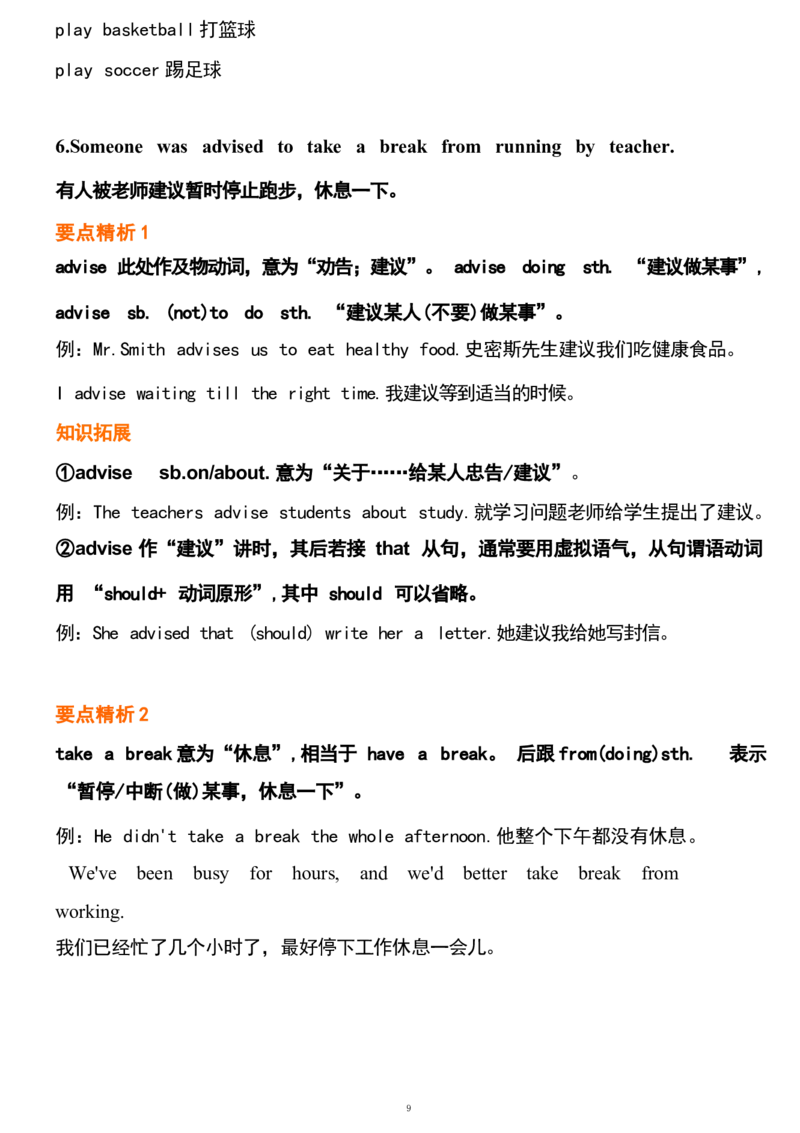
8play basketball 打篮球
play soccer 踢足球
6.Someone was advised to take a break from running by teacher.
有人被老师建议暂时停止跑步,休息一下。
要点精析 1
advise 此处作及物动词,意为“劝告;建议”。 advise doing sth. “建议做某事”,
advise sb. (not)to do sth. “建议某人(不要)做某事”。
例:Mr.Smith advises us to eat healthy food.史密斯先生建议我们吃健康食品。
I advise waiting till the right time.我建议等到适当的时候。
知识拓展
①advise sb.on/about. 意为“关于……给某人忠告/建议”。
例:The teachers advise students about study.就学习问题老师给学生提出了建议。
②advise 作“建议”讲时,其后若接 that 从句,通常要用虚拟语气,从句谓语动词
用 “should+ 动词原形”,其中 should 可以省略。
例:She advised that (should) write her a letter.她建议我给她写封信。
要点精析 2
take a break 意为“休息”,相当于 have a break。 后跟 from(doing)sth. 表示
“暂停/中断(做)某事,休息一下”。
例:He didn't take a break the whole afternoon.他整个下午都没有休息。
We've been busy for hours, and we'd better take break from
working.
我们已经忙了几个小时了,最好停下工作休息一会儿。
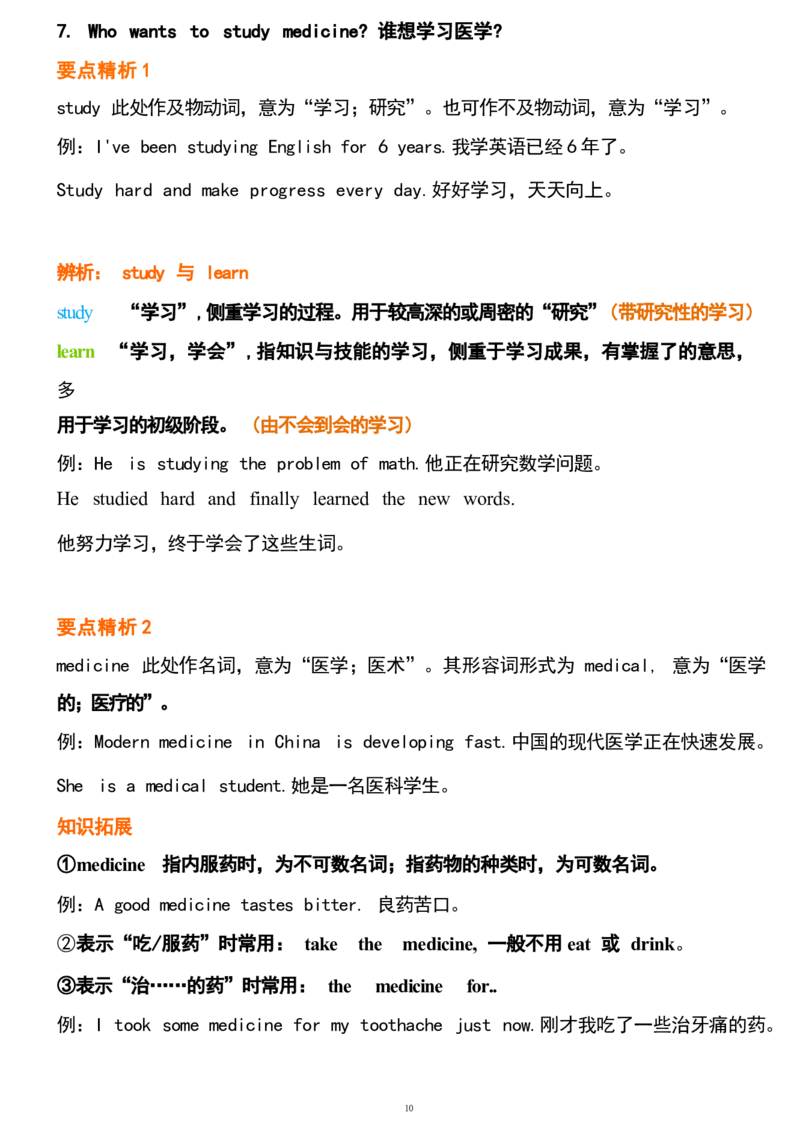
97. Who wants to study medicine? 谁想学习医学?
要点精析 1
study 此处作及物动词,意为“学习;研究”。也可作不及物动词,意为“学习”。
例:I've been studying English for 6 years.我学英语已经 6 年了。
Study hard and make progress every day.好好学习,天天向上。
辨析: study 与 learn
study “学习”,侧重学习的过程。用于较高深的或周密的“研究”(带研究性的学习)
learn “学习,学会”,指知识与技能的学习,侧重于学习成果,有掌握了的意思,
多
用于学习的初级阶段。 (由不会到会的学习)
例:He is studying the problem of math.他正在研究数学问题。
He studied hard and finally learned the new words.
他努力学习,终于学会了这些生词。
要点精析 2
medicine 此处作名词,意为“医学;医术”。其形容词形式为 medical, 意为“医学
的;医疗的”。
例:Modern medicine in China is developing fast.中国的现代医学正在快速发展。
She is a medical student.她是一名医科学生。
知识拓展
①medicine 指内服药时,为不可数名词;指药物的种类时,为可数名词。
例:A good medicine tastes bitter. 良药苦口。
②表示“吃/服药”时常用: take the medicine, 一般不用 eat 或 drink。
③表示“治……的药”时常用: the medicine for..
例:I took some medicine for my toothache just now.刚才我吃了一些治牙痛的药。
108.He gave really clear instructions during P.E. class.
在体育课上他给出很明确的指示。
要点精析
instruction 此处作可数名词,意为“指示;命令”。
例:You must read the instructions carefully before you use this machine.
在使用这台机器之前,你必须认真阅读使用说明。
辨析 instruction 与 direction
命令,指示,用法说明 表示详细的一步一步的具体指弓
instruction
或指示,常用复数形式
方向;(行路的)指引;(用法、 表示一个方向性的指引,没有一
direction
操作的)说明[常用复数形式] 步步的具体指示
例:The instructions on the medicine box are very confusing.
药品盒上的使用说明含混不清。
We can find her in this direction.沿着这个方向我们可以找到她。
9.I know that Ms. Lee was always patient with you in math class.
我知道在数学课上李老师总是对你很有耐心。
要点精析
patient 形容词,意为“有耐心的;忍耐的”。其名词形式为 patience. be patient with
sb. “对某人有耐心”, be patient of sth.“忍耐某事”。
例:You should learn how to be patient.你应该学会忍耐。
I am patient with my little brother.我对我的弟弟很有耐心。
11知识拓展
patient 还可用作可数名词,意为“病人”。
例:The patient is too weak to speak.这位病人太虚弱了,不能说话。
10. She helped you to work out the answers yourself no matter how
difficult they were. 无论问题有多难她都帮助你使你自己算出答案。
要点精析 1
work out 意为“计算出(答案、数量价格等)”。
例:Can you work out this physics problem? 你能算出这道物理题吗?
We'll have to work out how much food we'll need for the party.
我们将必须算出这次聚会需要多少食物。
小贴士
work out 是“动词+副词”型短语。名词作其宾语时,放在 out 之前或之后均可;代
词作其宾语时,只能放在 work 与 out 中间。
例:This problem is difficult.Can you work it out? 这个问题很难。你能解决它吗?
链接中考
(山东威海中考)This math problem is too difficult. Can you show me
George?
A. what to work out B. to work it out
C. how to work it out D. how to work out it
解析:句意:这道数学题太难了。乔治,你能给我说一下怎么解出它吗? “特殊疑问
词+动词不定式”是固定结构,可作主语、宾语、表语等;代词 it 指代 this math
problem,
作 work out 的宾语,应置于中间,故选 C。
12要点精析 2
no matter 意为“不论;无论”,通常与 what,who,how,when,where 等疑问
词连用,引导让步状语从句。
例:Nobody believed him no matter what he said.无论他说什么,都没有人相信他。
No matter where Linda is, she is happy.无论琳达在哪里,她都很快乐。
【注意】
①引导让步状语从句时, no matter+疑问词=疑问词+-ever。
例:No matter how fast you run, I can catch up with you. (= However fast you
run, I can catch up with you.)无论你跑得多快,我都能赶上你。
No matter where you go, never forget that you're a Chinese.(=Wherever you
go, never forget that you're Chinese.)
无论去到哪里,永远不要忘记你是一名中国人。
②引导名词性从句、时间状语从句或地点状语从句时,只能用“疑问词+-ever”, 不能
用 “no matter+疑问词”。
例:He does whatever she asks him to do.她要他做什么,他就做什么。
11. …Mr. Brown guided me to do a lot better in science.
……布朗老师指导我在科学上做得更好。
要点精析 1
guide 此处作及物动词,意为“引路;指导”。 guide sb. to do sth.意为“指导某人
做某事”; “guide sb.to+地点名词”意为“指引某人去某地”。
例:He can guide you to find the way.他可以带你找到路。
I guided her to her seat.我把她领到她的座位上去。
要点精析 2
13a lot 相当于一个副词,意为“很;非常”,通常修饰动词、形容词或副词的比
较级,表示程度。
例:It usually rains a lot at this time of a year.每年这个时候通常雨水很多。
He feels lot better today.他今天感觉好多了。
知识拓展
常见的修饰比较级的词(组)
①much/a lot+比较级,意为“得多”。
例:She's feeling much better today.她今天感觉好多了。
②a bit/a little+ 比较级,意为“稍微”。
例:Can you come to school a little earlier to morrow?
明天你能早点儿来学校吗?
③even+ 比较级,意为“甚至…… “。
例:This book is even more useful than that one.这本书甚至比那本书更有用。
④倍数、分数、百分数等表示数量的词可放在比较级前。
例:The room is two-fifths smaller than yours.这个房间比你的房间小五分之二。
I
12. He always took the time to explain things to me clearly whenever
couldn't understand anything.
无论何时我遇到不能理解的地方,他总是花费时间给我解释清楚。
要点精析
whenever 此处作连词,意为“无论何时;每当”,相当于 no matter when, 引导
让步状语从句。
例:You can ask for help whenever you need it.
每当你需要帮助的时候你都可以提出来。
1413.She encouraged me in English class.在英语课上她鼓励我。
要点精析
encourage 此处作及物动词,意为“鼓励,激励,支持”,常用结构为 encourage
sb. to do sth.“鼓励某人做某事”; encourage sb. in sth.“在 ……方面鼓励某
人/助长
某人的某种行为”。
例:Parents should encourage children to do things by themselves.
父母应该鼓励孩子们独立做事。
Don't encourage him in laziness.别助长他的懒惰行为。
知识拓展
①encourage 的名词形式为 encouragement, 意为“鼓舞,鼓励”。
例:Mike received a lot of encouragement from his teacher.
迈克从他的老师那里得到了很多鼓励。
②动词变名词在其后加 ment 的还有:
例:excite→excitement
develop→development
agree→agreement
14.Because of her, I put in more effort and my exam scores doubled.
因为她,我投入了更多的努力,我的考试分数也翻了一倍。
要点精析 1
put in 意为“花费,投入(时间、努力等)”。
例:Tom puts in more effort than last year.汤姆比去年付出了更多的努力。
They have put in lots of hard work during the past two years.
他们在过去的两年间付出了大量的辛苦劳作。
知识拓展
15含 put 的其他常见短语:
put off 推迟
put away 收拾起来
put out 扑灭 put up 建造;张贴;举起
要点精析 2
double 此处作不及物动词,意为“加倍;是……的两倍”。还可作及物动词,意为“使
加倍”。
例:The number of students doubled.学生人数增加了一倍。
His sister worked so well that her boss doubled her wages.
他的姐姐工作得如此好,以至于她的老板给她加了一倍工资。
知识拓展
double 作形容词,意为“两倍的;加倍的;双人的”。
例:He can lift double his own weight.他能够举起自己体重两倍的重量
Last weekend we bought a new double bed.上个周末我们买了一张新双人床。
15. Shall we get each of them a card and gift to say thank you?
我们给他们每个人一张卡片和一份礼物来道谢好吗?
要点精析 1
“Shall we+动词原形+其他?”为表建议的句型,表示建议对方和自己共同做某事,
语气比较委婉,意为“我们……好吗?”。
例:-Shall we go and buy some bananas? 我们去买些香蕉好吗?
-Good idea! Let's go.好主意!我们走吧。
知识拓展
其他常见的表示建议的句型:
“建议”句型
16What/How about…? …… 怎么样?
You'd better… 你最好……
Why not/don't you…? 为什么不……呢?
Let's… 我们……吧。
要点精析 2
each of为固定短语,意为“…… 中的每一个”,常用于 “each of+可数名词复数+谓
语动词的单数形式”结构中。
例:Each of my friends is from China.我的每一位朋友都是来自中国。
Each of the students has eaten a hamburger.每个学生都吃了一个汉堡包。
辨 析 each 与 every
形容词 指两者或两者以上中的“每一个”侧重个体
each
代词 可作主语、宾语或同位语,其后可跟介词 of
形容词 指三者或三者以上中的“每一个”,侧重总体,不能单独使
every
用;其后不能接 of,应接可数名词单数
例:There are lots of trees on each side of the road.公路的每一边都有许多树。
Each of us has a dictionary.我们每个人都有一本词典。
Every teacher knows him.所有的老师都认识他。
16. Looking back at these past three years 回顾这过去的三年时光
要点精析
look back(at/on sth.) 意为“回首(往事);回忆;回顾”。◇
例:We can learn something whenever we look back.
每当回首往事,我们都能学到东西。
17When I look back on those days, I realize I was very happy.
当我回想起那些日子时,我意识到那时我非常快乐。
17.Pride of overcoming fear 因克服恐惧而骄傲
要点精析
overcome 及物动词,意为“克服;战胜”。其过去式为 overcame; 过去分词为
overcome。 相当于短语 get over。
例:We can overcome/get over any difficulty, however great it is.
不管多大困难,我们都能克服。
As long as you try, I think you can overcome/get over the difficulties.
只要你努力,我认为你会克服困难的。
【助记】
巧记o与ver hoegvde r在 头有关的ove合rse成as 词 在 : 海 外
上
在……上
外 加 过分
超
过
overwork
overcoat 大 衣 过度工作
18. reparing for art festivals 为艺术节做准备
要点精析
prepare for sth.意为“为某事做准备”。
例:The students are busy preparing for the exam.学生们正忙着准备考试。
【习惯搭配】
18prepare sth.准备某物
prepare for 为……做准备
【助记】
prepare a test prepare for a test
准备测试 准备应试
prepare a test 准备测试
prepare for a test 准备应试
知识拓展
prepare to do sth.“准备做某事”。
例:They prepare to go on vacation.他们准备去度假。
19.And making a great big mess.结果弄得一团糟。
要点精析
make a mess 意为“弄得一团糟”,表示动作。 mess 此处作名词,意为“混乱;肮
脏”。
例:I have made a big mess at their wedding.我把他们的婚礼弄得一团糟。
知识拓展
①in mess 意为“团糟;乱七八糟”,表示状态。
例:The thief left the house in a mess.小偷把房间弄得乱七八糟。
②含有 mess 的其他短语:
get into mess 陷入困境;遇到麻烦
19get sb.into mess 使某人陷入狼狈的处境
mess up 搞乱;弄脏
20. Having fun at New Year's parties 在新年聚会上玩得尽兴
要点精析
have fun 意 为 “ 玩 得 高 兴 ;过 得 愉 快 ” , 其 同 义 词 组 为
have a great/good/wonderful time 和 enjoy oneself /have
fun(in)doing sth.意
为“做某事很开心”。
例:The kids are having fun playing in the park now.
现在孩子们在公园里正玩得开心。
Did you have fun visiting that country? 游览那个国家你们快乐吗?
21.Wishing everyone the best 给予大家最好的祝福
要点精析
wish 作及物动词,意为“希望;渴望”。
例:I wish you to go with me.我希望你和我一起去。
辨析 wish 与 hope
wish wish to do sth. “希望做某事”
wish sb. to do sth. “希望某人做某事”
wish+that从句,表示某种强烈而又难以实现的“愿望”
表示良好的“祝愿”,后接“宾语+宾补(形容词或名词)
hope hope to do sth. “希望做某事”
hope+that从句,表示可以实现的“希望”或能达到的“期望”
20例:I wish to place an order right now.我想马上下订单。
I wish her to make progress.我希望她取得进步。
I wish I could fly like bird.但愿我能像鸟儿一样飞翔。
l wish you happy.祝你幸福。
I wish you pleasant journey.祝你旅途愉快。
We hope to see you again.我们希望再次见到你。
We hope that we can see you again.我们希望能再次见到你。
【注意】
“wish+ 宾语从句”时,谓语动词要用虚拟语气,表示与事实相反,或表示将来不太
可能实现的愿望。
①表示现在不能实现的愿望,从句的谓语动词用过去式 (be 的过去式为were)。
例:I wish I were as tall as you.我希望我和你一样高。
②表示将来不能实现的愿望,用 “would(could)+ 动词原形”。
例:I wish it would rain tomorrow.要是明天下雨就好了。
③表示过去不能实现的愿望时,用 “had+ 过去分词”或 “would/could+have+ 过去
分词”。
例:He wished he hadn't said that.他希望他没讲那样的话。
22. And now it's time to graduate. 现在毕业的时刻到了。
要点精析 1
It is time to do sth.为固定句型,意为“该做某事了;到做某事的时候了”,相当于
It is time for sth.。
例:It's time to have lunch.=It's time for lunch.该吃午饭了。
知识拓展
It is time for sb.to do sth. “某人该做某事了”。
21例:It is time for you to do your homework, Mark.马克,你该做作业了。
要点精析 2
graduate 此处作不及物动词,意为“毕业”,其名词形式为 graduation, 意为“毕
业"。 graduate from… 意为“从……毕业”。
例:Tom graduated from the university last year.汤姆去年从大学毕业。
He has not seen his father since that graduation day.
自从毕业那天起,他就一直没见到他的父亲。
23. We will leave our lovely school.我们将离开美丽的学校。
要点精析 1
leave 此处作及物动词,意为“离开”。 leave some place “离开某地”。
例:I will leave my hometown tomorrow.明天我将离开我的故乡。
知识拓展
①leave 作及物动词时, leave sb./sth.+adj. 意为“使处于某种状态”。
例:He left the windows open.他让窗子开着。
②leave 作名词时,意为“休假,假期”等。
例:I had a two-week leave.我休了两周的假。
要点精析 2
lovely 形容词,意为“美丽的;可爱的”。
例:You look lovely in blue.你穿蓝衣服看上去很漂亮。
What a lovely girl!多么可爱的女孩儿啊!
小贴士
英语中有一些以-ly 结尾的词为形容词,而不是副词, 如: friendly (友好的),lively
22(活泼的), lonely (孤单的,寂寞的), brotherly (兄弟般的), weekly (每
周的), daily (每日的) 。
24.I'm trying to keep my cool.我正尽力保持冷静。
要点精析
keep one's cool 意为“沉住气;保持冷静”。
例:We must keep our cool when we are in danger.
当处于危险中时,我们必须保持冷静。
知识拓展
keep/stay cool “保持冷静;保持凉爽”。
例:keep/Stay cool, Jack! 保持冷静,杰克!
Let's sit in the shade and keep/stay cool.我们坐到阴凉处乘凉吧。
25.And our kind and caring teachers.还有我们和蔼体贴的老师们。
要点精析
caring 形容词,意为“体贴人的;关心他人的”。
例:The woman is very happy because she has a caring husband.
这位女士很幸福,因为她有一个体贴的丈夫。
He is a lovely boy, very gentle and caring.他是个可爱的男孩儿,既温柔又体贴。
知识拓展
care动词,意为“在意;担忧;关心 care about “担心;关心”。
care for “照顾,照料”,相当于 look after/take care of。
careful 形容词,意为“小心的;仔细的;认真的”。
careless形容词,意为“粗心的” 。
carefully 副词,意为“仔细地;认真地” 。
23carelessly副词,意为“粗心地”。
例:Please care for yourself when you are away.当你在外面的时候,请照顾好自己。
You made many mistakes in your homework because you did it carelessly.
因为你做得粗心,所以作业中犯了许多错误。
26.Wonderful memories of ours.将变成我们的美好回忆。
要点精析
ours 名词性物主代词,意为“我们的”。
例:Their school is different from ours.他们的学校和我们的不同。
I'll show your room to you.Ours is next door.
我将带你去你的房间。我们的房间在你的隔壁。
【注意】
①名词性物主代词相当于名词,不能用于名词前作定语,但可以作主语、表语或宾语。
[译]她的头发比我的长。
[正]Her hair is longer than mine.
[误]Her hair is longer than mine hair.
② “形容词性物主代词+名词”可用名词性物主代词代替。
例:This is her hat. (=This hat is hers.) 这是她的帽子。
27.My time in junior high school has been enjoyable.
我的初中时光一直很快乐。
要点精析
enjoyable 形容词,意为“令人愉快的;使人快乐的”。
例:What an enjoyable party it is!多么令人愉快的聚会啊!
They had an enjoyable journey.他们进行了一次愉快的旅行。
24【助记】
enjoy(v.喜欢,享受)+-able (后组) →enjoyable(adj 令人愉快的,使人快乐的)
知识拓展
有些动词或名词加后级-able, 可构成形容词,如:drinkable (可以饮用的),valuable
(有价值的), reasonable (有道理的), comfort able (舒服的)。
28. In Grade 8,I studied harder but I still got poor grades in English.
在八年级,我学习更刻苦了但我的英语成绩仍然很差。
要点精析 1
get 此处作及物动词,意为“得到;获得;取得”。其后常接名词或代词作宾语。
get…from… 意为“从……得到……”。
例:You can get an A for that answer.就那个答案你能得 A。
I have a black cat, and I get it from my friend.
我有一只黑色的猫,我是从朋友那儿得到的。
要点精析 2
grade 可数名词,在此意为“成绩;分数"。 get poor grades 意为“取得糟糕的成
绩”, get good grades 意为“取得好成绩”。
例:He often got poor grades when he was in Grade Seven.
在七年级的时候他的成绩经常很糟糕。
Lily got good grades last term.莉莉上学期取得了好成绩。
29. I had problems with pronunciation and reading texts.
我在发音和阅读课文上有困难。
要点精析
25have problems with sth.为固定短语,意为“在 ……上有困难”。
例:I have problems with my math sometimes.有时我在数学上有困难。
知识拓展
have problems(in)doing sth.意为“做某事很费劲/有困难”,介词 in 指在某 一
方面,在句中可以省略,后接动词-ing 形式。 problem 是可数名词,意为“困难;麻
烦”,在本短语中 problems 可 用 trouble 或 difficulty来代替。
例:We had some problems/difficulty/trouble getting to the top of the
mountain. 到达这个山顶我们有些困难。
小贴士
该短语的否定形式还可改为 do sth. without any problems/difficulty/trouble,
意为“做某事没有困难/毫不费劲”。
例: She didn't have any problems finding the park.=She found the park
without any problems.她毫不费劲地找到了那个公园。
Section A 即学即试
I. 单项选择
1. I wondered why he failed in the math exam
A. in the row B. on a row C. in a row D.row a boat
2. This is a room and the cost will
A.double; double B.doubled; doubled C.double; doubled D.doubled; double
3. It's best to read the before you take the medicine.
A. introductions B.instructions C.explanations D.graduation
4. Mr.Wang is a teacher and we all love him.
A. care
B.careful C. careless lD.caring
5.Several years before they met again.
26A.has gone by B. have gone by C. went by D. go by
6. The picture on the wall is painted by my nephew.
A. having hung B. hanging C. hangs D.being hung
7. What's the result of your you please tell
me? A. survey B. standard C. cancel
D.cruel
8. Those toys for children look and sel l
A. good; lovely B.lovely good C.well; lovely D.lovely; well
9.-What are you going to do when you grow up?
-A singer, but my parents wish me a teacher.
A. am B. to be C. will be D.be
10. Finally the boy his shortcomings (缺点) and became top student.
A. overcome B. overcomes C. overcame D.overcoming
Ⅱ .根据句意及汉语提示完成句子
1. More than 300 watches are not up to ( 标 准 ) .
2. The boy learned to play the (键盘式电子乐器) with the help of his mother.
3. How many (课文) are there in your Book Ⅲ?
4. Are you looking forward to your (高级的) high school?
5 I have a simple and easy (方法) .
Ⅲ .用括号内所给词的适当形式填空
1.I remembered (lock)the door, but it was still open when I returned
home.
2. I don't know how to use the machine. Could you give me some (instruct)?
3. Don't worry. We have (overcome) all the difficulties.
4. She is a kind and (care)grandmother.
5. Those are not your desks. They are (our).
27Section B 知识点精析
1. I hope to get a business degree and become a manager.
我希望获得商业学位并成为一名管理者。
要点精析 1
degree 名词,意为“学位;度数;程度”。 get a business degree 意为“获得商业
学位”, take a degree 意为“取得学位”。
例:The degree can qualify you for teaching.这个学位能使你有资格教学。
要点精析 2
manager 名词,意为“经理;经营者,管理者”。
例:Our manager is very strict with us.我们的经理对我们要求很严格。
知识拓展
①manage 动词,意为“完成(困难的事);应付(困难局面)”。
例:He took great pains to manage the factory well.为了管理好工厂,他煞费苦心。
②manage to do sth. 意为“设法成功地做某事”。
例:The girl managed to work out the math problem.
这个女孩儿成功演算出了那道数学难题。
2.Mrs. Chen believes in all of them. 陈老师信任他们所有的人……
要点精析
believe in 意为“信任;信赖”,其后可接名词或代词作宾语。
例:We all believe in Sandy because she is such an honest girl.
我们都信任桑迪,因为她是一个如此诚实的女孩儿。
You have got to believe in yourself, or you'll never succeed.
你必须相信自己,否则你永远不会成功。
28辨析 believe in与 believe
believe in
①信任、信赖某人(的品格、作风等)
②相信某人会成功
③相信某人或某事物的存在
believe
①相信某人说的是实话
②相信某事是真实的
例:They need a government to believe in.他们需要一个值得信赖的政府。
I believe in you, so l believe what you said.我信任你,所以我相信你说的话。
3. Thank you for coming today to attend the graduation ceremony at No . 3
Junior High School.感谢你们今天来参加第三初级中学的毕业典礼。
要点精析 1
Thank you/Thanks for.意为“因 ……而感谢(你/你们)”,是向对方表示感谢的句
型,后面接名词、代词或动词-ing 形式。
例:Thanks a lot for your help.非常感谢您的帮助。
辨析thanks for与 thanks to
因 ……而感谢 后接感谢的原因
thanks for
thanks to 多亏,由于,幸亏 并无当面感谢的意思,其后接名词或代词,有时可
与 with the help of和 because of互换
例:Thanks for inviting us to your birthday party.
谢谢你邀请我们参加你的生日聚会。
29Thanks to your help, we finished the work in time.
由于你的帮助,我们及时完成了工作。
要点精析 2
attend 及物动词,意为“参加”。用于参加会议、婚礼、葬礼、典礼,去上课、上学,
听报告等。
例:He'll attend an important meeting tomorrow.他明天要参加一个重要的会议。
3. First of all, I'd like to congratulate all the students who are here today.
首先,我想祝贺今天所有在座的学生。
要点精析 1
first of all 意为“首先;第一”,常放在句首,后面用逗号与句子的其他部分隔开,用
来强调重要的事情或动作。
例:First of all, you must study hard.首先,你必须努力学习。
First of all, I think he is a good student.首先,我认为他是一名好学生。
要点精析 2
congratulate 及物动词,意为“祝贺”,其用法如下:
①congratulate sb.意为“向某人祝贺”。
例:I want to congratulate you with all my heart.我想向你表示衷心的祝贺。
②congratulate sb.on/upon sth. 意为“因某事向某人祝贺”,congratulate 的
宾 语必须是“受到祝贺的人”,不能是“所祝贺的事”,介词 on/upon 后可跟名词、代
词、
动词-ing 形式表示所祝贺的事。
例:We congratulated her on having passed the exam.我们祝贺她通过了考试。
Let me congratulate you on the birth of your daughter.我祝贺你喜得千金。
30③congratulate sb.+that 从句
例:I should congratulate you that you resisted the temptation.
我应该向你祝贺,你抵抗住了这种诱惑。
知识拓展
congratulation 名词,意为“祝贺;庆祝”。常用复数形式。
例:I offer you congratulations on the New Year.祝你新年快乐。
5. You were all so full of energy and thirsty for knowledge.
你们所有人都充满了活力并渴求知识。
要点精析 1
energy 不可数名词,意为“活力;精力”。其形容词形式为 energetic, 意为“精力
旺盛的,精神饱满的”。
例:The young usually have more energy than the old.
青年人通常比老年人精力更充沛。
He is an energetic ping-pong player.他是一名精力充沛的乒乓球运动员。
要点精析 2
thirsty 形容词,意为“渴望的;口渴的”。 be thirsty for 为固定短语,意为“渴望,
渴求”,后跟名词、代词或动词 ing 形式作宾语。
例:All children are thirsty for getting more love from their parents.
所有孩子都渴望从父母那里得到更多的关爱。
Young men should be thirsty for knowledge.年轻人应该渴求知识。
知识拓展
be hungry for 渴望……
例:She is hungry for knowledge.她渴望知识。
31要点精析 3
knowledge 名词,意为“知识;学问”。
例:We go to school to get knowledge.我们去上学是为了获得知识。
Knowledge begins with practice.知识始于实践。
知识拓展
①knowledge 的常用短语:
have no knowledge of… 不理解…… ;不认识……
have good knowledge of 通晓,熟知
②knowledge 的形容词为 knowledgeable, 意为“有学问的”。
6.And yes, some of you were little difficult to deal with!
并且你们中有些同学有点儿难以对付!
要点精析
deal with 为固定短语,意为“处理;应对”。
例:Tom has learned how to deal with difficulties.汤姆已经学会了如何应对困难。
辨析 deal with 与 do with
deal 侧重于方式、方法; deal with 常与疑问词 how 连用;
deal with
在
动词不定式短语 to deal with 中,with 后必须带宾语
do 侧重于对象;do with 常与疑问词 what 连用
do with
例:I don't know how to deal with it.我不知道如何处理这件事。
I don't know how they deal with the problem.= I don't know what they do with
the problem.我不知道他们如何处理这个问题。
327.But today I see a room full of talented young adults who are full of
hope for the future.但今天我看到了满堂对未来充满希望的、有才能的年轻人。
要点精析
talented 形容词,意为“有才能的;有天赋的”,其比较级形式为 more talented。
例:Beethoven is talented musician.贝多芬是一名天才音乐家。
The girl is talented in dancing.这个女孩儿有舞蹈天赋。
【助记】
talent(n.天资;天赋;天才)+ed→ 形容词 talented (有才能的;有天赋的)
辨析: talent,ability 与 gift
talent “才能,天赋”,一般指先天所具有的某种特殊才能,尤其指艺术方面的天分
ability 泛指”能力,本领”,可以是先天的,也可以是后天获得的
gift “天资,天赋”,指不需要努力,与生俱来的优秀能力
例:She has music talent.她有音乐天赋。
He has a great ability as an engineer.他是位很有能力的工程师。
He is a boy of many gifts.他是个多才多艺的男孩儿。
8.You've all grown up so much and I'm so proud of you.
你们都已经成长了许多,我为你们感到如此骄傲。
要点精析 1
grow up 意为“长大;成长”。
例:I grew up in Beijing.我在北京长大。
I want to be a football player when l grow up.我长大后想当一名足球运动员。
知识拓展
grow into 意为“成长为”。
33例:Mary grew into a beautiful girl.玛丽长成了一个漂亮姑娘。
要点精析 2
be proud of 意为“为……感到骄傲;为……感到自豪”,其同义短语为 take pride in。
例:Jack is proud of his model plane.杰克为他的飞机模型感到骄傲。
We are very proud of our football team.我们为我们的足球队感到非常自豪。
链接中考
(浙江丽水中考) Parents enjoy any progress their children have made and will
feel them.
A. angry with B.interested in C. proud of D. worried about
解析:句意:父母享受孩子们取得的任何进步,并会为他们感到骄傲。 be proud
of “为……感到骄傲”,符合题意。 be angry with“生 ……的气";be interested
in”对……
感兴趣"; be worried about “担心…… "。选 C。
9.Although you've all worked very hard over the last three years none of
you did it alone.
在过去的三年里,尽管你们学习都很刻苦,但你们没有一个人能独自做到这些。
要点精析
none of 为固定结构,意为“没有一个……”,作主语时,若 of 后接复数名词或复数
代词,谓语动词用单复数皆可;若 of 后接不可数名词,谓语动词用单数。
例:None of us have/has seen him.我们中没有人见过他。
34辨析 none of,all of, both of,neither of 与 either of
用于三 表否定 所有的人(或物)都不 ……,作主语时,谓语动词用
none of
者或三 单
者以上 数或复数应视 of后的名词或代词的数而定
表肯定 所有的人(或物)都 ……,作主语时,谓语动词用复数
all of
表肯定 两者都 ……,作主语时,谓语动词用复数
both of
neither 用于两 表否定 两者都不 …,作主语时,谓语动词用单数
者之间
of
表肯定 两者中任一 ……,作主语时,谓语动词用单数
either of
例:None of these cars is /are new.这些汽车中没有一辆是新的。
All of us go to school every day.我们所有人每天都去上学。
Both of the girls are clever.这两个女孩儿都很聪明。
Neither of the films is good.这两部电影都不好。
Could either of you lend me ten dollars? 你们俩谁能借给我十美元?
知识拓展
none 的用法小结:
①none 所修饰的名词可以提前。
例:Gold and silver have I none.金银我都没有。
②none 和 the+ 比较级或 so,too 连用。
③none 作代词用于三者或三者以上的全部否定;如果指可数名词,谓语动词单复数
都 可以;若指不可数名词,谓语动词则只能用单数形式。
④none 可指人指物,表示的事物往往有范围,能表示数量,回答 how much 或
how many 引导的疑问句。
例:-How much money do you have with you? 你身上带了多少钱?
-None. 没有。
-How many girls are there in the room? 房间里有多少个女孩儿?
35-None. 一个也没有。
10.Please consider what they've done for you and what they mean to you.
请考虑一下他们为你们做了什么,他们对你们意味着什么。
要点精析 1
consider 此处作及物动词,意为“考虑”,相当于 think about, 后跟名词、代词、
动词-ing 形式、宾语从句或“疑问词+动词不定式”作宾语,但其后不能直接跟动词
不定式作宾语。
例:I'm considering changing my job.我正在考虑换工作。
She has never considered how to solve the problem.
她从未考虑过如何解决那个问题。
知识拓展
consider 还有“认为”的意思,相当于 think。consider…as… 意为“把……当作”。
例:The nation all considered him as a wise leader.
全国人民都认为他是一位英明的领导人。
要点精析 2
mean 此处作及物动词,意为“意思是;意味着”,其名词形式为 meaning, 意为“含
义;意思”。 What do/does/did…mean? 为固定句型,意为“……是什么意思?”,
相当于 What 's the meaning of…? 或 What do you mean by…?
例:What does this word mean?= What's the meaning of this word?
这个单词是什么意思?
What do you mean by saying so? 你这样说是何用意?
知识拓展
①mean 后接名词或宾语从句。
36例:This means that I have to go away.这意味着我必须离开。
②mean doing sth. “意味着做某事”; mean to do sth. “打算做某事”。
例:Accepting the job means living abroad.接受这份工作意味着要在国外居住。
I didn't mean to start an argument.我并不想引发争论。
③mean 的形容词为 meaningful, 意为“有意义的”; meaningless 意为“无意
义 的”。
11. Never fail to be thankful to the people around you.
永远不要忘记对你们身边的人心存感恩。
要点精析 1
never fail to do sth.用在陈述句中意为“总会做某事;从来不会忘记做某事”,旨在
陈述;用于祈使句中意为“千万/一定别忘了做某事”,旨在提醒。
例:My daughter never fails to phone me on my birthday.
我女儿从来不会忘了在我生日的时候给我打电话。
Never fail to show your love to your parents.别忘了向父母表达你的爱。
要点精析 2
be thankful to sb.意为“对某人心存感激”。
例:We are very thankful to you.我们十分感激你。
I am thankful to my friends.我对朋友们心存感激。
12. Lastly, the end of junior high school is the beginning of new life.
最后,初中的结束是新生活的开始。
要点精析 1
lastly 副词,意为“最后;终于”,一般用于句首。
37例:Lastly, we're going to visit Athens and fly home from there.
最后,我们将访问雅典,然后从那儿乘飞机回国。
Lastly, must say owe all the achievements to the encouragement and help from
my friends.最后,我必须说我所有的这些成就都归功于我朋友们的鼓励和帮助。
辨析 lastly 与 at last
lastly 指按顺序的“最后”
at last 指经过周折后“终于“
例:Lastly I must say that he is a good student.最后我必须说他是一名好学生。
His wish has come true at last.他的愿望终于实现了。
要点精析 2
the beginning of 意为“……的开始”,其反义短语为 the end of,意为“……的结
束”。
例:Tears are just the beginning of pain.泪水只是痛苦的开端。
知识拓展
含有 beginning 的常见短语:
①at the beginning 和 in the beginning 皆有“起初,开始,原先”之意,通常可
互换。
例:You'll find it difficult to learn English at the beginning.
起初,你会发现学习英语很难。
In the beginning,I didn't know this.开始我不知道这件事。
②at the beginning of 意为“在……之初”,其后通常接表时间、事件等的名词,其
反义词组为 at the end of。
例:At the beginning of 1976, she came back to China.
1976 年初,她回到了中国。
3813.I don't need to tell you that life in senior high school will be
harder and that you have many difficult tasks ahead of you.
我不需要告诉你们高中的生活将更辛苦,并且在你们面前会有很多艰巨的任务。
要点精析 1
task 作名词,意为“任务;工作;作业”。
例:The task has been finished.任务已经完成了。
辨析 task,work 与 job
可数名词一般指必须完成的“任务”,含有“艰巨、沉重”之意
task
不可数名词常指正式职业的经常性、 一般性工作,不含“艰巨、沉重”之
work
意
job 可数名词多指为换取报酬而进行的日常活动,尤指在某一行业的工作、职
业
例:Mother set me the task of sweeping the floor.母亲把扫地的任务交给了我。
He has been out of work for a long time.他已经失业很久了。
Washing the windows is not my job.擦窗子不是我的工作。
要点精析 2
ahead of 意为“在……前面”,可表示时间或空间。
例:You have a long way ahead of you.你前面还有很长一段路要走。
She arrived ahead of schedule.她比原计划提前到了。
知识拓展
ahead 的其他用法:
①表示“比……强(高)”,主要用作表语。
39例:He's ahead of me in English.他的英语比我强。
②ahead of time 意为“提前;提早”;也可表示为 ahead of schedule。
例:The work was done ahead of time.工作提前完成了。
14.You'll make mistakes along the way, but the key is to learn from your
mistakes and never give up.
一路走来,你们会犯错误,但关键是从错误中学习,并且永不放弃。
要点精析 1
make mistakes 为固定短语,意为“犯错;出错”,也可以说 make mistake.mistake
此处为可数名词,意为“错误;失误”,其复数形式为 mistakes。make mistakesin
“在……方面犯错误”,by mistake “错误地”。
例:l used to make mistakes in spelling.我过去常常犯拼写错误。
I can't find my schoolbag. Someone must take it away by mistake.
我找不到我的书包了, 一定有人错拿了它。
知识拓展
mistake 用作动词时,意为“弄错;误解”,常用短语: mistake…for… 意为“错把……
当作…… "。
例:The teacher mistook me for my twin sister.老师错把我当成了我的孪生姐姐。
要点精析 2
along the way 意为“沿着路”, along 此处作介词,意为“沿着”。
例:There are trees all along the road.沿着这条路从头到尾都有树。
辨析 along,across 与 through
along 意为“沿着”,通常指沿着狭长的东西
across 意为“横过,穿过“,主要表示从某物的表面“横过”
40through 意为“横过,穿过”,表示从某个空间或内部穿过
例:I saw her running along the road.我看见她正沿着那条路跑。
She walked across the road carefully.她小心地穿过马路。
She walked through the forest alone.她独自一人穿过森林。
15.But along with difficulties, there will also be many exciting things
waiting for you.但是伴随着困难,也将有很多令人振奋的事情等着你们。
要点精析 1
difficulty 此处作可数名词,意为“困难;难题,难事”,其形容词形式为 difficult,
意为“困难的”。 have difficulty in doing “做 ……有困难”。
例:He did it without any difficulty.他做那件事一点儿困难都没有。
He has no difficulty in solving the problem.他解决这个问题一点儿困难也没有。
要点精析 2
此句 there 中 will be 意为“将有,会有”,是 there be 句型的一般将来时,有时可
与 There is/are going to be 相互转换,其中 be 不能改为其他任何动词。 “There
be+ 名词+ doing” 句型表示“有……正在做……”。
例:There will be a concert this evening.今晚将有一场音乐会。
There is going to be a sports meeting next week.下周将有一场运动会。
There is someone knocking at the door.有人在敲门。
知识拓展
①There be … 型中, be 动词的形式通常与离得最近的名词的单复数形式保持一致,即
遵循“就近原则”。
例:There is one cat and two dogs on the boat.船上有一只猫和两条狗。
There are two dogs and one cat on the boat.船上有两条狗和一只猫。
41②there be 与 have/has 的区别:前者表示某地存在某物;后者表示“拥有”
的意思。二者有时可以相互转换。
例:Our school has twenty-five classes.= There are twenty-five classes in our
school. 我们学校有 25 个班。
要点精析 3
wait for 意为“等候”,其后可跟人或物。
例:I'll wait for you at the door.我将在门口等你。
Adam was waiting for bus over there.亚当正在那里等公共汽车。
知识拓展
与 wait 相关的短语:
①wait minute 意为“稍等”。
例:Please wait minute.请稍等。
②wait for sb.to do sth. 意为“等待某人做某事”。
例:Would you please wait for me to get ready? 请你等我准备一下好吗?
16. Behind each door you open are chances to learn new things, and you
have the ability to make your own choices.
在你们打开的每扇门的后面都是学习新东西的机会,并且你们有能力做出自己的选择。
要点精析 1
chance 此处作可数名词,意为“机会,可能性”。其后常接动词不定式或“of doing
形式,即 (have)chance to do.=(have)a chance of doing, 为“(有)做……
的机会”。 by chance 意为“偶然地”。
例:It's a good chance to learn from others.这是一个向他人学习的好机会。
I met her by chance.我偶然遇到了她。
42链接中考
(山东德州中考) The people who are more confident have more to make
themselves successful.
A.education B.chances C. pride D.excuses
解析: education “教育”; chance “机会,可能性”; pride “自豪”; excuse “借口,
理由”。句意:那些更自信的人有更多的机会使自己成功。故选 B。
要点精析 2
ability处作名词,意为“能力”。表示“能力”时,多为不可数名词, have the ability
to do意为“有能力做 ……”;表示“才能;才干”时,多用复数形式。
例:I think he has the ability to do it.我认为他有能力做这件事。
要点精析 3
choice 此处作名词,意为“选择;抉择"。 make one's own choice意为“做出某人
自己的选择”。
例:He is faced with a difficult choice.他面临着艰难的抉择。
We each had to make a choice.我们每个人都得做出选择。
知识拓展
①have no choice but to do sth. 意为“除做某事以外,别无选择”或“只好做某
事”。
例:I have no choice but to accept the fact.我只得接受事实。
②choice 的动词形式为 choose, 过去式 chose, 过去分词 chosen 。choose to do
sth.意为“选择做某事”
例:I choose to be your friend.我选择做你的朋友。
4317.Choose wisely and be responsible for your decisions and actions.
明智地选择,并对自己的决定和行为负责。
要点精析 1
be responsible for 意为“对……有责任;负责任”。 for 为介词,后跟名词、代词或
动词-ing 作宾语。
例:We should be responsible for ourselves.我们应该对自己负责。
Zhao Wei is responsible for training new players.赵伟负责培训新运动员。
要点精析 2
decision 名词,意为“决定,决心”。
例:I don't know if the decision is right.我不知道这个决定是否正确。
知识拓展
make ones' own decision 意为“某人自己做决定”,相当于 make decision for
oneself。
例:Teenagers should be allowed to make their own decisions.
= Teenagers should be allowed to make decisions for themselves.
应该允许青少年自己做决定。
18.Although you have to go your separate ways now, I hope that in a few
years' time, you'll come back to visit our school.
尽管现在你们不得不各奔东西,但是我希望几年后,你们会回母校看看。
要点精析
go(one's)separate ways意为“分路而行;分手”。 separate 此处用作形容词,
意为 “单独的;分离的”。
例:We have to go our separate ways one day.总有一天我们不得不分开。
44知识拓展
go(one's)separate ways 还可意为“分道扬镳;断绝往来”。
例:They finally went separate ways because of that event.
他们最终因为那件事分道扬镳。
19. As you set out on your new journey, you shouldn't forget where you
came from. 在新的旅行启程之际,你们不应该忘记自己来自何处。
要点精析 1
set out意为“出发;启程”。相当于set off。 其后可跟 “for+ 地点”,表示出发去某
地。
例:The army are about to set out.部队就要出发了。
Lingling and I will set out for Hangzhou.玲玲和我将启程去杭州。
知识拓展
set out还可意为“(怀着目标)开始做某事”,其后跟动词不定式。
例:He set out to win the game.他一心努力要得比。
要点精析 2
journey 意为“旅程”,此句中用的是它的引申义,即它的隐喻用法,意为“(人生的)
阶段或行程”。
辨析:journey,trip,tour 与 travel
journey 通常指陆地上由某一地点到另一地点的旅行,强调旅行的路程,用于较正式
场合
trip 非正式用语,多指短途旅行,但也可替代 journey
指以观光、视察、购物等为目的的旅行,表示旅行一周再转回原出发点,在
tour
强调这种含义时,不可用 journey,trip等词替代
45泛指一般意义的旅行、游历,指具体的旅行时,常用复数形式
travel
例:I hope you have a good journey.我希望你旅途愉快。
We'll make a trip to the seaside next month.下个月我们要去海边旅行。
They are having a sightseeing tour.他们正在进行观光旅行。
Travel is much easier now than it used to be.现在旅行比过去容易多了。
记忆方法技巧
长途陆路用 journey, 短途短期用 trip,
观光游玩用tour, 时长路远用 travel。
要点精析 3
should 为情态动词,意为“应该;应当”,否定式为 shouldn't, 其后接动词原形,
无人称和数的变化。常用来表示征询意见和建议提出劝告和要求、表达义务等。
例:You should stop smoking.你应该戒烟。
You shouldn't talk in class.你不应该在课堂上说话。
记忆方法技巧
情态动词 should 的用法
表示劝告与建议,也表义务与责任;
第一人称问句中,征询意见要记清。
20.Good luck and hope to see you again sometime soon!
祝你们好运,并希望在不久的将来再次见到你们!
要点精析
sometime 副词,意为“某时”。表示某个不确切或不具体的时间,后面应该接表示过
46去或将来的时间。
例:Tom went back home sometime last month.汤姆上个月某个时间回的家。
辨析: sometime,some times,some time 与 sometimes
指某一个不明确的时间,用过去时、将来时都可以
sometime
名词短语,表示几次,几倍
some times
名词短语,表示某一段时间,也可表示某个时候
some time
表示“有时,间或”,用来描述现在或过去常发生的事
sometimes
例:The film will be shown again sometime next week.
这部电影下周某个时候将重映。
We have been to the Great Wall some times.我们已经去过长城好几次。
We still have some time to look around in the city before lunch.
在午饭前我们还有一段时间在城里逛逛。
Sometimes we are busy but sometimes we are not.我们有时忙有时不忙。
21. It is always hard to separate from those whom you have spent so much
time with for the past three years.与那些与你共度三年时光的人分离总是很难的。
要点精析
separate from 意为“分离;隔开”。 separate 此处用作动词,意为“分开;分离”。
常用短语 separate A from B, 意为“把 A 与 B 分开/分离”。
例:Separating from my friends makes me sad.与朋友分离使我感到难过。
Please separate your book from mine.请把你的书和我的分开。
47辨析: separate 与 divide
separate 意为“分隔”,指把原来连在一起或靠近的分隔开来,被分隔的对象通常
没有整体性
意为“划分”,指把整体分成若干部分,被划分的对象具有一定的整体性
divide
例:The two girls don't want to separate from each other.
这两个女孩儿不想彼此分离。
The teacher divided the class and took one section to the library and left the
other to write an article.
老师把该班分开,把一组领去了图书馆,留下其余的人写作文。
【助记】
separate 分隔开
divide 分隔开
22. However, we are still excited to set out on a new journey when we enter
senior high school.
然而当我们升入高中时,我们仍然很兴奋地出发,踏上新的征程。
要点精析 1
excited 作形容词,意为“兴奋的”。
例:The kids were excited about the holiday.孩子们对假期兴奋不已。
48辨析: excited 与 exciting
主语是人指人对某事惊奇,意为“感到兴奋的,可用于 be
excited
excited to do sth.结构中
exciting 说明事物指某事物令人兴奋,既可作表语,也可作定语
例:The children were excited about opening their presents.
孩子们兴奋不已地打开礼物。
They waited and waited for something exciting to happen.
他们等啊等啊,等待着激动人心的事情发生。
知识拓展
类似的形容词还有:
interested/interesting
surprised/surprising
relaxed/relaxing
moved/moving
bored/boring
要点精析 2
enter 此处作及物动词,意为“进入;开始;参加”,后面可直接跟宾语。
例:He showed me how to enter data into the computer.
他向我展示如何将数据输入计算机。
知识拓展
enter 的其他用法:
①表示进入某一具体的空间。
例:Someone entered the room behind me.有人跟在我后面进了房间。
49②表示进入某一组织或某一机构。
例:He entered the army last year.他去年参军了。
③表示报名参加考试(比赛等)
例:1,000 children entered the competition.1000 名孩子报名参加了比赛。
Only five British players have entered for the championship.
只有五名英国运动员报名参加了锦标赛。
23. Even though I am sad that junior high is over, I am looking forward to
new experiences in senior high!
初中毕业了,尽管我是伤心的,但我期盼高中的新经历!
要点精析
experience 此处用作可数名词,意为“经历”。
例:It was her first experience of living alone.那是她第一次体验独居生活。
I had a bad experience with fireworks once.我放烟火曾有过一次不愉快的遭遇。
知识拓展
experience 用作不可数名词时,意为“经验”。
例:Do you have any previous experience of this type of work?
你有这种类型的工作的经验吗?
Section B 即学即试
I.单项选择
1.There more visitors in Tokyo in 2020 because the 32th Olympic
Games will be held there.
A.is B. are C. will be D. is going to have
2.My father has habit of jogging the Jinchuan River for an hour in the
50