文档文本内容
教科版小学英语三起四上 Unit 1 知识点
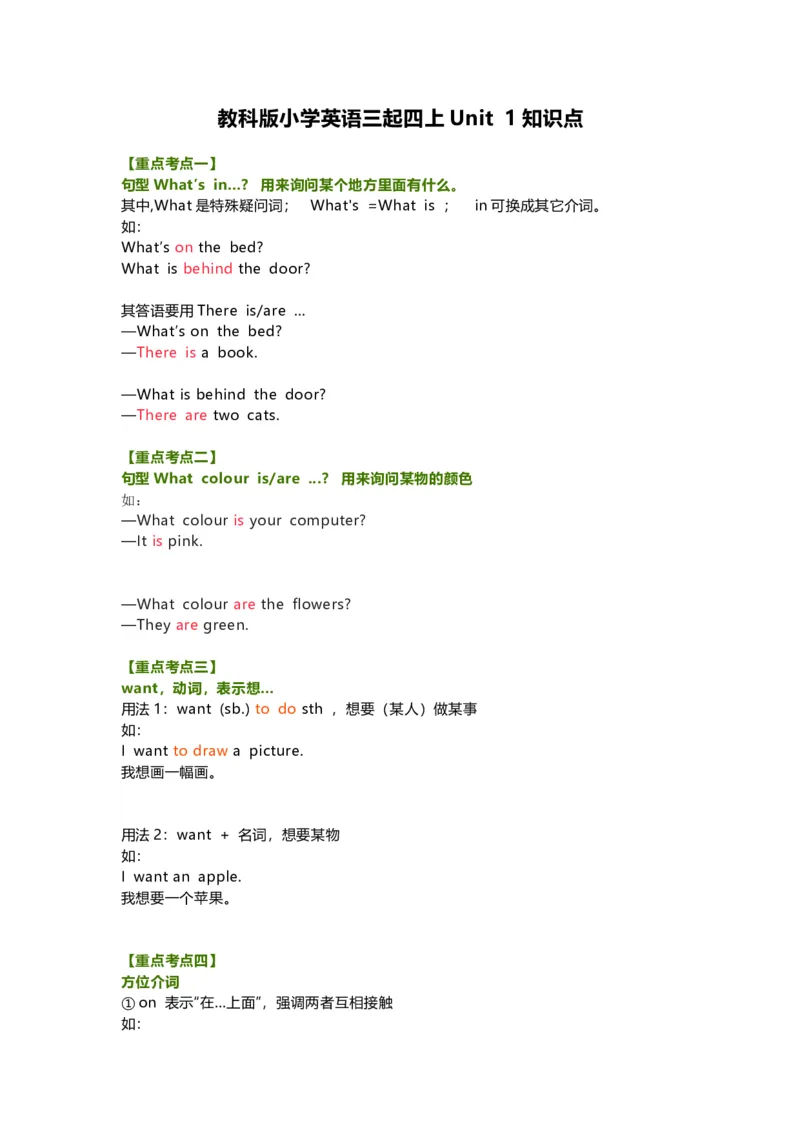
【重点考点一】
句型What’s in...? 用来询问某个地方里面有什么。
其中,What是特殊疑问词; What's =What is ; in可换成其它介词。
如:
What’s on the bed?
What is behind the door?
其答语要用There is/are ...
—What’s on the bed?
—There is a book.
—What is behind the door?
—There are two cats.
【重点考点二】
句型What colour is/are ...? 用来询问某物的颜色
如:
—What colour is your computer?
—It is pink.
—What colour are the flowers?
—They are green.
【重点考点三】
want,动词,表示想...
用法1:want (sb.) to do sth ,想要(某人)做某事
如:
I want to draw a picture.
我想画一幅画。
用法2:want + 名词,想要某物
如:
I want an apple.
我想要一个苹果。
【重点考点四】
方位介词
①on 表示“在...上面”,强调两者互相接触
如:I put my pen on the desk.
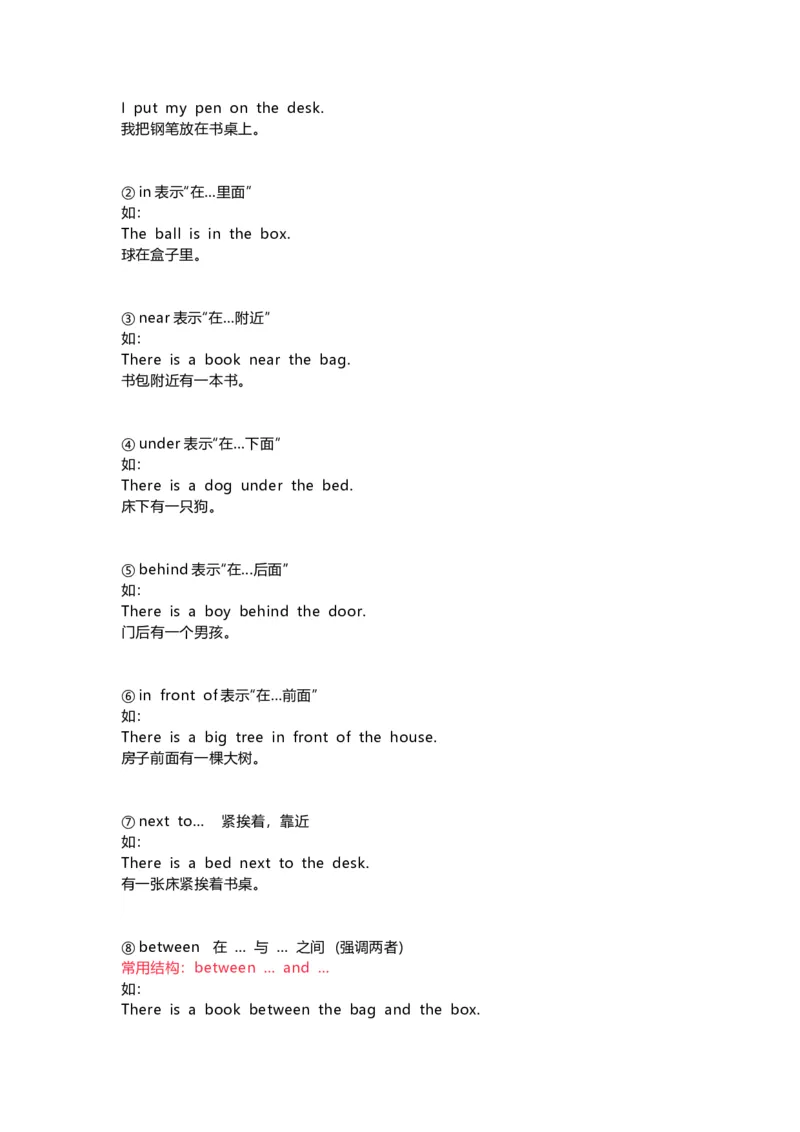
我把钢笔放在书桌上。
②in表示“在...里面”
如:
The ball is in the box.
球在盒子里。
③near表示“在...附近”
如:
There is a book near the bag.
书包附近有一本书。
④under表示“在...下面”
如:
There is a dog under the bed.
床下有一只狗。
⑤behind表示“在...后面”
如:
There is a boy behind the door.
门后有一个男孩。
⑥in front of表示“在...前面”
如:
There is a big tree in front of the house.
房子前面有一棵大树。
⑦next to... 紧挨着,靠近
如:
There is a bed next to the desk.
有一张床紧挨着书桌。
⑧between 在 ... 与 ... 之间 (强调两者)
常用结构:between ... and ...
如:
There is a book between the bag and the box.在书包与盒子之间,有一本书。
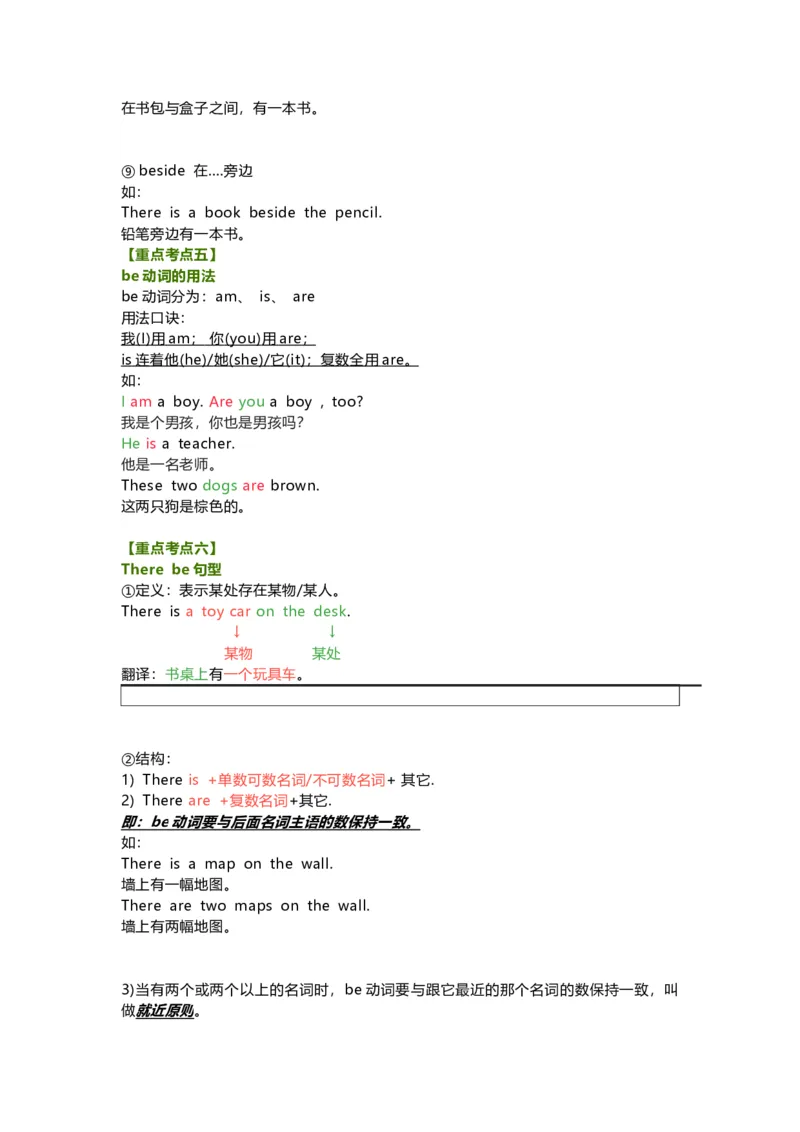
⑨beside 在....旁边
如:
There is a book beside the pencil.
铅笔旁边有一本书。
【重点考点五】
be动词的用法
be动词分为:am、 is、 are
用法口诀:
我 (I) 用 am ; 你 (you) 用 are ;
is 连着他 (he)/ 她 (she)/ 它 (it) ;复数全用 are 。
如:
I am a boy. Are you a boy , too?
我是个男孩,你也是男孩吗?
He is a teacher.
他是一名老师。
These two dogs are brown.
这两只狗是棕色的。
【重点考点六】
There be句型
①定义:表示某处存在某物/某人。
There is a toy car on the desk.
↓ ↓
某物 某处
翻译:书桌上有一个玩具车。
②结构:
1) There is +单数可数名词/不可数名词+ 其它.
2) There are +复数名词+其它.
即: be 动词要与后面名词主语的数保持一致。
如:
There is a map on the wall.
墙上有一幅地图。
There are two maps on the wall.
墙上有两幅地图。
3)当有两个或两个以上的名词时,be动词要与跟它最近的那个名词的数保持一致,叫
做就近原则 。如:
There are two boys and a girl under the tree.
(two boys 距离be动词最近)
树下有两个男孩和一个女孩。
There is a gir l and two boys under the tree.
(a girl 距离be动词最近)
树下有一个女孩和两个男孩。
③句型转换
1)变成否定句:在be动词后加上not即可。
如:
There is a bike behind the tree.→变否:There is not a bike behind the
tree.
缩写后变成:There isn't a bike behind the tree.
>肯定句中如果含有some,在变成否定句时,要把some变any
如:
There are some pictures on the wall.
→变否:There are not any pictures on the wall.
缩写后变成:There aren't any pictures on the wall.
2)变成一般疑问句:把be动词调整到句首,句号变问号。
There is a book in the bag .
→变疑:Is there a book in the bag ?
>但同时要注意:当肯定句中有some时,变为一般疑问句时,要将some变为any。
There are some books in the bag .
→变疑:Are there any books in the bag ?
3)特殊疑问句
1>对主语提问:当主语是人的时候,则用who 引导;
当主语是物的时候,则用what引导。
注意:无论原句的主语是单数还是复数,对之提问时一般都用 be的单数形式,回答时
却要根据实际情况来决定。
如:
My mother is in the room?(对划线部分提问)
→Who is in the room?There are some books on the desk.(对划线部分提问)
→What is on the desk?
2>对地点进行提问,则用where 引导。
如:
The computer is on the desk .(对划线部分提问)
→ Where is the computer?
3>对可数名词的数量进行提问,则用How many
如:
There are five people in the room.(对划线部分提问)
→ How many people are there in the room?
④ there be与have/has的用法区别
位子不同:
There be + 名词 + 其它
主语 + have/has + 其它 (has 用于 主语三单 )
试对比:
There are some apples in the box.
盒子里有一些苹果。
We have some apples.
我们有一些苹果。
There is a dog under the desk.
书桌下有一只狗。
My mother has a dog.
我妈妈有一只狗。
⑤have/has跟主语的搭配使用
其中,has用于主语三单,have用在主语非三单。
而have的第三人称单数形式是:has
第三人称单数,简称三单:(上表蓝色标记的5种三单情况,要记牢!)
例:
I have a book.
You have a book.
They have some books.
(主语I/You/They是非三单)
He has a book.
My mother has a book.
The cat has big eyes.
(主语He/My mother/The cat是三单)