2025 年长沙市初中学业水平考试试卷
英 语
注意事项:
1. 答题前,请考生先将自己的姓名、准考证号填写清楚,并认真核对条形码上的姓名、
准考证号、考室和座位号;
2. 必须在答题卡上答题,在草稿纸、试题卷上答题无效;
3. 答题时,请考生注意各大题题号后面的答题提示;
4. 请勿折叠答题卡,保持字体工整、笔迹清晰、卡面清洁;
5. 答题卡上不得使用涂改液、涂改胶和贴纸;
6. 本学科试卷中听力材料以中速朗读两遍。
试卷分为四个部分,共8页,61小题,时量100分钟,满分100分。
第一部分 听力(共两节,满分20分)
第一节(共5小题;每小题1分,满分5分)
听下面5段对话。每段对话后有一个小题,从题中所给的 A、B、C三个选项中选出最
佳选项。听完每段对话后,你都有10秒钟的时间来回答有关小题和阅读下一小题。每
段对话读两遍。
1. What is the girl’s favorite food?
A. Salad. B. Beef noodles. C. Hamburgers.
2. What subject is Sam crazy about?
A. Art. B. Science. C. Math.
3. What is the matter with David?
A. He has a fever. B. He has a toothache. C. He has a headache.
4. Where is Mr. Zhang now?
A. In the classroom. B. In the meeting room. C. In the computer room.
5. How is the weather today?
A. Sunny. B. Rainy. C. Snowy.
第二节(共15小题;每小题1分,满分15分)
听下面6段对话或独白。每段对话或独白后有几个小题,从题中所给的 A、B、C三个
选项中选出最佳选项。听每段对话或独白前,你将有时间阅读各个小题,每小题 5秒钟;
听完后,各小题将给出5秒钟的作答时间。每段对话或独白读两遍。
听第六段材料,回答第6、7题。
6. What did Sophia do on Saturday evening?
A. She went to a concert. B. She visited a friend. C. She watched a movie.
7. Who takes a great interest in music?
A. Sophia. B. Sophia’s husband. C. Robert.
听第七段材料,回答第8、9题。
8. How does Steve feel about his training?
A. Boring. B. So-so. C. Great.9. When does Steve start training every day?
A. At 7:00 a.m. B. At 8:00 a.m. C. At 9:00 a.m.
听第八段材料,回答第10、11题。
10. Why does the man make the call?
.
A To book a table. B. To look for a job. C. To ask for leave.
11. What is the man’s name?
A. Brown. B. Anderson. C. Howard.
听第九段材料,回答第12至14题 。
12. What is the new product?
A. A pocket translator. B. A music player. C. A medical dictionary.
13. Who are the main customers of the product?
A. College students. B. Language teachers. C. Business people.
14. How much is the new product?
A. $50. B. $60. C. $70.
听第十段材料,回答第15至17题。
15. How does Jane like the Australian man’s words?
A. Serious. B. Funny. C. Polite.
16. What was the Australian man’s job when he was in China?
A. A car salesman. B. A tour guide. C. An English teacher.
17. What does the Australian man miss the most?
A. His friends. B. Chinese food. C. The supermarkets.
听第十一段材料,回答第18至20题。
18. Where is Roombot 2000 made?
A. In China. B. In India. C. In Russia.
19. What can Roombot 2000 do according to the speaker?
A. Cook meals. B. Make the bed. C. Water flowers.
20. What does the speaker think of Roombot 2000?
A. Time-wasting. B. Money-saving. C. User-friendly.
第二部分 阅读(共两节,满分30分)
第一节(共10小题;每小题2分,满分20分)
阅读下列材料,从每题所给的A、B、C三个选项中选出最佳选项。
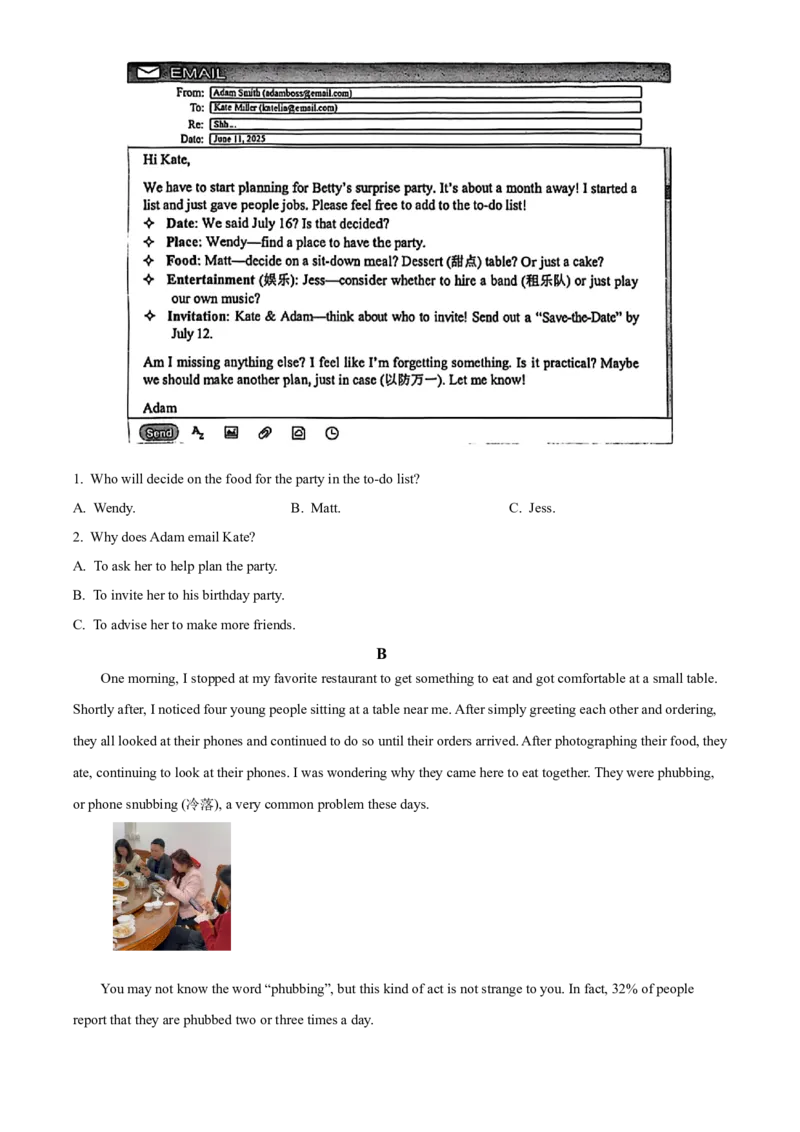
A1. Who will decide on the food for the party in the to-do list?
A. Wendy. B. Matt. C. Jess.
2. Why does Adam email Kate?
A. To ask her to help plan the party.
B. To invite her to his birthday party.
C. To advise her to make more friends.
B
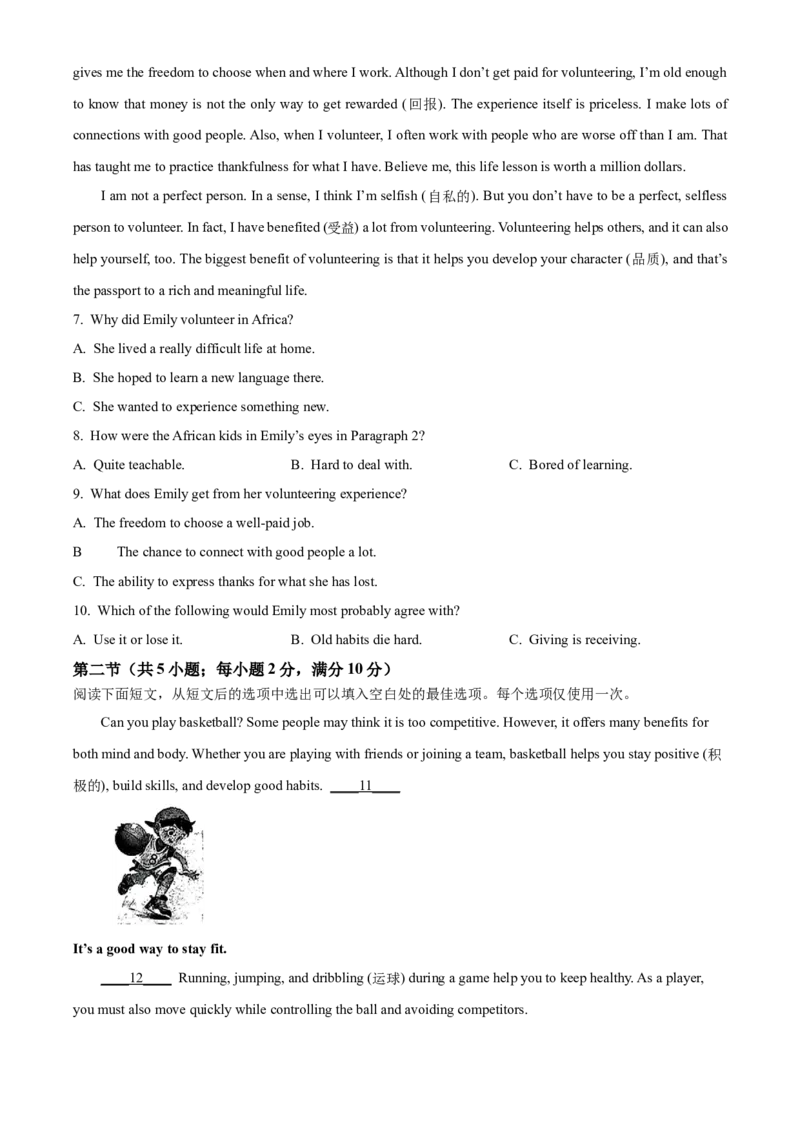
One morning, I stopped at my favorite restaurant to get something to eat and got comfortable at a small table.
Shortly after, I noticed four young people sitting at a table near me. After simply greeting each other and ordering,
they all looked at their phones and continued to do so until their orders arrived. After photographing their food, they
ate, continuing to look at their phones. I was wondering why they came here to eat together. They were phubbing,
or phone snubbing (冷落), a very common problem these days.
You may not know the word “phubbing”, but this kind of act is not strange to you. In fact, 32% of people
report that they are phubbed two or three times a day.Do you have a conversation on your phone while talking to another person face to face? Do you scroll (上下
滑动) through your phone while eating with someone for fear of missing out? If your answer is yes to either of
them, you might be a “phubber”.
The writer of The Psychology of Phubbing did a survey and found that the influence of phubbing on
relationships can be very harmful or destructive. For example, children felt that parents who phubbed them didn’t
care about them. This led to a feeling of being left out. Also, partners who were phubbed might be less satisfied
with the relationship because of jealousy (嫉妒) and worries.
Phubbing is a learned act, so unlearning it is possible. Start by accepting the problem. Set a time limit (限制)
for not using your phone. Create areas where phones are off-limits.
Don’t let the modern technology which is designed (设计) to bring people together separate you from others.
3. What did the four young people keep doing before their orders arrived?
A. Greeting each other. B. Looking at their phones. C. Photographing their food.
4. How does the writer introduce the word “phubber” in Paragraph 3?
A. By raising questions. B. By listing numbers. C. By giving reasons.
.
5 What does the underlined word “destructive” in Paragraph 4 mean?
A. 微乎其微的 B. 积极正向的 C. 有破坏性的
6. What is the main purpose of the text?
A. To warn people against phubbing.
B. To show how phones bring people closer.
C. To present the advantages of modern technology.
C
I used to teach English as a volunteer in Africa. Some of my friends asked me, “Don’t you miss your home,
Emily?” I told them I was the only child in my family and I truly had an easy life at home. However, I got bored of
having a “good” time at home and needed a change.
The kids from Africa were eager (渴望的) to learn and easy to teach. I was surprised at how smart they were.
Talking with them made me think a lot. When you come from a poor area, you must grow up fast and deal with all
kinds of difficult situations.
Volunteering has always been easy for me because I don’t like to do the same things every day. My job alsogives me the freedom to choose when and where I work. Although I don’t get paid for volunteering, I’m old enough
to know that money is not the only way to get rewarded (回报). The experience itself is priceless. I make lots of
connections with good people. Also, when I volunteer, I often work with people who are worse off than I am. That
has taught me to practice thankfulness for what I have. Believe me, this life lesson is worth a million dollars.
I am not a perfect person. In a sense, I think I’m selfish (自私的). But you don’t have to be a perfect, selfless
person to volunteer. In fact, I have benefited (受益) a lot from volunteering. Volunteering helps others, and it can also
help yourself, too. The biggest benefit of volunteering is that it helps you develop your character (品质), and that’s
the passport to a rich and meaningful life.
7. Why did Emily volunteer in Africa?
A. She lived a really difficult life at home.
B. She hoped to learn a new language there.
C. She wanted to experience something new.
8. How were the African kids in Emily’s eyes in Paragraph 2?
A. Quite teachable. B. Hard to deal with. C. Bored of learning.
9. What does Emily get from her volunteering experience?
A. The freedom to choose a well-paid job.
.
B The chance to connect with good people a lot.
C. The ability to express thanks for what she has lost.
10. Which of the following would Emily most probably agree with?
A. Use it or lose it. B. Old habits die hard. C. Giving is receiving.
第二节(共5小题;每小题2分,满分10分)
阅读下面短文,从短文后的选项中选出可以填入空白处的最佳选项。每个选项仅使用一次。
Can you play basketball? Some people may think it is too competitive. However, it offers many benefits for
both mind and body. Whether you are playing with friends or joining a team, basketball helps you stay positive (积
极的), build skills, and develop good habits. ____11____
It’s a good way to stay fit.
____12____ Running, jumping, and dribbling (运球) during a game help you to keep healthy. As a player,
you must also move quickly while controlling the ball and avoiding competitors.It’s a team sport.
Teamwork is the key. ____13____ You have to trust and support each other during matches. Pass the ball
when someone is in a better position (位置). Each member has to do their part to help the team win. Remember, no
one can win alone.
____14____
The speedy nature of the game requires focus (专注) and quick decision-making. New difficulties always
appear during a game. You have to think on your feet and keep cool in all situations. So you need to think of ways
to face and overcome difficulties. And that helps you solve problems in your daily life.
It improves communication.
Stay connected with your teammates during matches. If you have a winning idea, tell your teammates!
____15____ Communication is an important part of basketball. The winning team is the one that works together
and communicates well.
Basketball isn’t all about athletic (运动的) ability. The game is also about using your brains and good
teamwork. So call your friends and give it a try!
A. It teaches problem-solving.
B. Basketball is not a one-person game.
C. Basketball is a great way to improve physical health.
D. If you need someone to cover you, tell them that, too.
E. Here are some key advantages of playing this exciting game.
第三部分 语言运用(共两节,满分25分)
第一节(共10小题;每小题1.5分,满分15分)
阅读下面短文,从每题所给的A、B、C三个选项中选出可以填入空白处的最佳选项。
When Liivand was little, she was often sick. To get stronger, she ____16____ swimming. Soon after,
she was taking part in open-water swimming competitions, sometimes even in icy water.
Several years ago, Liivand moved to Florida, but she continued to ____17____ in the sea. One day
during her training, she almost swallowed (吞) some plastic (塑料) waste in the sea.
That experience made Liivand think of all the sea animals. These animals face ____18____ problems
every day like her. So she decided to do something to raise people’s awareness (意识) of ____19____
pollution. Thinking about sea animals gave Liivand the idea of swimming like a sea animal. Instead of using
her arms, she ____20____ swimming with a rubbery fin (橡胶脚蹼) on her feet and swam forward by
kicking her legs together. She believed that swimming with a rubbery fin would send “a bigger message”.
Liivand first set the world record for swimming with a rubbery fin in 2019. She swam 10 kilometers offthe coast of California. In 2021, she broke the ____21____ by swimming 30 kilometers, this time in Miami,
Florida. But Liivand believed she could go ____22____. Every day, she got up at 4:00 a.m., put on her fin
and went swimming. To improve her strength (力量), she sometimes even pulled other people in the water.
On May 7, 2022, Liivand managed to break her record again. ____23____, she swam 42.2 kilometers.
It took her nearly 12 hours. Along the way, the woman collected all the ____24____ she found and put it in
the small boat that was following her. Finally, the small boat held three full bags of rubbish. “Breaking a
record means a lot to me, but being ____25____ to help the community and the world means much more,”
Liivand said.
16. A. took up B. put off C. gave up
17. A. fish B. swim C. boat
18. A. similar B. different C. opposite
19. A. air B. sound C. plastic
20. A. stopped B. started C. regretted
21. A. leg B. rule C. record
.
22 A. farther B. slower C. higher
23. A. Unluckily B. Unbelievably C. Uncertainly
24. A. ice B. oil C. rubbish
25. A. warm-hearted B. cold-blooded C. weak-kneed
第二节(共10小题;每小题1分,满分10分)
阅读下面短文,在空白处填入1个适当的单词或括号内单词的正确形式。
I have always loved reading books that were written hundreds or even thousands of years ago. These are the
literature classics (文学经典), and they ____26____ (be) of lasting value. For example, The Iliad, written almost
three thousand years ago, tells us about the good and bad qualities (品质) of human nature; that is to say, we can be
heroic and silly at ____27____ same time.
China has ____28____ (it) own long history of classical literature that dates back to the “Four Books and
Five Classics”. These books ____29____ (write) before the Qin Dynasty. No one was considered educated unless
they had read these classics. Even today, students are encouraged ____30____ (read) The Analects of Confucius(《论语》).
There are also ____31____ (new) classics than those above, such as Journey to the West and A Dream of
Red Mansions. Still, many people don’t want to read them ____32____ they are long and have complex plots (复
杂的情节). But they are great ____33____ (story) which also show the goodness and weakness of human nature.
Are you interested ____34____ learning more about the classics? Just reading some of them will give you a
better understanding of the basis (基础) of culture then. They will also help you better understand yourself and
others. ____35____ (slow) but surely, you will fall in love with them.
第四部分 读写综合(共两节,满分25分)
第一节
阅读下面短文,根据短文内容回答问题。
One recent weekend, I decided to learn how to make jiaozi with my grandmother. I thought it would be fun
and easy at the very beginning, but soon it came to me that it wasn’t as simple as it looked.
At first, I didn’t pay attention to the sharp (锋利的) knife while cutting vegetables. My finger got cut because
of my carelessness. Luckily, it wasn’t serious. Grandma was nervous, and quickly helped me clean the cut. “My poor
little girl! Be careful next time!” said Grandma softly. Through the painful lesson, I learned the hard way that safety
should always come first.
After that accident (意外), I continued working with Grandma. We made the dough (面团), mixed the filling,
and started shaping the dumplings. However, I kept making mistakes. Some of my dumplings were too thick, others
were not properly sealed (封闭), and some even had too much filling, making them difficult to close. It was so
discouraging, but Grandma kept encouraging me.
Until noon, we had a plate full of dumplings—some are perfect, and some are a bit messy. Dad ate my ugliest
dumpling first. “Tastes better than it looks!” he laughed. Mom encouraged me, “They’re the most delicious dumplings I
have ever had. I am so proud of you!”
Now I understand that making jiaozi isn’t just about the final product; it is about learning patience, having fun with
my family, and improving through mistakes. Mistakes aren’t signs of weakness. Instead, they should be viewed (看
待) as stepping stones to achievements.36. What did the writer think of making jiaozi at the very beginning?
________________________________________
37. What happened to the writer’s finger because of her carelessness?
________________________________________
38. Did the writer give up making jiaozi after the accident?
________________________________________
39. How do Mom’s words sound?
________________________________________
40. What does the writer view mistakes as?
________________________________________
第二节
根据要求完成短文写作。
41. 学校英文报正在开展以“Mistakes—steps towards success”为题的讨论。请你根据以下提示,并结合自身
感悟,写一篇英语短文投稿。
要求:(1)短文必须包含所有提示信息,并适当发挥;
(2)80词左右(标题和开头都已给出,不计入总词数);
(3)文中不得出现真实人名和校名。
Mistakes—steps towards success
Mistakes are a part of life. Instead of fearing them, we should see them as chances to grow.
____________________________________________________________________________________________
____________________________________________________________________________________________
____________________________________________________________________________________________
____________________________________________________________________________________________
____________________________________________________________________________________________
__________________________________________________________________________________________________________________________________________________________________________________